Blog Archives
People We Meet on Vacation (2026)
 I’ll readily confess, I enjoy a good romantic comedy. I’ve even written a few rom-com Web series. Who doesn’t want to be captivated by charming characters, witty, banter,, and a yearning for a romantic coupling? The Sony-by-way-of-Netflix-acquisition People We Meet on Vacation is based on popular author Emily Henry’s 2021 breakthrough novel of the same name. I was expecting lots of fizz and frivolity, which can be had in doses, but I think the adaptation makes a few key mistakes that hampered my rom-com good time vibes. People We Meet on Vacation is not whom I was expecting, and maybe that’s me being too demanding, or maybe my travel companions made me think about switching seats.
I’ll dispense with the exact plot details further into this review, but the story in general is thus: Girl and Guy are friends but maybe also secretly like each other but also sometimes have other people, boyfriends.girlfriends, that they’re supposed to like more instead. Eventually, they grapple with these confusing feelings while also visiting global tourist destinations as “platonic vacation buddies.”
 First, I didn’t buy the main characters as close friends. We’re introduced to them as they travel home to small-town Ohio together for the holidays from their freshmen year at Boston College, and they’re immediately bickering and annoying and can’t stand one another. The film is following a friends-to-lovers path, but I guess at first it decided to become an enemies-to-friends storyline. Even as the animosity thaws, I never really bought what compelled these characters to be best friends, so much so that they make a plan to make a trip every summer across the world together (the disposable income these newly indebted college grads have access to blows my mind; he’s a teacher!). The premise is workable, and as you would expect there are feelings that begin to get messy over the years of vacation, but I never felt the core friendship, so whether or not they ruined it with a burgeoning romance never felt like a credible threat for me. What is there to ruin exactly? We’re jumping from vacation to vacation summers apart, the gaps are meant to serve as storytelling glue; we’re meant to just assume, “Oh, they became good friends,” without seeing it for ourselves. I think this misstep could have been avoided simply by making the two of them less acrimonious in their earliest introduction. Make the friendship credible, and even better, make me like them together and see that they bring out other sides in one another that others fail to elicit.
This could also be a factor of my second misstep, namely the casting. I did not feel a flicker of chemistry between Emily Bader (My Lady Jane) and Tom Blythe (young sexy Snow in 2023 Hunger Games prequel), and I think it’s mostly the guy’s fault. I was getting 2011 Oscar hosting flashbacks. Here me out, dear reader. In 2011, Anne Hathaway and James Franco were hired as hosts to have the awards show appeal to a younger demographic (begin knowing laughter). Franco’s energy was so low that critics joked he might have been stoned the whole time. As a result, Hathaway had to overcompensate for his dearth of charisma and energy and was stuck doing far too much. In People We Meet on Vacation, our female lead, Poppy, is a chatterbox extrovert, and our male lead, Alex, is a sullen introverted homebody. Naturally, opposite personality dynamics can make for engaging relationships, but the work needs to be careful. I found Alex to be a bore. The most he gets pushed out of his comfort zone is by skinny dipping and, separately, pretending to be on a honeymoon for free drinks. That’s it. That’s Mr. Wild on Vacation (more on that next). Most of the time he’s just converting oxygen to carbon dioxide on screen. As a result, Bader has to go above and beyond, talking circles around her taciturn scene partner and bowling him over with personality, so much so that her outsized personality begins to flirt from charming to dangerously annoying. The misaligned character dynamics and characterization form a ceiling of my engagement.
 Thirdly, I was expecting more of a flirty freedom from the premise. Poppy works as a travel writer and fantasizes about being someone completely new on vacation. With that concept, you would assume the story would explore that dichotomy, the woman who uses these trips to reinvent herself, try on different versions of herself that can be dramatically different, adopting new personas and exploring aspects of herself that she didn’t feel comfortable embracing as regular ole Poppy. This seems like the most obvious direction to take the story with a title like People We Meet on Vacation (the new people we meet are… ourselves). Astonishingly, the movie is not that. There is only one instance of Poppy and Alex leaning into the freedom afforded to them through their vacations to pretend to be different people. While in New Orleans, they pretend to be newlyweds and this grants them free drinks, and this new persona gets Alex to dance provocatively; he even does The Worm. Does this different version of Alex lead to anything more? No. It would make sense with all their free drinks for this to be the moment that Alex and Poppy get even closer, imitating newlyweds, and cross a line of their friendship. Does this happen? No. That’s a whole other international vacation where the characters aren’t pretending to be other people. We can break this down on an even smaller level. Maybe the characters have events in these vacations that push them out of their comfort zones and challenge them in ways that change them as people, like discovering an aspect of themselves they hadn’t given thought to before. If you’re going to Tuscany, do something that’s unique to Tuscany. Do something that matters. It never feels like the travel is actually making an impact on these two characters. Rather, the vistas change but the focus is always on their will they-won’t they, which isn’t dependent on their setting. They could have just gone down the block for the same results. At 118 minutes long, some of these various vacations might have been consolidated if they are so inconsequential.
Lastly, when the movie isn’t separating itself from the pack by embracing its unique story elements, it falls back on the familiar cliches of the genre. I’m talking stuff that even a layman to rom-coms would even know, things like the big kiss in the rain, the big Act Three dash, usually out of an airport. It’s stuff like that, and cliches by themselves are not inherently bad but they have to feel authentic to the characters and stories. It might be a cliche to simply say that you need to make the cliches your own. If I genuinely cared about the characters, and felt their chemistry, then I wouldn’t be nitpicking and noticing the cliches as much. It just so happens that a shaky adaptation can make reliance on genre cliches more noticeable.
 Now, I know the majority of this review has been critical of People We Meet on Vacation, and that’s mostly because I think this movie could have been better from some pretty obvious missteps. The version of People We Meet on Vacation is… fine. It’s consistently cute and amusing and harmless, an afternoon movie that can pass the time well enough especially for those predisposed to romantic comedies. It’s a fairly good-looking movie with an impressive war-chest for music licenses, including Ms. Taylor Swift. My middling frustrations with the movie seem to be echoed by many of Henry’s fans, that whatever made this story special seems to have been emptied, replaced with cozy genre cliches. I liked the ending, cliches and all, because it felt fitting for those characters, their different dynamic, and felt it had been sufficiently set up to serve as a payoff. I wanted more moments like this, that felt unique to this story, to these characters, and actually made use of their specific settings. No other characters in this movie matter other than our leads, so it’s a shame that I didn’t feel particularly excited for their eventual coupling. I didn’t find their characters repellent or mean-spirited, just ordinary, lacking a distinct personality. They were blandly likeable but the kind of people you’d meet and forget easily, vacation or no. People We Meet on Vacation is an agreeable movie that had the possibility for more, and that’s what lingers longest for me.
Nate’s Grade: C+
Share this:

The Rip (2026)
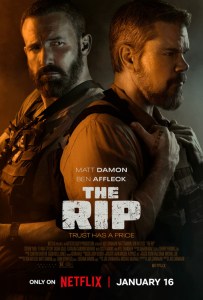
Director Joe Carnahan (The A-Team, Narc) excels at machismo, and I mean that not as a detriment. He makes muscular action-thrillers, often about corrupted men coming to terms with their ruination. 2012’s The Grey is still one of the best movies I’ve ever seen released in January. Well here comes The Rip, also released in January, starring Matt Damon and Ben Affleck as combustible Miami cops who follow a tip to a cartel stash house that holds a cache of twenty million dollars. The cops are supposed to follow protocol, call it into their superiors, but with that kind of money, much more than what the tip reported, it’s hard to resist the life-altering implications of indulging in that kind of haul. I thought The Rip, named after the seizure of contraband, was going to be a modern-day Treasure of the Sierra Madre, where the power of greed is irresistible and leads to betrayals and murder among our characters. It does that, with each questionable decision going against protocol making us question who might be most susceptible and who might be heading for a collision. The movie, co-written by Carnahan, is strictly genre boilerplate. The characters are never more than archetypes, the dialogue is aggressively expository often reminding us of all the conflicts and characters on the periphery that haven’t been brought back yet, and the majority of the film is a contained thriller awaiting trouble at the stash house. And yet I was entertained from start to finish thanks to the cast and a simmering tension that Carnahan unleashes between his paranoid characters. There are some late plot turns that I don’t know if they’re actually clever, convoluted, or both. It’s the kind of thing that’s meant to excuse bizarre behavior that we’d have no reason to assume differently, so it feels a little bit like being jerked around. However, The Rip is a fairly fun way to blow through two hours built upon movie stars unleashing their swagger.
Nate’s Grade: B-
Share this:

Wake Up Dead Man (2025)
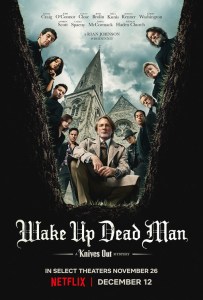 Being the third in its franchise, we now have a familiar idea of what to expect from a Knives Out murder mystery. Writer/director Rian Johnson has a clear love for the whodunit mystery genre but he loves even more turning the genre on its head, finding something new in a staid and traditional style of storytelling. The original 2019 hit movie let us in on the “murderer” early, and it became more of a game of out-thinking the world-class detective, Benoit Blanc (Daniel Craig). With the 2022 sequel Glass Onion, the first of Netflix’s two commissioned sequels for a whopping $400 million, Johnson reinvented the unexpected twin trope and let us investigate a den of tech bro vipers with added juicy dramatic irony. With his latest, Wake Up Dead Man, Johnson is trying something thematically different. Rather than adding a meta twist to ages-old detective tropes, Johnson is putting his film’s emphasis on building out the themes of faith. This is a movie more interested in the questions and value of faith in our modern world. It still has its canny charms and surprises, including some wonderfully daffy physical humor, but Wake Up Dead Man is the most serious and soul-searching of the trilogy thus far, and a movie that hit me where it counts.
In upstate New York, Pastor Jud (Josh O’Connor) has been assigned to a church to help the domineering Jefferson Wicks (Josh Brolin). The congregation is dwindling with the exception of a few diehards holding onto Wicks’ message of exclusion and division. The two pastors are ideologically in opposition, with Pastor Jud favoring a more nurturing and welcoming approach for the Christian church. Then after one fiery sermon, Wicks retires to an antechamber and winds up dead, with the primary suspect with the most motivation being Pastor Jud. Enter famous detective extraordinaire Benoit Blanc to solve the riddle.
 I appreciated how the movie is also an examination on the different voices fighting for control of the direction of the larger Christian church. Wicks is your traditional fire-and-brimstone preacher, a man who sees the world as a nightmarish carnival of temptations waiting to drag down souls. He sees faith as a cudgel against the horrors of the world, and for him the church is about banding together and fighting against those outside forces no matter how few of you remain to uphold the crusade. Pastor Jud rejects this worldview, arguing that if you think of the church as a pugilist in a battle then you’ll start seeing enemies and fights to come to all places. He’s a man desperate to escape his violent past and to see the church as a resource of peace and resolution but Wicks lusts for the fight and the sense of superiority granted by his position. He relishes imposing his wrath onto others, and his small posse of his most true believers consider themselves hallowed because they’re on the inside of a special club. For Pastor Jud, he’s rejecting hatred in his heart and looks at the teachings of Jesus as an act of love and empathy. It’s not meant to draw lines and exclude but to make connections. These two philosophical differences are in direct conflict for the first half of the movie, one viewing the church as an open hand and the other as a fist. It’s not hard to see where Johnson casts his lot since Pastor Jud is our main character, after all. I also appreciated the satirical tweaks of the church’s connections to dubious conservative political dogma, like Wicks’ disciples trying to convince themselves the church needs a bully of its own to settle scores (“What is truth anyway?” one incredulously asks after some upsetting news about their patriarch). It’s not hard to make a small leap to the self-serving rationalizations of supporting a brazenly ungodly figure like Trump. At its core, this movie is about people wrestling with big ideas, and Johnson has the interest to provide space for these ideas and themes while also keeping his whodunit running along pace-for-pace.
There is a moment of clarification that is so sudden, so unexpectedly beautiful that it literally had me welling up in tears and dumbstruck at Johnson’s capabilities as a precise storyteller. It’s late into Act Two, and Blanc and Pastor Jud are in the thick of trying to gather all the evidence they can and chase down those leads to come to a conclusive answer as to how Pastor Jud is innocent. The scene begins with Pastor Jud talking on the phone trying to ascertain when a forklift order was placed. The woman on the other side of the line, Louise (Bridget Everett, Somebody Somewhere), is a chatty woman who is talking in circles rather than getting to the point, delaying the retrieval of desired information and causing nervous agitation for Pastor Jud. It’s a familiar comedy scenario of a person being denied what they want and getting frustrated from the oblivious individual causing that annoying delay. Then, all of a sudden, as the frustration is reaching a breaking point, she quietly asks if she can ask Pastor Jud a personal question. This takes him off guard but he accepts, and from there she becomes so much more of a real person, not just an annoyance over the phone. She mentions her parent has cancer and is in a bad way and she’s unsure how to repair their relationship while they still have such precious time left. The movie goes still and lingers, giving this woman and her heartfelt vulnerability the floor, and Pastor Jud reverts back to those instincts to serve. He goes into another room to provide her privacy and counsels her, leading her in a prayer.
 The entire scene is magnificent and serves two purposes. This refocuses Pastor Jud on what is most important, not chasing this shaggy investigation with his new buddy Blanc but being a shepherd to others. It re-calibrates the character’s priorities and perspective. It also, subtlety, does the same for the audience. The wacky whodunit nature of the locked-door mystery is intended as the draw, the game of determining who and when are responsible for this latest murder. It’s the appeal of these kinds of movies, and yet, Johnson is also re-calibrating our priorities to better align with Pastor Jud. Because ultimately the circumstances of the case will be uncovered, as well as the who or whom’s responsible, and you’ll get your answers, but will they be just as important once you have them? Or will the themes under-girding this whole movie be the real takeaway, the real emotionally potent memory of the film? As a mystery, Wake Up Dead Man is probably dead-last, no pun intended, in the Knives Out franchise, but each movie is trying to do something radical. With this third film, it’s less focused on the twists and turns of its mystery and its secrets. It’s more focused on the challenging nature of faith as well as the empathetic power that it can afford others when they choose to be vulnerable and open.
Blanc doesn’t even show up for the first forty or so minutes, giving the narration duties to Pastor Jud setting the scene of his own. Craig (Queer) is a bit more subdued in this movie, both given the thematic nature of it as well as ceding the spotlight to his co-star. Blanc is meant to be the more stubborn realist of the picture, an atheist who views organized religion as exploitative claptrap (he seems the kind of guy who says “malarkey” regularly). His character’s journey isn’t about becoming a true believer by the end. It’s about recognizing and accepting how faith can affect others for good, specifically the need for redemption. Minor spoilers ahead. His final grand moment, the sermonizing we expect from our Great Detectives when they finally line up all the suspects and clues and knock them down in a rousing monologue, is cast aside, as Blanc recognizes his own ego could be willfully harmful and in direct opposition to Pastor Jud’s mission. It’s a performance that asks more of Craig than to mug for the camera and escape the molasses pit of his cartoonish Southern drawl. He’s still effortlessly enjoyable in the role, and may he continue this series forever, but Wake Up Dead Man proves he’s also just as enjoyable as the second banana in a story.
 O’Connor (Challengers, The Crown) is our lead and what a terrific performance he delivers. The character is exactly who you would want a pastor to be: humble, empathetic, honest, and striving to do better. It’s perhaps a little too cute to call O’Connor’s performance “soulful” but I kept coming back to that word because this character is such a vital beating heart for others, so hopeful to make an impact. It’s wrapped up in his own hopes of turning his life around, turning his personal tragedy into meaning, devoting himself to others as a means of repentance. He’s a man in over his head but he’s also an easy underdog to root for, just like Ana de Armas’ character was in the original Knives Out. You want this man to persevere because he has a good moral center and because our world could use more characters like this. O’Connor has such a brimming sense of earnestness throughout that doesn’t grow maudlin thanks to Johnson’s deft touch and mature exploration of his themes. O’Connor is such a winning presence, and when he’s teamed with Blanc, the two form an enjoyable buddy comedy, each getting caught up in the other’s enthusiasm.
Johnson has assembled yet another all-star collection of actors eager to have fun in his genre retooling. Some of these roles are a little more thankless than others (Sorry Mila Kunis and Thomas Haden Church, but it was nice of you to come down and play dress-up with the rest of the cast). The clear standout is Glenn Close (Hillbilly Elegy) as Martha, the real glue behind Wicks’ church as well as an ardent supporter of his worldview of the damned and the righteous. She has a poignant character arc coming to terms with how poisonous that divisive, holier-than-thou perspective can be. Close is fantastic and really funny at certain parts, giving Martha an otherworldly presence as a woman always within earshot. Brolin (Weapons) is equally fun as the pugnacious Wicks, a man given to hypocrisy but also resentful of others who would reduce his position of influence. The issue with Wake Up Dead Man is that elevating Pastor Jud to co-star level only leaves so much room for others, and so the suspect list is under-served, arguably wasted, especially Andrew Scott (All of Us Strangers) as a red-pilled sci-fi writer looking for a comeback. The best of the bunch is Daryl McCormack (Good Luck to You, Leo Grande) as a conniving wannabe in Republican politics trying to position himself for a pricey media platform and Cailee Spaeny (Alien: Romulus) as a cellist who suffers from deliberating pain and was desperate for a miracle delivered by Wicks. He’s the least genuine person, she’s hoping for miraculous acts, and both will be disappointed from what they seek.
Wake Up Dead Man (no comma in that title, so no direct command intended) is an equally fun movie with silly jokes and a reverent exploration of the power of faith and its positive impact, not even from a formal religious standpoint but in the simple act of connecting to another human being in need. This is the richest thematically of the three Knives Out movies but it also might be the weakest of the mysteries. The particulars of the case just aren’t as clever or as engaging as the others, but then again not every Agatha Christie mystery novel could be an absolute all-time ripper. That’s why the movie’s subtle shifts toward its themes and character arcs as being more important is the right track, and it makes for a more emotionally resonant and reflective experience, one that has replay value even after you know the exact particulars of the case. If you’re a fan of the Knives Out series, there should be enough here to keep you enraptured for more. Because of that added thematic richness, Wake Up Dead Man has an argument as the best sequel (yet).
Nate’s Grade: A-
Share this:

Train Dreams (2025)
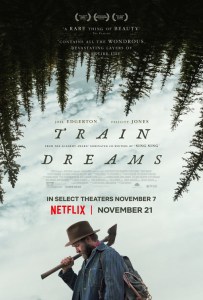 What a superb, tender, and deeply humanistic portrayal of life through the eyes of one man, Robert Granier (Joel Edgerton), a logger in Idaho in the early twentieth century. His life isn’t too different from the lives of many. He wants to spend more time with his wife (Felicity Jones) and child, less time away for months on end for logging, and he has difficulty making friends in his profession of hard work and inherent transience. He feels more connection to the natural world, of which he is felling one tree at a time. The nature of the script, adapted from the 2011 novella by author Denis Johnson, is episodic, people coming in and out of this man’s personal life. The narrative feels like a collection of memories, jumping back and forth in time, connected by ideas and imagery like we do in our minds, and providing a sum total for a life lived. There’s an inherent solemnity and awe to the movie, whether it’s about the transcendence of man’s place in the world, the march of progress, or merely the pull of tragedy and love that seeps into our core being. There is a personal tragedy that defines Robert, and it is devastating to experience and process with him. Director/co-writer Clint Bentley (one half of the same creative team behind last year’s Sing Sing, one of the best movies of 2024) uses this character to represent the totality of the human experience, making the movie feel deeply felt and empathetic even decades removed from its subject. That’s because logging isn’t the movie. It’s about the people, places, and experiences that define us. William H. Macy hasn’t been this good in years. You give me a wise, elegiac narrator in the spirit of Assassination of Jesse James by the Coward Robert Ford, with such pristine details readily supplied, and I’m already a sucker for your movie. The only thing holding back Train Dreams for me was that post-tragedy doesn’t get the attention I think it deserves. You’d expect the second half of the movie would be the process of grieving and coming to terms, and in essence it is, but the movie is far less direct about its processing, which I felt was a minor misstep for an overall great movie.
Nate’’s Grade: A-
Share this:

Frankenstein (2025)
 One of the reasons Mary Shelley’s novel Frankenstein has been so richly relevant two hundred years later is because of her thought-provoking themes and concepts, which still prove potent with each new malleable reinterpretation from the newest creative caretaker. It’s the “be careful what you wish for” adage combined with man’s hubris and our self-destructive impulses to play with things we don’t fully understand. It’s also a monster story that asks us to reconsider the perception of who the monster may truly be, and under writer/director Guillermo del Toro, the answer is always and forever man himself. This isn’t a surprise from the same filmmaker who gave us Hellboy and The Shape of Water. The man identifies with the monsters more than other people. The man turned his astounding stop-motion animated Pinocchio movie into a deft Frankenstein allegory, so the famous story has been on his mind for quite some time. It’s been an obvious influence, and now that he’s gotten his chance on his own imprint, it’s hard not to see elements of del Toro’s other movies everywhere. It creates this bizarre echo chamber of creative influence where the movie can feel derivative at times even though the source material was an influence on those other del Toro works. It’s just the nature of finally tackling the influence later in his career. It reminds me of 2012’s John Carter, based on Edgar Rice Burroughs’ highly influential sci-fi series, and yet because it took 100 years to leap to the big screen, it couldn’t help but seem derivative of the same popular movies that were inspired by it. This is a convoluted way of saying del Toro’s Frankenstein is a much better Guillermo del Toro movie than a Frankenstein adaptation.
You probably know the story well enough to recite it yourself. Victor Frankenstein (Oscar Isaac) is obsessed with conquering death after his own mother’s demise in childbirth. He gathers the parts of criminals and dead soldiers to reanimate into a new being, a Creature (Jacob Elordi) of superhuman strength and regeneration who cannot die. Victor’s cruelty punishes the Creature and disowns it, setting the stage for a showdown between dysfunctional father and son and the havoc caused by recklessly playing God.
 There are deliberate decisions that mitigate some of the more compelling characterization of the novel. With del Toro’s version, Victor is the clear-cut villain. There’s some setup given to his strict childhood where his domineering father (Charles Dance) would quiz him and physically abuse Victor if he failed to recite the correct answers to his medical questions. Dear bad dad was doing this, you see, out of a belief that good doctors need to know intuitively because any hesitation could cost lives. When we witness Victor abusing the Creature in the same manner, we’re meant to see the connection between abusive fathers confusing disappointment with defiance. In the original story, Victor abandons the Creature on the night of its birth and then it’s gone. In this version, Victor imprisons the Creature, keeps him chained, attempts to train him, grows frustrated, and then tries to destroy the evidence. That’s a little more diabolical than simple morning-after regrets. This Victor can also be viewed as a forefather of incels the way he projects his romantic feelings onto Elizabeth (Mia Goth) and then gets huffy when she doesn’t return them. There are other deaths later in the story that are directly attributed to the Creature that are now Victor’s doing, which continues to squeeze out moral ambiguity from Shelley’s novel. If the Creature is purely innocent and Victor is purely villainous, that makes the relationship between father and son, Creator and Creature, far less meaningful and layered. It’s so obvious that another character, in their literal dying words, says to Victor, “You are the real monster.” It all becomes an ongoing cycle of bad fathers and the Creature ultimately trying to reach forgiveness. Even if the Creature ultimately finds that, is this Victor even worthy of redemption?
Another significant feature of del Toro’s retelling is, how do I put this delicately, the inherent magnetism of the Creature, a.k.a. Sexy Frankenstein. Elordi (Saltburn) is a tall, lithe actor to begin with with classical Hollywood features, but there was a conscious choice to portray this figure in a certain light, a sexy light. You might find parts of you that are suddenly alive while watching the character onscreen. That’s why even though he’s a literal assembly of corpses the makeup effects are very minimal and less intentionally grotesque or monstrous. The delicate lines around his body make me think of a cross between the Engineers in Prometheus and the body paint of that Gotye music video “Somebody I Used to Know.” The gentle makeup is meant to further convey the Creature as a sensitive figure; granted, he’s also capable of ripping the jaw off a wolf. By swerving away from the Creature’s physical deformities, the movie is also inadvertently downplaying the isolation that he felt that led to such rage and resentment. Is this man that hideous that some good woman couldn’t love him as is? The movie is already presenting Elizabeth as someone who sees through to his gentle nature, and she certainly also seems more than a little attracted to what he’s got going on. This Sexy Frankenstein reconfirms del Toro’s penchant for identifying with the monster, the outcasts, the underdogs. However, Sexy Frankenstein also takes something away from the horror and cost of the creation if he’s just going to be another brooding, misunderstood Byronic hero. Still, there are definitely worse pieces of meat you could be watching, so enjoy monster sweethearts.
 With all that being said, del Toro’s Frankenstein is still a sumptuously made and entertaining Gothic spectacle. The production design is immense and immersive with del Toro’s knack for perfect details to create such a lived-in sense of mood (never enough giant stone face edifices). I loved Victor’s models of human torsos that looked almost like ballet dancers at rest; granted, ballet dancers having their skin peeled back by dozens of hooks. I just wanted to spend as much time as possible soaking up these sets and this heightened Gothic realm. It’s the kind of world where Victor’s laboratory needs to be an opulent abandoned castle complete with a pit in the middle of the floor plan that goes through several floors to a sewar/aqueduct basement level. There’s even what appears to be a water slide out of the estate, and the Creature gets to escape it in the most fun way. The movie is gorgeous with del Toro’s signature orange/green color palette bathing his universe. Even if the story isn’t quite reaching the heights it could, the visuals are always sterling and inviting. There’s also a surprising amount of gore, which maybe shouldn’t have been that surprising. I don’t know if we needed as much of the Arctic framing device, which itself was structured as a series of letters in the novel. It’s a platform for del Toro to demonstrate the Creature’s physical prowess and get some quality big-screen bloodshed flowing. I don’t know if we needed to keep cutting back throughout the whole running time like it’s a Christopher Nolan movie. Regardless, if you’re a general fan of monster movies, there’s going to be plenty here to proverbially sink your teeth into and savor on that super Netflix budget.
Mary Shelley’s Frankenstein gave birth to science fiction in 1818 and the James Whale movies from the 1930s gave birth to some of cinema’s most iconic and lasting images and influences. There’s quite a legacy for anyone who wants to put their own stamp on the material, so it helps that Guillermo del Toro has quite a legacy himself, a career built upon the dark recesses of a verdant imagination (I’ll always lament what could have been his version of The Hobbit movies, alas). His Frankenstein has all the hallmarks of a classic del Toro film experience, from the impeccable technical qualities, to the celebration of the mythic and Gothic, to the sympathetic portrayal of the outsiders condemned by a society too square to accept them, and an unironic emotional undercurrent that can approach self-parody. It’s a little long, a little ungainly in its shape, and a little too simplistic with its themes and characterization, but it can also be fittingly transporting and romantic and easy to feel that swell even if it’s all too familiar. For my money, the best Frankenstein adaptation is still the 1994 Kenneth Branagh version, flaws and all.
Nate’s Grade: B
Share this:

A House of Dynamite (2025)
 Director Kathryn Bigelow’s first movie in eight years plays to her strengths with a dynamite ensemble cast trying to process a ticking clock of doom and their dwindling options. It’s an incredibly taut and thrilling movie elevated by Bigelow’s penchant for later-career verisimilitude. A nuclear missile is launched from an Asian country (North Korea? Russia? It’s never clarified) and heading for the American Midwest. The movie replays the chain of events three times and in real-time, first with the initial discovery of the missile and those in charge of launching counter defenses to take it out (a character describes the difficulty as “shooting a bullet with a bullet”). Then with the higher military brass debating whether to launch pre-emptive strikes against foreign countries making moves. Finally, with the president who hasn’t been seen up until this point, keeping the identity of the actor a surprise. He has to make the final decision of what to do as the missile looms and loss of life seems inevitable. I was fairly enthralled by the immediate pacing and the fraught conversations over doomsday planning. It felt like a modern-day and terrifying version of Fail Safe. There’s even room for some human stories here as people contemplate what might be the end, like trying to reach a loved one by phone and summarize a lifetime of feelings for closure, or debating whether or not to stay or leave the incoming danger. Because of the repeated structure of the screenplay, it holds out the missile striking or not striking until the very end. What will the president do? Is it as another character dubs a choice between suicide and surrender? And then…
Spoiler…
the movie just ends. I’m spoiling to protect you, dear reader. It’s not an ambiguous ending. There is no ending. There is no conclusion. I was flabbergasted. It’s like they lopped off the last twenty minutes. How could they do this? It completely ruins the movie for me and the whole experience becomes one of those distaff “we just want you to think” experiments that don’t function as a fully-developed movie. A House of Dynamite (coined from a podcast the president listened to) is a thriller that goes up in smoke.
Nate’s Grade: B-
Share this:

The Old Guard 2 (2025)
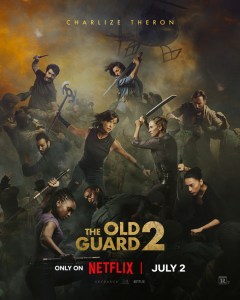
I wasn’t a big fan of the 2020 immortal action movie The Old Guard, but apparently it became one of Netflix’s most viewed movies, so here we are five years later with a sequel about the ancient conspiracy of warring immortals co-starring Chiwetel Ejiofor (not to be confused with Infinite, which is about an ancient conspiracy of warring immortals who are reincarnated into new bodies co-starring Chiwetel Ejiofor). I found the action and the general world-building to be underwhelming, but Old Guard 2 makes The Old Guard look like Michael Bay in comparison. There are two key developments in this sequel. Uma Thurman plays the first immortal and she wants to destroy the world or whatever. The second is that anyone injured by our newest immortal, Nile (Kiki Layne), loses their immortality. The rules of this universe get awfully hazy. I’m taking this directly from the film’s Wikipedia summary: “Additionally, anyone who has lost their immortality can regain their power by another wounded immortal who can transfer their power to the host they choose.” Still following? So we have one person who can make immortals mortal, but any mortal immortal can also choose to have their absent immortality bequeathed to a mortal immortal of their choice, reasserting their immortality. Okay. The confusing rules would be mitigated if we found any of the characters compelling. The sequel does bring back Andy’s (Charlize Theron) ex-beloved Quynh (Veronica Ngô) who was locked into an iron maiden coffin and dumped overseas. The established rules had immortals reawaken from death, so this poor woman would keep waking back up again only to drown instantly and repeat the horrifying process again. Let’s do the math here. On average it takes about two minutes to drown (FYI, I typed into Google “how long does it take to drown,” and now my computer is worried about my mental health). Let’s cut that in half from the extra water pressure filling her lungs. So let’s say she dies every minute. That means she dies 1440 times a day. Over the course of 500 years she has died 262,800,000 times. Rescuing this woman should be a recognition not just of her relentless suffering but the fact that her mind should be shot. Having to endure that horror would break anyone, and Andy coming to terms with her inability to heal someone who cannot die but is also unable to continue life any longer woukd be interesting. That’s my preferred sequel. Instead with The Old Guard 2 we get a bunch of lackluster fights and convoluted lore, and it doesn’t even offer a conclusion, more an implied hand-off to a third movie where the characters may indeed be able to finish what they’ve started. It’s time to let these mortal immortals just die in peace.
Nate’s Grade: C-
Share this:

KPop Demon Hunters (2025)
 I’ve watched KPop Demon Hunters four times in the last week on Netflix, so I may be a bit partial to it. Sony Animation’s newest genre-bending stunner is an action musical with surprising heart to ground the supernatural multi-dimensional battles between the forces of good and evil. Our main characters are the three young women who form the Korean pop group Huntrix; they play sold-out arenas by day and slay demons by night, working toward sealing a barrier that will protect mankind from soul-sucking demons. They meet their match when the demons form their own boy band, the Saja Boys. Handsome, charming, and media savvy, the Saja Boys begin pushing Huntrix out of the top spot and stealing their fans and their souls. It’s a cute premise buoyed by spry and colorful animation with terrifically designed and pleasing action sequences. It also helps that every song is an absolute banger, with some exceptional melodies and anthemic choruses. It may prove impossible to resist the songs, making those dastardly yet dreamy demons all the more likeable. What works just as well is the character work put into establishing the friendship between Huntrix, whose lead singer, Rumi, is keeping a secret that she is herself part demon. She finds herself drawn to Jinu, the leader of the Saja Boys, who seems more complicated than simply being a remorseless creature. He has plenty of real remorse and feeling, as Rumi has plenty of self-repression and shame, and they find the other more complex and mysteriously appealing as they feel out a possible romance. There’s a lesson here about self-acceptance and being open with the ones you love, and it’s effectively developed to the point that, during the grand climax, with the crowd chanting in unison with our ladies, affirming that solidarity, you too might get a little misty of the eye. That’s the amazing part of a movie literally titled KPop Demon Hunters: it can have you bopping your head one minute and drying your eyes the next. The animation can get exaggerated into cartoon comic absurdity (eyes literally pouring popcorn another person gobbles down), but it’s the sincerity and messages about acceptance and tolerance that rise highest. Plus there’s that music. It’s all such a vibrant blast, and it’s got the infectious jams of the summer all in a tight yet playful and poignant 90 minutes.
Nate’s Grade: B+
Share this:

Heart Eyes (2025)/ Fear Street: Prom Queen (2025)
Slasher movies have been a popu;ar staple of horror, enough so to go through different phases of resurgence and ironic reinterpretation. They rose to prominence in the 1980s but are still wildly popular today, perhaps proving that there’s something timeless about a masked maniac chasing after dumb teenagers with his or her weapon of choice. Mix in heavy amounts of blood and gratuitous nudity, and it’s easy to see why this cost-effective entertainment strategy continues to endure. Two new 2025 slasher movies show the highs and middling lows of this horror genre known for its graphic kills and little else.
 Heart Eyes is ostensibly about a romance-hating masked killer who stalks happy couples on Valentine’s Day and gets all stabby with their insides. However, it’s really a pretty charming romantic comedy that just so happens to also have a healthy amount of gore. The clever screenplay follows many of the same tropes we come to expect from the rom-com genre but now with a twist. It’s Boy Meets Girl, as Jay (Mason Gooding) and Ally (Olivia Holt) are forced to work together to save a romantic ad campaign gone wrong. It’s Girl getting over the pain of her recent breakup with the emergence of a handsome new man in town. It’s Guy and Girl butting heads before creating sparks. And then they’re chased repeatedly by the masked killer. They yell, “We’re not even a couple,” but it makes no difference; their chemistry is just that undeniable. In that regard, this murder menace is actively driving these two would-be lovebirds together, forcing them to rely upon one another for survival, and revealing parts of themselves. If you cut out all the horror parts, it would still work as a romance, but it’s even more entertaining to watch how the two genres, both beholden to their formulas, mash so bloody well. The banter is witty, the silly are over-the-top gory, and this is a rare movie that could be loved by gorehounds and foolish romantics. It’s an elevation that is self-aware but not obnoxiously, more silly tongue-firmly-in-cheek. You can tell there is a love for both of these genres from the filmmakers. Heart Eyes is a fun and refreshing spin on the old.
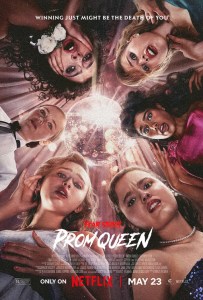 The newest Fear Street movie, based on the scream teen novels by R.L.Stein, is by far the weakest in the Netflix horror anthology series. Prom Queen is a pretty straightforward rehash of your 1980s high school movie staples of horny teens, bitchy popular girls, the less popular girl striving for Prom Queen and having to reconcile the changes she’s willing to make to be a winner, and a knife-wielding killer. Ah, the nostalgia. The issue is that there’s nothing separating this movie from, say, Prom Night, either the 1980 original or the PG-13 remake in 2008. The most thought put into this movie is the gruesome kills with some decent gore, but the whole movie doesn’t even play like a cartoon. It plays like a TV special you’ve watched before, something not just outdated but that’s been iterated upon iterations, a bland copy of a copy of a copy. The mystery of who might be the killer has some slight fun but the culprit should be easy enough to suss out when you take into account what actors have names that you remember. There’s nothing wrong with emphasizing the more gruesome exploitation elements of the genre, but the kills aren’t that memorable or clever, nor are the characters that interesting even as generic stock roles. I found myself confusing many of the multiple Prom Queen candidates (why are there so many pale brunettes?). The previous Fear Street movies released in 2022 had an interesting gimmick connecting them with the history of the town going back centuries to explain its crushed nature. Prom Queen just exists in this space without doing anything to connect to the larger Shadyside mythos and cross-generational storytelling. It feels so dreary and perfunctory and rather boring, shuffling along like a zombie wearing the husk of Fear Street. It’s just not fun. It’s not outlandish enough to be silly and too dumb to be self-aware. It’s mostly unimaginative cliches warmed over and unrelated to a far more stylish and ambitious horror series. This is a Prom Queen that deserves a bucket of blood and social ostracism instead of any accolades.
Nate’s Grades:
Heart Eyes: B+
Fear Street: Prom Queen: C-
Share this:

Havoc (2025)/ Novocaine (2025)

Action cinema has long been one of the most satisfying experiences for the always-insatiable moviegoer, being presented with the thrum of kinetic editing, expert choreography, and visceral photography to produce a sensory thrill. Watching a well-developed action sequence is akin to watching a stupendously choreographed dance, where the movement and struggle are part of the storytelling momentum. Two recent action movies show what can be achieved, one through intensity of the familiar and the other through elevating its concept. Both are fairly enjoyable escapes and reminders that, with the right hook or sense of passion, action cinema can be some of the most gleefully transporting sensory experiences.
One of the best genre filmmakers is Gareth Evans, a man who blew the industry away with his intense Indonesian martial arts epics, The Raid and its even better sequel. After watching those movies, and taking time to catch your breath, you have to wonder why Evans isn’t directing every Hollywood action movie, or at least been tapped to try his hand at juicing some studio franchise with his visionary feel for action. It’s still a mystery to me that Evans has only helmed two movies since 2014. Both of them happen to be from Netflix, and while I don’t pretend to understand the creative machinations behind this streaming giant, if I were them I would give Evans a $20-million budget every three years and tell him to do whatever he wants as long as it involves people getting hurt. At first glance, Havoc looks fairly conventional, a crime drama about corrupt cops and hoodlums fighting over who can get to a target first. You have to keep reminding yourself that Havoc is not The Raid and not aspiring to be, so the fact that it cannot rise to that extreme level of action excellence does not mean it is a failure. It’s not in that upper echelon of action cinema, like your John Wicks, but Havoc is most definitely a step above many of Netflix’s junky action-thrillers with A-listers that inevitably disappoint in their flailing execution.

Tom Hardy plays Walker, a veteran cop who works as an enforcer when the money’s right. He’s tired of being a tool to the rich and powerful and looking to get out and be a better family man. You know, the stuff of formulaic action boilerplate. He gets involved in a job gone wrong that leads to a gang war spreading and plenty of hired guns looking to find the son of the mayor (Forest Whitaker). That’s about it as far as the plot. It’s about different groups racing to get what they want first at whatever bloody cost.
Whereas The Raid was a martial arts action extravaganza with professionals at the top of their game getting the platform and material to showcase their amazing skills, Havoc is not that kind of movie; in fact there’s very few moments where the action consists of fisticuffs. This is an action movie built on car chases and mainly gunfights. It’s a cops and robbers kind of action movie, which puts less emphasis on hand-to-hand and more on room clearing. While the accumulated thrills might not be as gratifying as watching professional athletes launch exciting routines, there is still plenty to enjoy when watching finely developed gunfight sequences. The boring approach is simply to convey a shot-reverse shot dynamic: Character A fires a gun, then cuts to Character B being shot or dodging, repeat. Good directors will think about how to better stage a sequence so that each one has its own purpose, its own set of mini-goals, a set of organic complications that keep the conflict roiling, and ways to connect to character. Action sequences should not just be excuses to blow something up. With Havoc, it takes quite a bit to get going, but there are two standout action sequences that make it worthwhile and will satisfy most action aficionados.

The first sequence is a fight in a club that kicks off the movie’s shift to constant scrambling action. It’s about 50 minutes into the movie and all the respective characters have been slotted into their conflicting positions. We know who the good guys are, the bad guys, the goals in opposition, and what the stakes are, and from there the movie just takes off in a sprint until its final blast. The club involves different levels and different factions fighting and mixing, providing a series of changing complications that makes the sequence feel more lively and engaging. There are several inventive moves to avoid gunfire or reach guns, and the cinematography keeps the action centered and easy to comprehend. The best action sequences are planned like moving puzzles, and the more work that is put into the preparation, the more enjoyable the action can become. This club shootout scene finds numerous ways to keep the stakes upended and to place the characters in new forms of danger they have to quickly adapt to survive.
The second sequence is a climactic confrontation at a cabin in the middle of a snowy forest. It’s a prolonged siege sequence where the bad guys are attempting to break through into this secure location and take out our heroes. From this claustrophobic setting, Evans presents the antagonistic intrusions as unrelenting and coming from all four walls and even below as well. The characters have to constantly be moving and reacting to an assembly of threats while their protective walls begin to literally crumble. It is a literal onslaught. I’m shocked the cabin is still standing by the end. It’s an immensely engaging sequence that communicates the frenzy and anxiety of being under constant attack. The gunplay can be brutal and there are satisfying kills and battles between side characters throughout this sequence to avoid the sequence from feeling too repetitive. It feels in many ways like the whole movie has been leading up to this sequence, not just in a traditional linear-plotting fashion but also the viewer has been waiting for the director to fully go off with a celebration of action mayhem. This is Evans unleashing his best, and he’s adapted his creativity to the setting and the action sub-genre, so there’s different moments meant to present immediate gunfire problems and fast-paced responses. In this world, people aren’t all gifted as expert fighters, and thus even our heroes can falter under the harried circumstances.

Short of these sequences, the rest of Havoc has difficulty breaking free from the gravitational pull of its own genre cliches. Evans wrote the screenplay by himself and I’m surprised how flimsy so much of the story and characters come across. With 2011’s Raid, there wasn’t much of a story once the action stopped, but with 2014’s Raid 2, Evans was able to compose an undercover cop story that was just as compelling even when people weren’t getting kicked in the face. He can write colorful side characters that feel like they stepped out of a Tarantino-favorite grindhouse movie. He can write tense sequences that don’t have to rely upon action. He can do so much more than what Havoc provides, so it’s hard not to feel like this wasn’t exactly a passion project. It feels more like a serviceable vehicle to achieve the kind of action that Evans was looking to achieve. Now, if you’ve underwritten a genre movie because your real interest is staging the action, then you would expect there to be more action, correct? Strangely, Evans spends most of those first fifty minutes setting up his story, the same story that is awash in genre stock roles and cliches without much intrigue beyond a one-sentence description. Simply put, if you’re going to stick us with underdeveloped characters, don’t keep us waiting for the action. There’s so many characters in this movie that I think Evans gets overwhelmed trying to set them all up and involve them in the larger story. If they’re only going to be stock roles, why do we need 30 when 10 can do? I think Evans keeps his cast so big so he can unceremoniously bump off so many of them, which can be surprising, but I would have preferred doing more with the space their absence might have provided the narrative. There’s also an odd stylistic choice where any exterior shots are much more stylized, looking more like video game cut-scenes or something out of the realm of Sin City. It’s at odds with the rest of the film’s stripped-down look.
Havoc is a gritty and bloody action movie that can overwhelm at moments and underwhelm at others. The genre grist is pretty familiar, from our troubled antihero lead trying to atone for his past sins, to the dumb kids in the middle of a gang war they don’t understand, to the good-natured partner who has to grow up, so to speak, by getting their hands dirty. You’ve seen variations of these stories before, but the real draw is once Evans works up enough space to really unleash his invigorating action best. It’s a movie I wish was better but it’s functional enough for Evans to do his extraordinary thing. I just want more of his specialty.
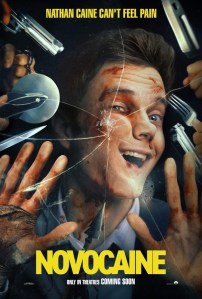
In comparison, Novocaine isn’t going to be defined by stylish choreography or exceptional style. It’s a high-concept action comedy driven by flipping the genre script. Instead of our hero inflicting great pain on his foes, this movie is about a hero enduring amazing amounts of pain. It’s an underdog story where a novice is thrust into an unfamiliar situation and has to utilize his unique disorder, a blessing and a curse, in order to rescue the girl and save the day. It’s a great premise that lends itself to plenty of fun scenarios to fully capitalize on its bizarre potential, and that’s where Novocaine hits a sweet spot of entertainment.
Nate (Jack Quaid) is a shy assistant manager at a small bank in San Diego. He suffers from a unique medical condition where he doesn’t feel the burdens of physical pain. You might think this a luxury but it’s actually a great worry for Nate. Without his body’s alarm system he can stumble into grave danger without even knowing it, so he’s been living an overly cautious life as a result. That all changes when he meets Sherry (Amber Midthunder), a new coworker who takes an interest in him. They go out on a date and really hit it off. Things are looking up for Nate until bank robbers storm his work, kill his boss, and take Sherry hostage. Nate hijacks a cop car and goes chasing after the bandits to rescue Sherry. He’ll undergo lots of trials of pain to win back the girl who makes him feel things.

How do you make a person invulnerable to pain an exciting character? It’s the lingering Superman question, except nobody is going to confuse the character of Nate with Krypton’s orphaned son; if a character cannot feel pain how can we worry over their well-being? Now there’s a reason writers have been able to tell Superman stories for decades, even if the movies often struggle with representing the figure, and that’s because it just forces you to have to think harder. It can be done. With Novocaine, Nate is a hapless naif thrown into an action movie and trying his best to fit in. He lacks physical prowess, weapons training, and tactical planning. However, the only thing he has going for him is his inability to feel physical pain, and the filmmakers routinely find funny and entertaining methods to test how far one could go with this pain threshold. While his body isn’t registering pain he is still taking all the punishment. Nate is nowhere near indestructible, and a running gag becomes how utterly mangled and deformed his hand becomes from event after event (I thought it was just going to be a stump by the end). He takes quite a beating but because of the whole “mind over matter” matter, he’s surprisingly able to persevere where others could not. This allows Nate to become an unexpected hero where the rest of us would pass out from shock. The appeal of the movie isn’t so much the action itself but the ongoing response to all of said action.
The set pieces are what makes this movie so much fun, pushing Naate into action hero mode when he’s clearly awkward and not ready for the promotion. I loved his dry responses to every new injury, from mild annoyance to feigned surprise. There’s a scene where one of the villains is torturing Nate and he has to go along with the charade in order to appease his tormentor and get valuable information out of him. It’s a reverse interrogation where the target is actually trying to manipulate the guy with the pliers. I loved how quickly he could bounce back from whatever trauma, from catching a knife blade first and quickly yanking it out of his hand, to casually writing an address on his hand with a tattoo gun. There is a crafty ingenuity to how the filmmakers can make the best use of this superpower. There are some impressive kills that also made me wince in response, like reaching for a gun at the bottom of a deep fryer, or literally stabbing a person in the face with an exposed arm bone. Novocaine has a delightfully demented sense of humor that keeps everything grounded with mordant laughs even when it’s dishing out the punishment.

Even more surprising, there’s a buoyant love story that genuinely feels sweet that could have benefited from a little more development and attention. Sherry is the one who activates our protagonist and pushes him outside of his comfort zone. He lacks confidence in himself and has been living an overly cautious existence from fear of not being able to respond to his body’s emergencies. The man has been eating his food as liquefied goop out of a fear of choking. She introduces him to the simple joys of eating one’s food before it’s been vigorously blended, like the wonders of pie. Their first date was genuinely charming and I liked the chemistry between both actors. Midthunder has been a favorite of mine since Prey and I want to see her in more varied roles. When the bank robbery commences, I actually had an emotional response to these two being in danger and watching the other being put in danger. Once she becomes a hostage, Sherry is placed as the damsel to be saved, which is disappointing because I liked her contributions to the story and especially what she brought out of Nate. There is a revelation with her later that reorients our understanding of her but I don’t think it was fully necessary. Their budding romance is quite enjoyable and so I wish the story could also continue to develop this connection over its wild series of mishaps.
Novocaine is a great example of a movie that maximizes its unique premise to stand out. It’s structured like a traditional action-thriller but it never takes itself seriously, pushing forward a stumbling protagonist whose real gift is that he’s the human equivalent of a punching bag. This dynamic is ingeniously developed and showcased, and just when I was worrying the premise might get old or become repetitive, the filmmakers find new ways to twist their story into even better twisted results. I wish the female supporting role was more tied into the action and fun, and the villains are a bland blend of overly confident paramilitary goons. Still, the fun comes from Quaid and his light-footed screwball performance anchoring the bloody hi-jinks and demented humor. Novocaine is a fresh reworking of action movie tropes with a twist that allows the audience to heartily laugh at our hero’s pain and pratfalls. It’s the kind of humor and energy that reminds me of the Crank filmmakers. If you’re looking for a winning dark comedy bouncing against the formulas of action movies of old, settle in for some Novocaine and enjoy the pain.
Nate’s Grades:
Havoc: B-
Novocaine: B+


 nathanzoebl
You must be logged in to post a comment.