Blog Archives
Frankenstein (2025)
 One of the reasons Mary Shelley’s novel Frankenstein has been so richly relevant two hundred years later is because of her thought-provoking themes and concepts, which still prove potent with each new malleable reinterpretation from the newest creative caretaker. It’s the “be careful what you wish for” adage combined with man’s hubris and our self-destructive impulses to play with things we don’t fully understand. It’s also a monster story that asks us to reconsider the perception of who the monster may truly be, and under writer/director Guillermo del Toro, the answer is always and forever man himself. This isn’t a surprise from the same filmmaker who gave us Hellboy and The Shape of Water. The man identifies with the monsters more than other people. The man turned his astounding stop-motion animated Pinocchio movie into a deft Frankenstein allegory, so the famous story has been on his mind for quite some time. It’s been an obvious influence, and now that he’s gotten his chance on his own imprint, it’s hard not to see elements of del Toro’s other movies everywhere. It creates this bizarre echo chamber of creative influence where the movie can feel derivative at times even though the source material was an influence on those other del Toro works. It’s just the nature of finally tackling the influence later in his career. It reminds me of 2012’s John Carter, based on Edgar Rice Burroughs’ highly influential sci-fi series, and yet because it took 100 years to leap to the big screen, it couldn’t help but seem derivative of the same popular movies that were inspired by it. This is a convoluted way of saying del Toro’s Frankenstein is a much better Guillermo del Toro movie than a Frankenstein adaptation.
You probably know the story well enough to recite it yourself. Victor Frankenstein (Oscar Isaac) is obsessed with conquering death after his own mother’s demise in childbirth. He gathers the parts of criminals and dead soldiers to reanimate into a new being, a Creature (Jacob Elordi) of superhuman strength and regeneration who cannot die. Victor’s cruelty punishes the Creature and disowns it, setting the stage for a showdown between dysfunctional father and son and the havoc caused by recklessly playing God.
 There are deliberate decisions that mitigate some of the more compelling characterization of the novel. With del Toro’s version, Victor is the clear-cut villain. There’s some setup given to his strict childhood where his domineering father (Charles Dance) would quiz him and physically abuse Victor if he failed to recite the correct answers to his medical questions. Dear bad dad was doing this, you see, out of a belief that good doctors need to know intuitively because any hesitation could cost lives. When we witness Victor abusing the Creature in the same manner, we’re meant to see the connection between abusive fathers confusing disappointment with defiance. In the original story, Victor abandons the Creature on the night of its birth and then it’s gone. In this version, Victor imprisons the Creature, keeps him chained, attempts to train him, grows frustrated, and then tries to destroy the evidence. That’s a little more diabolical than simple morning-after regrets. This Victor can also be viewed as a forefather of incels the way he projects his romantic feelings onto Elizabeth (Mia Goth) and then gets huffy when she doesn’t return them. There are other deaths later in the story that are directly attributed to the Creature that are now Victor’s doing, which continues to squeeze out moral ambiguity from Shelley’s novel. If the Creature is purely innocent and Victor is purely villainous, that makes the relationship between father and son, Creator and Creature, far less meaningful and layered. It’s so obvious that another character, in their literal dying words, says to Victor, “You are the real monster.” It all becomes an ongoing cycle of bad fathers and the Creature ultimately trying to reach forgiveness. Even if the Creature ultimately finds that, is this Victor even worthy of redemption?
Another significant feature of del Toro’s retelling is, how do I put this delicately, the inherent magnetism of the Creature, a.k.a. Sexy Frankenstein. Elordi (Saltburn) is a tall, lithe actor to begin with with classical Hollywood features, but there was a conscious choice to portray this figure in a certain light, a sexy light. You might find parts of you that are suddenly alive while watching the character onscreen. That’s why even though he’s a literal assembly of corpses the makeup effects are very minimal and less intentionally grotesque or monstrous. The delicate lines around his body make me think of a cross between the Engineers in Prometheus and the body paint of that Gotye music video “Somebody I Used to Know.” The gentle makeup is meant to further convey the Creature as a sensitive figure; granted, he’s also capable of ripping the jaw off a wolf. By swerving away from the Creature’s physical deformities, the movie is also inadvertently downplaying the isolation that he felt that led to such rage and resentment. Is this man that hideous that some good woman couldn’t love him as is? The movie is already presenting Elizabeth as someone who sees through to his gentle nature, and she certainly also seems more than a little attracted to what he’s got going on. This Sexy Frankenstein reconfirms del Toro’s penchant for identifying with the monster, the outcasts, the underdogs. However, Sexy Frankenstein also takes something away from the horror and cost of the creation if he’s just going to be another brooding, misunderstood Byronic hero. Still, there are definitely worse pieces of meat you could be watching, so enjoy monster sweethearts.
 With all that being said, del Toro’s Frankenstein is still a sumptuously made and entertaining Gothic spectacle. The production design is immense and immersive with del Toro’s knack for perfect details to create such a lived-in sense of mood (never enough giant stone face edifices). I loved Victor’s models of human torsos that looked almost like ballet dancers at rest; granted, ballet dancers having their skin peeled back by dozens of hooks. I just wanted to spend as much time as possible soaking up these sets and this heightened Gothic realm. It’s the kind of world where Victor’s laboratory needs to be an opulent abandoned castle complete with a pit in the middle of the floor plan that goes through several floors to a sewar/aqueduct basement level. There’s even what appears to be a water slide out of the estate, and the Creature gets to escape it in the most fun way. The movie is gorgeous with del Toro’s signature orange/green color palette bathing his universe. Even if the story isn’t quite reaching the heights it could, the visuals are always sterling and inviting. There’s also a surprising amount of gore, which maybe shouldn’t have been that surprising. I don’t know if we needed as much of the Arctic framing device, which itself was structured as a series of letters in the novel. It’s a platform for del Toro to demonstrate the Creature’s physical prowess and get some quality big-screen bloodshed flowing. I don’t know if we needed to keep cutting back throughout the whole running time like it’s a Christopher Nolan movie. Regardless, if you’re a general fan of monster movies, there’s going to be plenty here to proverbially sink your teeth into and savor on that super Netflix budget.
Mary Shelley’s Frankenstein gave birth to science fiction in 1818 and the James Whale movies from the 1930s gave birth to some of cinema’s most iconic and lasting images and influences. There’s quite a legacy for anyone who wants to put their own stamp on the material, so it helps that Guillermo del Toro has quite a legacy himself, a career built upon the dark recesses of a verdant imagination (I’ll always lament what could have been his version of The Hobbit movies, alas). His Frankenstein has all the hallmarks of a classic del Toro film experience, from the impeccable technical qualities, to the celebration of the mythic and Gothic, to the sympathetic portrayal of the outsiders condemned by a society too square to accept them, and an unironic emotional undercurrent that can approach self-parody. It’s a little long, a little ungainly in its shape, and a little too simplistic with its themes and characterization, but it can also be fittingly transporting and romantic and easy to feel that swell even if it’s all too familiar. For my money, the best Frankenstein adaptation is still the 1994 Kenneth Branagh version, flaws and all.
Nate’s Grade: B
Share this:

Wolf Man (2025)
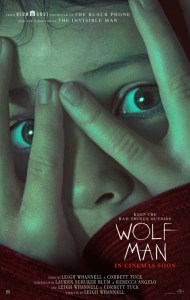 I had high hopes for writer/director Leigh Whannell’s second take on the classic monsters after how thrilling and satisfying his take on the Invisible Man was in the early months of 2020. Werewolves have served as a fertile metaphorical ground for genre storytelling to cover such varied topics like coming of age, self-actualization, and addiction. Considering Whannell was able to use an invisible man to explore toxic masculinity and gaslighting, without losing sight of a monstrously entertaining movie, I was hoping for repeated success. Wolf Man is ostensibly about inherited curses and the relationships between fathers and children, but it’s really about dealing with flaring tempers and whether or not our shortcomings are a result of our genetic inheritance. It’s also about a family trapped in a cabin helplessly watching their father/husband transform into a dangerous beast. I suppose there’s something here about the cycles of trauma and abuse, anger as a sickness, but the problem with Whannell’s Wolf Man is that it all feels like an incomplete beginning. There are definite identifiable themes here, and a scenario that would lend to slow-building dread amid losing control over one’s sanity to become a monster against their loved ones. I just kept waiting for something more. The movie runs out of steam shockingly once it strands its family in the cabin. We’re treated to many scenes of Christopher Abbott, as the beleaguered father, blankly staring and then seeing his vision where people are highlighted with neon outlines. It’s a neat visual but what does it mean? I was waiting for more development, more character work, more culminating of themes, more… anything. It’s a lot of sitting around, like this promising genre movie had been hijacked by, like, some self-sabotaging arty Godard-obsessed filmmaker trying to Say Something with all the protracted scenes, pained silences, and repetition without revelation. It’s a surprisingly boring movie and, I repeat, it’s a werewolf movie. The makeup effects also make our titular monster look more like a shaved wolf, or a goblin rather than a lupine-centric creature of the night. I don’t even think there was a single shot of a full moon in the whole movie. Regardless, Wolf Man is a disappointing a d dull monster movie that’s too shaggy for its own good.
Nate’s Grade: C
Share this:

The Gorge (2025)
 While watching the action-thriller The Gorge, I kept thinking, “Wow, I’m surprised this didn’t get a theatrical release at all.” The Apple Plus original is the kind of movie you’d want to watch on the big screen, with large-scale action, atmospheric imagery, and a creepy sound design meant to elicit shudders. It has a dynamite premise that grabbed me right away: two elite snipers from the East and West, Levi (Miles Teller) and Drasa (Anya-Taylor Joy), are tasked with manning watchtowers overlooking a cavernous and mysterious gorge. They have heavy-duty Gatling guns to make sure whatever is in the gorge stays in the gorge. It’s a year-long tour of duty and both snipers are forbidden to communicate with one another. Naturally, out of boredom and necessity, they break the no-contact rule, first through white board messages, then through shared experiences and competitions, and finally coming face-to-face. For the first 45 minutes or so, The Gorge is actually a pretty lean and effective long distance romance of sorts. There’s ingenuity in the process of getting to know someone from across a large hole in the ground, and both actors have solid chemistry that will help make you silently yearn for a little global collaboration. The movie also has an intriguing scenario with tantalizing details that point to its secret history, until everything is literally spelled out in Act Three. The monsters, who look like a combination of Groot and zombies, are an unsettling character design, though I wanted more variety in their appearance. When the characters finally delve into the gorge for the majority of our climax, we got some new and nasty creepy crawlies, like a tree with rib bones like insect mandibles that ensnare like a Venus flytrap. Alas, I found the stuff inside the gorge to be fun and creepy with a great atmosphere to play upon what we can and cannot see, but it was the stuff above and outside the gorge that made the movie for me. That’s The Gorge for ya: come for spooky monsters, stay for the surprisingly involving romance between monster killers.
Nate’s Grade: B
Share this:

Van Helsing (2004) [Review Re-View]
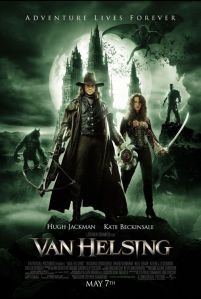
Originally released May 7, 2004:
Crossover movies have a distasteful history in the world of cinema. Some movie exec gets the notion, “Hey, why can’t two great tastes taste great together?” But what we’re left with is usually uninspired (The Flintstones Meet the Jetsons notwithstanding). Crossovers for horror movies are the worst of the lot. For every Freddy vs. Jason there’s a dud, like 1966’s Jesse James meets Frankenstein’s Daughter. That year went down in the annals of cinematic history, however, as it also gave us Billy the Kid versus Dracula, marking two entries in the expanding genre of cowboys battling famous monsters (as far as I know, this genre still stands at two movies). So what can one expect from Van Helsing, a big-budget creature feature that includes Dracula, Frankenstein, and the Wolfman?
Van Helsing (Hugh Jackman and a really big hat) is a secret soldier for a covert order of the Vatican. This covert order dispatches monsters and creepy-crawlies the world over. He’s been ordered to assist Anna Valerious (Kate Beckinsale), the last in a Romanian family line that has sought to kill the infamous Dracula (Richard Roxburgh). It seems that their family line is dwindling. And Anna’s brother being turned into a werewolf doesn’t help the situation. If her family line dies before Dracula then they cannot enter heaven. Van Helsing comes to town to help out the locals who are terrorized by Dracula’s flying brides. Van Helsing effectively kills one of the vamp ladies and is celebrated as a hero by the village. As he gets closer to Anna he also learns more about his own mysterious past and his connection to a certain figure with big teeth.
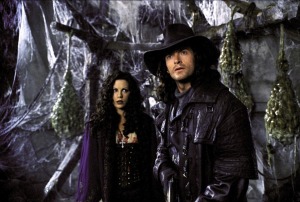
The Big D has a dastardly plan. He wants to find Frankenstein’s monster (Shuler Hensley) to channel enough power through him to awaken zillions of goo-sacks harboring the vamp’s undead brood. Of course, Frankenstein’s monster isn’t too keen on this. Together, he and Van Helsing, with the help of Anna as well as a comic relief monk, battle to stop Dracula from unleashing his children of the night.
Van Helsing is stupid, stupid, stupid. Director Stephen Sommers exists in his own indulgent world where bigger is better and some CGI spackle will fix any plot holes. He makes check-your-brain-at-the-door popcorn movies, but a “popcorn movie” is no excuse to forgive a rambling, incoherent, loud, stupid mess. I liked the first Mummy flick and even found some good with the second, but Van Helsing is Sommers at his rock-bottom worst, gorging on a trough of special effects and vomiting the results onto the big screen. Sommers’ idea of character development is knocking people through walls like they were in a Looney Tunes cartoon.
Van Helsing raises some interesting questions, like why do Dracula’s brides morph into flying demons that are conveniently genitalia-free? Why does a werewolf rolling over the top of a carriage somehow cause it to catch on fire? Why does Dracula keep his magic lycanthropy cure in the open? It doesn’t matter. Van Helsing is so straight-laced about its absurdities that questioning them will just get tiresome.
Not that you would expect much, but the acting in Van Helsing is bad. Beckinsale’s accent couldn’t be less convincing if her role were played by Charo. The trio of Dracula’s brides are played by swimsuit models and let me just say their performance is on par with what you would expect from swimsuit models. Roxburgh is quite possibly the worst vampire in the modern history of vampires, and that includes Blacula, Count Chocula and Tom Cruise. He couldn’t look any less sinister if he was in a diaper and bonnet. What’s up with those strands of hair that dangle in his face? Why do the Van Helsing creators want their Prince of Evil and son of Satan to look like he was the keyboardist for some 80s pop synth band?

This overly long film feels like a seven-year-old’s book report that he hasn’t read: it’s like a child is making this up as they go. “And then … a werewolf pops up … and then Dracula’s flying brides … and then they all need Frankenstein’s monster ….” Seriously, were the penning this script on the fly? It’s a $150 million improv film. The reels of the film could be switched around and no one would be able to tell the difference. Van Helsing is one long, exasperated action sequence that drags its heels instead of wowing. It beats the audience into submission with its stupidity and redundancy.
The entertainment level of Van Helsing is exceedingly weak. It runs an eternity, which wouldn’t be a problem if one were intrigued by the story, the characters, or the action sequences. The action could have been suitable but Sommers has gotten less reliant on the physical and more superfluous with his CGI. Watching a CGI monstrosity smash into a CGI monstrosity before a CGI background where no semblance of reality is present grows tiresome after 130 minutes. The effects are passable, but they overload the viewer and numb whatever slight interest may have existed for the classic monsters.
What should have been a clever homage turns instead into a hollow marketing ploy that’s so frenetic and tireless with its manic pacing and bad special effects. Even the many attempts at humor are flat. It has to be some kind of apocalyptic sign that Hellboy and now Van Helsing have been unleashed unto the innocents of this world. Some will find Van Helsing decent popcorn entertainment, but most will grow weary of its sloppy design and wafer-thin substance. For me, this is one to avoid, period. There isn’t an ounce of fun to be had while sitting through the painful pair of hours that is Van Helsing. This is one monster mash that’s a real monster mess.
Nate’s Grade: D
——————————————————
WRITER REFLECTIONS 20 YEARS LATER
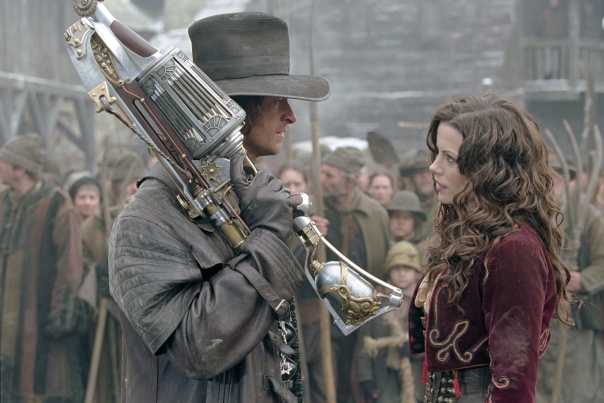
In 2004, Van Helsing was being primed to be not just a blockbuster but the forerunner for a new interconnected franchise revitalizing the classic Universal horror icons. Director Stephen Sommers was hot off the success of the first two Mummy movies, Hugh Jackman had become a household name playing everyone’s favorite growling superhero, and Kate Beckinsale had proven her own box-office mettle fighting vampires and werewolves in the Underworld series. The studio was expecting so much that it planned a sequel, a TV series on NBC called Transylvania, an animated prequel, a clothing line, a video game, maybe even theme park additions, and to maintain the Eastern European sets so that they could be utilized for the eventual show and sequels. Obviously, this never came to pass, and Sommers’ last big Hollywood action movie was the 2009 G.I. Joe movie, and he hasn’t directed a movie since 2013’s Odd Thomas adaptation. He chose not to direct the third Mummy movie in 2008, but it seems like this man’s career has never been the same since Van Helsing cratered in the summer of 2004. It began as the studio asking Sommers for even more monster movies, Sommers pitching them all together as an Avengers-style super movie, the studio getting carried away with larger plans of franchise dominance, and then when it didn’t materialize, a promising popcorn filmmaker in the highest blockbuster sphere just vanished in a poof of overzealous CGI.

Me wife’s crush circa 2004
In 2004, I did not like Van Helsing. That might be too charitable a description. I wrote in my original review, “Van Helsing is stupid, stupid, stupid. [Sommers] exists in his own indulgent world where bigger is better and some CGI spackle will fix any plot holes. He makes check-your-brain-at-the-door popcorn movies, but a ‘popcorn movie’ is no excuse to forgive a rambling, incoherent, loud, stupid mess.” It was one of my worst movies of 2004, and twenty years later, I’ve mostly come around on the movie. I won’t tell you that it’s a great movie, or even achieves that same magic alchemy of action-adventure swash buckle that The Mummy brought back to major studio filmmaking in 1999, but Van Helsing is enjoyably ridiculous schlock nonsense. It was also one of my wife’s favorite movies growing up, and she reminded me that her teenage self had a big crush on Richard Roxburgh’s version of Dracula, not Hugh.
I now view Van Helsing less as a horror monster action vehicle and more of a spy vehicle in a strange world. The titular Van Helsing is our secret agent complete with spy gadgets with his comedic relief sidekick, and he’s got his important missions and the sexy Bond Girl, and the villains and betrayals and added back-story that doesn’t seem even necessary. It’s Sommers taking the structure of a spy thriller and supplanting it onto a Victorian-era monster steampunk universe of demons and centuries-old church conspiracies. Jackman is enjoyably suave as the Vatican’s favorite killing machine learning his own life lessons about the nature of legacy. I even enjoyed the villain’s motivation for Dracula; he’s trying to learn the secrets of Dr. Frankenstein’s reanimation to ensure that his vampy babies survive. Here is a Dracula who is bereft because he cannot father living children. I suppose there could be further discussion over the different forms of life as converting humans into vampires is itself a rebirth. Perhaps the distinction is like the difference between having biological children and adopted children. Maybe dear old Drac just wants to have a bundle of joy he can call his own. That’s more interesting than versions that make him out to be some stalker ex-boyfriend. Likewise, the role of Anna (Beckinsale) is given more pathos than simply being the Strong Romani Badass. While her wardrobe consists of corsets and teased hair to appeal to a young male demo, her character’s mission is powerful and personal. Anna needs to kill Dracula not to save herself but to ensure the rest of her deceased family members can enter heaven. Talk about cumulative family guilt. That’s heavy. When her face appears in the clouds at the end like Mufasa, it’s a confirmation of generational rest. That’s an arc that’s more fulfilling than being any love interest that would be discarded later.
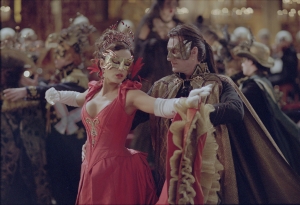
As soon as it got rolling, I said to my wife that this was going to go one of two ways: Van Helsing will learn that his organization is not as righteous as he believed them to be, manipulating him to eliminate threats to the organization’s standing rather than threats to humanity; or Dracula and Van Helsing have a personal connection that hasn’t been fully examined. Dear reader, it went in both directions because Sommers is slapping so many plot elements to make this movie feel full to bursting like a bloated tick. There’s ideas stacked upon ideas here, references and unexplored plot points for an untapped universe (vampires started werewolves?). An hour in, all of Dracula’s bats, a.k.a. his children have been slain, and you may erroneously think the movie is over. Well, there’s a whole other castle to explore with even more baby bats to kill. The last hour operates on pure video game mechanics of, go here, grab this item, battle this mini-boss. There’s definitely a level of redundancy and a “more is more” kitchen sink excess philosophy, but the bombast is part of his general appeal. There’s a touch of Sam Raimi here, a touch of Michael Bay; schlock with sheen. Maybe it was my nostalgia goggles, or maybe I was just attuning to Sommers’ wavelength, but the movie worked for me much better in 2024 as I was now charmed by its goofball sensibilities and less irritated by its over-plotted script.
You feel the admirable passion that Sommers has for this universe, adopting stylish pastiches to celebrate the older movies and lore, but definitely bringing his more modern sensibilities to the forefront. There’s a certain chaotic energy that animates Sommers big movies, bringing these classic characters together to run amok and crash into each other. That little kid’s imagination given the whole sandbox to play in can be enviable and lively, and it can also lead into unexpected directions that unexpectedly go nowhere. The incorporation of Frankenstein’s monster (Shuler Hensely) is more a plot device than a thoughtful character to bring to the team. He’s the magical MacGuffin both sides are fighting to claim for their own. Van Helsing’s major crime is trying too much and being too straight-laced about its silly. It’s not winking to the audience, it’s not self-commenting on its absurdities, it’s just living them lavishly. In 2004, I couldn’t appreciate that and this movie, and now I can find a place in my heart for such fun.

My original review in 2004 is scathing, with ready-to-blurb snark trying to communicate the intensity of my distaste. The line that Sommers is “gorging on a trough of special effects and vomiting the results onto the big screen” sticks with me. I’m surprised I restrained myself from making a “Van Helsing sucks” comment. Several of my criticisms about the acting, the confusing rules, the convoluted storytelling are entirely valid, but they just don’t bother me enough twenty years later. I can relax and enjoy the movie because it is a mess. That doesn’t mean every flawed movie deserves kindly dismissing its faults if it doesn’t aspire to anything other than mass entertainment. Big movies for big audiences can still be big bad. I think Van Helsing’s appeal is how sloppy it is and how excessive every element plays. In another universe, a… “dark universe” to borrow a phrase that came to me for no reason, this could have kicked off the interconnected Universal monster movies (any reference to Egyptian mummies is absent, implying perhaps that Sommers earlier movies exist in a shared world). It was not to be, and Sommers’ career has never been the same since, which is a real shame. The blockbuster space needs a filmmaker like Sommers, a man nimble enough to juggle tones and childlike glee with darker humor. Come back, Stephen Sommers, and maybe try your hand at the Creature From the Black Lagoon while you’re at it.
Nate’s Grade: C+
Share this:

Hellboy (2004) [Review Re-View]

Originally released April 2, 2004:
Guillermo del Toro loves things that go bump in the night. The Mexican born writer/director has shown prowess at slimy, spooky creatures with Cronos and 1997’s Mimic. He helmed the 2002 sequel to Blade, which had super vampires whose mouths would open up into four sections with rows of chattering teeth. The man sure loves his movie monsters. del Toro also loved Mike Mignola’s cult comic book Hellboy enough to turn down directing Harry Potter 3 and Blade 3 to ensure he could bring Hellboy to the big screen. Was it worth the sacrifice?
Let me just explain to you the villains of this movie as an example of how ridiculously stupid Hellboy is. The villains are … Nazis. Yes, the tried and true villains everyone can hate – Nazis. But these ain’t yo’ daddy’s Nazis; they’re immortal and led by zombie Rasputin (yes, the Rasputin). They all wish to puncture a hole into another dimension. What’s in this alternate dimension? Why nothing except for a giant floating spaceship that houses, I kid you not, the Seven Gods of Chaos, which all happen to be gigantic space squids. Why would anyone create a universe that has nothing but the imprisoned gods of evil? That seems awfully precarious. How exactly are giant squids going to take over the industrialized, nuclear-age world? Shoot ink at everyone? Sorry, space ink?
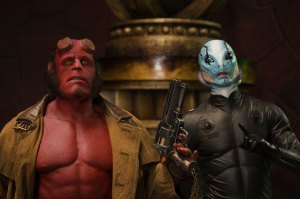
Let me not forget a Nazi assassin and his handy dandy arm-length blades. This assassin is also 100 years old and his body is filled entirely with sand. He winds himself up like a big clock. But if his body is filled completely with sand how can the clock gears work inside? You see what the normal audience member has to deal with? Plus these are just the villains, there’s a whole plot left to toil over as well.
The story revolves around a hulking, red demon named Hellboy (veteran character actor Ron Perlman). Hellboy escaped the space squid dimension in the 1940s when the Nazis unsuccessfully tried to open a dimensional hole large enough for your everyday on-the-go space squid. Now, Hellboy is an elite soldier for the government’s Bureau of Paranormal Research. He fights the creepy crawlies. He has to deal with a wide-eyed rookie, the watch of his “father” (John Hurt) and an attempt to rekindle a romance with a mentally troubled fire starter (Selma Blair). Oh yeah, and all the Nazi/Rasputin/space squid stuff mentioned before.
Perlman is really the only redeeming thing about this movie. The makeup is impressive, and he gives an enjoyably droll performance as a man who fights monsters with the same ho-hum-ness as a plumber reacts to clogged sinks. The rest of the acting runs the gamut of either being too serious (I’m looking at you Blair) or just too over-the-top silly (I’m looking at you, league of villains).
Hellboy is strung together with bizarre inanities, flat one-liners, heavy Catholic imagery, conflicting logic and contradictions, ridiculous villains, painful comic relief, half-baked romance and frustratingly ever-changing plot devices.
Watching Hellboy is like playing tag with a kid that keeps making up new rules as he goes (“You can’t tag me; I have an invisibility shield!”), and after a while you lose any interest. Late in the film, the Nazis will all of a sudden decide not to be immortal, and at a very inopportune time. Why? How? I don’t know. Hellboy also gets sudden new powers for some reason. Like he can bring people back to life by whispering otherworldly threats in their ears. For some reason nobody’s clothes burn when they’re set on fire.

Not only does Hellboy frustrate by changing the rules of its world arbitrarily, it will also frustrate out of sheer uninhibited stupidity. How come characters can’t hear or see a pendulum the size of the Chrysler building? How come during a vision of the apocalypse we see a newspaper that actually had the time and staff, during the Apocalypse, to print an issue that reads, “APOCALYPSE”? Why doesn’t Blair use her pyro superpowers immediately to vanquish all the H.P. Lovecraft creatures instead of letting Hellboy foolishly wrestle with them all? The gaping holes in Hellboy are large enough to squeeze a gigantic space squid through.
All this frustration and insanity might have been moot if the action sequences were somewhat thrilling. Sadly, they are not. del Toro’s action sequences seldom matter. There’s such little consequence of what’s going on that the action becomes stiff and lifeless. The first time we see Hellboy chase a creature through city streets it’s a fun experience, but soon the novelty wears off. The overuse of CGI wears down the audience, and after the third or fourth time we watch Hellboy battle the same monster, the audience is ready to go to sleep. There’s little entertainment in the film’s action sequences but just as much frustration and stupidity.
I have never watched a film that induced more eye rolls, shoulder shrugs, raised eyebrows, pained and confused glances and mutters of, “What the hell (boy)?” Comic book aficionados may enjoy the fruits of Hellboy but general audiences will simply shrug. I’m amazed that the majority of film critics seem to think positively about this movie. Maybe I’m the last sane person in an insane world but Hellboy is one of the worst films of the year and one of the craziest films you could ever hope to see in a lifetime.
Nate’s Grade: D+
——————————————————
WRITER REFLECTIONS 20 YEARS LATER
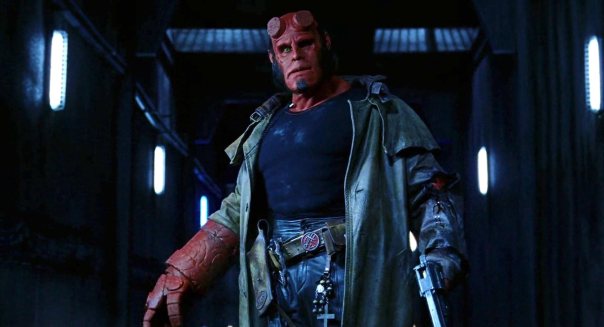
When I first saw 2004’s Hellboy, toward the tail end of my undergraduate years that April, I had no real familiarity with the character and went in with my pal, and fellow college newspaper entertainment critic Dan Hille. I went in a blank slate to the grumbling demonic lug created by Mike Mignola. To say I was underwhelmed would be an understatement in my original review. I had an extremely hard time gelling with the world and finding some firm internal logic, and my general astonishment colored every inch of that incredulous review from a snarky 22-year-old soon-to-be college grad. Twenty years later, we have a sequel, reboot, and a series of animated shorts and feature-length films, so the character is much better known today than back in 2004. I also think its occult-heavy, Lovecraftian world-building has also been further established through mainstream horror and science fiction projects. So, in 2024, I’m more familiar with the title character, the cultural connections and background, and especially Guilermo del Toro as a filmmaker, and I’m still left unmoved by this initial pitch to the character and his weird world.
It took del Toro and company years to get this movie made as the big studios lacked faith in the material, in Ron Perlamn as the lead, and in superhero and comic book properties period. This really was its own superhero story with outlandish villains, oversized heroes burdened with secrecy, shame, and guilt, and heavy themes reaching into religion and determinism. The concept of an underground agency of monsters to fight monsters is a good starting point for stories, and Perlman brings the right degree of curmudgeon charm to the outcast character who might become the ultimate hero of the world or its instrument of doom. The iconography of a demon trying to be a good guy provides a fun sense of irony, as well as a natural point of conflict as the wider world would have trouble seeing past the red skin, forked tail, and big curved horns. It makes me think of the gut-punch reveal from Arthur C. Clarke’s novel Childhood’s End where the benevolent aliens look exactly like the common visualization of a hooved and horned demon. The starting point for Hellboy has potential. However, it’s the rest that ultimately lost me.

Secret agencies and hidden conspiracies working behind the scene need to, themselves, be interesting. Think of the Men in Black and their assortment of goodies and agents. With the Bureau for Paranormal Research and Defense (BPRD), I expect more from the supporting characters and what they can unlock about our understanding of the world and the unknown. There really are only two super-powered supporting players, with Doug Jones playing Abe Sapian, a variation on the Creature from the Black Lagoon gillman, and Selma Blair as a pyrokinetic woman who checks herself into mental asylums to protect others. Both of these characters have possibility and are fellow outcasts like Hellboy, but neither feels sufficiently fleshed out and incorporated into this story. Because of Abe’s scenic limitations of being in water, he serves as more of a taste of “the world world” and narrative device. He’s not even involved in the entire final act of labyrinth misadventures. With Blair’s unstable pyro, her character is relegated to a tormented love interest for Hellboy to save, get jealous, and also save again through even more ludicrous means. For a secret agency, it all feels a little too small.
The biggest side character is John Myers (Rupert Evans, The Man in the High Castle), invented for the movie to be the audience’s entry point into learning more of this strange land of strange creatures. He’s a total bore, and he also doesn’t factor much more into the story than being a living reaction shot. He has one significant moment in the climax, and that’s simply telling Hellboy to remember who he is, ultimately convincing the big man to turn back from his destiny of enabling the apocalypse. Why do we need this character? Can’t another super-powered creature serve this same purpose? Why not Blair’s love interest figure, which would then present more attention on beginning that romantic connection between her and Hellboy? There’s a reason in X-Men that we followed a mutant to learn about other mutants and not some boring human. John Myers isn’t even included in the 2008 sequel, The Golden Army, because by that point he had served his only purpose of introducing us to a new world and being a benign romantic foil.

In a story with literal living Nazis brought to life through the magic of anti-Semitic clockwork, I’m dumbfounded why so much of the movie is watching Hellboy fight these boring lizard creatures with tongue tentacles. I appreciate the emphasis on practical effects and the reality that it’s a bunch of stunt performers in monster suits rather than complete CGI. The movie is another love letter of del Toro’s to his influences. His affection for the monsters and outsiders is apparent in every movie going back to his first, 1993’s Cronos. It’s too bad then that the primary opponent are these rudimentary lizard monsters that feel like the kind of easily disposable pawns you would see heroes fighting in other superhero spectacle. They’re faceless, and the fact they can regenerate and duplicate upon death doesn’t make them more formidable, only makes them more depressing as they can’t be easily rid of. If you’re going to give me giant space squids in an alternate dimension, then give me the giant space squids. If you’re going to give me Nazi zombies led by Rasputin, then give me that crazy mess. Don’t confine these potentially interesting villains to the opening and closing only. I will also say the ending is still a rather sizable letdown as far as how formidable these evil space squid gods might prove in a world of explosive devices and a modern military with a practical blank check for its budget.
Fun fact, at the time of its release, some theaters were so worried about playing a movie with “hell” in the title during Easter weekend, and coming off the ongoing success of The Passion of the Christ that brought in more conservative ticket-buyers, they decided to re-title it “Helloboy” on their theater marquis. I find this absolutely hilarious.
Hellboy has some points of interest, as del Toro was still fine-tuning his brand of fantasy-horror into a more mass-appealing conduit. It’s got terrific makeup effects and some fun ideas, and it’s also certifiably insane. It threw me for a loop back in 2004, and I just couldn’t process this level of hyper absurd elements jumbled together, and it still makes for a bumpy viewing. I enjoyed the 2008 sequel much more, which took more of a dark fantasy bent, and I wonder if I was more accepting of that realm of material than I was for Lovecraftian sci-fi nonsense. del Toro has learned from the Hellboy experience, becoming something of a masterful chameleon. He delivered one of the best kaiju action movies of all time that made me feel like a giddy kid. He created a haunting fairy tale timed to the Spanish Civil War. He created a charming romantic fable where a woman falls in love with a fish and it won an Oscar for Best Picture and he won Best Director. He created one of the most visually impressive stop-motion animated movies of all time that can make me cry like a baby and deservedly won another Oscar. Next up, he’s got another stop-motion animated movie and another creature feature, a remake of Frankenstein. Through his versatility, creative consistency, and inherent ability to find human drama in the most peculiar places, I’ll see any movie that del Toro decides to devote his worthy attention towards. Hellboy though? I’ve seen it twice now, and I think I can leave it at that. I’ll upgrade my earlier ranking but not too higher, Hoo boy is that 2004 review a fun read.
Re-View Grade: C
Share this:

Godzilla x Kong: The New Empire (2024)
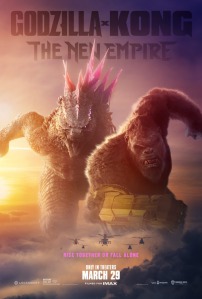 In 2021, the Monsterverse series, begat from 2014’s Godzilla franchise kickstart, finally matched up its two chief prizefighters by pitting King Kong against the mighty Godzilla. It was also by far the most successful movie in the fledgling kaiju franchise, and Warner Brothers was eager to keep the good times running. Now it’s three years later, but Kong is older and weary, living in the Hollow Earth realm below our feet but feeling very alone, the last of the giant apes. Suddenly, he discovers a new world beneath his feet, another level where there are other apes like him. However, they’re ruled in fear from the vicious Scar King, and so Kong needs to call upon his former rival and now tentative ally Godzilla for the ultimate homecoming smack-down.
Godzilla x Kong: The New Empire finds a comfortable resting place as solid disposable fun, a work that knows its real appeal and doesn’t get in the way of it, so why does this movie work for me whereas I had trouble really celebrating the 2021 predecessor? I think it comes down to streamlining and limiting the “dumb fun” to a more manageable quotient. There is still plenty of junk science and goofy moments that will likely inspire their share of guffaws, but I was more pleased this time than overwhelmed in 2021. I had plenty of friends that absolutely loved the 2021 showdown, and I’ll admit the big bouts of monster action were well developed and staged, but for me the dumb was more present than my “dumb fun” threshold could bear. Again, that’s not to say that this newest adventure doesn’t evoke similar eye-rolling. The very revelation of ANOTHER subterranean world and hidden civilization just under the feet of the other subterranean hidden world makes me wonder if every successive sequel will just keep digging downwards, discovering yet another undiscovered world, until they reach the molten core.
 This movie is broken into three storylines and only one of them has the human characters; the core of the movie is Kong’s exploration of the new subterranean world and this is told wordlessly and effectively. The 2021 movie had to juggle multiple human enclaves all having their own adventures and discovering components of our story that would ultimately prove helpful. There was the Godzilla Team and the Kong Team, but did you know that the 2021 movie included all these human characters: our unexpected lead of the Monsterverse now in Hall, the returning new characters from 2021 by Rebecca Hall, Brian Tyree Henry, and Kaylee Hottle, Alexander Skarsgard, Eiza Gonzalez, Julian Dennison, Demian Bichir, Lance Reddick, and the returning characters from 2019 by Millie Bobby Brown, Kyle Chandler, and the son of Ken Wantanabe’s deceased scientist. Top it off with the starring title bout of Kong v Godzilla, and that’s a lot of speaking roles to have to juggle over two hours of monster mash. Having only one human group and only one new significant character (Dan Stevens as a hip veterinarian) helps keep things moving and puts more emphasis on the real big star, Mr. Kong.
Godzilla is sidelined for the second movie in a row to give way for Kong, and it’s the right call as the giant ape is more of a wounded warrior, and his loneliness and desire for community is an easier emotional state to convey than anything from the large enigmatic lizard. Godzilla spends almost the whole movie, leading up to the climax, on a mission where he’s powering up, like it’s a filler Dragon Ball Z episode. It does build a sense of anticipation for his eventual return in the big arena, but it’s clear that Godzilla’s name should be second in the title. He’s presented almost like an angry cat, settling into the Colosseum as an impromptu nap den. With Kong, the emotional arc of a lonely creature seeking kinship is universal and easy to understand even without words. He believes he’s the last of his kind and then to discover a community of those like him, and adjust as an outsider, and then upset the power structure of a bully wrecking havoc. There’s even a budding stepfather-like relationship with a little ape who begins as quite an annoying little stinker and then warms up to this better paternal figure. It’s a simple story of discovery and reunification, as well as overthrowing a corrupt leader, but it’s enough to get you emotionally invested in this giant CGI monster and his giant sense of encroaching ennui.
 The biggest appeal of any monster movie is its destructive action, and Godzilla x Kong delivers in this regard while keeping things fluid and fun. Returning director Adam Wingard (You’re Next) makes sure the big brawls are easy to follow with minimal edits to better orient the viewer. The big hits feel like they matter, and the rules of the different fights and fighters and the varying geography matter. There’s a climactic fight in the Hollow Earth where gravity becomes a second thought, and it’s a tremendous visual spectacle as well as rousing sequence of excitement to watch these giants suddenly weightless and zooming through the air in combat. Wingard also knows when to give his characters their big hero moments, and the team-up between Kong and Godzilla has the same rousing satisfaction as you would wish for two titans of mayhem. I enjoyed the new orangutan villain, the Scar King, a fearsome beast that cannot match Kong for sheer brutal strength but makes up for it in speed and agility, and a whip-like weapon that controls a frost-breathing kaiju through fear and pain. It’s an interesting character at least in design and contrast from our hero kaiju, so it’s not just more of the same but with a horn or something. I have to think anyone coming for some top-tier monster wrestling will leave the movie happy.
As for the human drama, it’s mostly kept along the fringes and there to introduce necessary plot elements that a grunting ape couldn’t more adequately convey. Hall has to worry about possibly losing her adoptive mute daughter who is herself the last of an older civilization. It’s pretty simplistic but acceptable as a parallel about finding one’s place in the world from feeling alone.
Godzilla x Kong is silly and stupid and stupidly fun, appealing to any kaiju fan’s inner child, working that same primordial wonder of monsters and destructive spectacle. For my money, it’s a step above the 2021 initial brawl thanks to scaling down its many assorted plotlines dealing with too many forgettable human characters. The action is rip-roaring and proof that even more can be ceded to Kong and a lack of dialogue to tell this story in a meaningful manner. Wingard still has a natural feel for elevated B-movie material, and clearly this movie is going in a very different route than 2023’s now Oscar-winning Godzilla Minus One, a shockingly affecting post-war human drama that just so happened to have Godzilla in it. It’s a perfect blockbuster to chow down popcorn and hoot and holler along with our giant avatars of childhood glee.
Nate’s Grade: B
Share this:

Teenage Mutant Ninja Turtles: Mutant Mayhem (2023)
 As an elder millennial, the Teenage Mutant Ninja Turtles have been a formative franchise for me. I grew up on the cartoon, got the toys for Christmas, died endlessly during the shockingly hard underwater stage of their Nintendo video game, and generally have a soft spot in my 80s nostalgia for the likes of Leonardo, Donatello, Raphael, and Michelangelo, plus their surrogate father, Master Splinter. Apparently Seth Rogen felt the same way, and he and his writing partner Evan Goldberg have spearheaded a new animated variation of TMNT that just so happens to also be co-written and directed by the man behind my favorite film of 2021, The Mitchells vs. The Machines. It was a recipe to guarantee my personal enjoyment, and Mutant Mayhem thusly delivered. The biggest selling point for me was how lovingly realized the “teenage” part of the title was, getting a foursome of actual adolescents to portray our heroes, and using high school experience about acceptance and fitting in as effective and even poignant parallels. I loved just hanging out with these characters, who view their surrogate dad (voied by Jackie Chan) with a mixture of love and embarrassment, and who want to be accepted by a world predisposed to finding them monstrous. Naturally, becoming crime-fighting heroes is their best method for winning over the public, with a young and aspiring journalist April O’Neil (The Bear‘s Ayo Edebiri) hoping to improve her own social standing at school by breaking the existence of these unknown mutants. The comedy is robust and layered while allowing for nice character details and moments, giving each turtle their own satisfying arc. The action is fun and inventively staged while still being thematically relevant. The vocal cast is great, and the young actors are tremendous together, sparking an enviable improvisational energy that made me smile constantly. The art style has an intentional messiness to it, like smeared colored pencil drawings, and the imperfections are themselves part of the vast visual appeal. It’s a family movie that will succeed with old fans and new, and Mutant Mayhem is the best film depiction yet of the famous heroes in a half-shell.
Nate’s Grade: B+
Share this:

Rumble (2021)
 No more and no less than exactly what you’re expecting, Rumble is a giant monsters wrestling movie that’s cute enough to entertain young kids and pass the time agreeably and not much more. The world isn’t exactly fleshed out and the characters are very archetypal and the plot is entirely predictable, but I found it mostly fun and low-level escapism. It’s nothing that will wrestle with the better animated films of the year, but if you have little ones that are fans of wrestling or giant monsters then that might be enough to keep their attention for 90 minutes.
Nate’s Grade: C+
Share this:

Eternals (2021)

Chloe Zhao is the biggest name Marvel has gotten yet for its cinematic universe (MCU). Sure, they’ve had major directing names before like Kenneth Branagh and Ryan Coogler, and successful populist genre filmmakers like Jon Favreau and Joe Johnston and Joss Whedon and Shane Black, and quirky auteurs like James Gunn and Taika Watiti. However, Zhao is the first Academy Award-winning director to jump into the Marvel sandbox. Zhao seems like an odd fit for something as mainstream and successful as the MCU, but she was excited to tell a big story with the biggest studio operating in Hollywood. Eternals (no “The”) is just as much about the question over what it means to be human as Zhao’s Best Picture-winning Nomadland, and it’s a lot easier to watch with one hundred percent less Frances McDormand pooping in a bucket in her van (granted, she did win an Oscar for that performance). Eternals has received the lowest critical rating of any MCU film in its thirteen-year history and I’m trying to figure out why.
Thousands of years ago, the Eternals were created by the Celestials, powerful beings that are responsible for birthing new galaxies into the universe. The Eternals were sent to protect the inhabitants of Earth from the Deviants, terrifying tendril-heavy monsters that will consume and overrun a world. The Eternals are instructed by their masters not to intervene in human conflicts; only to intervene to save them from Deviants. Now that the last Deviant has been dead for over 500 years, the Eternals have settled into comfortable lives among present-day humans. Then the Deviants return, evolving with added powers and posing a new threat to humanity and the Eternals, but the real threat might be outside the confines of Earth.

Eternals feels like a different kind of Marvel movie in that stretches feel like it’s a Stanley Kubrick movie, or a Terrence Malick movie, or a DC movie. The plot structure and tone even reminded me of Watchmen. Don’t get me wrong, the standard Marvel elements are recognizable, but this is a much slower, more methodical, more cerebral, and more challenging movie that really feels like a distillation of Zhao’s humanist indie naturalism and the crazy cosmos from Jack Kirby’s trippy source material. I can understand why some people would find this movie to be boring and poorly paced. There are extensive flashbacks and setup. It definitely doesn’t need to be a staggering 157 minutes long, second only to the three-plus hours of Endgame. Granted the movie is introducing a dozen characters, their relationships, their powers, their histories, as well as a new history for the universe that doesn’t relate to anything that came before it. There are assorted references to Thanos and the events of Endgame, bringing half the population back, but this is more a standalone movie that can serve as an introduction for those less well-versed in two dozen movies’ previously on’s. I knew going into Eternals it was going to be slow, and I knew several friends that outright hated it, but I think pacing is more to its benefit and detriment. The scenes feel like Denis Villenueve (Dune) is pacing them, where moments are given more time to breathe and where characters are given space to reflect and absorb. Like a Villenueve film, Zhao wants her audience to take in the grandeur of the moment, but she also wants the characters to be able to take in the drama of their circumstances. Some people will find it all too boring, and while there were points that could be trimmed, I was enjoying myself because of the attention to character perspectives that are given precedence over splashy beat-‘em-ups.
I was drawn in by the character reveals, their conflicts, and the time Zhao allows to examine their emotional and philosophical states. Look, it’s still a big, action-packed Marvel movie with plenty of monster fights and a world-saving cataclysm climax, and while those are agreeably executed, I was more taken by letting the characters pontificate on their problems. There’s Sprite (Lia McHugh), an eternally looking child who can never live an adult life she craves. There’s Druid (Barry Keoghan), a man with the power to control the minds of all humans on Earth but is explicitly instructed to remain hands-off with their conflicts. He is severely torn and emotionally wrecked over watching them slaughter one another and knowing he has the power to intervene and resolve genocide, prejudice, and poverty. That’s the eternal question over why a loving God seemingly chooses to be hands-off, all rolled into one character. There’s Thena (Angelina Jolie), a legendary warrior of physical renown but whose mental state is fracturing and who poses a potential lethal threat to her family. There’s her partner, Gilgamesh (Don Lee), who would rather watch over his love as she suffers and potentially declines than have her lose her identity and erase herself. There’s Phastos (Brian Tyree Henry), a man who only wants to help the humans with his technological skills but regrets his contributions and declares humans as unworthy of their keep after Hiroshima. Then there’s a reveal halfway through the Eternals that loads a needs-of-the-many sacrificial debate that positions different characters on different sides of the divide for the final act. I enjoyed that even the villains are presented with their rationale and are tortured over their choices they deem to be necessary for the greater good.

I’ve written a lengthy paragraph all on the meaty character conflicts, and none of them revolve around the goal to gather a magic item or learn a special power. I didn’t mind Zhao’s movie taking its sweet time to allow these conflicts and struggles to be felt because they were evocative, and Zhao’s storytelling shines when she focuses on the noble and often tragic struggles of people being complicated, contradictory, and confusing. Even the big dumb beasts evolve and have a perspective that has an understandable complaint. The final confrontation doesn’t come down to a giant sky beam and an endless army of disposable CGI brutes. It rests upon character conflicts and a romance that spans thousands of years where empathy is the secret weapon. Early on, you think it’s going to be a love triangle, and the movie just teleports out of that trope. I found myself more invested in the ending, even if I could already predict the conclusion. I was more interested in what the conflict was doing to the Eternals as a family fracturing under the weight of their destinies and the consequences of defiance. The film ends on a cliffhanger with significant fallout, and I don’t know how the rest of the MCU is going to square what we learned and accomplished here. This seems in sharp contrast to everything down the road.
Eternals is also an often beautiful-looking movie with Zhao’s penchant for natural landscapes and magic hour lighting. The editing and photography feel nicely matched and allow the viewer to really soak up the natural splendor and the impact of the battles. The action is kept at a human level with the camera tethered to the characters even when in flight. There is the occasionally eye-opening shot of a landscape, or Zhao’s use of visual framing, or the special effects revelations that reminded me of 2001: A Space Odyssey. It’s certainly not the most breezy, action-packed movie in Marvel’s lengthy canon of blockbusters, but it’s not devoid of spectacle.

So then why has Eternals scored so low with film critics and a significant portion of general audiences? Some wonder if the level of diversity and inclusivity of the movie is a factor; we have many non-white characters including a deaf character and a gay male character in a committed relationship, with a genuine and loving onscreen kiss no less (your turn, Star Wars franchise), and that seems like a trigger point for certain fans that grumble about “woke culture.” I’m sure for some that’s a factor. I think the length will be a factor too. I think the elevated emphasis on emotional stakes and philosophical conflicts might be another factor. This doesn’t feel like any Marvel movie that has come before. It’s much more comfortable with silences, with patience, and with cerebral matters (again, not to say the dozens of other MCU entries were absent these). This one is just different, encompassing the directing style and humanist attentions of Zhao and looking at a far larger scope of drama than toppling one super-powered being. I saw this in theaters with my girlfriend’s ten-year-old daughter and her friend and they both said they enjoyed it, so I won’t say it’s too mature or impenetrable for younger viewers. Eternals might be too boring for some, too long, and too different, but I was happy to endure it all.
Nate’s Grade: B
Share this:

The Tomorrow War (2021)
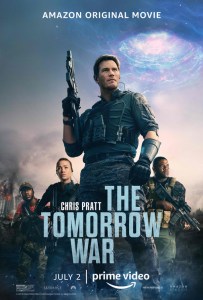 Amazon’s new movie, The Tomorrow War, is the costliest original blockbuster of the summer, and it’s skipping theaters entirely. The $200 million-dollar sci-fi movie was originally slated for theatrical release in December 2020, then pushed to summer 2021, then sold to Amazon streaming for the cost of its production budget. It’s easy to grasp the excitement of its premise and how it could translate into engrossing escapism. At the 2022 World Cup, a flash of light transports a team of future soldiers who need enlistments. In a matter of months, the world will be facing a war between alien monsters, and by 2050 we will be on the verge of losing for good. Dan Forrester (Chris Pratt) is a science teacher/ex-veteran who is conscripted into the future war, along with some other unlikely soldiers, and thrown into the future. His tour will last one week and then he’ll be sent back to 2022, if he survives, and only twenty percent come back.
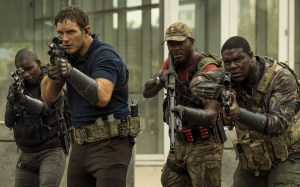 Perhaps it was the allusions or homages to Starship Troopers, but I found the first act and the action before the action to be the most interesting part of The Tomorrow War. I was hoping with its time travel premise of a future war fought by the past that there would be some attention paid to the world building and implications of its premise, at least before it became hunting down monsters and shooting in corridors, and thankfully the movie actually takes some sweet time to lay its foundations before being conscripted itself into action movie spectacle. Much like Starship Troopers, we have people unprepared for a war against an alien species and essentially being tossed into basic training as cannon fodder for the military industrial complex. I enjoyed that the screenplay by Zach Dean (Deadfall) actually plays out some of the larger effects that its future confirmation would stir. Effectively, humanity knows that in thirty years it’s all over. There is a definitive end date. Knowing that thirty years is all civilization has remaining would cause all sorts of global, social, and psychological upheavals. Why bother going to school if it’s all over in thirty years? Why try and start that business if it’s all over in thirty years? Why start a family if your children will be doomed in thirty years or less? Society would be irrevocably changed, and sectors and populations would refuse to go back to the way things were, and instability would flare up with generations sore over their lack of Earthly inheritance.
That’s just one factor that gets attention during this first 45-minute section. The nature of the future conscripting people of the past to fight their war has plenty of political commentary about generational conflict, proxy wars, and how the poor are disproportionately affected with less choice. The soldiers being taken from the past are older and an unorthodox pool of candidates that wouldn’t meet contemporary military recruitment standards. This is because the people being sent to fight are already dead by the time 2050 rolls around to avoid any time paradox concerns. There are interesting implications here. It’s like their own governments are saying, “Well, you’ll be dead anyway, so you might as well die now rather than much later and maybe you’ll provide a more immediate need other than taxes. Thank you for your service, now die.” Again, the psychology and ripples of that can be fascinating. I’m skeptical why more 2022 Americans are not disputing why they should fight 2050’s war with their own flesh and blood. I suppose I wanted this intriguing premise to be played out more in the span of an ongoing TV series, something along the lines of the elegant existential bummer of HBO’s The Leftovers. As a feature, The Tomorrow War gets beaten into blockbuster shape to become another noisy sci-fi spectacle, but the potential of its premise and the bombshells of its world-building deserved even more deliberate consideration.
 When the action picks up, The Tomorrow War follows a predictable path of alien invasion military thrillers. Dan’s unit must go into enemy territory and retrieve an important thing before the aliens overrun the facility as well as before the Army firebombs the block. There are many ticking clocks built into the plot mechanisms, from Dan’s week-long sojourn into the future ticking clock, the overall “humanity’s last stand” ticking clock, the ticking clock of getting needed lab components before destruction, the ticking clock of synthesizing a magic alien cure, and there’s likely others I haven’t even noticed. That cluttering of urgency extends also to its personal exploration of two sets of frayed familial relationships, father/daughter and father/son across three generations. It’s simply too much and detracts from more time and attention being given to the elements that demand the most development. The father/daughter relationship has the most meaningful drama considering it covers multiple periods of time and pushes Dan into thinking more critically about sacrifice and legacy. The broken father/son relationship between Dan and his absentee dad (a buff J.K. Simmons) is unnecessary and put on hold for too long and then hastily tied together. The Tomorrow War is an unlikely candidate of having too many conflict elements and points of urgency that they can dilute one another.
This also gets into an extended third act that feels entirely tacked on. After a critical climax, I grabbed my remote to pause the movie with the belief that things were wrapping up shortly. I was shocked to see I still had another 30 minutes left to go. The mountain-set final action set piece feels like a late studio addition rather than an outgrowth of what was established in the screenplay. Strangely, the characters don’t seem to be acknowledging the reality of cancelling out the alien-invasion nightmare future with their actions. If Dan has the magic elixir to thwart aliens, and goes back to 2022, then he can prevent the billions of eventual deaths. I suppose that does nothing for those in 2022 that got zapped into 2050 and died in the line of duty, but it spares everyone else from 2023 onward. I started yelling at the screen that preventing the terrible future meant good things.
 As far as the quality of action, it’s a cut above thanks to director Chris McKay (The Lego Batman Movie), making his live-action film debut. I’ve noticed with other directors who primarily got their start in the realm of animation that they have such a great command of filling up the screen. Brad Bird, Travis Knight, Phil Lord and Christopher Miller, and Tim Burton, all of them have an extra artistic sense of how to use the space of the frame to immerse the viewer. I greatly appreciated that many of the sequences where the soldiers fight the alien monsters use long takes and clear editing. There’s one scene where soldiers are trying to wrangle a monster as a hostage and all the fighting and buckling is impressively presented with sufficient distance so we can see the soldiers react and go flying. The introduction of the alien monsters is drawn out of the shadows, but from that moment onward the movie presents the monsters clearly, and I enjoyed the squid-meets-feline creature design enough that I welcomed more closeups. There’s also a horrifying and darkly comic tech mishap where the future accidentally zaps its new recruits into 2050, but instead of re-materializing five feet above the ground it’s 100-plus feet high, so we watch people hurtle to their awful deaths. McKay can replicate standard studio action movie grist seen in plenty of other big-budget blowouts (there are multiple examples of characters slow-motion jumping out of the way of explosions), but more often McKay has a natural eye for visual compositions and how to bring out more with his sci-fi spectacle.
One of the bigger miscues of the movie was the hiring and prominence of Pratt (Jurassic World) as the lead. He’s got the presence and build to be convincingly ex-military, but he’s not a good fit for an everyman, let alone a family man everyman scientist. He’s a high school science teacher going through personal malaise because he feels like he’s meant for something bigger (what’s bigger than saving humanity, guy?) and this ordinary life just ain’t cutting it. Except Pratt can do charming and affable, he can even do heroic, but this part does not play to the actor’s strengths, so Dan often comes across as plain and bland. He’s stuck as the square-jawed straight man for the movie and is boring once he goes into action or thinking mode.
 I wished the movie had been retold from the point of view of Charlie, played by reliable comic Sam Richardson (Veep, Werewolves Within). He’s a welcomed voice of panic and reason among the avalanche of sci-fi, science, and military jargon. He’s a widower, losing his wife on her own tour of duty, and he feels greatly out of place. The actor is so amusing and the character so unexpectedly entertaining that I wish Pratt’s hero had bit the dust early as a meta head-fake (think of Seagal getting killed off early in 1996’s Executive Decision) and we were left to follow Charlie as humanity’s unexpected savior. Along the conversation of waste, Betty Gilpin (The Hunt) is shortchanged as Dan’s wife in 2022 world. They introduce a plot point that family members can be conscripted in place, and then there’s the transport glitch that kills all but a few, so I assumed that an actress of Gilpin’s kick-ass capability would find herself in the future fighting too. Alas, dear reader, Gilpin is just here to be the concerned wife at home waiting for her man to return.
The Tomorrow War is an original story though it’s built from older, recognizable parts, a little Independence Day here, a little Alien there, and a dash of Edge of Tomorrow. It’s derivative but it still has its own points of interest, chief for me is the world building and premise. The action is solid and filmed well. The scope of the special effects fits comfortably in the blockbuster studio range. It’s a good-looking movie with plenty of action and enough time travel quirks, though your attention may also flag as the movie lurches to a protracted close with its extended third act. It does more right than wrong as blockbuster spectacle. I think it had offshoots of better potential that could have been tapped, but as a big screen entertainment ported to your smaller home screen, The Tomorrow War is destined to win fans with lowered expectations and 140 minutes of free time.
Nate’s Grade: B-


 nathanzoebl
You must be logged in to post a comment.