Blog Archives
The Tillman Story (2010)
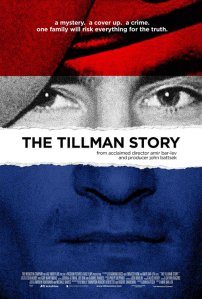 Perhaps better than any movie I’ve ever seen, the searing documentary The Tillman Story explores the nature of shared grief and whether a family is even entitled to privacy when the world feels like it has a shared pain in their loss. This documentary focuses on former NFL star Pat Tillman who enlisted in the Army Rangers in 2002 and was killed in 2004 in the mountains of Afghanistan. He was hailed as a hero of battle, saving his men from enemy ambush, but the truth was really far less sensational but just as damaging. Tillman was killed by friendly fire, a fact the Army admitted only with their backs against the wall. Tillman was their most famous soldier and became a recruiting poster for the post-9/11 armed forces. The doc recounts Tillman’s family struggling to get a straight answer from Army officials and government goons who felt the truth could not compare to a good story. While recreating the events that lead to Tillman’s death in a mostly commanding manner, the doc’s real draw is exploring the idea of a family who has had their private mourning torn away, who are trotted around the nation to events memorializing their son, turning him into whatever symbol best serves personal agendas (conservative pundits are seen in stubborn disbelief when it comes to processing the news that Tillman read Noam Chomsky, thought the Iraq War was illegal, and was going to vote for John Kerry in 2004). What gets lost in all that patriotic maneuvering is a complicated man who didn’t want to become a myth.
Nate’s Grade: B
Share this:

The Men Who Stare at Goats (2009)
 This movie was a big letdown given the cast, the strange true origins of this fantastic tale, and even with the title. This odd little film feels tonally off. The material feels mishandled, mixing broad humor and with military satire and the dark realities of the war in Iraq. The premise is solid — a Pentagon program training psychic soldiers, men convinced they could run through walls or terminate goats through the power of thought. Why then does the movie feel so misguided and rudderless and, ultimately, boring? Never has such an outlandish concept, based on true events, felt so devoid of edge. The satire picks safe targets and the comedy remains farcically broad. I think the film’s downfall can ultimately be traced to the decision to turn this material into a fictional narrative. I would have preferred an actual documentary detailing the men, women, and goats involved in the real Pentagon program. If truth can be stranger than fiction, why dress it up and then dull it through fiction?
Nate’s Grade: C
Share this:

Green Zone (2010)
 I have noticed that I’ve really been dragging my feet when it comes to writing a Green Zone review. I’ve prioritized it only to have something more necessary (catching up on VH1 reality shows) come to the forefront of my attention span. It’s not like the movie is bad. It may have been misleadingly advertised as Jason Bourne’s tour of Iraq, bringing back together Matt Damon and director Paul Greengrass (The Bourne Supremacy), but it’s not bad. It’s a perfectly fine movie, except in this instance, given the politically explosive and monumentally relevant subject matter, “perfectly fine” sounds like a missed opportunity. This movie should be incendiary, shocking, aggravating, enlightening, and if it happens to be entertaining then that ain’t bad either. The subject matter –the false rationale for war, WMDs– deserves a sober examination. Green Zone is not that movie. Green Zone is about uncovering and righting the mistakes of the Iraq War, and I believe I figured out what keeps Green Zone from being a better, more powerful, more engaging movie — it fictionalizes a story that is already wroth telling. This is a true story that could have stood well on its own merits.
Shortly after the fall of Baghdad in 2003, Chief Warrant Officer Roy Miller (Damon) is on the hunt for those weapons of mass destruction (WMD), the chief argument for invading Iraq. His team investigates suspected weapons sites but they keep coming up empty. The intelligence appears to be in sharp contrast with the reality on the ground. Miller butts heads with shady government officials (Greg Kinnear) and finds aid in a state department realist (Brendan Gleeson) and a reporter (Amy Ryan) who put her reputation at stake parroting the government intelligence as fact. The Iraqi army is disbanded and now the former generals under Saddam Hussein are conferring what the next steps should be. General Al Rawi (Yigal Naor, who played Saddam in a TV mini-series) is waiting for the Americans to extend a hand, and if not then they will become an insurrection. Miller is racing to track down Al Rawi because he knows the truth in the lead up to the war, which is why those shady government officials are also trying to kill him.
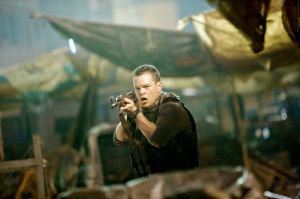 Based upon reporter Rajiv Chandrasekaran’s book Imperial Life in the Emerald City: Life Inside the Green Zone, the filmmakers have resorted to a fictional narrative informed by the real events. My biggest gripe is this: the true story is far more interesting, complicated, and relevant than concocting a story about one military man’s search for answers. The film is laid out like a conspiracy thriller, where our hero gains a small sliver of information that leads to another piece, and another and another, until finally a picture emerges. I get it. With Damon as a soldier, the audience has an obvious rooting point, a protagonist who we can easily be labeled as good. And then when he uncovers the truth, and alerts the media, it provides a tidy, satisfying end for the movie. Except that’s not what happened. In the real world, the hunt for those phantom WMDs carried on for months, and the news trickled drip by drip. There were no smoking guns, no white knights to shine the light of truth (Joe Wilson and Valerie Plame might be the closest in consideration), and there wasn’t anything as conclusive as a military officer writing a report and sending it the mainstream media.
Green Zone attempts to craft a satisfying close to the WMD hunt and likewise the war itself. This is nothing more than revisionist wish fulfillment, wanting to insert a hero of conscience and ability during a time where we had a malaise of responsibility from those in the realms of higher command. And just to make sure they don’t make too many waves, Greengrass and screenwriter Brian Helgeland (Mystic River) wrap their crusading character in the uniform of America’s finest, making it difficult to criticize his noble hunt, striping away politics. The trouble is that the Bush Administration rarely made apolitical decisions; everything was steeped in politics, even the truth about weapons of mass destruction. So Green Zone does the audience a disservice by trying to play nice, setting up a villainous fictional straw man, and forgoing naming the names of those that led this country astray. Because of placing the film’s point of view squarely with Miller, we never get to examine the bigger picture, the manipulations and machinations that led to war. We are stuck in a very limited focus of finding the WMDs.
 Now, I must ask whether or not I’m unfairly judging the movie. Hollywood has often taken fascinating and momentous true-life stories and redirected them toward fiction. Green Zone is certainly a technically proficient film. Greengrass’ trademark shaky camera is ever vigilant, always roving and looking for the action; although in a realistic war setting, the kinetic handheld camerawork can come across as potentially hyperactive. Conversations between two people can come across like intense linguistic battles. Walks down hallways can appear to be speedy jaunts brimming with purpose and anxiety. The tension just doesn’t materialize. Without a nervy story, the Greengrass visual staple can seem over the top, antsy, nervous, and also annoying. This is one narrative for Greengrass that could have improved by the dedicated use of a tripod.
Green Zone is not Bourne at all. The Universal marketing team was trying to hoodwink the public into seeing an Iraq War movie. Damon isn’t as polished and in command as Bourne. Those who argue that Green Zone is anti-American or anti-troops are grossly missing the point. Reactionary, bellicose rhetoric, without a wit of substance, is part of the reason the U.S. is currently in Iraq. You can argue against policy, including war policy, and still be considered a patriot. Patriotism is not synonymous with warmongering. It’s too bad that the filmmakers felt that the true story wasn’t good enough to be told, instead settling for a decent if unmemorable political thriller. This adaptation takes the most significant foreign policy event in modern American history, one where the ramifications will be felt for over a generation, and clears all the hard-boiled details to attach a conventional one-man-fights-for-truth tale. It’s hard to get self-righteous when the movie keeps trying to cover its own ass.
Nate’s Grade: B-
Share this:

Dear John (2010)
 Best-selling author Nicholas Sparks is probably a perfectly reasonable human being. I’m sure he’s great at parties and that people love him. He may even have a dynamite recipe for sugar cookies. But I don’t know what happened to Sparks to turn him into the romance genre’s angel of death. His novels have followed a familiar practice of big Third Act deaths that usually deny readers their cherished happy endings. Is the motive to push people to make the most of our preciously little time spent on Earth? Is Sparks just sadistic and has found the secret to eternal life — the tears of millions of housewives and teenager girls. Whatever his rationale, another commonality for Sparks is that the film adaptations of his books are pretty corny and dreadful. A Walk to Remember, Nights in Rodanthe, Message in a Bottle; all about romance ultimately denied, none coming close to watchable. Dear John can at least be called watchable; however, watching should be limited to the confines of your living room TV when there’s nothing else on.
It’s the spring of 2001, and John Tyree (Channing Tatum) is enjoying his two-week leave from the military. He’s out surfing the fine North Carolina beaches when he rescues the handbag of Savannah (Amanda Seyfried) from being washed away. They two of them casually chat and soon those chats lead to barbecue invitations, parental visits, and kisses in the rain (a romantic movie tradition). Savannah takes an interest in John’s eccentric father (Richard Jenkins) because she recognizes his condition as autism. She’s been helping to watch her neighbor’s autistic child. Savannah would like to start her own horse camp for the autistic (sounds like an insurance nightmare). Life seems so full of promise and John promises to be back as soon as his military commitment expires in six months. Then 9/11 happens. John re-enlists and extends his tour another two years. This places great strain on his relationship with Savannah, but they write each other countless letters that manage to find John no matter what far-flung village he’s stationed at. Can their love exists on a series of hand-written letters? Well, look no further than the classic implications from the film’s title.
 Dear John goes through all the traditional Nicholas Sparks waterworks trademarks: young love leads to yearning, which leads to heartbreak, which leads to more yearning, which then inevitably leads toward one of the leads dying and everyone learning some sort of shallow profound meaning about life, blah blah blah. There are plenty of heightened melodramatic elements thrown into a fairly traditional, unspectacular love story, but all potent potential moments of drama feel underwhelming pretty much because the audience doesn’t care. John and Savannah are perfectly nice people and their love has that hopeful bloom, but their relationship is no more involving than watching a pretend couple in a commercial for greeting cards or life insurance. These people are vanilla. It makes it astounding, then, that such highly charged elements like cancer autism, and 9/11 fail to leave any impact. Dear John confuses listing dramatic events as drama itself. The dramatic stakes feel entirely too mellow and the film generally has a detached feeling, like it’s purposely distanced from the material for fear of getting too involved. This is a relationship movie that has its own commitment issues.
The military angle is respectfully explored, though not in much depth. John is torn apart by the pull of returning to his beloved but also of serving his country and, more personally, keeping his band of brothers in arms together. It’s a complicated scenario but the military commitment is another item in a list that should grab your interest but fail to do so. 9/11 isn’t given any deeper consideration other than the fact that it serves as a roadblock between our two lovebirds. If you want to see a more nuanced, complicated, and empathetic view of today’s overburdened military, check out the movie Stop-Loss, which also stars Tatum.
 The film drops any facade of being a romantic drama about midway through when Seyfried gets completely sidelined. She’s less a character and more an agreeable plot device; she’s self-aware and kind and knowing and receptive yet also naive. This makes her sudden character shift rather jarring, which seemingly paints Savannah as extremely co-dependant. Dear John then transforms into a serviceable father/son drama. There are some nice and moving moments between John and his father; this should have been the real focal point of the movie. Jenkins acts circles around everybody in this movie. It’s wonderful seeing a grown-up in these kind of movies show the kids ho this acting thing is done. Tatum actually might become a pretty good actor. He convincingly plays the more emotional moments well. He may very well prove to be the Patrick Swayze of his generation. Tatum can dance (Step Up), make the girls cry, and also handle some rock-socking action (G.I. Joe, Fighting, most of Tatum’s other movies). I think there’s an actor buried beneath that daunting physique waiting to blossom. Don’t disappoint me, Channing.
Dear John is a formulaic romance trained to seek pre-programmed audience responses (“Now you will laugh. Now you will cry. Now you will cry again. Now you will once again continue to cry…”). Lasse Halstrom (What’s Eating Gilbert Grape, Cassanova) directed this movie but you’d never be able to notice. I don’t want to be too harsh on the film because the acting is pleasant the story isn’t repulsive and does have some good moments, but mostly the movie comes across as bland and remote. The romance seems absent a beating heart to keep things moving. It’s all too lifeless. The character of Savannah best summarizes Dear John as a whole: mild pretense of wisdom, pretty to look at, genial, but fairly bland and difficult to convince is worth your valuable time.
Nate’s Grade: C
Share this:

G.I. Joe: Rise of Cobra (2009)
 While plenty stupid, the big-budget G.I. Joe movie is actually passably entertaining. Sure the characters are one-note, the motivations and romances are strained, the acting is abysmal, Dennis Quaid looks to be in particular pain, the plot has too many unneeded flashbacks, the special effects are cheesy, and the movie is crammed with deliberate toy merchandizing connections, but I had fun with this flick. Director Stephen Sommers (The Mummy) works the right kind of stupid, the loud noisy kind that manages to tickle a childlike sense of glee like watching an eight-year-old’s imagination blown up on screen. The scale of weapons and special vehicles and special suits and special ladies in special leather outfits for engaging in criminal activity should delight younger film goers. The action is frenetic (if there is a pane of glass within 100 miles, the movie assures that you will see it shatter) and the international collateral damage is colossal, so much so that G.I. Joe almost comes across as a goofy, straight-laced version of Team America. Certainly the benefactor of rock-bottom expectations, G.I. Joe: Rise of Cobra is a brash blast of acceptable action movie stupidity. Grab a big bag of popcorn, shut off your brain, and enjoy the film’s cartoonish yet entertaining qualities.
Nate’s Grade: C+
Share this:

The Hurt Locker (2009)
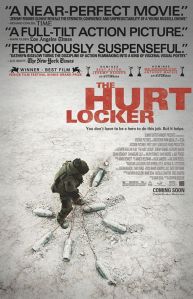 The Hurt Locker is an action movie on a very human scale. Sure there is a time and place for your Michael Bay-esque action vehicles, the type that scorch square miles and leave recognizable world cities in ruins. However, those kinds of action movies are never the kind where storytelling ever enters the fray beyond a meager question of how to get from Point/Explosion A to Point/Explosion B. In fact, Bay openly admits to planning the story of Transformers 2 by working on various action sequences during the 2007 writer’s strike and then tasking screenwriters to connect the dots. The Hurt Locker exists in a frighteningly believable world. This isn’t a movie about explosions but about the extinguishing of explosions. It follows the Explosives Ordinance Disposal (EOD) unit, tasked with detecting and detonating bombs and other improvised incendiary explosives (IED) in the field of combat. You will not be restless for loud “booms” while watching The Hurt Locker. In fact, you will be on pins and needles hoping that you never hear another loud “boom.”
Delta Company are the men responsible for protecting the other soldiers by disposing of bombs. The new team leader, Staff Sgt. William James (Jeremy Renner) has defused over 800 bombs during his tour of duty. He knows he’s the best and he’s addicted to the thrill of being so close to death. He will make occasionally reckless decisions putting himself, but not his fellow company men, at higher risk. This does not sit well with Sergeant JT Sanborn (Anthony Mackie), a by-the-book type that doesn’t appreciate his officer chasing a thrill. The other EOD unit member, Specialist Owen Eldridge (Brian Geraghty), is a man more accustomed to taking orders than giving them, and his indecision may have actually cost the life of the former head of the EOD. Both Sanborn and Eldridge worry that their new team member is going to get them all killed.
 Director Kathryn Bigelow (Near Dark, Point Break) has been directing male-centered action flicks for over two decades; it’s been seven years since her last feature, the regrettable Harrison Ford submarine flick, K-19: The Widowmaker. The Hurt Locker is her finest work to date by far. Her action sequences are visceral and downright agonizing to sit through. She is masterful at setting up the geography of the set piece, ratcheting up the suspense, adding organic obstacles and complications, and then makes sure with her camera and editing that an audience knows exactly what’s happening to whom for every minute that ticks off the clock. Bigelow takes her time to establish the particulars of her locations and sequences, allowing the audience to, surprise, understand what is happening and better engage in the movie. Bigelow chose to shoot the movie in Jordan, the neighboring country to Iraq, and the locations and actual refugee extras add an unvarnished sense of realism. The movie goes without music during much of the action, which makes it all the more uneasy. There isn’t any over eager composer telling you how you should feel, no direction that now things will get even more hairy. You will feel every second of danger, and Bigelow crams in a whole lot of danger. Things can go wrong very, very quickly.
There’s nothing to action cinema quite like the bomb that’s only a few tick-tocks away from doing its dirty work. Do you cut the yellow wire or the green wire? Never cut the red wire. The bombs found in Iraq are a stark range of death. There’s the crude incendiary device just wrapped up in garbage, but then there’s also the fiendishly clever devices with multiple charges and there are grotesque devices as well. At perhaps the film’s most guttural and shocking moment, Staff Sgt. William James finds the corpse of an innocent stuffed with explosives. The easiest thing would be to simply detonate the bomb, but that would also desecrate the body of someone we have come to know. Watching James snip open the crude stitching and dig inside the chest cavity, if we didn’t know then we know now, Bigelow has made sure that The Hurt Locker is the most emotionally resonating contemporary war film in memory.
 Bigelow and screenwriter Mark Boal, an Iraq War journalist, create a vivid sense of dread, antipathy, and most of all, paranoia. Is that a kite flying in the air or is that a signal? Is that a nondescript observer with a cell phone or is that a terrorist with a remote detonator? Is that child being friendly or collecting intelligence? Your mind will race through all these possibilities because Bigelow teases out her action sequences to an unbearably taut level. The audience cares about these soldiers and wants to see them make it back home (we’re informed how many days Delta Company has left on their tour throughout the film), which Bigelow uses to her advantage at every turn. What happens matters. My nerves were frayed during several sequences, including one where the soldiers are pinned down by distant enemy gunfire. The moment turns into a duel and a chess game, as each side tries to adjust their gaze in the searing heat and measure their long-range shot before the other side beats them to it. Then the sequence turns into a waiting game. This is the kind of movie that keeps you poised on the edge of your seat fearful that at any moment something disastrous will suddenly happen. Every time Staff Sgt. William James went back out to defuse another bomb, my sense of dread intensified. I began to doubt everything that I would ordinarily take for granted in other movies.
While being a top-notch action movie, Boal (In the Valley of Elah) has also crafted a great character study. In between the bomb episodes we learn more about these men, which makes it all the more hard to see them then head out to defuse another explosive. The film opens on a quote equating war as a drug, and we explore this notion through the character of Staff Sgt. William James and the weight his unique duty bears. It takes a special person to volunteer for defusing roadside bombs. The defuser must be extremely intelligent, be extremely cool under pressure, and be able to work in a giant suit that makes them look like a chubby astronaut, while enduring debilitating desert temperatures of 110 degrees. It sounds like a suicide mission. James is an adrenaline junkie and war is his drug. He exudes a Zen-like calm in the heat of the moment and this is now the only life for him. Shopping for cereal back home has lost its meaning. Being a husband has lost its meaning. His life now has one purpose. Renner (28 Weeks Later, North Country) gives a stirring performance laced with cavalier confidence and resignation. Mackie (Eagle Eye, We Are Marshall) is also another standout in the pared down cast. When he laments about the dishonor of having no one to remember you in death, you feel the man’s existential sorrow.
 Ignore the political cranks that decry The Hurt Locker as another partisan anti-war film from Hollywood. The American public has been mostly indifferent to any contemporary movie that aims to tackle our current military conflicts in Iraq and Afghanistan, but The Hurt Locker eschews the politics of war to focus on the realities and dangers of its characters. These guys are more concerned with surviving the next bomb than the politics of why they’re in the Middle East. The public has voted with their wallets and does not want to see the reality of war onscreen, or at least the Hollywood version of war reality, but I pray that those same people give The Hurt Locker a fighting chance. There is no preaching to be found here. The Hurt Locker could just have easily taken place during other wars, though the current Iraq War allows for added cultural dissonance (Is the central goal of bomb-defusing a metaphor for our conflict in the region?). This is a film that transcends politics and genre.
The Hurt Locker is more than an action movie, more than a war movie, more than a psychological study; this is an outstanding movie. This movie is a drug to the adrenaline senses and I need another hit. This is one of the finest films of the year and as it expands across the nation, I highly encourage everyone to seek out The Hurt Locker.
Nate’s Grade: A
Share this:

In the Valley of Elah (2007)
 Is anyone more polarizing in the film world at this moment than writer/director Paul Haggis? He takes a far subtler approach to exploring difficult subject matter this time, and the lack of histrionics makes the message far more serviceable. The film begins as a mystery, with Tommy Lee Jones investigating the disappearance of his son who was supposed to return from Iraq. Then the film transforms into an examination on the hidden, psychological costs of a war that continues to backslide into incivility and chaos. Jones gives a terrific taciturn performance, expressing so much sorrow with his hangdog expressions and sad, soulful eyes. There isn’t a moment in the movie that feels trite or contrived, and its conclusion is surprising in how subdued it plays out, which makes it far more emotionally troublesome. The title is in reference to the location of the famous biblical battle between David and Goliath. Is America Goliath? Are we David? I can’t honestly decode all the metaphors in this solid slow burn anti-war flick. Haggis is bristling with things to say but effectively buries them below the surface so that the viewer is not beaten over the head but yet left with many significant questions. And what police investigation, even in a war away from home flick, would be complete without a visit to a strip club?
Nate’s Grade: B+
Share this:

Transformers (2007)
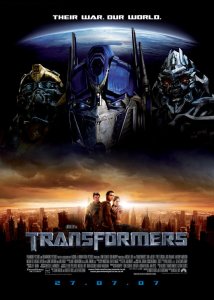 Once again Hollywood is quick to prove that if any television show emits some level of nostalgia, or merchandising potential, it is only a matter of time before it finds itself reconfigured as a big screen blockbuster movie. In all honesty, I was never a huge Transformers fan; I was more into Ghostbusters and then transitioned into Teenage Mutant Ninja Turtles. It may be sacrilegious, but I thought the knockoff cartoon/action figures, The Go Bots, were just as good. Steven Spielberg and critically derided director Michael Bay (Bad Boys II, Armageddon) have teamed up to bring the world a lengthy and noisy Transformers feature film. I can’t wait for the Go Bots to get their own equally pricey close-up.
Sam Witwicky (Shia LaBeouf) is your typical teenager obsessed with getting his own car. He can only afford an old Camaro at a used car lot, and his dreams of impressing the hot girl in school (Megan Fox). But Sam’s car isn’t just any old busted jalopy, no sir, it is really a robot in disguise from another planet. Sam’s car, codenamed Bumblebee, is apart of a robotic race known as the Autobots, led by their leader Optimus Prime (Peter Cullen returning to voice with gravitas). They can transform into vehicles that they scan with their optical sights. The Autobots are trying to save the planet from their evil counterparts, the Decepticons, who have already infiltrated our world in search of their fallen leader, Megatron. It seems Sam holds the key to the survival of Earth. His great grandfather was an Arctic explorer and happened upon the frozen sight of Megatron. He left behind an artifact that reveals the location of the chilled robot as well as a source of unparalleled power known as the Allspark. Needless to say, the military and the Secretary of Defense (John Voight) are a little aghast at how their weapons stack up to big bad robots.
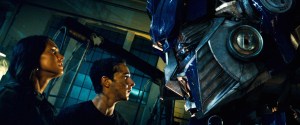 Michael Bay was born to direct a live-action, ultra expensive Transformers movie. The testosterone is through the roof and the film worships everything shiny, fast, and automotive. This is the kind of movie that fits exactly into the artistic parameters of Bay. The film is one gorgeous product placement orgy that is all about the eye candy; the cars are hot and desirable, the car chases are cool, the explosions are a lovely shade of orange, and Megan Fox is quite hot and desirable too (engaged to a 90210 actor? Why oh why, Megan?). The special effects are downright flawless and the action sequences are enormous. The scale of destruction is, like most aspects of Transformers, cranked to such a high degree that summer satisfaction can only ensue. Everything is bigger in Michael Bay world. Transformers is Bay’s best movie so far and it delivers the goods when it comes to hyper-kinetic action and plenty of thrills.
While the movie runs on silliness it also keeps its wits about it and delivers solid and exciting action with a breathless pace. What really surprised me about Transformers is how much humor they squeezed into 143 minutes of loud and hyper bombast. Screenwriters Alex Kurtzman and Roberto Orci (The Island, Mission: Impossible 3) have a great economy to their storytelling. They also have created a wacky teen comedy that just so happens to also be inhabited by giant robots. Much of the first hour is spent with Sam and his attempts to look cool with his new ride and impress the pretty girl. Sam is hocking his family wares on eBay and the Decepticons are on the hunt for… LadiesMan217. There’s a lengthy sequence where five Autobots have to duck and hide outside Sam’s house so he doesn’t get in trouble with his parents. Ma and Pa Witwicky look out the windows, and the robots dodge getting caught, and it’s like a classic bumbling slapstick comedy. A good action movie can become a great one when aided by well-timed humor, and Transformers has so many quips, sight gags, and goofy sidesteps (“Mountain Dew machine must destroy all humans!”) that is could be considered the most expensive comedy of all time (take a seat, Evan Almighty).
 There is, however, a price to be paid for all this comedy and that is that no one acts with any true sense of awe. They are witness to large walking and talking monsters of metal that are out to enslave the planet – there has got to be some wonder there, but the film doesn’t treat anything seriously. Its jokey nature keeps the film from being anything more than disposable, throwaway entertainment. I mean, I find it difficult to take any movie seriously that features a robot “relieve” itself on John Turturro.
Shia LaBeouf (Disturbia) carries the film on his sturdy shoulders. The shape of Transformers has more to do with his horny, smart allecky character than the robots that fight. Normally the only thing required in an effects-heavy action flick are some fast legs and a healthy set of lungs, but LeBeouf has charisma to spare. He has a young Tom Hanks everyman feel to him. The greatest compliment I can give him is that he is the most memorable figure in a movie with big brawling robots. Fox is pretty easy on the eyes. Voight is adept at playing government figures in times of national peril. If you need a guy to stare at something massive, or formative, or formatively massive, and utter, “My God,” then Voight is your man. Kevin Dunn and Julie White provide nice comic additions as Sam’s mother and father.
Transformers may be a perfect slice of summer thrills, but unlike its titular gigantic robots, it’s little more than meets the eye. The movie loses steam whenever it deters from its main story involving Sam. I understand that the filmmakers were trying to widen their story scope, but nothing is gained by the inclusion of such useless characters like the overweight super computer hacker who lives at home with his mom. There’s an elite team of national security analysts and they all happen to be scruffy multi-cultural hippies. We have a blond Aussie (with a nose ring, oh so rebellious) who discovers the Decepticon signal and then, well, she sits in a room for a long while and then mostly sits on her hands during the climax. The opening follows a band of soldiers in the Middle East (which the film reminds us is where Qatar is, because apparently it does not feel that your core Transformers fan has a basic grip on geography) who also must reach the bigwigs in Washington with important info on these killer robots. These dangling storylines could be lost and little momentum would be lost. None of these extra characters are given a lot of attention. Most of them will vanish for long stretches so that when they do reappear you’re reminded how much you did not miss their absence. You’re going to need stock roles, like military men and tech geeks, but Transformers has cast its lot with the simple story of a boy’s first car and his unyielding teenage hormones. Transformers could use a good pruning for balance.
 The robust action sequences are somewhat hampered by the typical Michael Bay ADD edits, but what really hurts the action sequences are the robots themselves. The original Transformers were designed smoothly, because in all reality they were animated toys and needed to function for kids. These 21st century Transformers have parts all over the place. There are gears and wheels and who knows what sticking out everywhere. They look far too cluttered, like a little kid’s art project where he keeps slathering on more junk. As a result of this robo design, when it comes to action you may not have a clue what’s actually happening. When the big robots wrestle you’ll be left trying to piece together in your mind which part is the robot mouth, the robot head, the robot fists/claws/drill/whatever. I suppose in a way this kind of demanding user activity is similar to watching scrambled porn; both involve trying to dissect the image into something workable and, thusly, satisfying to the senses. That’s right, I compared Transformers to scrambled porn, which is also quite more than meets the eye.
Obviously, with a film about powerful robots from space, there is going to be a stopgap of logic. If you can accept interstellar robots that arrived from a robotic planet, oh and by the way, they learned English from the Internet (it’s a wonder they speak in full sentences), then you should be able to shrug off any other shortfalls in logic. Transformers was never too deep a subject to being with; every episode of the cartoon revolved around the Autobots and the Decepticons battling over new energon cubes, and that was all the plot needed for a show about robots that fight.
There could be 20 minutes sliced out. Lots of ancillary characters are just dropped. There may be too much humor. The climax is way too long. The dialogue is corny. And yet with all its flaws considered, Transformers is an exhilarating entry into the world of summer smashups and blown eardrums. Michael Bay may never stretch his creative wings with a Victorian costume drama, but the man does what he does well. Transformers is a perfect match for Bay’s noisy and boisterous sense of action and his love of things fast and expensive. There isn’t much below the surface when it comes to Transformers, but it’s such a fun and exciting popcorn movie that it’s hard to argue with the results.
Nate’s Grade: B
Share this:

The Guardian (2006)
 Ever since 9/11 we’ve been redefining who exactly qualifies as a hero. We’re stepping away from the old line of thinking, money and fame, and reexamining those selfless few that protect us, like firefighters, policemen, doctors, and military personnel. But when the culture defines a new hero, then the Hollywood tribute canonizing that role is sure to follow. We’ve had plenty of recent films looking at those who put their lives on the line, but are we, as a friend asked, scraping the bottom of the hero barrel when we devote an entire movie to the U.S. Coast Guard? And does it help your film in this day and age to feature Kevin Costner in a leading role?
Ben Randall (Costner) is a senior officer in the Coast Guard’s team of rescue swimmers, men and women first on the scene no matter what the situation is like. He’s the lone survivor of a rescue attempt gone awry and it’s badly shaken his confidence and ability to perform. He’s reassigned to a teaching position to mold the next generation of rescue swimmers. Enter Jake “Fischbowl” Fischer (Ashton Kutcher), a champion swimmer with an oversized ego. He takes every abuse Ben can dish, and slowly but surely he learns what it takes to devote your life to a job whose motto consists of, “So that others may live.”
 To enjoy this movie you must come to grips with the fact that it is born atop a mountain of clichés. I mean a whole slew of clichés, so many that you may feel genre fatigue by the end of its 140-minutes. It’s like every other military training film. The old buck readjusting to his new position as teacher. The young hotshot he butts heads with but eventually forms a father-son relationship. The tragic pasts both have that still haunt them. Old buck’s job demands cause marital discord. The many many training montages. The requisite bar fight as team building activity. The local girl who starts off as a fling but develops into something more. The lessons about teamwork over individual gain. There’s a sassy bar owner that dispenses life advice. The old buck being pulled back into the game one more time to save his pupil and consequently overcoming his guilt/fear/apprehension from losing his team. And even the heroic ending. Like I said, you will accurately be able to guess where every storyline and every character is heading because you’ve seen them all long before. You might even call the film Top Gun with fins or Kevin Costner Returns to the Water (and just when you thought it was safe to go back in).
And yet the film works. It’s a sturdy, no-frills genre movie that goes about its business in a respectable manner. I may have known every turn but it didn’t stop me from enjoying the movie. The characters are a bit rote, but the harrowing situations they thrust themselves into and their sense of heroism was very affecting. The story is familiar but the demands of the genre almost require a familiarity for success. The Guardian isn’t going to change the world (it will definitely increase Coast Guard recruit numbers), but it’s more than suitable entertainment for a weary moviegoer let down by bigger, louder Hollywood fare and looking for something more adult.
When it comes to genre movies, great acting and great writing can elevate the material. I found the details about how exactly the Coast Guard goes about rescues to be interesting, and the movie is effective at filling in the minutia of this life. I learned a lot of things about the Coast Guard and was impressed with what they go through, despite the misconceptions and dismissals. There is intelligence to the illustration of this world, and the dialogue often has a certain snap to it. Director Andrew Davis (The Fugitive) stages high excitement on the seas with great editing and seamless use of CGI.
Make no mistake about it; The Guardian is definitely tilted to an older audience. It’s a bit of a familiar, old-fashioned story and it doesn’t come close to rocking any boat, but it’s also a durable movie that plugs in the needs of this formula effectively and satisfying. This is a movie that will appeal to dads and granddads and, who knows, may get them to tear up. It’s hard to dislike a film that wears its heart on its sleeve and has such affection and reverence for those in harm’s way. It’s harder when the story, mountain of clichés and all, still resonates with semi-palpable emotion.
There is one very big misstep at the conclusion of the movie. I won’t go into great spoiler detail, but the film leaves you in two positions: 1) the ludicrous notion that something we saw minutes ago did not happen, or 2) a somewhat sappy but too-detailed-to-come-across-as-coincidence puzzler. All The Guardian had to do is trim a few words or made its final lines of dialogue a little more vague, then none of this would matter.
Costner seems to be settling into a nice second life as a middle age supporting actor. Here is an actor that’s had his share of setbacks and creative wounding (The Postman?), and yet he’s still immensely likeable when he turns on the grit and aw-shucks determination. He’s the film’s mentor and father figure and infuses a lot of personality into what could have come across as an idol of worship rather than a human being. After a sublimely laid back performance in The Upside of Anger, and now this, it looks like Costner is back on track and well over dud territory.
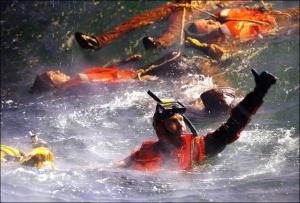 Kutcher is a mystery to me. I’ve mostly found this kid to be grating and overdoing his one-note joke of a dimwit persona. The Guardian is the first film where I’ve begrudgingly found myself enjoying a Kutcher performance. He’s got the physique for hard duty but he finally gets a chance to flex some acting muscle as well. While I won’t say he opened my eyes to the talent behind one half of Dude, Where’s My Car?, I will concede he’s worthy of taking a chance on in upcoming dramas. Don’t let me down Kutcher now that I’ve gone out on a limb for you, boy. Don’t punk me.
The Guardian is in a lot of ways very similar to Ladder 49, another fawning tribute to brave first responders. Whereas Ladder 49 idolized firefighters to the point of worship, The Guardian does a better job of molding penetrating characters. I think firefighters and rescue swimmers are heroes, obviously, but I find their courage and selflessness more admirable when we don’t place them on a pedestal. When we don’t make our heroes into something super-human that makes their decisions and acts that much greater.
I’ve been to few movies where the audience broke out in applause at the end credits. This was one of them. I could understand why. The Guardian is a familiar formula aimed at older adults and reminds them of the sacrifice and heroism of those who keep us safe. This flick is an adoring testament but also succeeds as a respectable, mostly engaging genre piece that manages to be emotionally involving without getting too sappy. It’s a meat-and-potatoes male weepie. Costner and Kutcher create a solid father-son bond and both actors reveal a bit more about themselves. This isn’t a movie that dares to reinvent the wheel, but it is worth a spin if you’re a fan of this genre and don’t mind reworking old clichés into something new.
Nate?s Grade: B-
Share this:

Jarhead (2005)
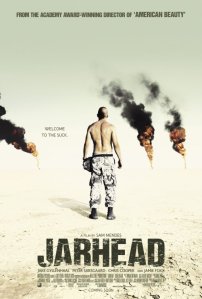 The controversy surrounding Jarhead, a hotly anticipated movie dealing with the 1991 Gulf War, seems rather misplaced. Some argued it would be anti-American, anti-war, anti-Marines, and on the other side of the coin, some even argued that it would be pro-war and pro-aggression. Now the movie seems to be taking flak for not being too political. Director Sam Mendes (American Beauty, Road to Perdition) is interested in crafting a movie about the soldiers, a true first-person war. I was actually very pleased, and somewhat relieved, that Jarhead didn’t try to bend over backwards and make any forced parallels to our current Gulf War conundrum. When you’re arguing about whether a movie leans right or left then perhaps the movie stands tall on its own, and Jarhead stands very tall indeed.
Anthony Swofford (Jake Gyllenhaal) is a “jarhead” the nickname for Marines because of what their heads resemble after their sheering, but it’s also indicative of a vessel, ready to be filled with knowledge. Swofford says he entered the corps because he “got lost on the way to college.” He’s humiliated, beaten, and looking for a way out when Staff Sergeant Sykes (Jamie Foxx) offers (more like orders him) to try out for the elite position of Marine snipers. It’s during this new training regiment that Swofford becomes “hooked” on being all he can be. He’s partnered with his barrack buddy Troy (Peter Sarsgaard), who serves as Swofford’s moral anchor. The boys get their hopes up when they catch the news that Iraq has invaded Kuwait. They’re shipped out to the action and are finally going to get a taste of combat … or so they think. They spend months in the Saudi desert amongst 114 degree heat and interminable boredom. They drink water, they play football in their gas suits for the cameras, they goof off, but mostly they wait. And wait. And wait. When the war does finally come into being, any action is short-lived: “Four days, four hours, one minute. That was my war.” Swofford, Troy, and his fellow Marines are aching for some kind of combat, any kind of violence that they’re physically and mentally breaking down in the monotony.
 Even the safety nets in previous war films, like the chickadee at home waiting for you, are ripped away in Jarhead. Usually the life at home is a source of release for movie soldiers, but in Jarhead it’s just one more source of mounting anxiety. The men have a Wall of Shame with pictures of ex-wives and girlfriends who have left them or cheated on them.
The acting on display is tremendous. Gyllenhaal (The Day After Tomorrow[) gives a sensational performance that should turn him into a bona fide, A-list leading man. All at once he can display fraternal bravado, closeted fear, confusion, and dulled horror. His show stopping moment is when he’s amidst a mental breakdown and turns a rifle on a comrade and then on himself, pleading that a shot be taken. The scene is a powder keg of intensity and Gyllenhaal is utterly captivating, startling, and horrifying with every teeth-grinding second. What?’ even better is that his performance doesn’t stop when the camera isn’t centered on his beautiful baby-eyes. He draws stronger performances out of those around him, and he does it quietly with confidence. He masks his fear and does so in fascinating, layered ways. Performances like this are what Oscars are for. And for any Jake fans out there, yes he does show a good bit of flesh in the film.
Foxx (Ray) breathes fiery life into what otherwise could have been a stock character, the tough love drill sergeant. He’s given much more screen time than I had ever thought and makes the most of it. Sarsgaard (Garden State) is a steely, dependable shoulder of support in the film, and his own big breakdown scene is amazing to witness. He?s so close to a kill but is overruled by the military brass, and Sarsgaard just lets everything go. It’s incredible. Chris Cooper (Adaptation) and even Dennis Haysbert, 24‘s president Palmer himself, have brief but very memorable small turns.
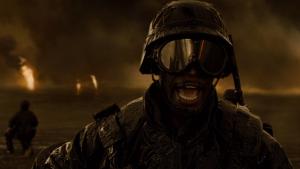 The cinematography by Roger Deakins (replacing Mendes previous Oscar-winning collaborator, the late great Conrad Hall) is gorgeous and uses light and shadow in remarkable ways to convey the turmoil of the soldiers and the other-worldliness of the desert. There are scenes amongst the lit oil fields that look like some alien world. It’s a perfect visual representation of how alone these men are and how ill-equipped they are for that scenario. The camerawork beautifully echoes the emptiness of their surroundings. Jarhead should easily score a much-deserved Oscar nomination for Deakins (House of Sand and Fog).
Jarhead is really an analysis of the psychology of what it takes to go to war. There is a transformation process, where young boys get stripped down and turned into killing machines. Jarhead poses a central question: what happens when you create the ultimate killing machine and give it nothing to do? Essentially, these men are breaking down in the tedium and many will be broken for the rest of their lives. A very poignant scene comes late in the film during their triumphant bus ride home. A Vietnam vet hops on to cheer his fellow Marines and in his hazy jingoism, you see how haunted and broken this man is from his own war experiences decades past. The future is staring them right in the face. Swofford opens and closes the film with narration explaining that once a man holds a rifle in combat, no matter what else he does in his life his hands will feel that rifle. These are men trained for war and adjusting to everyday life where the only war resides inside. Jarhead is a monstrously powerful study on the lasting effects of turning young men into monsters of combat.
Jarhead‘s inherently anticlimactic nature works against it, which will cause some level of disconnect with an audience. This is a very loosely structured flick about delayed gratification with no payoff. That’s not exactly a recipe for success. Jarhead is essentially the Waiting for Godot of war movies. The film is about monotony, about inaction, and the movie achieves a surprising yet palpable tension simply from drawing the viewer along for so far. In lesser hands a movie about boredom would still be boring, but Mendes brings an unprecedented art to it. Mendes has a confidant vision and the technical skill to bring out the drama of boredom. Jarhead has a deadpan sense of humor and some very sobering moments, like when Swofford comes across the remains of a traffic jam caught in napalm. These killing machines are getting rusty and will come back home without ever getting to pull a trigger, and what does that do to a man? These are important questions and Mendes is interested in answering them at a pace that still serves his characters. I love that Mendes has directed three films that are wildly different from one another. In my view, this guy is three-for-three.
 Jarhead is no Full Metal Jacket and yet Mendes gives passing nods to Vietnam and how our culture has shaped its history. The Marines watch Apocalypse Now and cheer as helicopters mow down villages set to a thundering soundtrack by Wagner. They’ve completely missed the point of one of the most anti-war films ever, transforming it into a bloodlust ritual. When Mendes reaches the desert then Jarhead becomes a war movie unlike any other. It’s a war movie without a war, sort of. All wee see are the results, both external and internal.
In a way, Jarhead is all about transformations and transitions, one of which is the Gulf War itself. This was arguably the first made-for-TV war and viewers were amazed at the green-tinted images of explosions and military might. War had been brought into the video game age where what once took months on the ground could be accomplished by pushing a button. Jarhead shows you the side of the Desert Shield/Storm that never made it to the cameras. The movie also presents some of the more obscured details of the war, like the care for and disposal of human waste from outhouses. That stuff never made CNN. Jarhead shows, very quietly and somberly, that sometimes the soldiers who return home have still been left behind.
Jarhead is an intense, sobering, evocative, and deeply contemplative film about the psychology of turning young men into killers and then leaving them with nothing to do. The inherent anticlimactic nature will likely push some audiences away while others will simply find it tedious. Mendes’ direction is strong and confidant and able to squeeze drama and tension from inaction, crafting an existential war movie that feels relevant and profound. Gyllenhaal is amazing and utterly captivating; you can’t take your eyes off him and, for many out there, a certain strategically located Santa hat. This movie isn’t anti-America, anti-troops, or even anti-war for that matter. Jarhead tells us that all wars are different and all wars are the same. We know war is hell, but for some, the absence of war is an even greater hell.
Nate’s Grade: B+


 nathanzoebl
You must be logged in to post a comment.