Blog Archives
Black Bag (2025)
 It’s Steven Soderbergh’s second movie of 2025, also with screenwriting vet David Koepp, and this time they’re tackling the spy thriller, centering on a marriage between two spies. Michael Fassbender and Cate Blanchett play a couple who both have clandestine lives, and when either one ventures into sharing sensitive details, they utter the code “black bag” as a conversation-ender. There’s a mole in the agency and Fassbender is tasked with uncovering the identity of the culprit, but he worries this investigation might ultimately point toward his own wife and then what’s a man to do? Black Bag is one of those more realistic, exacting spy thrillers, which means it’s churning at a very slow pace with minimal stakes before things ratchet up late. The parallels between trust in a marriage and trust in a spy agency are there but never explicitly explored for thematic richness. You know where the ultimate goal is, finding the mole, but every scene plays out more like a couples drama of squabbling, unhappy upper class winos with secrets and grudges. I had to occasionally remind myself, “Oh yeah, these are spies.” I never fully got on board the wavelength of this movie, finding its detached sexy vibe to be more glossy and meandering. The characters just weren’t that interesting to me. I kept waiting for things to pick up, and even when characters are murdered the tension level still feels unchanged. It’s all a little too heavily submerged under the icy tranquil surface for me. Black Bag is a sedate spy thriller presented as sophisticated but comes across a tad too detached and ultimately tedious.
Nate’s Grade: C+
Share this:

The Killer (2023)
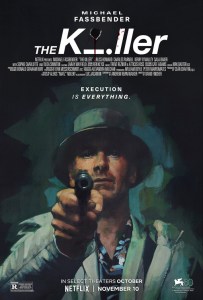 Were you even aware that David Fincher had a new movie? The celebrated director has been very mercurial since 2014’s Gone Girl, only helming one other movie. His partnership with Netflix has afforded the notoriously perfectionist director a lot of creative latitude, though sadly not a third season of Mindhunter. But even the artistic cache of a new Fincher movie isn’t enough for Netflix to change its business model. The Killer only played in theaters for two weeks before beaming into millions of homes. You would think this streaming giant would want to leverage its big names and their new projects, but I’m reminded of how much money Netflix likely left aside forgoing Glass Onion’s theatrical run. Alas, The Killer is an intriguing if cold and unsatisfying thriller that epitomizes the limits of surface-level living.
Our titular killer (Michael Fassbender) is hired to kill a Parisian businessman and botches the job. He’s on the run and fears for his well-being from his employers wanting to eliminate any loose ends. His girlfriend in the Dominican Republic is beaten and threatened, and the lead killer realizes he’s going to have to out-kill all the other killers after him if his loved ones don’t get killed. Through five chapters, each ending in a death, the killer works his way up the food chain.
 Fincher is attempting to strip out the movie-cool mythos of the world of hired assassins, to subvert the entertainment value that can come with expert murderers leading to blood and death. The Killer is Fincher’s stubborn subversion of what a trained assassin movie should be, and his main takeaway, beyond stripping the misplaced glamor from the profession, is how tedious it would all be in real life. In the movie world, being a trained killer involves all sorts of exciting derring-do and acrobatics and the like. In the possible real world, being a trained killer is more like a paid security guard; it’s a lot of protracted sitting and waiting and watching, and it’s easy to understand just how overwhelmingly boring all this would be. The opening twenty minutes quite convincingly strips the cool factor away from this profession. It doesn’t make you feel the weight of the culpability, like 2018’s You Were Never Really Here (more on that later), but what it makes you feel is just how maddening and boring this whole job must be and what kind of dedicated people would succeed. It’s like Fincher is making a bet with a mainstream audience that he can find a way to make a boring assassin movie, and while doing so can be seen as subversive to some degree, bleeding much of the thrills out of the picture, it also feels like a bet gone wrong. You made the main character boring on purpose to prove a point, but regardless of intent, your protagonist is still boring. Victory?
As physically inactive as Act One proves, watching our title killer sit and wait and watch, it is conversely hyperactive in narration. This is wall-to-wall narration as our lead character expounds upon his regiment to keep his mind and body ready when his eventual window materializes. It reminded me of the narration of Patrick Bateman from American Psycho, about his methodical lifestyle routines. Except that character was being satirized from their first moments, whereas the emptiness of our killer here is the larger point, that he’s fashioned himself into an unfeeling weapon. Here is a character that feels he is only effective if he strips everything human away, if he only focuses on the job regardless of politics or consequences, and lives his spartan existence. I’m sure he envisions himself as some noble modern-day samurai, living a code others cannot keep. Except the movie reveals throughout that he might not be the best killer in the phone book. First off, he misses shooting his target, which sets everything into motion. All his narration about focus and yoga and dedication and even I know you shouldn’t fire while someone else is in front of your target. There’s a jarring scene where he fires nails into the lungs of a character and theorizes the man has six or seven minutes left to live before his lungs fill up. Nope. The man dies within one minute max. For all his resourcefulness, which is benefited by the long reach of capitalism, the man also doesn’t live up to his self-image. His paranoia keeps him from returning to his home on time and allows the attack on his girlfriend to happen in his absence. There might be an even deeper commentary on how even the lead is confusing his life for a movie.
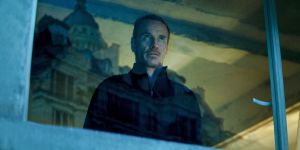 My favorite scene is a sit down with a competing hired hitman played by Tilda Swinton (Three Thousand Years of Longing). She’s one of the two competing assassins responsible for targeting his girlfriend, so she presents a threat. He meets her at a fancy restaurant and she already accepts that she will not be making it to dessert. She is the exact opposite of our main character, a woman who has found a way to live a normal life in the suburbs, marry a man, and enjoy the luxuries of a life afforded by her wealth. She’s not living out of storage units or purposely dressing like a German tourist to stay under the radar. In some ways, this has allowed our more single-minded assassin to get the jump on her, to take advantage of her complacency. However, it’s also an indictment on the stripped-down, isolationist life our lead killer has prioritized. Here is a woman who has embraced allowing herself to enjoy things. She’s not eating McDonald’s breakfast sandwiches minus the slimy egg patty. She’s not slumming it for her “art.” She sees no value in abstinence. This stark contrast, as well as a sustained conversation between two foes, is the highlight of the film. It’s also interesting to watch Swinton’s character go through her own mini-grieving process accepting the likelihood that this will be her final meal, and so she savors it without fear.
Being a David Fincher movie, you can rightly assume that the technical elements are nearly flawless. The visual arrangements are beautiful, the cinematography is chilly and atmospheric, and the editing is precise and smooth. The first attempted kill has a nice degree of tension simply from shifting audio levels, going from diegetic to narration, never allowing the viewer to properly adjust during such a heightened point of paying attention. It’s naturally unsettling and effectively raises the tension of a moment we’ve been waiting over twenty minutes to arrive. There is an extended hand-to-hand fight sequence that’s exceptionally well choreographed and carries on from room to room, transforming with each new location and utilizing the geography of each space nicely (the John Wick folks would approve). The overall movie feels more in keeping with the likes of Fincher’s Panic Room or The Game, a more straightforward thriller that lacks simply extra levels and commentary, like Zodiac or Gone Girl. There’s nothing wrong with a well-executed and developed thriller purely designed to be a good time. It’s just at this stage of Fincher’s career, the expectations are raised, fairly or unfairly, with every new release. The Killer is a polished thriller meant to be pared down to its essential parts and can be enjoyed as such.
There is little to hold onto here emotionally though, so we’re left with the intellectual curiosity of watching a so-called professional go about their business and see how he gets around obstacles. Very often it’s dressing up in a delivery outfit and simply waiting on other polite strangers to open doors for his unassuming facade. One could argue that the character arc is about a man who rejects empathy, argues that it is weakness, comes around to accept empathy, and embraces it on his way out. I can see some of this, as the motivation for his trail of vengeance is to protect his loved one from being harmed again. There’s even a moment where he demonstrates a sliver of sympathy to a victim, albeit still utilizing gruesome violence. Except I don’t believe that easy assessment of this being a journey of embracing empathy. This doesn’t come across as a character changing who they are but instead as a character cleaning up their own mess. The main character keeps reiterating to “stick to the plan, don’t improvise,” but I don’t think he’s reflecting at any point on his actions beyond a clinical cause-effect relationship. He’s stripped all the complexities of humanity out from himself but recognizing fault isn’t the same as building and maintaining a sense of empathy. I also think the reading that many critics are making of Fincher standing in for the main character, a dedicated tactician who tries to do it all, is a little too cute and desperate for meta-narratives to derive a better lens to analyze the overall vacancy of the lead character.
 This is very different from Lynn Ramsay’s You Were Never Really Here, a film that also subverted the same hitman sub-genre and made the audience re-examine its own bloodlust. As I wrote in 2018: “The focus of the movie is on the man committing the acts of violence rather than how stylish and cool and cinematic those acts of violence can be. …Ramsay offers discorded images and brief flashes and asks the audience to put together the pieces to better understand Joe as a man propelled and haunted by his bloody past…. It’s not all tragedy and inescapable dread. Amidst Joe’s tortured past and troubled future, there’s a necessary sense of hope. You don’t know what will happen next but you’re not resigned to retrograde nihilism.” This is not the feeling I took from The Killer, and I recommend everyone watch Ramsay’s movie too.
The problem with making a boring assassination thriller on purpose is that, at the end of the day, you still have a boring assassination thriller. Fassbender (who hasn’t been on screen since 2019’s Dark Phoenix killed the X-Men franchise) can be compelling for two hours doing just about anything, and a performance that is minimal in spoken dialogue does not mean a minimal performance. He’s great to sit and watch, the running commentary of his narration serving as a starting point to assess all the concentrated, nuanced acting under the surface. The Killer has sheen and skill, much like its title character, but it too also misses the mark where it counts.
Nate’s Grade: B-
Share this:

Dark Phoenix (2019)
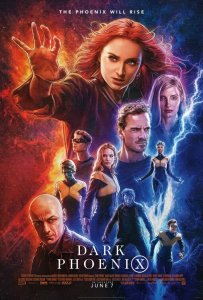
Dark Phoenix is the end of the X-Men as we know it. The franchise is arguably the reason that Disney bought Fox, to combine its Marvel properties under one creative universe, and hastened its ultimate demise. The franchise kicked off in 2000 when nobody knew what a Hugh Jackman was. Over the course of 19 years we’ve had ten total X-films (the original trilogy, four prequels, three Wolverine solo films — I’m not counting the two Deadpool entries) of varying quality. Dark Phoenix is longtime series writer Simon Kinberg’s debut as a director and was originally intended for a fall 2018 release before it got pushed back for extensive reshoots. There was even some doubt whether Disney would release Dark Phoenix or shunt it to its new streaming service (that’s my prediction for the long-delayed New Mutants, which released its trailer… in 2017). Ultimately this is the final X-Men movie, as we have known them for 19 years, and it’s the equivalent of a mayonnaise sandwich at room temperature: something nobody really wanted and delivered in a package not designed to satisfy.
In 1992, the X-Men are called upon by the president when the government is left with no other options. Charles Xavier (James McAvoy) watches over as shape-shifting Mystique/Raven (Jennifer Lawrence) leads the younger X-kids, Cyclops (Tye Sheridan) and Jean Grey (Sophie Turner) and Nightcrawler (Kodi Smit-McPhee) and Storm (Alexandra Shipp), into space to save some astronauts. A strange cosmic energy cloud zaps Jean Grey and supercharges her telekinetic powers. At first she feels more alive but is losing control and worrying her friends. After a tragic confrontation, she runs off to find Magneto (Michael Fassbender) while a mysterious alien woman (Jessica Chastain) seeks to gain the “phoenix” powers.

Thoroughly mediocre, Dark Phoenix is a pitiful ending to a franchise that kicked off the superhero era of the twenty-first century. This is a pretty sad ending to a franchise that has admittedly had more downs than ups (I’d say four of the ten X-Men movies have genuinely been good, two were fine, and four have been different levels of bad). What’s even more peculiar is this is Kinberg’s second attempt at the Dark Phoenix storyline, arguably the most famous in X-Men comics, and it doesn’t work — again. At least 2006’s The Last Stand had other storylines that presented topics of interest, like the choice over taking a mutant cure and whether this should be a choice after all. The problem with Dark Phoenix is that it’s nothing but Dark Phoenix with little variation but it doesn’t ever expand on the Dark Phoenix dilemma. Act Two of the film seems to consist of the same scene on repeat, where Jean Grey complains about her power struggles to some character, warns them, doesn’t want to harm people, and then something bad happens and more characters elect to try and murder her. It’s like watching the same TV show recycle the same plot but just changing the characters. It makes for a saggy mid section that loses momentum and cannot regain it. The last act feels like a different movie because… it is. Thanks to late reshoots, the final act is a series of clashes aboard a military train. There are some fun moments of mutant-power action, especially Magneto and Nightcrawler. It doesn’t make much sense to what came before (when questioned why Magneto is trying to save Jean after literally trying to kill her ten minutes earlier, he says, “I had a change of heart”) but the sequence is at least diverting and visually playful in a way the rest of the movie had been missing. By the end of the film, much of it feels rushed and little feels earned, especially the time you’ve spent watching it.
I’m going to declare that the villains in Dark Phoenix are actually the worst in the entire universe of X-Men movies. They’re aliens adopting human form and they talk… so… slowly… and in unshakable monotone. They’re an alien species that wants the powers of the super space cloud. That’s it. That’s all you get. I have no idea what attracted Jessica Chastain (Molly’s Game) to this role and almost feel like it must have changed at some point. She walks around in a zombie-like daze with a giant platinum blonde wig that makes her look like an albino. At no point are any of these aliens interesting. At no point do they present personalities. At no point does their overall powers become clear. They seem invulnerable to anything, except when the script needs them not to be, and their vaguely defined powers seem limitless. Because of the creative choices with Jean Grey and how she developed her Dark Phoenix powers, extra emphasis is placed on the villains to carry the burden, and they could be eliminated entirely and not be missed in the slightest. It’s genuinely hilarious to watch them walk so stiltedly and then break into a run. The best thing Chastain does is strut in stilettos while taking a dozen blasting firearms to the face.

There are just some weird moments in this movie. Apparently Charles Xavier watches the students have their beer blasts in the woods and also keeps a thermal heat analysis of them during these moments (“That student’s really hot… I mean… getting really hot…, uh…”). That’s so weird and possibly perverted. There’s a running clothing item with blood that never gets changed. You’ll listen to “whose blood is that?” close to ten times. It’s always been inherently goofy watching these trained actors make silly strained faces while pretending to do things with their mind powers. Except this movie it goes a step further. There’s a moment of goofy strain face versus goofy strain face while the actors thrust their arms out, and there’s a scene where Jean Grey only has one arm out and then, to power up, she throws out her second arm. That’s not how mind powers work. There are several character jumps that seem rushed and unearned, like Charles becoming a focal point of disdain amongst his fellow X-people over his catering to public relations. Everyone is so quick to jump on the murder wagon when it comes to Jean Grey, which makes me wonder if they never really liked her and have just been waiting for a good excuse to kill her. The seesawing public support on mutants can be extremely confusing. The action sequences are filmed in a very haphazard way with replenishing bad guys to be disposed. During key stretches of the movie, I didn’t know who was on screen, where they had come from, and what relations they were to one another until punches started being thrown.
Continuity has never been a thing the X-universe cherished, especially once you started throwing in time travel with 2014’s Days of Future Past. However, Dark Phoenix complicates matters with its disregard for the overall continuity. Firstly, I am not a fan of the idea that these prequel films all take place in separate decades. It worked with First Class which tied the cultural revolutions and changing mores to the characters and their selfI identity, plus the Cold War paranoia. It even worked for Days of Future Past being set in the early 70s, during the malaise of the optimism of the 1960s. That related to the character arc for Raven on her quest for vengeance and the individual versus society. But what did Apocalypse have to gain by taking place in 1983? What does Dark Phoenix gain by taking place in 1992? Plus it means that these characters have hardly aged in 30 years and in less than a decade James McAvoy and Michael Fassbender are going to look like Patrick Stewart and Ian McKellen (no offense to McKellen, but that’s quite a sudden, precipitous drop). Let’s even say the older movies are eliminated from the timeline after the reboot of Days of Future Past. Just in the LAST movie they established that Jean Grey had the powerful phoenix spirit and abilities within her, as it was the final push to topple the bad guy.
Allow me to get into more detail why this disregard is so troublesome and erroneous. Judging from the trailers and marketing, I thought Dark Phoenix was going to be an addiction metaphor, with Jean Grey embracing a self-destructive thrill that made her feel good even as it pushed others away and forced her down a darker path. Despite the ads emphasizing this aspect, the actual movie ignores this addiction metaphor for a cosmic illness she contracts. Kinberg and the filmmakers have dropped that Jean Grey had this power within her and have made her a victim of an external force from space. This is far less interesting because it makes the story of Jean as reactive from external forces taking over. Space clouds resembling a pink Parallax (the poop cloud monster from 2011’s Green Lantern) did it all. That’s boring.

Think of the stronger version already within reach that examined the power within her that Charles has been keeping limited thanks to withholding her memories of her parent’s deadly accident. Because she was denied this essential part of her past she was never able to process her trauma and work through it. The man she trusted, the father figure telling her how to best control her feelings and powers has been inhibiting her the whole time and manipulating her. That betrayal could reignite the power already within her, and her journey would be about self-discovery while also confronting the gaslighting by those she trusted. You could even go further and have Charles eventually revealed as a villain for psychically altering people’s memories and minds to his ideal of what is right. That’s the better movie. They might as well have gone all-out and ended with the destruction of the Earth and the death of everybody we know because why not? What we get with Dark Phoenix is a woman who glows a lot thanks to an inscrutable pink space cloud.
It’s hard for these talented actors to hide their disinterest; some have been eyeing the exits since the last film. I challenge every reader to look at the painting of Chastain’s face on the very poster, which to me reads loudly, “Let’s just get this thing done with.” Turner (HBO’s Game of Thrones) is the best thing in the movie and yet the screenplay doesn’t give her an actual character arc with depth. It feels like she has three or four stages in the movie where Kinberg just asks her to repeat the same note over and over. Many of the actors that have been here since 2011’s First Class feel like they’re on autopilot. It’s simply another level of mediocrity that ends up defining this disappointing movie.
If you asked writer/director Simon Kinberg, in private so he could be truly honest, whether he would have repeated what happens in Dark Phoenix as the very last X-Men movie, and I legitimately think he would say no. That’s the problem with the movie is that it’s a double dip that, surprisingly, doesn’t get better. The story is boring and repetitive, the action is bland, the characters are at the mercy of a story that has no interest in them, and the resolution does not provide any satisfying finality. It feels like the close of a weekly television episode that knows more is to come except it’s been cancelled. The X-Men movies have been at their best when they’ve been about something, when they’ve gone inside their characters and the conflicts of living in a society of oppression and prejudice and fear. The franchise lends itself to being more than spandex-clad superheroes fighting each other. The division between the good X-Men movies and the bad X-Men movies is wide and clear; nobody is going to put Logan and Apocalypse in the same grade. It’s easy to tell when the plots connect to character and have exciting themes to go with their exciting action sequences. Coming to a shrug-worthy series conclusion, I think I’d rather rewatch The Last Stand than the second go-round of the Phoenix saga. The X-Men ultimately go out with a whimper but that doesn’t take away from the greatness of the other films. It’s been nearly two decades, and I’m grateful for the ride, but it’s a shame it had to end this way.
Nate’s Grade: C-
Share this:

The Snowman (2017)
 The Snowman is an awfully dumb movie that mistakenly believes it is smart. It’s convoluted, impenetrable, serious to the point of hilarity, and a general waste of everyone’s times and talents. When the best part of your movie is the scenic views of Norway, and unless it’s a documentary about Norwegian winters, then you have done something very, very wrong. The Girl with the Dragon Tattoo this ain’t.
Harry Hole (Michael Fassbender), possibly the most regrettably named protagonist in recent memory, is a brilliant detective on the hunt for a killer in Oslo. Someone is abducting women and chopping them up into snowmen. The killer even sends Harry a taunting note with a crude drawing of a snowman. Together with a new partner, Katrine Bratt (Rebecca Ferguson), they try and hunt the cold-blooded killer with a penchant for snowmen.
 The plot is so convoluted and hard to follow that it’s a challenge just to work up the energy to keep your eyes open as scene after scene plods along. The Snowman doesn’t so much exist as a functional screen story but more a series of incidental scenes that barely feel connected. It feels like one scene has no impact upon the next, which eventually sabotages any sense of momentum and direction. It feels like it’s going nowhere because none of these moments feel like they’re adding up to anything. There are entire subplots and characters that are, at best, tangential to the story and could have been culled completely with no impact. J.K. Simmons’ wealthy sleaze and storyline about securing the World Cup for Oslo comes to nothing. The self-recording police device seems destined to record something significant. It does, but then the killer just erases the footage. This entire storyline could have been achieved with a smart phone, including the part where a severed finger is required to break the device’s fingerprint lock. Val Kilmer’s flashbacks (he sounds weirdly dubbed and looks sickly) as a murdered detective don’t really come to anything or offer revelations. In fact the revelations that do arise are not gleaned from clues but are merely told to us with incredulous haste. The Snowman poster boasts “I gave you all the clues” but I challenge anyone to tell me what they are. What’s the point of a mystery where nothing matters? It’s a film stuffed with nonessential details and lacking a key point to engage.
I’ll give you another example of how moronic and wasteful this movie is, and it involves none other than Oscar-nominated actress Chloe Sevigny (Boys Don’t Cry). Harry Hole and Katrine visit Sevigny’s character and (mild spoilers but who really cares?) approximately two minutes later she is decapitated. Seems like a pretty big waste of an actor of Sevigny’s caliber on a do-nothing part. The police show back up on the scene and Sevigny is still walking around alive, this time introducing herself as the twin sister we never knew about. Ah, now perhaps the inclusion of Sevigny will be warranted and maybe the killer having confused his victims will be a significant clue that leads the detectives onto the right path. Think again, hopeful audience members. Sevigny is never seen from again, never heard from again, and never even referenced again. Why introduce the concept of an identical twin and do nothing with it? Sevigny had not one but two do-nothing parts in this mess.
Even the ending (again spoilers, but we’ve come this far, so why the hell not?) elicited guffaws. Harry Hole tracks down the killer outside onto an icy lake and screams for this person to confront him. The killer then immediately shoots Harry in the chest, immobilizing him. The killer then slowly stalks Harry and then simply walks into an open hole in the ice and drowns. Was that there the entire time? Did Harry somehow create it? Did he find it and strategically position himself near it? Did the killer not see this hole in the ice at all considering they were walking up on Harry from a distance? It’s such a hilariously anticlimactic ending that it feels like the killer, and so too the movie, is meekly giving up and accepting defeat.
 The main character is just as uninteresting as the gruesome killer. Harry Hole is reportedly a brilliant detective and one whose past cases are so revered that they are taught in places of higher learning. Yet, at no point in the movie do you gain the impression of his oft-stated brilliance. He seems pretty bad at his job, plus he constantly loses track of his gun. It’s another example of the movie telling us things without the requisite proof. Harry Hole (referred to as “Mr. Hole” and “the Great Harry Hole” too) is your typical super driven alcoholic detective who pushes his family away because he’s too close to his work. There is the germ of a starting idea of a character that is too selfish to make room for his family, but this isn’t going to be that story. At one point, Harry Hole’s ex-girlfriend (Charlotte Gainsbourg) seems to be having a self-destructive affair with Harry Hole, but this dynamic isn’t explored and only surfaces once. It’s a scene so short that it’s over before Harry Hole can literally get his pants off. We don’t see the brilliant side of the character and we’re also denied the evidence for his destructive side. Fassbender (Assassin’s Creed) is on teeth-gritting, laconic autopilot here and the English-speaking cast tries their own game of playing Norwegian accents while sounding mostly British or Brit-adjacent.
Even the title is one more example of how woefully inept this movie becomes. Surprise: the snowman means absolutely nothing. It’s not some key formative memory from the killer’s childhood or some integral icon attached to a traumatic experience. It’s not even a bizarre sexual fetish. The snowman doesn’t even mean anything to the guy making the snowman in the movie! You’d be forgiven for thinking that the presence of snowmen are entirely coincidental throughout Oslo and the whole of the film. It’s so stupidly misapplied as well, with the movie working extra hard to make the very sight of a snowman as a moment to inspire uncontrollable fright. It goes to hilarious lengths, like a camera panning around an ordinary snowman that then reveals… a second snowman built into its snowy back. OH NO, NOT THE DOUBLE SNOWMAN. There’s a moment when Harry looks down to his car parked on a street and sees… a snowman having been carved into the snow atop the car. OH NO, NOT A SNOWMAN INDENTATION. Just imagine the killer standing on the hood of the car and digging snow out on top to craft his masterpiece of snow-art-terror. I just start laughing. Then there’s the application of the murders. When the killer is severing heads and putting human heads atop snowman bodies, now we’re in business. That’s an image worthy of the genre. However, there’s also a scene where the killer blows someone’s head off and replaces it with a snowman’s head. It’s such an absurd image and it’s going to melt before most people find it, so what was the point exactly? Then there’s the idea of thinking of the killer rolling a severed head into a snowball, which just makes me laugh thinking about somebody stooped over and toiling to make this happen. Ultimately, the snowman is so peripheral and meaningless, my friend Ben Bailey remarked it would be as if you renamed Seven as Toast because the killer also ate toast occasionally (“No, no, trust me, the toast is more important than you think…”).
 I thought at worst The Snowman was going to be a high-gloss Hollywood equivalent of a really stupid episode of TV’s really stupid yet inexplicably long-running show, Criminal Minds. This is far, far worse. At least with your casual Criminal Minds episode, it’s garish and lousy and icky in its sordid depiction of grisly violence against women, but you can still understand what is happening on the screen. You can still follow along. The Snowman is impenetrable to decipher, not because it’s complicated but because it’s all misinformation and filler. According to interviews, director Tomas Alfredson (Tinker, Tailor, Soldier, Spy) was unable to film about 10-15 percent of the script because of hectic schedule demands, so no wonder it’s so difficult to follow. Very little makes sense in this movie and what does has been done better in a thousand other movies. This makes The Girl with the Dragon Tattoo look like Shakespeare. With a dull protagonist who doesn’t seem exceptionally competent at his job, paired with a dull antagonist with no larger game plan or purpose, or even personality, and a mystery with a dearth of clues to actively piece together, the movie turns ponderous, punishing, and psychologically shallow. It’s a dumb, dumb, dumb movie that thinks it’s smart and contemplative with a cold streak of nihilism. This silly thing takes itself so seriously that, if you’re like me, you’ll find yourself cackling at its desperate attempts to make the visage of a snowman into the stuff of nightmares. This feels more like genre parody. The Snowman is an aggressively bad whodunit that fails to make an audience care about any single thing happening. You’re better off staying home and watching the worst of Criminal Minds instead.
Nate’s Grade: D
Share this:

Alien: Covenant (2017)
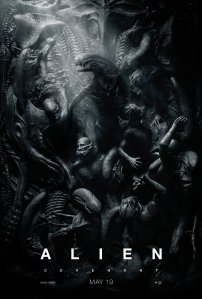 Was Prometheus really as bad a movie as fans made it out to be? While the 2012 Alien prequel could be rather obtuse, and the characters made some of the stupidest decisions as reportedly intelligent scientists, it had an intriguing central mystery, moody sense of atmosphere, great sets, some viciously memorable sequences like Noomi Rapace’s self-directed surgical operation, and a delightfully supercilious Michael Fassbender bot. By the film’s end there were still plenty of outstanding questions unanswered, and so five years later director Ridley Scott has returned with Alien: Covenant to further confound and entertain. The crew of a colony ship takes a detour to land on a habitable world and trace the mysterious transmission belonging to the android David (Fassbender). As expected, all is not what it seems and the crew is almost immediately put into jeopardy. For fans who wanted more answers from Prometheus, there is a surprising amount of carryover to serve as a resolution for the prior film. There are a few big reveals, particularly about the xenomorph evolution, but the overall Alien storyline is moved just mere inches forward, slightly closer to the events of the 1979 original. The biggest problem with Covenant is that it’s too pedestrian for far too often. It sticks pretty close to the formula we’ll all familiar with, so we know it’s only a matter of time before the xenomorphs hit the fan. There is a dearth of memorable scenes here. The characters in Covenant aren’t that much smarter and make their fair share of stupid decisions (hey, let’s ignore the existence of wheat on an alien world or the possibility of killer microbes being in this breathable air). There’s just more of them to be killed off. The movie doesn’t really bother getting to know a far majority of them, consigned to the fact that they’re only here to be later ripped apart and exploded in gore. Katherine Waterston (Fantastic Beasts and Where to Find Them) does a fine job as a Ripley replacement. Danny McBride (Eastbound and Down) has some effective dramatic moments too. But the best reason to watch Covenant, an altogether middling Alien sequel/prequel, is for twice the Fassbender robot action (there’s a Fassbender-on-Fassbender kiss, which will likely break Tumblr). Alien: Covenant is a missed opportunity of a movie hampered by a disappointingly predictable script, tedious characters, and a lack of strong set pieces. It’s acceptable entertainment but not much more. The moral: don’t be a dick to robots.
Nate’s Grade: C+
Share this:

The Light Between Oceans (2016)
 A melodrama through and through, The Light Between Oceans is at its core a pretty-looking movie about pretty-looking people being sad. The premise almost seems like a parody of prestige indie filmmaking in the 1990s. Tom (Michael Fassbender) is a shell-shocked WWI vet-turned-lighthouse keeper in Australia who falls in love with mainland lady, Isabel (Alicia Vikander). They marry and have difficulty conceiving, with Isabel enduring two grueling miscarriages. Then one day a dingy washes ashore with a crying baby inside and a dead man. Rather than alert the proper authorities, they decided to bury the man and raise the child as their own. Years later, the couple discovers the girl’s real mother, Hannah (Rachel Weisz), who has been racked with unanswered grief ever since. The couple is then thrown into an emotional crucible testing their ethics and moral compromises and the question of ultimately what’s in the best interest of this little girl. It’s a movie that’s geared to put you through an emotional wringer, and the actors do their part. Vikander (Oscar winner for The Danish Girl) is downright luminescent and dives deep into all of her character’s varied and heightened emotions. The scenes of her dawning realization of the miscarriages and her helplessness are heartbreaking without being maudlin. Weisz is shaken to the core when her identity is robbed from her; she’s so fragile and holding on to hope so hard you might think she’ll collapse any moment. Fassbender internalizes the most and fully communicates the inner struggle of his character’s guilt. Director and chief adapter Derek Cianfrance (The Place Beyond the Pines) has made an intimate relationship drama in a beautiful, sea-swept location, and the kind of Big Feeling classy melodrama you came to expect from Anthony Minghella. The problem is that Cianfrance’s characters are held too much at arm’s length for resonance. We empathize but not nearly as deeply as we could, and by the end the movie washes away like the surf.
Nate’s Grade: B-
Share this:

X-Men: Apocalypse (2016)
 “We all know the third movie is the worst,” says young Jean Grey (Sophie Turner) in a curious moment that is too meta for its own good. It’s meant to be an in-joke, and possible a jab at 2006’s heavily derided X-Men: The Last Stand, but it ends up summarizing more than one X-Men movie. Easily the weakest of the prequel series, X-Men: Apocalypse is a muddled super hero movie that marginalizes its interesting characters, lacks a thematic linchpin, pushes a new batch of boring and often superfluous new mutants, and feels like everyone is running through the paces of what they think an X-Men movie should be. It’s not Last Stand, the near franchise-killer that Days of Future Past had to wipe out of existence, but this movie is a dull and clear example of the lousy mediocrity of compounded missed chances suffered at the expense of loyalty to formula.
In 1983, Charles Xavier (James McAvoy) is running his school for gifted youngsters, a.k.a. mutants, and has a new class of students including Jean Grey, Scott “Cyclops” Summers (Tye Sheridan), Kurt “Nightcrawler” Wagner (Kodi Smit-McPhee). Magneto (Michael Fassbender) is trying to live a simple life and exclude himself from a larger fight between humans and mutants. Mystique (Jennifer Lawrence) is crossing the globe and discovering new mutants to rescue. Everything changes when an ancient mutant is awakened in Egypt. Apocalypse (Oscar Isaac) is thousands of years old and is rumored to be the first mutant. He collects four mutant helpers he deems his Horsemen, and in 1983 it happens to be a young Storm (Alexandra Shipp), Psylocke (Olivia Munn), Archangel (Ben Hardy), and Magneto. Apocalypse promises a world built for only the strongest mutants and will wipe the planet with those found lesser.
 Let’s start with the empty void that is the titular super villain; Apocalypse is a complete waste and a complete bore. Oscar Isaac is a terrific and soulful actor who can be so malleable to roles as diverse as misanthropic Llewyn Davis to dreamy X-wing pilot Poe Damaron. He is buried under pounds of purple makeup that limit his expression, coupled with a heavy costume that also limits his movement. Apocalypse should have probably been a motion capture performance. Andy Serkis has proven that mo-cap performances can exhibit tremendous emotive qualities and the technology can support it. Mo-cap would have been better than staring at Ivan Ooze lumbering around. Then there’s his haphazard characterization. Apocalypse is both too all-powerful and shackled with powers that are too vaguely ill defined. He doesn’t seem like the kind of guy that needs an entourage for support despite the whole snazzy “Four Horsemen” backing band name. Apocalypse should be the solo act; he doesn’t need a backup band. You could have written Storm and Psylocke out entirely and had no impact on the plot whatsoever. My pal Eric Muller even jokes that Psylocke literally walks off the movie. Allow me to indulge my X-Men fandom a moment and just say how Apocalypse is my favorite X-Men villain and Psylocke was one of my favorite X-Men way back when I was reading the comics consistently in the 90s. I loved the psychic blade of Psylocke, though in this movie it’s pretty much just a laser arm sword, which is a underwhelming. Seeing both of these characters completely wasted is particularly disappointing to 90s me.
But back to Apocalypse, he seems too powerful to need to seek out a select group of super lieutenants and part of this is also because of how poorly the movie explains the specifics or limitations of his powers. He absorbs the powers of his host mutants but what are those powers exactly? The movie never specifies beyond the weird shifting-humans-into-walls thing that looks a bit too silly to be truly terrifying. Every time he displays a new fancy power we just have to accept it, but if he keeps unleashing powers we never know about then why does he even need assistance? We already see Apocalypse turning the world into dust clouds, so why does he need Magneto to, I believe, rip the metal core out of the Earth? It’s not like he has a meaningful relationship with Magneto, the only Horseman who truly matters. Apocalypse should be the mutant equivalent of a god, and credit to my pal Ben Bailey on this assertion, and the world of mutants should be forced to make a choice to follow this god who genuinely wants a new world consisting only of his “children.” Instead he’s just a bloviating and boring demagogue that makes a terrible lead villain. For a guy who might be the “first mutant” and inspire the Bible, it sure seems like squandered potential.
 The trio of the core characters of the prequels (Professor X, Magneto, Mystique) is largely sidelined and you can certainly tell that the actors are eyeing the exit door, no more than Lawrence. These are the characters we’ve gotten to know and the ones we’ve built up an emotional attachment to, so why not just push them to the outer edges of your story and shove some new even younger X kids in place to dominate the narrative? Lawrence and Fassbender especially are given the least to do. When Mystique has to become a de facto X-Men leader and teacher, you can feel like everyone is just going through the motions. They just look bored or at least unable to hide their ambivalence with the muddled screenplay. The new X kids are also fairly bland with little charisma. I think there’s an actual scene where Nightcrawler is walking around a mall in plain sight. The X kids are here to take over for the Magneto/Xavier/Mystique unit and provide a bridge to the original X-Men series. It is here where I must now gripe because First Class was set in 1961 and Apocalypse is set in 1983 and nobody looks like they’ve aged. Maybe that’s a mutant ability plot device but then Rose Byrne’s human character hasn’t aged much either. Her character is also completely pointless in this movie. She might not be as badly shoehorned into the action as Lois Lane was in Batman vs. Superman, but then again there still isn’t anything as terrible as anything in BvS.
The X-Men franchise from the beginning has been a super hero saga with subtext and social commentary. It might not be completely subtle but it was effective and brings greater relevance and emotional power to the struggles of our mutant heroes. The first prequel was about a core philosophical divide between Xavier and Magneto; the second movie was about the individual versus society and was personally exemplified by the moral crisis of Mystique’s hunt for vengeance that would lead to the downfall of humanity. This third movie has none of that. Magneto is suffering from a personal tragedy caused by prejudice and fear but the basic theme is the same from First Class just not nearly as well articulated. Here it’s more just blunt “kill ‘em all” vengeance, and he’s made to be a practically mute cipher until called upon at the very end for some tidy plot work. I haven’t even talked about the tacky return to a concentration camp. The characters are either fighting the bad guy or fighting with the bad guy. That’s it. There isn’t any major personal or philosophical conflict that is highlighted by the subtext of the plot. It’s all just more grist for world-ending CGI nonsense.
Apocalypse at best is a series of moments, and the overall quality level rarely rises beyond competently acceptable, not exactly a ringing endorsement. The movie’s action sequences are rather dull and visually repetitive, making poor use of geography and development. The entire third act is a blandly extended action sequence in the dusty ruins of Cairo. Things just sort of happen and then more things just sort of happen. The opening action sequence in Days of Future Past is better than 99% of the scenes in this movie. The clear highlight that everyone will rightly cite is Quicksilver (Evan Peters) showcasing the amazing potential of his super speedy powers, but even this is a repeat of a highlight from a previous movie. It’s like the producers decided to take the moment everybody loved and do it bigger and better. It was a real fun surprise in the first time, and now it’s become the newest part of the X-Men formula. Still, it’s a fantastic sequence with great visual panache and a lively sense of humor. When the world slows down and Quicksilver steps into the frame, it’s almost like a hero moment for the audience to cheer. He saves a school of mutants, and a dog, from a colossal explosion, but it too is just another moment that could have been cut from the movie entirely. It’s a fantastic moment, the obvious highpoint, and yet it’s still superfluous. The other highpoint is an extended cameo at Alkali Lake, and again it is superfluous and calls into question greater franchise continuity.
 Speaking of continuity, there are some major events in Days of Future Past but especially Apocalypse that make me question how the events in the 2000s X-Men still stand. According to the events of the prequels, Mystique “outed” herself to the world and proved the existence of mutants to the wider public when she tried killing Boliver Trask (Peter Dinklage) and infiltrated the Nixon White House. Cut to 1983 and Apocalypse broadcasts a message to every human and mutant on the planet. He launches the world’s entire arsenal of nuclear weapons into space. That seems like a big deal, the kind of deal that would dramatically alter the events in the 2000s to the point that a mutant registration act would seem hilariously quaint and far too late. The character relationships in the first X-Men movie must also be reassessed with the events of Alkali Lake. It’s hard for me to reconcile the earlier films matching up with these prequels at this point.
The studio execs and producers behind the X-Men series have already gone on record speculating that their next movie will take place in the 1990s and have Mr. Sinister as its chief villain. I think they’re getting a little too ahead of themselves with the larger franchise vision much like what happened to Sony after their 2012 Amazing Spider-Man reboot. They started plotting two sequels, a spin-off, and lost sight of simply making a good movie with characters you care about and memorable action sequences. They lost track and had to reboot their Spider-Man franchise yet again, this time with an assist from the Marvel bigwigs. I don’t need an X-Men-a-decade adventure. I just want good movies. Out of six movies, half of them are great and the rest are acceptable to terrible. Apocalypse won’t kill its franchise but I think the negative and indifferent response from the public, as well as less-than-robust box-office returns, will give the studio caution. Don’t just throw out an X-Men movie in order to lay the tracks for the next two X-Men movies. Make a compelling and entertaining X-Men film that stands on its own. If you can’t do that, then there won’t be too many more X adventures, period.
Nate’s Grade: C
Share this:

Macbeth (2015)
 It’s a mighty task to boil the Bard’s classics down to a tight yet meaningful running time and maintain a degree of cinematic quality. You don’t just want to film a stage play with the mighty parameters of film, and yet giving in to the visual majesty means less time for Shakespeare’s stirring words and complex characterization. Woe unto thee who attempt an adaptation. It requires more skill than thou would believe. I had hopes for the latest version of Macbeth from its top-shelf cast, Michael Fassbender as the titular ambitious murderer-turned king and Marion Cotillard as his wife and co-conspirator. It didn’t take long for my hopes to be dashed. First, the good: the rolling hills of Scotland are lushly photographed, and the concluding battle is set amid a roaring hellish fire and flying embers that makes for a stunning backdrop. The actors are fairly fine. If you couldn’t tell from this faint praise, there’s not much to credit as an achievement with this Macbeth. It’s strangely narcotized and often listless. It doesn’t help that the actors speak 80% of their dialogue in whispers or mumbles, even when they discover the former king has been murdered. Director Justin Kurzel (the upcoming Assassin’s Creed movie, also with Fassbender) falls back on monotony, whether it’s an overabundance of mist, similar and low-rent locations, and a plodding score that feels like scorpions are in your mind. Some of the changes are also for the worse, especially making Lady Macbeth more “sympathetic” and neutering one of Shakespeare’s great characters. She no longer sleepwalks and instead confesses her unshakable guilt to a cross. Also Macbeth is haunted by the ghost of his dead son with the witches. And there’s some brief inclusion of awkward sex amidst monologues. The final showdown comes at the 90-minute mark and the entire proceedings feel rushed and yet miraculously boring. Even the bloody violence is pretty tame considering its R-rating. If you’re looking for a truly cinematic Macbeth that enlivens Shakespeare, check out the Masterpiece Theater version with Patrick Stewart adapted into a 1930s Stalinist era. Now that was brilliant. Kurzel’s version of the “Scottish play” is one that only signifies disappointment.
Nate’s Grade: C
Share this:

Steve Jobs (2015)
 Dizzying with its dialogue, Steve Jobs tells the story of its titular man through three Apple product launches, 1985’s Macintosh computer, 1988’s Apple rival and failure, Next, and 1998’s iMac, the beginning of the re-emergence of Apple into ubiquity. It’s really an Aaron Sorkin movie above all else, which means we get absurdly intelligent characters walking and talking at rapid-fire with brilliant one-liners and snappy dialogue that bristles with musicality to it, the kind that your ears perk up for. It’s a feast for the ears; however, Steve Jobs is really an emotionally cold stage play on film. Danny Boyle (Slumdog Millionaire) is the director but the staginess of the conceit is too much for the visually nimble filmmaker to overcome. There are a few small visual flourishes as inserts but the star is Sorkin’s verbose screenplay. We get a glimpse into the prickly, egotistical, bullying, visionary, and curious man that was Steve Jobs. His continual denial of being the father to his daughter is a source of great contrarian insight. The structure of the script lends itself to repetition and artificiality. All these characters keep turning up and having these important conversations at these moments? After a while it feels like the characters are talking in circles and waiting for catharsis, and the concluding ten minutes is a detour into unearned sentiment. The movie and its major themes just do not come together with the clarity or force that the filmmakers believe. Michael Fassbender is superb as Jobs and there isn’t a bad performance in the bunch. It’s an engaging movie in the moment but I don’t feel like I know Jobs any better than before. In attempting to tell the life of one influential man, Sorkin has made the movie about himself, but The Social Network this is not.
Nate’s Grade: B
Share this:

X-Men: Days of Future Past (2014)
 Ever since Marvel’s Avengers destroyed the box-office in 2012, every studio with super hero franchises has been looking to follow suit. It’s not just about comic book franchises; it’s about building a comic book universe. It’s been a long dark period for the X-Men ever since the regrettable 2006 debacle The Last Stand, which callously killed characters, butchered others, and botched the most famous storyline in the history of the comic. In 2011, Matthew Vaughn proved there was still life to be found in the franchise with his terrific 60s-era prequel, X-Men: First Class. Now, post-Avengers, Fox is salivating at combining the past X-Men and the present X-Men into one colossal movie with a colossal budget. Back on board is director Bryan Singer, the director of the first two X-Men films and the man who helped kickstart the modern superhero era. If that wasn’t enough riding on the film, X-Men: Days of Future Past also follows the second most famous storyline in the history of the comic.
In the horrible future, killer robots known as Sentinels hunt down mutants. These are the invention of Dr. Boliver Trask (Peter Dinklage), a military scientist who was killed back in 1973 by the vengeful shape-shifting mutant, Mystique (Jennifer Lawrence). The murder convinced humans to subsidize Trask’s killer robot plan of defense. Thanks to experiments replicating Mystique’s mutant ability, the Sentinels have the ability to adapt to any power, turning them practically indestructible. In the future, the Sentinels are eradicating all mutants, mutant sympathizers, and eventually human beings. Magneto (Ian McKellen) and Professor Xavier (Patrick Stewart) have teamed up with a small band of surviving mutants, including Wolverine (Hugh Jackman). Thanks to the phasing powers of Kitty Pryde (Ellen Page), they can send Wolverine’s consciousness back to 1973 so that he can prevent the Trask assassination. The only ones who can help Wolverine is the younger Xavier (James McAvoy) and Magneto (Michael Fassbender), former mentors to Mystique. Except Xavier is a recluse and strung-out on drugs to dull his powers and Magneto is locked away underneath the Pentagon.
 The X-Men films have always had a topical advantage to them that provided a weightier sense of drama than your typical story about a reluctant soul blessed with amazing powers. The mutant allegory automatically applies to any sub-group facing oppression mostly through fear and ignorance. What other superhero franchise has two opening scenes in a German concentration camp? The stakes are even larger with this movie because of the Horrible Nightmare Future that must be prevented. Now we all assume said Nightmare Future will be avoided by film’s end, so the movie provides a proverbial reset button that the filmmakers can have fun with, and they do (look out future mutants). Excluding the Nightmare Future framing device that becomes an unnecessary parallel storyline, the majority of the film takes place in 1973. If X-Men: First Class tapped into the groovy optimism and “take me for what I am” sense of social justice of the time, then this film certainly taps into the disillusionment of the 1970s, where the promise of reform and hope morphed into anger and cynicism (hey, that’s like us today!). This loss of innocence is typified in Mystique, who becomes the central figure of the movie in many ways. Her seething desire for vengeance is what animates her, as well as the pain of betrayal from the men closest in her life, as well as the world who once held such promise. Also, Jennifer Lawrence (The Hunger Games) has become one of the biggest female stars on the planet, so it makes sense to bolster her role. The central conflict is stopping an assassination, one domino that leads to many others, but it’s emotionally about Mystique having to confront her feelings of hate. It’s another platform for the ongoing conflict of perspectives between Xavier (restraint, tolerance) and Magneto (strong defense, eye for an eye). But as I found in First Class, it’s hard not to agree with Magneto as human overreaction leads to rash and thoughtless actions, like Horrible Nightmare Future.
That’s not to say that X-Men: Days of Future Past fails to deliver when it comes to the popcorn thrills and action highs we crave in our finest summer blockbusters. The action set pieces are large without dwarfing the characters, playful and imaginative without losing a sense of edge and danger. I loved how the character Blink (Bingbing Fan) would utilize her mutant power of opening portals as a fighting strategy. It makes action sequences so much more inventive and visually exciting to throw a series of portals. The pacing is swift short of the second half of Act Two, gearing up for the climactic showdown in D.C. that dominates Act Three. The time travel story starts with a lot of exposition but it gets smoothed out as it goes, the rules of the story fall into place. Every action sequence hits, some admittedly better than others, but it’s the small touches that Singer injects that made me smile most. I enjoyed Magneto pointing a gun, being toppled, but still using his power to have the gun fire in midair. I enjoyed the animalistic nature of the Beast/Wolverine brawl. Jackman is looking even veinier than usual in his bulked out form. Thankfully the fish-out of-water timeline jokes are kept to a minimum. Wolverine is the perfect glue to hold both timelines together. And then there’s that standout Pentagon prison break sequence (more on that later). Singer might not have the most natural instincts developing and staging action, but the man is a surefire talent when it comes to staging eye-catching visuals (I would say the same about Christopher Nolan). Even his unfairly maligned Superman Returns is proof of the man’s cinematic gifts. As far as entertainment value, this is right up there with X-Men 2. I still view Vaughn’s savvy First Class as the best X-film of the bunch, which has only gotten better the more I’ve watched it.
 And if that wasn’t enough, Singer’s new film does what every fan has been hoping for: (spoilers) it erases all the crummy X-Men movies, namely 2006’s Last Stand and the first Wolverine solo effort, from the official timeline. It’s time to start anew, toss out the old stuff nobody liked, and forge ahead with a new unified timeline. There can be two parallel X-Men franchises, one present/future and one with the prequel casts, and they can go on forever as desired, or until the prequel cast prices itself out. In one fell swoop, Singer and company have reset the mother franchise and given fans new hope about the possibilities. Make sure to stick around to the very end of the credits for a scene that indicates directly who the next major villain will be in the 2016 sequel.
Let me take time to single out just how expertly Evan Peters (TV’s American Horror Story) steals the entire mutant-heavy movie. First, he’s the most comically attuned character, which is a nice break from how serious, and rightly so, every character is so often. Quicksilver provides a whole new jolt of entertainment, and when he checks out after the prison break sequence you’ll dearly miss him. The character is a rapscallion (as my late grandmother might have termed) that enjoys using his super speed powers to mess with people, to test his limits, to see what he can get away with, and a Pentagon jailbreak is right up his alley. Ignore the silly yet period appropriate outfit and ignore what initially seems like Peters’ smirking self-involvement from trailers and ads. When this character is onscreen the movie has a joyful sense of irreverence. He is instrumental to freeing Magneto and the onscreen depiction of his super speed is the best illustration of the power ever conceived in film and TV. There is a segment sent to Jim Croce’s “Time in a Bottle,” and some wonderful special effects, which is just so playful, so giddy, and so cool that it very well might be my favorite moment in any superhero movie… ever. It is definitely an applause-worthy moment and my audience responded in kind. Quicksilver is a perfectly utilized supporting player in a movie stuffed to the gills with characters.
The time travel geek in me has a few quibbles with the parallel lines of action from past and present. Wolverine’s consciousness is sent back in time but he film plays out like it’s happening simultaneously to the events of the future. So if Wolverine is pulled out in the middle of the movie, he’ll have failed his mission to change the future, even though by going back in time he’s already, blah blah blah butterfly effect. Anyway, I understand how they want to make the future story have a sense of urgency but it’s not like waking Wolverine from a dream; the times are not happening concurrently. He’s in the past, meaning that the moment he goes back there, the future will already be altered due to the consequences of his actions, for better or worse. There is no race against time to keep his consciousness back in time until he complete his mission. I can see why they went this route for a summer blockbuster, but that doesn’t quell the quibbles.
 X-Men: Days of Future Past is a time-hopping, unabashedly fun time at the movies; well as fun as preventing nightmarish futures built from the consequences of oppression and prejudice can be. With Singer back in the saddle and the bridging of the two X-Men universes, the series is back on track and once again the promising font of stories and characters. The newest X-film is one of the most entertaining, funny while still being dramatic, and while burdened with the largest cast of any super franchise, finds notable moments for its characters big and small to remind us that these people matter. While less philosophical and funky than First Class, this is one of the best films in the franchise, on par with X2. The action sequences and visual eye-candy are great fun with some inventive and memorable touches. It’s also nerdy fun getting to watch the past and present interact, and for many this is their first return since 2006’s crappy Last Stand. It’s not a perfect movie; I wish there was more early Sentinel action, I wish Dinklage had much more to do, and I wish that the plot didn’t so transparently hinge on Xavier not having his powers. The slate is clean and all X-Men fans can breathe a sigh of relief. The future is once again rosy. The X-Men, and not just Wolverine, are relevant once again.
Nate’s Grade: B+


 nathanzoebl
You must be logged in to post a comment.