Blog Archives
The Phoenician Scheme (2025)
 It’s so nice to connect with a Wes Anderson movie again. I’ve been mostly a fan from the beginning but his career has as many ups as downs for me, often getting lost in his distinct dollhouse style of artifice and losing the sense of wounded humanity that marks his best movies. I haven’t truly loved a Wes Anderson movie since 2014’s The Grand Budapest Hotel, which I consider one of his very best. It’s been a long ten years of feeling indifferent or distant to that signature Anderson twee whimsy. I took my wife to see 2021’s The French Dispatch in the theater, and this was her first Anderson movie, and it also happened to be his worst movie, plus with Timothee Chalamet, an actor she isn’t fond of. I feel like I ruined her impression of this indie auteur and the question over his enduring popularity. 2023’s Asteroid City had some interesting ideas and dramatic potential, but its multiple framing devices and layers of obfuscation smothered what I could have enjoyed about its drama buried underneath. It is with that accruing disappointment that I began to question whether new Wes Anderson movies just weren’t for me, and that’s why I find The Phoenician Scheme a welcomed return to form that makes me relieved. The idiosyncratic tactician that is Anderson can still make a movie that engages me on different levels, including an emotional one, which I’ve been missing for so long from his recent output.
So I’m going to do something a little different with this review. I’m going to specify and articulate why this movie works for me, namely why it resonates and succeeds where his other movies of late have not. I suppose you could argue every film critique is charged with explaining the nuts and bolts of an opinion, but I’m going to really try and crack open why The Phoenician Scheme is a better movie overall.
 1) Emotional investment. Primarily Anderson is known for his heavily mannered, expertly curated style, which is why he seems to be the go-to pastiche for A.I. film juxtaposition experiments (“What if Wes Anderson directed Star Wars?” etc.). Many of Anderson’s movies are populated with hurt people trying to reconnect, a subject that has great emotional appeal. However, if you cannot connect with the characters or their dynamic or the relationship stakes, then it can feel like an afterthought to all that fancy production design and camera placement. With The Phoenician Scheme, the movie is an adventure film but it’s really about a father (Benicio del Toro as Zsa-Zsa Korda) trying to reconnect with his estranged adult daughter (Mia Threapleton as Sister Liesel). The father is a billionaire robber baron set in a vaguely mid 19-century setting. The daughter is a newly enshrined nun who believes that her father had her mother killed. Right away, we have very different perspectives and exciting conflict between them. He’s an arms dealer and willing to have key parts of his scheme involve a famine and slave labor. Her very involvement in the convent is itself a reaction to her father, who sent her away to live there at age five. She doesn’t want to be like him, who she views as on the wrong side of morality, but she also wants to get to know this man better and get her own answers. Her convent needs her to proceed to get a significant donation from her father. He wants to hire her on a trial basis to see if she’s fit to be his sole heir. They’re stuck together on an adventure that forces them closer, and the ensuing relationship that begins to build, with old hurts melting away to new revelations and new aches of yearning, comes across as very involving and emotionally rewarding. I was actually quite taken by the father-daughter relationship and their bickering, which organically gives way to better understanding and personal growth from both parties. They make each other a little better than they could be, and they recognize that despite their differences and hurt, they do genuinely care about the other. Korda is such an unflappable dilettante and yet the very notion that his daughter thinks he might have killed her mother from rumors deeply upsets him. The rest of the movie is essentially both characters directly and indirectly trying to prove themself to the other and also acknowledge and accept the other person. The core of this movie works because the core relationship is given serious and deliberate development to be meaningful. It’s about a broken family recognizing their connection to one another and desire to be connected.
2) The vignettes do add up. The folly of The French Dispatch was that it was a collection of short films, meaning that every twenty-minutes or so it felt like having to start over again with character introductions and relationship development. It didn’t feel like it added up to much. With The Phoenician Scheme, the film is structured around the different investors that Korda has to convince to cover a higher percentage of a budget shortfall for the big plan. It might sound pretty lackluster on paper but it becomes a larger goal that each segment builds to, and each new investor and setting allows Anderson to explore a new aspect of his characters. One situation involves a literal game of basketball and another involves taking a bullet to save an investor. Each situation allows us to change things up without losing the momentum of building toward that larger goal, as well as continuing to build the progression of the character relationships. With a vignette movie, each segment is a beginning, middle, and end that starts over with the next. With this, we have those mini stories with each new investor, but the whole is still advancing. It allows Anderson to explore a variety of comedy and story options while still keeping his attention to the bigger picture, thus earning our continued investment and more payoffs.
 3) This is still a very funny movie. That droll yet whimsical tone we expect from Wes Anderson is very present, and I was smiling and laughing throughout. I particularly loved a running joke where Korda offers each new guest a hand grenade like a welcome present. Korda also has repeated assassination attempts, which is the impetus for him reaching out to his daughter because he knows he won’t outlive every assassination attempt. However, in the meantime, each new assassination attempt is presented as another predictable annoyance, and I enjoyed that with every one Korda admits, “I think that guy used to work for me.” The basketball game of horse is wonderfully absurd and dryly serious at the same time, elevated by Bryan Cranston’s considerable commitment to the bit. Another great source of comedy is Michael Cera as the third significant character to the adventure, Bjorn, an assistant to Korda and also an entomologist. He’s such a delightful nonplussed addition to the trio, providing an outsider perspective to the family drama and reminding us how not normal everything is. I heartily enjoyed how his nerdy passion for bugs keeps inserting itself in all sorts of unexpected situations. The excesses of Korba’s lifestyle, and his seeming history of amorality, allows for just about anything to be possible or referenced, opening the comedy even further into surreal asides still tethered to characterization.
4) The added religious elements provide a deeper introspection for the characters and the viewer. Every time Korba has a near-death experience from his latest assassination attempt, we have a black and white sequence of Korba interacting with the afterlife. In one sequence he’s being judged by St. Peter, then God, then his own deceased wives. Each opportunity with the afterlife is a reminder for Korba about his sins and mistakes and a motivator to do better. The stylized realm is mysterious without being overt in its directions, allowing Korba to stumble around looking for guidance, like when God is annoyed that He isn’t recognized as the Big Guy. I was amused by these little interludes but they also act like a moral intervention for our main character, and his growing interest is a sign that his daughter’s influence is affecting him. It adds a depth to the character as well as a weightier sense of celestial consequences for a life of misdeeds, and it helps to better realism the character’s arc as well as set him up for change. It allows an introspection over legacy. These are also the segments you’ll get the most blink-and-miss-them cameos, like Bill Murray, Willem Dafoe, Charlotte Gainsbourg, and F. Murray Abraham.
 5) Smaller ensemble to devote characterization. Everyone wants to work with Anderson, and he keeps an impressive list of actors who continuously reappear, even if it’s only for seconds, anything to just be back into the ornate world of a Wes Anderson fantasy. His last few films have been stuffed with characters but there wasn’t enough for everyone to do (go ahead, try and remember what Steve Carrell did in Asteroid City). The narrative gets fractured trying to provide enough moments and screen time for all these distaff characters. A larger cast is not inherently a doomed prospect, but it does mean more attention and development needs to be made, and with less time, to ensure those characters are meaningful and well developed. The French Dispatch and Asteroid City couldn’t do that for me. This time Anderson condenses his important characters down to a manageable trio. We have other supporting players but they typically come and go through the different vignettes, each getting their turn with the main players. This keeps the focus on the winning character dynamic of the father-daughter buddy comedy, and with Bjorn bumbling along and finding himself becoming more fond of Liesel. There are some fun twists and turns with the three characters but no matter the external obstacles or silliness, the emphasis remains on these three and their relationships. It all works so much better.
6) The acting by the Anderson newcomers is greatly enjoyable. It’s shocking that this is the first time Michael Cera (Scott Pilgrim Takes Off) has been in a Wes Anderson movie because his comic sensibilities are a natural fit for this universe. The direction his character goes lets Cera have even more ways to have fun, and each new turn made me love his character and the performance even more. I also love that, despite all the revelations, at his core, Bjorn really is a nerd who loves talking about insects. The real discovery is Threapleton (The Buccaneers), though maybe we shouldn’t have been so surprised considering she is the adult daughter of Kate Winslet (do you feel old now too?). She holds her own with her many scenes with del Toro and is able to hone her withering glare into a considerable weapon of disapproval. Watching her character blossom and test her boundaries, like when she says she’s only drank communion wine and is introduced to a new form of alcohol at every jaunt that she feels compelled to try. It’s a character that is slowly recognizing more about herself and the possibilities of this life.
 The Phoenician Scheme isn’t a deviation from the tried-and-true Wes Anderson formula; it’s a better calibration of what makes that style and formula continue to resonate for so many fans. I’m apparently in a small minority with my esteem for this picture, and that’s fine by me. I’ve outlined through this review the reasons why it was a much more enjoyable and worthwhile entertainment for me, and if you found yourself nodding along, then perhaps it could work its query magic on you as well. It’s nice to be charmed again by a Wes Anderson movie but to also feel something rather than distant appreciation for the carefully composed sets and photography. I actually cared about these characters and their journey. The end results mattered to me. Their plights mattered. If you’re like me and falling from the Wes Anderson bandwagon, then perhaps The Phoenician Scheme might pull you back aboard.
Nate’s Grade: A-
Share this:

Dream Scenario (2023)
 Imagine being the most famous person in the world for doing absolutely nothing, where every person can see you every night, each of them feeling like they own a little piece of you. Now imagine that person being a balding, middle-aged father and professor of evolutionary biology, a man so dull that nobody would likely remember him except that he keeps popping up in everyone’s dreams on a nightly basis. The man in question is Paul Matthews (Nicolas Cage), a man so boring that his literal dream is to publish a book on the evolutionary biology of ants. Dream Scenario begins as a sci-fi curiosity and then becomes an intriguing expose on sudden fame as well as the most cogent argument yet on the hazards of a “cancel culture” that too many comedians cling to as an excuse for not being funny. I kept thinking back more and more on the movie, rolling over sequences and choices, as it refused to leave my waking thoughts.
There’s an obvious and easy parallel between what Paul is experiencing and general celebrity, where members of the public have an individual relationship to a person but divorced from the reality of who that person may or may not be, as well as one-sided. These are strangers to Paul but so many feel like they know him, like a neighbor, or a lover, or a threat to someone’s mental stability. It’s an ongoing struggle of rationalizing different perceptions of a person, where so many project what they want onto this smiling bald man who has become a national figure of fascination. Given the premise, I completely understand. I can only fleetingly remember my own dreams maybe once every two weeks, but if a real person, who I’ve never met, continued to make strange cameo appearances, I would definitely investigate further. That’s a genuine mystery that could break through even our jaded media culture. The big question would be why is this happening but the more interesting question is why this guy? What makes him special? I was always engaged with the movie and impressed by the turns the screenplay made, providing insightful glimpses into human nature that felt relatable as well as realistic in response to this phenomenon. Of course there are certain people that view him as some angel, whereas others a devil needing to be stopped, and some an unknown being they’ve projected sexual feelings onto. There’s a very funny and also deeply uncomfortable sequence where a young woman tries to recreate her erotic dream with the real Paul, and of course the real Paul fails to measure up to the fantasy mystique. I was also intrigued by the question of why Paul does not appear in his wife’s dreams. The screenplay by director Kristoffer Borgli is consistently well-developed and full of changes and challenges that had me glued, though I should warn you, dear reader, that you will never be given a concrete reason why the dreams began.
 The first half of the movie is Paul’s ascension, enjoying his notoriety and the new access he has to getting published and achieving his dreams that felt stalled for too long. It’s the positivity of the fame and untapped desire of the general public, with the assorted weirdo from time to time. Then there is a significant turn, and the movie gives a clear theory as to why, and the dreams all of a sudden now become nightmares. Instead of Paul just being in the background of everyone’s dreams, acting as an observer rarely doing much of anything, now he’s become a malevolent force, a stalker, a killer, or worse. Now the general public fears this man and fears going to sleep with the certainty that Paul will be waiting for them to perform any manner of terrors. Paul is placed on sabbatical after his very presence on campus drives students away into hyperventilating. Paul is genuinely pained by this but also painfully annoyed, as he argues he cannot be responsible for the dreams of others and what happens inside every individual subconscious. He hasn’t really done anything in physical reality, and yet he’s kicked out of restaurants, shunned by his colleagues, and his endorsement deals are drying up with the exception of the alt-right.
The premise also allows for plenty of beguiling and funny and creative imagery. Since we’re dealing with a wealth of dreams, this allows the filmmakers a near limitless opportunity to hit whatever themes or oddities they desire under the pretense of retelling a dream. We get the mundane, we get the horrifying, which plays out with some effective jump scares, and we get plenty of surreal moments. This artistic choice allows for an ending that feels ambiguously bittersweet but also tragically fitting and satisfying. It felt exactly how it should have been. It reminded me of Being John Malkovich, and truthfully this movie feels like a lost Charlie Kaufman story. The consumerism satire is also right on target, from Paul’s initial agency meeting trying to get him to endorse Sprite in the dreams of millions, to the application of harnessing people’s dreams to sell products or further one’s social media branding. It feels topical while also a sadly logical extension.
For me, this is the most interesting satirical broadside yet exploring the concept of “cancel culture,” a term often so overblown to the point of being a nonsensical catch-all for consequences. Paul’s sense of grievance is real, but the movie doesn’t present him as a martyr and instead chooses to use this transition, from curiosity to pariah and national nightmare, to better satirize people’s attempts to manipulate their own flailing narratives (see: ukulele apology videos, self-imposed exile for “listening,” late-night Ambien usage, etc.). After Paul has a nightmare of his own, starring himself, he records a manic tear-filled self-pittying apology to appeal to his detractors saying he now too has those “lived experiences” with transparent insincerity, and of course it doesn’t appeal to anyone and he’s even more ridiculed and despised. I enjoy that the movie doesn’t want to dwell in the tragedy or general unfairness of this turn of events with Paul becoming the world’s most hated man. Paul also refuses to accommodate or acknowledge other people’s discomfort, overriding security concerns and repeatedly placing his family and children in uncomfortable if not humiliating positions because dear old dad just refuses to accept mollifying his behavior for their social benefit. Paul was riding high on the ego trips of the unexpected attention and adoration, and occasional starry-eyed groupie, and he’s fighting to regain that same level of credibility and status before he retreats back to being a punchline, an asterisk in history, a trivia answer on a game card.
 Dream Scenario tackles the rise-and-fall of overnight celebrity and sudden fame and adds an intriguing sci-fi spin as well as some arty yet accessible meditation and fun satirical social commentary. It asks us to contemplate the nature of our dreams and how we might behave under this extraordinary scenario, whether as one of the people befuddled by the dreams or the even larger befuddlement of the person appearing in all those millions of dreams. It asks us to reconsider perception, as well as how well others may know us, as well as what we look for with our own dreams. When Paul’s wife (Julianne Nicholson) admits her own fantasy and it involves him wearing an old 80s costume that she found to be surprisingly sexy, he’s a little let down that this is all she has for her dreams, and that to me seems like a fine central theme to ground this movie. It’s easy to go crazy with limitless possibilities, but we often return to what matters most, and that’s often idiosyncratic, personal, and perhaps underwhelming to an outsider who lacks the context and, sorry, lived experiences. Our dreams can help define us but not necessarily as extravagant escapism. It can also be the ordinary, the unusual, the moments and people we just want to revisit a little longer. Now imagine this hijacked, weaponized, and then hacked into ad space, and you have Dream Scenario, a peculiar yet arresting little movie that has lots of intriguing ideas to share.
Nate’s Grade: A-
Share this:

Molly’s Game (2017)/ Call Me By Your Name (2017)
 Two new awards-caliber film releases couldn’t be more different. One of hyper-literate in a high-stakes world of drama, gambling, and crime, and another is somber, lackadaisical, and personal, chronicling a summer love that changed lives. One movie has scads of plotting it zooms through with high-powered visuals and voice over, and another luxuriates in the moment, a placidity on the surface interrupted by rising passions. One of these movies I found captivating and the other I found perfectly nice but unremarkable.
Molly’s Game is Aaron Sorkin’s directorial debut, clearly having studied at the altar of David Fincher, and he packs a lot into his 140 minutes chronicling the rise and fall of Molly Bloom (Jessica Chastain), a former Olympic hopeful who found herself running an expensive, private series of poker games. She’s drawn into an unfamiliar world and through her tenacious grit, preparation, and fortitude, she is able to become a fixture amongst the rich. Then the FBI comes knocking and wants to charge her in conjunction with being part of a Russian money laundering operation. Driven by a fierce performance from Chastain, Molly’s Game is a gloriously entertaining movie that glides by. It burns through so much plot so quickly, so much information, that you feel like you might have downloaded Bloom’s book while watching. The musical Sorkin dialogue has never sounded better than through the chagrined, take-no-prisoners Chastain. The snappy dialogue pops, the characters are richly realized, and even during its more outlandish moments, like a surprise paternal reunion therapy session, Sorkin packs multiple movies of entertainment in one brisk, excellently manicured production.
 In contrast, Call Me By Your Name is a slower peak into the discovery of romantic feelings between 17-year-old Elio (Timothee Chalamet) and grad student Oliver (Armie Hammer). Set amid the sunny countryside of northern Italy, the film takes it sweet time establishing the lazy world of its characters and their closely intersecting orbits. I became anxious because the characters kept me at arm’s length, leaving their burgeoning romance to feel distant and tame. I understand the hesitation of both parties and the age difference complicating matters. I understand caution. But it feels like the film is cautious to a fault, to the point that one of them laments later why they wasted so much time. The acting is pleasant if undistinguished. The best scene is a terrific monologue by Michael Stuhlbarg as the world’s most lovably accepting father. For an earth-shattering romance, I too often felt unmoved and restless. If we’re going to spend this much time hanging out with these people we should get to know them more intimately, and not just in the physical sense. I missed the compelling artistic charge of something like a Moonlight. I’m a bit stupefied at all the praise heaped upon Call Me By Your Name, a fine indie drama that, for me, too infrequently delves below its pretty surface into something more substantial.
I don’t know if this recent comparison sheds light on any personal insight, but perhaps I just love big, showy, obvious plot that calls attention to itself, with characters that fill a room, rather than an airy romance that moves at the speed of its own breeze. Anyway you have it, one of these movies makes my Best Of list and the other just makes me shrug.
Nate’s Grades:
Molly’s Game: A-
Call Me By Your Name: B-
Share this:

The Lego Batman Movie (2017)
 The Lego Batman Movie intends to expand the world of a movie that was designed to sell toys and was far better than anyone ever imagined. It’s frenetic, silly, and paced at spoof level speed with genial gags flying fast every ten seconds or so. It’s also flat, and while intermittently amusing I only chuckled, at best, a handful of times. Will Arnett’s self-involved Batman was a fun side character in the original Lego Movie but there’s not exactly enough there for his own starring vehicle (Jack Sparrow Syndrome). He’s saddled with a weak plot about letting others get closer and not having to be a loner. Besides a brief comedy bit about a cataclysm, the movie could have just been a broad Batman movie. It doesn’t really utilize the landscape of a Lego universe in any way. While many of the jokes didn’t work for me, I knew another one was mere seconds later, so I shrugged off the misfires. The final act of the movie involves a separate league of villains, all conveniently connected to other Warner Brothers properties. Lego Batman wore me down after the opening sequence where Batman battles his entire rogues gallery. It was high-energy but its aim was just too low for my tastes, and the results made me appreciate even more the cleverness and plain comedic accomplishments of the original Lego movie. There aren’t any memorable moments or jokes and there’s far too much Batman rapping. It’s colorful, it’s wacky, it’s filled with fine vocal actors with very little to do other than Arnett and an amusingly awed Michael Cera as The Boy Wonder himself, adopted sidekick Robin. It’s an acceptable albeit numbing experience that I wanted to enjoy more. I don’t know if this is the start of Lego spin-off movies but if it is I hope others do better with their own building blocks.
Nate’s Grade: C+
Share this:

Sausage Party (2016)
 Following the “secret life of” Pixar story model, Seth Rogen and Evan Goldberg’s hard-R animated movie about anthropomorphic food literally uses just about every possible joke it can from its premise. I was expecting plenty of puns and easy sexual innuendo, but what I wasn’t expecting was a religious parable that actually has substance and some crazy left field directions the movie takes that made me spit out my popcorn. Sausage Party seems like a one-note joke as we follow Frank, a sausage (voiced by Rogen), and his girlfriend Brenda, a hotdog bun (Kristen Wiig) and their food friends over the course of the Fourth of July weekend. The supermarket items have been told that loving gods will take them to a wonderful promised land. The reality is far worse as the humans consume and “murder” the supermarket products. The messy food massacre sequences are some of the cleverest moments in the movie, which too often relies on a lot of easy profanity and vulgarity and broad ethnic stereotypes (it earns points for pointing out its lazy ethnic stereotypes too). However, when it veers into its religious commentary and the plight of the atheist, the movie becomes far more than the sum of its sex jokes. It’s consistently funny with some hard-throated laughs toward the end, especially in the jubilantly demented third act that takes an extreme leap first into violence and then into food-based sexuality. The concluding five minutes might be some of the most insane images put to film I’ve ever seen. The only equivalent I can even think of is the concluding act of Perfume. I credit Rogen, Goldberg and their team for taking a potentially one-joke premise and finding something more interesting and substantial, while still finding plenty opportunities for crass humor when called for and then some. Sausage Party is not a film for everybody but it’s also a film that is hard to forget, although you might feel guilty about munching on your popcorn at some point.
Nate’s Grade: B
Share this:

Scott Pilgrim vs. the World (2010)
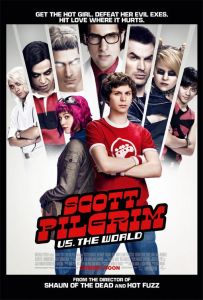 What happens when the millennial generation gets its own (attempted) seminal movie? It stays home and plays video games, letting the film, Scott Pilgrim vs. the World, languish at the box-office. I guess that’s what happens when you finance a movie whose target demographic will just as readily download the movie for free off the Internet.
Scott Pilgrim (Michael Cera) is a 22-year-old Toronto slacker. He?s the bass player for the band Sex Bob-Omb, along with lead singer Stephen Stills (Mark Webber) and acerbic drummer Kim (Alison Pill), a former ex-girlfriend of Scott’s from high school. The band’s biggest fan is 17-year-old Knives Chau (Ellen Wong), who also happens to be Scott?s new girlfriend. The world of Scott Pilgrim is abuzz with this scandal, especially Scott’s gay roommate Wallace (Kieran Culkin) and Scott?s younger sister (Anna Kendrick). Scott insists it’s all on the level and he has no ulterior motives for dating a high schooler. Then he sees the mysterious and alluring Ramona Flowers (Mary Elizabeth Winstead) who?s new to the area and American. Scott rabidly pursues her in what could best be described as stalking, eventually getting her to agree to date him. Trouble is, he hasn’t broken up with Knives just yet before starting this new venture. Scott is then confronted at the Battle of the Bands concert by a man who comes bursting out from the ceiling. He is the first of Ramona’s seven evil exes and Scott must defeat them all in order to earn the right to the violet-haired beauty. “Everybody has baggage,” Ramona says. “Yeah, but my baggage doesn’t try and kill me,” Scott wearily replies.
 Visually, this movie showcases director Edgar Wright (Hot Fuzz, Shaun of the Dead) using every crayon in the Crayola box. This is a visually resplendent film where every scene seems crammed with details to delight the eyes and light up the senses. It’s a rush to watch the kaleidoscope of colors and motions. The Scott Pilgrim universe clearly differs from our own. This is a realm that borrows heavily from old school video games, where people burst into coins when vanquished, where life-decisions are met with “leveling up,” where people have onscreen pee bars that will deplete after a trip to a urinal. Sound effects will routinely be verbalized on screen, everything from a “RIIIIIIIIIIING” of a telephone to the “Ding Dong” of a door. It’s amusing, though also easily overused. Jobs and stuff like that are for the real world, hence too square to be depicted. It’s this entire idiosyncratic comic book world treated like everyday reality.
The enormous display of style is impossible to ignore. Scott Pilgrim is a slick, flashy piece of entertainment that is riddled with nostalgic references for a select crowd. I appreciated how a nice walk was accompanied by the theme song from The Legend of Zelda, or that sound effects and onscreen graphics echoed the fights from Street Fighter II (don’t ask me which of the 800 versions). Scott Pilgrim is an excellent pop pastiche of a specific culture, namely a slacker, hipster, amiable, comics and gamer group. I myself was an avid Nintendo gamer back in my day, but I admit to waning interest when the games got too complicated and grisly (“Back in my day we had two buttons to push, one to jump and the other to shoot, and that’s how we liked it!”). The movie is an explosion of color, light, and (lo-fi garage rock) sound, which also might sound like the description of a seizure or a stroke to some. Like those ailments, Scott Pilgrim will be seen by some as an infliction. It’s hyperactivity and eagerness to please via nostalgic reference points will be what drives people to this film and what drives them away in equal measure.
The Scott Pilgrim graphic novels total six volumes and approximately 1200 pages, which means it?s not the easiest fit for a two-hour window. It also hurts that the Pilgrim books have a wide supporting cast of characters to tussle with, plus there?s the whole seven deadly exes thing which means the movie has to provide about a solid 20 minutes of set-up before finding enough time for seven antagonists (or boss battles, following gamer parlance) and a reasonable amount of resolution. Add on top of this the fact that Wright keeps the movie moving at an outrageous, ADD-addled pace, like the plot conveyor belt lever got broken and the scenes speed one after another. Everything about this movie feels fast and over caffeinated. The editing in particular has characters holding conversations where every line is in a new location, implying an added sense of movement. So you shouldn’t be too surprised when the Scott Pilgrim film feels like a whole lot of a little; it’s moving at the speed of light to entertain.
 Because of the plot mechanics and oversized cast of characters, Pilgrim can give off the impression of shallowness. It seems like all style and little substance and that’s because the movie attempts to cram an entire series of stories, back-stories, and conflict into two hours. The film version only has enough time to attempt to give Scott and Ramona characterization, though both come across as weak-willed, tentative, and less than charismatic, wondering if either party is worth the trouble. The movie tries to paint over these differences through distraction and force of will. The large cast of supporting players all elbows each other just to be mouthpieces for one-liners. Knives actually comes across as the most complete character, consumed by her infatuation, heartbreak, and then quest for misguided vengeance. She’s somewhat dismissed and yet she is the most developed person on screen thanks to Wong’s endearing and relatable performance. The entire experience of Scott Pilgrim vs. the World can be somewhat fatiguing when there’s little evidence presented for emotional investment. The books supplied the reasons for caring besides the whole underdog angle.
The movie aims to be a battle over love, but it’s not entirely convincing. Scott appreciates Knives because she’s simple, a relationship he doesn’t have to invest much within, something casual and enjoyable while it lasts or until it becomes too taxing. Then he goes ga-ga for Ramona and stalks her, wearing down her defenses. He’s purely smitten with her and willing to do whatever it takes to earn her affections, though he can?t explain why he feels this way. Here’s a note to screenwriters: when characters are asked why they love somebody, do not have them say, “I don’t know.” But for Ramona, Scott is her Knives. He’s something easy that won?t break her heart, an escape from the jerks she’s been dating before. He?s low maintenance. He’s something to pass the time. There’s an interesting dynamic here, made even more complicated by the fact that Scott’s time with Knives blended with his time with Ramona. There was not a clear end point. The movie takes a literal approach to the idea of love being a destructive force of nature. Scott is punished throughout because of his infatuation with Ramona, but he persists despite the bruises. And he doesn’t even really know much about her. There’s an interesting statement somewhere there about the punishment we endure, sometimes foolishly, over the affections of people we may love, or convince ourselves of, but not even like.
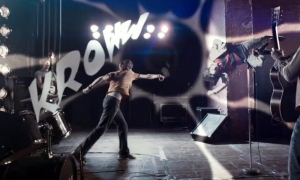 It may sound peculiar but I’m paying Michael Cera a compliment by saying his performance in Scott Pilgrim is the least Michael Cera the actor has ever been on screen. Gone is his gawky, awkward, ironic shtick that has fast become the Cera persona in films like Superbad and Year One. Scott is unjustifiably confident in his life’s pursuits, and Cera gets to act cocky and quippy, even if it?s done with a wink. He?s an unlikely kung-fu star but then again he?s also an unlikely leading man. Winstead (Live Free or Die Hard) is cute but plays her part a bit too toned down, like Ramona’s still searching for the right medication combination. Culkin and Pill are both scene-stealers of the first order, doing so with unabashed and flippant sarcasm. Every scene is made better by their presence. Among the evil exes, Brandon Routh (Superman Returns) has plenty of fun as a dim-witted super-powered Vegan bassist (“Vegans are just better than other people”), and Jason Schwartzman epitomizes hipster snark with such relish. The film is exceedingly well cast from top to bottom.
I’ve read some reviews positing that Scott Pilgrim vs. the World is an elaborate fantasy taking place in the mind of its titular hero, that he blends his knowledge of comics and video games to help make sense of the troubled waters of relationships and lingering hurt from the demise of love. I think that’s a nice explanation but perhaps trying too hard to frame this film as some form of psychoanalytical commentary on modern youth’s interpersonal relationships and the value of love. Scott Pilgrim vs. the World is really just a spastic, hip, clever wank that, as presented, gives little room or emotional investment. It?s a blurry, messy, prankish good time at the cinema that doesn’t translate into much more than the equivalent of sensory button mashing (video game reference). It’s fun while it lasts but it doesn’t have much beyond those astounding visuals to make it feel lasting, and I say this as a genuine fan of the graphic novels by Bryan Lee O’Malley. Alas, heavier discussions about the thorny, maddening issues of love are better left to more dramatic, and romantic, movies like Brokeback Mountain, Eternal Sunshine of the Spotless Mind, and even WALL-E. This movie is more preoccupied with spinning as fast as it can and then vomiting.
Nate’s Grade: B
Share this:

Year One (2009)
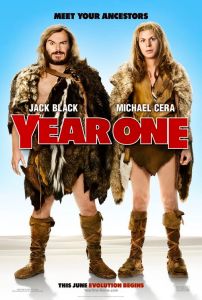 This is a slapdash comedy that?s too toothless to be satire and too dumb to be witty. Jack Black and Michael Cera play a pair of banished cavemen who stroll through various episodes from the Old Testament, like Cain and Abel and a circumcision-crazed Abraham, before settling in for a wild time at Sodom. This uninspired riff on the Bible rarely lands any laughs. The comedic aim of the film is extremely low; the scatological humor consists of farting peasants, bestiality, eating poop, urinating on your face, genital mutilation, and lots and lots of pedophilic jokes thanks to a grotesque, lispy Oliver Platt. Year One (of what exactly?) is a big step back for co-writer/director Harold Ramis and a general waste of everyone’s time and talent. Black and Cera do have an interesting and playful ying-yang chemistry but they have so little to do given the rambling, episodic nature of the plot. The characters make anachronistic pop culture references or talk in self-aware circles, the celebrity cameos do little, and the jokes lack any lasting momentum. Somewhere Ramis wants to make statements about religion and faith but the flick is too timid to do anything, so the movie limps to a finish with its lame “be your own chosen one” message. This is a prehistoric comedy with rocks in its head.
Nate’s Grade: C-
Share this:

Nick and Norah’s Infinite Playlist (2008)
 When you’re a teenager, sometimes there is nothing more important in life than music. Generally one of the most prominent means for a teenager to outwardly define his or her emerging personality is by music. Coming of age and maturing musical tastes seem to go hand in hand. I may date myself here but I can recall my own personal blossoming thanks to the likes of Green Day, the Smashing Pumpkins, and the Offspring (you couldn’t go anywhere in 1995 without hearing “Self Esteem”). Nick and Norah’s romantic interlude begins over common musical tastes and move from there. Having a person “get” you seems to be linked with having a person “get” your music. Nick and Norah’s Infinite Playlist is an inviting and mostly successful teen comedy that “gets” it.
Nick (Michael Cera) is nursing the common teen ailment of a broken heart. He’s one part of a queer core punk band and just happens to be the only heterosexual band member. Nick has been sending mix CDs to his ex-girlfriend, Tris (Alexis Dziena), but she’s been tossing them in the trash. Norah (Kat Dennings) has been fishing those mix CDs and falling in love with her unknown musical soul mate. Norah’s best pal Caroline (Ari Graynor) has informed her that her favorite indie band, Where’s Fluffy?, is playing a secret late-night show in New York City. The slew of characters, Norah and Caroline and Tris and her new boyfriend, attend a nightclub where Nick’s band performs. Awkward. Norah poses as Nick’s new girlfriend and the two take off together to drive a very drunk Caroline home. It is here that they begin an unforgettable odyssey filled with gross toilets, drag queens, Norah’s ex-boyfriend (Jay Baruchel), jaunts to recording studios, and many stops along the way to try and find Where’s Fluffy?
 Nick and Norah isn’t anything altogether remarkable but its charm comes in how, well, unremarkable it comes across. I do not mean this as faint praise or a backhanded compliment. The majority of teen-oriented films have the habit of slotting characters into rigid archetypes. Earlier this year, the documentary American Teen was released and barely made a blip. The director of this documentary condensed an entire high school year into a feature-length film, but she framed her characters as entrenched stereotypes patterned after movies (movies began the stereotype, now is life merely following its lead?). The marketing even had its main “characters” recreate the Breakfast Club poster with the requisite Jock, Geek, Princess, etc. It’s so easy to paint in broad, well-established strokes when it comes to teenage characters and a high school setting. So it’s genuinely entertaining and encouraging to see Nick and Norah where the characters just are people. Granted the gay characters are a bit too cutesy by half, though they never become swishy stereotypes and the slutty manipulative ex-girlfriend character is a pretty familiar and clichéd antagonist. But the real charm of the movie is seeing characters that cannot be painted in broad strokes, characters that do not hide who they are, and characters that refuse to be typecast. Just watching Nick and Norah interact, I felt like I was watching two friends instead of high school archetypes having the same tired class warfare. Making the characters reasonably realistic and unremarkable is a breath of fresh air.
Not all the elements in Nick and Norah entertain; some feel like they’ve been surgically attached from different movies. The entire subplot involving the sloppy drunk escapades of Caroline seems extraneous at best, providing an unnecessary plot point that keeps Nick and Norah together for the night. It provides some laughs due to Graynor’s highly amusing drunken performance, but the subplot also pushes the movie into outlandish gross-out humor, like when Caroline vomits into a toilet, drops her gum in the same toilet, and then decides to foolishly go after the gum. The same piece of chewing gum has its own fantastic journey. The coupling between Nick and Norah is also given a weird and somewhat unseemly addition. Clearly these two kids “like like” each other and the wild night presents different coupling obstacles before these fun kids eventually decide to make a move. In one scene Norah is taunted by Tris about never having had an orgasm. So then the movie makes it a point that when nick and Norah do hook up that we are presented with Norah earning her first O-face (the whole climactic sequence is done off camera and only with audio). Orgasmic proof was not needed to convince the audience that Norah has finally found a worthy guy. The fact that they’re high school-aged students brings an unsettling, seedy element into an otherwise wholesome film. It wasn’t needed.
The plot of Nick and Norah has a few bumps along the way because the emphasis is on the groovy and genial atmosphere. Watching the movie is somewhat akin to attending a party with some cool people. You leave the theater with your spirits lifted a tad, a smile on your face, and some fond memories for the time being. I’m not saying that Nick and Norah is comparable to the best teen comedies of all time but it manages to spin a little magic. I couldn’t help feel wistful as I watched the teen characters romp through the late night music scene of New York City, a character all its own. The movie manages to capture the exciting essence of being young and alive in an authentic way.
 The two leads are deeply enjoyable. Dennings (The 40-Year-Old Virgin) is a great find and comes across as a natural teenager. She’s not precocious or glib, but she seems grounded, unassuming, and yet intelligent in a way that doesn’t pass as hyper-literate. Dennings gives a spunky performance that is tinged with awkwardness and heartache, as she explores the scary yet exhilarating prospect of romance. She’s also got a bashful beauty to her, like the girl next door that would never admit that she could be attractive. She’s got lips like red licorice and classic features that could work in old Hollywood. Dennings gives every scene a boost of heart and the movie shines brightest every minute she’s onscreen. Cera (Juno, Superbad) seems to have patented his nervous stammer that he’s previously showcased. I wonder what Cera’s acting range actually is because he seems to be playing different variations on the same character. However, I have written before that Cera is the living master of comic understatement and the well-timed pause, and he proves it again. He mopes a bit too much through the movie but Cera manages to make him empathetic and not pathetic. The two of them have a sweet chemistry and it’s easy to yearn for their coupling.
Nick and Norah’s Infinite Playlist exists in a world that doesn’t exactly resemble our own but seems like a swell place to visit. The movie almost contains a certain innocence to its teenage shenanigans. Dennings and Cera make for engaging leads and an adorable couple onscreen. Not all of the parts come together as well as Nick and Norah do, but the movie’s overall vibe is authentic and low-key, apt to provoke cheerful smiles more than laughs.
Nate’s Grade: B
Share this:

Juno (2007)
 Juno is a hysterical teen comedy with equal parts sweetness and sour. The idea of an underage pregnancy certainly presents a lot of conflicts and seriousness but the film avoids direct messages on the big topics thanks to large doses of levity and some hard-earned wisdom. With this serving as a companion piece to Knocked Up, I suppose Hollywood is convinced there’s something inherently funny about unplanned pregnancy. Remember that, suddenly expectant fathers and mothers.
16-year-old Juno MacGuff (Ellen Page) drinks her “weight in Sunny D” to take pregnancy test after test, but each pee-dipped stick gives the same result: Juno is going to become a mommy. The father is Paulie Bleaker (Michael Cera), a fellow high school student who has a fondness for jogging shorts and orange Tic-Tacs. Juno’s father and step-mother (J.K. Simmons, Allison Janney) lament that they wish their daughter would have told them she was expelled or into hard drugs instead of being pregnant. Still, they are supportive and Juno decides to give away her bun in the oven to a childless couple, Mark and Vanessa (Jason Bateman, Jennifer Garner).
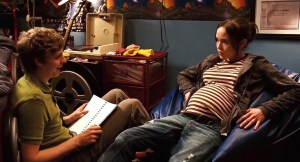 Juno doesn’t patronize or dismiss the gravity of what is indeed happening (a life is being brought into this world); Juno says she is trying to come to grips with issues “way beyond my maturity level.” There are moments that reveal real sadness and regret for some of these characters, and moments of palpable doubt about what it means to officially grow up and assume responsibility for another. Juno also refrains from easy high school stereotypes and coarse humor. Juno is an intelligent comedy that doesn’t make light of its circumstances even if the sarcasm is off the charts. It’s this winning combination of wicked wit and heart that makes [I]Juno[/I] destined to be a crowd-pleaser.
Writer/blogger/former stripper Diablo Cody makes one hell of an impressive screenwriting debut. The dialogue is practically sparkling and revels in the hip, hyper-literate realm that used to dominate the teenage speech patterns of shows like Dawson’s Creek. Sure, it’s not terribly realistic when characters can spout pithy one-liners mixed in with heavy jargon and lots of cool speak, but what do I care when I’m cracking up with laughter so often. But Juno cannot easily be dismissed as glib because Cody throws in some incisive moments that display shades of vulnerability and tenderness with her wacky assortment of characters. Even the aloof oddballs have moments that deepen them from just being quirky for quirky’s sake. These people are more than just receptacles for Cody’s wonderful words; they may begin that way but through the course of 96 minutes they manage to transform into flesh-and-blood where we, the audience, feel their pain and celebrate their happiness. You may be surprised, as I was, to discover yourself holding back tears during the movie’s inevitable and tidy conclusion.
The heavily acoustic score banks on a lot of pleasant, leisurely strumming but it suits the film and the song selections are apt. The very end involves a long acoustic duet rendition of the Moody Peaches’ “Anyone Else But You” and it may be one of the most disarmingly sweet, romantic moments of the year (the repeated lyric “I don’t see what anyone can see in anyone else” is a perfect summary for two outsiders finding their match). In fact, it’s probably the most potentially romantic song ever to include the line “shook a little turd out of the bottom of your pants,” but then again I do profess ignorance when it comes to romantic odes that include defecation references. Somewhere there has to be a Barry White song that has to cover this.
 Director Jason Reitman feels like a natural fit for this smart-allecky material. He lets the story take center-stage and, just as he proved with last year’s Thank You for Smoking, he can coax terrific performances from a strong body of actors. He keeps the pace chugging along and keeps form command of the many storylines and characters needing to be juggled. Juno is a comedy that says more about a character through a handful of smart, wry observations that cut to the bone, which is helpful considering the short running time means the film needs to do the most with its time.
Page should have been crowned a star immediately after her blistering performance as jail bait with claws in Hard Candy, but perhaps her top notch comedic turn in Juno will right this slip-up and give Page the opportunity to star in, at least, the same amount of movies as, oh, I don’t know, Amanda Bynes (Seriously, Hollywood, are you just throwing money at her?). Page is the perfect embodiment of the wiseacre teenager that thinks she knows more than anyone else. She recites the refined dialogue with such precision and ease, always knowing what segments to enunciate or de-emphasize to maintain a seamless comedic tone. Page brings great empathy to a know-it-all character and is the snarky spirit that makes Juno resonate.
The supporting cast around Page doesn’t let her down. Cera gives another fine performance of comic awkwardness befitting a teenager contemplating fatherhood. Simmons and Janney make a great pair of unflappable parents, particularly Janney who gives an ultrasound doc a memorable tongue-lashing for an off the cuff remark about Juno. Bateman works the same laid-back demeanor that he excelled at on TV’s Arrested Development. Rainn Wilson (TV’s The Office) makes a very funny cameo in the beginning.
 Garner as an actress has been somewhat hamstrung by her roles, either focusing on her multitude of ass-kicking abilities or landing her leads in romantic comedies that don’t require more than dimples and twinkling eyes. In Juno she is driven by her desire to have a baby; she’s affluent, prim, and an easy joke thanks to her stick-in-the-mud seriousness. But then Juno and the audience get a glimpse about how important being a mother is to Vanessa, and Garner nails a rather touching scene where she directly speaks to the growing child inside Juno’s belly upon Juno’s request. She speaks softly to the baby, briefly mentioning how loved they will be, and then she marvels at feeling the baby move. In lesser hands this scene could have induced eye rolls but instead seems genuine and a turning point for how we see Vanessa.
If Juno does have a flaw it is a minor one. The film places its teen romance on the back burner for so long that when it resurfaces and positions itself front and center the storyline lacks credence and believability. The conclusion would have had more emotional weight had the filmmakers spent more time on the teen romance angle, but regardless I was still amused, entertained, and grateful for the ending that came.
Juno is a delightfully tart and hysterical comedy that is easily quote-able thanks to Cody’s quick-fire retorts and snappy dialogue. Page is destined for greatness and Reitman proves once more that he can handle anything thrown at him with deftly comic aplomb. This is an impressive and assured comedy that bristles with comic vitality and confidence. This holiday season, make sure to take a trip to Juno.
Nate’s Grade: A


 nathanzoebl
You must be logged in to post a comment.