Blog Archives
The Hours (2002) [Review Re-View]
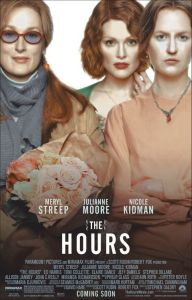 Originally released December 25, 2002:
Okay, after watching the Golden Globes award show and seeing The Hours crowned with the highest prize, and hearing incessantly about Nicole Kidman’’s fake prosthetic nose in the movie, it was time to venture into that darkened theater and see how good the awards-friendly The Hours was. Little did I fully realize what I was getting myself into.
Nicole Kidman plays Virginia Woolf, who is in the midst of writing her novel Mrs. Dalloway, where she proposes to display a woman’s entire life through the events of a single day. Julianne Moore plays Laura Brown, a housewife in 1951 having difficulty adjusting to a domestic life that she feels ill equipped for. Meryl Streep plays Clarissa Vaughan, a gay copy-editor in 2001 planning a party for a poet and former lover (an emaciated Ed Harris), who is suffering from the late stages of AIDS. These three storylines will be juggled as the film progresses, with each woman’s life deeply changing before the end of the day.
The Hours is a meandering mess where the jigsaw pieces can be easily identified. The attempt at a resolution for an ending, tying the three storylines together, is handled very clumsily. The film spins on and on that you start to believe the title may be more appropriate than intended. What this movie needed was a rappin’ kangaroo, post haste! The film is wrought with victimization and screams “Give me an award already!” Before you know it you’’re being bludgeoned to death with what is profoundly the most over serious Lifetime network movie ever assembled. And there’s nothing fundamentally wrong with Lifetime movies but The Hours does not share the sensibilities of its TV brethren.
 Kidman, nose and all, gives a strong performance displaying the torture and frailty of a writer trapped within her own mind but too often relies on wistful staring or icy glares. Moore is effectively demoralized but cannot resonate with such a shallow character. Streep is the least effective of the three and fizzles among an over-stuffed assembly of characters.
The supporting cast is unjustly left for dead. The characters are seen as parody (Toni Collette as Moore’s un-liberated homemaker neighbor), extraneous (Claire Danes as Streep’s daughter, Allison Janney as Streep’s lover, Jeff Daniels as Harris’ ex-lover, you know what, almost anyone in the Streep storyline), one-note (the workmanlike John C. Reilly who plays yet another doting and demystified husband) or merely obnoxious (Moore’s brat child that refuses to separate from her). It appears The Hours is the three lead actress’ game and everyone else is not invited to play along.
Stephen Daldry’s direction shows surprising stability and instinct after his art-house pandering Billy Elliot showed little. The technical aspects of ‘lThe Hours are quite competent, especially the sharp editing and musical score, which just points out further how slickly hollow and manufactured the film is.
The Hours is an over-glossed, morose film that is too self-important for its own good. It sucks the life out of everything. And for all its doom and gloom and tsunami of tears, the only insightful thing The Hours is trying to pass off onto the public is that women are more depressed than you think.
Nate’s Grade: C
——————————————————
WRITER REFLECTIONS 20 YEARS LATER
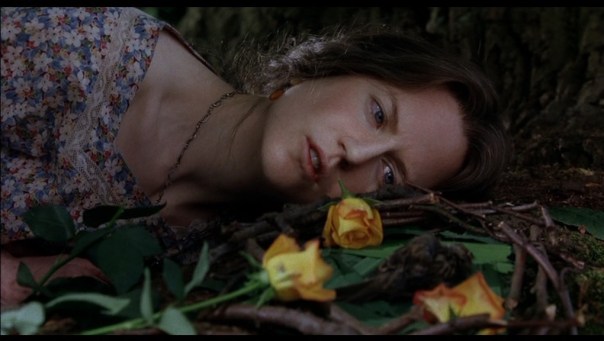
I thought 2002’s The Hours would be a good movie to come back to not necessarily because I thought it would be revelatory but because I thought it may have been emblematic of my more dismissive, glib attitude when I was a twenty-year-old smart alack getting published in his college newspaper and considering myself a hotshot wordsmith. I was worried that my initial review would come across as snide and condescending considering the subject matter. I dubbed it the “most over serious Lifetime network movie ever assembled” and yet, twenty years later, after having devoted two more hours watching The Hours, I must say that this comment still holds merit.
I was fully ready to disavow my younger self as being unkind to this movie, or being too quick to dismiss a movie about women’s suffering through three generations, especially as a young man trying to be clever and, by early 2000s standards, snarky and cynical. Well, even in 2022, I still dislike The Hours, and it’s because of how overwrought everything comes across in this movie. This movie is overstuffed with the trapping of importance, and the 1950s section featuring Julianne Moore as an unhappy housewife stifling her desires (not to be confused with her 1950s unhappy housewife also stifling her desires in 2002’s Far From Heaven) is played to the point that it could be self-parody. That’s not the kind of artistic approach you’d think you would want in something so transparently desirous of special award consideration. For me, it was unmistakable even early on, and the heightened melodramatic atmosphere made me, at several points, almost want to giggle at how obvious and cloying and annoyingly reaching each moment came across. There is no subtlety to be had with The Hours, and that’s fine, but there is also no real striking substance beyond a few transitory moments of grace that stand out. The Moore segment has her drifting through the day like a zombie and almost on the verge of tears at every single turn. I felt sorry for Moore, who is coasting on emotional instinct as the character she’s been given is, at best, meant to be a symbolic placeholder of millions of women of her era. Her interaction with her son makes her sound like a deranged android grasping for human behavior. The moment where they sift flour together and claim it’s beautiful was just so stupifying. It’s amazing to me that Moore was nominated for Best Supporting Actress for this role. She’s also the example of the kind of woman that Woolf was writing about with her titular Mrs. Dalloway heroine, but without Woolf explicitly commenting, the entire 1950s segment is one big airless melodrama, meant as a misdirect of the movie’s miserablist obsession with suicide. By the time old lady Julianne Moore shows up to unload a hasty monologue explaining decades of unknown drama, you may have decided that the three stories could have been two (or one).
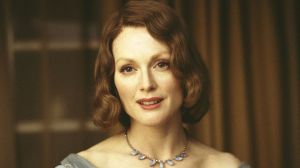
Each of the three plot segments is intended to better inform the other, to coalesce into a thesis statement on the plight of women, except each storyline is so thinly written. Without the others to provide direct companionship, each one of these storylines would be pitifully minimal and fail to evolve the notions of feminine hardship. Virginia Woolf (Nicole Kidman) is sad because she feels stifled by the country and doctors who are trying to improve her mental health. Laura Brown (Moore) feels stifled because she is a cloested lesbian pretending to be a happy and doting housewife to her oblivious husband (John C. Reilly, not to be confused with his other oblivious husband in 2002’s Chicago). And Clarissa Vaughan (Meryl Streep) is sad because one of her closest friends (Ed Harris) is dying from AIDS. That’s it. Each of the three timelines is threaded together for the intention of greater relevance, but what it really does is put the onus on the viewer to find more relevancy in context. Sometimes the three women will be doing the same actions, sometimes one will make a comment that seems to be answered by another, and sometimes they’ll inadvertently quote one another or Woolf’s novel. Except the connections and layers are superficial and clinging to an obvious thesis and biding its overlong time for absent depth.
Much of the early publicity around The Hours circulated around Kidman’s fake nose, which producer Harvey Weinstein hated (he also hated the score by Phillip Glass that would later be nominated for an Academy Award) but Kidman absolutely loved. During the time of production, she was divorcing Tom Cruise and was a tabloid magnet but the prosthetic nose allowed her a degree of refreshing anonymity with the paparazzi. She kept the nose on for the entire movie. I’ve been more critical of Kidman’s since her early 2000s career summit (Moulin Rouge, The Others, The Hours), but she legitimately is good in this and has more spark and reserved melancholy than she’s shown in numerous latter roles. Whether she deserved the Best Actress Oscar over the likes of Diane Lane (Unfaithful), Salma Hayek (Frida), Renee Zellweger (Chicago), and Moore (Far From Heaven), is another question I think I already know the answer to, but it allowed every single critic and would-be Oscar historian to use the same hacky joke: “she won by a nose.”

This cast is stacked to the point that even small parts are played by great actors. On top of the big three you’ve got Harris and Reilly, Toni Collette, Claire Danes, Margo Martindale, Eileen Atkins, Allison Janney, Miranda Richardson, and Jeff Daniels. It’s an embarrassment of acting riches, which makes it all the more disappointing when they are kept strictly as archetypes and stereotypes.
Director Stephen Daldry is a complete mystery to me. His first three directing features earned him three Oscar nominations for Best Director (2000’s Billy Elliot, The Hours, 2008’s The Reader). I thought The Reader was horribly misguided but it led to Kate Winslet winning her first Oscar, and I thought his follow-up, 2011’s Extremely Loud and Incredibly Close, was also horribly misguided and was still nominated for Best Picture. I don’t understand the adulation.
In my original review, I concluded by saying, “The Hours is an over-glossed, morose film that is too self-important for its own good. It sucks the life out of everything. And for all its doom and gloom and tsunami of tears, the only insightful thing The Hours is trying to pass off onto the public is that women are more depressed than you think.” I thought re-evaluating the movie twenty years later would prove more insightful and perhaps prove my younger self wrong, but the me of the year 2022 was the one in the wrong. I agree that its central thesis is relevant, but having three underwritten stories of sorrow stacked atop each other and expecting poetry is asking a lot. I wish this movie was indeed better but it’s prime early 2000s overwrought Oscar bait.
Re-View Grade: C
Share this:

Don’t Look Up (2021)
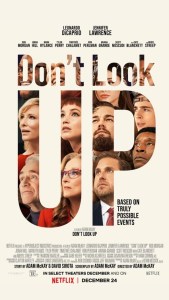 A scorched Earth satire that flirts with a literal scorched Earth, Don’t Look Up is writer/director Adam McKay’s star-studded condemnation of everything stupid and myopic in media, politics, and pop culture. Jennifer Lawrence plays a doctoral student who discovers a comet heading for direct cataclysmic impact with Earth, and she and her astronomy mentor (Leonardo DiCaprio) are trying to sound the alarm but nobody seems to be listening. Not the president (Meryl Streep) and her inept chief of staff/son (Jonah Hill). Not the greedy CEO (Mark Rylance) of a tech company. Not the media where morning TV co-hosts (Cate Blanchett, Tyler Perry) are more compelled by music star breakups than pressing science. It makes a person want to stand up and scream about priorities, and that’s McKay’s point, one that will be bludgeoned again and again. This movie is animated with seething rage about the state of the world and the cowardice about facing obvious problems head-on. It’s fit as a climate change allegory but COVID-19 or any scientific crisis could be applied as well. It’s about choosing ignorance and greed, about deferring to our worst instincts, and those in power who profit from inaction. I laughed at several points, some of it good cackling, and the movie is dark to its bitter end. This is the bleakest movie of McKay’s foray into his more sober, activist movie-making (The Big Short, Vice). It’s less Seeking a Friend for the End of the World, exploring the foibles of humans reconciling their last moments of existence, and more Idiocracy, where there is a lone voice of reason and the rest of the population are aggravating morons that refuse to accept reality even if it literally means just looking up with their own eyes. In some ways, the dark laughter the movie inspires is cathartic after years of COVID denials and mask tirades and horse medicine. The satire is bracingly blunt but also one joke on repeat. If you’re the right audience, that one joke will be sufficient. I don’t think the movie quite achieves the poignancy it’s aiming for by the end of its 138 minutes, but the anger is veritably felt. Don’t Look Up wants us to save the world before it’s too late, though the people that need to see the movie the most will be the ones fastest to dismiss it. Still, congrats to McKay for making a movie this depressing and relevant for the holidays.
Nate’s Grade: B+
Share this:

The Prom (2020)
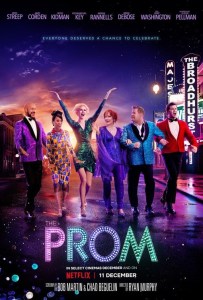 It’s full of big feelings, declarations of self-identity, an unabashed love of the transformative power of theater, and its power of positivity can be a balm to many during this holiday season. The Prom is based on a short-lived Broadway musical about a girl in Indiana who wants to bring her girlfriend to the school prom and the ensuing media controversy that erupts. A team of out-of-work theater actors (Meryl Streep, Anthony Rannels, Nicole Kidman, James Corden) see publicity value in rallying to her cause, so they decamp to Indiana and challenge the homophobic PTA leader (Kerry Washington) who refuses to hold an inclusive prom. Director Ryan Murphy’s style and sensibilities work well within the realm of musical theater; a decade of television curation for FX and now Netflix has made him an expert on camp and flash. The man loves applying slick gloss to trash. His camera is constantly, uncontrollably moving during the numerous musical numbers, attempting to compensate for the generic quality of the majority of them. There are two standouts. The first is when Corden’s character takes our lesbian teen to the mall for a makeover. It’s got a catchy hook and one that becomes a reoccurring theme for the show. The second is when Rannels’ character is pointing out the hypocrisy of local Christians decrying homosexuality but falling short of other Biblical teachings. The story is sweet but un-challenging. The plot exhausts so quickly that I was amazed at one point to discover there was still an hour left in the over two-hour production. Each member of the squad gets a signature number to varying degree of success. The happy ending is affirming and heartfelt but also quite easy and kind of unearned. The amount of catharsis and reconciliation doesn’t gel with the emotional investment and development of these characters. They’re nice but relatively dull, and the industry satire only goes so far to chide the out-of-touch Broadway elites for their own prejudices of Midwest life. The Prom is disposable fluff that will pacify an afternoon.
Nate’s Grade: C+
Share this:

Little Women (2019)
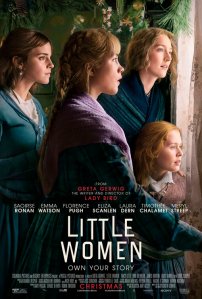 By my count, this is approximately the 182nd version of Louisa May Alcott’s Civil War sisterhood. There must be something universal about the trials of the March sisters and their struggles for independence, agency, love, and happy endings on their own turns. Greta Gerwig, fresh off her Oscar nominations for Lady Bird, has given Little Women a decidedly modern spin. The story flashes back and forth between past and present, sometimes in consecutive shots, and feels full of authentic youthful energy. It’s also the first adaptation I’ve watched that has fixed the problem of Amy (Florence Pugh, affecting), widely regarded as the least liked sister. Through Gerwig’s telling, she becomes a self-determined woman, just like Jo (Saoirse Ronan), who recognizes the social trappings holding her back but chooses to do her best within this unfair system rather than rage against it. It’s like an empathetic reclamation for this often reviled character. The enjoyment of Little Women is how vibrant and different each of the March sisters is and how an audience can see degrees of one’s self in each little woman. Jo is by all accounts our lead and her struggle to be a successful writer pushes her against conventions of the era. There is an invented and very amusing bookend where Jo bickers with a blowhard male publisher (Tracy Letts) about “women’s melodrama.” It’s a meta commentary on Alcott’s book herself, especially with the helping of marriages and happy endings by story’s end. Ronan is a force of nature in the film and sweeps up everyone around her with charm. Meryl Streep is supremely amusing as an older rich aunt bemoaning the girls won’t get anywhere without marrying a wealthy man. The limited options for a working-class family are given great consideration, but it’s really a movie that seems to pulsate with the exciting feelings of being young, having the world stretch out before you, and chasing your dream, rain or shine. It’s also gorgeously shot and feels so assured from Gerwig as a solo director. There are a few detractions for this new 2019 Little Women, the biggest being how confusing it can get with its melded chronologies. If this is your first exposure to Alcott’s story, I fear you’ll get lost more than a few times trying to keep everything in order. The love story with lovesick pretty boy Laurie (Timothee Chalamet) feels tacked on even though it’s a feature of the novel. This newly structured, reinvigorated, charming remake of a literary classic feels definitely of the period and of today. It’s the first Little Women adaptation that made me realize how timeless this story really can feel in the right hands. It may be the 182nd version but it might be the best one yet.
Nate’s Grade: B+
Share this:

Mary Poppins Returns (2018)

I have no real investment in Mary Poppins as a character or the original 1964 movie, so I was expecting to walk out of Mary Poppins Returns with a shrug, likely finding it middling at worse. I was unprepared for what I endured, and endured is the accurate statement. Mary Poppins Returns is an insane movie and one of the most maddening and painful experiences in a theater I’ve had all year, and no number of spoonfuls of sugar will help this bad medicine go far enough down.
It’s the “Great Slump,” a.k.a. Depression, in London and the Banks children have grown up. Michael (Ben Whishaw) has three young children of his own and he’s struggling to maintain his job at the bank and be the father they need in the wake of his wife’s death. His sister, Jane (Emily Mortimer), has moved into help but it’s still not enough. Enter that famous nanny, Mary Poppins (Emily Blunt), who takes it upon herself to watch over the children, help them through the grieving process, and explore the outer reaches of London with some help from some friends, chiefly Jack (Lin Manuel-Miranda). The Banks family is in danger of losing their home to the head of the bank (Colin Firth) unless they can find a specific title of shares that will grant them a wealth denied their adult lives.
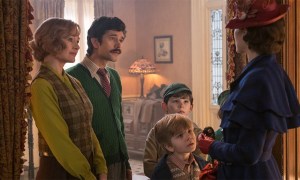
This movie felt like it was eight hours long and I had no sense of how much time was passing, mostly because of its misshaped structure and general lack of pacing. Mary Poppins Returns feels like it could have been renamed The Tony Awards: The Movie. It’s one unrelated song-and-dance number after another, rarely building from the previous one, and so it feels like an eternal televised awards show that just shuffles from one set piece to the next, never providing a sense of direction or finality. Things just happen in this movie and then different things happen but rarely do they feel consequential. This makes the film feel endless because you have no real concept of progression. It’s just another unrelated song into an unrelated magical realm that doesn’t really seem like it matters, and then we’re off to the next. I think some part of me is still trapped watching Mary Poppins Returns, never allowed to leave.
This would be mitigated if the songs were any good. There are over a dozen and not a single one is memorable. It was mere minutes after leaving the theater that I pressed myself into trying to hum any one of them, and I could not. They instantly vanish from your memory because there are no melodies or interesting production aspects that cause them to stand out. They assault you with their blandness and staid orchestration. They’re a careful recreation of an older sounding, 1950s musical, an antiquated sound that doesn’t have the same traction today. The only way you can remember one of these songs is if you have a traumatic experience forever linked to one of these mediocre, warbling collection of sounds.
There are two astoundingly peculiar songs. “Trip a Little Light Fantastic” is a big ensemble number involving the lamp lighters lead by Miranda. However, the song reference is clearly evocative of the Timothy Leary “trip the light fantastic” comment about LSD. It’s strange to think this is only a coincidence when the lamp lighters are dubbed “learies.” It’s not a good song to begin with and the performance literally involves men on BMX bicycles flying around and doing tricks. How is any of this happening in a reported Disney family film? The Meryl Streep “Turning Turtle” song may be the most excruciating five minutes I’ve sat through for all 2018. It’s just embarrassing to watch and made me honestly think of the children’s movie disaster, The Ooogieloves, where you watch once proud actors debase themselves and their legacies in depressing fashion. That’s the level of dread and mourning I had watching Streep slog through a Bela Lugosi accent and dance upside down. It has to be seen to be believed but you shouldn’t ever have to see this. I have a new appreciation for the La La Land songs.

The continual removal of stakes robs the movie of feeling like anything onscreen genuinely matters. Mary Poppins is a magical creature without clearly defined rules or limits. At any point she might simply have the solution to a problem that she wasn’t sharing. Take for instance the ending (spoilers for the duration of this paragraph, but really, who cares?) where the lamp lighters and the Banks family race to ole Big Ben to literally “turn back time” by adjusting the clock hands. The lamp lighters use their ladders to free climb the face of the clock to the very top, only to be undone by not being able to reach the minute hand at it nears twelve. Then all of a sudden Mary Poppins scoffs to herself and flies up to the clock face to adjust it. If she could do this the whole time why did these very mortal men risk their lives in this exercise? I think Mary Poppins may be a cruel god (more on this later). The concluding dash to ensure the Banks family can keep their home involves not one, not two, but three deus ex machinas, a “Turducken of ex machinas” as my pal Ben Bailey termed it. Ultimately all of their actions do not even matter because the film routinely provides an unknown escape route that invalidates their efforts. It turns out, in the end, they weren’t even going to lose their home thanks to (at my best guess) a magical bird head that is best friends with the head of a bank and who never mentioned this before, the same head of the bank who has just been off in what appears to be an adjacent room for whatever reason and that also knows that Michael Banks has accrued a hefty fortune from a childhood investment, and has never mentioned it as well except in this crucial moment. Why, why does Mary Poppins Returns do this? Why does it present stakes or the illusion of stakes only to sabotage them every time?
Is Mary Poppins really a creature of good or does her need to be loved prove her a fickle god who demands adulation, subservience, and obedience? When Mary Poppins travels from world to world, some live action, some animated, all fanciful, every inhabitant seems to know this woman and love her unconditionally despite her prevalent smarm. The bigger question is do these magical worlds exist independent of Mary Poppins? Is there a pocket universe in existence on the side of a chipped porcelain bowl, or did it only come into existence when Mary Poppins decided it would be a lovely vacation spot? If so, that means she is calling into being a throng of adoring creatures that exist to validate her impulsive whims. She is a selfish god that demands an audience of servants and sycophants, not unlike the Javier Bardem character in Darren Aronofsky’s polarizing polemic, mother!.

The actors acquit themselves fine for their roles. Blunt (A Quiet Place) and Miranda (Moana) will still be charming performers even when given substandard material. Blunt holds your attention with her prissy, schoolmarm persona, balancing the audience’s memories of Julie Andrews without going into parody. Her singing (as also evidenced from 2014’s Into the Woods) is above average and can help make some of the songs more tolerable to listen to. Miranda is a talent bursting with charisma and range, which makes it all the more frustrating to squeeze him into the narrow confines of a cockney scamp. He does get a rapping reprise in “A Cover is Not the Book” with a group of cartoon penguins. The stranger element is that it really feels like Miranda’s character wants to have sex with Mary Poppins. They slot him as a forced romantic option for Mortimer’s underwritten sister, but his eyes are clearly set for the woman who bosses people around and has magic in her fingers. He remembers her when he was a boy chimney sweep and I think he’s been fantasizing about her every day since. Plus, she hasn’t aged in 30 years.
Mary Poppins Returns is a bizarre artifact of a displaced time, taking great pains to recreate a style but without providing a purpose or sense of feeling beyond emulation. I don’t know who this movie is for besides the hardcore fans of the original. There are dancing dolphins, talking dogs, bathtub portals, an upside down house, flying balloons, union protests, Angelina Lansbury or an animatronic lookalike, and there’s lots of songs you will be unable to recall and a story that repeatedly removes any stakes or grounding from beneath itself so that the movie never feels firm or purposeful. There were several points where I just wanted to throw up my hands and ask, “What am I watching?” I still don’t know. Mary Poppins Returns is a movie musical that is nothing short of super-cali-fragil-awful.
Nate’s Grade: D+
Share this:

The Post (2017)
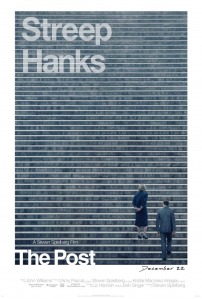 Even with the added timely benefit of championing a free press in the era of Trump, Steven Spielberg’s The Post is a movie held together by big speeches and Meryl Streep. It’s the story of the Pentagon Papers but it’s told from the wrong perspective. It’s told through the reference of whether the owner of the Washington Post (Streep) will or will not publish and how this endangers her family’s financial control over the newspaper. Plenty of dismissive men doubt her because she’s a woman. It’s simply one of the least interesting versions of an important story. Streep is her standard excellent self and has a few standout moments where you can actively see her character thinking. I just don’t understand why all these talented people put so much effort into telling this version of this story. I missed the active investigation of Spotlight, how one piece lead to another and the bigger picture emerged. There was an urgency there that is strangely lacking with The Post. The question of whether she will publish is already answered. It feels like the screenplay is designed for Big Important Speeches from Important People. Tom Hanks plays the gruff editor of the newspaper and Streep’s chief scene partner. They’re enjoyable to watch, as is the large collection of great supporting actors (Bradley Whitford, Carrie Coon, Sarah Paulson, Tracy Letts, Matthew Rhys, Jesse Plemons, Bruce Greenwood, and a Mr. Show reunion with David Cross and Bob Odenkirk). This is a movie that is easier to admire than like, but I don’t even know if I admire it that much. The film has to call attention to Streep’s big decision and the stakes involved by underlining just what she has to lose and reminding you how brave she’s being. When Streep leaves the U.S. Supreme Court, there’s a bevy of supportive women lined up to bask in her accomplishment. It’s a bit much and another reminder that The Post doesn’t think you’ll understand its major themes. It’s a perfectly acceptable Oscar-bait drama but it sells its subject short and its audience.
Nate’s Grade: B
Share this:

Into the Woods (2014)
 Theater fans, take this review with a Broadway-sized grain of salt because I’m going to admit I’ve never seen Into the Woods prior to its film release. I consider myself a Stephen Sondheim fan, especially with Sweeney Todd. Now with all that established, I found Into the Woods to be a thoroughly uninvolving and middling musical without any memorable tunes and a series of annoying characters that just kept running in comic redundancies. Perhaps it’s my own ignorance to the original 1987 theater production, considering subversive and edgy and not the most natural fit for the Disney brand. Perhaps I’m just not hip enough to Sondheim’s academic use of melody. Or perhaps others out there will share my opinion that Into the Woods is a tuneless bore.
In a fantasy kingdom, a Baker (James Corden) and his wife (Emily Blunt) are trying to conceive a child but having difficulty. A witch (Meryl Streep) reveals that the only way to undo the infertility curse is to gather a series of magical items. The baker ventures into the aforementioned woods, desperate to find these items, often running into the likes of other fairy tale icons like Red Riding Hood (Lilla Crawford), Cinderella (Anna Kendrick), Prince Charming (Chris Pine), the Big Bad Wolf (Johnny Depp), Jack (Daniel Huttlestone) and his beanstalk, and the entrapped Rapunzel (Mackenzie Mauzy).
 It must have been more relevant back in 1987, but today we are awash in the darker side of fairy tales. Analyzing the implications of “happily ever after” in a more adult and pessimistic way is nothing new. We’re saturated with TV shows and movies that have explored these issues before, revealing the darker truths to some of our favorite fairy tale characters, so it’s hard for a Woods novice to approach the show without a sense of ”been there, done that.” It’s unfair for Sondheim but that’s the reality that greets an adaptation of a musical that’s almost thirty years old. Because of this context, the insights and subversions with the fairy tale characters never feel somewhat pat. The fact that Little Red Riding Hood might be featuring a sexual awakening related to the dangerous Big Bad Wolf is the only striking one that adds dimension to her character. Other “twists” given to the characters are either predictable or just underwhelming. Oh, Prince Charming isn’t so nice and marrying into royalty isn’t the fantasy it’s made out to be? Then there are character betrayals that come out of nowhere, without any proper setup, that feel like the musical is just flailing around in transparent shock value. Just because someone suddenly does something out of character does not mean it was a good plot choice. The guilty party even sings, “I’m in the wrong story,” admitting the identity crises. I wouldn’t have a problem with these wrinkles if they felt better setup or there was more commentary attached. Instead, as delivered in the film, it feels rushed and unearned.
Music is inherently subjective (then again so is film, I mean…), so I’m sure others will vociferously disagree with my stance that Into the Woods is mediocre. True to Sondheim’s works, he establishes character-based melodies that fold and cascade atop one another, weaving in and out. The problem is when none of those melodies captures your attention. These are not humable tunes. To my ears, the songs just collided into one another forming one long string of tonal mélange. The singing is more than adequate by the performers (though Pine’s crooning is a bit subpar) but the songs just flatline. I just took a break from writing and listened through Amazon.com’s soundtrack for the show, sampling every song one again, and they all just blend together. There isn’t one song that burrows its way inside your brain, taking residence beyond the immediate. Then again, if you’re one of the fans of the show who loves these songs then having a fresh coat of Hollywood production will make them sound even better for you, especially with Corden and Blunt and Streep as the top performers.
Another hindrance for me was that I found many of these characters to be insufferably annoying. I found Red Riding Hood and Jack to be irksome and thieves, and so I didn’t feel much sympathy when Jack’s breaking and entering and giant manslaughter lead to dire consequences in the last act. Does not the lady giant deserve her vengeance? Her home was broken into, pilfered for its valuables, a small portion of which would have been sufficient but Jack cannot help his felonious ways, and then the boy killed her husband in a hasty escape attempt. If anything, I would have preferred the lady giant picking her teeth with the plucky lad. I also wanted Little Red to remain in the belly of the wolf (spoiler alert?). Cinderella lost my interest with her wishy-washy behavior. I believe it’s meant to be funny that she keeps returning and running off for three days in a row of princely balls. Another way of looking at that behavior is frustration. The only characters I actively cared about were the Baker and his wife, and the calamitous plotting of the musical’s second half tested even those allegiances.
 The story gets to be rather redundant as well once the main characters are established and their plight is set in motion. I suppose I can now understand why Into the Woods is one of the most popular stage productions to perform at high schools and colleges: the scarcity of scene changes. Much like other aspects of the film, the setting just blends together and becomes tiresome. My pal Eric Muller remarked, “It’s called Into the Woods and not Into Multiple Sets.” I got sick of the woods. The plotting requires the various characters to keep running into one another again and again. It’s amusing at first but once it keeps going, and going, and going, the repetition loses its charm. You start to feel like the show is as lost as the characters and just going in circles to bide its time.
Acting-wise, I cannot fault the big-screen version. Blunt (Edge of Tomorrow) has a great singing voice and has shown great range as an actress in 2014. Streep improves upon her shaky start to musical theater from Mamma Mia. She’s still the great Meryl and seems to be one of the few people having fun. She enlivens every scene she’s in. Pine (Star Trek Into Darkness) is enjoyably self-involved as his caddish prince. Depp (Transcendence) is suitably lascivious though he only has about five minutes on screen. Corden (soon to be the new host of CBS’ Late Late Show in 2015) is the real standout. The man has a self-effacing likeability to him that serves as an anchor for the show. He’s funny and tender but he’s the heart of the story, and the film is at its best with Corden as its center.
If you’re a fan of the original Into the Woods, chances are you’ll likely find enough in this adaptation to enjoy. Director Rob Marshall (Chicago) and his crew re definitely fans and you can feel their appreciation for the source material. However, if this is your first exposure to the Broadway show, then you may too find the characters annoying, the commentary underdeveloped and dated, the songs tuneless and unmemorable, and the plotting to be redundant and tedious. The actors do what they can but it was ultimately a losing cause to my ears. I found the film more exhausting than transporting. I’m at a loss how people can work up such passions for a show that feels so thoroughly blah. I await the Sondheim crowd to tar and feather me as an ignorant heathen, but there you have it. Into the Woods is an underwhelming musical that made me want to turn on the radio.
Nate’s Grade: C
Share this:

August: Osage County (2013)
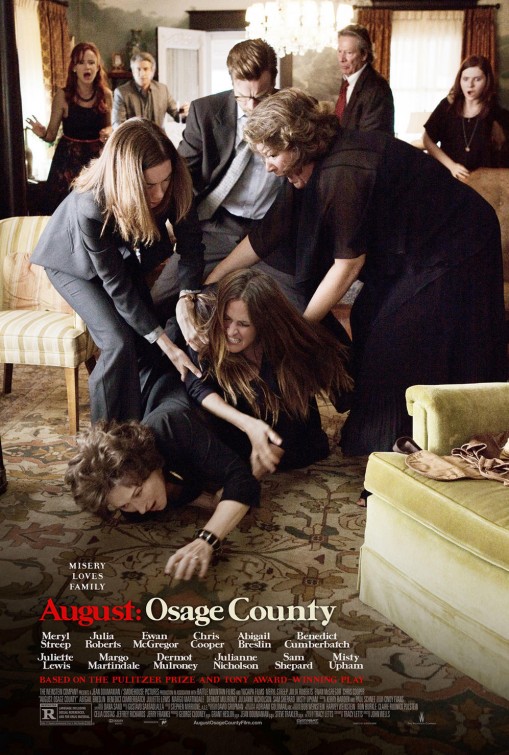 This holiday season, the movie with the most acting, by far, is likely to be August: Osage County, the adaptation of Tracy Letts’ Tony award-winning play. It’s a large dysfunctional family getting back together and opening old wounds, so, you know, the most relatable Christmas movie for some. It’s easy to see what attracted such A-list talent to this project because these characters are actor catnip; each is overflowing with drama, secrets, revelations, anger, and it’s all channeled through Letts’ barbed sense of humor and wickedly skillful dialogue. With Meryl Streep as the pill-popping matriarch, Julia Roberts as her resentful daughter, and a host of other inter-generational conflicts and secrets, you may feel exhausted by the end of its 130-minute running time (the stage play was 3.5 hours, respectively). The emotional confrontations feel like grueling pugilist matches, the melodrama kept at a fever pitch, but the film is never boring. Streep is her usual astonishing self and the deep ensemble gives each actor something to chew over. This is the best Roberts has been in years, and she’s not afraid to get nasty (“Eat your fish!”). Just when you think the story might soften, Letts unleashes another body blow, allowing no uncertainty that this is a family doomed. The story also provides insights into tracking the path of cruelty through the family tree, limb by limb. August: Osage County is stridently funny but also punishing in its no-holds-barred approach to family drama. If you’re looking for a movie that makes your family seem normal and even-tempered, this may be it.
Nate’s Grade: B
Share this:

Hope Springs (2012)
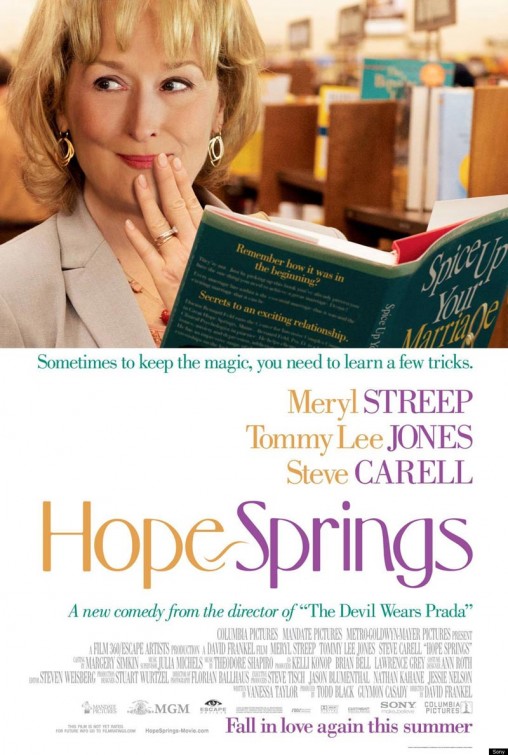 I may be 30 years removed from the target demographic, but I found the sexagenarian romance Hope Springs to be charming, insightful, and quite well developed. The idea of Meryl Streep getting her groove back and an older couple essentially learning how to be intimate again, physically and emotionally, sounds like a hard sell (no pun intended). The central couple has settled into the complacency of a long marriage, and little divisions have turned into routines. How can you bridge the divide? I was routinely surprised at how mature and thoughtful the movie was when it came to examining relationships. In between all these personal revelations of unhappiness is a curiously playful sex comedy, and you’ll see Streep engaging in certain acts you never thought becoming of the three-time Oscar-winner (no pun intended). Streep and her reserved husband, played by Tommy Lee Jones, are terrific, and their counseling scenes are the stuff of great drama, as two people who don’t really know how to communicate reveal their true feelings and problems. I’m making the movie sound like a chore but it’s really engaging and the stuffiness of Jones makes for some enjoyable comedy. This is a small movie, dealing with a weighty but recognizable subject that’s not often handled with this care and attention. Hope Springs is practically a Hollywood version of a Bergman film, and with these results, that’s not a bad thing. I foresee Hope Springs leading to a lot of patrons going home and having sex with their spouses. It’s like an AARP aphrodisiac. Good thing for menopause, or else Hope Springs would be responsible for a baby boom all its own.
Nate’s Grade: B+
Share this:

Julie & Julia (2009)
 Meryl Streep is as she always is, which means to say she’s terrific as famous jubilant chef Julia Child. She’s got the sing-songy voice down cold, and Julia comes across like a spigot of joy, yelping with delight like a child. It’s hard to not find it adorable, and her husband (Stanley Tucci) is a kind, caring man who complements her well. The scenes between the Childs can be heartwarming and delightfully comic. However, for some weird reason, the Julia Child section is only half of this movie. Writer/director Nora Ephron decided to frame the movie with the biography of Julie Powell (Amy Adams) writing a blog in 2002. Huh? Powell wants to prepare all 500 recipes from Child’s best-selling book on French cuisine in one year. As you might expect, this whole section turns into a lot of narration over food preparation and Powell becoming increasingly narcissistic about her blog fame. The only real purpose this modern storyline serves is to add perspective to the Julia Child storyline, giving historical context to what we see Streep and Tucci struggle over. The real resonance is with Streep as the larger-than-life cooking personality and her upward climb to be taken seriously as a chef and as an author. I don’t care about Julie Powell. She keeps interrupting a better storyline. Apparently the real Julia Child didn’t care for Powell either, because late in the movie Powell discovers that the real Child (who died in 2004) thinks the whole blog thing is a gimmick. And isn’t it? Then again, isn’t having Streep as Julia Child a gimmick of casting? Julie and Julia would have been better served if it had completely carved off the Julie section.
Nate’s Grade: B


 nathanzoebl
You must be logged in to post a comment.