Blog Archives
Adam (2009)
 It’s a romantic comedy with a quirk. Adam (Hugh Dancy) has Asperger’s syndrome, a higher-functioning level of autism that makes social interactions difficult. Lucky for him he?s handsome enough that his new neighbor (Rose Byrne) falls for him anyway. What follows is mostly standard romantic comedy stuff, with boy and girl feeling each other out, except Adam has trouble with figurative language and implied speech. The movie works on a low-key cuteness as it hits all the conventional plot destinations, but then it charts its own path for an ending. I give credit to writer/director Max Mayer for bucking formula and following his convictions, refusing to tie everything together so easily. With that said, the Asperger’s portrayal seems to go into an extreme, Rain Man-level of social disability. Adam is crippled with fear even to leave his home; he is a slave to routine. Dancy is a sympathetic lead, though he’s overly reliant on his character’s quirks. Adam isn’t a freak or some delicate flower needing to be protected from the rigors of reality, and I think the movie would have benefited from a broader look at Adam’s ongoing lifelong struggle with his brain. Mostly, audiences are served up a sweet if somewhat plain romance with an extra dash of eccentricity, but not enough to rock any rom-com sensibilities. It’s a non-threatening alternative to the genre.
Nate’s Grade: B
Share this:

Dear Zachary: A Letter to a Son About His Father (2008)
 Dear Zachary: A Letter to a Son About His Father is an extremely personal movie, but it’s also a gut-wrenching, emotionally devastating film that will completely empty out your tear ducts. As an ardent fan of film, I cannot fully advise doing some research on the real-life case before seeing the movie, but those with less strong sensibilities may be better off knowing what they are going to be in for. This film is emotionally draining and infuriating, but it is also unquestionably one of the best films of the year, bar none. Just thinking back on it makes me have to fight back tears.
In 2001, Dr. Andrew Bagby died at age 28. The squat man had a chubby face, a large personality, and an innate ability to make friends wherever he went. Here was a case where one man made a difference simply by living out his life (several grooms had pegged him to be their Best Man in weddings). Filmmaker Kurt Kuenne decided to make a movie that would serve as a living testimony to the life of his departed friend. He traveled the nation, interviewing scads of friends and relatives about what Andrew meant to them. For Kuenne, Andrew was his childhood best friend and the star of numerous home videos, which are a treasure trove of footage that reveal a charismatic star.
 But, you see, Andrew didn’t simply die, he was murdered. He was enrolled at med school in St. John’s, Newfoundland. There he met a woman who became instantly smitten and very emotionally needy. Dr. Shirley Turner was 40, twice divorced, and controlling. Friends lament that Andrew’s fragile sense of self-esteem when it came to girls probably made it easy for him to relish the lavish attention that Turner gave him. He found a family practice in Pennsylvania for his medical internship, and he didn’t invite Turner to come along. After being dumped, she drove 1000 miles to talk to Andrew. The next morning he was dead, lying face down in a park and having been shot five times. The circumstantial evidence was pretty damning for Turner, so she fled the country back to St. John’s in Canada. Andrew’s family thought the extradition process would be over quickly, but the wheels of justice in Canada spin even slower, and Tuner, a likely premeditated first degree murderer, was allowed to be free on bail even though she didn’t have to put a single cent down, nor did anyone else.
But this is where the story gets even more tragic. Turner revealed to the world that she was four months pregnant, and a DNA paternity test revealed that Andrew was the father. Andrew’s parents, David and Kate Bagby, moved to St. John’s to gain custody of the last link they had to Andrew. Kuenne’s film had a new purpose: to educate a child about the father that they will reluctantly never know. Turner gave birth while in prison and named the child Zachary Andrew Turner. Amazingly, the Canadian courts gave Turner custody while the extradition process dragged on for nearly two years. One ruling by appeals Judge Gale Welsh will make your head explode. While Turner was in jail and going to be extradited, Welsh granted Turner bail, again, without requiring Turner to put any money down, again (are numbers just meaningless?). Welsh ruled that Turner did not pose a threat to the community because the alleged crime of murder was “not directed at the public at large but was specific in nature.” Ergo, because Turner only sought to kill one man and succeeded, surely she poses no risk to others. Excuse me? And you’re a freaking judge? It does actually get worse from there.
 You will likely not see a more chilling antagonist in a movie this year than that of Dr. Shirley Turner. I do not say this lightly, but this woman is evil. You never see a glimmer of remorse in her eyes, only cunning manipulation and a deep psychosis. She readily knows the power she has and punishes Andrew’s parents over and over, putting them through an emotional wringer to be near their grandson, and all the while Turner pretends like nothing of consequence happened. It’s like a normal play-date between her and her in-laws. I am amazed that Andrew’s parents were able to swallow so much injustice to be involved with Zachary, the last living connection to their lost son. When David Bagby says how much he hated Turner, you too will feel every bit of seething anguish. To be fair, Kuenne’s film is wholly biased when it comes to his depiction of Turner, but you know what? I don’t care. Let’s objectively compare Andrew and Turner and see what each left in their wake. Andrew has a glut of friends and family that mourn him. Turner does not. This woman is evil and she had a long history of dangerously unstable behavior that Canadian justice officials ignored. The lengths that Turner will go to hurt others is terrifying. This woman makes Joan Crawford look like a responsible parent.
But while it’s the horror and tragedy and near unbearable sadness that will long stay with you, Kuenne’s movie also is a showcase for the capacity of human goodness. Andrew’s parents should be fast-tracked for sainthood after having to obey the whims of their son’s emotionally disturbed killer, who astoundingly was given the upper hand in the custody battle in Canada. David and Kate are exceptional people, both hardscrabble and resourceful but also funny and enormously good-hearted. When they move to St. John’s they immerse themselves in the community and quickly collect new friends. Many of Andrew’s friends feel like they were practically adopted by his parents; they will readily credit David and Kate for expertly raising such a beloved person. Dear Zachary is a terrific example of people who excel at parenting, who instinctively know how to tackle the greatest challenge in life, shaping a human being. Kate is so naturally loving with little Zachary that it eventually causes friction with Turner when she realizes that the baby doesn’t want to leave grandma’s arms. By the conclusion, you will feel better about the state of humanity that there are people like David and Kate out there to make a difference in a thousand subtle ways in a thousand different lives.
 As a filmmaker, Kuenne doesn’t overwhelm his true-life tragedy with spiffy visual artifice. That doesn’t mean Dear Zachary feels like a glorified home movie. It’s somewhat morbidly fascinating to watch one man work through his grief, and the film serves ultimately as a means of catharsis for the filmmaker. In that regard, Keunne can be forgiven for overdoing it a tad with some music cues trying to amp up emotion that’s already present. He also displays his understandable anger at certain points that mock Canadian authorities and Turner. The imperfections seem to make it feel more authentic. The documentary is only 90-some minutes but Kuenne packs lots of information and interviews into a small space of time. In fact, Kuenne serves as director, writer, narrator (he occasionally even gets choked up), composer, but his work as editor is the most accomplished. Through teams of interviews and home movies, Kuenne is able to bring Andrew to life in a manner where an ordinary audience member feels like they know the guy. The editing can be spastic, sometimes interviews bleed over into one another and Kuenne uses elliptical sound bites for poignancy. The editing keeps viewers alert and intrigued. I never found the editing to be problematic, but I welcomed Kuenne trying to pack as much life into his film about recreating a life.
Dear Zachary is a documentary that needs to be seen to be believed, and it desperately and deservedly needs to be seen. This potent doc is emotionally wrenching and will stir up great anger, which might just point lynch mobs toward our bewildered neighbors to the North. But Kuenne’s film isn’t just a sad movie that requires a few boxes of tissue at hand. No, Dear Zachary is also inherently a very life-affirming tale about the long reach of human goodness, as evidenced by Andrew and his parents. While the Academy has already left Dear Zachary off its shortlist for the Best Documentaries of 2008, I doubt you’ll find a more stirring and heart-breaking story in documentary form.
Nate’s Grade: A
Share this:

Lars and the Real Girl (2007)
 In order to be affected by the sweet romantic spell of Lars and the Real Girl, the viewer must accept everything as a fable; to try and apply real world logic would destroy the film’s magic. Lars (Ryan Gosling) is a painfully shy man still haunted by the knowledge that his own birth killed his mother. He lives in his brother’s garage and has difficulties interacting with regular folks. Then one day comes Bianca who just happens to be made of silicone; she’s a Love Doll, though Lars’ relationship with the upgraded Barbie is completely platonic. Lars is using the doll to deal with his own intense loneliness and his family and the town, a.k.a. the most understanding town in the world, play along to help Lars along on his emotional recovery. Gosling, in short, acts the hell out of this movie. His performance is a bit mannered but he channels so much pain and unresolved emotions that it’s a marvel to watch. He makes Lars more than just a weirdo with a weird coping mechanism; he makes Lars deeply, excruciatingly human and filled with unmet desire for affection. Gosling is so immensely talented that I don’t know if there are any limits to what he can bring to a character. The film has just enough psychology to it that the slew of characters deepen as we progress and the audience grows attached. By the end, I was amazed at how much genuine emotion I felt for a giant hunk of silicone. Give credit to the filmmakers who play Lars out with conviction and grace, and give major credit to Gosling.
Nate’s Grade: B+
Share this:

Away From Her (2007)
 Actress Sarah Polley makes a remarkable directorial/screenwriting debut telling the story of a couple going through the late stages of Alzheimer’s. This is a truly adult tale that deals in the heartbreak of losing a loved one gradually and slowly. The film centers on a long-standing marriage that endures the hardships of becoming a victim in your own mind, first forgetting small things and then finally shutting down completely. While plenty of films have articulately dealt with the point of view of the afflicted, I feel Away from Her is one of the better perspectives on seeing the devastating effects of the illness from the spouse. The movie deals with its real world dilemmas in a respectful and realistic manner and Polley has put herself on the map as a thoughtful, mature, and engrossing talent to watch whenever she hops behind the camera.
Nate’s Grade: B+
Share this:

Reign Over Me (2007)
 Adam Sandler in a serious drama? Well it worked in 2002’s Punch-Drunk Love, but that was aided by Paul Thomas Anderson deconstructing the typical Sandler goofball in his glut of crude yet successful comedies. Can Sandler work his thespian skills in a story not tailor-made for him? I think writer/director Mike Binder’s 9/11 human drama, Reign Over Me, is proof that Sandler can step outside his popular persona for a worthy cause. But this movie isn’t it.
Alan Johnson (Don Cheadle) is an ordinary dentist living his family life in Manhattan. Then one day he spots his old college roommate, Charlie Fineman (Sandler), zipping along on an electric scooter. He looks drastically different than Alan remembers, and this is because Charlie’s wife and children, and even his dog, were on one of the hijacked planes that crashed into the World Trade Center on 9/11. Charlie’s life now consists of a new adolescence where he does what he wants because of the insurance money, so he plays video games late at night, goes to see Mel Brooks retrospectives, and keeps remodeling his kitchen over and over. He is without friends and refuses to even think about any painful memories. Alan takes it upon himself to help his former dentist school pal confront his grief and get back on his feet.
 The varying elements never truly mesh, and Reign Over Me has a very haphazard, clumsy feel as it never comes to a firm landing. There’s a mixture of the serious and the sitcom, and both elements go together as well as vodka and motor oil — sure it may work in the immediate but couldn’t it be much better? Many of the connections feel tenuous and it’s hard to care about certain storylines, especially the film’s preoccupation with Alan’s midlife malaise. Are we supposed to be in Alan’s corner as he argues his adult life sucks because women at the office throw themselves at him and his wife wants him to open up? Am I really supposed to believe the film’s assertion that he covets the freedom of a 9/11 widower? Reign Over Me never shifts gears smoothly when it comes to tone. The audience is left to question why this story needs to be told through the prism of a bored dentist. It never truly feels right.
Charlie isn’t just bummed out, he is severely damaged from the shock of 9/11; this is far beyond post-traumatic. At several points he just freaks into violent fits out for no discernible reason, but people still tolerate him and don’t call for greater help. It would be naive to think that one friend could fix all of the psychological horrors of one man, but then you remember this is a movie. Charlie could use some serious meds. Friendship is important, but Reign Over Me toys with the object of abject loss without delving too deep, instead feeling that one good crying confessional and a terribly manipulative and unbelievable court battle will sum everything up.
I think that feeling was pervasive for me while watching Reign Over Me was that I felt toyed with. The drama takes a long time to wind down and even then it settles on surface-level solutions that always seem so easy in movies. Many of the comedic elements feel too dependent on sitcom generalizations. Charlie comes to Alan’s apartment late at night and asks his wife if he can go out and play. Alan chastises his friend, saying he’s an adult and doesn’t need his wife’s permission to go outside. Can anyone guess what the next moment will entail? That’s right, he asks his wife if he can go out and play. You’ll be forgiven if you hold for expectations of a laugh track. Reign Over Me even is also filled with the usual suspects like the brassy receptionist, the shyster lawyer, and the hilarious misunderstandings between the sexes that bring about sexual harassment lawsuits.
 Let me stop and illuminate on that last bit. Alan’s patient is obsessed with wanting to orally pleasure the good doctor, enough that she sues when he declines a second time. For whatever reason, he sees her again and she apologizes in some ham-handed back-story about how her husband dumping her left her devastated (and if you can figure out what Binder has in store for the film’s broken female and broken male, then you too deserve a lollipop). This storyline is beyond tacky, a bit humiliating for the actress, and a prime example of how poorly the all the female roles are written. It’s shocking that Reign Over Me can examine male adult male bonding so well but completely drop the ball with every single female character. Alan’s wife seems nice and responsible but the film tries to convince us she’s sucking the life out of him because she likes jigsaw puzzles, quiet nights at the home, and knowing where her husband is when he’s out odd hours of the night. It’s appalling how this movie treats its female characters. They are either seen as flighty beings at the control of their sexual desires or as cold, non-sexual wet blankets. After the hour mark you can almost forget about seeing anything about Alan’s family except for an implausibly tidy “I’m sorry/No I’m sorry” phone call.
Sandler can be a fine actor when given the right material, and a character that retreats into an infantile existence seems like a plum role for him. He effectively channels Charlie’s disconnect from reality, but a lot of his grief tics will start to remind you of Rain Man-style autism, like repeating phrases, obsessive behavior, and moaning and rocking while upset. He gets lots in his Bob Dylan bird’s nest of hair.
Cheadle is always dependable as an actor and proves to be a stable center the film needs because of its narrative shortcomings. He’s doing primarily a lot of reaction but still manages to work above his material and build sympathy to a character that really deserves less. Sandler bounces around like a ping-pong ball and Cheadle holds steady, and the two men form a rather strong acting unit that just makes me wish the material were up to their task.
Ultimately Reign Over Me is hard to pile on because of its wealth of good intentions and fleeting moments of dramatic heft. It’s a messy film that somehow believes all its disjointed elements fit together, when in reality the movie never settles on a cohesive tone. The acing is generally strong and there’s some mature and realistic writing regarding male relationships, however, there are just as many frustrating moments. The film skims the surface of Big Issues like 9/11 grieving but never wants to develop into something more thoughtful. Instead, the film retreats much like Charlie into an easier existence where the questions are only momentary. Reign Over Me is a fine if unremarkable drama, but good intentions can only take you so far. At some point, to be memorable, you have to actually be good.
Nate?s Grade: B-
Share this:

The Jacket (2005)
 In The Jacket, Adrien Brody plays a mentally disturbed soldier sentenced to spend his days in a treatment facility. He gets strapped into a straight jacket and locked inside a morgue drawer as part of his “therapy.” Inside these closed quarters, for whatever unexplained reason, Brody has the ability to travel through time. This got me thinking about some other weird/lame ways people travel through time in films. In 2004’s The Butterfly Effect a bearded Ashton Kutcher is able to jump through time by reading his childhood journals. Sure this is weird, and may give false hope to a nation of gloomy journal-scribbling teenagers, but when it comes to incompetent time travel techniques, 1980’s Somewhere in Time is number one with a bullet. Christopher Reeve’s character desperately wants to travel back to 1912. So he removed all modern furniture, clothing, and anything post-1912. Then he lies down on his hotel bed and keeps repeating to himself that he’s living in 1912. Somehow this works and Reeve gets to embark on romance, 1912-style y’all.
Jack Starks (Brody) is a helpful and well-meaning guy that just can’t catch a break. As a soldier in the 1991 Gulf War, an Iraqi kid he was trying to befriend shoots him in the head. When he returns home he starts a long trek through the Northeast. Starks helps out a mother and daughter whose car has stalled. He befriends the non-gun wielding little girl, Jackie, but her drunken mom nearly accosts Starks and they drive away. Then he gets a ride with a drifter (Brad Renfro). They get pulled over by a cop. The drifter kills the cop; Starks gets knocked out and framed for the murder. He’s sentenced to spend the rest of his days in a clinic for the mentally disturbed. And you thought you were having a bad day.
 The operator of the clinic (Kris Kristofferson) has some unconventional methods of therapy, like locking Starks in a straight jacket and sliding him into a morgue drawer. Inside this confined space Starks can zip through time to 2007. In the future he goes home with an angsty young woman (Keira Knightley) who, surprise, ends up being an adult Jackie, the girl he helped at the side of the road. They’re both confused and freaked out, but what spooks Starks even more is the knowledge that he dies on New Year’s Day, 1993. Starks must now get into that jacket so he can visit 2007 some more, fall in love with Jackie, and piece together clues to prevent his soon-to-be death.
Brody seems to be having as much bad luck post-Oscar as Halle Berry and Nicole Kidman. He’s in some funk playing glum character after glum character. Brody and his gaunt figure do have a natural haunted quality and he does excel at emoting grief and horror (hence the 2002 Best Actor Oscar for The Pianist). Brody gives the film more intensity than it deserves.
Knightley is a decent actress but has little to work with. Her role is wrapped in a slab of Gothic traits posing as characterization. When she talks it sounds like she has a cold. I don’t know if this is because of her attempted American accent, the glum character, or maybe she just had a cold from all that outdoor shooting in the snow.
Director John Maybury has the irritating habit of filming scenes entirely in jagged close-ups. Two people will be talking and then -WAM!- huge close-up of an eyeball. Then -POW!- giant mouth filling up the screen. Then -WAM! (again)- more of the same. This editing decision is a distraction but it also lacks purpose. It doesn’t effectively communicate character emotion or scene tension; it just annoys the crap out of you.
 The Jacket is fairly interesting for a good while. The premise is almost ingenious: a man must travel to the future to collect information to prevent his mysterious death in the past. The Jacket adds further intrigue with the question of whether Starks really is traveling through time. Maybe he truly is disturbed and this is all in his head. Sadly, but as expected, The Jacket disproves this tantalizing possibility after an hour of tease.
When the film does transition into its final half, the possibility it showcased seems to go slack. The answers seem either overly tidy or simply anticlimactic, like the truth behind Starks’ death. The Jacket opens strong and strings us along with some intriguing prospects but the end results merely peter out the film’s potential until The Jacket seems completely drained of blood.
Their relationship also has some unexpected creepy moments. Starks, in 1992, visits the little girl he will eventually have sex with in 2007. Yes she’s an adult when they take their tussle in the sheets, but having him later visit her when she’s a child is just plain cre-eeeee-py.
For a while, The Jacket aims to be an intelligent mind-bender but the film squanders its potential. The answers don’t seem nearly as thought-out as the film’s initially intriguing questions. Brody gives the movie more brooding intensity than it deserves. The Jacket is irritatingly directed, alternating between pale shots of white wilderness, extreme close-ups, and overkill on style. The Jacket seems like a nice fit for a while but becomes too frayed to be memorable.
Nate’s Grade: C+
Share this:

The Butterfly Effect (2004)
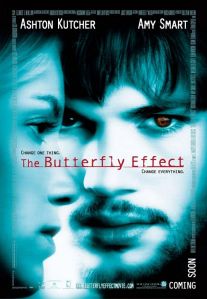 Notice: I found Ashton Kutcher, star of The Butterfly Effect, on a trip to buy dog food, and cordially asked him to write a review. This is what he sent me. It’s totally him. I wouldn’t make this stuff up. That would be dumb.
“So, like, this Nate guy asked me to do a review of my new awesomest movie, The Butterfly Effect. Dude, like anyone needs a review for the most awesomest movie ever. I mean, like, the term awesomest movie ever should say, like, everything. The only thing possibly more awesome than The Butterfly Effect would be trucker hats … or two chicks totally making out. And I only said possibly more awesome, which doesn’t mean it is more awesome, because, dude, like I said before, The Butterfly Effect is the most awesomest thing ever. You cant dispute that. Dont even try. Im awesome!
Like, the story goes like this, man. I play this guy, like I know big stretch there, but he’s not the most awesome guy ever, which is what you’d be thinking since its the most awesomest movie ever. But no, he’s like this kid who blacks out and has this wickedly twisted childhood where he stars in his neighbors kiddie porn, has his dog set on fire, and, like, his dad is all crazy, or, like I like to say, insane in the ole membrane. Ha, I totally made that up right now. I’m awesome!
So, you’re like saying, ’Dude, that movie sounds less than awesome. Yes, sir, I am having definite doubts about the awesomeness of this movie. Like, do I need to go to the movies to, like, feel bad? I got my parents to do that for me. That and school.’ Hey man, I’m there, I know what you feel. Cause right when you are like, “‘Dude, when is Demi gonna show up playing his mom?’ I find these old journals of mine and, dude, use them to travel back in time. I know, the awesomeness has returned. And I use the journals to go back and try and punk time, man. I try and make things better and change the future but I like totally just make it worse. I know, double punkd, man! I try and fix the life of this hot girl in the movie (she showed her boobs in that Road Trip movie, did you see that? That part where she shows her boobs, oh man … It is awesome) but things don’t work out. Like she becomes a crack ho at one point. Dude, total punkd. I’m awesome!
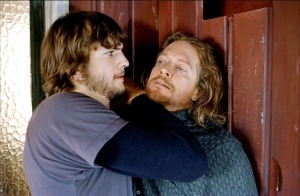 I should be taken as a serious actor. I didn’t hit my head on something and I grew a beard, what more do people need to know I got the goods? I mean, I don’t want to keep saying it but …
beard. C’mon! When actors want to be taken seriously they, like, grow beards. That’s why all those people in movies before 1970 (I know, it surprised me too that there were older movies) got awards and stuff. Beards, dude. Beards. When Billy Dee Shakespeare, like, invented acting, he totally imagined dudes, and chicks too, with beards. Thats why girls cant be taken as serious actors, cause they cant grow beards. But dude, don’t tell that to Demi, because she totally has one wicked ferocious beard, if you know what I mean. Ha. I’m awesome!
I should be taken as a serious actor. I didn’t hit my head on something and I grew a beard, what more do people need to know I got the goods? I mean, I don’t want to keep saying it but …
beard. C’mon! When actors want to be taken seriously they, like, grow beards. That’s why all those people in movies before 1970 (I know, it surprised me too that there were older movies) got awards and stuff. Beards, dude. Beards. When Billy Dee Shakespeare, like, invented acting, he totally imagined dudes, and chicks too, with beards. Thats why girls cant be taken as serious actors, cause they cant grow beards. But dude, don’t tell that to Demi, because she totally has one wicked ferocious beard, if you know what I mean. Ha. I’m awesome!
So, like, if you ever wondered what it would be like to see me, Ashton Kutcher, the most awesome man alive who ever lived, no the most awesome human being -the most awesome thing - ever, as a frat boy, or like, some poor dude with no arms, then you should see my new movie, The Butterfly Effect. After all, it is the most awesomest thing ever. That’s awesome. So, like, you people reading (is that what school is for?) should go see my movie. Ill tell you why in two words: beard.”
Nate’s Grade: C+
Share this:

One Hour Photo (2002)
 Do we regularly invite strangers to view the picturesque and personal moments of our life like marriages, celebrations, and maybe even a handful of hastily conceived topless photos? Well we all do every time we drop off a roll of film for development.
Robin Williams continues his 2002 Tour of the Dark Side (Death to Smoochy, Insomnia) as way of Sy, your friendly photo guy working at your local Sav-mart superstore. Sy takes an intense artistic pride in the quality of prints he gives. He knows customers by name and can recite addresses verbatim. One family in particular Sy has become fond of is the Yorkins, mother Nina (Connie Nielsen), father Will (Michael Vartan) and nine-year-old Jake. The Yorkins have been coming to Sav-mart and Sy for over 11 years to have their photos developed. He tells Nina that he almost feels like Uncle Sy to the family. For Sy, the Yorkins are the ideal postcard family with perennially smiling faces and the happiest of birthdays. He fantasizes about sharing holidays with them and even going to the bathroom in their posh home.
 Sy is an emotionally suppressed and deeply lonely man caught in his delusions. In one of the eerier moments of the film we see that Sy has an entire wall made up of hundreds of the Yorkin’s personal pictures. When Sy attempts to become closer to the objects of his infatuation that’s when things begin to unravel at a serious pace. The more Sy learns that the Yorkins are not the perfect family he yearns for the more he tries to correct it and at any cost.
One Hour Photo is an impressive film debut by music video maven Mark Romanek (best known for the NIN “Closer” video). Romanek also wrote the darkly unrepentant story as well. One Hour Photo is a delicate voyage into the workings of Sy’s instability with lushly colorful metaphors. Romanek’s color scheme is a lovely treat, with vibrant colors popping out and Sy’s life being dominated by cold, sterilized whites. His direction is chillingly effective.
This may be the first time we can truly say Robin Williams has not merely played a version of Robin Williams in a movie. Sy’s thick glasses and thinning peroxide-like hair coupled with an array of facial pocks allow us to truly forget that the man behind the mask is Mork. His performance is unnerving and engrossing. The supporting cast all work well. Nielsen (Gladiator) is a sympathetic wife even if her hair looks like it was cut with her eyes closed. Vartan (Vaughn on ABC’s wonderful Alias) plays understandably wary of Sy’s friendliness. The great Gary Cole has a small role as Sav-mart’s manager who grows tired of Sy’s outbursts and peculiarities.
 One Hour Photo is rife with nervous moments and titters. Williams almost has an uneasy predatory feel to him when left alone with Jake. The greatest achievement the film has is that is depicts the scariest person youll ever see, sans hockey mask, and by the end of the film you actually feel degrees of warmth for this odd duck.
Not everything clicks in Romanek’s dark opus. A late out-of-left-field revelation by Sy feels forced and needlessly tacked on. The Yorkin family photos all appear to be taken by a third party, since the majority of them involve all three of them in frame. The climax to One Hour Photo also feels anything but climactic.
A compellingly creepy outing, One Hour Photo is fine entertainment with beautiful visuals and a haunting score. And maybe, in the end, it really does take an obsessive knife-wielding stalker to make us realize the importance of family.
Nate’s Grade: B
Share this:

Donnie Darko (2001)
 Donnie Darko (Jake Gyllenhaal) is your normal malcontent teenager in late 1980s Reagan America. He bickers with his older sister, worries over the right moment he’ll kiss his new girlfriend, and tries to ignore the advice of many imprudent adults. Donnie’s your typical teenager, except for his imaginary friend Frank. Frank is a sinister looking six-foot tall rabbit that encourages Donnie into mischief and gives a countdown to the impending apocalypse. And I haven’t even gotten to the time travel yet.
One night as Donnie wanders from his home at the behest of Frank, an airline engine mysteriously crashes through the Darko home and lands directly in Donnie’s room. The airlines are all at a loss for explanation, as it seems no one will take responsibility for the engine or knows where it came from. Donnie becomes a mild celebrity at school and initiates a relationship with a new girl, Gretchen Ross (Jena Malone). One of his classes consists of watching videos of self-help guru and new age enlightenment pitchman Jim Cunningham (Patrick Swayze). His school has even, under the persistence of self-righteous pain Kitty Farmer, persuaded Cunningham to speak and try to help students conquer their “fears.”
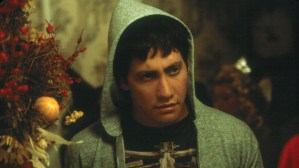 Donnie is also seeing a therapist for his emotional problems and taking medication for borderline schizophrenia. Around this time is when Donnie starts to inquire about a strange old woman, obsess over the possibilities of time travel, as well as see weird phosphorescent pools extend from people’s chests. He also floods his school at the urging of Frank. This is no Harvey type rabbit.
The longer Donnie Darko goes on the more tightly complex and imaginative the story gets. First time writer-director Richard Kelly has forged an excitingly original film that is incredibly engaging with charm and wit. He masterfully mixes themes of alienation, dark comedy, romance, science fiction, and a sublime satire of high school. Donnie Darko is the most unique, head-trip of a movie unleashed on the public since Being John Malkovich. Kelly has a created an astonishing breakthrough for himself and has ensured he is a talent to look out for in the future.
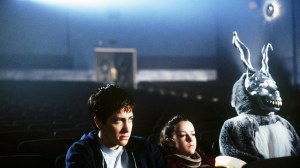 Gyllenhaal (October Sky) is superb as disenchanted Donnie, a Holden Caulfield for middle suburbia. His ghastly stare conveys the darkness of Donnie but his laid-back nature allows the audience to care about what could have merely been another angst-ridden teenager. Swayze is hysterical as the scenery-chewing Cunningham. The rest of the cast is mainly underwritten in their roles, including stars Drew Barrymore (who was executive producer) and ER‘s Noah Wyle, but all perform admirably with the amount they are given. Not every plot thread is exactly tidied up but this can easily be forgiven.
Donnie Darko is a film that demands your intelligence and requires you to stay on your toes, so you can forget any bathroom breaks. The film is one of the best of 2001 but also one of the funniest. You’ll be honestly surprised the amount of times you laugh out loud with this flick. The theater I saw this in erupted every half a minute or so with boisterous laughter.
Donnie Darko is a film of daring skill and great imagination. You don’t see too many of these around anymore.
Nate’s Grade: A
Reviewed 20 years later as part of the “Reviews Re-View: 2001” article.
Share this:

Nurse Betty (2000)
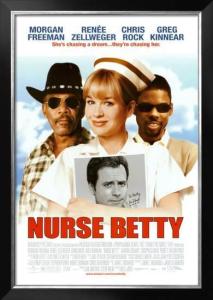 Can a fairy tale have a dark undertone below all the bubbly whimsy? Hell, the Grimm tales were barbaric before they became homogenized, sanitized, and finally Disneytized. Nurse Betty presents a modern day fairy tale with the strike of reality always below it — the strike of darkness and disappointment. Fairy tales are an escape from this, but what if one creates her own fairy tale and chooses to believe in it over the drab reality she presides in?
Neil LaBute, the director of the incessantly dark In the Company of Men and Your Friends and Neighbors, collects together a whimsical modern day fable with a top-notch cast. Yes, to those fans of earlier LaBute offeriengs his name doesn’t seem synonymous with whimsical comedy – but in this flick LaBute cuts his teeth in the mainstream and earns his stripes if ever.
Baby-voiced and rosy-cheeked Renee Zellweger plays our heroine in diner worker and soap opera fanatic Betty. Betty finds solace from her life featuring a sleazy spouse, played with marvelous flair by Aaron Eckhart, in her favorite soap opera. When her louche of a hubby isn’t wiping his hands on the kitchen curtains or banging his secretary he tries proposing drug deals for shady characters. A recent drug peddling snafu sets him up to an ominous encounter with hitmen team Morgan Freeman and Chris Rock. Through a jarring scene of violence Betty’s husband is left brutally murdered and the only witness is Betty herself. The event causes Betty to slip into a fractured psychological state where she believes the world of her soap opera is alive and real with herself a vital character. She hops in one of her dead hubby’s used cars and drives off toward California to meet the doctor/soap star of her dreams in Greg Kinnear.
 Morgan Freeman and Chris Rock mistake Betty for a criminal mastermind and believe her to have taken the drugs and run. They embark on their own mad dash to capture her and finish the job they were paid to complete. Along the way Betty encounters many people that are at first confused but ultimately charmed by this delusional dame. Through a series of events she meets up with the eternally smarmy Kinnear and begins to learn what happens when a fantasy is corrupted by the disappointment of reality. Allison Janey has a small part as a network executive that shines strong, and Crispin “McFly” Glovin is just nice to see in a film again. He doesn’t seem to age though. Maybe he has that Dick Clark disease.
The flow of Betty is well paced and a smart mix between drama, whimsy, and dark humor. Overlooking some sudden bursts of violence bookend the film it comes across as a sweet yet intelligent satire and fable. Betty is looking for her Prince Charming but will later learn that she doesn’t need one, that she is the fairy tale happy ending inside her.
The acting of Nurse Betty is never in danger of flat-lining. Zelwegger is a lovable and good-natured heroine. Freeman is a strong and deceptively hilarious actor along side a caustic yet down-to-earth Rock. And I make an outgoing question if there is an actor alive out there that can do smarm better than Kinnear — I think not.
Nurse Betty is a wonderful surprise. Check into your local theater, take one showing, and call me in the morning. You’ll be glad you did.
Nate’s Grade: A-
Reviewed 20 years later as part of the “Reviews Re-View: 2000” article.


 nathanzoebl
You must be logged in to post a comment.