Blog Archives
Unfrosted (2024)
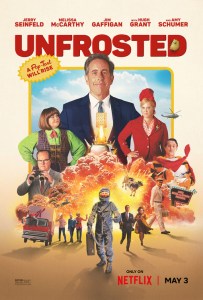 What to make of a movie like Netflix’s Unfrosted. It’s Jerry Seinfeld’s directorial debut, working off a screenplay he co-wrote, his first foray into film writing and acting since 2007’s Bee Movie. His eponymous sitcom “about nothing” was a 1990s mainstay and popularized an ironic meta form of comedy that still continues to dominate comedic tastes. Making a movie about the pseudo history of the invention of Pop Tarts, and the corporate rivalry between the major cereal brands, seems like a further exercise in that realm of humor, potentially satirizing a burgeoning sub-genre of late, the Biopic of Products (Air, Tetris, Flamin’ Hot, Blackberry). Except this supposed “biopic about nothing” is really a head-scratcher. Its humor feels pained and stale, the satire feels missing or glancing at best, and it seems like an expensive lark, wasting the nigh-infinite money of Netflix to purposely make a stupid comedy with all his friends.
Set in the mid 1960s, we follow two households, both alike in dignity, in fair Battle Creek, Michigan where we lay our scene. Kellogg’s has been the dominant cereal-brand for years but its chief rival, Post, is set to launch a new product that will revolutionize breakfast mornings. Bob (Seinfeld) is the head of development for Kellogg’s and reaches out to his old colleague, Donna (Melissa McCarthy), when it becomes evident that Post stole their unused research to develop a pastry treat designed to be cooked in one’s toaster. The warring CEOs, with Jim Gaffigan as Edsel Kellogg III and Amy Schumer as Marjorie Post, are desperate to one-up one another and be seen as more than an inheritor of their family’s wealth. It’s a race to see which company can get their treat to market first and capture the hearts, minds, and sweet teeth of America’s youth.
 I’d be lying if I said I didn’t laugh at points through Unfrosted, which operates like a spoof movie on a slower jokes-per-second pacing guide. There are zany sight gags amidst broadly drawn characters treating the silly straight, though occasionally you’ll have wisecrackers commenting on the inherent absurdity of moments, mostly confined to the stars making asides to the audience. Sometimes it’s lazy jokes that rely upon our foreknowledge, like when Bob coins a NASA beverage by saying it has a “real tang” (get it?). The movie frequently intensifies into goofy escalation when Kellogg’s impanels a team of mascots and inventors as a breakfast brain trust. Every one of these wacky characters is here to provide the exact same joke they will provide throughout the movie, and their inclusion is already suspect. Having the Schwinn bicycle guy (Jack McBrayer) comment on why he should be there is not enough. The hit-to-miss ratio will vary per everyone’s personal sense of humor, but overall I just felt mystified why this project would tempt Seinfeld from his comedy repose. What about this idea excited him? Was it just his lifelong love of cereal and Pop Tarts, a topic from his standup act decades ago? I ate a lot of cereal as a teenager too but I don’t want to make a movie about the Lucky Charms advertising campaign teaching children to beat and pillage the Irish (maybe Ken Loach could direct – to the three people on the Internet who appreciate this joke, I want you to know I appreciate you also).
It can be fun to simply watch dozens of famous people take their turns being silly in what is unquestionably a “dumb comedy.” When you have comedians of this quality in your movie, they’ll find ways to make even so-so jokes hit a little better, and that’s the case here. There’s an entertainment value in just wondering who will show up next, as many characters are only onscreen for a single scene or an abbreviated moment. Unfrosted becomes an example of Seinfeld’s industry power as he empties his Rolodex to fill even the tiniest of roles. Look, it’s James Marsden as Jack LaLanne. Look, it’s Bill Burr as JFK and Dean Norris as Kruschev (double Breaking Bad). Peter Dinklage as the head of the nefarious milkmen cartel? Why not? If you set your expectations low, maybe lower than what you were accounting for, there can be a mild amusement scene-to-scene just seeing who might show up next, almost like a modern-day version of those anarchic big ensemble comedies like It’s a Mad, Mad, Mad, Mad World.
 There is one segment that fell so flat for me that I was in utter amazement, and that was the unexpected January 6th insurrection parody. In a movie that has sustained a surreal and offbeat version of our universe, it evokes one of the most startling days of recent history. I think the humor is meant to derive from simply seeing a bunch of mascots in big colorful costumes as a mob running havoc, but there’s no jokes about like the challenges of a mascot costume in a fight, or say someone tipping over and being unable to get back up like a helpless turtle. There are jokes that can be had with this scenario, but instead Seinfeld is relying on the ironic juxtaposition of the ridiculous with the serious, and I don’t think it ever works as a joke. My sinking feeling began when Hugh Grant’s embittered mascot character wore a headdress resembling the QAnon shaman. It feels tacky and strange and the longer it persists the more I kept wondering what Seinfeld was doing with this. Why include this especially as the only form of relatively topical political humor, beyond, I guess, the depiction of business elites being complete morons? Why this? Again, it would be different if it was funny in execution, like the Saving Private Ryan D-Day parody from Sausage Party. This just isn’t funny, and its inclusion feels so odd compared to the stale nature of its other comedy.
As an admittedly silly enterprise, one that doesn’t even pretend to be accurate even as it flirts with the truth, Unfrosted is a successfully stupid comedy that feels a little too aimless, a little too edge-less and safe, and a little too dated and stale in its approach to comedy (lots of 1960s Boomer nostalgia ahoy). It’s hard to work up that much risible anger over a 90-minute movie that features a living ravioli creature. Clearly this movie wasn’t trying to be anything other than a gleefully stupid comedy, but I wanted more pep from its jokes and whimsy and general idiocy. I think the way to go may have been all the way in the other direction, treating the formation of a toaster pastry like international nuclear secrets and playing the corporate espionage completely straight while also making it patently ridiculous. Unfrosted did, however, make me want a Pop Tart that I ate afterwards, although it was my local grocery store’s generic brand, so I guess that doesn’t directly benefit Kellogg’s. This movie exists as a Seinfeld curiosity that ultimately left me hungry for more.
Nate’s Grade: C
Share this:

The Little Mermaid (2023)

With every new Disney live-action remake, and we’re not slowing down any time soon folks, I feel like I need to stipulate two reservations I have, so, dear reader, here is my boilerplate. First, I believe that simply because a film is animated does not mean it is missing something or somehow inferior to a live-action movie. Animation is a showcase of imagination and ingenuity and visual decadence, and often the live-action interpretations of this only serve to dilute and downgrade the quality of those presentations. I can’t believe the recently announced live-action Moana will add anything more magical or visually beautiful than the 2016 animated original. Second, the closer these original animated movies are to the present, the less likely that Disney will be to change things up. The core audience will be demanding fidelity to the source material, and thus we usually just get an inferior version of the same story with minimal alterations. Occasionally, Disney can really surprise with some of these live-action remakes; I adored Pete’s Dragon, was charmed by Cinderella, and will defend Tim Burton’s unfairly maligned Dumbo.
Now we reach The Little Mermaid, whose 1989 release began the much-heralded resurgence of Disney animation through the 1990s. I re-watched the original a couple years ago and found it still quite ebullient and compelling, but I was shocked at how short it was (only 80 minutes long) and how brisk much of its third act felt. With a few more old-fashioned wrinkles to iron out like gender roles and the prominence of securing a man, I felt there was actual room where a modern remake could actually improve upon the original. Having seen the live-action Little Mermaid, I can say that it falls into a middle zone where it can’t quite escape the shadow of its predecessor but it exhibits plenty of its own winning qualities to cheer audiences and fans of the original.

Ariel (Halle Bailey, not to be confused with Halle Berry) is a teenage mermaid and the youngest daughter of King Triton (Javier Bardem), the ruler of the seas. She longs to be part of the surface world, the world of man, and she’s willing to sacrifice her voice to her malevolent Aunt Ursula (Melissa McCarthy) for a pair of legs. She has three days to secure true love’s kiss, likely from Prince Eric (Jonah Hauer-King), but she can’t recall what she needs to do as part of Ursula’s spell. Her friends Sebastian (Daveed Diggs) the crab, Scuttle (Awkwafina) the gannet, and Flounder (Jacob Temblay) the fish must help protect and guide the new Ariel-with-legs.
Let’s start with the positive attributes that separate this Little Mermaid, and chief among them is the fantastic lead performance from Bailey (one half of the singing sisters Chloe x Halle). This is a star-making turn from this young woman who completely makes the role her own. She has a natural grace, curiosity, and charm to her Ariel, and when she gets her chance to belt the big musical numbers, she delivers a stirring rendition. I got tingles during different parts of “Part of Your World.” A good half of the movie takes place after her Faustian bargain, so Bailey is acting without her voice and she still is able to communicate so much through her physical performance as well as her facial expressions. The filmmakers decide to give Ariel several new songs through the guise of internal monologues where she can express all that she is feeling and thinking during her fish-out-of-water adjustments. I think it’s a smart move and while none of these new songs are particularly memorable, giving Bailey more opportunity to flex her own voice, both literally and thematically to express her character’s perspective, is a good creative choice.

I also was pleased that much of the added time, which amounts to almost a full hour of material, is devoted to fleshing out Eric and the development of the romance with Ariel. Rather than simply being a handsome himbo, this Eric is an adopted son of his island nation, and he feels more at home aboard a ship than in any royal ceremony. There’s a direct parallel with Ariel and Eric rejecting their predetermined roles under the pressure of royal expectations. This Eric even gets his own version of a “Part of Your World” ditty about dreaming for something more, especially after his chance encounter with a mermaid set his world afire. It’s not a particularly great song, as none of the new additions are on par with the Oscar-winning originals, and some of the lyrics made my wife physically cringe next to me in the theater (“Strange as a dream/ Real as the sea/ If you can hear me now/ Come set me free”). There is added time where the romance feels much more organic as we witness Ariel and Eric get to know one another and watch one another come alive and share their interests. The added curse of Ariel forgetting her end goal of true love’s kiss is an intelligent way to make the romantic feelings between them feel more believable and less the byproduct of her urgency and the manipulation of her friends. The added rom-com moments give more credence to their romance and it better reflects on both members.
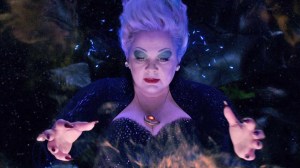
McCarthy (Thunder Force) acquits herself very well as the villainous sea witch. She puts her own spin on Pat Carrol’s famous vocal performance from the original, making her Ursula the seething also-ran waiting on the sidelines and nursing old grudges. The added back-story makes Ursula Ariel’s aunt now, which adds an extra degree of menace to their transactional bargain. I was also reminded how little Ursula is in this movie until it counts, so to justify her continuing presence, we have a few check-ins where she basically monologues her thoughts on the action. It feels like padding but I didn’t mind because I got to spend more time with McCarthy.
And now, dear reader, let’s go through some of the adaptation changes that aren’t quite as charming or beneficial. The colorful realm of the sea feels rather limited in this rendition. The vastness of the ocean and its mermaid kingdom feels strangely contained, and that’s a result of the reality of filming on a large empty set as well as the cost of extensive special effects. This is another case where the beauty and imagination of animation proves incomparable. The differing versions of “Under the Sea” really magnify this. Along those lines, making Ariel’s aquatic friends photo realistic robs them of the personality and expression they exuded in the animated movie, and it also drags them into an uncomfortable uncanny valley. Stop robbing characters of expression for the sake of added biological “realism.” It’s a bad trade. Stop it, Disney. Watching a photo realistic Flounder flop around on dry land while he tries to cheer Ariel on with his expressionless might-as-well-be-dead fish eye is not as whimsical as it should be. The original voice of Sebastian, Samuel E. Wright, has a small cameo as a fisherman, and it’s nice to hear his familiar voice again, especially knowing the actor sadly passed away in May 2021.
I’ve already discussed the new songs by Lin-Manuel Miranda being mostly agreeable but unremarkable, but there is one new track that stands out for all the wrong reasons. Being a Miranda musical, it’s not unexpected for the inclusion of a new hip-hop-infused song, especially with his Tony-winning Hamilton co-star in the movie. What is surprising is that Daveed Diggs doesn’t get the bulk of the new rap song but instead it’s Awkwafina, and her voice at these levels of gravely intensity feels like an aural assault. I was wincing throughout the song “Scuttlebutt” and kept wondering why Diggs wasn’t the star considering he handled the most linguistically complex flows in Hamilton. I even enjoy Awkwafina as a vocal artist but this song is painful to endure.
The 2023 live-action Little Mermaid has enough positive additions that fans of the 1989 original will likely enjoy while still checking the boxes of their own nostalgia requirements. Bailey is sensational and the added time for the romance to be more organic and believable, with some extra fleshing out supporting characters like the Queen and Grimsby also allowing the world to feel more textured and less archetypal. The visuals aren’t as murky as I feared but the magical world of this hidden undersea realm definitely feels lacking. The pacing is a bit sluggish too, as we don’t even get our deal with Ursula until an hour into the movie, and the added songs fail to compete with the classics even with the artistic prowess of Miranda. I don’t know if it needed to be this long, and I certainly don’t care for the photo realism approach, but I was smiling throughout the movie and found it charming. Consider this mid-tier Disney live-action scale, a remake with enough of its own to swim with the weight of expectations.
Nate’s Grade: B
Share this:

Thunder Force (2021)
 I feel like we were just here a matter of months ago, another aimless Melissa McCarthy comedy vehicle written and directed by her husband and chief enabler, Ben Falcone. With Thunder Force, McCarthy becomes an accidental superhero and that premise should be enough with this star to power a silly and amusing 90 minutes of entertainment. Once again it’s a dispiriting comedy that feels like it’s just sitting around and waiting for the performers to find something funny in their scenes and family-friendly improv ramblings. The energy of this movie is completely slack, and scenes feel adrift, lacking proper direction or purpose. The whole movie feels gassed and grasping. It takes 45 minutes for McCarthy to train to be a hero and sometimes there just aren’t jokes. Take one instance where McCarthy literally throws a bus, a point strangely referred to multiple times earlier as a setup for this long-desired moment, and then under Falcone’s uninspired direction we don’t even see the messy results. We don’t even see the bus crashing into, like, an orphanage or something that would provide an actual punchline. The comedy malpractice can be staggering. It’s the kind of movie that resorts to characterization where everything is clumsily reported to us, like, “You’ve always been this way since…” The chemistry between McCarthy and Octavia Spencer (The Witches) is lukewarm at best for these longtime friends. The buddy comedy doesn’t even seem like it was developed beyond its initial pitch. The shining light of this movie is easily Jason Bateman (Ozark), who plays a crab-armed mutant criminal that becomes an improbable romantic suitor for McCarthy’s character. If there is anything that made me laugh, it was related to this character (and an ordinary henchman named Andrew who may or may not be targeted as the next to get killed by his evil boss played by Bobby Cannavale). I even loved the simple image of Bateman crab walking off screen with his arms in the air. The sheer weirdness is enough to make you realize what potential could have been tapped with this super premise and with McCarthy, who can be so charming and disarming when she gives into her odd impulses. Just give me a full movie where a middle-aged superwoman tries to make a relationship with a crab-man super villain work. I wish that Thunder Force had more courage to chase its weird rather than settle, time and again, as an action comedy that is middling with its action and middling with its comedy. I think I had more fun with 2020’s Super Intelligence, another mediocre Falcone collaboration.
Nate’s Grade: C-
Share this:

Super Intelligence (2020)
 Given the sad and off-putting output from Melissa McCarthy and her husband Ben Falcone when they collaborate, it’s a small victory that Super Intelligence is only really super bland and forgettable. McCarthy stars as an everywoman picked by a highly intelligent A.I. to be the test subject for whether or not humanity should be saved or wiped out of existence. It sounds like an amusing premise but what it becomes is just a boring romantic comedy. The super A.I. (voiced by James Corden) becomes more or less a magic genie, and now our heroine has all her wishes granted. She has a huge new bank account, a new car, a new luxury condo, and all to impress the guy she let get away played by Bobby Canavale. That’s right, the super A.I., meant to test and judge mankind, is really just the world’s most advanced wingman and trying to get his human pal some love. As far as tests go this seems a bit weak. This mighty A.I. should be working against our protagonist, throwing increasing obstacles that push her out of her comfort zone, rather than just handing her everything and looking from afar with approval. The comedy is resolutely flat save for the inherent charms of McCarthy, who doesn’t seem challenged by anything in the movie. Much of the film is watching McCarthy talking into high angle CCTV cameras. Visually, it’s quite boring. Super Intelligence feels like an interesting idea that can’t be bothered to find anything interesting in execution. It’s standard rom-com fluff but the two characters aren’t even appealing together. I found Canavale’s character to be far more annoying than endearing. I’ve found that Falcone is a bad director for his wife. He encourages her worst onscreen habits and doesn’t have the presence or vision to be able to assert restraint or imagination. If Falcone is attached as director, you know you’re getting McCarthy doing her familiar shtick with little self-control. She’s still a highly appealing comedian, and an underrated dramatic actor, but the only super intelligence here are the people who avoid this film.
Nate’s Grade: C
Share this:

Charlie’s Angels (2000) [Review Re-View]
 Originally released November 3, 2000:
These angels aren’t exactly what your father was enjoying when your mother was away fulfilling errands. These angels aren’t delegated as mere sex objects running around providing the jiggle entertainment that is (or was) supplied by today’s Baywatch. The 90s is a different decade after our minority movements and today’s woman is just as apt to do a flying kung-fu face plant into a baddie as any man. The angels of the film are action heroes for an armada of small girls needing some female empowerment when their only other choices consist of a barely clothed Britney or a barely covered Christina. These angels aren’t just the sex objects that the classic assortment of angelic 70s stars were; these angels are also tough-as-nails, resourceful, and not afraid to tussle or tango. Now that this exposition is out I can concentrate on the scattershot film Charlie’s Angels.
The film has been rumored to have at a minimum of 17 writers who tried shaping a story for Cameron Diaz, Drew Barrymore, and Lucy Lui. The story is pretty much shelved toward the back so the forefront is our trio of ladies kicking ass then shaking it with zig-zaggy and wild camera movements from debut filmmaker and video director McG.
Charlie’s Angels is whiz-bang dumb fun. The overall feel of the film is something more difficult to get a grasp on. At times it shows itself as tongue-in-cheek and satirical but then at other times it seems overly serious or overly dumb. The characters are non-existent and basically only discernible by hair color. The characters are very wooden and I actually found more enjoyment watching the villains and seeing more of them; call it the Austin Powers dilemma. Diaz makes the only notable attempt as her goofy and light-hearted angel connects with the audience best. Lui plays a techno-babe dominatrix but is easy to see that she was the last angel chosen and doesn’t exactly gel with the others as much as she could have.
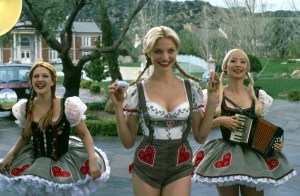 Charlie’s Angels is best when the action is pumping. The scenes are cut together in a jam-packing sequential way adding distinct flavor and style. McG is a true surprise in the effectiveness he can orchestrate his action motifs even if the Matrix effects and moves make absolutely no sense in the real world.
Crispin Glover shows himself as a silent assassin nicknamed “the thin creepy man.” Glover is so suave and slick in his role of the non-verbal Oddjob henchman role that he exhilarated me with every presence he made on screen. Goodness, he was too cool in this film and everyone gets brownie points for allowing him. He has such energy and charisma that I wanted the film to veer off into him and desert our angels. Seeing our ageless McFly perform action scenes and choreographed fights is something I will be pleased with until my grave. seeing Crispin in the excellent Nurse Betty and now huge exposure in this is a true joy. And man… he smokes a cigarette way too cool every time he’s in this film. Some people can smoke cool some of the time but Crispin does it all of the time. His mere presence almost cancels out the annoyance of Barrymore.
The line is drawn with Charlie’s Angels in that it’s sex-kitten jiggle and an acrobatic arrangement of (light) feminism and humor. These gals know they’re sex objects and they’ll use it to their advantage delighting in every second of it. Therefore, you could argue successfully that Angels is exploitation hiding as meaningful but hell… why think about this stuff? The movie rolls along at a fast pace where you don’t keep track of these issues. It’s just an easy sit down.
The gigantic success of Charlie’s Angels makes sequels and a possible franchise all but certain. I’d be happy for McG to hop back in his directorial chair but have a unique idea for Angels 2: Bigger, Longer, and Uncut… it involves Glover kicking a lot of ass really cool like.
Nate’s Grade: B-
——————————————————
WRITER REFLECTIONS 20 YEARS LATER

The 2000 Charlie’s Angels seems to understand that nobody should take this seriously. It even opens with an in-joke of T.J. Hooker: The Movie being inflight entertainment and an undercover character lamenting how bankrupt Hollywood is when it comes to recycling old TV shows. From there, our undercover angel literally exits with her target in the middle of the air and plummets to the water below, safely landing via parachute with a team meeting via helicopter aerial hook-up and a speedboat below. Why any of this? What sense does any of it make? It doesn’t matter in the slightest, and from the opening scene onward the movie lives by this credo, doing its best to be silly and have fun and just not care about the rest, and it shows. Twenty years ago, I think Charlie’s Angels benefited from low expectations as I recall mostly enjoying it. Now, having re-watched the movie for the first time in ages, I will say the fizzy appeal seems to be diluted. It’s still got energy to spare, though it feels a little too antic, a little too episodic and slipshod, and a little too proudly shallow, and that’s before you re-examine its depiction of the angels.
It took 17 writers and considering every under-30 actress in Hollywood to put together Charlie’s Angels. Drew Barrymore had bought the remake rights and wanted to make a big screen splash with a trio of kick-ass heroines that could better relate to the culture of the new century. I understand that Barrymore and her team wanted the angels to be sexy, yes, but also smart and funny and goofy and fearsome and all the things that little girls should believe possible. That’s commendable from a positive representation, but then so much emphasis is placed on their bodies and their off-the-charts sex appeal to bamboozle men that the goal becomes eclipsed. One could argue that Barrymore, Cameron Diaz, and Lucy Lui are embracing their sexuality, and that taking control of this is empowering, and if you feel empowered by Charlie’s Angels, by all right enjoy that and bless you. However, twenty years later, this feels less like the girls are in charge are more like they’re just being exploited in a manner we’re being sold as new feminism.
 There are so many examples where the angels are in skimpy clothing or objectified. There was an entire clip of Diaz dancing in her underwear that I remember Harry Knowles of the early 2000s mainstay Ain’t It Cool News devoted a gross drooling essay to his obsession (“But to sum up, Cameron Diaz’s Swirling Ass is one of the greatest images and objects in the whole of human existence.”). Barrymore’s character is constantly getting undressed and using her body to disarm men. Again, duping men through their hormones can be a key asset as a spy, but it’s happening in every scene and at her disservice as well. She tumbles down a ravine naked in a last-second escape, and the movie treats it as cheeky comedy (no pun intended). Lui adopts a series of disguises that routinely sexualize her, from a masseuse to the most overt, a domineering corporate boss that resembles a dominatrix. They’re straight fetish roles. I’m surprised a Catholic schoolgirl outfit wasn’t adopted as a disguise. The movie’s depiction of its female stars and the emphasis on their bodies feels retrograde for its ideals. I know they wanted to improve upon the portrayals from the 1970s but we still got problems. McG’s stylish direction prioritizes the angels’ sexuality. They can be smart and kick ass but also in a sexy way, the movie is telling you. Thandie Newton was supposed to be an angel but schedule overruns from Mission: Impossible II got in the way, and later she admitted she had strong misgivings because her character was going to be introduced with a closeup of her denim-clad butt. No one is arguing that women should be barred from taking ownership of their sensuality, but the lens Charlie’s Angels utilizes is strictly a male gaze, and these women are repeatedly objectified.
As a result, the movie has a new sheen of discomfort during all the silly, sudsy spy missions and wardrobe changes. Before you might think, “Oh look, they’re dressing up as Japanese geisha girls, what fun,” and now you’re like, “Oh, somebody at the studio was getting off on this.” Before you might think, “Oh look, they’re dressing up as Middle Eastern belly dancers, what fun,” and now you’re like, “Oh, somebody at the studio was getting off on this.” There are a lot of ethnic disguises that would likely get axed today as cultural appropriation. The carefree, frivolous attitude of the movie is meant to be charming and low stakes, but when it’s applied to the exploitative nature of how the women are depicted, it all becomes a bit dodgier to accept.
 This was the first real blockbuster after The Matrix reshaped action cinema and the stylish choices can run the gamut between exciting and cool to dated and shallow. Twenty years later, it’s just not as impressive that they used wires to swing their actors around for stunt choreography, or that they replicated key Matrix touches like bullet time. The fighting sequences are often choppy in editing and some of the moves meant to demonstrate the power of the angels just feel silly, like a moment where Diaz went full Lui Kang with her flying kicking feet. It’s moments like that where the style gets away from McG. The tonal trick is finding a balance between goofy and cool, exciting and cheesy, and I don’t think the movie achieves this with its action. The set pieces feel built around “cool moments” rather than using geography, organic complications, and escalation. It means that Charlie’s Angels has its share of cool moments but then they are fleeting and ultimately meaningless because they don’t better connect to character, story, or even simply their own satisfying action compositions. It’s like immediately disintegrating cotton candy. The dozens and dozens and dozens of needle-drop music cues feel like another potent example of this charge as well as some anticipated attempt to distract from its shallow and diverting design.
I was dreading revisiting my original review as an 18-year-old because I was convinced my younger self was going to conflate the portrayal of the women as taking ownership. I just knew this would be something I had bought into in 2000, and yet it wasn’t quite so: “The line is drawn with Charlie’s Angels in that it’s sex-kitten jiggle and an acrobatic arrangement of (light) feminism and humor. These gals know they’re sex objects and they’ll use it to their advantage delighting in every second of it. Therefore, you could argue successfully that Angels is exploitation hiding as meaningful but hell… why think about this stuff? The movie rolls along at a fast pace where you don’t keep track of these issues. It’s just an easy sit down.” Hooray for my younger self seeing through this movie’s sheen of empowerment. At the time, it bothered me less because the movie was dumb fun, and now it just seems less fun and also dumber. I was so taken with Crispin Glover (Back to the Future) and his creepy cool style, much of which was Glover’s doing. His character was supposed to have dialogue except he hated the lines and asked to be silent. That’s one way out of memorizing, and it worked because he was a breakout and appeared in the 2003 sequel. Sam Rockwell (Three Billboards) was also a fun discovery though he only gets good once he’s revealed as a baddie. He would reuse those dancing moves for Iron Man 2.
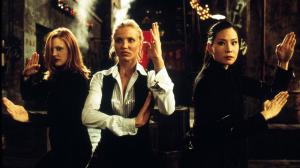 By the time 2003’s sequel Full Throttle rolled out, the appeal was gone. In my own brief review, I summarized, “It all seems so ho-hum and excessive at the same time. Quite an accomplishment. No more please.” I feel like the 2000 film also falls into this summary. It’s clearly not intending to be anything more than a goofy action movie, and I suppose the right person could still likely turn off the necessary parts of their brain to enjoy the rush of sights, sounds, and cleavage. There shouldn’t be a “wrong kind of feminism” so if this works for you, great. Many years later I felt that the male gaze was more ogling the women in the name of celebrating them. And yet Sony still felt there was material to be mined when they tried again with a failed 2019 reboot. The original Charlie’s Angels film is a cocktail of style with a creeping hangover right behind.
Re-Veiw Grade: C
Share this:

The Kitchen (2019)
 Mob movies are culturally beloved. I could watch Goodfellas every time I see it on TV. We know these movies, we know this lifestyle, in so much as it’s been demonstrated in our art. A feminine perspective is often the dame, the moll, the panicked wife who worries her husband will never come home and see his bratty kids again. Rarely in mob movies are there roles for women that can be considered three-dimensional. Even Diane Keaton gets shortchanged in The Godfather series. In comes Oscar-nominated Straight Outta Compton screenwriter Andrea Berlof, tackling her directorial debut and adapting a graphic novel about three mob wives fighting the system. It’s about time this under-represented perspective in some of our favorite movies got its due spotlight. It’s too bad then that The Kitchen finds ways to still leave the women behind where it counts.
Set in the Hell’s Kitchen neighborhood of New York City in the late 70s, three mobsters get arrested one evening by the FBI and sent to prison. Their wives are now left alone to raise their families, struggle for employment, and to not be forgotten with the new pecking order of those mobsters left behind. Ruby (Tiffany Haddish) and Kathy (Melissa McCarthy) think they should take over their husband’s rackets while their men are indisposed. Claire (Elisabeth Moss) is more worried about what will happen when her abusive husband comes back from prison. The three women work together to make a stake at their own claim, butting heads against the existing power structure of dismissive men who don’t think organized crime is any place for a woman.
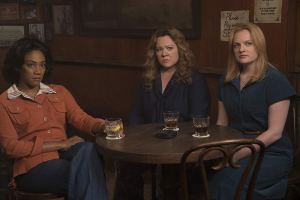 The Kitchen has such potential but it’s too often running off the fumes of other mob movies. Beyond the obvious similarities with last year’s more refined and polished Widows, this is a movie that gobbles its mafia movie clichés like a heaping helping of pasta (more clichés!). The characters aren’t terribly well defined and the story oddly moves in starts and stops, with moments either feeling too long or too short, and especially abruptly transposed, using montage to hurdle through what should have been needed onscreen development. People rightfully complained about the final season of Game of Thrones skipping over needed steps along a character’s journey to get to its intended destination, and The Kitchen is deserving of the same charge. We want to see these women in charge and others afraid, except the movie doesn’t show me any reason why these women would rise in power and what sets them apart from their steely competition. I get that they’re underestimated and they are determined, and that works in a general sense, but by the half-hour mark they’re already successful mobster entrepreneurs and I’m unsure how. Even after their rise, there is little that seems to deter them. Every new obstacle is comically taken care of in such casual fashion that you never worry for their well-being. It feels like Berloff wants to skip through all the hard work and just get to the enjoyable desserts or a life of crime, but moving up the ladder is an essential part of any power struggle story. As a result of the sloppy plotting and pacing, there is an over-reliance on clichés to stand in place, relying upon the audience’s warm understanding of the genre territory and what to expect to relieve the movie from having to do more work. It’s all telling and hardly any show.
The characters are kept as archetypes as well, at least 2/3 of the leads. Both McCarthy and Haddish seem miscast for their roles. Both are splendid comic actresses and have dramatic capabilities beyond what they get credit for, but they seem to rely upon comic instincts to get through their underwritten scenes, which further hampers the lack of tension. Each actress gets one solid scene to open up their character but it’s just so little. Ruby has a sit down where her mom credits beating the “soft” out of her daughter for Ruby’s success. That little glimpse into her past and her fraught relationship with her mother served as a tantalizing hint at what could be explored further with the Ruby character. The same with the fact that she’s a black woman who married into a very rigid Irish-American family set in their prejudices. There’s such dramatic potential to be had there. Alas, she’s tasked with being a hardass and that’s all The Kitchen asks of Haddish, treating her more as symbol than person. For McCarthy, there’s a late scene where another character tries to soft-peddle her involvement in crime, saying she did what she had to for her children, and Kathy corrects, saying, no, she did it all for her. She was tired of being a deferential doormat and wanted to feel important. That degree of self-empowerment through selfishness could be a fascinating character angle to explore, but we don’t get that. She clarifies the lens for us to view her with but by that point it’s far too late. The film is top-heavy with underwritten women and that’s a shame.
 The most interesting character by far is Moss’ abused wife-turned-budding killer. Claire is the one starting at the lowest point and the one who takes to the life of crime as means of salvation. These characters are doing some pretty heinous acts but with Claire I felt the most empathy for her plight, bullied by her husband and feeling trapped, more worried about the impending release and her return to being the scared woman cowering in the corner again. She doesn’t want to go back to that life and I believed every moment of Moss blurting out her despair and desperation. That’s why her relationship with another oddball killer played by Domhnall Gleeson (The Last Jedi) was what I cared about most in the movie. You watch them grow together, him mentoring her on how to cut up a body and dispose of it down river, and you watch how each of these two people finds something missing in the other. They may not even be good for one another, enabling their darker impulses and past a point of no return, but it’s the only evolving relationship we were given an entry point to empathize with fully. This segment is also criminally underwritten but it’s clearly where the focal point of the movie should have been. This was the perspective the movie should have been locked into and the character’s journey we follow through every step.
The Kitchen isn’t a bad movie at all. The production design and period appropriate costumes are to die for. There’s always going to be a visceral enjoyment watching the underdogs move ahead and topple their doubters and competition. The ensemble doesn’t have a bad actor in the bunch. Bill Camp (Molly’s Game) shows up with a real sense of veiled menace as a Brooklyn mobster both irritated and impressed by the ladies’ advancement. The soundtrack is packed with Scorsese-riff-approved tunes, including three instances of Fleetwood Mac. There are pleasures to be had. It’s just that the ingredients to a better movie were all there, plain as day. If you’re a fan of mob movies in general, you may find enough to satisfy with The Kitchen, which has its moments but ultimately feels too much like an under-cooked dish you’ve had one too many times before (metaphors!).
Nate’s Grade: C+
Share this:

Can You Ever Forgive Me? (2018)
 Melissa McCarthy adopts the Oscar bait route of pre-approved credibility, which usually means playing a tragic, self-destructive real-life figure, stripping away any sense of vanity, and working with an up-and-coming indie film director (Diary of a Teenage Girl‘s Marielle Heller). The recipe is alive and well in the consistently entertaining, but only for so far, Can You Ever Forgive Me? which traces the life of literary author Lee Israel, a biographer who nobody wants to read, that is, until she starts “discovering” lost letters from the likes of Noel Coward, Dorothy Parker, and other famous authors. In total, Israel forged 400 letters and sold them to private collectors and archivists until the FBI charged her with fraud. Because of the relatively low-stakes nature of her accidental jaunt into criminality, the “how” is less interesting than the budding friendship formed between Israel and a malcontent bawdy barfly/partner in crime (Richard E. Grant). Their rapport is wonderful and they truly seem to be having a ball with their ill-gotten gains, yet they still maintain a vulnerability even to the very end. In many ways this film does for McCarthy and her standard barrage of caustic, anti-social characters what Punch-Drunk Love did for the Adam Sandler introverted goofball sad-sack barely concealing his explosive rage. It’s a grounded deconstruction on that familiar movie archetype we’ve seen from a popular comic actor. There are some interesting aspects about Israel’s lonely life, like a timid female bookshop owner who circles around a potential romance with Israel, but it’s really a two-hander of a movie between Grant and McCarthy. Can You Ever Forgive Me? is a slight character-driven drama with comedic elements, but McCarthy shows that she has the acting chops to play multi-faceted characters in any genre if given the right opportunity.
Nate’s Grade: B
Share this:

The Happytime Murders (2018)

The Happytime Murders asks one question on repeat: is something inherently funny just because a puppet does it? As I feared from the marketing, this is strictly a one-joke movie, and that joke being the entire concept of puppets behaving badly.
In a world where puppets and humans live side-by-side, Private Investigator Phil Phillips (Bill Barretta) is investigating a series of grisly murders targeting the stars of a popular children’s sitcom. His ex-partner, Detective Connie Edwards (Melissa McCarthy), is forced to work with Phillips as the bodies and felt pile up. Together they trace the killer amid seedy drug dealers, prostitutes, strippers, and criminals, all of them puppets.
For a depressing majority of the running time, the jokes are simply puppets swearing or puppets being randy. Very rarely will there be more thought given to the gags and setups. This reminded me of Seth MacFarlane’s Ted wherein too much of the comedy was centered on a teddy bear doing things we don’t normally associate a teddy bear doing. A puppet simply dropping an F-bomb is not a joke, just as a random person dropping an F-bomb is not a joke without some degree of setup and/or context. A puppet smoking is not funny on its own. A puppet drinking is not funny on its own. This is lazy writing that falls back on its surface-level shock value to compensate for the paucity of actual comedy. Too many jokes fizzle on screen, drawing at best the occasional generous chuckle. While you’re watching The Happytime Murders, you’re quite conscious of the fact that it should be funnier. You can feel the desperation on screen and the disappointment. I kept thinking, “Why did they settle for that joke? Why aren’t they doing more with the possibilities of their premise? Oh great, now it’s a joke about balls.” An R-rated puppet cop movie starring Melissa McCarthy should not be this uninspired.

Let’s tackle one scene emblematic of the film’s best assets and its shortcomings. Early in the first act, our puppet P.I. visits a puppet porn store/theater/film set. As soon as he enters, the curtain is pulled back and we see an octopus vigorously milking a cow’s udders, milky geysers freely spraying everywhere amid giddy cries. It’s a memorable visual with obvious sexual connotations and it’s one of the better moments to convey some degree of thought as far as developing the world of puppets. But then the scene just keeps going without any new development or complication. And then it keeps going. And then you realize that the filmmakers tapped out with the visual and had nothing else. The sequence at the porn store/theater/film set keeps sliding in more debauchery, especially with clips from an array of fetish films, a notable example being a fireman whipped by a Dalmatian dominatrix. Then in short order it becomes a murder scene and the fluff flies everywhere. Once again it becomes readily apparent how poorly handled the development process was with this film. There are puppets fighting, puppets doing drugs, puppets even having sex, but are there comic scenarios here? Infrequently. Without better crafting, the shock value naturally loses its impact and then the film gives up. It’s front loaded with the most memorable transgressions, and then it settles into a fairly mediocre cop movie that you have to remind yourself is a comedy because… puppets?

Instead, what the viewer gets is pretty much a standard cop movie with some film noir elements emphasized as reference. There is some half-hearted commentary about discrimination against puppets and how they’re seen as second-class citizens (like Bright). This too is dropped after the first act and the movie settles into a second-rate potboiler. If you remove the presence of puppets, too many scenes don’t even present humor. It’s more a cop movie than it is a comedy, and that realization perplexed and disappointed me. The lazy, crude sexual humor is a crutch they return to, though with diminished returns, as another attempt to jolt the lagging movie to life. It’s a tedious affair where the imagination feels capped. You’ll likely be reminded, as I was constantly, of the brilliant Who Framed Roger Rabbit? which tackled film noir tropes and cross-human integration. The difference is that Roger Rabbit thoroughly thought out its characters, plot, world, and satire, and I consider it to be one of the best-written films of all time. With The Happytime Murders, it has to resort to a Basic Instinct legs-crossing gag twice in 2018. This movie desperately needed a few more drafts from better skilled comedy writers to have more entertaining jokes than “puppet does non-puppet stuff.”
McCarthy (Life of the Party) is drifting on autopilot, desperately looking for ways to make this enterprise funnier. Her improv intuition runs into conflict with the simple nature that puppeteering demands a lot of preparation, so there are less off-script riffs. This is your standard brash, profane, ball-busting McCarthy performance we’ve gotten to know but there’s not a character here. Even in the realm of simplistic cop movie tropes, she’s still never more than the irritable partner who develops a begrudging respect. There is one interesting aspect to her character that the film does so little with. In a flashback, we see that she was critically injured in the line of duty and had to have an emergency puppet liver donation. The only thing ever done with this is the allowance that McCarthy is now able to snort puppet drugs that would ordinarily kill humans. That is it. There’s not even a joke related to this fact. It’s another example of the film’s deficiency of creativity.

The Happytime Murders is a one-joke movie that has far too little imagination. The lewd vulgarity gets boring and becomes indicative of the lazy writing all around, the mere appearance of anything naughty meant to goose the audience into thinking they’re watching something really transgressive and provocative. The novelty wears off pretty quickly. Maya Rudolph as a cheerful secretary and the behind-the-scenes end credits were the best parts. What they’re really watching is a mediocre cop movie strung together with the flimsiest of genre tropes and a scant chuckle. Without better comedic writing and setups, you’re stuck with the story, and that’s not a good decision. This is a witless movie that doesn’t deserve its premise and is a waste of everyone’s time. At my preview screening, I could hear a child’s voice behind me and thought, “Oh my, a parent actually brought their child to see this movie? Did they not know?” That child never should have been in that theater, and not because of the raunchy content, but because that child deserved a better movie experience from their parent, a figure of trust.
Nate’s Grade: C-
Share this:

Life of the Party (2018)/ Breaking In (2018)
 Just in time for Mother’s Day weekend comes two eminently bland, safe, and unmemorable movies that generally waste their female stars. Melissa McCarthy has proven herself one of the most funny and dynamic performers in comedy, but Life of the Party is a listless and groan-inducing back-to-school comedy that feels tonally off, adopting the persona of its tacky, talky, and awkward middle-aged mother. You would think the premise would lead to plenty of R-rated shenanigans, but instead the film adopts a very sedate PG-13 atmosphere, dulling the wild collegiate experience into something so predictable and safe as to be completely inoffensive. It feels like a caricature reminiscent of a feature-length rendition of a Saved by the Bell: The College Years. McCarthy falls back on tired, corny jokes that don’t attempt to be anything else, and the supporting cast is left to gasp and grasp for anything to spark laughs (special credit Gillian Jacobs for doing everything possible as “coma girl”). McCarthy is best when given room to improvise and discover interesting odd angles for jokes, but she also needs a stronger comedic vision, and that’s not going to come from husband/co-writer/director Ben Falcone (Tammy). It feels like they had a general outline for a comedy and, in grand collegiate tradition, pulled an all-nighter and sloppily finished a serviceable draft. I chuckled about four times, mostly involving an exuberant Maya Rudolph and the one clever structural payoff revolving around a much younger fraternal hookup. Mostly, Life of the Party lacks a sense of stakes, credibility, surprises, development, and laughs, though the middle-aged mothers in my preview screening lapped it up, so take my opinion with a grain of salt if the trailer seemed moderately appealing for you.
 On the other side, Breaking In is a mundane, low-budget home invasion thriller that disappears almost instantly from memory. I’m struggling to even come up with enough to say in this review that isn’t just repetitions of the word “boring.” Gabrielle Union (Bring it On) plays a mom who brings her two children to visit the estate of her recently deceased, estranged father. Also visiting is a trio of stupid robbers searching for a hidden stash of money. They take the kids hostage though keep them locked in a room and in little danger. Union’s determined mother must break in and save her children. It’s a thriller without anything genuinely thrilling to experience, as each chase or near miss hums along ineptly and tediously, finding the least interesting conclusion. There are no well-drawn suspense set pieces to quicken the pulse, no clever escapes or near-misses, no intriguing villains with strong personalities, and no entertainment to be had through its strained 88 minutes. There are glaring plot holes, chief among them why doesn’t she just flag down a car and call the police rather than hack it alone. Depressingly, Breaking In is actually directed by James McTeigue (V for Vendetta) who seems to have exhausted any sense of style and excitement he may have had earlier in his directing career. It feels like nobody really cared about the movie they were making, and that lack of enthusiasm and effort translates into one very boring and very poorly written and executed thriller. Union deserved a better showcase but, then again, the audience deserved a better movie too.
Nate’s Grades:
Life of the Party: C-
Breaking In: D+
Share this:

Ghostbusters (2016)
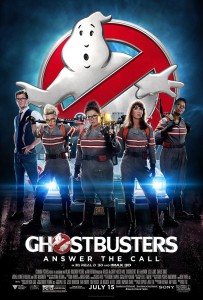 Growing up in the 80s, other kids had Transformers, or G.I. Joe, or He-Man, but I was a Ghostbusters kid. I fell in love with the 1984 original movie, slept below the poster for most of my childhood, and obsessively collected all of the action figures, watched with glee the animated TV series, and hold the world and its characters in a special personal place. The 1984 movie is such a perfect blend of buddy comedy, the supernatural, and action that nobody has really been able to fully replicate this special film alchemy as well since, including director Ivan Reitman (he tried in vain with Evolution). When the word broke that there was going to be a new Ghostbusters remake, some trepidation from fans could be expected. It’s sacred ground to many. Director Paul Feig (Bridesmaids) insisted that he wanted to have an all-female team of Ghostbusters, and that’s when the Internet lost its collective mind. The movie and its stars have been beset with hateful misogynistic (and, in the case of Leslie Jones, racist) harassment. The Internet didn’t want smelly girls playing with its toys. It became part of a larger war between feminists and retrograde men’s rights activist crybabies. Some people wanted it to be succeed just because of he gender of its leads, and others wanted it to fail for the very reasons. I just wanted a good Ghostbusters movie regardless of what bathroom the busters utilize.
Erin (Kristen Wiig) is an esteemed science academic trying to turn the page on her past. Her friend and fringe scientist Abby (Melissa McCarthy) has republished the book about paranormal they wrote together, which ruins Erin’s chance at tenure from her colleagues. Her ire is short-lived as Erin, Abby and her wacky nuclear scientist associate Jillian Holtzmann (Kate McKinnon) experience a real dead ghost. Their slime-filled encounter with the undead reawakens Erin’s love of the paranormal and the three of them join forces. Patti (Jones) is an MTA worker who leaves her job and joins the gals after her own experience with a ghost in the New York subway. Somebody is trying to open a portal between the living and the dead, and these Ghostbusters gotta bust some ghosts.
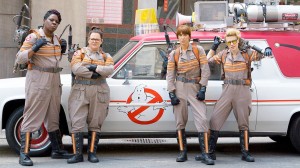 My initial apprehension melted away within the movie’s first twenty seconds when it already had me laugh out loud twice (“anti-Irish fence”). There’s a consistent genial absurdity that kept me engaged and entertained, and this is typified by the strong comic camaraderie of the four leads. I enjoyed spending time with these ladies and I enjoyed their interactions, so when scenes could creep up on overstaying their welcome from a pacing standpoint, something of a Feig staple, I gave them more leeway and felt my patience rewarded. I don’t know how to make it plainer than this: I am not a Leslie Jones fan and I liked Leslie Jones in this movie. I have found Jones to be all-too often on Saturday Night Live a one-note comic presence, always loud and brash and hitting the same joke again and again with little variation. With Ghostbusters, she actually plays a character, capable in her own right, and a straight man for the other characters. These women were goofy, gross (a queef joke within Holtzmann’s first appearance), but they also enjoyed one another’s company. There are internal conflicts, sure, but their enjoyment of working together, of displaying their know-how, of the joys of discovering the realm of the paranormal create a bond that helps seal the characters with the audience. Whatever the scenario, I was confident I would laugh from these characters, and I did.
There is a lightness to the movie that makes it all the more appealing, settling into pleasurable summer fare. This story is as much about the formation of the Ghostbusters as anything else. In the original film they just sort of have their ghost-busting gear all of a sudden. With the remake we watch the trial and error process of bringing all that tech to life. It’s a fun process to see their business from the ground floor, so to speak, and their fight for larger credibility. Murray himself even shows up as a paranormal debunker who scoffs at their claims. The ladies are the lovable underdogs in this world.
The real reason that Feig’s movies work is the interaction of his boisterous and often brilliant casts, and Ghostbusters is another example. Wiig and McCarthy have a natural chemistry together honed from Bridesmaids, and their back-and-forth banter will often find punch lines in odd places. McCarthy has always been her best under Feig’s direction (seriously go watch Spy if you haven’t). While Abby is a less outspoken character than we’re accustomed to from her, McCarthy still has a commanding presence and is the one who lassos the other funny characters back into a sustainable orbit (“You spell ‘science’ with a Y, and I don’t think you know that that’s wrong”). I’ve stated above my positive feelings on Jones. She brings a welcomed perspective to the team and often serves as the voice of the audience, like a moment where she looks inside a room filled with mannequins, calls it “nightmare stuff,” and wisely keeps walking. McKinnon is the true breakout star, going for broke in a deadpan, anarchic silliness that is Murray-esque. She also displays a funky, near pansexual sense of excitement with the world around her. She licks the radioactive barrels of her proton pack in jubilation. McKinnon is a constant source of mirth in the movie and has some of the best one-liners (“It’s 2040. Our president is a plant!”). Another breakout might be Chris Hemsworth in comedy. His dimwitted and inept receptionist is perhaps too dumb to even function. Hemsworth just commits to his character’s straight-faced stupidity and it produces big laughs.
Not everything in the movie works as well together as the ensemble. The movie’s tone takes a giant leap once the third act commences with its apocalyptic ghost showdowns. You can sense that Feig isn’t nearly as passionate about action heroics and CGI. Example: the movie sets up a large-scale dance sequence and we never see it until the scene appears during the end credits. That seems like a waste. The character arc between Abby and Erin isn’t quite as developed as the movie needs for the emotional re-connection at the very end to hit. As much as I loved McKinnon in the movie, her character is more a collection of quirks than a person. The cameos from the original cast are mostly awful and kill amusement. Watching Dan Akroyd as a cab driver say he “ain’t afraid of no ghosts” made me roll my eyes and wish I could delete this from my memory. The less obvious nods are better fan service, like a character referencing “mass hysteria” or Erin frantically pressing her body against a restaurant’s large glass window. The Stay Puft marshmallow man as a parade float is a nice touch, though. The main villain is feeble but I can see how a dude with a grievous sense of entitlement could itself be a feminist statement on the hostility that women face in today’s world. There are some logical consistency issues when the busters go from trapping ghosts to shooting them and blowing them up, but it wasn’t enough to derail my sense of fun. The worst thing about this Ghostbusters is the new theme song from Fall Out Boy and Missy Elliot.
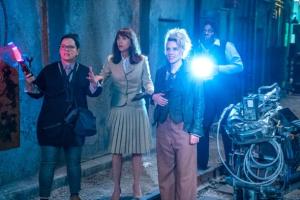 Is the new Ghostbusters a significant step in terms of feminism or is it overblown as some critics contend? The topic is unavoidable given the spirited furor over this remake; it has the most disliked trailer in YouTube history, though to be fair that was not a good trailer. First I’ll acknowledge that the world doesn’t need the opinion of a heterosexual white male on the topic of inclusion, but I’d like to say that there is something about positive representation. It’s the same reason I approve of Sulu being gay in the newest Star Trek. It’s not for me to say what is and is not empowering for a group of people who often lack positive representation in media. Nor am I arguing that every representation of a group needs to be positive; that swings in a direction where well intentioned “protection” becomes condescending. People can be good. People can be bad. People can be brilliant. People can be dumb. No one pool of DNA has ownership over these human traits. However, the reality of Hollywood is that it is often a poor representation of diversity. It is because of this that I say Ghostbusters deserves some praise for portraying a plot around four women that doesn’t involve boyfriends, weddings, marriages, pregnancies, any sort of romantic coupling, and doesn’t pit them against one another. This is an action movie with a female ensemble, three of whom are in their 40s, and all of whom don’t exactly fit with Hollywood’s standard conception of the attractive female lead. They don’t dress provocatively for the male gaze (the default setting for “strong heroine” in Hollywood is often “sexy deadly”). They don’t make fun of one another’s body types. They stand up for one another when people in power attack. They love what they do. I think there will be a swath of the public that recognizes themselves on screen, maybe for the first time, and I think there is genuine merit to this.
Somewhere amidst all the hype and hate, the new Ghostbusters emerges as a pleasant and enjoyably silly summer comedy. Feig’s movie pays homage to the original, including borrowing many of the general plot beats Force Awakens-style, but steps out onto its own territory. The 2016 Ghostbusters is not slavish to the original but recreates what made it work, a strong core group that meets the experimental and outlandish with droll irony. I think I laughed more with the 2016 Ghostbusters than the 1984 Ghostbusters. It has some flaws and some pacing issues but I was enjoying these characters so much to mind. As a lifelong Ghostbusters fan, I would gladly watch a sequel with these characters and this world once more. This won’t replace the fond feelings I have for the original, nor was it ever supposed to. This all-female Ghostbusters doesn’t take away what fans have loved. It simply adds another chapter with a new batch of entertaining characters, and if a part of the audience can better imagine themselves strapping on the proton packs and going along for the ride, then I don’t see what the harm lies with representation.
Nate’s Grade: B


 nathanzoebl
You must be logged in to post a comment.