Blog Archives
Jurassic World: Rebirth (2025)
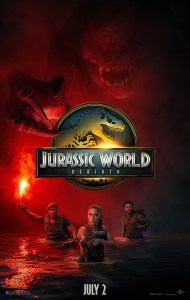
“Rebirth” might be a bit optimistic in that title. The issue with the still-quite-popular Jurassic Park/World franchise is an ongoing lesson in diminished returns. Back in 1993, Steven Spielberg and special effects breakthroughs enchanted audiences on the peril of man’s hubris and the core love and undying appeal of dinosaurs getting to be wrecking machines. Thanks to the marvels of modern big-budget blockbusters, we can bring realistic dinosaurs back to life for perilous adventures in survival, but much like the famous line, the producers eager to crank out a new Jurassic movie every so many years only focused on whether they could and not whether they should. The movies are still significant moneymakers; the worst film in the franchise, 2022’s Dominion, still made over a billion dollars at the global box-office. Just imagine how much that could have raked in if it was actually, you know, good. Jurassic World touched upon the nature of diminished returns through satire, that audiences that were once wowed by the very presence of real dinosaurs have grown bored and need more to capture their flagging interest. Since then we’ve had a movie about dinosaurs eating the rich in a haunted house-style horror-thriller and a nostalgic-heavy conclusion that was more about giant locusts and far less about dinosaurs cohabitating with mankind. The interesting storyline (man co-existing with dino) has been there for multiple movies, and yet the producers keep neglecting that glorious potential. Now here comes Jurassic World: Rebirth, another attempt to keep this franchise chugging along with more mediocre sequels that have fleeting moments of popcorn thrills. Ultimately, it’s a bit more of the same, and like the characters in this world, I too am growing restless.

There are two groups of characters that we follow. The first is a clandestine science team funded by a large pharmaceutical company looking to create the next big drug as a result of studying dinosaur blood and tissue. This is the familiar movie world of quippy security experts and ex-CIA agents and panicky scientists thrust into danger in the field. The other group is a family going on a sailing trip through… dinosaur-infested waters for some reason. The first group is on a mission. The second group is just trying to survive, and possibly for the teen daughter’s boyfriend to grow on her skeptical father.
Rather than reinvention, Rebirth is once again more of the same old same old. There can still be intrigue and spectacle from simply interacting with living dinosaurs brought to life by the best special effects money can buy, so the Jurassic movies will never be without some level of primal appeal. There are some fun moments and sequences throughout Rebirth, but it’s hard to stitch together the whole movie from these minor pieces. I think the premise could have worked. The team on the mission has to track down and retrieve blood from the three biggest dinosaurs by habitat: one by land, one by sea, and one by air. There’s some flimflam excuse that these creatures have the biggest hearts and therefore the live blood they extract blah blah, but it doesn’t really matter. The premise of having to track three of the biggest dinos in different terrains makes for an episodic but varied structure that is easy to follow and engage with. All along the way, we know what the total number needs to be and the progression provides mini-climaxes. It’s just that the retrieval of all of these is completed before Act Three. That’s right, it’s all done before the movie is supposed to get really climactic and intense. The land dino isn’t even a challenge, more just an attempt to recreate the majesty of when we first saw those plodding apatosaurs in 1993. This feels like a mistake, and each of the dino retrievals should be getting moderately harder to succeed. There should be escalation so that each one feels more like an accomplishment with the team getting better not worse.

So what could be Act Three? Well you see, dear reader, this is yet another new island. I can already hear you asking how many islands there are, and the answer is however many the studio needs. This island could have been nicknamed Monster Island because it was the dinosaur experimentation labs. Here’s where the InGen scientists threw darts at a board and said, “What if you mixed a [anything] with a raptor?” That seemed to be their go-to for these sequels. We’re introduced into mutant T-Rex in the opening, presented like a monster lurking in the shadows, and then we come back to our giant lab-designed monstrosity. Except this is the silliest looking dinosaur mutant. I laughed out loud when I saw its full form. It made me think of the xenomorph and human hybrids from Alien Resurrection. Its head is so bulbous like he’s part mushroom, but there’s no contours or anything menacing like spikes or something evolutionary useful. It’s just a big goofy head. This is the kind of dinosaur that would be made fun of by the other dinosaurs who snicker when his considerable back is turned. It has larger forearms but walks with them like a hunched gorilla. A T-Rex was already frightening because of its size, as evidenced during one of the movie’s better sequences where a normal T-Rex chases after the beleaguered family in a raft. This just made the T-Rex’s head comically oversized, like somebody glued a shower cap on this guy. This guy has a bigger head but it doesn’t mean bigger brain. It makes for a rather perfunctory and silly ending fighting against a disappointing dino Frankenstein. We shouldn’t have held our expectations too high considering this mutant’s lab breakout all stems from a lone Snickers candy wrapper getting loose.
The characters are also pretty disposable and strictly archetypal. Scarlett Johansson (Fly Me to the Moon) is the lead as our quippiest ex-CIA agent, more or less playing a version of her Marvel persona. She has a slight arc about joining the mission for the money and being convinced by the idealistic head scientist (Jonathan Bailey) to release the medical information to the entire planet. I don’t think this is as hopeful as the characters think because it seems like you’re also making it so plenty more mad scientists have access to dino DNA to make their own at-home Jurassic Parks. The other lead character is played by Mahershala Ali (Leave the World Behind) as the boat captain who provides the movie with the most disposable of characters so that the dinosaurs have something to feed upon. It doesn’t seem like a coincidence that the one lost family is gifted a dinosaur baby that they trot around like an adorable puppy. That thing’s going to get extremely big and I don’t know if anybody is going to be able to pick up after it. I wouldn’t say any of these characters are memorable or even that likeable, mostly stars coasting on charm autopilot.
I didn’t know where else to put this but I loathed every time the Jurassic Park musical themes would start to trinkle into a scene, especially since so many of them are perplexing. Why would you insert that familiar theme over this scene? It’s intrusive, tone deaf, and just a bizarre creative choice.

It’s hard to really see the added value of returning veteran screenwriter David Koepp (Black Bag) and new director Gareth Edwards (Godzilla, The Creator). This whole enterprise feels a bit like a runaway train rushing to meet its release date deadline. The development needed for a relaunch seems to go by the wayside so that we can squeeze in more set pieces, and I suppose two sets of characters equal always having a new and fraught action sequence we can jump to. It’s just that everything feels so rote and familiar, so much of the same kinds of thrills and chills we’ve gotten from the previous six movies. The most exciting development across these new movies since 2018 has been the reality of humans having to adapt to an Earth with dinosaurs in our ecosystems, and yet this again is hand-waved away in exposition that limits the dinosaurs to a much smaller band of the Earth. Turns out they only really live around the Equator now. Okay, if that’s the case, then tell me a story from that setting. It can still be done. Jurassic Park: Rebirth doesn’t feel like the start of something new or exciting or even promising. It feels like more of the same, sliced and cut up with different actors getting their turn to make frightened faces. It’s not as bad in design or execution as Dominion but Rebirth is no more than more of the same.
Nate’s Grade: C
Share this:

Leave the World Behind (2023)
 Apocalyptic thrillers can oddly enough serve as a therapeutic means for dealing with our fears of being helpless against forces well beyond our control, but they’re also reflections of our current state of anxiety as well. There’s more than just giant hurricanes or earthquakes breaking records on the Richter scale, it’s about how we respond to the momentous and alarming changes and what that says about The Way We Live Now. The new Netflix apocalyptic thriller Leave the World Behind, based on the 2020 book of the same name, has some big mysteries that I feel safe to say won’t fully be explained by the end. There is a possible explanation but it’s a movie more consumed with how people respond to tumult than the tumult. I found the majority of the movie to be gripping and engaging, and while it doesn’t exactly nail the landing, writer/director Sam Esmail (Mr. Robot, Homecoming) crafts a paranoid thriller with flair. It’s an apocalyptic thriller at crossroads with a paranoia thriller and a disaster movie, and the biggest challenge of them all is ultimately being able to trust another person during a time of remarkable uncertainty.
Amanda (Julia Roberts) and her husband Clay (Ethan Hawke) have elected to take a spur-of-the-moment family vacation out of New York City and onto a lavish home in Long Island. Everything seems so placid until the phones no longer get a signal, the TV broadcasts are strictly limited to a blank emergency screen, and two strangers show up (Mahershala Ali, Myhal’la) saying this is their house and they would like to stay inside. They claim that the U.S. is under a cyber assault and there’s more to come.
 Leave the World Behind has two intriguing questions to keep the audience hooked: what is actually happening and who are these new people? Most disaster movies put you in the thick of the action, from presidential boardrooms to scientific outposts keeping up with the changing data and going over the options to prevent further loss of life. This movie purposely leaves you in the dark in a well-kept Long Island home and the first thing that goes is the expediency of knowing things from our phones. When two new people come knocking at the door to say the world is falling apart and this is our home, trust us, it’s hard not to hold some level of suspicion. Can we take these people at their word? What kind of agenda could they secretly have? And if so, what does that say about what has happened or what is happening in the outside world? They seem like they know more than what they’re letting on, so how much do they know themselves? It’s the slow drip of information that makes the movie simmer in such an anxious predicament of looking at every new piece as another new question. This places the viewer uncomfortably in similar territory as Amanda, who despite her prejudices might be right not to trust the newcomers. We’re stuck on the outside wondering what has happened and what may be left. The movie is carefully crafted to only give us so much to work with while our minds start reading and rereading everything for more connection and meaning, running rampant and going stir crazy just like the characters. While the second big question naturally gave way and could only produce so much tension, the main thrust of the movie kept me hooked and excited and worried and actively questioning just what exactly was going on.
I appreciate how Esmail is a restlessly ambitious filmmaker. He took on directing duties for the entire second season of Mr. Robot and from there continued coming up with new challenges. There was an episode meant to be told as an episode-length elaborate tracking shot. There was an episode that was told almost without any spoken words, entirely through visual action. There was an episode that was presented like a five-act stage play and it was enthralling. While these are the easy to recall gimmick episodes, Esmail’s directing vision for his series never eclipsed the series itself. It elevated the episodes but the emphasis was still on the significance of the characters and their emotional states (highly recommend Mr. Robot, one of my favorite 2010s TV shows, to anyone who has yet to watch). With Leave the World Behind, only his second feature after 2014’s parallel universe rom-com Comet, Esmail refuses to let any sequence pass without some kind of visual flourish. His camera is constantly swooping through the visual landscape, flipping and spinning and craning above the characters from on high. It reminded me of Brian DePalma, who also loves the high angle pans across rooms and also abides by the dogma that there should be no uninteresting shots in a movie. It’s easy to appreciate but without an engaging story can quickly become a distracting exercise in empty artifice, which is also how I view most DePalma. Here, much like Esmail’s accomplished prestige TV work, the style makes me better appreciate how much effort and thought Esmail has put into his presentation and his ideas. The man wants you to see his work, and there’s no fault in that as long as you’re enjoying the experience, which I was for the most part.
 There are some supremely well-crafted moments played to a breaking point of intensity. Early on, as the family relaxes on the beach, they see a ship in the distance, an ordinary sight on a seemingly ordinary day. Then hours pass and it’s getting closer, and closer, and finally the realization begins to settle in that this thing is now a danger and they need to very much run very much now. Esmail’s camerawork keeps the scene feeling kinetic, with a long take that establishes the colossal danger as the tanker runs aground and the family has narrowly fled in time. In many ways this moment also serves as an ecological metaphor, with problems looming in the distance but ignored until they are at their most dangerous and right on top of us. Another sequence involves Clay venturing outside and discovering what appears to be a dust storm the color of blood. It’s getting closer and closer and the movie is testing how much we can take before you start hitting an imaginary gas pedal to strongly suggest Clay out of there. There’s another sequence that’s a literal pile-up of driver-less cars coming to the same nexus point like they’re all migrating. It makes for an immediately eerie sequence that becomes extra horrifying once the Teslas become unmanned missiles.
The themes of disconnection aren’t exactly subtle but that doesn’t mean they are misguided. This movie is about as subtle as an oil tanker heading straight for you, but I didn’t mind because of the skill of the storytellers and the ongoing mysteries that kept me begging for every new morsel. The messaging isn’t exactly complex. At one point Amanda has a speech that might as well be titled “This is Why Humans Are Terrible and We Deserve This.” Following this, another character tells her that they may not agree on much but she agrees with every word she just uttered with her speech, so you know this is the kind of pessimistic monologue that can reach across the doom-scrolling aisle. The movie almost frustratingly ends without a larger sense of clarity over what has been happening, a fate that would have greatly angered my wife. Esmail gives you something that can work as an explanation without making it definitive; it’s merely a theory but it’s enough to hold onto if you desperately need an explanation. However, the way the movie ends feels less conclusive and more like the conclusion of a season of television where the characters, now grouped together, are in for something fierce next year so stay tuned. The nature of this story is designed to leave you hanging, and that’s why I circle back on it mattering more on how these characters respond to this apocalyptic event versus what is clearly happening.
 Chilling and effectively plotted to keep you guessing until the end, Leave the World Behind is an apocalyptic thriller that really simmers in the anxiety of the unknown. It’s not perfect but it’s pretty good, as long as you can accept not having all the answers. The acting is strong but it’s the control and finesse that Esmail exhibits as director and screenwriter that really makes the material engaging and impactful. It’s an apocalyptic thriller where the scariest proponent might be having to live with one another.
Nate’s Grade: B
Share this:

The Flash (2023)/ Spider-Man: Across the Spider-Verse (2023)
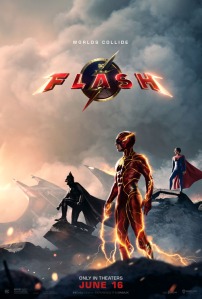
Released within two weeks of one another, two big summer movies take the concept of a multiverse, now becoming the norm in comic book cinema, and explore the imaginative possibilities and wish-fulfillment that it proposes, but only one of them does it well. Spider-Man: Across the Spider-Verse is the sequel to the Oscar-winning 2018 revolutionary animated film, and it’s a glorious and thrilling and visually sumptuous experience, whereas DC’s much-hyped and much-troubled movie The Flash feels like a deflated project running in place and coming apart. Let this be a lesson to any studio executive, that multiverses are harder than they look.
Barry Allen (Ezra Miller) has the ability to travel at fantastic speeds as his superhero alter ego, The Flash. He’s tired of being the Justice League’s errand boy and still fighting to prove his father is innocent of the crime of killing Barry’s mother. Then Barry discovers he can run fast enough to actually travel back in time, so he returns with the intention of trying to save his mother. Except now he’s an extra Flash and has to train his alternate self (also Miller) how to control his powers. In this different timeline, there is no Justice League to combat General Zod (Michael Shannon, so thoroughly bored) from destroying the planet for Kryptonians.
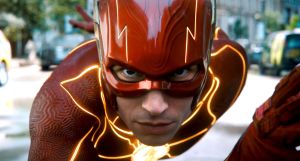
This is the first big screen solo outing for The Flash, and after none other than Tom Cruise, Stephen King, and James Gunn calling it one of the best superhero movies of all time, it’s hard to square how trifling and mediocre so much plays out as an example of a creative enterprise being pulled in too many directions. Miller was cast as the speedster almost ten years ago, and this tale has gone through so much tortured development, leaping through numerous filmmakers and writers, that its purpose has now gone from being a pillar of the expanding DC cinematic universe began with Zack Snyder’s Man of Steel in 2013 to becoming the Snyderverse’s death knell. The premise of traveling back in time is meant for Barry to learn important lessons about grief and responsibility and the limits of his powers, but it’s also intended as the reboot option for the future of these cross-connected comic franchises. It allows Gunn, now the co-head of the new way forward for DC movies and TV, to keep what they want (presumably Margot Robbie and Jason Momoa) and ditch the rest (Henry Cavill, Ben Affleck, Black Adam, Shazam, and Zack Snyder’s overall creative influence). So reviewing The Flash as only a movie is inadequate; it’s also a larger ploy by its corporate overlords to reset their comic book universe. In that regard, the quality level of the movie is secondary to its mission of wiping the creative slate clean.
Where the movie works best is with its personal stakes and the strange but appealing chemistry between the two Millers. It’s an easy starting point to understand why Barry does what he does, to save his mother. This provides a sturdy foundation to build a character arc, with Barry coming to terms with accepting his grief rather than trying to eradicate it. That stuff works, and the final talk he has to wrap up this storyline has an emotional pull that none of the other DCU movies have exhibited. Who wouldn’t want one last conversation with a departed loved one, one last opportunity to say how you feel or to even tell them goodbye? This search for closure is a relatable and an effective vehicle for Barry to learn, and it’s through his tutelage of the other Barry that he gets to see beyond himself. The movie is at its best not with all its assorted cameos and goofy action (more on both later) but when it’s a buddy comedy between the two Barrys. The older Barry becomes a mentor to himself and has to teach this inexperienced version how to hone and control his powers as well as their limits. It puts the hyper-charged character into a teaching position where he has to deal with a student just like him (or just him). It serves as a soft re-education for the audience alongside the other Barry without being a full origin story. The impetuous young Barry wanting to have everything, and the elation he feels about his powers, can be fun, but it’s even more fun with the older Barry having to corral his pupil. It also allows the character an interactive checkpoint for his own maturity and mental growth. Miller’s exuberant performances are quite entertaining and never fail to hit the comedy beats.
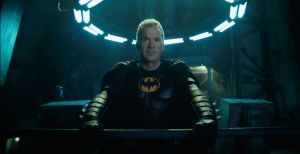
The problem is that the movie puts so much emphasis on too many things outside of its titular hero. Much was made of bringing back Keaton to reprise his Batman after 30 years. I just wish he came back for a better reason and had legitimate things to add. His role is that of the retired gunslinger being called back into action, and there’s an innate understanding with Barry wanting to go back in time and save his family, but too much of this character’s inclusion feels like a stab at stoking audience nostalgia (the callback lines all made me groan). I highly enjoyed Keaton as Batman and appreciated how weird he could make the billionaire-turned-vigilante, but he’s no more formed here than a hologram. The same thing happens with the inclusion of Super Girl a.k.a. Kara Zor-El (Sasha Callie). In this universe, there is no Superman, so she’s our requisite super-powered alien that Zod is hunting to complete his plans for terraforming Earth. She’s an intriguing character as a tortured refugee who has lingering doubts about whether humanity is worth the sacrifice, but much of her usage is meant only to make us think about Superman. She’s not given material to make her own impression, so she simply becomes the imitation of the familiar, the shadow to the archetype already being left behind. But these character additions aren’t even the worst of the nostalgia nods, as the final climactic sequence involves a collision of worlds that harkens to just about every iteration of the famous DC heroes, resurrecting several with dodgy CGI and uncomfortable implications (spoilers… the inclusion of George Reeves, when he felt so typecast as TV’s Superman that he supposedly killed himself because he thought his acting career was over, can be galling).
The action of The Flash is mostly fine but with one exceptional example that boggles my mind. In the opening sequence, no less, Barry is trying to help clean up a crumbling hospital when it collapses and literally sends a reign of babies falling through the air. I was beside myself when this happened, horrified and then stupefied that this absurd action sequence was actually happening. Barry goes into super speed to save the day, which more or less reverts the world into super slow-mo, though he needs to power up first, so we get a quick edit of him stuffing food into his face to load up on calories. We go from Barry breaking into a falling vending machine, stuffing himself in the face with snacks, getting the green light from his suit which I guess measures his caloric intake, and then grab a baby and literally put it in a microwave to shield it from danger. Just describing this event makes me feel insane. I figure the filmmakers were going for an over-the-top approach that also provides light-hearted goofiness to separate the movie from the oppressively dark grist of Snyder’s movies. However, this goes so far into the direction of absurdity that it destroys its credibility. It’s hard for me to fathom many watching this misguided and horrifying CGI baby-juggling sequence and say, “Yes, more please,” rather than scoff and shake their head. It’s not like the rest of the movie keeps to this tone either, which makes the sequence all the more baffling. There are Flash rules that are inconsistently applied to the action; Barry’s caloric intake is never a worry again, and the effects of moving a person during super speed don’t ever seem to be a problem except for one spewing gross-out gag.
While not being an unmitigated disaster, it’s hard for me to see the movie that got so many figures in the entertainment industry raving. The Flash has some notable emotional stakes, some amusing buddy comedy, and some goofy special effects sequences that run the gamut from amusing to confounding, but it’s also quite a mess of a movie, and too many of its nods to the fandom feel like empty gestures of nostalgia compensating for imagination. For all it gets right, or at least keeps interesting, it seems like another cog in a multi-billion-dollar machine, a stopping point also intended to be a reset and starting point. It feels like the character wasn’t trusted enough by the studio to lead his own solo movie even after years of buildup with Miller, nine seasons of the popular TV series, and 80-plus years of prominent placement in DC comics.
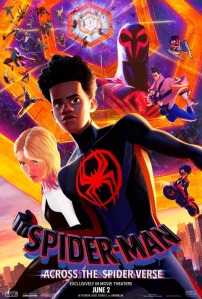
Conversely, Across the Spider-Verse is a sequel that expands an already stuffed story but knows what stories and themes to elevate so they don’t get lost amidst the fast-paced lunacy. Taking place a year later, Miles Morales (voiced by Shameik Moore) has grown into his role as the new Spider-Man for his world. He strains to meet the expectations of his parents, and keep up his grades, while fulfilling the duties of a superhero jumping into danger. When Gwen Stacey (voiced by Hailee Steinfeld) reappears to discuss joining the multiverse police, Miles jumps at the chance, having genuinely missed his other Spider friends, especially Gwen. There are countless Spider people in countless worlds, even including a Spider-T. Rex and a Spider-Car (Peter Parked Car, I believe the name was). Miguel O’Hara (voiced by Oscar Isaac) is the Spider-Man tasked with keeping order across the many interconnected multiverses, and he insists that sacrifice is essential to maintain balance, one that hits too close to home for Miles to abide.
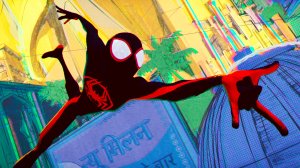
The 2018 original is a hard act to follow, and while Across the Spider-Verse doesn’t quite overrule its predecessor it is a more than worthy sequel that has everything fans loved about the first trip. The visual inventiveness has been taken even higher, with the mixture of even more different animation and art styles. I loved seeing each Spider person and how they fit into their unique art style of their world, like the living water colors of Gwen’s world and the punky paper collage style of Spider-Punk (voiced by Daniel Kaluuya). There’s a villain that comes from a paper universe, so he resembles a three-dimensional paper construction with hand-scribbled notes appearing around him like Da Vinci’s commentary. There is something to dazzle your senses in every second of this movie. The visuals are colorful, creative, and groundbreaking with the level of detail and development. There’s probably even too much to fully take in with just one viewing. I want to see the movie again not just because it’s outstanding but so I can catch the split-second vernacular asterisk boxes that pop up throughout the movie. Going further into living comic book aesthetics, new characters will be introduced with boxes citing their comics issue reference point, and certain names and vocab will get their own citations as well. These are split-second additions, nothing meant to distract from the larger narrative. Simply put, this is one of the most gorgeous looking movies of all time, animated or live action. It’s bursting, thrumming, nearly vibrating with life and love stuffed into every nook and cranny, and it’s exhilarating to just experience a vivid, thriving world with animators operating at peak talent.
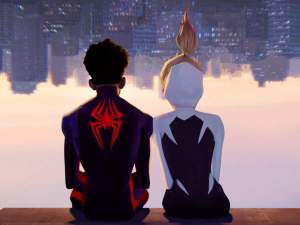
However, the movie has an engrossing story to better position all those eye-popping visuals. The worry with any modern multiverse story is that the unlimited possibilities of variations and opportunities for characters to do just about anything will overwhelm a narrative, or like The Flash, become a checklist of overburdened and empty fan service. The screenplay by Phil Lord, Christopher Miller, and Dave Callaham is all about relationships. If Miles’ relationship with his stern police lieutenant father (voiced by Brian Tyree Henry) wasn’t such an important focal point, then the emotional stakes of the movie would be meaningless. We see a relatable struggle from both sides, the parents trying to connect with their growing child and give him enough space to find himself, and the child who clearly loves his parents but doesn’t fully appreciate or understand their concerns. They worry about Miles leaving them and whether others will love and support him like his parents. Miles has to experience a wider world of possibility, but these experiences make him appreciate what he has at home, and what could be permanently lost. I don’t mind saying there were more than a few moments that caused me to tear up. I found Gwen’s storyline equally compelling, and her turmoil over keeping her secret identity and then coming out to her father was rather moving. The family bond resurfacing will get me every time, and the simple action of a hug can be as heartwarming and fulfilling as any romantic ode. Across the Spider-Verse makes sure we care about the characters and their personal journeys.
At a towering 140 minutes, this is the longest (American) animated movie ever, and it’s still only one half of a larger story. I knew ahead of time this was only the first part so as soon as we entered Act Three I kept gearing up for the cliffhanger ending. Every five or so minutes I thought, “Okay, this is going to be the end,” and then it kept going, and I was relieved. Not just because I got to spend more time in this unique universe but each new moment added even more to raise the stakes, twist the intrigue, and make me excited for what could happen next. I was shaking in my seat at different points, from the excitement of different sequences to the emotional catharsis of other moments. I cannot wait to experience this same feeling when the story picks back up reportedly in March 2024, though I fear it will get delayed to late 2024.
Even with the unlimited possibility of jokes and silly mayhem, the filmmakers keenly understand that it doesn’t matter unless we care about the characters and their fates. I am shocked that a goofy character I thought was going to be a one-scene joke, The Spot (voiced by Jason Schwartzman), could end up becoming the ultimate destroyer of worlds. I think this reflection nicely summarizes the impeccable artistry of Across the Spider-Verse, where even the moments or characters misjudged as fleeting or inconsequential can be of great power. It’s a movie that is full of surprises and thrills and laughs, all in equal measure, and a blessed experience for a movie fan. In the crush of comic book multiverse madness, Across the Spider-Verse is a refreshing and rejuvenating creative enterprise, one that builds off the formidable talent of its predecessor and carries it even further into artistic excellence that reminds us how transporting movies can be. If you see one superhero multiverse movie this summer, the choice should be as obvious as an inter-dimensional spider bite.
Nate’s Grades:
The Flash: C
Across the Spider-Verse: A
Share this:

Alita: Battle Angel (2019)
 James Cameron has been dreaming about making Alita: Battle Angel for decades. He bought the rights to the 90s manga and has been sitting on the property, having to continuously push it back because of technological demands and the demands of, at last count, a thousand Avatar sequels. Cameron co-wrote the screenplay and handed the directorial duties over to Robert Rodriguez (Sin City), a talented visual stylist who has been struggling of late. The marriage looks good and the final 122-minute feature is the closest a live-action film has ever gotten into replicating the look and feel of an anime, for better and worse.
Hundreds of years after the fall of civilization, a lonely scrapper and doctor, Dr. Ido (Christoph Waltz) discovers the remains of a cyborg with a still beating heart. He puts her back together with a new body and names her Alita (Rosa Salazar). She’s special and learning about the big new world, trying to unlock her memories of the past, and we’re talking way way back into the past. She’s old technology, something that’s quite valuable for the street gangs that strip amputees for parts and for the global corporation whose emissary (Mahershala Ali) needs to reclaim the powerful tech. Alita falls in love, learns about her sense of humanity, and fights lots and lots of robotic villains.
This visual decadence of Battle Angel is the greatest reason to see it, especially on the big screen if able. The future setting is immediately visually engaging, with people walking around with mechanical limbs that look like they were literally cobbled together with whatever junk was lying around. There is a have/have not dichotomy between the huddled masses trying to eek out a living in a garbage city and the floating metropolis above that regularly dumps its trash onto the people below. It’s easy to see the influences of Battle Angel in other media, like Elysium, as well as its own cyberpunk influences, from the likes of Blade Runner to recycling the chief sport of Rollerball. The character design is to die for in this movie, with exceptionally assembled figures that stand out in memorable, dangerous, sometimes junky ways. There are a number of different robotic killers with colorful and unique weapons and personalities, and the larger world invites further scrutiny. There is a bustling post-apocalyptic life here and it’s plastered on a splashy, broad visual canvas with some spectacular special effects. Not all of the effects are at the highest level, from some compositing issues with faces to the big anime eyes (more on that later), but Battle Angel is an expensive movie that puts it all onscreen. The world is fun to watch and the action sequences feel ripped directly from the manga, with larger-than-life creatures fighting in vicious and frenetic ways. Even when the movie feels like it’s losing its momentum there’s always the visuals to enjoy.
 The central idea of this post-apocalyptic junk town being populated with deadly bounty hunters who work for a mysterious conspiracy is a great starting point. There is a bevy of killers with different allegiances and different codes, and then you throw in a powerful new addition who doesn’t remember her hidden past and you’ve got a recipe for drama and conflict with some crazy characters. There are even little dark touches that I would have thought would have been clipped in the adaptation process. Battle Angel has so much going for it that it can get a little frustrating when it feels like it’s spending so long to stay in the same place. The plot revelations are fairly predictable but still effective, but the long delays between them are filled with numerous action set pieces that diminish a sense of progression. I liked the Alita character and her relationship with her surrogate human father, but I didn’t think enough of any other relationship she had in the film. I wasn’t that invested in uncovering her past, which was still a bit too vague for me as a non-reader of the source material. At the end of the story, Rodriguez has set up his audience for a continuing saga of strife that feels too incomplete. Alita has learned more about herself (though I’m still confused) and has a goal of vengeance (against a force that is left too vague) and a renewed sense of purpose (built upon a relationship that doesn’t feel that affecting). It’s a curious end point and a questionable decision for a movie this expensive to assume it would secure demand for a presumptive sequel.
Where Battle Angel began losing me was because its title character, Alita, became too overpowered for her own good, eliminating a sense of stakes early on. The battle calculus skewed far too quickly. After the first act, actually from her first fight onward, there is never any doubt whether Alita will triumph. She doesn’t undergo any training or any real learning curve when it comes to her superhuman defense. Right from the get-go she’s doing amazing acts of fight choreography and making it all look easy. She even defeats an enemy when she’s only a one-armed torso. That’s admittedly impressive but another indicator that there is no real threat that can be posed against her. No matter how huge the cyborg, or how many pointy appendages at their disposal, it’s only a matter of time before our little pint-sized warrior is eventually triumphant. There is really only one fight where she’s presented with any slight disadvantage, the aforementioned one-armed torso sequence, but this too is shortly rectified. She goes from having a nigh-invincible body to an even more nigh-invincible body, making her, you guessed it, even more powerful. This reality takes something away from the numerous cyborg-on-cyborg battles, and without greater variance on the scene-to-scene needs, the fights become somewhat stale. Visually they are still impressive with a sense of fun watching the manga pages come to startling life, but without stakes and variance, it’s all the same punches with less power.
 Now Battle Angel isn’t the only story to deal with an overwhelmingly powerful protagonist (see: Neo, Superman, just about every character on Dragonball). The solution is usually a specifically applied weakness or, most often, the vulnerability of those closest to the hero. It’s the regular people that can be gotten to, that can be endangered, that approximate the “weakness” for the overpowered protagonist. However, for this to work, you need an emotional connection to the characters in order to feel their potential loss. This cannot work if the characters are stuck in archetypal mode and add little help. That’s the problem with Battle Angel; I didn’t really care about any of the other characters. They had points of interest, a tragic shared back-story, a dream to escape their earthbound poverty, some secrets they don’t want getting out, but it’s never enough to make them feel that much more refined than the secondary background players. The film doesn’t even go the route of really threatening the more vulnerable people in Alita’s life, which is a strange miscalculation. What we’re left with is a very kickass robot woman doing her thing and taking down the big bad cyborgs. It’s entertaining and there’s enough of an interest in bullies being beaten by the underdog, but Alita isn’t really the underdog and so the many action sequences become a tad tedious.
Salazar (The Maze Runner: The Death Cure) gives an expressive performance and enables her superhuman cyborg to find a semblance of her humanity. Because of the character design the degree of performance capture relies much on the micro expressions of Salazar, so if she overdoes it then Alita can lose that tenuous sense of reality. She finds a balance that makes her feel real, at least real enough to exist in this world. Waltz (Downsizing) is enjoyably paternal with a few dark secrets of his own. His rocket-powered pickax thingy falls under my category of something that’s futuristic but not exactly practical. This wouldn’t present much of a problem except his character is an expert at using the parts he can scrounge up to get the job done. Skrein (Deadpool) has found a real career for being sneering villains with oh-so punchable faces, and he succeeds yet again. Ali (Green Book) and Jennifer Connelly (Only the Brave) deliver enough with so little that you wish the screenplay asked more of them than the occasional in-shadows skulking. It’s interesting to look at this cast, which has four Oscars to their names (possibly another one for Ali), and an additional nominee with Jackie Earl Haley.
 Let’s talk about those eyes. The film is based upon a popular manga and anime and James Cameron was determined, from the earliest point, to recreate that stylized big-eyed look famous to Japanese art. It’s one thing on the page and another brought into real life, and the response has been all over the place. Some cite the uncanny valley and cringe while others argue it makes Alita more vulnerable, the eyes being the window to the soul and all. It does set her apart from the crowd, which is supposed to befit her character and where she came from, so to that end it works. It’s not as distracting as I feared and you do grow accustomed to them. However, was any of it necessary? Would we feel any different for Alita if she had more human-sized eyes? I doubt it. The costly effect of a very costly movie ($200 million reported) made me think of a similar quirk with the 2011 Green Lantern film where Ryan Reynolds’ suit was a CGI effect. Rather than simply wearing a costume the filmmakers spent millions applying one in post-production, and in the end what of value did it offer to the experience?
It’s hard for me to watch Alita: Battle Angel and understand why this was a property that James Cameron set aside for almost two decades. What about this makes it special or at least separates it from the pack of imitators? It’s a world with points of interest and characters that could be interesting, though many stop short at the design phase. The live-action version is entertaining and visually sumptuous, but I was finding myself grow tired of the film’s loose stakes, predictable plotting, simplistic themes, and archetypal characterization. The action can be pretty fun but even as Alita lines up more obstacles and more enemies we never feel threatened or concerned. Without a larger sense of danger and plot development the many fights start to grow monotonous. The special effects are wild but they service a story that seems ordinary genre. Alita: Battle Angel ought to please fans of the source material but it short-circuited for my attention.
Nate’s Grade: C+
Share this:

Spider-Man: Into the Spider-Verse (2018)
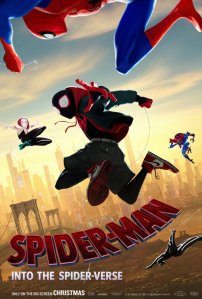 Walking out of Brad Bird’s hotly anticipated sequel to The Incredibles, I was convinced there wouldn’t be a better-animated film for the rest of the calendar year. Then I saw Ralph Wrecks the Internet and felt the same conclusion. What could top these two incredible movies from Disney? I wasn’t expecting a parallel world Spider-Man animated film to contend with that heralded echelon, but after watching Spider-Man: Into the Spider-Verse, I am now certain. This is the best-animated film of the year and one of the best films of the year, full stop. It’s rich, imaginative, exciting, satisfying, and way too much fun.
Miles Morales (voiced by Shameik Moore) is an ordinary teenager starting a new school he’s eager to leave. His police officer father, Jefferson Davis (voiced by Brian Tyree Henry), is pushing him and can be embarrassing. His cooler uncle Aaron (voiced by Mahershala Ali) encourages Miles to express himself through his graffiti art. One night, Miles encounters the famous Spider-Man, a particle collider, and a special spider from another dimension that bites him. He develops super powers and seeks out Peter Parker (voiced by Jake Johnson) as the only other person who might understand what he’s experiencing. Except there happens to be multiple Spider-laden heroes, including Spider Gwen, a.k.a. Gwen Stacy (voiced by Hailee Steinfeld), Spider-Pig (voiced by John Mulaney), Spider-Man Noir (voiced by Nicolas Cage), and an anime heroine Peni Parker with a giant spider robot friend. They’re all from alternate dimensions, dragged into Miles’ world thanks to Kingpin’s (voiced by Liev Schreiber) particle collider. If they don’t get back to their original worlds they’ll glitch out of existence, and Miles’ own world, and everyone inside it, is threatened by the instability of that collider.
 Into the Spider-Verse is bursting with color, imagination, kinetic energy, and a real celebration of the art form of animation and comics. Once that super spider bites Miles, the visual mechanics of the movie alter as well as him. Suddenly his thoughts are louder and appear in floating boxes (only we can see), in addition to thought bubbles, sound effects, and the occasional panel shifting transition device. It gets far closer than Ang Lee’s Hulk at recreating the experience of a living comic, and it’s joyous. The animation style too recreates the cross-shading effect of comic artists and the fluidity of the animation has purposely removed frames, giving it a slight stutter-step more often found in stop-motion animation. This distinct style might be off-putting to certain audience members accustomed to the smooth movements of modern animation mimicking real life, but for comic fans, it better approaches the captured stills of comic panels being connected into a whole. The different animation styles of the new Spider characters, Looney Tunes to anime to stark noir Frank Miller riffs, become reminders of separate universes with their own visual rules that keep things fun. The film is vibrantly colorful and gorgeous to watch on the big screen where a person can best luxuriate in that flamboyant palette. The finale feels like an explosion of splash pages and graphic designs merging together, even mimicking the sprawling graffiti art of Miles. It’s a spectacular visual feast that manages to be that rare treat of something new yet familiar.
The action of Into the Spider-Verse is delightful when it’s comedic and thrilling when it’s serious, but at every turn its fun, well developed, and wonderfully rendered. Early on, as Miles learns the tricks of his new and confusing abilities, the action is wildly funny. Take for instance a sequence where he becomes attached to an unconscious Peter Parker through the Spider-Man webbing. Soon after, the police approach Miles, and now he has to make a break for it while still attached to another body, forcing him into a series of comic escapes. It’s highly spirited and filled with enjoyable jokes. Later, as Miles gets more centrally involved in Kingpin’s scheme, the action becomes harsher, more violent, and dangerous. A battle between Miles and The Prowler gets more and more extreme, especially after some twists an audience may or may not see coming depending upon their source material knowledge (this is a parallel universe, after all). The action is frenetic, inventive, and visually engaging, easy to follow and filled with wonderful organic complications that allow each scene to feel vital and different from the last.
 Into the Spider-Verse is also brashly hilarious from beginning to end. Being co-written by the writers responsible for The Lego Movie and 22 Jump Street, I was expecting a combination of clever and antic, and that’s what they delivered and then some. There are brilliantly conceived and executed jokes but, and this is what separates the professionals, they do not distract from the larger work of the characterization. Often the humor is built through the characters, their personality and motivation differences, and the unique circumstances, so even when its zany it feels connected or grounded. There’s a silly joke about getting more bread from a waiter that works on multiple levels and they keep going back to it for further meaning, and it’s one example of many that shows the work put into their funny is meaningful and smart. After six movies and several animated series, audiences are well versed in the origin of Spider-Man, so Into the Spider-Verse even turns that knowledge into a source of humor itself, laying a formula for each new Spider character to introduce themselves with the same fill-in-the-blanks origin speech. The alternate universe Spider heroes do not overstay their welcome and, miraculously, even find themselves with some potent small character moments, which is an amazing feat given the 100-minute running time. The laboratory break-in with Peter Parker and Miles is a comic highlight with plenty of complications, and there’s a smart, sly joke about personal biases that just slides by nonchalantly that had me howling. The post-credit scene had me laughing so hard that I was crying. Please, I implore you, stick around for it and go out laughing with the biggest smile on your face.
Besides being a great comic book movie and a great action movie, Into the Spider-Verse is also just a great movie. The Spider-Man character is so familiar that the film easily could have gone on autopilot yet it puts in the work to build characters we care about, give them arcs, and provide setups and payoffs both big and small to maximize audience satisfaction. Miles is a terrific new character with a voice all his own, and his teenage foibles are both recognizable and refreshing. He’s a hero worth rooting for, and his more personal family issues can be just as compelling as the end-of-the-world adventures. That’s the core of what makes Spider-Man still an invigorating character 50 years later, and Into the Spider-Verse taps into that essential element even with an alternate universe Spider hero. It’s got the DNA of Stan Lee and Steve Ditko’s original creation and given a welcomed jolt of relevancy thanks to the onscreen racial diversity and youthful perspective.
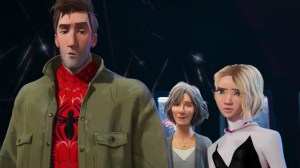 There are two relationships at the core: Miles and his father and Miles and Peter Parker. The latter is an unexpected mentor/pupil relationship that provides the enjoyment of watching both members grow through their bond, and the former allows a familial baseline to come back to and demonstrate how far we’ve come. The Peter Parker/Miles relationship has that big brother/little brother angst that keeps things sharp while still maintaining an undercurrent of emotional need. There were genuine moments where my eyes welled up. The film can be that affecting because it is so well structured and developed from a characterization standpoint. Even the chief villain, the Kingpin, has a motivation that is personal and effectively empathetic. Everyone involved gets careful consideration, even the bad guys.
Let me cite one prime example that showcases how great the storytelling can be (minor spoilers). At one point, Miles is bound and gagged by the other heroes to prevent him from joining them in a dangerous activity they do not believe he is ready for. They’re removing him from the team for his own good. Then, at this low point, his father comes to visit him and tries talking to him through the other side of his dormitory door. They’ve had some challenging moments between them and what Mr. Davis has to say is extra challenging. He’s trying to connect with a son he feels he’s losing touch with, and it’s a one-sided conversation where Miles is unable to respond to his father’s pleas, who eventually walks away knowing his son is there but not ready to talk. Right there, the screenwriters have gone from the fantastic to the personal, finding a way to bring Miles even lower but in an organic fashion that plays right into his ongoing communication problems. It’s a simple moment to start with, standard even, but then having it contribute to the father/son estrangement is beautiful and handled so well. The sparkling screenplay for Into the Spider-Verse is packed with moments like this.
The voice acting is perfectly suited for their roles. Moore (The Get Down) is an expressive and capable young actor that brings a terrific vulnerability to Miles, selling every emotion with authenticity. Johnson (Tag) is the absolute best choice for a slacker Spider-Man who has become jaded and self-indulgent. His laid back rhythms gel nicely with Moore’s eager breathlessness. Henry (Widows) is so paternal it hurts your heart. Steinfeld (Bumblebee) is poised and enjoyably spry. Cage (Mandy) is doing everything you’d want a Nicolas Cage-voiced crime fighter to be. Schreiber (Ray Donovan) can be threatening in his sleep with that velvety voice of his. Plus you get Katheryn Hahn as a villain, Zoe Kravitz as Mary Jane, and Lily Tomlin as Aunt May, and they’re all great.
 As the credits rolled for Spider-Man: Into the Spider-Verse, I tried searching my brain for any flaws, minor quibbles, anything that would hold the film back from an entertainment standpoint. The only thing I could think of is that animation style, but different people will either find that look appealing or irritating. This is a glorious and gloriously entertaining movie replete with humor, heart, surprises, payoffs, and a great creative energy that bursts from the big screen. This really is a movie to see on the big screen as well, to better feast on the eye-popping visuals and pop-art comic book aesthetics that leap from the page to the screen. It’s the second best Spidey movie, after 2017’s impeccably structured solo venture, Homecoming. The late addition of the other alternate universe Spider heroes keeps things silly even as it raises the stakes. The film is a wonderful blending of tones and styles, from the different characters and universes to the heartfelt emotions and vicarious thrills of being young and super powered. This is a movie that even Spider novices can climb aboard and fall in love with. Into the Spider-Verse is a film for fans of all ages and nothing short of the best animated film of 2018. It’s as good as advertised, folks.
Nate’s Grade: A
Share this:

Green Book (2018)
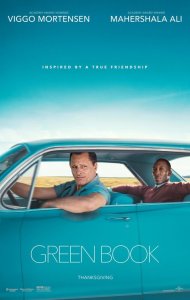 Green Book plays like a twenty-first century rendition of Driving Miss Daisy, a well-meaning and relatively gentle movie about race relations where a prejudiced white person comes about thanks to their firsthand friendship with an African-American male. It’s reportedly inspired by the true story of Tony Lip (Viggo Mortensen), a nightclub bouncer, driving around a famed pianist, Dr. Don Shirley (Mahershala Ali), as he performed throughout the South in 1962. The best part of the movie is the character interaction between this odd couple, and you’ll get plenty of it too. The actors burrow into their very distinctly conflicting characters, so it’s a natural pleasure to watch them eventually bond and learn from one another. This is the kind of racism that doesn’t make people feel too uncomfortable, and you could say that about the film as a whole. It’s a bit safe and has its intentions set on being a big, inclusive crowd-pleaser, and it plays like one. There are moments to make you laugh, moments to make you cheer, and moments to make you tear up. Morstensen and Ali are terrific together and find dignity and humanity in characters that could have easily become one-note stereotypes. The more we learn about Dr. Shirley the more interesting he becomes, a man used to feeling like an outsider no matter the company he keeps. Watching the two men grow and open up to one another can be heartwarming and deeply satisfying. Remarkably, the film is directed and co-written by one half of the Farrelly brothers, the pair responsible for ribald comedies like There’s Something About Mary and Dumb and Dumber. It’s an easy movie to fall for, with its winning formula and enjoyable actors, but there’s a little nagging concern I have that Green Book is too safe, too straight, and too pat in its life lessons. Despite its Best Picture win, it’s not like Driving Miss Daisy has any lasting cultural impression, and I wonder if maybe Green Book is destined for the same. Still, the acting and writing is enough to bring a smile to your face and remind one’s self about the power of kindness.
Nate’s Grade: B
Share this:

Moonlight (2016)
 What Moonlight achieves is both something different and familiar and amounts to nothing less than watching the birth of human identity on screen. The film chronicles three formative experiences at three different times of a man’s life, each serving as its own one-act play examining our protagonist and his tortured sense of self. The results are breathtaking and deeply immersive, allowing the formation of a human being to take place before your eyes in such magnificent artistic strokes. This is a sensitive, sincere, beautiful movie that serves as an indie coming-of-age tale sliced into three significant parts. I was completely under its sway within ten minutes, finding its perceptive perspective and nuances to be convincingly naturalistic. I felt like I was watching a documentary of a young black man’s life told with ferocious realism, or at least a loosely fictionalized version of a life informed by fully authentic personal experiences. It’s a somewhat ineffable quality for slice-of-life movies but they live or die on whether the film carries an unforced sense of realism, telling larger truths with small details, each piece coming together to make the world and the character feel fully formed. Moonlight pulls you immediately into its orbit thanks to its authentic drama and observations.
The three segments compliment one another as they build toward a young black man’s understanding of his homosexuality. We’ve seen movies before where characters undergo sexual awakenings and from gay perspectives; it’s practically a cottage industry unto itself in independent film. However, rarely have we seen this story from people of color. The expectations of accepted masculinity are entrenched at a young age, where “Little” (Alex Hibbert) is chided by, among others, his own mother Paula (Naomie Harris) for the “swishy” way he walks. It goes without saying that being gay is not exactly widely accepted in the Miami projects of the 1980s. This conflict of what makes a man is wonderfully symbolized with Juan (Mahershala Ali), an unexpected father figure that takes “Little” under his wing along with his girlfriend, Teresa (Janelle Monae). The kid wants to know how he can know if he’s gay because it’s certainly something he doesn’t want. Juan doesn’t pressure the boy or make big speeches about what it means to be a young black man in America. Instead, he tries teaching him to accept himself and provides an alternative home that serves as a refuge during his mother’s long absences and crack-withdrawal tirades. There’s a lovely moment where Juan teaches “Little” how to swim, and it’s touching in how recognizably father/son the activity is, how much trust is involved and vulnerability, and how the film doesn’t need to oversell the subtext. Juan definitely becomes the father figure that Chiron lives up to for the rest of his life. This first segment is dominated by their relationship but also Juan’s sense of responsibility. He’s making a living through selling drugs, including to “Little”’s own mother. In a very memorable and heated moment, Paula angrily calls out Juan for thinking he would make a better parent given the moral culpability of his own actions to her habit.
 The second segment zooms ahead to when Chiron (Ashton Sanders) is a teenager in high school and subjected to hostile bullying. The schoolyard taunts from his youth have morphed into something more ferocious and toxic, as a collection of bullies torments Chiron and looks to rob him of his personal connections to others. The central focus on the middle segment is about the growing relationship with Kevin (Jharrel Jerome), the childhood friend who Chrion crushes on. Their closeness takes a leap one fateful night that Chrion will always remember. It’s an awakening and a confirmation of self, and it’s only after having this fulfilling outlet cruelly taken from him that Chiron finally lashes out, with lifelong repercussions. It’s an explosion we can see coming and one that feels fully set up. The second segment feels more familiar because of the age range and it’s the one with the dawning of sexual realization, a story situation we’ve seen before. What elevates it is that it’s a fairly direct carryover from the beginning segment, which means the personal issues have magnified for Chiron. His relationship with his mother has become even more frayed as he’s grown, and what once was name-calling and questions over his maturation has become confirmed. Her addiction has become even stronger and she’s harassing her own son for whatever meager money he’s given from Teresa, his surrogate mother figure. Chiron is struggling to make sense of his feelings in an upbringing lacking support and clarity. You could examine the conclusion of this segment as an empathetic cautionary tale, as we see the years of abuse and measured choices that lead to that confrontation.
The final segment is where Moonlight transforms into a late blooming unrequited romance that should steal your heart if it’s still functioning. “Black” (Trevanta Rhodes) is a fully-grown adult that has seemingly followed in the footsteps of Juan in a life of low-level crime. He’s hardened both emotionally and physically. The muscles will provide an intimidation factor missing during his youth if anyone questions his sexual leanings. He’s burrowed into himself and the role he feels he must accept, but all of that changes the instant he gets an apologetic and searching phone call from Kevin (Andre Holland). Now working as a chef at a diner, Kevin reaches out to his old friend though even he can’t fully explain why. This reawakens “Black”’s longing and he works up the courage to travel back to Miami to surprise the friend who meant so much to him. Their reunion is treated like the culmination of a romance that you may not have realized had you completely. After two segments of setup and years apart, you may find yourself projecting your thoughts to the screen, trying to compel these two men together. It’s an extended sequence that moves at a gradual pace, a fitting tempo for a character racked by insecurities and suppression. By going forward he’s taking a big risk, putting himself out there, and we desperately hope “Black” finds a sense of support. It’s the segment where “Black” finds resolution with the major conflicts that have defined his life, and the climax of the movie is a deeply tender moment where an emotionally reserved man reaches out to another and lets his firmly fixed guard down in the process.
 I don’t usually go into such a detailed plot synopsis with my reviews because I like to hit the basics and let the readers experience the story for themselves, but the pleasures and artistic triumphs of Moonlight are in how fully immersed and felt the movie becomes. By telling the story in three noteworthy sections, Moonlight provides an impressionistic statement about the formation of personal identity, specifically a young man growing up black and gay in a hostile environment to both. The movie also blows apart the argument made for 2014’s Boyhood about how truly necessary it was to watch one young actor play the same part for 14 years. Here we have six different actors playing two different characters at three different points in time and the impact is no less great. Here is a movie that doesn’t need a gimmick to have a larger emotional impact on its audience.
Director/co-writer Barry Jenkins has a marvelously fluid and natural feel for his camera, swinging around the parameters of a scene to make the world feel more charged with energy. Jenkins is a born filmmaker and knows how to squeeze the most out of his scenes with gorgeous cinematography and an eclectic musical score that feels traditional with classical orchestration like churning strings layered and rearranged into something arrestingly new and yet still personal. There aren’t many overly stylized choices, rather Jenkins tells his story with uncommon poise and treats one man’s life like an opera, like the greatest story never told on film, like a life of complexity worth the deep dive. There’s a classical lyricism to the presentation that reminded me of the works of Todd Haynes (Carol). There’s one scene where Paula is strung out on crack and finds her son in the middle of a joyous high. Her face fills the frame, absorbing all of Chiron’s world, and her euphoria is inter-spliced with jarring speed ramps in editing, meant to convey the mania and peace that pumps through her veins in this fleeting moment. It’s a stylistic device that isn’t overplayed and has genuine purpose. Jenkins is restrained from self-indulgences and keeps every aspect focused on reflecting the inner life of his lead.
The very talented company of performers makes the movie even more powerful. Ali (Hidden Figures, Luke Cage) is creating serious awards buzz and it’s deserving, though every actor in this movie is deserving of notoriety. Ali plays a man trying to do right by his own sense and he lets you see the troubles that wash over him. Should he insert himself into this young boy’s life? Is he in a position to set an example? Ali has such paternal strength and tenderness while still displaying doubts and regret, hardly deifying this found father figure. Harris (Spectre) is wonderfully horrifying and heartbreaking in her role and has some big moments that convey her given completely into desperation. She’s offended that others would deign replace her but does little to reclaim her title of mother and provider. Holland (Selma) has a world-weary smooth sense of wisdom to him, and his unassuming charisma helps unlock his friend’s true feelings. The three actors who portray “Little”/Chiron/”Black” are each exceptional, giving different performances and interpretations, further supporting Jenkins’ artistic thesis.
 Moonlight is a beautiful film told with such delicate care and a resounding sense of authenticity and personal detail. It swallows you whole and leaves you with the impression of a human life observed with tenderness, intimacy, empathy, and grace. It’s about the people and experiences that help guide us onto the paths we take, and while there’s a sense of heartache as we think of what might have been, there’s also the serenity of accepting what has been and what can still be. Jenkins proves himself a superb talent who doesn’t lose sight of his artistic goals with extraneous artifice. There’s a lilting, lovely lyricism to the movie that elevates Chiron’s life into feeling like poetry. This is a life we so rarely get to see given such an artistic and honest examination without condemnation or judgment. It’s the story of a man embracing his identity and overcoming isolation and suppression. This disadvantaged young man is worth your emotions, your sympathies, and your attention. Moonlight is an alluring and heartrending film that manages to be deeply personal and universal at the same time. It’s sublime.
Nate’s Grade: A
Share this:

Hidden Figures (2016)
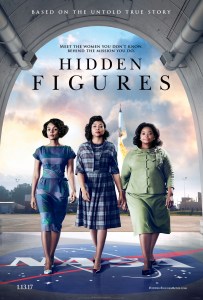 After the end of 2012’s Red Tails, I said to myself that those men of history deserved a better movie. By the end of Hidden Figures I was thinking the same thing for the unheralded African-American women of NASA in the 1960s Space Race. It’s an inherently engrossing story that the public knows precious little about, and the biggest problem with director/co-writer Theodore Melfi’s (St. Vincent) film is that is rarely breaks free from its formula for feel-good mass appeal. Rather than allowing us to absorb the complexities of the three women featured (Taraji P. Henson, Octavia Spencer, Janelle Monae) the movie wants us to just know about their struggles over injustice and inequality. That’s a fine starting point but rarely do these women become fully fleshed out. They’re kept as symbols, put-upon figures, and less as people. That allows them to have their Big Acting Moments where they uncork a snappy retort to institutional prejudice that is the kind of stuff meant for Oscar clip packages. Henson is given the most significant part but even her math genius feels like a crude Hollywood extrapolation of a stereotypical movie nerd. Monae was the one who left me most impressed with her feisty attitude and swagger. It’s all a pleasing and moderately entertaining package but the presentation and artistically stilted character development hinder the movie’s message. I would have preferred a documentary on the same subject, something that would allow further depth as well as the direct testimony of those women involved. I believe Henson’s character is still alive and in her 90s, so there’s no time to waste. Hidden Figures is a safe yet still appealing biopic that hits some of the right notes but lacks greater ambition. Not all films have to try and redefine their genre, but when you’re giving the titular hidden figures of history their much-deserved spotlight, maybe a little more effort is deserving and necessitated.
Nate’s Grade: B


 nathanzoebl
You must be logged in to post a comment.