Blog Archives
Fantasy Island (2020)
 I wasn’t expecting to become a defender of Blumhouse’s much-reviled remake of 1970s TV staple, Fantasy Island (it currently has a 7% fresh rating on Rotten Tomatoes) but this year has been defined by surprises. I’m not going to say that this is a good movie but turning a cheesy TV drama into a horror thriller that might as well take place on the magical island from Lost, I have to admit that’s a daring approach and it almost works. Michael Pena is miscast as a villainous Mr. Roarke who invites a group of strangers to a beatific island resort to have their fantasies come true be they hedonistic (wild parties with sexy guys and gals) or vengeance (Lucy Hale getting even against a high school bully) or regret (Maggie Q saying yes to a proposal and starting a new life). At first the fantasies seem too good to be true and then the darker reality comes forward, forcing many characters on the run. I was very happy that the filmmakers, the same creative team behind the equally-reviled Truth or Dare, present the proceedings as being clearly supernatural and stick with it. I was expecting some hackneyed explanation of how it was all a show, or a simulation, or some kind of televised event for the rich to gamble upon, but the movie stays supernatural to the end as if it is the Lost island with its weird secrets. Because of that scenario, even when the rules of the island and the final scheme comes to light as to whose fantasy all of this pertains to, it’s a forgivable level of convolution. There were moments I even had fun, mostly just seeing how crazy and far away from the source material everything can get. It felt like if someone was ordered to remake The Love Boat and came up with Ghost Ship. It’s just fun how different it can go. I didn’t care for any of the characters outside of Maggie Q, who gets the best acting showcase as a woman with many regrets who is trying to ignore her misgivings. Hale seems to be playing a character ported from the Spring Breakers universe (what a dreadful thought). Michael Rooker (Guardians of the Galaxy) appears as a grizzled veteran of the island. Even when things aren’t working, like black-eyed zombies or much of the comedy, I wasn’t ever bored. How crazy would things get next? How would they tie this all together? Fantasy Island is not the horrible experience critics claimed earlier this year. It’s not a great movie but it works as silly escapism, and during a time of pandemic-initiated quarantine, a little silly escapism might just be what you need for a couple of hours.
Nate’s Grade: C+
Share this:

Divergent (2014)
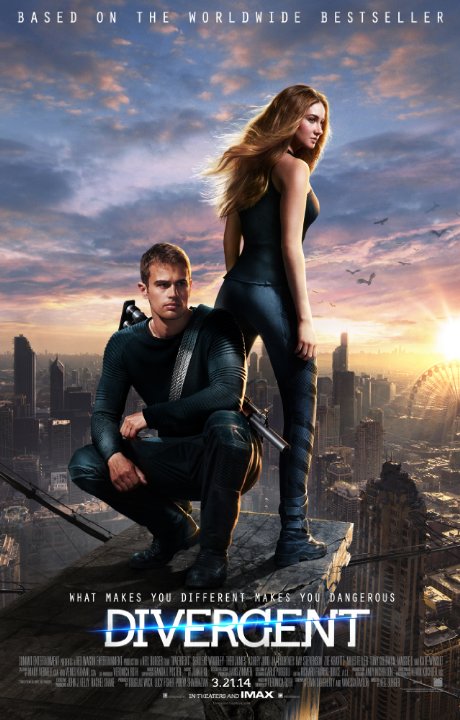 High school for many was a personal version of hell, with its class system and pressure to conform. Divergent built a whole future dystopia around this relatable concept. The problem with the movie is that the source material doesn’t think that much further.
In the future, 100 years after a great war that scarred the world, the survivors have holed up in the remains of Chicago with a large fence as their protection. The government decided to split off into five different factions, each with their important purpose. The five factions (Abnegation, Candor, Erudite, Amity, and Dauntless) work in harmony. Tris (Shailene Woodley) comes from a family of Abnegation, the selfless ones who run the government, though Jeanine (Kate Winslet), the head of Erudite, would like her faction to be on top. At the choosing ceremony, a candidate can select which faction they wish to live within. However, if rejected, that person will be factionless and on the outskirts of society. Rather than choose the comfort of her boring life, Tris decides to join Dauntless, the faction in charge of the security of the city. Before she can say goodbye to her family, she’s off joining a new one, but Dauntless has many tests to weed out the weak. Paramount in her mind is the fact that Tris is told she’s a divergent, one who doesn’t fit neatly into any one of the factions. Divergents are being singled out and executed because they are feared; they can’t be so easily controlled. Tris has to prove herself against tough competition in Dauntless while hiding her true divergent nature.
 Having not read the best-selling Young Adult books, I went into Divergent and walked away entertained enough though questioning the larger appeal. My movie partner told me that the adaptation hews closely to the book, fitting in all the major plot beats; she even said it was a better adaptation than the first Hunger Games, so fans should be relieved. What the movie came down to was one long plot about Tris getting through the Dauntless tests. It’s like a post-apocalyptic Full Metal Jacket, just minus the war half. With this tight focus, the film actually plays better and is easier to digest. The stakes are made clear and the hurdles are easy to understand. In a way it reminded me of the Ender’s Game film where we watch a recruit move up the ranks of their sci-fi training, though Ender’s was better at establishing dimension to its world. I did like the small touch that the Abnegation people won’t allow themselves to see their reflection because they see it as vain. I could have used more touches like that.
There are simple pleasures watching Tris, the plucky underdog, rising to the challenge and besting her snobby peers. The games get more intense and Tris learns from trial to trial, eventually learning how to hide her divergent nature by blending in against her nature. There’s also an intensity to this world that’s appreciated; people will die if they can’t keep up (there is one shocking sequence where a batch of jealous recruits literally try and kill Tris). The physical trials are fun but the mental ones are even more entertaining because they function around the candidate’s fears. It’s a tad lazy to simply broadcast a character’s fear for them to confront in a dream, but it provides some creepy imagery and new wrinkle for Tris to master. Even the requisite romance that every YA property has to have is handled respectfully without overdoing it. The mentor/teacher relationship with Tris and Four is a natural conduit for their budding romantic feelings, though James (Underworld: Awakening) looks way older than Woodley (The Descendants). In reality, he’s 30 and she’s 22, though she’s supposed to be… 17? 18 years old? I don’t know but it just didn’t sit right.
 Where the movie gets into problems is the larger world outside those Dauntless camps. It feels too ill defined and purposely vague. What’s on the other side of the giant electrified fence (hopefully dinosaurs)? I suppose that’s what sequels are for (they’re already filming the second Divergent for March 2015). The world just feels too small even for one city, and the history doesn’t feel integrated into the cultivations of this society. In a sense, the movie doesn’t give you enough to go on with its world building and spends far too much time dragging out its story. At a hefty 142 minutes, a time frame becoming de rigueur with YA adaptations, the film feels laboriously padded. I kept thinking the movie was going to check out at any moment, robbing me of some semblance of a complete ending. Fear not, there is an ending, though one that feels far too definite to continue a franchise. The bad guys are so obviously guilty, that even while still being at large, it’s hard to fathom a scenario that doesn’t unite everyone against the common threat. Does every YA post-apocalyptic mold eventually lead to unlikely heroes becoming the focal points of revolutions? I’m being facetious, but also highlighting just how derivative this movie is. Divergent borrows from its larger influences liberally, having enough story sense to know how to construct a satisfying tale of heroes and villains. It’s a well-polished film thanks to director Neil Burger (Limitless) but it’s also lacking necessary elements to distinguish it from the glut of dystopian imitators and predecessors.
I just can’t wrap my head around the world of Divergent. It lacks the clean clarity of, say, The Hunger Games, where the game is kill-or-be-killed and it’s very much a class warfare allegory. In Veronica Roth’s novel, the post-apocalyptic Chicago is divided into five factions but this isn’t a caste system. The different factions are looked at as equals, meant to cooperate harmoniously. So there goes any sort of class conflict when the factions are presented more as lifelong clubs. The design is that branching people off into five groups will somehow prevent the strife that lead to the unnamed war of the past. This doesn’t really make a lot of sense to me. Why would limiting people’s options for careers and lifestyles eliminate conflict? I understand the not so subtle message about conformity and the strength in controlling others, but it still doesn’t hold. Then there’s the notion that a divergent is a dangerous rogue, but it’s not like the divergent are mutants or genetically different. These are just people who don’t fit neatly into one of the five faction options. If you eliminate the conformity obsession, who cares? It’s only an aptitude test in the end, like what you take in middle school that say, “Hey, you like drawing, maybe you’d like to be a police sketch artist” (true personal anecdote of mine). It’s not something that looks deep into the souls of boys and girls and presages their future. It’s an aptitude test for crying out loud. The world of Divergent also feels strangely unfulfilled, with too many lingering questions about the logistics of how this future Chicago is able to function. There’s a confusing aura around this world and it doesn’t get explained because we spend so much time in Dauntless boot camp.
There was a weird motif I kept noticing throughout the film and that’s the future’s unsafe disregard for medical safety. The Dauntless kids are all about the running, jumping, punching each other in the face, but it all begins at their choosing ceremony. The candidates walk to the front of an auditorium, slice their palm with a ceremonial knife, and then squeeze blood into a bowl representing the faction they select. Of course they reiterate “faction before blood” so it’s a little strange that the ritual involves their blood. Anyway, what I picked up was that every candidate was using the same knife, only with he most perfunctory of wiping the blade. That is just unclean and a way for blood-based disease to spread. Then later during the mental round of testing, Four injects Tris and himself with the same needle. Clearly these post-apocalyptic people have forgotten all about AIDS and other deadly diseases. Why else would Jeanine be so calm as her hand is covered in someone else’s blood? I’m surprised she just didn’t lick it for effect.
 The actors are all well cast for their parts, with Woodley again proving herself as one of the best young actresses today in Hollywood. Her part isn’t anywhere as complex or demanding as her terrific turn in The Spectacular Now, but she’s able to slide in emotion where possible, expressing much through the power of her eyes. She’s a heroine you want to root for, and when she goes into badass mode it feels earned. James is suitably hunky while still being mysterious and broody. Interestingly enough, Miles Teller, Woodley’s onscreen beau in Spectacular Now, is here as a bully and Ansel Elgort, who plays Tris’ older brother, will soon play Woodley’s onscreen beau in The Fault in Our Stars. It’s like this weird cross-section of Woodley’s film history of boyfriends. The adults do fine jobs with their limited time, with Winslet (Labor Day) being a better realized version of what Jodie Foster was possibly going for in Elysium. My favorite adult actor was Jai Courtney (A Good Day to Die Hard, Jack Reacher) who hasn’t found the right fit for his talents, until now (he was great on Starz’s Spartacus TV show). As a no-nonsense Dauntless captain, he’s imposing in many respects and also intriguingly devious. He’s a grade-A heavy and adds a jolt to the scenes he’s in.
Poised to be the next YA breakout franchise, Divergent will likely be a hit with its target audience and reap the rewards at the box-office, though I think its flaws will hold it back from being embraced by a wider audience with no affiliation with the books. It’s an entertaining story with good actors and enough well constructed payoffs, but it’s also confusing, vague, and lacking enough urgency, class conflict, and developments to parlay into a more interesting story once Tris graduates from the Dauntless ranks. As a standalone film, Divergent works enough and duly entertains, thanks again to Burger’s visual sensibilities and the strength of Woodley. I’m just not invested at all in this world or its larger characters to compel myself to find out what happens next. I ravenously tore through the Hunger Games books, but to each their own. As a big screen sci-fi film, it’s strange that Divergent would work best in its smaller moments and settings. It’s too bad the movie doesn’t diverge enough from the pack of YA-modeled adventures. Well there is one thing to look forward to: I’ll see if I get my wish for dinosaurs in March 2015.
Nate’s Grade: B-
Share this:

Mission: Impossible III (2006)
 Few celebrities have had the intense flame-out Tom Cruise has experienced in a little over a year’s time. First there was the PDA-heavy relationship with Katie Holmes, never a wet tongue-kiss away from a camera. Then there was the couch aerobics on Oprah Winfrey’s set, bleating his over-the-top declarations of love like Roger Rabbit. This was followed by a series of testy interviews about his war of words on psychiatry and prescription drugs. Entertainment Weekly just ran a cover story asking, “Is Tom Cruise worth his paycheck?” He’s gone from Hollywood’s most bankable actor to a national punch line. To bring new life to Cruise’s spy series, he tapped TV mastermind J.J. Abrams to make his feature debut after Cruise churned through two seasons of spy series Alias DVDs. Abrams is a gifted franchise starter, first with Alias and then with Lost, and with Mission: Impossible III he does the best he can to erase the memory of Tom Cruise, daredevil of furniture.
Ethan Hunt (Cruise) is out of field work at the Impossible Mission Force, training recruits for the big time. He’s settled into a comfortable home life with Julia (Michelle Monaghan), a woman he’s blissfully engaged to be wed. Ethan’s happy home is disrupted when IMF needs his services. It seems one of his trainees (Keri Russell, Felicity goes badass) has been captured by an arms middleman Owen Davian (Phillip Seymour Hoffman), a man that will get any deadly force to the right bidder. Hunt reluctantly goes back into the field, assembling a team that includes Luther (Ving Rhames), Zhen (Maggie Q, quite fetching), and pilot Declan (Jonathan Rhys Meyers). Their mission goes badly and Hunt is reprimanded for his cavalier actions. He’s determined to snag Owen and get justice. This leads to an incredibly stuffed game of cat-and-mouse, each jockeying for leverage. There’s some super powerful device called the “rabbit’s foot” that everyone wants but it’s not really important. What is important is that Owen is eager to strike back at Ethan’s most vulnerable point — harming Julia.
 This movie is quite possibly one of the greatest TV adaptations of all time. No, not the Mission: Impossible series but Alias. Just like J.J. Abrams’ TV brainchild, this slick, propulsive caper puts a smart spin on familiar ground. We’ve got the flash-forward narrative trickery, the super gadgets, the undercover teamwork, the world-trotting sprawling vistas, and anchoring the whole thing with an emotional counterpoint, trying to lead a double, “normal” life and keeping your loved ones equally safe and in the dark. There’s a great scene in the middle of a mission where Ethan and Luther casually discuss the impossibilities of living a normal life given what they do. Luther warns that those close to you will only end up getting hurt, and by this point thanks to a startling, right-to-the-point opener with a gun to sweet Julia’s head, we know he’s right. That’s what makes the third go-round different: Abrams has injected some emotion into the darn thing. Ethan is pressed back into service and then becomes something of a knight in shining Kevlar, trying to save his beloved in the crossfire of international espionage. There are a handful of scenes between Cruise and Monaghan and they sell the emotional drama in tender quiet looks. As a result, the audience and Ethan are rooted to their seats beyond just the assembly line of pyrotechnics. Just like Alias (at least up until Season 3 when it jumped the shark with the long-lost sister). It’s like if True Lies was played straight and Tom Arnold was mercifully forgotten.
Ah, but what pyrotechnics they are. Things get heated with a trip to the Vatican and they literally do not let up, all the while raising the stakes by pulling Ethan’s home life closer to the danger of his job. You’ll be left breathless absorbing all the exhilarating action sequences, which to my best estimate are more than the first two flicks combined. The stunts are superbly death-defying. What makes action sequences so enjoyable, pay attention you Hollywood rubes, is when the stage is set and then we watch organic complications. Abrams has a tremendous feel for action and playfully extends virtuoso sequences of awesome carnage. An attack on a bridge is simply outstanding and gave me an overload of geeky joy. We’re given the tight, controlled setting, and then Abrams introduces the outside conflict and keeps developing it masterfully step by step. There’s air attacks, there’s running back and forth amongst the wreckage, there’s searching for guns while escaping attack, and then there’s flying leaps over gaping concrete holes. I was jumping in my seat with boyish glee. The slow-mo gun toss between Cruise and Russell? Awesome. The swing-shot jump off a gigantic skyscraper in Shanghai? Awesome. The use of Simon Pegg (Shaun of the Dead) as gadget guru? Awesome. Mission: Impossible III is, if nothing else, an incredible adrenaline rush orchestrated by a man with a finger directly on the pulse of his audience. By summer popcorn standards, Mission: Impossible III is everything you could hope for. Sure it’s highly implausible but it’s just so damn fun.
 Abrams has created quite a breakthrough for himself. Long regarded as a TV visionary for his tangled, engrossing pop-pulp like Alias and Lost, Abrams shows what he can do with a bazillion dollars and one of the world’s most recognized stars. Abrams intelligent, deft handling of his material, elevating tired genre devices with flash and reverence, reminds me of a young Steven Spielberg. This is a man that respects his material and respects his audience, but still knows how to bring home an entertaining movie. I’ve followed Abrams’ career since getting hooked on Alias in 2001, and I’m confident he will become the best friend a movie geek could ever have (Star Trek fans should be clicking their heels about Abrams’ rumored involvement). Even though Mission: Impossible III is Abrams’ film debut (and on record the most expensive ever for a first time film director) he already shows more command, more wit, and more hipness than most of Hollywood’s graying old guard.
Finally, this is the first Mission: Impossible film to utilize the team aspect of the TV show. Granted, Cruise still does most of the running, jumping, climbing trees, but thankfully this movie is more than the Tom Cruise Kicks Everyone in the Face Show a.k.a Mission: Impossible II. The supporting cast all have their one great moment and part of the fun is their interaction, seeing the pieces fit into place. Just like last summer’s Batman Begins I would like to see another movie immediately with everyone involved. Make it happen. This is the Mission: Impossible world I want to explore in greater detail.
Mission: Impossible III is not bulletproof. The movie seriously needed more time for its villain. Hoffman does a great job of bringing his bad man to grumpy life. He goes about business with a detached nonchalance, like a plumber fixing his 10,000th clog. It may sound silly but it works because Hoffman gives his character a lizardy, unscrupulous sense of ethics. He really will put a bullet between the eyes of anyone, possibly while reheating some food in his microwave. That’s the greatness of Hoffman’s villain, how ordinary he sees his line of work and what it calls him to do. Now, with such a terrific villain it would behoove Mission: Impossible III to give him plenty of screen time. Sadly, Hoffman has about three real scenes, and his end is anticlimactic and so is the film as a whole. And what does IMF have to do to curb moles? There’s been one in all three Mission: Impossible movies. Maybe they should offer better vacation plans.
Tom Cruise may have done a lot to wear out his welcome with the public but he knows to surround himself with good people. The decision to let J.J. Abrams helm Mission: Impossible III has finally given this franchise vision and sustained excitement. This movie is far more emotionally based than any other in the series and there’s a genuine emotional reason for all the fireworks this time. The team aspect is finally addressed and Hoffman makes a truly lecherous, scary villain. But the bread and butter of this flick are its breathless action sequences, brilliantly choreographed by Abrams, a name destined for even greater things. Abrams knows how to spin genre clichés into clever, loose, twisty, funny, thrilling, emotionally centered gold. I don’t care if Cruise abused a couch and the public’s good will; Mission: Impossible III is an extravagant popcorn movie and a great way to start the summer. If only they were all like this.
Nate’s Grade: B+


 nathanzoebl
You must be logged in to post a comment.