Blog Archives
Kill Bill vol. 1 (2003) [Review Re-View]

Originally released October 10, 2003:
Breathtaking and stylistically amazing. That’s all there is to it. Can’t wait for part two.
Nate’s Grade: A
——————————————————
WRITER REFLECTIONS 20 YEARS LATER
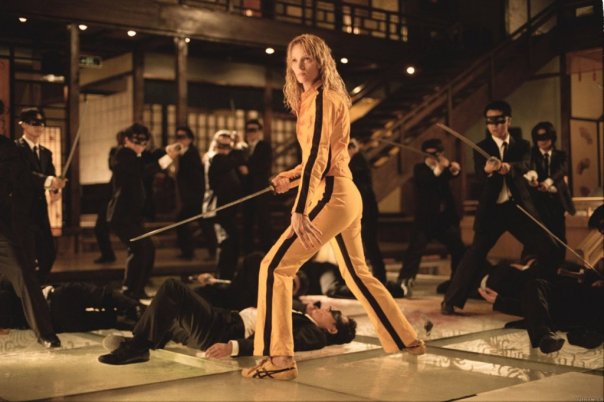
Kill Bill was a turning point in the career of one of the biggest cinematic artists of the past 30 years, and as exciting and stylish as Volume 1 proved, this is the point where Quentin Tarantino vanished within himself and became the ultimate B-movie revivalist. It only took two films for Tarantino to not just become an indie brand name but his own adjective, as Hollywood was flooded with “Tarantino-esque” imitators chasing after the man’s unique voice of snappy pop-culture soliloquies, hard-boiled dialogue, and meta-textual irony. Of course the imitators could never truly capture the full appeal of Tarantino’s movies, overvaluing the surface-level aspects (quirky characters, non-linear plots, unexpected bursts of violence) and missing the greater character depth and thematic intricacies that allow the style to accentuate the entertainment rather than solely serve as that value. 2003 was the crossroads where Tarantino switched from smaller dramas and crime thrillers about semi-recognizable and relatable people (the middle-aged romance in Jackie Brown is the most tender and sincere writing of his career) to remaking and re-packaging his favorite grindhouse exploitation movies. It was like Tarantino himself was following the path of the would-be Tarantino-esque imitators.

Kill Bill began as an idea between actress Uma Thurman and Tarantino on the set of Pulp Fiction; it even feels like a big-screen realization of the failed Fox Force Five pilot that Mia Wallace (Thurman) filmed. Thurman had the idea of the opening, a bloody and beaten woman in a wedding dress being executed only to survive her execution. The idea germinated for years and became two movies worth of material. It’s hard for me to envision Kill Bill as one whole entity because the two volumes feel so thematically distinct. The first is an homage to 1970s kung-fu movies and Eastern cultural influences whereas the second volume serves as an homage to spaghetti Westerns and Western cultural influences. I’m shocked that through the annals of numerous physical media releases at no point has someone released Kill Bill as one whole four-hour movie. It’s only ever been physically screened as such once by Tarantino, and I think the implicit admission is that, while conceived as one sprawling and gargantuan epic, the movies work better as halves that reflect and enrich one another due to that separation. As I wrote in my 2004 review of Volume 2, the first part is the “show” and the second is the “tell,” but what a show Tarantino pulls off.
There was a time where the idea of Tarantino helming an action movie felt antithetical, but he tapped every corner of his encyclopedic knowledge of genre cinema to give us one of the best action movies of all time. The centerpiece sequence pitting The Bride against the Crazy 88s, as well as the ball-and-chain-wielding schoolgirl Gogo, feels like the culmination of a lifetime of cinema geek passion. It’s viscerally exciting without getting boring over the course of twenty-something minutes because Tarantino keeps things shifting, never falling upon redundancies, as if he’s so eager to squeeze in each and every loving homage and reference point. The climax, which again feels so natural an escalation and end point for a “part one,” took eight weeks to film, and the MPAA insisted it be toned down to secure an R-rating (he turned it black and white to obscure the color of the blood, itself another indirect homage to martial arts movies of old when they played on American television). Reportedly over 450 gallons of fake blood was used during the production of both volumes, but this first edition is definitely the more gleefully over-the-top.

The revenge structure is shaped around The Bride (née Beatrix Kiddo) killing the five members of her former gang, the Deadly Viper Squad. Volume 1 only covers two members meeting their just desserts, one of which is the opening scene. That means after the first ten minutes fighting Vernita Green (Vivica A. Fox), we’re working the rest of the movie to the next boss fight. That’s where we get the character dynamics, the obstacles that The Bride must overcome (step one: wiggle your big toe), and the history of O-Ren Ishii (Lucy Lui) and her ascension to Japanese crime lord. With less careful filmmakers, this middle stretch might feel sluggish, but with Tarantino, it’s invigorating as the new world and its many faces connect together to create such an intriguing and engrossing larger picture. Volume 1 provides the structural bones of the story, as well as buckets of sticky viscera, whereas Volume 2 adds the meat and complexity and larger nuance. That doesn’t mean Volume 1 is lacking creativity, it’s just that it’s the half that has to perform more foundational lifting so that those character details and choices will have the larger impact they do. Volume 1 is a long straight line back to O-Ren Ishii, and the accelerating carnage is wonderful to behold.
Thurman has never been better than with her Quentin collabs. After her sudden rise in Pulp Fiction, it felt like her career stalled playing many “hot girl” roles in misfires like The Truth About Cats & Dogs, The Avengers, and of course Batman & Robin. After her Kill Bill revival, her star rose again only to once again falter from more reductive “hot girl” roles in misfires like Paycheck, My Super Ex-Girlfriend, and the movie musical of The Producers. She recently came into the casting orbit of Lars von Trier, a filmmaker who never met a beautiful woman he didn’t want to punish excessively onscreen for society’s ills. Her role in 2014’s Nymphomaniac volume 1 was a memorable high point as a contemptuous woman confronting her husband’s younger lover, the titular nymphomaniac. Perhaps it was the meta-textual comment of Thurman’s cinematic type-casting, the older “hot girl” replaced by the younger, newer beauty. I’m probably just grasping for greater meaning here. Thurman and Tarantino didn’t speak for years after the conclusion of the Kill Bill series, but it wasn’t until 2018 that we found out why. That’s when the public found out about the existence of a video where Thurman was driving a car and crashed. The problem was it should have been a stunt driver but Tarantino insisted and pressured Thurman into doing the stunt, she crashed, was injured, and still suffers to this day. She says she has since forgiven Tarantino even though he and Harvey Weinstein withheld footage of the incident for years.
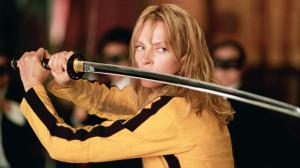
The music has taken on a life of its own. Much was repurposed from old movies and given new context, much like Tarantino’s overall creative mantra. The siren-blaring announcement of two foes facing each other has become its own pop-culture meme. The slow-motion walk to “Battle Without Honor or Humility” has also become pop-culture shorthand. “Twisted Nerve” is a great ringtone, and “Woo Hoo” by the Japanese surf rock girl group The 5,6,7,8s became so inescapably hummable that it eventually became the catchy theme of a wireless company.
This movie also holds a special place for me because the image that immediately comes to mind is watching my father uproariously laughing throughout the movie and rocking in his theater seat. A severed head leading to a geyser of endless blood had my father cackling like a child. By the end of the movie, I recall him turning to me, smiling ear-to-ear, and exclaiming, “Now that was a great movie!” Conversely, I also remember my college roommate falling asleep next to me as The House of Blue Leaves was bathed in (>450) gallons of (black and white) blood.
In the ensuing two decades, Tarantino has directed five other movies, published two books, been nominated for Best Director twice, won his second screenwriting Oscar, and essentially brought the tastes of the Academy to his own. He’s written three Best Supporting Actor winners (Christoph Waltz in 2009 and 2012, Brad Pitt in 2019) and become one of the most commercially reliable names, a director whose very name itself is a selling point for mainstream audiences. Even while some may bemoan that the indie provocateur might be “slumming” with his own highly polished version of B-movies, he’s dragged those same tastes to wide commercial appeal and industry acclaim. Kill Bill Volume 1 is the beginning of Tarantino tattooing ironic air quotes to his output, but when you’re this talented and passionate about movies of all kinds, even a kung-fu homage can become a cultural force and one of the best superhero origins ever (The Bride is pretty much a superhero and compared to Superman in Volume 2). Kill Bill Volume 1 is still a masterfully entertaining and bloody fun experience twenty years later.
Re-View Grade: A
Share this:

Shazam! Fury of the Gods (2023)
 I enjoyed 2019’s Shazam! because it felt like a breath of fresh air, a lighter story compared to the relentless gloom and doom of the DCU. It was more a silly Big-style body swap movie than a super hero romp, tapping into childhood wish fulfillment of getting to transform not just as an adult but as a super-powered adult on a whim. It was funny, sweet, and different. The 2023 sequel, Shazam! Fury of the Gods, feels like the definition of a sequel for the sake of a sequel. It is thoroughly mediocre and lacking the charm and heart of the original. I’ll try and deduce why this super-charged sequel feels so lacking and why the fun feels so forced.
Billy Batson (Asher Angel) can turn into Shazam (Zachary Levi) by uttering the magic name, and now his foster family share his same super abilities. They’re trying to adjust back to “normal life” when the Daughters of Atlas, Hespera (Helen Mirren) and Kalypso (Luicy Lui), arrive with a vengeance. Turns out Shazam’s powers were stolen from the Greek gods, and now they want them back, and if they don’t reclaim their power, the gods will destroy the world of man.
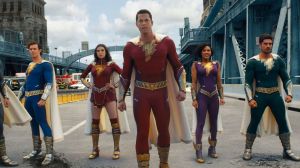 I think one of the most lacking elements of Fury of the Gods is that it loses its core appeal. The first movie was about a child fulfilling their adult dreams and leaping into maturity before their time. Levi (Apollo 10 1/2) was goofy and enjoyable in his broadly comical fish-out-of-water portrayal as a kid in an adult’s body. Now, the growing pains of being an adult, and a superhero, have been eclipsed. In fact, the amount of time we spend with Billy is pretty sparing. It’s all Shazam all the time, and this hurts presenting a worthwhile contrast between the mythic and the recognizably human. You forget the initial dynamic of this kid pretending to be an adult and what advantages this affords. At this point, being an adult is the same as being Billy Batson, who is approaching 18 and will age out of the foster system. This reality creates an existential crisis for Billy, as he’s afraid his family will move on so he’s eager to keep them together all the time, trying to maintain control. It’s about fear of change; however, I never fully understood why Billy was so worried. He’s already found a home with a loving mother, father, and extended clan of siblings, so why does aging out matter? He’s not going to be removed from his home. His siblings also aren’t talking about shipping out to the different corners of the world to begin careers or higher education. It’s a forced conflict to make the character uneasy about growing up. If the first movie was about a kid coming to terms with himself and letting others in, then this movie is all about a kid worrying his relationships will arbitrarily evaporate. This anxiety over losing something meaningful could have been an interesting storyline, but it’s all so contrived, and the whole body swap dynamic, the selling point of the first film, feels strangely absent.
Likewise, the villains have questionable motivation and character development. The movie begins with cloaked and masked figures wreaking havoc in a museum, and then it makes a big deal that these figures happen to be… women (also middle-aged and older at that). The opening is meant to be surprising in a way that feels out of date (what… g-g-girls can be powerful too?). It’s a strange point considering we’ve already had Wonder Woman. This same easily-satisfied, lowest common denominator plotting is disappointingly prevalent. These powerful gods want their father’s powers back but they already seem pretty powerful, so the movie lacks a fitting explanation of why these extra powers are worth all this effort. I suppose there’s a general revenge and righting of wrongs but the characters don’t play their parts too scorned. They’re more annoyed and tired, which doesn’t make for the most compelling villains. Another Daughter of Atlas has the power to mix and match the world like a volatile Rubix cube, but what is this power? It’s virtual obstacle-making but it feels arbitrary too in the world of superpowers. The ultimate scheme to conquer the world is as flimsy as the reasons it’s ultimately defeated.
 Let me dissect that part for a few words, the solutions to overcoming our vengeful gods. They raise an army of mythical creatures to destroy Philadelphia and it’s Ray Harryhausen character designs with cyclops and unicorns and the like. The way to reach through to the monsters and bring them on your side is to offer them a gift of “ambrosia,” some tasteful bounty that they can’t help but fall in love with. So what is the solution to this? One of the kids literally drops a handful of Skittles onto the street and the unicorn happily snarfs them down. Yes, through the power of Skittles-brand candy the heroes are able to save the day. There’s even a moment where the kid is riding the unicorns into battle and screams, “Taste the rainbow,” before the movie cheekily cuts her off before she can unleash an added “MF-er.” What is this? I’m usually agnostic on product placement in movies; characters have to eat and drink, etc. But when it’s egregiously transparent and played as the key to victory against all odds, that’s a bit much. If the joke is that contemporary food is a blast of flavor that nobody would have been prepared for thousands of years ago with their palettes, then any modern food could have worked. It didn’t have to be a brand-name candy with its brand-name slogan screamed in battle. This is but the first of several contrived and unsatisfying deus ex machina solutions that erase consequences.
Even with returning director David F. Sandberg (Lights Out), the enterprise feels like an empty retread relying too much on rote spectacle and missing the heart and perspective of its predecessor. There is an action sequence atop a collapsing suspension bridge and the song “Holding Out for a Hero” plays, and then we have a character comment on it, and it all seems like a desperate attempt to add some energy or style or fun to the sequence that is absent. The action relies on a lot of watching characters zip pedestrians to safety, but it’s the end result we see, not the whoosh and flurry of the arduous mission. The whole sequence feels like it’s going through the motions, as much of the movie does, falling back on a formula of superhero blockbuster autopilot. The CGI army of villains, the face-offs between characters shooting magic beams at one another, the overly quippy and tiresome dialogue and mugging cranked up to overdrive, the world-saving stakes feeling so minor. I was longing for some of the ’80s Amblin tone of the original, which got surprisingly dark. With Fury of the Gods, everything feels so safe and settled, with the stakes feeling inauthentic and the action reinforcing this with effects sequences that feel like Saturday morning cartoon filler.
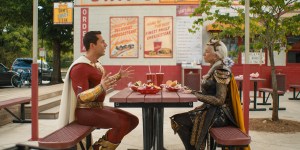 There’s a strange question with the family powers. The extended brothers and sisters can utter “Shazam” and turn into adult alter egos, but the character of Mary (Grace Caroline Currey, Fall) now transforms into a super suited version of herself with slightly different hair. In 2019, she transformed into actress Michelle Borth (Hawaii 5-0). Mary is the oldest sibling, and we’ve undergone a time jump of years to account for the ages of the kid actors, so does this mean that as the kids get older they will just turn into versions of themselves? Does this mean that the Zachary Levi-persona is set to expire once Billy turns legally an adult at 18? The implications of this casting choice made me question the very reality of the Shazam universe’s mechanics.
I can see certain audiences enjoying the slapstick and gee-whiz goofiness of Shazam! Fury of the Gods, and I have no doubt that the people making the movie wanted to tap into that childlike wonder of magic and myth. The problem is that this feels like the most inessential of the dozen DCU movies, going through the motions rather than exploring cogent and potent drama. Just take the character of Pedro (Jovan Armand) who is unhappy with his larger body and transforms into a handsome, slim, musclebound version of himself as a fantasy. That’s an interesting psychological exploration for the character, on top of his own self acceptance on a whole other front. Or take the sidekick from the first movie, Freddy (Jack Dylan Grazer), and his Romeo and Juliet-esque romance of a super-powered being from the other side of the conflict. There’s some drama there as well as his understanding of who the good and bad guys can be. Or simply take the perspectives of the parents trying to raise a household of kids who can transform at whim and what worries and joys this can offer. There’s material here to be finely explored, fun dynamics going beyond just repeating the Big-style body swap hi-jinks. Unfortunately, this is a sequel that feels like what made the original special has been replaced by blockbuster status quo.
Nate’s Grade: C
Share this:

Charlie’s Angels (2000) [Review Re-View]
 Originally released November 3, 2000:
These angels aren’t exactly what your father was enjoying when your mother was away fulfilling errands. These angels aren’t delegated as mere sex objects running around providing the jiggle entertainment that is (or was) supplied by today’s Baywatch. The 90s is a different decade after our minority movements and today’s woman is just as apt to do a flying kung-fu face plant into a baddie as any man. The angels of the film are action heroes for an armada of small girls needing some female empowerment when their only other choices consist of a barely clothed Britney or a barely covered Christina. These angels aren’t just the sex objects that the classic assortment of angelic 70s stars were; these angels are also tough-as-nails, resourceful, and not afraid to tussle or tango. Now that this exposition is out I can concentrate on the scattershot film Charlie’s Angels.
The film has been rumored to have at a minimum of 17 writers who tried shaping a story for Cameron Diaz, Drew Barrymore, and Lucy Lui. The story is pretty much shelved toward the back so the forefront is our trio of ladies kicking ass then shaking it with zig-zaggy and wild camera movements from debut filmmaker and video director McG.
Charlie’s Angels is whiz-bang dumb fun. The overall feel of the film is something more difficult to get a grasp on. At times it shows itself as tongue-in-cheek and satirical but then at other times it seems overly serious or overly dumb. The characters are non-existent and basically only discernible by hair color. The characters are very wooden and I actually found more enjoyment watching the villains and seeing more of them; call it the Austin Powers dilemma. Diaz makes the only notable attempt as her goofy and light-hearted angel connects with the audience best. Lui plays a techno-babe dominatrix but is easy to see that she was the last angel chosen and doesn’t exactly gel with the others as much as she could have.
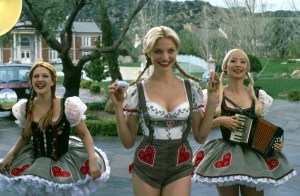 Charlie’s Angels is best when the action is pumping. The scenes are cut together in a jam-packing sequential way adding distinct flavor and style. McG is a true surprise in the effectiveness he can orchestrate his action motifs even if the Matrix effects and moves make absolutely no sense in the real world.
Crispin Glover shows himself as a silent assassin nicknamed “the thin creepy man.” Glover is so suave and slick in his role of the non-verbal Oddjob henchman role that he exhilarated me with every presence he made on screen. Goodness, he was too cool in this film and everyone gets brownie points for allowing him. He has such energy and charisma that I wanted the film to veer off into him and desert our angels. Seeing our ageless McFly perform action scenes and choreographed fights is something I will be pleased with until my grave. seeing Crispin in the excellent Nurse Betty and now huge exposure in this is a true joy. And man… he smokes a cigarette way too cool every time he’s in this film. Some people can smoke cool some of the time but Crispin does it all of the time. His mere presence almost cancels out the annoyance of Barrymore.
The line is drawn with Charlie’s Angels in that it’s sex-kitten jiggle and an acrobatic arrangement of (light) feminism and humor. These gals know they’re sex objects and they’ll use it to their advantage delighting in every second of it. Therefore, you could argue successfully that Angels is exploitation hiding as meaningful but hell… why think about this stuff? The movie rolls along at a fast pace where you don’t keep track of these issues. It’s just an easy sit down.
The gigantic success of Charlie’s Angels makes sequels and a possible franchise all but certain. I’d be happy for McG to hop back in his directorial chair but have a unique idea for Angels 2: Bigger, Longer, and Uncut… it involves Glover kicking a lot of ass really cool like.
Nate’s Grade: B-
——————————————————
WRITER REFLECTIONS 20 YEARS LATER

The 2000 Charlie’s Angels seems to understand that nobody should take this seriously. It even opens with an in-joke of T.J. Hooker: The Movie being inflight entertainment and an undercover character lamenting how bankrupt Hollywood is when it comes to recycling old TV shows. From there, our undercover angel literally exits with her target in the middle of the air and plummets to the water below, safely landing via parachute with a team meeting via helicopter aerial hook-up and a speedboat below. Why any of this? What sense does any of it make? It doesn’t matter in the slightest, and from the opening scene onward the movie lives by this credo, doing its best to be silly and have fun and just not care about the rest, and it shows. Twenty years ago, I think Charlie’s Angels benefited from low expectations as I recall mostly enjoying it. Now, having re-watched the movie for the first time in ages, I will say the fizzy appeal seems to be diluted. It’s still got energy to spare, though it feels a little too antic, a little too episodic and slipshod, and a little too proudly shallow, and that’s before you re-examine its depiction of the angels.
It took 17 writers and considering every under-30 actress in Hollywood to put together Charlie’s Angels. Drew Barrymore had bought the remake rights and wanted to make a big screen splash with a trio of kick-ass heroines that could better relate to the culture of the new century. I understand that Barrymore and her team wanted the angels to be sexy, yes, but also smart and funny and goofy and fearsome and all the things that little girls should believe possible. That’s commendable from a positive representation, but then so much emphasis is placed on their bodies and their off-the-charts sex appeal to bamboozle men that the goal becomes eclipsed. One could argue that Barrymore, Cameron Diaz, and Lucy Lui are embracing their sexuality, and that taking control of this is empowering, and if you feel empowered by Charlie’s Angels, by all right enjoy that and bless you. However, twenty years later, this feels less like the girls are in charge are more like they’re just being exploited in a manner we’re being sold as new feminism.
 There are so many examples where the angels are in skimpy clothing or objectified. There was an entire clip of Diaz dancing in her underwear that I remember Harry Knowles of the early 2000s mainstay Ain’t It Cool News devoted a gross drooling essay to his obsession (“But to sum up, Cameron Diaz’s Swirling Ass is one of the greatest images and objects in the whole of human existence.”). Barrymore’s character is constantly getting undressed and using her body to disarm men. Again, duping men through their hormones can be a key asset as a spy, but it’s happening in every scene and at her disservice as well. She tumbles down a ravine naked in a last-second escape, and the movie treats it as cheeky comedy (no pun intended). Lui adopts a series of disguises that routinely sexualize her, from a masseuse to the most overt, a domineering corporate boss that resembles a dominatrix. They’re straight fetish roles. I’m surprised a Catholic schoolgirl outfit wasn’t adopted as a disguise. The movie’s depiction of its female stars and the emphasis on their bodies feels retrograde for its ideals. I know they wanted to improve upon the portrayals from the 1970s but we still got problems. McG’s stylish direction prioritizes the angels’ sexuality. They can be smart and kick ass but also in a sexy way, the movie is telling you. Thandie Newton was supposed to be an angel but schedule overruns from Mission: Impossible II got in the way, and later she admitted she had strong misgivings because her character was going to be introduced with a closeup of her denim-clad butt. No one is arguing that women should be barred from taking ownership of their sensuality, but the lens Charlie’s Angels utilizes is strictly a male gaze, and these women are repeatedly objectified.
As a result, the movie has a new sheen of discomfort during all the silly, sudsy spy missions and wardrobe changes. Before you might think, “Oh look, they’re dressing up as Japanese geisha girls, what fun,” and now you’re like, “Oh, somebody at the studio was getting off on this.” Before you might think, “Oh look, they’re dressing up as Middle Eastern belly dancers, what fun,” and now you’re like, “Oh, somebody at the studio was getting off on this.” There are a lot of ethnic disguises that would likely get axed today as cultural appropriation. The carefree, frivolous attitude of the movie is meant to be charming and low stakes, but when it’s applied to the exploitative nature of how the women are depicted, it all becomes a bit dodgier to accept.
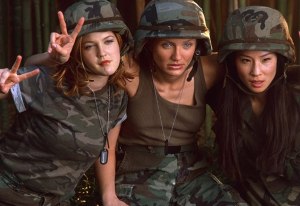 This was the first real blockbuster after The Matrix reshaped action cinema and the stylish choices can run the gamut between exciting and cool to dated and shallow. Twenty years later, it’s just not as impressive that they used wires to swing their actors around for stunt choreography, or that they replicated key Matrix touches like bullet time. The fighting sequences are often choppy in editing and some of the moves meant to demonstrate the power of the angels just feel silly, like a moment where Diaz went full Lui Kang with her flying kicking feet. It’s moments like that where the style gets away from McG. The tonal trick is finding a balance between goofy and cool, exciting and cheesy, and I don’t think the movie achieves this with its action. The set pieces feel built around “cool moments” rather than using geography, organic complications, and escalation. It means that Charlie’s Angels has its share of cool moments but then they are fleeting and ultimately meaningless because they don’t better connect to character, story, or even simply their own satisfying action compositions. It’s like immediately disintegrating cotton candy. The dozens and dozens and dozens of needle-drop music cues feel like another potent example of this charge as well as some anticipated attempt to distract from its shallow and diverting design.
I was dreading revisiting my original review as an 18-year-old because I was convinced my younger self was going to conflate the portrayal of the women as taking ownership. I just knew this would be something I had bought into in 2000, and yet it wasn’t quite so: “The line is drawn with Charlie’s Angels in that it’s sex-kitten jiggle and an acrobatic arrangement of (light) feminism and humor. These gals know they’re sex objects and they’ll use it to their advantage delighting in every second of it. Therefore, you could argue successfully that Angels is exploitation hiding as meaningful but hell… why think about this stuff? The movie rolls along at a fast pace where you don’t keep track of these issues. It’s just an easy sit down.” Hooray for my younger self seeing through this movie’s sheen of empowerment. At the time, it bothered me less because the movie was dumb fun, and now it just seems less fun and also dumber. I was so taken with Crispin Glover (Back to the Future) and his creepy cool style, much of which was Glover’s doing. His character was supposed to have dialogue except he hated the lines and asked to be silent. That’s one way out of memorizing, and it worked because he was a breakout and appeared in the 2003 sequel. Sam Rockwell (Three Billboards) was also a fun discovery though he only gets good once he’s revealed as a baddie. He would reuse those dancing moves for Iron Man 2.
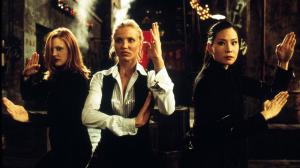 By the time 2003’s sequel Full Throttle rolled out, the appeal was gone. In my own brief review, I summarized, “It all seems so ho-hum and excessive at the same time. Quite an accomplishment. No more please.” I feel like the 2000 film also falls into this summary. It’s clearly not intending to be anything more than a goofy action movie, and I suppose the right person could still likely turn off the necessary parts of their brain to enjoy the rush of sights, sounds, and cleavage. There shouldn’t be a “wrong kind of feminism” so if this works for you, great. Many years later I felt that the male gaze was more ogling the women in the name of celebrating them. And yet Sony still felt there was material to be mined when they tried again with a failed 2019 reboot. The original Charlie’s Angels film is a cocktail of style with a creeping hangover right behind.
Re-Veiw Grade: C
Share this:

Lucky Number Slevin (2006)
 Probably too clever by half, this Tarantino knockoff is gloriously twisty and far more twisted than you may have thought from the surface. It’s a puzzle piece that winds up being vastly entertaining. Josh Hartnett does the best work of his career in an effervescent comedic performance, playing Slevin, a nobody mistaken for a somebody who owes different mobsters large sums of money. There are a lot of balls to keep juggling, but Lucky Number Slevin finds a way to keep the headstrong momentum constantly going. The neo-noir art direction is fabulous and eye-catching. Things get really dark in the last act, perhaps too dark for some, but for me, this was a crime caper that left me captivated by clever storytelling and flashy camerawork. Definitely for fans of the noir genre and for those with hard stomachs for violence.
Nate’s Grade: B
Share this:

Kill Bill Vol. 1 (2003)
Breathtaking and stylistically amazing. That’s all there is to it. Can’t wait for part two.
Nate’s Grade: A
Share this:

Charlie’s Angels: Full Throttle (2003)
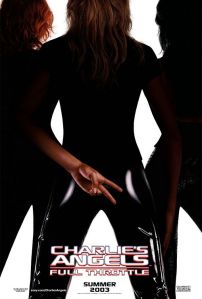 More of the same, except this time all the verve and invention seems stale and reheated. This sequel subscribes to the bigger-better train of thought, so as it continues to get more and more outlandish and the girls become invincible super heroes on par with Neo, the movie tanks hard. Much has been made about Demi Moore’s “comeback” but apparently she wasn’t sharpening her acting muscles during her hiatus. No one said the first Charlie’s Angels movie was within the realm of reality, but in the sequel apparently the Witness Protection Agency has decided to store all their valuable information not in a computer mainframe, a system of files, no, on two magic decoder rings. What the hell? McG returns as director and cranks the style into overkill, set to a radio-friendly soundtrack, but it all seems so ho-hum and excessive at the same time. Quite an accomplishment. No more please.
Nate’s Grade: C
Share this:

Chicago (2002)
January at the theaters is a tale of two kinds of films. One type are the studio bombs (take Just Married and Darkness Falls, please take them far away). The other type are the prestige pictures expanding their releases in hopes of garnering some of that Oscar magic. A lot of prestige films were released around the holidays and though not every one could be a winner, they were all better than Kangaroo Jack. Well, except for The Hours.
 Chicago (2002)
Premise: Roxie Hart (Renee Zellweger), hungry for fame, finally grasps it when she kills her lover and is put on trial. Silver-tongue lawyer Billy Flynn (Richard Gere) stirs up the media in her defense, as well as for another starlet killer, Velma Kelly (Catherine Zeta-Jones).
Results: A song-and-dance picture thats quite toe-tappin with imaginative numbers, even if I can only remember like two songs. A surprisingly steady Zeta-Jones really shines and Gere can cut a rug. Chicago is just lively fun. Blink and youll miss Lucy Liu in it.
Nate’s Grade: B
Share this:

Charlie’s Angels (2000)
These angels aren’t exactly what your father was enjoying when your mother was away fulfilling errands. These angels aren’t delegated as mere sex objects running around providing the jiggle entertainment that is (or was) supplied by today’s Baywatch. The 90s is a different decade after our minority movements and today’s woman is just as apt to do a flying kung-fu face plant into a baddie as any man. The angels of the film are action heroes for an armada of small girls needing some female empowerment when their only other choices consist of a barely clothed Britney or a barely covered Christina. These angels aren’t just the sex objects that the classic assortment of angelic 70s stars were; these angels are also tough-as-nails, resourceful, and not afraid to tussle or tango. Now that this exposition is out I can concentrate on the scattershot film Charlie’s Angels.
The film has been rumored to have at a minimum of 17 writers who tried shaping a story for Cameron Diaz, Drew Barrymore, and Lucy Lui. The story is pretty much shelved toward the back so the forefront is our trio of ladies kicking ass then shaking it with zig-zaggy and wild camera movements from debut filmmaker and video director McG.
Charlie’s Angels is whiz-bang dumb fun. The overall feel of the film is something more difficult to get a grasp on. At times it shows itself as tongue-in-cheek and satirical but then at other times it seems overly serious or overly dumb. The characters are non-existent and basically only discernible by hair color. The characters are very wooden and I actually found more enjoyment watching the villains and seeing more of them; call it the Austin Powers dilemma. Diaz makes the only notable attempt as her goofy and light-hearted angel connects with the audience best. Lui plays a techno-babe dominatrix but is easy to see that she was the last angel chosen and doesn’t exactly gel with the others as much as she could have.
Charlie’s Angels is best when the action is pumping. The scenes are cut together in a jam-packing sequential way adding distinct flavor and style. McG is a true surprise in the effectiveness he can orchestrate his action motifs even if the Matrix effects and moves make absolutely no sense in the real world.
Crispin Glover shows himself as a silent assassin nicknamed “the thin creepy man.” Glover is so suave and slick in his role of the non-verbal Oddjob henchman role that he exhilarated me with every presence he made on screen. Goodness, he was too cool in this film and everyone gets brownie points for allowing him. He has such energy and charisma that I wanted the film to veer off into him and desert our angels. Seeing our ageless McFly perform action scenes and choreographed fights is something I will be pleased with until my grave. seeing Crispin in the excellent Nurse Betty and now huge exposure in this is a true joy. And man… he smokes a cigarette way too cool every time he’s in this film. Some people can smoke cool some of the time but Crispin does it all of the time. His mere presence almost cancels out the annoyance of Barrymore.
The line is drawn with Charlie’s Angels in that it’s sex-kitten jiggle and an acrobatic arrangement of (light) feminism and humor. These gals know they’re sex objects and they’ll use it to their advantage delighting in every second of it. Therefore, you could argue successfully that Angels is exploitation hiding as meaningful but hell… why think about this stuff? The movie rolls along at a fast pace where you don’t keep track of these issues. It’s just an easy sit down.
The gigantic success of Charlie’s Angels makes sequels and a possible franchise all but certain. I’d be happy for McG to hop back in his directorial chair but have a unique idea for Angels 2: Bigger, Longer, and Uncut… it involves Glover kicking a lot of ass really cool like.
Nate’s Grade: B-
Reviewed 20 years later as part of the “Reviews Re-View: 2000” article.


 nathanzoebl
You must be logged in to post a comment.