Blog Archives
Sorry, Baby (2025)
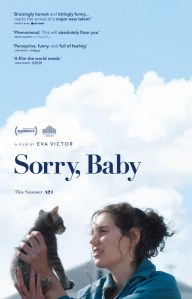
Sundance favorite Sorry, Baby takes several serious subjects and provides its own little bittersweet treatise through a character study of one woman navigating her complex feelings after being assaulted by her college professor. Written, directed, and starring Eva Victor, the movie feels like a combination of one of those small-town slice-of-life hangouts and something a little more arch and peculiar, but it still coasts on its vision and authorial voice. Victor’s portrait rings with honesty and empathy as her character, Agnes, wants to live a “normal life” but doesn’t quite understand what that might be. Her best friend is pregnant from a sperm donor, she’s adjusting to her workload as a literary professor at her alma mater (in an ironic twist, she occupies the same office as her former mentor and attacker), she’s flirting with the possibility of a romance with a nice neighbor (Lucas Hedges), and she just adopted a stray cat. The present, suffused in indecision and depression, is juxtaposed with flashbacks to her before, immediately after the assault, and the infuriating aftermath. This is where some of Victor’s darker sense of humor arises, like when Agnes is consoled by university officials who tell her there’s nothing they can do because her attacker has resigned but, hey, they’re also women, so, you know, they get it. Sorry, Baby walks a fine line between making you wince and making you want to laugh. It’s an impressive debut for Victor on many fronts, though I wish I felt like it amounted to something more emphatic or emblematic. It can feel more like a lot of self-contained scenes than a full movie, like Agnes going through jury selection before being excused when she has to confess her own history and her conflicted view of her attacker. I really enjoyed the concluding monologue Agnes gives to a newborn, explaining that the world she’s just entered will probably eventually hurt her but that there’s still good people and goodness that can be found. It’s heartfelt but in-character and feels completely on her own terms. Sorry, Baby is a little slow and a little closed-off, but it also deals with trauma and perseverance in a manner that doesn’t feel trite, condescending, or misery-prone.
Nate’s Grade: B
Share this:

Honey Boy (2019)
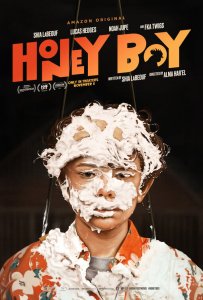 Honey Boy may be one of the most fascinating movies before you even watch a single second. It’s begging for an intensely ambitious psychological analysis as Shia LaBeouf lays bare his soul in an act of art as therapeutic device. He wrote the screenplay of a very autobiographical tale of a young child actor (nick-named “Honey Boy” by his father) hitting new levels of fame and his abrasive, abusive, and very controlling father, an alcoholic entertainer that relishes his son’s growing success and also resents his accomplishments. That alone would have made Honey Boy an interesting film experience, but LaBeouf goes the extra mile, as he does, and he literally plays the father character, putting him in the position of bringing to life the hurtful authority figure and thinking from his skewed perspective. It makes every moment LaBeouf is onscreen deeply fascinating and deserving of a deep dive to unpack the layers of personal meaning for the man. LaBeouf is also startling and terrific as the self-destructive and self-determined father, a man who finds slights in the slightest but can also be very encouraging of his son’s dreams. Seriously, every moment he is onscreen is suffused with layers of artistic meaning for what it represents in the story, its relationship to LaBeouf the person, and what LaBeouf the son is discovering while playing his father. It becomes a cathartic exercise that also could prove to be literal empathy. The problem with Honey Boy is that it feels more like that dramatic exercise than an actual story; the secondary storyline with the adult protagonist, played by Lucas Hedges (Manchester by the Sea), hardly provides much significance. He’s going through rehab and dealing with his unresolved feelings and addictions, but it’s more a framing device than a story itself or a worthwhile contrast to provide helpful details. The movie would just have been fine without it. However, there isn’t really a development of a plot as there is a general repetition of the relationship, namely the complicated and fractious father/son relationship. We spend a lot of time at this motel. We spend a lot of time with father speaking to son. I think a clear majority of the lines are spoken by LaBeouf. It’s always fascinating, with the exception of a misfire of a young romance that seems to float by more on yearning, but after a while I started to notice it felt like we were getting more of the same. We weren’t generating new insights into the characters and how they might change. Is this movie an act of forgiving his father or understanding him? I don’t know, but I’d happily debate Honey Boy with a pal over a beer for the next hour. It’s an inherently intriguing movie loaded with subtext that has its own subtext, a touch of the surreal from documentary filmmaker Alma Har’el, and powerful acting from LaBeouf. It can also feel like more of the same after the first hour. It’s a movie you need to see but it’s ultimately more LaBeouf opening up his intensive therapy role-play than it is a fully-formed movie. James Franco must watch this movie and weep.
Nate’s Grade: B
Share this:

Mid90s (2018)
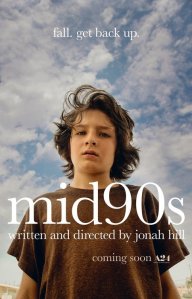 Jonah Hill’s directing debut is a small slice of 90s cinema that’s heavy on sense of time and place, light on plot, but filled with youthful authenticity. We follow a young kid (10? 12?) as he ingratiates himself with a group of older teen skaters. He wants to emulate these cool kids and dedicates himself to being a skateboarder. There are some intra-group conflicts and jealousies that play out as our protagonist becomes part of the gang. He gets exposed to smoking, drinking, and girls at house parties. There is one sequence at a party where a teen girl (15? 16?) takes our young hero into a bedroom to deflower him, and I instantly became anxious and needed to know the ages of the characters onscreen (it’s never verified). Our main character also happens to be one of the more boring people in the film, almost by design. He’s a blank page for the audience to project onto, and he’s trying so hard at such a formative age to emulate the older teens that it makes sense to leave him less defined. Hill hired professional skateboarders and taught them acting, and they act like professional skateboarders. In fairness, they act like recognizable teenagers, and Hill’s natural ear for dialogue rings true for this time of life. The movie takes a few turns into After School Special territory but doesn’t seem to deal with the consequences or resolutions of those dramatic events, which makes the film feel both more realistic and less fulfilling. Our hero takes a lot of injuries, some of them bleeding-head related, but nothing seems to come from them except the growing admiration of his peers. The home life storyline is worrisome and vague. Our protagonist has a physically abusive older brother (Lucas Hedges) who resents him and a single mother (Katherine Waterston) who seems irresponsible in not doing something about her youngest son being gone well into the morning hours. Even our protagonist seems to have penchant for self-harm, something that will presumably lead to problems down the line. In the meantime, mid90s is a pleasant and mostly entertaining, seemingly autobiographical experience. It gets by on enough for a watch.
Nate’s Grade: B
Share this:

Three Billboards Outside Ebbing, Missouri (2017)
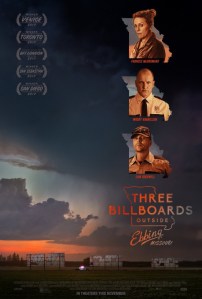 Mildred (Frances McDormand) is a divorced single mother working in the small town gift shop of the small town of Ebbing, Missouri. It’s also been seven months since her teenage daughter was raped, murdered, and set on fire. She rents out three billboards on a rarely used side road to advertise her frustrations with the slow pace of law enforcement. The billboards say, “Raped while dying,” “Seven months and no arrests,” “How come, Chief Willoughby?” The chief (Woody Harrelson) tries to pacify the grieving mother while keeping his loyal officers in check from retaliation. Deputy Dixon (Sam Rockwell) is trying to apply pressure to get the billboards removed by any means. The small town loves their sheriff and turns on Mildred, which suits her just fine. The more people that disagree with her the more it helps fuel her sense of righteous indignation. Mildred engages in an escalating series of battles with the police and town that might just make justice impossible.
Three Billboards Outside Ebbing, Missouri feels like a Coen brothers’ movie played straight, and it’s borderline brilliant in its depiction of homespun characters allowed tremendous emotional latitude. These are people with complex depth who are allowed the power to be contradictory. They can be vicious one moment and kind the next, wise one moment and impulsive and self-destructive the next, capable of great acts of mercy and cruelty. This achieves two things: 1) making the characters feel far more convincingly drawn, and 2) making the characters consistently surprising. This is a messy movie but I don’t mean that as any intended insult. It’s messy in scope, messy in tone, and yet it thrums with the messy feelings and messy complications of human tragedy. What happened to Mildred’s daughter is utterly horrifying and her rage is righteous; however, that doesn’t sanctify her. She makes mistakes, pushes people away, and can be cruel even to her own family. I was expecting Harrelson’s police chief to be a sort of villain, either incompetent or conniving, willfully ignoring the murder investigation. This is not the case at all and he is full of integrity and rightfully beloved in his community. As happens in many criminal cases, the trail of evidence just ran cold, but Mildred would prefer every male in the city, state, and even the country be blood tested to find a culprit. Her demands are fundamentally unreasonable and Willoughby points out the many civil rights protections in possible violation. Just because Mildred has been wronged does not make her the hero, and just because Willoughby is the face of local law enforcement does not make him the enemy. They are people with much more in common than they would ever admit. The awful circumstances of the plot have pit them against one another in an escalating tit-for-tat that serves as projection for Mildred’s blinding fury against a world that would rob her of her daughter.
 The dichotomy of sweetness and terror is best exemplified in the transformation of Mildred and Dixon, one of the most satisfying and engrossing film experiences of the year. Thanks to writer/director Martin McDonagh’s deft handling, these two characters start at opposite ends and grow before our eyes. Mildred tests the limits of her resolve and anger and makes costly mistakes. Dixon begins as the screw-up with a badge (hat he literally misplaces) rumored to have tortured a black prisoner in jail. He seems like the dim-witted poster boy for unchecked masculine privilege. He feels like an enforcer of the corruption we (wrongfully) assume is at work in this small town. As Mildred descends into darker decisions, Dixon ascends and chases a redemptive arc, which is amazing considering the damning behavior he engages in at the halfway mark. These two characters start as adversaries and develop into begrudging allies in a completely organic way that doesn’t blunt either character. That transformation is thrilling to watch and terrifically satisfying on its own terms. By the very end of the movie, I was ready and willing to watch its hypothetical sequel setup, especially if it meant I got to spend more time with these carefully crafted people.
McDonagh’s film juggles many tones, effortlessly switching from laugh-out-loud comedy to crushing drama and back again. I was genuinely surprised how many times I laughed and how hard I was laughing. During my second theatrical viewing, there was an old woman in the back who was quite vocal in her bafflement about how anyone could be laughing. And if you were told the specifics of the plot and its heavy subject matter, I would tend to agree. McDonagh has a preternatural feel for how to find humor in the most unlikely of places. The humor dissipates as the film marches into its second half, a natural byproduct of having to raise the dramatic stakes and make things feel serious. This is the first grounded drama in McDonagh’s filmography (In Bruges, Seven Psychopaths). He doesn’t shortchange the impact of his drama by weaving in more heightened comedic moments. The characters feel realistically developed and portrayed and are allowed to exist in moral grey areas. There’s a minor character played by Peter Dinklage who is positioned as a romantic option and a bit of a fool, but by the end you feel degrees of sympathy even for him. Even this most minor of supporting characters (not a comment on Dinklage’s stature) has earned your emotions. That’s great storytelling but it’s also tremendous execution from the director. Another sure sign of McDonagh’s command for tone is that he undercuts his story’s moment of triumph. I’ll dance around spoilers but Three Billboards looks to end in a way where several characters would claim a hard-won victory, and McDonagh casually strips that away. Even though this is a movie, and even though there are moments of broad, irony-laced comedy, the complexities and disappointments of real life emerge. Even to the very end, Three Billboards doesn’t follow the expected rules of How These Things Go.
 The excellent acting gives further life to these tremendous characters. McDormand (Fargo) is radiating with ferocious resentment and indignation. Her character is a walking missile that just needs to be pointed in the right direction. Her stares alone could cause you to shrivel. McDormand hasn’t been given a character this good in years. She opens up the full reserve of her deep acting reservoir, able to flit from great vulnerability to intense repulsion. She has plenty of big moments where she gets to tell off the disapproving townspeople and media members. It’s ready made for easy laughs, but McDormand is so good that she shades those moments with subtler emotional nuance. You get the laugh and you also get further character insight. It’s a performance of such assured strength that I imagine you’ll be hearing her name often during the awards season. Rockwell (The Way, Way Back) has also never been better. He has to play a similarly deep array of emotions, from idiot comedy to heroic dramatics, and at every point Rockwell is stunning. He makes every joke twice as funny. When Dixon becomes a larger focus of the story is when he undergoes more intensive introspection. He goes from buffoon to three-dimensional character. Harrelson (War for the Planet of the Apes) also delivers a worthy performance as a proud yet wounded man who is trying to do right against a world of pressures and self-doubt.
Three Billboards is an impressive, absorbing, searing film gifted with some of the best-developed characters in 2017. The portrayal of the characters is so complex and given startling life from such amazingly talented actors. You’ll watch three of the best performances of the year right here. You get a really strong sense of just how life has been irrevocably altered from this heinous crime, not just with Mildred but also for the town as a whole. Things cannot go back to being the way they were. The characters you like can make you wince. The characters you don’t like you might find yourself pulling for. Thanks to the complexity and nuance, the film delivers a raft of surprises, both pleasant and painful. These people feel closer to real human beings. McDonagh’s brilliant handling of tone and theme is a remarkable work of vision, cohesion, and execution. This is a darkly comic movie that can make you bust out laughing and an affecting human drama that can make you cry. It takes you on a journey that feels authentic and wildly entertaining. Three Billboards Outside Ebbing, Missouri (which should have simply been called Three Billboards) subverts typical Hollywood clichés by making sure, even during its wilder flights of comic fancy, that everything is grounded with the characters first and foremost.
Nate’s Grade: A
Share this:

Lady Bird (2017)
 Coming-of-age movies typically coast on a combination of mood, sense of place, and character, and Greta Gerwig’s Lady Bird excels in all areas and supplies a straight shot of happiness to the senses. Gerwig serves as solo writer and director and tells a semi-autobiographical story of “Lady Bird,” a quirky, determined, feisty, self-involved, and vulnerable teenager (Saoirse Ronan) trying to leave the lower-middle-class confines of her Sacramento life for bigger pastures. Ronan (Brooklyn) is spectacular in the title role and displays a heretofore-unseen sparkling sense for comedy, punctuating Gerwig’s many witty lines with the exact right touch. This can be a very funny movie and it has a deep ensemble of players. Ronan’s character is a magnetic force of nature that commands your attention and finds ways to surprise. The film follows her high school senior year’s ups and downs, potential new friends, bad boyfriends, social orders, family struggles, jobs, and most importantly her dream of getting into an East Coast college and leaving the trap she sees is her hometown. Her parents (Laurie Metcalf, Tracy Letts) are stressed and exasperated with their demanding daughter. Metcalf (TV’s Roseanne) is outstandingly affecting as the beleaguered matriarch. Much of the movie’s ongoing conflict, and later triumphs, revolve around the fraught mother/daughter relationship, and Ronan and Metcalf are never better than when squaring off. This is a movie rich in authentic lived-in details and observations. It can stray into overly quirky territory but Gerwig as director has a remarkable feel for when to hold back. There’s a genuine and poignant family drama at its heart that doesn’t get lost amid the whimsical additions that cater to Lady Bird’s vibrant personality. By the end of a coming-of-age movie, the characters should feel a little wiser, having learned through heartache, bad choices, and changes in perspective. This isn’t a movie about big moments but about the ebb and flow of life and the formation of one’s sense of self. We should enjoy having spent time with these characters on their journeys. With Lady Bird, I couldn’t stop smiling like an idiot.
Nate’s Grade: A-


 nathanzoebl
You must be logged in to post a comment.