Blog Archives
Miss Peregrine’s Home for Peculiar Children (2016)
 Miss Peregrine’s Home for Peculiar Children feels like Tim Burton’s X-Men franchise, and it’s just as awesome as that sounds. Burton has always had an interest in the outcasts and misfits of society and now he has his chance to leave an imprint on the ever-present superhero phenomenon. His own personal group of gifted youngsters is looking to form a funky family and fight against fearful forces that have their sights set on exploiting these special children or worse. It’s a natural fit for a man who has become a Gothic industry unto himself over three decades of peculiar and spooky filmmaking. This is Burton’s chance to flex franchise tentpole muscles with a subject matter perfectly attuned to his offbeat sensibilities, and watching the fabulous final product is akin to watching a master musician dive into Beethoven’s Fifth. This movie was flat-out delightful.
Jake (Asa Butterfield) is reeling from his beloved grandfather’s (Terrence Stamp) mysterious death. The old man loved sharing his stories about tending to the shape-shifting Ymbryne Miss Peregrine (Eva Green) and her wards, a group of children with special abilities including starting fires, controlling plants, invisibility, and being able to float lighter than air. On a trip to Wales to investigate grandpa’s stories, Jake discovers a time portal and is taken back to the WWII era where Miss Peregrine is waiting for him. She and her children relive the same day and will never age. They’re hiding from Barron (Samuel L. Jackson) and his group of scientists who wish to hunt the children. Jake is tasked with being the new protector, as he is the only one that can see an invisible band of slender monsters known as hollows that feast on the children.
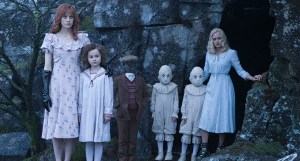 There’s a whimsical nature to the dark elements, and the script is rife with enjoyable payoffs and fun moments that cry out for a full visual immersion. This is Burton’s best film since 2007’s Sweeney Todd (I have a soft spot for that macabre musical), arguably best since 2003’s Big Fish, and maybe his most fun movie since his 90s heyday. If you’re a Burton fan, you’ll be tickled by all the imagination and humor. I grew up on the cinema of Beetlejuice and Edward Scissorhands and The Nightmare Before Christmas (yes, directed by stop-motion maven Henry Selick but still very much a Burton film), so I’ll admit that seeing Burton in high form once again warmed my little mischievous heart.
You get a sense just how involved Burton was in the filmmaking and its details, the degree of passion and involvement, and also his commitment to being a dark movie intended for peculiar children and adults with macabre interests all over the world. I kept thinking that the 12-year-old version of myself would have adored this movie, never mind the 34-year-old version of myself who greatly enjoyed it too. This feels like a natural evolutionary step for children and adolescents who gorged themselves on the works of Edward Gorey and R. L. Stine. It’s not a significant spoiler but it’s something I feel you, dear reader, need to know in order to properly assess just how wonderfully morbid the movie can come across. There is an entire visual feast of a group of villains dining upon the delicacy of… children’s eyeballs. You read that right. It’s a silver platter piled high with severed eyeballs, and they get slurped down like it’s spaghetti. I could only cackle to myself at the audacity of the movie to embrace the fun of the darkness rather than hiding from it, mitigating it, trying to be delicate with tone. The villains want to return to a normal state that can only be achieved by consuming the eyeballs of peculiar children, and so they are hunted not for sport or prejudice but for eyeballs. That’s wonderfully squirmy, and it definitely affected me, an avowed cinema patron who gets extra squirmy with any onscreen eye trauma. There are other creepy and memorable moments, like a dead child being used as a ventriloquist doll and the slenderman-styled hallows creatures. The moments are plenty but they don’t choke the story’s momentum, which hums along with great imagination and lucidity.
There’s a lot going on with Miss Peregrine, and Jane Goldman’s (Kingsmen) screenplay juggles a lot of rules and world building without losing momentum. I was intrigued early and the movie would widen its focus, providing more texture and connection to the world in calculated doses. It was enough that I always felt like I was learning something while still being able to see how the pieces snapped together in retrospect. There’s time travel that has to be done at a very specific point, the rules of who can travel back in time to these bubbles of safety, the history of this specific day stuck in time, the non-linear history of the protectors, the fact that the bubbles are also teleportation hotspots, the history with Jake’s grandfather, the history of the Ymbryne and their powers, the powers of all the peculiars, dream prophecy, mad scientists and their peculiar ailments, the differences between the hallows and the predatory scientists, and also establishing the character dynamics of several lost children and a budding YA romance. It’s amazing that Goldman’s script is as understandable as it is considering all that heavy lifting. It’s not completely free of muddled plot points and some hazy explanations, but those instances are a clear minority to what works so effectively. I wanted to know more about this world, and once they added time travel and teleportation, I was hooked. I enjoyed the movie so much that I’m considering reading the additional books for my next freaky fix.
 The acting ensemble is full of bright spots and none brighter than the new queen of genre gusto, Eva Green. I raved about Green’s magnetic performance in the considerably lesser 300 sequel. She was easily the best part of that movie and it suffered whenever she wasn’t on the screen. The same can be said for the too-long-in-the-making Sin City sequel. She was the best thing in Burton’s otherwise forgettable Dark Shadows feature. In short, this woman is incredible, and she digs into the vampy and ridiculous with the right degree of malevolence and glee. Green is a wonderful hostess into this magical world, and her foreknowledge gives her a caffeinated energy that makes her even a tad more peculiar. Her children are all fine actors who have uneven parts thanks to the unfair distribution of their powers. Not everyone gets super useful abilities. I felt sorry for the kid who projected his dreams from his eyeball especially during the third act scuffles. A mouth in the back of the head doesn’t seem very useful either. I enjoyed the idea that the invisible kid needs to be fully naked to be fully invisible, and everyone acknowledges this reoccurring fact with shoulder-shrug nonchalance. The standout amongst the peculiars is Ella Purnell as the winsome girl who will float away. She has an innocent and yearning quality that doesn’t sink her character. She’s more than just a love interest to Jake and Purnell helps channel great affection. Jackson (The Hateful Eight) is expectantly highly entertaining as the lead villain and Butterfield (Ender’s Game) is perfectly acceptable as an audience surrogate into this wild world.
I was duly impressed with just about every element, from the structure of the screenplay and its precision with information and intrigue, to the level of acting, to the dark and whimsical tone, to Burton’s own peculiar particulars that fill out the film with adoration. It may sound corny but there is an affection woven throughout the film, for its dispirit outcasts, for their strangeness, for the ardor of telling a spooky story that can appeal to children without pushing away adults. There’s a care that’s been absent Burton’s other recent films, especially Dark Shadows, which left me bewildered whether Burton had any genuine fondness for the source material. Miss Peregrine’s Home for Peculiar Children is a haven for fans of the peculiar, Burton’s oeuvre, and those looking for a quality children’s film that has some bite. I can only hope for more fantastical adventures.
Nate’s Grade: A-
Share this:

The Blind Side (2009)
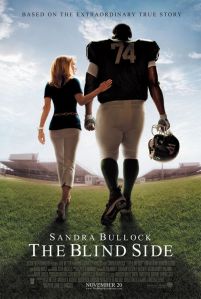 Based on a true story, The Blind Side tells the true-ish story of Michael Oher (Quinton Aaron) who was a lost, homeless black youth in Tennessee. He was adopted s a teenager by the Tuohy clan, a rich White family led by no-nonsense matriarch Leigh Anne (Sandra Bullock). Her husband (Tim McGraw) is a restaurant franchise owner, so they don’t have to worry about money or food budgets for Michael’s large appetite. The gentle giant is grateful but wary. He’s admitted into a private school because of his football potential, but at first they envision the hulking teenager on defense. Leigh Anne is the one who sees his protective instincts and assists in the switch to offensive tackle, whose job is to protect the quarterback’s blind side. With Leigh Anne’s steady influence and a stable home environment, Michael begins to feel like he has a loving family. Eventually Michael Oher becomes an All-American player in college and was drafted by the Baltimore Ravens in the first round of the 2009 NFL Draft.
The Blind Side might just sneak up and, forgive me, blindside you. Well, that?s not accurate, because this movie will not sneak up on anyone. There is not a single moment of surprise to be had. Michael Oher is portrayed as a gentle giant who is very tight-lipped. Much of his performance is in body movement and those dark, sad eyes of his, which means that the audience has to intuit a lot from the character. That might be why the most affecting moments come from Oher’s stunned, grateful reactions. It’s hard not to be affected by such an outpouring of earnestness. Stay during the end credits, watching the photos of the real family at the 2009 NFL Draft and try not to feel a smidge of their happiness.
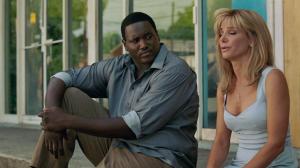 Bullock seems like a natural fit for this character and this material, and she does give the Southern spitfire life. She’s the heart of the movie and pretty much the driving force for the film, so it helps that Bullock taps her natural charms to make the character feel less like a cartoon and more like some approximation of a person. She’s formidable and brassy and pretty much gets her way on everything. The movie has the faulty belief that Leigh Anne saying anything folksy is funny, which is not the case. However, Bullock makes the character likeable and embraceable, and plus, she doesn’t fall down once. It must be a first for a Sandra Bullock movie.
Every scene is played into a moment of uplift and eventual triumph, which can be tiring but also has a respectable batting average for success. Structurally, the movie doesn’t have any overarching sense of conflict, which seems bizarre given the circumstances of an insanely wealthy white family adopting a troubled black youth in Tennessee. You might think Michael would take some adjusting, or that the students of privilege might not fully accept someone so different, or that the Tuohy children might need more convincing to suddenly add a new member. There are a few raised eyebrows and some slight hesitation, but the characters just barrel forward like what they are doing is common. The family is just resoundingly good-hearted and full of such moral clarity, though the husband seems to be content to be a powerless pawn to his vociferous wife. There is no real internal conflict within this family despite the burdens they tackle, and even worse the movie doesn’t really show any change occurring. At a lunch with her rich girlfriends, Leigh Anne remarks that Michael is changing her life. How? She seems like the same kindly woman from the beginning. Instead, the movie is packed with tiny little conflicts that get easily resolved and then move along. Will Michael feel at home? He does. Will he get his grades up? He does. Will he figure out the game of football? He does. Will he play well in a game? He does. Will he graduate? He does. Will he get a scholarship? He does. Will he reject the lifestyle of crime? He does.
Big Mike is sidelined in his own story by the firecracker of a character that is Leigh Anne. The saintly Tuohy family is yet another example of Hollywood feeling the need to tell a compelling African-American story framed as the story of helpful, White characters. Why can’t he film’s emphasis be on Michael instead of Leigh Anne, especially since she remains the same good Christian woman from the start? It’s probably because Oher, as portrayed on film, doesn’t have much of a personality. He’s a nice if soft-spoken kid but he mostly just shuffles his feet. Off the football field, he is written merely to take up space. He serves as the ongoing results to Leigh Anne?s teaching experiments.
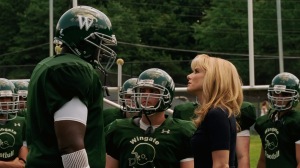 If you peel away the movie’s sentiment, it does have some niggling, potentially troubling aspects to the story. It sings the praises of insanely rich Southern Christians and makes us say, “How nice and rich of them.” Leigh Anne is the kind of woman with enough mettle to venture into the ghetto and even stand up to taunting gang members. She even threatens to shoot one of them. Every one of these “ghetto” sequences feels transparently written by somebody whose only understanding of an urban environment is from movies and TV. I wasn’t expecting The Blind Side to be as accurate as The Wire, nor would I normally care about the inaccuracy, but when it’s in the service of comparison (the comfy world of rich White people vs. the hopeless existence of poor blacks) the portrayal becomes ham-handed and morally questionable. Just to rub it in how good Michael’s got it, the movie resorts to ending with a montage of newspaper reports detailing gang slayings in Oher’s old neighborhood, highlighting every character we saw onscreen. The movie says they had no choice to end up as criminals because they could not escape the nightmares of the ghetto. If only those unfortunate black youths could have found rich families to adopt them.
Perhaps the funniest moment for me, as an ardent college football fan (go Bucks!), was a montage of South Eastern Conference coaches trying to recruit Oher in 2005. He’s visited by the head coaches for South Carolina (since retired), Tennessee (since fired), Auburn (since fired), Arkansas (since fired, now coach of Ole Miss), Louisiana State (left for NFL, now coach of Alabama), Auburn (since fired), and Ole Miss (since fired). The turnaround in just a four-year period is astounding for a major college conference. The coaches look like they’re having fun in the movie, probably because they get to pretend to be coaches again.
The Blind Side is a straight-down-the-middle genre picture that plays every expected note, it?s manipulative and formulaic for a sports drama, but I’d be lying if it didn’t get to me from time to time. If you go into The Blind Side under the right frame of mind, which means essentially ignoring the flagrant manipulations, then this movie will work on its sentimental sports genre sensibilities.
Nate’s Grade: B-
Share this:

Thank You for Smoking (2006)
 As soon as I saw a trailer for Thank You for Smoking I was in love. I found the book for cheap and read it with months to spare before the film reached my local theater. Admittedly, my expectations were high because the book was wonderful, and Thank You for Smoking as a movie is equally wonderful and a very good film adaptation.
This is a wickedly funny satire that skewers all sides in the political debate about Big Tobacco, and the film doesn’t take a stand, which is refreshing. It has a firm grip on its humor and gleefully gives its finger to political correctness. There?s a lunch group called the M.O.D. (Merchants of Death) squad where reps for Alcohol, Firearms, and Tobacco, of course, argue over whose product is harder to spin. It’s likely the snort-because-you-can’t-believe-they-said-that movie of the year. The tar-black humor in Thank You for Smoking rolls off so casually. This is a comedy that respects the intelligence of its audience and doesn’t dumb down its barbs or its satire. Aaron Eckhart was born to play the role of Nick Naylor, tobacco’s master spin artist and public charlatan. Naylor is conniving, slippery, and yet immensely likable not in spite of these traits but because of them. Eckhart is downright charming and you can see how he could dupe a nation, even if he’s only doing it for the challenge. Thank You for Smoking has one of the finest assembled casts in a long time, and every member fires on all cylinders. This is a film brimming with confidence and it’s evident with every frame. You almost might feel guilty for wanting to capture a contact buzz from how polished, assured and witty the flick is.
I never thought I’d say so but it sure looks like adapter/director Jason Reitman has a far more promising future right now than his dad, Ivan. Jason, the son, keeps the movie brisk, packed with characters, subplots, jokes, and a visual whimsy. This is a terrific adaptation of a terrific book, and Reitman really hones in on the mechanics of debate and lobbyist practices with aplomb. A scene where Nick teaches his adoring son the tricks of debate with ice cream is outstanding. Thank You for Smoking crackles with dialogue to die for, like Nick’s boss BR (J.K. Simmons) saying, “We sell cigarettes. They’re cool, and addictive, and available — the job is practically done for us.” My only complaints with the film, besides that it’s too short at just 90 minutes, is the manufactured danger seems a bit too slight and too easily overcome. Nick quite simply vanquishes whatever threat his reporter sex buddy Heather (Katie Holmes) posed. Otherwise, Thank You for Smoking is a superb movie all around and there’s no reason you shouldn’t see it. Take the hit.
Nate’s Grade: A


 nathanzoebl
You must be logged in to post a comment.