Blog Archives
I Am Number Four (2011)
 Despite being based upon a young adult book series, I Am Number Four is an unfortunate title. What do you call the sequel? I Am Number Four 2? I Remain Number Four? Let’s not even mention the obvious pan that is begging to be covered by that title (“I Am Number Four? More like I Am Number Two!”).
Number Four, a.k.a. “John” (Alex Pettyfer), is your normal teenage alien hiding on Planet Earth and trying to live a regular life while eluding intergalactic mercenaries. Numero Quatro has relocated to the town of Paradise, Ohio with Henri (Timothy Olyphant), his alien guardian who poses as dear old dad. The two are trying to keep a low profile because Number Four is one of the last nine super-powered aliens from a dead planet. The aliens develop different special abilities as they mature and Number Four has begun to notice that his hands glow in the dark. Number Four catches the attention of Sarah (Dianna Agron), a pretty gal whose ex-boyfriend happens to be the super jealous quarterback. Number Four also befriends the school’s nerd (Callan McAuliffe) who thinks his father was taken by aliens. He’s not exactly keeping the desire low profile. Numbers 1-3 have been killed by a pack of alien mercenaries who intend to dominate Earth, and now Number Four is next.
While neither special nor afflicting, I Am Number Four is a pretty mundane, mediocre, special effects driven goof aimed primarily at young teen males. The plot lacks any trace of nuance and seems fantastical in what should even be ordinary. The Ohio town is one of those small towns that exist in the minds of west coast studio executives, where everyone gathers round for a carnival and the roads are mostly of the dirt variety. Sarah’s family is one of those ideal, chatty families that exist primarily in the minds of nostalgia. They don’t just sit around and chew their food; they are actively involved in dinner cutesy dinnertime games and cutesy embarrassing interactivity. But the movie never lets you think about these inauthentic tidbits for long before more explosions or colorful special effects rattle you. The plot follows an almost mechanical process, supplying some PG-13 skin (ladies in low rise jeans! Cleavage!) or some rudimentary chase scenes at a fairly brisk pace. The story borrows liberally from many sources, including a dash of super powered loner Spiderman stuff, angsty teen romance from Twilight, and a sprinkle of whatever is playing on TV right now as you sit reading this.
 The action is never really takes off beyond the general concept of Things Exploding and People Running. Director D.J. Caruso (Eagle Eye, Disturbia) can string together a series of pleasing visuals but they never amount to much. The film lacks real suspense and any risible sense of excitement. The action sequences are disposable but at least Caruso makes sure that the audience can follow along. I thought with all the sci-fi elements that the film would make more interesting choices, but alas I Am Number Four relies all too easily along commonplace action tropes like it’s an accomplishment. Number Six (Teresa Palmer) gets to walk away from an explosion in slow-motion (while she wears sunglasses). Nobody in town seems to ever pick up on the mounting collateral damage of this interstellar spat. Caruso and the screenwriters are too content to just be happy playing with the special effects toolbox, emulating the favorite moments of the sci-fi action genre. And one of those tropes is that ANIMALS CAN NEVER DIE. Number 4 has a shape-shifting guardian pet that decides to take the form of a dog. Then when things get rough, this dog mutates into a hulking CGI creature, which still looks like a dog. And when he gets wounded fighting another CGI monster, it’s not enough that we get the pained dog cry but the filmmakers decide that he also has to transform back into a regular Earth dog at this point to hammer home the image of pooch in trouble. Shameless to the very end. And then, during our resolution this space dog has to come hobbling out.
Fortunately for the audience, the actors are all rather beautiful. Pettyfer (Alex Rider) isn’t much when it comes to this thing called acting, but he’s got abs you could scrub laundry with and really that’s half the part of playing a hunk from outer space. I give the guy more credit just for having to be saddled with the lame superpower of glowy hands. It’s a long wait for those glowy hands to become instruments that launch glowy fireballs. For most of their screen time, Pettyfer’s power just looks like he’s clenching two very powerfully charged indigo-glowing cell phones. Olyphant (Deadwood, Hitman) is too young for me to be covering as the dad to a 17-year-old kid. I still remember Olyphant in 1999’s Go. Maybe that’s just my hang-up. The ladies are all gorgeous are all in the flawless skin and teeth variety, you know, the ones that populate every small town. No one truly makes much of an impression but they’re easy on the eyes. It’s like an Abercrombie and Fitch catalogue come to life with extra explosions (and more clothes).
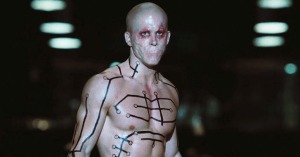
 The only actor that stands out is Kevin Durand and he’s under pounds of makeup as the chief villain. Durand first came to serious attention as a season-long villain on TV’s Lost as Martin Keamy. He has a real distinct menace that doesn’t come across as self-satisfying or ironic. He’s got a real presence and it seems like casting directors have caught on to this former Canadian standup comedian. From there Durand has become something of a go-to guy when it comes to large intimidating men and men with some kind of mild speech impediment; his characters in X-Men Origins: Wolverine, Legion, and even Robin Hood all sounded like they had their mouths stuffed with cotton. Durand always has a good time with his bad guy roles, whether they are flinty or over-the-top. I enjoy watching this man onscreen even if he’s under some fairly lackluster creature makeup that makes him look like a tattooed shark man.
The point that caught my attention, and was scantily mentioned but once without nary a rejoinder from any character, was the fact that the big bad evil aliens are killing the alien teens in order. No reason is ever attempted. There are nine super alien teens but for some reason these interstellar killers are uncontrollably anal-retentive (“We may be vicious monsters, but we respect the value of numerology”). It makes little strategic sense to stick to the doctrine of taking out your enemy one at a time and in a predetermined order that everyone knows about. It also means that presumably Number 9 will be the hardest to vanquish since they will have the longest time to master their super power. Later on, Number 4 gets an added boost from a sexy, slinky Aussie who happens to be Number 6. My first thought: “What the hell happened to Number 5?” Then I figured that Number 5 has to be locked away somewhere in a protective safe house at an unknown location. Because that affords Number 6 to do whatever the hell she wants; the evil aliens would just have to stop and say, “Look Number 6, we’d really, truly love to vaporize you right now, but first we gotta go find and kill Number 5 first. See ya later.” If that’s the case then Number’s 7-9 need to get off the bench and team up. Number 4 can’t keep this up forever, guys.
I Am Number Four is tailor-made for a young male audience that doesn’t have the urge to see something harder or edgier. It’s got superfluous jet-ski stunts, girls with flat tummies, explosions, cool space weaponry, CGI monsters, villains in long black trench coats, failed attempts at romance, a dog, and even a reference to famous Cleveland Browns quarterback Bernie Kosar. It’s not an incoherent cacophony of light and sound like you’d find in a Michael Bay film; director D.J. Caruso is like Bay lite with more self-discipline. I Am Number Four is fairly derivative stuff but nothing worth getting upset about. After you see derivatives of derivatives, you start forgiving the final product for lacking any discernible flavor. All of the elements come together in rather harmless fashion making a rather empty but harmless sci-fi action flick.
Nate’s Grade: C
Share this:

Robin Hood (2010)
 So what happens when you make a Robin Hood movie that doesn’t have any Robin Hood? What’s the point of revisiting the legend when you don’t even bother incorporating the elements that made it legendary to begin with? It’s not like they sacrificed familiarity for historical accuracy. Director Ridley Scott’s film spends more time setting up the various pieces of a Robin Hood tale; it’s a prequel at best. This is mostly a historical drama about the English faring off French invasions (the opening text also identifies the setting as the wrong century). The film still manages to be relatively entertaining. The production design and cinematography are top-notch, the acting is robust, Russell Crowe makes a good, if aged, Hood, and the action sequences are thrilling and visually striking. The problem is that there are few action sequences and way too much yakking about foreign policy and Medieval politics and debt. I don’t think people were clamoring for a big-budget Robin Hood revival that explores in depth the financial consequences of an overextended military on the English treasury. This is just not an appealing origin story. The movie resorts to having Hood pose as Maid Marion’s (Cate Blanchett) husband, and it’s as eye-rollingly contrived as any sitcom setup. Originally, the film was designed so that Crowe would play both Hood and the villainous Sheriff of Nottingham (barely seen in the movie). While that is a terrible and senseless idea, at least it would have made the film worth watching from morbid curiosity. Robin Hood isn’t a bad film, but it barely ranks as a Hood outing, and it’s steps behind the delightfully cheesy Kevin Costner version.
Nate’s Grade: B-
Share this:

Legion (2010)
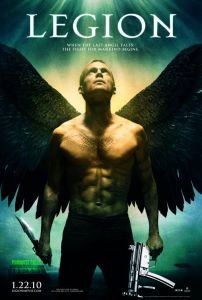 Just to be upfront, I am a big fan of action movies making use of Christian mythology (sorry if the use of the word “mythology” offends some). You tell me a tale about angels, demons, in a contemporary setting no less, and I’m hooked. You give those two sides weapons and have them fight over the fate of mankind, and I’m already revving my engines. So please know that no matter what the artistic achievements of Legion may be, I was predisposed to enjoying a movie that features the angel Michael (Paul Bettany) on the poster with a sword in one hand and an automatic weapon in the other. The premise of Legion is that God has finally had it with mankind and is making good on his threat to “turn this thing around right now.” He’s sending a host of heavenly angels to … eliminate humanity. Michael rebelled, believing man was still capable of making good on its promise. So he fights alongside a handful of characters shacked up in Dennis Quaid’s greasy spoon diner in the middle of nowhere. The action isn’t really involving but the movies does have some cool moments, like when Michael goes mano-a-seraphim with Gabriel (a marble-mouthed Kevin Durand). Legion deals with an antagonist (God) that is so powerful that there have got to be arbitrary limits placed on that power. So the attacking angels don’t overwhelm the tiny diner with their superior numbers, nor does the Almighty just blink the troublemakers out of existence. The end doesn’t really give much in the way of clarity but I got what I wanted from a movie like Legion. Though, in retrospect, I really didn’t want sizzling acid popping from boils.
Nate’s Grade: C+
Share this:

X-Men Origins: Wolverine (2009)
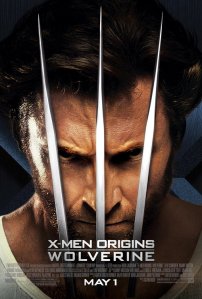 X-Men Origins: Wolverine has been slashed from all sides. First, the movie has not been able to shake bad buzz, from extra reshoots to rumors about conflicts between the studio and the director. There was even one rumor that the head of 20th Century Fox Studios ordered a wall repainted a happier color. Then in early April it got even worse. A DVD-quality print of Wolverine was leaked onto the Internet and spread like crazy, and once something finds itself inside the realm of cyberspace it cannot be put back. The reaction to the leaked copy was mixed, at best. The studio went into damage control mode, stating that the leaked copy was an unfinished work print, that they too were not thrilled with this version and paid millions for reshoots, and the final version that would be released in theaters had 20 minutes of new stuff and 10 minutes additionally edited out. But guess what? The wolverine’s out of the bag, it’s the same exact version minus some completed special effects shots. What amuses me about this whole situation is that the studio is on record trashing the movie, saying they were unhappy with this version, and yet this is the final release. After having seen Wolverine, at least I can say that those Fox execs know mediocrity when they see it.
We get to witness the storied history of Wolverine (Hugh Jackman), which goes all the way back to the pre-Civil War era. Born James Logan, and a mutant, the kid had the unusual ability to produce three jagged bone claws from his knuckles. Logan also had the ability to miraculous heal like his older brother, Victor “Sabertooth” Creed (Liev Schreiber). The two of them make use of their primal, animal instincts and near invulnerability by fighting in every major U.S. war, from Civil to Vietnam. Eventually that kind of thing gets noticed, and General Stryker (Danny Huston) recruits the brothers to be apart of a mutant mercenary group. The group also includes the likes of William “Deadpool” Wade (Ryan Reynolds), “The Blob” (Kevin Durand), and some other unimportant mutants (one of them played by a Black Eyed Pea, will.i.am). Wolverine walks away from the group when he decides that he isn’t cut out for a cutthroat life.
The man finds a quiet place to live along the Canadian Rockies. He’s found a hard-working job, lumberjack, and a good woman, Kayla (Lynn Collins), who loves him. All of this is ruined when Sabretooth comes back around, intent on eliminating the former mercenary members one by one. Stryker appeals to Wolverine to apply for the Weapon X program. He says he can give Logan the tools for his revenge. Wolverine then undergoes the famous procedure that bonds his skeleton with adamantium, an unbreakable metal, and his bone claws become extra sharp metal. Stryker has other plans, naturally, and Wolverine breaks out of the facility. Stryker tells his assassin, “Bring me back his head.” Sorry pal, but you’re the one that just spent half a billion dollars giving Wolverine an unbreakable spinal column.
 Is this origin tale worth telling? Short answer: no. The mysteries behind Wolverine’s back-story aren’t too involving and the answers make the character less interesting. I don’t really care why Wolverine got his metal skeleton or how he came to be an amnesiac, I just accept that the man has some mystique to him. I care even less that one of the answers to those mysteries is a murdered lover. The plot is incredibly thin; Wolverine meets one mutant who tells him to meet another mutant who tells him to meet another mutant, etc. Eventually the film heads for a mutant showdown that plays out like a lame video game, specifically the mid-90s Mortal Kombat (the Final Boss super villain resembles the blade-handed Baracka). What are Gambit (Taylor Kitsch) and Emma Frost doing in this? That?s not the end of the mutant cameos, either. I feel like the only thing we learn about Wolverine is that his super sense of smell cannot detect the difference between real blood and stage blood. The filmmakers think character development involves someone saying no to slaughtering innocents, and then other characters keep telling him, “You’re not an animal.” The movie meanders from one unimaginative special effects set piece to another, stopping at points to shove in various mutants that serve little purpose to the story other than diehard comic fans will be more forgivable.
Oh, but what to do when your main character is indestructible, your main villain is also indestructible, and your other lead villain cannot be killed because he?s due for an appearance in X-Men 2? Why you bring in a third, nigh indestructible being into the stakes, however, this being doesn’t already play into the established X-Men onscreen mythos, so this guy’s okay to kill off, that is, until he too gets a movie built around his character and then that movie has to backtrack to fill in on time before its capped ending. We already had a healing ability mutant with super claws vs. a healing ability mutant with super claws smackdown in X-Men 2, where Lady Deathstrike fought Wolverine. That fight was brutal and well staged. The fights in Wolverine’s big show are uninspired; how much stabbing can you watch between people who instantly heal? Also, apparently another side effect of the Weapon X program is that these metal claws are self-cleaning, because every single damn time Wolverine stabs someone there isn’t a droplet of blood to be found on his claws. It?s hard to get emotionally involved in characters that are fearless and have little at stake. Which, of course, is why Logan had to be given a cruddy romance where he gets to hold his dead lover?s body in his arms and bellow to the heavens for what feels like the 80th time. Seriously, twenty percent of all the dialogue in this movie is some combination of growling, spitting, and bellowing.
 Wolverine isn’t a terrible movie but it’s rather shoddy and thoroughly mediocre. I never thought I’d see this character do the beyond-cliché action movie motif of strutting in slow-mo while an explosion sizzles in the background. This is the kind of film that involves a super team standing shoulder-to-shoulder to walk down like they’re from The Right Stuff. This is the kind of movie that opens with a needless family squabble about Logan finding out the pointless identity of his real father. What was that about? (After killing his father, I remarked to myself, “I guess that he gets that whole healin’ thing from his mother’s side of the family.”) This is the kind of movie that hires Ryan Reynolds and then disarms the man of his greatest asset, his smart mouth. This is the kind of movie that theorizes the only thing to kill an adamantium-skeleton man is with an adamantium bullet, like a sort of werewolf. This is the kind of movie that sends a super assassin, with super bullet-bending powers, out to kill Wolverine but does not arm the super assassin with those special adamantium bullets. Why not shoot this guy in the eye? That is an open body cavity. This is the type of movie where the final super villain is controlled by, get this, key commands like “Engage.” This is the kind of movie where an assortment of characters refrain from killing super bad murderers out of the morally pretentious idea that they, too, would be no different from the super bad murderers. Excuse me, executing super bad murderers would be doing the world a favor here. This is the type of movie that fills the running time with pained dialogue like, “You wanted the animal, you got him,” and, “Nobody gets to kill you but me,” and the best line of them all: “I thought you were the Moon and I was your Wolverine. Turns out you’re the Trickster and I’m just the fool who got played.” Top that, screenwriters.
Whatever the budget was for this movie, well, apparently it wasn’t enough. The adamantium effects looked perfectly reasonable in the first X-Men film and that was nine years ago, so I cannot understand why the claws look astoundingly fake this go-round. They look like direct animation, like Wolverine is holding cartoon claws a la Who Framed Roger Rabbit? When did they become so thick too? These claws are like the size of the steak knives you get at restaurants.
Jackman deserves some of the blame here since he is listed as a producer and he hand selected director Gavin Hood (Tsotsi, Rendition) who does not have the interest or the eye for this kind of material. Hood lacks the finesse and vision to stage exciting action sequences, which explains why he falls back on tired genre tropes like the slow-mo strut in front of fireballs. I am dead certain that this stupid super assassin was pushed into the movie after film producers saw how much money the bullet-curving Wanted made the previous summer. The movie borrows heavily from recent Marvel Origin comics, or so I’m told, which is where the whole “Wolverine through the ages” storyline comes from. Personally, I don’t much care for the idea that Wolverine’s healing ability also deters aging until you hit that agreeable, desirable Hugh Jackman age range, but fine, whatever. The movie takes great effort to showcase Jackman’s flawless physique, and this dude is ripped to the point that you can see bulging veins. I just wished Jackman made more use of his acting muscles in this movie. He snarls and glares, and even has a softer moment or two with Collins, but rarely does Wolverine get to prove why he is such a beloved comics character.
 Thank goodness for Liev Schreiber (who actually also co-starred with Jackman in the forgettable romantic comedy, Kate & Leopold) because this man entertained me from start to finish, which is more than I can say about his movie. Schreiber has fun with his role and totally buys into the character’s animal instincts. He relishes the kill. The bizarre sibling rivalry between he and Wolverine is the best part of the movie, and the interplay between the two actors is when the movie has its few moments of life. Like Watchmen, the film finds its creative peak during the opening credits, as we watch Jackman and Schreiber claw and bite their way through American battlefields.
Here’s an easy solution to the Wolverine amnesia issue that doesn’t involve the use of admantium bullets. Kayla (Silverfox) has the power of hypnosis through touch, so why not in the emotional climax have her touch her dear lover Wolverine and wish, “Forget me. Forget all about me.” There, problem solved, and this way it works emotionally and organically with the story. It took me an hour after seeing X-Men Origins: Wolverine to come up with a better ending, so just imagine what more time will allow. Jackman and company are lost thanks to a mediocre script that sacrifices character for action beats, and even then the action is fairly mundane. There are a handful of cool moments, like Wolverine propelling himself onto a helicopter from an exploding car, but after four movies nothing has come close to producing the adrenaline rush that was the X-Men 2 sequence where Logan unleashes his berserker rage on the commandos in the mansion. By the end of his first solo outing, Wolverine is left without any memory. I won’t say we should all be so lucky but the X-Men filmmakers would be better off paying little attention to this origin tale, unless they want to bring Schreiber back, which they should do at all costs.
Nate’s Grade: C
Share this:

3:10 to Yuma (2007)
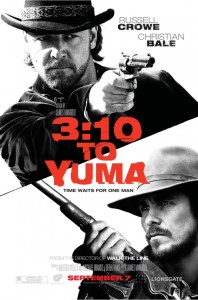 The Western used to dominate the pop culture landscape. In the 1950s, you had John Ford and Gary Cooper in a different dustup practically every week at the cinema, and the TV lineup was wall-to-wall cowboys, Indians, horses, and damsel retrieval. The Western has become rather inactive since its cultural heyday and now resides on the outskirts of movie land, idly chatting with Screwball Comedy and Busby Berkley Musicals about how good they had it back then (yes, I have just personified genres). With that said, director James Mangold (Walk the Line) has remade the 1957 John Ford film 3:10 to Yuma for a modern movie-going audience. The film has to work extra hard just to overcome the prejudices of a dormant genre, but fortunately 3:10 to Yuma is a rousing drama that could have knocked ’em dead way back when.
Dan (Christian Bale) is a wounded Civil War veteran trying to eek out a living in Arizona. He cannot grow any crops because of drought conditions, is behind on his payments, and his teen son has no respect for dear old one-footed dad. To keep his family financially afloat, Dan agrees to help transport notorious outlaw Ben Wade (Russell Crowe) to his date with justice.. It’s three days to ride across Arizona and get Wade onto the 3:10 train to Yuma prison, and along the way the posse is beset by unexpected setbacks and Wade’s gang hot on their heels to save their imprisoned leader.
 This is no deconstructionist Western or a modern revisionist Western, no this is an old-fashioned Western and Mangold embraces the genre staples instead of steering away from them (runaway stagecoaches, high-noon showdowns, ineffective lawmen, saloon girls). There’s a reverence for the genre and Mangold makes sure the audience soaks up the dusty details of frontier life with lots of revealing close-ups. You can practically taste the earth these men are caked in. The script is filled with plenty of surprises along the way as Ben keeps regaining the upper hand even as he’s outnumbered and in shackles. The story benefits greatly from really opening up and exploring in depth whom Dan and Ben are and what makes them this way. 3:10 to Yuma does not paint in broad strokes and dwells in a lot of grey, which presents opportunities for the actors to work their magic.
At the heart of the film is the moral battle between Ben and Dan, and both actors rise to the occasion. Crowe’s name is all but a guarantee for a quality performance and he shows an array of seemingly contradictory elements to Ben Wade. He has roguish charm and swagger, but then in an instant you can feel the intense glare of hatred in his eyes, and the scary calm in his voice, and you realize that this man is a caged tiger always stalking his prey. He can erupt in sudden and vicious violence and then fall back into a conscienceless laugh. He has moments that seem like empathy and kindness, but then you realize every seemingly kind gesture has a hidden meaning that links back to Ben’s own benefit. Crowe is magnificent and plays around with audience expectations to keep us jumping back and forth between liking the sly brute and fearing him.
Bale is equally as good as a martyr for his moral principles. He sticks to his ethical convictions no matter the hardships and temptations to take an easy way out. The painful lengths Dan goes to protect his family produce several touching exchanges and add substantial meat to a character that very easily could have been drawn as a simplistic do-gooder. Bale sells every moment with commendable authenticity.
 The rest of the supporting cast -Gretchen Mol, Alan Tudyk, a near unrecognizable Peter Fonda- add strong contributions to the movie, but none more memorable than Ben Foster. As Ben Wade’s sadistic right hand man, Foster displays a sick brand of hero worship and homicidal insanity. He’s an unpredictable and menacing figure and Foster magnifies these qualities to frightening realization. These excellent actors make 3:10 to Yuma more than throwback; it reminds you how great Westerns can be with the right actors and devotion to characters.
The only marks against 3:10 to Yuma occur during its climax. Things escalate immensely into a wild shoot-out that racks up a massive body count. While exciting, the sequence feels at odds with the intimate moral struggle between these two men. I’m also unsure about whatever prompted some eleventh hour motivational change for one key character. The ending is unnecessarily dark and will surely leave most audiences with a bad taste in their mouth to exit upon. Maybe it’s just the recent bout of films that I’ve been watching, but I’m starting to get tired of movies that are convinced that a pointlessly tragic ending somehow makes their story more meaningful (The Painted Veil, my wife is still upset with you, novel adaptation or not). A happy ending has long been perceived as a trite Hollywood cliché, but now I wonder of the pendulum has swung too far the other way so that conventional thinking says an audience has to be left wanting more or dissatisfied for a movie to attain higher artistic credibility. This is, of course, utter nonsense. A movie ending need only be appropriate for the scope of its story, but then again it doesn’t have to strive for forced wisdom delivered by unnecessary tragedy.
3:10 to Yuma is a hard-charging, stoic, classic American Western of the old guard with a bit more blood and profanity mixed in for a modern public. Despite a small handful of missteps toward the end, this is an engaging and often gripping morality tale catapulted by two strong performances from foreign-born actors showing Americans how the West was done right. Let 3:10 to Yuma stand as proof that any genre, no matter how outdated, can succeed as long as the filmmakers place care with character and treat the audience with a modicum of respect.
Nate’s Grade: B+
Share this:

Smokin’ Aces (2007)
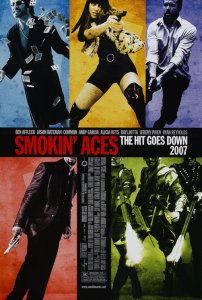 Writer/director Joe Carnahan (Narc) wants to impress an audience so bad with his muscular and macho gangster flick, but his Smokin’ Aces is vapid, nihilistic, and opines not to simply be a Tarantino rip-off, but a rip-off of a Tarantino rip-off. The premise seems ripe enough as we follow a rogue’s gallery of hitmen and killers trying to be the first to knock off a mob snitch/Vegas magician (Jeremy Piven) for a million dollar bounty. The colorful characters are introduced and some are quickly and unexpectedly taken out, but Carnahan never fully knows what to do with his bushel of baddies after he establishes their character quirks. The killers don’t really interact that much with one another and some of them hardly have any screen time at all; perhaps less would have been more in this jumbled stew. Carnahan throws out a few nifty visual tricks but it’s all superfluous and empty. Smokin’ Aces moves quickly, doesn’t make much sense in the beginning and end, and little to any of the characters have satisfying conclusions. So much of the writing feels like lame macho posturing without anything new or interesting to add to an overstuffed shoot-em-up. There are cops, robbers, plenty of gunfire, lesbians, and all sorts of convoluted twists, but it never holds together. Carnahan throws a lot of different elements together but they never extend beyond the elemental stage, so every storyline and character feels like an introduction that?s never capped off. The man has no idea what to do with what he’s started, and a karate kid on Ritalin is all the proof I need. Guy Ritchie did this territory far better service with the marvelously entertaining 2001 film Snatch. Rent that instead and save yourself the headache.
Nate’s Grade: D+


 nathanzoebl
You must be logged in to post a comment.