Blog Archives
Juror #2 (2024)
 Clint Eastwood’s possible last movie as a director (the man is 94 years old, people) was buried at the theater through a limited release by its studio, which is a shame because Juror #2 is a fairly solid adult drama with some grueling tension built right in. I was wondering how screenwriter Jonathan Abrams was going to make this premise work, where a recovering alcoholic and expectant father, Justin Kemp (Nicholas Hoult), is impaneled on a jury for a murder case and discovers, over the presentation of evidence, that he might actually be the culprit. That same night, at the same location of where the supposed murder took place, is where Justin thought he hit a deer. What follows is a soul-searching account of one man being torn apart as far as what he should do. Does he let this other man take the blame so Justin can live out his life with his new baby and wife? Or does he come forward and admit his own firsthand knowledge of the events would present a very reasonable doubt for this trial? The movie becomes an extended balancing act of how long Justin can keep this secret and what angles he will work, trying to push the jury one direction or another through persuasive appeals. It’s familiar dramatic territory to anyone who grew up on 12 Angry Men, though with an extra high-concept twist. It’s a fairly straightforward drama that allows the story to take center stage and puts the focus on one man’s personal crisis. The acting is strong all around with Hoult (Nosferatu) being the predicted standout, showing the heavy weight of his guilt wirh every pained expeession. I think the ending does a disservice to the kind of movie that came before it, namely that it should be more definitive in its conclusion and provide a fitting resolution. This isn’t exactly the kind of movie that benefits from prolonged ambiguity, so the abrupt ending feels like a miscalculation and hampers a bit of the ending’s impact. However, Juror #2 is a good squirm session.
Nate’s Grade: B
Share this:

Melancholia (2011)
 Melancholia opens with a bang. Literally. Lars von Trier, film’s most polarizing and famous sadist, begins his movie with the ultimate spoiler alert, destroying the entire planet. Lars von Trier’s grandiose exploration of annihilation, both personal and species-level, can be maddening in how tedious the whole affair can become for long stretches. What’s even more maddening is that the movie flirts with being magnificent for other, regrettably smaller, stretches.
We open with the wedding of Justine (Kirsten Dunst) and Michael (True Blood’s Alexander Skarsgard). Hours late, the couple arrives at their reception at the palatial estate that belongs to her sister, Claire (Charlotte Gainsbourg), and her husband, amateur astronomer John (Kiefer Sutherland). Over the course of one very late night, Justine will quit her job, sleep with a random wedding guest, alienate her family, and end her brief marriage, putting Kim Kardashian to shame. Several months later, Justine has been released from a hospital for clinical depression and is now living with Claire and John’s along with their young son, Leo. A tiny star in the sky has gotten larger over the ensuing months, and scientists have determined that this new planet is heading straight for Earth. Named Melancholia, this rogue space rock is predicted to pass by, but the calculations are getting closer and closer. Eventually, the truth is evident and Melancholia is on a cataclysmic collision course with Earth.
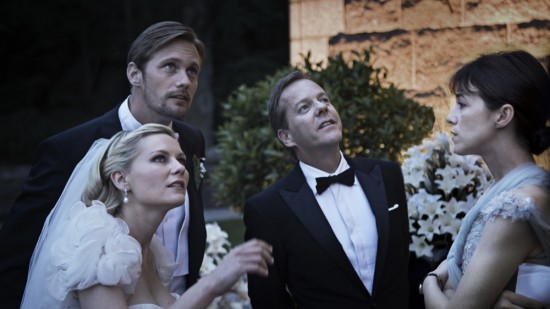 From a plot standpoint, the movie is completely lopsided. Melancholia opens with beautiful images that…. just…. keep…. going…. on…. and… on… set to thunderous Wagnerian overtures. It lets us know right away that von Trier is performing at an operatic level of melodrama. After this spoiler sequence, we jump back to the last months of Earth. The first hour of this movie is a boring wedding sequence that just seems to stretch for an eternity. You may wish that the rogue planet would show up and smash everyone to bits so we could get on with it. Justine and her groom are already several hours late because of the precarious route their limo had to take, so the fact that Justine takes frequent breaks and needs to be constantly retrieved can be draining. The hour of wedding blahs would be better time spent if I felt von Trier was laying the groundwork for characters. Little of the first hour seems to matter at all or has any lingering ramifications, which is bizarre considering the amount of personal nosedives Justine takes. It’s plain to see that Justine is unhappy and going through the motions, pretending to be happy for everyone’s benefit and maybe, just maybe, she can trick herself. What’s not plain to see is why we have to spend so much time on a room full of characters that will never be seen again. We learn so little about the characters, their relationships, and why any of this matters. The first half of this movie could have easily been condensed to 20 minutes. If the point was to test the audience’s patience, much like Justine does to her family, then bravo.
It’s that second hour where Melancholia flirts with the profound. The second half only concerns four principal characters. Unlike the first monotonous hour, there are events that actually matter and have substance to them, namely the encroaching obliteration of Earth. Having seen the pre-credit preview, we already know every life on the planet is doomed, but that doesn’t stop us from feeling the same pangs of anxiety as Claire discovers what we already know. Depression may be an elusive personal experience that not everybody can empathize with, especially when the depressed individual becomes overly taxing, but coming to terms with the end, not just your own, but of all of human history? That’s something every person can identify with. This confrontation of the inevitable can lead to some thoughtful soul-searching. This is an extinction event. There is no escape, unless you’re an astronaut (it’s now or never, lunar colonists).
Like most of us would be, Claire is terrified to die, to have all her loved ones die, but Justine is eerily placid. She feels that the Earth is evil and that “nobody will miss it.” To further drive von Trier’s bleak pessimism, Justine says there is no other life elsewhere in the universe. This is it, and it’ll all be over soon. “I just know,” she adds, unhelpfully. We watch Claire go through different stages of grief, fighting for some sense of closure, but von Trier will not allow any comforts. Gainsbourg was put through Trier’s typical emotional wringer in 2009’s unpleasant Antichrist, and here she’s really the entry point for the audience, and as such we sympathize the most with her since her reactions are so believable. It’s hard to feel like there’s any bond between these two sisters, which limits the impact of the end. Still, the end is fittingly devastating and makes me wish I had seen the beautiful destruction on the big screen, bathing in its apocalyptic splendor.
 The dread of that final hour is extremely palpable, with the presence of Melancholia in the sky played almost like an art-house existential horror movie. At first we’re told by John that the scientists predict it will fly-by at roughly 60,000 miles per hour, but slowly the realization becomes clear that Melancholia is coming back with a vengeance. There’s a terrific plot point where John introduces a way to judge the planet’s movement. A wire circle is held out at arm’s reach, designed to trace around the perimeter of Melancholia. Then five minutes later the wire ring goes back up and, voila, the rogue planet has shrunken in size or gained. It’s a smart device that helps establish the momentum of doom, and it’s practical enough for the characters to perform. As Melancholia comes closer to collision, it gives off an unnerving blue glow. I started joking with my friend Alan that the movie was going to descend into a slasher-style stalker movie, with Melancholia chasing to get you like a spurned and dangerous lover (“We’ve traced the phone call. The planet is calling from inside the house!”). These attempts at levity are inevitable when the subject matter is so depressing and the nature of von Trier’s film lends itself to operatic pomposity.
von Trier’s film is quite a departure from the most disaster cinema, but sometimes its Big Statements can seem inartful and obvious. The very idea that the planet of doom in this dance of death is called Melancholia… come on. Maybe this whole thing would have been avoided had those egghead astronomers had given this rogue planet a happier name (My suggestion: “Doug.”). The metaphorical connection to Justine’s own melancholy is just inane. The planet is but a tiny speck in the sky at her wedding, and Justine is desperately trying to hold it together, and then in the second half the planet is much bigger and, surprise, so is Justine’s melancholy.
I found it hard to care about Justine and her personal demons. Depression and mental illness can be exasperating conditions, but that doesn’t mean I sympathized with her any more than the other seven billion souls destined to be incinerated. Her rejection of niceties can seem cold when all her sister wants to do is find some level of reassurance before the end is near. Dunst (Marie Antoinette) won an acting award at the Cannes Film Festival for her performance, and it’s hard for me to see why. It’s a darker, somber, more serious role for the actress, but looking tired, sullen, and impassive doesn’t come across as a fully rendered performance, more of a bad mood swing. My feelings are likely tempered by the fact that I found her character to be unbearable and agonizingly opaque
Melancholia is half of a great movie, but only half. The movie can feel a little too isolated, a little too leisurely paced, a little too pretentious. The beginning wedding sequence is like a minor endurance test, but rewards await those who carry on to the bitter end. This uneven art-house disaster movie has stunning imagery, numbing dread, and an apocalyptic grandeur, the likes of which could only come from the perverse mind of Lars von Trier. It’s beautiful and lyrical in its best moments, a cold, surrealist nightmare. The boldness of von Trier’s vision is inescapable, but I only wished he had fashioned a better story and sharper characters for his experiment in nihilism. If we’re going to spend the last few hours on Earth, I’d rather it be with people I gave a damn about.
Nate’s Grade: B-
Share this:

Taking Lives (2004)
 While viewing Taking Lives my mind wandered quite a bit. There was one point where I actually gave credence to a theory that Taking Lives was so intensely bland that is was parodying the glut of serial killer films. Then I just concluded that the movie was dumb. Angelina Jolie plays one of those hard-as-nails criminal investigators who just happen to be drop dead gorgeous. She’s on the hunt for a Canadian serial killer who murders then assumes the lives of his victims. He’s been doing this for over 20 years. My main question is … how? Taking someones identity has so many variables to it. What if any family member found you? Theyd know for sure you wouldn’t be their loved one. Oh yes, and the killer masks the identity of his victims by cutting off their hands and smashing their faces in. Would that even work? All you have to do is draw some blood and do a DNA test. Taking Lives is so by-the-book that it even dares to have a scene where the serial killer calls Jolie and claims that he and her are exactly alike. The ending veers so far off track into the land of implausibility that its almost entertaining. Almost. The only reason to even poke your head in a theater to see this is for a gratuitous nude scene involving Jolie, and even that you’ve seen before in better movies.
Nate’s Grade: C-
Share this:

Phone Booth (2003)
 Colin Farrel is fast becoming the Hollywood It-boy, if he hasn’t achieved the title already. It’s hard not to agree. I’ve seen several interviews and this Irish bad boy is just so incredibly damn charming that you want to invite him to your house. He’s got that cocky grin and those eyebrows that look like they’ve been knitted. The man oozes charisma and stardom. So enough of that, let’s talk a little about the film. About 90% of the film takes place within the four walls of a phone booth, but it’s not as dull as one would expect. One reason is because of Farrel, even if his New Yawk accent can be a little grating on the ears at times. Another reason is because a sniper, with the honeyed voice of one Keifer Sutherland, has trained a rifle onto Farrel, and if he moves hes dead. Though the motivations for the sniper are quite murky, and some late revelations feel too telegraphed and forced. Director Joel Schumacher (he who destroyed the Batman franchise) delivers a mostly solid and taut thriller. Schumacher tries shoehorning in some visual flourishes with minute split-screens and some stupid statistics about phones. But, and I dont think I’m alone here, I’d have no problem spending about 80 minutes with Farrel.
Nate’s Grade: B


 nathanzoebl
You must be logged in to post a comment.