Blog Archives
Van Helsing (2004) [Review Re-View]
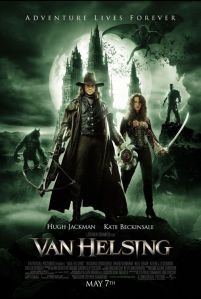
Originally released May 7, 2004:
Crossover movies have a distasteful history in the world of cinema. Some movie exec gets the notion, “Hey, why can’t two great tastes taste great together?” But what we’re left with is usually uninspired (The Flintstones Meet the Jetsons notwithstanding). Crossovers for horror movies are the worst of the lot. For every Freddy vs. Jason there’s a dud, like 1966’s Jesse James meets Frankenstein’s Daughter. That year went down in the annals of cinematic history, however, as it also gave us Billy the Kid versus Dracula, marking two entries in the expanding genre of cowboys battling famous monsters (as far as I know, this genre still stands at two movies). So what can one expect from Van Helsing, a big-budget creature feature that includes Dracula, Frankenstein, and the Wolfman?
Van Helsing (Hugh Jackman and a really big hat) is a secret soldier for a covert order of the Vatican. This covert order dispatches monsters and creepy-crawlies the world over. He’s been ordered to assist Anna Valerious (Kate Beckinsale), the last in a Romanian family line that has sought to kill the infamous Dracula (Richard Roxburgh). It seems that their family line is dwindling. And Anna’s brother being turned into a werewolf doesn’t help the situation. If her family line dies before Dracula then they cannot enter heaven. Van Helsing comes to town to help out the locals who are terrorized by Dracula’s flying brides. Van Helsing effectively kills one of the vamp ladies and is celebrated as a hero by the village. As he gets closer to Anna he also learns more about his own mysterious past and his connection to a certain figure with big teeth.
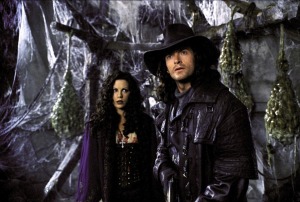
The Big D has a dastardly plan. He wants to find Frankenstein’s monster (Shuler Hensley) to channel enough power through him to awaken zillions of goo-sacks harboring the vamp’s undead brood. Of course, Frankenstein’s monster isn’t too keen on this. Together, he and Van Helsing, with the help of Anna as well as a comic relief monk, battle to stop Dracula from unleashing his children of the night.
Van Helsing is stupid, stupid, stupid. Director Stephen Sommers exists in his own indulgent world where bigger is better and some CGI spackle will fix any plot holes. He makes check-your-brain-at-the-door popcorn movies, but a “popcorn movie” is no excuse to forgive a rambling, incoherent, loud, stupid mess. I liked the first Mummy flick and even found some good with the second, but Van Helsing is Sommers at his rock-bottom worst, gorging on a trough of special effects and vomiting the results onto the big screen. Sommers’ idea of character development is knocking people through walls like they were in a Looney Tunes cartoon.
Van Helsing raises some interesting questions, like why do Dracula’s brides morph into flying demons that are conveniently genitalia-free? Why does a werewolf rolling over the top of a carriage somehow cause it to catch on fire? Why does Dracula keep his magic lycanthropy cure in the open? It doesn’t matter. Van Helsing is so straight-laced about its absurdities that questioning them will just get tiresome.
Not that you would expect much, but the acting in Van Helsing is bad. Beckinsale’s accent couldn’t be less convincing if her role were played by Charo. The trio of Dracula’s brides are played by swimsuit models and let me just say their performance is on par with what you would expect from swimsuit models. Roxburgh is quite possibly the worst vampire in the modern history of vampires, and that includes Blacula, Count Chocula and Tom Cruise. He couldn’t look any less sinister if he was in a diaper and bonnet. What’s up with those strands of hair that dangle in his face? Why do the Van Helsing creators want their Prince of Evil and son of Satan to look like he was the keyboardist for some 80s pop synth band?

This overly long film feels like a seven-year-old’s book report that he hasn’t read: it’s like a child is making this up as they go. “And then … a werewolf pops up … and then Dracula’s flying brides … and then they all need Frankenstein’s monster ….” Seriously, were the penning this script on the fly? It’s a $150 million improv film. The reels of the film could be switched around and no one would be able to tell the difference. Van Helsing is one long, exasperated action sequence that drags its heels instead of wowing. It beats the audience into submission with its stupidity and redundancy.
The entertainment level of Van Helsing is exceedingly weak. It runs an eternity, which wouldn’t be a problem if one were intrigued by the story, the characters, or the action sequences. The action could have been suitable but Sommers has gotten less reliant on the physical and more superfluous with his CGI. Watching a CGI monstrosity smash into a CGI monstrosity before a CGI background where no semblance of reality is present grows tiresome after 130 minutes. The effects are passable, but they overload the viewer and numb whatever slight interest may have existed for the classic monsters.
What should have been a clever homage turns instead into a hollow marketing ploy that’s so frenetic and tireless with its manic pacing and bad special effects. Even the many attempts at humor are flat. It has to be some kind of apocalyptic sign that Hellboy and now Van Helsing have been unleashed unto the innocents of this world. Some will find Van Helsing decent popcorn entertainment, but most will grow weary of its sloppy design and wafer-thin substance. For me, this is one to avoid, period. There isn’t an ounce of fun to be had while sitting through the painful pair of hours that is Van Helsing. This is one monster mash that’s a real monster mess.
Nate’s Grade: D
——————————————————
WRITER REFLECTIONS 20 YEARS LATER
In 2004, Van Helsing was being primed to be not just a blockbuster but the forerunner for a new interconnected franchise revitalizing the classic Universal horror icons. Director Stephen Sommers was hot off the success of the first two Mummy movies, Hugh Jackman had become a household name playing everyone’s favorite growling superhero, and Kate Beckinsale had proven her own box-office mettle fighting vampires and werewolves in the Underworld series. The studio was expecting so much that it planned a sequel, a TV series on NBC called Transylvania, an animated prequel, a clothing line, a video game, maybe even theme park additions, and to maintain the Eastern European sets so that they could be utilized for the eventual show and sequels. Obviously, this never came to pass, and Sommers’ last big Hollywood action movie was the 2009 G.I. Joe movie, and he hasn’t directed a movie since 2013’s Odd Thomas adaptation. He chose not to direct the third Mummy movie in 2008, but it seems like this man’s career has never been the same since Van Helsing cratered in the summer of 2004. It began as the studio asking Sommers for even more monster movies, Sommers pitching them all together as an Avengers-style super movie, the studio getting carried away with larger plans of franchise dominance, and then when it didn’t materialize, a promising popcorn filmmaker in the highest blockbuster sphere just vanished in a poof of overzealous CGI.

Me wife’s crush circa 2004
In 2004, I did not like Van Helsing. That might be too charitable a description. I wrote in my original review, “Van Helsing is stupid, stupid, stupid. [Sommers] exists in his own indulgent world where bigger is better and some CGI spackle will fix any plot holes. He makes check-your-brain-at-the-door popcorn movies, but a ‘popcorn movie’ is no excuse to forgive a rambling, incoherent, loud, stupid mess.” It was one of my worst movies of 2004, and twenty years later, I’ve mostly come around on the movie. I won’t tell you that it’s a great movie, or even achieves that same magic alchemy of action-adventure swash buckle that The Mummy brought back to major studio filmmaking in 1999, but Van Helsing is enjoyably ridiculous schlock nonsense. It was also one of my wife’s favorite movies growing up, and she reminded me that her teenage self had a big crush on Richard Roxburgh’s version of Dracula, not Hugh.
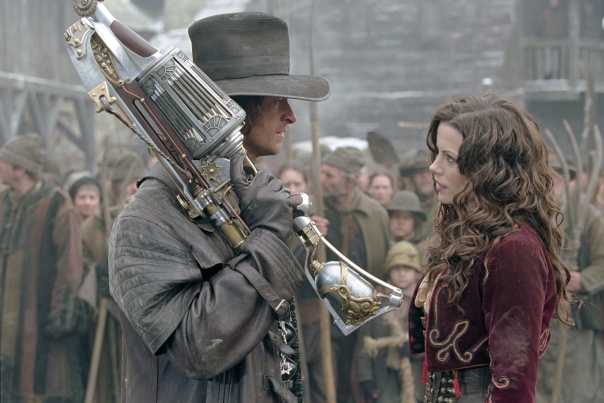
I now view Van Helsing less as a horror monster action vehicle and more of a spy vehicle in a strange world. The titular Van Helsing is our secret agent complete with spy gadgets with his comedic relief sidekick, and he’s got his important missions and the sexy Bond Girl, and the villains and betrayals and added back-story that doesn’t seem even necessary. It’s Sommers taking the structure of a spy thriller and supplanting it onto a Victorian-era monster steampunk universe of demons and centuries-old church conspiracies. Jackman is enjoyably suave as the Vatican’s favorite killing machine learning his own life lessons about the nature of legacy. I even enjoyed the villain’s motivation for Dracula; he’s trying to learn the secrets of Dr. Frankenstein’s reanimation to ensure that his vampy babies survive. Here is a Dracula who is bereft because he cannot father living children. I suppose there could be further discussion over the different forms of life as converting humans into vampires is itself a rebirth. Perhaps the distinction is like the difference between having biological children and adopted children. Maybe dear old Drac just wants to have a bundle of joy he can call his own. That’s more interesting than versions that make him out to be some stalker ex-boyfriend. Likewise, the role of Anna (Beckinsale) is given more pathos than simply being the Strong Romani Badass. While her wardrobe consists of corsets and teased hair to appeal to a young male demo, her character’s mission is powerful and personal. Anna needs to kill Dracula not to save herself but to ensure the rest of her deceased family members can enter heaven. Talk about cumulative family guilt. That’s heavy. When her face appears in the clouds at the end like Mufasa, it’s a confirmation of generational rest. That’s an arc that’s more fulfilling than being any love interest that would be discarded later.
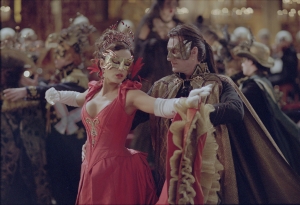
As soon as it got rolling, I said to my wife that this was going to go one of two ways: Van Helsing will learn that his organization is not as righteous as he believed them to be, manipulating him to eliminate threats to the organization’s standing rather than threats to humanity; or Dracula and Van Helsing have a personal connection that hasn’t been fully examined. Dear reader, it went in both directions because Sommers is slapping so many plot elements to make this movie feel full to bursting like a bloated tick. There’s ideas stacked upon ideas here, references and unexplored plot points for an untapped universe (vampires started werewolves?). An hour in, all of Dracula’s bats, a.k.a. his children have been slain, and you may erroneously think the movie is over. Well, there’s a whole other castle to explore with even more baby bats to kill. The last hour operates on pure video game mechanics of, go here, grab this item, battle this mini-boss. There’s definitely a level of redundancy and a “more is more” kitchen sink excess philosophy, but the bombast is part of his general appeal. There’s a touch of Sam Raimi here, a touch of Michael Bay; schlock with sheen. Maybe it was my nostalgia goggles, or maybe I was just attuning to Sommers’ wavelength, but the movie worked for me much better in 2024 as I was now charmed by its goofball sensibilities and less irritated by its over-plotted script.
You feel the admirable passion that Sommers has for this universe, adopting stylish pastiches to celebrate the older movies and lore, but definitely bringing his more modern sensibilities to the forefront. There’s a certain chaotic energy that animates Sommers big movies, bringing these classic characters together to run amok and crash into each other. That little kid’s imagination given the whole sandbox to play in can be enviable and lively, and it can also lead into unexpected directions that unexpectedly go nowhere. The incorporation of Frankenstein’s monster (Shuler Hensely) is more a plot device than a thoughtful character to bring to the team. He’s the magical MacGuffin both sides are fighting to claim for their own. Van Helsing’s major crime is trying too much and being too straight-laced about its silly. It’s not winking to the audience, it’s not self-commenting on its absurdities, it’s just living them lavishly. In 2004, I couldn’t appreciate that and this movie, and now I can find a place in my heart for such fun.
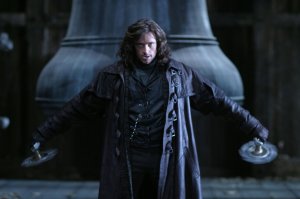
My original review in 2004 is scathing, with ready-to-blurb snark trying to communicate the intensity of my distaste. The line that Sommers is “gorging on a trough of special effects and vomiting the results onto the big screen” sticks with me. I’m surprised I restrained myself from making a “Van Helsing sucks” comment. Several of my criticisms about the acting, the confusing rules, the convoluted storytelling are entirely valid, but they just don’t bother me enough twenty years later. I can relax and enjoy the movie because it is a mess. That doesn’t mean every flawed movie deserves kindly dismissing its faults if it doesn’t aspire to anything other than mass entertainment. Big movies for big audiences can still be big bad. I think Van Helsing’s appeal is how sloppy it is and how excessive every element plays. In another universe, a… “dark universe” to borrow a phrase that came to me for no reason, this could have kicked off the interconnected Universal monster movies (any reference to Egyptian mummies is absent, implying perhaps that Sommers earlier movies exist in a shared world). It was not to be, and Sommers’ career has never been the same since, which is a real shame. The blockbuster space needs a filmmaker like Sommers, a man nimble enough to juggle tones and childlike glee with darker humor. Come back, Stephen Sommers, and maybe try your hand at the Creature From the Black Lagoon while you’re at it.
Nate’s Grade: C+
Share this:

Fool’s Paradise (2023)
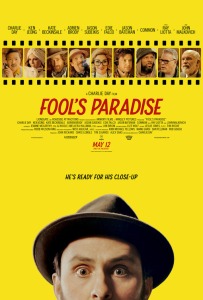 Charlie Day is a very funny guy who works with lots of funny people, so why isn’t his directorial debut, Fool’s Paradise, well, funnier? It’s about a mute simpleton (Day) with the intelligence of a five-year-old, or a Labrador retriever we’re told, who is mistaken for an acting savant. The intended joke is that this industry projects what it wants to see and is full of shallow, insecure, greedy idiots chasing anything that might be popular or career advancing. That’s a fine start but there is a shocking lack of jokes and funny scenarios to be had here, so the 93 minutes just creaks on by in protracted and pained awkward silence. It was a mistake to have Day, a comedian with such a distinct voice and often prone to hilarious outbursts, play a character who doesn’t talk at all. It’s not just that, he kind of shrugs or raises his eyebrows in response, and every time the camera cuts to him for a reaction shot, I was left wondering if this is all the movie had. This passive character, mistakenly named “Latte Pronto” by a director who finds him as a replacement for a prima donna Method actor (also Day), is just a miss. He’s not interesting, and what her reveals about the people around him is even less interesting and just as obvious and tiresome. It’s a movie about non-stop mugging to the camera and hoping to evoke some overly generous pity laughs. It’s attitude over wit. The jaunty score tries hard to make you feel the missing levity from scene to scene. It’s not convincing. The movie is chock full of stars, many of them friends and colleagues that Day has accumulated over a decade in comedy, but nobody has anything funny to do. It’s just all so confounding. Clearly the inspiration owes a debt to 1979’s Being There, a gentle political and social satire where everyone projects what they want to see on one middle-aged gardener raised on TV (I recently watched that movie and felt it was rather dated and quaint). At least that movie had a larger point. There’s just so little to hold onto with Fool’s Paradise, with a boring nothing of a character that never seems to uncover or reveal anything on a tour through Day’s many famous friends. Even the physical comedy is an afterthought. This is no charming Little Tramp. Do yourself a favor and watch any 90 minutes of 2022’s Babylon and you’ll see a funnier and more excoriating satire on Hollywood than the collective shrug that is Fool’s Paradise.
Nate’s Grade: C-
Share this:

Pearl Harbor (2001) [Review Re-View]
 Originally released May 25, 2001:
It turns out we went to war in 1941 not because of Japanese aggression, Hitler’s dominance in Europe, or the protection of freedom and democracy. Sorry kids. The real reason we went to war was to complicate and then clear up Kate Beckinsale’s love life. At least that’s what director Michael Bay and screenwriter Randall Wallace would tell you with their indulgent epic Pearl Harbor.
We open in Tennessee in the 20s with two boys who dream of being pilots. Rafe (Ben Affleck) and Danny (Josh Hartnett) grow into strapping young lads who flash their hot dog flyin’ skills at basic training, which brings them chagrin from superiors but admiration from peers. Rafe falls in love with a young nurse named Evelyn (Kate Beckinsale), who goes against ARMY rule and passes Rafe in his eye exam portion when he has a slight case of dyslexia. But he’s just so cuuuute. The romance builds but Rafe feels like he’s grounded when all he wants to do is fly, and volunteers to fight in the RAF over in Europe. He promises he’ll be back to see his lovely Evelyn. Of course he gets into an accident and everyone assumes that poor dyslexic Rafe is fertilizing a lawn somewhere with his remains. Hence Danny slowly but surely develops something for Evelyn in their periods of mourning, and the two consummate their puppy love with a tango in parachute sheets.
All seems well until Rafe returns back from the dead throwing a wrench into Evelyn’s second date parachute plans. Thus the Hollywood favorite of the love triangle endures until the end when the two fly boys enlist in the Doolittle attack against Japan, months after the ferocious attack on Pearl Harbor. The real purpose of the Doolittle attack was not militarily but merely for morale. The real purpose it serves in the movie is to shave off an end on our love triangle.
 Pearl Harbor allows us to follow a group of youthful and innocent starry-eyed kids from training to combat. Each seems pretty much exactly the same to each other. It’s near impossible to distinguish which character is which. It’s like the screenwriter didn’t even have the gall to resort to cliche supporting character roles, and he just made one character and duplicated it. The only one who was noticeable for me was the character of Red (Ewen Bremner, julien donkey boy himself), but that was simply because the man had a speech impediment. We also have our handful of young nurses alongside Beckinsale, and I had an easier time distinguishing between them; everyone had different hair colors.
If you look in the pic, or the credits, you’ll see that two of the nurses would turn out to be Jennifer Garner (Alias) and Sara Rue (Less than Perfect), both stars of ABC shows, and ABC is owned by, yep, Disney. Coincidence? Probably. When they ran this on TV they actually advertised Jennifer Garner above Kate Beckinsale. That reminded me of when Seven ran on TV shortly after Kevin Spacey had won his well-deserved 1999 Best Actor Oscar for American Beauty, and they gave him second-billing in the advertisement over Morgan Freeman, the movie’s true main character.
Affleck has a hayseed Southern twang, but seems to mysteriously disappear for long stretches. Hartnett seems to talk with a deep creak, like a door desperately trying to be pushed open. Beckinsale manages to do okay with her material, but more magnificently manages to never smear a drop of that lipstick of hers during the entire war. We could learn a lot from her smear-defying efforts. Gooding Jr. is pretty much given nothing to work with. I’m just eternally grateful he didn’t go into a usual Cuba frenzy when he shot down a Zero.
Michael Bay has brought us the ADD screenings that are the past, loud hits of The Rock and Armageddon. Teamed up with his overactive man-child producer Jerry Bruckheimer once more, Pearl Harbor is less Bay restrained to work on narrative film as it is Bay free-wheeling. His camera is loose and zig-zagging once more to a thousand edits and explosions. Bay is a child at heart that just loves to see things explode. When he should show patience and restraint he decides to just go for the gusto and make everything as pretty or explosive as possible. This is not a mature filmmaker.
Despite the sledge hammer of bad reviews, Pearl Harbor is not as bad as it has been made out to be. The love story is inept and the acting is sleep-inducing, unless when it’s just funny. It doesn’t start off too badly, but twenty minutes in the movie begins sinking. The centerpiece of the film is the actual Pearl Harbor bombing that clocks in after ninety minutes of the movie. The forty-minute attack sequence is something to behold. The pacing is good and the action is exciting with some fantastic special effects. The movie is bloated with a running time a small bit over three hours total. Maybe, if they left the first twenty minutes in, then gave us the forty minute attack sequence, followed by a subsequent five minute ending to clear up our love triangle’s loose ends… why we’d have an 80 minute blockbuster!
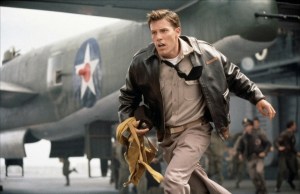 Pearl Harbor doesn’t demonize the Japanese, but it feels rather false with their open-minded attempts to show both sides as fair minded. It gets to the point where they keep pushing the Japanese further into less of a bad light that it feels incredibly manipulative and just insulting. It seems like the producers really didn’t want to offend any potential Pacific ticket buyers so the picture bends backwards to not be insulting. The only people who could be offended by Pearl Harbor are those who enjoy good stories. Oh yeah, and war veterans too.
The cast of Pearl Harbor almost reads like another Hollywood 40s war movie where all the big stars had small roles throughout, kind of like The Longest Day for the Pepsi generation. Alec Baldwin plays General Doolittle and is given the worst lines in the film to say. Tom Sizemore shows up as a sergeant ready to train the men entering Pearl Harbor. He has five minutes of screen time but does manage to kill people in that short window. Dan Akroyd is in this for some reason or other, likely because Blues Brothers 3000 has yet to be green lighted. John Voight is easily the most entertaining actor to watch in the entire film. He gives a very authentic portrayal of President Roosevelt. I still find trouble believing it was Voight under the makeup.
The blueprint for Pearl Harbor is so transparent. They took the Titanic formula of setting a fictional romance against a disaster, with the first half establishing characters and our love story, and then relegating the second half to dealing with the aftermath of the disaster. It worked in Titanic (yes, I liked the film for the most part), but it doesn’t work here. Pearl Harbor is a passable film, but the mediocre acting, inept romance, square writing, and slack pacing stop it from being anything more. Fans of war epics might find more to enjoy, especially if they don’t regularly have quibbles over things like “characters” and “plot.” To paraphrase that know-it-all Shakespeare: “Pearl Harbor is a tale told by an idiot. It is full of sound and fury, signifying nothing.”
Nate’s Grade: C
——————————————————
WRITER REFLECTIONS 20 YEARS LATER

Believe it or not, there was a point in time where people actually considered the possibility of Michael Bay making an Oscar contender. It seems mostly absurd now but at the time there was a benign sense of hope with the production of Pearl Harbor, the most expensive movie greenlit at the time ($140 million) and whose ultimate costs would exceed $200 million. The blueprint for the movie is easy to spot, borrowed heavily from the success of another risky and very expensive movie about sinking ships, James Cameron’s Oscar-winning blockbuster Titanic. If you’re looking for a movie to follow, you could certainly do worse than the highest grossing movie ever (at the time). There was great speculation and buzz about the movie, for its immense production scope, for the reported ambitions, for the prospect of Bay trying to make a serious movie, albeit a serious movie that still included a healthy helping of his usual explosions. There were similar rumors of disaster courting Titanic, then the first production to go over $200 million, and that turned out fine. Well, as should be obvious especially twenty years after its initial release, Michael Bay is no James Cameron in the realm of filmmaking and action storytelling.
Upon its release Memorial Day weekend in 2001, Pearl Harbor opened to a critical drubbing and general audience indifference. It failed to live up to whatever hype or hope had been attached, though it did snag a Guinness World record for most explosions if you value that honor. Bay has never since attempted a “prestige picture” again, resorting to the comfort of doing what he knows he can do well, showcasing large robots punching each other in between pretty explosions. I don’t know what the real legacy of the Pearl Harbor movie should be but I think, twenty years later, it’s a mediocre attempt to recapture something of a past, whether that was the movies of the 1940s or a very very specific movie from 1997 that rhymes with Smitanic. It’s too bad Pearl Harbor is still a three-hour shrug of a movie.
 A full 90 minutes is devoted to setting up the nascent characters and history before that fateful attack on the Pearl Harbor naval base in Hawaii on December 7, 1941, and that’s the first major misstep for the film. Much of the emotional involvement is built upon a romance that simply does not work in any capacity. Ben Affleck plays Rafe, a dyslexic pilot who charms Evelyn (Kate Beckinsale), a nurse who decides to help him cheat his medical exams. The first 45 minutes demonstrates their abbreviated courtship and romance through a series of cute moments that fail to coalesce into something more meaningful. And if you think that was rushed and abbreviated, after Rafe is believed to be dead, it’s about ten minutes before his best friend and fellow fighter pilot Danny (Josh Hartnett) is starting to fall in love with her and impregnating Evelyn in no time at all. Then Rafe returns, shocker, and everyone is upset with each other and confused, which is exactly what the Japanese military was waiting for, now knowing this is the ultimate time to strike its big assault.
I read that Bay rebuffed some of the more persistent criticism about the fetid romance, saying he and screenwriter Randall Wallace (Braveheart, We Were Soldiers) were aiming to replicate the romances of 1940s movies. To me this sounds like an inartful dodge. The romance in Pearl Harbor is not a throwback to a decade of movies that brought us Casablanca and The Shop Around the Corner and The Lady Eve, classic romances that knew how to pull your heartstrings and still register emotions to this day regardless of being over 70 years old. I think when Bay says he intended the romance to be older, nostalgic, he means simpler, and that’s just an insult to modern audiences as well as film audiences from the 1940s. This romance is just poorly written, not simple. Part of it relates to the chemistry between the three actors, which seems waterlogged, but most of the failure falls upon the shoddy character interactions. This is a movie devoted to having characters exclaim and explain things on screen rather than show you. Instead of watching characters fall in love over time, loosening and relaxing, flirting and deliberating, we just have characters declare feelings over the course of a few months of time. We’re supposed to feel conflicted when Evelyn finds comfort with Danny, but why should anyone care? Was anyone deeply invested in the relationship she had with Rafe? The other problem is that Danny is never even given a chance. His courtship is ridiculously short on time, and in fact his character drops out of the movie for what feels like twenty minutes before coming back to mourn Rafe’s loss. One of the guys says about Evelyn, “She’s got to be with someone, so it might as well be you.” Not exactly a ringing endorsement there, and also that’s pretty misogynistic thinking, my man.
 So much hinges on the romance and yet so little of it seems to carry as soon as the explosions kick in. Once the Japanese aerial assault begins, it’s all chaos until it’s over, and then it becomes about getting some measure of retaliation with the Doolittle raid for Act Three. The romance is, for all intents and purposes, put on hold for over half of the movie. It’s like the movie cannot make up its mind so it leaves it to the Japanese to clarify who Evelyn should end up with. When the entire emotional investment of the movie is predicated on a romantic triangle, and you don’t feel any semblance of human emotions for any combination, you might as well scorch the whole thing and have every participant make the ultimate sacrifice for God and country. This is why Pearl Harbor staggers because its love story does not put in the necessary work. I felt no more tension for Rafe or Evelyn in the bombing than any other nameless extra running for their lives.
As far as spectacle, Pearl Harbor can keep you entertained. Bay still knows intimately well how to stage scenes of multitudinous violence and chaos (his real lifelong romantic partner). The Pearl Harbor bombing is the absolute highlight of the movie and impressive in its scale. The shot of the bombing of the six American warships took six months of coordination to merely rig the 700 sticks of dynamite and cord for a shot that lasts all of 12 seconds. The production built the world’s largest gimble to simulate the top of the U.S.S. Oklahoma capsizing. The scale and scope of the attack is impressively massive and gives a real sense of how overwhelming this surprise attack was on the isolationist American military. The chaos that normally follows a Michael Bay action scene, where geography and mini-goals are lost, can actually be a virtue when communicating the surprise attack. You can get lost in all the noise and smoke. There are some moments that are just strictly movie silly, like a squadron of Zeroes chasing after individual people to shoot, or Tom Sizemore firing a shotgun while fighter planes zoom overhead. It’s little reminders that you’re watching a big screen entertainment of war rather than a realistic and jarring portrayal of the horror of combat. Bay only has one viewpoint when it comes to the military, to sacrifice, and to masculinity, so the tragedy of lives lost is only ever served upon the altar of a jingoistic reverence for military power. I would have preferred an entire half of the movie following the plight of the nurses trying to triage all the wounded and save who they could with dwindling supplies and even less time. That movie doesn’t get made by Bay. There aren’t enough explosions in that kind of movie and too much emphasis on realistic human suffering.
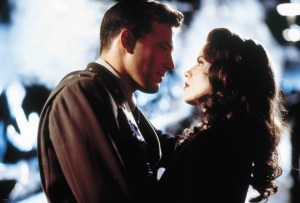 I’m also confused about the movie’s political apprehension. It bends over backwards to portray the Japanese generals as honorable and morally conflicted, which is better than mustache-twirling stereotypes, but this is still the aggressor country that had already invaded and occupied China. All of the good intentions of being more even-handed with the Japanese, perhaps to fight against anti-Asian demagoguery or even solely from money reasons, get supremely muddled when Bay decides to make the Pearl Harbor bombing even worse than it was in reality. The Japanese took great offense that in the movie their planes are seen attacking hospitals and civilian targets, something that never happened according to history and witnesses on both sides. Bay reportedly included the extra attacks because he wanted the attack to seem more “barbaric.” What is the point of better trying to represent a group of people and make up extra barbarism?
Looking back at my original review from 2001, I believe this was a watershed review for me. I wrote over 1200 words and it’s more in keeping with my current reviews than my early reviews. I find the analysis to be more critical than my early reviews where I was more likely to settle for puns and scant broadsides. This review has a few of those, but I also found myself nodding along with much of it even twenty years later. There are some marvelous turns of phrases, like “A Longest Day for the Pepsi generation” and Harnett’s voice sounding like a stubborn door refusing to stay open. There’s a punchiness to the writing that I recognize and admire, and it’s like I can see myself developing and finding my critical voice at this early juncture, which was almost two years into my beginnings as a fledgling film critic in Ohio. This one feels like a step above. I couldn’t end this analysis better than I did back in 2001, so I’ll quote my then 19-year-old self to close out both reviews: “To paraphrase that know-it-all Shakespeare: ‘Pearl Harbor is a tale told by an idiot. It is full of sound and fury, signifying nothing.’”
Re-View Grade: C
Share this:

The Only Living Boy in New York (2017)
 The Only Living Boy in New York may have made me hate New York. I was rolling my eyes at about every moment of this movie, not just because it wads cliché, not just because it confused the cliché with transcendent and relatable commentary, not just because the characters were aggressively loathsome and inauthentic, and not because it appears to be someone’s idea of Graduate Lite (though, yes, these are all contributing factors). It’s because the movie takes the easy way out at every route and wants to be congratulated for its artistic integrity.
Thomas (Callum Turner) is a twenty-something who feels that New York City has lost what made it special. He’s drifting through life, thinking about becoming a writer, and also trying to romance his best friend Mimi (Kiersey Clemons). His mother (Cynthia Nixon) self-medicates via dinner parties. His father (Pierce Brosnan) has a different approach, namely sleeping with another woman, Johanna (Kate Beckinsale). Thomas follows Johanna and makes his presence known to her. He convinces himself he’s falling in love with her and impulsively chases her as a romantic option as well.
 I think the movie wants me to be charmed by its male lead, the young protagonist that looks like a lanky Richard Gere. This twerp made me so angry and he pretty much embodied a creepy blend of entitlement. He’s tired of being in the friend zone with Mimi, but he keeps pushing, sneaking unauthorized kisses, and trying to wear down her defenses after she’s told him no. She’s annoyed that her friendship is by itself not good enough for him, and even though they had one “magic night,” that he won’t accept her repeated stances about not wanting to be together romantically. But what’s a woman’s ability to choose matter to Thomas, who we’re constantly told from every other character in this stupid movie, is clever, bright, good, virtuous, and a prized talent in the making. The movie never shows you these things, never provides evidence of his talents or even his virtues, and so it becomes another series of empty gestures. He’s just so captivating that all the women of New York can’t help themselves around him. This wouldn’t feel so tone deaf and backwards if the film did a better job of making Thomas feel like a living, breathing human being rather than some misguided, coming-of-age hipster creep.
The premise here has promise, a wayward son who ends up having an affair with his father’s mistress. That could work and devise plenty of palpable dramatic tension. Except because we never get to know Thomas beyond a superficial level, the affair only feels like another conquest of entitlement. Even a more interesting subtext, punishing his father for putting their family dynamic at risk, is only kept at a distance. What does Thomas learn about himself, his father, Johanna, or the world through his affair? If you cannot come up with a good answer then that means your plot point is lacking substance. Perhaps they just like the danger or the attention of one another, and yes Beckinsale (pick an Underworld movie) is an attractive woman so that’s a plus for a horny young lad. Most frustratingly, nothing seems to be pressed by this affair. It pushes some eventual third act confrontations but Thomas and Johanna’s tryst, for lack of a better term, just kind of lies there. It doesn’t do much, which is strange considering what it involves. It feels like its real purpose is to engineer jealousy from Mimi, which is gross. Johanna is never more than another trophy for the most blithe boy in New York.
The drama is pitched to a level that feels like it dances into self-parody, except it plays everything so unrelentingly serious. The narration begins by calling out life moments pulled from movie watching, but then it presents these very moments without any ounce of satire. We open with a New York dinner party where the attendees lament how the city has lost its soul (“The only soul left is Soul Cycle,” someone says like the worst 1980s stand-up comedian). Oh no, CBGB’s closed down. Oh no, there are Starbucks on multiple corners. Oh no, a city of ten million plus people is now only a commercialized hell, worry the rich elites from their ivory towers and their faulty memories of New York City being more pure when it was older. Not one character feels like an actual human being in this screenplay by Allan Loeb (Collateral Beauty). This is the kind of elitist, out-of-touch, artificial, self-involved characterization of New Yorkers that hacky conservative writers like to cling to when criticizing their big city targets.
 The actors do relatively fine work with what they’re given, though special mention to Brosnan who tries his hardest to imbue notes of complexity in a character that, for 90 percent of the movie, is set up as a snide and disapproving patriarch. I don’t want to give up on Turner (Assassin’s Creed) as an actor because the part did him no favors. Mostly I just felt sorry for them. Cynthia Nixon deserves better. The charming Kiersey Clemons (Dope) deserves better. Jeff Bridges is an executive producer, so he deserves what he gets as an alcoholic author/mentor with an out-of-nowhere ending that feels pulled from a soap opera. These characters are powerfully boring, shallow, and unappealing.
At only 88 minutes long, The Only Living Boy in New York still feels punishing in length, protracted, and not worth the overall effort. Even the title makes me irritable. It’s a reference to the Simon & Garfunkel song that you better believe will get played, one more desperate attempt to glom onto the legacy of The Graduate. The title refers to Thomas, our entitled hipster of a lead, but does that mean that he’s the only one who really feels things, man, because the rest of us are just dead to the world, living our lives, and this hip young man just sees through all the nonsense of the day-to-day and, man, if only we could give him the platform he so rightly deserves then we’d all be better off. I wanted the cameraman to abandon the film and run a few corners and join a new set (it’s New York City, so by the law of averages, there has to be another film shoot a few blocks away). The Only Living Boy in New York is insufferable, haughty, pretentious, privileged navel-gazing masquerading as deep thought; it is smug New York hipster twaddle.
Nate’s Grade: D+
Share this:

Total Recall (2012)
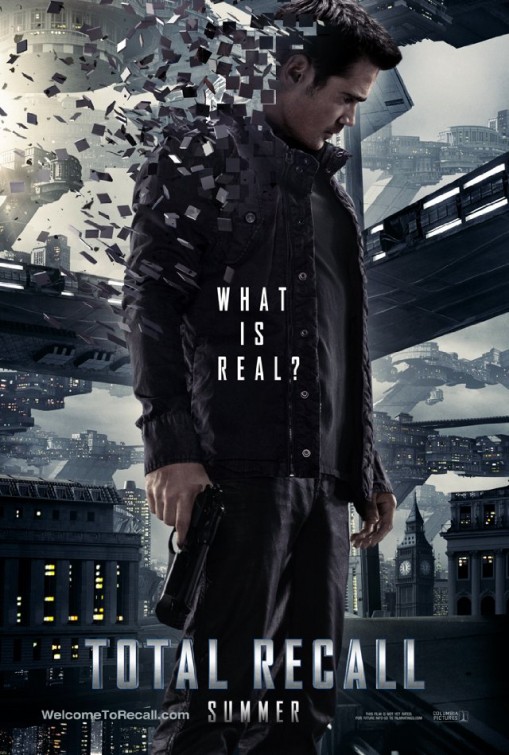 The latest needless remake takes the basic elements of 1990’s Total Recall and streamlines them into one very long chase sequence. And for those concerned males, the three-boobed lady makes a triumphant reappearance, because surely the movie wouldn’t be the same without her. Though in the age of the Internet, the sight of a three-boobed woman seems less indelible to impressionable male minds. But I digress. I was ready to dismiss this as another soulless Hollywood remake. Then I found myself enjoying Total Recall, and even the stuff that was dumb I had to also admit was cool. Take for instance a commute that goes through the center of the Earth. How exactly could such a thing be built? What does one do for maintenance? How does this not affect the Earth’s rotation? But then I forgot all about it because, in pure movie terms, it was cool. The zero gravity change-up as the transport changes directions at the core – cool. The fact that we get a zero gravity action sequence in this environment – cool. The fact that this transport system becomes a conduit for an invasion – cool. The plot mechanics are all familiar, notably the memory wipes and the super spy histories, but I didn’t care because the movie rarely lets its foot off the gas. When this thing starts, it doesn’t let up. The chase sequences are well executed amidst an imaginative array of locations, from a flying highway to a series of hanging housing developments. It’s not terribly smart but Total Recall is an entertaining escapist thriller that delivers some robust action and enough imagination in its future settings. Plus, there’s a woman with three boobs in it.
Nate’s Grade: B
Share this:

Contraband (2012)
 January at the movies has long been a time for two kinds of releases: 1) award-worthy films expanding into wider release, and, 2) crap. That’s about it. I’ll let you figure out which category the action thriller Contraband belongs in.
Paul (Mark Wahlberg) was once the best smuggler in the business. He’s since gone legit, starting a family and his own private security business. His brother-in-law (Caleb Landry Jones) gets into trouble with some bad men. He tosses a load of smuggled drugs to elude Customs ships, but now Briggs (Giovanni Ribisi) wants the value of the drugs or else. Paul knows he has no choice but to put together one last job to save Kate’s (Kate Beckinsale) brother. Paul leaves his family in the hands of Sebastian (Ben Foster), a trusted accomplish on many missions. John puts together a team and plans to board a ship headed for Panama City. While there, the team will load large sums of confederate money. The sale of the fake currency should square things between John and Briggs. However, little goes according to plan.
 Contraband is a lousy heist picture that feels like it’s making it up as it goes. First off, the premise of John having to go back into his art of smuggling to settle a debt has been overdone, and the fact that John’s idiotic brother-in-law is as fault makes it hard to care that something might happen to the idiot. But why God do they bring this screw-up, the brother-in-law, along with them? He’s already proven to be a poor decision maker and a moron, and, surprise surprise, when in Panama the guy gets them into more danger. So irritating is this character, always foolishly making things worse for John, that you wish they had thrown this dolt overboard. This is a movie structured with a small beginning, a small end, and a great big fat middle, and it’s that middle that involves our destination to Panama. With heist movies, as well as most thrillers, we don’t want things to go according to plan. We want to see organic complications and watch our team of characters adjust. With Contraband, the complications don’t feel natural so much as like careening plot elements from other movies. John’s quick visit goes out of control, with the team losing their payment money for the confederate loot (guess who’s responsible for that? Guess?), and they have to go find a budding crime lord, Gonzalo (Milk’s Diego Luna), and then this crime lord just happens to be plotting a heist at THAT EXACT MOMENT and John and his team should come along and then the heist goes bad, as always, and the team ahs to get away, but Gonzalo demands to be taken to a hospital by gunpoint, and then the cargo ship is going to leave port, and, and, and, and, etc. There are so many breakneck plot turns thrown in that it feels like a broken blender spewing half-formed plot residue everywhere. It’s the film equivalent of the If You Give a Mouse a Cookie story (“If you give a smuggler a deadline, he’ll need a contact. If you give him a contact, he’ll need to do the contact a favor. If he does the contact a favor, he’ll have to do this one job for him. If he does this one job for him, he’ll need a crew. If he needs a crew, he’ll need… etc.).
Let’s take a moment to analyze the peculiar masks Gonzalo and his team choose to utilize. They literally wrap duct tape around their faces. That’s got to be the dumbest mask in the history of cinema, and there have been some stinkers. They couldn’t afford pantyhose? Anything? They had to use tape? First off, you can’t conceal key features, like your eyes and mouth, and lastly, isn’t it going to be something of a bitch to rip those things off? The only person who could properly wear a duct tape mask would be someone suffering from alopecia (condition that leaves a person hairless). Otherwise you’re sacrificing your eyebrows. Maybe this is just how things are done in Panama.
So much of this movie feels like it’s on autopilot, just drifting like that cargo ship. At this point, I don’t even think Wahlberg is trying to hide his indifference to the material. He’s a man with a shady past who went legit and has a family now, but in order to protect that family he is drawn back to his shady past. How many times has this plot device just been used in the last few years? The rest of the characters fill out the crime thriller cheat sheet: young screw-up who serves as plot catalyst, parent in prison to provide cautionary tale, best trusted pal that ultimately proves to be untrustworthy, and the harried, often victimized wife. Poor Beckinsale (Underworld) who gets beaten, threatened with a gun in her face, and victimized to a degree that it feels like exploitation. This woman can never catch a break. She gets few moments in the film where she is free from being terrorized with violence. I have no idea what would attract an actress like Beckinsale to this part other than the allure of a paycheck. Contraband stalls when it comes to thrills, and part of this is because the villains seem so lame. Briggs just comes across as an inept criminal, like somebody’s own screw-up brother-in-law that tagged along to play with the big boys. He’s routinely beaten and bossed around. It’s hard to take his threats seriously, so the movie cuts its losses and just has him threaten Kate some more. It becomes old quick. The only thing that keeps Contraband going is the great distance between Paula and his family, a divide that keeps Paul vulnerable. Too bad that the movie can’t think of anything thrilling to do with this scenario and settles, all too frequently, on scaring the wife. Wouldn’t the film have been more engrossing if Paul’s wife had been kidnapped this whole time? Would that not cause a better sense of urgency than the vague threat that a character we don’t care about might get offed for being stupid?
 From an action standpoint, the thrills rarely materialize, relying on a contingent of blunders and coincidences to provide the thrills. There wasn’t a moment where I worried for a character on screen. This may be because I didn’t care for a person on screen, thanks to workmanlike characterization, but it’s also got to fall on the feet of Icelandic director Baltasar Kormakur (who starred in Wahlberg’s role in the original Icleandic version of this flick) and his nascent camerawork. There will be moments where his camera does stutter-step zooms, mimicking the docu-drama camerawork that’s been en vogue with action cinema. And then he’ll never repeat it. There’s a shot of Gonzalo blowing the armored car up and it’s filmed in a high-speed, stylized shot to distill the strange beauty of the force, and then this never happens again. It’s like Kormakur is sampling all 31 flavors of action movie styles and can’t decide on a visual tone. The action is too dependent on arbitrary coincidences for it to be satisfying of thrilling; we’re just waiting for the next out-of-nowhere plot turn to move things along. The ending attempts to tie up things nicely but feels asinine and laughable in how John can take out three villains in one well-orchestrated, tidy swoop. Don’t even get me started on the impracticalities of John hearing a lone cell phone ringing to be able to trace his wife in an entire construction site. The resolution feels ludicrous and a stroke of dumb luck.
Contraband is a convoluted, knuckleheaded thriller that drags because of arbitrary maneuverings, poor characterization, a fat middle section plot-wise, and pedestrian action. The movie feels like it’s being made up on the spot. As a result of all this tiresome lateral plotting, Contraband feels like it’s going nowhere and spinning into oblivion. I found myself nodding off at various points, my brain bored by all the generic goings-on. The constant victimization of Paul’s wife is a rather ugly development for a movie that confuses salty language and furrowed brows for toughness. The movie is devoid of any sense of fun. It just becomes an empty enterprise of actors going through the motions to work of genre pap. Even by the dirt-low standards of January cinematic offerings, Contraband isn’t worth a cent of your hard-earned money.
Nate’s Grade: C-
Share this:

Whiteout (2009)
 I was expecting bad but this is shockingly bad, notably in its lapses in basic filmmaking fundamentals. For instance, there’s a scene where Kate Beckinsale talks with a superior, and the editing cuts back and forth in the middle of every damn line between a medium shot of the actress and a close-up. The jarring effect feels like the movie is punching you in the face. The movie can’t even get watching conversations right! This Antarctica-set murder mystery seems like a neat idea until you realize it’s just another lousy slasher movie, albeit in an exotic location. The Antarctica location is mostly used to make sure that nobody can tell what the hell’s going on. Furious white flurries of snow pretty much make the onscreen action oblique, like you’re trying to look through a dirty window and comprehend what’s happening. The plot sets up a wealth of disposable characters and patently obvious suspects (Gee, will the weird, tattooed pilot have something to do with a body dropped from a plane? Stay tuned). It’s all pretty stupid with no real room for brain-dead thrills because the technical craft is so shoddy. However, the movie did make it clear that when, not if, the CSI franchise expands, they need to set it in Antarctica.
Nate’s Grade: C-
Share this:

Snow Angels (2008)
 Director David Gordon Green is likely the most observant auteur today when it comes to exploring the realities of life in small towns. Snow Angels is a somber drama that follows an estranged couple (Sam Rockwell, Kate Beckinsale) going through the hard times of life in a snowy rural town. The couple is also beset by some tragic accidents that come in at the appropriate time, an hour into the film, which means that we’ve gotten to know the characters enough to build a relationship with them and also that there will be plenty of time left to watch these characters react. The movie has a handful of interrelated characters that don’t all sustain the same level of interest. Watching a band geek lose his virginity to a smart girl (Oliva Thirlby, deflowering her second 2008 virgin) is just not comparable to other storylines. Snow Angels has an astute sense of resignation throughout, like the characters know they will forever be stuck in dead-end jobs and live the rest of their lonely lives as fated. The movie takes some very dark turns but they feel authentic to the drama. Green creates such a rich portrait of despair and the inequities of small town life.
Nate’s Grade: B
Share this:

Van Helsing (2004)
Crossover movies have a distasteful history in the world of cinema. Some movie exec gets the notion, “Hey, why can’t two great tastes taste great together?” But what we’re left with is usually uninspired (The Flintstones Meet the Jetsons notwithstanding). Crossovers for horror movies are the worst of the lot. For every Freddy vs. Jason there’s a dud, like 1966’s Jesse James meets Frankenstein’s Daughter. That year went down in the annals of cinematic history, however, as it also gave us Billy the Kid versus Dracula, marking two entries in the expanding genre of cowboys battling famous monsters (as far as I know, this genre still stands at two movies). So what can one expect from Van Helsing, a big-budget creature feature that includes Dracula, Frankenstein and the Wolfman?
Van Helsing (Hugh Jackman and a really big hat) is a secret soldier for a covert order of the Vatican. This covert order dispatches monsters and creepy-crawlies the world over. He’s been ordered to assist Anna Valerious (Kate Beckinsale), the last in a Romanian family line that has sought to kill the infamous Dracula (Richard Roxburgh). It seems that their family line is dwindling. And Anna’s brother being turned into a werewolf doesn’t help the situation. If her family line dies before Dracula then they cannot enter heaven. Van Helsing comes to town to help out the locals who are terrorized by Dracula’s flying brides. Van Helsing effectively kills one of the vamp ladies and is celebrated as a hero by the village. As he gets closer to Anna he also learns more about his own mysterious past and his connection to a certain figure with big teeth.
The Big D has a dastardly plan. He wants to find Frankenstein’s monster (Shuler Hensley) to channel enough power through him to awaken zillions of goo-sacks harboring the vamp’s undead brood. Of course, Frankenstein’s monster isn’t too keen on this. Together, he and Van Helsing, with the help of Anna as well as a comic relief monk, battle to stop Dracula from unleashing his children of the night.
Van Helsing is stupid, stupid, stupid. Director Stephen Sommers exists in his own indulgent world where bigger is better and some CGI spackle will fix any plot holes. He makes check-your-brain-at-the-door popcorn movies, but a “popcorn movie” is no excuse to forgive a rambling, incoherent, loud, stupid mess. I liked the first Mummy flick and even found some good with the second, but Van Helsing is Sommers at his rock-bottom worst, gorging on a trough of special effects and vomiting the results onto the big screen. Sommers’ idea of character development is knocking people through walls like they were in a Looney Tunes cartoon.
Van Helsing raises some interesting questions, like why do Dracula’s brides morph into flying demons that are conveniently genitalia-free? Why does a werewolf rolling over the top of a carriage somehow cause it to catch on fire? Why does Dracula keep his magic lycanthropy cure in the open? It doesn’t matter. Van Helsing is so straight-laced about its absurdities that questioning them will just get tiresome.
Not that you would expect much, but the acting in Van Helsing is bad. Beckinsale’s accent couldn’t be less convincing if her role were played by Charo. The trio of Dracula’s brides are played by swimsuit models and let me just say their performance is on par with what you would expect from swimsuit models. Roxburgh is quite possibly the worst vampire in the modern history of vampires, and that includes Blacula, Count Chocula and Tom Cruise. He couldn’t look any less sinister if he was in a diaper and bonnet. What’s up with those strands of hair that dangle in his face? Why do the Van Helsing creators want their Prince of Evil and son of Satan to look like he was the keyboardist for some 80s pop synth band?
This overly long film feels like a seven-year-old’s book report that he hasn’t read: it’s like a child is making this up as they go. “And then … a werewolf pops up … and then Dracula’s flying brides … and then they all need Frankenstein’s monster ….” Seriously, were the penning this script on the fly? It’s a $150 million improv film. The reels of the film could be switched around and no one would be able to tell the difference. Van Helsing is one long, exasperated action sequence that drags its heels instead of wowing. It beats the audience into submission with its stupidity and redundancy.
The entertainment level of Van Helsing is exceedingly weak. It runs an eternity, which wouldn’t be a problem if one were intrigued by the story, the characters, or the action sequences. The action could have been suitable but Sommers has gotten less reliant on the physical and more superfluous with his CGI. Watching a CGI monstrosity smash into a CGI monstrosity before a CGI background where no semblance of reality is present grows tiresome after 130 minutes. The effects are passable, but they overload the viewer and numb whatever slight interest may have existed for the classic monsters.
What should have been a clever homage turns instead into a hollow marketing ploy that’s so frenetic and tireless with its manic pacing and bad special effects. Even the many attempts at humor are flat. It has to be some kind of apocalyptic sign that Hellboy and now Van Helsing have been unleashed unto the innocents of this world. Some will find Van Helsing decent popcorn entertainment, but most will grow weary of its sloppy design and wafer-thin substance. For me, this is one to avoid, period. There isn’t an ounce of fun to be had while sitting through the painful pair of hours that is Van Helsing. This is one monster mash that’s a real monster mess.
Nate’s Grade: D
Share this:

Serendipity (2001)
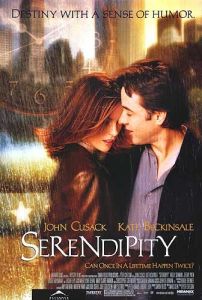 There’s a universe somewhere populated entirely with down-on-their-luck lovable sweethearts and good-hearted friendly buffoons operated under the physics of romantic comedies. In this universe there is no such thing as chance, even if one leaves it up to it, and in this place what would seem like frustratingly idiotic behavior seems romantic. So is Serendipity revolving in this universe. Kate Beckinsale is a gal that leaves everything to fate, possibly even her taxes, and John Cusack is the smitten man running all over the place trying to find this mad woman. In our world Beckinsale would seem foolish or even mean-spirited, but because the two will definitely end up in each other’s arms before the credits roll we allow her to continue her ridiculous behavior. She puts Cusack in a seemingly cruel obstacle course of chance to win her heart. These people operate outside of our known world. Eugene Levy has a brief and funny part in the movie but otherwise Serendipity takes itself as being much cuter and smarter than it is.
Nate’s Grade: C


 nathanzoebl
You must be logged in to post a comment.