Blog Archives
After the Hunt (2025)
 An unpleasant movie about unpleasant people being unpleasant to one another, After the Hunt is a movie supposedly about ethical dilemmas in academia but it comes across as insufferable people complaining about everything. The framing is about Maggie (Ayo Edebiri), a PhD candidate at Yale, who accuses an older male professor, Hank (Andrew Garfield), of sexual impropriety. He denies it and believes he’s the real victim of a post-Me Too witch hunt, especially after he suspected Maggie of plagiarizing her thesis. Maggie is looking for guidance from her mentor Alma (Julia Roberts) who feels pulled in many directions and unsure whom to believe. Given that premise, you would imagine there would be plenty of scorching drama and intrigue and characters divided by different loyalties and self-interest, especially when all these professors are supposed to be experts on ethics and philosophy too. I found myself so distant and disengaged with the characters because I found them all to be self-involved, cold, and entitled jerks. Worse than all of that, I found them all to be thoroughly boring. Watching After the Hunt feels like you’re trapped at a party with the worst people. That might as well be the moral of the movie: everybody sucks. I wasn’t expecting the characters to be shining examples of heroism, but I wanted them to be a little more interesting and the drama to be more insightful. Alma is our main character and she quietly seethes for most of the movie, that is when she isn’t running to puke into a toilet from her ulcers (symbols!). The movie is replete with characters just whining about “the kids today” and their brittle feelings. You know there’s only so many possibilities given the story; either the assault happened or it didn’t, either Maggie cheated or she didn’t. The score is absurdly discordant and intrusively obnoxious, sounding akin to a rack of instruments falling onto the ground. The abrasive score creates its own unintentionally hilarious jump scares. The more I think about After the Hunt the more I actively dislike it.
Nate’s Grade: C-
Share this:

Leave the World Behind (2023)
 Apocalyptic thrillers can oddly enough serve as a therapeutic means for dealing with our fears of being helpless against forces well beyond our control, but they’re also reflections of our current state of anxiety as well. There’s more than just giant hurricanes or earthquakes breaking records on the Richter scale, it’s about how we respond to the momentous and alarming changes and what that says about The Way We Live Now. The new Netflix apocalyptic thriller Leave the World Behind, based on the 2020 book of the same name, has some big mysteries that I feel safe to say won’t fully be explained by the end. There is a possible explanation but it’s a movie more consumed with how people respond to tumult than the tumult. I found the majority of the movie to be gripping and engaging, and while it doesn’t exactly nail the landing, writer/director Sam Esmail (Mr. Robot, Homecoming) crafts a paranoid thriller with flair. It’s an apocalyptic thriller at crossroads with a paranoia thriller and a disaster movie, and the biggest challenge of them all is ultimately being able to trust another person during a time of remarkable uncertainty.
Amanda (Julia Roberts) and her husband Clay (Ethan Hawke) have elected to take a spur-of-the-moment family vacation out of New York City and onto a lavish home in Long Island. Everything seems so placid until the phones no longer get a signal, the TV broadcasts are strictly limited to a blank emergency screen, and two strangers show up (Mahershala Ali, Myhal’la) saying this is their house and they would like to stay inside. They claim that the U.S. is under a cyber assault and there’s more to come.
 Leave the World Behind has two intriguing questions to keep the audience hooked: what is actually happening and who are these new people? Most disaster movies put you in the thick of the action, from presidential boardrooms to scientific outposts keeping up with the changing data and going over the options to prevent further loss of life. This movie purposely leaves you in the dark in a well-kept Long Island home and the first thing that goes is the expediency of knowing things from our phones. When two new people come knocking at the door to say the world is falling apart and this is our home, trust us, it’s hard not to hold some level of suspicion. Can we take these people at their word? What kind of agenda could they secretly have? And if so, what does that say about what has happened or what is happening in the outside world? They seem like they know more than what they’re letting on, so how much do they know themselves? It’s the slow drip of information that makes the movie simmer in such an anxious predicament of looking at every new piece as another new question. This places the viewer uncomfortably in similar territory as Amanda, who despite her prejudices might be right not to trust the newcomers. We’re stuck on the outside wondering what has happened and what may be left. The movie is carefully crafted to only give us so much to work with while our minds start reading and rereading everything for more connection and meaning, running rampant and going stir crazy just like the characters. While the second big question naturally gave way and could only produce so much tension, the main thrust of the movie kept me hooked and excited and worried and actively questioning just what exactly was going on.
I appreciate how Esmail is a restlessly ambitious filmmaker. He took on directing duties for the entire second season of Mr. Robot and from there continued coming up with new challenges. There was an episode meant to be told as an episode-length elaborate tracking shot. There was an episode that was told almost without any spoken words, entirely through visual action. There was an episode that was presented like a five-act stage play and it was enthralling. While these are the easy to recall gimmick episodes, Esmail’s directing vision for his series never eclipsed the series itself. It elevated the episodes but the emphasis was still on the significance of the characters and their emotional states (highly recommend Mr. Robot, one of my favorite 2010s TV shows, to anyone who has yet to watch). With Leave the World Behind, only his second feature after 2014’s parallel universe rom-com Comet, Esmail refuses to let any sequence pass without some kind of visual flourish. His camera is constantly swooping through the visual landscape, flipping and spinning and craning above the characters from on high. It reminded me of Brian DePalma, who also loves the high angle pans across rooms and also abides by the dogma that there should be no uninteresting shots in a movie. It’s easy to appreciate but without an engaging story can quickly become a distracting exercise in empty artifice, which is also how I view most DePalma. Here, much like Esmail’s accomplished prestige TV work, the style makes me better appreciate how much effort and thought Esmail has put into his presentation and his ideas. The man wants you to see his work, and there’s no fault in that as long as you’re enjoying the experience, which I was for the most part.
 There are some supremely well-crafted moments played to a breaking point of intensity. Early on, as the family relaxes on the beach, they see a ship in the distance, an ordinary sight on a seemingly ordinary day. Then hours pass and it’s getting closer, and closer, and finally the realization begins to settle in that this thing is now a danger and they need to very much run very much now. Esmail’s camerawork keeps the scene feeling kinetic, with a long take that establishes the colossal danger as the tanker runs aground and the family has narrowly fled in time. In many ways this moment also serves as an ecological metaphor, with problems looming in the distance but ignored until they are at their most dangerous and right on top of us. Another sequence involves Clay venturing outside and discovering what appears to be a dust storm the color of blood. It’s getting closer and closer and the movie is testing how much we can take before you start hitting an imaginary gas pedal to strongly suggest Clay out of there. There’s another sequence that’s a literal pile-up of driver-less cars coming to the same nexus point like they’re all migrating. It makes for an immediately eerie sequence that becomes extra horrifying once the Teslas become unmanned missiles.
The themes of disconnection aren’t exactly subtle but that doesn’t mean they are misguided. This movie is about as subtle as an oil tanker heading straight for you, but I didn’t mind because of the skill of the storytellers and the ongoing mysteries that kept me begging for every new morsel. The messaging isn’t exactly complex. At one point Amanda has a speech that might as well be titled “This is Why Humans Are Terrible and We Deserve This.” Following this, another character tells her that they may not agree on much but she agrees with every word she just uttered with her speech, so you know this is the kind of pessimistic monologue that can reach across the doom-scrolling aisle. The movie almost frustratingly ends without a larger sense of clarity over what has been happening, a fate that would have greatly angered my wife. Esmail gives you something that can work as an explanation without making it definitive; it’s merely a theory but it’s enough to hold onto if you desperately need an explanation. However, the way the movie ends feels less conclusive and more like the conclusion of a season of television where the characters, now grouped together, are in for something fierce next year so stay tuned. The nature of this story is designed to leave you hanging, and that’s why I circle back on it mattering more on how these characters respond to this apocalyptic event versus what is clearly happening.
 Chilling and effectively plotted to keep you guessing until the end, Leave the World Behind is an apocalyptic thriller that really simmers in the anxiety of the unknown. It’s not perfect but it’s pretty good, as long as you can accept not having all the answers. The acting is strong but it’s the control and finesse that Esmail exhibits as director and screenwriter that really makes the material engaging and impactful. It’s an apocalyptic thriller where the scariest proponent might be having to live with one another.
Nate’s Grade: B
Share this:

Money Monster (2016)
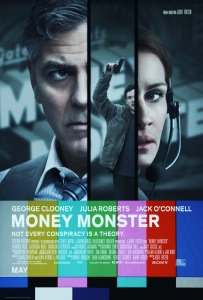 Jodie Foster hasn’t acted in a movie since 2013’s Elysium, and if you saw that movie you might have some sense why she’s taking time away. As a director, she has few film credits to her name, which makes each new Foster directing effort raise the question, “Why this one?” I would assume her last effort, 2011’s The Beaver, was her desire to work again with her Maverick co-star Mel Gibson and perhaps give him a career boost. Money Monster is a would-be hostage thriller with a socially conscience message about the greed and recklessness of Wall Street; however, the Bernie Sanders faithful, let alone anyone mildly educated on the excesses of Wall Street, will find this movie surely lacking, as will anyone looking for a competent and engaging thriller.
Lee Gates (George Clooney) is the host of Money Monster, a financial entertainment show where he provides stock tips to his loyal viewers. One day and angry man, Kyle Budwell (Jack O’Connell), wanders onto the set brandishing a gun. He demands Lee strap on a bomb vest. Kyle lost his life savings on a bad stock tip and he demands justice. Lee agrees to hear the guy out and get to the bottom of why this stock dramatically fell of a cliff, which leads him to suspect internal manipulation from the CEO (Dominic West). Lee’s director Patty (Julia Roberts) stays put through the duress and remains the voice in his ear, coaching him to safety and running research to discover the truth.
 While I was watching Money Monster I had to remind myself that this wannabe message movie existed in our reality, because the brunt of its ire against Wall Street criminal shenanigans is targeted specifically against one bad trader instead of the system. It’s like this movie exists before the 2008 financial meltdown, before the Oscar-winning movies Inside Job and The Big Short, but it doesn’t. It’s borderline insulting that the screenplay myopically focuses all of its attention on one bad actor and lets the rest of the Wall Street elite escape blameless for criminal misdeeds. The bulk of the movie after Kyle begins his hostage standoff is tracking down this bad trader and digging through archives to pin the blame for a stock fall on this guy, all the while keeping him away from the news so he doesn’t get suspicious. It’s a ludicrous turn of events that manages to take a big picture story with relevancy and find the smallest, most insignificant way to tell its tiny story. The condemnation should be for the system and not one guy, and not one character breaks from this preposterous thinking. It feels like they exist in a different time and place. If you didn’t know anything about Wall Street before this movie you would still be left clueless. Is there supposed to be a happy ending when they bring this guy to justice? The movie sets up an ending that doesn’t exactly feel like anyone learned a lesson or even that the villain was properly punished (oh no, he suffers the scorn of Internet memes!). The final line is so glib and self-satisfied that I groaned. By the end of Money Monster I was wondering what any character had learned from the experience except, maybe, to have better locks on the studio doors.
The other debilitating problem is that Money Monster is a movie that cannot find a character for you to care about. The setup should be so obvious and elicit audience sympathy and a natural underdog to root for against a corrupt system. Instead Kyle is a moron. First off he invests all of his money into one single stock based upon one tip from Lee’s TV show. That’s a pretty big risk. Next he takes hostages and makes demands, and yet none of those demands are for the return of his money but rather a simple apology. There’s also the fact that he’s more a ranting and raving angry lunatic than somebody who has targeted ire against the body of Wall Street, making for a pretty uninteresting hostage scenario. You also have to factor in that there will be no good outcome for Kyle, and so he’ll be leaving his girlfriend and unborn child left to fend for themselves after he blew away all their money on a bad gamble. This is not a sympathetic character nor is he rendered in a fashion to make him that interesting. He’s an angry and impulsive man whose actions are almost always about himself and his sense of being wronged. The other two primary characters, Lee and Patty, are completely absent personalities beyond staying cool under pressure. If you put a gun to my head I would not be able to tell you anything about either of those characters as people. Lee doesn’t seem to go through any sort of introspection over his own culpability with his TV show, and Patty is so laser focused on the problem at hand that we know nothing about her other than her capability. Spending 90 minutes with this trio of lackluster characters is a waste of 90 minutes.
 Despite the brisk pacing, I was bored mercilessly with Money Monster. I just didn’t care and Foster and company gave me no reason to care. The pacing made it hard to develop these characters; they felt like chess pieces being randomly assembled across a board, moved when the plot required it, and inert without these manipulations. When the movie goes outside is another example of nothing feelings believable. The will-he-be-shot suspense sequences are hackneyed and dumb. There are a couple of moments of solid comic relief at the expense of character egos, with Emily Meade (That Awkward Moment) serving as the highlight of an otherwise monstrously mediocre movie. Here is a list of other actors that are wasted in do-nothing parts: Caitriona Balfe (TV’s Outlander), Giancarlo Esposito (TV’s Breaking Bad), Christopher Denham (Argo), Lenny Venito (TV’s The Sopranos), and Chris Bauer (TV’s True Blood).
Money Monster is a disappointment in just about every stripe, from its perfunctory performances from it’s a-level movie stars, to the development of its characters, from its suspense sequences, and especially from its frustrating and laughably short-sighted vilification of Wall Street misdeeds on one culprit. It’s like this movie was pulled from a time capsule from the 1990s. Foster’s direction is perfectly acceptable though indistinct from any other journeyman. I cannot say what attracted her to this project as a director except for the opportunity to work with Clooney and Roberts. Otherwise, Money Monster is a thriller that keeps butting heads against reality, reminding the audience at every turn of its airless artificiality and stark superficiality.
Nate’s Grade: C
Share this:

August: Osage County (2013)
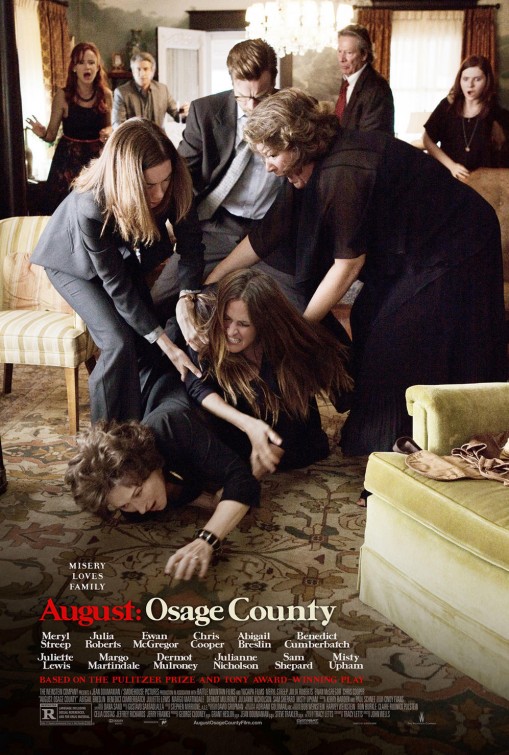 This holiday season, the movie with the most acting, by far, is likely to be August: Osage County, the adaptation of Tracy Letts’ Tony award-winning play. It’s a large dysfunctional family getting back together and opening old wounds, so, you know, the most relatable Christmas movie for some. It’s easy to see what attracted such A-list talent to this project because these characters are actor catnip; each is overflowing with drama, secrets, revelations, anger, and it’s all channeled through Letts’ barbed sense of humor and wickedly skillful dialogue. With Meryl Streep as the pill-popping matriarch, Julia Roberts as her resentful daughter, and a host of other inter-generational conflicts and secrets, you may feel exhausted by the end of its 130-minute running time (the stage play was 3.5 hours, respectively). The emotional confrontations feel like grueling pugilist matches, the melodrama kept at a fever pitch, but the film is never boring. Streep is her usual astonishing self and the deep ensemble gives each actor something to chew over. This is the best Roberts has been in years, and she’s not afraid to get nasty (“Eat your fish!”). Just when you think the story might soften, Letts unleashes another body blow, allowing no uncertainty that this is a family doomed. The story also provides insights into tracking the path of cruelty through the family tree, limb by limb. August: Osage County is stridently funny but also punishing in its no-holds-barred approach to family drama. If you’re looking for a movie that makes your family seem normal and even-tempered, this may be it.
Nate’s Grade: B
Share this:

Eat Pray Love (2010)
 Eat Pray Love is based on the best-selling memoir about Elizabeth Gilbert (Julia Roberts), a woman in her 40s trying to recover from personal setbacks. She’s divorcing her husband and she’s generally unfulfilled with her life. It seems to be missing meaning. Her solution is to set off on a journey to Italy, India, and Bali in order to rediscover who she is and what is missing in her privileged life.
Granted I am not in the target demo for this movie’s audience, but I found the main character to be rather hard to relate with. The film opens with her deciding to end her marriage to Billy Crudup (Watchmen). So far I’m okay. The dissolution of a marriage, especially when you’re older, is a prime starting point to reevaluate your life now that you’re on your own and, frankly, terrified by that prospect. But then the movie presents Gilbert as a rather self-involved and almost callous individual. Her husband is devastated, but she’s only tear-eyed one night as she prays to God why she’s in her marriage. The movie throws out some half-hearted excuse, saying her husband is wishy-washy about his career, but it’s a smokescreen. Why even leave this stuff in there if we’re just going to dislike Gilbert? That’s like including an opening scene in Schindler’s List where Schindler beats a child. A hyperbolic example, yes, but proof that it’s a terrible idea to have an early scene harm audience sympathy.
 And so Gilbert goes about on her globetrotting voyage of self-discovery, chiefly to fulfill her health, spirit, and heart. Except the movie seems to get worse with every stop on the map. The overly long beginning in New York shows that our flighty main character shacks up with a hunky theater actor (James Franco), and then agonizes over how unhappy she is with this new guy. She needs to learn to love herself before anybody else, she says. In Italy, she finds freedom in losing herself to food. She feasts on fine Italian cuisine and doesn’t obsess over her weight gain. In fact, she and a buddy treat shopping for larger sized jeans as a joyous celebration. I’m pleased that people can become more comfortable with their bodies. This Italy section focuses on food and fellowship, and Gilbert learns the language, enjoys the company of a group of locals, and cooks a traditional Thanksgiving dinner for her new friends. This is easily the most likeable Gilbert will be in the film.
First off, a film about a character finding personal discovery and self-awareness is going to be hard to pull off. Internal journeys of self-actualization and enlightenment don’t necessarily scream great movies, a medium of images and movement. For this to work you need a good story and a character worth rooting for, somebody who the audience can empathize with and cheer on the arduous path to personal grace. Elizabeth Gilbert is not that character. The other two segments in India and Bali are a true test of patience. Watching Roberts sway around, chant to herself, and look forlorn waiting for enlightenment to come is not the best use of 40 minutes. Richard Jenkins (The Visitor) gives the film’s best performance in the most tedious segment, which kind of reignites the “tree falling in a forest” scenario. When Indians have spiritual crises do they travel to New York? The end feels even more leisurely paced and I found myself nodding off here and there. The movie was failing to keep my attention short of some lovely scenery.
 Director Ryan Murphy, co-creator of TV’s Glee, knows that his audience wants beautiful countryside, beautiful food, beautiful men, and Julia Roberts smiling. To that end, Eat Pray Love is a success. Murphy seems to enjoy filming the food sequences the most. The food is portrayed like a glamour reel. It’s easy to feel the rumbles of hunger while watching this movie. Pizza from Naples looks divine. But Murphy also serves as co-writer, along with Jennifer Salt, so he should have known better about the plot deficiencies that keep the audience at a distance from embracing Gilbert. The actors all seem to be having a good time, and why wouldn’t they? Visiting exotic places and stuffing their faces with local delicacies? It feels like I’m watching someone else’s boring vacation videos that go on for 135 laborious minutes.
Eat Pray Love seems to be missing something, namely the soul of its journey. By design, so much of this existential crisis is internal, which is where the book can fill in all the clarifying and illuminating details to make this feel like a full story. As a movie, it just doesn’t work on screen no matter how powerful Roberts smiles. The main character is hard to relate to. How many people can solve a midlife breakdown by flying across the world for over a year? How did Gilbert afford this? I’ll tell you how. Gilbert pitched the idea to a publisher and then used the advance to pay for her yearlong trek of dining and self-discovery. It makes me doubt how genuine this whole journey really was, considering she sold the ending before she ever reached her catharsis. Maybe the title should have been Eat Pray Cash Check.
Nate’s Grade: C
Share this:

Valentine’s Day (2010)
 Imagine every romantic comedy cliché and sappy platitude about love stirred together into one giant gelatinous conglomeration of hollow sentiment. That’s Valentine’s Day. Regardless of your thoughts on the holiday, this movie, which aims to celebrate our national day of love, might have the opposite effect. This movie makes He’s Just Not That Into You look like When Harry Met Sally. It?s a fairly large ensemble with plenty of mega-watt stars, but it’s too bad that nobody knows what to do. Jessica Alba’s character literally runs her course an hour into the film and yet she still makes meaningless appearances. This overstuffed Hallmark card has ridiculously safe, candy-coated storylines sanded so that there is no hint of edge or wit (Anne Hathaway is the most ludicrous PG-13 phone sex operator you will ever find). The resolutions of most of these storylines will be predictable to anybody who has ever read a greeting card. Jamie Foxx is supposed to be a bitter TV reporter popping up everywhere reporting about the ills of V-Day. Think he’ll have a change of heart by the film’s end? The cast does offer their small pleasures (there are SIX Oscar nominees/winners in this movie!), except for the kid who has a crush on his teacher (Jennifer Garner). He was insufferably annoying. So was his movie.
Nate’s Grade: D+
Share this:

Duplicity (2009)
 This is the kind of slick, breezy fun that Hollywood seems to have forgotten how to make, or at least forgotten to make well. Writer/director Tony Gilroy has concocted an entertaining movie headlined by movie stars clearly having a blast. Gilroy’s narrative routinely folds back on itself with plot reversals, supplying new perspectives to the ongoing con/heist involving Clive Owen and Julia Roberts as ex-spies and current lovers. The movie itself is one long, pleasing con that manages to stay a step ahead of the audience without coming across as too confusing or dull. The tricky, twisty plot means that the audience must constantly reevaluate the movie, meaning that watching Duplicity can be described as less involving and more like an assignment. Gilroy is a sophisticated wordsmith and he has been knocking out crafty, intelligent adult movies, from the Bourne franchise to 2007’s Michael Clayton. The man probably spent too much effort trying to keep an audience on its toes. The audience becomes keenly aware of the plot structure, and we know it’s only a matter of time (usually 10-15 minutes) before another flashback reveals something else that will change the rules of the game. Still, the movie benefits from fantastic character interplay between Owen and Roberts and a superb supporting cast lead by Tom Wilkinson and Paul Giamatti as scheming corporate scoundrels (the opening credits slow-mo fight between the two men is delightful). Duplicity is an enjoyable romp with snappy dialogue, sizzling stars, and little re-watchability once all the plot machinations play out.
Nate’s Grade: B+
Share this:

Closer (2004)
 A funny thing happened to me when I sat in a theater to see Closer. It was packed, surely due to the film’s heavy star power. As the film played out I began to notice that my audience was laughing consistently, at moments that weren’t necessarily meant for humor. I don’t think they were laughing at the film, instead I think it was a defense. You see, I’m sure the majority of those couples read Closer to be a much different film than it is. They saw the pretty faces of Jude Law, Natalie Portman, and America’s sweetheart Julia Roberts. They were expecting something, let’s say, lighter than the cruel savagery of Closer. When America’s sweetheart Julia Roberts compares the taste of two men’s semen, you know this isn’t any Gary Marshall movie (forgetting Exit to Eden, and please do).
Dan (Jude Law) is an obituary writer planning to pen a novel one of these days. He locks his eyes on Alice (Natalie Portman), a stripper from the States, while walking one day. She gets hit by a car and Dan takes her to a hospital. Flash forward and Dan and Alice are dating but his eyes are already wandering. During a photography session with Anna (Julia Roberts) he kisses her but is spurned. He takes his revenge on some soul in cyberspace, pretending to be Anna and arranging a meeting. That sap turns out to be Larry (Clive Owen), and they actually do start dating. Then things get messy. Couples leave one another, get back together, swap lovers, and come crawling and begging for forgiveness or punishment. The rest of Closer is like a long game of relationship Red Rover.
 Director Mike Nichols has a definite affinity for his four actors (they are the only ones in the film with speaking parts). He shoots Closer as an actor’s showcase, with constant close-ups and no handheld camerawork. He places the emphasis on his actors. The results are more familiar to Nichols’ early films like Who’s Afraid of Virginia Woolf? and Carnal Knowledge. However, Closer isn’t as insightful as it thinks it is. It presents cruel characters doing dastardly acts, but this is stuff that wouldn’t impress Neil LaBute (In the Company of Men). There is intelligence to the film?s dialogue but it’s wasted on a ramshackle story.
The acting of Closer both helps and hurts the film. It seems that the two primarily wronged characters (Larry, Alice) give the better performances.
Owen is the standout performer of the ensemble. Playing the Dan role onstage has given him an intimate feel for the story’s characters. He’s the most decent of all four until the weight of circumstances finally pushes him to the limit. He’s the character the audience sees themselves in, so it helps that Owen gives a great performance of quiet dignity and slow self-destruction. He expresses more emotional turmoil in his eyes than most actors do with their whole body. Portman is having a breakthrough year for herself. First she showed pluck and grace in Garden State, and now with Closer she has graduated to the adult table. She radiates a fragility that makes you want to hug her. Portman will probably always look like a little doll (which works for her role as a stripper).
The beauty of Roberts and Law hurts the ugliness of their characters. I make no bones about my general dislike of Roberts as an actress. Her acting in Closer is like a soft-spoken, pouty child. She jumps from man to man, looking sullen or pensive, but comes off more petulant. Law is better, but his handsome devil is not in the details. Dan is a womanizing cad but we never get any understanding for why he acts as he does. Law can be hypnotizing, but like Roberts, his pretty facade takes away from the impact of Dan’s ugly behavior.
 Despite the title, you get no closer to getting to know or understand the characters. It’s really almost a stretch to call them characters because they’re more accurately different positions in an argument. The only characterization Closer has to offer is suffering and inflicting suffering. Closer really has one voice coming out of the mouths of different pretty actors.
The film has the annoying habit of skipping ahead in time and not telling the audience. We’re left to catch verbal asides that time has passed. After a while you’ll get the hang of it simply by assuming that the beginning of every new scene is the start of a new date in time. Closer is nothing but a string of uncollected scenes, usually involving people leaving a lover or starting a new fling. The actors come on, do their part, then they leave and we move on to a different scene. This is not staged as a movie.
The trouble with Closer is that it never really feels like it’s going anywhere. There’s no progression. Sure, couples swap, people get revenge, but the connection of sequences is lacking. The way it is, Closer could have gone on forever. It’s a series of scenes smashed together, not a story that rises and falls and builds to a climax.
Closer is an exploration into the darkness of human behavior starring some of the prettiest actors Hollywood can spare. The story goes nowhere, the ending doesn’t accomplish much, the characters lack convincing depth, but some of the acting is good and there is a ray of intelligence to the film. Fans of the above-the-title actors should enter Closer with caution. It’s a dark film with little to feel good about. Closer is brooding, moody, and probably the first and last time we?ll hear Julia Roberts talk about the taste of semen. Unless, of course, Gary Marshall starts pre-production on Exit to Eden 2: Rosie O’Donnell’s Bondage Boogaloo.
Nate’s Grade: C+
Share this:

Ocean’s 12 (2004)
 In 2001, Steven Soderbergh’s remake of Ocean’s Eleven was a giant surprise. It was a blast of fun with an impressive collection of Hollywood royalty. It had clever dialogue, fun characters, and a gala of amusing plot twists. It was one of the breeziest, most entertaining movies in years. Now, come late 2004, Ocean’s Twelve is released with the entire cast returning, including the lovely Catherine Zeta-Jones in tow. Expectations are high for another glitzy romp, but what you’re left with in Ocean’s Twelve is all glitz and no romp.
It’s been three years after the gang robbed ruthless casino owner Terry Benedict (Andy Garcia) of 160 million dollars. Benedict tracks down each member of Ocean’s Eleven and gives them the same ultimatum: either pay back what they stole, with interest, in two weeks or they’ll be killed. Danny Ocean (George Clooney) leaves his attempts at normal home life with Tess (Julia Roberts) and reassembles the team, many of whom have burned through their shares of the millions. Danny and his right-hand man Rusty (Brad Pitt) figure they’re too hot stateside so they’ll need to travel overseas if they’re to steal their fortunes. Linus (Matt Damon) also wants to have a greater role in the heist this time around.
In Europe, Ocean is challenged by a French playboy (Vincent Cassel) who moonlights as the notorious thief, the Night Fox. The challenge is to see who can steal a priceless Faberge egg, and if bested the Night Fox promises to pay all of Ocean’s debts to Benedict. Hot on the heels of both thieves is Isabel (Zeta-Jones), an expert police officer that also happens to be the former girlfriend to Rusty.
 Ocean’s Twelve does not work as a heist picture. For starters, the audience has no idea what’s going on for most of it. A general heist movie bylaw is to explain what the heist will entail, and then we watch the team hit it step by step. Forget that. In Ocean’s Twelve we’re never told how they are going to do their heist, and as they commence with their plan it’s not surprising to an audience, only confusing. I had to wait until the very end for some character to go into a monologue to explain how they accomplished their heist, and let me say, it was not worth two hours of waiting and scratching my head. The result seems to push away an audience instead of involving them in the fun of the scheme.
The story doesn’t utilize the talents of the assembled members. There’s a reason you hire a demolitions expert or a pick pocket, and that’s to let them work their skill. Well in Ocean’s Twelve we get none of that. Most of the cast’s skills are not ever put to use, which further gunks up a heist movie. The movie really errs by putting many of its eleven on ice for long stretches of the film. Around the second act almost everyone gets arrested. Pity poor Bernie Mac, who is in jail for near the whole movie. It seems that Soderbergh doesn’t know what to do with all his characters, and the new additions, so he stashes them away for long stages of time hoping an audience won’t notice.
Soderbergh is in danger of becoming a parody of himself. His usual narrative flourishes are present, including jumps in time and perspective; however, they don’t add up to much except unnecessary showmanship. The nonlinear leaps and shell game of information do not add to the film. Soderbergh keeps his audience in the dark for too long and then cheats us with the ending. Ocean’s Twelve is a good looking film (the vistas look beautiful), but it’s a good looking movie with nowhere to go. What’s even more frustrating is the ending to Ocean’s Twelve. You see, in the end we find out that the last hour plus of the movie was unnecessary. Yes, the movie actually makes a reveal that nullifies over half of the film. It’s cheap and unappreciated. Ocean’s Twelve, there’s a difference between tricking an audience and conning them. Maybe some day you’ll realize this.
 The new storylines never really develop. Zeta-Jones doesn’t add much besides another authority figure to chase after Ocean and the boys. Her subplot involving finding her master thief father is abrupt and easy. The best new addition to Ocean’s Twelve was the prospect of a rival, but again nothing really happens with our French thief. He’s more of a catalyst for the plot than anything else, and it’s a shame, because he could have opened the door for a great film pitting two competitive teams of thieves against each other.
Ocean’s Twelve is too satisfied with itself to be that entertaining. It’s now actually reminiscent of the 1960 original film (my grandmother swears it’s wonderful, take that for what you will), starring the Rat Pack. Plot and logic are secondary to a bunch of cool characters having fun. I really enjoyed Ocean’s Eleven (the 2001 film, not my grandmother’s preferred version), but this new sequel lacks any charm and verve. I can’t even say there were many good scenes, just some good ideas that they didn’t fully actualize, like stowing Yen in baggage and then losing their luggage (nothing comes of this). There’s a fun scene involving Topher Grace spoofing his own micro-celebrity, but beyond that many of the scenes and ideas don’t seem developed. The best moment of Ocean’s Twelve, for me, was when I saw Eddie Izzard, the funniest man on the face of the Earth and then some, chat with Hollywood’s A-list on screen. God bless you Eddie Izzard.
Ocean’s Twelve wilts in comparison to its witty, effervescent predecessor. Ocean’s Eleven was fun and hip but didn’t need to coast on star appeal. It had a believable heist, engaging personalities, and it was fun because we knew what was going on and it mattered! I’m sure the cast of Ocean’s Twelve had a blast making the movie together, and their friendly camaraderie shows, but when I left the theater I felt like I had been stuck with the bill for someone else?s good time.
Nate’s Grade: C
Share this:

Confessions of a Dangerous Mind (2002)
 The premise is undeniably amusing: game show host and creator Chuck Barris (Sam Rockwell) in between escorting Dating Game couples and introducing Gong Show losers, was a hired killer for the CIA. The directorial debut by George Clooney is impressive on a technical level. Clooney is inventive with scene changes, camera angles, lighting, editing, color palettes … I don’t know whether to champion him or credit his excellent cinematographer, but hats off to whomever designed the look of this movie. Rockwell is great and carries the film well, though I think he lacks the proper ability for self-loathing that the character needs. The brilliant weirdness of the story is tempered by famed scribe Charlie Kaufman’s astute sense of the intricately bizarre. Kaufman is a master of the offbeat, but he does more with his story structures and the ability to keep surprising than any other screenwriter. Confessions of a Dangerous Mind is a cheeky diversion into the unauthorized autobiography written by Barris himself. The movie itself is one big joke and Clooney tells it like a pro.
Nate’s Grade: B+


 nathanzoebl
You must be logged in to post a comment.