Blog Archives
Entourage (2015)
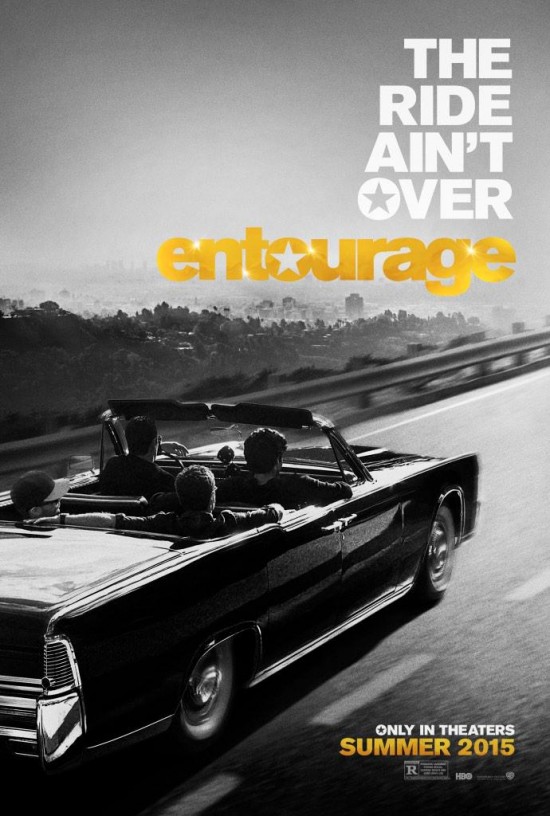 When Entourage first aired on HBO in 2004, it felt like a fun peak behind the glamorous world of Hollywood. A group of four friends were doing their best to navigate the land of dreams while staying true to themselves. For the first four seasons, Entourage felt fresh, fun, and engaging. And then it kept going for another four seasons, overstaying its welcome and proving to have worn out all credible story material several seasons before it went off the air in 2011. Creator Doug Ellin just didn’t want to leave the party, enough so that four years after finally leaving he’s back with his boys, co-writing and directing an Entourage feature film, answering all of the burning questions left unanswered. Does Ellin justify the move to the big screen, especially when you realize that the TV show already had gratuitous nudity and celebrity cameos?
Vincent Chase (Adrian Grenier) is nine days removed from his honeymoon where he and his wife decided they really weren’t meant to be, so they amicably split but not before having awesome sex one last time (oh yeah!). Back on the scene, Vinnie is hungry to direct and his debut is a $100 million adaptation of Jekyll and Hyde starring Vinnie and his older brother/desperate actor, Johnny Drama (Kevin Dillon). The problem is that Vinnie feels he needs more money to finish his masterpiece before he can show it to the studio. Ari Gold (Jeremy Piven), formerly Vinnie’s agent and now the head of the studio, has a lot on the line if this movie is a hit or a flop. He checks in with a financier for more money but the Texan moneyman insists his son Travis (Haley Joel Osment) go along to Hollywood and act as go-between. It’s not long before Travis is demanding drastic changes to Vince’s movie (oh no!). Here to help is Turtle (Jerry Ferrara), who works a business and a romantic angle with MMA fighter Ronda Rousey, and Eric (Kevin Connolly, who is weeks away from becoming a father with longtime girlfriend Sloan (Emmanuelle Chirqui). Can Vinni save his movie? Can Ari save his job? Can Turtle seal the deal with Ms. Rousey? Can these bros get any bro-ier (oh yeah)?
 The plot of the movie is almost insulting with how little conflict there is and when there is any how easily it all wraps up into lazy wish fulfillment. The main conflict of the film is that Vinnie wants more money for his directorial debut, even after blowing through $100 million. He needs just a pinch more for his movie to be able to be complete. Rather than having a disaster on their hands, which would be far more interesting and provide a wealth of conflicts with how to salvage what is there, the biggest perceived problem with Vinnie’s debut is whether it will be a box-office blockbuster and earn awards. Everyone sings the movie’s praises, though the concept sounds ridiculous and the little footage we see looks ridiculous as well. A Jekyll/Hyde DJ who fights “the system” and spreads his magic elixir at his club concerts… does that sound like the formula for Oscars? If Entourage were still functioning as an industry satire, there might be added commentary on how something so flatly terrible would be hailed as an awards darling, but entourage stopped being a satire midway through its television run. It’s just a consistent reward system for characters that stumble from one good thing to another. Even though Vinnie has never directed before everyone can’t help themselves but talk about what a superstar he is and how great the movie will be. Will he get tons of money, acclaim, and have sex with an attractive woman, or will he get tons of money, acclaim, and have to wait to have sex with another attractive woman? What a pressing conflict for a feature film. With that established, it’s no wonder then that Travis makes such an ineffectual antagonist. I was actually enjoying his hostility toward Vince and his dumb movie. Eric might have wanted to punch him in the face but I wanted to pat him on the back.
Another significant problem is that these guys are just too old to be going through these same tired arrested development routines. I think it says everything about Entourage the TV show that after eight seasons the characters were basically the same people except each had become more successful. Their shtick was already getting tiresome on TV. Flash forward four years, though the movie takes place months after the end of the TV show, so that means we’re in 2012 I think. Anyway, these guys should have accumulated some sort of personal growth as characters and they just haven’t. Except for Turtle’s weight loss, which becomes a running joke, it feels like they’re all the same. This is also featured in the Eric/Sloan relationship, which was an exhaustive subject on the TV show. As the series ended, they were together and having a baby, and as we pick up with the movie they’re, shocker, apart again just so they can get back together. The inevitability of this storyline offers a glimpse at what Ellin felt he had to squeeze in for Eric, which amounts to sleeping with two hot women and having a crazy mix-up. When it appears like there will be actual conflict here and Eric will be held accountable for his behavior, the movie instantly shrinks away and lets him off the hook. Every character’s interaction with women is regrettable, as women are served up as easy comforts. Ronda Rousey at least takes a stand but then retreats yet again under the supposed charm of these dolts.
The humor is low-grade and often missing, substituting references and celebrity cameos for well-developed comedic scenarios. There’s some humor in how self-deluded these guys are, especially the increasingly unhinged antics of Johnny, but they’re far too bland to generate consistent laughs. Except for Johnny, the other guys aren’t even given opportunities for comedy, which makes their storylines all the more painful. Do we really need to see Turtle’s courtship of Rousey, and what does she see in this guy? None of the cameo appearances are even used beyond just a ten-second-reference point with no greater impact than on the ten seconds of that very scene. Take for instance the cameo of Mark Wahlberg and his hometown buddies. He’s an executive producer on Entourage the TV show, based upon his own experiences coming to Hollywood. He’s shilling his own reality TV show he produces in the move based upon his old HBO show. That’s like product placement/plug inception. The problem is that Ellin has confused cameos as punch lines, which was also an issue with the original show. Just because I see someone famous doesn’t mean there’s a joke attached. Oh look, it’s Pharell and he’s wearing that big hat. Thanks for showing up, Pharell. Now go cash that check, you won’t be required for any other work on this set. Scene to scene, it feels like some sort of party that the filmmakers expect you to be grateful for attending. It’s not even a fun party.
 The most entertaining person is the movie is still Ari Gold and Jeremy Piven has always played him to the hilt, winning multiple Emmys in the process. I desperately wish this was more Ari’s movie, or told more from his studio perspective, because he’s the infinitely more interesting and entertaining character than the super relaxed and super boring Vince. Even though Ari’s vulgar outbursts have grown tiresome, he’s still the most exciting character because he’s transparent about his passion but also, more than any other character in this expanded TV universe, he works for his goals. Ari doesn’t just sit by and let good stuff fall into his lap, he’s working all angles to get the desired outcome, and that’s always more interesting than watching the life of a vacant actor go from great to even better. The subplot with Ari’s former assistant Lloyd getting married feels like setup for a comic set-piece that never materializes. It does, however, provide a cameo for George Takei to officiate the wedding. Hooray, more cameos.
If you were a fan through all eight bro-tastic seasons of the TV show, chances are you’ll probably find the movie easy-going and enjoyable. If you’re like me and grew tired of their boorish antics, the repetitive humor and plotting, and the casual misogyny, then a big-screen version where the boys get to continue their ways and get more rewards, where everything works out for everyone, will be highly fatiguing. Entourage the movie doesn’t aspire for much but its stunted ambitions and minor conflicts never allow the movie to be anything other than a particularly meandering and dull extended episode. Much like the main characters, it has confused mediocrity with success and being amiable with being interesting. Ellin said in interviews that he hoped this would be the start of an Entourage trilogy of movies. Thanks to the low box-office returns, at least I can credit America with stopping that plan. If this is indeed the last ride for Vince and the boys from Queens, well they went out pretty much like they did four years ago, and isn’t it great to still be a rich white guy in Hollywood? Oh yeeeeeah. Oh yeeeeeeah.
Nate’s Grade: C
Share this:

Ant-Man (2015)
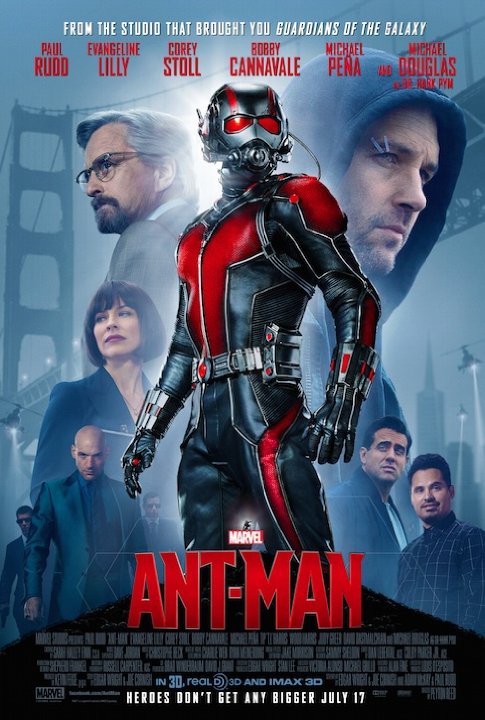 For the longest time it looked like Ant-Man might be the first dud of the runaway successful Marvel cinematic universe (MCU), a film franchise that was practically printing money at its leisure. It’s a strange setup and the man responsible for the movie even existing, writer/director Edgar Wright (Scott Pilgrim vs. the World), walked away six weeks before cameras were going to roll. Wright was a big fan of the character and has been working on and off on a screenplay with Joe Cornish (Attack the Block) for the past eight years. Before there was an MCU, there was Wright pushing for Ant-Man. I’m pretty sure Marvel execs weren’t thinking the relatively unknown character was worth sinking money into, but Wright kept pushing. I was far more excited for an Edgar Wright superhero movie than I ever was for Ant-Man, and then it all went away. Neither side has spilled too many details but it appears the divorce was a result of “creative differences,” which is odd since Marvel approved Wright’s script through eight years of development. Several directors were auditioned and Peyton Reed won the spot. The fact that Marvel has gained a rep for being a formula-driven creative committee and they literally hired a director with a film credit called Yes Man is an irony I don’t know that fully sank in. If Marvel was going to miss, this was the film. A funny thing happened in the ensuring year. Ant-Man is a visually engaging, energetic, and funny superhero caper that stays fun from start to finish and is a more entertaining movie than Avengers: Age of Ultron. Didn’t see that coming.
Scott Lang (Paul Rudd) is a master cat burglar just finishing the end of his prison term. Lang was punished for a “cool crime,” stealing millions a large corporation had illegally bilked form customers and returning it to the very victims, but it makes it hard to secure gainful employment. Scott falls back with his old crew, lead by his pal Luis (Michael Pena), and break’s into Hank Pym’s (Michael Douglas) safe. Expecting cash and jewels, Scott is disappointed to only find a weird looking suit, which he takes anyway. Hank observes Scott and communicates with him about the power of the suit. The wearer can shrink down to the size of n ant with the push of a button in the glove. Hank needs a protégée to wear the suit now that he’s too old. His estranged daughter, Hope (Evangeline Lilly), is working for Darren Cross (Corey Stoll), a scientist close to breaking through on replicating the amazing shrinking formula of Pym’s. As soon as Cross cracks the code, he’s going to sell the technology to the highest bidder (hail HYDRA). Hank must convince Scott to become the Ant-Man and sneak inside Cross’ secured workshop and steal his technology before it gets in the wrong-er hands.
 Arguably weirder than last summer’s Guardians of the Galaxy, which had a talking tree and space raccoon amongst its main characters, Ant-Man is the hardest property to sell by Marvel yet, and it smartly aims its sights lower and succeeds with the modest goal of just being a fun and enjoyable time at the movies. It helps that the movie doesn’t take itself too seriously and has characters pointing out the absurdity of its premise and developments, but not past the point where it would be detrimental. Let’s face it, a guy who can shrink down to ant-size isn’t that weird when you consider the applications, especially in espionage. The filmmakers do an admirable job of selling a superpower that pales in comparison to most other heroes on the market. However, the weirder power is that Scott has the ability to communicate and control ants via brainwaves. That seems like the even bigger superpower but it also begs the question, why simply ants? Of all the animals or living creatures who could be harnessed with this technology, we go with the tiny ones. There may be an explanation in the history of Ant-Man comics I’m missing but that doesn’t matter when we’re talking about the execution of the movie. The guy is able to control different species of ants with his mind. He is no Ant-Man but the Ant-King. Anyway, I think this power could be much more effective applied elsewhere. The ants are Scott’s friends and he has to train himself training them, getting them to coordinate and assist him properly, or else… there’s not much else at stake because they’re expendable. Perhaps their queen could have eaten Scott if he were unsuccessful.
On its surface, this movie should not work and is too goofy and insubstantial to engage, and yet that’s precisely what appealed to me. Not every superhero film needs to be averting a cataclysm that will destroy the planet. If the stakes feel big to our characters, and if the audience cares, then the stakes feel plenty big for us too. Scott simply foiling the corporate bad guy to be in a better position to see his daughter, that’s workable. Then the storyline is told through a heist, one of cinema’s most enjoyable plot mechanics. Heists are programmed for audience pleasure because it requires teamwork, which utilizes our cast in different and fun ways, it brings plenty of conflict and complications, and it lays out its steps one-by-one and provides a series of payoffs with the completion. It’s a tribute to Reed and the filmmakers that the heist portion of the film isn’t even the most fun part of the story. The majority of the middle is Scott coming to terms with the suit, his powers, his relationships in his life, and the mission. There’s probably one too many training montages (yeah, you get those sugar cubes you ants!) but the pacing is so breezy and the sense of fun so palpable, I didn’t mind. The use of humor never diminishes and Rudd is such a charismatic anchor for the movie, and yet he’s actually somewhat underplayed. He has it within him to be much funnier, but I guess he had to dial it down to effectively be seen as an action hero, hence the presence of newfound abs.
I didn’t have a lot of hope for the film once Wright left but I have to credit Reed for what he has achieved. It’s impossible for me to divorce myself from Wright’s involvement, and what kind of kinetic fireworks he would have birthed, but Reed manages to make Ant-Man come alive visually. Reed’s prior history shows an affinity for comedy but the films have never needed to be visually stylish, though I’d argue my super not-guilty pleasure Bring it On had an above average sense of visual spunk. Still, Ant-Man is a consistently visually immersive film that manages to find new perspectives. Scott’s first foray as a shrunken Ant-Man is an entertaining adventure through the dangers of a house party. The action sequences in miniature are treated just as we would expect a large-scale superhero epic to be treated, and then Reed pulls back at times for prime comic effect, like a battle atop a train that’s really just a child’s toy set. The visuals grandeur is patterned after the typical Hollywood action epic but the movie pulls back repeatedly to remind us how silly everything can be. The small world perspective opens up the movie in its storytelling and definitely in its action choreography. Because the Ant-Man has super strength when small, it behooves him to shift between small and human sizes when fighting. We’ll watch Scott race across the barrel of a gun in one second and then full-sized and hurling a security guard through a plate glass window the next. It provides a new sense of dynamism to basic fisticuffs. Reed takes advantage of the visual possibilities of his pint-sized super hero, like a clever battle that takes place entirely inside the contents of a briefcase. I chose not to watch this film in 3D, as my preferred option, but this is one I would almost consider going 3D. The shrunken worlds use a lot of macro photography to maximize the effect of depth.
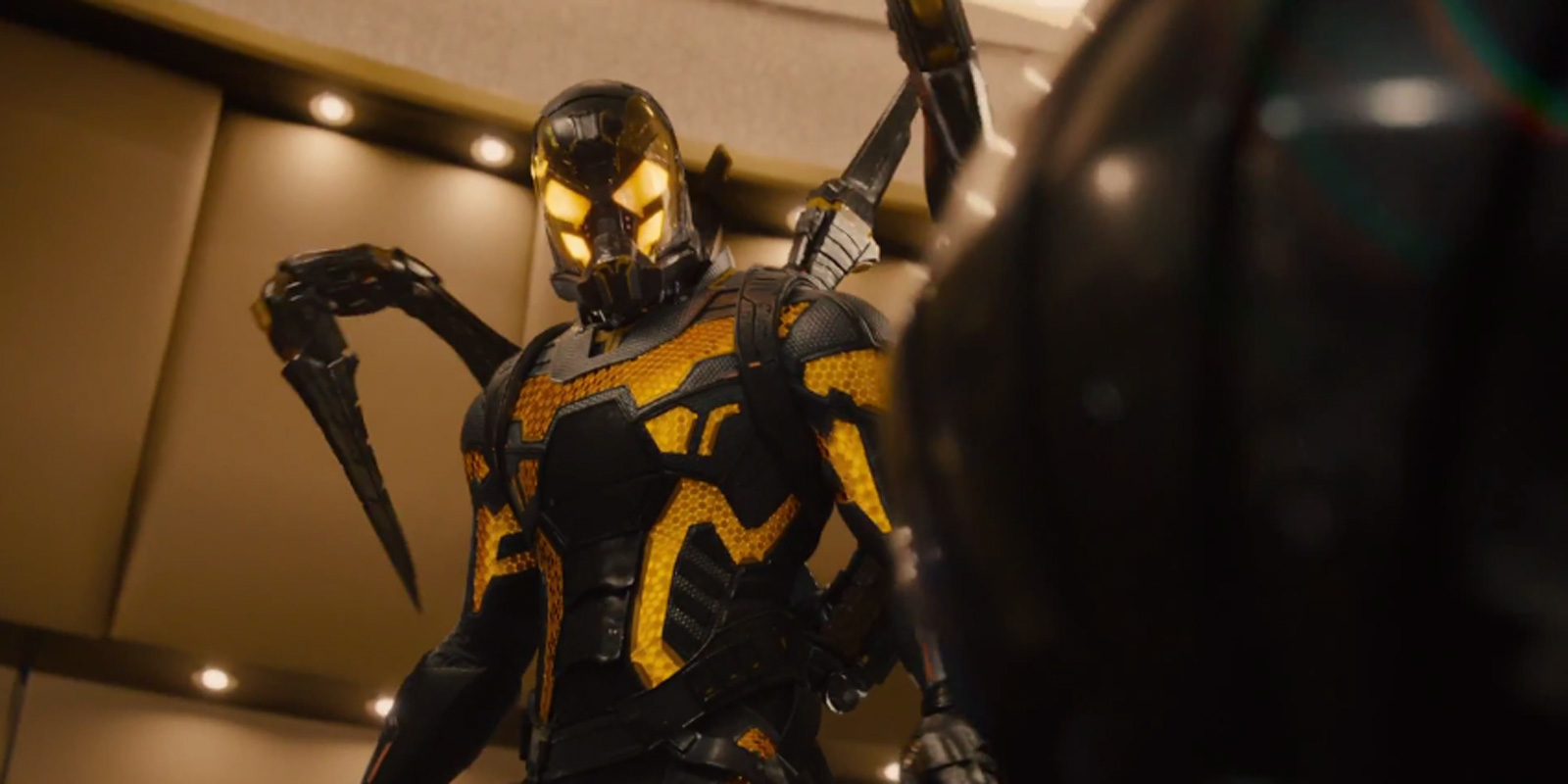 The cast also seems to be perfectly attuned to the comic rhythms of the story and several supporting players make the most of their moments to shine. Pena (Fury) is hilarious as the easily excitable friend given to lengthy diversions when retelling his tales of intrigue. The two instances where Pena breathlessly recaps what so-and-so said to so-and-so are two of the most playful and comically fulfilling sequences in the movie. I also enjoyed the fact that he’s always making waffles for his friends but this is never overtly commented upon. While Pena provides another dose of humor, the heart of the movie is really the father-daughter relationship, and it’s nice that Lilly (The Hobbit: Battle of the Five Armies)’s character is given such prominence. She resents Scott because she feels like by every right she should be the Ant-Man; the movie presents the two like bickering rivals fighting for the approval of a father figure. Hope’s credible grievances with her father are treated with weight and her reconciliation is given as much screen time as Scott’s training, pairing the two more as equals. Douglas (Last Vegas) is a warm and welcoming presence as a mentor working through his regrets late in his life. The de-aging CGI effects are amazing early on, showing a 1989 version of Douglas that looks pristine. He looks like he just stepped off the set of Ruthless People. The only weak point is Stoll (TV’s The Strain) but that’s because his underwritten villain is just too generic to blend in amidst all the colorful characters and comic mayhem.
It’s impossible to watch Ant-Man and not try to imagine what it would have been like had Wright remained as its director. Wright’s presence is still felt in stretches and he and Cornish are still the top-billed screenwriters, with the addition of Adam McKay (Anchorman) and Rudd himself performing a rewrite. I’d love to one day read what Wright’s full script was like and what Marvel eventually decided they could not abide. Whatever the case may be, the Ant-Man that made it to the big screen across the world is a surprisingly entertaining and spry piece of work. Reed provides a nice dash of visual flavor without losing its sense of the comedy or drama, Rudd is effortlessly charming, and the structure provides plenty of payoffs. Above all else the movie maintains a sense of fun and a lightness in an arena too often overwrought with doom and gloom. I don’t imagine there will be any Ant-Man sequels soon since the character is rather limited, but expect to see Rudd popping up in other MCU titles (he’s already been spotted filming Captain America 3). Ant-Man is a fun diversion but even Marvel knows not to push its luck too far.
Nate’s Grade: B
Share this:

Jurassic World (2015)
 Director Colin Trevorrow won the proverbial lottery after his 2012 film, Safety Not Guaranteed. The charming indie gem won many hearts, one of them Steven Spielberg. Trevorrow went from a rom-com that was made for under a million dollars to directing a Jurassic Park franchise reboot. Even last year’s Godzilla director, Gareth Edwards, had a previous film that somewhat primed a logical path for his impressive new gig. Enough time has passed for Jurassic Park to be new again, and the extra varnish of cutting-edge special effects, high-profile stars, and a renewed sense of fun remind us just how universally enjoyable it is to watch dinosaurs and then watch dinosaurs eat people.
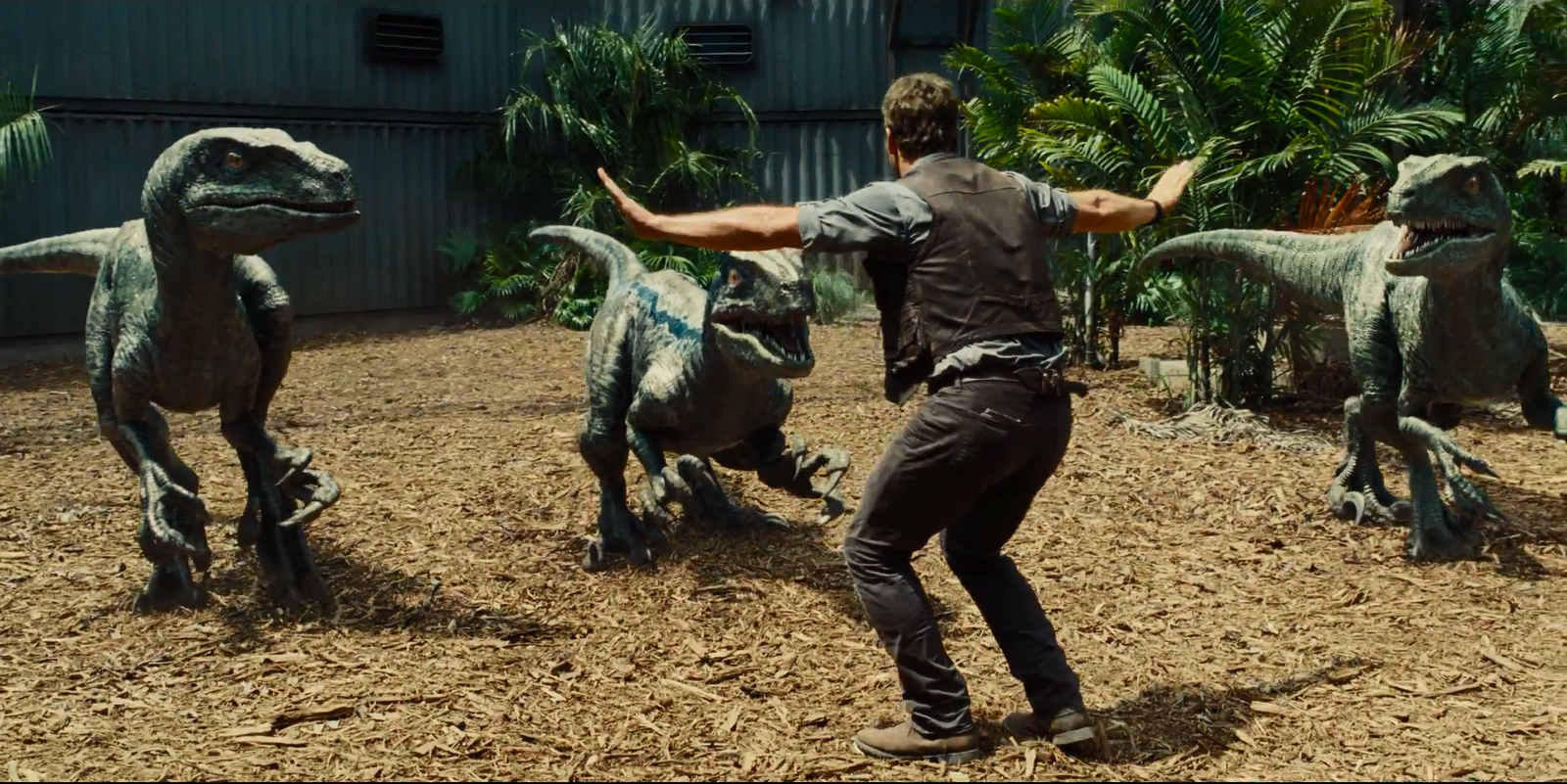
Jurassic World has been open for a decade plus now and audiences are getting bored. As a result, the board of directors for the park is looking to “up the wow factor.” They’ve genetically engineered a new hybrid dinosaur (Indominous Rex) that has never existed before in history, but nothing bad could happen, right? Owen (Chris Pratt) is a Navy trainer who is working on training a group of raptors to follow commands. A security leader (Vincent D’Onofrio) is convinced that there’s money to be made with military applications if dinosaurs can follow orders. Claire (Bryce Dallas Howard) is in charge of the day-to-day operations at the park. Her nephews (Ty Simpkins, Nick Robinson) are visiting as one last holiday adventure before mom and dad get divorced. She knows little about her nephews (she’s a workaholic – what originality), but when they’re put in mortal danger, Claire’s protective nature kicks into overdrive. The Indominous Rex escapes its paddock and heads from pen to pen deeper into the park, killing for sport. It’s up to Claire, Owen, and a team of trained raptors to stop this newest monster.
 What Trevorrow and his Safety writer Derek Connolly do well is establish a summer thrill-ride that places fun above all else, and it achieves this goal. Jurassic World is consistently entertaining and engaging, with action sequences that are shorter but constantly push the narrative forward. With all the Jurassic films, there’s a palpable sense of dread, of holding back before things get really nuts, and Trevorrow has fun teasing an audience; however, he also delivers on what he promises. The dinosaur action is visceral and rather violent for a PG-13 film, but the segments are diverse in orchestration that it never feels like the movie is repeating itself. That’s quite an accomplishment considering that the Jurassic sequels have mainly been a series of chases. There’s a definite nostalgic reverence for the original 1993 film, summed up with Jake Johnson’s geeky control center character. Trevorrow takes more than a few nods from the almighty Spielberg with his own directorial style. There’s also a surprise sense of humor, which can be quite amusing in moments and far too comically broad in others, like the forced screwball romance between Owen and Claire. The story this fourth time is less a cautionary tale of science and more of a monster romp, imploring a finale that feels reminiscent of Godzilla being called out to save the rest of us tiny humans from the newest and biggest monster. It feels like Trevorrow and Connolly accepted they would never recreate the magic of the original, so they’re aiming to just make the best sequel possible instead. If you’re looking for dinosaur mayhem, Jurassic World has plenty and a sense of what makes summer movies work, mixing in the right amount of suspense, humor, and well-crafted payoffs.
There are a few subplots that have to be swallowed or ignored for maximum benefit. The Raptor Force Five subplot is either going to be cool or silly, or both, and will go a long way to determine your overall feelings on Jurassic World. I know this idea has been in the works for several Jurassic sequels, so there doesn’t seem like there was ever going to be a movie that did not involve raptors being trained into some kind of combat role. This subplot connects to other points in the film about the nature of control/accepting being out of control, the building of a relationship, and the coordination for corporate interests. There’s a reason that the Indominous Rex seems to have special abilities that the handlers were not informed about, and this will be carried over into an assured sequel. For me, I thought the raptor hunting party was more fun than dumb. It had a Disney Wild Adventure feel for it, like we’re crossing over into Call of the Wild. I liked making the raptors allies to the humans who could be rallied for the final fight.
I appreciated how thought out the world building was; Jurassic World feels like a living, breathing amusement park in operation. From the Seaworld-like Mosasaurus aquatic shows, to the baby dinosaur petting zoo (I would totally spend hours there), to the celebrity-recorded comedy bits educating riders about safety supervision, to the listless park employee wishing each new rider to have a happy day. During the pterodactyl attack sequence, which is the most frenzied and exciting sequence, the crowds run for cover, including one guy who runs away while still carrying a clearly identified margarita in hand. That’s fantastic because it means that the park probably has a cheesy pun-laden menu of adult beverages (Tea Rex?) but it also means that even during an attack, a customer is determined not to lose his, likely, $10 margarita. While the “we can’t close the beaches” corporate mentality is somewhat tired as a plot obstacle, it’s still entirely fitting in a modern setting. It was the little details that told me that Trevorrow and company really thought the premise through and made their world feel far richer.
 One could also look at the social commentary in a fairly cynical manner and find Trevorrow giving in to the summer movie machine. Claire’s character explains that after years of operation, the public has grown tired of dinosaurs, and so they have to engineer a new bigger, badder dinosaur just to grab flagging interest. What once was magical has now become accepted and everyday. It’s easy to apply this critique on movie audiences themselves; we’ve become jaded from movie spectacles. What once blew our minds, like the original Jurassic Park, has now become passé. We’re constantly looking for the shiniest new toy but will lose interest soon enough. And then there are the fleeting images of people being more involved with their cell phones than the spectacle they paid to see. That’s right, annoying moviegoers who are unable to break from their phones for a two-hour window, Jurassic World is making fun of you, and rightfully so. The chief product of this desperation to give the audience what it wants is Indominus Rex, a beast that slashes a rampage through the island. In a sense, Trevorrow is externalizing the audience’s demands into the antagonistic monster, and finally just gives in, essentially saying, “This is what you want, right?” I can’t tell whether the social commentary holds up well, especially with the end that relies upon a metaphorical power of nostalgia to conquer the manifestation of audience apathy, or if Trevorrow just gives up. Is the concluding monster-on-monster brawl just mass appeal pandering?
I have a major solution to this dangerous park scenario. First, only herbivores allowed. Is any person going to reasonably refuse to go see millions-year-old multi-story extinct creatures because they primarily eat plants? I’m sorry, no way. That right there would solve most problems if the animals inevitably get loose. I would not believe a single person who would refuse to see living dinosaurs just because they lack a T.rex or other predators. That’s like Internet cretins refusing Angelina Jolie as a one-night stand because they don’t like the way her knees look. Nobody is this picky when awe-inspiring greatness waits. From a legal standpoint, I would also make sure guests sign a waiver before entering the park, thus mitigating any potential lawsuits over being attacked and eaten. How expensive is this park by the way? You have to charter a boat off the coast of Costa Rica, so that sort of price range already eliminates plenty of would-be customers.
I know many millennials who consider Jurassic Park to be their own Star Wars, a film that delighted the imagination and imprinted a love of movies at a young, impressionable time. Movies have never been the same since, especially in the sea change of computer generated effects replacing practical (Oscar-winning Sam Winston is retiring because of our over-reliance on CGI). We all want to experience that sense of awe again, like when we saw the T.rex roar for the first time. Movie moments like that send shivers but they are rare, so it’s unfair to compare Jurassic World to Park. However, it’s fair game to compare it to the lesser sequels, and that is where World stacks pretty favorably. Its sense of fun above all else, while remaining true to its larger vision of a real park, is a satisfying summer diversion. The dinosaur mayhem is satisfying and occasionally scary. The script does just enough to keep you from wanting to watch the human characters get squashed. In the wake of its box-office shattering opening weekend, expect the park to stay open.
Nate’s Grade: B
Share this:

Tomorrowland (2015)
 Crafting movies around theme park rides is a rather risky creative proposition. For every Pirates of the Caribbean mega-franchise, there’s a Haunted Mansion. Theme park rides are more locations then they are stories, so it’s an adaptation where there’s nothing really to adapt except for a setting starting point. Tomorrowland has a few nods to its spiritual source material, but it’s an original science fiction film with much on its mind beyond entertainment. With Brad Bird (Mission: Impossible Ghost Protocol, The Iron Giant) turning down the new Star Wars to make Tomorrowland, I had definite expectations. Bird hasn’t made a bad movie yet. He still hasn’t but Tomorrowland is definitely the worst film in Brad Bird’s heretofore-unshakable pedigree.
Casey (Britt Robertson) is a dreamer with a capital D. While her teachers bemoan the cataclysmic shape of world events and instability, she doggedly raises her hand to ask, “Yeah, but what can we do to fix it?” Her father works for NASA but the nation has lost interest in space and has stopped looking at the stars. Casey sneaks out every week to thwart the demolition of a NASA launch platform. She can’t let it go. She comes across a mysterious pin that, when touched, transports her to a hidden world, a future city called Tomorrowland. But there are others that are looking for this city too. A slew of androids chases after her to retrieve the pin. Robot child Athena (Raffey Cassidy) becomes a protector for Casey and the two set off to find Frank (George Clooney), a hermit and mechanical mastermind who once lived at Tomorrowland before becoming disillusioned.
 This is one of the few movies where the more characters explained the plot the more confused I ultimately became. The story by Bird, Damon Lindeloff (Prometheus, HBO’s The Leftovers) and Jeff Jensen doesn’t exactly a clear narrative, and that begins with the structure, inserting two framing devices that are too cute for the movie. The first 15 minutes is Frank’s childhood experience discovering Tomorrowland, and this is probably because we won’t see Clooney’s grown-up Frank until an hour into the movie. It takes far too long to get going, instead becoming a series of unnecessary plot detours, like a trip to a collectibles store in Austin or a trip to the Eiffel Tower. Is there a reason that a return to Tomorrowland is saved for the very end of its final act? Probably because utopias are boring, which the movie itself admits and admonishes us for accepting. You see, dear reader, it’s all of us and our collective negativity poisoning the planet. Our use of cynicism and our love of dystopias in movies and literature are to blame. In this proclamation, a movie as madly genius as Mad Max: Fury Road is leading to the downward spiral of humanity, and nobody who sees that brilliant film could accept that. Tomorrowland has some legitimate points, precisely aimed at the inconvenience of action over the convenience of stasis. In one of the better articulations of its shiny happy message, a character says that people accept the worst because “they don’t have to do anything today.” It’s the global equivalent of, “I’ll start my homework tomorrow,” knowing we’ll probably never get around to it, to our own detriment.
Tomorrowland’s idealism would be easier to swallow if it wasn’t so oppressively scolding. First, allow me to reject its notion that popular culture wallows in darkness and there is no inherent value with this predisposition. If this was true then no one would read the wealth of Russian literature, which is reams and reams of pages of suffering, unrequited longing, confusion, anxiety, pressure, and finding what grace one can. One of Casey’s teachers upholds George Orwell’s 1984 as a living testament to what we’re going through today, but Orwell’s novel isn’t popular or well revered just because it’s desolate. Would millions of readers be foolish for finding something powerful and poignant in Cormac McCarthy’s award-winning dystopian cannibal road trip, The Road? Just because one is optimistic doesn’t mean you’re in the right, and just because one is pessimistic it doesn’t mean you’re in the wrong. Perhaps the culture is too hesitant to take necessary action because it’s easier to buy into the argument that our actions are meaningless; hence why the newest argument against environmental reforms to curb the effects of climate change amount to, “Yeah, but what difference will it make now?” If Tomorrowland was trying to rouse its audience into action, it went about it the wrong way. The movie’s tone is far too scolding and stuck on can-do platitudes to be anything beyond an earnest motivational poster that will ultimately be ignored.
Then there’s the film’s restricted view on what constitutes the Right Dreams. Casey refuses to allow the NASA launch station to be demolished because it supplies her dad with a job, but really it comes down to her idealism of man’s capacity to achieve. And yet, her chosen way of expressing this, besides general perkiness, is to cling to an older definition of what constitutes achievement. The space shuttles were grand but we’ve outgrown them and space travel itself has migrated into the private sector. Just because U.S. astronauts aren’t being launched into space with the frequency they once were, does that means the country has somehow lost its ideals? Or are we allowed to adapt to the demands of the times? Strangely, Tomorrowland holds onto a retro definition of what constitutes achievement, something also touched upon in Interstellar, where Matthew McConaughey shook his McConaugh-fist at all these young kids for not having the same level of interest in the old technologies and pursuits. Tomorrowland fixates on the scientific dreams of the 1960s, but that’s no longer a representation of our world. What it ends up pining for is a throwback to Disney’s own era of gee-whiz futurism, a world where flying cars are valued above, say, the Internet.
If you think about it, Tomorrowland’s utopia is pretty much a progressive version of Ayn Rand’s Atlas Shrugged. In Rand’s famous ideological tome, the “best and brightest” (a.k.a. rich industrialists) decide they’ve had enough with the common man getting in their way, and so they up and leave and start their own secret paradise where they won’t be disturbed by the likes of us “normies.” With Tomorrowland, it’s not the business types who take their ball and go home but the inventors, scientists, and artists, the creative class, who are given magic passage to a hidden world where their work will be undisturbed by those deemed less creative and/or essential. It’s intended to be inspirational but it awkwardly falls into a murky class-consciousness it can’t escape. Who defines the value of creativity exactly? Is there a Tomorrowland board of directors that says, “You know what, we definitely need that guitar player. Forget having plumbers.” Are the day-to-day laborers and paper-pushers, the ordinary people that keep the infrastructure of the world running, are they just deemed less significant? Tomorrowland apparently only has the best and brightest when it comes to all things, including the people that take out your garbage and unclog your sinks. Are the gravediggers the finest from around the world? Is the world’s greatest and most creative gravedigger still a few notches below a rather lackluster environmental scientist? As you can see, it invites all sorts of questions that will go unanswered because, again, the film’s message is everything, and the particulars of its invite-only exclusive society are off limits.
 The action sequences are also strangely dull for a filmmaker such as Bird. Each sequence has its moments of inventive orchestration, especially a brawl in the sci-fi collectible shop that squeezes in lots of homage. Too often the action is missing the creative spark Bird has showed in so many of his past films, particularly 2004’s The Incredibles. The mayhem is also a little too intense for younger children, especially with real people being so callously zapped into dust out in the open (not exactly keeping a low profile, robot henchmen). There’s also a child robot who factors into a lot of the peril, and then very uncomfortably into a late scene where she expresses her love for the grown-up Frank. I understand they had a connection when they were kids but the movie still ends with Clooney cradling a child in his arms and talking what could have been their tale of romantic love. It’s just a little creepier than affecting. Speaking of which, are children going to be entertained by something this message-laden and obtuse in plot? Are adults going to be entertained with this movie? Who is this movie actually for?
The saving grace of Tomorrowland is the performance of its plucky heroine played by Robertson (The Longest Ride, TV’s Under the Dome). She’s got great presence on screen and a naturally charm that is far less oppressive than the material she’s delivering. Clooney (The Monuments Men) is his standard appealing, handsome, wounded leading man, and it’s a mistake to hold his character out of the action for so long. When George Clooney is on the poster for your big-budget sci-fi movie about the power of dreamers, you shouldn’t wait a whole hour to get around to his character. Magnifying this problem is the fact that the narrative has so few characters who actually matter, mainly four, and one of them isn’t significant until an hour in and another isn’t until the very final act.
Tomorrowland is a sincere, hopeful, and idealistic film that shoves its message in your face and doesn’t offer much in the way of an alternative besides, “Do better.” The problem is that this message of hope and agency is lost amidst a plot that is swallowed whole by near-constant exposition, a clunky framing device, and a world-destroying scheme that seems horribly convoluted in a manner unfitting for the supposed smarty-pants antagonists. It’s simply not a very good story, not told in a very good way, and a message that needs to go beyond a simplistic slogan to be more inspirational. It’s a pretty film with some fun moments, but Tomorrowland is a reminder that not all nostalgia is credible, not all dreams are equal, and messages are digested better when the audience cares about what is happening and (key point here) understands it. Me? I’ll prefer going to see Mad Max: Fury Road again, but that’s just me dooming humanity. Worth it.
Nate’s Grade: C+
Share this:

Men, Women, and Children (2014)
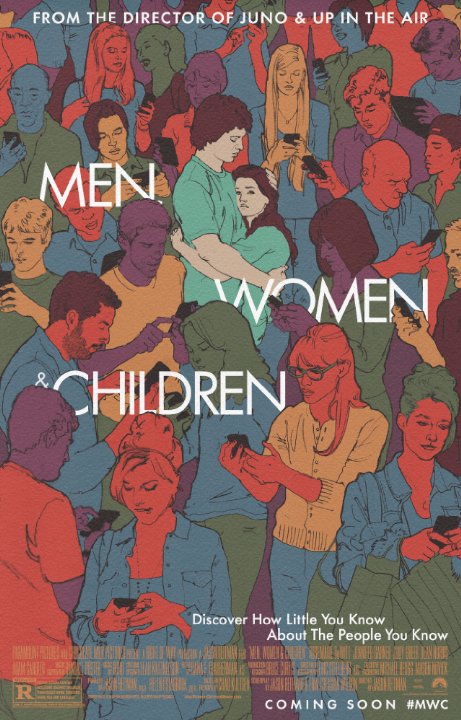 Jason Reitman was a director on the hottest of hot streaks with Hollywood. His first three films (Thank You for Smoking, Juno, Up in the Air) were hits but also an ushering of a new creative voice that felt mature, engaging, and immediate. His 2011 film Young Adult was divisive but I loved its nihilistic narcissism and satire. It looked like this guy couldn’t miss. Then in the span of less than a year, Reitman released Labor Day and Men, Women, and Children, two surprisingly misguided movies. Men, Women, and Children aims to be a Crash-style mosaic of modern-life in the digital age, but what it really feels like is a twenty-first century Reefer Madness.
The movie feels like it was made in the 1990s, like it should be a companion piece to the equally over-the-top and alarmist Sandra Bullock thriller, The Net. The movie’s thesis statement amounts to “the Internet is dangerous,” but this is a statement that everyone already acknowledges. The ensuing evidence from Reitman is so scattershot, so melodramatic, and so cliché-ridden, that it feels like an inauthentic lecture that is already past its prime. Firstly, did you know there is porn on the Internet? I hope you weren’t standing up when I dropped that bombshell. The film posits that because pornography is widely available with a few keystrokes, it has desensitized (primarily) male sexuality. It presents a slippery slop scenario, where the user more or less forms an addiction to online porn and has to keep going to more extreme places to chase that new high. This leads to their inability to accept their imaginations for pleasure or actual flesh-and-blood females. It’s not like Men, Women, and Children is a case study but this feels like the same alarmist rhetoric that’s been hashed since the 1970s. The characters are allowed to have their lives ruined by their pornography addictions, but the storytelling feels particularly disingenuous when it’s squared with the film’s heavy-handed message.  That core message is about the inability to communicate with the people around us thanks to modern technology meant to connect us 24/7 (oh, the unexplored irony). The message of the movie isn’t anything new or profound but it’s cranked up to such a comically over-the-top measure. I have no doubt the filmmakers were well-intentioned but their heavy-handed and tin-earned approach is a wild miscalculation that makes the film, and its dire message, more unintentionally funny than meditative.
It also hurts the film’s overall thesis/message when there are so many characters and storylines vying for attention. Reitman attempts to cover just about every aspect of Internet ills as if there is a mental checklist. We’ve got the porn addiction (check), there’s also a faltering marriage where both parties seek out online affairs (check), an fixation with online role-playing games (check), exploitation of teenagers for personal gain (check), stilted communication via social media (check), harmful communities encouraging body shaming (check), cyber bullying (check), and let’s just throw in general malaise (check). The plot is stretched too thin by the multitude of storylines, many of which fail to be interesting or find some shred of truth. There are two mother characters in this film that simply do not exist in real-life, at least the “regular” social milieu the film wants to portray. Jennifer Garner’s character is so obsessed with her daughter’s online life that she literally goes through every text, every tweet, every online post, and is also secretly recording her keystrokes. This militantly paranoid mother is such a broad and farcical caricature of parental concern. At the other end of the spectrum is Judy Greer’s mother, a failed actress trying to vicariously live through her teenage daughter. She’s photographing her daughter in provocative poses and outfits with the intent to jumpstart a modeling career, but it sure comes across like jailbait child pornography. There’s little chance a character could be this naïve and self-deluded to justify running a pervy website to market her underage daughter. Both of these characters are so removed from relatability that they become the two opposite poles of the film’s cautionary message.
I think Reitman was looking for something along the lines of American Beauty, but that movie had a group of characters that were fleshed out and given careful attention. The characters in Men, Women, and Children rarely break away from their one-sentence summations. That may be the biggest disappointment. Reitman has been exceptionally skilled at developing characters. However, the people that populate the world of Men, Women, and Children are really just slaves to the film’s message, plot points that rarely break away from their overtaxed duties. The teenage characters come across as the better half, especially a budding relationship between the ex-football star (Ansel Elgort, Fault in Our Stars) and Garner’s daughter (Kaitlyn Dever, Short Term 12). While their story is still underdeveloped, the actors work toward something that approximates reality, which is sorely missing throughout the movie. Sure, Dever gets to say clunky lines like, “I have a secret Tumblr account. It’s the only place where I can be who I am,” but at least this storyline goes beyond the obvious. The anorexic teen storyline has a lot of potential, even if she follows the same steps as every disappointing and disillusioned deflowering tale since Fast Times at Ridgemont High. Even the cheating spouses storyline goes slack, taking on the malaise of Adam Sandler’s character. The greater irony is that both parties use the same online service, Ashley Madison, to cheat on one another, though only Sandler pays for the service. I’ll give you one sense to how poorly developed these characters are. Sandler and Rosemarie Dewitt play Words with Friends in bed. She plays “gaze” (insight: she’s feeling undesired), and he responds with the word “sag” (insight: he’s feeling a deficit in passion). 
To make matters worse, the entire film is taken to new pretentious levels of ludicrousness thanks to the entirely superfluous narration of Emma Thompson. She’s a disembodied god commenting on the foibles of these lowly mortals stumbling around, and the narration constantly cuts back and forth to the Voyager satellite and its trek through the outer reaches of our solar system. Huh? Is any of this necessary to tell this story? It creates a larger context that the movie just cannot rise to the occasion. Thompson’s narration provides a further sense of sledgehammer irony, with Thompson’s detached narration giving added weight to describing things like pornographic titles. The movie keeps going back to this floating metaphor as if it means something significant, rather than just feeling like another element that doesn’t belong muddying the narrative and its impact.
The biggest positive the film has going for it is the acting by the deep ensemble. Nobody gives a bad performance, though Sandler does come across a bit sleepy. The problem for the actors is that a good half of the movie is watching characters read or text. Reitman at least gooses up his visuals by superimposing Facebook screens and online texts, but the fact remains that we’re watching people type or scroll through the Internet. It’s not quite cinematic and feels better suited for a written medium (the film is based on a book by Chad Kultgen). You haven’t lived until you watch actors texting for two hours.
At this point in his career, I’m getting worried about the direction Reitman is headed. He started off with four very different but excellent movies, two in collaboration with Diablo Cody. Each was elevated by its careful concentration on character and by its darkly comic worldviews. With Labor Day, Reitman took a sharp left turn into a Douglas Sirk-styled domestic melodrama. It was misguided and corny and could be written off as a momentary misstep. Now with Men, Women, and Children, Reitman has delivered two miscalculated and soapy melodramas that lack any of the acuity and creative voice of his earlier films. Men, Women, and Children especially feels like an alarmist and heavy-handed message about the evils of technology and how it’s warping modern communication; if the film was better written, had fewer characters, had more relatable characters, ditched the pretentious narration, and focused its scattershot message into something more nuanced or definable, then there might be something of merit here. It’s not that the commentary is entirely devoid of merit, but Reitman’s overblown approach does him no service. Men, Women, and Children plays out like a hysterical and outdated warning that is too feeble to be effective and too thin to be entertaining.
Nate’s Grade: C
Share this:

Jeff, Who Lives at Home (2012)
 This lumpy, amiable shaggy dog story from the Duplass brothers is another earnest, warm-hearted comedy that marries their signature family dysfunction, mumblecore quirk to a larger, more mainstream setting. The Jeff (Jason Segel) in question is a 30-year-old slacker, who indeed lives at home, and awaits signs from the universe to guide his decision-making. Incidentally, his favorite movie we learn in a monologue set on a commode, is Signs. His older brother, Pat (Ed Helms), is a selfish twit and embarks on a quest, with Jeff, to discover if his wife (Judy Greer) is cheating on him. The boys mother (Susan Sarandon) also has a nice storyline where an anonymous admirer is sending her flirty instant messages at work. Watching her face light up as she processes being wanted, it’s a thing of beauty. The characters are all flawed, and for some they may be too annoying to sit through. The film has been accused of being aimless, but I was engaged with its plot, which kept ping-ponging from one cause to another effect scenario. The movie is really more a drama with some comedic asides, mainly due to Jeff’s stoner zen and Pat’s aggressive dickishness. Greer has an outstanding moment where she lets her character’s deep reservoir of unhappiness come out in a blinding moment of honesty, and it rang true to my ears. In fact, the entire movie feels true enough. And then it appears destiny reveals its master plan with an ending that makes your heart warm all over, championing Jeff’s mantra of optimism and interconnectedness. The simple, good-natured, sweet little movie is worth checking out.
Nate’s Grade: B
Share this:

The Descendants (2011)
 We’re so used to seeing George Clooney as a smooth operator, a guy who coasts on his suave charm and chiseled-from-granite good looks. But in The Descendants, Clooney is more vulnerable than he’s ever been, trying to keep his family together, and as the film plays out we realize just how mighty a task this goal is. His character is ill equipped to take the lead of his family, especially a family of growing girls he is consistently confused with. His journey is much more than just becoming a better father. That lesson would be far too pat for director/co-writer Alexander Payne. It’s been a good while since Payne’s last film, 2004’s Sideways, but in that time away he has shaped another outstanding human comedy that manages to squeeze in more emotion than most Hollywood movies could ever hope for.
Matt King (George Clooney) is a self-described “backup parent” who has been thrust into the lead role. His wife, Elizabeth, is in a coma after suffering a traumatic head injury from a Jet Ski accident. The doctors say that she has no hope of waking up and she will die in a matter of days. Matt must break the news to his 10-year-old daughter Scottie (Amara Miller) and his rebellious older daughter, Alexandra (Shailene Woodley). The headstrong Alexandra clashes with her faltering father, finally revealing the reason why she blew up at mom months ago. She found out that Elizabeth was having an affair. Matt is reeling and searching for answers from friends, family, and his two daughters.
 Payne’s specializes in pitch-perfect bittersweet character-based comedies, ones that seem to unfurl over a journey of self-awakening. His fictional worlds feel exquisitely rendered, where every character beat and every line of dialogue feels genuine. That’s quite an achievement for a filmmaker of any scope. Even when dealing with caricatures (like in 2002’s About Schmidt), somehow Payne gets away with it. With The Descendants, the sunny setting of Hawaii is just an exotic backdrop for some wonderful, and wonderfully relatable, family drama. It’s hardly the worry-free paradise. Uncovering his wife’s secrets has lead Matt to reassess the woman he loved. The movie completely upends the standard deathbed goodbye trope. Instead of characters openly bawling about the loss of a saintly soul taken far too soon, we have characters dealing with real conflicted emotions, particularly anger, directed at the indisposed and unfaithful mother. Every character is approaching grief differently, and every character is trying to make sense of their feelings before Elizabeth’s inevitable passing. Matt’s father-in-law (Robert Forster) is harsh with accusations at the ready, blaming Elizabeth’s tragedy on Matt’s shortcomings as a husband. His pain is raw but al too recognizable. Matt and Alexandra are plotting how much info to reveal to young Scottie, trying not to ruin her image of her mother, a tremendous challenge with no easy answer.
This is the stuff of grand drama, and Payne doesn’t skimp on the heart-tugging moments. The Descendants is also a great comedy, naturally finding humor drawn from the situation and characters. The advertising has made The Descendants appear like a broad family comedy, with Clooney flapping around in his noisy flip-flops. This is not the case. The comedy doesn’t feel insensitive or too macabre, instead it adds another enlightening level to these people and their pain. We try and make sense of our world, to cope with our struggles and failures, with comedy, and so too does Matt and his family. You’ll probably be surprised how often you laugh and then in the next moment feel a lump in your throat. The character of Sid (Nick Krause) starts off as a questionable plot tagalong, a doofus for some easy laughs. His reaction to an elderly woman with Alzheimer’s is the movie’s one point of questionable validity. As the film progresses, this laid-back guy is revealed to have more layers, just like the rest of the clan. The second half of the film becomes something of a minor key detective story as Matt and Alexandra search for the elusive “other man.” As Alexandra eggs him on, the two bond over this manhunt and Matt becomes bolder, more confident, and clear-headed about the hard decisions that are necessary for his new life. The emotional rewards of the film are nourishing. Watching Matt and his daughters sit on the couch watching a movie together (March of the Penguins no less. Draw your own connections about parental turmoil), you’ll feel satisfied that this broken family has begin to heal itself.
The Descendants takes an interesting turn when we learn more about the other man’s background. Matthew Lillard (Without a Paddle) is actually respectable as Brain Speer, the real estate titan having the aforementioned affair with Elizabeth. Matt’s confrontation is subdued, sidestepping righteous grandstanding for a better attempt to seek understanding. Instead of lecturing Brian, he wants to know more about what his wife was after that Matt could not offer. Sure he’s still angry and doesn’t let the guy off easy. Complicating matters is the fact that Brian has a wife, Julie (Judy Greer), and two children. Matt is trying to find answers without willfully harming Brain’s family. Greer (Love Happens) has an outstanding sequence where she feels beholden to forgive rather than hate, a note of grace that feels rather profound.
Clooney at one point says he’s just trying to keep his head above water, and you can see why. The man shows a great deal of range as his character confronts his grief. There is no “right” way when it comes to grieving, something deeply personal. Matt’s dilemma is given an unlikely situational twist, but the feelings of betrayal and confusion are all too believable. Matt is looking for answers when the person who holds them all lies sleeping. As he develops a lager picture of his wife and her unhappiness, Clooney expertly flashes through a multitude of thoughts. While arguably not as textured as his performance in Up in the Air, Clooney is in fine form, showcasing a deeper sense of loss and anxiety. Matt is trying to find his footing while his world radically adjusts, and nothing has adjusted more than his feelings toward his wife. Clooney doesn’t have any Big Moments of Great Emotion, though lashing out at his comatose wife comes close, but the man’s nuanced portrayal of a life in flux is the stuff that award ceremonies were made for.
 Woodley is a remarkable discovery, more than holding her own with Clooney. She is excellent in her portrayal of an aggressive, mouthy, rebellious teenager. It’s all the more astonishing because Woodley’s long-running TV show, The Secret Life of the American Teenager, is one of the worst shows still running on television. The show is so inartful, the dialogue is so tin-eared, and the acting is wooden like the actors have been imprisoned. Where has this actress been the whole time? Woodley’s performance is so alive with genuine feeling, stripping away any reservations of the too typical bratty teen role. She’s much more than a troubled teen sent off to boarding school. Her every inflection, hesitation, motion feels completely natural for her character, and when Woodley gets her big dramatic scenes she is a force to witness. Upon the sudden news that her mother will die soon, she plunges underwater in the family pool and screams as loud as she can, tears squeezing out of those sorrowful eyes. For goodness’ sake, this girl cries underwater. An Oscar nomination is assured for the 20-year-old young actress. Maybe she can quit her crummy TV show after the wave of good press and fawning praise that await her.
The Descendants is an incredibly observed human drama, a humane and touching comedy, a movie so engaged and plugged in to the messiness of human emotions, eschewing the bitterness of some of Payne’s earlier works. This is a thoughtful and nuanced flick that is elevated to even grander heights due to the excellent performances of father/daughter team Clooney and Woodley. The film hits all those traditional emotional notes but on its own terms. The movie approaches a graceful resolution by accepting the incomprehensible disarray of life. The Descendants is just about everything you’d want in a movie: supreme acting, strong characters, an affecting story, and emotions that are completely earned. Payne’s mature and tender movie is, by the end, rather hopeful, a celebration of family overcoming adversity. It’s not schmaltzy in the slightest but a powerful antidote to simple cynicism. This holiday season, be a good movie citizen and spread the word of The Descendants.
Nate’s Grade: A
Share this:

Love and Other Drugs (2010)
 Director Edward Zwick has spent the last two decades making mass-friendly action films with designed to teach us all some valuable lesson, like Blood Diamond and Glory. But the idealistic filmmaker began his career with realistic relationship dramas like About Last Night… and the seminal TV show thirtysomething. There wasn’t an explosion to be had, unless you count the emotional ennui of middleclass white people. Love and Other Drugs is adapted from the biography of a Viagra salesman, which seems like a strange jumping off point for a romantic drama. Watch out for those unexpected side effects.
It’s 1996, and Jamie (Jake Gyllenhaal) is a smooth-talking, suave pharmaceutical rep for the medical giant Pfizer. He’s been dispatched to the Ohio River valley area with a mission to push his drug samples on doctors and raise his quotas. While posing as an intern, he meets Maggie Murdock (Anne Hathaway), a coffee shop beauty in stage one of Parkinson’s (don’t attack me, they reveal this spoiler before you even see Hathaway’s face). She spurs his advances but he persists, and the two agree to a strictly sexual relationship. Because of her illness, Maggie is wary of getting attached to people. She sees Jamie as a shallow, well-muscled lunkhead who won’t want anything else but a slew of orgasms from a pretty girl. And Jamie is content, until, of course, he falls in love. Maggie feels she’s sparing her lover the pains that will accompany her Parkinson’s. The two struggle with her illness, the toll it takes on their relationship, and the possible future they will have together… in between lots of sex.
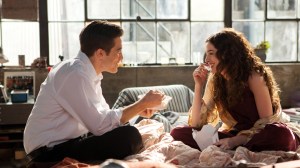 The true pleasure of Love and Other Drugs is watching Hathaway and Gyllenhaal together onscreen. The Brokeback Mountain buddies have tremendous chemistry that makes their give-and-take exciting and pleasing. Hathaway and Gyllenhaal may be the best onscreen couple I’ve seen since 2005’s Mr. and Mrs. Smith. Chemistry is such an indelible component for romance and yet it is so elusive to capture. So when a cinematic couple really create some serious sparks, it’s a memorable exchange. Hathaway and Gyllenhaal are a terrific team but also the rare screen couple that raises the performance of their partner. You are easily convinced that these two enjoy the company of one another; they’re so confident with each other even as they’re tumbling around naked. Hathaway has grown into an actress of surprising range, making keen use of her animated Disney heroine features. She has a knack for playing defiant, spunky women that have an alluring fragility, and that also describes her Maggie (how does a coffee shop give Hathaway the health insurance she needs for Parkinson’s meds?). Gyllenhaal has always had his boyish charm, but he seems catapulted to new charisma heights with Love and Other Drugs. He’s exploding with energy and comes across bursting with life onscreen. He starts as a suave Lothario drunk on his own charms but, as movie journeys dictate, he morphs into a committed, mature man. The roles are pretty standard (slick selfish salesman, sad girl with illness) but the duo bring extra vitality and heat that makes Love and Other Drugs compulsively watchable in its finer moments.
It’s refreshing to witness a major Hollywood movie that treats human sexuality without the standard artifices of Hollywood. Love and Other Drugs is not coy when it comes to physical lovemaking. This isn’t a blockheaded movie where the woman goes through the entire night of passion while wearing a bra the entire time (the epitome of PG-13 sex). This isn’t a movie where after a healthy bout of sex the couple feels the need to cover up their goods as they lay beside one another. Like after a vigorous sexual experience now the lovers suddenly become bashful at their own state of nakedness (get the fig leaves – stat!). So it’s refreshing to watch a film deal with sexuality without giving undue attention to how “risqué” everything is. The nudity is European-style casual, and while the film manages to be quite sexy, the nudity and sex scenes do not play as shameless titillation. The sex and copious nudity is just another part of the storytelling. Of course it also happens to be a prominent and highly marketable storytelling aspect. It’s not like Hathaway and Gyllenhaal are homely actors. Watching beautiful people writhe together on screen and nonchalantly walk around without a stitch on has always been a sure-fire way to sell tickets. Love and Other Drugs utilizes all that skin to lure boys into a traditional romantic drama. It’s to Zwick’s writing and directing credits, and the natural chemistry of his two high-wattage stars, that the parade of flesh doesn’t feel like naked, prurient exploitation. It’s not exactly an edgy film by any means but it’s assuredly adult in its portrayal of sexuality. Or at least it thinks it is. The sex isn’t really a topic to be explored with nuance and clarity; it’s more something to keep the actors busy.
 Ultimately, the tonal inconsistency is what hampers the momentum of Love and Other Drugs. It’s hard to build narrative momentum when the film just seems to be starting over time and again. Zwick bounces around different tones, sometimes wildly from scene to scene. At heart it’s a weepie romance, the sick girl and her paramour coming to terms with their doomed love. But then the movie also wants to be an energetic, smart-alecky comedy, then there are all sorts of crude gags (hope you like boner jokes), and then the film also wants to be a satire on high-powered pharmaceutical companies and their sleazy influence romancing doctors. And then in between all that is the weepie drama stuff as Maggie has to deal with the (movie) realities of her illness. Here’s an example of the tonal whiplash that did the movie no favors: Jamie stumbles in on his disgusting younger brother (see below) masturbating to a sex tape of Jamie and Maggie, of his own brother and his brother’s girlfriend. The scene is played for broad comic laughs and ends with Jamie beating his brother off screen with that very sex tape. If people needed another reason not to make sex tapes, here it is: Josh Gad might one day view them and pleasure himself. You don’t want that, trust me. But then the very next scene involves Maggie working on her art and unable to control her Parkinson’s symptoms, namely finger tremors. We watch as Maggie diligently and patiently tries to open a bottle of pills, the childproof locked top confounding her stubborn fingers, only to eventually find that the bottle is empty and her symptoms will only increase. The fact that these scenes coexist right next to one another makes their differences all the more jarring. Love and Other Drugs tries to jostle diverse genres but the different tones never coalesce. As a result, you feel violently ripped from one movie to another.
Let me give due attention to just how revolting the character of Jamie’s younger brother is. Josh is a cancer on the movie. He doesn’t make a scene better but rather drags it down to a lower level. He’s slovenly, boorish, coarse, and routinely unfunny. You can practically feel his sweaty fingerprints pawing at the movie for attention. This character is abominable and repulsive. He inserts himself into Jamie’s home and offers no dramatic value. His purpose seems to be solely as a cheap go-to plot device whenever Zwick feels he needs a random profane joke. Gad (The Rocker, 21) is a comic that I have enjoyed in other contexts, but he’s got the wrong energy and feel here, succumbing to the angry desperation of his character. Josh serves no worthwhile purpose and just becomes a pathetic distraction for a movie that already doesn’t seem to have full focus on what matters. He’s supposed to be an annoying presence but this annoying? You probably won’t find a more unnecessary and loathsome fictional character in a movie all year.
 Zwick can’t keep tired clichés from clipping how high the film can fly. The film’s message about family over business feels trite no matter how much nudity tries to obfuscate it. The Parkinson’s angle is too easily transformed into melodrama. The film takes a trip to a Parkinson’s meeting in Chicago with real-life people suffering through different stages of the debilitating disorder. It draws a poor comparison with Maggie’s tremors, which start to seem like a lightweight Hollywood example of illness (like when a character coughs onscreen and it somehow communicates a quickly metastasized cancer). Even after shirking Hollywood conventions the movie manages to end in that tried-and-true fashion where the man has to chase after the woman to give the Big Speech about how he truly feels. The Pfizer storyline that follows the launch of impotence-crushing super drug Viagra feels like the first draft of a different screenplay or the last remnants of a different story that’s been hollowed out. It’s fairly superficial and meant to serve merely as the male lead’s occupation that he has to reconsider when love’s on the line. The side stories and side characters feel like distractions. Oliver Platt is a fine actor to have in your movie, just make sure he has something to do other than drive Gyllenhaal around. Also, the movie follows the lead from the cancelled TV show Cold Case in that every scene from the past has to be accompanied by some generic hit of the day, like a simplistic scrapbook of the times.
Love and Other Drugs feels tragically overextended and if only Zwick had only been more judicious this could have been a really solid film. There are three or four different films at play here. The tone never settles down, bouncing from broad comedy to weepie Lifetime-related drama. Gyllenhaal and Hathaway work wonders together with and without clothes. Their performances make the film stronger, and they make you wish that the movie had more going on for it than spirited rolls in the hay. You even wish there was more to the sex than simply large amounts of it. Zwick will always wear his liberal idealism on his sleeve and slip a message into his films, but this time the message is completely eaten alive. If anybody walks away from Love and Other Drugs with a blinding passion for prescription drug reform, then they must have been watching a different movie. The one I watched was amusing in spurts and had nudity.
Nate’s Grade: B-
Share this:

Ghosts of Girlfriends Past (2009)
 I maintain that no story has been redone, recycled, re-purposed, and parodied more so than Charles Dickens’ classic holiday tale, A Christmas Carol. Dickens’ tale of redemption aided by supernatural ghosts and time travel has appeared in everything from Muppets to the Odd Couple. Statistically, the odds are good that right now as you read this very sentence television is airing some adaptation of this story right now. I suppose it was only a matter of time before Dickens got reduced to a romantic comedy setup. Ghosts of Girlfriends Past is a charmless and mostly empty movie that makes you pine for the comparative masterpiece of A Muppet Christmas Carol.
Connor Mead (Matthew McConaughey, playing himself for the thousandth time) is a hunky fashion photographer for Vanity Fair magazine and, boy, is he in-demand. Everyone wants his photo services and every woman wants to rip his clothes off. Connor is a notorious womanizer and he travels to the country to attend his younger brother Paul’s (Breckin Meyer) wedding. Connor is intent on dissuading his brother on the prospect of marriage, which Conner dubs archaic and he feels love is “comfort food for the uneducated and lonely.” It just so happens that Connor’s ex-girlfriend from way back, Jenny (Jennifer Garner), is the maid of honor at the wedding. She hasn’t seen her dubious ex for some time, but that doesn’t stop him from trying to make his move. Jenny and Connor were childhood pals, but an early bout of heartbreak led Connor to become the disciple of his Uncle Wayne (Michael Douglas), a boozy playboy who taught the kid everything he knew about bedding the babes. During Connor’s stay, the ghost of Uncle Wayne informs him that three spirits will visit to showcase Connor’s checkered past, present, and dodgy future, Dicken’s-style.
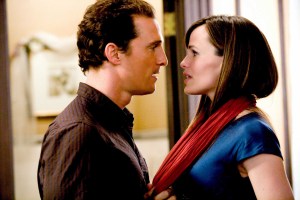 The movie is wholly unbelievable even for a contrived romantic comedy. The central romance between Connor and Jenny rests on the silly notion that after ten years apart, a lifelong selfish jerk can sweep his former girlfriend off her feet during a single crazy weekend. Connor’s redemptive arc is lackluster at best, and the movie just mimes the steps it feels that it needs to take to turn its lead insensitive jerk character into a sensitive jerk character. It doesn’t work. I refuse to believe for one second that a pretty, smart, confidant doctor such as Jenny would allow herself to get so completely suckered in by Connor’s “Baby I’ve changed” speech. It’s insulting and degrading. The compressed timeline reflects poorly on Jenny’s decision-making. The expedited timeline makes every human action seem far-fetched. There’s a scene where Connor opens a champagne bottle in the kitchen. The cork flies out and knocks one of the legs loose on the multi-tiered wedding cake. The cake is about to slip over when Connor slides in to stabilize it. Instead of redistributing the weight via the available legs, he tries reaching for the out of reach champagne bottle with his foot (the size of the bottle and the cake leg are not even close). A more believable situation would involve Connor trying to reach the fallen cake leg, not a champagne bottle, but alas. To make this example even worse, the filmmakers set up the disaster of a fallen wedding cake and then amazingly fail to show the goods. We only see the smashed aftermath. This is a comedy fundamental: set-up food disaster, let audience witness ensuing food-related disaster.
Ghosts of Girlfriends Past also doesn’t have one redeeming or marginally realistic female character. I would expect, given Garner’s star power and the natural importance of being the romantic lead, that Jenny would come across as a reasonable woman or someone worth fighting over. Sorry, Jenny is a powerfully underwritten character and Garner is left without much work other than serving as a reservoir of reaction shots. Seriously, that’s her main purpose in this movie; she is a cutaway image. Sandra (Lacey Chabert) is a shrieking high-maintenance shrew of a bride. The other female roles are largely one-note misogynistic fantasies (thanks male screenwriters Jon Lucas and Scott Moore). The trio of bridesmaids is gossipy chatterboxes and eager to get laid. Connor’s introduction to his future mother-in-law (Anne Archer) involves him casually groping her breasts, much to her prosaic approval. Connor has an irresistible way with the ladies, which makes everything without a Y chromosome want to sleep with the man. A young famous pop singer watches Connor dump three women simultaneously on an Internet conference call, insult them, and then she still strips off her clothes to bed the cad. She even states, “I don’t even know why I’m doing this,” and continues along. I’m just as confused what power Connor holds over the fairer sex because to me he’s just a twit.
 Here’s a telling example about how obvious this movie is written from an unenlightened male perspective: the central relationship dilemma is that Connor is afraid of cuddling. In the past, Jenny asked him to stay and cuddle but that was the breaking point, so he bolted. All of these women somehow manage to fall head over heels in love for a guy who willingly goes through women likes changes of underwear. It makes all the women comes across as emotionally needy, insecure, vapid bubbleheads who will sacrifice everything, including self-respect and dignity, to get a taste of McConaughey’s back sweat. Ghosts of Girlfriends Past is not a flattering movie for either sex.
The tone of this movie never finds an authentic and satisfying balance. Being a half-hearted tale of redemption during the period of a weekend, the movie crams in plenty of gooey sentimental claptrap. You’ll listen to characters talk about the true meaning of friendship, tear up over family memories, and then someone will make an inappropriate sex joke. There is a high level of semi-racy sex jokes that populate the world, appearing at odd moments, destroying any assembling emotions. Ghosts of Girlfriends Past will pretend like it’s building to something that actually matters and then it will throw it all away for a cheap sex gag — har har. There’s a moment where Douglas is illustrating how much ire Connor has wrought with visual metaphors. It begins to rain and he says that the downpour is made up of all the tears shed from ex-girlfriends and flings. Then it starts raining ripped pieces of confetti, and this we are told is all the tissues used. And then comes all the used condoms, and we watch Connor try and take cover before the aerial assault of used (and presumably “filled”) contraceptives annihilates him. It’s kind of gross and tonally disjointed from the rest of the sappy, happy PG-13 storyline.
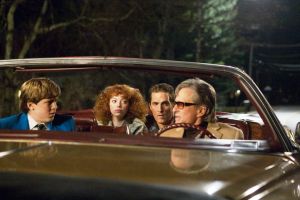 The movie is at its most amusing when it’s riffing on the expectations of following the Christmas Carol model. Connor is quite aware of the tried-and-true formula, so his comments along the way provide the movie’s only genuine laughs outside of Douglas. Really, Douglas’ character is the most entertaining character, and I kept wishing that the film would follow him even after death. Wouldn’t it be interesting to watch the life of a ghost involved in a Christmas Carol scenario? I imagine it would be a bit like a play rehearsal. I would enjoy seeing the behind-the-scenes work that goes into the scenario. I want to see ghostly foremen plot out unique scenarios for a list of real-life Scrooge cases, I want to see the ghost tryouts, I want to see the mechanics involved in the spiritual setup for this whole process. I enjoyed watching Uncle Wayne hit on his fellow spirits. But I suppose that approach would be too literary and break away from the cozy confines of the stillborn romantic comedy genre. And to prove that it is indeed a romantic comedy by the numbers, Ghosts of Girlfriends Past even includes the last minute dash to stop the romantic party from leaving via some method of transportation.
Ghosts of Girlfriends Past manages to squander every opportunity it has to be a better movie. The central idea could have worked but the execution is exceedingly lazy, charmless, and degrading to women in particular. The comic scenarios miss out on better laughs, and some of the better laughs are obvious and just around the corner, but the film routinely falls back on being a sexual farce. The characters don’t feel remotely like people and Connor is a terrible lead character with unfunny dialogue that reduces women to disposable pleasures. His transformation is contrived even for a romantic comedy. I’m not saying a cad character could not make for an entertaining lead here. Clearly Douglas is the best character, and his sleazy 1970s swinging sexpot has a fun Bob Evans vibe. Every moment he’s onscreen the movie comes alive in a new way, and Douglas is an actor that knows how to make lecherous appealing and appalling at the same time, like what Michael Caine pulled off in Alfie. This movie pales in comparison. Ghosts of Girlfriends Past should have been visited by the most important spirit of them all – the Spirit of Screenplay Rewrites.
Nate’s Grade: C-
Share this:

27 Dresses (2008)
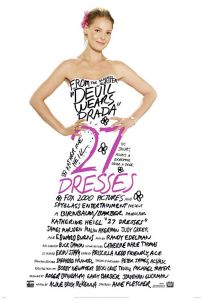 Katherine Hiegl is a likeable enough actress. She got her big break in 1994’s My Father the Hero, which had the exceptionally gross premise of having an adolescent’s father posing as her European lover to score the guy she’s really got her eyes on. The most memorable moment of the movie was a 15-year-old Heigl strutting around in a thong bathing suit. Her resume got better with a steady stream of network TV shows like Roswell and Grey’s Anatomy, and then she broke into another level of stardom thanks to the runaway success of [I]Knocked Up[/I] where she carried Seth Rogen’s baby. Then she told Vanity Fair that she felt Knocked Up was “sexist” and that the women were portrayed as shrews and that the men were fun-loving dudes (I must have seen a somewhat different movie). She’s entitled to her opinion, but what seems very odd is that Heigl’s follow-up to her breakout role is 27 Dresses, a romantic comedy about a woman who is a perennial bridesmaid and yearns for her own perfect wedding when her life will be complete.
Jane (Heigl) busies her time helping others to have heir ideal weddings. She has contributed to so many wedding ceremonies that she has amassed a closet full of 27 bridesmaid dresses that serve as trophies. Jane is in love with weddings. She is also harboring a crush on her boss (Edward Burns, wooden as always) that seems to be going nowhere. Jane’s younger sister Tess (Malin Akerman) comes to visit and immediately hooks up with Jane’s boss/crush. Jane’s wisecracking best friend (Judy Greer) is quick with a quip and declares Tess to be some very negative terms. Poor plain Jane is also taken aback when she meets wedding columnist, Kevin (James Marsden), whose fawning words about weddings are like poetry for Jane. He turns out to be a cynical guy who feels weddings and marriages are “the last legal form of slavery.” When Tess gets engaged to the boss man, wedding responsibilities fall upon Jane and Kevin is right beside her, ready to trade barbs about romance and perhaps start one of his own.
 27 Dresses hews pretty close to the familiar romantic comedy formula trappings. Opposites attract, bickering will lead to romance, and then true love will overcome all misunderstandings, that’s a given. Another given is the fact that we will get a montage of Heigl trying on all 27 titular dresses. 27 Dresses also includes the wisecracking best friend who has no purpose of her own but to comment on the troubles of our heroine with stark bluntness. Once again, this is the type of film where one character has some earlier, negative opinion or statement that resurfaces late to bite them in the ass after they have learned how flawed and shallow that original opinion was (otherwise known as the 11th hour misunderstanding). One party has a personal epiphany and runs to catch the other party leaving by some means of transportation (I’ve seen boats, taxis, motorcycles, barges, but usually they run to catch a plane). And then there’s the sing-a-long; oh what romantic comedy would be worth its salt if it didn’t include a group sing-a-long to some older tune that just united everyone in spontaneous song? 27 Dresses uses Elton John’s “Benny and the Jets” to rock out a beer bar. Really, “Benny and the Jets”? Rocking out a bar? And it’s not even a gay bar? Hmm. 27 Dresses is rather predictable from the first frame onward, but familiarity isn’t necessarily a deal-breaker for a strictly genre movie.
I’ve seen plenty of romantic comedies and I like to judge them fairly, so I use my patented cute-to-cringe count whereby I take stock of the number of times I smile, laugh, or find a moment, line of dialogue, or even choice of song that leaves a favorable impression. I then compare this figure with the number of times I want to roll my eyes, check my watch (if I had one), vomit, or any piece of dialogue or moment that feels so saccharine, so unbelievable even in the rom-com universe that I want to laugh derisively. The final tally for 27 Dresses was somewhere in the middle but I’ll admit it skewed closer to the positive “cute” side of the spectrum.
The acting overall really helps to make the most of the formulaic material. Heigl seems destined to thrive in the rom-com genre; she has an every girl appeal and seems apt making funny faces of seething indignation (take note of the amount of times she uses food in her mouth for comic effect). She seems like the heir apparent to Sandra Bullock movies. Her chemistry with Marsden is ripe and they bring out good thing in one another with their playful give-and-take. Marsden has a terrific smile (seriously, the man might have the best choppers in the industry) and is suitably dreamy but he also has an enjoyably droll delivery. Akerman plays a spoiled brat well, though she isn’t given the opportunities to flash her rather skillful comic skills that she displayed in The Heartbreak Kid remake. Greer is a top-notch scene-stealer and deserves her character deserves her own movie. She has the most fun role to play but Greer sinks her teeth into the character and delivers a juicy performance that feels slightly naughty, uncensored, and carefree.
The movie falters when it trips up in maintaining believability. There’s an extensive scene in a Goth bar/club where the costumed extras are acting like… costumed extras. It’s the least believable Goth club I have ever seen in a movie, not that I was expecting Hollywood fluff to pain an accurate picture. It’s just wall-to-wall stereotypes, but not only that, they’re distracting and lame and dated stereotypes. Then Jane marches outside to scream to the heavens an expletive-filled rant about her bad luck when, ut oh, right next door to the Goth club is an old couple celebrating their 50th wedding anniversary. What? Grandma and grandpa Old People celebrating their marriage vows next door to a Goth club? This incongruous setting takes a long, long while to set up one very blah joke that could have functioned anywhere. Realistically, the joke is that Jane is swearing unbeknownst to others, so why even have it next to the world’s crummiest Goth club? If you’re going that route, why not have grandma and grandpa Old People dressed in tacky Goth apparel as well? This may become my most nit-picky criticism of all of 2008 but it really stuck in my craw.
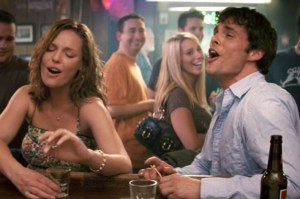 A better example is how the film handles Jane’s bratty sister, Tess. For 90 minutes we bare witness to Tess being a thoughtless, self-absorbed, lying, horrible human specimen, and then the movie tries to change strides. In the very end, it wants us to open up and look at Tess’ life and realize that she doesn’t have it so awesome because she was fired and dumped. Oh my, that must be perfectly excusable then for her rampant inexcusable, me-first behavior. If 27 Dresses has an antagonist in its midst than Tess is that bridezilla. The movie plays her bitchiness for comedy but then wants an audience to forget every whine and betrayal because, woe is her life, Tess wants to be happy. Tess remains an unsympathetic twit from beginning to end, no matter how hard the movie and its soft piano score try to change your mind.
The fact that 27 Dresses thought it could throw in some contradictory evidence at the last minute to make an audience forgive Tess is very telling. It showcases that the film has a hard time grasping the realities of characterization; Kevin is cynical about weddings because he was stood up at his; Jane must focus on making others happy because she is afraid of focusing on her self; Ed Burns is a douche. That isn’t necessarily an indictment on the film per se, just my honest opinion. 27 Dresses spells everything out in bold statements that hit like anvils, like when Kevin’s news editor congratulates him on his front-age story ridiculing Jane: “Hey, you got what you wanted, right?” Gag. The movie is too lockstep with the genre’s clichés that it doesn’t push hard enough with its characters, so we get plenty of intermittently cute moments but cute moments that will be easily forgotten and stored away like one of Jane’s hideous bridesmaids gowns.
27 Dresses is more or less par for the course in a genre littered with sappy clichés and cookie-cutter characterizations, and yet the movie possesses enough charm to outdistance its lapses in believability. The acting ensemble help make the movie enjoyable in parts, especially the chemistry between Heigl and Marsden. 27 Dresses passes the time but you wish that Heigl, Marsden, and especially Greer would be teleported to a better movie. One free from bitchy younger sisters, bar sing-a-longs, giddy dress-up montages, and Ed Burns. Did I mention that his character is a douche?
Nate’s Grade: C+


 nathanzoebl
You must be logged in to post a comment.