Blog Archives
Spy (2015)
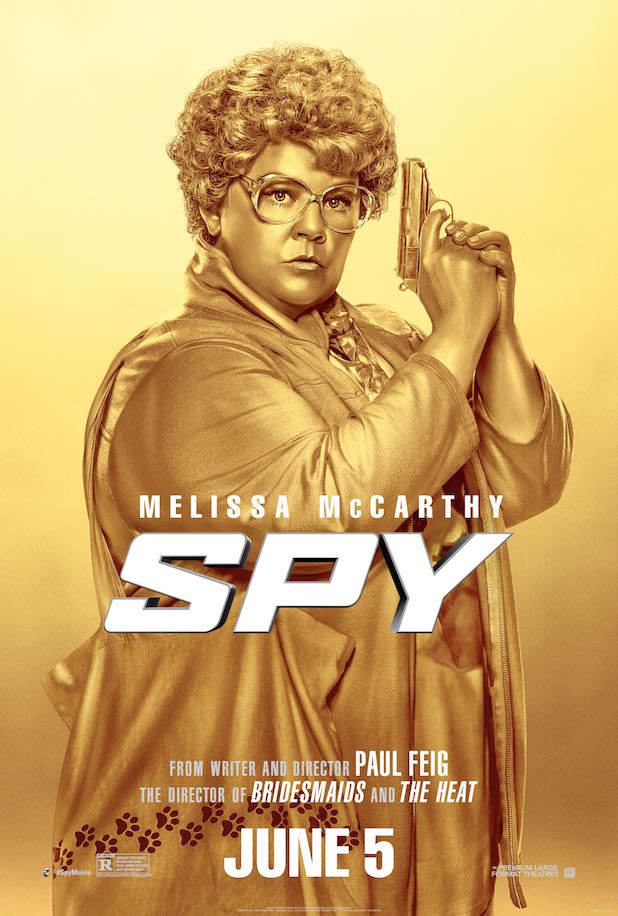 Melissa McCarthy’s meteoric comedic rise hasn’t been without its missteps, mainly the complaint that she seems stuck in a rut playing aggressively weird and foul-mouthed characters that are growing tiresome. McCarthy is never better than when teamed with her Bridesmaids’ director Paul Feig, and Spy is a welcomed return to form for a great comic actress who relishes being outlandish. The best part of the film is that it’s a character-centric comedy, with McCarthy as Susan Cooper, a CIA agent who works as a handler, the voice on the other end of the earpiece, guiding her partner the handsome Agent Bradley Fine (Jude Law). When Fine is compromised on a mission, Susan unexpectedly finds herself in the field to track down some very bad people. McCarthy does get to be vulgar, but fortunately it’s only one persona she adopts as a mask, and it’s cleverly utilized. Feig’s screenplay makes sure to find different comic beats as it goes, rarely repeating itself and, like any good action movie, finding twists to further develop conflicts. Part of what’s so enjoyable about Spy is how comic scenarios will evolve while staying true to the characters and the central conflict. Also, Feig acquits himself more than well with the film’s semi-slick action photography. The supporting cast is nicely tied into the story and matter and each actor has material to cut loose, none more than Jason Statham (The Expendables) as a hilariously boastful and incredulous agent. His boisterous chest-beating about his past deeds are some of the film’s funniest moments. Consistently funny, witty, and mildly progressive with its heroine, Spy is a vehicle that makes perfect use of McCarthy’s talents and then some.
Nate’s Grade: B+
Share this:

Dom Hemingway (2014)
 Undeservingly lost in the shuffle, Dom Hemingway is a brash and wildly entertaining dark crime comedy. Jude Law is a sheer force of nature as the title character, a charismatic and garrulous criminal with no shortness of ego or volume. He’s just getting out of a 12-year jail sentence and taking stock of his life. His wife is dead, his grown-up daughter (Game of Thrones’ Emilia Clarke) hates him for his absence, and his bosses are ready to reward him for his long silence. The only person who could screw things is up is Dom, and he does, as he’s prone to impulsive fits, shouting matches, and oversized bravado. This is really a series of comic vignettes and vulgar monologues, but the writing by Richard Shepard (The Matador) is slyly hilarious, leaving me in stitches throughout (“I am not burying your body today! I didn’t bring the right shoes for it.”). The comic voice here is assured and finely attuned to the broad wavelengths the characters. It’s not exactly he colorful, cartoon criminal universe of early Guy Ritchie films, but there’s a definitely heightened atmosphere here that blends well with the manic nature of Dom. Law is bouncing off the walls; you may have to wash the spittle off your TV. But he’s compelling from his first minute onscreen to his last. The third act squeezes in a degree of emotions though by then we’ve been enjoying the depravity too much to switch focus. I don’t think the work has been put in to make Dom a three-dimensional character, but that won’t stop Dom’s film from being a blast of entertainment with swagger to spare.
Nate’s Grade: A-
Share this:

The Grand Budapest Hotel (2014)
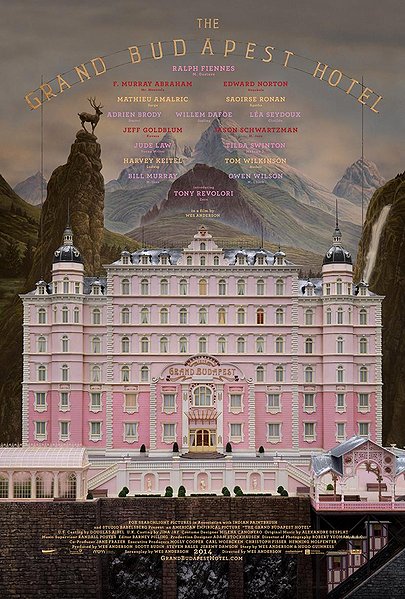 Wes Anderson is a filmmaker whose very name is a brand itself. There are a small number of filmmakers who have an audience that will pay to see their next film regardless of whatever the hell it may be about. Steven Spielberg is the world’s most successful director but just having his name attached to a movie, is that enough to make you seek it out and assume quality? If so, I imagine there were more than a few disappointed with War Horse and Kingdom of the Crystal Skull. But Wes Anderson has gotten to that height of audience loyalty after only seven movies, mostly because there are expectations of what an Anderson film will deliver. And deliver is what the quirky, fast-paced, darkly comic, and overall delightful Grand Budapest Hotel does.
In the far-off country of Zubrowka, there lays the famous hotel known the world over, the Grand Budapest. The head of the hotel, the concierge, is Gustave (Ralph Fiennes), a highly mannered Renaissance man who caters to the every whim of his cliental. Zero (Tony Revolori), an orphaned refugee, is Mr. Gustave’s apprentice, a lobby boy in training learning from the master in the ways of hospitality. Gustave likes to leave people satisfied, including the wealthy dowagers that come from far just for him (Gustave: “She was dynamite in the sack,” Zero: “She was… 84,” Gustave: “I’ve had older.”). One of these very old, very rich ladies is found murdered and in her rewritten will, the old bitty had left a priceless portrait to Gustave. Her scheming family, lead by a combustible Adrien Brody, plots to regain the painting, which Gustave and Zero have absconded with.
 For Wes Anderson fans, they’ll be in heaven. I recently climbed back aboard the bandwagon after the charming and accessible Moonrise Kingdom, and Grand Budapest is an excellent use of the man’s many idiosyncratic skills. The dollhouse meticulous art design is present, as well as the supercharged sense of cock-eyed whimsy, but it’s a rush for Anderson to pair a story that fits snuggly with his sensibilities. The movie is a series of elaborate chases, all coordinated with the flair of a great caper, and the result is a movie over pouring with entertainment. Just when you think you have the film nailed down, Anderson introduces another conflict, another element, another spinning plate to his narrative trickery, and the whimsy and the stakes get taken up another notch. The point of contention I have with the Anderson films I dislike (Life Aquatic, Darjeeling Limited) is the superficial nature of the films. As I said in my review for Darjeeling, Anderson was coming across like a man “more interested in showing off his highly elaborate production design than crafting interesting things for his characters to do inside those complex sets.” With this film, he hones his central character relationships down to Gustave and Zero, and he can’t stop giving them things to do. Thankfully, those things have merit, they impact the story rather than serving as curlicue diversions. We get an art heist, a prison break, a ski chase, a murderous Willem Dafoe leaving behind a trail of bodies, not to mention several other perilous escapes. This is a film packed with fast-paced plot, with interesting actions for his actors, maybe even too packed, opening with three relatively unnecessary frame stories, jumping from modern-day, to the 1980s, back to the 1960s, and finally settling into the 1930s in our fictional Eastern European country.
The other issue with Anderson’s past films, when they have underachieved, is that the flights of whimsy come into conflict with the reality of the characters. That is not to say you cannot have a mix of pathos and the fantastical, but it needs to be a healthy combination, one where the reality of the creation goes undisturbed. With Grand Budapest, Anderson has concocted his best character since Rushmore’s Max Fisher. Gustave is another overachieving, highly literate, forward-driving charmer that casually collects admirers into his orbit, but he’s also a man putting on a performance for others. As the head of the Grand Budapest, he must keep the illusion of refinement, the erudite and all-knowing face of the luxurious respite for the many moneyed guests. He has to conceal all the sweat and labor to fulfill this image, and so he is a character with two faces. His officiously courtly manner of speaking can be quite comical, but it’s also an insightful indication that he is a man of the Old World, a nostalgic European realm of class and civilization on the way out with looming war and brutality. And as played by the effortlessly charming Fiennes (Skyfall), Gustave is a scoundrel that the audience roots for, sympathizes with, scolds, but secretly desire his approval, much like Zero. It is a magnificent performance that stands as one of the best in any Anderson film.
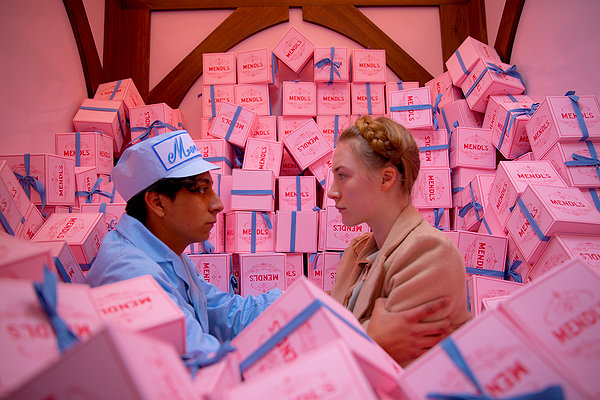 The fun of a Wes Anderson movie is the zany surprises played with deadpan sincerity, and there is plenty in Grand Budapest to produce smiles and laughter. It’s hard to describe exactly which jokes land the best in a Wes Anderson film because they form a patchwork that elevates the entire movie, building an odd world where oddballs can fit right in. It was under a minute before I laughed, and I smiled through just about every remaining minute of the film. I enjoyed a joke involving a dead cat that just kept being carried from scene to scene. I enjoyed a sexually graphic painting that just happened to be lying around. I enjoyed the fact that Zero draws on a mustache every morning to better fit in with the men of his day. But mostly I just enjoyed the characters interacting with one another, especially Gustave and Zero, which forms into the emotional core of the film. It begins as a zany chase film and matures as it continues, tugging at your feelings with the father/son relationship (there’s also a subtly sweet romance for Zero and a pastry girl played by Saoirse Ronan). One of the big surprises is the splash of dark violence that grounds the whimsy, reminding you of the reality of death as war and fascism creep on the periphery. In fact, the movie is rather matter-of-fact about human capacity for cruelty, so much so that significant characters will be bumped off (mostly off screen) in a style that might seem disarming and unsatisfying. It’s the mixture of the melancholy and the whimsy that transforms Grand Budapest into a macabre fairy tale of grand proportions.
The only warning I have is that many of the star-studded cast members have very brief time on screen. It’s certainly Fiennes and Revolori’s show, but familiar names like Bill Murray, Tilda Swinton, Tom Wilkinson, Jeff Goldblum, Lea Seydoux, Jude Law, Harvey Keitel, Jason Schwartzman, Owen Wilson, F. Murray Abraham, and Bob Balaban are in the film for perhaps two scenes apiece, no more than three minutes of screen time apiece. Norton, Brody, and Dafoe have the most screen time of the supporting cast. Though how does Revolori age into the very non-ethnic Abraham? It reminded me of Street Fighter: The Legend of Chun-Li (here me out) where, as she ages, Chun-Li becomes less and less Chinese in her facial appearance. Anyway, the brevity of cast screen time is not detrimental to the enjoyment of the film, considering all the plot elements being juggled, but I would have liked even more with the dispirit array of fun characters.
The Grand Budapest Hotel is Wes Anderson at his best, pared down into a quirky crime caper anchored by a hilariously verbose scoundrel and his protégé. Naturally, the technical merits of the film are outstanding, from the intricate art direction and set dressing, to the period appropriate costumes, to the camerawork by longtime cinematographer Robert Yeoman. The movie is a visually lavish and handcrafted biosphere, a living dollhouse whose central setting ends up becoming a character itself. The trademark fanciful artifice is alive and well but this time populated with interesting characters, a sense of agency, and an accessible emotional core. The faults in Anderson’s lesser films have been fine-tuned and fixed here, and the high-speed plotting and crazy characters that continually collide left me amused and excited. If you’re looking for a pair of films to introduce neophytes into the magical world of Wes Anderson, you may want to consider Grand Budapest with Moonrise Kingdom (Royal Tenenbaums if they need bigger names). In the end, I think Anderson more than identifies with his main character, Gustave, a man enchanted in a world of his own creation, a world better than the real one. Who needs the real world when you’ve got The Grand Budapest Hotel?
Nate’s Grade: A
Share this:

Side Effects (2013)
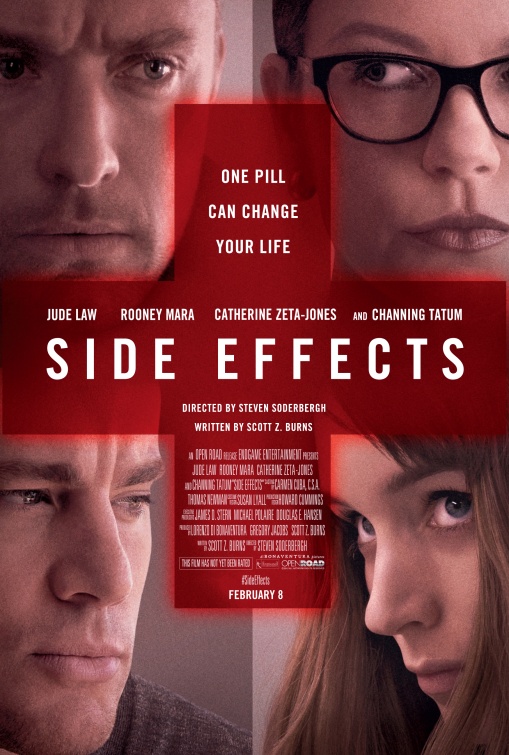 Steven Soderbergh’s supposed last stop before retirement is another of his genre exercises, but Side Effects feels like a firmer success, albeit modest, for the director to go out on. It’s the story of a woman battling depression, played with terrific cageyness by Rooney Mara (The Girl with the Dragon Tattoo). She gets prescribed a new drug and… does some very bad things. Who is culpable? The doctor, being funded by the drug companies? The woman who was sleepwalking at the time? The industry for blanketing patients with ads to demand their drug? After a rather slow start, the movie gets interesting and starts to try out different genres like hats. It appears for a good while we’re now going to be following her doctor (Jude Law) and his downfall as the industry turns on him and the media coverage intensifies. Written by Scott Z. Burns (Contagion), the movie has that same enticing sense of realism about how all the moving parts of a complicated industry would come into sync and conflict. Then the film tries out another identity, that of traditional thriller, with wronged parties orchestrating vengeance. I was invested until the end and felt sufficiently satisfied with the end results. Soderbergh’s smooth camerawork and cool color palate are well suited for a film about the battles of depression, and for a good while, before the thriller aspects take over, the movie is a fairly mature look at the struggles of depression and the industry that profits off it. Side Effects doesn’t seem like a closing statement for an artist as varied and unpredictable as Soderbergh, but as far as a Saturday afternoon goes, it’ll sure pass the time nicely.
Nate’s Grade: B
Share this:

Anna Karenina (2012)
 I’ve never read a Russian novel before, mostly because I don’t need to read 900 pages of bleakness and repressed happiness. With that said, I knew very little going into Anna Karenina (the very title sounds too heavy in syllables, like you’re stuttering). What didn’t help matters was director Joe Wright’s edict to set the story as if it was being performed on a living stage. This bizarre visual concept is interesting for a little while until you realize that it never goes further than the obvious note that the lives of the elites were played out in public for cruel judgment. The staging also gave me many periods of confusion where it felt like a character fantasy was taking place. The peculiar staging seems superfluous and the real draw for the film, not the relatively fine performances or Tom Stoppard’s (Shakespeare in Love) adaptation. I don’t think it works as a movie because, much like Wright’s Atonement, it feels too self-satisfied in its own mannered artifice. It’s an overload on style and the film neglects to give me a reason to care about the story and the characters. Keira Knightley as the titular heroine is hard to embrace, Aaron Taylor-Johnson (Savages) seems miscast as her dashing lover, and Jude Law (Hugo) comes across as unreasonably tolerable of his wife’s flights of fancy, so much so it makes it hard to sympathize with her downward spiral. It’s a pretty movie and I applaud its attempt to do something different, but Wright’s Anna Karenina feels too fanciful to come across as tragic.
Nate’s Grade: B-
Share this:

Rise of the Guardians (2012)
 Dreamworks animation has long existed in the mighty shadow of Pixar, but as of late the studios might be at a creative crossroads. After the excellent Kung Fu Panda films and How to Train Your Dragon, suddenly Dreamworks animated movies matured beyond feverish, pop-culture explosions and into character-driven, colorful, and genuinely heartfelt family films. I don’t think we’ll be getting something as dismal as Shark Tale again with the current path the studio is blazing. Rise of the Guardians looks like the pilot for a new lucrative Dreamworks family franchise. It’s easy to see the appeal for a superhero assembly of fantasy figures, though is every region going to have working knowledge of the Tooth Fairy? The movie just looked too silly to function for me, but I was optimistic after raves from a few trusted friends. Perhaps my own childlike sense of wonder is permanently replaced with a heart of stone, but I found Rise of the Guardians to be a somewhat entertaining but mostly stilted, intellectually and emotionally, journey.
The guardians are an ancient group of holiday-themed characters entrusted with keeping the sense of wonder alive in children. There’s Santa Claus, a.k.a. North (voiced by Alec Baldwin), and his army of yetti workers, the tooth Fairy (Isla Fisher), and her own collection agency of tooth-gathering fairies, the Sandman, in charge of the sweet dreams of children, and the Easter Bunny (Hugh Jackman), an Australian jack rabbit with a bit of a chip on his bunny shoulder. The world is threatened by Pitch (Jude Law), a bogeyman who desperately desires children to fear him again, because belief is what powers the Guardians. To stop Pitch and his array of nightmare creatures, the Guardians must add another member to their outlet, Jack Frost (Chris Pine). Except Jack has no interest in joining this fuddy-duddy group and would rather do his own thing, which usually involves wrecking havoc. Jack’s desperate to find out his past and figure out why he was chosen for his immortal role and what it will take to make kids believe in him.
 Ultimately, I just couldn’t really get into this movie. It’s set up like an Avengers team of children’s fantasy figures, but I felt like the movie failed to make me emotionally connect with their plights. The Jack Frost protagonist was another tired variation on the selfish, plays-by-his-own-rules cowboy character that needs to learn a dash of personal responsibility and putting others first. But his goal is essentially to be… seen. He’s worried kids will never see him because they won’t ever believe in him. That’s a fairly abstract existential crisis for your main character to have, and one that I found too odd to care about. The entire core of the movie revolves around children’s sense of belief, and unless you’re twisting this into some general statement about the purpose of faith (the Man in the Moon = God?), then I find it all to be silly considering we’re talking about the Tooth Fairy and Easter Bunny. I mean, the main kid (Dakota Goyo) has to be eight or nine years old and still fervently believes in these mythical creatures, to the point that he is literally the only person on the planet who believes at one dour point (sheesh, talk about how easily disillusioned kids can get these days). We’re celebrating a kid going into adolescence believing in these things. That just smacks me as a little weird if you stop and think about the film’s implications. This kid is going to grow up socially warped. Then again his beliefs are proven right, so maybe it’s just the rest of us cynical bastards out there who need to adapt. I guess I’m going to go accept my fate and be a crotchety old man now.
The plot feels too airy for my liking, too frenetic to get to the next set piece or chase sequence. It doesn’t feel like it ever takes the time to settle down and develop its characters or story. As a result, we’re left with a fairly middling backstory for Jack Frost that should be easy to figure out, but we’re also stuck in a world that doesn’t feel like the rules have been sufficiently explained. Case in point: the Tooth Fairy keeps all those baby teeth in one huge archive because, you see, the teeth hold memories. I guess. But then Jack’s after his own teeth to retrieve his forgotten past (yes folks, we have an amnesiac protagonist). I’m okay with this so far though it’s a tad forced, but when Jack does get those teeth, he’s presented with memories at the age of 18. I know people suffered through poor dental hygiene hundreds of years ago, but you cannot expect me to believe that Jack is still losing baby teeth. This is just one example where the movie didn’t come across as fully formed. The Guardians all seem to possess different super powers involving space-time travel, but then they don’t seem to do anything with these abilities that matters by the final battle. Pitch has the ability to craft nightmare creatures and all he does is end up making wispy evil-looking horses. That seems like a waste. There are not enough payoffs here with all the imaginative possibilities.
Rise of the Guardians has some enjoyable moments but it practically relies upon you to supply all the work as far as character empathy. We’re familiar with these magical figures, and so the movie gets by because we put in the emotional connection to Santa and the Easter Bunny, but the characters just don’t register on the page, at least with this story. I don’t know if David Lindsay-Abaire (Rabbithole, Inkheart) was the best candidate for the job, but he doesn’t give me enough reasons to engage with the movie. The characters are lackluster, their conflicts feel too abstract, the conclusion feels superfluous, and the world feels poorly defined, developed, and unsatisfying.
 I like Chris Pine (Unstoppable) as an actor, but the man brings absolutely nothing to the table when it comes to voice acting. Baldwin (Rock of Ages) and Jackman’s (Real Steel) performances are defined by their respective accents. I feel like Hollywood needs some sort of seminal moment to go back to genuine voice artists rather than hiring whatever celebrity. Yes we all enjoyed Robin Williams as the Genie in Aladdin, but are you going to tell me that Pine’s vocal work was so exceptional he had to be cast? It’s like having celebrities provide the voices for the helium-sounding Chipmunks. The best voice actor in the film is clearly Law (Sherlock Holmes) who does such a good job I felt more sympathy for him than I did Jack Frost. I know it’s commonplace in movies for the hero and the villain to have some duality, but I wasn’t probably supposed to jump ship as far as loyalty. Maybe I just found the actual kids in the movie to be annoying so I didn’t mind a magical creature preying upon their collective childhood fear. It reminded me of the space cloud villain from 2011’s Green Lantern flop, where I wondered if this fear-sucking cloud sought out the delicacy of children’s fears first.
To top it all off, I found myself left rather cold by the visual aesthetics of the movie. It has this overly androgynous, big-eyed anime feel, and I kept getting the sense that the whole movie looked like an extended video game cut scene. This movie even had Guillermo del Toro (Hellboy) and the brilliant cinematographer Roger Deakens (Skyfall) as producers or visual consultants, so I’m even more baffled at how visually poor I found the movie. The colors are so muddy and the visuals felt so limited for me, especially considering the imaginative parameters of the characters and their respective worlds. I thought Pitch seemed oddly similar in visual approach to Hades in Disney’s underrated Hercules. The action sequences had some nice visual panache to them as far as choreography, but I couldn’t stop thinking how cruddy and dreary everything looked.
Rise of the Guardians is based upon a series of yet-to-be published books by famed author William Joyce, who won an Oscar himself the previous year for the animated short, The Fantastic Flying Books of Mr. Morris Lessmore. I feel like that short was a better representation of magic and imagination than this film. The humor, the life lessons, the character development, it all felt so stilted to me. I thought the conflicts were too abstract and hard to care about (oh no, people have stopped believing in the Tooth Fairy!) and the world and rules felt too amorphous, poorly explained and creatively handicapped. If you’re going for a fantasy setting with larger-than-life figures, each with certain gifts and powers, hen I want the promise of that setup to be fulfilled. Rise of the Guardians isn’t a bad movie by any means but it left me cold and indifferent. It’s meant to strike at my childish sense of wonder, but I felt too often like a cynical adult, picking apart the frailties of its storytelling and muddy visual designs. It felt like it was missing the best magic of all: gifted storytelling. You’ll probably have more fun than I did, but that’s just because I probably have no soul.
Nate’s Grade: B-
Share this:

Sherlock Holmes: A Game of Shadows (2011)
 Delivering pretty much more of the same, Sherlock Holmes: A Game of Shadows isn’t exactly an improvement over the classic detective’s first foray into out-and-out Hollywood action cinema. The real treat of the budding franchise is the comic interplay between Holmes (Robert Downey Jr.) and Watson (Jude Law). Their harried banter makes for the best moments. Once again the plot is overwrought, the side characters underdeveloped (poor original dragon tattooed girl, Noomi Rapace, given absolutely nothing to do but run in a gypsy skirt), mysteries that you give up and just wait for Holmes to explain, and a villain that proves to be lackluster. For Moriarty (Mad Men’s Jared Harris) to be the nemesis, the intellectual equal of Holmes I’m going to need to see much more than this. There is a fine sequence at the very end where Holmes mentally envisions the steps of his attack and then Moriarty joins in: “You think you’re the only one who can do that?” They hold an entire duel fought step-by-step in the imagination. I wanted more experiences like this, but director Guy Ritchie (Snatch) falls back on his signature stylized action sequences of fast whooshing and quick spinning. The action is a step up from the first Holmes, and that will be enough for most ticket-buyers. I’ll admit there is a certain meta-literary charm at watching Arthur Conan Doyle’s signature detective fighting his way through an armed body of baddies. Whatever your feelings were for the 2009 Sherlock Holmes, I’m fairly certain you’ll revisit them in their entirety with Game of Shadows. I know I did.
Nate’s Grade: C+
Share this:

Hugo (2011)
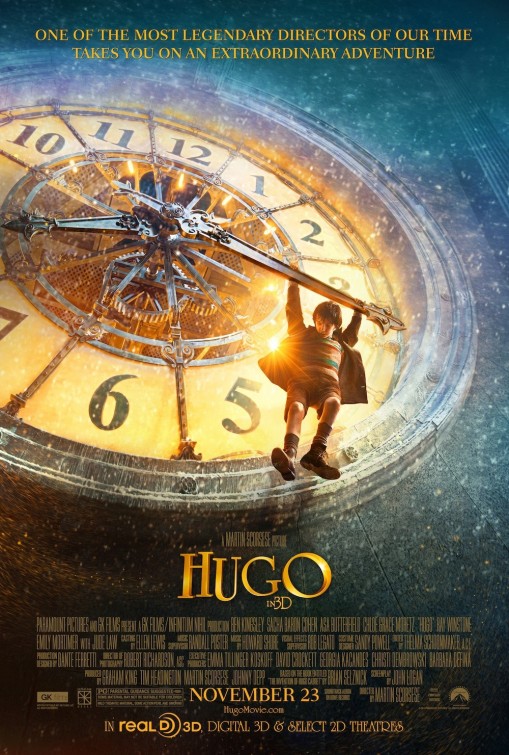 Martin Scorsese tackling a children’s film feels like an odd fit for the man responsible for classic gangster epics and symphonies of violence. But if David Lynch, Kevin Smith, Tim Burton, and Danny Boyle can all make family films that don’t make your brain rot, then why not the greatest living director? Maybe notorious sadist Lars von Trier will be next. Adapted from the award-winning children’s book, Hugo is, as my pal Eric Muller put it, a family film for film historians.
Hugo (Asa Butterfield) is an orphan boy living beneath the walls of the Paris train station. He’s secretly the one responsible for winding up all the clocks and keeping time. He has to stay one step ahead of the Station Inspector (Sacha Baron Cohen), who snatches wayward boys and sends them off to an orphanage. Hugo has been swiping clock pieces from the booth of a mysterious toy collector, George (Ben Kingsley). He needs the tiny pieces to fix a metallic man that Hugo and his late father (Jude Law) had been working on together. Hugo is convinced that if he fixes the metal man the automaton will write out one last message from his father. Hugo befriends George’s niece, Isabelle (Chloe Grace Moretz), and the two of them explore the various shops and shopkeepers of the station. As they uncover more clues, the kids realize that George is actually George Méliès, the filmmaking pioneer best known for the 1902 fantasy, A Trip to the Moon (the one where the moon gets a bullet in its eye).
 Scorsese’s first foray into 3D filmmaking is a rousing sensation for the eyes. The images pop without superfluous objects flying at the camera. The depth of field is nicely and creatively toyed with by Scorsese. Best of all, the 3D enhances the story rather than distracting you. Hugo is a celebration of the advances in moviemaking, and 3D is the latest advancement meant to make the theatergoing experience special. Of course the theatergoing experience has always been special, as the movie indicates. Where else but a theater can we collectively bond with a group of strangers, laughing collectively, feeling the pangs of emotion in unison? There’s a thematic rationale for Scorsese’s use of the third dimension. He masterfully fills the screen with wonderful images, like the massive inner working of clock towers. Scorsese’s signature tracking shots zoom in through the wintry 1930s Paris landscape and train station. A visual highlight is when a trunk of sketches busts open, the papers scattered all over the screen, some moving like flip books, creating the illusion of animation. I can honestly advise people to seek out a 3D showing of Hugo if given the option. For once, it’s worth the extra dough. I only anticipate making this same recommendation for the upcoming Piranha 3DD.
It’s the second half where the movie shows its true intentions, becoming a love letter to the power of cinema and the early pioneers of the art form. Scrosese has long been a historian of the movies, and Hugo is his celebration of the early cinematic dream makers, notably Méliès and his surreal theatrical landscapes. Arthur C. Clark famously said that “any sufficiently advanced technology is indistinguishable from magic.” That’s what early cinema was to a populace that had never seen the likes of moving pictures (we see an early audience fearing for their lives watching a film of a train arriving). It was like a new magic. The turn-of-the century filmmakers like Méliès were charting new terrain as visual storytellers, opening the public to new wonders of the imagination. Simple tricks of editing substitution, dissolves, and visual arrangement could help foster the ongoing illusion. It may be low-rent, like hand painting individual film frames, but it was the special effects of their day. D.W. Griffith once said of Méliès, “I owe him everything.” Scorsese is sharing his passion for the history of the movies and it’s hard not to feel the power of the movies.
But when Hugo gets swallowed whole by Scorsese’s nostalgia, the rest of the plot becomes incidental. The characters, which were not strong to begin with, are given pat resolutions that make you realize how flimsy the characterization is. The movie takes a sub-Amelie route, letting Hugo bring together disparate couples, but you don’t really know anything about these people. Emily Mortimer’s female florist has maybe two lines in the movie, so why should I root for her to get with the Station Inspector? There’s an older couple whose romance is sabotaged by an aggressive pooch. You can imagine the scintillating resolution that awaits. The film history section is honestly the best part of the movie, but it means that everything leading up to that point was just in service to prop up the academic nostalgia. It means that the characters and their mysteries were really unimportant, and they feel that way by film’s end. The movie just grinds to a halt. The mystery of the metal man is that he’s a MacGuffin, a means to discover Méliès’ past. The whole clockwork symbolism can be clumsy, instructing us time and again that people are broken and Hugo feels the need to fix things. Too bad he couldn’t fix the disjointed story.
 The actors manage to make favorable impressions when they can fight free of the movie’s educational pull. Butterfield (The Boy in the Striped Pajamas) is a strong lead actor who rises above the sniveling preface of his character. He makes you root for the kid even when we don’t really know much about him beyond his Dickensian conditions. The kid has some pretty piercing Paul Newman-esque blue eyes too. Moretz (Let Me In, Kick-Ass) is showing the poise and grace to make it long term in this business. Kinglsey (Shutter Island) is effectively curt with his poorly veiled pain and regret. Cohen (Borat) expands his dramatic range noticeably, adding touches of empathy for a character that could mostly have been arch and cartoonish. He’s still the film’s best source for comedy. Michael Stuhlbarg (A Serious Man) makes a welcomed appearance as an expert on early filmmaking, Méliès especially. He serves as the mouthpiece for Scorsese’s passion.
Hugo is a family film that ultimately gets swallowed whole by the filmmakers’ passion. It makes for an entertaining and informative essay on the skill and vision of turn-of-the-century filmmakers, but if people are anticipating a fun story about a scrappy kid and his mischievous adventures, then this is not that movie. Hugo benefits from terrific visuals, strong acting, and Scorsese’s blend of whimsy and innocence without stooping to anything crass or lowbrow. Hugo aspires for the rich, romantic experience of a Jean-Pierre Jeunet film (Amelie, A Very Long Engagement) but comes up short. Hugo is at turns charming and magical but as a narrative it is too often flimsy, a wispy thing meant to lead to Scorsese’s love letter. It’s a fine and fitting tribute but even the best and most powerful love letter can only go so far, never mind the hassle of special 3D glasses.
Nate’s Grade: B
Share this:

Contagion (2011)
 For the germophobes amongst us, you probably want to skip seeing the new thriller, Contagion. Like for life. Never see this film if you’re the type that needs a paper toilet seat cover before sitting down to do their business. Contagion is a movie that makes you reevaluate basic human interaction. You may not leave the house again without covering yourself in plastic and a year’s worth of Purel. Director Stephen Soderbergh (Che, Ocean’s Thirteen) has assembled an all-star cast to drop like flies like only Hollywood’s most talented can do. Contagion is an intelligent, unnerving, technically authentic thriller that will make you cringe just watching people cough.
Contagion’s main character is a virus that begins its origin in a Hong Kong casino and quickly spreads from there. A British model takes it to the UK, a Chinese waiter goes home infected, a Japanese businessman keels over dead on a return trip home, and Beth Emhoff (Gwyneth Paltrow) comes home from her business tripe back to Minneapolis and goes into seizures. The next day, she’s dead and soon after having her brain dug out for an autopsy. The spooked docs alert the Centers for Disease Control immediately; something is definitely wrong with Paltrow’s brain (insert Coldplay joke here). The head of the CDC, Dr. Ellis Cheever (Laurence Fishburne), and his specialists track the expansion of the virus. He dispatches Dr. Erin Mears (Kate Winslet), to Minnesota to coordinate inter-agency action and interview Beth’s husband (Matt Damon), who appears to be immune to the virus. He’s in shock and isolated from his remaining daughter. He’s still trying to make sense of how quickly everything fell apart for his family. Capitalizing on fear, anti-establishment medical blogger Alan Krumweid (Jude Law) steers a panicked public toward a homeopathic medical alternative that he just so happens to have a financial stake with. The World Health Organization sends Dr. Leonora Orantes (Marion Cotillard) to investigate the Hong Kong casino and overview hours of security footage to glean the origins of the virus. But she, like others, soon find themselves in ever-increasing danger as the world races against time to beat this new threat.
For those expecting an action-thriller with plenty of doctors barking moral quandaries and racing against time to escape government agents… you will be sorely disappointed. Contagion is much more cerebral, cool, like a scientific procedural that plays the premise out in a realistic fashion, which means it’s often short the fireworks that mainstream audiences have come to expect from disaster movies. The CDC is really the main setting as they try and determine the origin of the virus, breaking down the virus, and projecting its rate on infection and contamination. Soderbergh has onscreen titles indicating how large the population centers are for the plot settings, reminding us simply with text how vulnerable to danger all those people are. The real pleasure of the film is watching A-level Oscar actors puzzle out how to solve this multi-faceted crisis. The movie does a minimal amount of explanation and expects an audience to be able to keep up with its scientific analysis. Soderbergh’s film is much more in keeping with The Andromeda Strain than Outbreak (find that monkey and all will be happy again!). You witness smart people doing smart things and still making little traction. This isn’t necessarily Irwin Allen territory of disaster. It’s a disaster that seems all too reasonably possible rather than being trapped in the belly of a ship that has turned upside down. Getting sick is a lot harder to avoid especially in our modern world. Globalization has done many wonders for the world, but by making the world a smaller place it also means that we’re all much more susceptible to the spreads of pandemics. No longer can geography be held as a total defense. We’re all one flight away from the spread of the next great illness (as the end credits to Rise of the Planet of the Apes also remind).
Soderbergh and screenwriter Scott Z. Burns (The Informant!) cast a wide net all over the world to see the ramifications of crisis. Things go rather quickly. By the end of the first week, the CDC is coordinating its resources and media strategy to not inflame panic. Easier said than done when ignorance and fear are in large quantities. The reaction to the news, the intra-government squabbles over resources and money, the exploitation of fear by opportune business types, the rising resentment of those left out of the loop, and even the kidnapping schemes for those known to have access to medicine. Contagion works because it gets the details right without losing track of the big picture. The film feels eerily plausible at every beat. Nurses are on strike refusing to be near the sick until uniform safety protocols are established. Funeral homes refuse to handle infected bodies out of health concerns. These are absorbing details that feel completely authentic yet would easily have been overlooked in other disaster pictures. The movie even addresses recent pandemic fears related to H1N1, SARS, and the perceived “overreaction” when these potential worldwide disasters turned out to be milder bugs. A government agent asks the head of the CDC if some terror organization could have weaponized the bird flu. “They don’t have to. The birds are already doing it,” the CDC head replies.
While Burns lies out a host of characters and scenarios with increasing tension as stakes mount and the death toll rises, Contagion just kind of drifts into an ending for the last 20 minutes. I was expecting another big wallop, some kind of sudden plot turn that reestablished an ongoing threat, but it wasn’t to be. The tension just sorts of lets out slowly like a balloon, playing against movie laws. That means that Contagion, wile tense, eschews a dramatic buildup for a climax. Burns and Soderbergh instead to play out their realistic “what if” experiment to its conclusion, which makes for a realistic if somewhat inert final act. There’s no chasing monkeys or butting with government agents willing to sacrifice infected town for “the good of mankind”; it’s just government employees doing good work and trying to minimize damages. It’s exciting to watch smart characters break down a nasty new virus and try to understand it and get ahead of it, but once they succeed, it’s not as exciting to watch the aftereffects of people getting better and returning to a normal existence (minus 30 million people on the planet – the solution to fixing unemployment?).
 Because the emphasis is on the cross-sections of plot and scientific breakdown, the emotional connection to the characters is limited. There are a lot of famous faces that appear in this movie; even bit parts are taken up by the likes of Bryan Cranston (TV’s Breaking Bad), John Hawkes (Winter’s Bone), Demetri Martin (Taking Woodstock), Enrico Colatoni (TV’s Veronica Mars). Damon (The Adjustment Bureau) is probably the closest thing the film has to an emotional center. He’s immune to the virus but he has to watch his family fall apart with the knowledge that his wife was Patient Zero. On top of that, he has to deal with the fact that she was cheating on him. That’s a healthy brew of emotions to confront in such a heightened situation, and Damon does a nice job of putting a human face to the mass tragedy. Winslet (The Reader) is superb as a CDC investigator, so duty-bound that even when she awakes to discover she has become infected she goes through protocol trying to investigate who serviced her room so that others will not share her fate. Law (Sherlock Holmes) is suitably sleazy as a moral relativist trying that uses his army of Internet followers to discredit the government’s response. Fishburne (Predators) has terrific poise as the man in charge of scrambling the response forces, keeping his cool, and being the public face of the government response until an all too human scandal tarnishes him. But perhaps the best performer is Jennifer Ehle (Pride and Glory, The King’s Speech). She plays one of the chief CDC scientists studying the virus and takes some extreme measures to test a potential vaccine. She has a scene with her sick father that is likely the most emotionally affecting moment in the film. Her sturdy determination even when most vulnerable is selfless.
Contagion is a smart by-the-book procedural thriller that may not be dramatic enough for audiences fed by Hollywood disaster films. The film is far more analytical and detail-oriented to its benefit and sometimes detraction. It’s got stars galore and some plenty of rising tension, but the film also follows a realistic blueprint toward a rapid world response to a new pandemic, which means that well-developed characterization is spared amidst all that fraught scientific lingo. As a result, Contagion feels more like a docu-drama than an amped-up Hollywood thriller with its finger firmly pressed upon American anxieties. Contagion is a bit overextended and data-heavy. It’s a stripped down indie in studio clothing. Soderbergh’s movie is a bit too lean and clinical to be fully satisfying and emotionally engaging, especially with its somewhat inert ending. It’ll sure make you look at free bowls of peanuts differently. And Gwyneth Paltrow’s skull.
Nate’s Grade: B
Share this:

Repo Men (2010)
 It’s not unheard of for different writers to independently create similar projects. Remember back in 1998 when there were two animated bug movies and two apocalyptic asteroid flicks? Granted, those were big budget studio movies and the final films had little in common other than concept or premise. Repo Men takes place in a world where people open contracts on new organ transplants, but if the buyer is late on the payment then a repo man will come and take back the merchandise. This gory premise might sound familiar for fans of the Goth opera, Repo: the Genetic Opera, which was released a whole 18 months earlier. The makers of Repo Men and Repo have engaged in a he-said/she-said argument over who originated the idea. Repo Men‘s screenwriters claim they came up with the concept in 2003, though the book the film is based was only released in 2009. The Repo team point out that their funky little musical began as a theatrical show that was first performed in 2002. The songwriters behind Repo say that the idea itself goes back to 1999 and began as a 10-minute opera experiment. I suppose we’ll never know who really had the idea first, though I’m inclined to side with the Repo musical fellas because they can back up their claims with evidence. It seems like a whole lot of squabbling over so little, but hey, that’s Hollywood for you.
In the not-too-distant future, one corporation, The Union, seems to hold sway in the world of organ transplants. Remy (Jude Law) is an expert repossessions officer who will slice open anybody 90 days late on his or her payment. His wife wants him to transfer to sales; it’s less messy. Remy’s partner (Forest Whitaker) is an old childhood friend and doesn’t want to lose his butcher buddy. One night, Remy is sidelined by some malfunctioning equipment that fires his heart. He has no choice but to get his own organ transplant. Following the operation, Remy finds that he no longer has the stomach for his old line of work. Remy’s newfound moral compass comes at a cost. He quickly falls behind in his payments and his old bosses plead for Remy to refinance. Reluctantly, they sic the repo men, including Whitaker, on Remy to retrieve company property.
 Repo Men takes some nice commentary on predatory lending, pushing the hard sell knowing that the customer can never stay ahead of the mounting fees and payments. The allegory has some sharp moments. However, the movie would have benefited from being pushed further in pretty much every regard. The side characters are horribly shallow. I’m fairly certain that Carice van Houten (electrifying in Black Book), as Remy’s beleaguered wife, could have been replaced with a cardboard cutout boasting a disapproving look. She gets to glare and complain and talk about family issues and then she’s gone, replaced entirely by Beth, a mysterious organ replacement junkie. Beth could have an intriguing back story, and the concept of surgery addiction could dwell upon the human cost of beauty and “upgrading,” but alas, her real purpose is to become an oddly implacable love interest for Remy. She gets to hold his hand while they run. That’s her main contribution (except for one key scene detailed below).
The entire concept of a future world held hostage by a greedy health care corporation could use more contemplation. What is happening with society? No epidemic is ever mentioned, so why do people start contracts on million dollar organs? Do the heavy debts pass on to the next of kin? What is the legality of organ repossession? What level of competition is there out there in the market? What does the government have to say about all this? Does this mighty company supersede the U.S. government? How come Remy can’t even get an employee discount on the merchandise? Has anybody had enough surgeries to become the six million dollar man? There is a wealth of questions born from this premise, but the movie only scratches the intellectual surface and sets its standard change-of-perspective morality storyline into gear. I actually would have found the life of an organ salesman to be more dramatically appealing. What kind of ethical rationalizations take place in the mind of a man who makes his living signing saps into modern indentured servitude? I find that story direction to be more compelling than following the guys who bring back the company merchandise.
But then something weird happens. The movie gallops to a satisfying close, and then it somehow gets even better in its closing moments. I was certain that I was going to write off Repo Men but then 4 things happened to make me sit up straight in my chair (I’ll refrain from any large spoilers):
1) In a film relentlessly aping the visuals of other, superior dystopian films, there’s not much new to look at. You’ve seen this future society thing before, just with more flying cars or jet packs. I came to terms with this; it’s not every movie that reinvents how we interpret the future short of some calamity. Then when Remy breaks into the Company HQ, which is awfully easy by the way, he stumbles into the genetic organ hatchery, if you will. Rows and rows and rows of scientists tinker with organ replacements. The entire environment is a strikingly sterile white, including the scientists wrapped in bulky white biohazard suits. Then Remy and Beth make a run for it, and they are covered head to toe in black. It’s a fabulous visual image, watching the color contrasts. It’s debut director Miguel Sapochnik’s high point.
2) Once Remy and Beth move beyond this laboratory, they get caught in a hallway, and Remy proceeds to take out a mob of employees. The fight sequence is several minutes long and a clear nod to the memorable extended hallway fight in Oldboy (Remy takes out a hammer as his final weapon). Weirdly, Remy’s opponents are suit types, middlemen, office employees, numbers crunchers, but they all leap into battle to take out the corporate intruder. The fight sequence is bloody and stylish enough to please the senses, like when Remy swings a hacksaw and we get Swinging Hacksaw POV as characters duck out of the way lest their jugulars get sliced.
 3) Following this, Remmy and Beth must deposit their corporate-licensed organ replacements. This involves cutting each other open, taking a bar code scanner (think a grocery check-out), and digging inside each other to get those subcutaneous scans. What’s amusing is that the scene is blatantly juxtaposed as a sex scene; Remmy and Beth intimately penetrate each other, the editing cuts to close-ups of moaning, and the other tries to soothe the pain with physical assurances, and it’s all set to a slow jam. It’s something of a bizarre sequence, especially upon further review (how effective can scanning for bar codes be inside the gook-filled human body?), but man is it interesting.
4) Just as I had come to terms with the movie settling for a conventional conclusion, the movie pulls the rug out from under you. It offers up a last-minute ending that upends the conventional framework, and, actually, presents the easy coast to a conventional stop in a new light. This is one of those rare instances where a last-minute ending twist actually improved the film. More often than not, a last-second twist is forced and the nail in the coffin of lasting entertainment.
Repo Men is a competently looking, competently entertaining sci-fi thriller that miraculously stumbles into a final act that not only works, it elevates the rest of the movie. My mild boredom vanished and I started wondering why they made me wait so long for the good stuff. Repo Men is a mixed marriage of overall tone. One second it will be darkly humorous, the next it will be satirical, the next it will pine for serious drama, and occasionally it goes for Guy Richie-styled slapstick. A sequence where Remy describes the three occasions he’s been knocked out, with visual interludes, feels like a deleted scene from an entirely different movie. The movie never really settles, touching upon a lot of areas but mostly poorly. The script desperately needed to be fleshed out to make any lasting impact. Now that I’m living in a two-Repo world, I’ll probably stick with the campy musical fun of Repo: the Genetic Opera. At least that movie left you humming.
Nate’s Grade: C+


 nathanzoebl
You must be logged in to post a comment.