Blog Archives
The 40-Year-Old Virgin (2005) [Review Re-View]
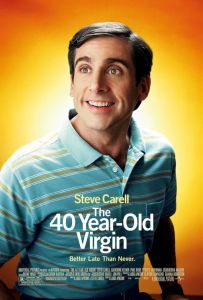 Originally released August 19, 2005:
Yes it’s an uproarious sex farce, that’s a given from the ads, but this movie is also surprisingly sweet and genuinely moving. A lot of credit goes to star/co-writer Steve Carell and co-writer/director Judd Apatow, creator of some of the best, most honestly funny TV series unjustly cancelled. Apatow is a master at mining human comedy for pathos, where you get a great sense of character and really feel for those onscreen, and yet nothing feels cheap or unwarranted, all the while deriving comedy from the situations. We need more men like Apatow in the film industry. Carell can do it all whether it’s deflecting his insecurity, which we feel so bad when he comes up with outrageous things he’s overheard to make himself seem like one of the guys. The supporting cast is top-notch. They’re basically the stock roles in a sex comedy and yet they bring so much more to the table, with a true-to-life boys-will-be-boys camaraderie that you can identify with. The character relationships in The 40-Year-Old Virgin really elevate the story and the jokes and make the film something really special. It’s not merely a barrage of gross-out humor; it’s a nice story with some very tender moments. This is a movie that goes well beyond its gimmick premise, never feeling like a skit blown up into a feature film. It mixes in psychology, heartbreak, awkwardness, but also insights into loneliness and human connection. The best character-based comedy in years.
Nate’s Grade: A
——————————————————
WRITER REFLECTIONS 20 YEARS LATER
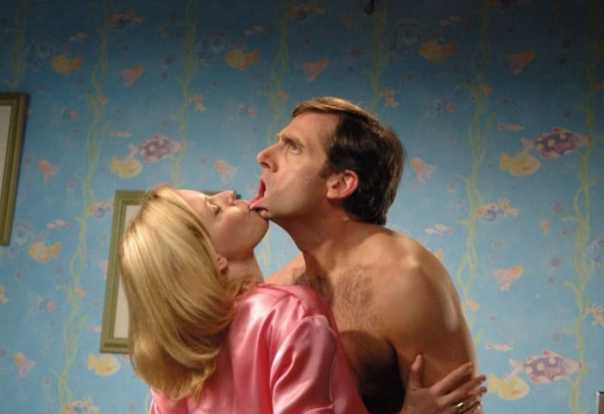
It’s always an interesting prospect to revisit beloved comedies decades after their impact. Comedy is, by its nature, a form of entertainment with the shortest shelf life. What one generation and time considers funny may prove antiquated or offensive the next or, just simply, not funny. I challenge readers to watch the old vaudeville routines and really try to laugh, not just snicker or titter but laugh, the kind of laughter where you have to hold your sides and worry about losing bladder control. Shakespeare wrote many comedies but I would argue most would view them today as clever rather than gut-busting. That’s just the nature of funny, which is in constant flux. One day you’re a popular comedian building your brand on copious “I hate my wife” jokes, and the next you’re a has-been who has transparent issues hating women. I experienced this before when I revisited the movies of Kevin Smith, a filmmaker who made a significant formative impact on my burgeoning sense of comedy and indie cinema. I found that the same movies that proved so funny and outrageous in my teenage and young adult years now, in the light of distance and decades, felt painfully dated and grasping, gassed and flailing. Comedy is a cultural time capsule.
The 40-Year-Old Virgin was a delightful surprise when it was originally released twenty years ago, but it wasn’t only a popular sex comedy, it began a new era of dominant comedy, the Judd Apatow Era. The prolific producer had been responsible for critically acclaimed TV series that always got cancelled too soon, like Freaks and Geeks (created by Paul Feig), Undeclared, and The Ben Stiller Show. He was a well-regarded writer with a sharp eye for talent, but it wasn’t until 2004’s Anchorman that Apatow had a hit under his name, a comedy that crossed over from a small cult audience into the zeitgeist. After The 40-Year-Old Virgin’s reign, the Apatow style of comedy became hip and desirable. It was a winning mixture of broad body humor and character-driven pathos, usually following lonely men suffering from arrested development and finding kinship, agency, and a fuller sense of who they are by the end. There were regular set pieces like traditional comedies but these were more focused on character moments and vibes, which lead to roaming running times and loose-goosey, improv-heavy jam sessions. It was the combination of salty and sweet that proved a winning combination, starring less conventional leading men like Steve Carell, Seth Rogen, Jason Segel, and Jonah Hill, many of whom also wrote or co-wrote their own movies. The Apatow factory created a comedy coaching tree of influential big screen storytellers.
 It was the apex of studio comedy and then… it wasn’t. This isn’t so much a tale of the world growing fickle to the Apatow formula, though with time any formula can start to wear out its novelty. Apatow went on a cold streak for me, first with 2009’s misanthropic and misshapen Funny People and then again with 2012’s This is 40, a sequel to Knocked Up that was obnoxiously wallowing in its sense of woe-is-me rich privilege (it definitely wasn’t my life turning 40). After that, he became something of a shepherd for exciting new comic voices, creating starring vehicles for Amy Schumer (2015’s Trainwreck) and Pete Davidson (2020’s The King of Staten Island) and Lena Dunham (HBO’s Girls). Then he made 2022’s The Bubble, a limp COVID-era satire of studio filmmaking that was painfully unfunny. It felt like Apatow had run out of things to say and even things to laugh about. It was pretty depressing for this comedy giant.
However, the downturn in Apatow’s influence also coincided with the downturn in studio comedies. These mid-budget vehicles used to dominate the box-office and then by the end of the 2010s, they seemed to vanish, seemingly folded into larger-budgeted superhero movies and/or ceded to streaming venues. This became even more entrenched in the theatrical environment during and “after” COVID. Even the occasional A-list starring vehicle, like 2023’s No Hard Feelings with a brassy Jennifer Lawrence performance and the selling point of a full-frontal nude fight scene, could only muster so much attention. Take for instance a Will Ferrell and Reese Witherspoon comedy released just this year directed by Nicholas Stoller (Neighbors). Can anyone even remember the title? I had to look it up myself and I watched it. Have moviegoers grown to expect comedies being lesser or have people lost their sense of humor in the Trump Era where every day can feel like a burdensome weight on your very soul.
I genuinely enjoyed most of the Apatow-related comedies of the 2000s, and The 40-Year-Old Virgin holds up because its central appeal is on the engaging characters, their winning camaraderie, and the relatable vulnerability and awkwardness of sex and dating. While some of the jokes and attitudes have changed in twenty years, there is a timeless quality to the inherent vulnerability of feeling like you cannot connect with others and the steps taken to rectify that, risking shame. Dating is still a minefield for awkward yet relatable observational comedy just as it was and just as it always will be. Apatow and co-writer Carell anchored their movie on a repressed man’s awakening, taking the formula of a sexual awakening we usually see in teen/young adult movies and applying it to an older man. It redefines a sub-genre but also provides a little sadness and sweetness, as we can’t help but hope that Andy (Carell) will luck in on pleasurable experiences denied him. He’s not a creep, and the explanation for how a man could hold onto his virginity for 40 years (the CDC stats say 0.3% of women and 1.2% of men aged 40 to 44 are indeed virgins) is painfully plausible. After a few embarrassing experiences, he just waited with the expectation it would happen eventually, and the longer it took, the more shame built, and the less certain he was to pursue a romantic relationship. He knows once his secret is out that people won’t just look at him differently, they’ll look at him as if he’s a freak and think less of him. That’s why it’s genuinely sweet how involved his co-workers get to help Andy get over this hump, so to speak. While each co-worker has a different perspective of advice, they open up about their own troubles with women and self-confidence. It’s not like this is a searing relationship drama, but the fundamentals that make it worth investing are there, and that begins and ends with the characters and their conflicts and their camaraderie.
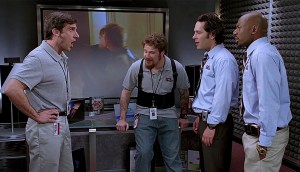
 Each of Andy’s co-workers is giving him bad advice because each one of them wants him to be someone else. Cal (Rogen) advises Andy to be inscrutable and standoffish, turning everything into a question while revealing nothing personal. It’s reminiscent of those smug 2000s pick-up artists that trained a generation of young men into thinking the way to a woman’s heart was to insult her. He does have a hilariously specific note (“Be like David Caruso in Jade”) that still made me laugh hard. Jay (Romany Malco) advises Andy about it being a numbers game, to embrace a bravado to ensnare women, and to pick them up where they are most impressionable. David (Paul Rudd) is still hung up on his ex and is lovelorn, so his advice is often coated in reflexive bitterness. He’s the friend who advises Andy to explore more about his own desires, leading to a very funny sequence where Andy sets up his home environment for his attempt at masturbation, turning around family pictures to spare their eyes. It’s actually through the character of Marla (Kat Dennings, Thor), the teen daughter of his girlfriend, that Andy finds a level of self-acceptance for being a novice to human sexuality. I think it’s telling that the best advice he receives on the subject is from a teenage girl rather than his horndog pals who consider themselves female experts.
The movie pivots into a more focused romantic comedy by its second half once Andy finally works up the nerve to ask out Trish, played by Catherine Keener (Get Out, Being John Malkovich). This is a natural transition because now Andy has a person to practice all the advice and prove himself. They have a chummy and self-deprecating chemistry together, so the challenge becomes how long he can hide what amounts to his secret shame. Things are going so well he throws out obstacles to delay their physical copulation because he’s afraid that’s when she’ll realize he isn’t worth it. You’re rooting for Andy to get over his hangups and recognize he’s actually a nice guy and that Trish would be really happy to have sex with him, especially after waiting over twenty-plus dates. This is one of Keener’s warmest performances in her storied career. This was Carell’s star-making role. He had been a notable scene-stealer before in Bruce Almighty and Anchorman, but now he was a leading man, further solidifying that same year with the role that would define him, as Michael Scott on the American version of The Office. The both of them are a winning pair and you want their shared adorkable energy to work out for the best.
Much of the comedy still works very well, like the famous chest-waxing scene where Carell really had his chest hair ripped out, but there are some elements that would have been scuttled had The 40-Year-Old Virgin been released today. It’s hard to conceive of a modern studio comedy that would allow two straight guys insulting each other with the many ways they are irrefutably gay. The 2000s was a time rife with gay panic jokes. What has aged the worst is the advice to prey upon “drunk bitches” because they have fewer defenses. Given the term, “prey upon,” you’ll no doubt surmise that this advice is predatory. This dubious thinking is something that would set up a guy as one of the bad men in Promising Young Woman, and it would have proven fitting had one of those women gotten one over on the guys. Frustratingly, Jay has a brief moment of recompense and self-reflection when his long-suffering girlfriend has had enough of his cheating ways, but then she goes right back to him and reveals she’s pregnant. We’re missing a scene that would help solidify how this event changes Jay, but instead he’s basically rewarded for his bad behavior with a baby and a woman forgiving him once again.
 You’ve probably heard about the loneliness epidemic of modern men, a media-friendly term exploring how many of today’s available men are having difficulty making connections with women and some of them using this rejection and/or fear of rejection as the excuse to radicalize themselves. There’s been so much written on the subject, but I think most of it really just comes down to empathy. When you care about other people, and allow yourself to think about their needs and desires, it communicates an openness to others and that their time and emotional investment is worth it. It’s hard to fathom a swath of young men, the ones who identify as reactionary incels, deigning to view empathy as a strength rather than character defect. Empathy communicates two important self-realizations: 1) other people matter, and 2) being vulnerable and possibly being hurt is worth the risk. You can’t have one without the other. When young men reach that epiphany and acceptance, they will discover women are, amazingly, much more open to seeing them as a romantic partner worth their time, affection, and their bodies. Nobody owes anyone their bodies or emotional bandwidth. Sharing your life with others should be valued, not entitled.
This is also a perfect spot to talk about one of the minor co-stars, Shelley Malil as co-worker Haziz, who was charged with stabbing his girlfriend 25 times in 2008. He was released from prison in 2018 after serving eight years of a twelve-years-to-life prison sentence, which doesn’t sound very close to “life” for me, but on the flip side, “12 years to all years” seems like too expansive of a window of time to serve.
Twenty years later, The 40-Year–Old Virgin still funny and sweet and entertaining because it nails the tenets of what makes movies worth coming back to again and again, our connection to the characters and their relatable plights. Even two decades later, we can still see elements of ourselves in these characters, though maybe fewer. This was the announcement of the Judd Apatow Era of big screen yuks, and frankly I’d be happy to return to it if we got more movies like this and Knocked Up, a comedy I liked even more upon release. My original review was correct for all the accolades The 40-Year-Old Virgin deserved and still deserves, and so it remains a comedy classic with more on its dirty mind than many adult dramas.
Re-View Grade: A
Share this:

The Bubble (2022)/ Moonfall (2022)
 What to do with a comedy that just isn’t that funny? I come to co-writer/director Judd Apatow’s The Bubble with a rhetorical surgeon’s scalpel ready to figure out this conundrum. There are plenty of funny people involved with this Netflix project. Apatow has been an industry unto himself in developing comedic talent going back to his Freaks and Geeks TV days and with such heralded twenty-first century comedies to his credit like The 40-Year-Old Virgin and Knocked Up. The cast assembled for The Bubble has great comic potential. Even the premise is fun, a group of spoiled actors trying to film a bad sci-fi action movie under the challenges of the COVID-19 quarantine. So what went wrong here and why is The Bubble Apatow’s least engaging and least funny movie to date?
We follow the Hollywood production of Cliff Beasts 6, filming in rural England under the supervision of studio execs trying to keep the secluded production as problem-free as possible under the 2020 COVID outbreak. Karen Gillan (Avengers Endgame) plays Carol Cobb, an actress returning to the franchisee she had once left behind to star in a misguided Oscar bait movie where she, a white woman, was the solution to solving the Israeli-Palestinian conflict. She’s hoping to save her career, while her coworkers are just hoping not to go insane with the forced isolation and new safety protocols during their film shoot.
 So let’s circle back to the central question of why The Bubble isn’t funny, and I think I have some theories. First, we can acknowledge comedy is subjective but at the same time also acknowledge that the construction of good comedy can be academically identified and appreciated, that there are tenets that hold and maintain, like setups and payoffs, rules of threes, etc. I think one of the big problems is that nothing is really that surprising throughout the protracted and unfocused duration of The Bubble.
The characters are intended to be shallow but are too shallow to even register as distinct comedy types played against one another. There are levels of general buffoonery, but so many of these characters are missing out on a more definite angle or perspective. Take for instance the smug movie star (David Duchovny) who takes it upon himself to rewrite the script. This should be an obvious route where the story comes undone or character actions are inconsistent or that other characters, especially those who had larger roles, become subservient to the star and his ballooning ego. There needs to be distinct differences for the comedy to land and be an indication of his ideas about what he thinks would be an improvement. This doesn’t really happen. Take the recent Oscar winner (Pedro Pascal). He’s not haughty and pompous, thinking himself beneath this kind of genre filmmaking. He’s simply a dumb hedonist who is seeking out pleasure he is denying himself. That’s fine, as at least one character is set up to be more of a wild card to stir trouble. This character spends the entire movie whining and having unfunny fantasies when they should be the one causing havoc and unexpected consequences from their behaviors. What a waste. Every character falls into this nebulous underwritten area without being distinct enough to be considered stock and ultimately useful for comparisons and generating comedic conflicts.
Another lack of surprise is how every character is exactly how they are presented, so with no points of change it all gets very redundant. If this was going to be the case, Apatow needed to be far more exacting with his satirical barbs. If he wants to really send up the industry and self-absorbed actors, we need something akin to 2008’s Tropic Thunder, which, by the way, had very distinct character differences it used for maximum comedy. This movie feels more like an extension of the privileged world populated by the bourgeoisie characters from 2012’s This is 40, a marked misstep for Apatow and his idea of recognizable midlife struggles (“Oh no, we’ll have to move from our ridiculously large house to… just a very large house!”). It’s the same pitiable rich people whining about their lives while they quarantine in luxury. Watching montage after montage of them being bored in their private hotel suites is not funny. It doesn’t even work as a criticism of the characters on display. They aren’t doing anything out there or particularly telling, they’re just being bored, and just watching bored people is boring.
 The moviemaking process and the film-within-a-film itself is also shockingly unfunny. Apatow has worked in Hollywood for decades, so I was expecting harder-hitting satire of the moviemaking industry and the way that films are continuously compromised. As another example of shallow character writing, take the director (Fred Armison), a Sundance award-winning indie artist tackling their first studio project. The expected route would be to start with this character having big ideas about a grand artistic vision, taking real chances, and trying to do something different and compelling within the realm of giant dinosaur action movies, and then little by little, they have to compromise and delete this grand vision, taking studio notes, limitations from the actors, and bad luck. This would provide a foil for every bad item complicating the production, the artist struggling to watch their dream die piece-by-piece. This doesn’t happen and the director’s indie background is never utilized as a contrast for comedy.
Apatow plays the same trick over and over with the film-within-a-film. It will be a dramatic sequence and then cut to the actors running on a treadmill or swinging behind a green screen, the same undercutting gag on repeat. It’s not funny and, frankly, gets tiresome. The ridiculous nature of blockbuster filmmaking should be ripe for satire (again, Tropic Thunder did it) but Apatow never pushes too hard, settling on the same soft-pedaled jokes on simple characters. Pascal is left to practice funny accents, but none of what they say within the movies is funny-bad; it’s just tin-eared dialogue that is merely bad only. The only segment that genuinely had me laughing was when the young actress (Iris Apatow) teaches a raptor how to do the latest TikTok dance. This is the only moment that feels biting on the out-of-touch desperation of modern moviemaking to chase and incorporate vaporous youth trends to remain hip. The Hollywood film gone awry should feel like a mess, it should be getting progressively worse or more out of control or at least something so outlandish it separates itself from its targets. I suppose shooting the CGI genitals off dinosaurs is something you don’t see every day but it too gets old fast.
 Fortunately, these actors can still be charming even with lesser material, but you’ll simply walk away feeling enormous sympathy for them. Everyone is trying to do so much with so very little, and it can get painful at points, like Pascal’s character clinging to an amorphous evolution of an accent. There are very funny people here. Keegan Michael-Key is very funny, but he gets nothing here, especially with a ripe subplot where he might be starting a self-help cult. Maria Bakalova is very funny, and was even nominated for an Oscar, a rarity for a comedian, but she gets nothing here, being a horny hotel worker. Gillan is very funny, but she too gets nothing here as a slumming actress desperate to rehabilitate her career. It’s remarkable considering she’s the main character but really just an insecure straight man role. The main character needed to be Gavin (Peter Serafinowicz), the producer on location doing his best to herd all these spoiled and irresponsible people into getting this movie made and on time. You want to focus on the character with the most chaos to try and control, and that’s him. It just feels criminal that a cast this good, with fun supporting players like Samson Kayo (Our Flag Means Death) and Harry Trevaldwyn (Ten Percent) to round out the more famous faces.
This also made me think to reflect on the recent release of Moonfall, which looks like the big, schlocky sci-fi disaster movie that Judd Apatow would be satirizing with The Bubble. It’s a Roland Emmerich disaster movie where he does exactly what Roland Emmerich does best: expansive scenes of cataclysmic destruction on the biggest scale possible. It was believed by industry watchers that Moonfall would be the kind of epic that people would go back to the movies to experience, watching the scale of destruction on the biggest screen and cheering along. It didn’t work out that way and Moonfall reportedly will lose over a hundred million dollars for its investors. It seemed like a smart bet as disaster movies have performed well for Emmerich, like 2012 and The Day After Tomorrow. In times of struggle, human beings enjoy fantasies about surviving fantastic odds, or at least that was the established way of thinking. After two years of life during COVID-19, maybe our idea of sci-fi escapism isn’t quite what it used to be.
I watched Moonfall with general indifference. It felt like a mediocre hodgepodge of other Emmerich disaster movies and veered into campy nonsense at many points. It’s the kind of movie that demands you shut off your brain and just go along with the scientific gobbledygook, especially once the moon begins making Earth’s gravity go all haywire. At that point the movie becomes an inconsistent video game with its liberal use of physics. It doesn’t seem like it matters, but watching characters do Super Mario Brother-level jumps has a fun appeal as well as being impossibly goofy. One character says, “The moon can’t do these things,” and another character waves away that pertinent thought and says, almost directly to the audience, “Yeah, but this isn’t a normal moon, so forget everything.” The special effects are also quite hit or miss. Plenty of the larger effects are quite awe-inspiring and suitably terrifying in depicting an awesome reality, and then others look like they didn’t quite have enough money when it came time to render. Some of the CGI reminded me of moments from 2008’s Torque, where the high-speed backgrounds resembled badly composited video game texture blurs. If your movie is going to exist primarily in a junk food realm, then you need to either have as minimal distractions as possible to rip you from the believability of this world, or you simply need to veer into it and accept that the instability and chaos will be part of the general appeal. Provide the goods, and Moonfall just doesn’t.
 The movie also takes an inordinate amount of time to get back to space after a prologue, almost halfway through its two hours. This first half stalls with setting up so many characters to follow that you simply won’t care about. I didn’t care what happened to anyone back on Earth. When the rednecks found our party (again!) in a petty car chase, I literally laughed out loud. The alien/moon mythology is also convoluted and vague enough to simply apply a good versus evil designation for technology, and the big sacrifice doesn’t feel so big when you find that character to be annoying for the duration of their grating screen time. It’s another movie tipping you off about a possible linked sequel and one that appears more appetizing than the film we just witnessed (just like Emmerich’s 2016 Independence Day sequel). In short, Moonfall is a bit of a mess, a mess I can imagine others enjoying and laughing with, but definitely one of the lower outputs in Emmerich’s long career of destroying global landmarks and formerly pristine vistas.
I found Moonfall and The Bubble to both be poor examples of what Hollywood thinks audiences will desire as escapism in the wake of COVID-19 disrupting routines and lives. Each of the movies is disappointing because it doesn’t fulfill what it promises. The Bubble has a bunch of combustible characters in a combustible scenario and squanders its time with weak satirical gags and lazy characterization. Moonfall wants to be the big, fun epic of Emmerich’s past, but it takes its sweet indulgent time with uninteresting characters, convoluted and underwritten lore, and a plot that would have been more entertaining had it better embraced the absurdity of its implications. You may likely have an enjoyable time watching either movie, and they’re almost the same length too, but I found both to be middling examples of Hollywood’s attempt to try and give the people what they think they want and missing the entertainment mark.
Nate’s Grades:
The Bubble: C
Moonfall: C+
Share this:

The King of Staten Island (2020)
 The King of Staten Island is a semi-autobiographical vehicle for its star and co-writer, Pete Davidson. He plays Scott, a shiftless young twenty-something bumming through life and trying to find his sense of self as a wannabe tattoo artist. His father was a fireman who died on 9/11 and his mother (Marissa Tomei) has just started dating a new man (Bill Burr), also a fireman, and that triggers Scott, who fights to sabotage his mother’s new relationship. I’ve never been impressed with Davidson from his fleeting appearances on Saturday Night Live, but I genuinely enjoyed him here and, yes, the character is a natural fit with his awkward, sarcastic, deadpan sensibilities. It’s another in director Judd Apatow’s style of loping big screen comedy, so we have many scenes of hanging out with friends and reprobates, with Scott trying different things to get a better concept of what he wants to do with his life. It’s a movie that coasts on the good feelings with the characters and their easy camaraderie. However, from a plotting standpoint, The King of Staten Island could have used more at the end and less in the middle. It’s only the last 40 minutes or so where Scott moves into the firehouse, which seemed like a more central focus from the advertising. The abrupt conclusion left me on a note of, “Oh? Okay.” The movie is already an unwieldy 137 minutes long, so there was plenty of hanging out moments that could have been trimmed to better position the actual personal triumphs and character resolutions. Some of the payoffs don’t exactly feel earned either. Scott’s wants to keep things casual with a woman he sleeps with (Bel Powley) and uses his mental illness as the excuse, and she says she deserves better, but then they just end up together and it doesn’t feel earned or like Scott has learned how to be a better boyfriend. It’s like Apatow is saying, “Oh, yeah, and he got the girl. The end?” I would put this on par with 2015’s Trainwreck, though that film has a more clearly defined character arc, but both serve as fitting vehicles that play to the strengths of their individual comedians. I enjoyed the overall mood, I laughed, I enjoyed the various vignettes of the fun supporting characters. I wish there was a bit more shaping with the plot and a more fitting conclusion, but The King of Staten Island allowed me to enjoy Davidson as a performer. That’s a triumph for a guy I didn’t care much for prior to this moment.
Nate’s Grade: B
Share this:

The Disaster Artist (2017)
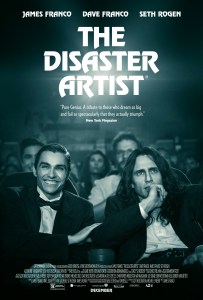 As an avid devotee of The Room, and a connoisseur of crappy cinema, I have been looking forward to this movie for literal years. I’ve been fascinated by Tommy Wiseau’s movie ever since I first saw it in 2009, and I’ve since watched it over 40 times. In my review for the movie, I said if I had to pick only five DVDs to take with me on a desert island, I might just select five copies of The Room. It’s that rare form of bad movie that is a thousand brushstrokes of bad, where you can discover something new with every viewing, and you desperately want to have your friends discover this miracle of filmmaking. It’s become a modern-day cult classic and theaters have been playing rowdy spoon-tossing midnight screenings of Wiseau’s film since its initial 2003 release (humble brag: I’m responsible for it playing on a monthly basis in Columbus, Ohio since 2009, the only regular public screening in all of Ohio). From its successful re-branding as a “quirky new black comedy,” fans had burning questions that needed answering, and that’s where Room actor Greg Sestero co-wrote a behind-the-scenes book, The Disaster Artist. One fan was multi-hyphenate James Franco, who purchased the adaptation rights, attached himself as director and star, transforming into Wiseau and tapping his younger brother to play Sestero. Who would have guessed all those years ago that these beleaguered actors would soon have Hollywood celebrities portraying their astonishment? The Disaster Artist might be one of the best films of the year by chronicling one of the worst films ever made.
Greg Sestero (Dave Franco) is a struggling actor in San Francisco when he meets the Teutonic acting force that is Tommy Wiseau (James Franco). Tommy doesn’t behave like anyone else, for good or ill, and it inspires Greg to become friends with him. Tommy says he’s the same age as Greg, though is clearly double, and that he’s from New Orleans, though he definitely sounds more vaguely Eastern European. Tommy also has a lot of money and elects to move to L.A. to make it in the film industry, and he wants his best friend Greg to join him. Greg finds some beginning levels of success but Tommy is rejected at every turn, determined as too weird and off-putting by casting directors. He doesn’t want to play a villain; he sees himself as the hero. Tommy won’t wait for Hollywood and decides to make his own movie. He’ll write it, direct it, and be the star, and Greg can be his onscreen best friend. The Room, Wiseau’s magnum opus, was a stunning document of filmmaking ineptitude that had to be seen to be believed, and many of the people involved were certain it would never be seen at all.
 I was worried that the film version would simply be many painstaking recreations of scenes from The Room and watching characters snicker. Thankfully, the recreations are kept to a minimum and The Disaster Artist personalizes the story in the friendship between Tommy and Greg. If anyone has read the book, you’ll know there is a wealth of juicy anecdotes about the bizarre onset antics and about the human enigma himself, Wiseau. The film could have been three hours long and just thoroughly focused on all of the crazier aspects of the behind-the-scenes and I would have been satisfied. However, the ace screenwriters, Scott Neustadter and Michael H. Weber (The Fault in Our Stars), have elided all of those crazy details into a story about a personal relationship. The most memorable tidbits are still there, like the 60 plus takes needed for Tommy to say one line, but the sharper focus allows the film to resonate as something where you can genuinely feel invested in these people as characters rather than easily mocked send-ups. Greg feels greatly put upon by Tommy but he admires his fearlessness, and deeper down he feels indebted to Tommy for getting him onto the road to his dream. Thanks to Tommy, Greg was able to move to L.A., find a place, become an actor with representation, and book commercial spots. Tommy is also an anchor weighing him down. Greg will routinely have to place his rising career opportunities at the mercy of Tommy’s capricious sense of loyalty. It’s a movie that explores the value of friendship and the lengths people will go.
This is also an extremely funny movie. Part of the allure of The Room is how it feels like a movie made by space aliens who didn’t quite understand human interactions. The head-scratching choices and dropped subplots and redundant, nonsensical plotting are all given examination, allowing the audience to be in on the joke even if they have never seen Wiseau’s actual movie. This is a film completely accessible to people who have never seen The Room; however, if you have seen The Room, this movie is going to be 100 times more fascinating and enjoyable. The sheer bafflement of what transpired is enough to keep you chuckling from start to finish. The Disaster Artist is wonderful fun, and the actors involved are here because they love Wiseau’s movie. The celebrity cameos are another aspect that helps to add to the film’s sense of frivolity, spotting familiar faces in roles such as Casting Agent #2 (Casey Wilson), Actor Friend (Jerrod Carmichael) and Hollywood Producer (Judd Apatow). Watching everyone have a good time can be rather infectious, but The Disaster Artist succeeds beyond the good vibes of its cast.
 Rather than lap up the easy, mean-spirited yuks, The Disaster Artist goes further, following a similar point of view with 1994’s terrific Ed Wood by portraying these men as deeply incompetent filmmakers but also as sincere dreamers. Wiseau is clearly overwhelmed by the demands of being, let’s be generous, a traditional filmmaker, but he is also a person who set off to achieve a dream of his own. He was denied other avenues so he took it upon himself, and a mysterious influx of money he doesn’t like to discuss, and this self-made-movie star built a vehicle to shine brightest. Sure, ego is definitely a factor, though one could argue it plays some degree in all creative expression needing an audience. Wiseau didn’t let a little thing like ignorance of storytelling, film production, or how to handle cast and crew as human beings with needs stop him from plowing ahead to prove his doubters wrong. The filmmakers definitely find a certain nobility in this artistic tenacity, as did Tim Burton with Ed Wood. It’s natural to pull for the underdog, even an underdog that is so naïve it might be worrisome. You can laugh freely at Wiseau, and you will, but you may also start to admire his gumption. As the opening barrage of celebrity interviews posits, you could not make something like The Room even if you were the greatest filmmaker on the planet. It is nothing short of an accidental masterpiece. It is a movie that has entertained millions of people and one they feel compelled to share with friends and family, compelled to bring others into this strange, beguiling cult of fandom. While Wiseau may not have made a “good movie,” he has made one for the ages.
James Franco (11.23.63) deserves an Oscar nomination for playing Tommy Wiseau. I’m serious. He is channeling some Val-Kilmer-as-Jim-Morrison lightning when it comes to simply inhabiting the spirit of another person onscreen. It’s crazy that a movie so bad could inspire another movie that might legitimately compete for legitimate awards. James Franco is entrancing with his performance as he fully channels Wiseau, an almost mythic figure that we have never seen the likes of before. The accent is pitch perfect and impossible not to imitate after leaving the theater. Wiseau can be manipulative and cruel but he can also be generous and selfless. He takes great ownership over his friendship with Greg, so he believes all of his actions are to help their unique bond, even when he’s pushing that same person away. He so desperately wants acceptance but seems incapable of achieving it on anybody’s terms but his own. Wiseau is a fascinating film figure, and the movie does a fine job of neither overly romanticizing him nor vilifying him. Even despite his missteps, you may find yourself feeling sympathy for Wiseau, and that’s a major credit to the screenwriters and James Franco’s magnetic performance.
 The other actors, a.k.a. everyone in Franco’s sphere of friends, are committed, enjoyable, and plugged into why exactly audiences have grown to love The Room for years. Dave Franco (Now You See Me 2) is effectively the perspective of the audience, deliberating how much of Tommy to put up with and when to walk away. Seth Rogen (Sausage Party) gets the most sustained comedic run as a script supervisor who is bewildered by Wsieau’s methods. Alison Brie (Netflix’s GLOW) is our chief source of confused expressions as Greg’s girlfriend. Ari Graynor (I’m Dying Up Here) wrings great laughs from her awkwardness with Wiseau as filmmaker and onscreen anatomically-challenged lover. Megan Mullally (Will & Grace) is Greg’s disapproving mother who worries about what kind of relationship her son has with a much older man. Zac Efron (Baywatch) is hilariously excitable as the inexplicable drug dealer, Chris R. Speaking of excitable, Jason Manzoukas (The House) and Hannibal Buress (Spider-Man: Homecoming) are a great team as the film equipment rental guys who can’t believe their luck with Wiseau. Even two-time Oscar nominee Jacki Weaver (Silver Linings Playbook) gets some nice moments as an older actress who justifies in a heartfelt message why exactly everybody on set would go out of their way to work on such an awful movie.
If you’re a fan of The Room, then you’ll absolutely adore The Disaster Artist, and if you’ve never seen The Room, you’ll still find plenty of entertainment in Franco’s film. Wiseau’s 2003 film has to be experienced to be fully believed. The film-about-his-film provides the added extension of a coterie of characters to share in our bemusement and bafflement, providing a chorus of commentary. However, the movie isn’t all jokes at Wiseau’s expense. It evolves into a love letter for the power of art to bring distaff people together with a shared dream. Like Ed Wood, Wiseau might be incompetent by traditional measures of filmmaking but he ignored the naysayers and followed his artistic vision. Under Franco’s direction, he’s a modern-day Don Quixote, or just a really weird guy who lucked into a miraculous alchemy that gave birth to a cult classic. At the end of the movie, Tommy thinks he’s a failure. Greg reminds him to listen to the audience reaction. They are hooting, hollering, applauding, and having the time of their lives. He’s responsible for that and he should be proud of his accomplishment. I unabashedly love The Room. I introduce the theatrical screenings in Columbus. I loved The Disaster Artist book. This movie is everything I was hoping for, and it just so happens to be one of the funniest, most genuinely pleasurable films of the year.
Nate’s Grade: A-
Share this:

Trainwreck (2015)
 Amy Schumer is having what some might refer to as a moment. Her comedic rise has accelerated as her sketch comedy show has gained greater notoriety for its social commentary from a post-feminist feminist perspective. For many, Schumer has become a relevant and empowering creative voice, and the fact that she breaks free from the Hollywood “thin is the only beautiful” mold is refreshing. Her star is only going to rise higher as soon as audiences get a load of Trainwreck, a raunchy romantic comedy penned by Schumer herself and starring Schumer as the lead. Paired with director Judd Apatow (Knocked Up), Schumer excels and surprises in Trainwreck, a modest but appealing rom-com that’s not afraid to get real when it counts and sweet when needed.
Amy (Schumer) is a magazine writer in New York City and follows her dad’s (Colin Quinn) words of wisdom he dispensed when she was ten years old: “monogamy is unrealistic.” Amy dates and sleeps with an assortment of men. Her current boyfriend Steven (the wrestler John Cena) likes to spend time at the gym but he doesn’t quite satisfy her, at least enough not to still see other men. Amy’s younger sister Kim (Brie Larson) rejected dad and settled down with a single dad and his son. The idea of marital bliss and raising children makes Amy uncomfortable. Amy’s editor (Tilda Swinton) assigns her a profile on a sports surgeon, Aaron (Bill Hader), specifically because Amy hates and is ignorant of sports. Amy and Aaron hit it off and she confidently takes their relationship in a non-professional direction. It’s then that Aaron surprises Amy. He calls her the next day and is interested in seeing her again. Amy has to come to terms with how to navigate a relationship with a good guy who understands her and would like more.
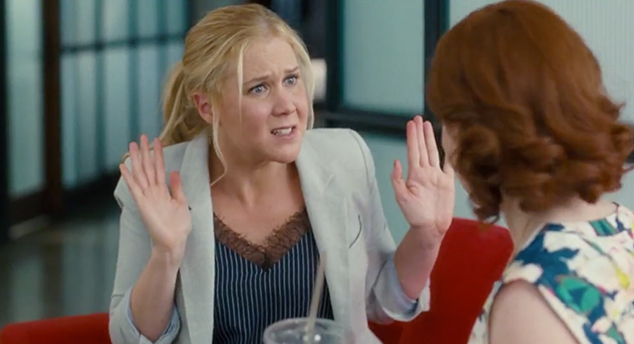 The tone and spirit of Trainwreck is very clearly Schumer’s voice, following her brand of sexually brash humor from an unapologetic and independent perspective. Amy is a love-em-and-leave-em character who would shrug at being called a “loose woman.” Then again if we applied these same standards to men we don’t have the gender-swapped “loose man” nomenclature. Instead of the standard male playboy character who beds a plethora of sexual partners and then moves on about their day, this time it’s a woman, and while perhaps this isn’t the strongest foothold in the realm of being progressive, every bit counts (women can do it too!). Amy is unrepentant about her sexual appetites and she is not punished for them. Imagine that, a sexually liberated woman who enjoys sex and doesn’t have to suffer some physical or psychological trauma related to her desires. We’ve come a long way from Mr. Goodbar. The character of Amy is much more than just her dating habits. She’s ribald and unapologetic while finding ways to be relatable and more in depth than just the commitment-phobic lead character in a mainstream romantic comedy. Her views on relationships go back to idolizing her cad of a father and a strong sense of fatalism. Relationships can’t work out so why bother? This accentuates Amy’s already self-destructive habits, which make her in many ways our protagonist and antagonist. She’s an enjoyable character who can also be mean-spirited, petty, and push the important people in her life away from her. Her biggest challenge isn’t getting the story, holding a long-held secret, or even landing the guy, because he already wants to be with her. It’s about whether she can accept a different view of herself. That’s way more interesting and complicated than your standard rom-com fussbucket or workaholic.
The content of Trainwreck is far easier to engage with than Apatow’s previous film, 2012’s This is 40. Even though she has a cushy job and a nice apartment in the big city, Amy’s struggles with her relationship with her boyfriend, her sister, her father, and her boss, trying to please others without giving away too much of herself. Her father is the source of much of her discomfort as she and her sister debate how to take care of him in his ailing health. Where Amy views her father as an admirable straight-shooting guy who rebels against the social standards and expectations of decorum. Her sister views him as a bigoted and sexist jerk that was never much of a father. The slow acceptance Amy comes to about the degree of pain she’s dealing with and guilt related to her father is a key development. Her rejection of the “old ways” is a repudiation of her father. The arguments that she has with Aaron are realistic, and he admits that he’s uncomfortable with certain aspects of her lifestyle but he’s not forcing her to change. There are some dramatic turns in the film that require Schumer to do some heavy dramatic lifting, and she carries it gracefully, keeping in character but also losing her carefree façade. It opens up your sense of the character just as much as the actress. Trainwreck is still very much a romantic comedy and it spends its third act coalescing to its happy ending, but Schumer’s self-deprecation won’t let it get too saccharine.
The movie is also funny quite often though it ultimately gives in to more rom-com conventions than subverting them. There’s a funny sequence where Amy is trying to coax her boyfriend into being more vocally risqué during sex, and John Cena does a great job awkwardly trying to be dirty. There’s a funny moment tied to character as Amy mingles with far more straight-laced married women at a baby shower. They play a game of revealing secrets and it’s everything you would want it to be. The satirical broadsides at the tabloid and celeb navel-gazing industry are broad but quite amusing, including article topics like “Ugliest Celebrity Kids Under 6” and, “I’m Not Gay, You’re Just Boring.” Amy’s self-destructive attitude and her outer layer of confidence lead to many humorous observations and exchanges, especially with Hader. The two actors have good chemistry and bounce off one another well, capturing a fun energy of a couple that really enjoys one another’s company and exploring that. Swinton (Snowpiercer) is almost unrecognizable and quite hilarious as the unfeeling boss. The biggest scene-stealer and breakout star is the world’s greatest basketball player, Lebron. He plays the standard rom-com “concerned best friend,” even warning Amy not to break his man’s heart and having a dating debrief while playing very one-sided basketball with Aaron (all elements lampooned in last year’s rom-com spoof, They Came Together). The basketball scene is particularly amusing as Lebron dominates his friend so casually and without ego. It’s a fictionalized version of Lebron but the man just has natural comic timing and a star presence. I could totally see more acting work coming Lebron’s way if he wanted it.
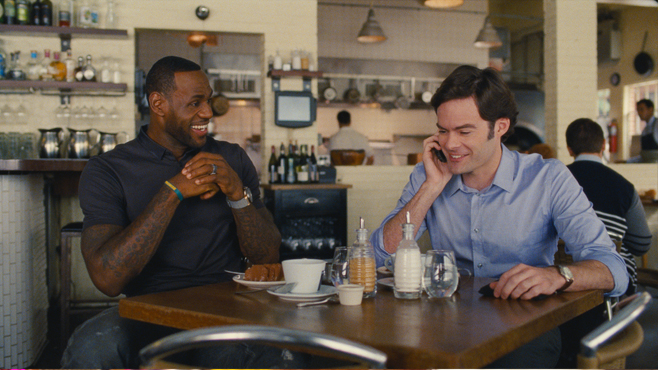 However, there are jokes, storylines, and moments that don’t feel as well constructed and simply don’t work, enough that it hampers the overall impact of Schumer’s story. There’s a recurring theme of gay equals funny, notably when all of Cena’s threats to a movie patron bear a striking homoerotic quality. That scene works well enough, but the theme reappears in a late storyline where a lisping intern at the magazine played by Ezra Miller (We Need to Talk About Kevin) unleashes his inner sexual freak, which involves a lot of homoerotic foreplay and positioning. It’s a comedy angle that gets old fast. I also never believed the sentimentality attached to Amy’s father after his health worsens. Schumer tries to turn a bigoted jerk into a well-liked character and it just doesn’t connect. He has real physical struggles dealing with MS but at no point does he come across sympathetic. I sided with Kim on this one, though I think I wasn’t supposed to by the film’s end. There’s also far too many supporting characters that just kind of float along the peripheral; this is common in Apatow comedies but these characters, from a homeless bum to Amy’s work colleagues, don’t feel well integrated. There’s a misfire late in the film when Lebron holds an intervention for Aaron. The core idea would work but Lebron’s intervention participants include Chris Evert, Matthew Broderick, and Marv Albert, with the bulk of the jokes being Albert’s in-game announcing. They don’t address that the figures are playing themselves until much later in the scene, so I was wondering if somehow Broderick was Aaron’s father. It’s a miss. The movie-within-the-movie is also never that funny or satirical of Sundance indies, but thanks for the effort.
As a side note, it seems like quite a missed opportunity that the Knicks game at the end of the film did not feature the Cavs. With Lebron as a supporting character, it would seem like a natural fit to include him in the climax. My theory on this is such: the Knicks play the Brooklyn Nets and we see Paul Pierce in a Nets uniform. As NBA fans know, Pierce left the Nets and signed with the Washington Wizards for the 2014-2015 season (he has since signed with the L.A. Clippers). That means that Trainwreck must have been filming the spring of 2014, which means Lebron was still with the Miami Heat. No wonder the movie didn’t feature the Cavs in its finale. Also, in what NBA universe is Amar’e Stoudemire the star of the Knicks? Does Carmelo Anthony and his $120 million dollar contract not exist in this universe? It’s a little comical that Stoudemire’s knee surgery is given such dramatic stakes for a player that the Knicks were looking to dump.
Trainwreck is by no means the disaster implied by its title. Even Amy isn’t really a trainwreck of a person. She can be mean and self-destructive, but her shocking behavior isn’t all that shocking. She drinks and has sex with multiple partners and does not feel shame in this. Look out, world. Yet it’s Schumer’s sprightly comedic voice that shines throughout the film even when certain jokes or storylines misfire. Make no mistake, Trainwreck is also a star vehicle for Schumer and she earns it. She even sheds some tears in very effectively dramatic moments. She can do it all (refraining from obvious bad joke…) and still be funny whether she’s cutting someone to size or the butt of a joke. Trainwreck is an enjoyable romantic comedy, another in Apatow’s sweet lineup of raunchy and somewhat old-fashioned romances with their happy endings. There should be more than enough to tide Schumer’s fans and for her to make new ones.
Nate’s Grade: B
Share this:

Anchorman 2: The Legend Continues (2013)
 A lot has changed in the nine years since the raucous, instantly quotable, and deeply silly hit comedy, Anchorman. Steve Carell, Will Ferrell, and Paul Rudd have all become big stars (sorry Dave Koechner), producer Judd Apatow has become a comedy empire unto himself, and director Adam McKay has gone on to helm several other hit Ferrell collaborations. As much as I loved Anchorman, and I unabashedly do, I was nervous about a sequel capturing the same magic. While Anchorman 2: The Legend Continues cannot be as good as its predecessor; my worries were mainly unfounded because this is still the funniest movie of the year. Simply put, if you’re a fan of the original, you’ll find enough to enjoy, possibly even love, with this latest chapter. The laughs-to-minute ratio is pretty high, as long as you don’t mind some scenic detours. The plot is much looser this time with several competing storylines that come in and out of focus. There are segments that could have been cut completely, like Ron’s bout with blindness, but I laughed enough that I never minded. But that ending 15 minutes is where the filmmakers drop any pretension of reality and double down on absurdity. It’s no surprise that those last crazy 15 minutes were my favorite. The cast is universally strong together, working off one another’s comedic styles so effortlessly, but the plot is very much a kitchen sink approach. I’m happy that Ferrell and McKay, co-writers again (though it’s hard to credit a collaborative improv), didn’t feel the need to recycle many jokes from the first film, reliving their old hits for fans hungry for instant nostalgia. Anchorman 2 is the same brilliantly broad comedy and absurdist dada experiment every loyal fan was hoping for. Give the gift of Ron Burgandy this holiday season and stay classy, America.
Nate’s Grade: B+
Share this:

This is 40 (2012)
 In the five years since 2007’s comedy smash, Knocked Up, writer/director Judd Apatow has ascended to heights in Hollywood that few ever achieve. And while his disappointing 2009 film Funny People may have been an example of the man flying too close to the sun (let’s mix metaphors, why not?), he’s had a stable career guiding mostly hit comedies to big numbers, particularly last year’s Bridesmaids. For Apatow’s next directing effort, he picks up a handful of supporting characters from Knocked Up and gives them their own spotlight. This is 40 is Apatow’s “sort-of sequel.” It may seem familiar in tone and style to his previous efforts, but there’s one big difference between this film and Apatow’s previous works. This movie never feels like it goes anywhere. Even Funny People went somewhere even if I disliked it.
Five years after the events of Knocked Up, Peter (Paul Rudd) and Debbie (Leslie Mann) are struggling to keep their household afloat and sane. Their daughters, Sadie and Charlotte, (played by Apatow’s real daughters, Maude and Iris), are constantly fighting, Debbie’s worried one of her employees is stealing from her business, and Pete’s trying to save his record company without alerting his family to his panic. Pete has put all his efforts into promoting a new album from 1970s rocker Graham Parker, but really he’s fighting a losing battle against mainstream taste. Pete has also been secretly loaning out money to his no-good father (Albert Brooks), while Debbie has been trying to reconnect with her distant biological father (John Lithgow). Weirdly enough, both fathers have started secondary families and have broods of young children. As Debbie and Pete both approach the big 4-0, both of them make resolutions to better themselves, renew their family bonding, and reignite the spark in their romance. Of course, after two kids and several years of marriage tallied, it’s easier said than done.
 The Apatow films have always had their own loping rhythm to them, an easygoing quality that isn’t as directed by plot as character. So when I say that This is 40 feels rather aimless, I want readers to recognize that this goes beyond the normal loosely plotted Apatow affairs. Usually his movies have defined events to direct the overall trajectory of the plot; a baby on the way, losing one’s virginity, etc. I’m hard pressed to say what exactly is the direction of This is 40. It’s about the ups and downs of a married couple, but there isn’t necessarily any definable conflict. They’re sort of in a malaise and internalizing their unhappiness, but the movie is the sum total of many small conflicts that never seem to congeal. As a result, the movie feels like it’s often coasting, going beat-for-beat until something new takes it on a mild diversion. It’s a movie of diversions without a unifying path. Sure the couple becomes, presumably, stronger by the end of the film, but I can’t say what’s taken place to explain this progression. The movie plays out like a series of loosely connected scenes. I enjoyed myself, and found the movie often amusing, but I kept wondering what it was amounting to. It was never enough of a niggling concern to stop from being entertaining, but when it was done, I thought to myself that I just watched Apatow’s friends hang out for two hours and call it a movie.
There’s also the issue of indicating this is a sequel to Knocked Up or at least exists within the same universe. There’s very little continuity between the two films other than Pete and Debbie’s family. Jason Segel (The Muppets) and Charlyne Yi (Paper Heart) make reappearances playing characters with the same names, but they don’t seem like the same characters (though the gyno doc is the same – hooray). My major sticking point is the complete absence of the stars of Knocked Up, Ben (Seth Rogen) and Alison (Katherine Heigl). Now I wasn’t expecting a drawn out cameo from these two, especially after Heigl publicly badmouthed Apatow and the movie that made her a star. I did expect some passing reference, even something as small as, “Ben and Alison are looking at schools for their daughter.” I just wanted something to feel satisfied. Where this becomes a problem is that I’m fairly certain that Ben and Alison would be attending several of these major social events for their family members. They make a big deal about Pete’s 40th birthday party, so why wouldn’t Ben and Alison be there? And with her litany of marital woes, wouldn’t Debbie seek out, you know, her sister to talk with, the same sister she hung out with all the time in Knocked Up? Apatow might as well have just given everyone a new name if this was as sequel-y as This is 40 was daring to go.
Part of my lukewarm reception to the film is likely my lack of empathy with the problems of the main characters. Good storytelling should allow anyone to be able to empathize with characters dissimilar to themselves. I found many of the problems in This is 40 to be the stuff of rich fantasy. Pete is worried his record company, that he started, might not make it. He’s also been secretly giving his mooch of a father $80,000 (!) over the years. Maybe these people could stand to cut back and live within their means. Their house is huge, downright opulent, and it seems like Pete has wasted plenty of money on needless expenditures, which his own employees eventually point out at work. Did they need a big 40th birthday bash? Do their kids need every expensive gadget? When they take a vacation, does it need to be in a lavish hotel along the beach? I found too many of these complaints to be whiny and indulgent. That’s not to say that there aren’t serious relationship problems that are given thoughtful attention. This is 40 is arguably Apatow’s most mature and reflective film yet, though that might be faint praise to some. I would rather the movie spent more time focusing on the relatable concerns of a relationship crumbling rather than the stress of possibly having to move from a super-rich house to a merely somewhat rich house.
And yet the movie is routinely funny and charming, thanks to the Apatow standards of cast camaraderie, character, and the mixture of raunch with sweetness. I like these characters and so I enjoy spending time with them, and even if I feel like we’re not going anywhere fast, I don’t mind that much. I’ll gladly spend two plus hours with these funny people and their mid-life crises comic follies, at least once. The characters are well drawn and played by capable comic players that can do their Apatow jazz deal, finding peculiar riffs to work and squeeze out mirth. I thought a discussion over the appeal of being a widower and the fantasy of a spouse’s untimely demise to be quite funny as well as a topic generally unspoken (“This is the mother of your children we’re talking about. You want her to go peacefully.”). Rudd (Wanderlust) and Mann (The Change-Up) are terrific together and entirely convincing as a longstanding couple, people who know the ins and outs of one another. It’s fascinating just to watch the nuts and bolts of a relationship that is still a battle; it also helps when you like both participants and find that they each have valid points. Though I cannot fathom how hiding impending financial doom is a smart move.
 Apatow does a fine job of making sure the dramatic parts do not overweigh the film, usually settling things with a nicely punctuated joke or pop-culture critique (oddly enough, TV’s LOST becomes a major reoccurring gag, though you expect a bit more of a comedic payoff when they get to the controversial finale). I’m not sure that many people are going to know who Graham Parker is, but here he is folks. There are a lot of Apatow players peopled throughout, like Chris O’Dowd (Bridesmaids), Lena Dunham (TV’s Girls), and Melissa McCarthy (Bridesmaids), making fine work with minimal screen time. You’ll recognize other familiar faces as well. Occasionally the jokes feel like they go on too long, catching the downward slope of an overstayed improv riff, but I was laughing throughout and enjoyed the unpredictable nature scene to scene. You’ll likely predict the outcomes for certain storylines and conflicts, since Apatow is a sucker for the squishy ending, but you’ll feel like it got there on its own relative terms. It’s not exactly a happy ending but it’s a less unhappy ending.
There are plenty of supporting actors that shine in this movie, though I feel that I need to single out the great Albert Brooks (Drive). He plays such a passive-aggressive, manipulative, mooch of a father, but he does it in a way that almost wins you over, how straightforward he is with his bad behavior. When Pete tells him he cannot loan any more money, Brooks blithely, almost cheerily, theorizes that murdering some of his recent kids can solve this problem. He marches out, gets a hose, and asks the kids to volunteer who wants to be murdered. It’s scenes like this that manage to be funny but also cutting to a dramatic truth that the film hovers around, occasionally hitting the bullseye. Megan Fox (Transformers) is also enjoyable as a, what else, vivacious employee men are falling all over themselves for. And even Apatow’s own kids give rather strong performances, now playing actual characters rather than scene-stealers. Maude, the oldest, has a lot of dramatic scenes as the teenager daughter coming to grips with hormones and her crazy parents. The Apatow clan might just get some outside work after people see dad’s movie.
While I doubt Apatow has made any sort of definitive statement on what it means to approach four decades worth of life (and poop jokes), This is 40 is a perceptive and enjoyable movie even if it feels like a collection of scenes. Good thing I like these characters and enjoy spending time with them, otherwise I might find this whole film to be a bit aimless and self-indulgent. Seriously, how many scenes are there going to be of people singing along to music? This is 40 has enough going for it, be it comedy or some insightful dramatic moments, though it keeps an audience a bit removed due to the unrelatable nature of their posh problems. If there’s a This is 50 in the works, next time get me some more Rogen time. I’d rather watch him deal with raising a teenage girl in the age of social media. You don’t have to know anything about Knocked Up to follow along with This is 40, but then again, if you haven’t seen Knocked Up, just go watch that movie instead. Trust me.
Nate’s Grade: B
Share this:

The Zookeeper (2011)
 A lamebrain comedy with a horrible, repulsive romance where we watch a sweet, hapless zookeeper (Kevin James) romance a shallow woman (Leslie Bibb) who dumped him years ago and wants him to change, despite the fact that he’s great at his job, loves what he does, an the animals love the big lug as well, so much so that the animals all take turns giving the guy mating advice. That doesn’t sound like a bad premise for a comedy, though James takes the admission that animals could always talk a little too in stride. Their advice typically amounts to stuff like “puff out your chest” and “pee on this tree.” The potential of the premise is dashed when the comedy usually takes one of two routes: 1) James being clumsy, or, 2) James being fat. Rarely will The Zookeeper stray from these two troughs of canned laughs. There’s a bizarre montage of product placement for T.G.I. Friday’s where James takes a gorilla out to the restaurant. There’s Rosario Dawson looking splendid as the Obvious Love Interest Who Will Not Materialize Until James Has to Chase Her Down to Stop Her From Leaving. And there are poop jokes. Oh, the poop jokes. At one point there was a studio bidding war over this screenplay, which has five names attached to the finished product. I can’t imagine the end result was worth fighting over when it’s so predictable, flat-footed, and unfunny. And why have animals singing over the end credits? Surely that little dash of CGI was an extra few million dollars that could have been spent wiser, like purchasing a different script.
Nate’s Grade: C-
Share this:

Bridesmaids (2011)
 To refer to the bawdy new comedy Bridesmaids as a “female Hangover” seems disingenuous and a facile comparison cooked up in some marketing laboratory. This is nothing like The Hangover, a conceptual comedy that, can we all agree, was a funny movie but not the funniest movie of all time? Bridesmaids is a byproduct of the Judd Apatow comedy factory, and that’s what it feels like. This is no mere concept comedy built around a madcap premise. This is a magnificent character-based comedy that lets the women finally be in on the joke rather than the butt of it. Bridesmaids proves that the ladies can do everything their gender counterparts can do and better.
Annie (Kristen Wiig, who co-wrote the screenplay) is a woman down in the dumps. She lost her bakery due to the crummy economy, she lives with a pair of cretin roommates, and she’s a sleazy creep’s (Jon Hamm, wonderfully douchey) number three choice whenever he needs some casual sex. Her lifelong best friend, Lillian (Maya Rudolph), has just gotten engaged and asked Annie to be her Maid of Honor. Annie is threatened by Helen (Rose Byrne), a rich socialite who has grown close to Lillian in Annie’s absence. Helen is also apart of the bridal party and is always at the ready with a classy alternative when Annie stumbles. Annie gets pulled over by state patrol Officer Rhodes (Chris O’Dowd) who takes pity on her but warns her to get her taillights fixed. She continues to meet Rhodes at different spots and the two seem to be circling something romantic. Annie’s life seems to be unraveling just as Lillian’s is coming together.
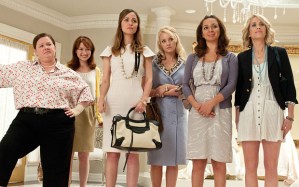 Apatow himself has been accused of making overly guy-centric comedies about rude adolescent man-children (I wouldn’t agree fully with that statement), and people have been rightfully asking when do the girls get a chance? When will the ladies be able to be something other than “love interest” or “device that triggers male character’s metamorphosis into maturity” (Forgetting Sarah Marshall, even from a clear male POV, was rather charitable and empathetic with its feminine characterizations). Well here it is, folks. Bridesmaids let’s the ladies are just as rude, crude, crass, and sexual as the men in the comedy universe. Bridesmaids is a terrific gross-out adult comedy told from a distinct feminine point of view. They can be just as crude as the dudes. But what really sets it apart is that it’s even more so a story about the dynamics of female friendship and the pain of growing apart due to the circumstances of life. Much like the joyous male camaraderie as one of the hallmarks of an Apatow film, we get to witness an entirely female dynamic that feels authentic. These women, their troubles, their friendships, all feel real and deeply felt. Even the supporting characters get a chance to be fleshed out with added dimension rarely seen in mainstream comedies, like Becca (Elli Kemper) and Rita (Wendi McLendon-Covey) confiding in each other about their disappointments with married sex. In other movies these ladies would just be “Bridesmaid #3” or “One-note Bridesmaid,” and while Becca and Rita could both be designated as types, they transcend classification when the script allows them to become rounded out as people. Another hallmark of an Apatow production, this is a true ensemble work.
You really do care for these people because of how relatable they are. I’ve never been the operator of a uterus, but that doesn’t stop me from being able to greatly relate to the anxieties of the female characters on screen. I know how significant female friendships are, and that is the central focus of the movie. You buy the relationship between Lillian and Annie, the comfort level they have with one another, the importance, the history, and you feel the pains of Annie’s plight. You feel like the entire bridal party could actually be a group of friends instead of a collection of wacky caricatures. These feel like real people, and people you want to see experience good times. Even the treatment of Helen feels thoughtful. She’s not this shrewish antagonist, but a trophy wife trying to impress the one person she could call a friend in her own life. For Helen, her friendship with Lillian means the world to her. She comes across as another real person, albeit a fabulously looking one. Annie’s romance with Officer Rhodes is indelibly cute and the duo has a warm, charming interaction. You pull for their union. Their relationship spawns a very funny sequence where Annie tries an assortment of illegal driving activities to get his attention. A romantic subplot is expected but that doesn’t mean it has to feel like rote, and in Bridesmaids the romance feels just as authentic and charming as the female friendships.
But don’t let my adoration with its character-work fool you into thinking this is some sort of “chick flick,” a divisive term tragically slapped onto anything female-centric or female-led. Just because there is rarely a Y chromosome on screen does not mean that this is some frilly, frothy sentimental fantasy replete with a “trying on clothes” montage and some sequence where the main characters break out into song in a bar. A wedding central to the plot should hopefully not be disqualifying for male audiences (men don’t get married too?). This is not a story about a crazed, jealous woman who wants to shiv another pretty lady in her pretty lady ribs because she stole her Maid of Honor duties. The cinema is littered with plenty of awful movies that revolve around women battling over petty squabbles. This is not that movie. It is not about who wields the title of Maid of Honor. It is a tale about your friends making new friends, entering new phases of their lives and possibly leaving you behind in the process. It’s about insecurity and holding onto those important people in your life, despite a gradual pulling apart. Relationships change over time, and it’s terrifying to have to adjust to the people closest to you taking lesser stations. It’s terrifying to feel like you’re being pushed out by new people. That sounds fairly universal to me, not some chick flick pabulum.
 There were several spots where I laughed so hard I was crying; the film kept me in fits of laughter throughout. The fact that a great majority of the comedy is character-based and not situation-based makes the jokes richer and more satisfying. Even a hard-to-top gross-out sequence where the girls are trying on bridal dresses at a chic store and all start losing control over their bodies due to food poisoning is related to character. Annie took the bridal party to a cheap restaurant to save money, because she’s too proud to admit her own penniless nature and too stubborn to allow Helen to swoop in and claim another victory. So the women all get terrible bouts of food poisoning, which causes them to spew vomit and forces Megan to make one very unfortunate decision with a sink (“Don’t look at me!” she bellows). The movie doesn’t shy away from the gross-out goods but doesn’t overly rely upon them for surefire gags.
The film has several terrific comedic set pieces that connect back to the fractious relationship between Annie and Helen. The two get into a competition when it comes to party toasts. They must upstage the other, asserting who has the closest relationship with Lillian. Just when you think it’s done, one of them grabs the mic again and takes it to another level. Bridesmaids has several comic set pieces that carry on longer than you would expect for a comedy. Director Paul Feig (director of episodes of Arrested Development, The Office, and co-creator with Apatow of Freaks and Geeks) has the resolve to keep the situation alive, steadily building the comic momentum as situations get more and more out of hand, but pulling back before we reach farce levels. The movie goes one step further, convinced that the audience would be there to follow. The movie expertly lays out setups, finds satisfying payoffs, and ties up its storylines in worthwhile ways.
The dialogue is sharp and jokes work on a very fundamental level of context and defying expectation. Annie is terribly nervous to fly. She sits next to a passenger (Wiig’s co-screenwriter, Annie Mumolo) who is also deadly afraid of flying. “I had a dream last night. This plane went down,” she sys. “You were there.” That last part just turns an okay joke into a great joke. There’s a great visual gag where people keep assuming that the unkempt men standing behind Annie at a party is her husband or boyfriend. And then there’s a conversation between Annie and Officer Rhodes about being born for a profession. He encourages her to get back to baking, relating that if he were not a police officer he would still “patrol the streets and… shoot people.” These are just a few small examples I wanted to share that illustrate that, to its core, Bridesmaids is a funny story and knows the fundamentals of comedy.
Wiig has been a comic that I have found grating due to her ever-present dominance of Saturday Night Live. Her stable of wacky characters grew tiresome, but now she gets to play someone who has three dimensions. Annie is often as big an antagonist in the story as Helen. She can be self-destructive and stubborn and when she finally decides to stop being quiet is when people get hurt in her wake. You give her some latitude because, like many comedies, Annie begins as a put-upon character and has to regain her dignity and put her life together. Her life hasn’t turned out as she’s hoped, and how relatable is that? Wiig is a tremendous center for the film. Her rapid-fire eyes communicate so much nervousness and indecision, as well as her crinkly defensive smiles. But she’s also funny, tremendously funny as she loosens up and becomes more aggressive. The film is impeccably cast from top to bottom, another Apatow hallmark.
 What Melissa McCarthy does in this movie is incredible. You’ve never seen a person steal a movie at this high degree of theft. McCarthy, best known from the TV show Gilmore Girls, is Megan, the sister of the groom and an unapologetically brash woman with limitless confidence. She’s built like a linebacker but, thankfully, no attention is made to the fact that McCarthy is an overweight woman. That’s not significant to her character, though it does provide for a nice character moment as she confides to Annie late about the horror of being fat in high school. It’s not funny because she’s overweight; she’s just a brash woman without a filter who happens to be overweight. The fact that nobody cracks a joke at her expense or even comments on her weight is refreshing, and a reminder that character is not confined to outward appearance. With all that said, McCarthy is flatly hilarious. There won’t be a scene that McCarthy doesn’t get in one solid belly laugh out of. She is consistently funny from scene to scene, but stays true to her character at the same time. I would love for Megan to have her own spin-off movie much like what Russell Brand earned after his scene-stealing work in Sarah Marshall.
Bridesmaids is a comedy and it is one hell of a comedy. It may no be the best movie under the ever-expanding Apatow banner, but it is easily the funniest film yet. Yes, I said it. Bridesmaids is funnier than Knocked Up, The 40-Year Old Virgin, Superbad, and all the rest. Wiig deserves to become a star and so does McCarthy. This movie left me sore from laughing and giddy with happiness. It’s funny, touching, and genuinely entertaining, and destined to become a modern classic worth revisiting. I foresee this becoming a word-of-mouth sensation this summer, particularly from appreciative female ticket-buyers who feel like they finally have a worthy, relatable, very funny comedy that they can call their own. It’s kind of like the old slogan for female deodorant: strong enough for a man, made for a woman. That may sound too flippant, so I’ll just put it like this: do yourself a favor and RSVP ASAP for the funniest film of 2011 and one destined to charm members of both genders.
Nate’s Grade: A
Share this:

Get Him to the Greek (2010)
 How many scene-stealers get spin-offs? That sounds like something you’d more likely find in the realm of TV, but it does happen occasionally in cinema. In 2008’s Forgetting Sarah Marshall, comedian Russell Brand played British rock star Aldous Snow. He stole Sarah Marshall and he also stole the movie. Now the stringy Brit with the crazy hair gets is own movie, Get Him to the Greek, a semi-sequel to Sarah Marshall.
Aldous Snow (Brand) has had his career hit a bit of a snag. His latest album, and lead single, “African Child” has been met with a tidal wave of bad press. Critics are calling it the worst thing to strike Africa after famine, war, and apartheid. His longtime girlfriend and fellow recording artist, Jackie Q (Rose Byrne), has dumped him and gotten full custody of their son. His life, and he, has gone off the wagon. Music exec Sergio (Sean “Puff Daddy” Combs) is desperate for ideas to help make money for his company. Aaron Green (Jonah Hill) suggests to the boss man that it will be the 10-year anniversary of Snow rocking out at the Greek Theater in Los Angeles, a seminal concert event. The boss tasks Hill with traveling to London, retrieving Snow, getting him to a Today Show performance in New York and then to the Greek in L.A. for an anniversary concert. Of course babysitting a drug-addled rock star and getting him places on time is easier said than done.
 Get Him to the Greek is ultimately a buddy movie. Brand and Hill play off each other so well. In fact, I might say that Hill’s character is a tad too dull when he’s not around the hyperactive and impulsive Snow. You sort of feel for the guy and you’d like life to turn out well for him and his girlfriend, but you’re not completely committed to the character. However, when he’s bouncing off Brand, the movie transforms into a wild comedy with many funny moments and a few that miss the mark. Green has been entrusted to handle his high-maintenance rock star and this presents a few stellar comic setups. Green has to make sure that his star is not impaired when he performs on the Today Show, so he steals Snow’s flask of booze and joint and downs them both to protect his star. The resulting appearance on the Today Show then flips the script, having the flaky star be the straight man to the highly impaired handler. The funniest sequence for my taste involves a drawn-out drug trip in a Vegas hotel. Things spiral out of control and involve furry wall groping, mass amounts of property destruction, and Snow stabbing Green in the chest with an adrenaline needle, then being chased by an incensed Sergio who will not be stopped even after being hit by a car. It’s an exhilarating, madcap sequence that picks up comedy momentum and plows ahead. You may not be able to relate to either character, but when you put them together the movie comes alive with comic mischief and misfortune.
Being a Judd Apatow (Knocked Up, Superbad) production, Get Him to the Greek has got to bring the heart with the raunch. Even though we spend the majority of the running time with two characters, the film is less character-based than other Apatow-produced products. The sentiment slips in at the end. Obviously, given the setup, you expect Green to become more aggressive motivated, Snow to become more mellow and conscientious, and we’re all better for it in the end. The two characters do begin to bond in their unusual way, which elicits much of the film’s enjoyment. I enjoyed spending time with these two guys, especially when they were together. That likeability factor got the film through some of its rough patches. As far as supporting casts, a hallmark of an Apatow-produced film, Sean “P. Diddy” Combs is the movie’s scene-stealer, mostly through sheer force of will. He’s not the funniest guy but man does he chew scenery with gusto. He’s so loud and crazed that he practically scares you into laughing as a defensive impulse.
 Brand is a terrific comedy discovery. He has such an electric energy and his wild-eyed hijinks and deadpan delivery had me in stitches. I was worried that a full movie for Aldous Snow would wear thin, but Stoller and Brand have deepened the character. It would be extremely easy, and almost understandable, for Snow to just be this caricature of the rock and roll lifestyle, an easy send-up for easy jokes. But just like with Sarah Marshall, the more time you spend with Snow the more you start to like him. He’s genuinely charming. His onstage persona evokes memories of Mick Jagger, Led Zeppelin, and Freddie Mercury. He’s self-destructive and egotistical but he’s not as shallow as he may appear to be (his vocabulary is a notch above, too). He’s unpredictable but he’s not stupid. He’s fairly vulnerable with some real feelings, lamenting his failed relationship with Jackie Q and yearning to be the father for a son that may not even be his. His life is filled with hangers-on and leeches, including his own parents. Brand can be good at being ridiculous but he can also be very good at being miserable. His vulnerability and attempts to be something more than the sum of his lifestyle allows for some tender moments between the babes and booze.
Hill has graduated from supporting player to “regular dude” lead in the Apatow Academy. He’s presented almost as a brazenly average everyman, albeit one who appears to be dangerously overweight (seriously, Hill has ballooned like a blowfish and I worry for the guy). This role allows Hill to showcase the most range he ever has yet. He believes in the power of music and has a personal stake in what goes down at the Greek. He sells his dramatic parts better than expected. He and his girlfriend, Daphne (Elizabeth Moss from TV’s Mad Men), make for an unconventional couple via Hollywood’s superficial standards. It’s an interesting match and somewhat refreshing that Hill isn’t dating some knock-out (Moss is quite fetching, don’t get me wrong).
Greek doesn’t measure up to Sarah Marshall and part of that is because the story is a bit too shaggy, housing gags but lacking a stronger driving plot. Many of the scenes don’t connect so much as independently exist. Also, writer/director Nicholas Stoller (who also directed Sarah Marshall) sometimes doesn’t know when to leave well enough alone. The drug-addled sequences tend to get a little tedious after the third or fourth time. Granted, drugs and alcohol are all apart of the modern rock and roll experience, but watching people act weird on drugs can get tiresome unless given a different context to work with. Some of the comic setups are a tad lazy but are saved by the efforts of Brand and Hill. When Aldous orders his lackey to smuggle heroin in his rectum, it feels strained even by the standards of wacky comedies. It feels like one episode that doesn’t lead to anything other than a quick, almost absurd, comedy dead-end. And for a movie with a ticking clock constantly running down the hours before Snow needs to be at the Today Show and then the Greek Theater, there sure is a strong lack of urgency. When they run late or miss planes, you don’t really care because you know it’s a matter that will be easily solved.
 A fact I really enjoyed with Sarah Marshall was that the girls were given something to do — they were allowed to be more than the joke, they could be in on the joke. Mila Kunis and Kristen Bell’s characters were allowed to be nuanced, mature yet able to make mistakes, and both were funny while being central to the story. With Greek, the female characters are mostly one-note and then given a little polish. Jackie Q is all brash sexuality and Daphne is prim and constantly exhausted. They’re extremes made for easy laughs. When Jackie Q tries to get serious, we don’t really buy it because she seemed rather pleased to soak up the unhealthy riches of fame. Her behavior is inconsistent. With Daphne, her wet blanket personality is supposed to be the joke, and then when she cuts loose toward the end, requesting a three-way between her, Green, and rock star Aldous Snow, it feels wrong for her character and weirdly reminiscent of Chasing Amy. I know Get Him to the Greek is primarily a boys movie, but it lacks the same generosity of character that aided Forgetting Sarah Marshall.
Get Him to the Greek is a solid comedy helped by two strong lead performances. It’s a nice addition to Apatow’s family of character-based comedies even if it doesn’t live up to its ambitions. The movie is consistently funny throughout, which is integral to being a comedy. The character dynamics lead to some entertaining comic set-ups and sometimes some lazy ones, but the troupe of actors makes it all work. Brand and Hill are a fine team and the movie has plenty of surprises and cameos to keep things fresh when a gag misfires. I wouldn’t mind seeing the further exploits of Aldous Snow, or even listening to some of his recordings (his Sarah Marshall tune “Inside You” was criminally left off the Oscar nominees in 2008). But this movie just made me realize how much more I appreciate Sarah Marshall, and how that movie has grown on me over time. I suppose like Hill’s character, it took an extended detour with Aldous Snow to make me realize what I truly appreciate in life.
Nate’s Grade: B


 nathanzoebl
You must be logged in to post a comment.