Blog Archives
From Paris with Love (2010)
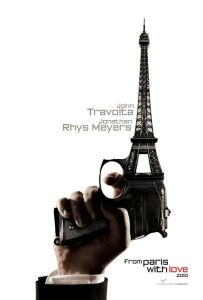 Sometimes a strict genre film can be forgiven its clichés. You find the characters interesting, the actors are having a grand time, or the director finds a way to make old seem new. And sometimes a movie just gets sunk to the watery depths of boredom thanks to an overabundance of genre clichés. From Paris with Love is the latter. I had higher hopes for the film coming from the director of 2009’s Taken, which defied a ball of clichés to be a fairly kick-ass and efficient action caper. Paris involves the tired setup of the straight-laced guy matched up with the reckless loose canon. John Travolta gets to chew every piece of scenery not nailed down. Travolta unhinged has its pleasures, but if the entire movie is Travolta’s theatrical tantrums and some scattered explosions, then forget it. We watch Travolta act up, go overboard, and then eventually be proven right. This formula is repeated ad nauseam. The silly plot involves a Pakistani terrorist strike against the U.S. ambassador at the African summit in Paris (convoluted much?). The twists and double-crosses are easily telegraphed, and most of the action sequences are poorly edited and structured, and the attempts at humor fall deadly flat. From Paris with Love is a stupid action movie for all the wrong reasons.
Nate’s Grade: C
Share this:

August Rush (2007)
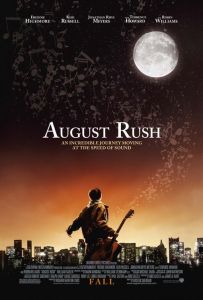 Am I too cynical for my own good? I’d like to think that I appreciate authentic works that tug at my heartstrings, and I’m a believer in the power that music can have, which are part of the reasons I named Once the best film of 2007. In comparison, August Rush tries to go all message and winds up skirting over why I should even care what happens to its characters.
In 1994 or so Lyla (Keri Russell) is a concert cellist in New York City. Louis (Jonathan Rhys Meyers) is the lead singer in a rock band touring the area. They meet atop a rooftop, look deeply into each other’s eyes, and then have sex. Parents, do not condone this behavior with your daughters and sons. But they’re separated through lame circumstances and nearly miss each other several times. This romantic encounter has spawned a son growing in Lyla’s womb. She gets into a car accident late in the pregnancy and was told by her manager/father tells her the baby has passed away. He is a liar because the baby was born and he signed it up for adoption.
 Flash forward 11 years. The child has gown up into the likes of Evan (Freddie Highmore) who lives in a boarding school for orphan boys. He knows his parents are out there in the world somewhere and he believe he can find them through the connection music. He gets lost in New York City and follows a troop of child musicians to the Wizard (Robin Williams). He looks after a gathering of orphan musicians that play on street corners. It’s like Oliver Twist meets American Idol with an extra dose of sugar. Sure enough Evan stars drawing a crowd and the Wizard wants to make sure he doesn’t lose his biggest earner.
This film is a ludicrous and manipulatively maudlin mess. August Rush plays all the big notes; the film’s script is entirely comprised of big moments that waddle and crash into one another, and as such it ignores any details. Like the fact that Evan has the ability to connect to his long-lost parents simply by strumming an instrument, but he’s never heard of musical notes or touched an instrument until he was 11. If the kid hears music everywhere, which reminded me a lot of Bjork in the superior Dancer in the Dark, wouldn’t it stand to reason he would try to, I don’t know, play music? Now I’m not saying he’d have access to every musical instrument at the boy’s boarding house but surely he could have drummed something? I find it unbelievable that a musical prodigy would wait until he was 11 before he picked up an instrument. Also, he learns what sounds are labeled as what letter notes by a cherubic little tyke with some powerful pipes of her own. He goes immediately from learning what an F sharp is to scribbling complex musical notation on blank sheets of music stanzas. How does he know all the symbols and placements and everything that the little girl did not teach him in their brief instructional moment? I’ll go back even further. How come Lyla and Louis give up trying to find each other so easily? Why does Louis wait 11 years before he searches the Internet for Lyla, who, being a world-class cellist, would not exactly be low profile? And why does a pregnant Lyla not do more to, you know, get in contact with her child’s father when he’s even in the exact same city? It’s details like these that August Rush hopes to will the audience to ignore, but to me it was proof time and again that the film’s indifference to plot, character, and maintaining any level of credibility even on a heightened “urban fairy tale” level.
If you replaced the stars then this movie would prove to the world that it belongs on the Lifetime TV network. It’s a melodramatic free-for-all that turns the topic of music into a quasi-religious experience. Now I know for many that music actually can maintain a religious level of power and sweep, but I challenge people watching August Rush to replace the word “music” in the dialogue with any other word to fully realize how cheesy the dialogue is. Let’s try replacing “music with “the force,” and now read this choice line of dialogue: “You know what [the force] is? God’s little reminder that there’s something else besides us in this universe; harmonic connection between all living beings, every where, even the stars.” And: “[The force] is all around you, all you have to do is listen.” This is the kind of film where characters can look up into the void with wistful, wide-eyed looks and somehow connect over the ether. That’s how the characters stay together and eventually reunite in a predictable and sappy manner.
The music itself is rather unremarkable. It’s well composed but I wouldn’t be able to recall it again even if I had a gun to my head. When the movie trumps the message of the transcendent power of music it doesn’t help when the music it presents is less than special.
The acting befits the same cheesy atmosphere of the movie. Highmore is pretty vacant and looks like he’s shrugging from scene to scene, that is, until he bangs his hands against a guitar neck and everyone somehow calls this genius. I think part of Highmore’s problem is that regular folks just think that honest-to-goodness geniuses don’t really have to work hard for results. This is, of course, false. Mozart was a prodigy, yes, but he didn’t just yawn and write down invisible notes that were dancing in front of his eyes waiting all day to be transcribed. He worked hard. Highmore just looks off into the distance and he seems to be in a trance. It’s annoying.
 Russell gets to pine for something just outside her reach (turns out it’s a son) but she doesn’t flash an iota of the grace and magic she showcased in Waitress. Meyers gets to “sell out” and then reunite his mid 90s alternative rock band. Here’s the thing — the sound EXACTLY THE SAME after 12 years and yet on their first gig back together they have a huge crowd? The movie is trying to tell me that the tastes of pop culture wouldn’t change in a dozen years. Williams manages to give hints about a troubled past as a musical prodigy eaten up by a system hungry for the next big thing. He also bellows and growls and comes across like a creepy Fagan for a team of street urchins.
August Rush is sticky, sappy, manipulative and maudlin feel-good rubbish. This is the kind of movie that most people will probably never get. Perhaps people who live, breathe, sleep, and eat music will feel more inspired by its message of human connection and spiritual fulfillment via the power of music. That’s swell but it still doesn’t excuse the fact that August Rush is a overly serious, laughable, syrupy work. If you’re going to dismiss its faults as the film being a “fairy tale” well then the film still doesn’t establish any hard rules for its universe. The characters are still one-note and behave in annoying and moronic ways because the plot demands it of them. And classifying the film as a fairy tale still doesn’t make the music any better. I can’t believe this stuff had a shot of beating the spectacular songs from Once for 2007’s Best Song Oscar. In fact, August Rush wishes it was Once because that low-budget charmer was able to communicate the power of music honestly and profoundly with the added benefit of beautiful tunes. I would like to recommend that all people thinking about renting August Rush.
Nate’s Grade: C-
Share this:

Mission: Impossible III (2006)
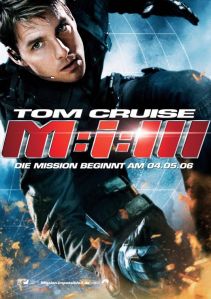 Few celebrities have had the intense flame-out Tom Cruise has experienced in a little over a year’s time. First there was the PDA-heavy relationship with Katie Holmes, never a wet tongue-kiss away from a camera. Then there was the couch aerobics on Oprah Winfrey’s set, bleating his over-the-top declarations of love like Roger Rabbit. This was followed by a series of testy interviews about his war of words on psychiatry and prescription drugs. Entertainment Weekly just ran a cover story asking, “Is Tom Cruise worth his paycheck?” He’s gone from Hollywood’s most bankable actor to a national punch line. To bring new life to Cruise’s spy series, he tapped TV mastermind J.J. Abrams to make his feature debut after Cruise churned through two seasons of spy series Alias DVDs. Abrams is a gifted franchise starter, first with Alias and then with Lost, and with Mission: Impossible III he does the best he can to erase the memory of Tom Cruise, daredevil of furniture.
Ethan Hunt (Cruise) is out of field work at the Impossible Mission Force, training recruits for the big time. He’s settled into a comfortable home life with Julia (Michelle Monaghan), a woman he’s blissfully engaged to be wed. Ethan’s happy home is disrupted when IMF needs his services. It seems one of his trainees (Keri Russell, Felicity goes badass) has been captured by an arms middleman Owen Davian (Phillip Seymour Hoffman), a man that will get any deadly force to the right bidder. Hunt reluctantly goes back into the field, assembling a team that includes Luther (Ving Rhames), Zhen (Maggie Q, quite fetching), and pilot Declan (Jonathan Rhys Meyers). Their mission goes badly and Hunt is reprimanded for his cavalier actions. He’s determined to snag Owen and get justice. This leads to an incredibly stuffed game of cat-and-mouse, each jockeying for leverage. There’s some super powerful device called the “rabbit’s foot” that everyone wants but it’s not really important. What is important is that Owen is eager to strike back at Ethan’s most vulnerable point — harming Julia.
 This movie is quite possibly one of the greatest TV adaptations of all time. No, not the Mission: Impossible series but Alias. Just like J.J. Abrams’ TV brainchild, this slick, propulsive caper puts a smart spin on familiar ground. We’ve got the flash-forward narrative trickery, the super gadgets, the undercover teamwork, the world-trotting sprawling vistas, and anchoring the whole thing with an emotional counterpoint, trying to lead a double, “normal” life and keeping your loved ones equally safe and in the dark. There’s a great scene in the middle of a mission where Ethan and Luther casually discuss the impossibilities of living a normal life given what they do. Luther warns that those close to you will only end up getting hurt, and by this point thanks to a startling, right-to-the-point opener with a gun to sweet Julia’s head, we know he’s right. That’s what makes the third go-round different: Abrams has injected some emotion into the darn thing. Ethan is pressed back into service and then becomes something of a knight in shining Kevlar, trying to save his beloved in the crossfire of international espionage. There are a handful of scenes between Cruise and Monaghan and they sell the emotional drama in tender quiet looks. As a result, the audience and Ethan are rooted to their seats beyond just the assembly line of pyrotechnics. Just like Alias (at least up until Season 3 when it jumped the shark with the long-lost sister). It’s like if True Lies was played straight and Tom Arnold was mercifully forgotten.
Ah, but what pyrotechnics they are. Things get heated with a trip to the Vatican and they literally do not let up, all the while raising the stakes by pulling Ethan’s home life closer to the danger of his job. You’ll be left breathless absorbing all the exhilarating action sequences, which to my best estimate are more than the first two flicks combined. The stunts are superbly death-defying. What makes action sequences so enjoyable, pay attention you Hollywood rubes, is when the stage is set and then we watch organic complications. Abrams has a tremendous feel for action and playfully extends virtuoso sequences of awesome carnage. An attack on a bridge is simply outstanding and gave me an overload of geeky joy. We’re given the tight, controlled setting, and then Abrams introduces the outside conflict and keeps developing it masterfully step by step. There’s air attacks, there’s running back and forth amongst the wreckage, there’s searching for guns while escaping attack, and then there’s flying leaps over gaping concrete holes. I was jumping in my seat with boyish glee. The slow-mo gun toss between Cruise and Russell? Awesome. The swing-shot jump off a gigantic skyscraper in Shanghai? Awesome. The use of Simon Pegg (Shaun of the Dead) as gadget guru? Awesome. Mission: Impossible III is, if nothing else, an incredible adrenaline rush orchestrated by a man with a finger directly on the pulse of his audience. By summer popcorn standards, Mission: Impossible III is everything you could hope for. Sure it’s highly implausible but it’s just so damn fun.
 Abrams has created quite a breakthrough for himself. Long regarded as a TV visionary for his tangled, engrossing pop-pulp like Alias and Lost, Abrams shows what he can do with a bazillion dollars and one of the world’s most recognized stars. Abrams intelligent, deft handling of his material, elevating tired genre devices with flash and reverence, reminds me of a young Steven Spielberg. This is a man that respects his material and respects his audience, but still knows how to bring home an entertaining movie. I’ve followed Abrams’ career since getting hooked on Alias in 2001, and I’m confident he will become the best friend a movie geek could ever have (Star Trek fans should be clicking their heels about Abrams’ rumored involvement). Even though Mission: Impossible III is Abrams’ film debut (and on record the most expensive ever for a first time film director) he already shows more command, more wit, and more hipness than most of Hollywood’s graying old guard.
Finally, this is the first Mission: Impossible film to utilize the team aspect of the TV show. Granted, Cruise still does most of the running, jumping, climbing trees, but thankfully this movie is more than the Tom Cruise Kicks Everyone in the Face Show a.k.a Mission: Impossible II. The supporting cast all have their one great moment and part of the fun is their interaction, seeing the pieces fit into place. Just like last summer’s Batman Begins I would like to see another movie immediately with everyone involved. Make it happen. This is the Mission: Impossible world I want to explore in greater detail.
Mission: Impossible III is not bulletproof. The movie seriously needed more time for its villain. Hoffman does a great job of bringing his bad man to grumpy life. He goes about business with a detached nonchalance, like a plumber fixing his 10,000th clog. It may sound silly but it works because Hoffman gives his character a lizardy, unscrupulous sense of ethics. He really will put a bullet between the eyes of anyone, possibly while reheating some food in his microwave. That’s the greatness of Hoffman’s villain, how ordinary he sees his line of work and what it calls him to do. Now, with such a terrific villain it would behoove Mission: Impossible III to give him plenty of screen time. Sadly, Hoffman has about three real scenes, and his end is anticlimactic and so is the film as a whole. And what does IMF have to do to curb moles? There’s been one in all three Mission: Impossible movies. Maybe they should offer better vacation plans.
Tom Cruise may have done a lot to wear out his welcome with the public but he knows to surround himself with good people. The decision to let J.J. Abrams helm Mission: Impossible III has finally given this franchise vision and sustained excitement. This movie is far more emotionally based than any other in the series and there’s a genuine emotional reason for all the fireworks this time. The team aspect is finally addressed and Hoffman makes a truly lecherous, scary villain. But the bread and butter of this flick are its breathless action sequences, brilliantly choreographed by Abrams, a name destined for even greater things. Abrams knows how to spin genre clichés into clever, loose, twisty, funny, thrilling, emotionally centered gold. I don’t care if Cruise abused a couch and the public’s good will; Mission: Impossible III is an extravagant popcorn movie and a great way to start the summer. If only they were all like this.
Nate’s Grade: B+
Share this:

Match Point (2005)
 This is an excellent return to form for Woody Allen and his best film since 1987’s Crimes and Misdemeanors. The first half is deliberately slow, yes, but it is justified by the second half which more than makes up for it. The first half needed to be as slow as it is to set up the incredible minutia of this rich, elite world that former tennis pro Chris (Jonathon Rhys-Myers) has been adopted into. We need to see how comfortable this life is to understand why he doesn’t want to give it up and why he goes through the machinations he does in the second half. The characters and dialogue are spot-on and Allen has transported his world of the upper crust New York elite so well over to London, and the change of scenery has reawakened his writing. Allen knows the privileged world very well and their disconnected view point. However, he rightly centers his film not on the neurotic upper crust but on his social climbers Chris and Nola (Scarlett Johansson), a beauty engaged to Chris’ prospective brother-in-law. It is the second half of Match Point that makes it great. Allen tightens the screws on his social climbers and the tension is superbly taut. The dark turns and in the final act are greatly entertaining, as Allen delves further into his look at a universe built around chance and disorder. The returning imagery of the ball hitting the tennis net elicited gasps from my audience, and I was one of them. I love that Allen lets his story continue to unfold after the dark twists. The film’s biggest flaw is anchoring the entire point of view on Rhys-Myers, a somewhat limited actor that reminded me of Jude Law’s character in Closer. Johansson is an excellent noir femme fatale, her husky voice perfectly suited. Frankly, if ever there was a Scarlett Johansson nude scene, this movie was crying out for it. She has her tawdry affair with Chris and there’s even a sequence where we see her laying on her stomach nude while he applies baby oil to her. Their sex is supposed to be so impassioned and carnal, in contrast to his boring but stable relationship with Chloe (Emily Mortimer). And yet no nudity? Woody Allen, you’ve let me down. Your film, on the other hand, is intelligent, sharp, dark, taut, and wonderfully entertaining.
Nate’s Grade: A


 nathanzoebl
You must be logged in to post a comment.