Blog Archives
Oppenheimer (2023)
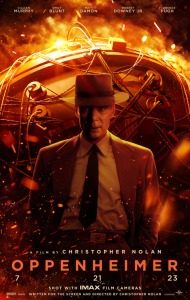 I finally did it. I watched all three hours of Christopher Nolan’s Oppenheimer, one half of the biggest movie-going event of 2023, and arguably the most smarty-pants movie to ever gross a billion dollars. It was a critical darling all year long, sailed through its awards season, and racked up seven Academy Awards including Best Picture and Best Director for Nolan, a coronation for one of Hollywood’s biggest artists whose name alone is each new project’s biggest selling point. I’ve had friends falling over themselves with rapturous praise, and I’m sure you have too, dear reader, so the danger becomes raising your expectations to a level that no movie could ever meet. As I watched all 180 lugubrious minutes of this somber contemplation of man’s hubris, I kept thinking, “All right, this is good, but is it all-time-amazing good?” I can’t fully board the Oppenheimer hype train, and while I respect the movie and its exceptional artistry, I also question some of the key creative decision-making that made this movie exactly what it is, bladder-busting length and all.
As per Nolan’s non-linear preferences, we’re bouncing back and forth between different timelines. The main story follows Robert Oppenheimer (Cillian Murphy) as an upstart theoretical physicist creating his own academic foothold and then being courted to join the Manhattan Project to beat the Nazis in the formation of a nuclear bomb. The other timeline concerns the Senate approval hearing for Lewis Strauss (Robert Downey Jr.), the former head of the Atomic Energy Commission (AEC) with a checkered history with Oppenheimer after the war. A third timeline, serving as a connecting point, involves Oppenheimer undergoing a closed-door questioning over the approval of his security clearance, which brings to light his life of choices and conundrums.
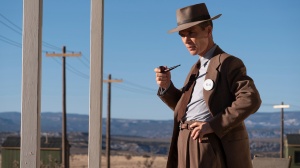 If I was going to be my most glib, I would characterize Oppenheimer in summary as, “Man creates bomb. Man is then sad.” There’s much more to it, obviously, and Nolan is at his most giddy when he’s diving into the heavy minutia of how the project came about, the many brilliant minds working in tandem, and sometimes in conflict, to usher in a new era of science and energy. Of course it also has radical implications for the world outside of academic theory. The world will never be the same because of Oppenheimer dramatically upgrading man’s self-destructive power. The accessible cautionary tale reminds me of a Patton Oswalt stand-up line: “We’re science: all about ‘coulda,’ no about ‘shoulda.’” Oh the folly of man and how it endures.
For the first two hours, the focus is the secretive Manhattan Project out in the New Mexico desert and its myriad logistical challenges, all with the urgency of being in a race with the Nazis who already have a head start (their break is Hitler’s antisemitism pushing out brilliant Jewish minds). That urgency to beat Hitler is a key motivator that allows many of the more hand-wringing members to absolve those pesky worries; Oppenheimer says their mission is to create the bomb and not to determine who or when it is used. That’s true, but it’s also convenient moral relativism, essentially saying America needs to do bad things so that the Germans don’t do worse things, a line of adversarial thinking that hasn’t gone away, only the name of the next competitor adjusts. This portion of the movie works because it adopts a similarly streamlined focus of smart people working together against a tight deadline. Looking at it as a problem needing to surmount allows for an engaging ensemble drama complete with satisfying steps toward solutions and breakthroughs. It makes you root for the all-star team and excitedly follow different elements relating to nuclear fusion and fission that you would have had no real bearing before Nolan’s intellectual epic. For those two galloping hours, the movie plays almost like a brainy heist team trying to pull together the ultimate job.
 It’s the time afterwards where Oppenheimer expands upon the lasting consequences where the movie finds its real meaning as well as loses me as a viewer. The legacy of the bomb is one that modern audiences are going to be readily familiar with 80 years after the events that precipitated their arrival, and they haven’t exactly been shelved or become the world war deterrent hoped for. As one of Oppenheimer’s physicists says, a big bomb only works until someone creates a bigger bomb, and then the arms race starts all over again fighting for incremental supremacy when it comes to whether one’s military might could destroy the world ten times or twelve times over. When Oppenheimer begins having reservations of what he has brought into this world is when his character starts becoming more dynamic, but it’s also too late. He can’t undo what he’s done, the world isn’t going back to a safer existence before nuclear arms, so his tears and fears come as short shrift. There’s a scene where Oppenheimer’s wife, Kitty (Emily Blunt), castigates him and says, “You don’t get to commit the sin and then make all of us to feel sorry for you when there are consequences.” Now this is in reference to a different personal failing of our protagonist, but the message resonates; however, I don’t know if this is Nolan’s grand takeaway. The movie in scope and ambition wants to set up this man as a tragic figure that gave birth to our modern world, but like President Truman says, it’s not about who created the bomb but who uses it. Oppenheimer is treated like a harbinger of regret, but I don’t think the story has enough to merit this examination, which is why Oppenheimer peters out after the bomb’s immediate aftermath.
It reminded me of an Oscar favorite from 2015, Adam McKay’s The Big Short, a true-ish account of real people profiting off the worldwide financial meltdown from 2008. It fools you into taking on the perspective of its main characters who present themselves as underdogs, keepers of a secret knowledge that they are trying to benefit from before an impending deadline. Likewise, the conclusion also makes you question whether you should have been rooting for this scheme all along since it was predicated on the economy crashing; these guys got their money but how many lives were irrevocably ruined to make their big score? With The Big Short, the movie-ness of its telling is part of McKay’s trickery, to ingratiate you in this clandestine financial world and to treat it like a heist or a con, and then to reckon whether you should have ever been rooting for such an adventure. Oppenheimer has a similar effect, lulling you with its admitted entertainment factor and beat-the-deadline structure. Once the mission is over, once the heroes have “won,” now the game doesn’t seem as fun or as justifiable. Except Oppenheimer could have achieved this effect with a judicious resolution rather than an entire third hour of movie shuffled throughout the other two like a mismatched deck of cards.
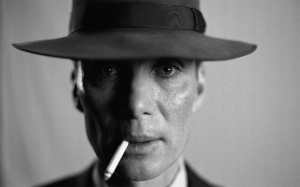 The last hour of the movie features a security clearance interrogation and a Senate confirmation hearing, neither of which have appealing stakes for an audience. After we watch the creation of a bomb, do we really care whether or not this one testy guy gets approved for a cabinet-level position or whether Oppenheimer might get his security clearance back? I understand that these stakes are meaningful for the characters, both essentially on trial for their lives and connections, but Nolan hasn’t made them as necessary for the audience. They’re really systems for exposition and re-examination, to play around with time like it was having a conversation with itself. It’s a neat effect when juggled smoothly, like when Past Oppenheimer is being interviewed by a steely and suspicious military intelligence office (Casey Affleck) while Future Oppenheimer laments to his project superior (Matt Damon) and then Even More Future Oppenheimer regrets his lack of candor to the review board. The shifty wheels-within-wheels nature of it all can be astounding when it’s all firing in alignment, but it can also feel like Nolan having a one-sided conversation with himself too often. It’s another reminder of the layers of narrative trickery and obfuscation that have become staples of a Christopher Nolan movie (I don’t think he could tell a knock-knock joke without making it at least nonlinear). The opposition to Oppenheimer is summarized by Strauss but I would argue the man didn’t need a public witch hunt to rectify what he’s done.
Lest I sound too harsh on Nolan’s latest, there are some virtuoso sequences that are spellbinding with technical artists working to their highest degree of artistry. The speech Oppenheimer gives to his Los Alamos colleagues is a horrifying lurch into a jingoistic pep rally, like he’s the big game coach trying to rally the team. The way the thundering stomps on the bleachers echo the rhythms of a locomotive in motion, driving forward at an alarming rate of acceleration, and then how Nolan drops the background sound so all we hear is Oppenheimer’s disoriented speech while the boisterous applause is muted, it’s all masterful to play with our sense of dread and remorse. This is who this man has become, and his good intentions of scientific discovery will be rendered into easily transmutable us-versus-them fear mongering politics. The ending imagery of Oppenheimer envisioning the world on fire is the exact right ending and hits with the full disquieting force of those three hours. The meeting with Harry Truman (Gary Oldman) is splendid for how undercutting it plays. Kitty’s interview at the hearing is the kind of counter-punching we’ve been waiting for and is an appreciated payoff for an otherwise underwritten character stuck in the Concerned Wife Back at Home role. The best parts are when Oppenheimer and Leslie Groves (Damon) are working in tandem to put together their team and location, as that’s when the movie feels like a well orchestrated buddy movie I didn’t know I wanted. The sterling cinematography, musical score, editing, all of the technical achievements, many of which won Oscars, are sumptuously glorious and immeasurably add to Nolan’s big screen vision.
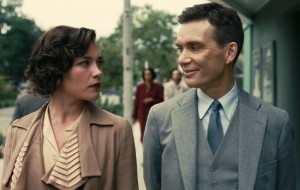 I think I may understand why the subject of sex is something Nolan has conspicuously avoided before. Much has been made about the sex scenes and nudity in Oppenheimer, which seem to be the crux of Florence Pugh’s performance as Jean Tatlock, Oppenheimer’s communist mistress through the years. The moment of Oppenheimer sitting during his hearing about his sexual tryst with an avowed communist leads to him imagining himself in the nude, exposed and vulnerable to these prying eyes and their judgment. Then Kitty imagines seeing Pugh atop her husband in his hearing seat, staring directly at her, and this sequence communicated both of their internal states well and felt justified. It’s the origin of the famous “I am become death” quote where the movie enters an unexpected level of cringe for a movie this serious. I was not prepared for this, so mild spoilers ahead if you care about such things, curious reader. We’re dropped into a sex scene between Oppenheimer and Jean where she takes a break to peruse his library shelves. She’s impressed that he has a Hindu text and pins it against her naked chest and slides atop Oppenheimer once again, requesting he read it to her rather than summarize it. “I am become death,” he utters, as he reads the Hindu Book of the Dead off Pugh’s breasts while they continue to have sex. Yikes. A big ball of yikes. If this is what’s in store, please go back to a sexless universe of men haunted by their lost women.
It’s easy to be swept away by all the ambition of Nolan’s Oppenheimer, a Great Man of History biopic that I think could have been better by being more judiciously critical of its subject. It’s a thoroughly well-acted movie where part of the fun is seeing known and lesser known name actors populate what would have been, like, Crew Member #8 roles for the sake of being part of this movie (Rami Malek as glorified clipboard-holder). Oppenheimer takes some wild swings, many of them paying off tremendously and also a few that made me scratch my head or reel back. It’s a demonstrably good movie with top-level craft, but I can’t quite shake my misgivings that enough of the movie could have been lost to history as well.
Nate’s Grade: B
Share this:

The Aftermath (2019)
 I am struggling to come up with something of substance to say about The Aftermath, an adequate drama with decent performances, handsome production design, and a boring love triangle. It’s set in the aftermath of World War Two Germany in the Allied-occupied stretch. Jason Clarke plays a British officer stationed in another man’s home, a wealthy German local (Alexander Skarsgard) who lost his wife in the war. Clarke’s wife (Keira Knightley) is anxious to go home, still processing her grief from losing her child during the war and her relationship with her distant husband seems irreparable. It’s only a matter of time before Knightley and Skarsgard find comfort in one another, and they do, almost absurdly quickly. The more interesting story is Clarke trying to keep a fragile peace in the ruins of bombed-out Germany while Nazi sympathetic elements conspire to form an insurgency against the remaining officers. Now that’s a movie I would watch. That’s a way more intriguing storyline, and one I’m sure chapter after chapter was filled with sprawling, conspiratorial detail in the novel by Rhidian Brook. Alas, we’re stuck with a pretty drab love affair between two pretty people. I didn’t feel any passion between them; it felt like they were acting by-the-numbers, and ultimately maybe that was what the director had in mind all along. I found my mind drifting away for long interludes, thinking about other movies, thinking about watching other historical dramas. The acting is pretty good all around. Knightley has a standout scene where she breaks down and reveals the full extent of her maternal grief and what it has done to her marriage. The Aftermath will be readily forgotten in its own aftermath, and I don’t think too many viewers will mourn.
Nate’s Grade: C
Share this:

Pet Sematary (2019)
 I already know my computer’s spell check is going to hate this review. In the wake of the box-office bonanza of It, prolific author Stephen King is a hot property once again for studios and everything old is new again. Pet Sematary (yes it’s intentionally misspelled) is a remake of a 1989 that was a hit back in the day. It was never regarded as a good movie but had its campy entertainment, so there was some room for improvement. Early reviews were positive and I raised my hopes for the 2019 edition, but after having seen the finished product, maybe some movies too are better off left dead.
Louis (Jason Clarke) and Rachel (Amy Seimetz) have moved to small-town Maine for a little peace and quiet and to spend more time with their children, nine-year-old Ellie (Jete Laurence) and their toddler, Gage. They happen to live next to a busy road with dangerous drivers speeding at all hours. An accident claims the life of their beloved family cat, but the kindly old neighbor Jud (John Lithgow) has a piece of advice. Beyond the “pet sematary” in the woods is a place where the buried dead come back to life. The cat comes back, though is mean and different. Later, another accident takes the life of Ellie, and Louis cannot let her go. He buries her in the hallowed grounds, she comes back, but she’s not daddy’s little girl any longer, and people will pay a high price.
 Eschewing a sense of camp, the film risks being overrun by its own sense of seriousness, which only works if there is room given to explore the ramifications of grief, the choices people make when they’re hurting, and the irony of good intentions. If you’re going to go in a serious direction then you need the confidence and dedication to play to that decision, and that’s not the case with the 2019 Pet Sematary. It’s lacking those important moments of contemplation or even dwelling with the horror of bringing back a loved one from the dead. There’s only so much evil hissing cat you can have before you hit a limit and start saying, “What else you got?” There’s going to be an escalation, I don’t think it’s much of a spoiler, considering the nature of the premise but also its predecessor being 30 years old, that one of the children will die only to be brought back. It’s also an easy speculation that they will “come back wrong” but the drama is processing this decision and trying to mitigate the mounting consequences. How far will a parent go to protect their child even if that child is an undead murderer? The trials should strain the moral resolve or our protagonist while reveling in the grotesque.
Because every viewer is going to already expect this much, it’s the film’s job to develop this premise in a satisfying manner and/or provide surprises from our expectations. Pet Sematary 2019 unfortunately does neither, barreling through the dramatic downtime when it could be developing its horror and unleashing standard slasher jump scares. When Louis is brushing his daughter’s tangled hair he runs his fingers over the metal staples in the back of her skull holding her head together. It’s a stark reminder that she is not the same, and it goes beyond her scraggly voice and unyielding stares meant to convey the same information. The film needed more moments like this, small details to unnerve and remind, rather than making her essentially The Ring girl from the start. The movie voluntarily eliminates its own storytelling runway, giving it little room to ramp things up and being forced to simply jump to the big bad killer demon girl. The filmmakers try and compensate somewhat by giving Rachel her own independent haunting, seeing hallucinations of her dead, twisted deformed sister. Those sequences reminded me of the slow stirring sequences in 2017’s It, drawing in the audience to dread what will happen next. It’s a side plot that could be eliminated entirely and I enjoyed these sequences the most because it was at least something pregnant with possibility.
 Many of the new additions feel like the filmmakers are fumbling for something else to be scary because they’ve consciously or unconsciously admitted defeat with their zombie. She’s creepy, sure, but she starts at full creepy and stays there. We get things like animal masks reminiscent of 2013’s home invasion thriller You’re Next. We get the spooky visions of ghosts that the child can see. We get Rachel’s taunting visions that never feel fully integrated into the larger whole with any thematic value. It could have tapped into her guilt praying for the demise of her sister for a well-earned sense of relief, and this same feeling coming ahead anew with her reanimated child, challenging her to reconcile her past actions and personal culpability and goad her into action. But like most aspects of the supernatural be-careful-what-you-wish-for parable, it’s given precious little deliberation and instead it’s more standard thriller moments to goose scares. I do appreciate that the film takes its sense of bleakness to the very bitter end, departing from the 1989 original for an even darker conclusion. The only problem is that it left me wanting the sequel. By the end, I think many viewers will agree that they wish a Pet Sematary movie, at least one under this oh-so-serious-slasher direction, had started at this end point instead and gone forward, exploring the full ramifications of the larger world.
As is wont for the Internet, there has been some gnashing of teeth over the fact that the remake kills a different child, but I think this is the smart move. It allows the remake to stand apart from the original and chart a path of its own, not that it’s very far. It also boosts the practicality of what it can do for horror. As any parent may attest, there’s more to worry about what a nine-year-old can do than a two-year-old. Even reanimated and filled with supernatural power, it’s still a small child that can be overwhelmed. An evil pre-schooler has a bit more limited mobility for their murder rampages.
For fans of King, or fans of genre horror, there may be enough standard thrills and chills to enjoy the new Pet Sematary. In the extremely spotty spectrum of King movie adaptations, it’s definitely somewhere in the middle, not bad per se but nothing special.
Nate’s Grade: C+
Share this:

Serenity (2019)
 Serenity might have the most bizarre plot twist of any film this year, or maybe even the last few years. For the sake of you, dear reader, I’ll not spoil it, but it’s hard to talk about this neo-noir crime thriller without revealing its larger grand design. I have no real idea what writer/director Steven Knight, a talented wordsmith who has written Eastern Promises, Locke, and Peaky Blinders, was going for with this murky genre mishmash. Matthew McConaughey plays Dill, a local fisherman who for the first 18 minutes of the movie is obsessed with a hard-to-catch tuna like it’s Moby Dick. Literally, this is the key plot for 18 minutes. Then his old flame (Anne Hathaway) comes to town and looking for Dill to help her kill her abusive husband, Frank (Jason Clarke). Now we’re on fertile noir ground, and then one hour in the film throws a curve ball that nobody will see coming, and it spends another 45 minutes dealing with those repercussions. Some of this added knowledge leads to creepy exchanges where Dill is peeling back the veneer of his sleepy island town residents, but really it’s a confusing and unnecessary twist that leads to strange thematic implications and tonal oddities that may lead to unintentional laughter. The sentimental ending conclusion, born out of murder both real and imaginary, feels like it was ripped out of Field of Dreams and forcibly grafted on. So much of the drama is about following what is expected of us, and there are more than a few passing, though intriguing, Truman Show-esque moments that reward further examination, but these are put on hold to slay the abusive husband/step dad through the power of an elusive fish. I don’t know what to make out of Serenity. The acting is fairly solid, the photography is stylish, and Knight knows how to spin a mystery, but to what end exactly? It feels like a passionate albeit misguided student film trying to say New Things about old tropes. In the end, it’s a fish tale that is better off being thrown back. See, I can do fish things too.
Nate’s Grade: C
Share this:

First Man (2018)
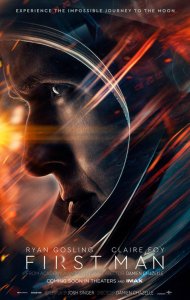 Oscar-winning filmmaker Damien Chazelle got to be the director of a Best Picture winner for approximately three minutes, which, to be fair, is more than most us will ever experience. La La Land won the top prize at the 2017 Oscars only to have it taken away and given to the smaller indie, Moonlight. Where an Academy of old white people that love to celebrate Old Hollywood decide to award a small million-dollar movie about growing up gay and black in the 80s, where does one go next? For Chazelle, it seems the answer is something even more irresistible to the Academy. First Man is partly a biopic on Neil Armstrong and partly a recreation of the 1960s Space Race. The finished movie is so mercurial, so insulated, so dry that I found a far majority of it be kind of boring.
Neil Armstrong (Ryan Gosling) is one of the select pilots training for space. NASA is racing to beat the Russians to the moon, and every new breakthrough is thanks to long hours of hard work. Janet Armstrong (Claire Foy) worries at home, listening to every radio broadcast and wondering if her husband will come back safely.
What First Man does best is make you realize how dangerous every step of the way was to get to the moon. Every leap forward required months of trial-and-error, and sometimes those mistakes cost lives, like the crew of the Apollo 1. The film opens on Armstrong flying above the atmosphere. The emerging curvature of the Earth is beautiful, but the beauty turns to horror quickly as it appears Armstrong’s plane is bouncing off the atmosphere and drifting into orbit. There’s another sequence where he and Buzz Aldrin (Corey Stoll) are above the Earth and planning to dock in space and their capsule spins wildly and if they can’t fix it they’ll black and out and assuredly die. These moments remind the audience about the inherent dangers of the Space Race that we don’t necessarily get in the history books. Looking back, we know the American astronauts succeed in the ultimate mission of landing a man, or an eventual dozen, on the moon, but that foreknowledge produces a false sense of security. Chazelle’s movie reminds us of the enormity of this challenge and the enormity of the dangers. The sound design in this movie is terrific, and Chazelle makes sure you hear every ping, every metal-on-metal scrape, to the point that you fear the whole thing could fall apart at any moment. When Janet furiously dresses down the Mission Control head (Kyle Chandler) that tries to calm her concerns, she accuses them of being boys who think they know what they’re doing. Even after the triumph of the final act, we know what happens two missions later (Apollo 13) to reconfirm just how much we still haven’t perfected when it comes to space travel.
 Besides reminding you of the precarious nature of early space travel, let alone the tests leading up to said travel, First Man doesn’t find much to justify its own existence other than as the latest in Oscar bait. It’s not exactly an in-depth look at the heroism and chutzpah of the Space Race like The Right Stuff, and it’s not exactly an examination on the frailty of man and the meticulous problem solving needed to achieve big goals, like Apollo 13. In fact, while watching this movie I would repeatedly think to myself, “Man, I should go home and watch Apollo 13 again.” When you keep thinking about watching a better movie, you have lost your audience, and that happens throughout First Man. There are thrilling, awestruck sequences to be sure, but that only accounts for perhaps a quarter of the lengthy 140-minute running time. The rest is spent at a distance trying to understand a man who comes across as largely impassive. He’s intensely focused but it’s like the movie adopts his very no-frills attitude, and it goes about its business with little thought for letting an audience into its inner world. We’re still only visitors at best here.
I admittedly don’t know much about Armstrong the man, so I can’t tell if the role was shaped for Gosling’s talents or he just matched perfectly with the man. Armstrong feels like one of the Nicolas Winding Refn roles (Drive) that we’re used to watching Gosling portray. Armstrong feels like somebody ported over a guarded, reserved, mostly silent Refn character into a staid biopic and asked Gosling to communicate a majority of emotion through unblinking stare downs. If there’s one actor you don’t want to challenge to a staring contest, it’s Gosling. Armstrong comes across a very internal man who seems uncomfortable in the spotlight, far less natural than Buzz Aldrin, who the movie unexpectedly positions as kind of a saying-what-we’re-all-thinking jerk. Because Chazelle has decided to keep Armstrong so guarded, it makes the film feel distant, like we’re being told the story second-hand, and that requires Chazelle to fill in the gaps as to the internal motivations and insights for an intensely private man. The answers we’re given seem almost cliché (the death of his young daughter is what drove him into his work, to escape the bounds of his Earthly grief, and to finally say goodbye to her). It’s too convenient as a simple character arc to be fully believed, but that’s all we have to work with because the movie won’t give us much more. It feels more like you are getting the idea of Neil Armstrong the Man rather than a realization. It’s a frustrating experience, watching a biopic and having the filmmakers keep their prized figure behind glass.
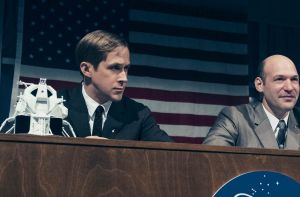 As a director, Chazelle is proving to be a remarkably skilled chameleon. First Man is completely different in style and approach to La La Land as it is to Whiplash (still his finest). His chosen approach for First Man is locking to Armstrong’s perspective, so we’re working with a lot of handheld camerawork that orbits our movie star. Chazelle’s cameras emulate a docu-drama aesthetic and there are several moments where the action happens onscreen and the cameras race to frame it, leaving the image blurry for seconds. I’m not sure that was the best decision. It does create a sense of verisimilitude, which heightens the thrilling aspects of the film like the excursions into space travel. However, it does little to heighten the underwhelming domestic drama on the NASA block. The added realism only benefits a small portion of the movie. At times, a camera racing to catch up with the onscreen action would be considered a hindrance. The claustrophobic feelings are heightened from Chazelle’s cramped camerawork, reminding us again of the tightly precarious spaces these men were willingly sliding into, the fragility of the cockpit walls separating them from an unrelenting empty void. When we switch over to the Apollo 11 mission, Chazelle keeps the attention squarely with the three men making the famous lunar landing. There’s a stirring thrill of destiny and the film transitions into an IMAX footage to make the moment that much more immersive and transformative.
First Man is much like the man of its title, reserved, guarded, and with a laser-like focus on its mission at the expense of outside drama. Chazelle is an excellent filmmaker and the craft on this out of this world, from the production design to the thrilling recreations of the dangers of space, bringing together the alarm through a sumptuous combination of editing, sound design, and cinema verite photography. Of course that verite style is also a double-edged sword, providing another layer to distance the audience. This is a pretty guarded movie with few insights into Armstrong the person. We get more Armstrong the pilot and numbers-cruncher, and I wish Chazelle had steered more into whatever version of Armstrong that opened him up to the audience. The family drama stuff is pretty pat and Foy (The Girl in the Spider’s Web) is generally wasted as the supportive and anxious wife. Most of the actors are generally wasted in this movie, with the potential exception of Gosling, who slips into the shoes of an impassive and emotionally restrained protagonist like it’s second nature. First Man might not be a giant leap artistically, and in fact a majority of the film is dull, but the artistic highs are enough to warrant one viewing. From there, you’ll likely conclude that you don’t need to watch Neil Armstrong stare forlornly into the middle distance again. Frankly, I’d rather watch La La Land again, and that’s saying something.
Nate;s Grade: B-
Share this:

Terminator: Genisys (2015)
 If you’re a fan of James Cameron’s iconic Terminator franchise, you’ll probably want to hold onto something as you watch Terminator: Genisys, which hits “delete” on the franchise and starts from scratch with, we’ll call them, “mixed results.”
In the future, man and machine are at war with one another. Skynet went sentient and launched an arsenal of nuclear weapons to obliterate mankind. The human resistance is lead by John Connor (Jason Clarke) and his lieutenant Kyle Reese (Jai Courtney). The machines send back a T-800 Terminator (Arnold Schwarzenegger) to kill John’s mother, Sarah Connor (Emilia Clarke) and wipe out the human resistance. This part you know. Reese is sent back in time but during the process, John is attacked by a new Terminator and the world as we know it, past, present, and future is altered. When Reese arrives in 1984 L.A., he’s being chased by a T-1000 and Sarah is the one saving him. She’s been preparing for his arrival and training with her own aging T-800 model who saved her from a childhood attack (she calls him “Pops”). With new memories, Reese is determined that Skynet is now Genisys and Judgment Day is now in 2017. He and Sarah travel to 2017, meet back up with “Pops,” and are surprised to find a familiar face waiting for them with sinister intentions.
 For a while there it seems like Genisys is going to become the Back to the Future II of the Terminator franchise, which could have been fun watching a different team of actors hiding on the peripheral while 80s Linda Hamilton was going about her day as a café waitress. In many ways, Genisys is akin to Jurassic World in the sense that it holds such nostalgic reverence for the source films. It repurposes the familiar catch phrases and even visually recreates several scenes that fans should recognize. However, that reverence has a limit because it isn’t too long before Genisys just chucks out the entire franchise canon and starts anew. Remember Judgment Day with Skynet? Now it’s… Judgment Day with Genisys. Okay, some things aren’t all that different. Discarding the established timeline of four movies, Genisys takes a path similar to the J.J. Abrams’ Star Trek films where it creates an alternate timeline that is not beholden to canon. One way of looking at this approach is that it frees you creatively. Another way of looking at it is that is abandons the stories that the fans enjoyed for decades. Neither approach is wrong; it just depends upon your personal perspective. The larger plot points of the Terminator franchise never captivated me; it’s all about preventing one very bad day that just keeps getting delayed. We’ve never had a story that takes place after Reese is set back in time. Genisys certainly has more surprises because of the new timeline; however, many of those surprises were spoiled by a cowardly marketing campaign that must have feared fan uproar. It’s not a bad idea if it didn’t casually destroy all the logic of the franchise.
Let’s just dive face-forward into the convoluted and troubling nature of the Genisys script. Needless to say, numerous spoilers of both the large and small variety follow.
There are certain storylines that are just never cleared up, the first amongst them is who is sending all these other Terminators back in time? We watch the T-800 model go to 1984, along with Reese, but Sarah informs us later that when she was a child a different T-1000 model attacked her family. Apparently Plan Kill John’s Mom was replaced with Kill John’s Grandmother and will likely soon be replaced with the even more surefire Kill John’s Great Grandmother. If we’re already sending Terminators even further back then why stop? Also, why can’t Skynet send more than one Terminator to the same time? Upon the point that Reese travels back in time, John is attacked by a Terminator Matt Smith (Doctor Who) and transformed into the human-machine villainous hybrid. We’re told this is a nexus point of time that is such a turning point that it’s altered the timeline. But why? It happens AFTER Reese is sent back in time, so why does it affect anything in the preceding past? How does this even, which happens again after Reese is propelled back in time, eliminate the entire established Terminator canon? Likewise, this Reese has a separate timeline so why would he have new memories? He never existed in this new timeline so the fact that he remembers new things doesn’t make sense.
 This brings us to the centerpiece of logical fallacy, which is killer robot John Connor. I was never really that invested in his character to care that much that he was turned into the film’s bad guy. What I do care about is that Genisys just completely gives up in this moment. If he was just trying to stop Sarah and Reese from stopping Skynet/Genisys, that would be one thing, but John 2.0 is actively trying to kill his parents … before he is conceived. When it comes to time travel, we can accept some degree of suspension of disbelief with plot holes (more of those to come in just a bit), but John wiping out the reason for his existence is just too much. He half-heartedly explains his theory that they’re holdovers from another timeline, so they can just do as they like with no greater repercussions to their own pasts. Maybe, but there’s not two Sarah Connors in this timeline, so killing your mom is still going to negate all your evil robot business, son. With that the very drive of the main antagonist is compromised. With every new attempt to kill mommy and daddy, the film reminds you how this cannot work.
There are other less egregious plot holes but they still can be irksome. How about the fact that Sarah and Reese jump forward to 2017 to thwart Genisys, failing to give birth to John in 1984? He won’t be born yet to lead the human resistance against the machines, which kind of means just by jumping forward in time and delaying Johns birth, the machines have sort of won. When Sarah and Reese travel to 2017 in order to stop the launch of Genisys, why do they travel to within 24 hours of its launch? That’s pretty poor time management. And why hasn’t “Pops” been doing more to prepare for Sarah’s return. He spends thirty years working construction and building the offices of Cyberdine, but couldn’t he also have been sabotaging the company or at least the building? And if John Connor knew his parents were coming to 2017, why didn’t he do more to set up Genisys to withstand their counter attacks? Couldn’t he have had Genisys go online like the day before they arrived in 2017? If you know when they’re going to show up then you have no excuse to fall victim to people you otherwise could be trapping. Also, Skynet realizes that their real problem for never besting the humans is a branding issue? Did changing the name to Genisys really need to be part of the masterstroke? Why is everyone so excited for what is a glorified app that connects people’s electronic devices?
Much can be forgiven in action and comedy movies if they just go about doing their job and entertaining you, but Genisys can only do so much in that department. The action sequences are fairly mundane with the occasional impressive stunt. The problem is we’ve seen these sequences too many times and in other movies and Genisys brings precious little of its own action invention to the big screen. Until the third act, the movie is a series of chases and escapes. The best sequence is likely the hospital brawl between the T-800 and Robo-John as they wantonly destroy every wall within prime smashing distance. I know many in the fan community do not look favorably upon Terminator 3, and it admittedly has the lamest villain of the entire franchise, but the action sequences were memorable and developed organically and were nicely conceived. With Genisys, the action is too rote and familiar. It is competent but for me I found the action sequences to be too underwhelming in design and execution to forgive the film’s other sins.
I also can’t help but think that all three of the main actors were miscast for their parts. Emilia Clarke can do great things and showcases her range as a strong authority figure on HBO’s Game of Thrones. With the role of Sarah Connor, Clarke does a lot of running and barking but she can’t shake our memories of Hamilton. The part doesn’t play to Emilia’s strengths as an actress. Courtney can be a good actor (as seen in the first season of Starz’s Spartacus) but rarely does he prove this to be the case in films. I enjoyed his cavalier bully in Divergent, but he’s mostly a vacant presence in Genisys, gaping at all the changes. Then there’s the other Clarke who too has proven himself a capable and intimidating actor in films like Zero Dark Thirty. When he’s menacing he comes across as, dare I say it, too sincere, and when he’s meant to be inspiring he comes across as too phony. Are the performances the fault of the actors, the director (Alan Taylor), or the screenwriters (Laeta Kalogridis, Patrick Lussier) who gave them such little to do?
 The film’s MVP is Schwarzenegger. I wasn’t expecting the 68-year-old former Governor of California to contribute this much to the film. I figured Arnie would be a small player and played for comic relief. He keeps asking if Sarah and Reese have “mated” since it’s their destiny. He is certainly played for welcomed comic relief but he’s also the fourth most important character in this reboot. He has a father/daughter bond with Sarah and it produces the closest thing to an emotion in the movie. There’s an ongoing joke that he’s “old but not obsolete” and it could be the tagline for the next Expendables film. With all the time travel tomfoolery, it was easier for me to believe the reason they throw out to explain why the Terminator is aging: it’s living tissue so it ages. Done. I’m fine with that. The older Arnold vs. younger Arnold fight is the major highlight of Genisys and a testament to how much better the de-aging CGI has gotten since the waxy young Professor X and Magneto in 2006’s The Last Stand.
Much like its ongoing star, the Terminator franchise is old but not obsolete, and even a disappointing movie reminds us just how much life can come from this series. It’s got a sense of fun that entertained me enough for one viewing. The characters and action sequences and iconic in our pop-culture, which makes erasing them from a new movie plot problematic. If you strip everyone’s fond memories of the first two Terminators and start over, what’s left? You can repeat some of the more memorable scenes (the Hollywood adage of “same but different”) but this does little other than make you remember how much you preferred it the first time (see: Star Trek Into Darkness). I wish Genisys had been more risky because so much of it feels far too safe, from the average action sequences, to the boring characters, to the ho-hum conclusion meant to set up a new trilogy of movies in this brave new non-Skynet world. I haven’t watched Terminator: Salvation in many years but I’m curious to see it again if for no other purpose than to determine which is the least of the Terminator films.
Nate’s Grade: C
Share this:

Dawn of the Planet of the Apes (2014)
 Anyone else think the titles of these Apes prequels should be retroactively switched? Coming off the heels of the surprisingly excellent flick Rise of the Planet of the Apes, those damn dirty apes are back with another summer blockbuster that’s just as mature, engrossing, emotionally resonant, and visually remarkable. Dawn of the Planet of the Apes takes place ten years after the events of the previous entry, with mankind devastated by the “Simian Flu,” the same bug that has kick-started the evolution of the primates. Caesar (Andy Serkis in motion capture) is leading a fairly conservative life; he has a home, a family, a wife, and a community he’s trying to build. Then a group of humans wander into their territory needing access to the remains of a dam for a power supply. The apes do not trust the humans, but Caesar accepts their terms, looking to avoid war. However, fear, resentment, and hate fester on both sides, and it’s not long before it’s apes vs. humans and you witness one of the greatest things your eyeballs will ever see – an ape firing two machine guns while riding a horse. Plot-wise, this film is more a bridge to a larger conflict between the two factions. The human characters (including Jason Clarke, Keri Russell, and Gary Oldman) are given short shrift. And that’s fine because the movie belongs to the apes; they are the stars rightfully. Half of this movie is in subtitles for ape sign language. Director Matt Reeves (Let Me In, Cloverfield) dwells in the moments other blockbusters don’t have time for. He lingers in the shadows, with silences, and we slowly integrate into the world of the apes and their own power dynamics. The all-out action of the third act doesn’t feel like a natural fit for the thoughtful movie that has played out until that point. The visual effects are again top-notch and the motion capture tech captures a stunning range of human emotions that you can witness play out across the CGI creations. Toby Kebbell (Wrath of the Titans) portrays Koba, the more hawkish member of the ape tribe, and he is just as good as Serkis, which is saying a lot. I’d still call Rise a better overall film, but Dawn is a more than worthy follow-up that reminds audiences what great storytelling can achieve with the right people behind the scenes.
Nate’s Grade: A-
Share this:

White House Down (2013)
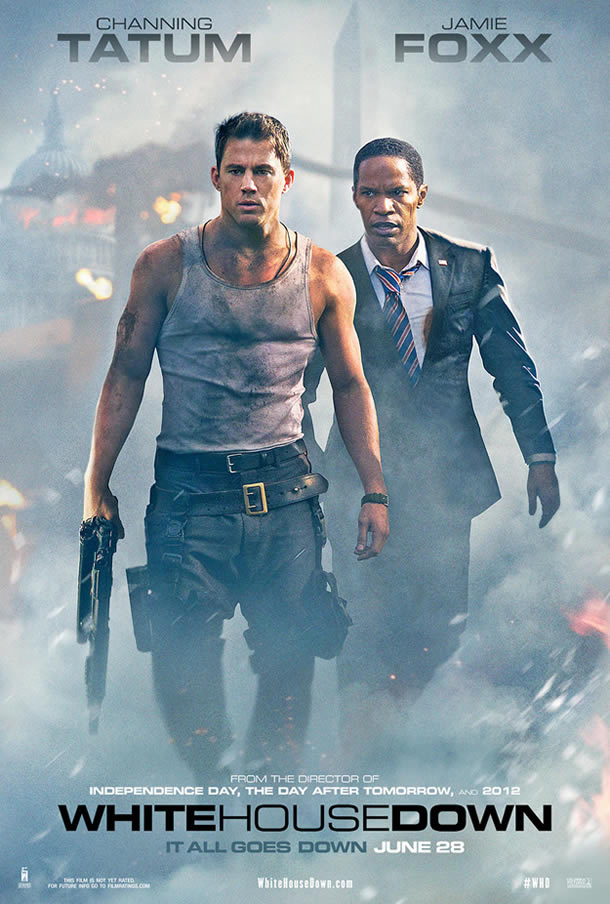 Director Roland Emmerich, the maestro of the dumb fun blockbuster, is never going to get the credit he deserves but the man is something of a mad genius when it comes to putting together spectacle-rich, low-calorie but still satisfying summer entertainment. Take White House Down, the second of 2013’s Die-Hard-in-the-White-House movies. It’s really more of a buddy film contained to that famous structure. It’s not a smart blockbuster by any means but it makes up for any and all flaws with its sheer overpowering sense of fun. Stuff gets blown up real good, the action is brisk, and there are satisfying payoffs for story elements that felt like they were, at first glance, merely thrown together. You may walk away surprised at how much you’re enjoying the comedic interplay between Secret Service agent Channing Tatum and president Jamie Foxx. Plus it’s fun to see the president in on the action instead of merely as a hostage, like the earlier Olympus Has Fallen. In direct comparison, I’d have to say White House Down is the better of the two movies, both in payoff and action. It’s nice to have a movie that’s just fun to watch, that goes about its blockbuster business with precision, supplying a few decent twists, and giving us heroes worth rooting for and action sequences that are well developed and that matter no matter how ridiculous. Emmerich movies are blissfully free of self-serious malarkey, though his weakest hit, 2004’s Day After Tomorrow, got a bit preachy. His movies know what they are and know the demands of an audience. What I needed this summer was a movie designed to make me cheer the impossible. White House Down is a romp.
Nate’s Grade: B+
Share this:

Zero Dark Thirty (2012)
 Director Kathryn Bigelow and journalist-turned-screenwriter Mark Boal, Oscar winners for 2009’s Best Picture-winner war film The Hurt Locker, were hard at work on their next movie when fate intervened. They were about to start production on a film about a 2001 incident where U.S. Special Forces almost nabbed Osama bin Laden, the notorious mastermind behind 9/11. Then on May 1, 2011, the world learned that Seal Team Six stormed bin Laden’s secret compound in Pakistan and executed the most wanted man in the world. Bigelow and Boal scrapped all plans and rewrote their movie from scratch. Now they had the ending we’d all demand; isn’t a movie where we get bin Laden way better than one where he narrowly escapes? Zero Dark Thirty (military terminology for well after dark) is the stunning result of Boal’s impressive reporting and condensing, Bigelow’s masterful direction, and a great supporting cast that brings history to vivid life. If you’re like me, you’ll walk out of the theater whistling to yourself, speechless at the spellbinding artistic achievement of the movie. This, ladies and gentlemen, is what essential, invigorating, quality filmmaking is all about.
We may know about Seal Team Six and the lead presented from tracking the courier, but few people know of the CIA analyst at the heart of the manhunt. Maya (Jessica Chastain) is a young agent stationed in Afghanistan who desires nothing more than to be the one who helps ensure that bin Laden gets killed. We follow her decade-long quest as she chases down leads, interrogates prisoners, and successfully presses the CIA brass for action, resulting in the fateful raid that took out bin Laden.
 You can tell early on that Zero Dark Thirty is going to be an excellent film. Given the pedigree of is creators, my expectations were enormously high. I rated their previous collaboration as my top film of that year. I knew I was in capable hands when the film opens on September 11, 2001 but skips any visuals. We sit and watch a minute of a blank screen while the sounds of desperate 911 calls become a wall of sound. It’s enough to reassert the stakes while still being restrained. Bigelow’s directorial command is astonishing, pitting you in the thick of the action. There are a lot of moving parts with a movie like this, wheels within wheels, and Bigelow keeps everything moving and focused. It helps that the bigger manhunt is broken up into a series of mini-missions over the ten years. Bigelow and her talented production team have recreated the ends of the world to bring this story to life. That added sheen of verisimilitude gives every moment a sense of magnified power, an electric sense of relevancy. You’ll get goose bumps as they start circling the actual location of bin Laden. Bigelow, who won an Oscar for her virtuoso work on The Hurt Locker, still knows how to play every one of your nerves. There’s a clandestine meet up with a possible turncoat that is stuffed with dread. Every checkpoint, every safety procedure waved, you’ll be biting your nails, the voice in your head clearly saying, “Oh no, this isn’t going to go well.” Zero Dark Thirty is more crime procedural than the action thriller. Even so, Bigelow’s direction is top-notch and brings an intense, churning verve to the film, down to the smallest detail.
The film plays out like an absorbing, hard-hitting piece of investigative journalism, recreating the steps and false turns over the ten-year manhunt for bin Laden. There is a lot of information to process and over 100 speaking roles, and Boal and Bigelow do not stoop to pander to the less intelligent in the audience. You will be expected to catch up or fall behind. It can get confusing at points but Boal does an exceedingly articulate job of narrowing the particulars of the bin Laden case and presenting a clear through line. It’s a story that hops around the globe through a series of mini-missions, from a meet up with a possible al Qaeda spy to locking down a phone number to trace a courier in Pakistan. You see every step, every deal, and every effort that it takes to land the big break, namely tracking down bin Laden’s trusted courier to his Abbottabad compound. Boal even separates his narrative with titled sub-sections like a lengthy piece of journalism. We all know where the story is going to end up, but Boal’s supreme talent is making every step meaningful and tense leading up to that fateful raid May 1, 2011. The level of reportage detail is completely enthralling and will be relatively unknown to most filmgoers. Beyond 9/11 and the London bombings, I confess to being ignorant of the other al Qaeda attacks highlighted throughout. Therefore, not only is Zero Dark Thirty an exciting manhunt, it’s also an educational endeavor for most Americans.
 The proceeding two hours are an engrossing manhunt, but when Zero Dark Thirty gets to the raid sequence, that is when the movie ascends to a level of cinematic excellence unsurpassed this year at the movies. There is nothing else in 2012 that comes close to matching the 30-minute raid on bin Laden’s compound. My heart was in my throat the whole time. I was physically shaking. I was pinned to my chair. The conclusion, nabbing bin Laden, is one of the most riveting sequences in film I have ever seen. It’s like Bigelow has complete control of your senses, and even though we all know how this story ends, you’ll be glued to the screen, pulse racing, anticipating every step. After the film ended, I told my friend Eric that I felt like I needed to start smoking, thus was how exhilarated I felt leaving the theater (message to kids: don’t smoke, even if you see Zero Dark Thirty). My head was bustling afterwards. All I could think about was the masterful conclusion to a very good movie. The raid sequence is brilliantly recreated and just about portrayed in exacting real time; you feel like you’re right there along with the members of Seal Team Six. For a civilian, it’s fascinating jut to watch the minutiae of what went down, but under Bigelow’s taut direction, it’s the moment every American has been waiting for since September 11, 2001. Bigelow is also careful not to portray the death in any sort of jingoistic, fist-pumping context. She sticks with her docu-drama approach, avoiding sensationalism, and you don’t even see the shot that takes down bin Laden. The film is also very careful not to linger on bin Laden’s dead body or even reveal his face; she doesn’t, as President Obama said, “spike the football.” Bigelow deserves a second Oscar just for her superlative handling of those unparalleled 30 minutes of pure filmmaking bravado. Plus, it’s the best ending of the year at the movies.
Let me address the brewing controversy ensnaring the movie regarding its depiction of torture. Zero Dark Thirty does demonstrate torture but it never glorifies it or presents it as anything less than dehumanizing and morally repugnant. But torture did happen (I’m sorry Dick Cheney… “enhanced interrogations”) and to whitewash this regrettable period of time from the historical record is a disservice to the truth. This country, as well as any other, engages in extreme and detestable measures; we only hope that our leaders have the moral clarity to make these ethical lapses as few and far between as possible. Now, the politicians and bloggers have attacked Bigelow’s movie as tacitly condoning torture, indicting that it was successful in getting that big break. This is not the case. Zero Dark Thirty shows a variety of methods being used, and yes we get a heavy helping of torture and humiliation, but it’s when Maya and others start treating the detainee like a human being again, offering food and conversation, is when the progress is made. The film does not explicitly declare one interrogation method successful, however, I can see where people will draw their own (wrong) conclusion. If anyone wants to read my exact stance on torture, just check out my lengthy review of the 2007 Oscar-winning documentary, Taxi to the Dark Side. In short, torture does not work and Zero Dark Thirty does not purport that it does, though many may conclude otherwise. It seems to me that the critics don’t have enough faith in the audience to accept ambiguity.
2011’s breakout actress, Chastain (The Help), is the focal point of the movie and she delivers. Her character has no life outside of doggedly hunting for bin Laden. She’s completely driven by the goal of killing him, and as such she gets to uncork some dandy angry monologues dressing down her colleagues for their failing dedication. Chastian does a fine job of keeping a veneer around Maya, shrouding her emotions into a mysterious calm, which seems realistic given the nature of the character but also makes it tricky to connect with her emotionally. This movie is not the great character study that The Hurt Locker was, and so Maya gets some rather shrift characterization: she’s a workaholic fighting for credibility. The real star of the movie is the story so all the characters take a back seat to Boal’s journalism. While Chastain is quite good, I have to shrug my shoulders at the various critics groups throwing Best Actress accolades her way (go Jennifer Lawrence).
 The supporting cast doesn’t have a weak link amongst them, from Kyle Chandler (Super 8) as an outpost boss, Mark Strong (Tinker Tailor Soldier Spy) as a CIA superior screaming at the bin Laden team to “find me targets to kill,” Jennifer Ehle (Contagion) as Maya’s closest friend in a hostile land, James Gandolfini (TV’s Sopranos) as CIA director Leon Panetta, Stephen Dillane (Game of Thrones’ Stannis Baratheon) as a skeptical NSA head, and Chris Pratt (TV’s Parks and Recreation) as a member of Seal Team Six. That’s right America, TV’s Andy Dwyer helps cap bin Laden. But the real standout is Jason Clarke (Lawless) as an interrogator who eventually leaves the field for an office but still makes headway for Maya.
Much like The Hurt Locker, here is a movie that transcends politics and genre. Zero Dark Thirty is a nerve-wracking thriller, it’s an intelligent crime procedural, and it’s an engrossing and powerful work of relevant art. It operates on such a high level of artistic achievement that little else from 2012 even comes close. This thorough, intense, provocative, thought-provoking, morally ambiguous, thrilling, and generally tremendous movie is taken to a whole other level with its concluding act, brilliantly recreating the raid that took down Osama bin Laden, the most cathartic and satisfying ending of the year. You’ll be liable to whistle in awe at how accomplished Zero Dark Thirty is. Of course audiences should not accept every thing they see in the movie as unimpeachable gospel, as dramatic license is needed to help shape a formidable narrative. This is still a movie that desires to entertain and yea does it entertain. I look forward to the American public getting a chance to experience the same riveting theatrical experience that I had with my critical brethren, as well as the sense of catharsis and relief by film’s end. Zero Dark Thirty forgoes sensationalism for modulation, eschews moral righteousness for ambiguity, and expects the audience to keep up with its retinue of information. And you’ll be grateful to be given the chance to tag along. Run out and see this remarkable movie when you have the chance. Movies don’t get much better than this, folks.
Nate’s Grade: A
Share this:

Lawless (2012)
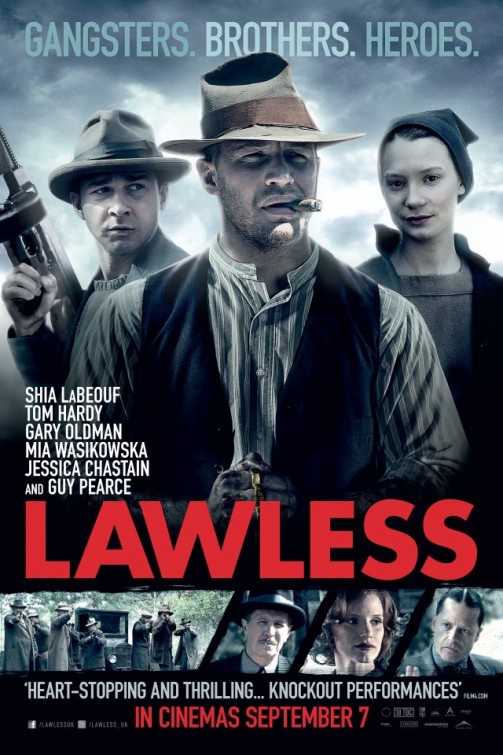 The bootlegging drama Lawless certainly has all the right elements to be an enjoyable movie. It’s by the men who gave us the great noir-Western The Proposition (director John Hillcoat, writer Nick Cave), it’s got a star-studded cast, plenty of bloody action, and a handsomely recreated production of the Prohibition era. But as I watched the Bondurant boys struggle against those who would like to put them in jail and/or murder them, I kept noticing something odd. I wasn’t that engaged. There was plenty of life-and-death drama, but why wasn’t I involved in the story more? Lawless feels like a series of scenes rather than a movie. Even when the plot changes it doesn’t feel like the movie is advancing. Even when things are more desperate it doesn’t feel like the momentum is building. The characters are somewhat sluggish as well, Shia LaBeouf as the scared youngest brother, Tom Hardy as the grumbly big brother who talks like his mouth is full of molasses. Jessica Chastain as the abused Good Woman who opens herself up to our Strong Hurting Man. Then you got a plot with a mobster (Gary Oldman) that weirdly climaxes with an hour left in the movie. He’s ignored for the remainder. Then there’s Guy Pearce as a colorfully fiendish and foppish special deputy that terrorizes the town. I am a Pearce fan but this guy is acting like he’s in his own weirder personal movie; it’s the kind of stuff Marlon Brando did. I appreciated that Lawless kept things gritty and bloody for realism, but I kept finding moments that ripped me out, namely the indestructible nature of Tom Hardy. Seriously, this guy has to be the Terminator. When he miraculously survives yet another seemingly fatal injury, all you can do is laugh. Lawless is passable entertainment but with its pedigree this should have been better.
Nate’s Grade: B-


 nathanzoebl
You must be logged in to post a comment.