Blog Archives
Dual (2022)
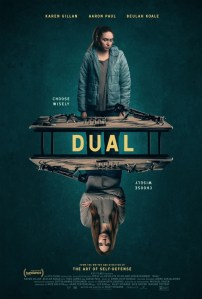 Imagine a world where anyone can create a clone, a perfect, or almost perfect, copy of yourself so that after you’re gone your family will never have to theoretically lose you? That’s the premise of Dual, an indie that played at the 2022 Sundance film festival and is now available online. Sarah (Karen Gillan) is generally miserable with her life. She doesn’t return her needy mother’s phone calls and texts. She’d rather watch porn than talk with her distant boyfriend. She’s also leaving disconcerting blood stains on her bed sheets. Turns out Sarah has a rare and incurable illness, and so she is eligible for the Replacement Program, an opportunity to get her own clone. She is gifted a clone (also Gillan), a reported exact replica except for eye color (the company offers a five percent discount for the defect). Sarah takes her doppelganger home and attempts to teach her about her life and how best to fit in. It’s not long that the Sarah clone has her own ideas about what her life could be. However, when Sarah’s terminal diagnosis improves, she intends to abort her clone. The clone triggers a legal clause that says that the ultimate decision over who gets to live as the only Sarah will be a televised duel to the death in exactly one year’s time.
Dual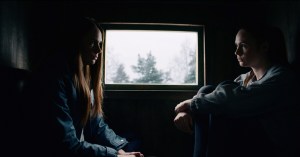 is a puzzling movie. I haven’t watched writer/director Riley Stearn’s other movies, notably 2019’s The Art of Self Defense, though I’ve read Dual is in keeping with his exaggerated, deadpan style, but to me it feels very much like an attempt to recreate a Yorgos Lanthimos world. Lanthimos is most famous for films like The Lobster and was even nominated for Best Director for 2018’s The Favourite. Lanthimos is excellent as creating these worlds that are reflections of our own but detached, deadpan, aloof, and irregular. The world of The Lobster is bizarre as a means of satirizing our social values when it comes to romantic relationships. In that world, if you cannot find a suitable mate within a period of probation, you will be transformed into an animal of your choosing. That world is bizarre in its very inception but there’s a reason that Lanthimos makes use of his stilted, stylized dialogue, to better reflect the absurdities of our culture. With Dual, the world never feels that wholly separate from our own and actually a little under-explored. The fact that society has cloning is woefully underutilized. What else does this mean about our concept of self, identity, legacy? What about clones that abandon their intended families? What about clones that murder their originals before their court-arranged duels? What about people that cheat the system and get more than one clone? What about a clone getting a clone? As the movie progressed, I kept feeling the unmistakable pull of wanting this story to be told straight and without the hip ironic posturing (I suppose that’s Swan Song, a 2021 movie I have yet to watch on Apple Plus). It just felt like there was so much more intriguing dramatic potential to be had here playing things straight, a woman facing her impending mortality, getting a “replacement you” and finding her not sticking to the script, endangering her fragile sense of preservation, and then the crisis of your friends and family preferring the clone over her. That’s some juicy stuff, but it all gets downplayed thanks to Stearn’s selected tone.
It would be one thing if Dual was hilarious with its cracked mirror approach but I just found little to actually laugh about. There are a few moments that I did chuckle, like Sarah and Trent (Aaron Paul) providing a play-by-play of their slow-motion brawl and the consequences of their amassed injuries, and the doctor that informs Sarah about her tragic diagnosis are the most well realized moments with tone (“This is why most doctors are depressed”). The bone dry, matter-of-fact style of speaking is too often the only joke. Just because characters are speaking in a detached manner does not mean you can skip over the same tenets of comedy construction. Lanthimos doesn’t just rest on his characters talking in a manner that is unexpected. There’s genuine work to make them seem of their weird world. The characters in Dual just seem like hyperactive, overly literal irritants. Often, they’ll just keep speaking about a subject and the joke is the length of the details. The Sarah duplicate doesn’t know how to drive, and as she watches her original, she remarks, “Oh, and I suppose you turn the big wheel left and the car goes left. Turn the big wheel right and the car goes right. Easy enough.” I suppose the joke is that she describes two pointless examples? Even the scenes with the doctor, which I laughed at, suffer from Stearns overwriting his dialogue exchanges. It’s not enough for the doctor to make an absurd, Kafkaesque remark, but the character must circle back and underline this over and over. The overall feeling is tiresome. There’s one example of what Dual could have been, where Trent suggests to Sarah during her money problems that she might provide “other means of payment.” The movie then cuts to them both dancing and Trent remarks, “Thank you for the hip-hop dance instruction. I’ve always wanted to learn but was too nervous.” That joke works. It’s a subversion that doesn’t overstay. I wish Stearns had pulled back and trusted his audience to get the joke without his incessant redirection of comic emphasis.
 The real reason to watch Dual is for the dueling Gillan performances. She gets to play two same-but-different versions of a character, and she really shines in the subtle differences she takes advantage of. I enjoyed the passive aggression of the clone re-examining the faults of her original, and I enjoyed how quickly she was interrogating her original while making casual, catty judgements. Paul (Breaking Bad) is also enjoyable but only appears in the second half of the movie and is underutilized. Stearns seems drawn to the mentor-pupil relationship dynamic (The Art of Self Defense) and the interaction between Paul and Gillan is a regular highlight of the movie. The actors generally elevate the material even as Stearns restricts the acting tools they can rely upon.
I’m sure there will be viewers that will genuinely enjoy the distaff comedy and pathos of Dual. There’s a clear artistic vision here by Stearns, it just didn’t fully gel for me because I felt the choices of tone and plot limited what could have been a far more emotionally engaging and intellectually fascinating story. The comedy too often settled on being quirky and too often it reminded you of this by circling and re-circling the same joke for diminished returns. Dual is not a bad movie, more a frustrating experience, one with big ideas and talent in front of the camera and behind, but it could have used more shaping and tone calibration to be its best version of itself. As it stands, it’s a fittingly amusing dark comedy with two solid performances from Gillan, and that could be enough for many to justify a 90-minute investment. For me, it felt too much like Lanthimos lite.
Nate’s Grade: C+
Share this:

Human Nature (2002) [Review Re-View]
 Originally released April 12, 2002:
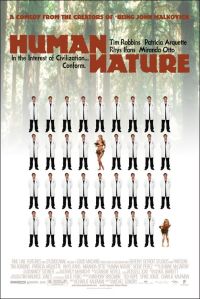
Screenwriter Charlie Kaufman jumped on to Hollywood’s A-list when his feature debut Being John Malkovich was unleashed in 1999. Malkovich was a brilliant original satire on identity, be it celebrity or sexual, and was filled with riotous humor but also blended beautifully with a rich story that bordered on genius that longer it went. Now Kaufman tries his hand expounding at the meaning of civilization versus animal instinct in Human Nature. As one character tells another, “Just remember, don’t do whatever your body is telling you to do and you’ll be fine.”
Lila (Patricia Arquette) is a woman burdened with excessive body hair ever since she was old enough for a training bra (with the younger version played by Disney’s Lizzie McGuire). Lila feels ashamed by her body and morbidly humiliated. She runs away to the forest to enjoy a life free from the critical eyes of other men. Here she can commune with nature and feel that she belongs.
 Nathan (Tim Robbins) is an anal retentive scientist obsessed with etiquette. As a young boy Nathan was sent to his room for picking the wrong fork to eat his meal with. He is now trying his best to teach mice table manners so he can prove that if etiquette can be taught to animals it can be ingrained toward humanity. Lila and Nathan become lovers when she ventures back into the city, eliminating her body hair for now, because of something infinitely in human nature – hormones. The two of them find a form of content, as neither had known the intimate touch of another human being.
“Puff” (Rhys Ifans) is a grown man living his life in the woods convinced by his father that he is an ape. One day while walking through the woods, Nathan and Lila discover the ape-man and have differing opinions on what should be done with him. Nathan is convinced that he should be brought into civilization and be taught the rules, etiquette, and things that make us “human.” It would also be his greatest experiment. Lila feels that he should maintain his freedom and live as he does in nature, how he feels he should.
What follows is a bizarre love triangle over the reeducation of “Puff,” as Nathan’s slinky French assistant Gabrielle (Miranda Otto) names him. Lila is torn over the treatment of Puff and also her own society induced shame of her abundant amount of body hair. Nathan feels like he is saving Puff from his wayward primal urges, as he himself becomes a victim of them when he starts having an affair with Gabrielle. Puff, as he tells a congressional committee, was playing their game so he could find some action and “get a piece of that.”
 Kaufman has written a movie in the same vein as Being John Malkovich but missing the pathos and, sadly, the humor. Human Nature tries too hard to be funny and isn’t nearly as funny as it thinks it is. Many quirky elements are thrown out but don’t have the same sticking power as Kaufman’s previous film. It’s a fine line between being quirky just for quirky’s sake (like the atrocious Gummo) and turning quirky into something fantastic (like Rushmore or Raising Arizona). Human Nature is too quirky for its own good without having the balance of substance to enhance the weirdness further. There are many interesting parts to this story but as a whole they don’t ever seriously gel.
Debut director Michel Gondry cut his teeth in the realm of MTV making surreal videos for Bjork and others (including the Lego animated one for The White Stripes). He also has done numerous commercials, most infamously the creepy-as-all-hell singing navels Levi ad. Gondry does have a vision, and that vision is “Copy What Spike Jonze Did as Best as Possible.” Gondry’s direction never really registers, except for some attractive time shifts, but feels more like a rehash of Jonze’s work on, yep you guessed it, Being John Malkovich.
Arquette and Robbins do fine jobs in their roles with Arquette given a bit more, dare I say it, humanity. Her Lila is trapped between knowing what is true to herself and fitting into a society that tells her that it’s unhealthy and wrong. Ifans has fun with his character and lets it show. The acting in Human Nature is never really the problem.
While Human Nature is certainly an interesting film (hey it has Arquette singing a song in the buff and Rosie Perez as an electrologist) but the sum of its whole is lacking. It’s unfair to keep comparing it to the earlier Malkovich but the film is trying too hard to emulate what made that movie so successful. Human Nature just doesn’t have the gravity that could turn a quirky film into a brilliant one.
Nate’s Grade: C+
——————————————————
WRITER REFLECTIONS 20 YEARS LATER

I’m at a loss with 2002’s Human Nature. I thought in the ensuing twenty years I would have more to say with coming back to the early burst of brilliant writer Charlie Kaufman in the immediate wake of his successful debut, 1999’s Being John Malkovich. 2002 was a big year for Kaufman; he had three movies released that he wrote, all of them wildly different. His best work was Adaptation, a reteaming with Malkovich’s Oscar-nominated director Spike Jonze, that earned Chris Cooper a Best Supporting Actor Oscar and Kaufman was close to winning for Best Original Screenplay and sharing the honor with his pretend twin brother, the both of whom were portrayed by Nicolas Cage. It was the most challenging and creative and fulfilling of the three. There was also Confessions of a Dangerous Mind, the debut for George Clooney as a director, was a lark of a movie, taking Gong Show host Chuck Barris’ “unauthorized autobiography” where he claimed he was doubling as a CIA black ops hitman. I recently re-watched this one months ago and my opinion even lowered because there’s nothing to the movie beyond the central irony of the unexpected reality of this unexpected man being a spy and assassin. There’s no real insight into Barris as a character and he comes across as scummy and unworthy of a big screen examination. It’s a story that only exists to be ironic and missing the messy humanity and pathos of Kaufman’s best.
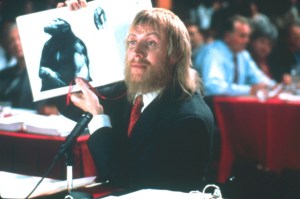
But Kaufman’s most forgotten movie in his screenwriting career is definitely Human Nature, the debut film for Michel Gondry, one of Kaufman’s other collaborators along with Jonze, both men having gained great acclaim for eclectic and visionary and just plain weird music videos. It follows three main characters, each debriefing their tale to an audience. Lila (Patricia Arquette) is accused of murder and discussing her lifelong malady of growing intense amounts of body hair, enough so that she worked as a gorilla woman in a circus sideshow. Puff (Rhys Ifans) is a man raised in the wild who intended to be an ape and returned to society, been trained in etiquette, and become an example of the transformative power of civilization. Dr. Nathan Bronfman (Tim Robbins) is telling his story after death with a bullet hole in the middle of his pasty forehead, as the scientist who found Puff, trained him, and romanced Lila before cheating on her with his French assistant (Miranda Otto). Immediately, the movie presents questions for us to unpack: how did Nathan die? Who was really responsible? What will be the connections between these three very different characters? Then there are assorted kooky side characters that come in and out, but the focus is mostly on this trio, perhaps a foursome with Otto, and the shame is that there is only one really interesting character among them.
Lila is the only protagonist worth following. She feels like a freak, even served in a “freak show,” and must hide her secret from lovers who would object to her untamed mane. She’s vulnerable and hopeful but pressured to conform to be accepted, and her journey to radical self-acceptance would have been an entertaining movie all on its own. However, by fragmenting the narrative with Puff and Nathan, she gets far less attention and her story becomes, for far too long, just her willfully sublimating herself to Nathan’s standards of beauty. Lila frustratingly feels like a character furiously trying to do whatever she can to keep the affections of a bad man. It’s reductive to the movie’s most interesting character. Puff and Nathan, in contrast, just feel like ideas, opposite poles in a discussion over the differences between animal instinct and the ideals of human civilization in all its hypocritical splendor. Even though both men are given comic-tragic back-stories, neither is really a richly defined character. Puff is all impulses and his urges become a tiresome comic device when we watch him hump somebody or something for the eightieth time. Nathan’s preoccupation with social niceties is meant to be absurd (teaching table manners to mice?) and petty, a meaningless articulation of “high culture and values.” I did laugh out loud when Nathan was teaching Puff how to respond at the opera, complete with a constructed box seat. Nathan is a satirical punching bag for a bourgeois sensibility. Neither him nor Puff feel like characters, instead more like conflicting points of view of humanity.
 The other disappointing aspect to Human Nature is as I declared in 2002, it feels like quirky for quirky’s sake screenwriting. Kaufman has become a screenwriting legend and he’s able to marry absurd, bizarre, and dangerous elements into meaningful and subversive and satirical masterstrokes, but the man cannot be expected to perform at the highest heights every time. Human Nature is stuffed full of wacky moments and wacky characters and it doesn’t feel like it ever amounts to more than the sum of its transitory parts. In contrast, 2022’s Everything Everywhere All At Once is an example of how one can take the most bizarre ideas and still find ways to tie them back in meaningful ways that braid into the larger theme. However, much of Human Nature feels like a quirk dartboard being hit over and over, a catalog of strange visuals and goofy ideas (Lila breaks out into song!) that fails to coalesce into a larger thesis like an Adaptation or an Eternal Sunshine of the Spotless Mind or the vastly underrated Synecdoche, New York, Kaufman’s directorial debut. He’s a master of the idiosyncratic, but Human Nature suffers because ultimately what does it have to say? Puff is set up for ridicule. Nathan is set up for ridicule. Even Lila is set up, though for murder. In the end, when Puff returns to the wild in a public galivanting that feels like a ceremonial bon voyage from the society that came to love him, he then scampers out of the woods and escapes back to the comforts of society with Nathan’s French mistress. In the end, is the point that we’re all rubes and hypocrites?
This was Gondry’s first film and it feels like a training vehicle for what would be his real masterpiece, 2004’s Eternal Sunshine of the Spotless Mind, one of my favorite films ever. Gondry’s style is still recognizable, especially reminiscent of his tactile, kitschy, avant garde music videos he directed for Bjork, the queen of weird 1990s music videos. Gondry’s hardscrabble, idiosyncratic style was a natural match with Kaufman’s vivid imagination. It’s surprising that they never reunited after Eternal Sunshine. Gondry had a few movies (2006’s The Science of Sleep, 2008’s Be Kind Rewind) but they felt lacking, trifling without a stronger writer to guide and ground them in human drama. Gondry even tried his hand at studio action to middling results with 2010’s The Green Hornet. He mostly retreated back to music videos and commercials and had a short lived series on Showtime with Jim Carrey as a former children’s TV entertainer whose fantasy is blending with reality. It seemed like a good fit for Gondry, and a nice starring role for Carrey, but it was canceled after two seasons. Even the realm of music videos seems so far removed now, where Hollywood was snatching up every visual virtuoso.
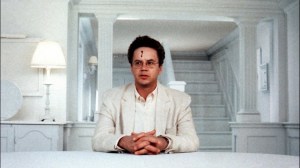
Human Nature has plenty of familiar faces, no doubt eager to attach their names to a daring Kaufman movie. Arquette is winning and the best part of the movie. She would later win an Academy Award for her decade-in-the-making performance in Richard Linklater’s Boyhood. Now I enjoy her in a chilly, villainous role as the shady corporate boss on Apple TV’s stunning sci-fi satire, Severance. Robbins is officious to a fault here. He too would later win an Oscar for 2003’s Mystic River. Poor Ifans, so big after his scene-stealing role in 1999’s Notting Hill, who never seemed to capitalize on his success (even his Spider-Man villain got the weakest treatment in No Way Home). He’s had a long career and prominent TV roles with Berlin Station and the Game of Thrones prequel series, House of the Dragon. I did laugh out loud at his “yahoo” after being zapped by his electric shock collar. You’ll also see Rosie Perez, Peter Dinklage, Robert Forster, Toby Huss, Hillary Duff, and Mary Kay Place. As I said in 2002, acting is not the problem with Human Nature. It’s the writing and characterization that lets these people down.
I usually like to devote a paragraph to going back and re-evaluating my initial words from twenty years ago, but I agree with everything I wrote. Everything. That’s initially why I thought this would be a shorter review. What more am I going to say other than my initial opinion of this movie is the same opinion I have upon re-watching? With the distance, it’s even more clear to me that Human Nature is the weakest film of Kaufman’s career. Even a movie I didn’t really gel with, like 2020’s I’m Thinking of Ending Things, at least has a lot more ambition I can recognize. It’s a character study obfuscated with too much eccentric clutter but there’s still an artistic vision there, even if it didn’t work for me. Kaufman is too unique a voice to only have made three movies in the last 14 years, and it makes it even more frustrating when I don’t connect with his long-in-the-making projects. Human Nature is too limited in scope and characterization. It’s slightly interesting as a footnote to a great screenwriter but little more.
Re-Review Grade: C
Share this:

X (2022)/ Choose or Die (2022)
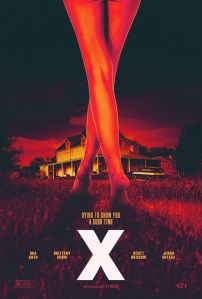 Horror is likely the most forgiving genre out there for being derivative. Just about every modern horror movie wears its many influences, even the recent trend of elevated horror movies that are trying to say Big Things with equal amounts of arty style and bloodshed. There’s only so many monsters that can chase so many teenagers. Ti West (House of the Devil) is a director I haven’t fully enjoyed, though I would say X is his most accomplished film to date for me. It’s clearly going for a Texas Chainsaw Massacre vibe and docu-drama aesthetic. It’s set in 1979 and we follow a ragtag film crew trying to make “a good dirty movie.” They’ve rented a guest house in the middle of nowhere Texas as their film site because who knows. The octogenarian couple who owns the farm property doesn’t seem to approve of these young folk, and the old lady ends up becoming the slasher killer that mows down the randy young adults. Turns out the old lady has her own urges that the old husband is no longer physically able to satisfy, so she seeks out solace one way or another with the newcomers, whether that be through her sexual satisfaction or through violence. To West’s credit, he has given more attention to his characters. These people are not going to be confused with three-dimensional figures but there’s enough character shading that made me more interested in spending time with them and a little more rueful that most of them will probably die horribly soon enough (Chekhov’s alligator). The slow burn is not wasted time or dawdling, and there are some very well-executed squirm-worthy moments of discomfort. I don’t think X quite works on that elevated horror level of late; it’s mostly a slasher movie with a dollop more complexity and style. The real reason to appreciate X is from the dual performances from actress Mia Goth (Suspiria), the first as a stripper-turned-ingenue that sees pornography as a path of possible self-actualization, but she’s also secretly the killer old lady under piles and piles of makeup. Her wild performances, including scenes where she is facing off against herself, makes the movie far more interesting. Goth goes for broke. I don’t think the X is as fun as it thinks it is, nor is it as thoughtful as it thinks it is, and I don’t know if I care about a prequel that was shot back-to-back that illuminates the killer old lady’s younger life. Is this character really that interesting to warrant her own movie? As a horror movie, it’s disturbing and bloody and surprising in equal measure even as it doesn’t do much with re-configuring the many conventions of its genre.
 Netflix’s Choose or Die is one of those spooky horror movies that wants the audience to play its deadly games alongside the unfortunate characters, much like Saw and Would You Rather?, and I typically enjoy these kinds of movies and thinking what options or strategies I would undergo if I was in their place. The structure is pretty straight forward, with a young woman (Iola Evans) and her programmer friend (Asa Butterfield) coming across a cursed old school text-based computer video game that forces its users to make awful choices. The game turns itself on every 24 hours, so there’s a natural delivery of set pieces, each increasing in its personal stakes. There’s the amateur investigation of the history of this 80s video game and uncovering the possible owner who might be benefiting from all this cruelty and sadism. This is a movie built around its set pieces and they start strong. When the protagonist sees the game in action, with a poor diner worker force-feeding herself broken pieces of glass, it’s truly horrifying and the sound design makes it so much worse. The movie isn’t s gory as it could have been and implies a lot more than it shows. The problem with Choose or Die is that there are too many leaps in logic and characters doing silly things just for the sake of the plot. There needs to be an established system of rules or else everything will feel arbitrary, and eventually that is what dooms Choose or Die. Even while we get more of an explanation behind the makers of the game and their occult connections it never feels like we’re better positioned to beat the game. I will say the final act, the Boss Battle, is where the movie cranks things up and gets really intense and darkly humorous. There’s a showdown that involves a key concept of self-harm that plays out in moderately clever, bizarre, and surprising ways, and this splashy, silly finish made me wish the rest of the movie could have lived in this tonal space. I found the overall sound design to be very annoying as it cranked up the volume on lots of glitchy electronic noises that just made me want to turn it off. There are some good ideas here, like the criticisms of being too nostalgic to the past, and of misogynist men believing nobody else is deserving of being the hero of their story, but this is a movie that lives or dies on its killer set pieces, and those just fall flat after its unsettling first level. Watching someone vomit VHS tape is not scary. Watching people move their bodies like they have no control over them will inherently look goofy. Choose or Die wouldn’t be the worst choice of a movie to kill 85 minutes but it’s certainly not much more than the sum of its parts, and even those are overly derivative and been done better by its predecessors.
Nate’s Grades:
X: C+
Choose or Die: C
Share this:

Everything Everywhere All At Once (2022)
 Even after only two movies, I would trust the directing duo Daniels (Daniel Kwan and Daniel Scheinert) with any movie. They have earned a lifetime pass from me. If these men can make the farting corpse of Harry Potter not just one of the weirdest movies of 2016, not just one of the best films of that year, but also one of the most insightful toward the human condition, then these men can do anything. It’s been six long years for a follow-up but it sure has been worth it. Everything Everywhere All At Once is, to be pithy, a whole lot of movie. Everything Everywhere (my preferred shorthand from here) is a miracle of a movie. It’s a wonder that something this bizarre, this wild, this juvenile, this ambitious, and this specific in vision could find its way through the dream-killing factory that is Hollywood moviemaking. This is the kind of movie you celebrate for simply existing, something so marvelously different but so assured, complex but accessible, and deliriously, amazingly creative. I’m throwing out a lot of adjectives and adverbs to describe the experience of this movie and that’s because it filled me with such sheer wonder and divine happiness. I am thankful that the Danirels are making their movies on their terms, and two movies into what I hope is a long and uncompromising career, I can tell that both of these gentlemen deserve all the accolades and plaudits they have coming. I’ll try my best not to sound like a simpering moron while I try to explain why this movie is so thoroughly outstanding.
Evelyn (Michelle Yeaoh) is a middle-aged Chinese immigrant who is taking stock of her disappointing life. She and her husband, Waymond (Ke Huy Quan), own a floundering coin-operated laundromat. They’re under audit by a dogged IRS agent (Jamie Lee Curtis). Evelyn’s disapproving father, Gong Gong (James Hong, still so great even into his 90s), has moved from China to live with the family, and he was never a fan of Waymond, looking down on his daughter for marrying the man. Then there’s Joy (Stephanie Hsu), Evelyn and Waymond’s twenty-something daughter, who wants to bring her girlfriend to dinner but mom still doesn’t accept her daughter’s queerness and uses the excuse of Gong Gong’s generational disapproval. Then, at the IRS agency, Waymond’s body is taken over by another Waymond, Alpha Waymond, who informs Evelyn that she is the key to saving a universe of universes, and she’ll have to tap into her alternate selves and their abilities to battle the evil destroyer, Jobu Tupaki, who wants to destroy all existence, and who also happens to be an alternate universe version of Joy.
 Multiverses are definitely all the rage right now as they present nostalgic cash-grabs and cameos galore, but Everything Everywhere is a multiverse that is personal and specific. It’s based on all the paths the protagonist never took, and each allows her confirmation of what her life could have been, often more glamorous or exciting or initially appealing. A movie star. A famous singer. A ballerina. A skilled chef. Evelyn is a character paralyzed by the disappointment of her life’s choices, the malaise that has settled in, and the nagging feeling that things could have and should have been better. In one of the best jokes early on, Evelyn is told she’s the Chosen One not because she is special but because she is, literally, living the worst of all possible lives of the multiverse of Evelyns (then again the pinata Evelyn didn’t look like an upgrade). She has taken all the many bad paths and dead ends, but this positions her as the only one who has the power to tap into every other power and ability from her multiverse duplicates. It’s one thing to be feeling like you should have made a different choice in the past, and it’s another to get confirmation. This backhanded revelation could just serve as its own joke but it actually transforms into a philosophy that coalesces in the final act, that of all the universes and possibilities we could have had, the best one is the one we are actually present for. In another universe, one very much styled like In the Mood for Love, where a Waymond who was rejected by Evelyn long ago reconnects with her, mournful of what could have been, and says, “In another life, I would have really liked doing laundry and taxes with you,” in reference to Evelyn’s dismissive summation of what his unrequited romantic “what if” would have lead to. It’s such a poignant moment. By the end of the movie, it’s become a journey of self-actualization but tied to self-acceptance, where kindness and empathy are the real super weapons and the answer to the tumult of postmodern nihilism.
Smartly, the Daniels have made sure that a universe-hopping threat is actually connected to our hero in a meaningful manner. By making the villain an alternate version of Joy, it raises the stakes and forces Evelyn to have to confront her own parenting miscues and frayed relationship with her daughter. It’s the kind of decision-making that reinforces the emotional and thematic core of a movie that is spinning so fast that it feels like you might fall off and vomit new colors. Joy is an avatar of generational disconnect, inherited disappointment and resentment, but what really makes her relatable is the growing feeling of being over it all. Given the power to see everything in every universe, Joy concludes that life is overwhelming and without meaning. It’s the same sort of nihilism we might feel today as we doom scroll through our phones, eyes glazed over from the barrage of bad news, outraged click bait, and feeling of abject helplessness while the world spins on in an uncertain direction. It’s not hard to feel, as Joy, that it’s all too much to bear, and if she can experience everything then does it present value to anything? If she can always just sidestep to another universe, what does that do to the value of life? That’s the ethical conundrum with Rick and Morty, a show where they can swap characters from other dimensions to fix more costly mistakes. What Daniels attempts with Everything Everywhere is to tackle the same question but approaching a different answer: that despite everything, life matters, our relationships matter, and kindness and empathy matter most. Watching Evelyn and Joy, and their many different versions of mother and daughter, try to reach an understanding, it’s easy to feel that struggle and relate to wanting to feel seen. As Evelyn encouragingly says to one character at their lowest point, “It is too much to handle, yes. But nobody is ever alone.”
 This is a dozen different kinds of movies, all smashed together, and each of them is utterly delightful and skillfully realized and executed. If you like martial arts action, there are some excellent fight sequences including a showstopper where Waymond wrecks a team of security guards with a fanny pack. The action is exciting and the martial arts choreography is impressive and filmed in a pleasing style that allows us to really appreciate the moves and countermoves. If you like wild comedies, there are many outlandish moments that combine low-humor and highbrow references. I’ll simply refer to one as finding payoffs for IRS auditor trophies shaped like butt plugs. This is one of the funniest American comedies in years. If you like family dramas, there is plenty of conflict across the board between Evelyn and Waymond and Joy, plus the specter of Gong Gong, and each person trying to communicate their dissatisfaction and desires for a better life. If you removed all of the crazy sci-fi elements, googly eyes, people’s heads turning to confetti, and what have you, this would still be a compelling human drama. When the movie isn’t working through ridiculous tangents, or eye-popping action, or a staggering combination of kitsch and intelligence, it’s building out its emotional core, the heart of the movie, the thing that makes all the gee-whiz fun matter, the family in flux. Likewise, this is a powerfully optimistic movie, life-affirming in all the best ways without being pandering, and one that is without any flash of ironic condescension. Sincerity is powerful and all over.
The movie is elevated even higher by the strength of the performances. Yeoh (Crazy Rich Asians) has spent decades as a martial arts master, and of late she’s been branching out in more demanding dramas, but this is easily the finest performance of her career for nothing less than playing a dozen different characters. She is sensational. The early Evelyn is full of despair and regret, and as she gets to explore each new version of herself, there’s an excitement that’s bristling, as she gets to see the successes she could have been and celebrate. Yeaoh is hilarious and deeply affecting in the central role and still very much a badass. She showcases starting range, it makes you weep that she has never gotten to play so many different kinds of roles because she’s so good at all of them. Hsu (The Marvelous Mrs. Maisel) is the wounded soul, and her sneers and seen-it-all attitude are killer without losing track of the pain at the core of the character. Her emotional confrontations with her mother still hit hard. But the secret weapon of this movie is Quan, the former child actor best remembered as playing Data in The Goonies and Short Round in Temple of Doom. Yes, that same actor. He too gets to play such a wide, wild variety of Waymonds, from the doting and meek husband, to the confidant warriors, to the smoldering former flame, but with each new Waymond, Quan makes you fall in love with the original more. The character of Waymond and his central philosophy of kindness is so moving and needed, that we almost get to fall in love and re-evaluate this man the same way Evelyn does. Also of note, Curtis (Knives Out) is having an absolute blast as her menacing IRS agent.
 It’s truly amazing to me that a movie can have some of the silliest, craziest, dumbest humor imaginable, and then find ways to tie it back thematically and make it yet another important thread that intricately ties into the overall impact of the movie. The genius of Daniels is marrying the most insane ideas with genuine pathos. Take for instance that one of the many multiverses involves people with hot dogs instead of fingers. It’s a goofy visual, and it could simply have been that, a passing moment to make you smile, but the Daniels don’t stop there. They continue developing their ideas, all of their ideas, and find additional jokes and purposes few could. Okay, so this is a big divergence from history, so how could humans evolve to have hot dogs for fingers? Well the movie actually showcases this moment in a hilarious 2001: A Space Odyssey reference. And then the film says, “Well, if this was the way of life, what other practices would evolve from here when it comes to communication and intimacy?” It’s that level of development and commitment that blows me away. The same with what starts as Evelyn’s misunderstanding of the Pixar movie Ratatouille. It works just as a joke in the moment, but then it comes back as its own reality, and even that reality has a thematic resonance by the end. This level of imagination, to take the weirdest jokes and make them meaningful, is special. In one second, I can cry laughing from a raccoon and in the next second a rock can make me want to cry. In essence, even though Everything Everywhere is beyond stuffed, nothing is merely disposable.
That doesn’t mean that the film doesn’t also fall victim to repetition at points. My only criticism, and it might even be eliminated entirely after a second viewing, is that Daniels can over indulge when it comes to their narrative points. Some things can get stretched out, so that they hit points with five beats when three could have been sufficient. It’s this kind of mentality that pushes the running time to almost two hours and twenty minutes, which feels a bit extended. However, the messiness and overstuffed nature of the movie is also one of its hallmarks, so I don’t know if this criticism will even register for many, especially if you’re fully on board their wacky wavelength.
If you can, please go into Everything Everywhere All At Once knowing as little as possible. The carousel of surprise and amazement is constant, but the fact that there is a strong emotional core, that all the many stray elements become perfectly braided together, no matter how ridiculous, is all the more impressive. This is stylized filmmaking that is very personal while also being accessible and universal in its existential pains and longing. It’s style and substance and exhilarating and genius and emotionally cathartic and moving and everything we want with movies. It’s the kind of movie that reignites your passion for cinema, the kind that delivers something new from the studio system, and the kind that deserves parades in celebration. Simply put, as I said before, this is a miracle of a movie, and you owe it to yourself to feel this blessing.
Nate’s Grade: A
Share this:

Windfall (2022)
 When is a 90-minute movie egregiously too long? When it’s like Windfall and lacking plot and direction and tone to justify all those minutes. The scaled-down production follows three characters confined to the grounds of one location. Nobody (Jason Segel) is trespassing and living on a fancy estate, complete with orange grove, but when the rich owners, CEO (Jessie Plemons) and Wife (Lily Collins), come home and find the mysterious man, he holds them hostage. From there, you would think the movie might be a comedy of errors, a social satire, and it’s not really. Or maybe you would think it’s a taught thriller with each side trying to manipulate the other, and it’s not really. It’s not really a comedy and not really a thriller, so its laughs are minimal, its thrills are trifling, and it comes down to spending too much time with characters that lack the depth to justify the investment. This movie is strictly kept at parable level, so the characters are meant as ciphers, hence the generic title names. These people are not that interesting to spend this much time with. The movie feels like an anecdote stretched beyond the breaking point and by writers I respect (Seven‘s Andrew Kevin Walker and Charlie McDowell, the writer/director of 2014’s The One I Love). That beguiling little indie movie also revolved around one luxury vacation home and a feuding couple but it had an intelligent sci-fi twist that kept things focused on characters and creative ingenuity. There is no such turn with Windfall. It’s all kept so frustratingly obvious, so the movie just feels plodding and meandering, like we’re simply waiting with the characters for things to end too. The insights are too few. The burst of violence at the end as climax feels unearned and too little too late to raise the stakes. Mostly, Windfall is a hostage drama that doesn’t want to be a hostage drama, a social satire that doesn’t want to be a social satire, a thriller that doesn’t want to be a thriller, and a movie that doesn’t have a consistent tone or direction or entertainment value.
Nate’s Grade: C
Share this:

Straitjacket (2021)
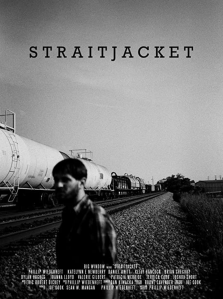 I genuinely forgot that I had supported Straitjacket, a new Ohio-made indie thriller filmed in the Dayton area several years hence. I know some people involved in the production and remember seeing a teaser trailer years ago asking for further editing donations. I could not remember if I had actually donated to its post-production costs and sure enough, in the end credits, there is my name under the thanks section for financial assistance. We’ll see if writer/director/co-star/editor Phillip Wiedenheft feels like listing my name was a mistake after this review. Straitjacket is a moderately successful thriller that entertains as long as it keeps things unbalanced.
The first thing we know about Wolf (Wiedenheft) is that he’s getting wasted in the woods. He awakens the next morning and loads a rifle and shoots at glass bottles. Except his shot goes beyond the bottle. He hears screaming and discovers his shot hit an old man walking through the woods. The man’s granddaughter, Lola (KateLynn Newberry), chases after Wolf, who hops into his car and drives away. Wolf is desperate to escape but he doesn’t have enough money for a plane ticket. He also might have left behind more than a few incriminating items in the woods after he quickly ran off. Wolf tries to take refuge with his dealer, the few family and friends who may still speak to him, while Lola languishes in despair and wonders if she can find the killer.
 Straitjacket owes a creative debt to the films of writer/director Jeremy Saulnier (Green Room, Hold the Dark), the man who worked nervy tension to a breaking point in his elegantly constructed indie thrillers (I immediately re-watched Green Room following this movie too). The tone and visual palate of this movie reminds me plenty of 2013’s Blue Ruin, a superb movie that follows a bearded vagrant on the run after an act of vengeance places a target on his head. It’s a revenge story stripped to the bone and free from the bombastic spectacle of bigger movies exploiting the same territory. The hero in that film, a drifter, wasn’t particularly skilled at killing, or defending himself, and was clumsy and all-too human as he brought a maelstrom of pain onto his life. It’s easy to make these same connections with Straitjacket, where it almost literally begins with a literal bang, a very easy to follow starting point stripped of exposition. Before the five-minute mark, our main character has killed someone in an accident and is now on the run. There’s a pleasingly frantic nature to the plotting, going from one desperate gamble to another, trying to figure out a possible escape as well as covering up his culpability. Wolf, just like the protagonist of Blue Ruin, is not particularly excelled when it comes to crime. He screws up. He has to correct his mistakes. He gets into debt to people who hold leverage over him. He has to scrounge up money in order to secure the things he needs to flee. The screenplay connects the dots in a way that doesn’t feel overly contrived even when the final act involves the ironic crossing of paths of all the necessary characters. That is a common occurrence in tragedy, the nature of inescapable fate and so we allow it, and Straitjacket is a tragedy disguised as a runaway thriller. If anything, it’s about people trying to escape from their mental and physical pain.
At the half-hour mark, the narrative switches perspectives, and we now see things from the victim’s point of view. In the hours before the fatal accident, we see Lola and her grandfather going about their day before he is taken permanently from this Earth. They discuss her process of recovering from addiction and share a small but heartfelt moment planting a tree mingled with the ashes of loved ones, Lola’s mother and grandmother (I think?). The old man says Lola is the only family he has left and he doesn’t want to come out here and plant another tree. Just with that line, with that moment, the filmmakers have managed to say everything they need to say in a meaningful and character-centric fashion. From there, much of the next half hour is Lola trying to make sense of her sudden loss. I thought perhaps the narrative had flipped and we were going to follow Lola as she tracked down Wolf and enact her own vengeance, but the movie doesn’t really do that either. She stumbles upon him again just because he returns to the scene of the crime and she recognizes his car, but her agency stops at calling for help from an ex. That’s disappointing because she could have been the right participant for the audience to root for.
 And therein lies one of the issues holding back Straitjacket from real gut-churning dramatic greatness, the fact that you don’t really root for any character to achieve his or her goal. While streamlining the narrative has made the plot relatively tight and quick to start, we also don’t really get much in the way of fleshing out Wolf as a person. We know he’s self-destructive, we know he’s struggling, and a caravan of interactions with minor supporting players fill us in on the myriad ways he is disappointing others (he has a son he never sees, he’s stolen from family before, he’s gotten into trouble with his dealer, etc.). He’s just sort of a screw-up but we aren’t given redeeming qualities, we aren’t given moments that allow a personality to shine through, where we can see his hopes, maybe a glimmer of his time and who he was before his addictions. He’s less a character and more a walking Tragic Symbol with antsy legs. The same with Lola. She’s suffering, she’s hurting, she wants to find her grandfather’s killer and bring them to justice. But does she do anything to actively achieve this? Not really. She lucks into attending the same drug house that Wolf does, and this sets up a finale that tries to have it both ways, ultimately ending on redemption and closure but not quite managing the catharsis of either. That’s because the limited characterization made the later emotional investment limited as well.
Take a look at Blue Ruin for comparison on how it could have been done effectively. It’s established why the main character’s life has been in shambles, he finds the person responsible for murdering his parents, takes his clumsy vengeance, and the rest of the movie is him outrunning the mounting and bloody repercussions. That movie works because the act of violence that kicks off the scramble is eventually revealed to be justifiable from the character’s perspective (his own sister, whom he initially hides with, congratulates him). He’s also the underdog as the forces coming after him are armed, dangerous, and larger, so then the movie becomes how this one man can use his few resources and lead time to outsmart his eventual attackers. It becomes naturally engaging because the odds are stacked against him and every time he surprises or beats them back is another victory and satisfying to watch. Straitjacket doesn’t afford similar satisfaction for a viewer. That’s the difference between a thriller and a tragedy, not that Blue Ruin was absent its own stark sense of tragedy as revenge was deemed ultimately as self-harm. There isn’t that push with Straitjacket. Lola isn’t actively looking for her culprit, and her path toward vengeance isn’t taking a toll. Sure, you could argue it’s what causes her to consider relapsing back to addictions but even that struggle is kept very generalized.
 When the movie attempts to connect to larger social and political issues, it feels more grasping than edifying. Both of the main characters are struggling with drug addictions, and there’s even passing reference to the opioid crisis happening nationwide, but the drug problems are more scant characterization than anything thematic. I suppose one could be generous and talk about people being haunted by their past mistakes, enthralled to addiction, and working to become better people in control of their own lives, but that’s a generic plot foundation that any nominal drug addiction movie traffics within. Likewise, the Army vet who is coping with his PTSD through drug addiction seems like it has the potential to make larger statements, but even this aspect of the movie is curiously underplayed. I thought the filmmakers would tie more trauma together with the past and present for Wolf, even indulging in certain triggering sounds or images. I suppose Straitjacket’s title is meant to reference the bind that these characters find themselves in due to drugs and other socioeconomic circumstances (no one literally wears a straitjacket). I just thought the movie would have more to say than drug addiction is rough.
I also think it was a mistake for Wiedenheft to have played Wolf. I don’t know if this decision was born out of necessity of keeping the crew small and moving, not having to contort around another actor’s schedule when the writer/director could just step in, or if this was a part that Wiedenheft really wanted to portray. I assume it’s more the former than the latter. In that case, this might be why Wiedenheft the writer kept things minimal on Wiedenheft the actor. There are a few challenging scenes to play, like drug highs and the lows of desperation, but the performance is much more reactive and kept at a distance. Maybe he’s meant to be more a cypher, a stand-in for countless others struggling with the cost of addiction, but if this was the case I figure more attention and specifics would have been placed thematically.
The acting shortcomings of Wiedenheft are more noticeable when compared to his co-lead. Newberry is a familiar face in the realm of Ohio-made indies (The Curse of Lilith Ratchet, Dark Iris, The Wager) and gets the big emotional moments. Newberry sells the grief and shock with ease. A notable standout is JoAnna Lloyd (Brimstone Saint) as a park ranger. She’s only in the movie for two brief scenes but she leaves a favorable impression as a woman struggling to even compute the tragic events that she is now meant to serve as an authority for. Her loss of words, awkward articulation, and sense of bewilderment trying to comfort another is deftly played.
 From a technical standpoint, Straitjacket is marvelous and impressive, and the level of its professional presentation in no way betrays the fact that the movie’s budget was only $15,000. The cinematography is extremely polished and moody, again reminding me of how Sauliner uses his sleek images and compositions to make even unnerving anxiety appear oddly beautiful. There’s a clear and clean visual talent here. I can see how a thriller would be appealing for this artist. When things are on edge and in movement, that’s when Wiedenheft is at his best as a director. It’s when things slow down that we start to see faults with the limited characterization and themes. Still, this is one Ohio-made indie that doesn’t feel like it’s stretching to a breaking point simply to get to a feature-length running time. There feels like even more could have been explored, maybe a third character perspective to open things up even more and examine the long ripples one devastating mistake can have on many lives. It’s tragedy served up as chase movie, but when things slow down that’s when you’ll notice how Straitjacket could have used more knots to tie itself into an even more tantalizing and emotionally grueling film experience.
Nate’s Grade: B-
Share this:

Entropy (2022)
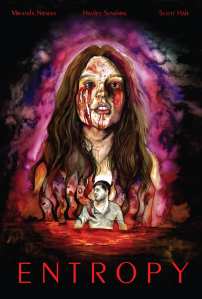
I was unaware of the horror movie Entropy until the production sought me out to review their movie. It was filmed in Ohio for a minimal budget over the course of six days and nights during the 2020 COVID-19 outbreak. I think it’s admirable that, as things were shutting down and lives were thrown out of balance, that this small group of filmmakers banded together and made something creative with that unexpected down time. The final ten minutes of credits includes behind the scenes video of the special effects process and it looks like everyone was enjoying themselves with this project to keep their minds off the pandemic. As a finished film, however, Entropy leaves a lot to be desired even as a low-budget, lowered expectations chiller thriller.
Abby (Miranda Nieman) hates her girlfriend Miranda’s (Hayley Sunshine, and what a fabulous name) friends. She used to be part of a self-improvement group that some have labeled a cult. Miranda pressures Abby to come to dinner and meet these people and understand they’re not so bad. Also at this friendly dinner is Scott (Scott Hale), their former leader, who has come back from his time overseas with stories of horror. Is he to be believed? Is he dangerous? And how far out of the pull of this group is Miranda and should Abby begin planning her escape?

While the movie is labeled as that feature-film-qualifying metric of 80 minutes, in reality it’s 70 minutes, and even within that minimal running time there is plenty of padding and dead air. I have found this fault with many of the Ohio indies I’ve seen, and it’s essentially a case of not having enough material to fulfill the demands of a feature length running time. Director/co-writer Kameron Hale and his fellow co-writer, producer, and brother Scott Hale, have made several horror short films, and it’s easy to see how Entropy likely started as a short script that the brothers thought could expand into a larger story. There just isn’t enough material here as presented although it had the potential for further exploration. The idea of finding out your lover is formerly in a cult has some nice juicy character reverberations, which would make anyone second-guess things. The premise of a cult leader returning from his mystical and mysterious sojourn is also rife with potential for a horror movie. From a strict psychological thriller level, over the course of one very disconcerting dinner, he could be re-consolidating power, and Abby could slowly understand the dawning threat that her girlfriend is succumbing to, like an addict plunging once more into the self-destructive behaviors of their past. From a body horror standpoint, you can use the returned guru as the bringer of otherworldly terror. Something supernatural could have hitched a ride and taken over him, and now it wants more flesh. There are ideas that, with careful plotting and characterization, could sustain a feature film. Entropy doesn’t quite do that, so that’s why we get situations like three minutes of sustained driving or three minutes walking through the woods that’s meant to be moody but is really just padding.
The movie’s small budget becomes a handicap at parts but what really harms the movie is the sloppy, clunky manner in how the story establishes its needed points. Characters will often speak in a “Hey, you remember when…?”-style of artificial conversation for the benefit of informing the audience of things they would naturally likely already know. Every movie needs exposition to better orient an audience, but the trick of the writer is to mask it as much as possible. It’s stuff like, “Don’t you guys hate Scott? Wasn’t he in a cult?” and, “I thought you were wrapped up in the medical scene like the rest of them. Cody said he’s seen you at the hospital a lot.” With each of those lines, you can tell where the screenplay wants to go for info, but it’s so clunky and lacking the opportunity to shed light about the character doing the speaking. Writing for characters is not something that automatically improves with a higher budget, so one way a low-budget indie can make its mark is through its writing of people, making them intriguing, memorable, and drawing us in. With a cult of people in pain, there should be potential there. Unfortunately, the characters are kept as walking-talking expository devices. I didn’t even realize Abby had cancer and I think the movie was expecting me to know upfront (the cancer diagnosis is in the plot description supplied by the production). Early on she’s in her bathroom crying, and she refers to “whatever’s growing inside me,” and I thought she was pregnant, which brings its own follow-up questions for a lesbian relationship. It is not until 26 minutes into the movie when the word “cancer” is actually spoken via text: “I have ovarian cancer. I need to go home.” She then texts, “My vagina is literally killing me” twice, and I chuckled (also, a possible misuse of “literally”). Other lines of dialogue I found to be tin-eared yet memorable include, “I’ll go to the party but I won’t go to a pity party,” and, in reference to Abby’s ovarian cancer, “If anyone’s gonna understand what’s going on inside you, it’s gonna be them, and me, if you’d let me,” and, “I was drugging the drinks but not like you think. The drinks were already drugged, and I was drugging them to counteract the drugs,” and my favorite toward the very end, “I don’t know where the fuck this basement came from but I guess it’s part of the house now.”

You can see the better version of this movie, one that strips away much of the exposition-heavy and dawdling first half hour. Rather than being told upfront that Abby is sick, or at least being told with a lack of clarity, let’s let this be a much later revelation. The same with Miranda’s relationship to being in a cult. It would have been more interesting and creepier for Miranda to have withheld this vital background and for Abby to realize over the course of one long awkward dinner. Likewise, the dinner setting could have been a great showcase for Scott to demonstrate his manipulative Svengali tendencies. The dinner could be a reunion of friends Miranda hadn’t seen since college rather than her best friends; best friends, I might add, that have not been told anything about the girl she has been dating for over three months. The fear of thinking you really know someone but they’ve been hiding key parts of themselves, and who they may actually be under the surface, is a universal plight. That way the truth comes out piece by piece and we are placed in Abby’s shoes, the outsider to this gathering and trying to understand. It’s a dynamic that would have played to a low-budget production and put emphasis on the character writing and performances as the night descends into Rosemary’s Baby “who are these people?” territory.
When Entropy does go all-in on its Lovecraftian body horror in the final twenty minutes, it’s certainly a leap ahead in entertainment. The lighting favors lots of indigo and purple, which reminded me of 2020’s Color Out of Space, a surefire artistic influence here. The body horror is gross and slimy and the practical effects, while limited, are designed to be more impressionable and shape-defining, triggering our innate sense that something is very wrong. It’s during this wild stretch that the movie tries to do too much with its remaining time (while still padding things out, of course) and by then it’s too late. The lack of clarity in the writing with the characters at the beginning resurfaces and now we have a lack of clarity about what is happening. While Lovecraftian horror often features imperceptible qualities of terror, the story feels more purposely vague out of convenience than a grand design of the unknowable.
At only 70 minutes of movie length, I can’t say that Entropy is an easy watch. My patience was grinding down with all the tedium and padding. Fans of micro-budget horror movies and especially with a taste for the lurid and wild machinations of body horror could be entertained, though it’s a long wait to get to the gory goods. That protracted setup should establish the characters, their dilemma, and most importantly, our interest in what is happening so that when everything goes crazy that we care about what happens next. The characterization, plotting, and dialogue are disappointing and stilted. The acting is pretty limited all around, and that may be another reason why the script didn’t become a tense chamber piece. I found Hale as the cult leader to be the best actor of the bunch. I credit the filmmakers with striving to make something, working together during such fraught times, and succeeding in getting a level of distribution through the prolific Gravitas Ventures. However, next time, and I hope for the Hale brothers there is a next time, that they work just as hard on creating the core elements that will make people care about what dastardly thing happens next to the people in their story, and maybe get an outside set of eyes to read their script for clarity.
Nate’s Grade: D+
Share this:

They/Them/Us (2022)
 Jon Sherman has been a film professor at Kenyon College in Ohio since 2010. He has sought to build up the Columbus, Ohio film community and has often guest lectured at various film screenings held in central Ohio. Sherman has some personal experience with Hollywood, writing and directing his 1996 breakout indie rom-com Breathing Room (starring Dan Futterman!), and then given an even bigger stage with the 2002 rom-com I’m with Lucy (with Monica Potter!). He may be an academic but that filmmaking itch never really goes away, and so that brings us to another Sherman rom-com, 2022’s They/Them/Us, which is available to be viewed nationally through digital release. It’s a charming, offbeat romance with a sweet sensibility and an unexpected kink.
Charlie (Joey Slotnick) is a middle-aged man starting his life over. He’s re-entered the dating scene after a recent divorce, he splits custody of his two teenage children with their mother, and the only job he could find as a film professor is at a conservative Christian university. Lisa (Amy Hargreaves) is a woman in her forties, a successful artist with full custody of her two children, one of whom has recently identified as non-binary (preferring “they/them” pronouns, hence the title). They meet online, have their first date, and are immediately smitten, enough so that Lisa bends her rules about not getting too attached too soon. Charlie and Lisa decide to combine their clans into one modern blended family, and the reunification is a messy and awkward process.
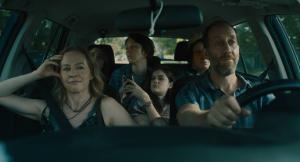 Given Sherman’s background as a film professor, you would hope that if anyone, when given the opportunity to make a feature film, could rise to the occasion, it should be somebody whose career rests upon the analysis of what makes movies work best. They/Them/Us succeeds as a relatively light-hearted rom-com and family drama with several nice moments. It’s hard to quantify, but you know better writing when you witness it, how characters interact and how witty the exchanges are and how much characterization they impart. Typically, a lesser writer will overstay their welcome or begin a scene before the importance. This can also be done to add unique character details, but often it’s a writer not knowing when to start and when to leave, a trait I’ve experienced so many times with Ohio-made indies. With Sherman’s scene writing, everything is to the point and moving, imparting the most important info or character detail, then chugging along. Early on, we establish Charlie as a man struggling to parent two surly teenagers and find someone special online. The fact that in the opening seconds he seems to be messaging two women who have BDSM kinks in their profile should be telling. After Charlie admonishes Danny for smoking pot in his house, he snatches the kid’s bong and runs upstairs, pacing and unsure of what to do next as his breathing calms and he focuses his attention to the bong in hand. Cut to Charlie smoking the bong to relax. It’s a quick, smart detail that demonstrates Charlie’s uncertainty on how to be the stable authority figure with his own dismissive children.
They/Them/Us is also a charming and sex positive romance between two middle-aged divorcees, a subject that rarely gets such big screen attention. The movie touches upon the challenges of modern dating when you’re not just dating a single individual but a person with attachments, about starting over later and finding a new life that will make appropriate space for you. Selecting a common dinner option can be its own minefield. It’s a perspective worthy of more attention by Hollywood. Beyond that angle, the movie is also surprisingly kinky for a “family comedy.” While unrated, They/Them/Us still exists in a more PG-13-friendly universe so it’s rather gentle when it explores the BDSM urges of Lisa. The movie is refreshingly free of judgements though has more than a few grand jokes drawn from Charlie’s squeamishness. He tries to throw himself into a more aggressive role, and Lisa asks him to pull her hair harder, and he says, “I’m sorry, I can’t. I’m a feminist.” I laughed out loud at that one. Another time, Charlie is attempting to spank Lisa and he keeps hesitating, finally admitting that it keeps bringing up unwanted and uncomfortable memories of spanking his unruly son as a child, something he still feels guilty over. In time, Charlie seeks out advice and instruction on how to be a better BDSM participant, and his educational process is a bit obvious, with more than a few easy gags (no pun intended), but it’s still one borne from a desire to better understand and fulfill his partner. It’s a sweet romance.
 Slotnick (Twister, The Marvelous Mrs. Maisel) has been a staple of TV and movies for decades, a reliable “that guy” with overly neurotic tendencies. He’s a terrific put-upon dad and his age has only added more authenticity to Charlie’s harried struggle. He’s got a warmth to him that is easily conveyed during his brighter, kinder moments, and he’s also got a wellspring of awkward, cringe-inducing comedy as a middle-aged dad trying too hard to connect with a brood of teenagers and often flailing. When he’s genuinely happy, Slotnick genuinely wins you over. I think the vague details about Charlie’s dismissal from his previous professor job are a mistake. We’re told by his ex-wife, who inexplicably is still trying to get him back for the sake of the children, that a coed sent Charlie inappropriate texts. That topic is way too big not to clarify, and it’s also strange that Sherman and co-writer and partner Melissa Vogley Woods never come back to this as a conflict with his new relationship. It also seems like a natural point of conflict for keeping his new position at the Christian college and yet it’s glossed over (the resolution over that is laughably too tidy and convenient but keeping with the low stakes).
Hargreaves (13 Reasons Why, Homeland) is very enjoyable as the more experienced and confident half of this blended relationship. Lisa knows what she likes and is not ashamed, and she’s patient with Charlie as he attempts to reach her on her level. Hargreaves has a fun spirit to her that doesn’t veer into exploitation. It would be easy for Sherman to just write her as a fetish object for Charlie, but Lisa comes across as a real woman with her own desires and doubts and questions. There’s a scene where Lisa and Charlie are talking after their less-than-stellar first date with the combined family unit, and Lisa’s children are impatiently waiting by the locked car. “Come one, mom,” they whine. “You have the keys.” In mid-sentence, Hargreaves just hurls the car keys to her children and then continues her conversation with Charlie without missing a beat. It’s a defiant, petulant, lovely moment that keys the audience into her devotion to Charlie and her own character. I adored it.
Lexie Bean, as Maddie, and Jack Steiner as Danny, are both acting breakthroughs. Both of the actors are so natural and with a great poise and presence. Steiner has minimal acting experience but could easily headline a movie with the sly charisma and comic timing he displays. He even finds a way to enliven one of the least funny segments in comedies, the drug trip. Bean has notable, obvious talent that I regret that They/Them/Us doesn’t draw more upon.
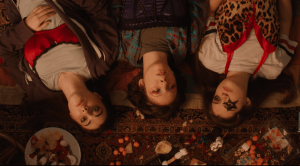 There is one significant critique I do have with They/Them/Us and that’s that this all feels like a far better fit for a television series than as a single film. Rare do I come across a story engine that seems like it has the output to keep going, but that’s what we have here. There are three significant storylines that all would have benefited with far more time and development that a wider field of narrative writing would afford: 1) at its core, this is a story about a blended family and all the troubles and revelations and connections that come from two established families suddenly sharing spaces and lives, 2) Charlie working at a conservative Christian university and having to awkwardly pose as devout while hiding his true feelings, and 3) it’s a BDSM rom-com.
Taken as a whole, it’s easy to see how those storylines could form the backbone of a series-long narrative. Charlie’s facade at work could get more and more complex to carry on, and as his secret gets discovered, more desperate. He could also experiment more with wanting to become sexually adventurous for his partner. There could even be the question over whether he was having an affair when he was really just getting one-on-one instruction with a helpful dominatrix to educate himself. That might sound like a generic sitcom contrivance, but the script makes plenty of these kinds of conflicts and too-easy resolutions. When Maddie refuses to eat, Charlie sits with them, and within literal seconds Maddie is confessing a teacher is deliberately misgendering them and it hurts. Charlie’s solution is to get donuts, and it’s during his exchange with the drive-thru intercom that he makes a heartfelt stand about Maddie being non-binary and preferred pronouns, and then it’s like we’ve wrapped up that conflict in a bow. It’s so absurdly quick, and these characters have not had a conversation together before this, that we’ve seen, so its resolution feels so abrupt as to be arbitrary. That’s where a TV series would allow these characters and their inter-family drama to really take shape. An entire episode could be devoted to Charlie trying, and awkwardly failing, to bond with Maddie, finding a small triumph at the end that would feel better earned. This goes especially in the last twenty minutes when Danny’s drug problems get way too serious for the film’s tone. For most of its running time, They/Them/Her has such a low-stakes sense about all of its family drama, keeping things light and loose. It can’t quite make that leap to melodrama that encapsulates the end of the movie, a transition that doesn’t feel properly established.
 When you’re dealing with human relationships, and with the battleground that a blended family would present, then squeezing everything into a measly 90 minutes feels like a disservice. At one point, Charlie and Lisa ask if they’re rushing things, going too fast, and they agree to move in together at the twenty-minute mark, but it’s almost like an admission to the audience about the movie. Everything is moving just too fast. We need the time to slow down, to really luxuriate in the awkwardness and unexpected connections, and the kind of narrative berths where each character can feel more fleshed out and less defined by a single note of distinction (the Non-Binary child, the Drug Problem child, the Sarcastic child, the Blame Shifter, etc.). I still enjoyed these characters and their interactions, but I would have enjoyed them even more with a larger scope to appreciate the depth and eccentricities of each person.
They/Them/Us is a rather wholesome movie that doesn’t feel like it’s talking down to its audience, judging its characters punitively, or overly sugar-coating their personal dilemmas. It’s not a particularly challenging movie but Sherman and his cohorts know what kind of movie they want to make. It’s technically proficient, assuredly low-budget but still professional in presentation. I often enjoyed the musical score by David Carbonara (Mad Men – what a get this guy was). While some subplots and conflicts are so swiftly and conveniently handled, the core of this charming movie remains its fractious, funny, and all too human relationships. When my biggest complaint stems from wanting more, more of these people, more of their adjustments and misunderstandings and triumphs, and more comic possibilities from a larger time frame of stories, then you’ve done something right with your 90 minutes of movie and clearly not everyone can accomplish even that.
Nate’s Grade: B
Share this:

CODA (2021)
 Ruby Rossi (Emilia Jones) falls under the category of CODA, a Child Of a Deaf Adult. Her mother (Marlee Matlin) and father (Tony Kotsur) and her older brother (Daniel Durant) are all deaf, and she is the only member of her household with the ability to hear. She’s balancing working for her family on their fishing trawler, maintaining good grades in school, and possibly pursuing scholarships to enroll at a music and fine arts college for singing. Ruby’s music teacher agrees to train her because he believes in her potential, but Ruby has to worry that her dream is something that cannot be shared with the people she loves most, and how would they all get on without her?
The framework of CODA is familiar to anyone who has watched a coming-of-age story or family drama, but it’s the conviction and strength of character and sheer force of empathy that makes this movie a standout film for 2021. It’s based upon a 2014 French film, The Family Beller, and follows many of the same beats from other sentimental family dramas about sticking out in your family and society, chasing your dream, often in conflict with your family’s expectations, gaining that sense of inner strength and resolve, and mending differences in perspective with hard-fought and well-earned wisdom. It’s familiar, but that doesn’t mean under the right set of hands that it cannot still be resonant and emotionally gratifying. I do not hold the familiar formula against CODA, even as the family’s goal and her personal goal come into direct conflict in sometimes forced manners. That’s because the movie does an excellent job of establishing these people as characters, establishing the family dynamic as fraught but loving, and establishing a conflict that is direct and clear as far a major point of separation.
 Ruby isn’t just the only member of her family who can hear, she’s also their vital lifeline to the outside world. She’s looked upon as the family interpreter, a position they cannot afford to pay for someone else’s services so the duties and responsibilities fall upon her. That’s so much pressure to bear for one teenage girl, knowing that she’s the link between her family’s poverty-treading existence and possibly breaking free into a larger hearing community. She feels ostracized and awkward within her own family and outside of her own family. To the rest of the school, she’s that “deaf family girl,” and it’s remarked that when she began high school she had an accent reminiscent of what deaf people can sound like, a point that her peers cruelly imitate. She worries she will forever be defined by her family’s disability even if she doesn’t share it. However, within her family, she feels ostracized because she’s different. She wonders if her mother wishes that she too were deaf, and during a heartfelt late-night talk, mom actually admits that upon her daughter’s birth she did feel disappointment when Ruby had hearing. While she knows sign language and has grown up with these loving figures, she’ll still always be the one who’s different, the one who hears the insults her family cannot.
The film does a remarkable effort about contextualizing Ruby’s fears and frustrations of being held captive in two different worlds, neither feeling fully accepted or whole, and that’s why her embarking on a personal dream that her family can never fully appreciate feels so significant. Part of Ruby might feel that singing is selfish, especially if it means limiting her family’s upward mobility by eliminating their unpaid interpreter, but it’s the thing that makes her most happy, a special gift that her family will be excluded from. There’s a wonderful moment toward the end of the movie where Ruby’s father asks her to sing to him, and he puts his hands along her shoulders and neck to feel the vibrations, and his awed and tear-stricken face is so moving, as he so desperately wants to indulge too in the beauty of his daughter’s voice. While occasionally the film goes overboard pounding these two conflicting paths into forced collision (family vs. self), the movie is personal with its big problems and personal with its big triumphs, making it transcend the trappings of formula.
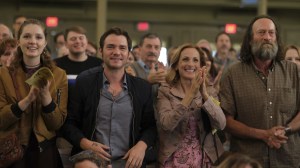 Writer/director Sian Heder got her start on Orange is the New Black, and that TV series’ hallmark has been its enormous sense of empathy for its diverse characters. This is evident in Heder’s screenplay and her observational, detail-rich simple storytelling that immerses you in this world, so even while you recognize more familiar made-for-TV plot turns, the genuine authenticity makes the movie feel like its own unique story. Heder’s direction is delicate and places the attention squarely on her performers. There is one stylistic move late in the film when Ruby’s family comes to her choir recital in support. They look around for cues when to applaud, and their minds wander as they sign about other menial topics like grocery lists, and you understand why once Heder drops you into their perspective. For a minute, the sound disappears, and you’re left studying facial expressions for cues like them. While we can imagine being deaf, it’s another matter to experience it and try and understand.
The acting is another laudable merit for CODA. I personally want three Oscar nominations for this clan, Jones (Locke & Key) for Best Actress, Matlin (Children of a Lesser God) for Best Supporting Actress, and Kotsur (Wild Prairie Rose) for Best Supporting Actor. Over the course of nine months, Jones learned American Sign Language and how to sing, which is surprising because I would have said she has a natural talent with singing. Her performance, as well as Matlin and Kotsur, feel so real, so nuanced, and so natural, like we’ve plucked these people from real life and given them this platform. It’s the best credit you can give an actor, when they seemingly disappear into the character, and the character feels like a fully breathing, flesh-and-blood person. Even the small supporting roles are well cast, well acted, and contribute to the overall authenticity of the movie. Unlike the 2014 French original movie, all of the deaf members of the family are portrayed by actual deaf actors as well.
CODA was a sensation at the 2021 Sundance Film Festival, with Apple Films buying the rights for $25 million dollars, and it’s easy to see why because it’s such a satisfying, enriching crowd-pleaser and legit tear-jerker. There were several points that had me tearing up, and then fully crying, because I was so emotionally engaged with the family, their struggles, and their triumphs and outpouring of love. You might be able to see where the movie is headed because its template is familiar and formulaic, but it’s the execution, the attention to detail, and the level of observational attention that elevates CODA and makes it so winning and so heartwarming.
Nate’s Grade: A
Share this:

Youngstown (2021)
 Pete Ohs is an Ohio-born filmmaker who has met some level of success in the Hollywood indie scene. He’s mounted movies that got limited releases, including one starring multiple Emmy winner Julia Garner (Ozark, The Assistant). According to Ohs’ own admission, writing a script, finding the money, getting talent attached, and pitching to gatekeepers had somewhat drained the fun out of the creative process of being a filmmaker. He wanted to go back to the days of being kids, just rolling with an idea and chasing it wherever it may lead. So Ohs decided to turn a vacation into a possible movie. His childhood friend, producer Jesse Reed, begged him to come to Youngstown, Ohio and make a movie, so that’s what Ohs did. He would fly out with his two lead actors with no script, no crew, no permits, and film over the course of two weeks during the summer of 2019. For Ohs, it was an attempt to go back to something fun, the appeal of filmmaking before it got so complicated and pressure-packed, and even if things didn’t work out, they still got a two-week vacation. Youngstown is their finished result, a 75-minute trifle of a movie, light and meandering, and admittedly stretched thin.
The story revolves around “Sarah Jayne Reynolds” (Stephanie Hunt) who is in the witness protection program. She’s been relocated in Ohio but just can’t help herself and heads back to her hometown of Youngstown. Along the way, she meets a fast-talking grifter (Andy Faulkner) -literally credited as “Grifter”- who is happy to drive her to Youngstown and see the sights. She shows him her favorite restaurants and haunts, and he tries to teach her how to be a better liar for her own safety, while trying to keep his own low-level schemes going as well.
 All criticisms for Youngstown need to be blunted somewhat because this movie had obvious disadvantages, a limited ambition, and was possibly never intended to even exist. It needs to be graded on a curve not because it’s low-budget (I’ve seen movies made for less), or because it’s an indie (Ohs has enough experience as a filmmaker to not deem him a novice), or even that it began life without a finished script (it sure feels like many movies, even big-budget studio tentpoles, sadly follow this route). It’s because the movie is essentially a glorified vacation video and improv experiment. The people behind it just wanted to have fun and highlight the local hot spots and town history for a dilapidated former steel city. The movie is their souvenir. Did Ohs and company, and by that I mean his two actors, pull it all off? Well, yes and no.
It’s impressive that with as many reasons going against it, Ohms is able to pull off a narrative that mostly works. The premise of a woman in witness protection returning to her hometown seems like the dumbest idea a person could do being in reported relocation. The very premise invites you not to take things too seriously, because the character of Sarah never feels like she’s in any real danger. In fact, the impression she gives is either one of blithe ignorance or perhaps limited mental acuity. Then again the government seems to have set her up with a new identity in a neighboring Ohio city. I don’t think moving a vulnerable person just across the county line is the same thing as keeping them safe. Regardless, the movie doesn’t hold Sarah to account for these rash and foolhardy actions, and she’s never placed in any real danger, so it’s the movie’s way of telling you to relax and just go with it. The core is about two odd people who are trying to learn from one another. He’s learning about her wholesome take on life. She’s learning to be more duplicitous or at least less naive. This dynamic actually works well enough to produce comedic sparks of potential, like when Sarah is learning how to lie better by faking being on crutches and her reason for needing them. It’s kind of adorable to watch a person who is really bad at lying being sweetly oblivious. More could have been wrought from this creative combination, but the fact that they never go into a romantic direction and keep things strictly platonic is admirable although perhaps not the best choice.
 Another laudable aspect is that Ohs can even make up a movie on the spot without having to scout his locations. According to his account, they would find a space and come up with the scene in that space, with him studying the angles and already mentally putting together an edit in his head so he would know what angles were needed to tell the moment. The photography is crisp and the visual compositions are often well coordinated, with varied focus depth. For being made on the spot, it helps when you have somebody who knows how to shoot a movie, and considering he was the ENTIRE crew, that’s a lot riding on the talents of one man. Ohs has edited more movies than he’s directed (including 2019’s Olympic Dreams), so the editing is efficient and often smooth, evoking the same unhurried, gentle feeling of the story.
Where this movie could have been improved should be obvious to anyone who watches it, and that’s beefing up the story and scenarios to better effect. As the movie was improvised and created from scene-to-scene and day-to-day, it has a general loping quality to it; however, this feeling can become meandering quite often, and just about every conversation, even the comedic ones, feels creatively exhausted. Hunt (Friday Night Lights, The Get Together) and Faulkner (Spree) are agreeable performers, both are charismatic even in minimal, but they’re not gifted improvisers. Faulkner seems to fall back upon the “more is more” approach of Judd Apatow movies. He’ll riff on a bit for an extensive amount of time, conjuring dozens of details or phony names but not really transforming the moment. The best improvisers find new and unexpected avenues with what they’re given, making the transitions seamless. The overall effect of Youngstown is like slowly letting the air out of your patience. A scene will be established, and then it will just keep going, beating whatever joke was present into tiny particles of comedy dust.

Director/editor/co-writer Pete Ohs on location.
Take Sarah showing off her town’s main street and offering commentary about all the restaurants and different locales. Like many of the comedy bits, it starts amusing but then deteriorates. It becomes three minutes of Sarah saying something about every shop and eatery she sees, and few of these observations are even funny. It’s stuff like, “Best Chinese food in the city.” It starts to feel like you’re stuck with a passenger just narrating anything they see without much helpful commentary at all, and that’s precisely what is happening. Some scenes work, like Faulkner explaining how to be better at lying, but too many scenes follow the car narration formula: they keep going longer than the joke affords. It starts to remind me of those improv-heavy additional versions of comedies, like the Anchorman bonus DVD, and even those grow tiresome and they are professionals. The extension of these comedy bits is likely a result of trying to find enough useful material to reach 75 minutes for a feature running time. Otherwise, why include three minutes of a conversation best kept at 30 seconds? It’s a film necessity dragging subpar improv.
As an experiment, Youngstown deserves recognition for even mostly working and for its enjoyable actors and amiable spirit. As a movie, it even looks and sounds professional despite its limitations. Ohs is a real filmmaker who can be trusted to make his movies look like professional movies. As a story or as a comedy, Youngstown is too lacking. The improv seams show all too often and whatever comedy momentum gets diluted and lost. Your tolerance for middling improv will be a big indicator whether or not you find the movie to be charming. Congrats to Ohs and his two actors on being able to make a movie without any significant preparation. It’s a testament to all of their skills. Now only imagine what these folks could do with an actually honed script. As a fun distraction, it can pass the time agreeably but it’s little more than meandering filler. It makes me intrigued to follow Ohs and Hunt and Faulkner in other, more polished projects.
Nate’s Grade: C+


 nathanzoebl
You must be logged in to post a comment.