Blog Archives
Alternate Opinion: Lady Ballers Guest Essay
My friend and writing partner Ben Bailey asked me to host an extensive essay he was compelled to write after watching Ben Shapiro’s deeply disingenuous and presumably laugh-free sports comedy, Lady Ballers, a movie built upon not just transphobia but also misogyny. I plan on watching this movie as well because of course it will be one of the worst movies of the year and thus I’ll need to analyze these things for you to spare you, dear reader. In the mean time, enjoy Ben’s monumental take-down on the movie, its terms and goals, and the disingenuous nature of the toxic conservative media ecosystem.
______________________________________________
“Trigger Warning: A Woke Soy Cuck is About to Talk About Lady Ballers“
By Ben Bailey

So, Lady Ballers is a thing. If you haven’t heard of it, or of Ben Shapiro’s right wing Daily Wire production company, I envy your life and your ability to avoid psychic pain. For the rest of you, maybe you’ve seen the trailer or some reaction videos on YouTube, and then you likely did what most rational people would do and casually dismissed it as something you will never have any reason to watch. At least I assume most people will never watch Lady Ballers because most people don’t have a subscription to Daily Wire+ or the wherewithal to actively seek it out through other quasi-legal means, but I watched it, and if only to justify the effort of doing so, I decided to commandeer my good friend’s blog for a bit to talk about it. You should know that I insisted he watch it, because even though I cited him as a friend just now, I secretly hate him and only want bad things for him.
Lady Ballers is the story of the whitest basketball team you’ve ever seen in your life deciding to take advantage of our modern “woke obsession” with regarding trans people as human beings with basic dignity by pretending to identify as women so that they can compete in women’s sports, where they will obviously dominate due to their manly testosterone being the natural kryptonite to weak lady estrogen. If you are as exhausted reading that synopsis as I became writing it, rest assured that the rest of this isn’t actually going to be much of a traditional review of the film on its cinematic merits, because that would be completely pointless. If you’ve seen the trailer and know anything about the people who made it, you already know it’s bad. It’s not funny, its amateurish and just generally poorly made, because it was made by unfunny amateurs who don’t know how to make anything good. I will touch on quality issues here and there, but mostly I want to focus on what the film represents in the larger cultural and political context in which it is being presented. What is the point of Lady Ballers, and what does its form and function say about the bigots behind it and the zeitgeist they so desperately wish to influence?
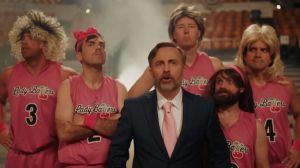 I also want to stress at the outset that the level of critical analysis I am about to apply to Lady Ballers should not be seen as any attempt to elevate it to the level of art worth engaging with or expanding any intellectual strain to deconstruct. Just by talking about this movie, or even calling this loose assortment of tired hate-filled nonsense a movie, might leave the erroneous impression that Lady Ballers is, in any way, inherently interesting. It is not. It is in fact, beyond the novelty of its miserably cynical polemic, a very boring thing that I would defy most people not already tuned into its disgusting message to even sit through (and frankly I bet most of its target audience would find it difficult as well).
Let’s start with Ben Shapiro, the public face of the Daily Wire brand, who appears briefly in a cameo as a referee at one of the games to deliver a line that unintentionally reveals more about him and this movie than anything else in it, flatly stating that he’s just getting paid to be here and doesn’t actually care about anything going on. Ben Shapiro is a grifter, and almost certainly a bad person who probably believes a lot of terrible things about people, but I say probably because you can never be sure with someone like Ben if he actually believes anything he says or is just saying what he needs to say to appeal to an audience of people as bad as he is presenting himself to be. The science is not yet in on whether he is biologically a piece of shit, but he clearly identifies as one, and just as he seems to regard trans identification according to his film, he’s only doing it for the clout and the money. Whether or not Shapiro actually believes any of his own hate-filled rhetoric is immaterial to his main goal, which is raking in money from the suckers in his audience who very much do believe it, and the reason we know this for sure, is because he just made a movie called Lady Ballers.
You see, in a recent interview about the movie on his website, Shapiro revealed that the original intention for Lady Ballers was not creating a kind of dumb, raunchy, shocking for its own sake comedy that he would almost certainly hate if he hadn’t made it himself, but rather, a hard-hitting documentary focusing on his favorite fake culture war controversy. The plan was to have cis-gendered men actually pretend to identify as women in order to infiltrate women’s sports for real and prove that all the so-called trans-women currently doing it were just liars like them trying to get a hairy leg up on the competition. The problem apparently became immediately obvious when they found that the standards for applying to women’s sports as trans-women were much higher than any of their stooges were willing to meet, as they weren’t ready to undergo the hormone treatments, surgeries, and other little details required to prove that they weren’t just a bunch of assholes trying to co-opt something they don’t care about in order to score political points with MAGA douchebags. You get it, right? It’s the one legitimately fascinating thing about Lady Ballers, that its very existence in its current form invalidates its entire thematic premise. They had to make a fictional “comedy” version of the story they wanted to tell because it was impossible to present the thing they claim to believe is actually true in any way that could qualify as a documentary even by their incredibly low standards. As Shapiro is fond of saying, facts don’t care about feelings, and in this case, that appears to be true.
 But of course, that didn’t stop them, so they went ahead and made Lady Ballers, and I could go on for quite a while listing off all the transphobia and misogyny and racism awash in it, as well as all the stuff that wasn’t deliberately objectionable but still offensively unfunny, but again, what would be the point? More interesting to me is what this movie says about the people who made it and the audience it is targeting and what the perceived existence and marketability of that audience says about us as a country and a species. I always felt that the rise of Donald Trump was less about him than it was about us, that whether he won or lost, or wins again or loses again in 2024, it would be a test of our own moral character for us to pass or fail. Do we accept that this is who we are, or do we actually try to live up to what we all want to believe are our better selves? The vitriol intrinsic to Lady Ballers and the Daily Wire and this whole movement of stoking anti-trans hatred to rile up bigots, ultimately in the hope of pushing them to the polls to support a fascist overthrow of our democracy, just seems to me to be another facet of that test, and how close we are to passing or failing it is the only question worth thinking about.
For a movie supposedly about the topic of trans-people in sports, it is a bit surprising that this movie doesn’t actually feature any depictions of real trans-people in it. Obviously, I wasn’t expecting any portrayal to be positive, but I at least expected there to be a trans-character, if only to take the role of a villain or antagonist representing the thing the movie is railing against. We have the aforementioned cis-men pretending to be trans but otherwise no one who genuinely considers themselves to be trans. Even if you dismiss the authenticity of trans identification and say they just wrongly believe something about their gender, you’d think they would show someone like that in their own movie, right? There’s a brief bit at the end where a character suggests they might be, but only as a quick throwaway ball-kicking joke. If trans people are the bad guys in real life, why are they not the bad guys in this movie that wants you to come away thinking that they are so bad?
More to the point, why are there no trans conservatives in the movie? I know there aren’t that many, but off the top of my head I can think of at least two public examples. Maybe Caitlin Jenner was too big a get for this and just saying that the vaunted star of Can’t Stop The Music, Jack and Jill, and literally no other movies is too good for this is saying something, but what about Blair White? Pretty sure she’s been on the Daily Wire a couple of times, but apparently, they couldn’t get her to show up to provide any kind of cover for the transphobic message. That’s literally what she does for a living, being the trans person willing to sell out her own people for conservative clout, and either they didn’t want her in this for some reason, or even she turned them down. Blair White agreed to appear in a Tom MacDonald music video but turned down Lady Ballers?
 That can’t be it. It’s not possible that they even asked them, or ever considered including any trans-people, even as imaginary straw-women to make fun of them, because that would require acknowledging that they are actual people who exist. As the film’s mid-credit stinger suggests, depicting one of the main characters attending Jordan Peterson’s reparative therapy to cure their trans-delusions, for this movie and the ideology behind it to make any sense, trans-people can’t exist, and anyone claiming to be trans is either mentally ill or pulling the same scam as the film’s protagonists. If Jenner had shown up, sure she may have parroted the talking points about keeping sports segregated by the gender binary, but she would have presumably done so with the confidence of a person who clearly believes that they have the right to exist as they are without being accused of being crazy or a liar, which would go against the movie’s larger message that trans-people aren’t just illegitimate as players in sport but illegitimate as people in general. The people behind Lady Ballers are grifters who don’t believe anything, so naturally they assume that everyone else is too, and that includes trans-people, who don’t actually believe what they say about themselves, and are merely grifting a gullible public, just like the Daily Wire is doing.
Designed to work in tandem with freak-outs about Drag Queen Story Hours grooming your kids and doctors prescribing hormone blockers to babies without their consent, the faux controversy about trans-people in sports has always been a thinly-veiled cover for the larger goal of trans erasure, a way to launder openly genocidal rhetoric designed to inspire the very kind of deadly violence against trans-people we’ve seen increase in the last few years as if it were just some completely legitimate concern for the integrity of women’s sports. But Lady Ballers is so blunt and bad at its own messaging that it fails to hide what it needs to hide, giving away the game, no pun intended. Obviously, these people don’t genuinely care about women’s sports; a major running gag in the movie is about how literally no one cares about women’s sports, and the central premise of the movie assumes that any man, regardless of skill, is inherently physically superior to every woman and could beat any women at any sport at any time purely by virtue of being a man.
And I know that sounds like a joke, to the point where you might question my criticizing it in the context of a movie at least intended to be a comedy, but that’s not a joke in this movie. You as the audience are not meant to take the idea that any man is better than all women at all sports as an exaggerated, farcical concept. That is the actual thing you are meant to unironically accept so that the other jokes in the movie work, the underlying rational assumption upon which the other jokes are made relatable. You aren’t meant to laugh at the idea that these men are trouncing these women at the sports the women trained for and the men didn’t, you are meant to laugh at the absurdity that any woman would ever think they could try to go up against any man. A few years ago, there was a poll that found that 1-in-8 men genuinely believed that they could beat Serena Williams in tennis, and this movie was written for them.
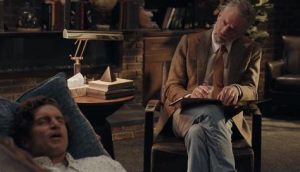
If you know who this person is in the picture, I’m sorry.
The virulent misogyny dripping from every corner of Lady Ballers would seem to preclude any genuine regard for the integrity of women’s sports or women in general. The most prominent female character in the film is a conniving reporter colluding with the team’s head coach to cynically milk the “stunning and brave” human interest story for viewers, who casually references her regular abortions as the annoying minor consequence of aggressive promiscuity, you know, the way all women who get abortions do? At one point, one of our “heroes” stares off into the middle distance while spitting out a creepy incel screed sarcastically defining women as just like men but better because they shave their legs, brag about bravery for things that aren’t brave, and aren’t afraid to cry at work, and the next shot is the reporter shrugging and nodding in agreement, as if it was the truest thing ever said and, despite her prior demonstration of assertive hostile feminism, she has absolutely no way to refute it.
Again, you might be saying, these are just jokes. Bad taste jokes, maybe even jokes based on faulty premises that could only be enjoyed by the terrible people who accept those premises, sure, but still, only jokes. But that’s the weird thing about a movie like Lady Ballers that is more preoccupied with its political and cultural message than its service as a functional comedy. The message is not in the service of the comedy, the comedy, such as it is, is in the service of the message. Comedy is about subverting expectations, while cultural polemics are about reaffirming expectations. For instance, if you start your movie with a bunch of characters assuming that simply being men would allow them to dominate women’s sports, one would think the next scene would be them realizing that this was not the case, in a montage of them getting taken down a peg for their sexist hubris. Or you might have an actual trans character presented as a contrast for the absurdity of their fake trans grift. But this movie can’t do any of those things, because to subvert the expectations of its audience of bigoted right-wing morons would defeat the whole point, which is to validate their bigotry and to keep the cash flow coming. The needs of a comedy and the needs of whatever this movie is are diametrically opposed to one another.
Fairly early on in Lady Ballers, before the film’s gender-bending twist, the head coach delivers one of his famously rousing motivational speeches to his team, getting them to chant a motto that will return in the third act: “Winners are just losers who win.” Credit where its due, unlike most of what passes for comedy in the movie, this line at least structurally conforms to be a recognizable joke. It’s not particularly funny or clever, just a superficial rhetorical absurdity, but it also serves as another one of those accidental confessions on the part of the producers. Because if you think about it, losers who win basically describes the Rightwing Influencer Pipeline to which the Daily Wire crew belong.

Also, Ted Cruz cameo.
To the extent that they have won anything, or rather succeeded financially as a grift or culturally as propaganda for a noxious worldview, it has always been with the distinct stench of loser-dom. C.H.U.D.s like Matt Walsh or Michael Knowles speak with all the confidence of people with an actual point, but there’s always this underlying sense that beyond the choir to which they are preaching, the cringe and bluster are obvious to anyone else. When Ben Shapiro tries to own Cardi B and Megan The Stallion’s W.A.P. by questioning whether the titular wetness is a disturbing medical condition, unintentionally revealing to the world that he’s apparently never made his own wife sexually aroused, the self-own, while hilarious, is not even a little surprising. In short, contrary to the utter gob-smacking dearth of actual jokes in their movie, these guys are themselves complete jokes.
And the more important point is that the joke isn’t landing anymore, if it ever did. One need only look to the spectacular failure of Moms For Liberty, a group that tried to ride the wave of transphobia to take local school board elections by storm, only to lose almost every seat they ran for in 2023. If there is any saving grace to Lady Ballers, it is that it decidedly does not feel like the work of people who are or even think they are winning anything. This doesn’t feel like a triumphant victory lap of the Anti-Trans Right, but rather the sad last desperate gasp of a dying movement that was never even a real movement to begin with, the fizzled fart of stale air escaping a punctured basketball, or if you prefer, a balloon used to approximate a fake boob by someone who’s never done drag and didn’t bother to research anything about how to do it right. And that’s good. Not the lack of research but the larger failure of the mission that this movie represents. You still shouldn’t watch it because it sucks.
The thing I’ve always found interesting about Shapiro is that in spite of his horrible takes on everything, he strikes me as someone at least smart and self-aware enough to feel some measure of secret disdain for how his career is dependent upon debasing himself to the kinds of people who boycott M&Ms because the green one isn’t sexy enough anymore. If you didn’t know, he got into the right-wing commentary business after a failed attempt at making it as a screenwriter, and it would seem that the Daily Wire getting into its own film production is at least on some level a way for him to live out the dreams that were robbed of him by his crippling lack of creative talent. I like to think that knowing Lady Ballers is the closest he’s come to the achievement of his lifelong aspirations, and that the actual career he did build for himself is an active impediment to those aspirations trapping him in a cage of his own bullshit from which he can never escape to a land where he is regarded as a legitimate creative person, is the funniest joke of all.
(Addendum: I didn’t have any other place for this, but I did feel I would be disingenuous if I did not mention the one actual good idea in the movie. At one point, the head coach goes to a Hooter’s-esque sports bar but one staffed entirely by men in drag. Of course, in the context of the film this is yet another joke about how men dressed as women are silly and should be dehumanized and presumably executed by the state in the next Trump administration, but out of that context, it’s just a solid concept for a restaurant and I would patronize the hell out of a place like that. Not sure if anyone has ever tried something like it in real life, but if not, they should.)
[Editor’s Note: At the film’s premier, one of the actors was arrested by the FBI and charged with four crimes relating to the January 6 insurrection because of course.]

Share this:

Beau is Afraid (2023)
 Beau is Afraid is a ramshackle mess of a movie, and that is both the highest compliment and an indictment on its tremendous excess and lack of focus. It’s Ari Aster’s big swing after his modest successes in elevated horror (Hereditary, Midsommar), so the indie maven studio A24 gave him a thirty-million budget and three hours and full artistic reign to do whatever he wanted, and love it or hate it, one has to objectively admit, Aster really went for something all right. I’m still deliberating where that final something falls on the artistic merit equation. There’s undeniable ambition and artistry here, but there’s also so many ideas and moments and bloat, it genuinely reminded me of 2007’s Southland Tales (did your stomach just drop, dear reader?). It’s because both movies are stuffed to the brim with their director’s assorted odd ideas and concepts, as if either man was afraid they were never going to make another movie again and had to awkwardly squeeze in everything they ever wanted into one overburdened project (in Richard Kelly’s case his suspicion might have been correct, as he did only direct one more feature -so far). While I certainly enjoyed -if that is the right word- Aster’s movie more, Beau is Afraid is not an easy movie to love, or enjoy, or even simply sit through, and not just because of its bloated time.
 If I had to boil down this sprawling movie into one easy-to-digest concept, it’s about Jewish guilt. If you’re not a fan of feeling uncomfortable or anxious from the intensity of a movie, I would skip this one entirely. Beau (Joaquin Phoenix) might as well be a stand-in for the biblical figure of Job for all the cruel punishments and indignities he endures. Just when you think, “Well, it can’t get any worse,” Aster rolls up his sleeves and rises to the challenge and makes things even worse for his pathetic put-upon plebeian. This is a movie of escalating discomfort, chiefly meant to convey the constant state of anxiety that is Beau’s daily existence, and for the first hour or so, Aster works marvelously at making you squirm. It’s a movie less meant to reflect our objective reality and more a projection of one man’s anxious feelings and paranoia, the unsettling urge that everyone secretly hates you and something bad is always ready to lethally strike.
Beau is Afraid is an absurdist comedy of heightened almost screwball proportions, with Beau becoming increasingly frazzled and muttering “Oh no” hundreds of times as fate has it out for him. Small worries become all-consuming, like the simple task of trying to get water to swallow his new prescription medication, and how this eventually spirals to the ransacking of his apartment building, which is also all Beau’s fault, inadvertently, though that won’t mitigate the guilt. There are numerous fears and worries amplified to breaking points, inviting morbid chuckles and nervous titters. Beau sits in his bathtub to stare at an unknown man squeezed against the walls of his ceiling and about to slip and fall. Why is this man there? Why does Beau not immediately leap out of the tub? Why do both men remain fixed in their positions until the inevitable? It’s because it’s a ridiculous paranoid fear manifested into a ridiculous scenario made even more ridiculous. It’s the same with ignoring his mother’s calls only to have a stranger answer her phone to inform Beau that she has been killed and happens to be without a head now. It’s a realistic fear, avoiding phone calls and the draining emotional energy required to answer, and following it up with a consequence of darkly absurdist proportions to make him feel even worse. The movie leaps from one squirm-inducing, grueling sequence to the next, testing your limits and patience. There’s a post-coital revelation debunking, and then confirming, an outlandish worry that made me laugh out loud with tremendous auditory force. What else could I do? It certainly feels like Aster is inviting the audience to laugh at Beau’s pain and tragedy because what other human response can there be but to laugh in the face of unrelenting torment?
 Where the movie loses momentum is about halfway through, after Aster has established the drive of the movie, Beau’s attempts to get to his mother’s funeral so they can finally bury her. Every hour he is delayed, Beau is reminded that his mother’s body is rapidly decaying and only furthering her “humiliation” at the hands of Beau’s inaction. The second part of the movie involves Beau recovering from injuries in an upper class family’s home, the same family (Nathan Lane, Amy Ryan) that accidentally ran him over and is now kind of holding him hostage against his weakened will. We have an urgent goal, we have obstacles keeping him from that goal, and this is where the movie continues to work, as each new attempt to escape only confirms how much stranger and dangerous this family unit is. This dynamic plays into the established heightened fears and absurdist complications. It’s keeping him from his goal. But when he does eventually free himself from this hostage scenario, he literally wanders into the woods and discovers a troupe of thespians that refer to themselves as the Orphans of the Forest, and then a theatrical production may or may not present the rest of Beau’s natural life. This was where the movie’s momentum, which had steadily been ratcheting up along with the dark comedy, began to flag, and when I started to worry, then suspect, then confirm my sinking feeling that this all isn’t going to add up to something more cohesive and thought-provoking. It’s really more a movie of sustained memorable moments and unpredictable, tone-shattering twists and turns. Beau is Afraid is unpredictable, and that both works as an asset and eventually as a handicap. That’s because every scene is hammering the same overall thematic point just with a different stylistic arrangement of fears and anxiety. Following this redundant framework, a 130-minute version of this movie world would feasibly have the same thematic impact as the 180-minute version, merely eliminating some of the many detours.
Another nagging aspect of the movie that failed to add up to much more for me was how little Beau seems to matter in his own story. He’s more intended to be the universe’s lone fall guy rather than a person, a victim whose chief characterization is his ongoing victimization. He suffers and that is his identity. Considering the movie is more a loose fable, this can work since Beau is essentially a stand-in for all of humanity, but there are more personal aspects of him worth exploring in finer detail. The toxic relationship with his mother is worthy of further examination, especially the decades of emotional manipulation to ensure Beau would never replace her with another woman. I wish Aster had devoted more of his 180-minute run time to exploring Beau as a person rather than pitting him against a proverbial assembly line of pies to the face. Phoenix (Joker) has so little to do here except stare wide-eyed, helpless, and mumble as the world constantly befuddles and antagonizes him. It’s a performance purely of pained reaction.
 Can I recommend Beau is Afraid? For most viewers, probably not. It’s too long, too sporadic, and doesn’t come to anything cohesive or cumulative or even meaningful beyond a mean-spirited sense of pessimism directed at our titular human punching bag. It’s wildly ambitious and off-putting and bloated and outlandish and the kind of big artistic swing that artists usually only get so rarely in their careers. And yet I have to admire the sheer gusto of Aster making a movie this strange and alienating, a movie that’s constantly altering its very landscape of possibilities, usually to the detriment of Beau’s physical and mental well-being. It is an exhausting experience, so that when the end finally arrives, we, much like Beau, are simply ready to accept the finality we’ve been waiting for after so much abuse. There are moments throughout these ungainly 180 minutes that are sheer brilliance, and sequences that are sheer torture, some of which are on purpose. There’s also just way too much of everything, and without variance or finer exploration of its themes and specific characterization, it becomes a cosmic game of whack-a-mole where you might be the one actually getting hit over the head, and after so long I can’t blame anyone for not enjoying the prolonged experience.
Nate’s Grade: B-
Share this:

Past Lives (2023)
 The world of cinema is rife with romantic tales of two people from the past reconnecting and rekindling a passion, learning to love again as older adults now presumably wiser. The Hallmark Christmas industry is practically built from this plot structure, as the man or woman, usually the woman, goes back home to rediscover that their old friend or former flame is still living a humble life and ready to teach him or her about the small pleasures of a simple life. It’s also human nature to think about paths not taken and wonder what may have been. That’s where Past Lives starts and that’s also where it differs. The small-scale indie drama getting some of the best reviews of 2023 follows Nora (Greta Lee) as a thirty-something writer who immigrated to the United States when she was twelve. One of the friends she left behind in South Korea was Hae Sung (Teo Yoo), the boy she was crushing on who she finds again as an adult. In their early twenties, Nora and Hae Sung reconnect online and grow close again, though she requests they take time apart as their lives will not allow them to physically meet again until at least a year later. He agrees. Cut to another twelve years later, and Hae Sung seeks out his old friend, except now Nora is married to another writer, Arthur (John Magaro). What will happen with their 24-years-in-the-making reunion actually takes place?
 Past Lives is a very gentle and sparse movie, and it’s remarkable that this is the debut film from writer/director Celine Song (TV’s Wheel of Time). She has the patience of an artist who knows exactly the vibe they are going for. It’s so confident with those long takes, prolonged pauses, and visual metaphors. Even the plot structure is reflective of her patience, with the adult reunion not even occurring until 50 minutes in and all three parties not meeting until 80 minutes. The opening scene spies all three of our main characters at the bar while two off-screen eavesdroppers provide their own speculative interpretation of the relationship of the three; are they lovers, are they family, who is who? It’s such a smart yet playful way to open her movie, presenting the three main players and then having unseen spectators theorize who they are, providing voice to the audience as we begin to question who might feel closer to whom. It’s also a scene that left me immediately confident that Song was going to be an assured storyteller from here on out.
A soapier and more melodramatic version of this story would center on whether Nora is going to have an affair with her childhood sweetheart; even Arthur recognizes in the “Hollywood movie” version of these events that he would be the white American villain standing in the way of true love. Except it’s not that at all. Past Lives is about two former friends and possibly romantic partners reconnecting but it’s not about whether there are still old feelings that will be rekindled. It’s not likely that after a dozen years these two would so quickly fall in love and run away together, so please don’t pretend like this is some kind of spoiler. Instead, the meeting of someone who was once important in their lives allows for a pause point to reflect not what could have been, as Hae Sung is wont to do as he imagines a life where he and Nora were linked, but as the person they used to be and how they have changed into the person they now are. This is how Nora sees their encounter, an opportunity through her childhood friend who stayed to serve as her own “what if.” Not what if she had ever gotten romantically involved with this man but what if she had stayed in Korea rather than immigrating to a new life in the West. There’s also a rosy presumption at play here, where people assume the road not taken would have led to an unmet present happiness. There’s just as much if not more a likelihood that had Nora stayed, and had she dated Hae Sung, that they could have eventually broken up on bad terms and want nothing to do with one another. By leaving young, and by never fulfilling that initial spark, they are both eternally preserved as meaningful people without regret coming into their (past) lives. Granted, every viewer can surmise their own interpretation, especially with a movie so powerfully understated, but my assessment of the movie was less romantic revisionism and more personal accounting.
 The movie hinges on three characters, so it’s a good thing that all three actors are compelling to watch. The nuance each of these three performers displays is amazing. They have to communicate much through gestures and glances, where a simple smile allowing oneself to acknowledge the significance of a hug a dozen years in the making are the tools of communication. This is the kind of movie where you can watch the characters processing their thoughts in real time. Lee (The Morning Show, Russian Doll) has the difficult job of navigating as the woman in between past and present, between her husband and this other man from her old life, and she does so with uncommon grace. Yoo (Decision to Leave) is the most reserved as the interloper who doesn’t know what is safe to reveal about himself and his interior life. He confides that he and his ex-girlfriend are on a break because he feels like he’s weighing her down, that he’s too ordinary and thus inferior for her. Then there’s Magaro (The Many Saints of Newark) who might just be the most understanding husband of all time. He’s not going to make a big stink and encourages his wife to see this old friend. There’s a nice moment where Arthur reveals one reason he learned Korean was because Nora would talk in her sleep in Korean. He wanted to learn more about a hidden part of her life. “It’s like there’s a whole place inside you I can’t go,” he says, and rather than seem like jealousy, it’s an admission of wanting to empathize with as many facets of the person you love. No wonder Hae Sung, despite himself, liked Arthur.
And yet the curmudgeon in me, the yin to my foolishly romantic self’s yang, has some qualms about what holds Past Lives back from being the emotional tour de force it could have been. This is because the characters are understated to the point that they feel less fully formed as people so that a larger selection of viewers will recognize themselves and their own questions and relatability. In making the film more universal, the movie has also made the characters feel less defined, more informed by key details of difference that the characters list like employee evaluations. Nora thinks like an American woman and Hae Sung thinks like a Korean man. In some ways, they’re meant to be stand-ins for Eastern and Western cultural differences. Understatement is grand but it can also leave less specifics. Think about how remarkable the characters are in Richard Linklater’s Before series, their mellifluous conversations so natural and pleasant to behold. It’s the same key aspect with many of the mumblecore indies, dropping you in on lives and characters that you want to observe for 100-or-so minutes of investment. They leave an impression because of who they are, whereas much of Past Lives is leaving an impression of reflection of who they could have been and how they might have changed over time. It’s not quite the same, and so this is why my emotional and intellectual investment were not as steadily satisfied by the full film.
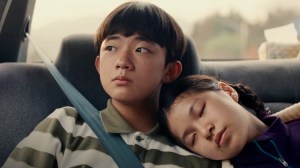 Aching to the point of being painful, Past Lives is a beautifully tender drama about characters taking stock of their lives both past and present. It’s like somebody mixed Before Sunset with a French New Wave romance. A key theme throughout is the concept of fate, known as “In Yun” in Korea. It’s about the many actions and ripples through years and years to bring people into contact with one another and recognizing that every connection is the result of thousands of these actions pushing us to that singular point. It’s a way to say be appreciative of what you have but also who you’ve been allowed to become. Past Lives is an appealing story that might be a bit too understated to break through higher levels of emotional engagement, but even at its current level, it’s still one of the finer films of the year.
Nate’s Grade: B+
Share this:

The Station Agent (2003) [Review Re-View]
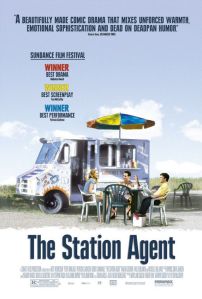 Originally released December 5, 2003:
This is the most charming film of 2003, and Im not just saying this because I had an interview with one of its stars, Michelle Williams (Dawson’s Creek). Fnin McBride (Peter Dinklage) is a man with dwarfism. With every step he takes every look he gives, you witness the years of torture hes been through with glares and comments. Hes shut himself away from people and travels to an isolated train station to live. There he meets two other oddballs, a live-wire hot dog vendor (Bobby Cannavale) and a divorced mother (Patricia Clarkson). Together the three find a wonderful companionship and deep friendship. The moments showing the evolution of the relationship between the three are the films highlights. Its a film driven by characters but well-rounded and remarkable characters. Dinklage gives perhaps one of the coolest performances as the unforgettable Fin. Cannavale is hilarious as the loudmouth best friend that wants a human connection. Clarkson is equally impressive as yet another fragile mother (a similar role in the equally good Pieces of April). The writing and acting of The Station Agent are superb. Its an unforgettable slice of Americana brought together by three oddballs and their real friendship. You;ll leave The Station Agent abuzz in good feelings. This is a film you tell your friends about afterwards. There’s likely no shot for a dwarf to be nominated for an Oscar in our prejudiced times but Dinklage is deserving. The Station Agent is everything you could want in an excellent independent movie. It tells a tale that would normally not get told. And this is one beauty of a tale.
Nate’s Grade: A
——————————————————
WRITER REFLECTIONS 20 YEARS LATER
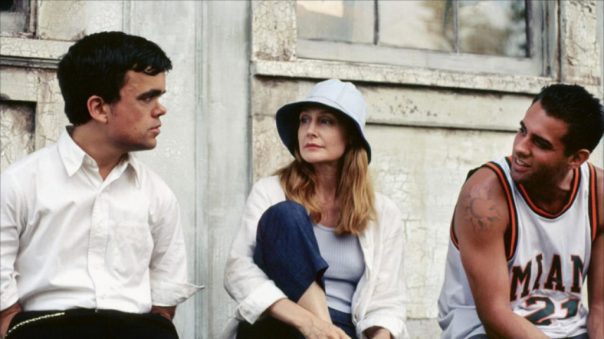
Tom McCarthy didn’t invent the quirky, found family indie but he sure seems to have nearly perfected it, starting with 2003’s The Station Agent. This little gem of a movie is so subdued, so relaxed, and so gentle that it seems to adopt the very personality of its lead character, Fin (Peter Dinklage), a dwarf who just likes trains a lot and wants to live his life in solitude. He’s an unassuming man who keeps to himself as a means of survival, because almost every time he goes into public life Fin is met with stares, snickers, and harassment (the convenience store lady gets his attention to take his unsolicited picture). Very few will get to know this man beyond his superficial physical characteristics, so he retreats within himself, perhaps purposely obsessing over an antiquated hobby as a means of escape to the past. He’s a lonely man and the movie is about him finding his clan, his place in the world, by slowly lowering his defenses. It’s a simple sort of story that is lifted by the strength of its characters and its wonderful ensemble cast.
With such a taciturn main character we need a contrasting character, a much more talkative person with high energy, and this is beautifully embodied by Bobby Cannavale. He plays Joe Oramas, a coffee truck operator who exemplifies joy de vie. He’s charming, garrulous, and relentlessly upbeat, which makes for a magnificent odd couple contrast with Fin, and it allows both characters to gradually change and grow attached to one another’s mutual friendship. Finn allows himself to become more vulnerable and form bonds and Joe starts to see the world from Fin’s point of view, allowing himself to slow down and appreciate the smaller things he might have missed in his excitable and irascible activity. Dinklage’s dry understated performance is a perfect counterpoint to the churning energy emanating from a grinning Cannavale. This is a fine showcase of both actors, who would go on to win six Emmys between them in the years ahead.
The third member of this found family is Olivia, played by Patricia Clarkson, and I actually think the movie might have worked better without her character. She does provide a point of view that our two guys lack; she’s experienced significant grief over a lost child and her life is in shambles as she tries to discover what she wants from her cratering marriage to a young-er John Slattery. Clarkson is also wryly enjoyable and gets some of the best lines in the movie, so she’s not at fault here. I think it’s because I’m confused about how this character is treated, especially compared to the natural opposites-attract dynamic of Fin and Joe’s friendship. Olivia feels like a broken thing that the boys need to try and help get better, but we were already covering this with Finn’s reserve from a lifetime of feeling ostracized. The possible romance between Fin and Olivia is also awkward because there are obvious implications that she sees Fin as a replacement son, even having him sleep in her son’s old bed. At one point, in her anger, she yells at Fin that she’s not his mother, but it feels much more like she’s the one who is looking for a surrogate son, and just because Fin is a dwarf and perhaps of similar heights makes the whole thing feel uncomfortable and ill-advsied. I’m not going to refuse an added Patricia Clarkson in my movie, but upon my re-watch twenty years later, it’s hard not to feel like McCarthy didn’t have as much envisioned for this part.
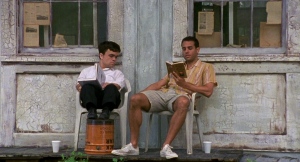 McCarthy’s movie acclimates the viewer to the simple charms of its people and the small town, getting to know the various characters and their foibles and hopes, getting used to the rhythms of this life and adjusting much like Fin. There are small victories that are payoffs, like Fin finally getting a library card, or speaking in front of a school class about his affinity for trains. It works so well. McCarthy continued his found family writing with 2007’s The Visitor and 2011’s Win Win, both anchored by the emotional enormity of sad, lonely men learning to open up to companionship. There were some dips in the road but McCarthy worked his found family magic to the biggest stage with 2015’s Best Picture winner, Spotlight, which McCarthy directed and co-wrote. His only follow-up theatrical movie was 2021’s Stillwater, where an oil rig dad (Matt Damon) tries to save his daughter overseas from a very ripped-from-the-headlines scandal (Amanda Knox was very unhappy). There is also a 2020 Disney Plus movie about a kid detective and his imaginary polar bear best friend (that actually sounds adorable). I guess I figured a Best Picture Oscar on your resume, as well as a history of working within the studio system and world of indies, would have given McCarthy more work than directing a handful of episodes for 13 Reasons Why and creating Alaska Daily. I’ll always be looking for the next McCarthy project when I can.
McCarthy’s failures can be just as intriguing as his successes. The Cobbler is just such an astounding idea that it’s hard to imagine anyone thinking it would work out, with Adam Sandler as a magic shoe-maker. However, this same pessimistic mentality probably prevailed when McCarthy was trying to raise money for The Station Agent. His indie successes proved that he could take any jumble of strange characters and turn it into a functional movie. Maybe that hubris, well-earned along with his contributions to the Oscar-nominated Up script, finally caught up with 2014’s The Cobbler. I would pay good money to one day watch that un-aired footage of the original Thrones pilot, the one the producers themselves acknowledged to be deeply troubled. After retooling the show and cast, bringing in Michelle Fairley and Emilia Clarke, McCarthy departed, though is credited for helping to secure Dinklage’s involvement, and it’s impossible to think of the zeitgeist-defining excellence of the HBO series with anyone else playing the iconic role of Tyrion Lannister.
 Re-evaluating The Station Agent twenty years hence, its many charms are still abundant and I appreciated how gentle and relaxed everything felt. When indie movies deal with heavy amounts of quirk and oddities, it can often be heavy-handed and abrasive, never letting the audience forget for a second just how special and strange and different the movie must be (here comes 2024’s look at Napoleon Dynamite). McCarthy’s movie almost feels like a writing exercise where he plucked three very different characters out of a hat and challenged himself to build a grounded movie built upon their unexpected friendships. It’s a movie confident to just let the characters speak for themselves. It’s more a slice-of-life glimpse at people who feel far more real than most Sundance indies built upon oddballs and quirk. I would slightly lower the grade from an A to an A minus simply because of the Olivia character. Clarkson is great but her role feels undeveloped, somewhat redundant, and a little sloppy. Still, the enjoyable performances, the observational detail, and the simple pleasures of a story well told with characters you genuinely care about are what shines through even twenty years later.
Author’s note: In my original review, I cite having interviewed Michelle Williams (yes, surprise, she plays the small-town librarian). While I was my college newspaper’s film critic from January 2002 to May 2004, I did have the opportunity to interview several actors and directors through phone cattle calls with other collegiate journalists. These names include Angelina Jolie (Tomb Raider 2), Billy Bob Thornton (Bad Santa), Kevin Smith (Jersey Girl), and the late Paul Walker (Timeline). However, my school schedule was not accommodating for the Williams interview, so I had my dormitory neighbor and friend Tim Knopp call in and ask my question. It wasn’t me. I’m coming clean after twenty years, folks. I also recall having him quote a line her character says in The Station Agent, saying Fin had “a nice chin,” and being told that she was baffled and blanking on the reference. I’m sorry, eventual multi-Oscar nominee Michelle Williams, for trying to be clever.
Re-View Grade: A-
Share this:

Asteroid City (2023)
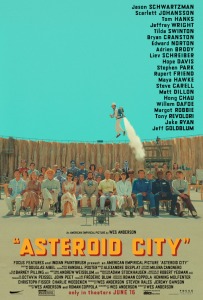 It’s not a good sign that a week after watching a movie I was racking my brain to try and remember what I had watched, and it’s even worse when it’s a movie by Wes Anderson, a filmmaker with such a distinct sense of intricate style it’s now become a go-to A.I. test for untalented people. Asteroid City has the makings of an appealing comic escapade set in a Southwest small town known for its tiny asteroid, and once aliens make their presence known, the entire town and its tourists and wanderers and scientists are quarantined. The problem comes almost immediately, as the movie is presented through several added layers of obfuscating framing devices. The story itself is a play, and we’re watching a movie version, but then also the play of the movie, and the behind the scenes of its now-deceased playwright toiling with his authorial messages and stubborn actors, and it feels like two different movies at odds with one another. The Asteroid City sequence is the more engaging, with some sweet storylines like Jason Schwartzman as a widower processing loss with his family, including his father-in-law (Tom Hanks) who never liked him, while beginning to find a possible romantic kinship with a struggling actress and single mom (Scarlett Johansson). I enjoyed weird little asides about the history of this little town, like a vending machine for land ownership, and s science fair with brainy whiz kids finding their own comradery. There’s even a nice moment in the meta-textual framing where the Schwartzman actor recites an exorcised dialogue scene with the actress who played his deceased wife in the play. It’s elegantly heartfelt. However, the added layers don’t really add extra insight or intrigue but serve as muddy trappings, making meaning less likely rather than more. It feels like Anderson didn’t have enough material with the central story so he added on the meta to make up the difference. There are too many moving pieces and too many characters, and versions of characters, here to settle into something grander. The whimsy and visual style of Anderson is still evident throughout every highly-crafted and pristine arrangement in the movie, so if you’re an Anderson diehard, he still has his charms. This is two Anderson movies in a row that felt disorganized, distracted, and chiefly under-developed, and I’m starting to worry that the form has taken over the function as storyteller.
Nate’s Grade: C+
Share this:

Obstacle Corpse (2022)

Hope Madden has been an esteemed critic, journalist, and writer for many Columbus media publications and television for years. She and her husband, George Wolf, run MaddWolf, a popular film blog, and head the Fright Club podcast and horror film programming at the Gateway Theater. They know movies inside and out and they know horror. So it makes sense for Obstacle Corpse to be Madden’s first feature as a writer and director. It’s a high-concept horror comedy filmed in the Columbus, Ohio area and now available to watch on Amazon. Madden and Wolf are both part of my Columbus film critics’ group, and so I will, as I always strive for with reviewing Ohio-made indies, attempt to be as objective as possible knowing many involved in the cast and crew. Obstacle Corpse is, above all things, enjoyably demented. It’s a low-budget horror movie that understands that an indie horror movie is going to succeed through concept, personality, and mood, and Madden pays attention to each of those winning dimensions.
Sunny (Sylvie Mix) just wants to impress her domineering and dismissive father. She signs up for the Guts and Glory competition, a twelve-event obstacle course, to prove herself. Each contestant is expected to bring a partner, so she brings her best friend Ezra (Alan Tyson) who is ready to get back home and out of the woods pronto. That’s even before they discover that the teams have gathered for some brutal competition. Each team is also required to kill their teammate over the course of the grueling events, so will Sunny and Ezra survive, and will they possibly turn on one another to save themself from the deadly games?

The premise is a quick hook, a deadly version of an obstacle course, and makes twisted sense, not just from a canny take-something-from-childhood-but-make-it-deadly calculus of recent gimmicky horror. There are plenty of adult-oriented obstacle courses known for their physical endurance, like the Tough Mudders and Spartan Race and Ninja Warrior, so an escalation into literal life-and-death stakes as an experiential attraction makes sense in a twisted fashion. Madden has also done what I wish several other indie filmmakers would and distinguished her large net of crazy characters. There’s a wonderful sense of personality to the different groups, which helps the audience keep track of the many different faces, but it also allows the characters to be more playful. I don’t care why some would dress up like clowns for this competition and others as baseball players, I’m just glad that these characters are happy to stand out. I enjoyed a middle-aged man eager to transform every moment into a phony social media tableau. I readily enjoyed the hyper-competitive nature of Stephanie (Gareth Tidball), an intense woman who gets off on the thrill of each challenge. I enjoyed one grumbling angry man (Wolf) who could be counted on to struggle in last place no matter the obstacle. I enjoyed a tracksuit-clad bickering couple. I liked a family of siblings that distinguished itself in paired T-shirts, with one pair wearing “single” and the other wearing “double.” I didn’t quite understand it since they were both pairs but I liked the effort all the same. Even little details can add much.
The mood of Obstacle Corpse is chiefly one of carefree fun, an amiable tone that brings a comedic lightness to even the most ghastly of circumstances. It’s prevalent throughout the movie and makes the 80 minutes easy to digest. Madden’s good times are best summarized by the scene-stealing performance of Mason (Donovan Riley Wolfington, Madden’s son), a costumed chef dishing out cold vengeance from his ice cream truck. This character is presented as a change agent, an unexpected wildcard who is disrupting the establishment overseeing the games. He’s a live-wire of energy, channeling Deadpool or a Looney Tunes cartoon at different points, and he will dismember contestants while gleefully singing his violent versions of Christmas carols. It’s a standout performance in a large cast of varied characters, and Wolfington is just operating on another level of insane amusement. The character also becomes one to easily root for because he’s an antihero underdog taking advantage of others underestimating him, and he’s also that change agent, bringing a bloody sense of justice to those involved in the continuance of the games. A late-in-the-game revelation about his history made me wish for more development to better utilize the key info, but Wolfington is the best mascot for the movie’s demented charms.

Given its large cast, there are several that made a favorable impression as they navigated the comedy aspects. Mix (Poser, Double Walker) is a definite find for Columbus cinema and will be going places in no time. She is a natural actor and serves as our baseline of normality, a shifting concept in a world of violent mayhem. Tyson (Stowaway) is a great foil as Sunny’s friend. He’s more effete and unimposing, at first glance, so his incredulous reactions are a welcomed source of comedy and reason. Tony White does a lot as a clown/mime who befriends our “normal” characters. He gives a very expressive and charming performance, and yet there are a couple of moments where his tortured emotions serve as a surprising well of feelings (he is labeled as Sad Clown, after all). Even producer Jason Tostevin (Hellarious) has a laconic menace as the head of the games security, and he delivers a monologue about achieving your peak greatness that sounds like a self-help guru comfortable into the exploitative routines. He’s our face of the establishment, so as things begin going haywire from our anarchic chef, his discomfort provides a consistent outlet for satisfying comeuppance. You can tell the cast is enjoying themselves, and that casual camaraderie helps to add to the overall silly and bloody fun of the movie.
I wish the parameters of this killer event had a bit more clarity and development to really maximize the possibility. First, I thought that these many obstacles were themselves going to be part of the killer challenge, something akin to Squid Games where familiar childhood playground games have been transformed into life-and-death contests. That’s not the case, so watching characters overcome a cargo net or a set of tires feels somewhat disappointing because what would the appeal of this physical track be beyond the murdering? I think part of the joke is that these are ordinary park obstacles that are causing so many so much struggle. The rules of this course can also be rather murky. We see the enforcement of what happens when a contestant kills outside of an official obstacle course event, but the rest of the rules are left too vague. Contestants are welcome to bring their own weapons, like bats and knives, so could someone simply bring a high-powered gun and mow down the entire competition? How does this work exactly? What prize do the winners receive at the end other than having killed their partner? Did Sunny’s father understand what exactly she was getting into and approved? I’m also left slightly bewildered how many of these teams are family members that are so eager to kill one another. I’m not opposed to the possible fratricide plot, but I think the movie needs to present more conflicts within the couples to present as possible explanation for this murderous intent (maybe an old score to settle like stealing a girlfriend, maybe it’s an inheritance battle, maybe it’s sussing out what the particulars are of the familiar tension, etc.). It’s shocking to watch an older brother pitch his younger brother into a fire and kids killing kids (off-screen), but the shock value only goes so far, and having more setup or context could have added more satisfaction. I guess many are just wannabe psychopaths looking for any excuse to indulge their darker impulses.

I think about the brilliant simplicity of 2019’s Ready or Not. The movie’s premise is essentially a killer game of hide and seek, already a rather uncomplicated children’s game. But the filmmakers carefully established the rules and stakes, with the family holding to he belief they need to kill the person hiding before sunrise or else they will all die thanks to a generational curse. It’s outlandish but the movie presented all the vital information and then let things rip. In the case of Obstacle Corpse, it’s around the fifty-minute mark before our main characters, the normies, discover the actual deadly stakes of the game, and their response seems a tad… relaxed. Part of this is, as earlier described, the amiable low-stakes charm of the movie, so nobody ever brings too much of a sense of actual reality to the absurd competition and its slapstick violence.
I also wish Obstacle Corpse had coalesced more of a class-conscious political commentary. We are introduced to a wealthy couple who are bankrolling the games under the auspices of live online betting, a concept also explored in many other movies that summarize the villains as bored rich people betting on the lives of the poor (Squid Games, Escape Room, The Hunger Games, etc.). That works, though the script only gives us one or two check-ins with our wealthy couple as they seem more interested in canoodling than keeping up with their own spectacle. Maybe that signifies how blase they are about human life but it felt like a missed opportunity. I kept envisioning a version of Obstacle Corpse that really trained its fire on the callousness of the rich, with the teams each being a boss or CEO and some lackey or intern that they’re stringing along, meaning each competitive couple already has a class distinction. The plot informs us that the veterans know they are inviting their guest to their intended doom, so why not project onto a corporate or wealthy head and their contempt for a lower-class worker they see as literally disposable? Perhaps these fragile wealthy men think they’re so much more capable or threatening than they really are, a concept given some attention through the hyper-macho character of Richard (Brian Spangler) who can’t live up to his overblown expectations. There’s an overinflated sense of toxic masculinity that relates to physical dominance that was worthy of even more deconstruction and criticism. I think this dynamic would have allowed the movie to hone and target its ire with more potent satirical firepower.
Even with some of my misgivings about clarity and untapped thematic potential, Obstacle Corpse is an enjoyable horror comedy for fans. The blood gushes constantly and the gore is impressively grotesque for its minimal budget. There are some impressive shots for a movie 95 percent filmed in the woods. Madden has crafted a movie that works regardless of budget, with its larger-than-life characters and conflicts resulting from a strong and memorable high-concept premise. The emphasis is more on comedy than horror, like the world’s most demented summer camp outing. Given the large cast of characters, the movie always has a new batch of people to jump through, which keeps the movie fresh even when the suspense can slacken because of the comedic emphasis. It’s not a one-joke movie, and the fun of the cast can often be felt, especially the grand ball of a time had by Wolfington. There are things left out I wish had been explored further, but this is a solid start for Madden and her team in the realm of indie genre filmmaking. If you enjoy your comedy with a heaping helping of blood and bad taste, give Obstacle Corpse a chance.
Nate’s Grade: B-
Share this:

Sound of Freedom (2023)
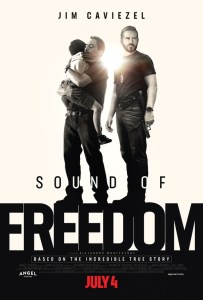 The surprise of an otherwise underwhelming summer at the box-office, so far, has been an indie movie made for only a fraction of the bigger studio fare. Sound of Freedom is an action drama originally filmed in 2018 and even resorted to crowdfunding for post-production assistance, so you’d be curious as to what about this movie is making it the hot commodity in 2023? Well, the answer is both uplifting and also dispiriting, with good intentions running against possible bad faith. However, as an action drama chronicling the ills of human trafficking, it’s pretty mediocre genre stuff and indulges too often in wallowing in the danger of these innocent children under the guise of raising awareness of a pertinent problem that too many may unfortunately misconstrue.
Reportedly based on the experiences of Tim Ballard (Jim Caviezel), a former Homeland Security agent who was tasked with breaking up child-trafficking rings. He even goes undercover to bust skeevy mustachioed pedophiles looking to meet up with buyers, which causes obvious physiological distress and a strain on his marriage, although his wife seems saintly (played by Mira Sorvino, who is only here briefly to urge her man on). A Honduran brother and sister are sold through the front of a child beauty pageant into sex slavery, and after rescuing the brother, he’s determined to reunite the siblings. His efforts lead to Ballard quitting his government job and going to Columbia to try and rescue the children being held as commodities by gangs.
 Allow me to be a little glib, dear reader, as I summarize what the plot of Sound of Freedom boils down to. Here goes: the movie quickly establishes sex trafficking as bad. Not hard. Got it. Our hero sees this and says, “This is very bad. I should do something.” The government says, “This is very bad. But what are you gonna do, you know?” Then our hero proclaims, “I can do something,” and the government brass says, “Well, we don’t know if you should,” and then our hero declares, “Well, I’m gonna!” Then he infiltrates the trafficking ring and reunites a little girl with her brother, and by the end we all learned a valuable lesson that human trafficking is very bad. The end. Now, yes, when you reduce any movie to its most essential plot points, it can feel reductive and like you’re missing something (Star Wars: farm boy leaves home, has adventure with hermit, saves princess), but there isn’t anything more to this Sound of Freedom than any of the Taken movies. It’s not exactly illuminating though it feels very sincere in its convictions.
As an action movie, there sure is a deficit of action to go on for a movie pushing two hours. There’s a climactic rescue but the majority of this movie is the overly simplified journey of trying to find one missing girl. Criminal procedures can be intriguing when there’s a real sense of continuity and progression, chasing down leads, connecting the dots, building the case. It can be invigorating when done well by smart people, like in 2012’s Zero Dark Thirty or the more recent true-life tale of exposing the murderous subject of 2022’s The Good Nurse. With Sound of Freedom, the problems are too easily overcome and the details are minimal. A lot of the breakthroughs are reliant upon chance.
Sound of Freedom feels like a professional action movie, with grimy cinematography and a mournful score, but there’s too little else going on here that is unknown to a general audience. It’s all pretty straightforward and yet sludgy with its overwrought pacing. This is a slow burn of a movie with an obvious end point manufactured for audience uplift, with Caviezel appearing as himself during the end credits to plead for others to donate to the cause and buy tickets for others for the “Uncle Tom’s Cabin of the twenty-first century,” which is what many are doing and donating them to others or passing them off to strangers.
 There is one moment that I thought was unexpected, where reliable character actor Bill Camp (The Queen’s Gambit) plays an ally to assist Ballard in putting together a fake sex trafficking palace for pedophiles (this is much of the last act). Camp plays a businessman who indulged in the illicit excess of power until one fateful sexual encounter with a prostitute that he believed to be in her mid twenties. He’s sickened by the revelation that she was only fifteen years old, and this causes him to have a moral shakeup of his behavior, his complicity, and the entire system of wealthy and powerful people indulging in vices that leave others trapped in cycles of violence and degradation. It’s a potent moment that I wished that Camp’s character was the actual protagonist, a character with flaws trying to overcome a shameful past and do some measures to rectify change. That’s a more interesting starting point than a stoic yet familiar action hero who is defined by his dedicated calling to save the lives of children.
Nobody needs much persuasion to believe that sex trafficking is a definite bad thing, and yet the movie spends so much time wallowing in the grotesque terror of its captive children. It’s one thing to highlight the harsh reality of real-world trauma, but it’s another thing to keep going back for dramatic weight not provided through the rest of the movie. It’s hard to watch young children, gasping and crying, knowing they are likely minutes away from being abused, but why go back to this repeatedly? Did they think the audiences forgot what was happening? Because there is so little else to this movie, plot and character-wise, the frequent stops to watch kids in horror right before being abused are galling, and not just for the intended artistic purpose. Too much of Sound of Freedom is watching a grief-stricken dead-eyed Caviezel gravely intoning, “How can we let this happen?” intermingled with prolonged scenes of terrorized children. It feels too exploitative and gross. I recognized it as a cheap emotional cudgel, and one I didn’t appreciate considering the film’s intended message about the well-being of children.
Here’s where I think the movie’s good intentions run up against the reality of trafficking. The far majority of people who are victims of sex trafficking are not being abducted in public by foreign strangers, they’re not being grabbed at Target stores or somehow hidden in Wayfair furniture (this specific and moronic conspiracy theory was propagated by Ballard as well, sigh); instead, the common perpetrators are friends and family. Often it’s low-income parents with significant substance abuse issues who, in desperation, resort to the most cruel outcome to resolve their addiction. The far majority of trafficking victims are in their teens, seventy percent between 15-17. Victims are also often members of the LGBTQ community who have been kicked out of their homes, and some of these victims resort to trading sex for their own survival. Victims are often those seeking out relationships because of abuse and neglect at home and those coercive relationships then transforming into trafficking. The reality of human trafficking is a lot more complex. It is a worthy topic of imminent concern, but it’s not scary brown-skinned foreigners coming to steal your unsupervised babies. It’s not a cabal of Democrats wanting to drink the blood of children for its power (this specific and moronic conspiracy theory was propagated by Caviezel as well, sigh). The problem with crusading against sex trafficking is when your concept of the topic does not match the reality of the problem. It’s this sensationalized boogeyman, and not knowing the actual reality of the problem will only lead to misapplied solutions for a different reality. Also, the far majority of human trafficking is with labor trafficking, which will be much easier to succeed by lowering the age of child labor in certain states, so there’s that too.
 By every objective measure, Sound of Freedom is a hit. The movie cost $14 million and has already grossed over $50 million at the U.S. box-office. While part of this is a campaign for people to buy tickets to then give away to others, the tickets are still purchased regardless of whether the seats are filled in their entirety. Many people have been inspired by the movie and its heroics, and far be it from me to deny them their uplift. I was let down by the deficiency of the find-and-rescue plot details and the sludgy pacing. I was especially put off by the excessive time spent exploiting the terror of abused children for unnecessary drama. Obviously the subject should make anyone feel uncomfortable, and sex trafficking is a very real evil that everyone should be able to condemn, but there needs to be more to this movie than reminding you that sex trafficking is very bad. I will credit Sound of Freedom with not depicting any specific pernicious QAnon conspiracies, but there’s significant overlap between that community and the audience for this. As a genre exercise, it’s kind of dull. As an expose on human trafficking, it has potential but skirts complexity for the finality of a feel-good mission with clear cut heroes and villains. There are obvious good intentions here wanting to highlight a worthy cause, and that might be enough for many viewers who can coast on the slick production values and overall stoicism.
Nate’s Grade: C
Share this:

Three Quarters Dead (2023)

I don’t normally review short films but I was asked to by an Ohio filmmaker, and so I agreed to do my best in providing a review of a movie that runs a total of only seven minutes. Three Quarters Dead is the latest from writer/director Angelo Thomas, a rising Ohio filmmaker who already has two movies under his belt, The Incredible Jake Parker and the documentary, DeRosa: Life, Love & Art in Transition. Short films must still function under the same guiding rules as feature-length films: there needs to be a beginning, middle, and end; characters should be engaging; conflict should be clear and developed; and the audience needs a reason to care. Granted, you expect more from an 80-minute movie than an eight-minute movie but you’re still expecting the basics of story, character, and entertainment to land. Three Quarters Dead is a cute little movie that nibbles at the edges of some profound concepts but settles a little too quickly.
We begin at the end, well the end of Zach’s (Eric Six) life. He’s moved on from the mortal plane and wakes up inside a peculiar movie theater. There are only three other patrons sitting in attendance and two of them are skeletons. David (David Reid Hatfield) is the only other living patron, though perhaps that term doesn’t even qualify. He has a sickly, zombie-like pallor and prefers to munch on popcorn sprinkled with maggots. David serves as a guide for wayward spirits, helping them transfer to the Great Beyond outside the theater. Until then, they can sit and watch movies for possibly an eternity of downtime.
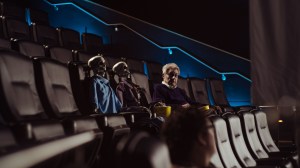
The premise of a movie theater as purgatory is a fun concept and has several areas to connect with the theological and philosophical aspects inherent in any life-after-death story. I liked the projectionist being the equivalent of God looking down from above, offering light and diversion while the mortals sit and wait for answers that might never come. I liked the idea that David has been here so long that he forgot who he is. He is literally deteriorating physically and mentally. The presence of skeletons implies that you can possibly rot away and never even make it to the other side (unless these are just for ambience). Whenever you present a fantasy setting, the audience is going to be keen to adjust to the rules and expectations of this abnormal setting. The premise begs plenty more questions. I was surprised at no point does the short imply what the souls are even watching. This would provide more material either for comedy, like complaining about being stuck watching only so many movies so many times, for character exploration, maybe the movies are chosen that have a specific meaning to each soul, or some melodramatic rumination, like the characters are watching home movies of their own life and its ups and downs, regrets but also the joys that fill the bounds of a life lived. Considering that Zach is revealed to have taken his own life (he even has the note still with him, though its words are not shared either), it would have been helpful to either shed more details about this unique space and its connections for our newcomer or the newcomer’s life that he’s bidding goodbye to. I was left with an unrequited desire for more than the story was willing to offer for its seven minutes.
The central metaphor of a movie theater as a supernatural setting is a good starting point. The script was a little too locked-in on the discovery period and needed more development. Zach is such a blank from a character standpoint, which is acceptable since he’s the audience’s entry point. He seems to emit no real strong emotions or defiance about his strange situation. This may be a result of just being overwhelmed by the sheer existence of another spiritual plane, or this could also be him trying to remember who he was when he was alive. The dynamic of New Guy/Veteran is a comedy staple, learning the ropes from the charming and wily veteran. It seems like a storytelling disadvantage to limit the knowledge base of both parties. We’ve just spent a few minutes with David when he learns that Zach will actually be his replacement. I wish this had been revealed upfront rather than reserved for an ending meant to provide some uplift and reward. We still could have had the same end results but now there would have been an immediate urgency, David only having so many minutes (maybe even make it real-time) to teach his replacement the ropes before he gets recalled to that Great Beyond. If Zach is taking on this new responsibility, you would think he’d need to understand how exactly he’s supposed to help souls transition.

The movie is technically polished and has a nice score from Brooks Leibee (DeRosa). The shot selections are somewhat minimal, likely a result of budgetary time limits, but it also makes the movie visually staid. Many of the edits are simply from two shots from the same angle. It’s efficient but can also be bland over time. Also, I’m surprised there wasn’t a godlike point of view shot from the projectionist booth, at least a high angle looking down from above, but that might have given away the fact that nothing was actually on the screen during filming. The makeup effects for David are simple but effective and do well to assist the actor’s mordant performance.
I enjoyed both actors, though Hatfield (Dogwood Pass, Quarantwinned) has the more fun role as the decrepit veteran teaching us all about this unique space. He gives glimpses of even more honed comedic skills that I wish the short could have utilized. Six (Christmas Collision) is given the less fun role of being responsive but the character is so subdued that he can feel like a proverbial and literal seat-filler. I liked the two actors together and wished their interaction had a bit more energy to it.
Three Quarters Dead is an amusing and light-hearted short even as it skirts over some more meaningful and darker material. It’s a promising idea with more intriguing directions that are unexplored. Partly because of the limits of short-form storytelling but also partly because the concept just wasn’t creatively pushed further. It’s a quick seven minutes that elicits some smiles and maybe even a chuckle (I enjoyed the quarters classification of its title). You won’t regret watching it, and trust me, I’ve watched dozens of short films that I do very much regret ever having seen. Even with a few precious minutes, bad filmmaking and a paucity of coherent ideas can become most evident. Three Quarters Dead is a fun little horror comedy that coasts on charm, good vibes, and the tantalizing possibility of more, but like the characters trapped inside that theater, you’ll be left waiting.
Nate’s Grade: B-
Share this:

Winnie the Pooh: Blood and Honey (2023)
 The surprise horror movie Winnie the Pooh: Blood and Honey is likely a preview of what’s to come when well-known stories and characters fall under the public domain. However, the cheerful Pooh that most people recall is from the Disney animated shorts and films which began in 1966 and still fall under current copyright laws. So if you were gonna make a killer Pooh bear, he better resemble author A.A. Milne’s original creation and not the Disney version or else you’ll incur the wrath of the many lawyers of the Mouse House. In writer/director Rhys Frake-Waterfield’s version, Pooh and Piglet are on a killing spree after their dear Christopher Robin (Nikolai Leon) grows up and abandons them (they ate poor Eeyore). However, most of the movie is about thick-bodied malevolent men in masks preying upon young British women who are regularly in their underwear or bathing suits. To say this movie is creatively lacking is an understatement. Blood and Honey isn’t just a bad B-movie, it gives a bad name to enjoyably bad B-movies.
The only reason this movie exists is for the novelty of its existence, so that younger horror fans, and those with a healthy appreciation of irony and bad movies, can say, “I watched a killer Winnie the Pooh movie.” No other thought was given to this entire enterprise after that first one. The intellectual property fell into the public domain and now the filmmakers are scooping it up for a cheap and easy, “Well, I haven’t ever seen [wholesome or kid-friendly character] behave like that,” and “that” being blood-thirsty and cannibalistic. I am not against the very idea of this movie, but Frake-Waterfield puts no subversive connections to anything happening. It’s just a low-rent slasher movie with British coeds being knocked off by a guy in a bear mask and a guy in a pig mask. The characters could have been renamed as anything and the movie would have had the same impact. For that matter, the masks could have been swapped with, oh let’s say, a mask of Presidents Richard Nixon and Gerald Ford. Then we could come up with some half-baked explanation of Nixon and Ford reawakening from the dead and seeking to kill the youth vote to better ensure Republican candidates win elections. It would make just as much sense as anything else. The characters of Pooh and Piglet are not in any way reflected upon or given distinct personality or any connections to their non-killer interpretations. In the opening narration, we’re told that the vengeful animals of the 100 Acre Wood swore to conveniently never speak again and to revert back to their base nature. Fine, but then why is Winnie the Pooh still wearing human clothes? Why are they using tools? Why are they walking on two legs (four legs good, two legs bad)? And, most inexplicably, when did Pooh learn how to drive a car? There’s an onscreen kill where Piglet positions a captured woman in the path of a car tire, and it seems torturously convoluted for “killer animals reverted to being animals.” The entire enterprise lacks any subversive connection to the characters and story it’s intending to upend, and the whole movie feels creatively void.
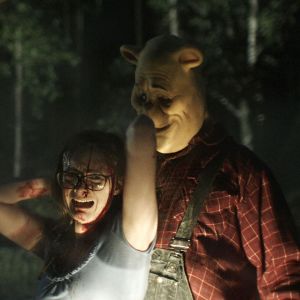 Here’s another example of how little thought was put into this movie beyond getting it to completion. The main character has a past trauma of being molested by a man who was stalking her and broke into her home. For our own edification, this scene is played visually for us, with the intruder taking their time to slowly pull down the strap of our sleeping protagonist’s shirt. So we have a past trauma and the character is now experiencing a new trauma, so from a writing standpoint, you would expect this horrible situation would be a way for the character to exorcise her trauma in a very extreme circumstance and there would even be a parallel for her to triumph over as a rudimentary character arc. It would, at the very least, provide a story justification for why our main character has endured her suffering, so as to work through that as her arc. Well, none of that seems to matter, nor are there any pertinent parallels, and so her past of having a creep break into her home, hover over her asleep, and touch her body was just prurient exploitation. Look, I understand the horror genre is built upon its tried-and-true exploitation elements, boobs and blood and the like. That’s what the audience for a killer Pooh movie comes to expect. I understand why Pooh is ripping the top off one woman before slamming her head into a meat grinder, though it still made me feel icky and sad, but that’s my central response. I did a lot of exasperated sighing and shaking of my head throughout the bloated 80 minutes of movie. After a slightly eerie and decently animated opening, this movie is creatively bankrupt on all fronts.
Winnie the Pooh and Piglet and the rest of the population of the 100 Acre Wood are products of Christopher Robin’s imagination, so him leaving them is more him moving on from his childhood enchantments rather than abandoning his friends. I guess this movie’s version chooses for them to have really existed, which raises some questions over what these creatures were doing before they ever met Christopher Robin. Were they animals and then Christopher Robin’s love and attention magically transformed them into anthropomorphic creatures? If so, then this little boy’s imagination has an amazing power to tap into. Although, to be fair, Disney itself made a 2018 movie with an adult Christopher Robin (Ewen McGregor) who was being followed by the stubborn animals of the 100 Acre Wood who sought him out to remind him about the power of friendships and belief that, I assume, he seemed to have lost track of as a jaded adult.
 Taking a look at the larger filmography of Frake-Waterfield, a devious pattern starts to emerge. The movies are built on title and concept, and there sure are a lot to choose from. As a producer, he has 21 movies released all since 2021 and another 14 in the works, including a sequel to Blood and Honey. Here, dear reader, are some of the titles of the past and future Frake-Waterfield productions: Dinosaur Hotel, The Legend of Jack and Jill, Spider in the Attic, Easter Killing, Wrath of Van Helsing, Croc!, Kingdom of the Dinosaurs, Curse of Jack Frost, The Killing Tree (about a murderous Christmas tree), Firenado, Monsternado, Bambi: The Reckoning, Mary Had a Little Lamb, Peter Pan’s Neverland Nightmare, Crocodile Swarm, Dinosaur Prison, and Snake Hotel. It almost plays out like a B-movie Mad Libs exercise. Take an animal people fear (snakes, crocodiles, dinosaurs) add a place (hotels especially, though is Snake Hotel a lodging intended for people who love snakes or for the snakes themselves?) and, when in doubt, swipe some public domain IP that has an innocent or more wholesome reputation and switch it up (Steamboat Willie but as a sex trafficker?). I’m not against schlocky low-budget horror movies that are acutely aware of their schlock. The killer Christmas tree movie actually seems ridiculous enough to be fun. Except, having seen Blood and Honey, I’m dubious that any of these will actually take advantage of their goofy concepts.
Even if you were turning into Blood and Honey for the ironic yuks, there’s nothing to really laugh at here. This is a bad movie rather than an enjoyably bad movie. It’s a movie that only exists because somebody thought enough people would be curious to watch a killer Winnie the Pooh movie. That’s the reason I tuned in, but from the second minute onward, there’s no reason to bother watching the remaining mess. Just imagine a low-rent slasher film with unimaginative kills, boring characters, a lack of any subversive connections or reframing of its source material, and an ending that doesn’t so much conclude but simply give up for a sequel, and you’ll have replicated Blood and Honey. As one saving grace, I will say that the movie has more polished cinematography than most of its low-budget ilk. The startling lack of imagination of everything else is depressing, as is the fact that this movie has earned over four million at the global box-office, hoodwinking enough rubberneckers looking for a good bad time. The problem is that Winnie the Pooh: Blood and Honey is only a bad bad time.
Nate’s Grade: D-
Share this:

Free to a Bad Home (2023)
 Last year, I was approached by HaleHouse Productions, a company led by the Ohio filmmaking and brotherly duo of Kameron and Scott Hale, to review their first feature, Entropy. It was a small indie shot with a bunch of friends over the course of the COVID-19 lockdown, and I appreciated the artistic aptitude of ganging together during such trying times, but ultimately I found the movie’s flaws to be too overwhelming. I was slightly surprised when HaleHouse reached out to me a year later and solicited another review for their next horror movie, Free to a Bad Home. After all, I had been critical about their earlier film, but they said they appreciate reading the reviews, and this has always been my aim when I write these critiques for Ohio-made indies, to try and provide a professional review with clear and coherent constructive criticism and earned praise. So I figured why not, and I watched Free to a Bad Home, and now I’m wondering if HaleHouse is still going to seek out my opinion when it comes time for movie number three.
I was happy that the Hale brothers (credited as both writers and directors) took the anthology route because, greedily, it means more stories to be told, and it also conveniently allows the audience to leap to another story if the current one wasn’t exactly firing. It’s a numbers game: rather than hoping for one story to entertain, now we have three shorter stories to hopefully engage and entertain. However, the needs of telling a short are still very similar to that of a feature-length screenplay; you still need interesting characters, you still need a story with a beginning, middle, and end, and you still need to use your time wisely, whether it’s a five-minute story or a two-hour one. While Free to a Bad Home divides its time between three smaller tales, and one perfunctory wraparound, I can’t say the movie still knows what to do with its 80 minutes (divided by three). Any horror movie needs adequate time to establish mood. There are plenty of movies that are nothing but a mood piece, like David Lynch or the recent indie breakout Skinamarink, where the intent to present an experience that detaches the audience from the known and places them into a limbic middle zone of uncertainty and dread. Storytellers are going to need some time to establish the main characters, their dilemmas, the setting, and where and when things are going peculiar or wrong. Watching Free to a Bad Home, it felt like each segment had an idea but left it frustratingly vague and with regrettably little development to carry it.
 Ignoring the wraparound, the first segment is about Amy (Miranda Neiman) overcoming loss while visiting her old home. She spends a lot of time walking around, hearing strange noises, and getting lost through drinking. Her sister comes around too. It lasts around twenty minutes and much of it hinges upon the very ending twist, which explains what happened to her husband and why it is weighing so heavily on Amy. Except the preceding twenty minutes doesn’t feel like we’re getting more intrigue or insights into Amy or even her fraying psychology. She’s seeing weird visions of a guy in bed sheets and a strange sinkhole in the woods, but a lot of the running time is sitting and waiting. We understand she’s in some stage of mourning. This isn’t really further developed after being established, and that’s the issue with many of the segments. It’s an idea, and there’s a conclusion that is generally predictable, but we’re missing the middle. You could include the first three minutes, the last three minutes, and cut out the in-between, and the “Amy” segment would play out the exact same way. The problem is that the end is too obvious to simply keep the character in a holding pattern for so long with only minimal action. The character is very much sitting around and waiting, and so are we for too long. It’s structured like a haunted house story where a woman is coming undone. Except we don’t get better insights into this person over time, nor do we get increasingly scary haunting or her unraveling mental stability.
The second segment follows Ryan (Jake C. Young) breaking into a home and taking just the most absolutely leisurely time looking for anything of value. We spend nearly ten minutes just watching this guy walk into a room, look around, and then leave to go search in another room. I think the drawn out time is meant to heighten the vulnerability of our thief, making the audience worry that he’s spending too long and is more likely to get caught. First of all, that requires me to find this character likable or interesting to care if he avoids exposure and arrest. This could happen if somehow during these ten minutes we’re learning about dear old Ryan. Maybe we see his problem-solving skills, maybe he gets an inopportune call that he tries to get out of but reveals his own status of financial insecurity, and maybe he even encounters evidence of the family that lives here and makes comment, like he’s a disgruntled employee trying to take what he feels is deserved from a wealthy executive. Anything other than watching one guy walk into several rooms and look around for valuables. At long last he finds something unexpected, a woman named Camilla (Roni Locke) chained to a mattress. Rather than pretend to be a traumatized victim of trafficking, which would be the easy assumption, this woman declares herself a demon who will help Ryan open the family’s expensive safe. However, if he were to release her, she promises to kill the family next door. Do we know anything about them? No, not really, but the devil’s bargain is established: personal gain for the death of strangers. Once again, the ending seems obvious given the lack of substantial character development. The hook is the offer from the evil entity and the cost of his own selfishness, but this hook is diminished when we don’t exactly get any personal struggle wrestling with the decision or its horrific outcome.
 The final segment is the longest, nearly half the total running time, and we follow Julia (Olivia Denis) who is going with her older sister and her friends to a Halloween party. There’s the start of something here with a younger sibling eager to grow up and hang out with older peers, with the drawback of getting into trouble in the pursuit of being seen as cool. Except none of the four characters we follow to the party really distinguish themselves as people. We spend more time watching them do acid in the car, slowly, than we do anything else. It’s a full ten minutes of watching ladies drop drugs into their eyes while moody neon lighting bathes their skin and the synth score rings. We’re clearly going for an immersive mood here but the drug usage, so heavily covered, isn’t ever conveyed in plot or perspective. When the characters arrive at their party, we don’t see any hallucinations or hear anything amiss, which could have been more visually interesting as well as ratchet up tension that things are unwell. Instead, the ladies attend a very sparsely attended gathering where they unveil a smiling corpse and then take turns projectile vomiting onto the body. Then the women are chased and easily dispatched. The end.
So what do all the story segments have in common? There’s plenty of idle waiting. There’s a real dearth of characterization outside whatever the initial premise might afford. There are specific stylistic fixations that are often to the detriment of pacing and story, like the low-light investigation of Ryan and the trance-like neon dream of the ladies tripping on eye drops. There are also obvious endings that don’t feel any better realized or subverted or better set up. Every anthology collection is going to be a mixed bag depending upon your personal tastes, but there’s a certain safety in numbers. I didn’t love all 26 segments on 2012’s The ABCs of Death but there were enough that tickled my fancy, likewise with the many V/H/S collections. However, each of the three anthology tales in Free to a Bad Home suffers from simply not having enough to do.
There are concepts here that can work. The idea of an anthology movie following a cursed object is a fine starting point, almost like the horror equivalent of 1999’s The Red Violin, an underrated indie that traced the adventures of a special violin through centuries of owners. The idea of a criminal coming across a caged demon who tempts them with a Faustian bargain is good. The setup of a younger sibling wanting validation and tagging along for something they are unprepared for, that’s a strong starting point for a night of unexpected terror. A woman alone in her old home and haunted by her memories is a familiar but potent starting point for horror. These core ideas can work but not one is given substantial development to make them matter.
 If you wanted to trace the lineage of a cursed object, I think it would have been more creatively fulfilling to tell your stories in distinctly different time periods, highlighting shifting values but also the different appeals this haunted object might have had depending upon the times. Imagine a woman coming across a cursed piece of jewelry in 1890 or 1950 versus modern-day. There’s nothing in any of the three stories that ties them to a specific time period, so why not venture into other times to give a larger sense of history and the ramifications of this curse? As a low-budget indie, I understand the production reasons why the three stories are all contemporary, though the movie opens with a quick succession of suicide and murder in two earlier time periods. Creatively, the movie feels too easily satisfied and needed to push its ideas and horror further. As it stands, Free to a Bad Home feels like a collection of disappointing shorts rather than one single story disappointment, which oddly enough makes the movie feel even more disappointing.
For being a small indie Ohio production, there are some impressive artistic values. The cinematography by William E. Newton (Black Wolf) can be occasionally entrancing, like during the drug-addled driving sequence that is a little too in love with its protracted mood. The practical makeup effects are sparing but can be unsettling and effective, most notably during a coda where a woman picks at a very open wound on her face and works it to disgusting lengths.
Free to a Bad Home doesn’t separate itself from the glut of cheap horror movies with half-formed stories. Rather than squandering one story over the course of 80 padded minutes, now it’s squandering three-ish stories over the course of 80 padded minutes. I’m a little surprised there isn’t more horror as well, whether that’s conventional exploitation elements like gore and sex, or simply just constructed and sustained sequences of terror and dread. For genre fans with a love for DIY indie spirit, there may be some entertainment to be had with Free to a Bad Home. You can tell the Hale brothers and their small crew have their passions for the material. I only wish more scrutiny and perhaps outside assistance in the writing and development of future tales to make the most of the potential. Free to a Bad Home is available on Tubi and other streaming services, making the title even more apt. For me, there was just too little going on creatively to maintain my ongoing interest and waning attention.
Nate’s Grade: D+


 nathanzoebl
You must be logged in to post a comment.