Blog Archives
Waitress (2007)
 Kerri Russell is irresistibly charming in this winning romantic comedy from the late write/director Adrienne Shelly. I fell totally in love, head over heels, with Waitress and I’m not ashamed to say it. In a perfect world, Russell would earn an Oscar-nomination for her sure-handed, witty, and incandescent performance as a pregnant woman who has an affair with her new gyno doc (Serenity‘s Nathan Fillion). This is a star-making performance and it is sealed when the movie relies solely on her emerging smile for an entire minute to communicate a blossoming figure. The supporting cast is great in their eccentric roles well and the movie concludes in a happy if unconventional manner. Waitress is the kind of movie that makes you feel great. The sheer exuberance on display is infectious and it makes it an even bigger tragedy that Shelly will never grant the world another wonderful slice of entertainment.
Nate’s Grade: A
Share this:

Lars and the Real Girl (2007)
 In order to be affected by the sweet romantic spell of Lars and the Real Girl, the viewer must accept everything as a fable; to try and apply real world logic would destroy the film’s magic. Lars (Ryan Gosling) is a painfully shy man still haunted by the knowledge that his own birth killed his mother. He lives in his brother’s garage and has difficulties interacting with regular folks. Then one day comes Bianca who just happens to be made of silicone; she’s a Love Doll, though Lars’ relationship with the upgraded Barbie is completely platonic. Lars is using the doll to deal with his own intense loneliness and his family and the town, a.k.a. the most understanding town in the world, play along to help Lars along on his emotional recovery. Gosling, in short, acts the hell out of this movie. His performance is a bit mannered but he channels so much pain and unresolved emotions that it’s a marvel to watch. He makes Lars more than just a weirdo with a weird coping mechanism; he makes Lars deeply, excruciatingly human and filled with unmet desire for affection. Gosling is so immensely talented that I don’t know if there are any limits to what he can bring to a character. The film has just enough psychology to it that the slew of characters deepen as we progress and the audience grows attached. By the end, I was amazed at how much genuine emotion I felt for a giant hunk of silicone. Give credit to the filmmakers who play Lars out with conviction and grace, and give major credit to Gosling.
Nate’s Grade: B+
Share this:

Crazy Love (2007)
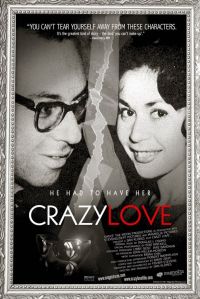 A fine documentary subject and intriguing characters, but this film doesn’t feel like it has any reason for being as long as it is or even existing outside the realm of a TV special. Constructed mostly from interviews, there’s not much in the way of visual representation, and after a while the subject (boy meets girl, boy must have girl, boy hires man to toss acid in girl’s face, girl eventually goes back to boy?) starts to peter out of material. There’s definite shock and puzzlement to this bizarre tale of so-called love, and a whole lot of psychological disorders and dependencies, but there isn’t too much of a full-blown movie here. The material could have been adequately covered as a special on the History Channel of some other cable outlet.
Nate’s Grade: B-
Share this:

Away From Her (2007)
 Actress Sarah Polley makes a remarkable directorial/screenwriting debut telling the story of a couple going through the late stages of Alzheimer’s. This is a truly adult tale that deals in the heartbreak of losing a loved one gradually and slowly. The film centers on a long-standing marriage that endures the hardships of becoming a victim in your own mind, first forgetting small things and then finally shutting down completely. While plenty of films have articulately dealt with the point of view of the afflicted, I feel Away from Her is one of the better perspectives on seeing the devastating effects of the illness from the spouse. The movie deals with its real world dilemmas in a respectful and realistic manner and Polley has put herself on the map as a thoughtful, mature, and engrossing talent to watch whenever she hops behind the camera.
Nate’s Grade: B+
Share this:

I Know Who Killed Me (2007)
 We interrupt the nonstop barrage of Lindsay Lohan media coverage and speculation to bring you her movie, or, more accurately, further proof that Lohan is in desperate need of a career makeover. The tabloid target has a pretty shoddy track record of late when it comes to picking acting projects, so it’s no wonder that her splashy private life has overshadowed her cinematic duds. Thanks to a second summer DUI Lohan was unable to promote her new movie, I Know Who Killed Me. This may be a blessing in disguise because if I were her I would want to draw the least amount of attention possible to what is destined to contend for the worst film of 2007.
We open to Aubrey (Lohan) reading her story in her high school class. The story revolves around a stripper named Dakota and the amorous attention she earns from creepy older gentlemen. One night Aubrey goes missing and the police believe she may be the next victim of the local blue-gloved serial killer that hacks off the limbs of his victims. The last girl, currently residing in the morgue, is missing her right forearm and her right leg. Her parents (Neal McDonough, Julia Ormond) fear the worst. Then a motorist finds Aubrey’s mutilated body on the side of the road. She wakes up in the hospital and will survive, except the problem is that she has no idea who any Aubrey is; her name is Dakota and she worked as a stripper. She vows to find the “real” Aubrey.
This films is sleazy and tries to energize a lame straight-to-video thriller with some tawdry turns. Without Lohan’s name, I Know Who Killed Me would never have gotten a theatrical release. The torture sequences are drawn out to the soundtrack of Lohan’s muffled screams. The violence fails to excite or horrify, but instead it just seems like a sorry attempt to ape the success of recent torture-heavy horror flicks.
 The sex is even less believable. Aubrey/Dakota, fresh from the hospital, beds the quarterback in one of the least convincing, most unintentionally hilarious sex scenes of recent memory. She throws the jock onto her bed and pins him down for a good pumping. In the ensuing two minutes, the pair engage in exaggerated and noisy PG-13 sex where the woman stays on top and keeps her bra on the whole time (does any woman do that?). The whole time the movie cuts back and forth to Aubrey/Dakota’s mother listening and furiously cleaning the kitchen sink. I think the juxtaposition is intended to be funny, and it is, just not in the manner the filmmakers were probably hoping for.
The movie would be more revolting if it weren’t so incomprehensible. I Know Who Killed Me begins to disassemble at a fantastic rate of idiocy once it attempts to explain its central Aubrey/Dakota conflict. But the movie only presents two options: 1) Aubrey and Dakota are the same person and she just created a fictional persona as a means of post-traumatic stress (yawn), or 2) somehow there are TWO Lohans on this planet (what?). The first scenario is pretty dull and obvious and way too feeble for such a dank exploitation thriller. The second scenario requires a scheme so convoluted and ridiculous that it cannot be taken seriously. In the end, the movie becomes Saw meets The Parent Trap, and it’s every bit as terrible as you would concur from such a description.
For the sake of the morbidly curious, I will be discussing some heavy-duty spoilers to fully shine the spotlight on how ludicrous the movie gets. Don’t say you were not warned. Aubrey/Dakota keeps swearing she is indeed her own woman but no one seems to believe her. She researches the unexplainable via the Internet and it is here that she gathers the theory of stigmatic twins. The idea is that whatever happens to one twin will magically happen to the other, no matter the distance and no matter the situation. In the online example, a man with gambling debts is shot in the throat, and thousands of miles away his twin brother bleeds to death thanks to a perfectly placed and ill-timed hole in his own throat. I Know Who Killed Me tries to wrap up its questions with answers that would seem preposterous even in a soap opera. Not only does the film give us the old long-lost twin chestnut but it also goes the extra inane inning to say that one twin endures whatever happens to the other. So when Aubrey is losing limbs during her capture, Dakota is mysteriously waking up some considerable weight loss. If my limbs were disappearing I might consult a doctor. Essentially, if there’s any merit to this theory, the best way to get revenge on your twin (long-lost or not) is through extreme masochism.
 I Know Who Killed Me is littered with stupid behavior and stupid plot points that stick in your brain. A doctor fixes Aubrey/Dakota with a pair of prosthetics – a fake leg and a robot arm. He slides the robot hand onto her stump and it reacts to her nerve impulses. As soon as I saw this scene I blurted out, “Oh my God, Lindsay Lohan becomes the Terminator!” Where the scene earns its stupid wings is that the doctor says she’ll have to charge her prosthetic when not in use or else the battery will go dead. Naturally, I’m thinking he’s referring to the robot arm of doom, but no, he’s talking about her freaking leg. Aubrey/Dakota’s leg amputation is below her knee; therefore this fake leg is little more than a pole. There’s nothing mechanical to it. Why does it need to be plugged in? Will it hop away? It doesn’t matter because the leg and arm never pose any trouble or danger for Aubrey/Dakota. It’s a strange setup without any payoff.
The bloody ending to I Know Who Killed Me is such a mess that it takes special attention just to pick apart its awfulness for further clarity. Aubrey/Dakota figures out the whole complicated rigmarole and declares in titular fashion, “I know who killed me.” Given the silly stigmatic twin theory, even this statement is incorrect from a tense standpoint (if it was true she wouldn’t be able to utter the words). Aubrey/Dakota and her dad head off to the dismembering serial killer’s home without bothering to contact the authorities. She says they don’t have time because, apparently, cell phones do not exist in this universe. I don’t know how it’s possible for Aubrey/Dakota to dig up a grave with one arm. When she goes running into the woods she’s looking for an owl from a vision. That’s good. It’s not like the woods are big or have more than one owl. For that matter, how did Aubrey even get kidnapped in the first place when she was among a large crowd on a busy sidewalk? Would no one have noticed and done something? Even the identity of the serial killer cannot give the movie a sense of finality that it wants. This is your standard serial killer movie where the killer has no working motivation and their identity is relatively meaningless. The limb-slicing maniac might as well have been the janitor seen in the background of one scene for a fleeting moment.
 Lohan gives a performance that suits the material – dreadful. Her idea of a bad girl seems more like a perturbed and insolent child. Lohan gets to hurl her share of F-bombs but never seems adult in whatever she’s doing onscreen. I Know Who Killed Me is a depressing low point for such a once-promising young actress who had the world on a string.
Director Chris Sivertson seems to know he’s the captain of a doomed vessel. He overwhelms the movie with irritating lighting excesses. Sivertson takes a cue from Shyamalan and ramps up the color symbolism; there’s blue roses, blue gloves, blue killer tools, blue stained glass of blue roses. You may start to wonder if the Blue Man Group suddenly became a symphonic serial killing side project.
I Know Who Killed Me is a disaster in every sense of the word. The ineptness on display is staggering. The movie is trash from start to finish but it’s not even redeemable trash. The movie tries to cover its numerous plot holes with images of Lohan canoodling with a stripper pole. I Know Who Killed Me is a ludicrous, incomprehensible, and rather sundry thriller that won’t help Lohan’s troubled life. I have a lot of good will for Lohan after her performances in Freaky Friday and Mean Girls. I want her to succeed, but truthfully, if she needs to know who’s killing her career, the answer is in a mirror.
Nate’s Grade: D
Share this:

Once (2007)
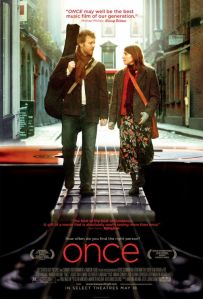 Once is the perfect antidote to noisy summer blockbusters assaulting the theaters. It’s a small, hardscrabble indie that’s completely unpretentious, unassuming, and sweetly divine. Once is not mawkish, nor overly sentimental, but it does leave you with the sensation that you’ve just had your best hopes about love reaffirmed, no small feat. This is a movie for people that love music and the innate power it can unleash.
A Dublin street singer (Glen Hansard) works in his father’s shop and fixes vacuums by day, while he sings his heart out in public at night. Then one day he meets a Czech immigrant (Markéta Irglová) who becomes his biggest fan. They start seeing more of each other and share their joint passion for music. It’s through the music that the beginning of a special relationship forms between them, however each has their own baggage. He’s nursing a broken heart after his girlfriend cheated on him and then moved to London. She lives with her mother and works several jobs to take care of her young child. Her husband left the family but there’s a chance he may return. Together, they write enough songs and raise enough money to record an actual album in a studio, something that can stand the test of time.
 When you boil it down the story is very simple. Boy meets girl. They run into each other some more. They help each other write music, ending with the accomplishment of a studio-produced album. Then they part. That’s it from a synopsis point of view, but Once is far more than that. This is an honest to God real-life musical, where the songs advance the storyline and the lyrics express the emotional desires and changing moods of our leads. People don’t break out into choreographed song and dance numbers; no, this is set in a modern and realistic world. Once could be described as a musical for people that hate traditional musicals but I think that sells the film too short on its merits. Once is a very stripped down but enormously romantic love letter to music and human connection. Watching the movie is akin to be serenaded by a soulful crooner that clearly wears its idealistic heart on its sleeve. There’s something undeniably magical about watching Once; you feel transported by the sheer exuberance of feeling and emotion. The openness may seem awkward or a bit cheesy to a more cynical lot. The story is a rather bare-bones affair (no pun intended), but that’s where the film takes the opportunity to explore the burgeoning relationship between our leads in their short yet important time together.
Of course it helps a musical if the music is something worthy of listening. I’ll say this: Once is the first movie since 1999’s Run Lola Run that I immediately went out and got the soundtrack for after watching. Unfortunately, as Once is still expanding most large retail stores do not carry it just yet. I guarantee by the end of the summer that every one of them will have it well stocked. The songs are largely acoustic guitar and piano arrangements, and the heartfelt, slightly biting yet optimistic lyrics are reminiscent of acts like Bright Eyes and The Shins. The music is softly beautiful and lilting and a great showcase for Hansard’s sensitive yet powerfully evocative vocals. Irglova is a classically trained Czech pianist and sings with a breathy Bjork-like style that blends well with Hansard’s graceful and rich tenor.
The music is a big reason for the film’s success as a sweeping romance and human drama. The standout track is “Falling Slowly,” which is a stunning turning point for the film and for the characters. In the film, they assemble in a piano shop and put together an impromptu duet. The song builds, and our singers coalesce smoothly, and the soothing sounds stir something inside them as well as the audience. Both characters are realizing that they can make beautiful music together, and they’re exploring one another’s desires and intentions. They definitely sense something new; the music is what binds them, but the music is also their most lucid platform for expressing their escalating feelings.
 Writer/director John Carney, who used to be a bassist in Hansard’s band The Frames, gives the movie a fly-on-the-wall viewpoint, probably more due to a limited budget of around $150,000. In fact, the home movies footage Hansard watches of his former flame looks identical to the rest of the movie. The performances are naturalistic if a bit amateurish, but this also works with the realistic tone of the film. Much of the 85-minute movie consists of full-length songs and performances, so any audience that isn’t really jazzed by the music may grow restless.
The MPAA, in its irritating wisdom, has decided that Once should be rated R, thus distancing it from an armada of impressionable youth. Once has a handful of F-bombs, though you could argue their inclusion is diminished because of the occasional indecipherable nature of heavy Irish accents. The restricted rating is a shame because this movie doesn’t have a profane bone in its body. Teenagers, people who are struggling for meaning and acceptance, and re-configuring their musical tastes, should see this movie. I think they would relate to the personal struggles and the romanticism. Hansard may populate many a teen girl’s bedroom in poster form soon enough.
Once is a lovely and charming modern musical. I suppose the music is really going to be the breaking point for people; either you enjoy its sweet harmonies and light acoustic arrangements, or, um, you don’t. I adored the music and was transported by the deeply romantic current running through the film. Once is a small movie with a big heart and some wonderful music. In between pirates, robots, super heroes, and wizards, I think there’s plenty time to squeeze in a beguiling and earnest musical.
Nate’s Grade: A
Share this:

Grindhouse (2007)
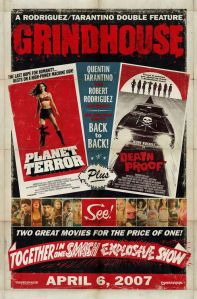 The movie going experience isn’t what it used to be, and Quentin Tarantino and Robert Rodriguez want to do something about it. There?s no denying that the joy of seeing a movie has been watered down a bit; there’s soaring ticket prices, floundering product, and let’s not forget the influx of teenagers with cell phones. Rodriguez and Tarantino grew up gorging upon the exploitation films at their neighborhood grindhouse, where they could see kung-fu, blaxploitation, gory Italian zombie movies, and nearly anything that promised to be titillating and shocking. These movies dealt in copious amounts of sex and violence on a shoestring budget and teenagers lapped it up. Grindhouse was designed to be a double feature with Rodriguez and Tarantino each writing and directing an 80-minute movie. This three-hour plus movie is stuffed to the gills with 70s reverence, right down to cheesy retro clips telling us the film rating via an animated cat. If Rodriguez and Tarantino could, they probably would make the floors stickier just to round out the experience. But that’s the marvelous thing about Grindhouse — it turns the filmgoing experience into an event once again.
First on the bill is Rodriguez’s Planet Terror. An outbreak is about to sweep across a small Texas town. A toxic green gas is causing people to break out in festering wounds that are spreading rapidly. Cherry Darling (Rose McGowan) is a go go dancer who runs into an old flame, Wray (Freddy Rodriguez), a badass drifter with a dark past. They get attacked by a group of “sickos” who take Cherry’s leg as a chew toy. At the hospital we’re introduced in rapid succession to Dr. Block (Mary Shelton) and her creepy husband (Josh Brolin) she plans on leaving for the lovingly massive cleavage of Fergie from the Black Eyed Peas (she gets eaten and can, one assumes, be described as being Fergilicious). The sheriff (Michael Biehn) has an unsettled score with Wray and refuses to trust him, even though the town is slowly being overrun by what appear to be zombies. The survivors take refuge at a Bar-B-Q joint, run by the sheriff’s brother J.T. (Jeff Fahey), located only two miles away from the military outpost that released the gas.
 Planet Terror is a great blast of fun, a perfect ode to schlocky B-movies. Rodriguez creates action movies closer to cartoons, and the more over-the-top and crazy things get the more joyous his films generally turn out. This is a gonzo world cranked up to a wonderfully weird wavelength, where Cherry can have a machine gun leg without any nagging question on how she even gets it to fire let alone why it would be more accurate. It doesn’t matter because this movie is all about 80-minutes of awesome, twisted, gloriously gory fun. Planet Terror isn’t the first zombie comedy, and its inspirations are quite plain, but the film establishes a wide-range of colorful characters effectively and then ramps up the chaos. Rodriguez amuses with even small touches, like a woman trying to operate a car with a anesthetized hands, a pair of skimpy babysitters who clobber a car with baseball bats, and a bio-chemical scientist (Naveen Andrews) that has a penchant for collecting and bottling the testicles of the men who fail him (hey, we all need hobbies). Even amongst an exaggerated canvas there’s still plenty of humor and adoration for the grindhouse experience, like when the beginning of a sex scene is interrupted with a “reel missing” sign. Rodriguez also intentionally downgrades the look of his film, adding hairs and scratches and pops in the film to look like it had been dragged across the floor. Planet Terror even has a dreadfully dated synth score to compliment the full-tilt celebration of splattery schlock.
Tarantino’s Death Proof is going to sharply divide audiences. The action in Planet Terror is relentlessly paced, which makes the adjustment to Tarantino?s half all the more hard. Rodriguez is all about genre relevance and making a film that would excel in the grindhouse era; Tarantino, on the other hand, is all about taking the genre and catapulting it into something ambitious and different and greater.
 Death Proof is Tarantino’s take on the slasher horror genre, with the unique twist being that Tarantino?s roving killer takes out his prey with his car. Stuntman Mike (Kurt Russell) is a stuntman of the old guard. The youth of the day have no idea of the TV shows he worked on or the celebrities he rubbed elbows with. The only lasting visages he has from those removed days are a long scar decorating the side of his face and his stunt car. The vehicle has been outfitted to be death proof, meaning that Stuntman Mike can get into any wreck and come out alive. A group of women are visiting Tennessee for a film shoot. Abernathy (Rosario Dawson) is a makeup artist, Lee (Mary Elizabeth Winstead) is an actress, and Zoe Bell (herself) and Kim (Tracie Thoms) are professional stunt women. The stunt ladies are interested in test-driving a Dodge Charger, the same iconic car used in Vanishing Point. Zoe wants to play a dangerous game known as “Ship’s Mast,” which entails strapping herself to the hood of the car as it speeds along. This is when Stuntman Mike comes roaring with his death proof material and plays an extreme game of chicken.
The narrative structure of Death Proof is deliberately slow. The focus is on a group of Texas girls (including Sydney Poitier’s daughter named, rather unoriginally, Sydney Poitier). They dance to jukebox jams and drink. And they talk, and talk, and talk, and talk. The dialogue is clever but you worry Tarantino has been hypnotized by his own pithy writing. The movie drags a bit but mostly because it follows a film that had the pace of a runaway train. The slow buildup is an intentional correlation to slasher films, which would spend their first half hour setting up characters for the eventual slaughter. I liked how Stuntman Mike was seen playing with his prey and interacting with them. The wait is worth it, though, but then Tarantino turns around and repeats this same setup with a new batch of girls. Many will grow impatient going through the same process all over again and become irritated that they have to endure another round of talky pop culture diatribes in order to get to some more vehicular manslaughter. And at this point, the only character the audience has any affinity for is Stuntman Mike, so it’s a little tough to wait so long for his reappearance. When he does appear, the movie takes some unexpected turns and transforms into a female revenge thriller that left my audience cheering by its conclusion. My wife loved it. I married the right woman.
The makeup work is outstanding. Most of the effect work gets its spotlight during Rodriguez’s half, and Greg Nicotero and KNB have created the most gut churning, sickeningly inventive makeup work since John Carpenter’s The Thing. Rodriguez’s Planet Terror is dripping in blood, and the gore is heightened to such an unrealistic, comical degree that it becomes more tolerable and, in the end, another element in the overall outrageous vibe of the film. Some memorable gore work includes makeup pioneer Tom Savini being ripped apart like a child’s jigsaw puzzle, soldiers whose faces undulate and bubble until they look like close relatives of the Elephant Man, and a truck smashing against bodies like they were made of paper and filled to the brim with Kool-Aid. This is the kind of movie where entire hoses of blood explode from single gun shot wounds. It is a gory, gruesome, sticky icky movie but that?s part of the fun.
 Whereas the makeup work shines in Planet Terror, the stunt work in Death Proof is stupendous. Bell was Uma Thurman’s stunt double in the Kill Bill tandem, so by writing a part specifically for her Tarantino knew he could get up close and personal during the scary moments. Seeing Bell struggling to stay atop the hood of a car zooming at 80 miles per hour is nerve-racking and exhilarating, and you know there isn’t any computer trickery given how Tarantino’s own characters bemoan how computers have blunted action cinema output. That really is Bell and even though it’s all a movie a part of you does think, “Oh my God, this woman is going to die for real.” This killer bumper-car sequence in Death Proof will have you holding your breath. It takes much longer for Tarantino to rev up his action, but when he does he puts the pedal to the mettle.
But don’t get up for pee breaks once Planet Terror is over, because you may miss some of the best parts of Grindhouse. In between the feature films are three fake trailers directed by friends of Tarantino and Rodriguez, who made a fake trailer himself for Machete, about a Federale (Danny Trejo) out for revenge. The Machete trailer gave me the everlasting gift of a line, “They f***ed with the wrong Mexican.”
The best trailer, hands down, is Shaun of the Dead director Edgar Wright?s trailer for Don’t, a Dario Argento style horror film where a narrator instructs the audience lots of items not to do (“If you are thinking about turning this door… DON’T! If you think about going into the basement… DON’T!”). What makes Don’t so wonderful is that the trailer builds a thick head of steam, to the point where all wee see are bizarre rapid-fire images and the announcing repeating the message, “DON’T!” The momentum builds to a great comic high that left me giggling.
Eli Roth, who gave us Hostel and Cabin Fever, one of my all-time favorite filmgoing experiences, runs a close second with his slasher trailer for Thanksgiving. The concept is rather straightforward, a person dressed as a Pilgrim picks off residents around Turkey Day, and a great showcase for Roth’s sense of tongue-in-cheek homage and his warped sense of humor. This trailer has some gasp-inducing moments, chiefly among them a topless cheerleader who performs the splits right onto a knife blade. Wow. Then there’s a guy humping a stuffed turkey with a human head attached. I’ve said it before and I’ll say it again, Roth is one sick bastard but he’s my kind of bastard.
 Rob Zombie’s trailer for Werewolf Women of the S.S. sounds better on paper than how it turns out. There’s a subgenre of Naziploitation films (did you know you could add “-sploitation” to damn near any word?), most famously popularized by Ilsa, She-Wolf of the S.S. Zombie’s trailer has got hairy wolf boobs, Nazis, shiny fetish outfits and S&M, but it feels too new and doesn’t work on the same vibe of Grindhouse. It feels too polished and too happy with itself; it spends more time telling you who’s in this fake movie than delivering anything juicy. The trailer is saved by a brilliant cameo by an actor whom I will not spoil, but suffice to say that I was left in stitches.
Honestly, I cannot say another movie released this year that provides more bang for your buck than Grindhouse. Tarantino and Rodriguez’s double bill will leave you giddy. This is the fastest 3 hours and 10 minutes of your life, folks. Unfortunately, the film hasn’t been doing as well at the box-office and this has caused the Weinsteins to contemplate splitting the films into two to make the most of their investment. I suppose Grindhouse was never going to have a 300-sized audience, since the idea of making a sloppy three-hour love letter to trashy cinema seems destined for a limited appeal. This is a high-art tribute to high camp, and you really do feel you get more than your money’s worth even if you pay, like I do, 10 bucks a pop for a show. I can’t imagine having a better time at the movies this year than the one I had during Grindhouse.
Nate’s Grade: A
Share this:

Shortbus (2006)
 How do we define pornography? John Cameron Mitchell (creator of Hedwig and the Angry Inch) wrote and directed an examination on human relationships that also employs hardcore sex. Yes, the actors are really having sex and we really see, among other things, a man fellate himself to climax. There’s hetero sex, homo sex, masturbation, and, in small flashes, a whole sweaty orgy of people of all shapes, sizes, colors, and tastes. This movie celebrates the sheer possibilities and enjoyment of sex. Mitchell isn’t the first serious filmmaker to show people really doing it, and the movie shows sex in a realistic fashion that is rarely seen, with all the humor, playfulness, and stumbles that can arise. It?s refreshing and a great window into the depths of human interaction. That’s the deal: everyone in this film is reaching out to feel something. The script mostly follows the pursuit of a sex therapist who has never had an orgasm. The sex will get the headlines but it’s the quiet reflections on human connection that really sneaks up on you and can hit hard. The movie doesn’t cover every facet with ease, like a stalker-esque character, and some of the acting is a bit amateurish; however, it’s a daring film that has a disarming sweetness to it and an open-hearted message that’s rather romantic after all. And no, it’s not porn.
Nate?s Grade: B
Share this:

Half Nelson (2006)
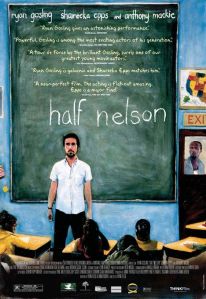 Ryan Gosling gives a devastating performance as an inner city schoolteacher addicted to crack. This is a thoughtful look at friendship and vice as Gosling befriends one of his female students and becomes something of a mentor, trying to steer her in a good direction. The film is refreshing because of how awkward and authentic it is, and it does not pull punches; there are no happy endings or storylines wrapped with bows. The biggest drawback from this powerful film is that it’s too insular and doesn’t get much of an outside perspective. Scenes have a tendency to drag, but the movie is set ablaze by the troubled yet hopeful turn by Gosling, already firmly established as the most astonishing talent of his age. Who ever would have guessed a former Mousekateer would be our next Marlon Brando?
Nate’s Grade: B+
Share this:

Hard Candy (2006)
 Pedophilia is all the rage these days in the media spotlight, though people are misusing the term most of the time. Pedophilia denotes an attraction to pre-pubescent kids, not, say, a 16 year-old girl. But anyway, this is a nasty little firecracker of a film that pushes the audience into increasingly uncomfortable moral quagmires. I enjoyed being made uncomfortable, being forced to question who was in the right, when the truth of the matter is neither party, the accused pedophile or the vengeful 14 year-old girl, is totally justified in their actions. Ellen Page gives a shocking and intense performance, one of the year’s biggest surprises. She’s a skinny coil of rage, deception, and questionable ethics. Most of the film is just watching two actors argue back and forth, each vying for dominance, and the results are pretty absorbing. The movie trips up late by spelling things out when it should have remained a nagging mystery. Sure it’s not entirely believable but damn if it doesn’t put you into a tight spot.
Nate’s Grade: B+


 nathanzoebl
You must be logged in to post a comment.