Blog Archives
happythankyoumoreplease (2011)
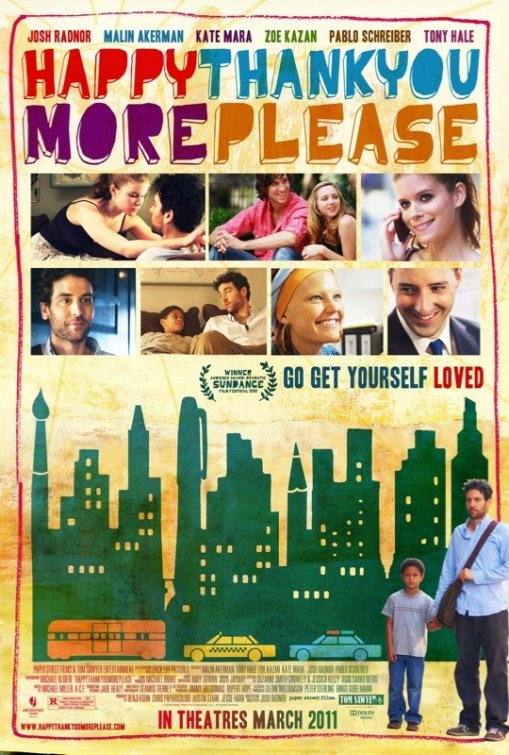 Josh Radnor’s (How I Met Your Mother) writing/directing debut reads like a heavy order of sitcom plots rolled into one tight space. There’s enough New York navel-gazing to fill up a spate of twee indie films. There’s Sam (Radnor), a struggling writer prone to relationship problems, having a three-night stand with Mississippi (Kate Mara), a waitress/cabaret singer. There’s Sam’s cousin, Mary (Zoe Kazan), is being pressured to move to L.A. by her boyfriend (Pablo Schrieber). Sam’s best friend Annie (Malin Akerman) suffers from dating the wrong kind of guys. She also suffers from alopecia, which makes her hairless (doesn’t sound like a deal-breaker to me). She’s being pursued by a suitor, Sam #2 (Tony Hale), a good man who acknowledges he’s not exactly a lady’s first image when it comes to Mr. Right. If this wasn’t enough plot to fight over for 100 minutes, Sam becomes an unlikely caretaker to a young child, Rasheen (Michael Algeri), left behind on a subway. The kid refuses to go back to foster care so he just sort of becomes Sam’s pet. Actually, the child is a plot device to facilitate Sam’s maturity and personal growth, which is why he all but disappears in the film’s second half dominated by romantic drama. Radnor is a relaxed presence onscreen. As a director, he knows a thing or two about pleasing shot compositions. As a writer, he has a good feel for droll observation (“Don’t make me run, kid, I’m almost thirty,” had me ruefully chuckling). As with most ensemble movies, some storylines are stronger than others; the Annie/Sam #2 stuff could have been its own movie. Both actors, Hale especially, are winning. Mara is sexy and a star in the making. The Mary stuff would have been better left alone. Kazan’s performance is somewhat irritating, and my interest sunk every time her face came onscreen. And yet, the film is carried by a sweetness that doesn’t tilt into saccharine. Given some of the sitcom-level setups, this could have spilled into eye-rolling cuteness (a girl named after the poorest state in the nation!). It’s romantic in a somewhat cheesy way but that’s part of its charm. It’s nothing groundbreaking, but happythankyoumoreplease rolls agreeably along thanks to being earnest, but not too earnest, and witty without being overly whimsical.
Nate’s Grade: B-
Share this:

Skyline (2010)
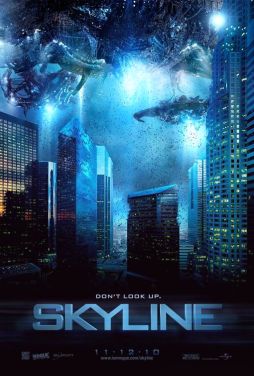 This movie is out-of-this-world terrible. Who wouldn’t want to spend an alien invasion stuck in some L.A. condo with a load of insufferable Los Angelinos? From a storytelling standpoint, watching characters I don’t care about talk about amazing and horrible things happening off camera is not the best use of anyone’s time. Skyline is a movie that keeps surprising you with the depths of its stupidity; just when you think it couldn’t plumb any deeper, the aliens have invaded to eat our brains. Yes, they’re after our brains. So that explains why gigantic monsters will claw away at a building, scrounging for the tiniest morsel of human (that still doesn’t explain it, really). That does not explain why they targeted L.A. if they’re after brains. The special effects are notable for a $10 million dollar movie, but due to the budget restraints, that’s probably why most of this alien invasion is spent indoors and behind trusty sets of Venetian blinds. The pacing is as shoddy as the character work. I kept waiting for these nitwits to step into the light and be vacuumed up into the alien mothership. The end almost looks like it might redeem part of this monstrosity, with our survivors accepting a doomed fate together. But then… I can’t even put into words how shocking, dreadful, and groan-inducing the true ending is for this junk. Suffice to say, it ends with zero resolution, a jagged plot left turn, and setup for a sequel that I’m absolutely positive not one person will be demanding.
Nate’s Grade: D
Share this:

Hobo with a Shotgun (2011)
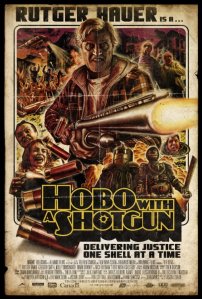 Consider the ultraviolet, gleefully vulgar movie Hobo with a Shotgun is the SECOND feature-length film that began life as a fake trailer for the 2007 exploitation opus, Grindhouse. Except this film began as a fan-made trailer to win a Grindhouse contest. Director and co-writer Jason Eisener’s winning entry followed a homeless defender of the streets, a hobo who found himself thrust into greatness thanks to oen fortunate shotgun. The two-minute fake trailer became a viral hit, was even attached to Canadian prints of Grindhouse, and Eisener was asked to extend his bloody trailer into an actual movie. He scored Rutger Hauer (Bladerunner, The Hitcher) as the star. finally, an actor from the 1980s who begs for change – on purpose! Hauer’s hobo rides the rails into a very Canadian city (the hookers say “aboot” – it’s cute) discovering an urban landscape overrun by scum. Drug dealers, gangs, pedophiles, crooked cops, all under the thumb of crime boss, the Drake (Brian Downey) and his two sons, Slick and Ivan (Nick Bateman and Gregory Smith). Can one hobo, shotgun in hand, inspire a city to stand up?
Hobo with a Shotgun is a movie that lives up to its very title. It’s a gleeful, jubilantly violent, colorfully over-the-top genre exercise that doesn’t push your nose in its campy excesses. But it is excessive, and to what effect? If you stop to catch your breath, you’ll start to realize that there isn’t a whole lot holding the film together. It barely covers 80 minutes and that’s with a lot of wheezing to get to the finish. The plot is mostly a series of beheadings, stabbings, and, of course, gunshots. Sure it’s a fun throwback and meant to be entertaining due to its homage to awful exploitation films, but it’s a one-joke movie that’s pretty hollow at its center. He’s a hobo, he’s dispensing justice (“one shell at a time” a newscaster reports), that’s about all there is, not that I expect a film with a title like Hobo with a Shotgun to tackle weight philosophical topics (the titular hero seems like a figure that would give Ayn Rand fits). If somebody wants to go to the effort of making the hobo some metaphorical everyman, lashing out at a society he feels impotent and angrily displaced by, then by all means. This is not a film with commentary in its blood. It lacks the creative consistency of a Black Dynamite or the narrative pulse of a Planet Terror, or the genre-rattling re-purposing of a Tarantino effort (have your pick). But the violence is often brutal and sickeningly clever, sating base appetites.
 This is a movie chiefly about grotesque characters, grotesque violence, and grotesquely dark and demented laughs. Luckily, the film has a finely attuned sense of humor that elevates what otherwise might be static genre exercises. The film is fully aware of its outrageousness. One of the Drake’s thuggish sons literally walks around with ice skates on before confronting the hobo of fame. He declares somebody’s going to be “skate raped.” He then uses these unorthodox shoes as an unorthodox weapon. A hooker (Molly Dunsworth) with a heart of gold saves the hobo. He remarks, without a hint of irony: “You’re smart. You should be a teacher.” He then refers to her as a teacher for the rest of the film. They develop a bizarre relationship that involves the shared desire to see a bear in a zoo (no joke). A cop reasons, “Well at least he’s only shooting the dirty cops,” in reference to the hobo, to which the chief responds, irony-free, “We’re all dirty cops!” A pedophile is dressed up as Santa Claus and abducts children, including one who bangs on the back windshield of a car as it drives by our hobo. The fact that it happens not a second later than two or three other incidents of crime, creating a melange of overrun criminality, made me giggle. And some of the jokes in this movie are dark; I’m talking scorched earth dark, but I was howling throughout. Now you know where my sense of humor lies. The newspaper headlines decrying the vigilante uprising have a frenzied penchant for rhyme and overly serious statements that are often hilarious (“Hobo Refuses Money, Demands Change”).
Eisener takes care to make his film look like a relic from the 1970s, from the low-budget mayhem, to the ominous synth-laden score, to the highly saturated film colors that advertise being phony “Technicolor.” His camera is antic, constantly swooping to find its intended target, and the cinematography feels grimy, constantly lit by strong neon colors like Joel Schumacher was a paid consultant. Eisener would do best to settle down a bit at times. His direction is a little too erratic, a little too antsy, like he’s constantly afraid that his audience will turn on him. Hobo with a Shotgun is a loving yet messy and uneven homage to the schlock movies of old, and your enjoyment level of this flick will depend greatly on whether or not you appreciate movies aim low on purpose. The crazy nature of the film, its frenetic pacing, and its strong sense of humor will delight fans of trashy cinema. The rest of the audience will probably just view it as trash.
 Hauer is a classic movie tough that actually has a bit of a soul inside those steely blue eyes. He’s an actor that’s been giving small, quietly menacing performances over the last decade. He plays the character completely straight, which makes him far funnier and even somewhat surprisingly sympathetic and less sociopath than a Travis Bickle-esque figure that wants to cleanse society through blood. His dream is to own a lawnmower, which he loftily dreams of opening his own lawn care company. He’s spat on, beaten, and treated without a shred of respect. To many, the hobo is just a nuisance at best and a subhuman lecher at worst. Hauer doesn’t even have to say a word, just hang onto his weary grimace and it says enough about the character. The hobo character makes for an interesting dispenser of justice, though the character is little more than a concept with legs. However, Hauer makes this hobo one for the ages. Way better than the creepy magic hobo from The Polar Express.
The movie is more fun than it should be and at the same time the movie is nothing more than the power of its admittedly awesome title. This seedy, blood-soaked is destined to be an acquired taste for a select few, however, I doubt anyone will randomly stumble into something as provocatively titled as Hobo with a Shotgun. This is a self-aware B-movie celebration of the grindhouse canon while giving is a gentle parody nudge; enough to capture a wink without going into camp. It has enough of a chaotic energy and cracked sense of humor to make up for its narrative deficiencies. Hauer somehow finds a soul inside his cartoon hobo, which is more than I can say about any of the other actors. But when you’re in a movie with burning school children, pedophilic Santas, oddball lines like, “When life gives you razors… make a baseball bat filled with razors,” and a hero who dreams of owning a push mower, well, you’re not expecting Shakespeare.
Nate’s Grade: B
Share this:

Super (2011)
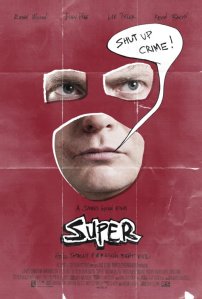 Super is a different kind of superhero movie. Writer/director James Gunn (Slither) has crafted a story that attempts to deconstruct the superhero fantasy. In his story, the people that put on the costumes to fight crime are just as dangerous as the criminals.
Frank (Rainn Wilson) has two memories he can hold onto as his life’s highlights: marrying Sarah (Liv Tyler), a former drug addict, and assisting the police in finding a crook. He works as a short order cook and dreams of being something more. Then local crime lord Jacques (Kevin Bacon) comes into Frank’s home, eats his eggs, compliments him on his cooking of said eggs, and then walks off with Sarah. He’s been gotten her hooked back on drugs. Frank tries to rescue her but Jacques and his goons (Michael Rooker, Sean Gunn) won’t let him get anywhere close to his wife. Then Frank becomes inspired. He feels that God has spoken to him and instructed him to become a crime-fighting super hero, the Crimson Bolt. With a wrench, Frank patrols his streets looking for crime to vanquish and a way to thwart Jacques. Along the way he gets help from Libby (Ellen Page), a 22-year-old girl who works in a comic book store. She jumps at the chance to live out her super hero fantasies and elects herself to be Frank’s sidekick, Boltie. Together they plot to clean up their city and maybe enjoy some of the perks of superhero-dom.
 Super mines familiar territory scene in other movies, the what-if scenario of what might transpire if people put on some tights and attempted to fight crime. Unlike last year’s similarly themed Kick-Ass, this is a movie that refrains from overt style. It does not portray Frank as a hero in any traditional sense. Gunn takes great pains to showcase the frayed mental state of his main character. Frank is troubled, seriously troubled. His attempts to escape his reality are borderline dangerous and his violent attacks are without warrant. I watched this movie shortly after seeing the suitable violent Hobo with a Shotgun (good pairing, folks), and the tone of the violence between the two films was starkly different. Hobo‘s violence is meant to make you laugh; Super is meant to make you wince, then laugh in a “Oh my God” kind of alarm. In Super, the extreme bouts of violence, which are not as prevalent as in Hobo, are meant to make you think how stunningly dangerous Frank and Libby are. When somebody cuts in line at a movie theater, the rest of the people react in disgruntled anger. But Frank goes into his car, changes his clothes, comes back as the Crimson Bolt and declares, “You don’t cut in line,” and strikes the guilty party across the face with his trusted wrench. The crowd is freaked out, naturally. These revenge fantasies are taken to the limits, and Frank has decided that everyone deserves the same punishment for breaking the rules of society whether they be a drug dealer or a line jumper (“You don’t butt in line! You don’t steal! You don’t molest little children! You don’t deal drugs! The rules haven’t changed!”). Frank follows in the same vein of disturbed social justice as Travis Bickle.
The characters are played straight, which only highlights their demented oddball qualities even more. Wilson is a strong comedic actor as he showcases week after week on TVs The Office. He’s always had something of a unique “off” quality to him, be it presence or looks or demeanor. It allows him to slip into cracked characters so easily. Frank is a troubled individual, but there’s something sympathetic about his plight to finally assert himself in the world and stand up to forces that he feels have victimized him. He’s a sad guy, lonely, deeply insecure, feels impotent to the world, and yet he can put on a costume and work out his varied psychological issues. Wilson can be terrifying, deadpanned hilarious, and even potentially touching as he desperately seeks a life filled with moments he can be proud of.
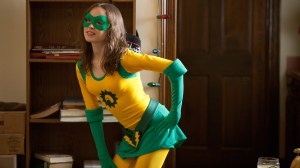 But it’s the little firecracker that is Page (Juno, Inception) that makes Super come alive with risk. Page’s performance is bristling with uncontrollable energy; she practically shakes with excitement over becoming a superhero sidekick and leaving her boring reality. Then, when they actually do kill bad guys, she jumps around, taunting at the top of her voice, chuckling at a level of violence that should be disquieting to most normal human beings. That’s because Page, in particular, has tapped into her character’s manic wish-fulfillment role-playing persona. What would faze people makes me laugh and hop around in impish joy, because she is laying out her idea of justice. And Page is joyous to watch. She’s so excited onscreen that her words practically trip over themselves. And then there’s the superhero sexual angle. This is the first movie, by far, where I ever viewed the elfin actress in a sexual manner. And with Gunn’s film being what it is, prepare for some strange discomfort. Libby tries to seduce her superhero partner into being a partner of a different sort, and she leaves the sidekick suit on.
The tone is meant to make you squirm and laugh under your breath through gritted teeth. Seeing Frank legitimately hurt people can be funny in a bleak sense, and the delusions of the main characters and their inept execution as superheroes certainly adds plenty of chuckles. When Frank tells his newest sidekick that they’re going to fight crime, she’s bouncing off the walls in happiness. That is until she discovers “fighting crime” means sitting in an alley and just waiting for crime to materialize. “This is so boring,” she groans. Frank’s oft-repeated catch phrase of empowerment, while swinging his wrench of justice, is: “Shut up, crime!” But then he later starts to reconsider his place in the order of society, reflecting upon his brute force actions and whether he too has become a criminal in the pursuit of battling evil (“How can I tell crime to shut up if I have to shut up?”). The side stories involving the evangelical TV superhero The Holy Avenger (Nathan Fillion) are a hoot. They’re even funnier when you consider that Frank uses these outlandish bits of corny Christian message-delivery as confirmation from God. For those looking for some Kick-Ass kicks, they will be sorely disappointed until the violent confrontation between good (Frank and Libby?) vs. evil (Jacques and his minions).
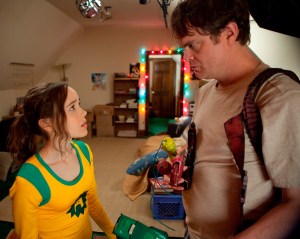 Super isn’t so much of a superhero parody as a morally queasy, crazy, discomforting comedy of the darkest sort. Gunn’s film shows that people with unchecked superhero fantasies can be just as dangerous as the criminals they seek to penalize. Gunn de-romanticizes the concept of vigilantism. Wilson and Page make a fun pair of superheroes with a few screws loose themselves. This is a different kind of superhero movie, the type that shows how dangerous and ridiculous and insane the fantasy can be in a real world where the bad guys have guns and a short fuse. Gunn’s Troma-fied super story has plenty of dark laughs, uncomfortable moments, and nutball characters. I don’t even fully know what to think about the film. Do I really like this? Am I supposed to? Is this all entertaining or just uncomfortable? Is it an entertaining form of discomfort? Does the ending, which aims for emotion, work, or has the film burned too many bridges and fried too many nerves to attempt something tonally different? Super probably won’t win any new converts to the genre, and I imagine its bleak laughs will push many away, but the film also has a car-crash watchability. I do not mean that in a backhanded way. Super keeps you watching but you don’t know if you want to.
Nate’s Grade: B
Share this:

Cave of Forgotten Dreams (2011)
 Only Werner Herzog (Rescue Dawn, Grizzly Man) would make a feature-length documentary about doodles on a cave wall. But hold on, those aren’t just any doodles. In the recently discovered Chauvet caves in southern France, explorers discovered cave paintings from humankind’s prehistoric ancestors. The pristine paintings are 30,000 years old, shockingly twice as old as the next oldest cave painting. That means these remarkable displays are the oldest artwork in human history and a great insight into mankind’s beginning; Herzog dubs the cave “the place where the human soul was born.” Herzog was given special permission to film inside the cramped cave, and to share the experience he shot with 3-D cameras. The theatrical experience comes alive with the 3-D, watching the rippling contours of the cave walls, finding that our prehistoric artists actually used the topography of the cave intentionally (abstract thought from long ago). The movie itself is a bit dry and Herzog is prone to ramble on melodramatic pontification, but the real star is the art. It reopens our ideas of life 30,000 years prior. The artwork is also far more sophisticated than you may be assuming. Due to the limitations of shooting, Herzog relies on several talking heads to fill us in on historical/archeological contexts, but it’s never enough. You hunger for more information that the movie ultimately never dishes. But Herzog has given the world a cultural treat, an artifact to remind us about our shared history and the significance of art to humanity.
Nate’s Grade: B
Share this:

Win Win (2011)
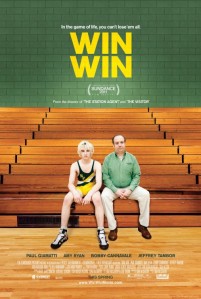 After two stellar movies (The Station Agent, The Visitor), writer/director Thomas McCarthy has proven that he may be one of the greatest humanist voices working in cinema today. He writes wonderful stories about people who find connections via unorthodox family units. McCarthy can spin bizarre elements into deeply felt human dramas. Win Win is another hodge-podge of storytelling elements. It follows the life of Mike Flaherty (Paul Giamatti), a midwestern lawyer and high school wrestling coach struggling to get by. Then a sullen teenager (Alex Shaffer in his acting debut) lands on his doorstop looking to see his grandfather in Mike’s guardianship. The kid also happens to be a gangly wrestling phenom. Things are going great for Mike, that is, until the kid’s mother comes looking for him and wants him back. Win Win assembles a great group of flawed, empathetic, relatable characters that make conflicted choices that they then have to abate. Giamatti is reliably fantastic as the center of McCarthy’s humanist universe. He can communicate so much despair and relief just with his expressions. Teamed up with a cast that includes Amy Ryan, Bobby Cannavale, Burt Young, and Jeffrey Tambor, the movie works best when you can just sit back and take in great actors relishing playing great roles. Win Win doesn’t all come together in the end like other McCarthy films; there’s definitely a missing ingredient feeling to the movie. Shaffer’s limitations as an actor hamper some of the later dramatic moments. The end is satisfying, but I felt like I should have felt more. While it doesn’t strike the same seamless balance of comedy and drama as The Station Agent, this is certainly a film that should be winning for most audiences.
Nate’s Grade: B+
Share this:

Dogtooth (2010)
 Dogtooth is a surprising, sometimes shocking, sometimes maddening vicious little film that serves up dark satire with plenty of tense, incredulous laughter. But make no mistake; this is no comedy in the traditional sense. This Greek flick is deceptively slow-witted, drawing us in to a very different world. The film chronicles the three teenage children (one older brother, two twin sisters) kept at home in isolation by their parents. These kids have been taught to fear the outside world, they have been taught erroneous vocabulary (a “zombie” is a yellow flower; a woman’s privates are known as a “typewriter”), they believe that cats are man-eating beasts, that Frank Sinatra is their grandfather singing to them, their dead little brother lives on the other side of a hedge that they toss food to, and that overhead planes can be plucked from the sky. They even have to get on all fours and bark to scare away intruders. And then there’s a troubling budding sexual element, made considerably more complicated once the woman the father hires to satisfy his son introduces sexual curiosity to the twin sisters. Dogtooth is a detached yet fascinating portrait of one seriously screwed up family, where children are trying to make sense of the limited and sometimes fantastical concepts they’ve learned through severe sheltering. This manufactured artificial world, a satiric swipe at those who believe ignorance to be a suitable protection, is perilous yet believable. Dogtooth raises plenty of questions about the nature of society, parenting, knowledge, responsibility, and identity all in a package of bleak social satire that Luis Bunuel could admire. It may take some effort, but give yourself over to this Greek oddity and enjoy the unique weirdness.
Nate’s Grade: A-
Share this:

The Runaways (2010)
 This fizzy 1970s glam rock biopic on the teen girl rock group The Runaways is a fairly shallow tale elevated by a handful of strong performances. All but completely ignoring the other members of the famous girl group, the movie focuses on lead singer Cherie Currie (Dakota Fanning) and guitarist Joan Jett (Kristen Stewart). Both actresses slip under the skin of their real-life figures, imbuing the anger, desperation, and sheer nerve of pubescent rock stars being exploited. Watching Stewart’s attitude-filled strut, or how Fanning transforms from any other California girl into a slinking rock goddess igniting a Tokyo stage, is downright exciting to behold. But the chief reason to watch this film is Michael Shannon (Revolutionary Road) as the group’s flamboyant, lewd manager who put the girls together. Shannon is his typical bug-eyed sensational self, but the profane tirades he unleashes are downright poetic. He gives the movie a desperately needed pulse, and thus when he leaves the screen he also takes most of our interest. The biggest issue The Runaways has is that writer/director Floria Sigismondi doesn’t convince us why any of this matters. We watch the girls get together, play their first gigs, improve musically, and then all of a sudden they’re famous thanks to a magazine headline montage. Then they’re broken up. You neither feel the rise nor the fall, nor do you ever truly get a good feel for any of the characters. The Runaways spends too much time posing and trying to look fierce when it should have spent more attention on a decent script.
Nate’s Grade: C
Share this:

Splice (2010)

Splice is a slice of freaky-deaky sci-fi horror done with enough style and weirdness to keep your eyes glued to the screen. Director Vincenzo Natali (Cube) takes a few notes from David Cronenberg in staging his creature feature. A scientific couple (Adrien Brody, Sarah Polley) are about to have their gene-splicing lab shut down, so they make a radical decision to start an experimental personal project. Utilizing human genes, they combine other DNA to create a new species. The moral ambiguity and scientific danger is thoughtfully addressed, with the couple quickly finding how easy it is to make moral compromises. Soon they become attached to the creature they name “Dren” and view her as a daughter. Things get even crazier when Dren starts exhibiting some Oedipal desires (I believe the reverse is more fitting, an Elektra complex). Slick cinematography and seamless practical and digital effects help ensure that Splice is never dull. The movie seems two steps away from achieving true greatness. In the end, after all the intrigue and surprising amount of emotional subtlety given the premise, Splice devolves into a by-the-numbers slasher film. The final act is all about character poking around in the dark for the big scary monster. It’s not nearly as intellectually stimulating. In this regard, Splice reminds me of 2007’s Sunshine, another sci-fi film that started strong, had some style and brains, and then blew it by devolving into a clichéd horror movie where characters outrun a super-powerful slasher villain. As a fan of intelligent sci-fi, it’s frustrating to get teased with greatness and have to settle with pretty good, but I’ll gladly take the gonzo pleasures of Splice over any rote action thriller.
Nate’s Grade: B
Share this:

Birdemic: Shock and Terror (2010)
 Ever since the organic, years-in-the-making cult ascent of The Room, every blogger and journalist has been trying to scour the world of inept cinema to crown the next great worst movie of all time. We all want to be kingmakers of camp. In the summer of 2009, After Last Season mystified audiences and seemed like it could be an excellent camp candidate, until people actually saw the film and discovered that it was more painful awful than pleasurable awful. Then a few months ago a new contender emerged — Birdemic: Shock and Terror. The extremely low-budget ($10,000) film, curiously dubbed a “romantic thriller,” is the THIRD film from writer/director/former software engineer James Nguyen. The Sundance Film Festival rejected his aviary masterpiece in 2009 but that didn’t stop Nguyen. He took a van, decorated it with (fake) dead birds, drove around promoting the film with the aid of screeching eagle cries, enticing people to come inside and watch the movie (sounds like the first reel of a serial killer film to me). The magic mixture of romance and eco terror has captured the interest of major media outlets like The New York Times, Entertainment Weekly, The Guardian, USA Today, BBC News, The Wall Street Journal, CBS News and ABC News, and the collective sugar-high rush to judgment says that Birdemic is “the worst film of all time.” Naturally, I had to see anything that vies for that hallowed honor.
For a movie citing the shock and terror of birds, it may be something of a shock that, short of a poorly rendered CGI dead bird on the beach, the first 40 minutes of this movie are absent the titular winged creatures. The first half of this movie is a mostly boring yet hugely personally eventful week for Rod (Alan Bagh) and Nathalie (Whitney Moore), our witless leads. Rod scores million dollar sales at his software company, which leads to Oracle buying the company for a billion dollars. He also successfully finds a venture capitalist to invest $10 million in his own solar panel startup. Nathalie, Rod’s high school classmate, is an underwear model. She goes from a photo shoot –in a one hour photo store in a strip mall!– to the cover of the Victoria’s Secret catalogue. They meet at a diner and then go on a series of dull dates, culminating in Rod responding to a goodnight kiss on the cheek with the request of going upstairs in her apartment (total misread of the signs). Regardless, Nathalie tells her mother that Rod is a special guy who’s not just interested in one thing, conveniently ignoring the end of the date. He meets mom and then after a night of hilariously, uncoordinated Caucasian dancing at a vacant bar, the two decide to consummate the relationship in the most romantic fashion possible — a seedy motel bedroom. And yes, they both have homes. It was at this point that I checked my watch and yelled, “Where the hell are the birds already?!”
It is after the off-screen lovemaking that the birdemic finally strikes. The next morning, for no discernable reason, birds turn into kamikaze agents and dive-bomb gas stations, cars, homes, and whatever else, causing explosions citywide. Rod and Nathalie team up with another motel pair, Ramsey (Adam Sessa) and Becky (Catherine Batcha), who conveniently have a stash of high-powered automatic weapons in their van. The gang fights their way to the van and then the rest of the movie turns into a series of mini-adventures finding victims and survivors of the birdemic.
 I will give Mr. Nguyen his due. His clueless naiveté is endearing, which makes the movie much easier to appreciate. Plus, unlike the filmmakers behind After Last Season, Nguyen has at least a competent idea of how movies are supposed to work. He doesn’t have any visual talent but he at least knows how camera compositions are supposed to be established, how editing orients the audience, and how to construct a story that people can at minimum follow. This is not intended as backhanded compliments, just another reminder at how monstrously appalling After Last Season was. It’s gotten to the point that basic competency is considered a virtue. Nguyen knows basic cinematic rules and the visual vocabulary that goes with cameras. He doesn’t have the skill to do anything else. The film was shot on DV and yet it constantly has focus issues. Characters will be stationed at distances that render them blurry. If Nguyen had a focus limit, why have the actors routinely wander outside that safe zone and into the blurry reaches of nothingness? Then there will be moments where it is painfully obvious that the background is a green screen, but why was that necessary? Nguyen will have two characters sit down at a restaurant, and then the rest of the table conversation will be green screen. That has to be the weakest excuse for a green screen ever (“We couldn’t afford to shoot people sitting at a table for an extended period of time”).
The editing is frequently choppy, jumping around to disorient the viewer, breaking visual rules of geography, but the editing seems on a timed delay. Every new shot/scene seems to start three seconds later than it should. The worst offense in the whole movie is the sound quality. Clearly using only the built-in microphone from his camera, Nguyen allows great portions of his movie to be un-listenable. A day at the beach turns into listening to the wild howl while it obscures all dialogue.
Birdemic has all the requisite components that make up a delightfully bad movie: bad acting, bad dialogue, plot holes, bizarre directorial and script decisions, and extreme awkwardness. For an outbreak of killer birds, everybody seems so resolutely casual about this aviary apocalypse. There is no sense of urgency or danger; characters will stroll in their walks and frequently make outdoor pit stops. One female character is killed after she wanders needlessly far from the safety of the van to pee. They didn’t decide that an indoor bathroom would be safer? The gang also decides to wander through a crowded forest, a habitat that might, you know, attract birds. Then there’s the careless frolic on the beach, again needlessly far from the refuge of the van. Rod is held up by one motorist for gas (yes, society has broken down that far in hours, and yet you can watch hundreds of cars pass along the other half of the road, foolishly driving toward the birdemic and their doom). But then Rod leaves behind the full gas container and hops back into the van, escaping a not so imminent bird attack. They keep venturing to outdoor areas to escape an enemy that utilizes the sky. They even have a picnic! In short, these people are dumb.
 But, to be fair, maybe they’re reacting with such relaxation because the birds are more laughable than intimidating. Nguyen recycles the same low-rent special effects of birds mysteriously levitating. They flap their wings but don’t ever seem to be moving. These CGI creatures look like early computer effects from the 1990s. These birds seem to explode on impact. I wouldn’t be too alarmed, either. When the gang leaves the motel, the bids hover and squawk, and some characters use coat hangers to swing away their non-moving antagonists. Ramsey doesn’t even try to fight them off after a few seconds. He just stand there while the birds fail to do anything. They keep appearing in swarms, though they seem to purposely be following our band of dumb characters. The second half of this movie mostly follows characters shooting and driving. You start to anticipate that the Duck Hunter dog is going to appear at some point and pick up the fallen carcasses and snicker. Avatar, this ain’t.
To call any of this acting would be a generous use of the term. Moore, as Nathalie, might actually be a plausible actress. She handles the material the best. Her onscreen love interest, on the other hand, is astoundingly bad. Bagh has mastered the aloof, dead-eyed stare, which he uses as his specialty. When Rod first meets Nathalie he gazes in one long unbroken stare, which communicates more “Did I leave the gas on?” then, “Is that the girl I sat behind in an English class and never talked to?” Bagh seems to have learned his lines phonetically because his line delivery is steeped in a singsong rhythm. The dialogue is mostly short exclamations that give no indication of character or plot. It’s hard to gauge the acting ability of clear non-actors in a trashy movie. It’s all a sliding scale.
Nguyen has been working on the story of Birdemic for five years. This labor of love was also Nguyen’s platform to make mankind think about its effect on the environment. Yes, the movie has all sorts of environmental messages squeezed in, where characters debate the ecological motivations of the bird attacks. A Tree Hugger (that’s his literal screen credit) theorizes that the birds are fighting back to protect Mother Nature, that’s why they seem to go after cars and gas stations. A doctor in Canada (we’re informed that the van leaves the country by watching it drive past an arrow pointing to the U.S. border written in sidewalk chalk) theorizes that the birds from Canada were infected with the notorious bird flu, and then it spread south. The doctor also gets the opportunity to declare man the most deadliest threat of them all, thus fulfilling a sci-fi disaster movie requirement. The TV news alerts about the peril of global warming, and even though the film is set in 2008, the characters see An Inconvenient Truth at the theaters (“An important movie!”). The environmental message doesn’t begin to approach cohesive commentary.
 As I was watching, I got the weird impression that Nguyen had been commissioned to film a tourist video for the city of Half Moon Bay, California. Then somewhere along the line the promotional project was scuttled and Nguyen looked at his assembled footage and said, “Well, why not make the most of it?” Ladies and gentlemen, Birdemic: Shock and Terror is “the most of it.” There are numerous scenes that serve no purpose other than highlighting some of the offerings of Half Moon Bay, from the quaint local shops, to the lighthouse, to its beaches and natural beauty, truly Half Moon Bay is where you want to spend your next vacation. There are pointless scenes of extended driving. The first three minutes of this movie is watching Rod drive to the office from the scenic view of his dashboard. The opening sequence mirrors Manos: The Hands of Fate, which began with over 10 minutes of uninterrupted driving shots. The opening is even more mind numbing because Nguyen plays the same 55-second piece of music over and over. So the next time you’re driving through California, think about stopping in Half Moon Bay, home of the world-famous birdemic.
Now comes the inevitable, and somewhat subjective part, where the critic must place Birdemic upon the scale of Absolute Awful ranging worst of the worst (Manos: The Hands of Fate) to the best of the worst (The Room). The people behind Birdemic are trying to streamline the cult phenom process. It premiered in New York City in early 2010 and is already being funneled to many markets. It all feels a little too manufactured for my tastes, like the media is so eager to be ahead of the hipster curve. Birdemic is a perfectly enjoyable laugh-out-loud experience best had with a bunch of your friends and perhaps some adult beverages. It’s a fine piece of derisive entertainment thanks to the sincerity of Nguyen. But in the world of bad, The Room still reigns supreme. Whereas Birdemic has plenty of bad housed in 90 minutes, it’s pretty much the same bad decisions and limitations. I look forward to Nguyen’s next film, Peephole: The Perverted. You just can’t go wrong when a movie has a subtitle, “The Perverted.” He may not be Tommy Wiseau, but this man knows how to make some tasty trash.
Nate’s (Derisive Enjoyment) Grade: B+


 nathanzoebl
You must be logged in to post a comment.