Blog Archives
Loving (2016)
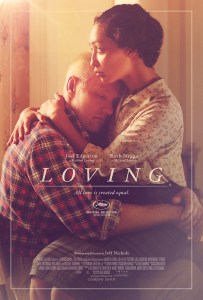 Richard (Joel Edgerton) and Mildred Loving (Ruth Negga) are a young couple deeply in love in the late 1950s. The only problem: he is white and she is black. The laws in their native Virginia forbid marriages to different races. The Lovings traveled to Washington D.C. to be married and then had to live as fugitives before ultimately getting caught and exiled under threat of jail time. Eventually an ambitious ACLU lawyer (Nick Kroll, broadening his range) challenges the legality of the miscegenation law, which will lead to the landmark 1967 Supreme Court ruling striking down laws barring interracial marriage.
The ordinariness of the Lovings betrays the kind of movie moments we expect from great historical turning points, namely moral grandstanding and stentorian speechifying. We’re so used to accentuated versions of history because, deep down, that’s what our storytelling impulses crave because the real thing is often less streamlined and usually more boring. We want Daniel Day-Lewis as President Lincoln admonishing his fellows with the power of his oratory. We don’t necessarily want to watch President Lincoln rewrite his speeches for grammatical mistakes. With all that being said, I appreciated the approach that writer/director Jeff Nichols took with Loving because the very point at the heart of the movie is just how powerfully ordinary Mildred and Richard Loving are. Their love is meant to be ordinary, their relationship relatable. They’re meant to be just like you or I. This thematically taps into the message of the movie about the fundamental human rights of American citizens to love who they love regardless of what others may think. There is nothing dangerous or subversive about their marriage. There is nothing radical. The rationale for why the state would care so much about a marriage can be flabbergasting, including one judge’s written opinion that God created separate races and placed them at separate points on the globe thereby never intending for them to mix. This was considered acceptable legal justification for discrimination in the 1960s and it’s absurd. The other argument against interracial marriage is that biracial children are a harm to larger society… somehow. It’s easy to look back to the past and shake our heads with a fury of moral indignation and say “How could they do that?” but some of these exact same legal arguments have been used in the twenty-first century to justify denying gay citizens the same equality. In that sense, Loving shows us how far we’ve come but also how far we have to go to make sure that human beings are simply considered human.
 If that wasn’t enough the movie also makes a powerfully compelling case about how the state’s miscegenation laws were an offense to human decency. The Lovings are given the legal ultimatum to separate or be exiled from the state, their families, and the home they were making for their family. They have been banished for loving the “wrong” person. Mildred and Richard try living out of the state in a D.C. suburb but it’s not the same; Mildred misses the quiet and relative safety of the country as well as the warmth of her immediate family. They decide to sneak back into Virginia and lay low, and you get a genuine sense of the day-to-day anxiety of having to constantly look over your shoulder and fly under the radar lest someone throw you in prison for loving another race. The degradation and dehumanizing effect of the miscegenation laws is on full display with how Mildred and Richard must act like criminals afraid of their country of laws. They may be used to the glares and hateful comments from intolerant onlookers but it’s another thing when the power of the state is employed to enforce that same hate. The wear and tear of their love perplexes some of the Loving friends and family. Mildred’s brother and sister each take turns blaming Richard for knowingly bringing this heap of trouble upon their beloved sister and for taking her from them. Her brother confesses he doesn’t know why he doesn’t just divorce her and stay together, satisfying the definition of the law. It’s a pertinent question that asks what is the value of marriage? He could readily be with Mildred and save themselves the persecution, but why should they have to settle for something less with their love? Why should they have to be second-class citizens?
This is very much a duet of a movie and Negga and Edgerton deliver admirable, understated work that cuts deeply. I was most impressed with Edgerton (The Gift) who has the more private and insular character. He’s not seeking the spotlight and doesn’t want to be a civil rights crusader. Richard Loving isn’t exactly a man prone to those speeches we crave and he’s certainly not a man to blurt out his feelings. Edgerton has to play within a tiny frame of emotional reference and he makes it work. When he does start to break down, his stoic defenses melting under the pressure and soul-killing compromises, the moments carry even greater emotional weight. Negga is the more emotive of the two but even much of her performance lies in her large, expressive eyes, taking in the collective injustices and triumphs. Using approximately the same Southern accent from her plucky performance on AMC’s Preacher, she radiates warmth and goodness and a sense of indomitable perseverance. It’s a performance that speaks in small gestures and small moments. Much of the film is Negga and Edgerton working together and each lifts the other up, providing the right space needed. There’s a physical intimacy that says much as each member of the relationship seeks out the other’s touch, grip, presence for comfort. It’s a delicate and understated duet of performances that bring the Lovings to faithful life.
 Nichols (Mud, Take Shelter) is the kind of filmmaker that astonishes me with every new movie. He reinvents himself with every picture and he takes genres and redefines them, shaping them to his needs, while never losing sight of tone and characters and narrative payoffs. He’s already delivered one of the best movies of the year with Midnight Special and now he impresses yet again, this time turning toward awards-friendly Important Stories of History. Nichols’ sense of place is implacable. He’s also superb at developing characters and giving them the time to properly breathe. He keeps the spirit of the story linked to his subjects, Richard and Mildred Loving, and makes sure we understand their plight and the larger issue at hand. This isn’t a film that’s going to hit you over the head with its message; in fact you could make a claim that perhaps the movie is too insular. As presented, the Lovings are relatable but we’re only given a fraction of insight into who they are as people and what makes them tick. There’s much subtext here to unpack. It does feel like we’re fighting through the defenses of Mildred and Richard to better know them. This specific approach allows the movie to keep in spirit with the ordinariness of the Lovings and their unknowing place in the history of civil rights, but it also caps the potential emotional impact. We’re invested in them as people but not as completely as characters. It’s a minor criticism perhaps but it’s really the only one I have for Nichols’ movie.
Given our recent turbulent political environment, Loving is an even more significant film. Jeff Nichols has crafted a poignant and affecting movie that passes over easy histrionics for a better representation of history and its characters. These people didn’t want to change the world; they just wanted to live out their lives. Mildred and Richard Loving are regular people living regular lives and that’s the ultimate message of the movie and their love. Having won their Supreme Court battle, the couple returns home to their original plot of land Richard bought in Virginia with the purpose of building his wife a house. Somber text appears in the sky to inform us that Richard would die in a car accident a mere six years later. It left me with a pall thinking about what a short span of time this man had to cherish the woman he loved without recriminations before it all came to a tragic end. It doesn’t seem fair, and I hope that’s a message other audiences take with them. When demagogues try and use religion in place of civil law to justify state-sponsored discrimination, saying the love others share is inferior and somehow a danger to their own lives, that’s when people need to remember the Lovings. This life is too short to harangue others about whom they choose to give their love to. Here is a beautiful, gentle, and restrained film that reminds us that the power of love is in its superhuman perseverance.
Nate’s Grade: B+
Share this:

Hillary’s America: The Secret History of the Democratic Party (2016)
 Conservative author and filmmaker Dinesh D’Souza is a man that has been uncharacteristically good to me, personally. He’s made two utterly abysmal political documentaries that are hatchet jobs and were my worst films of 2012 and 2014. However, the man has been a boon for me as far as my own exposure. My reviews for his 2012 and 2014 polemics exploded and became e-mail forwards. They were quoted in message boards, progressive websites, and all over. I still to this day have people that randomly message me to pat me on the back for my rational and methodical take-downs of this charlatan. I wouldn’t say I was looking forward to D’Souza’s next would-be documentary feature but I knew it would likely contend for the worst movie of that year and that I would profit from extra website hits and plaudits. Hillary’s America: The Secret History of the Democratic Party is the underwhelming Return of the Jedi of D’Souza’s trilogy of bad movies. They all exist in a galaxy far, far away from our own reality. Then again D’Souza has been catering to an alternate reality for the majority of his huckster career.
My first problem is that D’Souza tries to rewrite his own history (he has so much experience rewriting others’ history) and pretend that he’s a First Amendment victim instead of a man who knowingly violated federal campaign finance laws. He purposely donated $20,000 under a false name to skirt finance laws and lied about it to the FEC, and as a result was charged with a felony and served eight months in a halfway house. Even D’Souza said, “I knew that causing a campaign contribution to be made in the name of another was wrong and something the law forbids. I deeply regret my conduct.” However, in his own movie, his twists the facts to present himself as a free speech martyr facing a tyrannical president. “If you make a film criticizing the most powerful man in the world, “D’Souza intones with extra ominous relish, “Expect the empire to strike back.” I don’t think Obama needs to worry about a movie that made $30 million total. D’Souza’s deflecting his guilt as an act of imperial censorship and retribution, and not, you know, him committing a crime and pleading guilty. The fictional recreation of his halfway house experiences are resoundingly hilarious for how tone deaf yet ultra serious they are, as if D’Souza had to scrap for survival. What halfway house is also populated with murderers and rapists? I wish we had a scene of D’Souza giving himself a homemade tattoo from an electric toothbrush. His slimy misstatement of his own felonious failings sets the stage for his third cinematic expose that fails to advance a coherent, rhetorically sound case for his crackpot and disingenuous premises.
 Let’s tackle the man’s core argument and what gives his movie its subtitle: the secret history of the Democratic Party as one of blanket racism and oppression. D’Souza tries to make the leap that the Democratic Party is the biggest gang around, exploiting the vulnerable and naïve for nefarious, avaricious gain. He says the Democrats are planning to steal nothing less than American itself. His argument is that the Democrats have been conning the American public, and especially their contingent of minority and poor voters. He cites evidence that he feels is damning, though once again selectively removes context because it would undermine, or in many cases obliterate, his supposed point. D’Souza has to reach all the way back to the 1820s for his broadsides. Did you know that Andrew Jackson was responsible for the forced relocation of Native Americans, and, I hope you’re sitting down, that he was one of the first Democrats? Did you know that following the Civil War many Southerners resisted Reconstruction and joined the Ku Klux Klan and were Democrats? Did you know President Woodrow Wilson was such a fan of the 1915 movie Birth of a Nation, a film glamorizing the rise of the KKK, that he screened it at the White House? D’Souza feels like he’s stumbled upon his moral keystroke but he forgets that it wasn’t just the Democratic Party that was filled with racists during the nineteenth century and into the twentieth; the majority of America held racist views. To somehow suggest that those who registered as Republicans were immune from the casual racism of everyday society is preposterous. Case in point: at the time the Supreme Court rendered its verdict on the Loving case (tasteful movie coming soon), striking down miscegenation laws banning interracial marriage, a full three fourths of the American public disapproved. This was 1967, and the clear majority of the American public still held what could be charitably described as racially intolerant views. In the case of Birth of a Nation, an unquestionably repugnant movie, D’Souza is knowingly removing the fact that it was a groundbreaking piece of cinema and a global blockbuster. It wasn’t just President Wilson that enjoyed this newfangled moving picture, it was many, and it just so happened a majority of those people, Republican or Democrat, were racist.
D’Souza tries connecting the dots in a conspiratorial manner that demands painting mustaches on every former living Democrat just so they would have something to sufficiently twirl as they laugh maniacally. Jackson was apparently the progenitor of having slaves on plantations, as if this could be attributed to one person. D’Souza’s indictment of Jackson and abrupt empathy for the downtrodden Native Americans is in sharp contrast with his previous abhorrent documentary. In that movie, he argued that the Native Americans weren’t really doing much with their land anyway, that the pioneers were the ones who made it valuable, and that what happened to them should not be considered genocide. I don’t believe D’Souza’s phony crocodile tears over the Trail of Tears. If he’s going to decry Andrew Jackson for being a slave owner then why not the Founding Fathers as well? Why not George Washington? Because that would confuse his already confused argument. With D’Souza, the KKK wasn’t a grassroots organization of disaffected and angry Southern white men; no, it was a purposeful political arm of the Democratic Party. Wilson wasn’t just a fan of a popular movie; he and his cabinet were directly inspired to harass African-Americans. For him, the Democrats built ghettos, made sure to stuff them with immigrants, and wouldn’t allow them to leave. For him, Margaret Sanger wasn’t fighting for contraception for women’s health and equality but so she could stop black people from reproducing. For the record, Sanger spoke to whoever would listen to her cause, which did include the Klan at one point. For D’Souza, Planned Parenthood exists to wipe out minorities, and he even makes use of those undercover videos by conservative activists that got the activists charged with criminal activity, not Planned Parenthood, which was cleared for all outrageous charges. Everywhere he looks, D’Souza sees widespread conspiracy and the intent to do maximum harm. The shrill partisan attacks are amplified to the point that any points are muted. Not too many are going to defend Andrew Jackson to this day, but what about recent history, eh?
 It’s not long before you start to notice a hard cap on all of D’Souza’s historical anecdotes. They all seem to end just about the time of the signing of the 1964 Civil Rights Act, which is by no means a coincidence. When President Johnson signed the bill into law he said that the Democratic Party had likely lost the South for a generation. Almost sixty years later, I think he undershot that estimate. The party of Lincoln is no longer the party of Lincoln, judging by their policies and candidates. D’Souza has to reach back more than half a century to posit his case that the Democrats are the real party of racists. This line of argument is somewhat tainted with the 2016 Republican presidential nominee refuses to recant his excoriation of the exonerated Central Park Five, tells African-Americans they’re “living in hell,” and far too frequently retweets ugly messages from white supremacist groups. Which political history is more relevant to today, the actions of the last 30 years or over 200 years ago? The Republican Party doesn’t get a free pass because at one time certain members supported abolition and women’s suffrage. D’Souza even says, “As the South became less racist, they became more Republican.” Huh? The parties have held the same names for hundreds of years but their policies and platforms have shifted along with the nation and culture. To pretend that Democrats or Republicans today follow the exact same policies from hundreds of years prior is intellectually dishonest and thoroughly facile, which sums up the host of D’Souza’s feeble arguments.
D’Souza’s grandstanding and myopic personal crusade gets in the way of his larger message. You could easily construct a documentary about Hilary Clinton being unlikable or hard to trust. She is often her worst enemy and her penchant for secrecy can be reasonably unnerving. You can make an anti-Hillary doc without resorting to ad hominem attacks and worse. There are legitimate critiques over the Clinton Foundation and its lack of transparency, but D’Souza can’t help himself. He shouldn’t have to utilize bracingly absurd, offensive propaganda imagery like a young Hillary watching the bombs of the 1960s with unseemly fascination, the slow-motion horrors reflecting onto her youthful glasses, a fascination to her calculated expression. He shouldn’t have to resort to such incendiary charges like, “Now we know why Hillary let all those emergency Benghazi calls go. She couldn’t make a buck off of them.” Excuse me? She let Americans die because she couldn’t pad her wallet? “Hillary’s plan was to take over the institutions of government,” D’Souza intones, as if she was a Manchurian candidate who activated instead of a young political activist in law school. The main argument D’Souza musters against Hillary, well after 75 minutes of movie, is that her husband was a serial philanderer. In what may be the most outlandish accusation of the whole movie, D’Souza says that her husband’s infidelity is her fault and that “in many ways she orchestrated all of this.” Just take in that statement. It might take a while. Let it settle in. She “used his addiction to make him dependent on her.” Bill Clinton’s indiscretions have been well documented and are worth another examination in modern light, but this is new. And then this icky nugget took my breath away: “Bill, after all, is in a long line of Democratic ‘plantation owners’ who took power over women in their control.” We had earlier seen Andrew Jackson in bed with his slave, though again other Founding Fathers are left out of this charge, like Jefferson, because it would dilute the message. The level of projection and armchair psychology is staggering and often without coherent evidence.
The shady tactics and paranoid fear-mongering feel rather played out the third time around. Conservative boogeymen are thrown out there (Sanger, Alinsky, Daley, Chicago in general) but it feels like D’Souza cannot even be bothered to properly lambaste them. It’s like he’s checking the boxes of conservative agita and expecting that he doesn’t need to explain anything because of course Saul Alinsky was connected to Al Capone and ipso facto Hillary Clinton is a criminal. He sets them up and chiefly moves along, propelled by some other point that never fully materializes. He purposely blurs the line between archival footage and interview recordings and slanted fictional recreations. There’s a strange recreation where Obama’s father visits his classroom to present an African perspective on culture, including a spear and tales of killing lions. Why does the documentary even require a scene like this? D’Souza only deigns to say Obama learned how to “pitch” from his father. It’s an odious dog whistle to its core audience to remember that Obama is an “other.” There’s another strange moment when a fantasy Hillary leans into the ear of a dissatisfied man to whisper, “They are rich because they steal from you.” As the star of his trilogy of lunacy, D’Souza is the hysterically nonplussed face of his own madness. His interviews often set up his subjects with leaning questions and confirmation bias. It’s as productive as watching D’Souza interview himself, especially when there are perhaps only four interview subjects total, half of them partisans. D’Souza puts himself as the head of his own story of discovery as he wanders around and looks wide-eyed and forlorn over the symbols of America’s greatness, like a field of wheat he solemnly touches. It feels like D’Souza is going through the paces of what his audience is expecting and serves it up without mental taxation. The movie even ends on three straight musical performances, including one by D’Souza’s new wife, that sum up America’s greatness through stock footage montage of patriotism clichés.
 Hillary’s America wants to spare the nation at a critical moment in history, but D’Souza’s agitprop will only appeal to the converted or at least those viewers with an alarmingly low quotient for intellectual curiosity. “They can’t take America from us without our consent,” D’Souza rallies his crowd into mobilization (as a felon, he has lost his right to vote in the meantime). The reason I very much wanted to review this movie specifically today is because it’s Election Day and the country has been given a very stark choice. People talk about the deep divides in this country, and it’s men like D’Souza that are stirring those divisions, placating and agitating their audiences, and knowingly distorting facts and reality in a shameless attempt to milk money from the hapless. Here is a man who said Obama never truly lived the “black experience” because his mother was white. Here is a man who tried to mitigate the horrors of slavery in his previous documentary and termed it “theft of labor.” Here is a man who believes Christianity literally invented compassion. Here is a man who states that no Republicans owned slaves. He is not a man who tells truth to power but a man who willfully distorts the historical record in order to make people feel better about unhinged political takes that have no bearing in reality. It is people like D’Souza that have lead the way for the coronation of Donald Trump, and it should be people like D’Souza who are put to blame when that experiment crumbles. He couldn’t be an effective propagandist if he tried, and it really doesn’t feel like he’s even trying. Maybe at some level D’Souza is admitting defeat or at least sees the writing on the wall. He’s been on the wrong side of history and eventually history will judge him as well. Meanwhile, Hillary’s America is a disaster of a movie and the worst film of 2016.
Nate’s Grade: F
Share this:

Boo! A Madea Halloween (2016)
 Tyler Perry is an industry unto himself, and the face of that industry is his matriarchal force of nature, Madea, the trash-talking, advice-giving woman of fear and esteem. I don’t know if I’ll ever truly enjoy Perry’s Madea movies, and I fully admit being outside the target audience, but I think I’m coming around on the Madea character and in particular Perry’s broad comic performances. Boo! A Madea Halloween is a flimsy excuse to re-introduce Madea and her elderly gang of colorful cohorts, including her gruff brother Joe (also played by Perry). The movie seems to barely have enough plot at all, aimlessly revolving around Madea babysitting a pair of teen girls on Halloween and thwarting them from going over to a nearby fraternity party. There’s perhaps a 10-15 minute segment that just… keeps… going involving Madea and her friends literally advising a weak-willed father (also Perry) to enforce discipline and beat his child. As a writer, Perry relies too heavily on transparently expository writing in between his funny. The story keeps circling around on itself, stretching the improv jags with diminished returns and needing more comic set pieces for a 100-minute running time that could clearly be trimmed. Perry directs his actors much like his plays as they go for broke, playing to the rafters. However, Perry as actor, especially as Joe and Madea, is an enjoyable and quite credible comic performer who definitely displays surefire instincts. I found myself laughing enough even during the more aimless lulls in conversation. The plot doesn’t have to be David Mamet when you just unleash Madea on others. I appreciated that she’s a moral authority who is also shamelessly irreligious and hypocritical. The character manages to beat down some of Perry’s more misogynistic and moralizing tendencies as a writer. Her former stripper past comes out in entertaining ways like trying to stop herself dancing during a hip-hop track at the frat party. The conflicting physicality on display in the scene is terrific. Boo! A Madea Halloween is going to be candy for its intended audience, and for those willing to push through the expected negative reviews, you might find enough moments to enjoy. I’m not going to say I’m on Team Madea but I wouldn’t necessarily mind more of this matron run amok.
Nate’s Grade: C
Share this:

The Birth of a Nation (2016)
 Sold for a record $17.5 million at the Sundance Film Festival, there were big expectations for the Nat Turner biopic, The Birth of a Nation. Writer/director/actor Nate Parker was the toast of the town and the studio had its sights set clearly for a fall release and a big Oscar push. Then came the revelation from Parker’s past linking him to an accusation of sexual assault (it should be noted he was acquitted of the charge, though it should also be noted the woman declined to continue pressing charges during the second trial). Suddenly the Oscar hopes for Birth of a Nation were put into a tailspin and journalists were wondering if this salient news would provide older Oscar voters just the excuse they needed not to watch the movie. After having finally seen the film for myself, I can attest that this movie wasn’t going to go far into the Oscar race anyway. My friend Ben Bailey said it best as we walked out of The Birth of a Nation, making an apt comparison to the 2013 Best Picture Winner: “12 Years a Slave was a better movie made from a less interesting story; and this is a more interesting story but given a much lesser movie.”
In 1830, Nat Turner (Parker) is earning extra money for his friendly slave owner (Armie Hammer) as a preacher, convincing slaves on other plantations to work harder and obey their cruel masters. He reaches a breaking point and organizes a revolt, violently killing the same plantation owners that kept them in bondage. Nat felt his revolt could be the catalyst for slaves all over, but it was put down by overwhelming forces two days later.
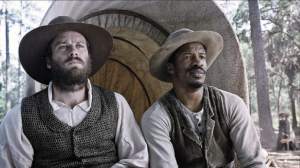 Nat Turner is a historical figure extremely deserving of a big Hollywood spotlight. The problem is that Parker’s movie feels like the arthouse version of the Hollywood Martyr Blockbuster, a field popularized by director Edward Zwick (Glory, Blood Diamond). This thing checks just about all the formula boxes you’d expect by showing the arc of a character called into action, forced to take a stand against an exploited people and series of injustices, and the eventual death for the cause. It’s meant to be inspirational but that sense of inspiration can be capped when you see the machinations. All storytelling at some level is about pulling the strings of an audience, but the storyteller must do their best to make this as nonobservant as possible so as not to disturb the experience. Parker doesn’t have that skill quite yet, either as a director or as a screenwriter.
His movie kept my interest but I felt oddly removed from it, unable to fully absorb the characters, which should never happen in a revolt against slavery. Case in point, we know how the movie is going to end so Parker needs to engineer something of a win for Nat, and that’s where Raymond Cobb (Jackie Earle Haley), nasty slave catcher, comes in handy as a conquerable antagonist. He ends up being the man responsible for chasing Nat’s father away, so it’s even more personal. During their final fight, Cobb implausibly wrestles atop a struggling Nat (this guy has to be at least 60 years old and it’s Haley, not Stallone). Parker even includes the knife that’s just… out… of… reach. I rolled my eyes. Parker shouldn’t have to resort to these tactics to rouse his audience, and as stated above, they’re just too nakedly transparent in their formula machinations. I wanted more suspense sequences like during the opening when Nat’s grandmother has to think on her feet to conceal contraband, smart uses of dramatic irony and ratcheting up the tension. The movie is structured too narrowly as Nat’s call to action, but Parker seems preoccupied with hitting all these other checkmarks to fully open him up as a human being.
Structurally, this movie is amiss because we don’t need 90 minutes to justify why slaves would violently revolt against their masters. The best part of Birth of a Nation is its final act when the revolts come and the slave owners get what they have coming. Some will equivocate that not all slave owners abused and terrorized their slaves to the same degree of abject cruelty, but the very nature of owning another human being is an assault on fundamental morality. 12 Years a Slave had an excellent 15-minute section where it disproved the notion of the “good slave owner” with Benedict Cumberbatch’s character. Even he too was corrupted because the institution of slavery is a corrupting agency. What that movie was able to communicate in 15 minutes is what The Birth of a Nation takes 90 minutes to do the same. The entire movie should have been the slave revolts with some choice flashbacks interspersed to give the movie even better context for the personal animosities against specific slave owners. That way we can better explore the emotional side of Nat Turner and his company without resorting to extended degradation. Parker deserves some credit for being very tasteful in his depiction of the brutality against slaves and the heavy heart of aiding and abetting an unjust system. It doesn’t whitewash, so to speak, the horror of slavery but also refrains from exploiting tragedy for easy gains. With that being said, and I may be alone in this observation, but I found it a bit peculiar that the sexual violence committed against women seems to be primarily framed as how it impacts the male characters, making them sad or angry at the mistreatment of their women. I may be over-analyzing this but it happens twice and stuck out to me. The structure of the movie does a disservice to the emotional power it demands, and Parker should have shown us the bloody campaign rather than the lead-up to the campaign.
Parker also shows some noticeable shortcomings when it comes to directing his fellow actors. His performance is a highlight and his moments where he’s trying to hold back the tide of mixed emotions working for the slave owners and using Scripture to justify the worst of the worst. This is a great showcase for Parker as an actor of suitable range. It’s not a great showcase for any other actor. The performances are a bit big when needing restraint, and a bit broad when nuance would be required. There’s no character that even comes close to the deeply wounding impressions left by the brilliant Lupita Nyong’o and Michael Fassbender from 12 Years a Slave. Hammer (The Man from U.N.C.L.E.) is given one note to play after the first act and that is aspiring drunk. I don’t know if there’s a scene where he isn’t accompanied by some bottle. It’s meant to communicate his increasing sense of shame he has to excuse, but it’s also a fairly facile acting crutch. The women in the film come across as angelic (there’s even a vision of an actual angel in the film) or maternally strong as steel. The lack of variance becomes frustrating, as it seems that Nat Turner is the only character, and by extension actor, allowed depth. You’ll enjoy the actors on screen but be scratching your head to recall anything memorable.
 The Birth of a Nation is very purposely meant to evoke the title of the famous 1915 D.W. Griffith movie, the world’s first film blockbuster and also virulently racist to its core. It’s about the formation of the Klu Klux Klan in a Reconstruction era to save all the honorable white people from the new hordes of wanton free slaves. It’s deeply offensive though an undeniable touchstone in the history of narrative filmmaking. I was looking for some kind of larger thematic connection beyond slavery but it seems that Parker’s movie is meant to be a reclamation of the title. There’s a moment at the very end that made me think that there was another possibility (spoilers). As Nat Turner is executed, one of the last images is a close-up on the face of a young teenage slave who witnesses his death. The camera then pulls out and that boy has aged into a man and is fighting with a battalion of other black soldiers during the Civil War (the movie literally becomes Glory!). I was wondering if we were going to continue skipping forward in time, next to the Civil Rights marches, next to protests against police brutality in the modern era, so that Parker was drawing a direct line from the experiences of old and how they have shaped the America of today, the birth of our current national racial injustices. This doesn’t happen, unfortunately. The Civil War flash forward is the only jump in time.
I’ve been critiquing Nate Parker’s movie for the majority of this review and I don’t want to leave you, dear reader, with the false impression that this is a bad movie; overrated and slightly disappointing, yes, but not bad. If it didn’t sound like faint praise I would say that The Birth of a Nation is a perfectly fine movie. It held my attention though I kept thinking of other ways this movie could have improved, from a restructured plot that begins with the slave revolts, to more attention to the supporting characters, to less fidelity to the patented formula of the Great Martyr Biopic. This was a passion project for Parker and took him over six years to complete. Walking out of my theater, I simply didn’t feel like that same passion was evident on the screen.
Nate’s Grade: B-
Share this:

Snowden (2016)
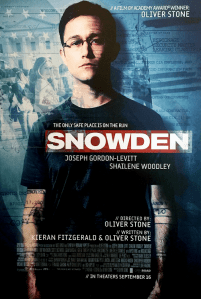 There’s quite a difference when director Oliver Stone actually gives a damn with a movie, and you can tell with Snowden that he is passionate about making a compelling and accessible movie for American audiences to understand why they should be angry. He wants to lead the righteous civil liberties mob against the right perpetrators while providing an appreciative moral context to the actions of Edward Snowden, America’s most famous fugitive. That sense of purpose and drive animates Stone in a way that his recent films have not, and even though it’s far less gonzo and experimental as Stone’s quintessential catalogue, the storytelling skill is still consistently engaging and the resulting 134 minutes inform as well as entertain.
Edward Snowden (Joseph Gordon-Levitt) wanted to serve his country and his expertise in computers landed him in various jobs working for U.S. agencies. He discovered the abuse of surveillance over everyday citizens rubber-stamped by a FISA court meant to provide oversight. Callous private contractors would surf through thousands of collected data points, and if pressed, could justify through terrorism connections, as it seems anyone in the world is perhaps three connections away from a person of interest (consider is the really unfortunate version of the Kevin Bacon game). Snowden risks everything to reach out to a team of journalists (Zachary Quinto, Melissa Leo, Tom Wilkinson) to tell his story and make sure the larger public will know these abuses of power.
 The best compliment I can give Stone as a screenwriter and director of Snowden is that he took a thoroughly challenging scenario with few cut-and-dry answers and made an accessible movie experience that effectively conveys moral outrage and dismay. It feels like Stone the educator is leading you by the hand, taking time out to explain some of the more delicate intricacies of the murky stuff that goes on behind closed doors. I won’t exactly declare it to be an intelligent examination on the moral implications of the material, but it’s certainly a movie that lands its goal of clarity. It produces a sense of clarity for the subject and a sense of clarity for why Snowden made the decisions he did. Gordon-Levitt delivers a steadily engrossing performance, even if it takes several minutes to adjust to his distracting speaking voice. Maybe my ears are just broken but it doesn’t sound like Snowden. Fortunately, my ears did adjust accordingly. Gordon-Levitt and Stone effectively kept my attention throughout the film. I was surprised how much I found myself enjoying long stretches of this movie, even if my own stance on Snowden is less clearly defined. He talks a good talk but the reality is messy.
Given Stone’s conspiratorial history, the plot definitely comes with a distinctive point of view over whether Snowden is a hero or a traitor. I don’t think inherent bias in a movie or the angle taken in storytelling is inherently misguided and that all stories should be as objective as possible. Sometimes the circumstances don’t permit objectivity. Stone’s film is clearly biased but it doesn’t fall into a hagiographical hero worship of its titular figure. This is a complicated subject and deserves a proper analysis to place the real-life people in the meaningful morally ambiguous context. Snowden ultimately makes the decision to become the world’s most famous whistle-blower for what he felt were systematic abuses of government surveillance, but before that climactic decision he comes across less than a spotless martyr. His character arc is a fairly recognizable awakening of alarm and horror at the great abuses of power in the name of security. He does start off as a lifelong Republican with family members who have served in the military and different governmental bodies. He’s devastated to be medically discharged from the Army and hungry to serve his country. He’s a patriot who becomes disillusioned with the system, but he’s also rather self-involved and excuses ego with civic duty. I didn’t know how gifted Snowden was in his field, and the movie has some amusement with the wunderkind training sequences where Snowden delivers shock and awe to his stunned superiors. However, the second act becomes more than a bit protracted because Snowden keeps quitting but eventually going back to government surveillance, whether CIA or private subcontracting. This is because of the pay, sure, but it’s mainly because nobody can do what he can do. He feels important. He feels needed. He convinces himself he’s making a difference in the War on Terror, but eventually the reality of the widening peripheral of the war zone is too much to ignore for him.
This is further epitomized through the romantic subplot with Lindsay Mills (Shailene Woodley), a liberal firebrand, photographer, and exotic exercise instructor. Woodley (The Fault in Our Stars) does her best infusing a warm personality into what is too often the underappreciated yet overly agreeable girlfriend role. It’s a storyline meant to further humanize Snowden as well as personalize the encroaching invasions of privacy and subsequent paranoia. After he discovers that the government can activate laptops and watch oblivious citizens through webcams, Snowden can’t help but stare down his open laptop during an almost laughably forced sex scene. My reaction as Lindsay climbed aboard Snowden was exactly this: “Oh, I guess this is happening now.” She would have a greater impact if the movie did more with her character, as she is the long-suffering girlfriend who keeps accommodating his life choices. They move three times across the country for his jobs and Snowden is always unable to fully explain why he feels the pull to these tech occupations, which further frustrates a woman who just wants trust and stability. There is one interesting conversation that Lindsay offers, typifying the blasé response to spying with a “well I have nothing to hide, so who cares” rationale. Snowden is quick to admonish this line of thinking, an opinion that many still share. The other regrettable reality is that the romance is inevitably going to be the least interesting facet of this story. By going behind the curtain of American secret surveillance, we’re indulging in our collective curiosity at how exactly all these moving parts operate. To then go home and watch a couple squabble is a consistent letdown of drama.
 There are a few other artistic miscues that weigh down Snowden, mostly Stone’s penchant for heavy-handed symbolism. The same instincts that allow Stone to carefully thread a knotty story are the same impulses that tell him that subtlety is for cowards. There doesn’t need to be a frame story here. I understand that select media outlets trying to break this story naturally allows for a question-and-answer framing system of flashbacks. However, very little is added besides a skeletal structure. The media members act as reactionary acolytes. It was all captured much more credibly in the Oscar-winning documentary, Citizenfour. There’s no earthly reason for Nicolas Cage to be in this movie except for drawing financing. He plays an old CIA code-breaker and admirer of outdated technology, but really he’s there to serve as an institutional nod to Snowden. At the conclusion, when Snowden’s identity and message becomes public, there’s a scene where Cage’s character literally toasts his pupil’s actions. I would say it’s a bit much but the character is a bit much for an actor that hasn’t generally been known for restraint. When Snowden is leaving the CIA offices in Hawaii for the last time, he steps out into the light (get it? get it?) and the scene is practically rendered in slow motion as the enveloping white light fills the screen and bathes Snowden (get it? get it?). He smiles bigger than we’ve ever seen. Lastly, Stone can’t just help himself during the very end and has Gordon-Levitt replaced with the actual Edward Snowden to deliver the closure of an interview. I don’t think we needed a reminder that Snowden is an actual living person.
Snowden the man, and Snowden the movie, wanted to shake up an ignorant and apathetic American public about the dangers of unchecked power in a surveillance state, but was the mission a qualified success? Years later and Snowden living in exile in Russia, the charitable answer would be inconclusive, though the pessimist in goes further. It very well seems that the majority of the American public simply doesn’t care (out of sight out of mind). The trial over whether Snowden is a patriot or a traitor seems a little moot perhaps when the larger public shrugs at the revelations of security overreach. Does a movie about a Great Man have as much resonant cultural cache if that defining act of greatness produces a shrug? I’m by no means saying we should apply a polling system to accurately measure a person’s value and accomplishments to the larger cultural and political landscape. Snowden wanted to wake the public up but we hit the snooze button. In the meantime, the movie about his exploits is fairly entertaining, so at least he has that.
Nate’s Grade: B
Share this:

Blair Witch (2016)
 As is mandatory with all reviews, let us acknowledge the tremendous impact of the original Blair Witch Project, a full-borne cultural event that tapped into the zeitgeist. It was a rare indie movie that curated a must-see reputation and became a blockbuster. The found footage format was highly influential afterwards as were its low-fi thrills, community interactivity, viral marketing, and experimental construction. I remember having heated arguments with people about whether the movie was indeed real or a work of fiction. I pointed to the TV once and said, “Look, the actors are promoting it on MTV.” Naturally imitators followed suit and the studio looked to eagerly turn a curiosity into a franchise. 2000’s hasty sequel Book of Shadows was quickly rejected and just as quickly the Blair Witch phenomenon had slipped away. It remained dead until this summer. Director Adam Wingard (You’re Next, The Guest) and frequent screenwriting partner Simon Barrett had recently made a horror movie called The Woods, but at 2016’s Comicon the secrecy was finally dropped. It was a sequel to The Blair Witch Project, filmed in secret J.J. Abrams-style. It was a stunt that worked, and once again there was life in this franchise. This will only last until people see the new Blair Witch, a monotonous, confused jump-scare haven that’s too indebted to the original and discards anything interesting it stumbles onto.
Sixteen years after three backpackers went missing, footage has been posted that possibly shows one of these backpackers, Heather, still alive. James (James Allen McCune) is now an adult male and determined to find out if his sister is alive. Lisa (Callie Hernadez), a film student and maybe James girlfriend, tags along to record James’ hunt for the truth into her graduate thesis. Their friends (Corbin Reid, Brandan Scott) come along for the adventure into the woods, as well as a conspiracy couple (Wes Robinson, Valorie Curry) responsible for posting that new footage. The conspiracy couple leads them into the woods and it isn’t long before people get lost, tempers get heated, and strange disturbing noises materialize from the never-ending night.
 Much can be forgiven if a scary movie delivers the spine-tingling goods, and standing in the shadow of one of the biggest horror hits of all time is no easy proposition. It’s too bad then that Wingard’s Blair Witch is far more tedious than terrifying. I didn’t fall under the spell of the 1999 original but I could appreciate its slow-burn efforts and execution, which relied upon a lot of unsettling dread left to audience imagination. With the 2016 reboot, the filmmakers have upped the ante but don’t have patience. There are over six different jump scares, each punctuated by a loud, often shrill scream. At one point there are three in a row in a succession of mere minutes, enough so that a character provides a meta dose of commentary by saying in exasperation, “Why do people keep doing that?” Calling attention to the annoying trait doesn’t make it better. The sound design is also, in a word, amplified. It sounds like Bigfoot or a dinosaur is tearing through the woods and wrecking havoc. It was enough that I hoped the movie would just reveal the Blair Witch never existed and instead it was some other sizeable monster of legend. I’ll give Wingard credit for the found footage cinematography not being self-consciously overdone. The characters have an incredible stash of cameras, from GoPros to flying drone cameras, which makes the editing less choppy and the movie easier to watch.
There are exactly two scenes that unnerved me. One is the sheer numbers of an expected item upon waking up, the immense quantity and variation in size providing an eerie sight as it fills the screen. The other is a late sequence that involves squeezing in a tight space, which allows Wingard to employ some nice claustrophobic tension. Short of these two moments, and they are mere moments, the movie was boring me so profoundly that I considered just leaving, and I’ve never walked out on a movie before. It felt like it was going nowhere fast with characters I didn’t care about and without any relevant suspense. The found footage filming elements are even used to enhance the jump scares with sudden visual and sound glitches amplifying the tired attempts to constantly startle its audience. This is a movie more concerned with startling its audience than scaring it.
When the movie does start to tantalize your interest, it’s like a mirage that soon vanishes and you’re once again left in your dire predicament. Getting lost in the woods is not interesting minus interesting aspects. However, finding out that time is operating at a different level, now that’s interesting. The characters set their alarms for seven A.M. but it’s still dark out. The possibility of the Blair Witch manipulating time to trap hikers was the first moment in this entire movie that made me sit up in my chair. It took the movie in a different direction that demanded my attention, and it opened up the possibilities of what had been a rather lifeless enterprise up that point. Show me this movie. Alas, it’s an aspect that is quickly shoved aside and largely forgotten even with the timeline of events regarding the footage. There’s a scene where the stick figures directly communicate a powerful connective relationship, and yet this too is never touched upon again. There’s a new threat introduced that takes the movie in a body horror direction and raises questions about whether the woods themselves can become alive. It’s another intriguing moment that culminates in what promises to be a memorable gross-out image, and instead it too peters out and then unwisely abandons the body horror angle. It’s almost like the movie is so single-minded in its path that it ignores the intriguing and preferable detours.
Wingard and Barrett are trying to expand the Blair Witch mythology but their reboot operates on the assumption that there is even a base to work upon and that its audience is familiar with heretofore unspoken rules that appear arbitrarily and randomly. This reboot operates in a world that acknowledges the release of the first Blair Witch movie, yet nobody seems to be any different from this. Obviously James is different having to lie with the legacy of the movie, but why venture out into the woods on a whim of hope to find his long-lost sister who vanished 16 years ago? Does he think she’s just been living off squirrels and twigs in the ensuing time? Why doesn’t James try and question who edited the footage from his sister into a narrative? Why doesn’t he try suing the film production for profiting off his family pain? Why hasn’t Burkitsville, Maryland become a counter-culture tourist destination from taking ownership over its supernatural legend, much like Salem or Roswell? The town should be swamped with adventurous backpackers who want to live the experience. The much maligned Book of Shadows did far more to discuss the reality of the Blair Witch phenomenon and the tenuous hold on reality that the Internet age was ushering in. Wingard’s version eschews this world-building context for narrative immediacy. James wants to find his sister, he gets a clue that she might be out in those woods still, so they all go into the woods. Once the conspiracy theory couple insert themselves onto the trip it seems odd that we’ve ignored the larger context of the legend, instead rehashing how the Blair Witch died.
 As things begin to fall apart in the second half, the events start to feel arbitrary and poorly defined. There’s a sequence during the climax that I’ll try my best to describe with some discretion but be warned, folks (spoilers): the remaining characters eventually find that same shack in the middle of the woods, though the exact number of floors seems unclear. The witch looks to finally confront our characters, though why she/it waited until this moment is also unclear since she/it seems to be entirely overpowering. That’s when a character declares, with no prior guesswork to arrive at this conclusion, that they have to stand in corners and as long as they don’t turn around and look they will survive. And this works. It’s not explained why this Raiders of the Lost Ark closed-eyes routine is somehow the secret to supernatural survival (ignorance is bliss?). When the character unleashes this tidbit it’s treated like the audience knows the rules of the Blair Witch universe, and we sure don’t. At no point has a larger system been established, so when characters start spouting rules it feels like the movie is making it up as it goes. This don’t-look-back trick is played out almost to a comical effect, which culminates in the rising question of whether a character is going to backwards walk out of the whole stupid forest. The muddled world building (time dilation, voodoo sticks, tree monsters?) makes it feel like the doomed characters are ultimately trapped in a half-finished screenplay.
I was honestly expecting more from Wingard and Barrett after their previous genre collaborations. These guys know the underpinnings of enjoyable genre filmmaking and how and when t upend the conventions and expectations, zigging when others would zag. I felt these two would be able to take a studio gig like Blair Witch and find something new, something interesting, and certainly something scary with the property. I regret to say that this Blair Witch might be new but it sure fails to be interesting or scary. The characters are meaningless and interchangeable and boring. Their decisions are often illogical and stupid. The scares are stacked too high in favor of cheap jump scares, and the movie lacks the patience to develop its tension and horror. It can’t even properly establish rules for the audience to follow. It’s like the filmmakers are being upfront with their lack of faith in their final product. I think the key missing ingredient is, surprisingly, humor. Both You’re Next and The Guest balance along a delicate tonal line that can veer into macabre comedy any moment to lighten or heighten the tension. There are no (intentional) laughs to be had with this retread into the woods. I think the newest Blair Witch has done the unthinkable: it’s redeemed Book of Shadows.
Nate’s Grade: C-
Share this:

God’s Not Dead 2 (2016)
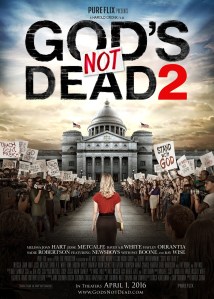 The creators behind God’s Not Dead 2 won’t admit it but their movie is pure science fiction; it exists in an entirely parallel universe that’s topsy-turvy where atheists want to stamp out the last signs of Christianity and will use their collusion of government and media power to marginalize and eliminate freedom in the name of “tolerance” and “diversity.” It’s another heavy-handed moral parable that feeds into the persecution complex of its target audience, the same people who made 2014’s God’s Not Dead a surprise hit. While the sequel isn’t nearly as mean-spirited and cruel (the godless characters don’t have to die or get stricken with cancer this time), it’s still speaking in code to stoke its audience’s unfounded fears of losing religious liberty. We follow an AP History teacher (Melissa Joan Hart) who gets into trouble from making a purely literary connection with the teachings of Jesus and non-violent revolutionaries Gandhi and MLK. The school board wants to “wash the blood off its hands” and she’s taken to court where her very faith is on trial and where her hunky lawyer has to prove Jesus historically existed. The entire premise is laughably preposterous given the context of her pedagogical reference. A student makes the Jesus connection and asks about it, and the teacher was not endorsing a religion but merely quoting a piece of literature as it pertains to those inspired from it. There’s no time for subtlety in this movie because we have a martyr that needs roasting, and in comes an ACLU lawyer played by Ray Wise (God bless this actor saying yes to everything) who may very well be the devil. Wise is the lone source of entertainment for me. There’s also a nasty TV pundit who says Christians are the real danger in this country (replace “Christian” with “Muslim” and the TV segments start to sound more familiar from our own world). Several characters from the first film pop back up but with very little to do. God’s Not Dead 2 is a pretty lackluster, laughable, and theologically simplistic morality tale but at least it isn’t as risible and offensively insincere as the original film. Like the first film, the credits close on a list of court cases the filmmakers say inspired the movie. Except, upon minimal research, not one of these cases echoes the movie I just watched. All of these cases involve intolerance against accepting gay marriage or fulfilling birth control and/or abortion services, all legal and protected aspects of our culture. I’m reminded of the quote “when you’re accustomed to privilege, equality feels like oppression.” I wonder if this kind of thinking would have lead an enterprising filmmaker telling the “brave story” of the segregationist standing up against government pressure to accept integrated schools. It’s not far off.
Nate’s Grade: C-
Share this:

The Neon Demon (2016)
 The prospect of a new Nicolas Winding Refn movie is akin to a trip to the dentist for me: long, painful, and full or regret over one’s life choices. The Neon Demon will not change this perception of mine. I hated this movie, and the more I think about it the more I hate it. Unlike Refn’s last film, the punishing, overwrought, and nihilistic Only God Forgives, there isn’t even a kernel of an idea of a movie here. I loathed Only God Forgives but I’ll at least credit Refn for crafting something with potential in its plot dynamics. In better hands, somebody could have done something with the setup for that movie. I don’t think anyone could work with what Refn offers in The Neon Demon because he offers nothing. That’s not entirely true. He offers pretty pictures and alluring shot compositions, bathing the screen in high-contrasting colors. What he fails to offer is a story, or characters, or any reason that this movie shouldn’t exist instead as a ten-minute short. Somebody enlighten me and tell me what exactly this vacuous and tedious art exercise offers.
Perhaps I’m being too cruel so allow me to explain the plot. Jesse (Elle Fanning) is a 16-year-old girl fresh off the bus to L.A. She gets hired at a modeling agency and makes friends with a makeup artist, Ruby (Jena Malone), who also works in a coroner’s office beautifying corpses. Jesse quickly rises through the ranks of the modeling world because of her fresh face and youthful, pure demeanor. She makes enemies with older models (Bella Heathcote, Abbey Lee) who feel threatened by her. And Keanu Reeves plays a sleazy motel owner who sticks a knife down Jesse’s throat for fun. Or that was a dream. I think. Then there’s a confrontation that includes necrophilia, murder, and cannibalism. And even after the cannibalism the movie still goes on for another fifteen minutes!
 There is not nearly enough plot or any substance to carry out Refn’s near two-hour running time, which becomes all the more obvious with one dreary, pretentious, artfully self-indulgent scene after another. There are long segments where I cannot even tell you from a literal level what is happening on screen. Is Jesse descending into madness? Is Jesse losing herself to the vanity of the industry in a heavy-handed visual metaphor? Does anything happening register with the slightest merit? Refn is possibly trying to tackle the same meandering dream logic that populates David Lynch’s more obtuse filmmaking entries, like Lost Highway and Mullholland Drive (recently voted the top film so far of the twenty-first century by the BBC). I’m not a fan of untethered David Lynch but he will at least keep things interesting. The Neon Demon is a powerfully boring enterprise in annihilating audience patience. There’s no there there.
Another problem I have with Refn’s movies is that he hangs much of his meandering on broad and obvious themes and assumes they’re revelatory. Only God Forgives was all about the pointless nature of vengeance and cyclical violence, and you felt the pointlessness with one grisly and uncomfortable moment after the next. With The Neon Demon, Refn falls back on the most general of broadsides against the fashion industry. Did you know that people working in a surface-level industry could be shallow? Did you know that young women are exploited for their beauty and then quickly cast aside? Did you know that succumbing to the appeals of vanity could be self-destructive? These are the most general themes and they are presented without able commentary. It’s like Refn thinks touching upon these shallow themes is enough substance to justify all the excesses.
This is borderline unwatchable cinema. The plot is like Showgirls without the camp but still following some of the basic plot beats. There is nothing interesting about these characters at all and that’s because they’re not people but robotic figurines at best. They’re dolls for Refn to pose and play around with his purple lights. It’s like watching two hours of somebody rearrange fancy-looking furniture. The characters are just as significant as the nearest love seat or coffee table. I’ve complained about all the empty space in Refn movies and The Neon Demon is no different. This movie is padded out exponentially to become Refn’s longest movie in his career. He cares far more about his shot compositions and cinematography than storytelling. At this point I don’t think Refn has any interest whatsoever in telling a story. He wants to construct a visually immersive film experience. The Neon Demon is little more than the misty atmosphere of the impermissible, the phantasmagorical. Refn deploys controversial imagery and plot elements but he deploys them in place of actual substance. Anybody can get a strong response by throwing in a necrophilia sex scene, but has that reaction been earned and has this moment been properly setup by careful development? Absolutely not. Things just happen.
 This was also billed as Refn’s horror movie but there’s nothing genuinely terrifying, at least from an intentional standpoint. You don’t feel any sense of danger or even a sense of uncertainty until the very end, and by then the movie has meandered far too much for the horror elements and gore to have an impact beyond lazy shock value. This is a movie where pretty people stand around and then, on the turn of a dime, do something outrageous. Refn hasn’t laid the groundwork for a descent into mental instability with our lead character, which seems like the most obvious solution. I could see a Black Swan-style psychosexual story about obsession with perfection and how this blinds one woman into making a multitude of sacrifices, driving her over the edge and into murder. Black Swan was a great, often brilliant movie. Go watch Black Swan instead, folks.
I think I have a solution that will benefit us all, dear reader. Nicolas Winding Refn should forgo the director’s chair and devote his career to being a cinematographer. He has an alluring eye for visual compositions and a great feel for atmospheric lighting, but with each passing movie I feel the man’s disdain for narrative filmmaking. His skill set is best utilized at making pretty pictures. Get him away from directing actors. Get him away from writing stories. Have adults in charge of the other aspects that help make a movie what a movie should be. The Neon Demon is a confounding, obnoxious, obtuse, intellectually destitute and monotonous movie experience. It’s frustrating to deal with the Cult of Refn in cinematic circles because I just cannot see what they see (I liked Drive well enough). The Neon Demon is too shallow and tortuous to be an insightful commentary on beauty, too oblique and maddeningly dreamlike to be an engaging story, and too devoid of interesting characters to hold your attention as they drift from one scene to the next. I’d be more forgiving of Refn’s indulgences if he was a short filmmaker. I’d allow more latitude for experimentation. The Neon Demon is not a movie. It’s a collection of half-formed, shallow ideas that Refn has thrown together, a whole lot of dead and empty space connecting them together, and an 80s synth score to underline the high-contrast colors. At this point I’d rather go back to the dentist than sit through another Refn film.
Nate’s Grade: D
Share this:

Don’t Breathe (2016)
 Alex (Dylan Minnette), Rocky (Jane Levy), and “Money” (Daniel Zovatto) are a team of burglars that use security codes to break into homes. They steal materials under $10,000 to keep them below larger charges. The trio hear about a visually impaired Gulf War vet (Stephen Lang) and his thousands of dollars he keeps inside his home. The naive burglars break into his home and sneakily search for his stashed cash, but the Blind Man (that’s how he’s credited) is a far more formidable victim than they ever could have imagined, and he’s keeping his own secrets that may be worth killing for.
The suspense in Don’t Breathe is deliciously developed and tautly executed, taking a premise that sounds silly on paper and wringing every juicy suspenseful morsel out of it. The crux of this movie is dramatic irony wherein the audience knows more than the characters, and once the Blind Man is activated, so to speak, it becomes an intense game of hide and seek with the audience in on the game. Director Fede Alvarez (Evil Dead) and company have established the layout and geography of the game space, the various rooms and hallways and hiding places, and we spend significant time in every location. A haven one minute might be endangered the next, and the way out or at least a momentary escape from immediate danger might be upstairs or downstairs, or in the walls. An essential part of effective suspense is fearing what happens to your characters, and Don’t Breathe achieves this often with clever setups. There’s one scene where a character falls out a window and lands unconscious on a skylight. The glass begins to crack underneath his weight, and then we see the Blind Man in the room below, anxiously looking for his target. Then there’s also the Blind Man’s attack dog, which you forget about and then pops back up, providing a new threat that changes the dynamics of the moment. The suspense sequences change up so frequently that there’s always something new going on every few minutes. The movie’s attention even seems to alternate between Rocky and Alex and their personal obstacles when separated. The technical merits are present without being overly flashy and self-indulgent. An opening tracking shot inside the house nicely establishes the general layout of the space. Alvarez doesn’t rush his suspense set pieces either, showcasing a wonderfully natural feel for teasing out the tension to make his audience squirm in their seats. With the variety of the suspense set pieces, their clever development, the clear understanding of the geography and stakes, and a swift pacing that doesn’t allow the audience to catch its own breath, Don’t Breathe is a small-scale case study in exactly how to maximize your premise for the most entertainment.
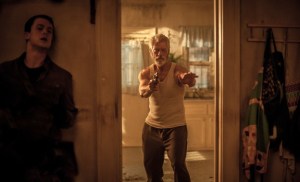 Don’t Breathe packs a punch and this is aided by how streamlined and clean the narrative proves to be, whittling down all unnecessary plot strands. I hated the Money character. He brought nothing to the burglary team besides perhaps some muscle (and a firearm), but I was worried that the movie was going to drag out his inevitable demise. Clearly Rocky and Alex were going to be the main participants and that meant that Money was the most expendable, and given the small number of characters, I worried he wouldn’t be given his merciful end until long into the movie. Well Alvarez must have heard my worry because Money is killed very early on, sparing the audience from dragging out the inevitable. I was appreciative but it also raised the stakes with the two remaining characters because now nobody was obviously next in line for death. A dead Money actually proves more useful than a living Money for the characters. I also appreciated that the movie didn’t dawdle when it came to setting up its trio of burglars and their goals. They’re breaking into the Blind Man’s house at about the 15-minute mark. There’s also no concerted effort at layering in larger social commentary. The economically depressed Detroit setting works to communicate the desperation of the characters, their desire to escape their trappings, and it also provides a tidy explanation for why the Blind Man can drag an unconscious girl by her hair down the middle of the road without alarm (it’s the opening image, so chill spoiler-phobes). This is not a movie that has larger things to say about The Way We Live Now, and to pretend otherwise would be a waste of valuable time. Also, having three white characters serve as the social commentary for Detroit’s ailments would seem rather tone deaf and ill advised.
 I think if the Blind Man had been a complete innocent that the movie would have been even more interesting as it forces the audience to test its loyalties and choose sides. As my friend Ben Bailey said upon leaving the theater, once they introduce a third act twist involving the Blind Man’s true goal, he ceased having any sympathy and “just needed to die.” I’ll concur mostly, but man I fell out of favor with our trio of young burglars and the best way I can explain is by making an analogy to the Howie Mandel prime time game show, Deal or No Deal. Contestants would randomly choose briefcases hoping that they contained low amounts of money, furthering the odds that their briefcase would contain a larger and joyous amount. It’s really just a game of odds and averages. It’s mildly fun but with every contestant there was a breaking point for me, a point where they really should have cashed out but instead chose to go forward against unfavorable odds. Once a contestant crossed this imagery point of no return in my mind I was rooting for their downfall (probably to just confirm that I was right all along). Horror movies are the same, and once the main characters make too many stupid decisions, then my sympathies generally gravitate elsewhere. With Don’t Breathe, the young characters have multiple opportunities to escape the house but make too many bad choices. They want to keep the stolen money above their own lives, and after the third missed chance I felt my loyalties wavering. Their first mistake was when they were casing the man’s house in broad daylight and see him walking his dog. Hello, here’s a golden opportunity to break into the home where you know he and his pooch will be absent. Why wait when they’re both back at home and needing to be dealt with? If the Blind Man had been an innocent, or even if they had simply omitted the insidious third act twist, I would have been rooting for this visually impaired war veteran to smite these punk-nosed kids but good.
Earlier this year Netflix debuted Hush, a home invasion thriller featuring a deaf protagonist. Now we have Don’t Breathe with a blind man trying to thwart home invaders. Let’s continue this trend: Don’t Taste, about a man that has to flick his tongue out to sense his hiding home invaders, or Don’t Smell, a pulse-pounding race-the-clock thriller where a scent-disabled man must match wits with attackers while his home, unbeknownst to him, fills up with carbon monoxide. It’s an easy punch line but credit Don’t Breathe for taking its potentially silly premise and treating it with deadly seriousness while still knowing how to have fun with its audience. There are several moments designed to get an audience to jolt or groan, and it all contributes to a skillful, above average experience at the movies that wears down your nerves. The film is terrifically tense, well developed, well paced, and not too stupid, veering in new directions and upping the ante with new twists to amplify the stakes. If you’re looking for a solid way to close out was has been an otherwise mediocre summer movie season, give Don’t Breathe a chance, sit back, and try to keep up with the fun.
Nate’s Grade: B+
Share this:

Lights Out (2016)
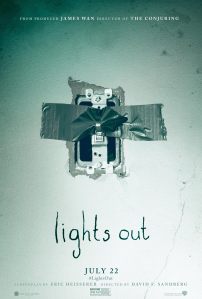 When it comes to horror, concept is king, but what’s just as important is fully developing that concept to meet its potential, and that’s where Lights Out succeeds. This is a low-budget horror movie that taps into a primal fear of the dark with a supernatural entity named Diana that can only be seen outside light sources. Thankfully, director David F. Sandberg smartly thinks of fun and interesting ways to play with this concept, like Diana disappearing in bursts of muzzle fire and a frantic, life-saving use of a car alarm. There’s a great suspense sequence where an off screen light from a flickering neon sign, switching off and on steadily, sets up audience expectations and lingers, drawing out the fear. The editing is terrific. There’s also a surprising subtext tackling the issue of mental illness and depression, as Diana, the malevolent spirit tethered to Maria Bello’s character, only seems to appear during the rougher patches of her life, and Diana fights against Bello getting “better” which weakens her existence. Theresa Palmer (Warm Bodies) settles in as a capable heroine that genuinely cares for her younger brother in danger from her mother and her “friend.” I cared about the people in this. The movie also subverts some genre clichés and treats its handful of characters with credibility. While the very end leaves some questionable final statements on mental illness, Lights Out is an elevated B-movie that takes its fun premise and executes it with aplomb. It’s worth 90 minutes in the dark.
Nate’s Grade: B


 nathanzoebl
You must be logged in to post a comment.