Blog Archives
Don’t Let Go (2019)
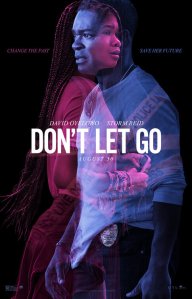 It’s a time-displaced mystery where two people, a police detective (David Oyelowo) and his teenage niece (Strom Reid), are trying to communicate across space and time to prevent a personal tragedy, namely the niece’s eventual murder. He’s two weeks ahead time-wise and making use of his advanced knowledge and her insider info to better understand what went wrong that fateful night. If it sounds a bit like 2000’s Frequency, featuring a father and son across the decades with a ham radio, that’s because it’s pretty much Frequency. No matter, this is the high-concept stuff of fun, clever structural gamesmanship, tapping into the past and future to solve a crime. Writer/director Jacob Estes (The Details) has a good first draft but the script needed more work. It starts off rather slow, takes more time than needed to establish its rules, and even after those rules are somewhat hazy, like when Oyelowo gets a download of new memories from his future self. To say the story gets a bit convoluted is an understatement, and the ending feels more like a rush to a finish rather than a carefully planned conclusion. The best asset the movie has is the relationship and performances from its stars. Oyelowo is a man rushed against an impossible task, and his fevered and harried performance does much to communicate the burden placed upon him. Reid (A Wrinkle in Time) is very good as an inquisitive teenager who has to process the looming danger that hangs over her head, plus just being a teen girl in L.A. Both of these actors are at their best when they’re together (via magic phone calls; are texts not magic?) and pushing each other to succeed. There’s great potential in the unlikely partner dynamic with them as well as a resonating personal motivation to drive the movie. I just wish Estes and the filmmakers had slowed things down and given their setup more thought and experimentation. It kind of goes in rather predictable and mundane directions, including having a super killer that seems anything but. Don’t Let Go (a painfully generic title destined to be forgotten) feels like it could have worked a limited run miniseries, or, barring that, a better paced and developed film.
Nate’s Grade: C+
Share this:

The Peanut Butter Falcon (2019)
 It’s a beguiling little buddy movie about a wrestling fan with Down syndrome (Zack Gottsagen) escaping his care facility, joining forces with a runaway screw-up (Shia LaBeouf) in over his head, and the nursing home assistant (Dakota Fanning) looking to find her charge so they can all sail down the river and meet an old wrestling coach (Thomas Haden Church) who may or may not exist. It’s an episodic journey that hearkens to Mark Twain and 90s indie cinema with its unorthodox family dynamics. The real pleasure of the movie is watching LaBeouf and newcomer Gottsagen bond, whether it be building a raft, channeling larger-than-life wrestling personas, running away from a vengeful criminal (John Hawkes), getting baptized by a blind man, and simply finding time to become friends. It’s one of those “journey, not the destination” films because by the end The Peanut Butter Falcon is nice but rather unremarkable. It’s amusing and sweet but the advertising was filled with heightened exclamations such as, “The sweetest damn film of the decade.” As I sat in my theater, I was wondering if there was something wrong with my ticker; it wasn’t exactly feeling too full from the onscreen proceedings. It felt like there were core elements here that could have been further built upon, further developed, to turn The Peanut Butter Falcon from a relatively good movie into a great one. It’s well acted and the photography of the South can be gorgeous. LaBeouf (American Honey) is genuinely terrific and carries the movie on his back as a beleaguered soul still wounded from personal tragedy. The way he becomes the biggest supporter and advocate for his new friend is heartening without feeling overly trite or saccharine. However, by the end, I didn’t feel too uplifted or moved by the accumulative adventures. I enjoyed myself, but much like a Twain story, it’s more the teller than the tale, and by its winding conclusion I felt like there was too much left behind unexplored.
Nate’s Grade: B-
Share this:

Dark Iris (2018)
 i71 Films is a small collective of filmmakers that came out of nowhere in 2016 for the Columbus, Ohio 48 Hour Film Festival, a yearly timed filmmaking competition, and won several awards. They’ve been flying ever since, and the fact that within two years of essentially being a collective they had a full movie out and available on services like Amazon Prime is ridiculously impressive and inspiring. This is a company that can hustle like few others. They have several other projects in development and I doubt we’ll see them fade from the film community any time soon with the momentum they’re building. With that said, I peeked into their first feature, 2018’s Dark Iris, whose cover looks like something out from the Underworld universe. The description made me think I was in for a Matrix-like sci-fi action thriller of meta-human combat. It’s a genre thriller that doesn’t fully seem comfortable with being a genre thriller, downplaying the elements that would separate it from the pack, and falling back on rote characters, rote action, and rote twists. It’s proof that i71 can make a disposable action movie, but disposable is not necessarily the same as good.
Iris Black (KateLynn Newberry) is a waitress with a bad boyfriend, a creepy boss, and a mysterious woman (Rebekah Hart Franklin) stalking her who may or may not be her long-lost sister. People around her keep winding up dead in ritualistic murders that she seems to know nothing about. The FBI (Marylee Osbourne, Jose W. Byers) begins looking into the unassuming barista that might be more than she seems. Little do any of them know that a secret government program named the Hyde Project gifted 13 individuals with advanced DNA and embedded technology that made them superior hunters. It also made them killers with killer urges. A pair of MI6 agents (Kyle Hotz, Jesi Jensen) is tracking down the living super soldiers and killing them one-by-one, and they believe Iris is their last target.

Look at all these characters fighting our literal lead (in far right) for literal space.
Dark Iris could instantly improve by pruning its overpopulated cast and narrowing its focus. There are far too many characters to keep track of without being given better identifying characteristics. We have Agent Fry, Agent Roman, Agent Dillion, Agent Mooney, Agent Lee, Agent Lance, Agent Adams, two MI6 agents, their boss, his underlings including Simone who has more pictures on the IMDB page than either lead actress, Iris’ friend and fellow put-upon waitress, Iris’ friend’s mom, Iris’s bad boyfriend and bad boss, a coroner, and a team of masked mercenaries, and all of these people are introduced within twenty minutes. That’s before a hilariously gun-toting reverend shows up too. I challenge anyone who watches Dark Iris to tell me what characters were named what and what they can recall about identifying characteristics for those characters beyond physical distinctions (this guy had glasses). Yes you can argue that these characters are not the main characters, with the exception of the MI6 agents figuring prominently, and therefore not necessary for character development or personalities to stand out, but if that was the case then why do we have so many of them eating away at the time that could be spent on the characters that actually do matter? There is a glut of unimportant characters jostling for positioning in this movie. It feels like something I’ve seen in some other local films and that’s the excuse to squeeze in friends and family into a project. The characters aren’t as important as simply cramming your pals into your movie. When you have masked mercenaries or characters intending to do little else but feature as extras, this can work. Every movie needs its background players. But when these needless side characters begin to overcrowd the movie, and literally overcrowding tightly shot location scenes at that, then you have a story problem.
The question begins to arise whose movie this actually is with the split attention, and I fully believe Dark Iris would have worked better if it was almost completely from Ms. Black’s perspective. A bunch of FBI agents picking up clues aren’t as interesting as a woman who is under investigation and begins to doubt her own sanity. By re-framing the entire film perspective to its heroine, Dark Iris would instantly have more mystery and shave away plenty of unnecessary information and characters. Her point of the story is the emotional core but also the most interesting perspective, because without extraneous side characters filling in exposition at every turn, the audience would be learning just as its heroine does, trying to piece together the clues or what is happening and who they could trust. It would also be a better move because Newberry and Franklin (Code 207, A Wicked Breed) are two of the best actors in the film. From a storytelling standpoint, refocusing to have Iris as the driving perspective better personalizes the film and gives it more emotional punch via a distressed woman whose life is falling apart. You’re not going to feel an emotional connection or loss for the dozen FBI characters and vague villains meeting in the shadows. You will feel for an ordinary woman who is going through hell.
Simply put, if you don’t have a lead character that you care about in a world of crazy killers, then it feels like the impetus was to make your own version of Wanted or any late-night action clone that confused style for substance, preening for perception. And if that’s the way you want to go, with a collection of killers, then we need people who have personalities that pop. I’m not saying they need to be broad Batman villains but it would help if more attention was made to consider how to make them full characters rather than Human Holders of Guns. Just because you slap a Russian accent onto one character doesn’t mean she now has a distinctive personality. The better way of doing this is to link characters to theme when possible. If this character represents a specific point of view, then you can better tailor them to that perspective, so that each character can represent something different. Dark Iris suffers because it’s not devoting enough time to the character with the most dramatic potential and it’s not devoting time to making its other supporting characters stand out or connect more meaningfully.
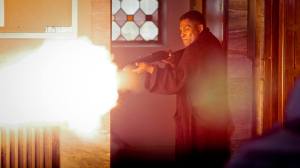 Much of the world-building of this story in the opening text amounts to nothing. We have super assassins with super biology mixed with super computers who then have super urges to kill because they feel like gods. The most we get from this is a lackluster fight scene and some easily duped people who are decidedly less than super. If you’re providing this sort of starting point, there should be some appeal to the dark side, the idea that embracing what makes you special is to fully live, coaxing our nervous heroine who doesn’t feel like she can become who she was born to be if it means succumbing to her baser impulses. There should be characters who present different points of view, who demonstrate the highs of their powers, and act as a temptation for Iris, but Dark Iris has none of this. The entire opening could be rewritten as, “A group of genetic experiments were created, then released, and now the government is looking to clean up its mistakes by eliminating the last living evidence of the project.” Boom, I just saved you multiple screens of text. One would think they would bring back the doctor who created the 13 super killers who then disappeared, but nope. There’s no reason for the science fiction elements to even be here if they are just going to be so readily forgotten and inconsequential.
The action, when it does happen, can be pretty underwhelming. I was willing to forgive the low budget if the filmmakers utilized ingenuity to their advantage. There’s a cat-and-mouse moment in a church, where one character is hiding behind pews, and I was thinking the movie would make use of drawing out the suspense, making smart choices with its shot selections to play with the distance, using sound as a useful tool to maximize suspense. None of this happens. Instead the character pops up and starts firing. Much of the action consists of two people at opposite ends firing guns at one another. The action isn’t tailored to locations or character skills and lacks organic complications to change things up. When the movie does focus on its fight choreography, the camera is so close to the action and the editing is jumbled that it’s hard to even understand what is going on. There was one moment where two people were fighting in the background and somebody got stabbed to death, but I only knew this because of an additional “stab/dying” sound effect that communicated what the scene by itself left vague. If you have the time to showcase a fight, wouldn’t you want to devote a shot for the audience to savor one character triumphing over another, especially if it’s good guy versus bad guy?
I have a theory to possibly explain the slapdash nature of the action and I think it amounts to simply running out of time. The production for Dark Iris has professional lighting (occasionally overdone with certain looks, like a set of window blinds that must be behind the brightest Bat signal) and cinematography. However, I started noticing that many of the scenes consisted of a lot of only two angles alternating, like the filmmakers only had enough time for two shot setups and had to forgo more coverage. There are dramatic reveals that made me wish I had a closer shot on a person’s face to watch their response, or some awkwardly framed angles that made me wish the characters moved to different blocking or there were more options how to visually compose this specific scene. It feels like they only had so many selections to use because they ran out of time. There are more shots and coverage of people arming themselves for battle than typically the battle itself; that equation should be reversed. If the production knew it was limited with its time and locations, I feel like there are clever workarounds, namely thinking through the stakes of each action scene, what its goal is, how to throw in new challenges, and how it can relate to the personal journey of the good guys and reveal the skills of the bad guys. Action doesn’t have to be just a bunch of people repeatedly firing guns and moving to a new spot to repeat the process.

The best pic I could find for Newberry for Dark Iris (2018).
The biggest asset Dark Iris has is its cast and there are three standouts. Newberry (Widow’s Point, Notes from Melanie) is a tremendous talent who provides a great emotional anchor for the story. She’s nervous and alarmed and confused by much of the movie and Newberry sells every scene in a manner that feels appropriate and even natural despite the unnatural circumstances. She draws your attention immediately and creates a connection even when her character’s purposely left in the dark. Another reason I wanted Dark Iris to re-calibrate is because I can see that Newberry has so much more she can offer as an actress, so it would behoove the movie to give her even more challenges. Newberry has risen to prominence in such a short amount of time in the Ohio indie film scene and with good cause. Look out for her name, folks, because she’s going to be famous and deservedly so. A real surprise was Hotz (The Penitent Thief, Operation Dunkirk) who, while not given material to separate himself from the pack, does so thanks to the innate charisma and presence of the actor. He has a weariness to him that tempers his scenes of violence and contemplation. He’s deserving of his own starring action vehicle. And finally, we have Dan Nye (Harvest Lake, Bong of the Living Dead) who wins the award for doing the most with the least. He’s just another one of those many FBI agents, but he becomes the much-needed comic relief. He has a few offhand lines that made me chuckle, but he also gets a big hero’s sendoff, which is strangely played as a dramatic high-point for a character that doesn’t really earn that emotional curtain call. Nye has a fun nonplussed nature to him and little asides that can elevate more mundane moments.
Dark Iris is the first film from i71 Films, and it’s impressively assembled with professional-looking technical aspects and some damn good actors, as well as a story that has plenty of exciting elements, from super spies to special powers to serial killers to psychological disassociation. It’s got the potential to be a fun action thriller to showcase the skills of this up-and-coming production team, but unfortunately Dark Iris cannot fully tap that larger potential. It’s too cluttered with interchangeable characters, the focus needed to be tighter, the action needed to be more distinguishable and given more consideration, the mystery is a bit predictable (the movie is called “Dark Iris” after all and the tagline says she has a “dark secret”), and the story of who is doing what is kept rather vague or undeveloped, as if the filmmakers themselves are silently acknowledging that the story is in service of just making a slick product. The pieces were there; a woman who can’t trust her own senses and memory, a group of elite killers who could tempt her into their amoral lifestyle, a chance at cool and memorable anti-heroes and rogues. The production doesn’t have the desire to embrace exploitation film elements, so we’re left with cool parts of a story that never quite assemble together into a satisfying and engaging whole. Dark Iris serves as proof that i71 Films has unbelievable hustle and determination. I hope their future endeavors also employ more attention to storytelling and making the best use of their available resources.
Nate’s Grade: C-
Share this:

False Flag (2019)
 Imagine the U.S. government is rounding up citizens, detaining them, and robbing them of their rights with the idea of installing a system of fear and compliance. No, it’s not the news on abuses of power via unchecked bodies like ICE, this is the plot of False Flag, a low-budget found footage action movie that happened to film in Ohio and is now widely available online as well as being carried on your friendly neighborhood Wal-Mart shelf. I congratulate them on getting their movie out there to the masses. The finished film has some narrative and execution issues but can still be an enjoyable experience, especially for genre fans of military thrillers. Strap in.
We open with a fringe conspiracy host as the frame story, telling his audience what they’re about to see is real footage compiled together to indict the U.S. government. In the small Ohio town of Madison, brothers Mark (Sean Mount) and Ash (Justin Rose) are feuding with old grievances and new, including Mark getting married to Stephanie (Olivia Vadnais). Ash has brought along his YouTube-eager pal Donny (Andrew Yackel), who is obsessed with recording everything for his fledgling channel. Then all of a sudden there is a high-pitched shriek, military vehicles roll into town, and citizens and protestors alike are rounded up and beaten. Ash, Stephanie, and Donny seek shelter with a conspiracy journalist (Jennifer Andrada) and some local militiamen armed and ready to combat what they viewed as the eventual tyrannical government takeover. Over the course of one long night, our people try and escape and get their story told.
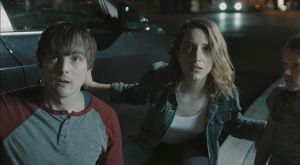 Before I go into further detail on some of the shortcomings of False Flag, allow me to highlight its positive aspects. This is a pretty good-looking movie for being a low-budget action thriller, and the cinematography has a nice color balance to many scenes. A race through a maze of school hallways at night is made all the moodier by the professional aesthetic, and many of the action scenes are pretty solid and staged well. The larger riot sequences and chaos that erupts are coordinated well with the background action giving way to whatever blocking our main characters need. The use of the military vehicles also helps lend to the credence of the “it could happen even here” reality. The acting overall is pretty solid without a bad performance. Surprisingly enough, writer/director Aaron Garrett (Foxcatcher) gives one of the more memorable performances as a local mechanic by day and would-be Rambo when called upon. The movie gets markedly more entertaining when he comes into the picture and is able to even the odds. He has a smoothness to his performance that grabs your attention. Yackel (Swamp Thing) has a pleasant presence and a squirrely demeanor that can be endearing. Andrada (Macabre Manor) stands out early as the on-location correspondent for the Alex Jones fringe TV show. She has an affectation that makes her talk very directly, quoting often, but it counts as a viable personality and a pointed perspective that helps butt up against others.
False Flag is the kind of movie that seems like its intended audience are the doomsday preppers and gun hoarders that envision themselves as a Hollywood action star waiting for the eventual government tyranny to give them their time in the spotlight. This premise can be done with skill but absent that it feels like a misguided wish fulfillment that encourages radical thinking in fringe people. I’m not saying the movie is irresponsible. I’m saying that False Flag exists in the same kind of universe of a “Jade Helm” takeover, where it only makes sense for the people who already think along these lines. At one point one character asks a prepper what’s in it for the government to perform its false flag operation, and he responds, “Global totalitarianism.” What does that even mean? Are the police acting in conjunction with the military? Have the military infiltrated the ranks of small-town police officers? It’s rather nebulous. All we know is that someone is taking over for vague reasons and there doesn’t seem to be enough of them.
Eventually it’s theorized that the government is doing this in a small-town to blame on terrorists and justify further military action. But… why is any of that necessary? The United States public has already accepted the idea of going after terrorists, especially on foreign soil and in the age of drone warfare. The U.S. military doesn’t need more public support to go after this already targeted target. If it’s to blame political activists as domestic terrorists, then this plan sure is sloppy. Nobody in Madison we see attempts to call for help, post their recordings, or even watch TV until seemingly hours after the start of the martial law, which is insane. It takes away from the seriousness if characters aren’t immediately trying to make outside connections. When the characters break into a school where prisoners are being detained in a cage (very reminiscent of our current concentration camps along the border) and there are NO GUARDS whatsoever in this room to watch. This is one incompetent government takeover. There is one moment that I had to stop the film and walk around my home because it simply astonished me (some spoilers to follow). The characters cut open a chain-link fence keeping people inside their detention cage… and the other people… stay put. I guess they realized what an important moment this would be to reunite the brothers and didn’t want to ruin it for the cameras. These people act with no urgency when they can flee, and I am still reeling from this moment.
 The very ending tries to flip the script but by that point it feels too late and too confusing. I’m at a greater loss what the whole operation was for, who benefited, and who was playing along. There’s some ire toward media manipulation but it feels too late to switch gears with who the recipient of the film’s condemnation is going to be. There’s a five-minute epilogue that throws everything in doubt and leaves you questioning what you saw, but I don’t know what the supposed agendas are and who is playing who and why. Good luck.
The dialogue is pretty plain, which is fine, but its use of exposition is heavy and rather inarticulate. Exposition is a tricky issue because any writer needs to make it as invisible as possible and think about what is essential and when it can unfold to the audience in a hopefully natural manner. There are easy ways around this like the ole answering machine message that fills in the blanks. Here is a sample from about a half hour into False Flag after the first big riot with police:
Stephanie: “…So your mom’s a doctor?”
Little Girl: “Yeah, so, she’s not home that much. But it’s okay I guess.”
Stephanie: “What about your dad?”
Little Girl: “John… I don’t know. He works for the government as a translator or something like that. He and my mom split up while I was young. We were actually on our way to DC to meet him before all this.”
Stephanie: “Sorry.”
Little Girl: “Don’t be.”
Stephanie: “Do you have any brothers or sisters?”
Little Girl: “Nope.”
Stephanie: “Must be tough being alone all the time.”
Little Girl: “Not really. I grew up pretty fast.”
Stephanie: “I can see that. You’re a pretty strong girl. How long have you lived in Madison?”
Little Girl: “I know you feel like you have some responsibility to keep me safe or keep my mind off what happened but you don’t. I can take care of myself.”
This example stunned me with how transparent the exposition was, which forced characters to speak like they were more machines built to espouse helpful context. Real people do not blab everything about themselves in case someone may be watching who doesn’t know the key parts of their background. Real people do not talk like every moment is a job interview. The problem with False Flag is that there are too many scenes likes the one above, where characters vomit out the necessary info in such a transparently clunky way that it further breaks the film’s reality.
The found footage conceit provides more problems that are not addressed. Firstly, the nature of found footage means there has been a hidden editor and this is all the more relevant because the showcase for this footage is the Alex Jones-style show, which means someone has intended for it to be broadcast for an audience. This brings up the same questions of why the mysterious editor elected to install a narrative. Why is it important to set up these people like they are characters when the important parts, the government’s supposed false flag entry, is the big deal? Furthermore, why is this mysterious editor splicing in flashbacks from an earlier recording of the two brothers running around in a park? This was cleverly done in 2008’s Cloverfield but that’s because it was taped over a previously existing recording, allowing for the good times of a former relationship to sneak in for contrast. But if the intent is the broadcast and to highlight government abuse, why has the mysterious editor chosen again to bend toward a narrative?
 Then there are things that simply break the reality of the found footage conceit, enough that they took me out of the movie and I had to start cataloguing them. The general idea is that we have Donny with a handheld camera and Ash with a body camera attached to his ear like a Bluetooth device, but you better believe every scene has the characters adequately framed, which means Ash is awfully cognizant of how he needs to turn and tilt his head in order to get a workable camera angle from his vantage point. When the camera gets passed to other characters, why do they continue recording? Ignoring even that since the movie needs it to carry on, there are moments that shatter the illusion of found footage, like one of those park flashbacks where we see Mark run into a clearing to help his brother and he sets the camera down not on the ground but on… something. When we saw him running there was no rocks, no trees, nothing to be seen, which means I have no idea what this camera is resting on. The most egregious is a conversation where the camera literally racks focus as the woman is talking. She doesn’t move out of her position and it happens even before she turns around, as if the camera KNEW the attention should be on the people in the distance who Donny was referring to. If you’re going to go the found footage route, things like this cannot crop up.
As far as low-budget action thrillers go, False Flag can sate your moderately checked expectations. It provides some thrills and with a professional presentation and uniformly solid acting. The story is pretty threadbare and the found footage conceit feels too minimally thought through, serving a larger point that ultimately is muddled by its rushed and twisty delivery. I think this premise and even the found footage approach could have been a dynamite combination, but it required a bit more development and consideration. False Flag is not a bad movie and I admire much of its technical grit but it is pretty standard thriller stuff, which means it’s hard for it to distinguish itself against the glut of other low-budget direct-to-DVD action lining the catalogues of streaming and shelves.
Nate’s Grade: C
Share this:

The Farewell (2019)
 This was a wonderful movie that just warmed my heart while holding to a beautiful melancholy. That is such a rare combination, and at its heights, The Farewell made me think it could have been plucked from the halcyon days of 90s indie cinema. The strange-but-true story follows an extended Chinese-American family that discovers its beloved Nai Nai (grandmother) back in China has terminal cancer. The family has elected not to tell her the devastating news and will reunite under the auspices of a grandchild hastily getting married (they’ve dated for only 3 months). Our protagonist is Billie (Awkwafina), a struggling New Yorker who disagrees with her family’s deception. Her extended family is convinced she won’t be able to keep her emotions in check, and so every scene plays with a great deal of subtext, as just about every character holds the burden of keeping a secret that deeply pains them. It makes for some pretty emotional moments, as different characters hold more meaning to their words and would-be goodbyes, but the movie is ultimately rather uplifting and winning. The matriarch of all this attention, played by Shuzhen Zao, is a bossy, compassionate, and deeply lovable old woman who welcomes her family’s return. I smiled every time she affectionately referred to Billi as “stupid child” and after a while noticed my eyes were getting glassy. Awkwafini, in her first stab at dramatic acting, nicely sells her tumult with an understated grace. The characterization achieved by writer/director Lulu Wang (the real-life Billie) is generous and honest, providing worthwhile moments to the larger family and giving them perspectives so while there is conflict nothing ever gets too preachy or stagy. Speaking of that, Wang films many of her scenes with an almost static camera, allowing the scene to unfold in front of us as if we’ve dropped in on these people’s lives. The film is about 80% Chinese subtitles but the story is really universal and deserves to be seen and celebrated. The Farewell is a terrific antidote to the summer blockbuster season and it left me thrilled to find a small little movie that could remind you again of the powerful pleasures of simple, sharply written storytelling (also stay tuned for the twist ending of the year in the credits).
Nate’s Grade: A
Share this:

Huckleberry (2019)
 As I’ve been more involved in my local film scene, I’ve gotten to know and befriend many good people and creatives that are following their dreams. My long-standing belief is that any movie is a miracle given the enormous undertaking and collaboration it requires, especially if it’s through the often arcane and contradictory gatekeepers of the studio system in Hollywood. Fortunately, writers and directors just gather what resources they can and make their movies on their own terms rather than waiting. I’ve found that these projects could benefit from sincere and respectful film reviews, and that’s something I can actually contribute to. As with other Ohio film projects, I do happen to know a few people involved in key areas with the movie Huckleberry (currently available for free on Amazon Prime, folks), but I promise to be as objective as possible with any constructive criticism and discussion. It’s an intriguing 77-minute feature with an admirable presentation, good acting, and some plotting missteps that hold it back from hitting its full potential.
In Ohio 1999, Huckleberry “Huck” (Daniel Fisher-Goldman) is trans and living as a man, with the occasional hormone shot via the Internet. He’s living with a foster brother (Yang Miller), aggravating various neighbors and authority figures with his attitude, and not-so-secretly crushing hard on his friend Jolene (Sarah Ulstrup). The problem is she already has a boyfriend, an abusive drug-addict named Clint (Justin Rose) who Huck cannot stand. One night it’s too much for Huck to bear, and he takes it upon himself to provide a reckoning for Clint. However, this confrontation doesn’t quite go as planned and an “unknown attacker” gets back at Huck.
 The story of a hero pulled into the spiderweb of a wronged woman in need of protecting is the setup of many an indie thriller and classic Hollywood noir. It’s the scenario of the character getting in over their head and learning that their preconceived notions of the world were naïve. Huckleberry borrows elements from that familiar setup. The direction of the story is very much tied to the lengths Huck will go to protect and/or win over his crush, Jolene. You think this will ultimately create a series of spiraling events that get worse and worse, but that’s also not quite what happens.
Huck is our plucky protagonist unafraid of much, including kissing his crush as his school video project (under different circumstances this act, and his insistence on sharing it to the class knowing Jolene’s potential discomfort, might come across more as creepy). The story does a fine job of establishing a one-sided relationship between Huck and Jolene. She does care for her friend but she’s clearly hesitant about anything beyond platonic, but she doesn’t use Huck’s obvious feelings for overt scheming. It would be easy to have her slide into femme fatale territory and manipulate Huck to take out Clint, but that doesn’t happen. Huck, seeing himself the champion, takes it upon himself to target Clint, and this unrequested intervention actually upsets Jolene and harms Huck’s relationship with her. That was a nice development. By choosing to have Huck incapacitated for a decent portion of the film, Jolene steps into the spotlight. The change in her character is a tad rushed, having to get to a place where she welcomes Huck’s white knight compulsions, but I feel writer/director Roger Hill (Flying Paper) has put together sufficient reasons why she would make her final decision.
This is a low-budget movie that doesn’t feel like a low-budget movie thanks to the admirable professionalism of its presentation and the occasionally stirring cinematography. There were a few moments that made me go, “Wow,” which is exceptionally rare for low-budget films. The photography by Jon Coy (The Turn Out) is gorgeous and makes a painterly use of light. The sets are impeccably chosen as well, making fantastic use of the decaying parts of small-town Ohio to provide a sense of ambience and time and place. There are some judicious shot selections as well, often tethering the camera to a moving object like a car. There’s one shot I thought was really well done where the camera is attached to a shopping cart and we watch Huck place different items inside, each contributing to a bigger, sinister purchasing picture of what lies ahead.
 Another sterling facet of Huckleberry is the acting overall. Ulstrup (The Dance of Amal) is a future star waiting to happen. There are several moments that live or die depending upon her line delivery, and she always succeeds, elevating the scene. A tearful confessional late in the movie had me spellbound. She comes across as so natural from scene-to-scene, whether it’s her awkward uncertainty of what to do with her friend’s feelings for her or the hurt and self-loathing she swallows in her abusive relationship. Ulstrup is excellent at hiding the affectations of acting and digging into her character. Fisher-Golden (The Emma Agenda) has an interesting presence and can definitely play to his character’s strengths of know-it-all condescension and coiled anger. The actor’s best moments are when he’s trying to contain the emotions that will spill out. Rose (Super Dark Times) does a fine job conveying a grungy, desperate lowlife who probably knows he’s never going to be cut for a better life than the one he’s eking out. Rose could have gone on autopilot as the “creepy abusive boyfriend” role, but he establishes a, for lack of better word, integrity to the character that reminded me of the better character actors. I could see Scoot McNary (Argo) in this part, and that’s a fine comparison. I want to single out one performer for making the most of it. Consider the No Small Parts Award to Dennis Lee Delaney (Departure), who plays the school principal who clearly has contempt for Huckleberry, referring to him by his feminine birth name. Again, it’s the kind of role that could be a caricature, but Delaney underplays the scene, bringing a greater sense of realism and disdain. At the end of his one scene, I found myself congratulating the actor and hoping casting directors would see this.
Where the movie miscalculates is once Huck is attacked by an unknown assailant. The aftermath takes up maybe a half hour and far too long, which puts the main character in the penalty box and relies upon the established supporting characters to carry the film. This can’t quite work because the supporting cast, with the exception of Jolene, have just existed to serve the protagonist. They don’t feel like they have a real inner life of their own. This makes it even more challenging when the narrative transforms into a “who dunnit?” mystery. The obvious first suspect is Clint, but the movie telegraphs he is not the perpetrator and makes you suspect everyone else, so we’ll get scenes of people acting mysteriously vague and peculiar to keep up the air of mystery. When a character responds to the news of Huck awakening with a look of worry, is that person the culprit? When another character ominously alerts someone that Huck has awoken, it plays like a warning, but ultimately most of these are misdirects. The narrative cannot sustain this extended guessing game because we haven’t gotten to know the supporting characters to the point that we may suspect them. When the eventual culprit is revealed, I literally said seconds before, “Wait, who is this character?” The reveal lacks the impact needed for a mystery because the eventual culprit was so incidental as to be forgotten. Once revealed, I felt like Huckleberry found some renewed life, because now this person had a secret to keep and would they be caught? How far would they go to keep it? If the film were going that route, I would reveal the perpetrator with no mystery early to better luxuriate in that tension of the consequences of this violent act. However, the emphasized mystery doesn’t allow for that, so it places the film in an awkward holding area with characters unable to carry the narrative burden.
 There are a few problems with setting the movie in 1999 and one of them is the treatment of being a trans high school student, an important dramatic aspect that doesn’t feel fully explored. Early on, when the movie establishes that our lead character is a trans man, it got my attention a little more, as this is not a perspective often showcased in movies during this time period. I thought it would be a way to make a neo-noir thriller or coming-of-age indie fresh. The problem is that nobody in this Ohio rust belt high school views Huckleberry being trans as any big deal. The only push-back comes from his principal during their hostile meeting. That perspective might work in 2019, after greater trans representation and general cultural understanding, but it feels inauthentic to a Midwestern world of twenty years ago. As somebody who was in high school in the 90s, in Ohio, I can say that any trans student living openly as they felt comfortable would have met some degree of resistance, name-calling, and bullying. The fact that everyone in this high school is so accommodating and understanding is remarkable and remarkably unrealistic.
This also opens up the question over why the filmmakers elected to have Huck be a trans man at all. It doesn’t affect the story in any significant way, beyond maybe one neighbor’s added fury when catching his teen daughter intimate with “another girl.” I suppose you could make the argument that Huck is trying to stake his claim on his identity, on this town, and doesn’t care what people think, but does the character need to be trans to convey this? You could also argue just having the lead character be trans is a positive for diversity and simply having better representation, and that’s true. Part of my disappointment stems from the fact that the story had this really interesting perspective and as executed it feels too peripheral. Huck could just have easily been a cis lesbian and achieved the same effect, or even just been a straight cis male. If you’re going to make your protagonist a figure from a marginalized minority group, often the target of bullying and worse, it feels like a narrative disservice to not make that perspective known. This is a very general analogy, but imagine telling the story of an African-American WWII soldier integrated in the armed services and having every person be oblivious to their race and the potential conflict.
 Huckleberry clipped along nicely and had many attributes that I admired, from the crisp photography, professional use of visuals and locations to enhance the story and mood, and the overall good acting. The story is only lesser because there are certain choices that don’t feel as best capitalized, from the main character being trans to the inclusion and overlong attention on a mystery that feels like a diversion at best. Also at no point does any character explain why Huckleberry wants to be called Huckleberry, which seems like a moment tailor-made for 90s-centric indie cinema. The story elements were there for an even more engaging, compelling, and unnerving story but it can’t quite maximize that potential. As a result, Huckleberry is an enjoyable and sincere little movie that was knocking on the door of being great. It’s worth your 77 minutes and I think it points toward bigger and even better things for Hill and Ulstrup in particular.
Nate’s Grade: B-
Share this:

High Life (2019)
 The one movie more of my friends have cited as their favorite of 2019, besides Avengers, is a small little indie that left theaters as quickly as it arrived. High Life is a challenging, provocative science-fiction movie by French director Claire Denis (Let the Sunshine In), making her English-language debut. High Life is set in the deep of space with a crew made up of prisoners serving life sentences. We follow Monte (Robert Pattinson) along with a baby and we’re left to determine how they got here. The following two hours will explore the hazards of space, the fragility of man, and the weirdness of French people.
I knew I was in troubled territory when the movie spends a whopping 18 minutes (18!) to set up that Pattinson is alone in space with a baby and everyone else on his crew is dead. I understand establishing a mood, a day-to-day sense of the grunt work operations this guy has to do to stay alive, but this is simply excessive latitude to convey the same information. It was a bad indication of what was to come.
 Fortunately, the movie picks up as we transition into the flashback of life with the crew and the growing anxiety and tensions that would seal their doom. I was waiting for some taut tension. We know they’re all prisoners serving life sentences so I also expected some combustibility with them trapped, together, for years on end, and subjected to strange experiments. I expected some prisoners to lose their minds into madness and others to be distraught and others to be excitable. What I wasn’t expecting was that everybody would simply be masturbating the whole time or raping each other. There’s a hard turn into explicit sexuality and the movie starts to resemble a more insidious soft-core flick. There’s a masturbation room though its overall importance escapes me. Juliette Binoche’s character is performing fertility experiments and has her eyes set on a specific DNA combination. This leads to some bizarre and almost unintentionally hilarious moments where she stalks the halls with syringes of sperm. The psycho-sexual aspect of the movie feels like it should be more important but Denis doesn’t seem to be articulating its importance, only using it as an excuse for characters to act on their carnality as if this is commentary on the human condition alone and without context. “Sex is the only freedom,” she says, as if this is a unique observation.
I suppose there’s the concept that these people have been disposed of by larger society, jettisoned out of the solar system in the name of scientific discovery but perhaps just as a means of cleaning out Earth’s prison population. These people are all atoning for something, or so we’re told, and you would think the existential solitude and knowledge that they will likely never see Earth again would be a prime starting point for some really interesting and introspective examinations on these people, their conceptions of themselves, and their actions and place in the universe. We get little glimpses of this but mostly the other characters are kept at an unreachable distance; they’re strangers to the audience, so when they start being dispatched one-by-one the emotional response is simply that of indifference. Another character we never got much of a sense of is gone. Oh well.
 The characterization by Denis and her four other co-writers (five people wrote this!) keeps everyone underdeveloped with the exception of our protagonist, who seems to be the model for the character journey the movie was setting up. He’s trying to live a life free from urges but ultimately comes into care of a little baby. Their father/daughter survival could be the stuff of great drama that pushes his character into uncharted realms. Unfortunately, once Denis has killed off everyone the movie zips ahead to the baby now as a teenager and then it abruptly ends in what seems like a suicidal confrontation of oblivion that could have just as likely happened at any point. It feels only so much an ending because there are credits afterwards.
This is going to be much more metaphorical and subtextual science fiction, so I was waiting for the eventual themes to emerge, and I just kept waiting. The first 18 minutes is watching Pattinson play take-your-daughter-to-work-day on the space ship. The next hour is almost a mad scientist drama with a bunch of expendable characters meeting unfortunate ends. There’s also a lot of sexual violence here. Once we get caught up in the timeline, the last twenty minutes is pretty mundane until one final fateful decision that we established earlier is the physical equivalent of suicide. That’s about it. It feels like pieces of more meaningful ideas and conversations are left as scattered detritus, demanding that an audience not just put the pieces together but also project their own meaning onto that puzzle. I don’t mind a movie that makes me work but there’s a difference between being ambiguous and being empty and vague. I don’t know what Denis and her movie is trying to say and it’s generally hard to follow when we don’t get to know people and situations before jumping around in time. There’s definitely a vision here, but to what?
High Life often looks gorgeous, with large swaths bathed in moody lighting and artfully styled shot compositions. A masturbatory “dance” into something dream-like feels like what would happen if David Lynch tried his hand at erotica. The performances are rather blank as if Denis had precious little to explain about their characters. There’s a stretch where they’re all highly sedated as well, which only makes them seem like slightly sleepier versions of who we have seen up to this point. Pattinson has really impressed me with his recent indie output working with eclectic artists, especially his live wire performance in 2017’s Good Time as a hapless criminal trying to get out of an increasing mess. Pattinson burrows into his character’s monastic aim in an attempt to tap into something deeper. It just isn’t there, so he looks longingly at the stars, thinks furtively about his past, and goes through his routine. These people too often feel like vacant shells of human beings, zombies walking the corridors in habit. The only other actor worth noting is Binoche (Ghost in the Shell) who gives it her all, especially during a masturbatory sequence that reminded me of a riding bull. Get ready for lots of extreme closeups of her pubic bone as well.
 High Life feels like Annihilation in space but even lacking that movie’s attuned sense of purpose about mankind’s relationship with nature and its general indifference to us. It fails to come together for me into something more cohesive or engaging or just even understandable. This is operating more on a metaphorical level than a hard science level, though the asides with black holes are depicted with intelligence. Mostly I was watching the movie and I kept waiting for the actual movie to kick in. There’s a dispirited collection of ideas and images and a general lack of hurry to get around to saying little with clarity. It’s frustrating because the movie has so much potential with its premise and setting and different narrative pieces, but ultimately it feels too lost in space when it comes to larger meaning and substance.
Nate’s Grade: C
Share this:

Sword of Trust (2019)
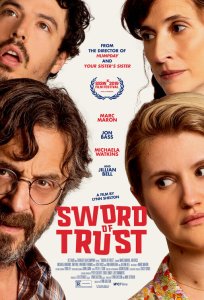 Writer/director Lynn Shelton is a filmmaker that has a habit of flying under the radar with her wonderful entries in the fly-on-the-wall hipster mumblecore sub-genre of indie dramas. The hilariously awkward Humpday punctuated insecure masculinity and was on my Top Ten list for 2009, and 2012’s Your Sister’s Sister was another laser-like focus on characters trying to deal with a lifetime of relationship secrets coming out. Both of those movies have been remade as French films too, with Humpday becoming 2012’s Do Not Disturb and Your Sister’s Sister becoming 2015’s Half Sister, Full Love (which sounds more like a porn title to my ears). Sword of Trust is one part mumblecore drama, one part screwball comedy, and a bit of a lovely, shambly mess.
Mel (Marc Maron) owns and operates a pawn shop in a small Alabama town. He’s used to losers and lowlifes and junkies coming through and giving their sad stories. Enter Cynthia (Jullian Bell) and Mary (Michaela Watkins), a gay couple looking to make the most of a strange inheritance. Cynthia’s grandfather gave her a Union sword and a story that says this sword is proof that the South did not lose the Civil War after all… somehow. The trio, along with Mel’s dimwitted shop employee Nathaniel (John Bass), hatch a scheme to try and con an underground Confederate memorabilia group for all its worth.
 The real draw of Sword of Trust is the low-key comic sensibilities of the cast. As I wrote previously in my review for Your Sister’s Sister: “There’s a tremendous naturalistic ease the film exudes, with the actors so familiar with one another that they truly feel like family. When I have well developed characters, and actors who seem so knowledgeable of their character’s tics and flaws and secrets and smallest details, I could honestly listen to them talk for hours.” Sword of Trust (written by Shelton and Michael Patrick O’Brien) probably ranks a distant third in the three Shelton-directed movies I’ve seen, but her skills and care are still evident in characterization and empathy.
Maron has matured into an impressive dramatic actor thanks to Netflix’s wonderful wrestling series GLOW. He has a natural sad sack aura to him, as well as a brittle fuse that’s in danger of being set off at any moment. The character of Mel seems tailor-made for him, and I wouldn’t put it past Shelton that it was (she directed several episodes of GLOW as well as Maron’s 2017 comedy special). He’s the biggest mystery of the movie and we get hints early on in a disarmingly dramatic moment when his ex-girlfriend Deidre (Shelton herself) tries getting collateral so she can secure a job. She professes that he knows “she’s good for it,” and that this time will be different, and the way the two of them seem to circle a larger conversation, one filled with hurt and heartache, is a masterful example in writing subtlety and subtext. We’ll have their personal connections revealed later in the movie, but this scene serves as a tantalizing clue that there’s more to this movie than a group of oddballs in a pawn shop. It’s the first stab at drama and it’s quite effective, and Shelton can be one hell of an actress too. She leaves an impression as a character you want to get back to, and sadly the movie keeps her at a distance as we learn more.
 The rest of the movie doesn’t quite tap into this vein (more on that below) but the agreeable camaraderie of the characters is a major selling point. Mumblecore movies are typically character-driven and small observational movies that lean on broken people navigating their way through the world, pushing forward onto greater emotional growth by the closing credits. If you’re not a fan of these kinds of movies, then Sword of Trust might still prove appealing based upon the broader comedy elements and the wackiness that can come at a moment’s notice, like when a man at gunpoint instructs each hostage to dance in a different bizarre style. Otherwise, Sword of Trust is a movie that ambles along on its own gentle wavelengths, buoyed by the performances and interactions of its core cast. There’s an uneasy alliance between the foursome. Primarily this is with Maron and Bell’s characters, the two most significant players. Bell (22 Jump Street) is enjoyably sunny and awkward as a woman trying to make the best of a bad inheritance. It’s the most dramatic and restrained I’ve ever seen Bell, best known for loud-mouthed, course comic supporting roles. Watkins (Casual) is more a force to push her girlfriend into further action, and Bass (Baywatch) is kept as the goofball meant for easy ridicule as a symbol of preferential ignorance. He’s never more than a quick punchline, especially as he tries explaining his scientifically strained flat Earth beliefs.
They’re an enjoyable group and watching them bicker, jostle for leverage, and ultimately work as a team for common cause it sweetly entertaining. Everyone is trying to make the best of an unexpected situation, with each playing their part to try and capitalize on this strange money-making scheme. A lengthy conversation in the back of a truck bounces from character to character, each revealing further layers they feel comfortable now sharing. It’s the kind of enjoyable character beats that the mumblecore genre is known for, crafting relatable, interesting, flawed characters and watching them play off one another. There’s also plenty of comedy because of how the characters are drawn, like when Mel insists that an attacker stole his own screwdriver to use as a threatening weapon. This small comedic beat grows and grows as it almost consumes Mel so that even when that harried situation clears up he has to know whether or not it really was his own screwdriver. That’s a sly comedy beat connected to character. Shetlon’s film has an improvised feel but honed to a script that provides a necessary degree of discipline.
 Despite the amiability of the cast and the comedic potential of the premise, Sword of Trust doesn’t really rise above being a pleasant if minor hang-out picture. I feel like if it was ultimately about the characters then we needed a few more scenes where they can grow, be challenged, or simply share their conflicts and histories. If it’s going to be more a wacky send-up of willfully ignorant conspiracy theorists and anti-intellectuals, then I feel like the final act needed more complications and examination. Shelton’s movie settles into a middle ground trying to have the wacky sitcom shenanigans and the heartfelt, modest mumblecore character beats. It doesn’t feel like either side is fully utilized and explored to its best version. I enjoyed the characters and found the movie getting better as they opened up, especially Maron’s curmudgeonly lead with a guarded past. I also laughed some big laughs at the wacky hijinks of a dysfunctional gang working together to con a group of Confederate revisionists. There are moments that point toward the more studio-friendly, concept-driven version of this movie, like when the gang creates a cover story of them being romantic couples. In Shelton’s film this is a momentary gag and then it’s left behind, also because it occurs so late into the movie. You can see where the escalation of misunderstandings and trouble could make the film a broader comedy. You can also see the avenues where the characters eschew the broad comedy for more intimate, revealing conversations. The resulting film is enjoyable and solid, but I think it would have been better if it had chosen its preferred tone.
Sword of Trust (my fingers keep wanting to type Sword of Truth) is definitely a lesser but still enjoyable film for Shelton and her ensemble. It’s stuck in a pleasant but diverting hangout zone when it could have been more observational or broader and wackier. I was hoping for more of a send-up of the fringes who cling to rumors and disbelief in the face of overwhelming evidence to the contrary, whether it’s that the South legitimately lost the war or that the Earth is indeed round. Sword of Trust benefits from a group of actors who can smartly handle improv scenarios while still keeping things true to character. It’s an enjoyable 90 minutes just hanging out with these people, even if the film feels like it’s losing some of its momentum as it veers into its third act. While not as polished, there’s still enough to enjoy and recommend with Shelton’s latest, and she’s a storyteller that deserves an adoring audience.
Nate’s Grade: B
Share this:

Cadia: The World Within (2019)
 Cadia: The World Within (pronounced Kuh-Dee-uh) is a fantasy film that was made in my hometown of Columbus, Ohio and directed by an alumnus of my own college. 24-year-old Cedric Gegel (The Coroner’s Assistant) wrote and directed Cadia, which was inspired by a story he was making up to entertain 12-year-old triplets backstage during a theater show. He spent years revising and elaborating that tale and elected to make it a big screen adventure, and starring those same triplets in starring roles. He even attracted known actors like Corbin Bernson and one of the two Harry Potter twins. I attended the special Capital University screening before Cadia begins hitting festivals and seeking distribution. As I have in the past, I happen to know several people that were involved in this production, primarily behind the camera, and I promise to try and be as objective as possible in this review.
Three teenagers are dealing with the recent loss of their mother. Renee (Carly Sells), David (Keegan Sells), and Matthew (Tanner Sells) are now living with their Aunt Alice (Nicky Buggs) and their Grandpa George (Bernson). One day, a magic set of stones takes the kids to another world, Cadia, where they meet Elza (John Wells) shortly after escaping a monster. They learn there are dueling factions in this realm, and Tannion (James Phelps) wants one of the siblings to tap into an elemental power supply to rewrite the cosmos for the better.
 I’m going to caution that this review will likely sound more negative than I intend. I want to be supportive of local filmmakers and encourage their efforts, and any movie by itself is something of a miracle considering the countless people who work in tandem to bring together a vision. The people behind Cadia seem like genuinely sweet and thoughtful individuals who cared about the movie they were making. I wish them all well. However, it does nobody good to avoid constructive criticism where it’s warranted, because ignoring problems is unhelpful. The characters of Cadia might even agree with that sentiment. So, dear reader, let’s dive into what doesn’t quite work here and keeps Cadia from being more than the sum total of its many influences and good intentions. Much of the faults chiefly come down to the writing.
Fantasy stories are tricky because they need to be transporting but also accessible, otherwise they will feel like they’re being made up on the spot or like a private story that wasn’t intended for a wider audience (Lady in the Water, anyone?). With Cadia, the influences are easy to pick up on (Narnia, Harry Potter, Peter Pan, the Bible) but the rules and understanding of this new world feel too murky and unclear. It’s a magic world with… warring factions that are at war because… power? I never understood who just about anyone was and what their purpose served beyond allegiances. It’s too vague and the world feels too small and undeveloped, making it feel less a new world and more like a weekend excursion. What is the relationship between this family and the history of Cadia exactly as it comes to Grandpa George? Did this world come into existence with George telling the story and thus linking it to this particular family and giving them larger importance, or did it exist on its own? Why do some people have powers and what are the extents of those powers, the limitations, the costs of those powers? Is dead mom alive in this world or simply a ghost? Are there more potential ghosts? What started the factions? There are teleporting stones but are they direct portals or can they be manipulated? It feels like this should be of greater importance just from a novelty of how they can be clever (and cheap to execute). There’s one malevolent monster witnessed but otherwise it’s just a bunch of people hanging out in the woods. Too many of the too many characters are just sitting around, seemingly like they’re waiting for something to do. Cadia operates on a level that assumes you know what is happening or find this new world intriguing, but as a viewer it feels like you’re missing vital critical info to make that happen.
Fantasy world building is essential because the new world has to be teeming with interesting life and details, the stuff a viewer could immerse themselves within. Barring that, the fantasy details can be shaped and pruned to serve the thematic journey of a character, externalizing the internal. I thought Cadia was going here. It kind of does and kind of doesn’t. The central trio are dealing with their grief over their late mother, except when the movie doesn’t need them to. I thought the world of Cadia would present itself as symbol for the grief and anger of a character, luring him or her as temptation to reverse course and save dear dead mom, and therefore we would learn a lesson about healing and about facing loss. This element is present, yes, but “element” is the proper term; it’s not a theme or anything larger in plotting, it’s merely there as needed like any other sudden magic power that goes without explanation or question. Overall, the fantasy world just felt under developed in detail and scope.
 I was hoping for the thematic personalization because there’s a general lack of urgency when it comes to any looming sense of danger. For being transported to a new world, these kids take it all in amazing stride. Even after a long-clawed monster chases after them, the kids are so casual and nonplussed the next scene even as they have just barely eluded this monster. Nobody seems in a hurry to return home. We’re constantly told of warring factions but the only outward danger felt is from this one monster, and even when the kids are close their fear seems fleeting. The characters they encounter don’t present (immediate) danger, which makes the film feel rather loping and without conflict and danger. It’s lacking potent stakes. What’s stopping these kids from returning? What’s stopping anyone from anything? The world of Cadia is too plain and safe, which coupled with its undeveloped nature, only makes things less interesting. If the world doesn’t present interest, it can at least present a palpable threat, and Cadia does not.
Another miscue that hampers the stakes is that the film keeps cutting back and forth between the kids in Cadia and the adults on Earth. Why? Do we really need to see Aunt Alice having coffee with her friend while the kids are lost in a new realm? Do we really need two check-ins with Grandpa George to literally watch him put together a puzzle? Cutting away from the discovery of the magic world to watch characters do mundane things back home is detrimental to pacing and establishing a growing threat. Can it be much of a threat if the kids seem chill and we cut back to puzzle formation? Without a threat, without an interesting setting, and without a personalization toward one of the main characters, Cadia feels like a less-than-magical retreat.
The characters also suffer from both being underwritten and simply having far too many of them. The main trio of real-life triplets are left as archetypes; there’s the more introverted one (The Nerd), the more rebellious, aggressive one (The Jock), and the… girl (The Girl). Seriously, that’s her characterization. The other brothers get starting points on a scale to grow from but her characterization is simply not being the things her brothers are, and also being a girl. It’s not like the characters are running away from confronting the hard truth of death and Cadia will allow them to better process their grief, like A Monster Calls and I Kill Giants. Other characters talk more about their mother than the actual children of that mother mourning that mother. It’s difficult for me to go much further in describing the characters because once they travel to the fantasy realm their characterization gets put on hold as they encounter a slew of dull new people.
 There are several scenes where we introduce a group of new, personality-free characters. That’s the other necessity with fantasy, writing larger, expressive, and memorable characters. There’s a Lost Boys-esque group of centuries-old Cadia dwellers, but this group could have been one person, could have been twelve, because there aren’t differentiated characters within, only actors fulfilling space in the frame. This isn’t the fault of the actors. They just weren’t given material to work with. A way to establish a memorable character is through a memorable entrance or at least with significant contrasts. Cadia has trouble with this even as it presents characters on opposite sides of its vague conflict that is eventually resolved through platitudes about love that could have been reached at any time prior to the characters’ fortuitous arrivals. The narrative feels polluted with extraneous characters that exist for no other reason than to squeeze another actor onscreen. Characters should have a purpose for their inclusion and the narrative shouldn’t be more or less the same without their involvement. With Cadia, you could eliminate 80% of the characters and still tell this story. Do we need a lady in the river? Do we need two untrustworthy schemers to tempt the kids? Is the cousin needed? When the big fight arrives, with side-versus-side, your guess is as good as mine who they are, why they are important, and what they’re even doing here.
The dialogue is also heavily expository, where characters are tasked with asking questions or making statements so that the audience will know critical points of information. Characters talk in inauthentic manners, the kind of stuff that seems like they know an audience is watching. “I know you’re having a hard time dealing with mom’s death,” sort of thing. Or you’ll have characters talk so point-of-fact, like this exchange: “Who’s good and bad?” and then, “Well that depends on who ‘you’ is. Good and bad depends.” It’s pretty on-the-nose, but even ignoring that, the two sentences in response are redundant, conveying the same idea. Naturally exposition is going to be needed when establishing an alternate, living world, but when it feels like characters are going from person to person to only digest info because the plot demands it, then it feels less like a film narrative and more of a museum display guiding you to the next exhibit.
The acting is a high-point for the movie. The triplets all handle their first big screen acting job reasonably well and demonstrate future promise. My favorite was probably Carly Sells as Renee, which is even more impressive considering she has the least amount of material to work with of the three. She has a particular sense of poise that lends to better imbuing life to her character. Keegan Sells is at his best in the beginning as he’s internalizing his grief and frustrations. Tanner Sells has a nonchalance to much of the world, which can be funny. Bernson is a lovable grump that doesn’t feel too off from his father figure in TV’s Psych. He doesn’t have much to do in the film but he’s a welcome presence who feels glad to be there. Phelps (Harry Potter) and Wells (Piranha Sharks) do a fine job as the resident schemers, concealing their intentions. Brittany Picard (Alan and the Fullness of Time) had a nice ethereal charm even in brief moments as the departed mother Maggie. Why wasn’t she in more? If mom is potentially alive, or at least corporeal in Cadia, why isn’t that a narrative resource to be tapped for further drama especially as it pertains to acknowledging loss? I was most impressed by Buggs (Powers) who was the one immediately processing the emotions of grief. She sells her scenes with subtlety and grace. Another pleasant standout was Grace Kelly (Kill Mamba Kill!) as Jade, the school guidance counselor. She has a presence that grabs you, and the fact that she’s a Marine athlete makes me yearn for her to have a starring action vehicle that can show off a full range of her capabilities. She’s a breakout star waiting to happen, so somebody make it happen.
 The technical merits are pretty agreeable for being a low-budget feature, but there are a couple aspects that I think take away from the overall achievement. The cinematography is very limited in how it presents the scenes, which follows the pattern of master and then shot-reverse shot. There are very long running takes with a swooping Steadicam that centers the action. It can be impressive at points but at other points, as the scene carries on without variation, I began to wonder if this was continuing because, frankly, that was all they had to work with. The editing can also be curious with certain choices. There’s a scene where Aunt Alice runs out of the coffee shop, having learned of the children’s disappearance. Instead of the scene ending there, the moment holds for another four or five seconds on Jade’s reaction, which is fine considering later revelations. But even after that we hold on the scene and a waitress comes to ask about taking away the coffee cups, and Jade says, “Yes, you can take them.” Why was any of that necessary? The scene just carries on awkwardly after its import has literally left the building. During the family dinner, the camera circles around the table for a full minute while they gab and reach for the food. Did we need a full minute of them vamping while eating? Is this included simply because they wanted to maximize the amount of Bernson screen time they could? The costumes are pretty standard fantasy garb except when they’re not. During the big showdown, there are characters dressed in flowing robes and tunics, and then there are others just in ordinary clothes. There’s one woman in like a polka-dot skirt and it just directly draws your eye. This incongruity almost made me chuckle, and then polka-dot skirt lady is given prominence in the fight too. It’s unfair to be too critical on any technical limitations of a low-budget film as long as they don’t impede the vision and intent of the filmmakers, but these decisions occasionally took me out of the movie.
I honestly feel conflicted about writing this review because I knew it was going to have some significant criticisms. It’s genuinely impressive that a film like Cadia: The World Within got made, attracted known actors, and pulled it all off on a low budget with many artists who were eager to sink their teeth into a bigger project. I definitely think there is an audience for Cadia and that there will be plenty of people that genuinely enjoy the movie on its own terms. Afterwards, at the screening, one such fan asked about the possibility of a sequel (Gegel respectfully demurred). For me, the fantasy world felt diminished, opaque, and too often as ordinary as the “normal world.” The characters are kept at an archetypal level, or are superfluous additions, and the plot seems to lack urgency, propulsion, or needed steps to tap into larger emotions and themes or intrigue. It felt like watching a bunch of people having fun with make believe and putting on a show, and they just happened to have larger names involved in the fun. Cadia is a family fantasy that might play well for its intended audience but unfortunately is a fantasy that feels less than magical.
Nate’s Grade: C
Share this:

Auschwitz (2011)
 I’ve been waiting years to finally see Uwe Boll’s take on the Holocaust. It was originally filmed around 2010 but never got a home release, making me scan the Internet for a chance to see a German movie that nobody in the world seemed to want to see. I’m not surprised it took almost eight years to finally see this movie, which was widely available on YouTube in its entirety, uncut, for over a year. If you’re curious, dear reader, you can easily see it for yourself, though I might caution you against that. It is, after all, the harsh reality of the Holocaust, and it is, after all, Uwe Boll, a filmmaker not exactly known for subtlety and tact in his career. I was worried that Boll’s Auschwitz (even that phrasing seems unduly unkind) would be a disservice to the men, women, and children who perished in that horrible atrocity. I’m relieved that Boll seems to have his mind on higher ambitions than exploitation, though I don’t know how well the academic intent translates.
It’s less a movie and more of an educational special on the practices of a concentration camp and the mentality of the people sentencing others to their doom. The opening four minutes consist of Boll speaking directly to the camera, switching off talking in German and then English three times, setting up his rationale for why he would tackle a filmed recreation of an Auschwitz gas chamber. He says that young people today do not know about the Holocaust and the concentration camps and are in need of a powerful reminder (more on this later). What then follows is about six minutes of Boll interviewing various German teenagers over what they know about Hitler, WWII, the Holocaust, and the systematic eradication of European Jews. After that, Boll’s film goes into a 35-minute live-action recreation of life at a concentration camp, leading dozens of people to their deaths in the gas chambers of Auschwitz. After that, Boll returns to his interviews with real German teens, interspersed with archival footage from WWII. That’s the whole movie, amounting to a little over 68 minutes long, not meeting the typical minimum.
 As someone who has worked in education for ten years now, I can reaffirm that a distressing number of young people have a general ignorance about the Holocaust. I suppose part of this is inevitable with the passage of time; the more years pass the less people can get to know survivors and veterans of the war. As it recedes into the past it becomes less pertinent and in some ways less real for many people. This is the reason why I personally include Holocaust texts in my school curriculum to check the knowledge level of students and build upon it, to make sure something this dastardly would not be forgotten. The early interviews Boll conducts (in what appears to be a bathroom?) appear to have a slippery sense of what the Holocaust was about as well as the cruel realities that befell those Hitler found as sub-human. But the latter interviews involve different students who have an amazing command of the Holocaust, even citing centuries-old incidents of anti-Semitism. If Boll’s intent is to show that his movie is needed why include interviews with students who are clearly not ignorant of the subject? That seems self-defeating, even if I’m pleased that there are articulate, intelligent students out there.
The biggest discussion piece will be on Boll’s extended live-action recreations of the atrocities of Auschwitz. Recreating the crushing reality of the Holocaust is a delicate subject, trying to find a line to maintain respectful voracity to what the people suffered through and steer away from exploitation thrills that highlight the perverse depravity for titillation. Stanley Kubrick famously said to make a Holocaust film that would do justice to the events would make it unbearable. Boll said in a 2010 Vice interview that he didn’t want a narrative to dull the impact of his intents, citing Schindler’s List and The Pianist as fine films but flawed because they attempted stories. Ignoring that both as personal accounts, I think Boll misses the importance of narrative, a device that makes the horrors of history more palatable for viewing because of an accessible entry point. We focus on a character and their experiences, their character’s journey, and how the events impact and change this person, which provides a rooting interest to maintain watching. The other unfortunate reality of purposely removing a narrative is that it makes the recreations seem constructed merely for their shock value. They exist not in the larger realm of a story but as events meant to convey the horrific reality and nothing more. I think this was a misstep.
Boll has handled real-world violence and genocide before, from school shootings (2003’s Heart of America) to mass shooters with god complexes (the woe begotten Rampage series), to the genocide in Darfur (2009’s Attack on Darfur), and the results have been decidedly mixed. His heart may be in the right place but rarely do his message movies succeed at their ambitions. The messages often get lost amidst the exploitation elements or Boll goes overboard to wake up his audience, leaning into the suffering in a manner that can come across as indulgent. This too happens with Auschwitz, as it seems Boll is unable to restrain himself with a subject as well known as the factory of death. One could argue restraint dilutes the memory of those who died, but again it becomes a delicate balancing act to veer away from being pornographic.

Boll’s recreations are solemn and affecting. You can certainly feel his reverence for the topic and his desire to do right. The onscreen depiction follows a group arriving at the death camp, being separated, lead to a gas chamber, where the collection of women, the elderly, children, and the disabled choke to death on the fumes of poison gas. We then watch a handful of prisoners gather the dead, shave their heads, pull out their teeth, transport their clothes and shoes, and then dispose of the bodies in the ovens. It’s impossible to watch the recreations of these panicked deaths and not feel something, especially when Boll includes innocent young children in the mix. It’s horrifying and Boll films the reality of these scenes in an admirable docu-drama style. The nudity is not played for titillation but as a means of showcasing the vulnerability and humanity of the victims. It’s not shied away from but Boll’s camera doesn’t make a point of finding it either. Granted, the close-ups, especially once the gas hits, seem to predominantly feature the pained grimaces of women, but I’ll chalk that up to Boll viewing distressed women as more emotionally powerful. The people featured during these sequences are also admirably ordinary. These people look like who you would see walking down your street. They don’t look like models who were hired because their nude bodies would be something the audience would desire. There are children and they too are seen with the same vulnerability in the nude, though I’m sure the inclusion of naked children will sabotage any noble intent for some viewers.
However, Boll’s inclinations can get the better of him, like the majority of his more high-minded “message movies” that can transform into pulpy genre fare. There are moments where Boll just goes too far, chief among them the baby murdering sequence. Of course this was a reality of Auschwitz and other extermination camps because the Nazis had no need for babies. One of the most startling details in Elie Wiesel’s famous novel is his recount of watching babies hurled into a pit of fire, as it would naturally traumatize anyone for life. But just because it happened doesn’t mean it needs to be given inordinate attention. There’s a difference between unflinching and simply gratuitous. A child is held in the air and we see another SS officer point a pistol at the baby’s head. Rather than cut away and imply the ensuing violent death, Boll purposely stays within the scene, watching the muzzle flash and the CGI blood spray lightly (thankfully that’s the extent of whatever gore is applied to this scene). This happens three times and each time Boll makes sure we know this gun is firing at this baby’s head. Once gets the point across but three times is just excess. The same can be said for the gas chamber sequences. There are two, one presented at the very start of the arrival at Auschwitz, intercut with the people disembarking from the train and lining up. It’s unclear whether this is a flash forward but the faces seem different. Also, I have no interest in re-watching it for further study. That means in the course of 35 minutes we endure two groups of people asphyxiating to death. Here’s another instance where a lack of narrative is harmful. Without a story, without characters, this presentation is just nameless innocents suffering. What does the second sequence provide that the first lacks? It’s indulgent, and indulgence built upon human suffering is just bad.

Boll’s limited budget also constrains his ambitions. He filmed Auschwitz simultaneously as he filmed two other movies, a third Bloodrayne film and a bizarrely conceived satire of this same movie, Blubberella. Even for a workaholic like Boll, making three movies at once is insane. This might be why the live-action segment only amounts to 35 minutes and involves minimal dialogue. There are only three credited actors including Boll himself as an SS guard (the symbolism of director as participant seems ripe for dissecting). There is one extended sequence where two SS officers discuss mundane small talk, hammering home the banality of evil. But it’s right back to another gas chamber sequence from there, the director’s true preoccupation. The Auschwitz camp was half the size of Manhattan. What we see onscreen is a pittance. It feels so incredibly small. It makes me wonder why Boll felt the need to draft off the name recognition of Auschwitz. This setting could have been any concentration camp as the gas chamber outcome was not unique to Auschwitz, and that is really the only thing visualized with these recreations. It’s not life at the camp, the struggles of survival, it’s only a quick march to a painful death. There’s no reason this had to be Auschwitz.
Even with misgivings, I do think there can be an academic value to what Boll has put together. Written accounts and stories are a valuable tool, but sometimes a visceral and visual demonstration can bring to life history for people in powerful and valuable ways. This movie could rattle people and stay with them years after viewing, translating the horrors of the Holocaust in a way that is blunt, direct, and reverent. However, Boll’s yearning for profundity comes into direct conflict with his schlocky, exploitation-loving impulses, which pushes him to prolong the onscreen misery in the name of “staying true to how it was.” Without a narrative to provide a foundation, the movie becomes an uneven documentary with bouts of strained intensity. I wouldn’t judge this movie as harshly as Boll’s Rampage films. I sense his noble intents. There’s even a maturity with the filmmaking that I don’t think a younger Boll would have found. Ultimately, Auschwitz is more supplemental teaching tool than movie, and to that end it might do some needed good, proving that even Uwe Boll can make the world a little better.
Nate’s Grade: C+


 nathanzoebl
You must be logged in to post a comment.