Blog Archives
I Still Believe (2020)
 I Still Believe was one of the last wide releases before theaters shuttled thanks to COVID-19. It was a low-budget Christian indie by the Erwin brothers, Andrew and Jon (I Can Only Imagine, October Baby). My expectations were already low and the final film is equal parts earnest and goofy, but where it goes wrong is with its stretched-out passion play built on suffering.
Jeremy Camp (K.J. Apa) heads to college and falls instantly in love with art student, Melissa (Britt Robertson). He’s a budding Christian musician and gets his big break from fellow “student” and successful musician, Jean Luc (Nathan Parsons). Jeremy and Melissa’s relationship is tested when she is given a cancer diagnosis, but he’s unwavering in his support. They pray for help and struggle for meaning, with Jeremy turning to music for answers.
As with many Christian indies, I’ve discovered that the elements of filmmaking and storytelling are generally secondary to whatever the message is the film wishes to confirm for its built-in audience. So the details don’t really matter as much as the bigger picture, which in this case I assume is to inspire in its audience that even when they are suffering that God has a plan for them. I can see how people can find that topic comforting because one of the nagging questions in theology is over why a loving God would allow terrible things to happen to good people. The best the film can surmise is that there is a “greater good” sort of response we cannot know, and that the death of one person could have ripple effects and inspire many millions more. That’s what I Still Believe is proposing with its true story, namely that the tale of Jeremy Camp’s deceased first wife happened to inspire millions and bring them closer to God through Camp’s music and storytelling over his loss. Either you find that comforting and an answer enough or you don’t, but if you question that logic, then the movie demonstrating this resembles a cruel passion play.
 Even before I started this movie, I knew that Melissa was going to die, and I knew her ultimate purpose was going to be to push the man along on his own spiritual and artistic journey. She dies so that you can become a better guitarist, Jeremy. I don’t mean to sound crass considering these are based on real people, and the real Melissa really died, and her friends and family felt real grief. My critical aims are with how the movie handles this and not her real tragic loss. I think many can be irritated when a movie says a character’s ultimate suffering was all to prop up another character; I’m reminded of numerous Hollywood stories about African-American suffering where it props up a white savior character to learn or achieve Important Things. This nagging feeling would have been lessened had Jeremy come across as a more compelling character in the movie and, even, a more compelling artist. He’s a pretty bland white dude and his music is fairly vanilla acoustic guitar soft rock. The music is earnest, it’s pleasant enough, but there’s nothing that really stands out, but that assessment is personal, I admit. I struggle with movies that try to convince me of someone’s artistic ascendance but don’t feel like they back it up with the evidence for that fame. The character of Jeremy onscreen is a nice guy, well-meaning, but he’s more interesting when he’s in the goofy love triangle with Jean Luc. Once Melissa gets her cancer diagnosis, his characterization just gets put on hold. He becomes a loving caretaker and then, once she inevitably passes, he becomes a loving and bereaved husband.
This is where I rankle because that cancer diagnosis comes so early and that is all the movie becomes afterwards, and when we all know where I Still Believe is ultimately heading, it becomes very tedious and arguably garish. The cancer diagnosis happens with an entire hour left to go, which means we’re left to watch Melissa get sick, everyone worry and cry, and when her remission happens with a half hour left to the movie, you know we’re just biding time until it comes back again because what else are we going to do with all this extra time? It’s not like Melissa, fresh from beating cancer, says to her man, “Let’s pull off a heist.” We all know where this is going, so this momentary reprieve and the movie treating it like, “Hooray, look at what prayer has done,” feels downright cruel because we know it’s not going to last. We know the rest of the road ahead is going to be watching her returned suffering, which is the entire movie. It is a passion play where we watch a young woman suffer and die so that we will ultimately get some songs written about her memory and experience. For those outside the target audience, this can become borderline offensive, and from a storytelling standpoint so much is left simply broad.
 The most enjoyable parts of I Still Believe for me are how goofy it can be especially with its fuzzy details. This is a movie without any sense of humor and yet it can inspire laughter. Jeremy seems to be attending a school where he never has to do any work. This school is also I guess a regular stop for Jean Luc, an alum who has already become famous and has a backing band, so why does he just keep showing up to perform on this campus? Doesn’t he tour outside the school? Also, Jeremy is almost immediately successful. He’s thrown onstage in what amounts to the film’s Star is Born moment when Jean Luc invites Jeremy to share his special song to a live audience. From there, Jeremy is recording, performing regular to packed crowds, to the point that I questioned when he has a sit-down with his college dean about quitting school to tend to the ailing Melissa, I was shocked he was still attending school at all. Isn’t he just a successful musician now? My opening impression of Jeremy as he goes off to college is positive, as he calms down his impaired little brother who is bereft with the departure. Then over the opening credits he’s playing his acoustic guitar on a charter bus and I thought how rude that would be. But by far the most amusing part of the movie is the love triangle between Jeremy, Melissa, and Jean Luc. First off, every time a character says the name “Jean Luc” with such seriousness I giggled. The actor seems so much older than everyone else, though he’s only two years older than Robertson (who is 7 years older than Apa). The love triangle is enough to keep Melissa from being public about dating Jeremy, and when he presses her on it, she pushes back that he should return the jacket that Jean Luc gave him, as if these are equivalent. And then she keeps bringing it up. Jean Luc isn’t even a character so much as a platform of opportunity for Jeremy and then a contrived obstacle for their blooming romance.
The acting overall falls into that earnest yet occasionally goofy territory of many Christian indies. It’s not quite camp but there are moments where characters are so serious that things feel a tad off, like we’re just seconds away from everyone breaking into laughter. Apa (Riverdale) is blandly appealing but feels very much like Zac Efron lite. He does all his own singing and guitar playing which is more technically impressive than the character he has been given. Robertson showed such promise with 2015’s Tomorrowland and seems to be given little to do here. She’s slated in that dewy role as the Wise Woman Fated For Tragedy, which is kind of like the more somber terminal illness equivalent of the Manic Pixie Dream Girl. Even in her last moments, she seems to have a radiance of knowledge. I wish I could say there was strong chemistry between the leads but Apa has better chemistry with his guitar. Then there are Jeremy’s parents played by Gary Sinise and, surprise surprise, recording star Shania Twain. This is only her third film appearance and she is given so little to do that, frankly, it didn’t impress me much. The best performance in the film happens late when Jeremy meets a fan (Abigail Cowen) who monologues what Jeremy’s songs and experiences have met to her and how they’ve changed her life. It’s a moment that feels emotionally affecting even if you know it’s here to literally remind the audience of the theme. That same woman would then go on to become Jeremy’s wife, so good for them.
 I Still Believe isn’t offensively bad, campy, or even theologically misguided in its view of morality like a hokey Kirk Cameron vehicle. It feels like a glossy made-for-TV movie that just happens to be made for a majority-Christian audience. The message is paramount, and all else serves the message, which means the characters are uninteresting, the story is redundant to the point of piling on cruelty, and the overall earnest tone can approach unintentional goofiness. It feels like much of the film is padding the running time with lengthy musical performances like a concert movie. It’s also a movie without enough story to cover its near two-hour length. Either you connect with the overall message that there can be meaning in suffering or you see past it and take umbrage with the movie presenting a woman’s suffering as character development for a soon-to-be popular musician. This is like a Christian weepie version of The Fault in Our Stars, which was another movie we knew where it would be headed, but it lacks the effort level. The Erwin brothers shoot everything either with annoyingly distracting handheld camerawork or swooping drone footage. The film has technical merit but filmed like it’s a collection of B-roll for some prescription drug ad (all those smiling, warmly lit faces on the beach having fun). I Still Believe is a blandly dull movie built upon extended suffering and extended musical performances. Maybe it knows its audience too well but I doubt anyone outside the flock will find inspiration here.
Nate’s Grade: C
Share this:

The Hunt (2020)
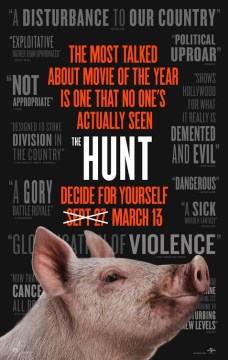 Has there been a movie with worse luck than The Hunt? It was originally scheduled to be released in late August 2019 and was postponed after the back-to-back mass shootings in El Paso and Dayton. Its studio, Blumhouse, pulled the movie out of sensitivity and rescheduled it for March, trying to draft off some of the latent controversy once President Trump caught wind of its liberals-versus-conservatives battle-to-the-death premise and tried to make political hay from it. The marketing highlighted quotes from political figures and writers and asked audiences to judge the controversy for themselves. Flash forward, and the new release date was pretty much the last weekend of theatrical action in 2020. Thanks to the worldwide spread of COVID-19, very few people ventured out from the safety of their socially distant homes to the movies, and it’s only become more dire since. Now just about every wide release has been scuttled from the release date from March into the middle of the summer, and who knows how long this may carry on for. The Hunt may be the last new theatrical movie for the foreseeable future. Thankfully, Universal made their theatrical releases available on demand (this may be an irreversible new reality of distribution) and I watched The Hunt at home. I home hunted, and I’m glad I did. If you’re a fan of Ready or Not and You’re Next, then The Hunt and its shocking violence, demented humor, and political satire might prove appealing.
A group of strangers wakes up gagged in a field. They’re given weapons and then the hunt is on from an unseen force. Crystal (Betty Gilpin) is trying to make sense of where she is, what is happening, and how she can escape into safety and who she may be able to trust.
 I was consistently laughing throughout The Hunt and amused at its breakneck twists and turns. It’s a film that lets you know very early that it’s willing to go to some dark and twisted places. It throws a lot of characters immediately into the grinder, as you go from following one person who is ultimately slain to another person who eventually meets the same fate, and it creates a desperation of trying to find an anchor. It also makes it feel like anything can happen at any time, that whatever might seem normal could really be hiding a dangerous reality. It’s the kind of movie that isn’t below throwing a grenade down someone’s pants. It has definite satirical sights but that doesn’t stop it from being an enjoyable dark and thrilling little movie. Once we settle on our main heroine, the new joy becomes her ability to see through the facades of different scenarios and fight back, again and again. It’s a wonderfully executed setup of giving us a very capable fighter who is constantly underestimated and then watching her opponents toppled. Each new scenario gives us someone to root for and a new mini-boss to foil. The film becomes a series of escalating payoffs tied to the smartest person making others pay for their mistakes.
I always thought the anger that conservative pundits, and Trump, assailed The Hunt with was misplaced considering that, given the premise, it seemed very much like the liberal elites were the villains. For most of the first act, this is the case, as we’re dropped right into the mix and left to learn on our own much like the hunted conservative characters. We are put in their shoes and don’t even see who may be hunting them until 15 minutes in. For the opening of the movie, it’s like the beginning of the Hunger Games. What is this crate? Why is it filled with weapons? What’s the deal with the pig? It’s a game that you’re trying to learn the rules of while bullets are whizzing by heads, and sometimes splattering into them too. Unquestionably, our allegiance is with these vulnerable people trying to make sense of this madness and survive. We see their humanity. When they do finally encounter their predators in disguise, the liberals can barely conceal their contempt and prejudices. If anyone is actively rooting for the predators after the first act, then they haven’t been paying attention or were too far gone with empathy.
However, the movie does start to take a turn the longer we spend with the hunted conservative characters, all but one not given official names (the list on IMDB cites names like Staten Island, Yoga Pants, and the parenthetically-enabled, (Shut the F*** Up) Gary). They begin to play into the same overblown prejudices and negative stereotypes of their across-the-ideological-aisle peers. As The Hunt continues, it becomes more and more apparent that screenwriters Damon Lindelof and Nick Cuse (HBO’s The Leftovers) have crafted a political satire that takes aim at both sides (more on this specific aspect later). Eventually the real target reveals itself to be extremism and how it can cloud one’s judgement and ability to see other people on human levels. There’s a late scene where a conservative figure confronts the liberal designer of the Hunt, and they get into a circular argument over which side is responsible for the creation of this death game. It’s a hilarious blame game but also emblematic of what happens when people try to play on the same level as conspiracy theorists who distort reality to their pre-selected biases. Sometimes in politics you need to fight fire with fire and sometimes that extra oxygen only makes things worse.
 Now The Hunt does have an issue with its “both sides are to blame” approach and that’s the false equivalency of the danger of right-wing and left-wing conspiracy clans. Right-wing militants are the ones saying Sandy Hook was a hoax with crisis actors, that Jade Helm was a military plot to take over the states, that scientists are in a cabal to bring down the petroleum industry, and cooping Americans up from COVID-19 to damage Trump, that immigrants are bringing crime and disease into the United States, and other such nutjob ideas. While left-wing extremists can be callous and have their own science denial problems (GMOs, vaccines), they aren’t the ones taking arms, storming federal buildings, sending pipe bombs in the mail, killing anti-Nazi protestors with cars, and shooting brown-skinned strangers in a Wal-Mart parking lot. One of these two ideological sides seem far more likely to support dangerous extremism than the other, especially with a man in the Oval Office who seems to wink and nod at these reactionary elements in approval. While the “both sides are bad” approach to satire allows The Hunt and its filmmakers more ground to market their movie to a wider audience sick of extremism, it’s also a dubious false equivalency that deserves to be called out.
Betty Gilpin (Netflix’s GLOW, Stuber) is the star of the movie and a force of nature. She’s capable, cunning, disarmingly physical and perceptive, and she creates wonderfully bloody havoc. She is a delight and her one-upping her opponents never gets old. She is no-nonsense and blunt, and her efficiency is admirable and highly entertaining. Gilpin is a surprise in badass mode, but she makes it her own with style. A late Act Three fight is brutal as it goes from room to room, smashing everything in sight. It goes on for so long that the fighters start to get fatigued, pleasantly reminding me of the excellent fight choreography of 2017’s Atomic Blonde. It’s a satisfying final confrontation and doesn’t find a contrived way to hold back her formidable ability.
 The Hunt might have been cursed with bad luck but it also might have the distinction of being the last new movie in theaters in what is proving to be an increasingly challenged year of content delivery. It’s certainly not going to be a film for everyone despite its aim at centrism. I was entertaining by the script’s constant knack for surprises and upending my expectations, of laying out dominoes and then laying waste to said dominoes. Gilpin is a star in the making and a terrific lead. It’s a movie that can get people talking by the end, debating its satirical messages, but it can also just be a fun, nasty little movie that will make you hoot in delight with each violent twist. I’m glad The Hunt could finally be judged on its own merits rather than the presuppositions of others. There might be a lesson in there somewhere.
Nate’s Grade: B
Share this:

Minus One (2010)
 As I’ve been looking into more Ohio independent films to highlight and review, I had several in local filmmaking circles recommend me the 2010 drama Minus One (currently available on Amazon Prime). It’s a war drama filmed entirely in Columbus, Ohio. It’s an example of what can be done when indie filmmaking accentuates the most important parts of storytelling, ones that do not require Hollywood budgets. It’s a heartfelt drama and one that is easy to plug right into.
A trio of National Reserve soldiers have been given the call that they are to report for duty. In three days, they will be transported overseas and onto a base in Iraq. David (Jon Osbeck) is a career veteran and in charge of rounding up the other guys in town. James (Roger Bailey) is a 30-something veteran still trying to build a family. Robert (Remy Brommer) is a young student whose days were about playing video games with his pals and sneaking time in with his girlfriend. The three men try and put their lives in order before they leave and face the possibility of not returning.
 Minus One is the kind of meaty drama that can be done on a shoestring budget, which makes it a smart play for indie filmmakers because the drama and characters are what sustain it. There’s something immediate and engaging about a group of men spending their last few days before shipping out. It’s a situation that feels like grieving, the uncertainty and anxiety hanging on everyone’s faces. Will this person ever return home to me? Will things ever be the same? It’s a premise that forces confrontations and that naturally leads to drama and catharsis. The trio of characters all have personal relationships that will need to be touched upon before their departures, although James really gets the short end dramatically. He’s scared about going back for another tour but his wife is supportive and loving and they’ll see it through. James seems to serve more as a contrasting data point in between the character chart, the middle ground between the novice (Robert) and the strong-but-silent veteran (David). The situation demands introspection, reflection, and the conflict of action versus inaction. Will you make amends while able? Will you continue to drift away from those who were at one time so crucial? Will you take ownership over your own faults and the pain you may have caused others? By starting at this point, each scene becomes a learning opportunity for the viewer, trying to deduce connections between established characters and new supporting faces, as well as getting a fuller sense of their daily lives through habits and breaks from routine. Not every scene does this, and there are some scenes that just restate the same learned info, but as a whole Minus One is a well-constructed drama that puts the emphasis on character and conflict and patience. It takes its time to fill in the blanks.
Each character is taking stock of their life and what this moment means, but they’re also taking stock of how it affects the people around them in their lives. Robert being called into service effectively ends his relationship with his girlfriend, and the both of them know it during a party. His mind is preoccupied and she gets up to leave, remarking she has an exam in the morning. You can tell Robert is a little hurt by this reality, wanting to soak up the time they have remaining before he’s gone, and then accepts that reality, that he’s already gone. She says goodbye, hugs him, and they hold onto one another, and what’s unsaid seems to be understood by both parties. This is more than a nightly goodbye. They both know it’s the end and must move on. David is also trying to make right with his ex-wife and little daughter, trying to fix one small thing, one achievable act of kindness, one point that can be fondly remembered, by fixing the broken front porch swing. As his ex-wife relays, David has been a family man in name more than deed, failing to fulfill promises and being present for his loved ones. The duties of the job took their toll. This is a small town and losing three of its own to the war effort will have repercussions. Especially during trying times, it’s clear that our lives and actions can extend far beyond us.
 Osbeck (Dark Waters, The Public) has the most challenging role given that he is the most hardened to the call of duty. He delivers a finely textured and weathered performance with enough glints to hint at reserved pools of emotion, from regret with his ex-wife and a lingering ember of hope, to resigned acceptance and gratitude to the many familiar faces in town. Watch the guy talk to his daughter and try not to get a sense of how good Osbeck is at bringing this character to life. His isn’t a showy performance and often underplays the scenes, which feels more appropriate for the role. Bailey and Brommer (Speak) do fine jobs especially when they’re pitted against each other. Both men are fearful but dealing with it in different manners, which puts them at odds. Robert is ignoring the certainty and changes, trying to parrot the Army’s slogans and racist terminology for the enemy overseas as a means of covering up for his gnawing fear. He’s gung-ho for war, and this greatly irritates James, who knows better than to blithely celebrate war as if it was glamorous. I wish their blowup could have gone on longer and cracked both characters open even further.
Other acting standouts include Jennifer Schaaf (Heather’s Painting) as David’s ex-wife who is trying to navigate her complicated feelings of sympathy and personal boundaries, Jane Mowder (The Street Where We Live) as Robert’s mom, especially during the scene where she has to process the news her son is shipping out, Misti Patrella (Classholes) as the grieving widow who has turned to the bottle and has a shared history with David, and the irreplaceable Ralph Scott (Bong of the Living Dead) as the small-town police chief who provides a much-needed wry sense of levity. He has such a natural way of inhabiting a character. Scott is so prevalent in Ohio-produced indie filmmaking that I assume if he’s not in the film he must have been holding the camera somewhere.
There is one significant misstep for the movie and it literally comes in the closing minute. I’ll dance around spoilers to keep things kosher. The film ends as you would expect with our trio being driven out of town and heading to the airport for their international travel (this should not be a spoiler). We’re then treated to post-script text informing us what happened to the three soldiers once they reached Iraq. Firstly, it’s not necessary to give resolution when so much of the story exists in the uncertainty of what will happen next. It feels like ending 12 Angry Men with a post-script that said, “Oh, the kid was really guilty the whole time.” It goes against the thematic emphasis of the preceding story. We don’t need a resolution because these men are representative of the United States soldier as a whole, so it’s better left open-ended. The other drawback is that this post-script covers some pretty major dramatic changes, and to do so in a handful of words in the close is inherently anticlimactic and unsatisfying and a bit clunky. If this was going to be the conclusion to certain characters, then learning about it this manner was not the right choice. Better to have kept things ambiguous and open-ended than serve up developments this way.
 This impulse also surfaces during one of the movie’s most dramatic points, a nearly six-minute monologue by David about his time overseas and a checkpoint that went badly. We begin the moment on Osbeck’s face recounting the painful memory, and then the movie haphazardly cuts back into flashback of the event as narrated. This decision seems like a reasonable one, visualizing the traumatic experience, but it takes away from the moment. It interrupts the focus on Osbeck’s performance where the viewer is studying him for the slightest changes. It’s a strong monologue and the emphasis should be on Osbeck’s face alone. Another reason why this choice doesn’t work is the reality of doubling the Middle East in Columbus, Ohio. This requires a stylistic choice that amounts to “ghost trails” in editing software (think “drunk vision”). It’s being used to signify the past but it’s also being used to cover up the environmental differences. Even with this effect, the forest of the checkpoint still stands out as incongruous. I do think a flashback could have strengthened this moment but it needed to be very judicious. The point of the monologue isn’t how he and his friend got into trouble, it’s about his friend’s sacrifice he blames himself over, which means the emphasis needs to be on his friend. David describes seeing his expression in that final moment, an understanding of his inevitable demise, and that is exactly what should have been the flashback focus. All you needed was a closeup of the man’s face, fixed, emoting every damn thing he can before a flash wipes away the memory. That way the emphasis is on the performance and gets rid of production replication shortfalls.
Minus One is a fairly simple story told in a straight-forward manner. The emphasis is on the relatable characters, the simmering conflicts and the personal revelations of each coming to terms with how their lives will be changing, and the uncertainty that they must come to terms with. This is a story that has been told before, both in film and simply a lived experience of millions, and it will continue to be told afterwards because, at its core, it’s a universal story. It’s saying goodbye to a loved one and coming to terms with responsibility and sacrifice. Yet, Osbeck, serving as writer and co-director with Marc Wiskemann (Holding Patterns), doesn’t rest on making these men symbols (admittedly some of the three have more depth than others). It does no disservice to say Minus One feels like a competent made-for-TV movie; from a technical standpoint, the visual compositions and shots are very standard, placing the focus on the actors and giving them space, and material, to deliver, and they generally do. It’s a small movie about big things and I enjoyed the little touches that better rounded out the world, like David revealing, with a delightful smirk, the secret to how he always gets the daily trivia question correct at his local coffee shop. It’s those small touches that give Minus One a personality. I disagree with the very ending and how it impacts the overall resonance of the movie but it doesn’t sabotage the whole experience. Minus One is a somber, reflective, and touching little homespun drama with plenty of sincerity and heart to spare.
Nate’s Grade: B-
Share this:

The Lodge (2020)
 The Lodge is a patient, methodical, and unsettling horror movie that establishes an eerie atmosphere, pushes the viewer to question what is going on, and then, upon finally revealing its last secret, sits back and lets the real horror play out to sickening effect. This is from the same writing/directing team behind 2014’s Goodnight Mommy, and you’ll start to wonder whether or not Severin Fiala and Veronika Franz really dislike children. The movie had me on edge early with a sudden jolt of violence, and I felt uneasy from there to the bleak ending. It’s about a father (Richard Armitage) taking his two children for a holiday retreat with his new girlfriend, Grace (Riley Keough), the person the kids blame for breaking up their parents’ marriage. She wants to get to know them and bond but the kids are having none of that. To make matters worse, the kids discover that Grace is the lone survivor of a religious suicide cult. Once at the family lodge in the snowy woods, strange events and messages torment Grace and the kids until they question where they are, what may have happened to them, and if there is an escape. The first act is the family in the wake of trauma and the children viewing Grace as the interloper worthy of their scorn. The second act becomes an existential horror movie that questions whether there has been a shift into the supernatural or divine. The last act reveals what’s really been going on and it’s the consequences of bad choices. The ending trajectory feels fated from the earlier setups, so when everything is falling apart, the danger feels incredibly real. I was so anxious during the ending sequences that I was holding my breath and covering my face. I didn’t know how far this movie would go, and while it pulls back at the very end, the implications are clear even if they aren’t explicit onscreen. Keough (Logan Lucky) plays a character with real depth as a woman trying to reclaim her life from deep-seated trauma, and when events spin out of control, that trauma resurfaces and starts to take over her thinking, placing her on autopilot, which then pushes the film into the realm of tragedy. She’s fabulous and impressively restrained as her character mines layers of self-doubt, bone-deep teachings, and shock. The atmosphere of the film is very fitting for the setting, chilly and isolated and dread-filled. The camera movements are often very deliberate to draw out tension and uncertainty. It all comes together for a very creepy little movie that gets under your skin. The Lodge is not going to be an audience-friendly outing due to its pacing and ending, but consider it an A24 horror film that somehow got away under a different studio.
Nate’s Grade: B+
Share this:

The Street Where We Live (2019)
 I was fortunate enough to actually hear co-writer/director John Whitney and co-writer/star Dino Tripodis discuss their hardscrabble indie drama, The Street Where We Live. It’s an Ohio indie that was filmed over the course of several weekends from the fall of 2015 to the summer of 2016, had its festival run throughout 2017-2018, and became available for the general public to watch via Amazon Prime in 2019. I was lucky to hear both men talk about their experiences making this movie on a small budget under a constrained time frame, as well as their hopes for it, paying homage in particular to the hard-working mothers that both men credit for their upbringing.
We follow Mary (Kristina Kopf), a recently unemployed factory worker, struggling to stop her family’s descent into greater financial ruin. Her children, Jamie (Katie Stottlemire) and Thomas (Dylan Koski), are trying to hide the shame of their living conditions, though it’s getting harder. Things go from bad to worse as this family tries to regain their stability.
 The film does a very good job of communicating the vulnerability and struggle of poverty as well as how susceptible a majority of people living on the fringes are. As has been said, many Americans are simply two paychecks away from disaster; in a survey, a majority of Americans would be unable to pay for a sudden expense of $400, meaning most Americans lack even that amount when it comes to personal savings. That day-to-day anxiety of simply getting by, of persevering and not prospering, is best expressed by the layers of sad, quiet resignation that hang on lead actress Kopf’s face. Hers is a performance steeped in quiet suffering (more on that later) and her fight for dignity and opportunity. This isn’t a very dialogue-driven movie and instead is more like one long sigh slowly eliminating all breath. One calamity leads to another in a succession of setbacks, and it’s clear to understand just how difficult it is to reset your life when that chasm seems more insurmountable by the day. You don’t have enough money to pay electricity leads to not enough money to pay for rent, leads to living in your car and washing in the bathrooms of gas stations, leads to having your car towed, leads to an impound that expects even more money if it cannot be immediately paid, and all the while that deficit grows and grows. The Street Where We Live is at its best when it’s opening up about the slippery slope of poverty and how it’s not some choice, not the result of trenchant laziness, but just bad timing, bad luck, and limited opportunities. In that way, the film works extremely well as an empathy project to convey the toll of poverty on the human condition and one’s hope.
Much like the mumblecore sub-genre of indie dramas, the observational little details and natural give-and-take are what help give the movie its sense of authenticity. This feels like a world where Whitney and his crew are well versed and can supply exacting insights. There are a few devastating moments in the movie, one of them being how out-of-touch a person can feel in a quickly changing marketplace. Mary has held her factory job for years and is applying for, what she has been told, is a simple secretarial position in an office, something she feels she can at least keep up with even if her typing skills are mediocre. Instead, she’s pummeled with questions of technical insurance jargon, and each one further shatter the idea that a “simple secretarial” job is within reach for Mary. Her sinking realization that this job is closed to her is such a hard moment to watch and Kopf, once again, plays it tragically and beautifully. It’s a small sucker punch of a moment, and from here she’s fighting even to get underpaid dish washing gigs. There are some aspects that are stretched a bit in order to maintain the family’s tragic desperation (one would think Mary wouldn’t have to venture all the way out of the state to contend for a paying job). It’s excusable because we’re meant to feel the crushing uncertainty of a character struggling with what is the best of her limited bad options. The only aspect of The Street Where We Live that didn’t feel realistic was the seconds before the factory workforce was about to find out their jobs were all gone, because I have to think everyone was suspecting the worst and wouldn’t be so amped for noisy chit-chat prior to the news.
The acting is another component that helps compliment the movie’s valued sense of reality. The Street Where We Live and its success hinges on two fulcrums: 1) its everyday realism, and 2) Kopf. The characters feel very recognizable and the performances rely on subtlety more than histrionics. More is gained by watching the pained expressions of ordinary people than listening to a character explode in a well-polished monologue about the hardships of living in poverty. There are a few emotional outbursts but they’re saved for the end, and even these moments are crafted to better maintain that well-earned sense of cinema verité.
 Much of the film’s impact is reliant upon Kopf (Constraint, Axe Giant) and the micro-expressions that cross her face. Hers is a role about suffering in silence, her weathered gaze its own shattering scream, and you study her to see how she’s coping with each new added indignity. A terrific moment is when Mary is trying to square a very personal, moral-crossing decision she made for the greater good of her family only to have a cruel man use his small amount of power to further wound. You feel how powerless this woman is and while you want her to punch the creep, there will be no release. You want the “movie moment” where she can upstage her tormentor but it won’t happen. Kopf has long been a staple of Ohio indies and there’s a very good reason why. Tripodis (Bottom Feeders) has an immediate well-worn charm that’s heartwarming. One of the best scenes in the movie is his character Ben and Mary sharing a small moment of compassion after hours of hunting for recyclables to turn in for meager money. This moment is so naturally written, with their interplay feeling relaxed, natural, and organic, that I instantly wanted more. Stottlemire (Tragedy Girls, My Friend Dahmer) has begun to branch out into bigger movies and her burgeoning talent is clear to witness. She follows Kopf’s lead and works in underplayed tones to great effect. Koski gets the least to do as Thomas, like him strumming his father’s guitar is all that is needed to communicate his longing to connect to his past. There are also small roles and cameos from other central Ohio indie faces like Ralph Scott (After), Daniel Alan Kiely (Bong of the Living Dead), Heather Caldwell (After), and Richard Napoli (After), and several others.
If there is one thing holding back the film from achieving a greater level of success and viewer engagement, it’s that the characters are defined entirely by their ongoing suffering. I call it the Lars von Trier School of Storytelling (not that it’s only associated to the Danish sadist) where you establish a character that takes the slings and arrows of their society, but this props up a protagonist as more of a symbol/metaphor/martyr than a human being. This approach can still work when given a major theme that is complex enough to take on the extra brunt of attention. However, this approach can also make the protagonist feel less active, more reactionary, and also less complex. If you were deconstructing Mary as a character, I know very little about her as a person. I know she had a job for many years. I know she lost her husband. I know she doesn’t feel comfortable asking others for help. I know she’s willing to make sacrifices for her children. Internally, I don’t know much about her, nor do I know much about her personality, interests, flaws, quirks, the things that make people more fleshed out, nuanced, and appealing. Mary certainly serves a purpose and she voices this in the film’s very last scene as Whitney unleashes his thesis statement about how our society should be better with its inherent social promises. For some, this will be a minor quibble and for others it will be, in essence, a cap for their empathy levels.
 The Street Where We Live is an affecting and honest little movie about the everyday hardships many people face when their lives are suddenly in free fall. It’s a potent drama packed with small, telling details that better create a world that feels lived-in, compassionate, and authentic. The acting is mostly sharp and anchored by a standout performance from Kristina Kopf. The technical details are pretty solid overall for a movie made for less than $13,000 and under the start-stop circumstances that the filmmakers had available. The cinematography and editing can feel like there wasn’t much in the way of additional options, but the look of the movie, muted greys and rusty browns, adds to the overall dreary tone. It’s a sparse film in execution but that’s because it doesn’t need bells and whistles and fancy camera setups to make its story felt. It’s a deeply empathetic movie that could open some hearts about the struggles of others. It’s so easy to fall down and much harder to get back up without a support system. The movie might be hitting repeated points without enhanced characterization but it still hits its marks. The Street Where We Live is the kind of movie where its small budget can actually be a plus, not just in forcing creative ingenuity from the filmmakers but also in lending a blue-collar validity. It’s a story that resonates because of its universal themes and lessons in empathy, and it’s worth watching to see what a group of well-meaning artists can do when inspired to do good.
Nate’s Grade: B
Share this:

The Assistant (2020)
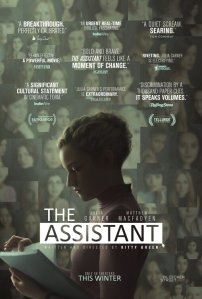 Jane (Julia Garner) is a young woman serving as an assistant to a high-profile film and TV producer, the kind of man with plenty of pull within the industry. She’s the first one into the production office and the last one out at night. Little by little, a larger picture forms of her temperamental, vindictive, and lecherous boss, especially as young women seeking to get ahead in the entertainment world as carted before him like sacrificial offerings. What will she do when the offending evidence becomes too much to ignore?
Where The Assistant lost me was in its lack or urgency with its storytelling. This is the slowest of slow burns, and it’s understandable, to a point, why this approach is the more realistic path. We’re watching the decades of inertia that make anyone standing up to harassment and abuse very difficult to find any traction or credibility. It’s much easier to just shrug it off, say “that’s just the way this awful man is,” laugh it off like some of his peers, ignore it like others, or compartmentalize, justifying your complicity as symptomatic of just how the industry works. I was waiting for the slow reveals to finally form a picture for our protagonist and push her into action, a desire to do something or say something about what she can no longer ignore or assist. The movie gets us to this point and, in its best scene, smacks her down for even seeking out this oversight. From there, the movie just becomes another repeat of what happened before, with more clues about the bad behavior of Jane’s boss, but it’s more of the same and then it just ends. I think writer/director Kitty Green (Casting JonBenet) was going for ongoing ambiguity whether or not Jane ultimately decides to leave her entry-level position or swallows her moral turpitude. However, there is a frustrating difference between an ending that is openly ambiguous and one that feels incomplete and lacking. After everything I went through, a little more definition by the end could have made the slog of work details more palatable.
 This subject is bursting with pertinent urgency and social commentary and I feel like this movie is just missing so many important things to say and do in the name of misplaced indie understatement. Understatement can be fitting as an approach to real-life dilemmas but The Assistant is understated to its unfortunate detriment, traversing from subtlety into somnolence. More time is spent establishing the mundane details of Jane’s office duties than the harassment and protection afforded to her boss. I was expecting to collect little telling details, like the male assistants’ patterned ease of composing “apology e-mails” for whatever indignation the boss feels, but we’re absent a certain momentum throughout. The first thirty minutes is packed with moments like Jane making coffee, Jane tidying an office, Jane getting food, Jane answering phones, Jane microwaving a cheap dinner. We never see her at home from the moment she leaves in the opening of the film. It’s like the movie is saying she lives at the office or must if she is to get ahead in a broken system of people using people. The people passing through are superficial to us, never more than pretty faces, or important names coming and going on the peripheral. I was feeling crushed by the obsessive details of this work routine. I expected to establish a pattern, establish a baseline, and then move from there, forcing change or at least reflection. The mundane details are meant to convey the soul-crushing nature of Jane’s job, being on the bottom of an industry she’s desperate to break into, and how un-glamorous the life of the little people can be. But she’s also a gatekeeper of sorts for the line of future victims encountering her bad boss. There’s a degree of culpability there, and it’s never fully explored because of how underplayed every moment and every scene comes across, choosing mundanity over drama. I would not begrudge any viewer if they tuned out The Assistant after the first half hour of work.
There is a noticeable feeling of dread and discomfort in the movie, but without variation or escalation it feels almost like a horror movie where we’re stuck with the person on the other wall of the action just briefly overhearing things. Imagine Rosemary’s Baby but if you were one of the neighbors just wondering what was going on. There’s an important message here and the point of view of an up-and-coming young woman as the assistant to a Harvey Weisntein-esque monster and her moral quandary of how far to ignore and how much she is willing to suffer is great. That’s a terrific, dramatically urgent starting point, and yet The Assistant is too muted and padded. There’s a remarkably thin amount of drama during these 85 minutes, with the more intriguing and disturbing action kept in the realm of innuendo and suspicion. It makes the final movie feel like the real movie is on the fringes of what we’re seeing and we just need to nudge back to the drama.
 There is one fantastic scene in The Assistant and it happens at the end of Act Two, and that’s when Jane finally seeks out the HR rep, Wilcock (Matthew Macfadyen). You sense just how much she wants to say but how much she feels the need to still be guarded, so minute by minute she tries a few more scant details, all that’s needed to limit her vulnerability and exposure. Wilcock seems like he might just take her words seriously, and then he interrupts to answer a phone call, and it’s an obnoxiously unimportant call and his behavior merges into just “one of the guys.” From there, he turns the heat on Jane, laying out her circumstantial claims and questioning what her future plans are and if this is the best course of action to see those plans through. It’s the company line sort of pressure and you feel Jane retreat within herself as soon as this potential ally becomes just another cog in a system to enable abusers. Garner (Ozark) is never better than in this scene, where the understated nature of the film, and her performance, really hits the hardest. It’s the quiet resignation and heartbreaking realization that the system is designed to protect itself. I wish the concluding twenty minutes had more of the drama that this scene points to as its direction.
The Assistant had a lot of things going for it as a queasy indie drama and it’s still well acted with searing details and a strong sense of authenticity. I feel like that authenticity, however, gets in the way of telling a more compelling and affecting story. I’m here to see the pressure, torment, and decision-making of a young woman put in an unenviable position, and what I was given was an hour of office tasks and eavesdropping. It’s got its moments but it left me wanting more.
Nate’s Grade: B-
Share this:

Confined (2019)

The first thing you need to know about the Ohio indie Confined is that, according to its IMDB page, its budget was $2,500. That number changes everything about how you gauge the success level of this indie thriller, or maybe it shouldn’t. The very fact that these people made a movie and delivered it to a medium that is widely available with Amazon Prime, that itself could be considered a victory among indie filmmaking, especially if the initial investment is as low as the reported budget. That’s a victory for a filmmaker, but it’s not exactly enough for the viewer. Just because a group of people made a movie doesn’t mean it’s automatically worth the time of the viewer to watch it. There are certain technical elements that you’ll have to be very charitable about more than likely, and Confined suffers from certain deficits in lighting, editing, and aspects that a more robust budget could have afforded. If harsh shadows and an intermittent sound mix is going to be a deal-breaker for a viewer, this movie will be rejected before given a chance on its story and execution. I think that’s the best way to gauge the success of the project, namely the entertainment value that it offers, because creativity is not really budget dependent. A writer does not need a certain dollar figure to tell a compelling story, and any filmmaker can have excusable lapses in technical merits as long as I’m glued to the story. That’s why movies such as Clerks (27K) and El Mariachi (5K) and Primer (7K) and Paranormal Activity (11K) were able to make a splash and give their filmmakers careers. Creativity trumps all else, and if you have a high-concept, thrilling experiment, a strong cinematic voice, or a fearless energy that becomes infectious, much will and can be forgiven with shortcomings.
Shot around Cincinnati and released in 2019, we follow a married couple, Donnie (John French) and Sara Jeter (Caitlin Drance), who are accosted by an angry man, Noah (Chris Dettone), who accuses them of being responsible for the death of his wife from an opening car accident. Noah kidnaps Sara and sends a threatening message to her husband that he has one week to find her. He must “play by the rules” of Noah’s game or there will be dire consequences. Donnie cannot go to the police so he seeks out assistance from his brother to uncover who Noah is and capable of.
The problem with Confined is that at its core it’s really indistinguishable from any other mediocre genre thriller that doesn’t exercise your thinking muscles. Given the budget limitations, starting with a cat-and-mouse game is a smart way that can get around the inability to include larger set pieces. The trick is going to hinge upon whether or not the movie creates a realm of believability that counters the encroaching and nagging doubts from its limited means. Confined disappointingly errs by rolling with the conventions and clichés of schlock thrillers rather than rising above them. Because of this determination, it makes Confined feel like a less-polished version of a mundane thriller. I think the premise has promise but its overall execution proves too lacking to save the final film.
Confined never truly recovers from its handling of its super genius villain, Noah. At no point did I feel like this guy was really scary or threatening. Dettone (Fury: Redux) is fine as an actor but he’s not exactly imposing as a skinny, scruffy dude. Perhaps he was modeled after Heath Ledger’s Joker, a criminal mastermind who always out-thinks his opponents and laughs at their physical strength advantage being neutralized through his cunning. He says he always has a plan and he’s always one step ahead, but I never fully believed Noah because he never seems menacing. It was a mistake introducing him as a hectoring restaurant waiter needling Donnie and Sara. That’s not exactly a position that strikes fear, even after he tells off his manager who then comps the meal. He sneaks into their vehicle and chloroforms Sara first, lightly punching Donnie, who seems to lack any urgency whatsoever watching a strange man drug his wife. He then gets drugged after. That’s another mistake. Noah takes his time drugging both parties and they just let him. Throughout the movie, characters talk a big game of how devious and manipulative Noah is, even his history of getting dismissed from the FBI, but we lack compelling evidence onscreen. I mean he repeatedly goes back to this storage locker area and leaves the locker open and minimally guarded. He says he has contingencies for contingencies, but he then has people murdered in broad daylight in public and seems to not cover his tracks at all if somebody like Donnie could follow. There’s also the overly generous timetable of rescue (7 days) and the general vague nature of his “rules.” Holding people for up to a week brings about logistic questions, like bathrooms, water, etc. Now times that by three because he’s kidnapped three victims (who never plot together for insurrection). As a would-be Machiavellian villain, Noah leaves a lot to be desired and so much is on him.
Confined could have significantly benefited by re-framing its perspective, so instead of Donnie having to save his wife, it was Sara having to save her husband. That’s because midway through the movie, writer/director William Chaffin (Streets of Syndicate, Devil’s Point) reveals that Donnie had an affair. He says he regrets it, and we’re never given much information to contradict that, but it becomes a cudgel that our villain uses to berate Donnie over whether he really loves his wife after all. However, the more dynamic version would flip the scenario and place Sara, an attorney, into this unlikely position of having to save her husband. It would prove even more devious if Noah was then unloading new revelations about her husband that paint him in an unfavorable light, like an ongoing affair with another woman. Then as her investigation got closer, and as time was winding down, she would be processing whether or not she really knew who her husband was, what is forgivable, and whether or not he deserved her intervention. It’s an immediately more dramatic and personal perspective for the lead of a movie rather than Donnie’s supposed redemption. It’s the smarter route to go on a low-budget thriller needing to stake its place with a point of interest that could hook an audience to keep watching for the entire 78-minute running time. There is a four-minute scene where a man looks at photographs and arranges them. Four minutes!

The assorted supporting characters don’t seem to know what they’re doing in this movie. There is a plurality of characters that greet Donnie with a pointed gun, which further strains the credibility level. The additional hostages and their related family members are useless to the story and simply disposable bodies to kill before Sara’s time is up. Donnie’s brother is a glorified exposition device and a strangely motivated figure after a later twist. That’s another factor where Confined seems born from the ilk of direct-to-DVD thrillers, forcing twists for shocking purposes but not providing enough material for them to be really felt. There are a few relatively surprising deaths but because the characters are disposable, underwritten, or simply oblique, it becomes less shocking and more shrug-inducing because what else was going to happen to these people? The final twist feels too forced and yet also wholly predictable. For the movie to have one final memorable moment, there will be a betrayal, but it doesn’t feel earned with what transpires. The ingredients are there to set it up where it feels like an organic development, but under this version of the story, this final twist feels like a final gasp to imitate mediocre thrillers to its end.
Confined is the work of several hard-working individuals and it can be enjoyed in some capacity as a low-budget imitation of the kind of movies you’d see starring, say, C. Thomas Howell or some guy who starred in a Universal Soldier sequel who isn’t Michael Jai-White (Black Dynamite forever!). There is nothing wrong with fun genre thrillers that aim to be nothing more than fun genre thrillers, and this can be accomplished on any budget, even one as tiny as $2,500. It all depends on the storytelling and maximizing the intrigue and development to mask any limitations of budget and technical know-how. If you can’t forgive the technical issues, you’ll never accept whatever charms that Confined has to offer, but the storytelling choices limit the entertainment takeaways. The villain is too unconvincing and powerful without being clever or terribly memorable, the choice of lead perspective feels limited and with a better and more personally compelling figure right there for the choosing, the supporting characters feel unimportant, the story often resorts to telling rather than showing, and the twists are often forced and without larger impact given the underwritten characterization. Would a bigger, more professional budget have solved any of these lagging creative issues? Maybe. Maybe not. Confined is currently available for viewing on Amazon Prime and that itself is its earned victory.
Nate’s Grade: C-
Share this:

Color Out of Space (2020)
 Color Out of Space is based on one of the short stories by famous horror author H.P. Lovecraft, but what’s even more noteworthy is that this is the first feature film from director Richard Stanley in 24 years. Stanley made a name for himself with early 90s gory cult movies Hardware and Dust Devil. Hollywood came calling and he was given directing duties on 1996’s The Island of Doctor Moreau, a production so plagued with troubles that Stanley was fired, replaced with John Frankenheimer, and then Stanley disguised himself and snuck onto the set again as one of the animal-human hybrids. There’s a fascinating documentary about the whole disastrous clash called Lost Soul that’s well worth watching for any fan of behind-the-scenes exposes (it would make a great double-feature with 2002’s Lost in La Mancha). Stanley has never been a man to put on airs about the material he gravitates to. He likes weird genre stories, and as a lover of weird genre stories, I’m glad to see that the man has broken from his sabbatical. Color Out of Space is a mostly successful, eerie, and occasionally stomach-churning little horror movie, and hopefully its release will make it that much easier for Stanley to deliver the next one.
A strange meteor crashes into the family estate of the Gardners. The parents, Nathan (Nicolas Cage) and Theresa (Joely Richardson), are struggling to make life “in the sticks” work with their family. Mom is trying to advise stock portfolio clients. Dad is tending to their prized alpacas. A land surveyor (Elliot Knight) is testing the drinking water and its safety after the meteor hits. Strange things begin to happen almost immediately. Young son Jack (Julian Hillard) is hearing voices and talking to an entity living in the well. Bright explosions of pink color come and go, followed by an oppressive cloud of static. And the animals are behaving differently, gaining pink glows in their eyes, and becoming more violent and deranged and dangerous.
 This is the kind of movie that you want to be weird, unpredictable, and terrifying, and Color Out of Space achieves these desires with a florid, downright Cronenbergian relish. There are several kinds of horror movies here mashed together, which don’t fully gel as a whole but it does exacerbate the overall effect of how screwed these characters are. There’s the cosmic invasion/outbreak angle with small weird changes going around the environment, from pink-hued flowers spreading to the bizarre effect it has on the wildlife. There’s a descent into insanity angle as the parental figures seem most affected and are tearing away the security of the kids. Cage’s character seems to be mentally slipping into his grandfather’s snitty persona, either implying mental illness, some degree of ghostly resurrection, or just general creeping madness. There’s the alien nature of being able to trust your own senses and body, as characters will lose hours of time in the blink of an eye and not be fully cognizant of their own actions. There’s the isolation of the invading force shutting down escape routes, blocking telephone calls (anyone want to try texting?), and trapping the family inside this hot zone. And then there’s the body horror as creatures begin physically merging together in nauseating displays that conjure the best/worst of the nightmares from John Carpenter’s The Thing. Stanley elects to build the horror and then dwell on it. There’s a scary development with a specific pair of characters, and Stanley lets the unknown of what will happen, as long as the dread of what seems to be happening, make it worse. He punctuates this moment with some gut-churning cries of anguish that run on a loop, to the point that you might be thinking yourself whether a merciful death was advisable. To the film’s credit, it switches back and forth between these different threats and alternating styles of horror. It allows a movie with a limited plot (meteor hits, bad things happen) to feel bigger.
A draw for any lower budget indie horror movie starring middle-aged Nicolas Cage is the desire to see the gonzo actor unleashed. You get tiny glimpses early, with his off-key line deliveries that might incite a few giggles. It’s halfway through where he starts to crack, breaking into an effete British accent, gesticulating more wildly and theatrically with his hands, and then breaking into protracted screaming fits. His references to the alpacas got some genuine goofy laughs out of me, as does passing moments where it feels like he’s channeling John Travolta in his performance style. The cult of Crazy Cage that found much to love with 2018’s moody Mandy should find extra enjoyment levels with Color Out of Space. These Cage-isms don’t detract from the movie or rip you out of the reality because it’s all about disintegration, mental and physical, so deploying Nicolas Cage losing it actually better serves the film’s cracked tone.
 Being a Lovecraftian horror adaptation, there is some leeway to be had for its incoherence. We’re dealing with a life form that defies our understanding by its inter-dimensional nature. Some of this will be mitigated simply by having to transpose Lovecraft’s more ethereal concepts into a functional visual medium. Characters call the strange incidents a “color, it’s only a color” but it’s not really just a color when you turn that literal concept into a movie. On the page, you can get away with something more obscure and abstract, but movies require a visualization, and so the “monster” of the film isn’t “just a color” but essentially a sentient neon energy cloud. I was reminded frequently of 2018’s Annihilation, a movie I admired but was indifferent to, just like its intended lesson about nature’s relationship to man’s existence. It’s a takeover that defies explanation because our puny human brains aren’t capable of perceiving what is happening. Therefore, when weird nonsense happens, we don’t need a tidy explanation. The breakdown of the family unit, both figuratively and literally, is enough to anchor our attention. We might not know why these things are happening but they are destroying this family slowly like an infection, and we’re watching them break down one-by-one, and that’s what matters. As the movie started picking up momentum and getting weirder and grosser, I wondered what possible ending could even be presented that might work. I think Stanley finds a workable solution that mostly suffices. Nobody wants to be in the business of explaining too much and damaging the reality of the movie (see: Us) but you still want to provide some set of rules, even if the larger picture is an incomprehensible design. Color Out of Space keeps things relatively vague but keeps to the few clues it offers, which at least makes the overall production feel forgivably vague.
There are elements I wish Stanley had fleshed out further or curtailed more. The supporting authority figures are mostly empty suits, including the willfully ignorant mayor running for re-election played by Q’orianka Kilcher, if you’re curious what she’s been up to since playing Pocahontas in 2005’s The New World. They don’t even qualify as “characters here just to be killed gruesomely later.” Then there are interesting personal aspects to the Gardners that deserved more integration into the story, like the teen daughter’s (Madeleine Arthur) interest in Wiccan spells and unorthodox spiritual practices. What does she fully believe? She’s trying to tap into something elemental to spare her mother, who is a recent cancer survivor who lost both breasts to the disease. When her husband begins to get physically intimate, she pauses, expressing that she doesn’t know if she still feels like herself, or desirable, after her surgery and recuperation. This is meant to serve as a launching pad for the body horror that will arrive later, with the mother already feeling violated by an entity, but it feels like something that should be more integral to the demonstration of the character than her angry demands to get the wi-fi fixed. Tommy Chong appears very briefly as an aged hippie living on the Gardner estate, and I wish that the movie had more to do for him besides slotting him as more or less Neighbor #1.
 For fans of Lovecraft, indie horror, body horror, Nicolas Cage, practical effects, atmosphere, and even Stanley’s past titles from long ago, there’s something to enjoy with Color Out of Space. It’s a movie that can get under your skin on its own terms, even if I wanted it to go deeper at points. It’s the right kind of airy atmosphere, switching styles and horror threats to keep things interesting, as well as not overstaying its welcome. It uses confusion and curiosity to its sneaky advantage and Stanley finds new ways to make old genre tropes still feel spooky. It’s nothing revelatory but Color Out of Space is a fitting visual translation of Lovecraft’s elemental nightmares and madness-inducing chaos. I don’t think it will take Stanley another 24 years before another production decides to take a chance on his next directing effort.
Nate’s Grade: B
Share this:

The Last Black Man in San Francisco (2019)
 Gorgeously shot and beautifully realized, The Last Black Man in San Francisco feels like a sacred hymn to a city, a past, a wayward love that is just aching with feeling. The Sundance-winning indie has such an immediate and invigorating sense of lyricism. Jimmie Fails (Jimmie Fails) talks about the meaning his family home has, the same home he hasn’t been living in for a decade but has been returning to touch it up and hopefully take it back. Debut filmmaker Joe Talbot has created a movie on the edge of the surreal where everything feels heightened, more emotional, like a religious experience, without puncturing its core dramatic reality. We touch upon a lot of issues and themes, from gentrification and reclaiming one’s past for pride, to the identities we choose to inhabit, to friendship and the love/hate relationship one can have with their home, and each of these pulsates with meaning and fervent feeling. In many ways, this film reminds me of If Beale Street Could Talk, not just because it’s an ensemble of African-American working class figures, but because there’s a bittersweet tenderness that taps into the profound and universal that reminds me of the kind of knowing, compassionate voice of author James Baldwin. I was often spellbound by this movie, enraptured by its transporting musical score by Emile Mosseri (the best score of the year), awestruck by its dynamic photography by Adam Newport-Berra, smiling from its presentation of bizarre comic flourishes, characters with genuine personality and peculiarities, and charmed by the overall picture the movie was lovingly constructing of a personal San Francisco bursting with meaning. If there is a slight drawback it’s that too many characters remain more as sketches than fully fleshed-out beings, and too much plot emphasis is placed upon whether of not Jimme’s grandfather really built their family home as he ardently holds true. The Last Black Man in San Francisco is a cinematic hymn of love to the emotional stability we designate for our homes. It’s a lovely, beautiful, deeply felt movie that washes over you in waves and is an artistic triumph for Fails, Talbot, and every set of hands that toiled on this uniquely personal ode.
Nate’s Grade: A-
Share this:

Queen & Slim (2019)
 It’s been a couple weeks since I watched Queen & Slim and I can’t get it out of my mind. It’s billed as a modern-day Bonnie and Clyde, and while that description is technically apt, it’s more a frighteningly relevant thriller about police brutality, the skewed criminal justice system, and the hairpin-turning horror of daily life as a black person in America. A first date between Queen (Jodie Turner-Smith) and Slim (Daniel Kaluuya) goes awry when they’re pulled over by a racist trigger-happy cop and, in the ensuring struggle, Slim shoots and kills the officer in self-defense. They go on the run trying to escape one setup after another, all the while during this hellish ordeal the characters are growing closer out of reliance and a budding sense of romance. This is a powerfully intense movie with several supremely suspenseful sequences where I worried deeply whether or not the titular pair would be found out, could escape out of a jam, and all the while the authorities are getting closer and closer. They become folk heroes for a community familiar with the oppressive day-to-day of always being seen as a suspect, as “up to no good,” as presumed guilty and dangerous. There are a couple questionable moments later in the film involving the pair as inspiration where I wish the film had perhaps been a little less ambiguous over what I’m supposed to draw. The screenplay by Lena Waithe (The Chi, Boomerang) is cannily crafted with a strong sense of how to develop its premise, deepen it with larger themes, and throw organic obstacles at the characters. I was impressed with how quickly the movie would crank up the tension of a moment, but these thriller aspects never felt cheap or superfluous. The characters do not get lost to the overall plotting machinations and the performances from Turner-Smith and Kaluuya are terrific. Director Melina Matsoukas (Insecure, the soon-to-be release Y comic adaptation) has such an affecting manner with her camera and, in particular, the moody lighting that can express a range of feelings from anxiety or sensuality. The ending of this tale might be expected but that doesn’t take away any of its inordinate power, an ending that has stayed with me and shaken me for days. Queen & Slim is a character-driven chase film that manages to also touch upon powerful social themes, taking a mythic story and making it personal, relevant, and, in a new manner, timeless.
Nate’s Grade: A-


 nathanzoebl
You must be logged in to post a comment.