Blog Archives
The Vast of Night (2020)
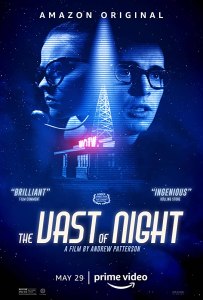 If you had told me that The Vast of Night was based upon a radio play or a narrative-driven podcast, something like the popular Welcome to Night Vale, I would have completely believed you. This is a very dialogue-driven story where the movie seems to hit pause and allow a speaker unfettered time to tell their tale in patient monologue, like a sci-fi edition of This American Life (I’m coming up with a lot of comparisons here). It’s a more high-concept, cerebral, imaginative-dependent science fiction. In 1950s New Mexico, a small-town radio DJ and a teen switchboard operator, both with dreams of leaving the town for bigger things, discover a strange signal and eyewitness reports of something in the sky. Over the course of one night, the characters investigate the signal and those who experienced it before. The Vast of Night flies right out of the gate, long takes giving space for fast-paced dialogue exchanges. The direction is very assured with long tracking shots to maintain the tightrope walk of a live theater performance that the screenplay imbues. I was always interested in what was happening but I can see many other viewers failing to click with the material and its narrative restraints. I do think the movie could use more of a resolution and errs by having the wrong combination of characters for a climax, denying the only real emotional catharsis that was offered by the screenplay. I’m sure many will simply find this movie slow and boring (it’s only 89 minutes but even that might be pushing it for many). The Vast of Night feels like an extended Twilight Zone episode, for better or worse. I applaud the ingenuity of the director and screenwriters on a small budget but I would not be surprised that bigger and better things lie ahead for each of these creatives.
Nate’s Grade: B
Share this:

Verotika (2020)
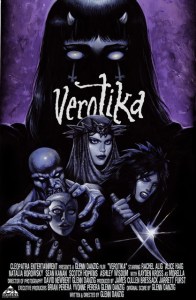 Misfits frontman Glenn Danzig loved the heavy metal aesthetic of big breasted ladies, fetish outfits, hulking monsters, and splashy gore, enough so that he started his own comic line in the 90s, Verotik (a portmanteau of “violence” and “erotic,” and yes that’s the explanation). They even adapted one of his comics, Grub Girl, into a 2006 adult movie, and I pulled this synopsis directly from Wikipedia: “One of the victims of the radiation is a sex worker whose scarred body is taken to a laboratory, where she wakes up while being sexually abused by a pair of necrophilic scientists, whom she kills on account of having given her ‘the worst f*** of my life.’ Grub Girl adjusts to being a zombie and returns to being a sex worker, discovering that being undead is advantageous to her career, as she is immune to disease and nearly impervious to pain.” Yikes. Anyway, Danzig took three of his comic tales and packaged them together into a low-rent horror anthology movie dubbed Verotika. Unfortunately, the final product is nothing short of one of the worst movies I have ever seen in my life. It is stunningly, exceptionally terrible in all facets.
I was left dumbstruck by the level of incompetence over the course of 89 ponderous minutes of awful. This goes beyond Tommy Wiseau and Neil Breen into downright Ed Woodian territory of ineptitude. I couldn’t turn away because I was trying to simply process everything I was seeing onscreen, to boldly attempt to understand so many choices made by Danzig as a filmmaker and storyteller. He serves as writer, director, and co-cinematographer. The finished film is not the so-bad-it’s-good derisive highs of Wiseau and Breen’s bemoaned catalogue of misfires. This is more just a slack-jawed “what were they thinking?” stupefied curiosity of an After Last Season (the worst film of the first 2000s decade, a movie so bad its small distributor asked theaters to burn their prints rather than ship them back). It’s not fun but baffling. It’s not silly but lecherous to the point of misogyny and discomfort. At no point are you transported to the weird imagination of an avant garde artist but instead you’re beset by huge lapses in filmmaking basics and a dearth of recognizable plot. With Verotika, there are no stories, only story premises that go nowhere and nowhere slow. While only 89 minutes long, it might be the most joyless, turgid, pointless 89 minutes I have experienced since After Last Season made an MRI machine out of paper print-outs.
 Allow me, dear reader, to describe for you the very opening minutes of Verotika, and please also understand that it only gets worse from there. The first segment is called “The Albino Spider of Dajette,” and it’s set inexplicably in France, which hamstrings every actor with a regrettable Pepe LePew accent that makes the segment even more ridiculous. Danzig could have spared his actors, who were clearly not capable of replicating French accents, the embarrassment but no. The opening minutes involve a busty woman, Dajette (Ashley Wisdom, porn actress), performing oral sex on a guy. He excitedly attempts to lift up her shirt, much to her chagrin, and is shocked to find that Dajette has eyeballs where her nipples should be. Yes, you read that correctly, she has literal eye nipples. The man leaves in horror and Dajette huffs dejectedly, “Not again.” These eye nipples will never amount to anything important, which is so confounding. Why include them? Her eye nipples cry a tear, which rolls down her breast and lands on a CGI spider, which then grows into a giant albino spider-man (Scotch Hopkins) with two working arms. This evil spider-man only comes out when Dajette is asleep, though she’s not sleeping now, so? He has a thirst for murder and sex and tells a prostitute he wants to rape her in the ass and then kill her. Her nonchalant response made me stare in amazement: “Ass f*** is my specialty.” Reader, I have described for you only the first few minutes of this entire segment. What is going on here?
The rest of this tale becomes repetitious as the spider-creature stalks and snaps more women’s necks, earning the moniker the “Neck Snapper” from the French media (imagine the strained pronunciation as “Nyek Snauhpah”). Dajette wanders around to stay awake, and this includes entering an adult film theater where the patrons conspire to gang rape her as soon as she nods off. She also enters a café where someone else’s cup is already waiting for her. Seconds later, a waiter asks if she wants any refills (“refeeelz”), and she declines and pays… for someone else’s cup of coffee? Here’s a prime example of the filmmaking shortcomings of Danzig. It would have been incredibly, stupidly easy to improve this scene simply by starting with Dajette at the table. By combining two shots of her walking along the street and then a shot of her indoors, still wearing her coat, and walking to a table, you are communicating an approximation of time. She has had no time to order her own coffee. All he had to do was start with her already seated and we could assume the cup was ordered off screen and before the edit. Verotika is replete with preventable bad decisions.
 Astonishingly, this segment is actually the best of the movie and each only gets demonstrably worse and more pointless. “Change of Face” is a clear homage/rip-off to 1960’s Eyes Without a Face as we follow a stripper/serial killer known only as “Mystery Girl” (Rachel Allig) as she slices off the faces of beautiful women to wear as her own. Our killer wears the faces of her victims to cover her own scarred visage while she strips for her customers. Considering she wears a mask to cover her face anyway while she dances, the face-removals seem gratuitous. If you’re looking for any clear motivation for this killer, even the simplest explanations, then you’ll only be further disappointed. Again, it would be so stupidly easy for Danzig to characterize the “Mystery Girl” as murderously jealous of the beauty denied to her, or present some insecurity that her stripping career and income will be shuttered if she cannot fix her face. Anything would have worked. Instead we simply get an absence of thought and development; this segment is taxed with several minutes of watching women lackadaisically walk around a stripper pole. It feels like Danzig had access to a strip club set for a day and was determined to use everything he shot. The epilogue of this segment even involves more lackadaisical dancing around a pole. The only thing that enlivens this segment is the acting of Sean Kanan as the detective tracking down the murderer. He talks like he’s trying to imitate Batman’s gruff voice and his chit-chat is blasé to the point of anti-comedy ironic perfection. “There’s your motive. They wanted a face,” he says. His big break in the case is finding a business card at the crime scene. Why would a stripper have a business card and why would this man assume she must be the killer? That would be like finding a carton of milk at a crime scene and declaring that the milkman was your top suspect.
The final segment is the most pointless of them all and feels like it should be visual accompaniment for talking heads on a History Channel special about Elizabeth Bathory, the notorious 16th century Hungarian noble who would bathe in the blood of virgins to stay young and vibrant. “Drukija Contessa of Blood” stars Alice Tate (Snowbound) as a woman who rubs blood on her face and body. That is literally the plot for thirty minutes. She slices some helpless women’s necks. She luxuriates in a bath. She rides a horse. She decapitates a runaway. She eats a woman’s heart while that victim inexplicably still writhes in agony well after the fact. There isn’t even the faintest hint of a plot here or characters. You would think we would follow one of the imprisoned women as she plots an escape. Once again, it feels like Danzig had access to certain elements that he was going to make sure got their overexposed spotlight. We watch Drukija stare into a mirror and make poses for several minutes. We watch Drukija sit in her creepy skeleton-lined bathtub for several minutes. We watch her ride a horse for minutes on end. At no point does Danzig offer a reason for the audience to care about anything happening on screen. The cruelty just becomes boring and as gratuitous as any other unfortunate moment in this unfortunate movie. The whole segment feels like watching a bored model on a cosplay photo shoot.
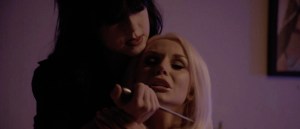 The fundamental lack of story, characters, conflict drives me nuts, but the movie fails just as badly on its technical merits. I can excuse some lapses in filmmaking from a continuity standpoint as long as they are not glaring to rip me out of the movie. Anyone that nitpicks the placement of bed sheets from shot-to-shot rather than emotional engagement and narrative drive is simply watching movies wrong. However, Verotika is complicit in making the kind of goofs and mistakes you’d associate with a schlocky student films and not a (gasp) million-dollar horror movie. Danzig favors ending every scene in a fade out, and I’m not exaggerating when I say “every.” It’s like he doesn’t know when to end his own scenes (more on that below). There are specific limitations in the makeup and production design, but then why feature camera angles and lighting that expose those limitations? Things like the crotch of the spider-man being blown wide open and visible on camera or a superfluous CGI floor Drunkija struts over. There are a proliferation of lens flares, which I think Danzig feels are “arty,” and they do provide a brief respite from the very grimy, over exposed photography that can be dispiriting. Even with a million dollars, this movie looks depressingly cheap. Then there are sloppy mistakes nobody bothered to correct. The neon “café” sign that Dajette enters is above the café window, not over it, and facing inward, which means no potential customer from the outside would get the benefit of the sign. Murder victims are extremely unmotivated to get away from their eventual killers. Certain physical confrontations are so confusingly staged that character geography will alter in a flash like a scene was missing. A shaken police officer laments “if the press finds out about this” about the THIRTEENTH murder victim. I think the cat’s out of the bag, fella. Why do we need an Elvira-styled host (Kayden Kross, porn actress) making bad puns to introduce segments?
As a director, Danzig leaves his actors adrift with awkwardly non-existent guidance. It becomes readily apparent that Danzig was afraid to call cut too soon because many shots will linger on long after the point has passed, leaving actors to fidget or look around, waiting to be told the take was over. Sometimes this involves literal minutes of an actor doing something repetitious while the camera will zoom in and out continually. There are moments where the camera will duck around, unclear about what it’s meant to frame, looking for its subject or composition like a documentary filmmaker on the spot. Every actor suffers from this and shots and scenes have that uncomfortable feeling of dragging on haphazardly, missing the rhythm of film narratives. I bet you could shave those extraneous seconds off every scene and trim 15 minutes total. As a result of actors given bad material, nascent characterization when evident, funny accents, and little to no direction, there are plenty of actors struggling to perform whatever they’re intending.
 Even as a low-budget sleazy exploitation film, Verotika cannot even succeed by that metric. The gore effects are few and far between and Danzig likes to linger over what he can get, much like other elements. If he bought the makeup for one girl to be skinned faceless, you’re going to see that effect a dozen times. When the Contessa is chomping on a heart, the proportions are so out of scale that it dulls the impact of what is a fairly good prosthetic otherwise. Even when it comes to gratuitous sex and nudity, the movie seems oddly inept. During the interminable stripping scenes of “Change of Face,” the women don’t actually strip while they lethargically spin around their poles. The women on display are more fetishized as murder victims than they are as sex objects. Why include eye nipples and then do nothing with them? Where did they come from? Is this a genetic thing? Did Dajette’s mother have eye nipples and nurse her from them? My pal Ben Bailey came up with a better storyline with “eye nipples” on the spot, gifting them laser powers and a thematic angle about striking back against handsy men who won’t respect consent. Boom, right there, a better use of weird exploitation elements and he was only joking around.
With every conceivable level of filmmaking and storytelling, Verotika shows that Danzig is not remotely ready for the big screen. The paltry story is kept at premise-level, there’s a decided lack of characterization and stakes and intrigue, lots of repetition, and shaky direction that leaves actors astray with over-extended scenes. Even as an exploitation movie, you will be sorely disappointed. As a hopeful heir apparent to the so-bad-it’s-good club, Verotika is not the next The Room. Not even close. It’s bad and inept and boring and flabbergasting but it lacks the bewildering appeal of the best of the so-bad-it’s-good crew. It lacks a sense of sincerity. I doubt Danzig thought he was making great art or even something cool. It feels like he took a music video concept and bloated it to bursting (Danzig’s music is a constant background presence). Danzig actually has another movie scheduled for release this year, Death Rider in the House of Vampires, starring Devon Sawa, Julian Sands, and Danny Trejo. I can only hope he’s learned from this baptism by fire (and blood) and surrounds himself with professionals who can carry the burden when he falters.
Nate’s Grade: F
Share this:

Gretel & Hansel (2020)
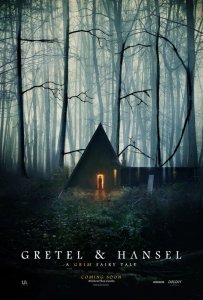 I feel bad for select audiences that went into Gretel & Hansel expecting a cheap thriller because what they really get is an atmospheric art movie that, even at a mere 80 minutes, moves at a very placid pace. Director Osgood “Oz” Perkins (The Blackcoat’s Daughter) takes the bones of the classic Grimm fairy tale and presents it as a feminist retelling of outcasts coming into their own feminine power and the costs of giving over to that power. The titular siblings are cast out by their mother after Gretel refuses to be a maid for a creepy older man very interested in hr “maidenhood.” They stumble upon the dwelling of an older outcast and she supplies plenty of food, but where exactly is it coming from? Gretel experiences strange dreams that portend to a witchy power of her own making, but she’s scared about what she may become and what may befall her brother, who the older woman deems Gretel’s “poison.” The story is a bit strained but the movie is visually luscious to watch. The photography and production design are exceptional and greatly lend the movie a transporting atmosphere that, coupled with its stodgy pacing, creates the sensation of experiencing a waking dream. The camera uses a lot of stark wide angles and centered compositions to heighten a sense of unreality. My favorite moments were the older Witch (Alice Krige, the Borg Queen from Star Trek: First Contact) was coaching Gretel on her inherent power and the sacrifices necessary for her to achieve her potential. She advises “trusting the darkness,” which sounds ominous enough. Because of the general familiarity with the fairy tale, the movie gets more leeway to fill its time with fantasy diversions and a slow build of horror revealing the disturbing process of how the feasts of food become prepared. It almost feels like the movie is reaching a breaking point with how lagging that pacing is, but then it generally gets back on track with a new revelation or complication. Gretel & Hansel is an enjoyably moody, stylish, equally beautiful and unsettling movie that’s heavy on grim and light on plot.
Nate’s Grade: B
Share this:

Wendy (2020)
 I was not a big fan of writer/director Benh Zeitlin’s first movie, 2012’s indie darling and surprise Oscar contender, Beasts of the Southern Wild. Some choice highlights from my mixed review include: “This movie is awash in all sorts of tones and storylines, failing to cohesively gel together or form some kind of meaningful message…. [it] offers half-formed ideas, strange, conflicting imagery, and characters that are rather thinly written and barely register… This is just a swampy mess of a movie, one that sinks under the weight of its own pretensions. It’s admirable from a technical standpoint but, as a movie, Beasts of the Southern Wild is an exercise in eclectic indie navel-gazing.” So as you can see, I wasn’t exactly heartbroken that Zeitlin took eight years for his follow-up, Wendy, a loose reinterpretation of the Peter Pan story. It has many of the same flaws as Beasts and not enough of its few virtues, which means Wendy is its own lost movie experience.
We follow a group of children from a working-class diner waitress in small-town Louisiana. They watch the trains speed by on the neighboring tracks and dream of far-off adventures. Wendy (Devin France) and her two younger twin brothers (Gage and Gavin Naqui) sneak off one night onto a passing train and meet Peter (Yashua Mack), a boy who promises to guide them to a magical island where they will never grow old as long as they believe in Mother, the spirit of the island and embodied as a giant glowing fish. Wendy enjoys the freedom but worries if she’ll ever see her mother again and if this extended excursion is worth that level of sacrifice.
 Maybe I’m just going through Peter Pan fatigue or maybe this latest variation on the mythology of J.M. Barrie just failed to provide any really thorough message, theme, or entry point of interest for me. Wendy seems to be going for whimsy and flights of fancy, once again attaching its perspective to that of children escaping into the realm of fantasy as a means of avoiding the hardships of their impoverished lives and what it means to be a working stiff (one child in the opening runs away at the prospect of becoming “a mop and broom man”). It’s meant to be diverting but it’s never really that exciting or involving, tapping into a wellspring of awe. There’s a beautifully idyllic island and a volcano, and of course our magic fish, but there aren’t nearly enough genuine magical elements to convey that desired whimsy. The freedom of a life without adults seems less free when there’s less to do. Much of the movie feels closer to The Florida Project where a group of poor kids are playing around junk to keep from being bored. This Neverland universe feels very limited as far as what can be done. They run around, they pretend, there are even some decrepit buildings, but what else? There isn’t really a society here in concert with our lost children and former lost children. It’s a pretty empty island retreat.
Perhaps that was Zeitlin’s goal, to strip away the romanticized notions we attach to forever staying young, chasing the fleeting feeling of the past while ignoring the present and adulthood, but this more critical theme doesn’t come across thoroughly either. There is one interesting aspect of the island’s unexplained magic and that is the older adults are former lost boys and girls who lost faith in Mother, thus activating their advanced aging and expulsion from Peter’s posse. I like the idea that the future villainous pirates of a Neverland are former lost boys; it gives an interesting personal dynamic for Peter. These adults, though, want to go back to being young again and they are convinced that killing Mother will achieve this, and it doesn’t go as planned. The deconstruction of fantasy with real violence doesn’t work because the consequences aren’t at the same level of realism. A child, in an effort to avoid growing old, makes a drastic decision, but the brushed-off aftermath makes the insertion of the harsher violence feel perfunctory. Peter is portrayed as an idealist leader one moment and ignorant and selfish the next, even with Wendy scolding him that there’s nothing wrong with growing up and becoming an adult, despite the mixed message of the former lost boys. The movie concludes with a goofy sing-a-long for magic resolution purposes that is played so earnestly that it makes it hard for me to believe Zeitlin was intending to be too critical of his magical world.
 Is Wendy about rejecting adulthood or the unavoidable perils of rejecting adulthood? I cannot say because the themes are so muddled with such a precious lack of significant storytelling content. Once again, a Zeitlin film feels like an improvised series of redundant scenes, where we watch kids play fight, we watch kids yell at one another, we watch kids run, we watch kids swim, all with headache-inducing handheld camerawork, but do we get to know these kids on a deeper level where they feel like people rather than figures? The plot of Wendy, written by Zeitlin and his sister Eliza, is very unclear about the rules of its magical world, which makes for a hard time to understand why anything is really happening. It also makes the movie less fun to experience because we don’t get to play along with the discovery of a fantasy world, its new parameters, and how we can develop and complicate them (not that there’s really much to discover; Neverland gets old quickly). This is definitely a movie that’s meant to convey more in feeling and inference, so the plot beats are very inconsequential outside of a few key movements. I didn’t find myself caring about any of the kids and their general well-being, even after they take it upon themselves to make some rash medical decisions. Wendy is our best realized character as she at least seems conflicted about the appeal and consequences of staying young indefinitely. The others are easily replaceable.
Wendy isn’t a bad movie and it’s clearly a very personally designed project from Zeitlin given the years of preparation. It has consistently gorgeous photography by Sturla Brandth Grovlen, the first film production shot on location on Montserrat island, and the score by Dan Romer (Maniac, Atypical) excels at the big swooning, churning melodies that crescendo into triumphant bliss. But even these positive technical qualities can only distract you momentarily from the missing center of Wendy, the story and characters and themes and discernible messages. I’m not asking for my entertainment to spoon-feed me what to think and feel from my art, but having a consistent message, or even an accessible entry point to decode and debate the art would help, as would engaging characters and a plot that felt more meaningful than just another disposable color to blend into a murky abstract mess of childhood whimsy, magic realism, and coming-of-age themes. A little of Wendy goes a long way, and two hours gets quite tedious. I just cannot foresee people falling under the spell of this movie. I wrote that Beasts had “half-formed ideas, strange, conflicting imagery, and characters that are rather thinly written and barely register,” and this much is also true with Wendy. I also wrote that Beasts was “an exercise in eclectic indie navel-gazing,” and this much is also true with Wendy. Maybe I’m just not the right fit for a Benh Zeitlin film. This is two hours of kids running around on an island without supervision and the occasional Peter Pan element thrown in. Maybe that sounds like a grand retreat as a viewer but it made me happy to be an adult and leave.
Nate’s Grade: C
Share this:

Constraint (2019) [PART THREE]
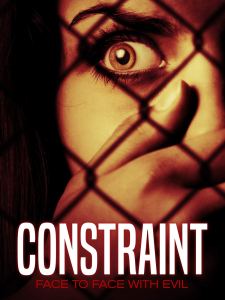 Please read PART ONE and PART TWO if you have yet to as I try and better articulate my questions over this Columbus, Ohio indie and its confounding creative decision-making. Dear reader, I am going to take you live through this very intellectual and artistic assessment as I continue to watch Constraint.
The main plot revolves around Oracabessa (Brooklyn Sabino Smith), a young cellist, who becomes entangled in a web of human traffickers, led by Tuco (Ralph Scott).
I’m now heading into Act Three with a half-hour left of movie to go with Constraint. Oracabessa mumbles the address from Tuco’s I.D. and wanders into the woods rather than call for help or use her moped or one of the cars at the scene of the accident. Magically, she finds the location. Her sense of direction must be superb while suffering from a concussion. Why would she think Tucco was holding the trafficking victims at his registered home address? I feel like the first step of human trafficking, after giving away one’s moral whole, is not to keep your victims at your home.
Dear reader, I am all about climaxes where our protagonist wreaks havoc among some very bad people who deserve some very bad justice dealt to them in hopefully poetic and painful ways. It’s a natural storytelling formula rife with catharsis and payoffs. But like other formulas, you need to still put in the work to reap the rewards. Just because our heroine is stumbling to a compound to free the victims and bring down their tormentors does not mean it works. It’s skipping to a climax the movie doesn’t really deserve because we spent so much precious time on side characters that didn’t matter and dawdled. Just in case if you mistook the good faith of the production, there’s also a gratuitous rape scene used as a setting device for one of the heretofore unknown bad men (at least she was clothed). One of the women from the beginning is found in the basement, she mistakes Oracabessa’s intentions, and runs to her to be saved, and she then gets gunned down in the back by the traffickers. She was let down twice by our heroine.
 Our leading lady wanders the compound and comes across two children, one white and one non-white, both of them trafficking victims, but she only addresses the white kid and says, “I’ve come to take you home.” They ask if she is the police, again a reminder that perhaps alerting the police to the whereabouts of this site might have been a higher priority than going alone. She is only here, it would seem, for these two children. Sorry the women she found in the confusingly oriented basement. I was already having a hard time liking this protagonist as is but this sealed it.
A lot of shots of running through the woods happen without much to connect a sense of spacing and geography, and then Oracabessa is saved when Derick drives up and they get inside his car and drive away to safety. The following then happens in our bulrush of a resolution:
1) Oracabessa is in a hospital bed. A nurse is asking her about medications.
2) Nicolas quickly rides a motorcycle to the hospital entrance outside.
3) The nurse says she “just got your blood tests back” (a certain The Room line echoed in my head) and then imparts, “Have you ever been pregnant before?” Why is this even being asked except to imply that she is currently pregnant or never had a son like she confessed before. We get no clear indication on either of these being true, so, again, why include it?
4) Cut to Nicolas running down the hospital corridor while SUDDEN electronica music begins blaring like we just dropped into an action set piece from Blade.
5) Nicolas comes into Oracabessa’s room and pulls up a blanket on her in a manner that seems less “tucking in” and more “pulling sheet over a corpse on a slab.”
6) We reveal in the same hospital is Oracabessa’s brother who was indeed the drug carrier that Tuco stabbed far earlier and has not been referenced since. The doctor says he lost a lung.
7) Nicolas thanks Derick for saving Oracabessa and they seem to part on good terms. In the same camera setup, with Derick in the same outfit, thus implying that same day, Oracabessa leaves on crutches, meaning she was discharged in hours. The ADR-ed line “Think you cracked the skull” occurs without Derick moving his mouth.
8) We jump to a new scene where Oracabessa has her hands around Derick’s face and she says, “I’m going to kiss you now, and it’s going to be the last time. I’ll never kiss you again.” It’s a repetitious line that screamed Neil Breen to me.
 9) We jump to a new scene where Oracabessa is hobbling to the ballet class teacher who shows no sympathy and literally tells her that her last performance “was an abortion.” Yikes! This is then immediately followed by Derick saying, “A woman has a right to choose” to Nicolas.
10) While talking to the creeper from before with the French accent who heads a music school, Oracabessa SUDDENLY remembers a time she saw him sitting in the passenger seat of Tuco’s car while it passed her on the street. Who else will she arbitrarily remember next? And how often did she see this one car drive around her entire town that she committed to memory? She, at long long LONG last, finally calls the police and has the human trafficker creeper arrested.
11) She then flies to Jamaica and visits her father, asking him about the little boy he ran over. Did this man serve jail time? Oracabessa blames herself for the kid’s death and now I feel like this should have been dealt with more if we’re going this route. It doesn’t feel like catharsis because it doesn’t feel like it was on her mind too often. Did I confuse the earlier scene of her talking about a son as this kid?
12) Nicolas surprises her in Jamaica. “Whatever happened to that Derick fellow?” asks dad at a dinner with the three of them. We’ve been told Nicolas was engaged to Oracabessa, so it seems peculiar that of the two men in his daughter’s life, this is the one he is unfamiliar with. Dad threatens Nicolas with great harm if he does anything to hurt his daughter. Is this comedy?
13) The voiceover overlaps and we jump to a wedding party dinner with the use of split screens. Why split screens? With how quickly we are rushing through plot content, I feel like this is the series finale of HBO’s Six Feet Under and I’ll see the next hundred years of these people’s lives.
14) The various characters mingle and dance in, what else, a wide angle that lasts an astounding FOUR MINUTES without cuts, as if the movie didn’t know it was over. It’s just lingering with no real purpose of why the audience needs to see any of this for four minutes. There is no dramatic change. Just people hugging. If the movie already wasn’t nearly two hours long, I would have accused the filmmakers of dragging this thing to a feature-length running time. Then the end credits just appear, which they could have done four minutes ago too.
 Finally, now I can derive my critical conclusions on this truly bizarre Ohio indie movie. Constraint feels overwhelmingly like Ohio’s own Neil Breen movie, plotted so loosely, so archaically, with characters behaving so randomly and nonsensically, and with a story that never seems to have traction, bouncing from one character to another and going on strange tangents and flashbacks, like it’s trying to pack in some half-formed Armistead Maupin ensemble piece. Constraint is just as much about a girl walking around town with her cello on her back (possibly one quarter of all shots) as it is about sex trafficking and finding the victims (when it’s not squeezing in some nudity from them). The pacing seems overstuffed and insufficient, with so many things happening but little connection to make those actions feel important even with life and death stakes. Perhaps having our main trafficker just wandering around town at all hours takes away from his mystery and danger. This is a movie where anything might happen at a moment’s notice because it doesn’t feel like much of what you’re watching builds off what came before. Being redundant at 110 minutes is just inexcusable. The scenes in a movie should matter, as should their placement, and the characters should learn, grow, progress, or at least present an interesting viewpoint for an audience to follow.
From a production standpoint, Constraint has some positive qualities but they are routinely hobbled by the exasperating creative choices of the man in charge, writer and director and editor and cinematographer Richard A. Nelson (The Endangered). The man likely should have only had one job on this project as director. He needed other creative supports that could better concentrate on seeing a vision through, a better writer to make a better story with fleshed-out characters, a better cinematographer to ensure more seamless camera arrangements for the edit, a better editor that wouldn’t sabotage the movie’s flow and literal comprehension with so many erratic edits. It’s not a bad looking movie despite some unfortunate edits and a heavy reliance on day-for-night filming. The acting is generally acceptable but I don’t hold the performances against the actors. The characters they are playing are very difficult to find a sustainable reality to inhabit. Smith (Indie Film School) has something about her that keeps you watching, which is good considering her cellist character doesn’t fulfill that same outcome. Scott (After) is dependably great. There are even moments, slivers, that give an idea of how good all these actors could be with better material, like the small scene between Alice and Tuco together. Constraint feels like a dozen movies that have been sloppily distilled together, with inorganic sections intruding upon one another. I don’t know if this approaches a so-bad-it’s-good quality but it’s flabbergasting to witness.
I cannot advise you to watch Constraint but I cannot not advise you to watch this. It’s Ohio’s own Neil Breen indie and I never thought I would discover something quite like that.
Nate’s Grade: D-
Share this:

Constraint (2019) [PART TWO]
Please read PART ONE if you have yet to as I try and better articulate my questions over this Columbus, Ohio indie and its confounding creative decision-making. Dear reader, I am going to take you live through this very intellectual and artistic assessment as I continue to watch Constraint.
The main plot revolves around Oracabessa (Brooklyn Sabino Smith), a young cellist, who becomes entangled in a web of human traffickers, led by Tuco (Ralph Scott).
I am now 45 minutes into the movie and screamed, “What?” to my screen. Oracabessa (Brooklyn Sabino Smith) is once again playing cello for a ballet class and the instructor doesn’t like the musical selection. She requests Wagner, and Oracabessa says she won’t. The instructor is animated and agitated and demands to know why she can’t play the composer. “I didn’t say I couldn’t play it. I won’t,” she replies. Why? Is this going to be like some character moment like in La La Land where Ryan Gosling gets fired for refusing to play the holiday music his boss asks for as dining accompaniment? I would think refusing to play what a client was requesting could cease in you getting more work from that client. And considering this one ballet class is the only thing we’ve watched her do for money, I wouldn’t be too pushy.
Oracabessa sees Tuco walking along the street again which begs the question of how protected does this guy think he is? She follows him but the ensuing tailing sequence goes through a blender of edits so it more implies the chase than allows it to establish. She then joins the college professor, and Derick, and others at a hookah bar to translate a French speaker. “What about having your own racial identity?” Why does this scene exist in a story about sex trafficking? Is the professor Oracabessa’s sister? Why was this never established earlier? There’s now a discussion over whether or not Jewish people should be defined by the Holocaust and its impact and it’s like a family dinner squabble, still with the omnipresent ADR dialogue, and I’m starting to lean into the arbitrary madness of Constraint as it further infects me.
 We transition back to the life of Tuco, our beleaguered sex trafficker. He kills a guy for being late to a drug deal and I cannot say but this might have been Oracabessa’s brother from the previous family dinner scene. Tuco has his kidnapped women line up in their underwear so they can be “inspected” by his superior. He warns them not to “embarrass him,” though I have no idea how that would be achieved. And then the women start stripping off their clothes and the camera angles are PURPOSELY AIMED to highlight their full-frontal nudity, even one side view that captures all three women’s breasts in a row while cutting off their heads. That’s when I stood out of my chair, cursed this movie out loud, and paced around the room in building anger.
Nudity in film by itself doesn’t have to be sexual or gratuitous, but this nudity is meant for titillation, framed for this purpose, and to squeeze this into the context of sex trafficking, a very depressing and all-too-real reality for many, I felt extremely grossed out. The scene doesn’t need visible nudity to feel the distress and vulnerability of the captured women. I love exploitation movies as entertainment, and have even supported a few financially, but story context and tone are key. The women of this moment are there to be objectified and the camera objectifies them too. You know how I know how these actresses felt about this scene? None of their last names can be found in the film’s credits, so I don’t think they were too happy to have their full names associated.
We now transition to another new perspective, this time Nicolas’ parents (Dino Tripodis and Kristina Kopf, The Street Where We Live). “He experimented with something exotic,” the father says, and I don’t know if this implies that dad is racist for thinking “black” equals “exotic.” This entire scene feels even more student film-esque than the rest, with the editing choices and the characters dancing around critiques of domesticity and parenting. The wide angles that suddenly cut to extreme close-ups of faces, the jump cuts, and ADR sound design, it’s all starting to make this feel like a foreign film that’s trying to be New Wave arty. “You didn’t even leave your son with the hopeful illusion that maybe his parents were in love at one time,” mom says. The dialogue in this movie feels like it was written by an A.I. at many points. Nicolas later confronts dad who is apparently out on a date with another woman, and he does so with his mom in tow. “My whole life, the one thing you’ve been good at, is making people cry,” Nicolas bemoans. The wide shots showcase a bar/restaurant with nobody else in attendance, again another mistake with revealing the limitations of filmmaking. Now the scene is suddenly in black and white, so is this an established flashback? If the whole thing was a flashback for Nicolas then why wasn’t it all coded in black and white? Wait, then Nicolas’ own voice over narration is coming in while dad is talking in the present. We then pull into a flashback of Nicolas telling the story of meeting his divorced father in the park to Oracabessa, so we witnessed a flashback-within-a-flashback for a side character. “What would you say is the most devastating thing to happen in your life?” he asks Oracabessa. Sheesh, if this is your pillow talk no wonder she dumped you, dude. There’s now a flashback 23 years to Jamaica with Oracabessa’s biological father. There’s an ongoing streak of whispered poetic voice over from Terrence Malick films. What movie am I watching now? I can’t keep up with the shifting perspectives and visual vocabulary that keeps being broken so flagrantly and randomly.
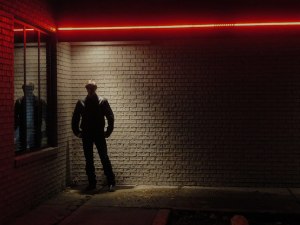 Folks, the erratic edits have not gotten any better and a conversation will randomly jump from four different camera positions from line to line to completely obliterate flow.
Derick and Nicolas are fighting over Oracabessa, who doesn’t want either of them, and then Oracabessa is playing at a big recital, and again I have to remind myself this is supposed to be a movie about sex trafficking but it’s playing like some small-town ensemble piece (why else do the same people keep running into each other in a city of over a million?) but like a Christopher Guest mockumentary (Waiting for Guffman) played straight. Why does Tuco even attend this recital?! Oracabessa follows him and the chase has several nice camera angles for a low-budget indie, and it’s also edited in a way that maintains the suspense and is readable for the audience, going from better selected angles to convey the progression of the chase and Oracabessa following closely. The music, however, is way too overwrought and we watch Tuco go into a restaurant, eat, and then leave with Oracabessa following again. Why did we need a pitstop? She didn’t even go inside.
Tuco finally ambushes Oracabessa and runs her over, which triggers a flashback of her son (?) she confessed she lost (in the flashback with Nicolas) being run over in the past. The way the scene plays doesn’t make it seem like she was witness to this event for recollection. Nope, it’s just a kid that Oracabessa’s father ran over while she was a child, which explains why she could recall this moment but also makes it too confusing for an audience to adjust to what is being thrown at us without context as it plays. It wasn’t even in black and white, which is the established code for flashback. A drunk driver then plows into Tuco’s car, which smashes into Tuco, finally killing him and setting Ralph Scott (Minus One) free from the earthly bonds of this movie. Oracabessa takes his I.D., gun, and sets off, presumably, on a path of righteous vengeance as she… wanders into the woods, but what do I know?
So this one woman had her father run over a child, abandon her, then she lost a child of her own, and has been stalked by human traffickers. This is getting into telenovela territory of melodrama. And so ends PART TWO of my real-time review of Constraint.
Share this:

Constraint (2019) [PART ONE]
A most unusual thing happened when I was watching the Ohio-made indie Constraint on Amazon Prime; I was so bewildered by the filmmaking choices that I had to stop and begin writing my thoughts immediately on the movie even as it continued playing. This is a rarity, a movie that causes such confusion that I feel compelled to articulate my thoughts in the moment rather than, as I normally do, assessing them upon completion. I wasn’t expecting any of this. Constraint has a very serious subject, sex trafficking, and filmed in my hometown of Columbus, Ohio, which has itself a very serious problem with sex trafficking networks. It starred familiar faces from my other Ohio indie viewings of recent. But then within only three minutes, I had to pause at several points, walk around my room muttering questions to myself, and couldn’t go much further in the movie without repeating this process. So, dear reader, I am going to take you live through this very intellectual and artistic assessment as I continue to watch Constraint.
The plot revolves around Oracabessa (Brooklyn Sabino Smith), a young cellist, who becomes entangled in a web of human traffickers, led by Tuco (Ralph Scott). Other characters will come and go into her orbit but Oracabessa is our guiding point.
Within minutes, I was already starting to question decisions, or practical limitations, exhibited by writer/director/editor/cinematogpraher Richard A. Nelson (The Endangered). Even the opening credits are strange with listing an assistant director before blocks of cast names and then zipping by in a blink as to render their inclusion seemingly moot. Then there was the realization that all of the dialogue sounded like it had been ADR, meaning recorded later and indoors. Not just outdoors scenes, which can be notorious for wind and auxiliary noise, but also indoor settings. Honestly, it made me immediately think of the notorious Mystery Science Theater 3000 high point/low point, Manos: The Hands of Fate, a movie from 1966 where every line of dialogue was recorded after filming and, what sounds like, in a bathroom, and sometimes with one actor providing both voices to a conversation of two characters. Immediately, my mind starts going into formulating some kind of explanation why this might be, what could have led to this, and I’ll fully admit to striking some of my criticisms if they vanish later in the film.
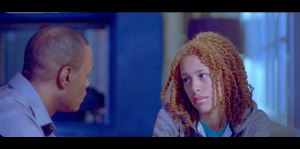 The editing choices can be jarring and forced me to stop the movie at several points. An early scene, at the four-and-a-half-minute mark, has our lead Oracabessa visiting her boyfriend, Nicolas (Aaron Geib). The camera moves to a wide angle as they settle at a kitchen table. Within seconds there are two jump cuts but they eliminate mere seconds or fractions of seconds of footage. Then there’s a quick cut to an exterior of the apartment, presumably to “clear the edit” and allow a passage of time or at least a new camera angle. Nope, we come right back to the same shot. Why? Why not just start with the shot from after the exterior cut of her passing her drink to him? Why did the previous moments need to be seen? What then follows is a close-up of the food, fully prepared, and the boyfriend has his line entirely off screen. This is the stilted dialogue that follows:
Him: “It’s a peace offering? What are we, at war?”
Her: “Man and woman in any kind of relationship are always at war. It’s just a matter of what degree.”
She then passes by him and it jump cuts (same camera angle) to him responding, then it pans over to her at the other end of a doorway, and then after her line it literally cuts back to his position on the doorway (same camera angle) to walk over to her. What? Why not just pan both ways? She responds and then we have ANOTHER JUMP CUT (SAME CAMERA ANGLE) and then ANOTHER JUMP CUT (YOU GET IT) of her a step forward walking past him, and then ANOTHER JUMP CUT (YOU KNOW IT) of him looking off screen at her. The camera angle then changes, mercifully, to a medium shot (with her head cut off) of her pulling off her ring followed by a different medium shot (with her head now visible) of her placing it atop a bookshelf. We then cut back to the EXACT SAME previous shot of the guy still looking off screen in response. There’s a couple more cuts as she leaves and then the movie jumps into a bizarre montage of images as she’s riding on her moped with a fixed handlebar-POV shot, a closeup in slow motion, and black and white inserts of her presumably as a child.
Ladies and gentlemen, I have no idea what to tell you beyond watch the segment (5:30-6:30) for yourself and join in my mounting alarm and confusion. Even if the production was stuck with minimal camera setups, why jump so haphazardly from moment to moment with jump cuts? Why use pans so sparingly when they could keep an audience in the moment? If the point of the scene is to impart a distance, a lack of engagement in this couple’s relationship, the staging and editing could have better communicated this without resorting to off-putting decisions.
The next moment of curiosity occurs seconds later as Oracabessa attends a very sparsely populated college lecture (I literally counted 12 people in a hall that likely seats 200). Again, the noticeable ADR sound, again the annoying jump cuts, and again confusing choices about the staging of the scene. The professor is arguing over reparations and there’s a moment where it cuts to a black and white still image of the professor and then cuts back to her talking. Is this an Oliver Stone movie? A (white male) college student protests he shouldn’t have to pay for his ancestors’ bad deeds and gets into a fight with another student, but the majority of the crowd shots are taken from one very wide angle. When the students confront one another, the camera doesn’t move, doesn’t get us closer, and they just occupy a small portion of our screen, which then cuts to another exterior shot and back to the same interior angle again. I’ll accept that the professor, and the older man monitoring her teaching, were filmed at a separate time and cut to look together with the crowd of students. I get scheduling shortfalls, but why make it all the more apparent to your viewer? Why film in a way that highlights how empty the space of this lecture hall is? Why shoot with such static angles? And why again do we get so much weird edits that break up the flow of the scene? Reader, I am only eight minutes in.
I just counted six edits and three different camera angles just to capture Oracabessa copying a paper on a copy machine. It’s a twelve-second scene which raises the question why multiple camera angles were needed to simply convey she copies something and why we needed twelve seconds on this task. I am just completely bewildered by the editing choices of this.
Credit where its due, the investigation scene of Oracabessa looking through old microfilm at the library on missing person reports is the place where jump cuts and rapid edits are beneficial. The black and white flashback is confusing though whether it constitutes the events that actually happened, seeing a young woman and little boy somehow separately being stalked by an unseen driver in a car regardless of the fact that they’re walking in opposite directions, or whether it’s Oracabessa’s imagination playing out over what might have taken place.
The movie then seems to transition its protagonist, switching to Alice (Maya Sayre), the mother of the missing boy, who is identified via a subtitle at the bottom as if this was a documentary subject. She seems to be sitting in a coffee shop with a stack of missing fliers and… signing them? I don’t know. There are more quick cuts of things like a closeup of a teacup and then Alice sitting alone at a park. The trees all around her have missing posters of her son tacked on, which starts to beg the question of why put it on twelve trees in close vicinity to one another unless Alice has an endless supply of disposable money for unlimited copies or really hates trees. She is literally posting the same flier within mere feet of one another.
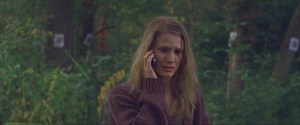 Here, finally, is an example I can praise for its filmmaking choices. Alice is postering the neighborhood when the bad trafficker Tuco then pulls up to her in his car and says, “Oh, your son is missing?” As he asks about her circumstances, the camera hangs on Sayre (One Dollar) to deliver the moment with her performance and it works. It works because the camera allows us to stay in the scene and because of the trust in the actors. She’s heartbroken but still unable to fully articulate her grief, and it’s a beautifully acted moment of desperation. She even looks like Jessica Chastain in certain angles, especially profile. When Tuco walks up to her, the camera angle remains the same but to the benefit of the scene this time, as his size towers over her, dwarfing her, his head cut out of the frame, his arm thrown around her shoulder, providing potential comfort or potential constraint, and we already fear for her safety. She invites him into her home and they have a nice talk, with Alice lamenting how people are no longer kind. The irony seems to be building, and finally Constraint feels like a movie with purpose.
This is legitimately a good scene as Tuco vacillates over what to do with Alice. Her dubbing him a gentleman seems to dial up his sense of shame and he leaves for another room where we see him take out his gun and then put it back. Will his compromised sense of morality win out? Even the clipped framing helps this case by placing the emphasis on Scott’s hands and the gun. Their conversation lingers and the camera continues running, and that’s how to drive tension. Unfortunately, her horny desperation to get him to stay and the weird song that plays in the background as if they were trapped in an elevator undermine the scene’s suspense.
More bizarre editing choices as the scene of Tuco talking with a crony literally jumps from a super wide shot to a closer shot as they trade lines. It makes me think of the Sesame Street bit where Elmo demonstrates near and far. After several more erratic edits, the film leaps to a shot of Tuco waiting in his car, but it’s being filmed from an angle where a pole or pillar is obscuring his very face from being seen on camera. Why choose an obstructed view of this? Even more baffling, a minute later the movie indicates Oracabessa is observing Tuco kidnap another young woman and throw her in his car and drive off. And. Oracabessa. Does. Nothing. Not even call the police, try and yell back and create attention, even jot down a license plate number. Perhaps she wasn’t literally viewing this spectacle, but when you cut to her walking in what looks like the same setting as this is going down, then you’re going to convey this interpretation to your audience.
A stranger who has been hardcore eyeballing Oracabessa as she played cello for some little ballet dancers stops her on the street. He compliments her playing and then leans a hand out and says, “May I?” and then bizarrely strokes the side of her face. “Your face is flawless,” he says in an accent that invites imitation, all while gripping her face. “It is like glass. Like caramel-colored glass.” Why is she allowing this creeper to continue doing this? This is even before he says he’s a music school bigwig and think she has real talent. Does this woman have any sense of self-preservation? The characterization for her doesn’t make any sense from scene to scene.
 There’s another flashback where she recognizes Callie (Jennifer Ann Hickey), the female partner for Tuco, and that she had the missing boy beside her in the same car Tuco was driving. Again, is she imagining this and trying to connect mental dots (it’s played in a kind of black and white) or did this happen, which means that yet again she should have recognized Tuco as he was abducting a new girl in front of her. Then I laughed out loud when the camera does a sudden zoom into Tuco’s car followed by a close-up of Callie turning to face the camera and glaring. I thought Tarantino’s Kill Bill music was going to commence. Does Callie somehow recognize Oracabessa too? She starts running away, and again this is an opportunity for Oracabessa to call the police or write down Tuco’s license plate number, and she does nothing, eventually fleeing herself.
The editing proceeds as follows: Oracabessa is on the run. We hear a classical music piece to note the tension. We then see Tuco’s car trailing Oracabessa. Inside Tuco’s car, the same classical music piece is playing but noticeably softer, trying to imply the music is diagetic to the car radio? Then we cut to a hand on an acoustic guitar and a young woman singing at a party, which also seems kind of like an attention-grabbing thing to do unless the party is centered upon your performance. It’s only revealed later that Oracabessa is at this party. The same professor from earlier asks to dance with Oracabessa and literally holds her hands and barely sways, like a child’s idea of what slow dancing would be. This same professor then admits to inviting Oracabessa’s ex Nicolas and then says to dance with her. All of this is the same shot too. Nicolas then hovers over Oracabessa, butts into her dance, and then they awkwardly stand next to one another without saying a word for thirty seconds, and then the other dancee comes back. What?
The movie jumps perspective again, this time following the ex Nicolas, who goes home and sits on the bed he and Oracabessa used to occupy. There’s a post-coital flashback, which features Smith nude, and I felt protective of the actress, like she shouldn’t have to get naked for this. There’s even more stilted dialogue between the pair:
Him: “In every great love affair, you gotta have a nickname. Yeah, I gotta come up with a nickname for you.”
Her: “I detest nicknames. They’re arbitrary.”
Him: “Naw, your birth name is given before your personality has time to develop. A nickname is usually based on a personal trait.”Her: “It’s an intimate thing naming a person.”
Him: “Well… I think you’re a… ‘Saffron.’’Her: “Why Saffron?”
Him: “It’s got a malevolous ring to it. And you with your angular edges. I gotta name you something pleasant, right?”
Oh my God, people do not talk like this, at least the people of Earth. This scene could have been cute and a snapshot of their better times as a couple but now it just makes whatever they had feel even more bizarre. The dialogue is very unnatural throughout Constraint and reminiscent of something I would find in a Neil Breen movie, and it pains me to make that comparison.
 Another guy, Derrick (Kenyatta Foster), is also interested in Oracabessa and having a flashback of falling for her, and why am I seeing any of this? Her anecdote about “sympathetic vibrations” from a cello is actually a well written aside that she can explain her dating goals with, but it’s hobbled by the guy just leering over her: “I can give that to you baby, you just have to see.” He goes for the kiss and she consents, which makes me question whether she cheated on her now-ex-boyfriend or what the timeline was for this, or even whether this might just be in his head. I do like that it cuts from him kissing Oracabessa to him kissing the professor, and he’s clearly not into her. That’s an honest-to-God clever editing choice and better conveys the character’s response.
So many jump cuts, so much day-for-night shooting, so many confusing geographies, so many quick exterior shots after spending time indoors just to cut back to the same indoors, and now even more nudity from our lead actress with a gratuitous shower scene. This woman deserves better.
Tuco has somehow tracked her though we have no idea how and hidden in her closet. Instead of killing her when she was in the shower, to avoid the Psycho homage I suppose, he waits until she’s performing her cello. They fight and she beats him with her cello and uses the bow like a riding crop. Yet she doesn’t call the police after nearly being stabbed by an intruder, when the assailant’s weapon is still there, as well as his blood, for physical evidence. Tuco comes back but she has a few intimidating dudes standing around as a posse. Then we cut to ballet! Why? Is the threat over? Why does this guy even see Oracabessa as a threat considering she’s never reported him? How did he find out where she lived? Her apartment looks like the interior of a school. How is any of this adding up to the larger narrative? I am just so lost with the creative choices here.
I’m actually going to turn this review into a multi-part series to make it more digestible for you, dear reader, so thus concludes PART ONE. Read PART TWO.
Share this:

Among Them (2019)
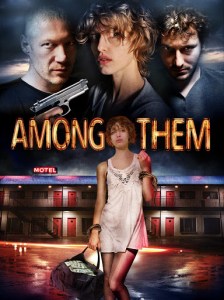
Among Them was described in its advertising as “Tarantino meets Bad Times at the El Royale,” and ignoring the fact that Bad Times is itself a colorful Tarantino-styled homage, what I was really reminded of was Waiting for Godot. For those unfamiliar with Samuel Beckett’s existential play, it follows two gentlemen who do nothing much more than waiting for a man named Godot who never shows up. They get involved in philosophical discussions, and many have intuited that Godot is a representation of God, to Beckett’s dismay, but it’s really a two-act play that involves a whole lot of waiting and the question over why. This is the extent of Among Them’s 90-minute total – a lot of waiting and a lot of questions over why bother.
Two bank robbers, Mick (Dan Liebman) and Harry (Jonathan Thomson), are hiding out in a motel room off the coast. Their bank heist has gone wrong and they’re awaiting the proper papers to escape overseas under new identities. They also discover a woman, bound and gagged, inside the trunk of their getaway car assigned to them from their bosses. Syd (Evalena Marie) could be a liability and they need to make sure she doesn’t get them caught.
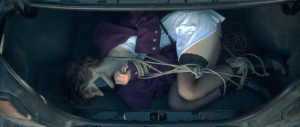
The problem with the screenplay by director Kevin James Barry (Serena and the Ratts) and co-star Marie (Dark Haul) is that it has conflated being vague with the idea of being mysterious. There’s far too little going on in this story and far too little that makes much sense. Our criminal duo is following instructions to lie low at a motel. That’s it. They don’t really know who they’re working for, what those plans might include, and so they wait for some unknown source to finally give them their new passports to escape from the police. Being kept in the dark with your characters can be a benefit for storytelling because you are forced to think things through at the character’s level, which works nicely for paranoia thrillers and mysteries. However, when you don’t put in the necessary work, it just makes the story feel unfinished and pointlessly protracted.
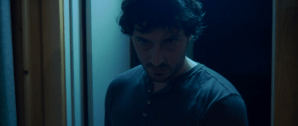
I can clearly see the Tarantino elements that the filmmakers attach to Among Them, the bank robbers hiding after a job gone wrong, the kidnapped character becoming part of the team, the motel that might not be all that it appears to be, but these are just elements. What’s desperately missing from Among Them is the intricate plotting and superb characterization one comes to expect from a QT joint. If we’re going to be stuck with these characters in a confined setting, then we need either intriguing developments or engaging personalities that draw us in. Well, considering the story involves characters just waiting around a motel room and seeing weird ghostly visions, plot development isn’t going to be the winner. This is really where Among Them creates an artistic ceiling for itself with its bland characters who we’re stuck hanging around with. Neither Mick nor Harry are charismatic, interesting, or even that dangerous. There aren’t even that many differences between them. If you’re keeping characters cooped up, it would be smart to have some sort of interpersonal conflict that threatens to boil over and ruin things. Think about From Dusk ‘til Dawn and Tarantino’s character and his creepy fixation on an underage hostage, or the different agendas in Bad Times. Just because the characters are seemingly losing their minds doesn’t replace dynamic and necessary characterization.
This brings me to the character of Syd, whom I do not understand at all. She’s discovered in the trunk of a car that was designated for our bank robbers. You would naturally think this woman either means something important enough to be captured or presents an intriguing enigma. This is another consequence of keeping everything so overwhelmingly vague. The characters don’t seem too bothered to learn more about her and why she was placed in the trunk of their car, which just seems like a criminal lack of curiosity on their part. Even worse, Syd doesn’t seem too interested herself why she ended up in somebody’s trunk. I figured she would want to run away at the first opportunity, but she doesn’t, and instead just hangs around with the guys, eagerly volunteering to help on their “spy missions.” If her perspective was going to be off kilter, then this could have opened up the character more, making her a wildcard who could take things too far, perhaps provide a dangerous threat to the characters achieving their goal, something. The fact that a bound stranger is gifted to them and they don’t have to thwart her from escaping feels bizarrely wasted. Why even bother with this scenario if nothing is to be done with it after twenty minutes?
Among Them fills its meandering runtime with unexplained supernatural imagery and dream sequences, which don’t so much convey the unique emotional trauma of the characters as it does serve up conventional spooky imagery and pad the running time. I held on waiting to see if there would be a viable explanation for everything, and I was left waiting unfulfilled, much like the main characters. I think the filmmakers were trying to get the audience to doubt what they watched, and show the characters are descending into madness, but it also doesn’t quite work. There isn’t an escalation for them. They don’t seem more unbound as things progress. These eerie visions don’t lead them to make drastic choices, though the movie comes close. Therefore, it just feels like a supernatural presence is messing around with people in a vague and unsatisfying manner because it, too, must be bored. It feels like weird things are happening to goose up a narrative that doesn’t have enough conflict or engaging characters.

From a production standpoint, Among Them looks relatively solid for a low-budget thriller. Having a limited location works for an indie production and the director seems to use every part of his space to keep things from getting visually dull. The acting is overall decent with the standout being Marie as a frightened victim who becomes the most interesting character among the three. Another actor worthy of note is Michael Reed (Chupacabra Territory) as the creepy motel clerk who is, from the get-go, clearly hiding something nefarious about his intentions.
Among Them is a fairly pedestrian thriller that had potential to be something more but is trapped by a stunning lack of imagination and intrigue. There are questions to be had and mysteries to be uncovered, but the subsequent supernatural twists and turns amount to distractions. The screenplay is absent memorable characters with complexity, conflict, and even colorful personalities to make spending all this free time with them something other than a chore. I never really knew what was happening and the characters didn’t seem too eager to find out either. Among Them is more a listless experience than a painful one, a tale that doesn’t ever seem to get started despite some surefire story elements just sitting there. If you’ve ever wanted to watch a disappointing 90s indie crime version of Waiting for Godot, then Among Them is chief among them.
Nate’s Grade: D+
Share this:

Another Version of You (2019)
 As for my Ohio indies round-up, Another Version of You (available on Amazon Prime) was recommended to me, and even though it was filmed in Tennessee I want to contort to consider it an Ohio-related project. One of the producers, Ryan Hartsock, seems to hail from Ohio. One of the supporting actresses, Brittany Belland, grew up in Cincinnati and attended Ohio State. It even features a cameo from famous Ohio State Heisman Trophy-winning running back Eddie George. For these reasons, I’m considering Another Version of You (formerly titled Other Versions of You) as Ohio-adjacent. I want to consider it Ohio-related because it’s very entertaining and well made. Another Version of You is a delightful and imaginative little gem of a movie that is proof positive how concept and the right people are how you make a standout lower-budget indie.
Diggsy Ellston (Kristopher Wente) is heartbroken. His longtime friend and secret crush, Suzette (Sara Antonio), has just gotten married to another man. Daphne (Belland) tries her best to remind her brother that there are more fish in the proverbial sea. Then at the bar a mysterious stranger (George) takes pity on him and gifts Diggsy a magic key that fits any lock and opens doors to parallel worlds. Diggsy is skeptical but curious. He uses the key and steps out into a brave new universe, and he decides to keep going until he can find a Suzette for him.
 I’m a sucker for time travel and parallel universe stories because they involve so many playful possibilities and imagination and don’t need huge special effects or expansive sets. You can tell a fascinating time travel/parallel world tale with a single apartment building. It’s all dependent upon the ingenuity of the storyteller and I’ve always loved the sheer open possibility inherent (I’ve written my own time travel and parallel world screenplays). I had a lot of hope with Another Version of You simply based upon the premise, and after the first fifteen minutes, I was finding myself smitten. There were several segments in the first hour where I was urging the movie to take a new turn, to follow through on an advantageous dramatic development, and then it dived right in and I pumped my fist and celebrated. Writer/director Motke Dapp (The Many Monsters of Sadness) must have been secretly plugged into my brain, waiting for my anticipation, and then ready to reap my mental high-fives. The twists and turns kept me glued to the movie and then something began to rise inside me I haven’t experienced during my viewing of most local movies, and that was, to paraphrase the dearly missed President Obama, the audacity of hope. I felt like I had something special blooming before me on my TV. While it doesn’t quite nail the ending (more on that later), I was highly entertained throughout this swoon-worthy concoction of romance, destiny, science fiction, and dramatic left turns.
Naturally, having an unlimited access to parallel worlds invites plenty of questions about rules, so it’s understandable that the different realms we hop between aren’t all that different. It’s not like a Rick and Morty episode where in one world the Nazis won World War II (why is this always to go-to for parallel worlds/alternative timelines?) or in another world dinosaurs never died out and evolved into humanoids. It’s okay to be limited, so every time Diggsy moves from one universe to another, he inevitably runs into the same faces from his familiar life even if he’s overseas in Iceland. Given the breezy rom-com tone, I thought this was a smart move, like that no matter the world the characters are anchored to one another. I will say there was room for further comedy and exploration with the differences in universes (Will Smith not passing on The Matrix), but since it’s about core character relationships, focusing on the people and less the new worlds guarantees the best audience investment. The different worlds themselves are almost inconsequential. It’s about who the people are in these spaces and how that reflects on Diggsy.
 That doesn’t mean that Another Version of You lacks a strong sense of the implications of its rules. From the get-go, there is no set number of universes, which means the chances of Diggsy returning to his own universe seem near impossible. I thought about his sister at home being distraught that her brother was lost to her. While the movie doesn’t dwell on this reality, it doesn’t remove it. There are some real unsettling consequences to this power. There are people that Diggsy runs into that get trapped in other parallel worlds, absent the ability to escape. Again, sometimes it’s played for laughs but other times it’s played for tragedy. What happens when you’re a refugee from another world and there’s already one of you occupying your spot? I wondered if Another Version of You would go into even darker territory, reminiscent of the final season of the brilliant TV series Mr. Robot, where the transplanted Diggsy accidentally, or intentionally, murders the native Diggsy so there is only one version present. I thought about him trying to pay for anything in these worlds. Would his prime universe credit card even work? Otherwise he seemed destined to run out of on-hand cash soon. This perspective isn’t ever really explored in great detail, and that’s fine, but my mind kept bouncing to intriguing implications and dangers from the premise.
One of the hardest hitting moments relates to the best part of the movie, and that’s the magnetic and talented actress Brittany Belland (The Sleeper, Clowntergeist). Early on she’s a winning and warm presence, but then her reappearance once the universe-hopping occurs complicates things. This universe Daphne has lost her brother and she’s overwhelmed to see him magically back. When he talks about leaving, she fights to keep him, breaking down and arguing the pain of losing Diggsy and then having this amazing opportunity to have him back in her life, to tell him all that she never had the chance to say to her departed brother. It’s a moment of stunningly felt acting from Belland who doesn’t go over-the-top with her performance. I was thrilled when her character stayed in the story longer and found her own version of a happy ending; the movie got better once Diggsy had an out-of-state partner. After having seen this Daphne at an emotionally distraught low point, it was very pleasing to watch her have fun, get flirty, and beam that incandescent smile. Belland can do heavy scenes. She could do light-hearted fizzy scenes. She could do it all. Belland reminded me at turns of Lake Bell or Carrie Coon; she felt like a real discovery, like I was watching someone excitingly new who had the versatility to make it big. I felt like I had found a future star. Then I saw the movie dedicated to Belland, and I was confused. I looked it up and quite sadly learned that Belland passed away in late 2018. I never knew this woman and I legit felt like I was in some degree of mourning. A pall came over me. I’m making a point of watching as many of her available performances as I can. She was so good, dear reader. I mean it.
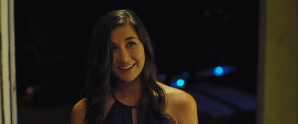 The other actresses are also notable highlights, particularly Antonio (The Reason, Christmas at Graceland) who gets the most versatility in the cast. She’s the object of Diggsy’s desire so just about every pit stop in every universe involves some version of Suzette appearing. Antonio demonstrates real impressive range; this whole movie could be her acting reel for any future part. She gets to play the manic pixie dream girl on crack cartoon version of Suzette, a sultry and aggressive version of Suzette, a sunny and domestic version, a terminally ill and wizened version of Suzette, and the romantic drama version, the one who would top-line a movie, a slightly awkward, vulnerable but undeniably appealing version. She’s great. Another surprise is C.J. Perry (Pitch Perfect) as a cafe worker named Gwyneth who comes into Diggsy’s orbit. Perry is best known to WWE fans as “Lana,” a world I’m generally ignorant of. She has a natural charisma and presence and, in another world, I could have seen her finding her footing in a world of features than a ring.
This is also one of the best looking lower-budget indies I’ve ever watched. The cinematography by Micah Simms is chock full of vibrant color and visual arrangements that feel ready-made for postcard replication. Even the opening segment caught my attention, as we go from a bride and groom being whisked away in their car only to reveal Diggsy drinking away his disappointment as the car drives out of the frame. That is sharp and direct and impactful visual storytelling. I knew I was in good hands already. I can see why Dapp works in commercials. He has a dynamic feel for putting together pleasing visual arrangements that don’t become self-consciously arty. The compositions with foreground and background can be blessed. The interior sets are impeccably designed and dressed to provide personality and, later, contrasts. For a movie mostly told from a series of rooms, Simms and Dapp choose different locales prudently to avoid redundancy. The footage from Iceland and its unique landscapes is refreshing. It’s not like there’s a glut of overly stylized camera movements. The film’s sense of style is not a creative trap that dooms many indie productions, boxing them in. It’s twee without being overbearingly so. I don’t recall even much in the way of camera movements. Dapp knows how to frame, light, and color a scene and doesn’t need to rub it in your face. I was impressed from the opening wedding march to the last shot. I will completely be in this man’s camp for his next film project and, if there’s a crowdfunding campaign, I would gladly contribute. Dapp has a clear understanding of how to tell a story visually and how to get the best from his skilled actors.
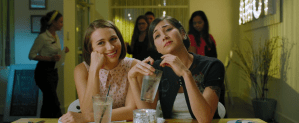 The story keeps moving forward with such intrigue and playfulness, cleverly tapping into its potential for exploration and complication, that I was worried whether or not the ending could keep up. The last act isn’t disappointing by any means but it lacks that same heightened level of promise the first hour exuded. It’s a central reason why Another Version of You is so tantalizingly close to total greatness: the character of Diggsy just isn’t terribly interesting. Early on, our introduction is that he’s lovesick over his crush getting married. When we cut to the requisite flashback of his regret, the moment he could have opened up to her about how he really feels, I felt very little for Suzette and Diggsy being together. They didn’t feel like a couple that I would root for. They didn’t even feel like close friends in that flashback. It was a misfire for the character as far as making me board his mission. He literally leaves his friends and family to chase after a universe where he can get his ideal version of his girl. Even forgetting that, there are several universes he discovers where he and Suzette are even together romantically but there are factors Diggsy doesn’t want. In one universe, Suzette has a child, in another she’s pregnant, with the indication it’s Diggsy’s baby, and the guy skedaddles hastily out the door (“I didn’t sign up for kids.”). I thought maybe the film would relay a commentary about Diggsy’s sense of possession of a Suzette like in 2012’s Ruby Sparks, an underrated and disturbing movie about the negative lengths of trying to manufacture and own/entrap one’s idealized mate. Nope.
The compound effect of the first act makes Diggsy seem overly selfish and a bit of a douche. I was never sold on wanting to see him get this girl, and as a result I wasn’t really interested in any of his relationships. Diggsy, as a character, is very opaque, his identity caught up in chasing after his dream of a woman. He’s even told, from one of those versions of that woman, that his idea of her may not even exist. That’s a good lesson but Diggsy seems stubbornly slow to learn. Kristopher Wente (Legal Action, Hour of Lead) does fine work in the role but Diggsy is too often more a reactive vehicle for the audience’s otherworldly exploration.
 Whimsical, exceedingly cute, heartfelt without being cloying, and surprisingly dark at points, Another Version of You is close to everything I could want from its clever, budget-friendly premise. I don’t want to make it seem like this movie is cheap. It’s a sunny and could measure up with any general Hollywood indie in technical accomplishments. This is an easy movie to get sucked into and it doesn’t take long to get running. It reminded me of The Adjustment Bureau (a personal fave, and an inspiration for my own time travel script too) and About Time. The storytelling here just flat-out works, more so with the supporting characters and the intricate and playful possibilities, best demonstrated with the character of Daphne and the excellent Belland. I was getting really excited as the movie kept going, following through with its fun potential. Clearly Dapp has thought through his film, but I honestly could have even used another 20-30 minutes to maximize the emotional investment in the lead character and his lovesick cause. This is one of the best indies I’ve had the pleasure of watching as I started my critical Ohio indie odyssey (even though it was filmed in Tennessee). I advise lovers of brainy rom-coms and human-scale sci-fi to check out Another Version of You. It’s a true keeper.
Nate’s Grade: B+
Share this:

Mock & Roll (2019)
 As far as Ohio indies go, Mock & Roll might have one of the smartest creative approaches. It’s a mockumentary following the mishaps of a Columbus, Ohio band trying to make it big. Director/co-writer/editor Ben Bacharach-White (Jimmie Van Zant’s American DeTour) and his cast and crew make good use of limited resources, blessed casting, but the movie could have been even more had it devoted more attention to its comedy writing and doc tricks.
We follow the band Liberty Mean, with lead singer Robin (Aditi Molly Bhanja), guitarist Rick (Chris Wolfe), bass player Tom (Pakob Jarernpone), and drummer Bun (Andrew Yackel). They are a parody band that sticks to only one source, parodying the songs from the rock band The Black Owls. Their mission is to put together an album, gather enough fans, and take the South by Southwest Festival by storm. Robin’s brother, Sully (William Scarborough), is documenting the band and their wacky hijinks as they play punk bars, try crowdfunding, undergo drug trials, stumble into the underground world of art dealing, and land in jail.
 Mock & Roll is an amiable experience and one comparison became so fundamentally clear to me that afterwards it’s all I could envision. This movie feels exactly like a Nickelodeon or Disney Channel live-action tween series. I know that may sound like a complaint but it’s not intended as one. The comparison just became so obvious to me that I was amused throughout to see the finished film hold to this creative endeavor, whether intentional or unintentional (I’m guessing unintentional). The exuberant energy level of the performers, the comedy scene writing that has specific beginnings and ends, the episodic nature of plot, the “let’s put on a show with our friends” mentality, the wacky hijinks, the direct communication with the camera, it felt like an extended collection of episodes for iCarly or Wizards of Waverly Place or Hannah Montana. Again, I do not intend this as a criticism, but the style and delivery of storytelling, as well as the genial likability of its cast, made me draw this comparison.
The best thing this mockumentary has going for it is its spirited cast who go beyond their limited characters. The difference maker in mockumentaries is characterization. The Christopher Guest mock docs (Best in Show, Waiting for Guffman) don’t have revolutionary storytelling but rely upon seasoned actors to really dig in deep with their unique characters, so that no matter the situation, something will spring out of the interaction and response to conflict. The characters in Mock & Roll are scant. The one with the most outward personality is Rick, puffing his chest out with bravado and swagger. The other two male characters, Tom and Bun, are working on the same note, basically deadpan absurdity. They’ll wax philosophical or bizarre at any moment. Robin, unfortunately, seems to be the straight-man role to center the rest of the group.
While these roles limit what comedy styles are available in the different vignettes, the performers go above and beyond and make the movie enjoyable. Wolfe (Where Are You, Bobby Browning?) is a standout as Rick and his voice reminded me of T.J. Miller. He has a natural charisma but also can easily channel a grinning doofus, which gives him the widest comedy berth. I would happily watch Wolfe in other movies and think he has a bright future in comedy. I would hire him. Yackle (False Flag) appears to be the best improviser on the set, able to pull wonderfully bizarre details from thin air and deliver them with understated care. His riff about Beethoven being deaf, and also blind, and having wooden hands, and that’s what made him great got a solid laugh from me. Jarernpone (Dark Iris) has a similar acting technique except it’s unloading deep philosophy without breaking a sweat, also performed at an understated rate, where the comedy best resides. Bhanja is a welcomed presence among the boys and I wish she had been given more to do. She shows promise and an engaging personality even in limited form. There are two supporting players of note, Scarborough (The Incredible Jake Parker) as Robin’s mostly unseen documentarian brother Sully, and Ohio superstar KateLynn Newberry (Dark Iris, Widow’s Point) as Rick’s girlfriend tasked with building a crowdfunding campaign for the band. Both are enjoyable to the point I wish they had been onscreen more often. Newberry has such a great nonplussed frustration with the band’s self-deluded antics.
 The episodic nature works for Mock & Roll until it simply doesn’t. At 77 minutes long pre-end credits, the movie feels far more like a collection of scenes than as a film narrative with a recognizable three-act structure. The vignettes don’t last longer than maybe eight minutes, which is another reason why they feel like anecdotal segments of a 22-minute TV episode. There is an advantage where if I’m not engaged in one scenario, and many are hit-or-miss, I know that another is coming up (after these commercial breaks). A disadvantage, however, is that nothing feels like it builds off the previous actions of the story. You could rearrange any of the first hour and would only impact the overall plot minimally (a reference to a crowdfunding campaign here and there). The episodic nature robs the movie from feeling like its plotting matters or builds to needed payoffs and running gags that make it more satisfying to watch than, say, a collection of unrelated skits.
Then in the last quarter of the film it becomes a prolonged segment that transforms into a baffling Boogie Nights homage. The gang get involved in art theft transportation (a miss), and then it happens again with a criminal art smuggler Dante (Brian Bowman, Dark Iris). This entire segment feels like the Wonderland/Rahad Jackson sequence late in Boogie Nights. Bowman is meant to be Alfred Molina in an open bathrobe, wavering between inebriated and dangerous. The plot beats follow the sequence and even some of the dialogue exchanges are similar. So the question arises, naturally, why even bother? The segment isn’t funny and doesn’t seem designed to be funny. Throwing the characters into an increasingly uncomfortable scenario that presents more and more danger could produce some great cringe-worthy moments of awkward comedy. This doesn’t happen. It just keeps going and it’s the only segment that actually builds off the events of previous segments, and I wanted it all to just go away. It’s too long, too turgid, and doesn’t have nearly enough construction in its comedy to justify the jaunt into criminality. The ending is also so flippant that it feels like it could all have been removed for the impact it has. If you’re going to break the formula established for an hour, it better be worth the excursion.
This transitions into some of Mock & Roll’s design flaws that keep it from being a stronger movie. The fact that the central band is a parody band of The Black Owls will mean next to nothing to an audience, the far majority who do not know whether The Black Owls are a real band or not. They are real but a quick check on Spotify shows they haven’t exactly crossed a listening threshold, so when the Liberty Mean band members talk about the band’s real songs, we won’t know the reference points. We don’t know the reference so we can’t appreciate the parodies, and the performances of Liberty Mean are fleeting, and many don’t even allow us to hear the parody songs themselves. If this was the given reality, Mock & Roll would have been better to just have them parody a silly fake band, or a band that everyone in the audience would be familiar with, rather than settling on a local rock band that allowed their music to be given featured placement. The idea of Liberty Mean as a parody band, and the nature of parody, also feels sadly underutilized. I was hoping the movie would go into a direction where one of the band members splits off, forms their own band, but it’s a parody band of Liberty Mean, so a warped parody of a parody.
 There are many fun possibilities for comedy with a parody band (a rival band nemesis, per se) but the comic shenanigans that Liberty Mean encounters are lackluster. The comedy segments are one-idea concepts that fail to develop and surprise as they go. The band plays at a punk bar and everyone seems to make a big deal out of this like it’s a grave offense, but the audience doesn’t understand why this would be any different. We’re not graced with any unsavory “punk bar patrons,” or specifics beyond that the acoustics might not be as precise. The band agrees to take part in an experimental drug experiment and the results are boring. They get high, they see hallucinations, but it’s nothing terribly interesting or different than you would expect. I’m starting to loathe drug tripping sequences in comedy because too many assume characters acting stoned is funny enough. There is also a lack of editing used for comedy potential with Mock & Roll. Watch The Office, or any other faux doc series, and an added benefit is that edits are part of its intention, so a quick cut or an inserted interview line allows a dense layering of jokes. Or at least the opportunity. Strangely, none of the band members are ever filmed individually for their takes. There are many comic and storytelling options through mockumentary that aren’t used.
Mock & Roll is a smartly modest film that coasts on the good will of its exuberant cast. Crafting a mockumentary approach for a fictional band is a clever way to make an indie film that can stand out with limited resources. The technical attributes are solid, especially the sound, though there are occasional questions like whether what we’re seeing is meant to be doc footage or simply reality, because when Sully is the only cameraman, who else is filming when he’s in the shot? The good nature of the movie is enough to warrant the time spent with an agreeable cast that seem to be having a good deal of fun. The episodic pacing works to keep things moving; however, it also makes the events interchangeable and lacking stakes. The comedy writing is often underdeveloped and reliant upon the performers to do most of the heavy lifting. It is breezy, genial, and fun, thanks to a cast that has great chemistry. I could see further adventures for Liberty Mean but would prefer a new creative approach. Mock & Roll could have been weirder, wilder, or simply better written and make better use of its documentary format.
Nate’s Grade: C+


 nathanzoebl
You must be logged in to post a comment.