Blog Archives
The Happening (2008)
 M. Night Shyamalan is still reeling from the beating he took over 2006’s Lady in the Water, a colossal misguided attempt at a modern fairy tale. The man is trying to retain his cozy relationship with audiences that adored his earlier works like The Sixth Sense and Signs. Shyamaln’s latest, The Happening, isn’t going to dissuade the detractors. This man is a talented filmmaker and I think it’s finally time that he starts thinking of focusing on one creative job and one job only, either writing or directing.
There’s a pandemic sweeping across the Northeast United States. It first starts with disoriented speech, then moves to disoriented movement, and ends with people committing suicide. Nobody knows what is officially going on. High school science teacher Eliot Moore (Mark Wahlberg) tries to flee Philadelphia with his estranged wife, Alma (Zooey Deschanel). They travel out into the suburbs when their train stops. The conductor says that they’ve lost contact with everybody. Eliot eventually theorizes that what’s causing this pandemic isn’t terrorists, or the government testing some biological agent, but plants. Yes, plants. In their defense, the plants are releasing an airborne toxin that flips a neurological switch in human brains. Instead of self-preservation the brain is pushed toward immediate self-destruction.
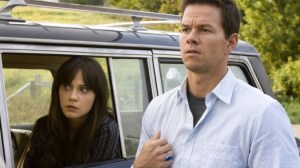 The Happening is no Lady in the Water, thankfully. The premise is pretty interesting in a feature-length Twilight Zone kind of way. Shyamalan does know how to spin an interesting idea and watch social paranoia explode. The best moments of The Happening take place during its beginning where confusion and panic reign. Shyamalan then takes a page from 2005’s War of the Worlds and follows the perspective of a handful of normal folk as the experience an apocalyptic event. We even spend the third act hiding out in the home of a crazy person (the creepy Betty Buckley). Unfortunately, we in the audience feel no involvement with the poorly written main characters. Once again Shyamalan utilizes a horrific and unique encounter as the impetus for reconciling the pains in a marriage. At a scant 99 minutes, there isn’t much time set aside for building characterization. There is not a whiff of personal connection to this tale.
Shyamalan doesn’t seem to explore the psychological ramifications of his premise. Suicide is very traumatizing and it would have swept over the East Coast in waves; millions would be dead. Yet the characters and Shyamalan never seem to focus on this point. Perhaps they’re in shock but no one seems to actually react realistically to the possible end of the world. Normal people would be freaking out. I would be freaking out. The idea that the country goes back to normal after three months is preposterous. Would anyone want to live on the East Coast again after all that death? People would be finding bodies for many months after the “happening;” just look at the slow recovery of New Orleans. Never mind the hit the economy would take from millions of people expiring.
The ecological message can also be incessantly heavy-handed. Characters run past a sign for a housing development that advertises the slogan, “You deserve this.” Oh, gee, I get it. A TV host at the very end interviews a scientist theorizing that what happened was a warning from the environment to shape up and change our ways. The TV host is so incredulous that he actually says, “Well, I’d like to believe you doc, but maybe if it just happened somewhere else again, maybe then I could believe you.” You idiot, millions of people died and there are how many witnesses? I know exactly what message Shyamalan is trying to say (wake up, we can’t ignore the signs) but having a character denying the obvious is too ludicrous given what happens in the story.
 But the story does invite further inquiries. How exactly do the plants communicate with each other? I can understand root structures but how does a bush talk to a tree unless they share root structures? Do plants speak different languages? Can a bush talk with a tree, and do French bushes speak differently than their English brethren? The plants seem to react to large numbers of people, but how do they know when there’s say enough folk running around to kill? Do they smell people? That toxin seems to not affect animals but I don’t see how that could be possible given that, as far as I know, animals inhale the air as well. Of course, if all surrounding animals and insects were to keel over then that would irrevocably harm the ecosystem and endanger the plants. This must be why the “happening” lasts a little over a day, coincidentally ending just when our protagonists are about to give up. And if Mother Nature, as a form of population control, triggers this toxin release then wouldn’t it stand to reason that some place like China or India would be hit first instead of the Northeast United States? Shouldn’t a science teacher know that still air would be filled with more toxins than when the wind blows? I’ll give Shyamalan this — he was able to make me fear a tree. There was one moment where a little girl was on a swing that was bolted into a tree limb and the constant creaking made me nervous that they would anger the tree.
Despite the flaws in storytelling, this narrative still could have worked as is if it just had a better director at the helm. Shyamalan lets everyone down on this one. Much of the marketing angle was how The Happening is Shyamalan’s first foray into R-rated material, but you can tell he doesn’t feel comfortable showing more than implying. One sequence follows a police officer’s gun as different individuals take turns shooting themselves in the head. Shyamalan shoots this sequence like the camera weighed 800 pounds, so the shot never rises above people’s feet. We see the gun fall on the ground, feet walk over to the gun, hands pick it up and lift it off screen, then a very unconvincing gunshot sound effect, then the process repeats. By not actually seeing the deadly aftermath Shyamalan risks the sequence becoming unintentionally funny and it almost happens. This directorial technique does not raise suspense, and in fact, Shyamalan botches most of the potential suspense in The Happening. Given the premise, Shyamalan doesn’t find too many sequences that make the audience squirm. A man wandering around in a lion’s cage is so fake and played in the wrong tone that it just becomes goofy even when his arms get ripped off. There’s only one protracted horror sequence that shows true gore, where a man lies down in the path of a giant lawnmower and we start to see the machine ride over him and whirl its blades. However, even this scene could have gone longer to fully draw out the shock and terror. Shyamalan just doesn’t have the temerity for R-rated material, and as a result the movie could have been a lot more terrifying had the man embraced the gruesome potential of a more mature rating.
Shyamalan’s visual storytelling is pretty rote. I kept thinking to myself how poor everything seemed to be looking. The cinematography is lackluster and the shot compositions are rather bland. Part of what makes a horror movie effective is clever visual setups that slowly leak tension like air from a balloon. Shyamalan’s idea of drawing out tension is to watch tress blow in the wind. After a while, when you realize this is the one trick Shyamalan has, it gets old and extremely boring. The Happening would have benefited from a stronger visual storyteller who could also goose the narrative with better-constructed scares. It’s disappointing because Shyamalan was able to elicit top-notch suspense in 2002’s Signs with simple sounds and the imagination. Now, when he’s given the chance to show terror he falls on his face.
 Another dent to Shyamalan’s direction is the fact that the actors all give bad performances. Wahlberg and Deschanel have given great performances in other movies so I know they are capable of more, and the blame must lie at the feet of Shyamalan. They overact with gusto and always seem to never be fully immersed in the reality of the drama. Even Wahlberg’s first line delivery raises your eyebrow because it seems too amateurish and flat. Deschanel is even worse and whatever emotion she is playing in a scene is the wrong emotion. She’s whiny and overly childlike when she should be reflective and contemplative, she’s wide-eyed and weepy when she should be tender, and she’s bad with just about every line. Alma is a weak character and seems to turn everything back to an injustice against her, even when people are killing themselves en mass. Part of the actors’ woes is complicated by Shyamalan’s wooden dialogue, which includes gems like, “We’ve just got to stay ahead of the wind” (how exactly does one do that?) and, “We’re not going to stand around like uninvolved bystanders” (who says that?). The most shocking aspect of The Happening is that Shyamalan totally betrays the trust of his very competent actors.
M. Night Shyamalan would be best served in the future by focusing on one role. He could direct someone else’s material or he could write and have someone else direct. If he had gone the latter route I’m convinced that The Happening would have worked even with a flawed script. The movie is too timid to push the horror boundaries available to a mature rating, the suspense is minute, and Shyamalan completely leaves his actors hanging out to dry. There is some laugh out loud moments of unintentional hilarity (like when Wahlberg calmly says “Oh no” upon hearing suicidal gunshots), but the movie also has moments of intrigue amidst its heavy-handed environmental message. Statistically, if there were a killer toxin there would be those who would be genetically immune to it, much like the scenario in I Am Legend. I have to say that if I was fortunate enough to survive I would whisper some threatening words to some choice flora and then I would set lots and lots of fires out of revenge. Take that, you stinking vegetation!
Nate’s Grade: C
Share this:

The Ruins (2008)
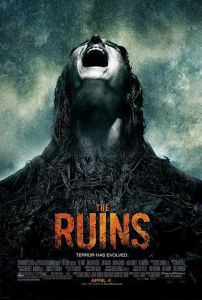 Author Scott Smith is from Ohio, my home state, which makes me like him. What made me respect him was his adaptation of his own novel, A Simple Plan. The movie version was splendid and taut, well acted and riveting and disturbing. Smith even received an Oscar nomination for his screen adaptation. When Smith released The Ruins, his second book, in 2006 I was mildly intrigued but never got around to reading it. Something about tourists, and Mayan temples, and bad things, and it got plenty of good reviews. Then I saw that Hollywood was producing a film version and that Smith had written the screenplay himself. Well, I figured, I’m going to be in for a chilling treat. Let’s just say my opinion of Smith has been slightly diminished.
Four over privileged American tourists are enjoying their final hours of a vacation to Mexico. Jeff (Jonathan Tucker) is studying to be a doctor. His girlfriend Amy (Jenna Malone) is best friends with Stacy (Laura Ramsey), and the two pal around together. Stacy’s boyfriend Eric (X-Men’s Shawn Ashmore) is along for the ride and enjoying every sun-soaked, boozy second. Lounging around the hotel pool, the group comes across a German (Joe Anderson, Across the Universe) who has a map to a hidden Mayan ruin. It’s a bit off the beaten path but the group decides to witness some genuine history. They take a taxi 12 miles into the jungle, hoof the rest, and discover a not very well hidden path to a not very well hidden Mayan temple (seriously, you’re going to have to do better than a couple of palm leaves if you want to obscure the path and keep people out. Try a fence next time). As soon as they arrive so do a band of armed Mayans that really insist the tourists do not leave the site. The Mayans chase the tourists onto the ruins and then they set camp around the perimeter. The Americans are being kept quarantined. Why? Inside and atop the ruins are a deadly plant that has a powerful hunger.
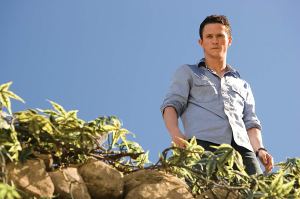 For a horror movie filled with unremarkable and generally unlikable characters, I must say that they at least don’t do anything incredibly stupid as is accustomed to the genre. Once they are chased to the top of the ruins you, the audience, are now put in their shoes. Every choice they make seems decently reasoned and cautious, exploring their surroundings and testing their boundaries. The Ruins features cheesy killer plants, yes, but the more interesting element to me was the survival game. These characters are quarantined in a remote area with little water, armed guards, and a handful of useful tools. What will they do next? This scenario grabbed my interest, as I played out my own personal survival scenario step-by-step and it wasn’t too different from what befalls the characters onscreen. However, I’m surprised no one tried setting the freakin’ plants on fire. The eventual psychological meltdowns and increasingly grim outlook help The Ruins maintain some level of credible drama.
But I think in the end I just couldn’t get over the fact that the main culprit was killer fauna. I can accept carnivorous plants, but seeing them is a whole different matter. Somewhere from pages to screen a step was forgotten to make them believable. The ancient plant system inhabiting the ruins looks like an overgrown swatch of ivy and marijuana leaves, and the vines would slowly inch forward to retrieve fallen pieces of meat. It’s downright comical to see a stringy piece of a vine trying to discreetly drag a dead body away, and frankly that’s where the movie fails. I shouldn’t be giggling at the killer plants. The execution comes across as way too goofy and made me shudder that I could be watching Little Mayan Shop of Horrors. I’m also wary that this highly localized plant has evolved to the point that it can duplicate exact sound. It mimics a specific cell phone ring tone to lure our vacationers deeper inside the ruins. Now, how in the world would it know well enough to do that? I can’t imagine in its potentially thousands of years of existence that it was come across a significant amount of cell phones. How would it know that exact sound would effectively lure others? I did enjoy the notion that the indigenous birds and insects have wised up and learned generations ago not to go anywhere near the ruins. Let this be a lesson to you, backpackers of America, that when insects refuse to go somewhere then perhaps you should take note.
 The Ruins should play out with a slow-burn sense of dread where the characters sadly realize with setback after setback that they are doomed; to be played right the plot needs to be methodical. Instead, Smith’s adaptation is more like a haunted house tale with crummy, obvious jump scares and lackluster spook setups. It seems like most of the film is intended to be a setup but the payoff is badly muffed, like seeing the stupid thin, twisty vines creeping out to sneak inside people’s open wounds. The Ruins has some fittingly disturbing scenes where something is moving and growing under the surfaces of people’s skin, but then you remember it’s just a plant vine and your mind starts racing with questions that illuminate how inane this whole situation comes across (How does a plant stem continue to grow inside a human body? What purpose does having an offshoot inside the prey serve? How does it penetrate open wounds without anyone noticing at all? Why should I be watching this?). I would have preferred if the under-the-skin creatures were some kind of insect or worm that had a symbiotic relationship with the plants. That would be cool and far creepier than stupid ivy vines.
From a gore standpoint, The Ruins has a few squirm-inducing moments. One character is badly injured and needs to have their legs amputated to survive. Oddly enough, this amputation sequence comes across as the most memorable part of a movie dealing with killer vegetation that can mimic cell phone ringtones and, later, lovemaking noises (now who goes out to have sex atop Mayan ruins?). The imprecise nature of the amputation is what makes it so gruesome. In one feel swoop, this character has to have leg bones crushed, then legs sliced off, and then have the stumps cauterized with a frying pan. And the only anesthetic is a bottle of Jack Daniels. Yikes. The amputation is played out with a deliberate pace and allows a satisfying buildup of nervous, queasy anticipation. Aside from that, there isn’t anything notable from the makeup department.
 None of the characters approach anything closely resembling characterization, but the acting is a notch above what you might expect from a horror movie populated with expendable, good-looking twenty-somethings. Tucker makes for a capable lead and projects a cool and controlled persona, never rising to hysterics. When he does realize the inevitable he begins to crack and it’s more effective because of how stoic he was before. The actor who gets tested the most is Ramsey, and this isn’t because she started her career in the derided “reality TV documentary” The Real Cancun. Her character is put through an emotional wringer and she sells the distress and Stacy’s fraying mental state. I never once was tempted to laugh even as she sliced herself open and fished around her insides. Malone and Ashmore are stuck being in the stock roles of whiny girlfriend and horny carefree dude.
The Ruins is a horror movie that’s far from horrible but not scary or perverse or funny enough to be recommended. The setup of isolation in unfamiliar territory could definitely produce some chills and thrills, however, when you throw in a ridiculous carnivorous plant that looks as menacing as your mother’s flower bed, well then, things just fall apart. I’m sure The Ruins worked well on the page, since it demands the reader create their own version of what goes bump in the night. Too bad that when you see it fully realized on the big screen it comes across as stupid. I really expected a lot more from Smith than this. The Ruins doesn’t justify why it should be treated any different than cheap, straight-to-DVD cheesy horror flicks (If there are multiple horror movies about killer snowmen, then there has to be an entire sub-genre of killer plants). I know M. Night Shyamalan’s upcoming summer release The Happening also features plants turning on humans. Let’s hope the creative force that brought us Lady in the Water can do more with the subject.
Nate’s Grade: C
Share this:

Sunshine (2007)
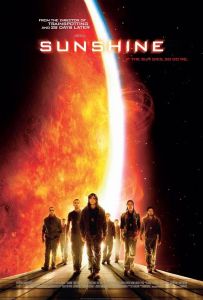 Danny Boyle is one of the more interesting film directors out there today. He seems to dabble in every genre. He’s done paranoid thriller (Shallow Grave), substance abuse drama (Trainspotting), zombies (28 Days Later), and a genuine family film (Millions). Boyle has a bountiful imagination. Now he and his 28 Days Later partner, writer Alex Garland, are going where many have gone before in the film world – outer space. Just don’t confuse the film with the 1999’s Sunshine where Ralph Fiennes plays three generations of a Jewish family with rotten luck. Come to think of it, both Sunshine movies fall apart in the final act. Note to filmmakers: just stay away from this title. It will doom your ending.
Fifty years into the future, the sun is dying. Earth is under a solar winter as it undergoes less and less light. The crew of the Icarus II has a very important mission: restart the sun. Attached to their spacecraft is a giant bomb intended to create a new star inside an old one. They have a giant reflective shield to protect them from the direct heat of the sun. The ship has eight crew members, including the physicist responsible for the bomb (Cillian Murphy), a botanist (Michelle Yeoh) with a garden to provide recyclable oxygen reserves, and a hotheaded handyman (Chris Evans) that believes nothing could be more important than their mission. As they drift closer to the sun they pick up a distress call that belongs to the previous Icarus I spacecraft which vanished under mysterious circumstances seven years ago. The crew decides that two bombs are better than one and changes course to intercept the Icarus I. anyone who has ever seen a horror movie knows you don’t go poking into the spooky place when you don’t have to.
 Boyle sure knows how to make things look pretty, or interesting, or pretty interesting, and this helps because Sunshine is rather shopworn with familiar sci-fi staples. The premise itself almost seems identical to a 1990 film called Solar Crisis, a movie I only remember marginally because of the female nudity my young eyes caught glimpse of (in those days we didn’t have any of yer fancy Internets). Besides this, the film borrows liberally from 2001, Solaris, Star Trek, Alien, Event Horizon, The Core, and the super crappy Supernova. Most every aspect of Sunshine can be traced back to a different science fiction film, but sci-fi is one of the few genres that don’t necessarily suffer from being derivative. A cookie-cutter sci-fi movie is forgivable as long as the filmmakers treat the audience with respect and attempt to be smart with their story. I don’t care that Sunshine reworks plot elements that have been worked since giant alien carrot people frightened necking teenagers in the 1950s, and that’s because the genre is built for being borrowed.
Sunshine is often beautiful to watch with awe-inspiring images of that great ball of fire, our sun, but even better is the fact that the film is pretty much the opposite of Armageddon – it’s smart. The movie discusses the realities of space travel, communication, oxygen levels, trajectories, sub-zero temperatures, sacrifice, and how to live so close to the sun where the human eye can only safely look at 3.1 percent of its light emissions for 10 seconds. It’s a bit slow but rather fascinating just to witness how day-to-day life functions for the crew and how the time, or lack of discernible time, plays with their psychology. This respectful intelligence helps when the crew debates altering their mission to inspect the mysterious space vessel. The audience knows that only bad things will happen but the crew argues with reasonably sound logic about the potential benefits.
Sunshine is a thinking man’s sci-fi treat for its first two acts and then it completely devolves with a disappointing turn of events; it becomes a slasher film in space. There’s genuine awe and intrigue, along with some brainy scientific discussions and some considerable religious/philosophical pondering… and it all just stops dead for a madman chasing people with pointy things. Sigh. It’s an artistic free-fall that Sunshine never quite fully recovers from. Boyle makes the strange decision to keep his space slasher out of focus so the audience never gets a clear look; even stranger are camera shots where the killer will walk into frame and then transform his area to an unfocused blur like a blurry infection. It’s an artistic choice that doesn’t quite work (“The blurry man’s coming to get you, Barbara!”). The film then morphs into your standard race-against-time and then balloons with trippy computer effects and snazzy light filters. Sunshine was exceedingly more entertaining prior to picking up the unwanted visitor.
 The cast does a fine job mulling their life-or-death options, but the two standouts are Murphy and Evans. Murphy and his piercing baby blues make for a strong lead. He provides soulful glimpses into his stock scientist role. Evans is the surprise of the film. Best known as the Human Torch in the dreadful Fantastic Four films, he exhibits a wider range of emotions from macho hardass to duty-bound soldier. This is a film heavy with noble sacrifices, and Evans is the reminder of all that is at stake.
Sunshine is visually pleasing and intellectually stimulating, especially for a sci-fi film built from the discarded pieces of other films. It’s a tense and exciting time, that is, until the movie just throws up its hands and transforms into a laughable slasher film. This movie did not have to go this tiresome route; there could have been an on-board mutiny when they discussed the idea of killing one of their own so they had enough oxygen to complete their mission, there could have been further psychological torments from within the crew, or even easier, the spaceship could just have undergone more malfunctions. Sunshine is a thoughtful, slightly meditative sci-fi thriller, but then it loses all of its better senses.
Nate’s Grade: B-
Share this:

The Reaping (2007)
 Forgive me father for I have sinned… I think The Reaping is not a terrible movie. Now, that would be damning praise in most circles, but when it comes to the notoriously implausible and awful genre of religious-based horror, well then “not terrible” is worthy of being brandished in the film’s ad. All of my fellow critics need to take a step down from the pulpit and see The Reaping for what it is: mild harmless fun.
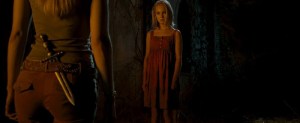
Katherine (Hilary Swank) is a professor at Louisiana State who specializes in debunking claims of religious miracles. “38 miracles and 38 scientific explanations,” she says matter-of-factly. Katherine has something of a grudge against the Big Guy, being that she used to be a minister before her husband and daughter were murdered on an overseas missionary trip. Doug (David Morrissey) has a case only that only Katherine can crack. In the sleepy town of Haven, along the Louisiana Bayou, is being beset by Old Testament style plagues. The river has turned to blood and the Bible-beating townsfolk are itching to blame a little blonde girl (AnnaSophia Robb) who they feel could be the spawn of Satan.
 The Reaping starts off with tiny amounts of promise and intrigue because of Swank’s character. She?s a globetrotting spiritual investigator and a skeptic that an audience can get behind. She has a checkered history and Swank uses glances and moments to make her seem convincing. The Reaping isn’t complicated when it comes to its spiritual message. It’s all about renewal of faith, and I?m not exactly certain how all the pieces add up but that’s the gist. The Reaping isn’t too deep when it comes to thoughts of any kind, but that doesn’t mean much from a genre that requires a healthy suspension of rationale thought.
As a horror movie The Reaping relies on routine jump scares and the occasionally jump cut to a dream or a flashback in Africa with a lot of loud, abrasive sound effects to jolt the viewer. The plagues themselves are kind of weak, especially when plagues of maggots and frogs are seen as being so contained and limited. For maggots, we see a grill loaded with fish now covered in maggots. We never get any other anecdotes of what may have been reaped by the maggot plague. The frogs fall for about ten seconds and only in one part of the swamp. These pathetically isolated incidents don’t do much to ratchet up any scares and they certainly belittle the powerful wrath of the Almighty. Then again, maybe God is trying to tell people in unorthodox ways to eat less meat, thus the ruined fish and diseased cows. The plagues lack some oomph when they just happen to a handful of people, especially when it comes to lice or boils. I think the small-scale plagues really say, “We blew our budget on that river of blood, but hey, that was pretty cool right?”
 I don’t think I’ll ever utter these exact words again but here goes. The Reaping is a rather so-so movie that is mostly redeemed by an implausible and foreseeable twist ending. Yes, as horror and supernatural thrillers are go, twist endings seem pretty common place and often times forced, like the studio is dictating that they need something just a little extra to fool the audience into thinking they got their money’s worth. We as a movie watching society are so attuned to twist endings now that we can sniff them out like bad CGI. Twists generally become worked into the advertising campaign. The Reaping has some last-second turns to it, and even though I had my suspicions, I was quite pleased the movie walked the path it did. In fact, I would even go as far to say that it turned a spiritually thin schlocky horror movie into a moderately enjoyable spiritually thin schlocky horror movie. This is far from a good movie, but as a dumbed down genre flick it will be like home cooking for the right audience. Now, I cannot defend the gaps in logic brought about by the twists in The Reaping, and you will be spending the rest of your day coming up with a new problem every minute (the line ?some people just don’t wanna go to heaven? takes new life). The film takes one step too far with trying to up the ante. Just know that the upcoming crisis in Katherine’s life has been solved by a little thing called Roe vs. Wade.
Director Stephen Hopkins has some stinkers to his resume, chief among them 1998’s abominable Lost in Space, so he will take kindly to having his latest film deemed “not terrible.” Swank struts around in a tank top in the balmy South, gets knee-deep in blood, and convincingly sells this nonsense as only a two-time Oscar winner can. The scares are clunky and the story is rife with lots of explaining for a 90-minute movie built around the simple concept that the devil is nasty. The Reaping will play best for fans of the religious horror genre as well as those willing to lower their expectations. This isn’t a good movie, but then again, it’s not terrible.
Nate’s Grade: C+
Share this:

Grindhouse (2007)
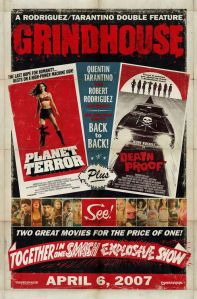 The movie going experience isn’t what it used to be, and Quentin Tarantino and Robert Rodriguez want to do something about it. There?s no denying that the joy of seeing a movie has been watered down a bit; there’s soaring ticket prices, floundering product, and let’s not forget the influx of teenagers with cell phones. Rodriguez and Tarantino grew up gorging upon the exploitation films at their neighborhood grindhouse, where they could see kung-fu, blaxploitation, gory Italian zombie movies, and nearly anything that promised to be titillating and shocking. These movies dealt in copious amounts of sex and violence on a shoestring budget and teenagers lapped it up. Grindhouse was designed to be a double feature with Rodriguez and Tarantino each writing and directing an 80-minute movie. This three-hour plus movie is stuffed to the gills with 70s reverence, right down to cheesy retro clips telling us the film rating via an animated cat. If Rodriguez and Tarantino could, they probably would make the floors stickier just to round out the experience. But that’s the marvelous thing about Grindhouse — it turns the filmgoing experience into an event once again.
First on the bill is Rodriguez’s Planet Terror. An outbreak is about to sweep across a small Texas town. A toxic green gas is causing people to break out in festering wounds that are spreading rapidly. Cherry Darling (Rose McGowan) is a go go dancer who runs into an old flame, Wray (Freddy Rodriguez), a badass drifter with a dark past. They get attacked by a group of “sickos” who take Cherry’s leg as a chew toy. At the hospital we’re introduced in rapid succession to Dr. Block (Mary Shelton) and her creepy husband (Josh Brolin) she plans on leaving for the lovingly massive cleavage of Fergie from the Black Eyed Peas (she gets eaten and can, one assumes, be described as being Fergilicious). The sheriff (Michael Biehn) has an unsettled score with Wray and refuses to trust him, even though the town is slowly being overrun by what appear to be zombies. The survivors take refuge at a Bar-B-Q joint, run by the sheriff’s brother J.T. (Jeff Fahey), located only two miles away from the military outpost that released the gas.
 Planet Terror is a great blast of fun, a perfect ode to schlocky B-movies. Rodriguez creates action movies closer to cartoons, and the more over-the-top and crazy things get the more joyous his films generally turn out. This is a gonzo world cranked up to a wonderfully weird wavelength, where Cherry can have a machine gun leg without any nagging question on how she even gets it to fire let alone why it would be more accurate. It doesn’t matter because this movie is all about 80-minutes of awesome, twisted, gloriously gory fun. Planet Terror isn’t the first zombie comedy, and its inspirations are quite plain, but the film establishes a wide-range of colorful characters effectively and then ramps up the chaos. Rodriguez amuses with even small touches, like a woman trying to operate a car with a anesthetized hands, a pair of skimpy babysitters who clobber a car with baseball bats, and a bio-chemical scientist (Naveen Andrews) that has a penchant for collecting and bottling the testicles of the men who fail him (hey, we all need hobbies). Even amongst an exaggerated canvas there’s still plenty of humor and adoration for the grindhouse experience, like when the beginning of a sex scene is interrupted with a “reel missing” sign. Rodriguez also intentionally downgrades the look of his film, adding hairs and scratches and pops in the film to look like it had been dragged across the floor. Planet Terror even has a dreadfully dated synth score to compliment the full-tilt celebration of splattery schlock.
Tarantino’s Death Proof is going to sharply divide audiences. The action in Planet Terror is relentlessly paced, which makes the adjustment to Tarantino?s half all the more hard. Rodriguez is all about genre relevance and making a film that would excel in the grindhouse era; Tarantino, on the other hand, is all about taking the genre and catapulting it into something ambitious and different and greater.
 Death Proof is Tarantino’s take on the slasher horror genre, with the unique twist being that Tarantino?s roving killer takes out his prey with his car. Stuntman Mike (Kurt Russell) is a stuntman of the old guard. The youth of the day have no idea of the TV shows he worked on or the celebrities he rubbed elbows with. The only lasting visages he has from those removed days are a long scar decorating the side of his face and his stunt car. The vehicle has been outfitted to be death proof, meaning that Stuntman Mike can get into any wreck and come out alive. A group of women are visiting Tennessee for a film shoot. Abernathy (Rosario Dawson) is a makeup artist, Lee (Mary Elizabeth Winstead) is an actress, and Zoe Bell (herself) and Kim (Tracie Thoms) are professional stunt women. The stunt ladies are interested in test-driving a Dodge Charger, the same iconic car used in Vanishing Point. Zoe wants to play a dangerous game known as “Ship’s Mast,” which entails strapping herself to the hood of the car as it speeds along. This is when Stuntman Mike comes roaring with his death proof material and plays an extreme game of chicken.
The narrative structure of Death Proof is deliberately slow. The focus is on a group of Texas girls (including Sydney Poitier’s daughter named, rather unoriginally, Sydney Poitier). They dance to jukebox jams and drink. And they talk, and talk, and talk, and talk. The dialogue is clever but you worry Tarantino has been hypnotized by his own pithy writing. The movie drags a bit but mostly because it follows a film that had the pace of a runaway train. The slow buildup is an intentional correlation to slasher films, which would spend their first half hour setting up characters for the eventual slaughter. I liked how Stuntman Mike was seen playing with his prey and interacting with them. The wait is worth it, though, but then Tarantino turns around and repeats this same setup with a new batch of girls. Many will grow impatient going through the same process all over again and become irritated that they have to endure another round of talky pop culture diatribes in order to get to some more vehicular manslaughter. And at this point, the only character the audience has any affinity for is Stuntman Mike, so it’s a little tough to wait so long for his reappearance. When he does appear, the movie takes some unexpected turns and transforms into a female revenge thriller that left my audience cheering by its conclusion. My wife loved it. I married the right woman.
The makeup work is outstanding. Most of the effect work gets its spotlight during Rodriguez’s half, and Greg Nicotero and KNB have created the most gut churning, sickeningly inventive makeup work since John Carpenter’s The Thing. Rodriguez’s Planet Terror is dripping in blood, and the gore is heightened to such an unrealistic, comical degree that it becomes more tolerable and, in the end, another element in the overall outrageous vibe of the film. Some memorable gore work includes makeup pioneer Tom Savini being ripped apart like a child’s jigsaw puzzle, soldiers whose faces undulate and bubble until they look like close relatives of the Elephant Man, and a truck smashing against bodies like they were made of paper and filled to the brim with Kool-Aid. This is the kind of movie where entire hoses of blood explode from single gun shot wounds. It is a gory, gruesome, sticky icky movie but that?s part of the fun.
 Whereas the makeup work shines in Planet Terror, the stunt work in Death Proof is stupendous. Bell was Uma Thurman’s stunt double in the Kill Bill tandem, so by writing a part specifically for her Tarantino knew he could get up close and personal during the scary moments. Seeing Bell struggling to stay atop the hood of a car zooming at 80 miles per hour is nerve-racking and exhilarating, and you know there isn’t any computer trickery given how Tarantino’s own characters bemoan how computers have blunted action cinema output. That really is Bell and even though it’s all a movie a part of you does think, “Oh my God, this woman is going to die for real.” This killer bumper-car sequence in Death Proof will have you holding your breath. It takes much longer for Tarantino to rev up his action, but when he does he puts the pedal to the mettle.
But don’t get up for pee breaks once Planet Terror is over, because you may miss some of the best parts of Grindhouse. In between the feature films are three fake trailers directed by friends of Tarantino and Rodriguez, who made a fake trailer himself for Machete, about a Federale (Danny Trejo) out for revenge. The Machete trailer gave me the everlasting gift of a line, “They f***ed with the wrong Mexican.”
The best trailer, hands down, is Shaun of the Dead director Edgar Wright?s trailer for Don’t, a Dario Argento style horror film where a narrator instructs the audience lots of items not to do (“If you are thinking about turning this door… DON’T! If you think about going into the basement… DON’T!”). What makes Don’t so wonderful is that the trailer builds a thick head of steam, to the point where all wee see are bizarre rapid-fire images and the announcing repeating the message, “DON’T!” The momentum builds to a great comic high that left me giggling.
Eli Roth, who gave us Hostel and Cabin Fever, one of my all-time favorite filmgoing experiences, runs a close second with his slasher trailer for Thanksgiving. The concept is rather straightforward, a person dressed as a Pilgrim picks off residents around Turkey Day, and a great showcase for Roth’s sense of tongue-in-cheek homage and his warped sense of humor. This trailer has some gasp-inducing moments, chiefly among them a topless cheerleader who performs the splits right onto a knife blade. Wow. Then there’s a guy humping a stuffed turkey with a human head attached. I’ve said it before and I’ll say it again, Roth is one sick bastard but he’s my kind of bastard.
 Rob Zombie’s trailer for Werewolf Women of the S.S. sounds better on paper than how it turns out. There’s a subgenre of Naziploitation films (did you know you could add “-sploitation” to damn near any word?), most famously popularized by Ilsa, She-Wolf of the S.S. Zombie’s trailer has got hairy wolf boobs, Nazis, shiny fetish outfits and S&M, but it feels too new and doesn’t work on the same vibe of Grindhouse. It feels too polished and too happy with itself; it spends more time telling you who’s in this fake movie than delivering anything juicy. The trailer is saved by a brilliant cameo by an actor whom I will not spoil, but suffice to say that I was left in stitches.
Honestly, I cannot say another movie released this year that provides more bang for your buck than Grindhouse. Tarantino and Rodriguez’s double bill will leave you giddy. This is the fastest 3 hours and 10 minutes of your life, folks. Unfortunately, the film hasn’t been doing as well at the box-office and this has caused the Weinsteins to contemplate splitting the films into two to make the most of their investment. I suppose Grindhouse was never going to have a 300-sized audience, since the idea of making a sloppy three-hour love letter to trashy cinema seems destined for a limited appeal. This is a high-art tribute to high camp, and you really do feel you get more than your money’s worth even if you pay, like I do, 10 bucks a pop for a show. I can’t imagine having a better time at the movies this year than the one I had during Grindhouse.
Nate’s Grade: A
Share this:

Hannibal Rising (2007)
 People love a good villain, and is there any greater villain in modern movies than Hannibal Lector? The flesh-eating, etiquette-minded fiend was most memorably portrayed by Anthony Hopkins in the Oscar-winning Silence of the Lambs. Even though he was only in the film for a whopping 16 minutes (the shortest screen time ever for a Best Actor), Hopkins stole every second. The character has resurfaced in additional movies like 2001’s Hannibal and 2002’s Red Dragon.
The history behind Hannibal Rising is that long-time film producer Dino Di Laurentiis owns the rights to the Hannibal character and essentially told author Thomas Harris, the man behind every Hannibal book, that he was making another movie starring America’s favorite cannibal, and it was going to be a prequel set amidst his boyhood days, and he was going to do it with or without Harris. With a proverbial gun pointed at his head, Harris decided if anyone is going to ruin his character it might as well be himself. He simultaneously wrote a new Hannibal book and a screenplay for it, both tied to be released within a few short months of each other. The results are about what you would expect for an artistic venture born from people wanting more money.
 Hannibal Lector is a young kid living in Latvia. His family even has an ancestral castle but this doesn’t matter because it’s 1944 and the Germans and Russians are going at it. His father and mother are mowed down by gunfire as his family flees to a cottage in the woods for protection. Sadly, this will not be the worst thing that happens to Hannibal. A group of deserted soldiers, led by Grutas (Rhys Ifans), finds the cottage and takes refuge in it, hiding from their superiors, the ongoing battles, and the viciously cold winter. Long story short: there’s nothing to eat and the soldiers kill and eat Hannibal’s sister to survive. Flash forward to 1956, and Hannibal (Gaspard Ulliel) is a rebellious Stalinist youth. He escapes his boarding school and heads out to France to find his aunt, Lady Murasaki (Gong Li). She teaches him about the ways of the samurai and sharpens his fighting skills, because that’s what Asian people do in Hollywood movies. Hannibal is haunted by nightmares of his sister’s murder and his inability to protect her. He vows to find the current whereabouts of the men who took her from him and exact bloody revenge.
I guess when you get down to it I never needed to know the back-story to Hannibal Lector. He was such a dominating, frightening, and fascinating presence in Silence of the Lambs, someone who could worm his way inside your head and download everything he needed to know to exploit you. And yet, the man still adhered to his own set of standards, as Clarice remarked that he only ate the “rude.” He’s like a kinky literary professor. In 2005, Hannibal Lector was declared by the American Film Institute as the greatest film villain . . . ever. What I’m trying to get at is that no explanation for what made Hannibal into the demented figure he is would ever be satisfying. I don’t need to know why Hannibal is how he is, just as I didn’t need to know why Willy Wonka is; they just are. There’s also a logistical quirk: because we know this is a prequel, it means Hannibal Lector is never in any danger. He has to survive to populate more books and movies. Hannibal Rising was doomed to fail the second anxious studio execs got dollar signs in their eyes.
The film really drops the ball by turning the most unique villain in modern literature into a mere creepy kid out for vengeance. Hannibal Rising is a gloomy revenge flick dressed up to feel more astute and highbrow, but it’s nothing but a run at Charles Bronson Death Wish territory. Hannibal tracks down his sister’s killers one by one and plots his bloody revenge, and with each death the film seems to deflate. The character is given a stable of psychological devices you’d find in trashy serial killer page-turners. The fact that he remains moderately sympathetic is a testament our warm feelings for a guy that eats people. Hannibal Rising also ducks risky territory by making the marked men bastards even 10-something years later. They’re either corrupt authority figures or petty criminals; Grutas even runs a houseboat that he cycles sex slaves in and out of. Splendid. Now, it would be truly daring if the film had the courage to show these men as people trying to do right in the world, continually haunted by the choices they made to survive. That would call into question the nature of violence and forgiveness. The film even hints that Hannibal might have unknowingly eaten his sister as well. The psychological ramifications of that could be really interesting. But no, that’s too much, so what we get are a bunch of sneering stock baddies for Hannibal to systematically pick off.
 Hannibal Rising shows its agenda with one very telling scene. When young Hannibal is living with his aunt he scours through her collection of samurai art. Then one mask catches his attention and he places it against his face, and wouldn’t you know it, the mask looks very similar to the one he will eventually wear like 40 years later. Why even include this scene? In 1991’s Silence of the Lambs, Hannibal wore this famous mask for all of one scene. The filmmakers are tipping their hat at what we know with Hannibal; the film is more concerned with reminding us about our memories of a character off screen than the one that’s in the story.
Despite all these failings, Hannibal Rising still manages to be passably entertaining. I credit director Peter Webber (Girl with Pearl Earring) and actor Gaspard Ulliel. Webber keeps the pacing light for a two-hour movie and adds a fine Gothic feel with a crisp, autumn look. He tries hard to bring some art to an overly glorified revenge flick. Ulliel (A Very Long Engagement) is something of a minor revelation. He digs deep into his character and finds a perverse pleasure in his portrayal of the cinema icon. He’s scary and weird but manages to still be grossly entertaining even when he’s doing gross things. It’s the sheer power of his performance that makes the film worth watching. I didn’t see this coming from the cute, boyish lovesick kid from Engagement, but Ulliel creates a clockwork-like performance of sinister eeriness. When he glares, his eyes burning with sharp intensity, he has this little dimple on one side of his face, like a permanent mark from evil grinning. He has a terrific look to him and I’d dare say there would be plenty of surprised moviegoers that find themselves thinking Hannibal Lector is a tad sexy. Hopefully Ulliel is destined for better things after mastering English so well, something his Engagement co-star seems to still be struggling with in American movies.
There really is no reason for this movie to exist. It’s not bad by any means, it’s just entirely unnecessary. It’s passably entertaining and has some grisly gore to it but much of it is pure genre. I’m more interested with the older, wiser Hannibal than this young pup. In the pursuit of the almighty dollar, Hannibal Rising sure wants to be a tasty dish. The problem is that this dish has already gone cold.
Nate’s Grade: C
Share this:

Pan’s Labyrinth (2006)
 Fantasy has a naturally cheerful tone. Someone did not tell that to Mexican writer/director Guillermo del Toro. The Hellboy director is obsessed with all things creepy, crawly, and gooey, and his films all seem to revel in the things that go squish in the night. Pan’s Labyrinth is a children’s tale not intended for children. It’s more in line with the fairy tales of old that were violent, sickening, and something to strike fear in disobedient kids.
Ofelia (Ivana Baquero) travels with her pregnant mother to live in a cottage along the Spanish countryside. Her mother has remarried The Captain (Sergi Lopez), a brutal officer in the ruling fascist government. He’s a stern and unforgiving man and plotting to eliminate the remaining scattered resistance soldiers. Ofelia discovers a series of stone stairs that lead to an underground labyrinth. Inside is a faun (the titular Pan) who recognizes the spirit of his world’s missing princess inside Ofelia. He gives her tasks to complete that will prove whether or not she can return to the other world.
This is a fabulously dark Alice in Wonderland for a more mature set. Pan’s Labyrinth is very similar to del Toro’s 2002 The Devil’s Backbone, a smart and affecting ghost story set against Spain’s bloody civil war. del Toro has set his supernatural fantasies against some very real and very dangerous backdrops. The Devil’s Backbone was more than just a ghost story, and now Pan’s Labyrinth is more than just a fairy tale. The real world is a violent and cruel place and worthy of a magical escape. However, the fairy tale creatures are not from the Disney school of kinder, gentler folklore. The faun is evasive and prone to outbursts when he/it does not get his hooved way. The other creatures, like a giant slimy toad, are all after their own gain and don’t much care for a little girl’s interference. There is no escape to safety.
 There are plenty of staples commonly found in fairy tales. Ofelia has to complete three tasks before the cycle of the moon. She has to complete trials of courage and prove her purity of heart. The characters look familiar but they definitely don?t behave the same. Pan’s Labyrinth has a continuing sense of dread. People die vicious deaths and the threat of violence is ever present.
The real world segments are just as engaging as the grander flights of fantasy. del Toro spins a very worthy tale of secrecy and suspicion at the dawn of Franco’s Spain. Several members of The Captain’s quarters are aiding the remaining resistance officers and risking their lives to hide their allegiance. It also draws the viewer in because these characters are the kind ones that look after Ofelia, who accidentally stumbles upon their secrets. The Captain is an earthly monster equal to the horrors of the fairy tale world. He has a deadly fixation with wasted time and punctuality (another Alice in Wonderland homage – the ticking pocket watch). Whether he’s torturing or shaving, the man seems peeved in all that he does. He tells the doctor that if a choice must be made, save the baby over the mother. His legacy demands an heir.
del Toro straddles differing genre lines like few artists out there. He has a great love for monster movies and horror but he also has great feel for human drama and a child’s wide-eyed point of view. Ofelia rests her head on her mother’s pregnant belly and speaks to her unborn brother. When her mother is experiencing complications she implores her brother to be gentle. It’s a little action but comes across as so honest and heartfelt from a child. The film is touching and exciting and pretty scary when it wants to be. Pan’s Labyrinth is a genre-bending gem that?s exceptionally well executed. The production design and make-up effects are terrific and lend to the otherworldly feel. The special effects are mostly a mix of practical designs and creepy make-up work, especially with the “Pale Man.” I especially enjoyed how the fawn moved and sounded, all clicks and creaks like he hadn’t moved his bones in ages. del Toro and his movie magicians do an excellent job of transporting you to two distinct worlds.
I could have used more labyrinth in my Pan’s Labyrinth. As it stands, the movie is divided as 15% fantasy world and 85% real world. That?s not enough for me. Maybe I just loved the fantasy elements too much or was expecting more of a live-action Spirited Away. Then again, del Toro has his mind set on an ambiguous ending that will divide the skeptics from the believers. Are there opposing worlds? Is Ofelia just making it up to escape reality? Whether what’s happening is real or not is irrelevant; Ofelia believes it is real. I feel that the movie could have been even greater had it utilized its fantasy side more.
 Take for instance the “Pale Man,” a grotesque monster that has to place its eyeballs in the palms of its hands to see. When Ofelia enters his realm its covered in ancient art showing this faceless creature devouring children. A giant pile of shoes sits in a corner as a constant reminder of the creature’s appetites. However, the creature sits at the head of a table motionless, unless some irresponsible child takes a bite from the illustrious feast of food at the table. Then the “Pale Man” springs to life. The imagery is horrifying but beautifully sickening, and it’s just too regrettable that Pan’s Labyrinth only gives such a memorable monster one single scene. I kept hoping that the movie would revisit the world it had begun establishing, all for not. I thought at least del Toro would have a fascist officer chasing after Ofelia and she would trace a portal back into the “Pale Man’s” world. Then she would escape but the officer would be trapped. He’s take a bite from the feast and then our occularly-challenged friend would go, “Well, you’re a little older than I like, but hey, beggars can’t be choosers.” CRUNCH! You must judge a movie for what it is, not what it could be, but I am certain Pan’s Labyrinth would have been even more remarkable had it just done more with its wild imagination. Oh well.
2006 has been something of a revelatory year for Mexican directors working within the Hollywood system. Alejandro Gonzalez Inarritu released Babel (bleh); Alfonso Curaon released Children of Men (wonderful), and now del Toro’s dark fantasy Pan’s Labyrinth is just starting to get a wider release. The film straddles the lines of genre, touching upon horror, human drama, fairy tale, historical action, and still finds time to be invigorating and moving. The production design and make-up effects do wonders to bring del Toro’s mordant imagination to chilling life. del Toro reigns supreme in the realm of sticky and icky things. Had the film actually spent more time interacting with its twisted fantasy creatures, I would gladly call Pan’s Labyrinth the best film of 2006. But alas we can’t all have our wishes comes true no matter how many fauns we encounter.
Nate’s Grade: A
Share this:

Saw III (2006)
 Horror works in cycles and seems to ebb and flow every three years or so. The popular horror cycle right now is all about torture and realism. I guess people have had it with masked men with large pointy things. Pasty Asian children don’t seem as gloomy as they once did; in fact, in today’s world-on-the-go, who wouldn’t want an extra hand in the shower? In a world bombarded with carnage leading the six o’clock news, I guess American audiences desire something more universal than ghosts and boogeymen. The Saw franchise has exploded and seems destined to place a new entry every Halloween until the public looks to a new en vogue horror cycle. After seeing the loss of luster that is Saw III, I am already looking.
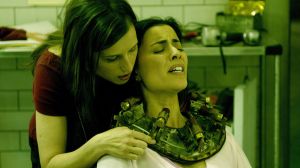
Jigsaw (Tobin Bell) is back with a fresh new batch of his twisted games. Unfortunately, he’s bedridden and dying. His serial killer apprentice, Amanda (Shawnee Smith), has to do the grunt work. She kidnaps a depressed doctor, Lynn (Bahar Soomekh), and orders her to keep Jigsaw alive as long as she can. Around Lynn’s neck is a crude explosive device that will detonate if Jigsaw’s heart flatlines. He has to stay alive just long enough to witness one final game. Jeff (Angus Macfadyen) is trapped in a typical Jigsaw-engineered series of traps. He has to pass through three tests of resolve and forgiveness, each involving someone related to his young son’s unexpected death.
 The Saw franchise seems to be losing momentum with each additional thrown-together sequel. I found the first film to be mostly entertaining and very inventive, but this was because of a smart narrative device: we wake up in the same dingy bathroom as our figures and must learn with them about what is happening. It plied some neat tricks and twists and was an altogether enjoyable horror movie that didn’t mind mucking around. But with all invention, if it sells then it becomes repeated in mass-market form, dulling the edges and losing the bite it once had. What once startled and amused is now the expectation. Just like the collapse of the Final Destination franchise, these movies started big but then bottomed out when their audiences had the rules memorized. At that point the only thing left is curiosity in what fiendishly outlandish ways people will get horribly killed. The Saw films still have more smarts to them than your typical man-chases-teens-with-axe slasher flick, but the franchise definitely seems, like Jigsaw, to be dying a slow death.
Saw III spends far too much of its time and energy trying to be a compendium to the franchise, filling in the blanks and the resolutions for Saw and Saw II. The film bends over backwards trying to tie up loose ends that didn’t really need tying up (Finally, now I know what happened to that foot that was cut off!). I don’t need to know how the incidents of the previous movies were set up, or who kidnapped who; the minute details are pointless in a horror film, especially one with such flights of frightful fancy. This movie spends too much time feeding the audience needless back-story. The film’s two major storylines are uneven in interest. There’s a real lack of danger and development for Lynn playing nursemaid to Jigsaw. We know the only time he may die is late in the movie, so her storyline becomes prime thumb-twirling time. We see some nifty medical procedures but I?d rather get back to Jeff’s descent into the funhouse of doom.
Saw III seems too concerned with how it fits within the framework of a trilogy when it should be worrying how it works as a movie. Saw III, for stretches, feels like it was cobbled together from the dull deleted scenes of previous films. And true to form, this Saw sequel ends with a familiar rush of twists, deaths, and a very nihilistic close. Let’s just say the inevitable Halloween 2007-bound Saw IV is going to have to go back to the ridiculous plot device drawing board. I truly wonder how many little tape recorders Jigsaw has stashed around and for what occasion (“Note to self: clean gutters.”).
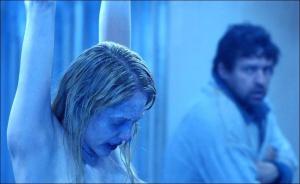 Some of the ingenuity is downright admirable; Jigsaw sure puts a lot of thought and care into his skin-crawling craft. Some notably gruesome torture tests include a naked woman being frozen to death by routine sprays of water, a man having his limbs twisted all the way around, and a man drowning in the slimy goo of ground up pig carcasses. Now that takes discipline just to plan, let alone fully stage. I’d like to see Michael Myers or Freddy Kruger try something like that. Part of the macabre fun of the Saw franchise was playing along, wondering what you would do in the situation and how far you?d go to save your own life. But in Saw III the deck is stacked for about half of the twisted games. There’s no way to win. A character goes through great lengths to free herself from a death trap but, alas, there is no escape and she gets her rib cage ripped out for the bloody hell of it. This … lack of sportsmanship, let?s say, does play a crucial part to the Saw III storyline, but it still knocks the film’s fun level down when you’re just waiting for the moment the person becomes a corpse instead of waiting to see what they do next.
It seems like the Saw movies become less engaging the gorier they get, and Saw III may be the goriest yet. These films have never been afraid to get messy, and Saw III has some squirmy moments, particularly a very protracted scene that involves the peeling, drilling, and scraping of the human skull. Horror fans should be happy with the results but there’s nothing that will make the squeamish cover their eyes (a bone snapping through a leg comes closest). Worst yet, despite the yucky credentials I’ve mentioned above, there really isn’t anything too memorable about the death traps this go-round, though the pureed pig entrails is certainly praise-worthy.
After three movies in three years, it feels time for a breather. The Saw movies are losing their sheen as their audiences become hungrier for blood and harder to fool. 2004’s Saw was clever and different, but like the demise of the Final Destination franchise, the sequels are victims of expectation. When the unexpected becomes the expected, then you may need to rework your scare formula. For whatever reason, Saw III feels compelled to be a refresher on the other films, devoting serious chunks of wasted time to clarifying loose ends that never mattered. I’d rather get to more sticky, icky death traps than examine the father-daughter-mentor relationship between Jigsaw and Amanda. Yawn. Saw III feels uneven, distracted, less fun, and a middling close to a franchise that began with wicked promise. This kind of movie just isn’t cutting it like before.
Nate’s Grade: C
Share this:

Alone in the Dark (2005)

Edward Camby (Christian Slater) is a paranormal investigator trying to rediscover what happened in his past. He was apart of 20 orphans taken by Fischer (Frank C. Turner), your basic mad scientist type. Camby was the only child to escape Fischer’s poking and prodding. The other orphans have become sleeper agents/zombies to assist him in opening a dimensional gate to another world, a world with bloodthirsty creatures that live in darkness. This world and its creatures were first discovered by an ancient Native American tribe who mysteriously vanished. But before doing so, they thoughtfully broke the dimensional key and hid the pieces all over North America. Aline Cedrac (Tara Reid) is a scientist/archeologist that specializes in this Native American tribe and its artifacts. She teams up with her old flame, Camby, to help stop the mad doctor. Monitoring the whole situation is Commander Burke (Stephen Dorff), the man in charge of the United States government’s bureau of the paranormal. He leads his no-nonsense super troopers to the location of the dimensional gateway, which just happens to be underneath Camby’s childhood orphanage.
Alone in the Dark is a good film for people that felt House of the Dead was too intellectual. It should be obvious after reading the plot synopsis, but Alone in the Dark is a movie of unparalleled stupidity. What was the point of making orphans sleeper agents/zombies? They’re very easily disposed of and not very effective. I don’t know whether or not this is because they didn’t have a mom and dad growing up. What does this mad doctor hope to achieve by opening the door to creepy crawly monsters? I guess he thinks the monsters will be grateful and give him some kind of bureaucratic job, instead of, you know, gutting him and drinking his blood. I’ll never understand why villains align themselves with creatures whose only purpose is killing. How does Camby end up having a childhood flashback from a perspective that isn’t his own? The plot of Alone in the Dark is a gigantic mess. What other film in recent memory fits together ancient Native American tribes, monsters from an alternate dimension, government agencies, orphanages, zombies, and Tara Reid? You know you’re in bad hands when they open the film with a ten paragraph scrawl to explain what the film, by itself, cannot. And then they add narration because they don’t trust their audience to read.
 The film is called Alone in the Dark and tells us that killer creatures lurk where we cannot see them. This is a fine platform to engineer some good scares; really stir the audience into fearing what they cannot see. As always, nothing will be scarier than a person’s mind at work. Boll doesn’t agree. He doesn’t even toy with the idea of hiding his creatures and building tension gradually. Boll prefers to show you his monsters immediately and often, therefore eliminating any attempts at suspense. Now the characters aren’t running away from what they can’t see; they’re running away from lame CGI rat/alligator creatures. The monsters look laughable and should have stayed in the shadows for as long as possible. It’s hard to spook an audience once they see what they’re supposed to be afraid of. Boll’s impatience for suspense and his love of cheesy special effects cripple Alone in the Dark.
Alone in the Dark has no pulse when it comes to action. Boll stages his action sequences like different stations on a gameshow. Characters (contestants) run from station to station, picking up weapons and shooting at whatever, and then advancing to another stage with a different weapon. Much of the action just comes out of nowhere and ends in its own confused way. Boll likes to season his poorly choreographed action sequences by cranking up loud rock music and mixing in excessive, gimmicky special effects. For no reason, Camby and Aline and the soldiers will be shooting and Boll just all of sudden decides this scene should be in a strobe light. Or he’ll shove in a cheap slow-mo follow-the-bullet effect. Boll likes testing out different effects that serve little purpose other than to call attention to itself. Boll has confused this with style.
Speaking of action coming out of nowhere, Boll manages to squeeze in an out-of-the-blue sex scene. Aline visits Camby in the morning, sees him sleeping, and decides on the spot to crawl into bed and have sex with him. Reid and Slater have no chemistry whatsoever. It’s like watching water buffalos go at it. Then the sex is never referred to again. This is just another pristine example of how carelessly Uwe Boll handles plot and characters. Rarely does Boll even bother with a transition scene to explain how a character got from Point A to Point B.
Boll’s direction is lazy and derivative. There are scenes that openly ape superior movies, like Alien, Raiders of the Lost Ark, Starship Troopers, and even Boll’s own House of the Dead for crissakes. The plot is a cut-and-paste job of the series finale of TV’s Buffy the Vampire Slayer. Both deal with an army of creatures living under an everyday school building and involve a special key to unlock the gateway. And like in Buffy, some noble individual sacrifices himself to destroy the gateway’s underground entrance. No, scratch that. The plot itself is virtually a copy of Super Mario Brothers, the first video game based movie. Both films involve some magical key needed to unlock two alternate dimensions of creatures. No, scratch that. This is one big rip-off of Darkness Falls, since both involve crazy creatures that can only attack from the dark. Whatever it is, Alone in the Dark is Boll’s opportunity to showcase his un-originality. That is, if you can pry him away from inserting more pointless slow-mo bullet effects.
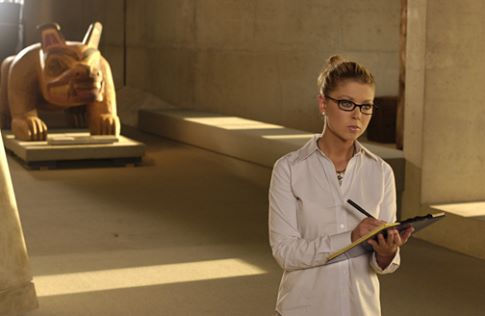 The acting is wildly all over the map. I wonder if Boll will ever be able to direct actors. The line delivery is terrible all around. Slater is subdued and permanently cranky. Maybe somewhere inside that Jack Nicholson grin he’s realized he’s slumming it. Reid acts like an irritable child. Dorff seems to be the only actor having any fun, though I don’t know how intimidating this diminutive actor comes across as a military man. The actors of Alone in the Dark confuse loud with emotional.
Let’s take some time out to spotlight Reid and her character. The way Alone in the Dark convinces us that Reid is a scientist is by giving her some black rimmed glasses and putting her hair in a pony tail. It’s just that easy, folks. Apparently being a scientist didn’t help Reid with her geography; she pronounces Newfoundland “New-FOUND-land” (the correct pronunciation is “New-fin-lan”).
The dialogue reeks of poorly concealed exposition. A chatty security guard serves as the writer’s sloppy conduit to establish back story: “You don’t know about the Indians? Let me explain,” “You don’t know who Aline Cedrac is? Let me explain,” “How’s your boooooyfriend, Aline Cedrac?” Alone in the Dark relies on gobs of thick exposition to cover up its insurmountable plot holes. The movie thinks it’s like a cool detective noir. It’s not. You never heard Sam Spade say, “Fear is what protects you from the things you don’t believe in.” Huh? Does that make any sense?
Alone in the Dark is symptomatic of all of Boll’s directorial flaws. He has no feel for tone, he has no control over actors, he makes bad stylistic decisions that detract from the film, and he has no time for subtlety. Boll spoils all of his surprise by showing the monsters up and front instead of letting the human mind fill in the blanks for terror. This is a brain-dead action film that doesn’t even trust its audience to read. Alone in the Dark is a film so incompetent, so ridiculous, so convoluted, and so moronic that it must bend the laws of space and time simply to exist. This makes House of the Dead look well thought out. If this is indicative of what Boll has in store for his video game adaptations, then you can expect many duds yet to come on Boll’s path to eventual audience oblivion. If anyone dared venture to a theater to see this movie, they’d find themselves alone in the dark all right. And shamed. Deeply, deeply shamed.
Nate’s Grade: F
Share this:

House of the Dead (2003)
 House of the Dead is Uwe Boll’s first foray into the video game-to-movie niche he’s carved himself. It’s based on a first-person-shooter by Sega that lets players blast their way through a haunted house and its undead tenants. There’s not much to the game. In interviews Boll has remarked at how he hated the film’s jokey script and rewrote much of it on the fly, trapping the film between the genres of horror and action. In the DVD jacket, executive producer/co-writer Mark A. Altman says, “House of the Dead is no Citizen Kane.” This may be the understatement of the millennium, comparable only to Napoleon saying Russia might be a tad cold.
Matt (Steve Byers), Greg (Will Sanderson), Simon (Tyron Leitso) are meeting with fellow college students Alicia (Ona Grauer), Karma (Enuka Okuma), and Cynthia (Sonya Salomaa). They’re ready to party at the rave of the century. This rave of raves takes place on the ominously named Isle del Muerte (The Island of the Dead). I suppose this proves that no one on the rave planning board speaks Spanish. The kids eventually hitch a ride to the island from Captain Kirk (Jurgen Prochnow) and his first mate (Clint Howard). Hot on Kirk’s heels is Casper (Ellie Kornell), a border agent after Kirk for gunrunning. Once they arrive at the island, the kids are shocked to find the rave site vacated, destroyed, and swarming with zombies. Everyone makes a run for it and regroups with some of the rave’s survivors, led by Rudy (Jonathon Cherry). The groups team up, armed by Kirk, and set out to shoot their way home. But there’s also a very evil figure roaming about that has more sinister plans for the island’s fresh meat.
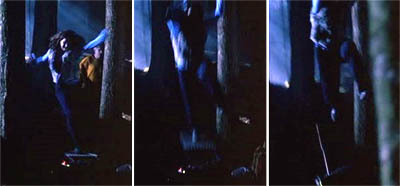 House of the Dead isn’t a horror movie at all. Boll has no idea how to stage scenes with tension. He has no feel for mood or atmosphere, which are the foundations of a good horror flick. So instead, House of the Dead is a riotously dumb action movie. But under Boll’s direction, it’s not even good at that. The action is repetitious and pedestrian. Boll’s big melee sequence becomes boring because it doesn’t progress. There’s just ten minutes of wall-to-wall shooting zombies, but there isn’t any order to it, no rhyme or reason. If you want a perfect example of Boll’s inept staging, skim to 47:20 into the DVD and watch. You’ll see a zombie leap onto a jumping platform and launch himself into the air. House of the Dead actually has scenes where we see exposed jumping pads and landing mats.
Boll gets drunk on special effects very easily. He loves the bullet time effect and throws it in at odd points. Every single character gets a tiresome slow-mo camera spin as they fire a gun. After the ninth and tenth time, the thing gets old. The characters don’t even have the same weapons in the shots before the slow-mo jazz. Boll doesn’t use flashy effects to benefit his narrative, unlike The Matrix. Boll actually thinks using clips from the actual video game is a good device to transition between scenes. There will be moments where screen shots of the game just pop up. Boll is a kid with toys and no clue when to put them back into the box.
This movie’s silliness is jaw dropping. The so-called rave of the century seems to be poorly attended, and the better for it since it takes place on the Island of the Dead (Isle del Muerte). Is that really the best place to host a social gathering? Perhaps everyone gets what they deserve for being stupid. Kirk, after shooting several zombies, limply remarks, “Now I know why they call this the Island of the Dead.” The line should be accompanied by a rim shot. The movie doesn’t even live up to the lofty ambitions of its title.
 By far the most ludicrous story element is the film’s villain, Castillo (David Palffy). It seems that before he stalked the island in a hooded cloak, looking like Robert DeNiro in Mary Shelley’s Frankenstein, he was a Spanish pirate/doctor. He tried to experiment on living tissue in order to unlock the secret of how to be immortal. He was imprisoned on a Spanish ship and was shipwrecked on the Island of the Dead (what are the odds?). He’s concocted a special Kool-Aid that will bring the dead back to life, though I don’t know why he’s still stuck on an island if he can’t drown. I guess he’s been biding his time and waiting for stupid college students so he can see some T&A.
The characters are made up of people interested in attending a rave, but when the action hits they’re all instantly adept at weaponry and kung-fu. That’s not the typical raver I know, and these people must be super ravers if they’re going to the rave of the century. Simon is described as “the biggest underwear model in America,” and for all I know underwear models encounter a lot of gunfire on the runway. The DVD jacket has character profiles where it lists their name, age, weapon of choice, and skill. After having watched House of the Dead, the skills are laughable at best. Simon the runway model’s skill is “tactical planning.” I also seriously question Rudy’s “leadership” skills since he gets everyone killed.
Of course everyone in the movie is profoundly stupid. While trapped in the island’s only house, Rudy says the kegs of gunpowder are useless without a charge, and then he walks past a series of lit candles. The whole house upon arrival is filled with lit candles (who has the time for that, by the way?). Alicia is convinced that the rave site being deserted, destroyed, and zombie-infested is all a practical joke, as if Ashton Kutcher is just around a tree poised to yell, “You suckas just got punk’d!” There are numerous moments where a character will wander into the dark and say, “[Insert name], is that you?” Kirk takes the last stick of dynamite and plans to sacrifice himself by blowing up some zombies good. He lights the stick, wanders outside their barricaded stronghold, and blows himself sky high. What Kirk failed to do was move far enough from the house, because he also blows the front door wide open and the zombies filter inside.
The acting doesn’t even rise to the level of camp. The actors feel unrestrained and marooned, typical of a Uwe Boll film. The man has no feel for actors and this explains why his films have some of the worst line readings I’ve ever heard (2000’s Dungeons and Dragons is still the worst). Casper acts like a crabby fitness instructor. The dialogue is bad as is, but when added with the poor line readings it turns every spoken sentence into something of unintentional hilarity. Take this nugget from Simon: “We got to the boat but it wasn’t there.” Well, then did you actually get to it?
House of the Dead can be enjoyed for the depths it plumbs. The dialogue is cheesy and leaden. The movie is bad enough that if you have some friends over, drink steadily, you’ll have a blast laughing and hurling popcorn at the screen. The movie does have a decent amount of blood and gore and the make-up effects are good but limited. You can enjoy House of the Dead in a fun derisive way, and it’s hard to argue with the price some retailers charge (I bought it on Amazon.com for 75 cents plus shipping). The DVD commentary is also good for a laugh, that is, if Boll’s self-flagellating remarks are serious. At one point he compares his zombie action movie to Schindler’s List. Boll also marvels at an actor’s ability to carry objects and make them seem heavy. I’m not sure if Boll is serious or just making fun of the movie like everyone else.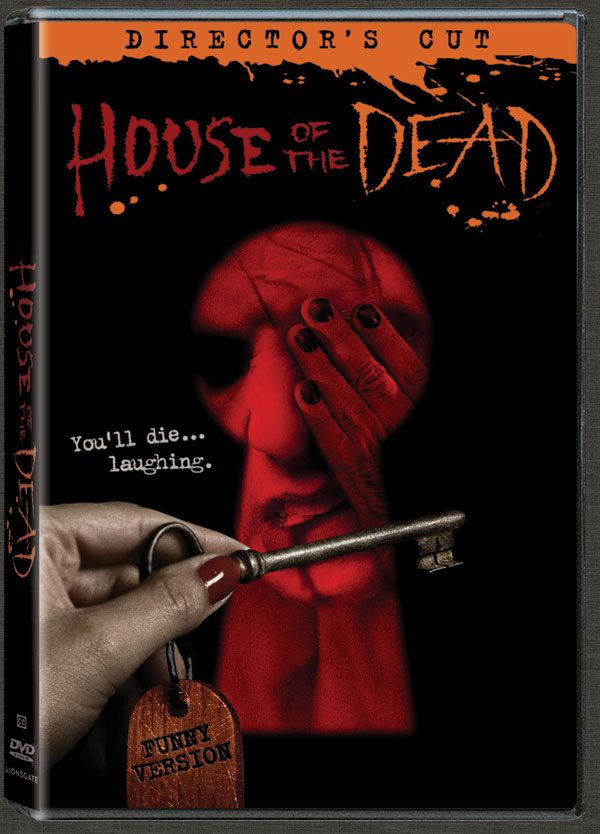
House of the Dead is a dull action movie within the framework of a horror flick. The characters are powerfully stupid, the action is redundant, the effects are chintzy and overused, and the direction is lackluster. Boll has added little in transitioning a game about poppin’ zombies onto the silver screen. The video game is flimsy and the movie based upon it manages to be even flimsier. House of the Dead is incredibly dumb entertainment and the fact that a sequel is well underway cannot be a good sign for human existence. I never thought I’d utter these words but . . . Clint Howard, you’re too good for this.
Nate’s Grade: D
Note: Boll re-released a recut House of the Dead as a comedy. I haven’t seen “the funny version” but I can’t imagine that it could possibly be any funnier than the original.


 nathanzoebl
You must be logged in to post a comment.