Blog Archives
Five Nights at Freddy’s 2 (2025)
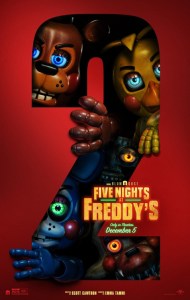 I wasn’t a fan of the original 2023 movie based upon the insanely popular video game series that serves as an entry point into horror for kids. It didn’t work for me but I thought fans of the series would have fun watching the characters come to life in live-action. Now with the sequel, I don’t know anyone that could enjoy this dreck except for the most diehard of the Freddy’s fanbase. I’ve watched the movie and I couldn’t understand it. I read the Wikipedia summary and that didn’t clear it up. So much hinges on so many characters having peculiar responses and relationships to what are… killer animatronics powered by the spirits and literal corpses of murdered children. Why is this pizza parlor even still standing? These robots went on a killing spree in the first movie, and yet this lonely little girl misses her “friends” and runs away to see them again. This isn’t E.T. here, it’s a weird killer robot horror movie that seems to be making up its lore and rules as it goes, like one unending “yes and?’ improv game you’re desperate to tap out from. I guess there’s more killer robots this time, and some unintelligible distinction between the good bad robots and the really bad robots. I don’t know. I gave up trying to comprehend what was happening and felt like maybe I could just try and enjoy the minimal PG-13 scares and tension. The animatronic designs are solid. Wayne Knight (Seinfeld) appears as a villainous robotics teacher. There’s a marionette character that’s kind of sinister to watch. That’s about it, folks. It’s a fairly nonsensical waste of 100 minutes, and unless you’re steeped in the lore and history of the series, you too will wish that this town would just set fire to the whole parlor.
Nate’s Grade: D+
Share this:

HIM (2025)
 Setting a horror movie in the world of competitive sports, especially American football with its fandoms akin to dangerous cults of zealots, is a smart concept that could have so much possible commentary, from the sacrifices and exploitation of the players for the blood-lust of the fans, to the conspiracy of a cadre of white owners profiting from the labor of black athletes, to even the blinding psychopathy of extreme tribalism as an identity and dividing line. HIM does little to none of this, and being produced by Jordan Peele, I expected so much more than what I got. We follow a college phenom quarterback who wants to be the greatest, so he accepts an offer to train with a famous champion (Marlon Wayans) who puts him through a series of intense trials to prove whether he has what it takes. The horror elements are more confusing and surreal than unsettling, often crashing into unintentional comedy, like watching mascots with sledgehammers. This is one of those movies that seems to shift from scene to scene, with murky elements meant to keep the main character guessing but really just keeps the viewer guessing if this will ever come to something meaningful. The horror grew tiresome and repetitive. I was hoping for more scenes like where our young QB’s misses in practice lead to other players being physically abused, but mostly HIM hinges on tired occultly leftover furnishings, including an ending that is simultaneously underwhelming and predictable, a shrug meant as catharsis. An electrifying horror movie can certainly be made about the world of football. HIM isn’t it, let alone the possible GOAT.
Nate’s Grade: D
Share this:

He’s Coming to Get You! (2025)
 Kyle Rayburn might just be one of the nicest human beings you’ll ever meet, and he’s admirably unafraid of pursuing his dreams, whether it’s starting a chicken wing food truck or making micro-budget horror comedies in central Ohio. The man has gusto, and it shines through the seams of his hardscrabble yet charming earlier cinematic efforts, Night Work and Satanic Soccer Mom from Ohio. Each of Rayburn’s movies is filmed for under $5000 and shot on an iPhone. He’s in a production groove, promising the next adventure during the credits of his latest completed movie (coming up next: Slam Hounds), and his latest cinematic salvo is the evocatively-titled He’s Coming to Get You!, a title that William Castle surely would have nodded in solemn approval. It’s more or less The Crow by way of Sam Raimi, who even gets name-checked in the movie, a supernatural-fueled revenge thriller with goofy slapstick and self-aware references. It’s a fairly entertaining beginning and ending to a movie that, unfortunately, at just an emaciated 51 minutes in length before end credits, lacks the development for a satisfying exploration between start and finish.
George Russo (Scott Baker, Sulphur for Leviathan) is turning thirty-three and looking forward to a night of cavorting with his long-time girlfriend, Aja (Alyss Winkler, Space Babes From Outer Space). A team of sex traffickers (Jason Crowe, Seth McGuffin – yes, that is his real last name) is determined to capture Aja for their boss. They mug the happy couple and shoot George in his face, killing him and kidnapping Aja. An occult bookstore owner (Grace Plazolles-Hayes) resurrects George through the power of voodoo. He’ll be alive for the remainder of the night, enough time to track and rescue Aja. He’s also a “pain sponge,” meaning that he can take lots of physical punishment and keeps on going, the Energizer Bunny of vengeance, if you will. Can he rescue his beloved before it’s time once again to shuffle from the mortal coil? Will he be able to inflict maximum justice while also trying out some long-sought kung-fu moves?
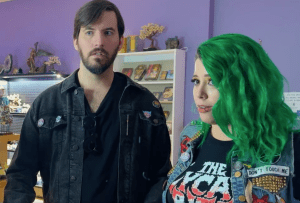 From that description, you can see how the premise would suffice as a movie for He’s Coming to Get You! (it’s never going to be normal in my brain to type a period after the punctuation in the title). There’s something inherently appealing about revenge stories, and you add a supernatural element that doesn’t just level the playing field for our undead underdog but gives them a key advantage, and we’re hooked. It really is The Crow with a better sense of humor, or, well, any sense of humor. Along those lines, giving our avenging crusader a sense of humor that would fit into Army of Darkness is a great boon. The heavier aspects of the movie like murder, assault, and trafficking are mitigated by having a main character who has definite Bugs Bunny by way of Bruce Campbell energy. It’s the filmmakers way of saying to the audience not to get too worried because the results will be more like an amiable, goofy hangout.
After three movies, I can say that Rayburn and his co-writer/producer Ben Reger love making movies that are, first and foremost, concerned with imparting good times no matter the twisted material. I laughed out loud a few times, like when a thug, seconds before his imminent death, replies forlornly, “I never saw Pari.” I laughed at George attempting a kung-fu move and then berating himself, “Nope, felt wrong the second I tried.” There’s a pair of bumbling cops (played by Rayburn and Reger) that you can tell they have such affection over, even if they seem like the most incompetent cops on the beat. It all encapsulates a certain teenage boy ethos of rock and roll, scatological humor, babes, and cartoonish violence. The infectious vibes of the movie are back and appealing, a feature that can elevate low-budget movies with obvious limitations. It’s the same with the mumblecore movies of the 2010s, low-budget slice-of-life movies buoyed by strong characters and sense of place. There is no budget on engaging storytelling. It’s the same with Rayburn and Reger’s collaborations. Whatever the premise, theirs is a universe you’ll want to make pit stops for the irreverent good times and weirdness.
 And that brings me to my biggest hesitation with He’s Coming to Get You!, mainly that in its final form it comes across more of a proof of concept for a bigger movie than feeling like a complete feature. This is primarily because of its length and the rushed development skipped over for an abbreviated Act Two. The total running time before end credits is 51 minutes, but if you subtract the opening credits that play over the montage of George getting up for the morning, that’s an additional three and a half minutes, taking the running time to a paltry 48 minutes or so, fitting an hour of network TV rather than a feature-length film. From a structural standpoint, George is killed at the 21-minute mark, resurrected and sent on his mission at the 31-minute mark, foils the bad guys by the 46-minute mark, and then the movie ends at minute 51. That’s it. It’s hard not to feel a little cheated; the “coming to get you” part of the title is only 15 minutes. Imagine The House on Haunted Hill but you’re only on Haunted Hill for all of ten minutes.
The movie is sprinting through potential plot and further world-building that would help to make its storytelling feel more original and engrossing. Once George is resurrected, he is given great powers but there aren’t any notable rules on the powers besides the fact that they, and he, will expire upon morning. The villains never really have a chance to even process their new adversary as he just shows up, kills them, and then wins the day on his first attempt. The absent struggle and creative development hampers some of the fun, like the movie was in a rush to call it quits over practical considerations. After George is resurrected, there’s one other group he gets to test his new powers on before it’s already time to eliminate the people who killed him. In The Crow, the main character targeted the gang of killers one-by-one, with them learning about this new threat gradually and planning counter-moves. The way it plays out in this movie is all too easy. It’s like an acknowledgement that an audience won’t want to watch a full movie of a supernatural hero getting everything he wants too easily, but the answer isn’t to just shorten the movie, it’s to better develop the premise and ensuing conflicts and challenges and unique world-building. I’d rather watch a version of this movie where George has to figure out his powers and has certain rules and limits than a speed-run to the finish without any interesting challenges, organic complications, or surprises.
 There is one moment toward the very end of He’s Coming to Get You! that I feel is emblematic of the positives and drawbacks of the development, but it involves some mild spoilers since it concerns the conclusion, so be advised, dear reader. Aja and George are reunited and finally get some privacy in the bedroom. Aja has been promising quite a bevy of sexual activity for George’s birthday. They’re finally alone, she performs a strip tease, then she crawls into bed and the movie cuts to them just talking and laughing. I thought that was a nice subversion. They have one final night together, so why spend it on physical copulation when you could wile away the hours talking to your favorite person, hearing their laugh, reminding yourself why you love them before they’re gone for good? Besides, having sex with a resurrected dead body, who has been stabbed and beaten throughout the movie, might make for an extremely upsetting final memory of your lover. Plus there’s the whole possible joke of being unable to control blood flow since, you know, blood doesn’t flow anymore anyway. I thought this was clever and sweet. Then it’s revealed that George and Aja did indeed have their sex off-screen and this is just post-coital pillow talk rather than a subversive replacement. Oh? Oh well then.
After three movies, I can start to catalogue the Kyle Rayburn film experience: silly comedy cul-de-sacs, low stakes regardless of circumstance, celebration of schlock, amiable vibes, actors having fun regardless of experience, lo-fi visuals, minimal if any coverage beyond shot-reverse shot edits, and underdeveloped stories. This has been my chief criticism with each of Rayburn’s previous movies, that they benefit from fun ensembles and intriguing premises but that more work could have been done to better realize the potential of each. I often walk away from these movies thinking we got the first draft onscreen. He’s Coming to Get You! is the most real world setting in a Rayburn vehicle, so there aren’t as many interesting characters or details to the world to cover some of those plotting shortcomings, so the vacancy becomes more notable and damaging to the entertainment. It’s easy to graft onto the relaxed, schlocky wavelength of the movie but by the end I felt a little shortchanged in creativity and execution, missing a movie middle. I’m happy Rayburn is following his dreams and has built a staple of returning players. He’s Coming to Get You! has enough going for it that I wish the team had dug in more. I only wish that whatever the next three or four projects prove to be, that Rayburn and his team take more time to really work through their particular story conventions to make them the best version they can be, not just completed.
Nate’s Grade: C+
Share this:

The Black Phone 2 (2025)
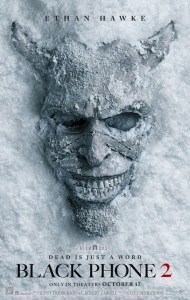
The original 2022 Black Phone was a relatively entertaining contained thriller where a kid was relying upon the ghosts of victims to escape the clutches of an evil kidnapper. It had other elements to fill it out as a movie, like a psychic sister, but the central conceit and execution worked well, especially a disturbing performance by Ethan Hawke as The Grabber, the aforementioned grabber and locker-away-er of unfortunate children. Then it was popular enough to demand a sequel, but where do you go when the villain has been killed and the source material, a short story by Joe Hill, has been exhausted? The answer is to turn the very-human Grabber into a Freddy Krueger-style supernatural predator terrorizing our survivors in their dreams. The kids from the first film are now teenagers and really the psychic sis is the main character. She’s the one most affected by the Grabber’s supernatural vengeance. Most of the movie is watching the sister get tossed around invisibly in the real world and talking to irritable ghost kids. There’s a mystery about uncovering the truth about what happened to their deceased mother, who too could have a personal connection to the Grabber from a Christian summer camp located in the far mountains. The snowy locale makes for a visually distinctive setting, though once you see the Grabber ghost ice skating it does take a little of the mystique away from the overall menace. The Black Phone 2 just didn’t work for me, feeling like another “let’s help these dead kids be at peace” adventure like a weekly TV series, but the scenario just didn’t have the draw and satisfaction of the original. I suppose the returning filmmakers wanted to expand their universe and its mythology, Dream Children-style, but the material doesn’t seem there to build a franchise foundation. The first film was simple and complete (makes me think of a variation on a line at the end of Bioshock Infinite: “There’s always a Grabber. There’s always a black phone. There’s always a ghost”). The sequel cannot compensate for that, and so it feels overstretched, underdeveloped, and goofy. At least they tried something different than just a straight replica of the original but it would have been best to leave the Grabber and us at rest.
Nate’s Grade: C
Share this:

Good Boy (2025)
 This is the first movie I can think of that might have a vested interest in opening its title with something usually reserved at the very very end of credits: the animal cruelty disclaimer. It seems barbaric now, but decades ago, film productions didn’t give much care for the care of their animal actors. In the old days, especially at the height of Westerns, horses would just die by the dozens and sometimes be literal cannon fodder like in 1980’s Heaven’s Gate. Nowadays, productions are monitored for animal cruelty and make every effort to tell their stories without harming anyone, human and animal. Good Boy is a novel take on a familiar horror concept. It’s a haunted house movie about a nefarious life-sucking specter. It’s also completely told from the point of view of the family pet. It’s a common horror trope to have the animals sensing supernatural danger before their respective owners finally wise up, it’s another to base your entire movie on that perspective. That’s what director/co-writer Ben Loenberg put together over the course of three years, training his dog Indy to be the star of his debut feature film. While the film feels more like an empathy experiment than a fully developed movie, it’s an interesting twist that made me rethink familiar horror movie staples. Here’s a helpful spoiler to set your minds at ease: the dog lives, folks.
Indy is a golden retriever and just the bestest boy. His owner, Todd (Shane Jensen), is going through a lot. Todd is suffering from a fatal illness and has returned to his grandfather’s home in the country. Todd’s sister is worried over his deteriorating mental and physical state and also believes that the old family home is haunted by a sinister presence that contributed to their grandfather’s demise. What’s a dog to do?
 It’s an interesting choice to have a dog as our main character because it’s both limiting as well as coursing with dramatic irony. Firstly, we know it’s a movie, and the dog is just a dog and doesn’t know its owners are making art by being purposely weird. So many animal performances are like candid camera exercises (cue think pieces arguing that the dog could not really give consent to being terrorized for art). Telling your story from only what a dog is privy to will naturally limit the extent of the story. We can overhear snippets of conversations to draw inferences but the movie is making a value judgement that its audience will fill in the blanks of its familiar ghost story. This is the filmmakers at peace with their story being hazy and familiar and underdeveloped. They’re sacrificing clarity for adhering to their artistic vision, but because it’s the whole relevant sticking point of the movie, I think they made the right call.
Alas, the dog is a limited perspective to tell a realistic story. However, the sense of dramatic irony is what helps add layers to the viewing. We see the dog know more but also simultaneously less than the humans. It senses the ghostly presence that the humans are ignorant of, but it doesn’t know why humans do their human things any more than any other non-human creature (we are puzzling). It makes for an experience where we are aware of what the dog knows but also simultaneously aware of what the dog doesn’t know. It makes for an interesting experience allowing the audience to empathize with our poor pooch but also recognize the dangers that it doesn’t and recognize the dangers that it’s trying to warn its owner over.
The perspective is a gimmick, sure, but it reminds me of last year’s In a Violent Nature, another indie horror project that took a familiar premise and turned it on its head through a canny choice of point of view. In that movie, we were presented the teenage slasher movie but from the beleaguered perspective of the zombified behemoth stalking the woods and trying to run into those mischievous teens. It was an experimental turn for a sub-genre that had been done to death by the conclusion of the 1980s, and that choice of perspective made it more reflective and contemplative as the viewer was forced to reconsider our relationship with these kinds of movies during the extended walks. Good Boy doesn’t go that philosophical distance, but its change of perspective refreshes the old tropes of the haunted house story.
 Is Good Boy scary? Not really, but I actually don’t think that’s the point of the exercise either. The purposely underdeveloped story rests on familiar tropes, which cues the audience to place their attention less on the plot, rules, and explanations and more on empathizing with the dog. Because of this creative choice it can create tension whenever we feel like the dog is confused, alarmed, or threatened. While the filmmakers do a decent job of crafting a potent sense of mood with such a low-budget, I doubt few will characterize the movie as genuinely scary. However, what’s scary is what might happen to this good boy and his own emotional fragility trying to understand forces and choices beyond his capacity. I will say to the horror aficionados who also happen to be ardent animal lovers, there is another ghost dog that used to belong to the dead grandfather who met a tragic end, but other than that, Indy isn’t truly harmed. Still, I found the resolution to the movie, including the very final image, unexpectedly poignant and a reminder that dogs are so inherently loyal that we honestly don’t deserve them as a species.
Dogs are inherently empathetic beings, just ask any dog owner, so it’s easy to sympathize with this little guy trying to do his best to be the good boy he is. He just wants some pets and to cuddle with his human. He doesn’t know his owner is suffering from a chronic lung condition. He doesn’t know the strange man in black ooze creeping along the shadows isn’t another strange person. Our dog just knows things aren’t right. Naturally, without narration, our protagonist is going to be limited by what he can emote, and yet the filmmakers do a superlative job of getting the best performance out of their four-legged star. Through the judicious editing and planning, it really feels like this little guy is giving a performance, enough so that animal lovers might squirm occasionally in their seats. When the ghost is taking over Todd and he’s mean to Indy, I felt so bad for this little guy (he doesn’t know it’s all pretend). There are some wonderfully expressive close-ups, and while it’s entirely the Kulushov effect and I’m projecting meaning into a performance that isn’t actually there, that’s also the intention of the filmmakers. They are cajoling their non-verbal star and creating the performance through carefully crafted setups and edits, and it works.
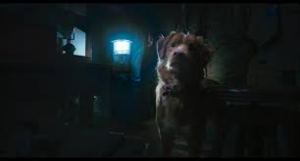 Good Boy isn’t the first movie with “man’s best friend” as its lead (Lassie, Rin Tin Tin, Benji, etc.) nor is it the first movie asking us to think from a non-human perspective. Its familiarity is the point, and it asks us to think of the tried ghost story but from the perspective of the curious canine. The movie is probably as long as it can be at 70 minutes without feeling truly punishing or significantly complicating its world building. I can’t fault people for viewing Good Boy as more of a gimmick or experiment than a fully engaging movie. It’s not going to be for everyone by the nature of its limited perspective and development; not everyone is going to be captivated watching a dog react to things for an hour. It didn’t fascinate me like In a Violent Nature but it did make me rethink the familiar, and to that end it’s an overall success and confirmation that you should always trust the animals when they sense something hinky.
Nate’s Grade: B-
Share this:

Opus (2025)
 Ever want to watch a second-rate version of The Menu and be left wondering why you didn’t just watch The Menu? That was my main takeaway watching the indie horror/comedy (?) Opus, a darkly satirical look at the music industry and specifically cults of personality. John Malkovich plays Alfred Moretti, an exalted and reclusive musical genius who has earned numerous awards and built a devoted fandom. He’s invited six special guests to a listening party for his new album, the first since his mysterious retirement. It just so happens that party is at his compound and the guests are tended to by a cult of devotees. From there, people start to go missing and weirdness ensues. I was waiting throughout the entirety of Opus for something, anything to really grab me. These are good actors. It’s a premise that has potential. Alas, the movie is uneven and under developed and I found my interest draining the longer it went. The music satire isn’t specific or sharp enough to draw blood or genuine laughs. The weirdness of life on the compound is pretty bland, with the exception of a museum devoted to Moretti’s childhood home that is explored during the climax. The characters are too stock and boring, not really even succeeding as industry send-ups. The music itself is also pretty lackluster, but the movie doesn’t have the courage to argue that the cult has formed around a hack. In the world of Opus, Moretti is an inarguable musical genius. We needed the main character, played by Ayo Edebiri (The Bear), to be an agnostic, someone who doesn’t get the appeal of this musical maven and can destruct his pomposity. Alas, the obvious horror dread of the followers being a murder cult is never given more thought. It’s fine that Opus has familiar horror/cult elements (The Menu, Midsommar, Blink Twice, etc.) but it doesn’t do anything different or interesting with them. It’s obvious and dull without any specific personality to distinguish itself, and if maybe that was the argument against the cult leader, I might see a larger creative design. Instead, it all feels so listless. When the weird cult movie can’t even work up many weird details about its weird cult, then you’re watching a movie that is confused about themes and genre.
Nate’s Grade: C-
Share this:

Death of a Unicorn (2025)
 Unfortunately, this never became the glorious B-movie its premise promises, a monster movie with ghastly gore that also satirizes the rich business elites. Death of a Unicorn has enough appealing elements, from the father/daughter relationship between Paul Rudd and Jenna Ortega, to some ridiculous gore and kills, to impressive creature prosthetics to bring the unicorn to life (and death). The setup has Rudd and Ortega run over a unicorn in a secluded nature reserve on their way to meet dad’s boss. They discover the unicorn blood can be miraculously healing, which is a fortuitous discovery considering Rudd’s boss runs a pharmaceutical company. You can see where this goes, especially when you learn that there are more unicorns out there and they are not happy. It becomes a wily creature feature from there, with unicorns picking off the characters one-by-one as they try and escape. The satirical broadsides are a bit too broad, thus only really glancing in their pointed attacks that the people in charge of medical care are themselves venal and selfish. Got it. Much of the humor is related directly to the absurdity of watching a unicorn as a blood-thirsty monster. If you replaced the unicorn with, say, a yeti, would the situation still be amusing? Maybe, but I seriously doubt it. Death of a Unicorn could have been a little scarier, funnier, even freakier, and maybe carried through on the courage of its convictions.
Nate’s Grade: C+
Share this:

Weapons (2025)

Zack Cregger began his career as one of the co-creators and co-stars of the sketch comedy troupe, The Whitest Kids U Know. This led to a poorly received sex comedy, 2009’s Miss March, which Cregger co-directed and starred as the lead. Then in 2022, Cregger made a name for himself in a very different genre, writing and directing Barbarian, a movie whose identity kept shifting with twists and world-building buried underneath its simple Air B&B gone awry setup. From there, Cregger joined the ranks of Jordan Peele, John Krasinski, and other horror-thriller upstarts best known for comedy. It became a question over what Cregger would do next, which sparked a bidding war for Weapons. It’s easy to see why with such a terrific premise: one day a classroom of kids all run out into the night at the same time, all except for one child, and nobody knows why. Weapons confirms Cregger’s genre transformation and the excitement that deservingly follows each new release. Each new Cregger horror movie is a game of shifting expectations and puzzles, though the game itself might be the only point.

The premise is immediately grabbing and Cregger’s clever structural gambits add to that intrigue. Right away in the opening narration from an unseen child, we’re given the state of events in this small town, already reckoning with an unknowable tragedy. The screenplay takes a page from Christopher Nolan or Quentin Tarantino, following different lead characters to learn about their personal perspectives. It continually allows the movie to re-frame itself, allowing us to pick up details or further context with each new person giving us a fuller sense of the big picture. Rather than resetting every twenty minutes or so, the movie offers an implicit promise of delivering something new at those junctures, usually leaving that previous lead character in some kind of dire cliffhanger. With each new portion, we can gain some further insight, but it also allows the story to ground its focus and try on different tones. With Justine (Julia Garner), we see a woman who is trying to figure out how to regain her life she feels has been unfairly stripped away, and many of her coping mechanisms are self-destructive old habits. With Archer (Josh Brolin), we see a father consumed by his sudden loss and the reflection it forces him into, while also obsessing over what possible investigative details he can put together to possibly provide a framework of an answer. Then with other characters, which I won’t spoil, we gain other perspectives less directly involved that approach a dark comedy of errors. At one point, you may even wonder when the movie is going to remember those missing kids again. I appreciated that Cregger resolves his mystery with enough time to really examine its implications. This isn’t just a last-minute twist or Scream-like unveiling of the villain coming to light. I also appreciated that it ends in such an enthusiastic climax that left me cackling and cheering. It’s a mystery with a relatively satisfying answer but a climax that is also cathartic and exhale-inducing after all the dread and build-up.

The technical elements are just as polished as its knotty screenplay. The movie is genuinely unnerving at many points. Even the image of kids Narutu-running off into the night is inherently creepy. There are a few cheap jump scares but most of the movie is built around a quiet sense of desperation and dread. Cregger prefers holding onto shots to build tension, like a door opening and waiting for something, anything to pop out of the darkness. There are moments that made me wince and moments that made me gasp, like suddenly being compelled to stab one’s face with a fork dozens of times. However, a significant drawback for me was the lighting levels of the cinematography. To be clear, the photography was eerie and very evocative. My problem is that this was a movie whose light levels were so low it made it excruciatingly hard to simply identify what was happening onscreen. I’m sure my theater’s dim projection was part of this, but this is also a trend with modern movie-making, the murky lighting, like everyone is trying to recreate those Barry Lyndon’s candle-lit tableaus. Sometimes I just want to see what’s happening in my movie.
Weapons is certainly a thought-provoking premise, but with some distance from the movie, I’m starting to wonder what more there may be under the surface. Now not every movie has to be designed for maximum layers and themes and metaphors; movies can have their own points of appeal before getting to subtext. I do think most viewers will find Weapons engaging and intriguing, and the slippery structure helps make the movie feel new every twenty minutes while also testing out different tones that might have been too obtrusive with different characters and their specific perspectives. However, once you straighten out that timeline and see things clearly, it begs the question what exactly Cregger is actually saying. The sudden and disturbing horror of a classroom of children all disappearing has to have obvious connections to school shootings and mass killings, right? The trauma image is too potent and specifically tied to schools to be accidental or casual. Taking that, what is the movie saying about our culture where one day, any day, a class full of young children can just go missing? Despite a literal floating assault rifle appearing in a dream, there doesn’t appear to be much on the movie’s mind about gun violence or even weapons in general. I’m reminded of my favorite movie of 2020, the criminally under-seen Spontaneous, which explored a world where one high school class of students lived under the threat that at any time they could explode. There was no explanation for this strange phenomenon, though scientists certainly tried, and the focus was instead on the unfair dread hanging over their day-to-day existence, that at any moment their life could be forfeited. The parallel was obvious and richly explored about the pressure and anxieties of a life where this very disturbing reality is considered your accepted new normal. That was a movie with ideas and messages linking them to its school-setting of metaphorical trauma. I can’t say the same with Weapons.

I’ve read some people analyze each one of the characters as one of the stages of alcoholism, and I’ve read other people argue that the movie is an exploration of a town come undone through unexplainable trauma, but I seriously doubt that last one. Don’t you think the mystery of the missing class would draw national and international media attention? Hangers-ons thinking they cracked the case? Intruders harassing the bigger names? People trying to exploit a tragedy for money or a sense of self-importance? Conspiracy theorists linking this mystery to their other data points for a larger conspiracy? It doesn’t feel like the impact of this unique mystery has escaped the county lines. Certainly there are characters searching for answers and treating this poor schoolteacher as a scapegoat for their collective fears and anger, but by turning the screenplay into a relay race where one character hands off to the next for time in the spotlight, it doesn’t expand our sense of the town and the broader effects of this bizarre tragedy. Instead, it pens in the characters we do have, which all seem to interact with those very same characters, making the bigger world feel actually smaller. Narrowing the lens of perspectives makes it more difficult to articulate commentary about community breakdown in the face of uncertainty. The creative choices square with the central mystery and the nesting-doll structure, playing a game with the audience to discover the source of this incident, but once you discover that source, and once we reach our ending, you too may appreciate Cregger’s narrative sleight-of-hand but eventually wonder, “Is that all there is?” Maybe so.
Weapons is an effective and engaging follow-up for Cregger and confirms that whatever stories he feels compelled to tell in horror are worthy of watching, preferably with as little prior information as possible. You definitely feel you’re in the confidant hands of a natural storyteller who enjoys throwing out surprises and shock value. I have some grumbles about ultimately what might all be behind that intriguing mystery and the lack of foundational commentary that would permit multiple viewings of close analysis. Then again not every movie is meant to be a repeat viewing. Some movies are one-and-dones but still enjoyable, and that might best sum up Weapons. It’s sharp and cleverly designed but maybe lacking a finer point.
Nate’s Grade: B
Share this:

Together (2025)
 With co-dependency as its anchor metaphor, Together is a body horror movie asking the question how intimate you’d ever want to be with your beloved? It’s a relationship drama about two people that should probably break up and move on but are clinging to some sense that they need to stay. Real-life married couple Dave Franco (The Disaster Artist) and Alison Brie (Horse Girl) play pretend couple Tim and Millie who relocate to the small-town countryside and come across a mysterious sinkhole belonging to an abandoned New Agey church, as one does. After Tim, in his desperation, drinks the water out of a pit that looks like it was designed by H.R. Giger, his body and mind are hijacked with the compulsion to be as close as possible with his long-time girlfriend. Now the two of them are fighting strange impulses, like swallowing one another’s hair, or trying to physically meld their bodies together. Can they learn more about their predicament and the history of this symbiosis before they are forced together forever?
 Considering its premise, there is plenty of potential here for grandly gross body horror. There are certainly some squirm-worthy and disgusting moments of vivid imagery that could induce nightmares. I’m not even talking about the direct body horror moments. Seeing a man swallowing a majority of your ponytail in his sleep might make you gag like it did me. Things get more wild after an hour and stay that way to the end, as the couple has to thwart their bodies from literally fusing together. The sticky skin-to-skin, or eyeball-to-eyeball sequences are dreadfully unnerving, but the imagery of them literally being dragged by invisible forces across the ground to one another like literal magnets is less horrifying and more absurdly ridiculous. That’s the rub. There’s some terrific body horror grotesquery here, and writer/director Michael Shanks has a sneaky way with dread, building things to a monumental point and then cutting away. However, some of the other aspects of this curse come across as far goofier, like the aforementioned being dragged across the floor. For some it might come across as terrifying, the whole supernatural exaggeration of being out of control of your own body, but it reminded me of Tenet where it looked like characters were just rolling around on the ground in a supremely silly way when it was supposed to be “backwards time.” There are also some middling jump scares relating to Tim’s trauma with his parents that, I guess, is the explanation for why he has intimacy problems. Still, if you’re coming to Together for the outlandishly gross potential of its premise, there may be enough to sate your curiosity for macabre oddities.
Together is more a movie about a couple who should retire. There’s far more about the struggles and pains of this relationship than weird body horror. She wants to get married, he doesn’t. She wanted to move for a new job, and he did not. She wants to have regular sex, he hasn’t wanted to for months for unspecified reasons (unresolved childhood traumas?). The relationship is very one-sided and unlike 2019’s Midsommar, which was about a poor woman realizing it was time to kick her no-good boyfriend to the curb, or burn him alive via cult intervention, this movie is more about Millie wearing down Tim’s defenses. He’s connecting with her again but it’s through this metaphysical compulsion that he can’t fully explain. He’s expressing real physical interest but he’s still finding ways to reject her, which just drives her crazier. One minute they’re trying to resolve their intimacy issues, and the next they’re working together to slice their arms apart. There are some memorable discomforts, like having to physically dislodge after some vigorous yet impulsive bathroom stall sex. That sequence made me uncomfortable for several reasons. The film’s shock value and tone flirts with darker humor without committing. The final shot of the movie is also a bit silly, and while it achieves the articulation of the movie’s main theme, the concluding imagery is more like, “Oh, well, okay then.” It might even produce a few guffaws. It’s not quite the lasting image I think the filmmakers wanted to go out on. It made me think of Kevin Smith’s man-becomes-walrus horror film, Tusk, where it ends and you go, “Oh… well, they did it, all right.” Some things are better in theory than finally visualized where they come across as anticlimactic.
 That’s the other thing with Together, it’s practically bludgeoning you with its obvious theme, having every other line relate back to codependency. Multiple times you will hear, “It would be better to separate now. It will just be harder the longer we wait.” Can you get how this will be applied in multiple contexts? These are characters that feel stuck. Get it? Franco and Brie have an easy-going chemistry and an innate ability to find the darker humor amidst all the body horror splicing. I might argue their chemistry is too good considering they’re supposed to be a couple that shouldn’t really stay together and have passed their relationship expiration date. I don’t think you should want them to stay together considering this relationship is killing the both of them, now very literally. I was surprised there wasn’t more combustion to how this complicates their interactions and mobility. If this is a relationship that has had its rocky points and toxicity, you would think something this unnatural and against their autonomy would produce some friction (no pun intended). I suppose you could examine the entire movie as an analysis of how easily people will subsume themselves in order to stay in something even they would admit isn’t healthy. I’m not going to pretend The Substance was subtle either, but that movie was more fable and mixing in its over-the-top elements with verve, rather than fitting them into a relationship dirge.
Right before its nationwide theatrical release, Together was accused of plagiarism by another filmmaker who approached Franco and Brie with a similar concept in 2020. Shanks has defended his film by saying he registered his first draft back in 2019, and the producers of Together, including Franco and Brie, have dismissed the claim. I haven’t read the competing script, nor do I pretend to be an insider on this matter, but it’s easy for me to see how this concept could have been independently generated by dozens of screenwriters and aspiring body horror gurus. It’s taking its theme and making it quite literal, forcing the challenged couple who shouldn’t be together to literally, physically, irrevocably be together. It’s all pretty straightforward, which makes Together a workable but limited body horror experiment. I liked it, as much as one can like a movie where characters have to forcibly unstuck their genitals, but I found myself wanting a little more from Together. The added Tim back-story spooks feel out of place, the ongoing mystery of what happened to a previous backpacking couple is over represented, and the theme is so obvious at every turn that the metaphor is in danger of being stripped bare. Its concept is undeniable, and the body horror imagery can be aces, but the development and execution could have been a little more, well, together.
Nate’s Grade: B-
Share this:

Final Destination: Bloodlines (2025)
 A funny thing happens once you conclude a Final Destination movie. You start to see the world differently. After I finished watching Bloodlines, the first new film in the franchise since 2011, I found myself elevated by creative paranoia. I was holding onto an empty aluminum can and thought, “What if placing this on the counter will create a chain of events that leads to disaster?” Then I was washing our kitchen sink and looking at how close other electrical devices were to the faucet spray. Then I began thinking of all the dog toys that could position themselves underfoot and cause me to hit my head against our tile, perhaps then having that aluminum can fall on my head as a finishing move. If you’ve ever seen one of these movies, they are games of misdirection and dramatic irony, anxiously anticipating that any little item will contribute to a Rube Goldberg-esque wave of death. In many ways, the franchise brings an outlandish fear home and makes you just as crazy as the doomed characters. Final Destination: Bloodlines is a return to form for a franchise that never should have been on the brink of death. As long as people can come up with clever deaths and misdirects, there should be sequels.
Having watched and enjoyed every Final Destination movie, I will readily admit that while each of the five previous entries can be gory good fun they cannot be described as great movies, and that’s okay. They are delivery systems for amusement and absurd deaths, asking the audience to try and guess the ridiculous series of events that will contribute to the demise of whomever fills the screen. It’s a reliable formula that can be replicated again and again, where death itself is the main villain, or star, and where the appeal of the franchise is the winking game the movies are knowingly playing with the viewers. We’re here for the over-the-top machinations and dark humor of trying to guess what combination will succeed. The later sequels were populated with repellent or powerfully bland characters that we happily awaited their fateful demise, but the deaths were also getting stale, becoming more mean-spirited or more flimsier in design, giving to obvious obliteration options and then cheap shock alternative as mini-twists. If you’re going to have a game, it’s better to play by your rules. That’s where things began to go sour with me, but that doesn’t mean good writers who fully understand this franchise cannot revive it. I just thought it would have taken less time considering the inherent rebooting potential at play.
 This brings us to Bloodlines, by far the most ambitious of all Final Destination movies. It attempts to really explore the mythology and history of the franchise while also grounding the characters and their drama in a surprisingly emotionally resonant manner. I’m not saying anyone is going to confuse this movie with, say, Sophie’s Choice, but the filmmakers have put in the work to make us actually care about the doomed characters and their fledgling efforts for survival. Usually these movies follow a group of strangers along with a small friend group that becomes our core. This is the first movie where all of the characters in peril are family members across generations. Watching your mother or aunt or brother die horribly before your eyes and knowing that someone else in your family is next is just more impactful than if the relationships were based on high school friendships, work colleagues, or strangers. That kind of trauma just hits differently. Also, the ages of the family dynamic present a clear direction for the path that death is planning to take, going from oldest to youngest, although death seems to put this chronological pecking order on hold to wipe out a line of siblings. Excuse the math word problem setup of what will follow. Let’s say you have Oldest Child and Youngest Child and both have two kids but Oldest Child’s kids were both born after Youngest Child’s kids. Rather than killing the descendants in descending chronological order, death would wipe out Oldest Child’s offspring first even though they are younger than the children of Younger Child. As always, it appears death is a stickler with its rules.
The opening sequence is an all-timer for the franchise, and because it sets everything in motion I don’t feel like discussing it is particularly spoiler-y, but you may decide otherwise and can skip this paragraph. According to the new mythos, this is the event that sets the entire Final Destination universe into effect. It’s a spectacular disaster set in a high-rise restaurant 400 feet in the air atop one of those Sky Needle skyscrapers. The entire sequence is brilliantly executed and edited with extremely heightened periods of dread. These first ten minutes introduce us to a young romantic couple and get us invested enough to feel bad about what’s to eventually come. They also set up the stakes as well as the twisted gallows humor to follow. I loved tracing the different elements at play, from the cracking glass dance floor, to a loose chandelier shard (if one little chandelier piece could cause cracks then this must be the weakest floor in history), to a loose penny causing mayhem all because of a snotty little brat, the real villain of the franchise. The cross-cutting between the different incidents as things ratchet up is wonderful, and the clever cuts to the creme brule being broken as that glass dance floor is cracking is just superb. This is more than just a sequence in vertigo terror. There’s a gas explosion, a falling elevator, a Titanic-esque splitting of the restaurant, and the use of a grand piano as a slapstick coup de grace that left me cheering. This opener lets you know you’re in bloody good hands with Bloodlines and it also begins to emotionally ground the film too.
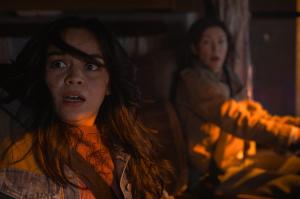 This is the most self-aware of the Final Destination movies but I think it works considering it’s the sixth entry, so having characters essentially be voices for the audience’s frantic clue-guessing is appropriate. One of the better sequences in the movie is when our protagonist, Stefanie (Kaitlyn Santa Juana), is walking through her neighborhood and trying to absently predict the everyday dangers on a garbage day. It begins as absurd and then it becomes even more absurd when everything she predicted lines up, though not as we might have expected. The whole thing plays out like a demented and extended joke setup with death as the punchline. Thankfully, it doesn’t take long for the family to get on board with this crazy idea that death is after them, so the second half of the movie is more their scrambling to plot how to cheat death established by the previous movies by either dying and being brought back or by taking a life and getting that person’s remaining time. There’s a gasp-inducing joke where characters, after discussing these rules, glance at a maternity ward and consider, “Could we actually kill a baby?” before shaking away the dark idea and going back to their original plan. It’s self-aware without being overly meta, working through the rules and expectations but without an ironic detachment that can cheapen the enjoyment of the drama and thrills. That’s important because this might be the Final Destination movie with the lowest amount of deaths after the big opener. Part of that is because we’re setting the story decades after that establishing catastrophe, where death has been busy chopping away the survivors before coming back around to our core family (there’s got to be a mathematical formula here how long it took death to catch up). You’ll have to wait longer for some kills, and a few are just haphazardly thrown together, but there’s still plenty of dreadful squirm and rueful chuckles to be had.
Considering its runaway success at the box-office, out-grossing all of the previous Final Destination movies, I doubt we’ll have to wait anywhere close to another 14 years for more franchise mayhem. These movies are perfect vehicles for twisted entertainment when they have the right people calibrating them. They may not always be great but they can be consistently great fun, and under the right mindset, exactly what you need to wash away the blahs and laugh at the absurdity of death and fate. It will also make you re-examine your home decorative plan for your own pre-emptive protection. Feng shui or die, ya’ll.
Nate’s Grade: B


 nathanzoebl
You must be logged in to post a comment.