Blog Archives
Ocean’s Eight (2018)
 The Ocean’s movies, with the exception of the too-cool-for-school 12, have glided by on their charm, style, and a knack for having fun with cool characters and satisfying twists and turns. After 2007’s rebounding Ocean’s 13, it looked like the franchise was going back to dormancy, and then writer/director Gary Ross (The Hunger Games) resuscitated it with an all-female team, following the exploits of recently paroled Debbie Ocean (Sandra Bullock). Like her (recently deceased?!) older brother, Debbie has a big score in mind, the New York Met Gala, but more specifically a $150 million diamond necklace to be worn by self-involved acting starlet, Daphne Kluger (Anne Hathaway). Debbie gathers a team of specialists and, with the help of he best friend Lou (Cate Blanchett), the assembled eight schemes to get rich off the neck of Ms. Kluger. Like its predecessors, this movie glides on by thanks to fun characters to root for and a fun heist that packs enough setups, payoffs, and reversals. The heist formula demands a protracted setup but this gives way to a bevy of payoffs, when done correctly, and even more payoffs when complications must be dealt with in a rapid time. Each of the ladies get a significant part of the heist, though not all of them have the same level of memorable involvement in the movie itself. Ocean’s Eight is a slick crime fantasy given a feminine twist, dipping into gaga fashions, killer jewelry, and celebrity worship. Bullock is a strong lead but it’s Blanchett that won my heart, so confidant in her wardrobe of striking men’s wear. Hathaway is a cut-up as a flaky actress needing constant validation. Part of the allure of the movie, and the heist itself, are the high-end clothes and accessories. Its prime escapism for the target audience to “ooo” and “ahhh,” as my theater did. Ross follows the house style of Steven Soderbergh closely with lots of tracking shots, zooms, and a consistent sense of movement. The pacing is swift and thankfully there’s a significant resolution after the heist that still finds time for even more payoffs. It’s not quite on par with the original, but I’d declare Ocean’s Eight the best of the sequels. It’s fizzy fun, but what happens if there are three more of them?
Nate’s Grade: B
Share this:

Solo: A Star Wars Story (2018)
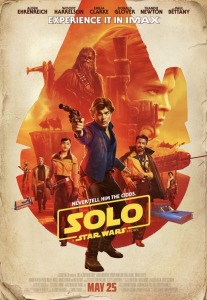 The notorious back-story behind Solo: A Star Wars Story has more than eclipsed whatever else this “young Han Solo” prequel appeared to offer. Directors Phil Lord and Chris Miller were responsible for a string of fast-paced, silly hits like The Lego Movie and the 21 Jump Street films, and when producer Kathleen Kennedy hired them, it felt like an inspired infusion of new blood to make a Star Wars movie different in tone and approach. Five months into shooting and mere weeks away from completing photography, Miller and Lord were fired. The on-set rumors and sources have relayed a badly conceived marriage between the directors, given to improv and irreverence, and Kennedy’s sense of what a Star Wars movie should include. Enter Ron Howard, no stranger to the world of George Lucas, and an extensive battalion of reshoots, and you’re left with Solo, which only lists Howard as director. With that as its genesis, it feels like this movie should be a train wreck. It’s not that. Instead, Solo is fitfully entertaining but underwhelming diversion weighed down by its untapped potential.
Years before that noisy Mos Eisley cantina, Han Solo (Alden Ehrenreich) is a low-level criminal trying to find a better life. He loses his girl, Qi’ra (Emilia Clarke), joins the Imperial Army, and defects, finding a partner in a big hairy wookie named Chewbacca (Joonas Suatamo). The two of them join a crew of thieves run by Beckett (Woody Harrelson), and after a job gone wrong, everyone is in grave danger and deep debt to the crime lord Dryden Vos (Paul Bettany). The crew must even the score and make things right, and they must navigate unreliable allies like Lando Calrissian (Donald Glover), his trusted robotic assistant L3-37 (Phoebe Waller-Bridge), and, most surprisingly, Qui’ra herself, working as one of Vos’ top criminal consultants.
 Solo is hard to justify except as an increasingly tedious appeasement to the greater altar of fan service. The movie reminded me of those young author biopics like Finding Neverland where everything is given the unspoken-though-heavily implied significance of dramatic irony, where the audience knows, “Oh, this will be where that comes from, or that’s the first time that happened, etc.” Solo provides further light on the Star Wars minutia that only a scant few will work up real excitement over. For every interesting revelation, like Han and Chewbacca first meeting and bonding, there are numerous others that could best be characterized as cataloging the story of Who Gives a Crap?: The Movie. Who cares how Han got his dice? On that note, did I just not remember this trinket being as heavily showcased in the original trilogy as these new films emphasize? Also, who cares about how Han gets the Millennium Falcon? Who cares how Han got into the smuggling business? Who cares why Han was on Tatooine to begin with? The film expects audiences to supply the significance for scenes that lack that on their own. Too much of the script by Lawerence and Jonathan Kasdan (In the Land of Women) coasts along on audience good will carried over from the original trilogy.
As far as being a heist movie, Solo doesn’t put much concentrated thought with its heist set pieces. Much of the plot hinges on a “job” to recover a large amount of fuel owed to the scary crime boss, so the job itself should be treated as important. Once topside, the characters stick to their ruse for about five minutes and things immediately go bad and then it’s just one messy, ongoing action sequence. I could understand carefully planning a scheme only for it to unexpectedly go wrong, but the appeal of heists are their intricacy, development, and complications, and Solo sadly snuffs this appeal out. The high-point of the film is an early Act Two heist that’s the sci-fi equivalent of a train robbery. Things start off promising with the space craft being able to rotate around its rail, which tickles the imagination for plenty of dire hangings on. We even get a few preparatory words for the plan, though even those are fairly general. And then things start and they immediately go bad and stay that way without satisfying complication. Part of the appeal of heists is seeing the curve balls, the unexpected complications, and how our team reacts and recovers. It’s a fun sequence with some thrilling visuals but it never rises beyond the sum of its action particulars, and so an important set piece is held back from going for greatness. The action throughout Solo is serviceable but rarely does it feel like what’s onscreen is the best version of what it could have been. Serviceable, sure.
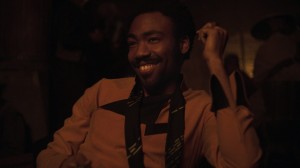 Which brings about the inevitable analysis over what can be gleaned from the final product that traces back to its original team of directors. There are a handful of comic asides that feel like the lasting touch of Miller and Lord. Beyond that, Solo feels very much like Howard’s movie, though much like Rogue One, the mind conjures the possibilities of the original version. One of the biggest changes is that Howard added Bettany’s gangster character. He’s on screen for really two sequences though his importance stretches over the entire film. Solo feels cohesively like one movie to the degree that if you had never heard about the headline-grabbing production tumult, you wouldn’t suspect anything had happened behind-the-scenes. However, the lasting impact seems deeper, namely that many of these sequences feel, to some degree, interchangeable by design. The execution and development feel lacking. It’s a lingering feeling that what you’ve been watching isn’t fully coming together. It’s not fully engaging the attention and making the most of its beloved characters. It feels less like a seminal moment in the story of Han, Chewie, and Lando and more like an extended episode of a television series. I was too detached and grew restless too often. I started waiting for it to be over rather than waiting to see what happened next.
Ehrenreich showed enormous promise with 2016’s Hail, Caesar! both with comedy chops and leading man appeal, so he seemed like a capable choice for a young Han Solo. After rumors of having to hire an emergency acting coach on set, I was expecting a poor performance. He’s decent, grinning through the indignities, stumbling along with a sardonic sensibility that still plays into a confident sense of optimism against the odds. Ehrenreich, much like most of the movie, is perfectly fine, entertaining at times, but far too often a passing blip. The real star of the movie is Glover (TV’s Atlanta) who is brimming with charisma. Plus Lando’s suave, pansexual nature and tendency toward shady scheming lends itself to a more fascinating glimpse at a character we know decidedly less about.
 Clarke (HBO’s Game of Thrones) is saddled with a non-starter of a storyline as the old girlfriend who got away. Harrelson (Three Billboards) plays another cranky father figure role. Bettany (Avengers: Infinity War) is generally wasted as a villain lacking a stronger sense of identity or menace. His weapons of choice, two laser-edged knives, seem like where the depth of character creation ended with him. Oh, he also has scars over his face, so that’s about the same as a personality. The lone supporting player that leaves an impression is Waller-Bridge (Fleabag) as the android, L3-37. I could have used an entire movie with her and Lando. She becomes a political revolutionary by accident over the mistreatment of droids, and L3-37 does what the other supporting characters, and even what Ehrenreich to some extent, do not — leave you wanting more.
After its problematic history, it would be easy to look for ways to carve up Solo as a hodgepodge creation of studio interference but that’s too tidy an explanation. I’m not against the idea of a “young Han Solo” film franchise, though it needs to find the right stories to shed new and meaningful light on this classic rogue. Han Solo was, like, mid thirties at the oldest in 1977’s Star Wars and Ehrenreich’s early-to-mid 20s version doesn’t afford a great many differences (he was already a “young” character to start with). If you’ve bought into the Star Wars universe, there should be enough to at least be entertained by, and if you’re a nascent fan, then Solo might be an easily digestible fun adventure. The mitigated or underdeveloped potential nagged at me as I was watching. It’s got aliens and space heists and most of the time I was approaching boredom. I’ll label the movie with its own Scarlet F: it’s… “fine.” It’s the kind of movie you shrug your shoulders at afterwards, not necessarily regretting the experience but moving along. Perhaps we’re just at a natural point in the post-Disney-purchase of Star Wars, and now we’re facing less-than-ideal time-discharged product. I was hoping for more, either good or bad, but had to settle for a relatively lackluster prequel. I don’t know if there will be further escapades with the “young” Han Solo but I wish they choose them more wisely. Even the title feels bland.
Nate’s Grade: C+
Share this:

Going in Style (2017)
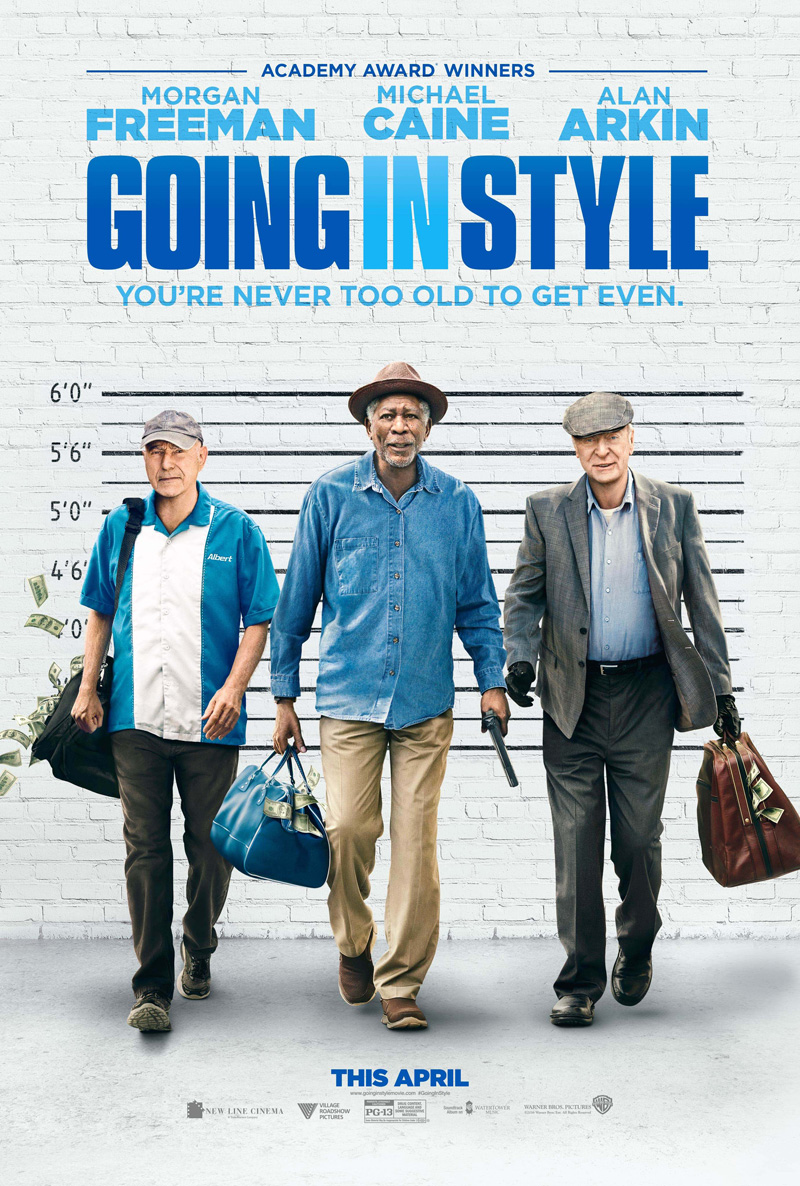 If seeing Michael Caine, Morgan Freeman, and Alan Arkin pal around and bicker for 90 minutes is enough reason to see a movie, then Going in Style offers that and precious little else. This is a movie that offers little more than three great old codgers doing their schtick as they plan to rob the bank that is cheating them out of their hard-earned pensions. The old-guys-acting-up routines vary from mildly amusing to sad and desperate, like a sequence where the trio inexplicably decide to practice their criminal impulses by robbing a convenience store. It’s all so broad and obvious and lackluster. There’s a scene where they get high and the mere utterance of the word “munchies” seems like it’s intended to be a comedic payoff. Going in Style is a remake of a 1979 movie where George Burns, Art Carney, and Lee Strasberg take to a life of crime to animate them from a forgotten existence. It was strangely serious and had pockets of depth about the kind of care the elderly were receiving and how invisible their needs became to our country. This update loses any seriousness for exasperated and hollow hijinks. One-time indie darling Zach Braff (Garden State) takes his turn as a hired gun directing for the studio system. I don’t know if he was easily cowed by the acting veterans or the studio, but his comedy instincts honed over several seasons from Scrubs feel muted here. My theater was packed with people old enough to get their social security checks and they were barely chuckling politely. It’s predictable every step of the way and ginned up with contrived conflicts. Still, if all you want to see is a group of octogenarians crack wise and act foolish and you have no other pressing demands, Going in Style may be just enough to get by.
Nate’s Grade: C
Share this:

Now You See Me 2 (2016)
 The first Now You See Me was a pleasant surprise that took a simple concept (magician heist) and injected enough sly fun, style, and humor and made a memorable action thriller. As success demands, a sequel was commanded, but I had hopes considering the blueprint of its success could be repeated because those core elements were strong. We all love heist movies, we all love to be fooled, we all love to watch a smart people befuddle those in power, and the reveals made it even more enjoyable. I wasn’t expecting Now You See Me 2 to drop much of what made the first film appealing and shamble through its set pieces with a disinterested sense of sequel duty. The magic is gone.
The Four Horsemen magic act (Jessie Eisenberg, Woody Harrelson, Dave Franco, Lizzy Caplan) has made quite a few enemies. They’re a group that attacks the fraud, exploitation, and greed of those rich and powerful who feel untouchable. This merry band of Robin Hoods is transported against their will to Macau, China by Walter Mabry (Daniel Radcliffe). Walter lost a lot of money from the Horsemen’s antics in the first film and demands they steal a super microchip that will allow him to erase his identity and stay private permanently. Meanwhile, the Horsemen’s handler, Agent Dylan Rhodes (Mark Ruffalo), is blackmailed by famous and currently incarcerated Thaddeus Bradley (Morgan Freeman). Bradley has a score to settle with the Horsemen and uses Rhodes to escape from prison. All forces are headed to Macau and much more will be learned of the Horsemen’s behind-the-scene organization, The Eye.
 It feels like the filmmakers aren’t even trying to keep one foot in reality this time. It’s not like the first Now You See Me was a deeply grounded movie but it took pains to at least offer varying explanations for how these illusions were accomplished. Some of the answers were clever and some were preposterous, but at least they tried to show you their work, which made the Horsemen even cleverer, in my book. Understanding the preparation for the illusions and the execution of them adds to their impressive aura. The characters in the sequel don’t even attempt to explain the far majority of their tricks, and it’s simply not as fun. The opening job is a fun refresher because we see the different characters working together but also because we can see how they’re getting away with their shenanigans. As the movie continues, those magic acts get bigger and bigger and more ludicrous and harder to explain and then the movie just stops trying to explain. At this point magic might as well be real and the Horsemen are wizards. There’s suspension of belief and then there’s simply obliterating all connections to reality. When Eisenberg can control the direction of rain itself without any explanation, it cheapens the thrill. Because if there isn’t some level of limitations, requiring the tricks to be based in reality, then the on screen efforts lose their appeal because it doesn’t matter. It’s like haphazardly just writing, “The Horsemen do some magic junk and get away.” It’s just not as satisfying when it feels like the trick is ultimately on the audience.
Another complaint I have is that the scattered script seems littered with missed opportunities. One of the bigger misses that comes to mind is Harrelson’s twin brother, an obvious Matthew McConaughey impression from his True Detective costar. The character isn’t nearly as funny as Harrelson or the producers believe. He isn’t particularly memorable or necessary to the plot at all, but that’s not even his biggest offense. In a movie about magicians playing sleight-of-hand trickery, how in the world do we not have a switcheroo with the twins? That would justify his existence for the plot. I was shocked this never happened because it seemed so obvious. Why is he a twin? What does being a brother to Harrelson have to do with anything related to the plot? The script also gets overcrowded with antagonists, introducing Radcliffe and then bringing back Michael Caine and Morgan Freeman. The characters don’t so much compete with one another as they operate in separate spheres until a “twist” reveals more about their connections. Their agendas are too opaque. Radcliffe wants them to steal a super microchip so he can fully be “off the grid.” A man of his means shouldn’t have a problem with this. It’s not like he’s hiding out from the law for some kind of corporate espionage. It’s a convoluted reason to bring the Horsemen to his hiding spot in Macau. It’s just one in a long line of ideas that never feel fully developed. Even the magic set pieces don’t feel as fun. Seriously, one of the climactic magic set pieces is a human game of three-card Monty.
 Director John M. Chu (G.I. Joe: Retaliation, Jem and the Holograms) has worked with action before and certainly knows his way around choreography, but he feels too hesitant this time. The action scenes are rare and the chase sequences are muted. Outside of the tricks, there isn’t a standout action scene in the whole movie. In the first film we had a pretty fun magic fight that was wild and surprising and loaded with small payoffs. In this movie we have a motorcycle chase that plays out as expected. We have a foot chase that plays out as expected. You have professional illusionists at your disposal; action set pieces should not play out as expected. The most fun sequence is fairly straightforward but easily the best developed, and that’s the Mission: Impossible-esque heist of the microchip that is outfitted onto a playing card. It’s also clearly the most visually inventive sequence as the Horsemen play a game of keep away and the camera literally at times tumbles into their clothes. I think what makes this easily the best sequence in the movie is because it’s moderately grounded, the stakes are explained, and the audience is in on the trick, enjoying all the flimflam obfuscation. It also means when there are complications to the plan the sequence generates suspense. When you don’t know what’s going on and don’t know when things are going wrong, or how they could go wrong, it’s hard to generate genuine suspense. Being involved in the action is much more fun.
The actors all seem on autopilot, falling back to the broader descriptions for their characters. Eisenberg is a smug and cocky. Harrelson is smooth and shrewd. Franco is awkward and insecure. Isla Fisher is replaced by the capable Lizzy Caplan (TV’s Masters of Sex) as the requisite Female Horsemen. She makes a good impression but part of it is that Capaln seems to be the only member allowed to be comedic. It feels like there are three straight guys to her comedy cut-up. She’s good but without variation it also starts to lose its appeal when only one character seems to be trying. Ruffalo (Spotlight) seems too often unrelated the Horsemen story as he discovers more info about his father. He’s the only character that actually has something of a storyline, though his playing of both sides and attempts to hide his role to the FBI is just another ludicrous element. I miss Melanie Laurent too.
Now You See Me 2 (how could this not be called Now You Don’t?) is a lackluster sequel that seems to have forgotten what made the first film the enjoyable caper that it was.
Nate’s Grade: C+
Share this:

The Big Short (2015)
 Adam McKay is not exactly the kind of name you associate with a prestige picture that’s building serious Oscar heat. McKay is best known as the director and co-writer of Will Ferrell’s best movies, from Anchorman and its sequel to Talladega Nights and the underrated 2010 buddy cop movie, The Other Guys. If you stuck through the closing credits for Guys, you were treated to an animated education lesson on the size of Wall Street’s greed and accountability in regards to the 2008 financial crisis. It was impassioned, angry, and an interesting note to end an otherwise goofy comedy. The Big Short is based upon Michael Lewis’ (Moneyball) best-selling book and it’s a disaster movie where the biggest disaster is the world economy. The movie McKay co-adapted and directed is bristling with intelligence, indignation, and a clear purpose. He wants to make you very angry, and by the end if you’re not, you haven’t been paying enough attention.
In the wake of the financial collapse in 2008, the fallout was so tremendous that many people felt nobody could have seen this coming. There were a few and they made out like bandits while trying to warn others about the impending doom. In the early 2000s, Michael Burry (Christian Bale) is a hedgefund manager who sees warning signs that the housing market is a bubble ready to burst. He sees the toxicity of the majority sub-prime mortgages wrapped together and sold as a seemingly safe security, a CDO (collateralized debt obligation). His bosses think he’s mad and they’re furious when they discover Burry has gone from bank to bank making big bets against the housing market. The banks are eager to take what they believe to be easy money from a sucker. How could the housing market burst? Other Wall Street investors take notice of Burry, notably Jared Vennett (Ryan Gosling) who pitches the plan to “short” the housing market. Nobody takes him seriously except Mark Baum (Steve Carell) and his small team who works for Goldman Sachs. Baum is curious how something so large could go unnoticed, so he and his team fly to Florida and Vegas to investigate the realities of the market and what they find does not match the rosy cheerleading from Wall Street. A pair of wannabe traders (Finn Witrock, John Magaro) stumbles across Burry’s analysis and try to make their own bets, except they need a bigger name to make the trades. They reach out to an ex-Wall Street trader (Brad Pitt) who agrees to shepherd them on this quixotic quest. Are these men righteous defenders of fraud or just people trying to get their own cut of the pie?
 The brilliance of The Big Short lies in its accessibility and the virulent passion that McKay has for the subject matter. The movie is structured like a heist and an underdog story, suckering in the audience to root for the upstarts trying to fleece the big banks and profit off their greed and stupidity. For the first 90 minutes or so, the film comes across like a caper and we follow our group of misfits as they fight against the conventional wisdom that the housing market could never topple. These guys see the signs and the risks that others could not or would not see, especially since the flow of money was rich and the good times could be shared, which lead to collusion from the very same agencies designed to regulate and enforce the financial laws. For those 90 minutes the movie flies by on its sense of whimsy and are-we-getting-away-with-this good fortune, putting our band of misfits in position to win big on the losses of the ignorant and fraudulent. And then, in one swift move, it all comes down and you’re reminded, rather indignantly by Pitt’s character, that what they are benefiting from is the meltdown of the U.S. housing market and by extension the American economy. What once felt like a celebratory caper now starts to feel queasy, and it’s in the last act that The Big Short reminds you just how awful the events of the 2008 financial crisis were and how these guys did nothing more than benefit from mass misery. These are not heroes, though Mark Baum is given plenty of moral grandstanding moments that present him as the closest thing we have in the picture. These were a bunch of guys who got rich betting on a lot of other people’s bad bets, bets that almost destroyed the world’s economic systems. The concluding half hour feels like a sudden stop after a sugar rush, where you’re left to question your decision-making but also come to terms with the reality of what seemed like a fun time. McKay lures his audience in with the guise of a heist/underdog story, appealing and accessible avenues of cinema, and then serves the cold hard medicine in the concluding moments.
McKay is admirably trying to educate and advocate while he entertains, but he truly wants the audience to understand why they should be sharpening their pitchforks. At several points, characters will break the fourth wall and talk directly into the camera, admitting that certain events didn’t happen exactly as we saw, or occasionally they’ll remind us that what we watched was exactly how it happened. It’s a measure that isn’t overplayed and helps juice the spirits of the movie, becoming something of a confidant in the schemes with the onscreen participants. When things gets a little hard to understand with the mountain of Wall Street lingo, McKay will cut to celebrity cameos to help explain the more arcane instruments of the financial system. Margot Robbie luxuriates in a bubble bath and explains sub-prime mortgages, Anthony Bourdain explains CDOs, and Selena Gomez, in a rather cogent analogy, explains synthetic CDOs as an endless chain of side bets being made off one hand of blackjack. The movie goes pretty fast and a viewer might experience information overload but McKay knows when to slow things down and provide a well-timed assist so that his learned audience will see the true extent of the corruption and greed rampant in how Wall Street handled its business.
 Of the three storylines, I found Mark Baum and his team easily the most interesting and I think McKay and co-screenwriter Charles Randolph (The Interpreter) agreed, which is why he’s the biggest part of the movie. Burry gets things started but he recedes into the background after the first act, and that’s where Baum and his financial team step into the spotlight to further explore how unstable the housing market just might be. I think this is Carell’s best dramatic performance to date (I wasn’t wowed by Foxcatcher). He’s playing perhaps one of the angriest people seen on screen but that’s because he has a moral center and the bad business practices, let alone the sociopathic greed of his “peers,” constantly enrage him. He’s something like a flabbergasted crusading journalist who keeps shaking his head in stupefying revulsion at just how deep this whole thing goes. Having Baum as our entry into the moral morass of Wall Street allows the audience to feel a sense of ethical superiority, and then like Pitt’s character, it can all go away with one perfectly articulated retort. There’s a moment where Baum is lambasting a mortgage ratings officer (Melissa Leo, her only scene too) after she admits that if they don’t rate bad mortgages as good, the banks will just go to their competitor, and then she accuses Baum of being a hypocrite. His reason for the office visit is not his outrage at the fraud but the fact that this fraud is holding up his winnings. He’s not the crusader he may wish to be. Bale (American Hustle) and Gosling (Only God Forgives) are perfectly cast and provide strong supporting work in small doses spread throughout. Pitt is in 12 Years a Slave producer mode where he knows he needs to appear in the movie to better sell it to audiences, and so he’s here and rather unremarkable. There is a bevy of familiar faces (Marisa Tomei, Rafe Spall, Max Greenfield, Karen Gillan) appearing in small moments as if everybody in Hollywood wanted to get in on McKay’s party.
There is one annoying misstep in the movie and it occurs about halfway and it’s made to stretch out the stakes in a haphazard manner. The Big Short is a disaster movie where the audience knows exactly when the disaster is coming, and yet there’s a section in the middle where the characters are all left in doubt whether their big bets will pay off because of the ratings fraud. Burry is threatened with losing his job. It’s silly because we know the economy is going to crash in 2008, but the movie throws out a weak obstacle that, hey, maybe it won’t crash. It reminds me of the Hinderberg movie from the 1970s. There were several moments where it looked like that zeppelin full of hydrogen was going to go up in flames… except students of history know that moment is fated in New Jersey, so all the close calls were foolish fake-outs for a major event that was well anticipated. We all know the economy is going down so there’s no need for the manufactured doubts.
McKay and company want to wake up a fairly apathetic general public about the crimes and negligence of the Wall Street robber barons that risked the world’s economy and then managed to skip out on the tab. The tones can juggle wildly, and I’d credit McKay’s background in comedy for his ability to maintain a reliable and firm comic footing for the film without losing the significance of his message. It’s hard to nail down a genre for the movie; it’s a dark comedy, a drama, a true crime picture, and a wake-up call. You have moments that feel like a heist flick and moments that feel like a sickening journalistic expose. It’s got highs, lows, laughs, groans, and plenty of human emotions, though the most prominent would be disgust and disbelief. The Big Short is advocacy populism as pop-entertainment, and it succeeds ably. It’s an economics lesson for the public. At the end of the movie, the closing text informs us about “bespoke tranches,” which are investment opportunities that banks are flocking to ($5 billion in 2013 to $20 billion in 2014). It’s just another name for CDOs. Unless an informed public demands action from the system, it seems that Wall Street is doomed to repeat its same high-risk mistakes and that same vulnerable public is doomed to clean up the mess.
Nate’s Grade: A-
Share this:

Ant-Man (2015)
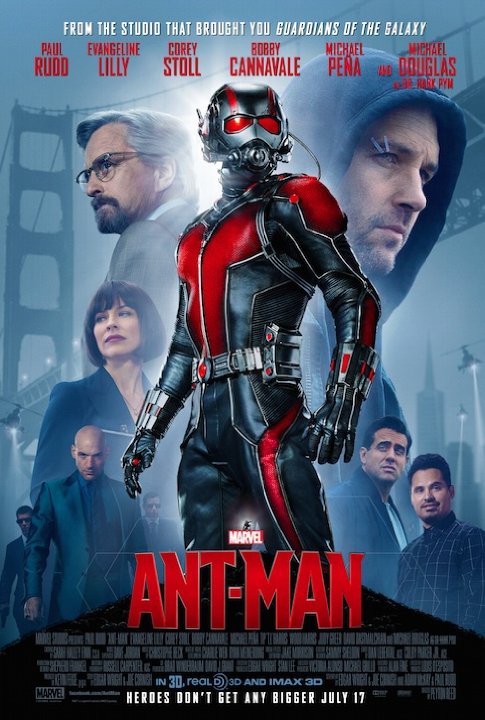 For the longest time it looked like Ant-Man might be the first dud of the runaway successful Marvel cinematic universe (MCU), a film franchise that was practically printing money at its leisure. It’s a strange setup and the man responsible for the movie even existing, writer/director Edgar Wright (Scott Pilgrim vs. the World), walked away six weeks before cameras were going to roll. Wright was a big fan of the character and has been working on and off on a screenplay with Joe Cornish (Attack the Block) for the past eight years. Before there was an MCU, there was Wright pushing for Ant-Man. I’m pretty sure Marvel execs weren’t thinking the relatively unknown character was worth sinking money into, but Wright kept pushing. I was far more excited for an Edgar Wright superhero movie than I ever was for Ant-Man, and then it all went away. Neither side has spilled too many details but it appears the divorce was a result of “creative differences,” which is odd since Marvel approved Wright’s script through eight years of development. Several directors were auditioned and Peyton Reed won the spot. The fact that Marvel has gained a rep for being a formula-driven creative committee and they literally hired a director with a film credit called Yes Man is an irony I don’t know that fully sank in. If Marvel was going to miss, this was the film. A funny thing happened in the ensuring year. Ant-Man is a visually engaging, energetic, and funny superhero caper that stays fun from start to finish and is a more entertaining movie than Avengers: Age of Ultron. Didn’t see that coming.
Scott Lang (Paul Rudd) is a master cat burglar just finishing the end of his prison term. Lang was punished for a “cool crime,” stealing millions a large corporation had illegally bilked form customers and returning it to the very victims, but it makes it hard to secure gainful employment. Scott falls back with his old crew, lead by his pal Luis (Michael Pena), and break’s into Hank Pym’s (Michael Douglas) safe. Expecting cash and jewels, Scott is disappointed to only find a weird looking suit, which he takes anyway. Hank observes Scott and communicates with him about the power of the suit. The wearer can shrink down to the size of n ant with the push of a button in the glove. Hank needs a protégée to wear the suit now that he’s too old. His estranged daughter, Hope (Evangeline Lilly), is working for Darren Cross (Corey Stoll), a scientist close to breaking through on replicating the amazing shrinking formula of Pym’s. As soon as Cross cracks the code, he’s going to sell the technology to the highest bidder (hail HYDRA). Hank must convince Scott to become the Ant-Man and sneak inside Cross’ secured workshop and steal his technology before it gets in the wrong-er hands.
 Arguably weirder than last summer’s Guardians of the Galaxy, which had a talking tree and space raccoon amongst its main characters, Ant-Man is the hardest property to sell by Marvel yet, and it smartly aims its sights lower and succeeds with the modest goal of just being a fun and enjoyable time at the movies. It helps that the movie doesn’t take itself too seriously and has characters pointing out the absurdity of its premise and developments, but not past the point where it would be detrimental. Let’s face it, a guy who can shrink down to ant-size isn’t that weird when you consider the applications, especially in espionage. The filmmakers do an admirable job of selling a superpower that pales in comparison to most other heroes on the market. However, the weirder power is that Scott has the ability to communicate and control ants via brainwaves. That seems like the even bigger superpower but it also begs the question, why simply ants? Of all the animals or living creatures who could be harnessed with this technology, we go with the tiny ones. There may be an explanation in the history of Ant-Man comics I’m missing but that doesn’t matter when we’re talking about the execution of the movie. The guy is able to control different species of ants with his mind. He is no Ant-Man but the Ant-King. Anyway, I think this power could be much more effective applied elsewhere. The ants are Scott’s friends and he has to train himself training them, getting them to coordinate and assist him properly, or else… there’s not much else at stake because they’re expendable. Perhaps their queen could have eaten Scott if he were unsuccessful.
On its surface, this movie should not work and is too goofy and insubstantial to engage, and yet that’s precisely what appealed to me. Not every superhero film needs to be averting a cataclysm that will destroy the planet. If the stakes feel big to our characters, and if the audience cares, then the stakes feel plenty big for us too. Scott simply foiling the corporate bad guy to be in a better position to see his daughter, that’s workable. Then the storyline is told through a heist, one of cinema’s most enjoyable plot mechanics. Heists are programmed for audience pleasure because it requires teamwork, which utilizes our cast in different and fun ways, it brings plenty of conflict and complications, and it lays out its steps one-by-one and provides a series of payoffs with the completion. It’s a tribute to Reed and the filmmakers that the heist portion of the film isn’t even the most fun part of the story. The majority of the middle is Scott coming to terms with the suit, his powers, his relationships in his life, and the mission. There’s probably one too many training montages (yeah, you get those sugar cubes you ants!) but the pacing is so breezy and the sense of fun so palpable, I didn’t mind. The use of humor never diminishes and Rudd is such a charismatic anchor for the movie, and yet he’s actually somewhat underplayed. He has it within him to be much funnier, but I guess he had to dial it down to effectively be seen as an action hero, hence the presence of newfound abs.
I didn’t have a lot of hope for the film once Wright left but I have to credit Reed for what he has achieved. It’s impossible for me to divorce myself from Wright’s involvement, and what kind of kinetic fireworks he would have birthed, but Reed manages to make Ant-Man come alive visually. Reed’s prior history shows an affinity for comedy but the films have never needed to be visually stylish, though I’d argue my super not-guilty pleasure Bring it On had an above average sense of visual spunk. Still, Ant-Man is a consistently visually immersive film that manages to find new perspectives. Scott’s first foray as a shrunken Ant-Man is an entertaining adventure through the dangers of a house party. The action sequences in miniature are treated just as we would expect a large-scale superhero epic to be treated, and then Reed pulls back at times for prime comic effect, like a battle atop a train that’s really just a child’s toy set. The visuals grandeur is patterned after the typical Hollywood action epic but the movie pulls back repeatedly to remind us how silly everything can be. The small world perspective opens up the movie in its storytelling and definitely in its action choreography. Because the Ant-Man has super strength when small, it behooves him to shift between small and human sizes when fighting. We’ll watch Scott race across the barrel of a gun in one second and then full-sized and hurling a security guard through a plate glass window the next. It provides a new sense of dynamism to basic fisticuffs. Reed takes advantage of the visual possibilities of his pint-sized super hero, like a clever battle that takes place entirely inside the contents of a briefcase. I chose not to watch this film in 3D, as my preferred option, but this is one I would almost consider going 3D. The shrunken worlds use a lot of macro photography to maximize the effect of depth.
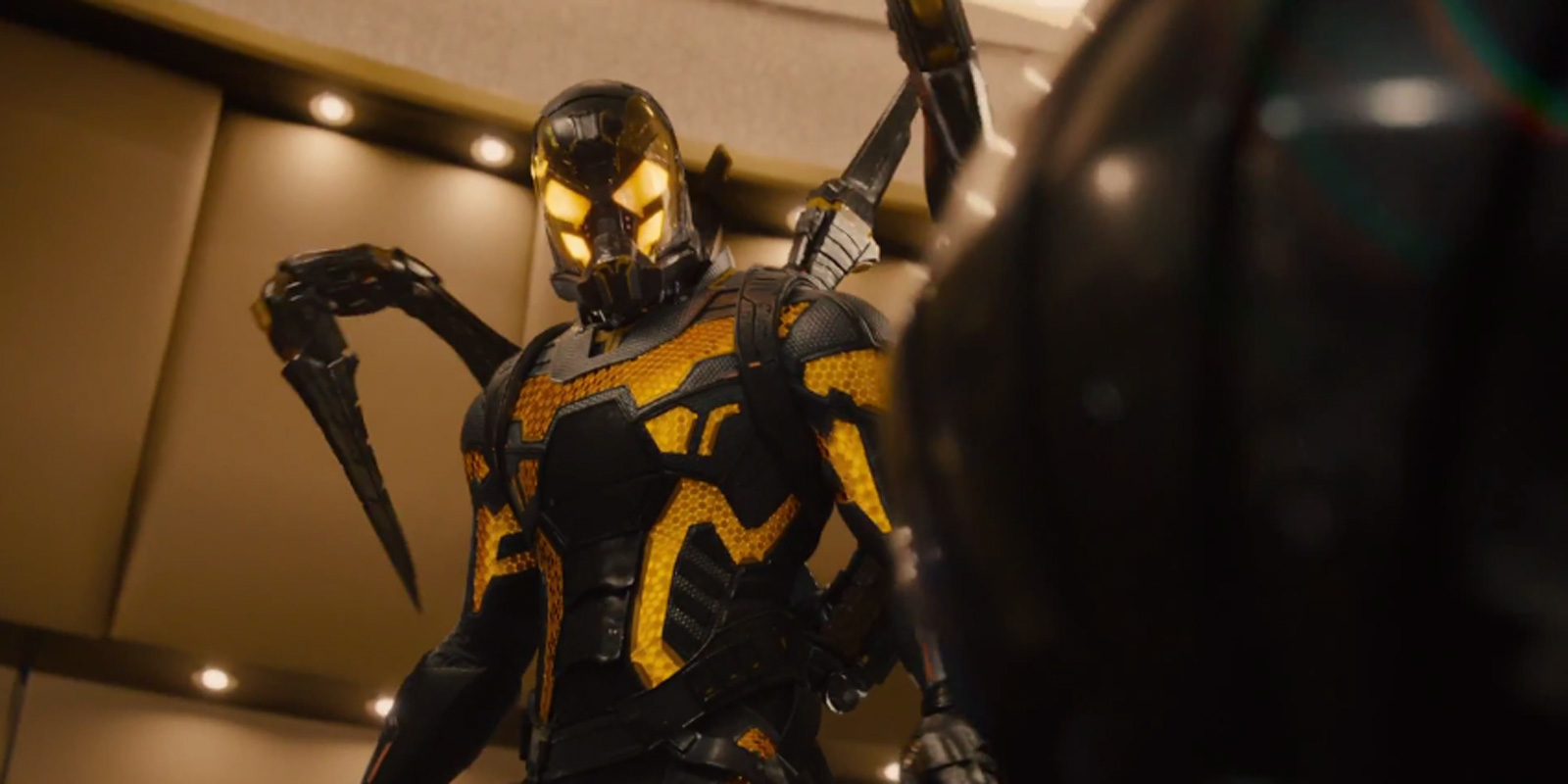 The cast also seems to be perfectly attuned to the comic rhythms of the story and several supporting players make the most of their moments to shine. Pena (Fury) is hilarious as the easily excitable friend given to lengthy diversions when retelling his tales of intrigue. The two instances where Pena breathlessly recaps what so-and-so said to so-and-so are two of the most playful and comically fulfilling sequences in the movie. I also enjoyed the fact that he’s always making waffles for his friends but this is never overtly commented upon. While Pena provides another dose of humor, the heart of the movie is really the father-daughter relationship, and it’s nice that Lilly (The Hobbit: Battle of the Five Armies)’s character is given such prominence. She resents Scott because she feels like by every right she should be the Ant-Man; the movie presents the two like bickering rivals fighting for the approval of a father figure. Hope’s credible grievances with her father are treated with weight and her reconciliation is given as much screen time as Scott’s training, pairing the two more as equals. Douglas (Last Vegas) is a warm and welcoming presence as a mentor working through his regrets late in his life. The de-aging CGI effects are amazing early on, showing a 1989 version of Douglas that looks pristine. He looks like he just stepped off the set of Ruthless People. The only weak point is Stoll (TV’s The Strain) but that’s because his underwritten villain is just too generic to blend in amidst all the colorful characters and comic mayhem.
It’s impossible to watch Ant-Man and not try to imagine what it would have been like had Wright remained as its director. Wright’s presence is still felt in stretches and he and Cornish are still the top-billed screenwriters, with the addition of Adam McKay (Anchorman) and Rudd himself performing a rewrite. I’d love to one day read what Wright’s full script was like and what Marvel eventually decided they could not abide. Whatever the case may be, the Ant-Man that made it to the big screen across the world is a surprisingly entertaining and spry piece of work. Reed provides a nice dash of visual flavor without losing its sense of the comedy or drama, Rudd is effortlessly charming, and the structure provides plenty of payoffs. Above all else the movie maintains a sense of fun and a lightness in an arena too often overwrought with doom and gloom. I don’t imagine there will be any Ant-Man sequels soon since the character is rather limited, but expect to see Rudd popping up in other MCU titles (he’s already been spotted filming Captain America 3). Ant-Man is a fun diversion but even Marvel knows not to push its luck too far.
Nate’s Grade: B
Share this:

Muppets Most Wanted (2014)
 The Muppets are back, though their new film seems to vaguely be recreating the amusing if somewhat slight Great Muppet Caper. The same blend of Muppet-staple sweet goofiness and anarchy is still a pleasure to watch, causing me to laugh throughout; it’s just that there are more leaden stretches between the laughs. The side stories have more interest and humor than the main storyline where Kermit has been replaced by a nefarious Russian doppelganger. Ricky Gervais is wasted as a criminal sidekick and he doesn’t bring much energy to the film. Fortunately Tina Fey, as a gulag prison guard, and Ty Burrell, as a Pink Panther-like Interpol agent, rise to the occasion. Burrel, teamed up with Sam the Eagle, made the movie for me. Their comic interplay and rivalry is the best and gives way to the best use of sight gags. It’s an amusing and agreeable film but there’s a noticeable spirit missing, possibly from the departure of living Muppet Jason Segel as an actor and a co-writer. I was shocked that Bret McKenzie, who won an Oscar for the 2011 movie, was the same man behind these new tunes. With the exception of maybe two songs, the remaining majority of the songs are downright dreadful. Within minutes of leaving my theater I could not for the life of me remember one of the tunes. The celebrity cameos are also less fun, many poorly integrated into the film, just the actors appearing and then vanishing. James McAvoy just walks onscreen to deliver a package. Is that the best use of everyone’s time? Still, while a noticeable step down from 2011’s The Muppets, the movie still has enough of the Muppet charm and silliness to entertain. It’s just missing some of the magic that made their return so special.
Nate’s Grade: B
Share this:

The Monuments Men (2014)
 An all-star cast, a true-life tale that incorporates a treasure hunt, a race against time, Nazis, and fish-out-of-water tropes as non-soldiers are placed in harm’s way, plus the skills of George Clooney behind the camera; in short, how could this go wrong? With that plot makeup and this cast it would take more effort to tell a boring big screen adventure of the real-life Monuments Men (and women). And yet, the movie found a way. It’s by no means a bad film and its heart is in the right place, but allow me to explain why The Monuments Men sadly fails to live up to its mission.
It’s 1944 and Adolf Hitler doesn’t just have his sights on constructing a permanent empire, he wants all the world’s art treasures as well. The Nazis have been plundering famous works of art, and while the war is coming to a close with the Allied invasion, the fate of these priceless works of art may be in jeopardy. Frank Stokes (Clooney) is tasked with putting together a team to save Europe’s art from the Nazis. He puts together an unconventional group of soldiers (Matt Damon, John Goodman, Bill Murray, Bob Balaban, Jean Dujardin, Hugh Bonneville) and search for the hidden loot.
 The film looks like it’s going to be a high-concept heist film when it reality it’s a series of vignettes that do not add up to a solid whole. Early on, the Monuments Men team is scattered to the wind, divided into pairs, and so we have four or five competing storylines that don’t develop as desired. To be fair, there are some very good scenes, well executed and written by Clooney and Grant Heslov (The Men Who Stare at Goats) where the conflict is turned up, but the film cannot escape the fact that it feels more like a series of scenes than a cohesive story. Not all of the stories are equal in their interest as well. The Cate Blanchett (Blue Jasmine) and Damon storyline in France amounts to little else than her stalling for as long as the plot necessitates, then handing over the Very Important Info, then she’s swept aside. The comical asides, notably with Murray and Balaban, feel like scene fillers when there could be stronger material. Once they’re reunited as a group, you wonder why we even needed the time apart. Perhaps it’s an attempt to showcase a wider sampling of stories and perspectives on a complicated war, which is fine, but the characters don’t get the same complicated examination. Despite physical descriptors, these guys are fairly one-note and stay that way, which is a real shame especially when we start losing Monuments Men. The attention is split amongst a bunch of characters lacking proper development. If I felt like we knew these guys on any substantive level, I would feel more at their untimely passing.
Another issue that exacerbates the directionless feeling pervading the film is that it lacks a clear and concise goal. I understand they’re saving and rescuing art, but that’s kept vague until the very end of the film when it becomes more concrete. Until then, the guys are just traveling from place to place, retrieving this piece or that, having comic misadventures, and the movie just feels like it needs a stronger guiding force to corral all these stories, a concise goal that each scene builds onto and where the urgency increases. Late in the film, I got a glimpse of exactly what kind of movie Monuments Men could have been. Once the war is over, the Germans are replaced as antagonists by the Russians (two-for-two with classic American movie villains) and it becomes a race against time to get to the art before the Russians confiscate it. There was always a ticking clock in the film, as Hitler was assembling his art and his command would destroy them in spite of returning them. However, in the very end of the film, the urgency is cranked up, made real, and for once the film emerges with a sense of suspense. I think it would have been a more engaging film experience if the scope of the film were narrowed simply to the material covered in the climax, namely beating the Russians to the art reserves. It practically has a Raiders of the Lost Ark feel with two parties trying to outrace the other to the next precious treasure. How cool would that movie have been?
 Another problem is the film’s seesaw tone never really gels together in a satisfying manner. The film awkwardly switches gears from drama to comedy to action without smooth transitions. Clooney wants his film to be a comical buddy comedy but also a poignant remembrance of the lives lost so that we can enjoy our great treasures. Clashing tones take away from the effectiveness, making us feel that Clooney didn’t feel confidant with either direction to make a movie. Alexander Desplat’s overbearing musical score instructs the audience what they should be feeling at any given moment. It vacillates without similar transitions informing you with little transparency that you should feel whimsical, now sad, and now heroic, now go back to whimsical. The entire film, from a story standpoint to a technical standpoint, cried out for a greater sense of unity.
Then there’s the question of whether art is worth people giving up their lives, and this is a valid question that deserves consideration. I was never in doubt what Clooney and company would say to this ethical query, but it’s as if Clooney has little faith in his own audience. He gives three separate speeches about the significance of art and culture and why it is worth dying for. I expected one hefty speech, but three? It’s like Clooney is afraid his audience will waver when blood starts to be shed, and so we need to be reminded by the professor why art is significant to mankind’s value. The point has been made; it doesn’t need to be belabored. The film even ends on recycling this debate, with Clooney putting one final stamp of judgment before the credits roll.
One gets the sense while watching The Monuments Men that it would make a better documentary than a fictional feature film, at least this incarnation of a fictional film. Hearing from the men who lived it will be far more interesting than watching the comic squabbles of Clooney’s crew through Europe. I was instantly reminded of an engrossing documentary from a few years ago called The Rape of Europa, which looked at the subject of saving the arts from Hitler, not specifically the Monuments Men. That documentary was filled with so many different fascinating stories, I remember thinking that any one of them could have made a stellar movie. Monuments Men is further proof that a sharper, more contained focus would be best rather than trying to tell as many war stories involved on the topic. Clooney has proven himself an excellent director and despite his film’s faults it’s still an entertaining film in spurts. I just think we all expected better given the pedigree of talent involved and the can’t-miss quality of the history.
Nate’s Grade: B-
Share this:

The Place Beyond the Pines (2013)
 Ambitious filmmaking is welcome, but usually ambition leads somewhere, which is the main problem with co-writer and director Derek Cianfrance’s unwieldy 140-minute multi-generational crime drama, The Place Beyond the Pines. First we watch Luke (Ryan Gosling) as a traveling motorcyclist enter a life of crime to support his infant son. Next the focus shifts to Avery (Bradley Cooper) as a cop with a conscience running into corruption on the force. Last, we jump ahead into the future and watch the dramatic irony unfold as the children of Avery and Luke interact, waiting for them to learn their paternal connection. I believe Cianfrance (Blue Valentine) and his team was attempting to tell a meditative, searching drama about children paying for the sins of their fathers, the lingering fallout of bad decisions and moral compromises. Except that’s not this film. By the end of the movie, while some secrets have been laid bare, there really aren’t any significant consequences. The film does an excellent job of maintaining a sense of dread, but it doesn’t come to anything larger or thought provoking. The entire structure of this film is geared toward a tragic accumulation, but it just doesn’t materialize. That’s a shame because it’s got great acting through and through, though I have grown weary of Gosling’s taciturn antihero routine that seems like a rut now. Avery’s portion of the plot was the most interesting and anxiety-inducing, but I found the movie interesting at every turn. The characters are given pockets of nuance and ambiguity as they traverse similar paths of desperation and conciliation. The Place Beyond the Pines is a perfectly good movie, albeit disjointed, that cannot amount to the larger thematic impact it yearns for.
Nate’s Grade: B-
Share this:

Now You See Me (2013)
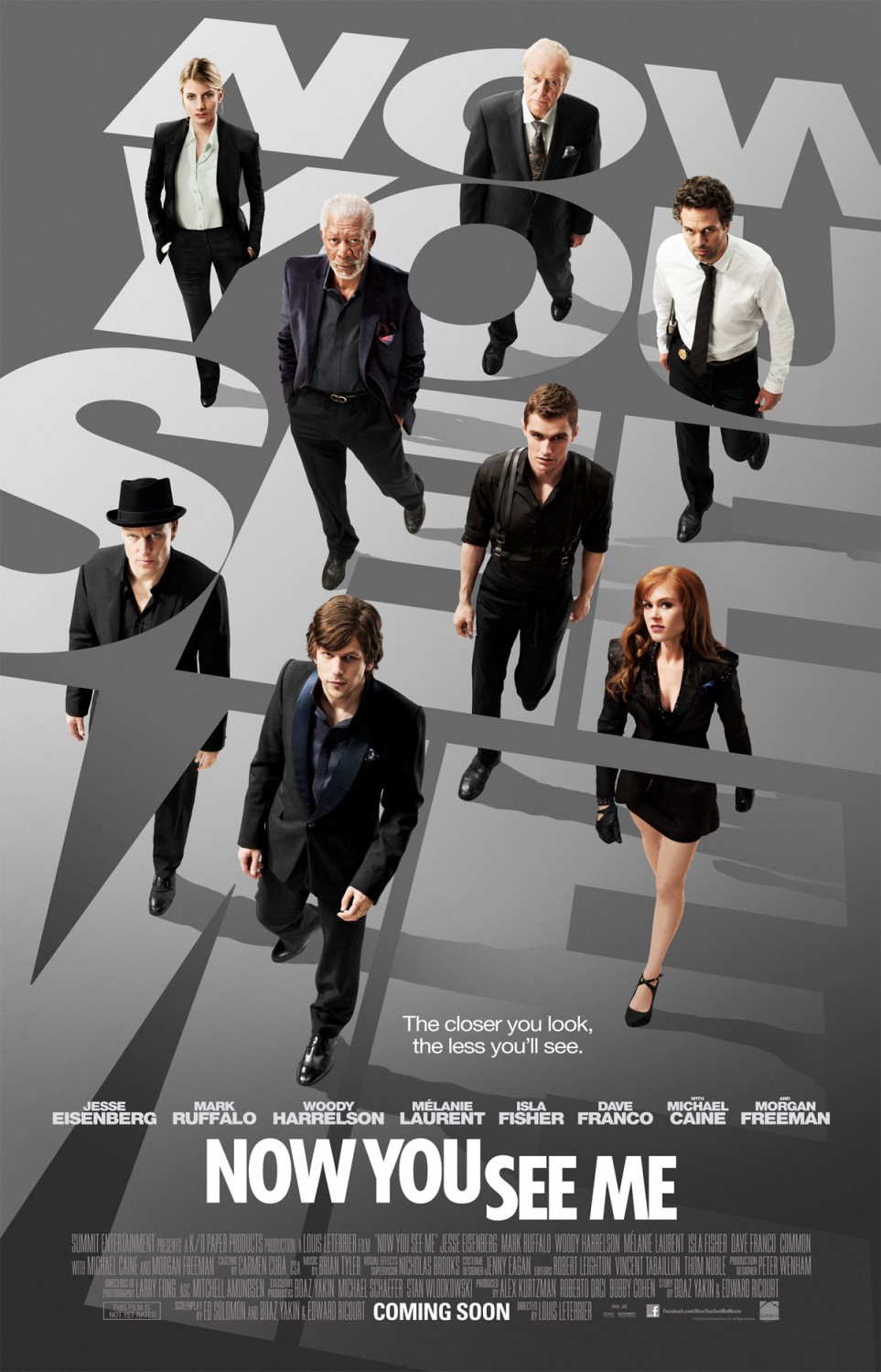 Everybody loves magic, right? At least the prospect of being surprised and delighted. Now You See Me takes something everybody loves (magic) and mixes it with a genre everybody loves (heist movie) and has already profited from the results at the box-office. Mix an ensemble of actors, though all of them white, and look over in this direction for a diverting, entertaining, and ultimately frustrating film that is too breezy to hate.
Four different magicians (Jesse Eisenberg, Woody Harrelson, Isla Fisher, Dave Franco) have teamed up to form a super team, The Horsemen, and they’ve taken Vegas by storm. A year into their reign, the insurance magnet and casino owner, Arthur Tressler (Michael Caine), is sitting pretty with his investment until the Horsemen turn their targets on him. With each new fantastic trick, the quartet fleeces the shady businessman of his money, returning it to wronged parties and the public at large. FBI Agent Dylan Rhodes (Mark Ruffalo) and Interpol Agent Alma Dray (Melanie Laurent) are tasked with finding the magical fugitives and figuring out their greater scheme. Just as one of the magicians notes, every time they think they’re one step ahead, they’re actually three behind.
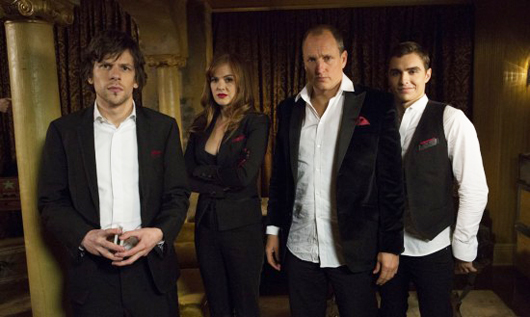 Let’s begin by admitting that the premise of a group of magicians performing heists is excellent. Seriously, on that alone I’d be hooked. Wouldn’t an Ocean’s 11-style movie about a group of magicians working a big score just be awesome? There’s so much fun to be had with such a breezy premise and for the most part Now You See Me lives up to its breezy potential. It works in segments, presenting a magical set piece, watching it unfold, and then unpacking it, sort of like a reverse heist sequence. It provides a bite-size moment of satisfaction, and then the movie goes off and repeats the process. The Horsemen elude the police and we start to get a broader sense of their aims, namely a slice of class warfare vigilante justice. There’s a genuine thrill to watching smart, talented types outfox their antagonists, and Now You See Me is no different. Under Louis Leterrier’s (Clash of the Titans) direction, the results are fast-paced, constantly shifting and surprising, and so cheery in tone that it’s hard to fault the movie for its lack of substance. Here is an example of a summer movie that’s just fun to watch. It taps into the desire we all have to be fooled, the same willful disbelief we process when watching magic or movies themselves, the modern artistic equivalent of magic. For a solid hour-plus, Now You See Me is a diverting and entertaining action thriller.
There are only a handful of traditional action sequences in the movie as most of the thrills are comprised of the illusions and some foot chases. I do want to single out a great moment, namely a magic fight where Jack Wilder (Franco) runs al over an apartment subduing police officers with magic. At first he relies on stealth to get the drop on them, but then the guy resorts to what is practically magic kung fu, using his sleight-of-hand to disarm his attackers. He then uses playing cards and flash paper at his disposal. I only wish that Rhodes, Wilder’s main adversary in the scene, tried to fight fire with fire, so to speak, and make use of the magical accessories in comical matters. The scene’s imagination reminded me of the final confrontation in Who Framed Roger Rabbit? where a selection of toon-specific tools were brought back for a unique showdown.
But with most magic acts, the good times start to fade once you find out how the trick is done. What hampers Now You See Me from being a stronger movie is a convoluted third act that goes to great preposterous lengths to explain the source behind the Horsemen. It’s pretty much who you’d assume it would be but I’ll still refrain from spoilers. Suffice to say, it’s an ending that doesn’t really work especially since it’s one of those reveals that makes you think back and question ordinary scenes. The movie muffs the landing, relying on twists to satisfy what was really just a high-concept heist movie. Another issue I had with the film is how quickly it marginalizes our would-be Robin Hoods of magic. After about the 45-minute mark, the Horsemen get sidelined as supporting characters and the movie is almost entirely told from the perspective of Rhodes. I understand there’s got to be some narrative discipline so that we don’t know the protagonists’ tricks before they perform them, but if I’m going to stuck with the dogged cop then make it his movie from the start. Compounding this problem is that the Horsemen, through no fault of the actors, barely register as characters. The actors are given one-note, and in the case of Fisher (The Great Gatsby) it was Woman, and that’s it. We see them as they perform their tricks and their daring escapes, but that doesn’t count as character development. In this regard, it’s less bothersome that these poorly conceived people get sidelined but then you stop and think that the only character you actually feel some interest in is Laurent’s Interpol agent.
 My suggestion for any possible future installments (Now You See Me Again? Now You Don’t?) is to focus more on our core team of magicians rather than their mysterious benefactor. I would also stress less time spent talking about The Eye of Horus or whatever through-the-centuries secret club of magicians the film was hinting at. I liked that, while completely elaborate and with endless fortune in preparation, that the illusions still had some tenuous foot in reality, that the magic tricks could be done in a somewhat recognizable world of ours (ignore the hologram junk). I strongly feel that even hinting about secret magical orders is just a step too far, breaking the film’s credulity, and taking what was fun and making it silly. I was worried before seeing the movie that the magic, as advertised, was going to be too supernatural. I was relieved that there wasn’t going to be a late reveal where some character rolls their eyes, probably Eisenberg, sand says, “Well, yeah, magic is real. Stupid.” When you’re playing around with larger-than-life figures that deal in theatricality and misdirection, I think it’s paramount not to get too carried away, failing to ground your movie for the audience.
If you’re looking for a fun time out at the movies, Now You See Me will serve its purpose well enough until it begins to fall apart by the end. You may find yourself looking back and the earlier mystery and thrill of the unknown will dissipate upon reflection, leaving you with little. It’s fun while it lasts but when it’s all over you’re left with substandard characters and an overly convoluted plot that doesn’t satisfy in the clinch. Magicians-plan-heist is such a juicy premise that I hope someone else makes better use of it. I would still love to see that movie, only well developed and giving me characters to actually care about. Now You See Me is as substantial as a magic trick itself but it’s an inoffensive, carefree, and mostly fun ride at the movies, though I think so much more could have been done with this concept and this budget. For a $75 million dollar magic trick, I want a better result.
Nate’s Grade: B-


 nathanzoebl
You must be logged in to post a comment.