Blog Archives
Repo Men (2010)
 It’s not unheard of for different writers to independently create similar projects. Remember back in 1998 when there were two animated bug movies and two apocalyptic asteroid flicks? Granted, those were big budget studio movies and the final films had little in common other than concept or premise. Repo Men takes place in a world where people open contracts on new organ transplants, but if the buyer is late on the payment then a repo man will come and take back the merchandise. This gory premise might sound familiar for fans of the Goth opera, Repo: the Genetic Opera, which was released a whole 18 months earlier. The makers of Repo Men and Repo have engaged in a he-said/she-said argument over who originated the idea. Repo Men‘s screenwriters claim they came up with the concept in 2003, though the book the film is based was only released in 2009. The Repo team point out that their funky little musical began as a theatrical show that was first performed in 2002. The songwriters behind Repo say that the idea itself goes back to 1999 and began as a 10-minute opera experiment. I suppose we’ll never know who really had the idea first, though I’m inclined to side with the Repo musical fellas because they can back up their claims with evidence. It seems like a whole lot of squabbling over so little, but hey, that’s Hollywood for you.
In the not-too-distant future, one corporation, The Union, seems to hold sway in the world of organ transplants. Remy (Jude Law) is an expert repossessions officer who will slice open anybody 90 days late on his or her payment. His wife wants him to transfer to sales; it’s less messy. Remy’s partner (Forest Whitaker) is an old childhood friend and doesn’t want to lose his butcher buddy. One night, Remy is sidelined by some malfunctioning equipment that fires his heart. He has no choice but to get his own organ transplant. Following the operation, Remy finds that he no longer has the stomach for his old line of work. Remy’s newfound moral compass comes at a cost. He quickly falls behind in his payments and his old bosses plead for Remy to refinance. Reluctantly, they sic the repo men, including Whitaker, on Remy to retrieve company property.
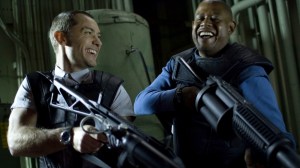 Repo Men takes some nice commentary on predatory lending, pushing the hard sell knowing that the customer can never stay ahead of the mounting fees and payments. The allegory has some sharp moments. However, the movie would have benefited from being pushed further in pretty much every regard. The side characters are horribly shallow. I’m fairly certain that Carice van Houten (electrifying in Black Book), as Remy’s beleaguered wife, could have been replaced with a cardboard cutout boasting a disapproving look. She gets to glare and complain and talk about family issues and then she’s gone, replaced entirely by Beth, a mysterious organ replacement junkie. Beth could have an intriguing back story, and the concept of surgery addiction could dwell upon the human cost of beauty and “upgrading,” but alas, her real purpose is to become an oddly implacable love interest for Remy. She gets to hold his hand while they run. That’s her main contribution (except for one key scene detailed below).
The entire concept of a future world held hostage by a greedy health care corporation could use more contemplation. What is happening with society? No epidemic is ever mentioned, so why do people start contracts on million dollar organs? Do the heavy debts pass on to the next of kin? What is the legality of organ repossession? What level of competition is there out there in the market? What does the government have to say about all this? Does this mighty company supersede the U.S. government? How come Remy can’t even get an employee discount on the merchandise? Has anybody had enough surgeries to become the six million dollar man? There is a wealth of questions born from this premise, but the movie only scratches the intellectual surface and sets its standard change-of-perspective morality storyline into gear. I actually would have found the life of an organ salesman to be more dramatically appealing. What kind of ethical rationalizations take place in the mind of a man who makes his living signing saps into modern indentured servitude? I find that story direction to be more compelling than following the guys who bring back the company merchandise.
But then something weird happens. The movie gallops to a satisfying close, and then it somehow gets even better in its closing moments. I was certain that I was going to write off Repo Men but then 4 things happened to make me sit up straight in my chair (I’ll refrain from any large spoilers):
1) In a film relentlessly aping the visuals of other, superior dystopian films, there’s not much new to look at. You’ve seen this future society thing before, just with more flying cars or jet packs. I came to terms with this; it’s not every movie that reinvents how we interpret the future short of some calamity. Then when Remy breaks into the Company HQ, which is awfully easy by the way, he stumbles into the genetic organ hatchery, if you will. Rows and rows and rows of scientists tinker with organ replacements. The entire environment is a strikingly sterile white, including the scientists wrapped in bulky white biohazard suits. Then Remy and Beth make a run for it, and they are covered head to toe in black. It’s a fabulous visual image, watching the color contrasts. It’s debut director Miguel Sapochnik’s high point.
2) Once Remy and Beth move beyond this laboratory, they get caught in a hallway, and Remy proceeds to take out a mob of employees. The fight sequence is several minutes long and a clear nod to the memorable extended hallway fight in Oldboy (Remy takes out a hammer as his final weapon). Weirdly, Remy’s opponents are suit types, middlemen, office employees, numbers crunchers, but they all leap into battle to take out the corporate intruder. The fight sequence is bloody and stylish enough to please the senses, like when Remy swings a hacksaw and we get Swinging Hacksaw POV as characters duck out of the way lest their jugulars get sliced.
 3) Following this, Remmy and Beth must deposit their corporate-licensed organ replacements. This involves cutting each other open, taking a bar code scanner (think a grocery check-out), and digging inside each other to get those subcutaneous scans. What’s amusing is that the scene is blatantly juxtaposed as a sex scene; Remmy and Beth intimately penetrate each other, the editing cuts to close-ups of moaning, and the other tries to soothe the pain with physical assurances, and it’s all set to a slow jam. It’s something of a bizarre sequence, especially upon further review (how effective can scanning for bar codes be inside the gook-filled human body?), but man is it interesting.
4) Just as I had come to terms with the movie settling for a conventional conclusion, the movie pulls the rug out from under you. It offers up a last-minute ending that upends the conventional framework, and, actually, presents the easy coast to a conventional stop in a new light. This is one of those rare instances where a last-minute ending twist actually improved the film. More often than not, a last-second twist is forced and the nail in the coffin of lasting entertainment.
Repo Men is a competently looking, competently entertaining sci-fi thriller that miraculously stumbles into a final act that not only works, it elevates the rest of the movie. My mild boredom vanished and I started wondering why they made me wait so long for the good stuff. Repo Men is a mixed marriage of overall tone. One second it will be darkly humorous, the next it will be satirical, the next it will pine for serious drama, and occasionally it goes for Guy Richie-styled slapstick. A sequence where Remy describes the three occasions he’s been knocked out, with visual interludes, feels like a deleted scene from an entirely different movie. The movie never really settles, touching upon a lot of areas but mostly poorly. The script desperately needed to be fleshed out to make any lasting impact. Now that I’m living in a two-Repo world, I’ll probably stick with the campy musical fun of Repo: the Genetic Opera. At least that movie left you humming.
Nate’s Grade: C+
Share this:

Saw VI (2009)
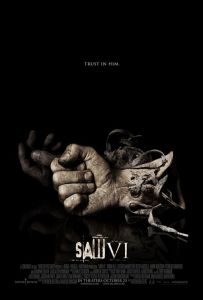 I checked out on Saw 4 and Saw 5 feeling like this horror series had grown stagnant, plus its central villain was killed off by the conclusion of the third movie. I thought the series wouldn’t go on for much longer, and oh how wrong I was. Jigsaw (Tobin Bell) has a second apprentice now fulfilling his departed master’s bidding, capturing even more people and trapping them into the franchise-favorite death traps. This means that there are yet even MORE recorded messages and vast, abandoned warehouses out there. FBI Agent Hoffman (Contas Mandyor, an amazingly horrible actor) has taken up the contrived contraption mantle. Of course it’s all preposterous and overly gory, but that never stopped the series before. Saw 6 boasts the franchise’s fourth director (the editor of all the previous movies just graduated to the big leagues). But this is mainly a franchise built around the hardened desires of its fans, indoctrinated in the gospel of gore. As I said before with Saw 3: “Just like the collapse of the Final Destination franchise, these movies started big but then bottomed out when their audiences had the rules memorized. At that point the only thing left is curiosity in what fiendishly outlandish ways people will get horribly killed.” This pretty much still holds true.
The real interesting draw for the sixth entry, and the only reason I drifted back in curiosity, is because Saw 6 is the weirdest participant yet in the current health care debate. The victims in this installment are health insurance employees. The people in charge of deciding who live and who dies are now put through morally challenging, queasy challenges. It’s a lot harder to kill somebody deliberately rather than by omission, by denying coverage or finding a loophole to get out of paying for a perfectly reasonable, and much needed, procedure. There’s a macabre enjoyment in watching health insurance officials put through Jigsaw’s battery of tests, though some of his victims seem pitiable — one guy is thrown in just because he’s a smoker (I suppose Jigsaw didn’t consider giving the guy a nicotine patch first). The main character going through the funhouse of horrors is an insurance company CEO (Peter Outerbridge) who has his mathematical equation about who earns coverage put to the test. Jigsaw is exacting vengeance after the CEO denied him coverage on an experimental treatment for cancer. It’s easy to see what side of the issue Jigsaw is on; he says that insurance companies put profits over human lives and get in the way between doctors and patients. This is a Saw movie even Michael Moore could cheer. I wish at the recent health care summit on Capitol Hill that the president had said, “Gentlemen, we’ve heard what the Democrats had to say about health care, we’ve heard what the Republicans had to say. I’d now like us all to see what Saw 6 has to say on the matter.”
 The story again is cut into two halves: the health insurance CEO going from death trap to death trap, and Agent Hoffman trying to stay ahead of the FBI investigation into the new Jigsaw killer. Guess which is more interesting? The FBI agents in this movie are those classical trained bumbling FBI goons that always come in late, take things over, and properly muck everything up. These people are lousy detectives and even worse at hiding their suspicions about Hoffman. It’s no surprise then that he manages to outsmart these idiots when Hoffman is, in fact, a dolt. This is not a smart man. Case in point, he’s using the severed thumb of a dead agent (Scott Patterson, apparently on Hoffman’s trail for the previous two films) to mark up bodies and frame the guy. Problem is that he’s framing a dead man, which means Hoffman has a really small window of plausible time to make this frame credible. It’s not going to work months later when the FBI wonders how a dead agent keeps kidnapping new people and putting them through hell. Then again, given the intelligence level of these onscreen agents, I’d assume that the FBI would blame zombies.
The apprentice aspect has always been the worst part of this series. I do not care whatsoever about the ins and outs of how Jigsaw set up his traps and who helped build the damn things. This isn’t some Discovery Channel series. I don’t need to watch the behind-the-scenes look at the grisly garage of doom. Just like the third Saw film, this is another entry that wants to play around with the bigger Saw picture. Scenes are introduced that retroactively alter the Saw timeline of events, causing characters to grow different motivations. I swear, the Saw movies all start to feel like they’ve been built from the rotting leftovers from each previous and less effective movie.
The only thing of note as far as acting goes is that the opening player (Tanedra Howard) won a VH1 reality show competition for a spot in this movie. Ladies and gentlemen, we now live in an age where people will compete for the luxury of being the first to cut open their insides in the SIXTH movie of a flagging horror franchise. You don’t want to know what they’re willing to do for a spot in the next flick.
 The draw of this franchise are its clever yet queasy death traps where the audience can place itself in the victim’s position and wonder what they would do given the life-and-death circumstances. How far would we all go to live? Well, in Saw 6 the traps aren’t that fiendish or memorable. The best one involves a group of six insurance actuaries (experts at finding loopholes to deny and cancel coverage) tied to a carousel with a shotgun pointed at them. One by one they swing by the kill zone, making it the most proverbially deadly game of musical chairs ever. Even better is the fact that the CEO is given the opportunity to “save” two on the carousel from the shotgun blast, so they each start screaming little arguments why they are worthy and their peers are not. It’s a neat little pressure-cooker of a scene, especially when one guy on the carousel realizes he’s the last to die. The thing slowly reels back around as he uses his final seconds to demand that the CEO look at him (“You look at me when you kill me!”). That defiant little moment manages to pierce through the ponderous personal growth edict the series has foolishly heralded as its purpose. The rest of the death traps are just cruel and labored and not nearly as interesting. You ca only watch people singe their skin on hot burners so many times before the body begins to involuntarily yawn.
Saw 6 is certainly no better than the other movies but neither is it worse. It’s the topical subject matter that makes this the only Saw movie worth a dubious look after the first flick. It taps into a populist rage against insurance companies that makes it vicariously satisfying and truly bizarre. It would be questionable to say that the franchise has recaptured any sort of creative juice, but I wouldn’t mind catching a future Saw film take on other big issues plaguing our country. Imagine Saw tackling predatory lending and the negligible banking industry resisting reform tooth and nail. Wait until the heads of Goldman Sachs and AIG get a load of Jigsaw.
Nate’s Grade: C
Share this:

The Wolfman (2010)
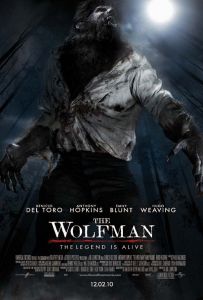 After re-shoots, reedits, a second director late in the process, and delayed release dates, it’s no surprise that The Wolfman is a bit of a shaggy mess.
In 1880, Lawrence Talbot (Benicio Del Toro) is an actor who returns home to England when he learns that his brother has been killed. Gwen (Emily Blunt), the fiancé to Talbot’s dead bro, writes that the departed brother was mauled, which points toward some kind of vicious creature roaming the woods. Inspector Aberline (Hugo Weaving) has been called in to clear the matter. Talbot’s father, Sir John (Anthony Hopkins), welcomes his prodigal son back but warns him of the dangers lurking in the countryside. The villagers are ready to blame the gypsy caravan and their chained bear when the feral creature strikes again, thus exonerating the bear. Talbot is bitten by the beast but survives only to transform into the cursed werewolf once every full moon.
Structurally, this movie feels like it’s all Act 1 and Act 3 with about ten minutes in between. By that I mean it’s all protracted setup and climax and little to connect the two. The beginning takes so long, with characters walking around like zombies who have no sense of wonder or fear given the extravagant circumstances. This is a movie that confuses set changes with plot advancement. Dour characters enter half-lit rooms and say little that isn’t cryptic or terse about the unusual happenings. This is what you have to look forward to for about an hour. The central mystery of who is the initial Wolfman is pretty easy to figure out when you play the economy of characters, which only compounds the movie’s sluggish pacing problems. You’re going to have definite pacing issues when your monster can only appear once a month, so say hello to massive time-lapse montages with the moon. It makes it hard to keep track of how much time is actually elapsing.
 There is little cogent explanation for why anything happens and the movie does an extremely poor job of maintaining a credible suspension of disbelief. What exactly are the rules here? What are the limitations for the Wolfmen? How far back does this whole thing go? The movie traces it back to an Indian kid, who looks like Gollum, in a cave, but where did he get it from? What is the history of this lycanthropy illness? When you turn into the monster, do you have any control? Are you a slave to your animal impulses? Are you culpable for what happens? Is it more like having multiple personalities except one of them is harrier? Nothing is really made clear and the movie just plows along while the unanswered questions continue to pile up, never to be addressed.
The Wolfman does a fine job of establishing an ambiance that feels ripped right from the old Hammer horror films, but fog and shadows and art direction can only take you so far. Every room looks like it’d be a prize-winning example of how to build a haunted house, though the lighting tends to be overly murky. Danny Elfman also provides a darkly lush score that mingles well with the onscreen atmosphere. But the refined sets only tease a better movie. An attack at the gypsy camp can get interesting. The beast flaring up at an insane asylum calls for something wickedly entertaining and scary, but everything is over before it really gets going, and we’ve moved on to the next scene of character sitting glumly in the dark. There’s nothing to startle beyond some overused jump scares. The movie lacks good scares because the film fundamentally can’t sustain a mood because the plot is never elaborated.
The character work is exceedingly shallow. Talbot is the main character but what do we learn about him? He’s an actor, he left town, he gets bit by a wolf, he skips stone’s with his dead brother’s girl, and that’s about it, folks. There’s an entire back story about Talbot spending time in a mental ward, which could prove to be fascinating but it’s just another set piece and nothing more. Talbot is pretty much a placeholder for a character; he’s the dude that has to get bit for there to be a story. He’s more catalyst than character, and you can feel that painful realization in how Del Toro (Traffic, Che) plays his non-character. Del Toro is a truly capable actor but he sleepwalks through the entire movie and mumbles most of his lines. Despite being a dead ringer for Lon Chaney Jr., he brings no energy to his role, nor does he ever seem truly concerned with his beastly transformation. You got more reaction and contemplation from Michael J. Fox in Teen Wolf.
The rest of the actors try and make good with the parts they’ve been tossed. Blunt (Sunshine Cleaning) can be a very good actress but she’s playing the thankless task of the underwritten love-interest-to-monster part. She’s no more fleshed out than the blonde damsel that screams and faints in the old classic monster movies. Blunt has the annoying habit of her voice turning into this simpering whine when she’s distressed. Hopkins (Fracture) pretty much gives the plot away with his maniacal cackling and incessant ear-to-ear grinning. You can pretty much faithfully assume where his character is going from the first malevolent twinkle in his eye. The screenplay exerts no effort to disguise its easily telegraphed character reveals. The person who comes out best is Weaving as the inspector, but that may be directly linked to the fact that he has the least amount of screen time of any of the main characters.
The special effects are fairly good and the practical makeup effects by screen legend Rick Baker are even better. The actual Wolfman is a snarling, spooky creature, but I wonder why we don’t get more shots allowing us to fully view the makeup work. Director Joe Johnston (Jurassic Park 3, Jumanji) seems to be more of a proponent of CGI, which means that we get scenes of Wolfie jumping from ye olde rooftop to rooftop like he’s any sort of wily creature. There’s nothing in the movie that really makes use of the specifics of being a Wolfman. We get a few POV shots of the Wolfman running extremely fast, but little else takes advantage of what makes the Wolfman a creature to be reckoned with. We only get a slew of decapitations and sliced innards that display the ferociousness of those wolf claws. Johnston isn’t afraid of gore but he doesn’t help his case when he fails to create any feeling of dread. It’s hard to dread what you can barely understand and with people you don’t really care about. Consider me stubborn, but when I got to a movie called The Wolfman I want some attention paid to the title animal.
 As I was watching The Wolfman I began to disassemble it in my head and piece together my own version of the film, an infinitely better version. For the sake or argument, I’ll explain my version and you can tell me which seems like the superior product. In my imaginary version, I completely eliminated Blunt, Hopkins, and most of the other side characters. I focused on Talbot and the Inspector and their relationship. Talbot has known about his lycanthropy for some time but he’s been able to control it for the most part, until recently. It haunts him, his inability to stop the sinister urges inside him that take over. The inspector is called in after the mysterious murders have picked up and they resemble some equally gruesome murders from 20 years prior (when Talbot first grappled with his hairy alter ego). The bent of the plot would then be on the relationship forged between the two men, how it turns into mutual affection and admiration all the while Talbot is trying to stay one step ahead of the investigation. Then my Act 2 break would be the Inspector finally realizing who is responsible for the murders (his friend!) and struggling with his own moral obligation to meet justice. Maybe this sounds too much like a crime thriller, but to me that sounds like a better film than watching two CGI werewolves claw at each other and spit.
The Wolfman is yet another misguided remake in a genre being gutted by horror remakes. The old monster movies of old were more than creature features and deserve better treatment than this bloody mess. I suppose few films can survive given the retooling process this one went through. This super serious monster movie has terrific production design, some alluring atmosphere, and a whopping void where a story should be. Characters will bumble about and the plot hums along with no explanation or elaboration given, meaning that setup often immediately crashes into climax. That’s not a satisfying recipe for a moviegoer. The Wolfman is mostly suspense-free and the actors are phoning it in; Hopkins is a kook, Blunt trembles her lower lip, and Del Toro seems to be drugged. This is mostly a costume drama with a little gore splashes in for good measure. It’s boring and half-baked and the best attribute is the scenery. If I wanted to watch scenery I’d flip through a Home and Gardens magazine. I was expecting entertainment here but instead it’s just another reminder to stick with the original.
Nate’s Grade: C
Share this:

Legion (2010)
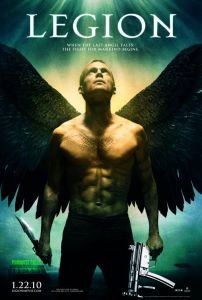 Just to be upfront, I am a big fan of action movies making use of Christian mythology (sorry if the use of the word “mythology” offends some). You tell me a tale about angels, demons, in a contemporary setting no less, and I’m hooked. You give those two sides weapons and have them fight over the fate of mankind, and I’m already revving my engines. So please know that no matter what the artistic achievements of Legion may be, I was predisposed to enjoying a movie that features the angel Michael (Paul Bettany) on the poster with a sword in one hand and an automatic weapon in the other. The premise of Legion is that God has finally had it with mankind and is making good on his threat to “turn this thing around right now.” He’s sending a host of heavenly angels to … eliminate humanity. Michael rebelled, believing man was still capable of making good on its promise. So he fights alongside a handful of characters shacked up in Dennis Quaid’s greasy spoon diner in the middle of nowhere. The action isn’t really involving but the movies does have some cool moments, like when Michael goes mano-a-seraphim with Gabriel (a marble-mouthed Kevin Durand). Legion deals with an antagonist (God) that is so powerful that there have got to be arbitrary limits placed on that power. So the attacking angels don’t overwhelm the tiny diner with their superior numbers, nor does the Almighty just blink the troublemakers out of existence. The end doesn’t really give much in the way of clarity but I got what I wanted from a movie like Legion. Though, in retrospect, I really didn’t want sizzling acid popping from boils.
Nate’s Grade: C+
Share this:

Daybreakers (2010)
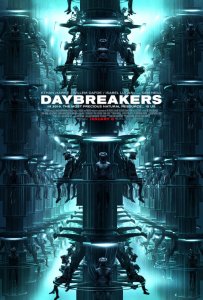 Taking a cue from zombie cinema, Daybreakers takes the idea of vampire-as-virus to an apocalyptic crescendo. The world is populated almost exclusively by vampires now. Human beings are farmed for blood but they are in such limited supplies. You see there is an extreme blood shortage because the vampires have lived beyond their means. That’s right, it’s a consumer consumption/environmental metaphor. The limited resources are dire because if vampires go without human blood they begin to devolve into senseless, winged mutating monsters known as “subsiders.” The poor cannot afford the skyrocketing blood prices so they are most fated to doom, while the rich argue that the blood supplies need to go to families first and not be wasted on the lesser dregs. The U.S. vampiric military, when not hunting humans, shackles the subsiders and marches them into the sunlight to be executed. Daybreakers has a lot more on its mind than most vampire movies, and it’s plainly fascinating to explore the realities of a world run by vampires (cars that drive during the day, the Subwalk, blood in your coffee). For most of its running length, Daybreakers is an intriguing setup that makes room for cool visceral action and social commentary. Then in the final act it sort of devolves itself into one big, dumb action movie. Ethan Hawke is a blood scientist trying to work on a synthetic substitute for a super vampire corporation that, of course, is evil. He stumbles upon an outlandish “cure” for vampirism and wants to resurrect humanity. This leads to a climax where Hawke and his human warriors wage battle inside the corporate HQ. For a promising concept, it’s depressing that Daybreakers had to end in such a typical manner. At least the vampires explode in the sun instead of sparkling.
Nate’s Grade: B-
Share this:

Final Destination 4 (2009)
 I felt that this franchise was creatively exhausted after the third film in 2006, and I see no reason to change that opinion. The fourth film has the added feature of being in 3-D, which means you get the luxury of having entrails exploding in your face. I watched the movie in the limits of two dimensions, which may be why I wasn’t thrilled having every other visual thrown at the screen. Regardless, the cruelly elaborate deaths are the draw. This is a horror movie built from the inside out, finding the thinnest of tissue to connect all the gory gross-out moments. A documentary set in writer’s room for a Final Destination movie would be more interesting than the finished product. It seems like the producers aren’t even trying any more; the one-note characters exist in a world bereft of adults, cops, media, and anybody with a brain. The film doesn’t waste any time on characters because they’re all just meat for the grinder. The film does, literally, the bare minimum just to move the plot along to the next fiendish death trap (this flick has a franchise record 11 death sequences). At one point, a character says, “Don’t make fun, but we Google-ed ‘premonitions,'” and then they explain the rules of the series like somebody handed them a manual. Later, the teens celebrate because they think they broke death’s chain, and I’m yelling at the screen, “That hasn’t worked for three movies, you stupid kids!” They’re all running through the same worn-out patterns that the audience already knows by heart. The big question is whether the gruesome death sequences deliver the goods. Flaming escalators and killer car washes? Clever or desperate, you be the judge. For me, the fun of this franchise was killed long ago when it gave over to the cynical bloodlust of its target audience. Since Final Destination 4 made the most money out of any of the previous films, expect more entrails in glorious 3-D.
Nate’s Grade: C-
Share this:

Watchmen (2009)
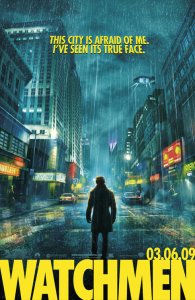 In the realm of comics, Watchmen is tantamount to the Bible. It consisted of 12 issues released between 1986-1987 but it arguable changed the medium forever afterward. TIME magazine listed the book, by author Alan Moore and artist Dave Gibbons, as one of the 100 greatest 20th century novels. Therefore, there has always been heavy trepidation within the geek community when Hollywood came courting the Watchmen property. Different directors have tried tackling the material, going back to the late 1980s when Terry Gilliam was hired to direct and producer Joel Silver was adamant about getting Arnold Schwarzenegger to portray Dr. Manhattan (back then, they totally just would have painted him blue — like they did when he was Mr. Freeze). The movie would seem like a tantalizing possibility and then the production would collapse, most recently in 2004 with director Paul Greengrass attached. Director Zack Snyder (300) understood all of the concerns from the notoriously vocal geek community and attempted to make the most faithful Watchmen film possible. He accomplished that goal. But was it the right goal?
In this alternative account of history, masked crime fighters exist and were even bankrolled by the U.S. government. President Nixon is re-elected to a third term, thanks in part to superheroes winning the Vietnam War, and then he outlaws all masked vigilantes. Flash forward to 1985, and Nixon is on his fifth term and staring down Soviet aggression into Afghanistan. It appears that the world on is on the brink of nuclear annihilation by the dueling super powers engaged in a staring contest. Edward Blake, a.k.a. the Comedian (Jeffrey Dean Morgan), is thrown from his apartment window and killed. Blake used to belong to a second-generation superhero team in the 1970s called the Watchmen. The other members consisted of Dan Dreiberg, a.k.a. Night Owl (Patrick Wilson), Rorschach (Jackie Earle Haley), Adrian Veidt (Matthew Goode), a.k.a. Ozymandias, the glowing blue man Dr. Manhattan (Billy Crudup), who was transformed into a god-like figure of power after a laboratory accident, and then there’s Laurie Jupiter, a.k.a. The Silk Spectre (Malin Akerman), who was following in her mother’s (Carla Gugino) footsteps, the first Silk Spectre. The death of the Comedian brings the old team back together and rekindles some interest in putting on the super suits and fighting crime one more time. It seems someone out there is trying to knock off the retired superheroes, and Rorschach is convinced that a bigger conspiracy is unwinding.
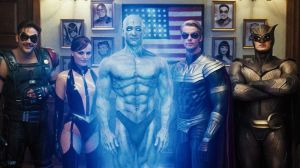 It’s difficult for me to formally express my feelings and reactions to the Watchmen film adaptation. Count me among the throng of fans that feels that Moore’s source material is a remarkably dense and witty deconstruction of the superhero mythos. Imagine a Superman that can’t be bothered to help out humanity because he feels life is overrated, or a group of super heroes that don’t necessarily do anything heroic; when they beat up the bad guys it’s because they get a sexual thrill from the rush of violence. My voice was among the cacophonous crowd screaming, “Don’t you dare butcher this great work! Keep it as close to the comic as possible!” And that’s pretty much what Snyder delivers. But now I’m left to wonder if a literal-minded interpretation is truly what I wanted all along. Watchmen is not like Sin City, a comic that was already a movie in panels. Frank Miller’s ode to film noir was ready and waiting to be a splashy action movie with style to spare. Watchmen is not a ready-made action vehicle, as it really only has about two extended pieces of action. Moore’s story examined what kind of people would become vigilante crime fighters if the government approved the practice. Surprise, it’s a bunch of sociopaths that are now getting checks from Uncle Sam! Watchmen is a nihilistic account of human behavior and far more cerebral than any superhero film that has ever graced the screen. Seriously, what other superhero movie opens with a fictitious episode of PBS’ political yak fest, The McLaughlin Group? So I suppose this paragraph is a sheepish way of admitting that perhaps Watchmen should have stayed place on the page unless, gulp, it was advantageously adapted for the medium of film.
It’s not that Snyder does a bad job or that the film itself is poor. While Snyder isn’t the best man to handle actors, he is certainly a skilled visual tactician and knows how to make some immensely pleasing imagery. He breathes great life into the images of the comic book and filled in the blanks nicely, and his one big artistic addition is one of the film’s best moments. In the opening credits we get a series of shots that perfectly establish this alternative universe, where JFK shakes Dr. Manhattan’s hand on the White House lawn only to be later gunned down by none other than the Comedian in Dallas. The segment is cleverly set to Bob Dylan’s “The Times They Are A Changin'” and is a terrific intro into a re-imagined America. I wanted to spend more time exploring the differences, like watching a giant Dr. Manhattan win the Vietnam War in one week’s time. In many ways, Watchmen is Snyder’s epic pop commentary on the history of the United States. Dr. Manhattan takes the first pictures of the astronauts on the moon. It is a female crime fighter that swoops a woman off her feet for that iconic celebratory kiss marking the end of World War II. The flick even has a period appropriate, synth-aided score, which is fine, though the use of period pop songs can be distracting. Watching Laurie and Dan make love to the raspy tunes of Leonard Cohen’s already overused tune “Hallelujah” is a deeply uncomfortable moment. Also, the aging makeup is horrendously bad. Gugino looks like she has a turkey waddle and the older Nixon looks like a freaking Halloween mask.
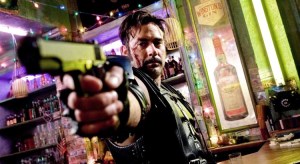 At what cost did Watchmen make it to the screen? Wacthmen plays as an adaptation like the first two Harry Potter movies, like there was an assigned checklist rather than a fully developed script. I achieved a brief understanding with the characters and each central figure provides a glimpse of the trouble beneath the surface. Laurie is a girl with daddy issues who’s been pressured to follow her mother, a rape victim who still loves her rapist. Dan is a self-pitying putz who has never felt more alive than when he puts on a costume. Rorschach has the same pessimistic view of mankind that Travis Bickle did, viewing many people as vermin clogging the gutter. Yet Rorschach also is the most single-minded of all the characters and abides by an innate moral code and sense of duty, never mind the fact that he may have lost his mind. Dr. Manhattan has been turned into a supreme being and has lost his connection to humanity. The Comedian is a man of wanton desire who declares himself to be the epitome of the American dream: giving in completely to the id. Watchmen has been deemed as an unfilmable book, and perhaps they were right. It feels like Watchmen and looks like Watchmen, but the movie never seems to become anything grander than the sum of its parts. The Dr. Manhattan back-story, where we see him live life in the past, present, and future simultaneously may be one of the best moments in the movie, but it doesn’t add up to much more than an interesting aside. The trips to Mars and Antarctica provide nice visual landscapes but do little else. The other quandary is that everything Snyder cut from the comic (the side characters, the pirate comic, the alien squid) is something that ultimately was unimportant. All of the important and memorable moments from the comic are here, though abbreviated and truncated. Even a 2-hour and 40-minute movie feels like too much of a sprint through such rich material probably better suited to the more accommodating narrative confines of a glossy HBO miniseries. The movie ends up becoming a handsomely mounted and reverent homage to the source material, but I question if the movie serves any other purpose than as an advertisement to go read the book. Will people unfamiliar with the book enjoy a movie practically tailor-made to appeal to fans of the book? Who will watch the Watchmen?
Make no mistake, Watchmen is a hard R-rated movie and if any parent takes their child to this flick because it has men in capes, then that parent should have their child removed. Snyder has ramped up the book’s adult elements, which were originally a commentary on how comics flirt with sex and violence but never get their hands too dirty. Snyder has gotten his hands dirty all right. Instead of zapping others into poofs of smoke, Dr. Manhattan turns them into explosions of human goo that stick to the ceiling. Instead of the Comedian being thrown from the window, we see an extended fight sequence that seems to indicate that the Comedian’s apartment is full of nothing but breakable glass tables. When Dan and Laurie get into a street brawl where bones pop through skin. The sex scenes now involve an almost-agonizing level of thrusting. This is an adult tale in a very simple sense: there are boobs and blood. But the movie is also adult in the fact that it trades in complex political, psychological, and philosophic ideologies, asking hard questions that do not come with easy answers. Do the ends ever justify the means or is mankind destined to always destroy itself? Is humanity worth saving and at what cost? This is probably the most subversive studio-backed movie to come out of Hollywood since 1997’s pro-fascism melodrama, Starship Troopers.
 The three best performances in the movie all come from the three weirdest and most messed up characters. Haley (Little Children) fully inhabits the grisly character of Rorschach and growls his way through the movie. You can tell just by the man’s face how much he has weathered. Crudup (Big Fish) and his gentle voice make Dr. Manhattan an intriguing yet beleaguered super being. Morgan (TV’s Grey’s Anatomy) makes the Comedian one consummate bastard but a bastard that you cannot stop watching, nonetheless. The rest of the cast does suitable jobs and I don’t feel that Goode (The Lookout) or Akerman (27 Dresses) deserve the drubbings they’re getting through the critical community. I actually liked Goode’s portrayal of Ozmanydias, though he fails to express the heavy crown the smartest man in the world must bear. Gugino (Sin City) is terrific when she’s the young, spunky Silk Specter and the opposite of terrific when she’s the troubled, alcoholic older version on screen.
Snyder has served up the Watchmen that fans have been demanding for years, but is this really what everyone truly wanted? Snyder made an adaptation for the fans but what do the fans know except for lavish loyalty? The book utilized the medium of comic books to accentuated its story while commenting on the history of comics and superheroes, and when translated to the big screen as is Watchmen can feel like an artistic stillborn. I’m now more curious than ever to read the previous drafts out there, the ones that directors like Darren Aronofsky and Greengrass were going to film until the financing got pulled. One of the drafts transplants the world of Watchmen to modern day and replaces the nuclear brinksmanship with the Russians to the ongoing War on Terror. It may not be faithful to the fabulous source material, and it quite possibly would have made a terrible movie, but it would have been more interesting as a film project because it would have been an adaptation. Snyder’s Watchmen is reverent to a fault but I cannot complain too much. This is likely the most faithful recreation of a complex book that fans could hope for. I feel satisfied and yet unsatisfied with the finished product. It was everything I was looking for in a Watchmen movie and maybe, in the end, that was the problem. I think instead of buying the DVD I may just read the book again.
Editor’s Note: I have warmed up to this film much, much more on Blu-Ray, especially the 3-hour director’s cut. It’s Snyder’s best work to date.
Nate’s Grade: B
Share this:

Repo! The Genetic Opera (2008)
 In a dystopian future, organ failure has become an epidemic. Fortunately, the GeneCo Corporation and its CEO Rotti Largo (Paul Sorvino) have devised a solution. They will loan out new organs to those in need. However, if the customer happens to be late on a payment then GeneCo sends out the Repo Man. This hooded figure will track you down and surgically remove GeneCo’s property, and perhaps they’ll harvest the rest of you too. People become obsessed with surgery upgrades (just think what wonders a third kidney could do for you). Blind Mag (Sarah Brightman) is a famous opera singer that signed a contract for new corneas. She’s now reconsidering retiring from the stage, no matter what that means. There’s also a powerful pain killer known as Zydrate that can be extracted from fresh corpses. Anyone caught robbing graves will be shot on sight.
One repo man, Nathan Wallace (Anthony Stewart Head), is working to keep his daughter safe. Shilo (Alexa Vega) has a rare blood disease she inherited from her mother, who died in childbirth. Nathan must keep her locked away in order for her to survive. His daughter must never know his true identity as a repo man. Rotti is informed that he is dying from inoperable cancer. His trio of bratty, homicidally crazy children (Paris Hilton, Bill Moseley, Nivek Ogre) are all fighting over who will get to run GeneCo once dad’s dead. Rotti plans a big bloody finale for everyone at the Genetic Opera’s final curtain call.
To answer the most burning question, yes it is an opera. There are perhaps five spoken lines and the rest of the movie is completely sung; you will get a solid 85 minutes of people singing while they engage in plenty of questionable acts. To say that Repo is unique is a disservice to the flick. I cannot imagine watching another movie that combines opera, vivisection, surgery addiction, Gothic costuming, and Paris Hilton actually doing a credible performance. Knowing that it is indeed a full-fledged opera, it mostly eliminates the snickers that arise from watching actors break into song at curious moments; when they’re singing all the time you’re more aware when they stop. It’s a futuristic rock opera that exists in the realm of a horror movie. There are several dispirited elements that can be occasionally awkward but that isn’t necessarily the flick’s fault. I just haven’t witnessed too many folks singing while arm-deep inside an exposed chest cavity. The movie isn’t as bloody or gory as repulsed film critics have lead you to believe. There are about four sequences of horror gore, though the film does resort to casual violence that can be off-putting, like stabbing extras. Repo possesses a wickedly entertaining and gleeful spirit.
 But how is the music for such an avant guard enterprise? It’s pretty solid, actually. It won’t be everyone’s cup of tea, naturally with some vulgar lyrics, but the music is certainly well crafted, with strong melodies, catchy hooks, squealing guitars, and some rather impressive singing. The music is reminiscent of industrial rock acts but it also has some pretty flavorful pop styling (the pounding hard rock beats reminded me of the underrated band, kidneythieves). These are tunes that will stick in your grey matter. Some of the highlights include “Infected,” where Shilo laments her condition and says, “I’m infected/By your genetics!/Mother can you hear me?/Thanks for the disease!” The tune is likely the catchiest of them all and has a fun pop-punk melody that becomes a leitmotif. Vega also proves immediately that she can sing. “Zydrate Anatomy” is led by the charming vocals of the Graverobber (Terrance Zdunich, who co-wrote the music and lyrics) as he exposits to the audience the ins and outs of the drug market. The guitars careen and the backup junkie chorus (“A little black vial? A little black vial!”) add some depth to the tune. But least you think it’s all Goth rock, Repo mixes in traditional arrangements as well, including plenty of harried violins, cellos, and some classical opera music. There are also subdued ballads like “I Didn’t Know I’d Love You So Much” and “Genetic Emancipation” that conclude the film on a high note. It all blends together into a unique soundscape that’s well worth singing along to.
Unlike the big screen version of Mamma Mia, the cast of Repo can actually sing, and they sing quite well. Vega (Spy Kids) sounds like a better Avril Lavigne than Avril Lavigne. She’s an ingénue that actually gets some good songs. Fans of Buffy the Vampire Slayer will recall that Head gave a standout performance on the TV show’s musical episode, and here he shows his amazing lung capacity. Head has a rich tenor voice that is lovely to hear. He howls with soulful anguish and holds onto notes for long duration. It’s tricky to present a performance only through song and Head has the most complex role (in one song he laments that “I’m the monster!/I’m the villain!”). Head also switches over into a gravely demonic voice, like his maniacal “I’m on the job” voice to frighten his victims. The personality shift is a credit to Head’s vocal range. The rest of the cast includes singers with actual opera experience (Sorvino, Brightman) and musicians (Skinny Puppy’s Ogre), and then there’s Hilton. She’s already proven with one flop album that the hotel heiress is not the surest singer in the world. However, she works with the material as a spoiled rich kid consumed by her vanity (at one point her face literally falls off).
 Repo! The Genetic Opera plays better as a soundtrack than as a movie. The story is mostly simple but still manages to be confusing at points because of unresolved subplots. The characters are given glimmers of outgrowing their stock roles, but most of them just accept their underwritten fates. Repo seems like it’s on the verge of making social commentary on vanity, man’s compulsion to destroy himself to live outside one’s means, the disposable nature of beauty, destiny versus free will, but it never really delves deeper. The surface is barely skimmed and then the movie kind of chugs along at a super brisk pace. The movie has a trashy, campy atmosphere that can wear thin at times, especially under director Darren Lynn Bousman’s lackluster lens. I know this is low budget but Bousman doesn’t conceal the budget limitations too well and his shot selections can seem rather redundant and mundane for a music video, let alone a feature length film. With that said, this is still worlds more ambitious than Bousman punishing audiences with another Saw sequel (he directed Saw 2-4 and took time off from 5 for this flick). Some of the songs, while fun, seem out of place given the narrative, like the punkish “Seventeen” where Vega declares her womanhood and pretends to be a rock star and pounces around her bedroom, complete with dancing stuffed animals. It’s almost like a Miley Cyrus/Hannah Montana moment of strange daydreaming. The finale at the opera is a tad overwrought and yet it seems appropriate given the operatic backdrop.
I’m dumbfounded that some critics would cite Repo! The Genetic Opera as the worst film of 2008. How could something this ambitious, with such a killer soundtrack, be worse than 88 Minutes, The Hottie and the Nottie, and the atrociously harmful Meet the Spartans? The movie is far from perfect and is bizarre, messy, and somewhat shambling, but I have a healthy appreciation for a film that tries something different, whether or not it succeeds. A bloody rock opera seems like it’s begging to be considered midnight movie material, but it’s better than that. This curious experiment works better as a soundtrack than a movie, but it’s well worth seeing because, really, when are you going to catch another freaking movie like this? If you ever venture inside a Gothic-themed club, you can expect to see this movie playing on a TV somewhere until the end of time. My advice: buy the soundtrack and get ready to have the songs take root in your brain.
Nate’s Grade: B-
Share this:

Rambo (2008)
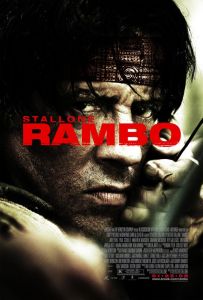 Count me as one of the many who were surprised at how effective Sylvester Stallone was when he dared to make a sixth Rocky movie. That 2006 swan song was an effective and somewhat emotional return for a character that had been dormant for over 15 years. Now Stallone is trying to work his resurrection magic yet again. Rambo was the epitome of the 1980s action star as he laid waste to vast stretches of enemy armies. What few remember is that Rambo’s first film, 1982’s First Blood, is actually more of a psychological drama about a Vietnam War veteran coping with adjusting to life back home. The action only comes at the end and a grand total of four people perish. Stallone had bigger plans for the character, I suppose. Just as he did with Rocky, Stallone has brought back an old character now with an older face.
John Rambo (Stallone) has been living outside the Burma (now known as Myanmar) border in Southeast Asia. He’s commissioned by a group of missionaries, including pretty blonde Sarah (Julie Benz), to transport them upriver into Burma. They want to do aid work, but Rambo says that Bibles cannot help a country overrun by men with guns. Eventually, all those Christian missionaries are kidnapped by a ruthless warlord. Rambo teams up with a group of mercenaries to go back and rescue them. A lot of people die horribly in the process.
Do we need another Rambo movie? The first one was linked to the Vietnam War, the increasingly cartoonish sequels involved John Rambo going back to Vietnam and then going to Afghanistan to help take out the invading Soviets. Perhaps the figure of Rambo should be added as a footnote to Charlie Wilson’s War. But the world has changed and the notion of a one-man army taking out the trash seems a tad ludicrous when a modern enemy isn’t a clear, identifiable source. Stallone wisely returns his scarred soldier to the jungle, back to where atrocities are going down in international lands. In some manner, Rambo becomes like a wishful force for justice, and instead of Vietnamese and Russian soldiers being shot out of jingoistic American glory, it’s Burmese military warlords that meet their makers. Stallone even opens the film with real archival footage of the Burma military junta committing violence acts. The bad guys feel real and relevant, which makes it partially more fulfilling when Rambo meets out his own brand of punishment.
 The dialogue is sparse and kept to an expository minimum. This is for good cause. Ladies and gentlemen, allow me to perfectly showcase for you why it is a blessing that Rambo is as dialogue-free as possible. This exchange happens early in the film and is a glimpse into the philosophical rumblings of one, John Rambo.
Sarah: Really? If everyone thought like you, nothing would ever change.
John Rambo: Nothing does change.
Sarah: Of course it does! Nothing stays the same.
John Rambo: Live your life cause you’ve got a good one.
Sarah: It’s what I’m trying to do!
John Rambo: No, what you’re trying to do is change what is.
Sarah: And what is?
John Rambo: Go home.
That’s the kind of dialogue you hear during fake audition scenes in movies, where the aspiring actors are saddled with ponderous drivel. There is some discussion over whether it is right to take a life. You get an idea of Stallone’s worldview when he has the pacifist preacher eventually kill his fellow man out of survival. After the twenty-five minute mark or so, Rambo essentially becomes a silent movie with added grunts.
The plot is as thin as possible; it’s essentially a rescue mission stretched to 90 minutes. Of course Rambo is a brutal and bloody action flick, but man is this thing tremendously gory, and it’s war gore so that means bodies being blown to bits. I’m somewhat awed at the sheer variety of ways bad guys have giant holes punched in them and through them. Limbs go flying, blood soaks the ground, heads go rolling, insides spend more time on the outside, and bodies are ripped apart. The blood and guts splatter the screen so much that sometimes even the camera can’t escape. There’s so much carnage that you may be advised to wear a poncho if you sit close to the screen. According to the Internet Movie Database, Rambo has 236 onscreen kills and that averages to 2.59 killings per minute. It’s a viscerally violent flick that can become occasionally entertaining, if you can stomach other people’s stomachs exploding in your face. In the end, though, the violence is just another bloodlust high that completely dissipates once the movie concludes, and you?re left with nothing of value. It’s somewhat fun while it lasts, but once it stops Rambo is an empty exercise. Then again, if you’re hungry for lean, mean action, and only action, then Rambo will certainly provide the gory goods.
 Stallone has somewhat re-energized his career by going back to the well. Rambo isn’t as nuanced as that big palooka Rocky, but the taciturn man of action suits Stallone. After a 20-year absence, Stallone eases back into the character and gives him a satisfying weariness, as solitary life has taken its toll. You won’t find me specifying the accomplished feats of acting in this movie because most of the acting is the equivalent of running and falling down, though perhaps not in one whole piece. Credit must be given to the 61-year-old Stallone, who still appears physically agile and spry when he could be cashing a Social Security check. Benz (TV’s Dexter, Saw 5) spends most of her time wailing through tears. It must have been exhausting for her tear ducts and her lungs.
Rambo is a movie that doesn’t pretend it’s anything but a grisly, masculine action flick. The story isn’t anything remotely involving and I doubt that Rambo was a character that needed to be reawakened. However, as a meaty old school action film, it aims to satisfy in the moment. Stallone does what he does well. It should be noted that the Myanmar military government has naturally banned this latest Rambo entry but rebel factions have actually used the film as a source to renew the spirits of the oppressed. They have even taken to using some of the dialogue as rallying cries. To think after all these years Rambo could still have an effect on the world. That’s more amazing than any of the creative carnage within the 90 minutes of Stallone’s rumble in the jungle.
Nate’s Grade: C+
Share this:

Seed (2008)
 Uwe Boll had some things he wanted to say with his low-rent horror flick, Seed. Like much of Boll’s output it’s based upon a video game. However, Boll opens the flick with a warning that footage of animal abuse and disturbing images will be incorporated into the movie. Seed gets the ball rolling with a two-minute montage of animals being cruelly beaten and mutilated before the title ever finds its place on screen. Boll’s opening text says that he decided to use this disturbing snuff footage because he “wanted to make a statement about humanity.” Yeah, sure Boll. Isn’t it a bit trite and easy to castigate the human condition for evil when you just roll out visceral real-life footage of cruelty? By highlighting the real stuff Boll is calling into question the significance of his whole stupid slasher movie. It opens with real-life cruelty and then plays out 90 minutes of fake cruelty, so what’s the point? I don’t think Seed has any interest in the subtext that can elevate horror movies. I think Boll just wanted to make his own torture-heavy horror film and found some animal abuse footage on the cheap (PETA probably gave it to him free of charge). The opening smacks of exploitation and opportunism and has zero thematic connection to the flaccid and empty-headed horror movie that follows. If I sound angry that’s because I don’t need to see animals having their skulls crushed in to get it.
Seed (William Sanderson) is a killer of astounding proficiency (for further details: see below). Matt Bishop (Boll BFF, Michael Paré) is the detective that’s been tracking Seed all these years. You can tell he’s a haunted cop because he has a drinking problem and hears the cries of dead babies. Eventually, Bishop tracks down Seed’s hideout and he arrests the murderous fiend. Seed is sentenced to die by the electric chair. The problem is that the prison doesn’t have a pristine electric chair, and the law says that if a man survives three jolts of juice then he’s free to go (for further details: see below). The warden (Ralf Moeller) decides to take command. He and a group of prison employees bury Seed alive and tell the world he died on the faulty electric chair. Of course Seed comes back and rekindles that old killing feeling.

 If Sanctimony was Boll’s attempt to manufacture the clever Saw-esque serial killer, a higher scale of serial killers, then Seed is at the opposite end of the serial killer equation. This is a dull slasher movie and Seed is about as dull as killers can be. His main attributes are that he’s a huge guy with a sack on his head, which is kind of similar to about 1000 different slasher movies. He looks particularly close to Leatherface from The Texas Chainsaw Massacre. I guess the slasher recipe is add one obscure mask plus one set of overalls plus dirt = killer. The guy has zero personality and is merely a silent killing machine that, in typical slasher fashion, always roams around at a deliberately slow pace. Sanderson (star of SEVEN Boll films) is unrecognizable as Seed and this is mostly because he wears a sack on his head and says maybe one thing for the entire 90-minute running time. I don’t recall Sanderson being as bulky either. Boll’s attempt at a horror movie wallows in exploitation and prolonged torture. As always, he’s late to the party.
Seed is credited as bring solely written by Boll, and the man screws it all up within minutes. When it comes to horror movies there will always need to be a somewhat healthy suspension of disbelief but only up to a point. Every movie no matter the genre or internal logic will have a breaking point. Seed cruises through that breaking point alarmingly early. Through the use of newspaper clippings, Boll introduces us to the backstory of Mr. Seed (he uses newspaper clippings for 90 percent of all exposition, meaning someone at the police department has a big thing for scrapbooking). We are told that from 1973-1979, Seed killed an astounding, and numerologically convenient, 666 people in those six years. Just take a second and think that figure over. One person in a ratty cloth mask and overalls killed 666 people. Ted Bundy and John Wayne Gacey weren’t even anywhere near that figure and they are highly prolific serial killers. Boll wanted to make his serial killer scary but he totally overcompensates and destroys any credibility the film could possibly attain. Why 666? There’s no way it’s a coincidence considering the pull of that number in our pop culture. Was that a target quota for Seed? Did he make a chart to know when he was falling behind?
The sheer magnitude of that number obliterates the facade of “reality” Boll wants to create in his movie. These cops have to be the worst investigative unit in history. Seriously, could they not tabulate any clues or patterns or habits of Seed after 665 murders? I think the FBI would have stepped in hundreds of unsolved murders ago. And yet Boll then shows again how staggeringly inept these local cops are. They find out Seed’s home, which is of course a dilapidated shack in the middle of nowhere. This naturally begs the question that Seed would have to venture out long distances to find so many victims, and yet no witnesses of any sort? But Boll ignores this and steamrolls ahead. What showcases the utter stupidity of these boys in blue is that they ride out in the middle of the night, into the middle of the woods, and decide to raid Seed’s house with only six officers. I’m sorry, but if any man killed 666 people with his own hands then you don’t plan on taking him down with a small unit of cops who have already proven to be inept. You bring in tanks.
 The premise itself is deeply flawed and begging for mockery. Seed proposes that there is a law on the books that somehow mandates prisoners must be set free if you can’t kill them after three jolts from the electric chair. We’re talking 45 second long jolts of 15,000 volts of electricity frying your brain. Your heart will eventually explode with all that electricity. So how does this law truly work? Surely no one would actually abide by it or fear that the government would punish them for breaking this law? Seed never specifies where it takes place, though the vibe I get is more southern, and they love to kill people in the South, especially Texas. Did the electric company propose this three-strikes-and-you’re-alive policy as an incentive to inmates? Do low-income prisons have a higher turnaround rate? Does this law cover firing squads and hangings as well? A judge and jury have found Seed guilty and sentenced him to be executed. That judicial ruling is not absolved because an inmate could withstand a high degree of voltage. The premise turns an execution into a contest.
Most slasher movies involve a near superhuman antagonist, and Seed follows suit. He can attack and kill four prison guards who try to gang rape him in his cell (what part of 666 kills says, “please expose your penis near me”?). He can step on a prison guard’s forearm and crush it so that it looks like a swaying doll part. He can bust out of a coffin and dig himself out of a grave. Now I did some quick math and a 6 feet by 6 feet by 3 feet grave is 108 total cubic feet. The lightest dirt will weigh is 42 pounds per cubic foot. That means that Seed had 4536 pounds of force weighing down on him in that grave. Yet he was able to free himself and go on his rampage. If Seed is this indestructible force then it’s ridiculous that Pare could kick him a few times and the man went down during the police capture. Which is the worse screenwriting sin? Having Seed wiggle out of 4500 pounds of force or the fact that the prison guards did a lousy job of BURYING ALIVE a man who killed 666 people! Why would you ever bury this maniac alive?! That seems hardly definitive. Common sense begs cutting off the man’s head just to be certain.
When it comes to horror movies, building an atmosphere is essential but there’s a notable difference between building dread and simply killing time. Boll does not know this difference. Seed doesn’t even get placed on the electric chair until 46 minutes in. The first 33 minutes of the movie is pointless because it retells Seed’s capture via a flashback while he sits on death row. Watching Seed finally get captured isn’t really important to the story, and a good half of that misspent time is simply gross and grainy home videos. Seed sends videotapes to the police to taunt them. The tapes are shot in a dungeon-like location and involve living creatures rotting thanks to the miracles of time-lapse photography. Naturally this raises two quibbles: 1) No one had personal video recording devices in the mid 1970s, let alone a maniac living in the middle of nowhere, and 2) watching dogs and babies die of dehydration and then decompose to ash means that these video projects took many weeks to accomplish. That’s a lot of time. Boll spends five plus minutes of screen time just showing these grainy snuff videos with the police recoiling. Perhaps the extent of their investigation was watching these gross videos and making faces. How many videos do the police have from Seed? It seems like Seed’s version of the fruit of the month club.
 But getting back to misspent time, Boll thinks just holding onto a shot and not cutting makes it scary or tense. It doesn’t. I don’t need nearly two minutes uninterrupted of watching guards fiddle with Seed’s chains as they try and latch him into the electric chair. I don’t need almost a minute of one shot panning around a boat departing the prison isle. I don’t need nearly two uninterrupted minutes of watching the prison doctor’s bedtime rituals before he eventually gets murdered. I especially don’t need over five uninterrupted minutes of watching Seed hit a woman in the head with a mallet. I’m not being facetious when I tell you that he literally hits her 40 times until her head is purified into a bloody stump of a neck. Seed literally paints the walls with this old woman’s blood (how did this genius not get caught?). The soundtrack soars to laughable heights and the scene just goes on and on, figuratively bludgeoning the audience as well. Boll believes that just holding onto a moment of depravity makes it sinister. It doesn’t when there’s no audience connection whatsoever to the tired material. Boll does craft one nicely tense sequence where Pare and the cops capture Seed. There’s a moment when one officer is tiptoeing through the basement of Seed’s home and the only source of light is the flicker of the police siren. It’s visually appealing and works to create tension as well. But this moment is short-lived. I’ll never know how a burly guy can see through a cloth mask in the dark and sneak around in a dilapidated home filled with crap covered in tetanus.
It may be hard to notice for some, but Uwe Boll is actually improving as a filmmaker, at least from a technical standard. Seed looks like an actual movie. Seed is grisly and nihilistic and futile. The killer is a bore and the story is poorly structured, taking far too long to get Seed in the ground and wrecking havoc. Boll’s screenwriting shortcomings are fully evident as he strings together genre clichés and ridiculous plot points that obliterate credibility. He grasps at making statements about the human capacity for cruelty. Well I didn’t need a Uwe Boll movie to educate me on man’s inhumanity to man, especially one this shoddy and empty. This movie isn’t even entertaining; it’s a chore to sit through. This is the first Boll movie that I sat just waiting for it to be over. There is no reason to watch this thing. During the extended scenes of video watching by the police, one of the cops watches a baby decompose and replies, “Sick bastard.” I think Boll was projecting here. And I didn’t need footage of animals being slaughtered to reach that conclusion either.
Nate’s Grade: D-


 nathanzoebl
You must be logged in to post a comment.