Blog Archives
Jurassic World: Rebirth (2025)
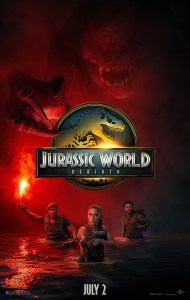
“Rebirth” might be a bit optimistic in that title. The issue with the still-quite-popular Jurassic Park/World franchise is an ongoing lesson in diminished returns. Back in 1993, Steven Spielberg and special effects breakthroughs enchanted audiences on the peril of man’s hubris and the core love and undying appeal of dinosaurs getting to be wrecking machines. Thanks to the marvels of modern big-budget blockbusters, we can bring realistic dinosaurs back to life for perilous adventures in survival, but much like the famous line, the producers eager to crank out a new Jurassic movie every so many years only focused on whether they could and not whether they should. The movies are still significant moneymakers; the worst film in the franchise, 2022’s Dominion, still made over a billion dollars at the global box-office. Just imagine how much that could have raked in if it was actually, you know, good. Jurassic World touched upon the nature of diminished returns through satire, that audiences that were once wowed by the very presence of real dinosaurs have grown bored and need more to capture their flagging interest. Since then we’ve had a movie about dinosaurs eating the rich in a haunted house-style horror-thriller and a nostalgic-heavy conclusion that was more about giant locusts and far less about dinosaurs cohabitating with mankind. The interesting storyline (man co-existing with dino) has been there for multiple movies, and yet the producers keep neglecting that glorious potential. Now here comes Jurassic World: Rebirth, another attempt to keep this franchise chugging along with more mediocre sequels that have fleeting moments of popcorn thrills. Ultimately, it’s a bit more of the same, and like the characters in this world, I too am growing restless.

There are two groups of characters that we follow. The first is a clandestine science team funded by a large pharmaceutical company looking to create the next big drug as a result of studying dinosaur blood and tissue. This is the familiar movie world of quippy security experts and ex-CIA agents and panicky scientists thrust into danger in the field. The other group is a family going on a sailing trip through… dinosaur-infested waters for some reason. The first group is on a mission. The second group is just trying to survive, and possibly for the teen daughter’s boyfriend to grow on her skeptical father.
Rather than reinvention, Rebirth is once again more of the same old same old. There can still be intrigue and spectacle from simply interacting with living dinosaurs brought to life by the best special effects money can buy, so the Jurassic movies will never be without some level of primal appeal. There are some fun moments and sequences throughout Rebirth, but it’s hard to stitch together the whole movie from these minor pieces. I think the premise could have worked. The team on the mission has to track down and retrieve blood from the three biggest dinosaurs by habitat: one by land, one by sea, and one by air. There’s some flimflam excuse that these creatures have the biggest hearts and therefore the live blood they extract blah blah, but it doesn’t really matter. The premise of having to track three of the biggest dinos in different terrains makes for an episodic but varied structure that is easy to follow and engage with. All along the way, we know what the total number needs to be and the progression provides mini-climaxes. It’s just that the retrieval of all of these is completed before Act Three. That’s right, it’s all done before the movie is supposed to get really climactic and intense. The land dino isn’t even a challenge, more just an attempt to recreate the majesty of when we first saw those plodding apatosaurs in 1993. This feels like a mistake, and each of the dino retrievals should be getting moderately harder to succeed. There should be escalation so that each one feels more like an accomplishment with the team getting better not worse.

So what could be Act Three? Well you see, dear reader, this is yet another new island. I can already hear you asking how many islands there are, and the answer is however many the studio needs. This island could have been nicknamed Monster Island because it was the dinosaur experimentation labs. Here’s where the InGen scientists threw darts at a board and said, “What if you mixed a [anything] with a raptor?” That seemed to be their go-to for these sequels. We’re introduced into mutant T-Rex in the opening, presented like a monster lurking in the shadows, and then we come back to our giant lab-designed monstrosity. Except this is the silliest looking dinosaur mutant. I laughed out loud when I saw its full form. It made me think of the xenomorph and human hybrids from Alien Resurrection. Its head is so bulbous like he’s part mushroom, but there’s no contours or anything menacing like spikes or something evolutionary useful. It’s just a big goofy head. This is the kind of dinosaur that would be made fun of by the other dinosaurs who snicker when his considerable back is turned. It has larger forearms but walks with them like a hunched gorilla. A T-Rex was already frightening because of its size, as evidenced during one of the movie’s better sequences where a normal T-Rex chases after the beleaguered family in a raft. This just made the T-Rex’s head comically oversized, like somebody glued a shower cap on this guy. This guy has a bigger head but it doesn’t mean bigger brain. It makes for a rather perfunctory and silly ending fighting against a disappointing dino Frankenstein. We shouldn’t have held our expectations too high considering this mutant’s lab breakout all stems from a lone Snickers candy wrapper getting loose.
The characters are also pretty disposable and strictly archetypal. Scarlett Johansson (Fly Me to the Moon) is the lead as our quippiest ex-CIA agent, more or less playing a version of her Marvel persona. She has a slight arc about joining the mission for the money and being convinced by the idealistic head scientist (Jonathan Bailey) to release the medical information to the entire planet. I don’t think this is as hopeful as the characters think because it seems like you’re also making it so plenty more mad scientists have access to dino DNA to make their own at-home Jurassic Parks. The other lead character is played by Mahershala Ali (Leave the World Behind) as the boat captain who provides the movie with the most disposable of characters so that the dinosaurs have something to feed upon. It doesn’t seem like a coincidence that the one lost family is gifted a dinosaur baby that they trot around like an adorable puppy. That thing’s going to get extremely big and I don’t know if anybody is going to be able to pick up after it. I wouldn’t say any of these characters are memorable or even that likeable, mostly stars coasting on charm autopilot.
I didn’t know where else to put this but I loathed every time the Jurassic Park musical themes would start to trinkle into a scene, especially since so many of them are perplexing. Why would you insert that familiar theme over this scene? It’s intrusive, tone deaf, and just a bizarre creative choice.

It’s hard to really see the added value of returning veteran screenwriter David Koepp (Black Bag) and new director Gareth Edwards (Godzilla, The Creator). This whole enterprise feels a bit like a runaway train rushing to meet its release date deadline. The development needed for a relaunch seems to go by the wayside so that we can squeeze in more set pieces, and I suppose two sets of characters equal always having a new and fraught action sequence we can jump to. It’s just that everything feels so rote and familiar, so much of the same kinds of thrills and chills we’ve gotten from the previous six movies. The most exciting development across these new movies since 2018 has been the reality of humans having to adapt to an Earth with dinosaurs in our ecosystems, and yet this again is hand-waved away in exposition that limits the dinosaurs to a much smaller band of the Earth. Turns out they only really live around the Equator now. Okay, if that’s the case, then tell me a story from that setting. It can still be done. Jurassic Park: Rebirth doesn’t feel like the start of something new or exciting or even promising. It feels like more of the same, sliced and cut up with different actors getting their turn to make frightened faces. It’s not as bad in design or execution as Dominion but Rebirth is no more than more of the same.
Nate’s Grade: C
Share this:

Rogue One (2016)
 In the opening text crawl for Star Wars Episode IV: A New Hope, it says, “During the battle, Rebel spies managed to steal secret plans to the Empire’s ultimate weapon, the Death Star.” Disney, in its infinite wisdom to cash in on every potential resource of its lucrative cash cow, has decided to devote a whole movie to that one sentence in that initial crawl. I can’t wait for each sentence to get its movie. Rogue One: A Star Wars Story (in case you’d forget) is the first film outside of any of the trilogies and much is at stake. Not just for the rebels but for Disney shareholders. If a wild success, expect future tales coming from every undiscovered corner of the Star Wars universe. And if Rogue One is any indication, that’s exactly the kind of artistic freedom needed to blossom.

Not actually in the finished film.
Jyn Erso (Felicity Jones) has plenty to rebel against. Her father (Mads Mikkelsen) was forced against his will by Orson Krennic (Ben Mendelsohn) to work on a fiendish death machine for the Empire. Jyn’s father is responsible for designing the Death Star. Jyn is broken out of imperial prison by Cassian (Diego Luna) for the Rebellion. They want her to track down her father, find out whatever she can about this new fangled Death Star, and if possible, retrieve the plans on how it might be stopped. Her mission will take her to the ends of the galaxy to reunite with her father and to provide hope to the Rebellion.
Finally after many films we finally get a war movie in a franchise called Star Wars, and it’s pretty much what I wanted: a Star Wars Dirty Dozen mission. It’s thrilling to go back to the height of the resistance against the Evil Empire and see things from a ground perspective with a skeleton crew working behind the scenes. We may know the future events of those Death Star plans but we don’t know what will befall all of these new characters. Who will make it out alive? The open-and-shut nature of this side story in the Star Wars universe brings a bit more satisfaction by telling a complete story. This film will not have to wait for two eventual sequels years down the road in order for an audience to form a comprehensive opinion. I welcome more side stories like Rogue One that expand upon the fringes of the established universe and timelines, that establish colorful new characters and tell their own stories and come to their own endings, and hopefully don’t feature any more Death Stars (more on this below). It seems like it was ages ago that major studio tentpoles just attempted to tell a single, focused story rather than set up an extended universe of other titles to nudge along their respective paths. Director Gareth Edwards (2014’s Godzilla) is less slavishly loyal to the mythos of the series than J.J. Abrams. His movie doesn’t feel like flattering imitation but its own artistic entry. The cinematography is often beautiful and the natural landscapes and sets provide so much tangible authenticity to this world. Edwards has a terrific big-screen feel for his shot compositions and achieving different moods with lighting. He knows how to make the big moments feel bigger without sacrificing the requisite popcorn thrills we desire.
 Rogue One has to walk a fine line between fan service and its own needs. While it’s fun to see Darth Vader on screen again voiced by the irreplaceable James Earl Jones, it’s also a bit extraneous other than some admittedly cool fan service. We don’t need to see Vader clear out a hallway of Rebel soldiers but then again why not? It’s the same when it comes to the inclusion of cameos from the original trilogy. Some are minor and some are major, achieved through the uncanny valley of CGI reconstruction. Gene Kelly may have danced with a vacuum cleaner and Sir Lawrence Oliver and Marlon Brando both appeared as big floating heads after their deaths, but this feels like the next step beyond the grave. There’s a somewhat ghastly feel for watching a dead actor reanimated, so your sense of overall wonder may vary. The cameos are better integrated than the Ghosbusters ones.
There’s a great cinematic pleasure in putting together a team of rogues and rebels. The characters on board this mission have interesting aspects to them. Chirrut Imwe (Donnie Yen) is a blind warrior and aspiring Jedi. He feels like he stepped out of a great samurai movie. He uses his connection with the Force to make up for his lack of visual awareness, and Chirrut demonstrates these abilities in several memorably fun instances. There’s a world of back-story with Saw Gerrera (Forest Whitaker), a dotty wheezing warrior who is more machine than man at this point. Whitaker gives an unusual performance that reminded me of a kindlier version of Dennis Hopper in Blue Velvet. The reprogrammed robot K-250 (vocal and motion-capture performance by Alan Tudyk) is a reliable source of catty comic relief and I looked forward to what he was going to say next. The first 40-minutes is mostly the formation of this group, and it’s after that where the movie starts to get hazy. We know how it’s all got to end but the ensuing action in Act Two feels a bit lost. This may have to due with the reportedly extensive reshoots that were done last summer to spice up the movie (much of the earliest teaser footage isn’t in the finished film). I’d be fascinated to discover what the original story was from Chris Weitz (Cinderella) and just what rewrites Tony Gilroy (Michael Clayton) performed so late into its life. For much of the second act, the characters feel a bit too subdued for the life-or-death stakes involved, and that translates over to the audience. We travel to different locations throughout the first two acts but I can’t tell you much about them other than some intriguing mountainous architecture. The plot is a bit too undercooked and still obtuse for far too long, requiring our team to bounce around locations to acquire this person or that piece of information. Rarely do the characters get chances to open up.
 It all comes together in the final act for a 30-minute assault that makes everything matter. It’s a thrilling conclusion and the movie finds a way to keep escalating the stakes, bringing in powerful reinforcements that force our Rogue One crew to alter their plans and placement, while still clearly communicating the needs of each group and the geography as a whole of the multiple points on the battlefield. It’s what you want a climactic battle to be and feel like where each player matters. It’s also a welcome addition to the Star Wars cannon, as we’ve never seen a beach assault before. It feels like a new level that was unlocked in some video game, and that’s no detriment. The ending battle has different checkpoints and mini-goals, which allows for the audience to be involved from the get-go and for the film to jump around locations while still maintaining an effective level of suspense. Many of these characters make something of a last stand, and you feel the extent of their sacrifice. I read in another review that the reason Jyn and her rogues win is because they accept that they are replaceable, and Orson Krennic fails because he made the mistake of believing himself irreplaceable. I think that’s a nice summation about the nobility of sacrifice. I won’t get into specific spoilers but I was very pleased with the ending of the film even though it’s not exactly the happiest. It feels like a fitting ending for the darker, grittier Star Wars tale and it provides earned emotional resonance for the setup of A New Hope, which this movie literally rolls right into.
With as many fun and potentially interesting characters aboard for this suicide mission, it’s somewhat surprising that they are also the film’s weak point. Beyond simple plot machinations like Character A gets Character B here, I can’t tell you much more about these rogue yet noble folks other than their superficial differences. Take for instance the Empire turncoat, pilot Bodhi Rook (Riz Ahmed) What personality does he have? What defines him? What is his arc? What about Cassian? He’s supposed to secretly assassinate Jyn’s father if given the chance, but do we see any struggle over this choice? Does it shape him? Does his outlook define his choice? Can you describe his personality at all whatsoever? What about the villain, Krennic? Can you tell me anything about him beyond his arrogance? What about Baze Malbus (Wen Jiang), who carries a big gun and is close friends with our blind wannabe Jedi. Can you tell me anything about this guy beyond that? Even our fearless leader, Jyn Eros, feels lacking in significant development. She wants to find her father, get vengeance, but then changes her mind about sacrificing for the greater cause of hope. Many of the character relationships jump ahead without the needed moments to explain the growth and change. The original trilogy was defined by engaging characters. When you have a ragtag crew of six of seven rogues, you better make sure each brings something important to the movie from a narrative perspective, and not just from a pieces-on-the-board positioning for action. Look at Marvel’s Guardians of the Galaxy for tips. If this was going to be a powerful and emotionally involving war movie, the characters needed to be felt deeper. All too often they get lost amidst the Star Wars debris and then they become debris themselves. Ironically enough, Rogue One has the reverse problems of The Force Awakens, a movie that benefited from engaging characters but sapped from an overly familiar and cautious story. It’s telling when my favorite character, by far, is a sassy comic relief robot.
 Let’s talk about the Death Star in the room, namely the fact that over the course of eight Star Wars movies there have been Death Stars, or the construction thereof, in five of them (63% rate of Death Star sighting). We need a break. You can cal it a Star Killer Base whatever in Force Awakens but it’s still a Death Star in everything but name. I can’t even put a number to the amount of money it cost the Empire/First Order to build these things, plus the review process to try and correct design flaws that never seem to get corrected. At this point it feels like this model just isn’t cost-efficient for its killing needs. What about a more mobile set of multiple mini-Death Stars? I hope that the filmmakers for the new trilogy (Rian Johnson, Colin Trevorrow) refrain from putting another similar planet-killing space station-type weapon into their movies as we’ve had enough. However, the use of the Death Star in Rogue One was perfectly acceptable because it already fit into the timeline of the first film. I also greatly appreciated the clever retcon as to why the Death Star had its fatal flaw. It took a bothersome plot cheat from 1977 and found a gratifying and credible excuse. Now when Luke blows up that sucker it’ll have even more resonance.
Rogue One is a Star Wars adventure that feels like its own thing, and that’s the biggest part of its success. By being a standalone story relatively unencumbered by the canonical needs of hypothetical sequels, the movie opens up smaller stories worth exploring and characters deserving a spotlight. This is an exciting and entertaining war movie, and the kind of film I want to see more of in this multi-cultural universe. It’s not a faultless production as the lackluster character development definitely hampers some audience investment. I wish more could have been done with them before they started being permanently taken off the board. While Rogue One is looking to the past of Star Wars it still makes its own independence known. I hope this is the start of a continuation into exploring more of that galaxy far far away without the required additions of every Skywalker and Solo in existence. It’s a far bigger universe and it needs its close-up.
Nate’s Grade: B
Share this:

Godzilla (2014)
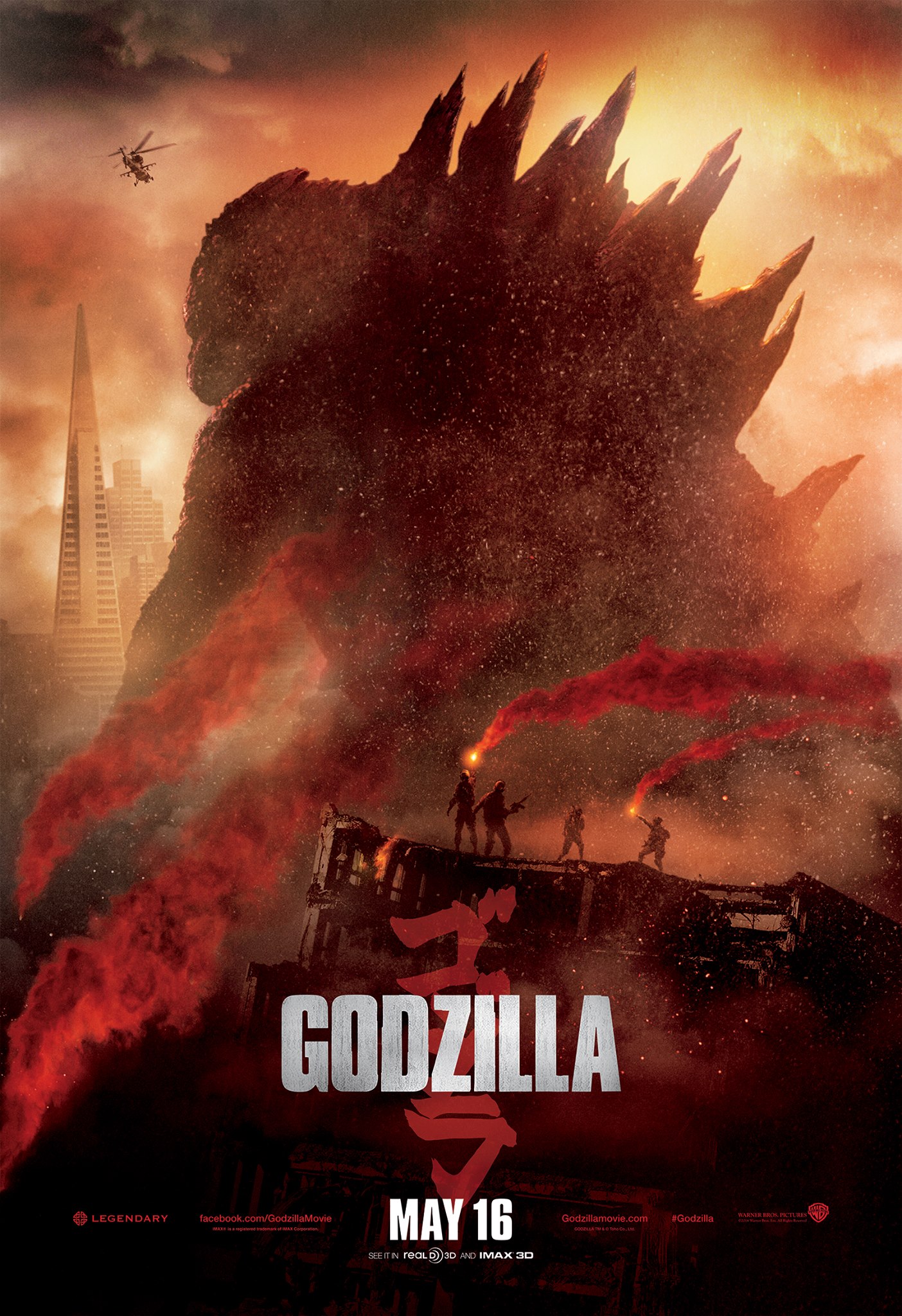 When it comes to the monsters of cinema, it’s hard to beat out Godzilla, and not just because, you know, he’s hundreds of feet high and can breath fire. The famous monster began as a cautionary tale about nuclear weapons, destroying man’s hubris and often the good people of Tokyo. The legendary beast has been hibernating as such since 1998’s not-so-spectacular big-budget return, a film that the Japanese loathed. But like all ancient being, Godzilla has been resurrected again and given a splashy new coating of CGI devastation. If only the filmmakers had decided to leave out the humans and make Godzilla the rightful star.
A scientist (Bryan Cranston) warns the Japanese government of a massive impending danger. The offspring of a giant creature, a Massive Unidentified Terrestrial Organism (MUTO), has hatched and heading straight for the United States coastline. Attracted by nuclear power, the U.S. military tries to lure it away from populated centers. Ford Brody (Aaron Taylor-Johnson) is witness to the monstrous destruction and just wants to get back home to his wife (Elizabeth Olsen) and child in San Francisco, exactly where the creature is headed. There’s also the emergence of an older creature, one that has taken to combating the MUTOs to the death. This is the legendary Godzilla.
The big guy is back in a very different approach from 1998’s Godzilla (i.e. “better” approach). Director Gareth Edwards (Monsters), an avowed Godzilla fan, has made a reverent big-budget ode to the king of all monsters; however, the resulting film is more of a disaster epic than a monster brawl. The perspective is often framed at the human-level, which grounds the film from going too overboard into disaster porn territory like, say, Man of Steel. The effect is thrilling and adds a greater sense of verisimilitude to the mass chaos and destruction. It reminded me in some ways to 2008’s Cloverfield, where a group of characters is just trying to survive the periphery of all the collateral damage of a giant monster. There are sequences that directly relate to Fukushima as well as the tsunami from 2004. It’s almost like somebody watched the stirring movie The Impossible and said, “Yeah, give us some of that in our giant monster movie.” I don’t know if these sequences are entirely necessary. Watching Ford carry around a little Japanese tyke, wondering where his parents might be amidst the confusion post-monster attack, it relates to our modern response to tragedy and worldwide disaster, but do you really want to watch Ford have to find this kid’s parents? If there is a commentary to be found in the movie, it’s the uncontrollable and destructive power of nature pushed to the brink by mankind’s own energy crises. After all, the MUTOs are attracted to and strengthened by consuming nuclear energy. Godzilla is argued to be an “alpha predator” but also a figure to bring balance back to nature. I think it means that there can be only one giant monster and Godzilla is going to eliminate the competition.
 But the real question of any giant monster movie is the degree of satisfying, smash-em-up fun it provides, and the new Godzilla is a mostly agreeable venture. The action sequences, mostly saved for the climax, are cool and well thought out, but Edwards proves to be a brilliant visual stylist than a composer of action. This is a movie where the moments stand out better than the action. Edwards’ command of cinematic visual arrangements is at Spielberg levels of being a natural showman. I can easily think back on small moments, images that pop, visual reveals that are executed with aplomb, far more so than a central example of an action piece. I loved the horror-esque reveal of the elevated train being on track to head right for the MUTO. I loved the hide-and-seek nature of Ford waiting for the MUTO to pass. I loved when Ken Watanabe’s advice was literally just, “Let them fight” (I started chanting it in my seat). My favorite part of the movie is actually what was previously shown as a teaser trailer, namely Ford and several other paratroopers diving into the destructive city scene. The eerie hum of the 2001: A Space Odyssey monolith plays over, each man has a red flare streaking from their leg, and we watch them quickly descend through the sky, nervously awaiting what is on the other side of those heavy clouds, only to discover a city on fire, glowing like a hearth, and through the goggles, a monster fight taking place. The entire sequence is a visual standout, a thrilling set piece, and a reminder that Edwards has more on his mind.
Edwards does a lot of intentional teasing of Godzilla, so much so that it can get frustrating for an audience. I understand he’s building to a payoff reminiscent of Jaws; we’ve been teased for so long that we will go nuts when we finally see Godzilla in full glory, and it works. However, it also works as a detriment. There are several points in the film where it looks like we’re about to get some exciting Godzilla/MUTO action, or even just a MUTO wrecking havoc, and then the film cuts away, often to news footage. It’s a choice that begins as artistically clever but can become maddening in time. There is a lot of visual obfuscation throughout the film, far more so than the same compliant I had with last year’s Pacific Rim. Edwards will show Godzilla’s tail just swinging behind a building, or his colossal foot coming down with authority, or the wispy shadow of giants in billowing clouds of smoke. All those near misses can add up to cinematic blue balls. And so much of the action and destruction happens at nighttime, leading to a dour color palette heavy in grey and dark blacks, making the good stuff all the harder to see. I cannot even fathom why someone would want to see this film in 3D with those darkened glasses. It’s 90 minutes of foreplay that you may start to grow restless that we’re getting a Godzilla movie that will never show the goods (shouldn’t Godzilla be in a Godzilla film?)
 The problem with a disaster movie on a human-scale is when you don’t give a damn about any of the human characters. Now, Godzilla should be the star of any Godzilla movie but I understand execs fearing that their monster movie needs some relatable human drama. The problem is that the writing doesn’t do anything with these characters, forcing them into tidy and token roles that we’ve come to expect from large-scale disaster movies. Did anyone really feel anything about whether Ford would get back to his wife and child? Did anyone feel anything for anyone in this movie, beyond a slight reservation whether they would be squished, if even that? I’m not expecting three-dimensional characters here but even Roland Emmerich films do a decent job of establishing a milieu of people at various points of the globe we know will somehow coalesce together. There is so little effort to mask the character’s grand design: exposition mouthpieces, symbols of military threats, the noble family man, the beleaguered and crying wife. Seriously, there is a great cast of actors in this movie and they are given nothing to work with. Olsen (Oldboy) gets to look realistically scared and cry but she deserves so much better. Cranston (TV’s Breaking Bad) gets all the best yell-worthy lines. But it’s really Taylor-Johnson (Kick-Ass 2) who suffers the most since he’s placed as our impassive stand-in for a human protagonist. He’s so blank throughout the film and there’s little charisma to pull you in. His character, and the performance, feels no better than an elevated extra, Grunt #13. When we have to spend 90 minutes with these lackluster characters rather than some awesome monster fights, that’s when the film flounders.
I’m conflicted about the end results of Godzilla, an entertaining, surprisingly artistic film that can nail small moments of cinematic grandeur but has trouble matching its vision. The human-scale approach grounds the action, but do we want a giant monster movie grounded from a limited vantage point? The constant teasing builds a payoff for finally seeing Godzilla, but don’t we want more actual Godzilla in a film bearing his name? The human-scale, as well as the slow dodging of showing Godzilla, mean the storytelling emphasis is on an array of human characters, but what happens when they are poorly written, poorly developed, and lacking in charisma? The movie does more right than wrong but I’m left with the unmistakable feeling that, while a step in the right direction, there is too much self-sabotage holding back the movie. It actually made me re-evaluate and appreciate Pacific Rim even more. I can’t say this movie is nearly half the fun as Rim was. The monster design of the MUTOs is rather lacking, resembling a cross between the monster from Cloverfield and more patently the arachnid aliens of Starship Troopers, down to the heads that look like staple removers. Edwards has proven himself a big screen talent with a terrific feel for grandiose visual spectacle. I just hope if there is a sequel that we can skip all the slow buildup and just get to the main event – Godzilla beating the crap out of some other lesser yet still giant monster.
Nate’s Grade: B


 nathanzoebl
You must be logged in to post a comment.