Blog Archives
Alien: Romulus (2024)

I will maintain that over the course of forty years that there have been no bad Alien movies. While 2017’s Alien Covenant gets the closest, I think each of the four Alien movies from 1979 to 1997 are worthy of praise for different reasons. The Alien franchise is unique among most sci-fi blockbusters in that each of its movies feels so radically different. The groundbreaking first movie is the hallowed haunted house movie in space; the 1986 sequel set the foundation for all space marine action movies, with Sigourney Weaver earning a Best Actress nomination, a real rarity for any sci-fi action movie; the much-derided third film from 1992 is much better than people give it credit for, and while flawed it has really intriguing ideas and characters with a unique setting and a gutsy ending; the fourth film from 1997 might just be the most fun, going all-in on schlocky action and colorful characters. Each of them is different with a style and tone of their own, and each is worthy of your two hours. Enter director/co-writer Fede Alvarez’s Alien: Romulus, meant to take place between the fifty-year time span between Alien and Aliens. It was intended to be a Hulu streaming movie but got called up to the big leagues of theatrical release, and while it has some underwritten aspects and clunky fan service, Romulus is another worthy sequel for a franchise that admirably keeps marching to its own beat.
It’s 2142 and life on an off-world colony isn’t exactly the adventure advertised. It’s a mining colony that’s slowly poisoning its huddled masses. Rain (Cailee Spaeny) has just finished her two-year contract only to be informed by her greedy company that, because of worker shortages, she’s locked in for another two years of indentured servitude. She’s also in charge of her adoptive brother, Andy (David Johnsson), a malfunctioning android that her late father reprogrammed. An ex-boyfriend comes back into Rain’s life with a plan: there’s an old derelict research station that they can scavenge and retrieve the cryo chambers, which can make long-term travel to a new life in a new system a possibility. There’s also a catch: they need Andy because only he can open the ship’s locked gates. The ragtag crew flies out to the derelict ship orbiting a ringed planet and, of course, discovers far more than they bargained for as the ship, of Weyland-Yutani origins, is crawling with face-hugging fiends just waiting for new faces.

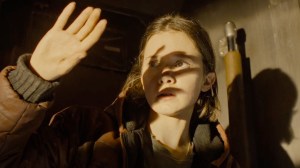
Despite my grumbles, I found Alien: Romulus to be a very entertaining new entry that had the possibility of genre greatness. The setting and central character dynamic are terrific. The Alien franchise hasn’t exactly been subtle about its criticisms of multi-faceted corporations and their bottom-line priorities, but it’s even more effective to see the dinghy world of this mining colony. It’s a bleak existence of dystopian labor exploitation and you get an early sense of the desperation that motivates the characters to flee at any opportunity. Eventually, the evil corporation’s big plans for the “perfect organism,” a.k.a. the xenomorph, are to replace the depleting labor force. Humans, it turns out, aren’t built to work in space long-term, and the human cost is felt effectively in Act One. Another key part of what made the movie so immediately engaging for me is the sweet surrogate brother-sister relationship between Rain and Andy. He’s vulnerable, an older android model who needs some repairs, but he’s loyal and kind and loves pun-heavy jokes. This central relationship hooked me and gave me something to genuinely worry over as things get more dire, and it’s not just the scary aliens. Once onboard, Andy uploads the programming of a different android, and the competing objectives make him become a different person, all wonderfully played by Johnsson, who was supremely appealing in Rye Lane. While literally every other character is remarkably underwritten (this one doesn’t like robots, this one is pregnant, this one is… Buddhist?), the genuine bond between Andy and Rain grounded me.
Romulus also has some sneaky good set pieces that kept me squirming in my seat or inching closer in excitement. Alvarez (Don’t Breathe, Evil Dead) can concoct some dynamite suspense sequences and knows how to draw out the tension to pleasingly anxious perfection. This is the best Alien movie yet to really sell the danger of the springy face-huggers. There’s a taut sequence where the humans have to slow their movements to walk through a face-hugger minefield lest their spike in temperature alert the deadly creatures. There’s another later sequence that ingeniously utilizes space physics to escape the xenomorph acid blood. I loved how well it was set up and then the fun visuals of zero-gravity acid blood. The practical effects make for lots of great looking in-camera effects, and the production design is incredibly detailed while achieving a chilling overall mood of dread. Alvarez leans upon the visual frameworks of Ridley Scott and James Cameron, as who doesn’t, but finds ways to make his Alien movie his own. I really appreciated the dedication to the sprawling vistas of space, like extended shots outside the ship that really translate the sheer majesty and terrifying scale of space. The last-second threat of demolition is made all the more arresting by crashing into the rings of the planet. I think most people confuse a planet’s rings like it’s some kind of water vapor when instead it’s like a crowded highway of debris.
However, there are some misguided nods toward fan service that go overboard and become groan-inducing. There’s a fine line between homage and back-bending fan service, and Romulus skirts over occasionally into the dangerous territory, given over to references to the other movies that lack better context to make them anything more than contrived callbacks. Take for instance a triumphant killing of a xenomorph where a character utters, “Get away from her,” which itself would have sufficed, as any Alien franchise fan knows this reference point. Then the character continues, in an awkward pause, almost stumbling over the words and translating the awkwardness directly for us, as they add, “…You bitch.” Why? Why would this character need to say this exact same line (although, timeline-wise, this is now the first use of the phrase as Ripley is still in hypersleep)? The moment doesn’t call for this specific line; it could have been anything else, but they made it the line we all know from Aliens. There’s also the familiar ending where the characters think they’ve won and, wouldn’t you know it, there’s one more tussle to be had with a xenomorph who has snuck onto the escape ship. I’m less bothered by this continuation as it’s almost a formula expectation for the franchise at this point, though keeping Rain in her sleeping undies for the final fight seems like another unnecessary nod to the 1979 original. They even tie back the mysterious black goo from the Engineers via Prometheus, though as a vague power-up when, if I can recall, it was a biological weapon of mass destruction, but sure, now it’s a power-up elixir.
But the worst and most misguided act of fan service is where the movie literally brings a performer back from the dead (some spoilers ahead, beware). When Rain and the gang stroll through the derelict company ship, they discover the upper torso of a discarded android, like Ash (Ian Holm) in the original Alien. Not just like Ash because for all intents and purposes it is Ash, as the filmmakers resurrect Holm (who passed away in 2020) and use Deepfake A.I. technology to clumsily animate the man. This isn’t the first instance of a deceased actor brought back to screen by a digital double, from Fred Astaire dancing with a mop to Peter Cushing having a significant post-death supporting role in 2016’s Rogue One. Here’s the thing with just about all of these performances: they could have just been a different actor. Why did it have to be Grand Moth Tarkin (Cushing) and not just any other obsequious Empire middle manager? With Alien: Romulus, why does it have to be this specific version of an android when it could have been anyone else in the world besides the dearly departed Holm? I just can’t comprehend why the filmmakers decided to bring back Holm in order to play A DIFFERENT android who isn’t Ash but might as well be since he’s also been torn in half. Why not have the android be another version of Andy? That would have presented a more direct dichotomy for the character to have to process. The effects reanimating Holm are eerie and spotty at best, apparently built from an old scan from The Lord of the Rings. It’s just a distracting and unnecessary blunder, the inclusion of which can only be justified by trying to appeal to fans by saying, “Hey, remember this character? Even though he’s not that character. Well. Here.” We used to readily accept other actors playing the same character before the rise in technology. Nobody watching The Godfather Part II wondered why Robert DeNiro wasn’t a slimmed-down Marlon Brando.

As an Alien movie, Romulus starts off great and settles for good, but it still has several terrific set pieces, its own effectively eerie mood and style, and a grounded character dynamic that made me genuinely care, at least about two characters while the others met their requite unfortunate ends. It doesn’t have the Big Ideas of a Prometheus or the narrative arcs of Aliens, or even the go-for-broke schlock of Alien Resurrection, but Romulus delivers the goods while also feeling like its own movie, a fact I still continue to appreciate with the Alien franchise. It’s an enjoyable genre movie that fits in with the larger franchise. I wish some of the clumsy nods to fan service, especially the resurrection of a certain character, had been reeled back with more restraint to chart its own course, but it’s not enough to derail what proves to be a winning sequel.
Nate’s Grade: B
Share this:

The Girl in the Spider’s Web (2018)

The Girl with the Dragon Tattoo was an international best-selling trilogy that gave way to three hit Swedish movies, one Hollywood remake that netted a Best Actress nomination, and millions in worldwide revenue. The problem was that its author, Stieg Larsson, died of a heart attack in 2004, before the publication of any of the original novels. The property was too valuable to simply collect dust and thus a new author came aboard to tell further adventures of Lisbeth Salander, the pint-sized Gothic avenger. A new set of novels began being published in 2015, and after David Fincher’s 2011 version underperformed at the box-office, it seemed expected to reboot the franchise with a new big screen story that had yet to be adapted. In steps a new director, a new dragon-tattooed lady for The Girl in the Spider’s Web. Unfortunately, my fears have come true and the eventual reckoning has happened: they have made Lisbeth Salander boring.
Lisbeth (Claire Foy) is thrown into another criminal conspiracy with shadowy forces at play. A network of high-powered assassins, known as “spiders,” has stolen a dangerous technology that will allow the user control of nuclear arsenals. Lisbeth is hired to retrieve this tech, betrayed, and then on the run from Swedish authorities, professional killers, a dogged NSA operative (Laketih Stanfield), and the head of this cabal, Camilla Salander (Sylvia Hoeks, Blade Runner 2049), her long lost sister Lisbeth left behind years ago.

In her first 2010 outing, Salander was presented as a complex, emotionally withdrawn figure, eminently capable but flawed, hurt, and looking to punish others from her fraught history with terrible men. Strip away all the Gothic trinkets and camouflage, her assertions of identity, and she’s still a deeply intriguing human being. However, even the latter Swedish films started veering in this more derivative direction. As I wrote presciently with the second Swedish Dragon Tattoo movie back in 2010: “We project the interest we felt for her from the first film to the Salander stand-in represented in the second film. She’s still a resourceful, loyal, and cavalier presence, but the plot corners her into being a creature of action. She becomes the fantasy bisexual ass-kicking protagonist that was merely hinted at previously. That sounds like a good thing, but trust me, it does the audience a disservice to box in such a fascinating character.” With Spider’s Web, Lisbeth Salander has become a Gothic Jason Bourne spy figure, and as anyone who has seen the Bourne movies can attest, he’s the most boring character in his own movies, which is why he needs to be kept constantly on the move and hunted. He’s only interesting when he’s getting out of jams, and Lisbeth is now sadly in that realm.
Lisbeth has been reduced to her most essential, and most superficial, characteristics, which also go for the film as a whole. The Dragon Tattoo series began as a twisty investigative procedural with a litany of suspects and dark secrets worth killing over. From there, the Swedish films turned Lisbeth into an indestructible Terminator capable of getting the drop on anyone and axe-fighting oversized men. The Swedish series began more grounded as a mystery/thriller and suddenly, and regrettably, transformed into a preposterous Hollywood-style action-thriller, following the edict of bigger being better. That same mentality has carried over past Larsson’s contributions, and now Lisbeth has become an action superhero and the series has become trashy fun, high-calorie junk food, a safe excursion to a seedy underbelly. The Girl in the Spider’s Web still provides a consistent degree of entertainment, but it’s not playing at a higher level, content to hand-wave away its story for cool chases and fights. It’s the kind of movie where, to escape an encroaching fireball, Lisbeth dives into a bathtub of water. It makes for a visually interesting shot but it’s pretty cliché 90s action movie stuff. Director Fede Alvarez has a slick handle with visuals and evidenced real talent at sustaining and developing tension with 2016’s Don’t Breathe. He has obvious visual talent. There are some engaging fights, like a close-quarter struggle in a bathroom, and some nifty chase scenes, like a motorcycle chase over a frozen lake. I would have liked even more action if Spider’s Web was going to brush aside narrative and moral complexity for stylish set pieces.

The story of The Girl in the Spider’s Web feels like a lukewarm repackaging of spy clichés, and the film does little to make any of it feel important or relevant. There’s a super powerful technology that everyone wants, which falls into the wrong hands, and now it’s about retrieving this device and saving the world. That’s like the plot of just about every James Bond movie. It’s a formula, but where Spider’s Web missteps are that it doesn’t add anything else to this staid foundation. There are scenes but it’s usually about this group going after this group, or this group now going after this group, and without wider relevance it becomes redundant plot placeholders, something meant to distract long enough to get our characters from Point A to Point B. With a mystery, there’s a natural momentum that builds as the case builds coherency and the investigation focuses the direction. With action thriller mode, Spider’s Web just has a bunch of guys that occasionally interact until the movie needs some of them dead. This model by itself can work but it requires concerted effort, and that just isn’t present here.
The most interesting aspect of Spider’s Web is the further examination on Salander’s troubled upbringing, this time introducing a sister that has been plotting vengeance. Salander is, first and foremost, the selling point of this franchise; she is, after all, the titular girl with that particular tattoo. She is what separates this from any other paperback thriller. The Swedish sequels opened up her past traumas with her Soviet-defected father. He was the Big Bad Man behind the scenes trying to institutionalize and neutralize her. While skirting into the above-stated dangerous territory, the Swedish sequels still knew that Lisbeth Salander’s complicated history was the real mystery the audience craved, and it set up a series of antagonists ready to be foiled for years-in-the-making payback. I don’t really know how the events of Spider’s Web gibe with the overall series. I had to look up whether the evil father in the opening was the same evil father in the other films (both are listed as Alexander Zalachenko, so I think so). But the established history has Lisbeth committed after trying to set dear old dad on fire to save her abused mother. I don’t see how any of that is likely if she escapes her father’s clutches as a pre-teen and is supposedly on the run. The secret Salander sister revelation also impacts little. She was the one left behind, whose continued abuse and degradation are strongly referenced. It doesn’t feel like Lisbeth harbors great guilt over leaving her sister behind. During their final face-to-face, Camilla actually poses a worthy question: “Why did the woman who hurts men who hurt women never come back and save her own abused sister?” Because this storyline is flagrantly underdeveloped, the evil sister angle is a cheap twist. There’s nothing to the Camilla character, so she serves as a symbol of shame, and yet the movie doesn’t seem to capitalize on this in the slightest, which is a puzzling disservice.

Foy (Netflix’s The Crown, First Man) is having a big year for herself but feels slightly miscast. She never really gets an opportunity to show off her range, which is a byproduct of the streamlined, reductionist screenplay emphasizing bare plot mechanics. She is missing the intensity or fire that we’ve seen in prior Salanders, breakout-star Noomi Rapace and the Oscar-nominated Rooney Mara. When Foy tries for glower you see the effort. She’s more grumpy than tortured, like maybe she skipped a meal. Even with the requisite piercings, tattoos, and black leather wardrobe, Foy seems a bit too clean-cut for the part. Personal admission: Foy with her sharp bangs, saucer-eyes, facial shape, and Gothic accessories, looks remarkably like an ex-girlfriend of mine from the early 2000s. That was something that kept sneaking into my mind throughout the film, which made the experience a tad stranger as if I was imagining an ex engaged in action heroics. Even excusing that personal connection, Foy ranks a distant third place for the Girls With.
The new Dragon Tattoo movie will likely also be its last. I can’t imagine fans getting too much pleasure out of a streamlined, underdeveloped spy thriller that sands away the edge and complexity of its characters for rote action movie chases. It’s not a bad movie and it does carry moments of excitement and entertainment, but it’s also become a standard Hollywood thriller, no different than a dozen other high-tech, junky hacker thrillers. The Girl in the Spider’s Web gets caught in its own formulaic web. If Lisbeth Salander has been transformed into a standard action hero, then we don’t deserve more adventures.
Nate’s Grade: C
Share this:

Don’t Breathe (2016)
 Alex (Dylan Minnette), Rocky (Jane Levy), and “Money” (Daniel Zovatto) are a team of burglars that use security codes to break into homes. They steal materials under $10,000 to keep them below larger charges. The trio hear about a visually impaired Gulf War vet (Stephen Lang) and his thousands of dollars he keeps inside his home. The naive burglars break into his home and sneakily search for his stashed cash, but the Blind Man (that’s how he’s credited) is a far more formidable victim than they ever could have imagined, and he’s keeping his own secrets that may be worth killing for.
The suspense in Don’t Breathe is deliciously developed and tautly executed, taking a premise that sounds silly on paper and wringing every juicy suspenseful morsel out of it. The crux of this movie is dramatic irony wherein the audience knows more than the characters, and once the Blind Man is activated, so to speak, it becomes an intense game of hide and seek with the audience in on the game. Director Fede Alvarez (Evil Dead) and company have established the layout and geography of the game space, the various rooms and hallways and hiding places, and we spend significant time in every location. A haven one minute might be endangered the next, and the way out or at least a momentary escape from immediate danger might be upstairs or downstairs, or in the walls. An essential part of effective suspense is fearing what happens to your characters, and Don’t Breathe achieves this often with clever setups. There’s one scene where a character falls out a window and lands unconscious on a skylight. The glass begins to crack underneath his weight, and then we see the Blind Man in the room below, anxiously looking for his target. Then there’s also the Blind Man’s attack dog, which you forget about and then pops back up, providing a new threat that changes the dynamics of the moment. The suspense sequences change up so frequently that there’s always something new going on every few minutes. The movie’s attention even seems to alternate between Rocky and Alex and their personal obstacles when separated. The technical merits are present without being overly flashy and self-indulgent. An opening tracking shot inside the house nicely establishes the general layout of the space. Alvarez doesn’t rush his suspense set pieces either, showcasing a wonderfully natural feel for teasing out the tension to make his audience squirm in their seats. With the variety of the suspense set pieces, their clever development, the clear understanding of the geography and stakes, and a swift pacing that doesn’t allow the audience to catch its own breath, Don’t Breathe is a small-scale case study in exactly how to maximize your premise for the most entertainment.
 Don’t Breathe packs a punch and this is aided by how streamlined and clean the narrative proves to be, whittling down all unnecessary plot strands. I hated the Money character. He brought nothing to the burglary team besides perhaps some muscle (and a firearm), but I was worried that the movie was going to drag out his inevitable demise. Clearly Rocky and Alex were going to be the main participants and that meant that Money was the most expendable, and given the small number of characters, I worried he wouldn’t be given his merciful end until long into the movie. Well Alvarez must have heard my worry because Money is killed very early on, sparing the audience from dragging out the inevitable. I was appreciative but it also raised the stakes with the two remaining characters because now nobody was obviously next in line for death. A dead Money actually proves more useful than a living Money for the characters. I also appreciated that the movie didn’t dawdle when it came to setting up its trio of burglars and their goals. They’re breaking into the Blind Man’s house at about the 15-minute mark. There’s also no concerted effort at layering in larger social commentary. The economically depressed Detroit setting works to communicate the desperation of the characters, their desire to escape their trappings, and it also provides a tidy explanation for why the Blind Man can drag an unconscious girl by her hair down the middle of the road without alarm (it’s the opening image, so chill spoiler-phobes). This is not a movie that has larger things to say about The Way We Live Now, and to pretend otherwise would be a waste of valuable time. Also, having three white characters serve as the social commentary for Detroit’s ailments would seem rather tone deaf and ill advised.
 I think if the Blind Man had been a complete innocent that the movie would have been even more interesting as it forces the audience to test its loyalties and choose sides. As my friend Ben Bailey said upon leaving the theater, once they introduce a third act twist involving the Blind Man’s true goal, he ceased having any sympathy and “just needed to die.” I’ll concur mostly, but man I fell out of favor with our trio of young burglars and the best way I can explain is by making an analogy to the Howie Mandel prime time game show, Deal or No Deal. Contestants would randomly choose briefcases hoping that they contained low amounts of money, furthering the odds that their briefcase would contain a larger and joyous amount. It’s really just a game of odds and averages. It’s mildly fun but with every contestant there was a breaking point for me, a point where they really should have cashed out but instead chose to go forward against unfavorable odds. Once a contestant crossed this imagery point of no return in my mind I was rooting for their downfall (probably to just confirm that I was right all along). Horror movies are the same, and once the main characters make too many stupid decisions, then my sympathies generally gravitate elsewhere. With Don’t Breathe, the young characters have multiple opportunities to escape the house but make too many bad choices. They want to keep the stolen money above their own lives, and after the third missed chance I felt my loyalties wavering. Their first mistake was when they were casing the man’s house in broad daylight and see him walking his dog. Hello, here’s a golden opportunity to break into the home where you know he and his pooch will be absent. Why wait when they’re both back at home and needing to be dealt with? If the Blind Man had been an innocent, or even if they had simply omitted the insidious third act twist, I would have been rooting for this visually impaired war veteran to smite these punk-nosed kids but good.
Earlier this year Netflix debuted Hush, a home invasion thriller featuring a deaf protagonist. Now we have Don’t Breathe with a blind man trying to thwart home invaders. Let’s continue this trend: Don’t Taste, about a man that has to flick his tongue out to sense his hiding home invaders, or Don’t Smell, a pulse-pounding race-the-clock thriller where a scent-disabled man must match wits with attackers while his home, unbeknownst to him, fills up with carbon monoxide. It’s an easy punch line but credit Don’t Breathe for taking its potentially silly premise and treating it with deadly seriousness while still knowing how to have fun with its audience. There are several moments designed to get an audience to jolt or groan, and it all contributes to a skillful, above average experience at the movies that wears down your nerves. The film is terrifically tense, well developed, well paced, and not too stupid, veering in new directions and upping the ante with new twists to amplify the stakes. If you’re looking for a solid way to close out was has been an otherwise mediocre summer movie season, give Don’t Breathe a chance, sit back, and try to keep up with the fun.
Nate’s Grade: B+
Share this:

Evil Dead (2013)
 Upping the gore quotient considerably but having little else of merit, the remake of Evil Dead loses just about everything that made the original special. Gone is the sense of humor, unless you just count the quantity of gore to be the qualifier for “humor,” and gone is any real sense of a creative spark. It looks good thanks to director Fede Alvarez, and the practical gore effects can be memorable and truly disgusting in the best possible way, but it just doesn’t feel like an Evil Dead movie. It makes the same mistakes that your typical dumb horror movies do, from a lack of clarity to one-dimensional characters (I think Blonde Girlfriend had one line of dialogue for the first hour) to repeated rule breaking. There are a bunch of callbacks to the original Evil Dead but they serve little other purpose. The finale, after a series of fake-outs, involves a weak showdown with a Big Bad that’s anything but. I expect better from a remake sanctioned and produced by the original director, Sam Raimi, and star Bruce Campbell. Maybe they knew it was only a matter of time before their 1981 film, and its superior 1987 sequel, would be remade by a cannibalistic Hollywood, so they wanted to cash in while they could. Or maybe they just argued, if anyone was going to make a poor remake, it might as well be them. If you’re hungry for gore, then Evil Dead may suffice, otherwise it’s a horror movie that’s too familiar, too mediocre, and ultimately too disappointing to recommend.
Nate’s Grade: C+


 nathanzoebl
You must be logged in to post a comment.