Blog Archives
Marcel the Shell with Shoes On (2022)
 The feature-length movie based upon the short stop-motion films about a mollusk in sneakers, Marcel the Shell with Shoes On might just be the most precious movie of the year. It’s set like a faux documentary where a lonely filmmaker discovers a magical inhabitant in his Air B&B, a very soft-spoken little guy with a heart much bigger than his actual size. Marcel (voiced by co-creator Jenny Slate) is looking for his lost family who were unknowingly absconded when the original couple who lived in the house broke up and gathered their things quickly before storming off. Dean (Dean Flesicher-Camp, also the movie’s director) records Marcel and his innocent little observations on life and the bigger world and posts the videos online, and Marcel becomes Internet famous, for good and bad. The plot of the movie is less important than its overall gentle nature. There’s not a lot that happens in the movie, but you dont mind because it’s really an 80-minute sit-down with Marcel. The entire movie is just so sweetly innocent that it’s hard to resist. It also has some bigger things to say about our place in the world as well as mortality. Marcel has a loving yet ailing grandmother shell (voiced by Isabella Rossellini) who is beginning to lose her lucidity, and it will hit home for anyone who has watching a loved one suffer from mental decline. Marcel the Shell with Shoes On is a perfect little antidote for our modern cynical lives. It’s overwhelmingly adorable and wholesome and winsome and just plain cute.
Nate’s Grade: B
Share this:

Trial of the Chicago 7 (2020)/ Borat Subsequent Moviefilm (2020)
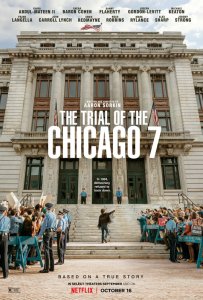 Two new movies have been released for streaming, both coincidentally starring Sacha Baron Cohen, and both are highly political, one by design and the other through fortuitous circumstances of history regrettably repeating itself, and both are simultaneously everything you would expect from their creative forces and worth watching in our tumultuous times.
The Trial of the Chicago 7 is a courtroom drama depicting the injustices applied to a dispirit group of anti-war activists who were charged with inciting a riot at the 1968 Democratic National Convention. The various men of different backgrounds and affiliations had their reasons for being there to protest, whether it was building public support to end the Vietnam War, to gain personal publicity, or to get laid, and tensions mounted inside and out the group as the police plan to send a message, harassed protesters, and in one amazingly prescient moment, remove their badges and name tags to then inflict state-sanctioned violence. This is an Aaron Sorkin movie through and through, and his second offering as a director after 2017’s Molly’s Game, and the best thing about the Oscar-winning wordsmith is that watching one of his movies feels like you’ve just downloaded a complete syllabus. The sheer audacious density of information can be overwhelming, but when Sorkin is able to get into his well-established rhythms, the actors feel like wonderful pieces in an orchestra playing to its peak. The real-life story of the activists has plenty of juicy drama and intriguing characters and intra-group conflicts breaking open, mostly between the divided poles of political leaders Tom Hayden (Eddie Redmayne) and counter-culture prankster Abbie Hoffman (Cohen). Bobby Seale (Yahya Abdul Mateen, HBO’s Watchmen) could have gotten his own movie and suffers many of the worst indignities as a member of the Black Panthers who was grafted onto the case in order to make the rest of the indicted men seem scarier by association. The consistent interference by the trial judge (Frank Langella) is shocking. It’s so transparently biased, racist, and unprofessional that I have to believe that many of these anecdotes actually happened because otherwise they seem so absurdly prejudicial that nobody would believe this happened. For a movie with such a sizeable cast of trial litigants, lawyers on both sides, friends and family, and maybe every police officer in Chicago, it’s impressive that Sorkin is able to provide so many with great Sorkin moments, meaning those grandstanding speeches, cutting one-liners, and intensive cross-examination. Not everyone is on the same level of importance. Several of the Chicago 7 are merely bodies on screen, two of the guys serve as little more than a quip-peddling Greek chorus. You sense there’s more being left out to fit into a crammed yet tidy narrative that plays to our demands for satisfying character arcs, reconciliation, and a morally stirring final stand. As a director, Sorkin doesn’t distinguish himself but he lets his meaty script and the performances of his actors get all the attention. The editing, like in Molly’s Game, can be a bit jumpy but it’s to serve the sheer size of information being downloaded during the 129 minutes. The political parallels for today are remarkable and a condemnation of our modern times. The Trial of the Chicago 7 is an invigorating and, at points, exhausting film going experience that can feel like a retro, overstuffed special episode of The West Wing. It’s everything you should expect and want in an Aaron Sorkin courtroom drama, so if you’re already in that anxious camp then this Netflix original will be preaching to the overly verbose choir.
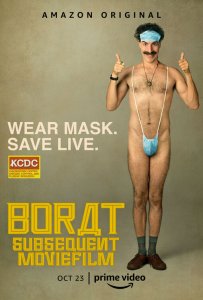 Secretly filmed over the past year, Sacha Baron Cohen reprises his outlandish Borat character to once again lampoon people’s not-so-hidden prejudices, anti-Semitism, xenophobia, and misogyny, which seem to have only gotten worse since the first Borat movie in 2006. The flimsy story follows international journalist Borat returning to America to help improve the standing of his home nation Kazakhstan by offering his daughter Tutar (Maria Bakalova) to the Trump administration. It’s really just a platform for Cohen to adopt a series of disguises (his Borat is too recognizable) and dupe some rubes while exploiting their ignorance and patience. Much of the entertainment comes from the cringe-inducing interactions of how far Cohen and Bakalova will go, marveling at their improvisational skills and also dreading what lines they might cross next. I was laughing fairly consistently, though the schitck naturally won’t be as funny the second time around, even with a 14-year gap in movies. I was really impressed by Bakalova and her own commitment and quick-thinking, keeping pace with a pro like Cohen and really stealing the show because Borat can’t go out in public as before. There are some outrageous moments that work, like Cohen imitating a country singer leading an anti-masking crowd into a singalong with ridiculous verses, and some that simply don’t, like an ongoing stretch where Bakalova explains the appeal of masturbation to a gaggle of deadly silent Republican ladies. Sometimes the comedy seems so broadly caricatured that it’s questionable whether its helpful or harmful, especially the anti-Semitic tropes that Cohen embraces as means of satire. Saying something outrageous to an outraged or shocked party isn’t quite enough. When compiling these hidden camera comedies, they thrive on the oxygen given to them by the targets of the prank. If they don’t really engage, it can feel a bit tired and desperate. I’d say the ratio of hits-to-misses is about half and half but the movie has enough big moments to keep fans happy. The most notorious moment has already been widely disseminated through social media and serves as the climax of the movie, strangely both as the high-point of pranks with big names but also as the emotional catharsis. Tutar poses as a foreign journalist and interviews Trump surrogate Rudy “America’s mayor” Giuliani, who drinks, goes into a hotel bedroom alone with Bakalova, and then lays on the bed while slipping his hand down his pants (like a gentleman does). Borat realizes he doesn’t want to offer his daughter to this creepy, sleazy man and rescues her because he truly does care about her. Borat 2, or Borat: Subsequent Moviefilm, takes a scattershot approach to satire and squarely aims at the science-denying MAGA crowd celebrating the excesses of their leader (who doesn’t sound that different from Borat, come to think of it). It might be more admirable in intent than execution but the new Borat can provide a few belly laughs and a more than a few groans as Cohen attempts to make American funny again.
Nate’s Grades:
Trial of the Chicago 7: B+
Borat: Subsequent Moviefilm: B-
Share this:

Mock & Roll (2019)
 As far as Ohio indies go, Mock & Roll might have one of the smartest creative approaches. It’s a mockumentary following the mishaps of a Columbus, Ohio band trying to make it big. Director/co-writer/editor Ben Bacharach-White (Jimmie Van Zant’s American DeTour) and his cast and crew make good use of limited resources, blessed casting, but the movie could have been even more had it devoted more attention to its comedy writing and doc tricks.
We follow the band Liberty Mean, with lead singer Robin (Aditi Molly Bhanja), guitarist Rick (Chris Wolfe), bass player Tom (Pakob Jarernpone), and drummer Bun (Andrew Yackel). They are a parody band that sticks to only one source, parodying the songs from the rock band The Black Owls. Their mission is to put together an album, gather enough fans, and take the South by Southwest Festival by storm. Robin’s brother, Sully (William Scarborough), is documenting the band and their wacky hijinks as they play punk bars, try crowdfunding, undergo drug trials, stumble into the underground world of art dealing, and land in jail.
 Mock & Roll is an amiable experience and one comparison became so fundamentally clear to me that afterwards it’s all I could envision. This movie feels exactly like a Nickelodeon or Disney Channel live-action tween series. I know that may sound like a complaint but it’s not intended as one. The comparison just became so obvious to me that I was amused throughout to see the finished film hold to this creative endeavor, whether intentional or unintentional (I’m guessing unintentional). The exuberant energy level of the performers, the comedy scene writing that has specific beginnings and ends, the episodic nature of plot, the “let’s put on a show with our friends” mentality, the wacky hijinks, the direct communication with the camera, it felt like an extended collection of episodes for iCarly or Wizards of Waverly Place or Hannah Montana. Again, I do not intend this as a criticism, but the style and delivery of storytelling, as well as the genial likability of its cast, made me draw this comparison.
The best thing this mockumentary has going for it is its spirited cast who go beyond their limited characters. The difference maker in mockumentaries is characterization. The Christopher Guest mock docs (Best in Show, Waiting for Guffman) don’t have revolutionary storytelling but rely upon seasoned actors to really dig in deep with their unique characters, so that no matter the situation, something will spring out of the interaction and response to conflict. The characters in Mock & Roll are scant. The one with the most outward personality is Rick, puffing his chest out with bravado and swagger. The other two male characters, Tom and Bun, are working on the same note, basically deadpan absurdity. They’ll wax philosophical or bizarre at any moment. Robin, unfortunately, seems to be the straight-man role to center the rest of the group.
While these roles limit what comedy styles are available in the different vignettes, the performers go above and beyond and make the movie enjoyable. Wolfe (Where Are You, Bobby Browning?) is a standout as Rick and his voice reminded me of T.J. Miller. He has a natural charisma but also can easily channel a grinning doofus, which gives him the widest comedy berth. I would happily watch Wolfe in other movies and think he has a bright future in comedy. I would hire him. Yackle (False Flag) appears to be the best improviser on the set, able to pull wonderfully bizarre details from thin air and deliver them with understated care. His riff about Beethoven being deaf, and also blind, and having wooden hands, and that’s what made him great got a solid laugh from me. Jarernpone (Dark Iris) has a similar acting technique except it’s unloading deep philosophy without breaking a sweat, also performed at an understated rate, where the comedy best resides. Bhanja is a welcomed presence among the boys and I wish she had been given more to do. She shows promise and an engaging personality even in limited form. There are two supporting players of note, Scarborough (The Incredible Jake Parker) as Robin’s mostly unseen documentarian brother Sully, and Ohio superstar KateLynn Newberry (Dark Iris, Widow’s Point) as Rick’s girlfriend tasked with building a crowdfunding campaign for the band. Both are enjoyable to the point I wish they had been onscreen more often. Newberry has such a great nonplussed frustration with the band’s self-deluded antics.
 The episodic nature works for Mock & Roll until it simply doesn’t. At 77 minutes long pre-end credits, the movie feels far more like a collection of scenes than as a film narrative with a recognizable three-act structure. The vignettes don’t last longer than maybe eight minutes, which is another reason why they feel like anecdotal segments of a 22-minute TV episode. There is an advantage where if I’m not engaged in one scenario, and many are hit-or-miss, I know that another is coming up (after these commercial breaks). A disadvantage, however, is that nothing feels like it builds off the previous actions of the story. You could rearrange any of the first hour and would only impact the overall plot minimally (a reference to a crowdfunding campaign here and there). The episodic nature robs the movie from feeling like its plotting matters or builds to needed payoffs and running gags that make it more satisfying to watch than, say, a collection of unrelated skits.
Then in the last quarter of the film it becomes a prolonged segment that transforms into a baffling Boogie Nights homage. The gang get involved in art theft transportation (a miss), and then it happens again with a criminal art smuggler Dante (Brian Bowman, Dark Iris). This entire segment feels like the Wonderland/Rahad Jackson sequence late in Boogie Nights. Bowman is meant to be Alfred Molina in an open bathrobe, wavering between inebriated and dangerous. The plot beats follow the sequence and even some of the dialogue exchanges are similar. So the question arises, naturally, why even bother? The segment isn’t funny and doesn’t seem designed to be funny. Throwing the characters into an increasingly uncomfortable scenario that presents more and more danger could produce some great cringe-worthy moments of awkward comedy. This doesn’t happen. It just keeps going and it’s the only segment that actually builds off the events of previous segments, and I wanted it all to just go away. It’s too long, too turgid, and doesn’t have nearly enough construction in its comedy to justify the jaunt into criminality. The ending is also so flippant that it feels like it could all have been removed for the impact it has. If you’re going to break the formula established for an hour, it better be worth the excursion.
This transitions into some of Mock & Roll’s design flaws that keep it from being a stronger movie. The fact that the central band is a parody band of The Black Owls will mean next to nothing to an audience, the far majority who do not know whether The Black Owls are a real band or not. They are real but a quick check on Spotify shows they haven’t exactly crossed a listening threshold, so when the Liberty Mean band members talk about the band’s real songs, we won’t know the reference points. We don’t know the reference so we can’t appreciate the parodies, and the performances of Liberty Mean are fleeting, and many don’t even allow us to hear the parody songs themselves. If this was the given reality, Mock & Roll would have been better to just have them parody a silly fake band, or a band that everyone in the audience would be familiar with, rather than settling on a local rock band that allowed their music to be given featured placement. The idea of Liberty Mean as a parody band, and the nature of parody, also feels sadly underutilized. I was hoping the movie would go into a direction where one of the band members splits off, forms their own band, but it’s a parody band of Liberty Mean, so a warped parody of a parody.
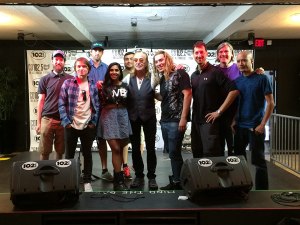 There are many fun possibilities for comedy with a parody band (a rival band nemesis, per se) but the comic shenanigans that Liberty Mean encounters are lackluster. The comedy segments are one-idea concepts that fail to develop and surprise as they go. The band plays at a punk bar and everyone seems to make a big deal out of this like it’s a grave offense, but the audience doesn’t understand why this would be any different. We’re not graced with any unsavory “punk bar patrons,” or specifics beyond that the acoustics might not be as precise. The band agrees to take part in an experimental drug experiment and the results are boring. They get high, they see hallucinations, but it’s nothing terribly interesting or different than you would expect. I’m starting to loathe drug tripping sequences in comedy because too many assume characters acting stoned is funny enough. There is also a lack of editing used for comedy potential with Mock & Roll. Watch The Office, or any other faux doc series, and an added benefit is that edits are part of its intention, so a quick cut or an inserted interview line allows a dense layering of jokes. Or at least the opportunity. Strangely, none of the band members are ever filmed individually for their takes. There are many comic and storytelling options through mockumentary that aren’t used.
Mock & Roll is a smartly modest film that coasts on the good will of its exuberant cast. Crafting a mockumentary approach for a fictional band is a clever way to make an indie film that can stand out with limited resources. The technical attributes are solid, especially the sound, though there are occasional questions like whether what we’re seeing is meant to be doc footage or simply reality, because when Sully is the only cameraman, who else is filming when he’s in the shot? The good nature of the movie is enough to warrant the time spent with an agreeable cast that seem to be having a good deal of fun. The episodic pacing works to keep things moving; however, it also makes the events interchangeable and lacking stakes. The comedy writing is often underdeveloped and reliant upon the performers to do most of the heavy lifting. It is breezy, genial, and fun, thanks to a cast that has great chemistry. I could see further adventures for Liberty Mean but would prefer a new creative approach. Mock & Roll could have been weirder, wilder, or simply better written and make better use of its documentary format.
Nate’s Grade: C+
Share this:

The Devil Inside (2012)
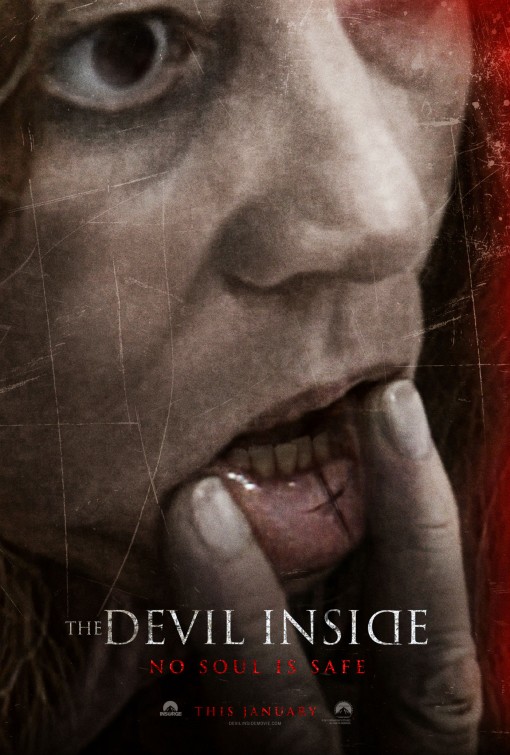 I heard all about The Devil Inside earlier this year, when supposedly midnight screening audiences were so incensed that they practically became a riotous mob, throwing items at the screen, loudly booing, some even destroying theater equipment. If that doesn’t sell this movie, then I don’t know what will. I wasn’t expecting much from this faux documentary about one pretty girl’s (Fernanda Andrade) search for her crazy mom who may or may not be possessed by demons. She enlists the help of two exorcists and a camera crew and goes searching for answers. Never mind that the movie is absent any scares outside the sudden jump variety, ignore the empty characters and nonsensical plotting and poor pacing and choppy editing, as well as some bad Italian accents, and let’s get down to what makes this movie so notorious – the ending. Just when it appears that The Devil Inside is gearing up for a climactic showdown between good and evil, just when it seems like the movie is finally getting somewhere, it ends in the most abrupt, ludicrous fashion (note to self: when transporting possessed people, stow them away in the trunk). You’re left dumbstruck, shocked that the filmmakers cheated you out of an ending. It’s a nonsensical and cheap thing to do, and I can understand why it inflamed audiences (it still made over $50 million, so I think the filmmakers are feeling fine). Only those easily spooked by demonic possession would find this movie scary. Everyone else will just find it upsetting, not because of its content, but because of its lack of a workable conclusion.
Nate’s Grade: D+
Share this:

Bruno (2009)
 Sacha Baron Cohen struck comedy gold and financial riches with Borat, his popular anti-Semitic foreign character that skewered American ignorance and xenophobia. Now, he’s back at it as Bruno, an extremely gay Austrian TV host who travels across America in hopes of being famous. The problem this time is that the Borat formula just doesn’t work the same with this character. Borat at heart had an innocence to him that made his outrageous statements tolerable, but Bruno is mostly obnoxious and you feel pity for the dupes that he annoys. The Cohen-Larry Charles technique of crash interviews snares some high profile victims like Congressman Ron Raul and Paula Abdul, but the movie is also thinly staged with corporate compliance from NBC/Universal opening doors for Cohen. There are a small number of worthy targets, from gay brainwashing counselors to stage parents willing to submit their children to anything for a buck, but the best is saved for an Arkansas fighting ring. It’s depressing that a bunch of people foaming at the mouth to see violence would become so incensed and repulsed by men kissing. Regardless, this movie is a string of unfunny skits slapped together with the message of breaking down homophobia. My question to Cohen: how exactly are you going to rid people of homophobia by inundating them with over-the-top gay stereotypes? Doesn’t that reconfirm what they feel? Bruno doesn’t make you feel uncomfortable because he?s gay; he makes you feel uncomfortable because he’s a jerk.
Nate’s Grade: C
Share this:

Borat (2006)
 It’s niiiiiiice. It seems like Napoleon Dynamite impressions are being replaced by Borat impression, and this can only be for the better. I say this without a hint of sarcasm — Sacha Baron Cohen should have been nominated for Best Actor. He is simply brilliant as he stays in character through every second of a road trip through America, running across all sorts of people and turning them into unwitting co-writers. Cohen’s film succeeds both as a pee-your-pants funny outrageous crude comedy but also as a socio-political examination on bigotry and tolerance in America. What makes so Borat so loveable is how innocent Cohen makes him seem even when he’s spouting racist, sexist, inflammatory ignorance. It’s amazing that people will buy his whopping tales of life in Kazakhstan because we as a nation have a willful ignorance about world culture. The scripted bits stand out like a conclusion with Pamela Anderson, but it’s still amazing they worked out as cohesive a story as they did for this movie. Borat is the best comedy of the year, hairy naked man wrestling and all.
Nate?s Grade: B+
Share this:

Death of a President (2006)
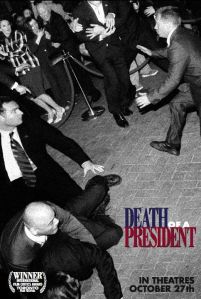 It’s been called morally reprehensible and obscene. Theater chains have refused to even touch it. The White House is concerned it will spawn a deadly array of copycats. The controversial movie in question is a little independently produced mock documentary about the assassination of George W. Bush in the year 2007. It’s kind of funny that this small talking-heads piece has so many people talking, because without its central gimmick, no one would be utterly a word about Death of a President. No readers, they would all be fast asleep.
We’re introduced to various people involved in the fateful event. In October 2007, Bush is appearing in Chicago and the city is overrun with protestors armed with angry signs and angrier words. A handful of protestors even break police lines and come within a hair of the president’s motorcade (to his credit, Bush doesn’t take it personally). Then as he’s leaving a speech, shaking hands along a roped line, shots are heard and the president goes down. In the aftermath many are suspected, including disenfranchised Iraq war vets, protestors, and a Muslim man who may have a connection to al-Quaida.
 Death of a President has the potential to be little more than extreme left-wing wish fulfillment. No matter your thoughts on Bush as a president and a person, I hope the majority of people would not wish death upon him. I think the appeal of this mock-doc is the ghoulish rubbernecking of watching the president die right before your eyes. The moment is quick and mostly just Bush bending over in pain. The lead-up to the kill manages to quicken the pulse. Is it offensive to flirt with the idea of killing our elected leaders while they are still in office? Is it more repugnant when filmmakers use advanced computer effects and archival footage to make the moment as real as possible? It seems that the movie is coming at the peak of an unpopular president and an unpopular war, so some moviegoers will buy their tickets just to vicariously watch Bush die. Those same folks will be surprised how sympathetic and likeable Bush comes across in passing.
Questionable ethics aside, the movie is a whodunit built around a fortuitous gimmick, but once the title death takes place the movie utterly collapses. The ensuing hour turns into an investigation into who had their finger on the trigger. Death of a President has a baffling lack of political insight. The government centers their investigation on a Middle Eastern man of Syrian descent, fudges evidence out of pressure, and tries to build support for a unilateral military response, civil liberties get trampled upon in the name of security, and yet it’s all so sadly predictable. Death of a President is merely repeating the news of our tumultuous times, and it feels so stiltedly scripted. You can?t help but think that the current political scandals are far more weird and fascinating than this ho-hum what-if political science scenario. It’s just recycling current events and changing corresponding details. There?s nothing new or interesting here. As soon as Bush gets shot down so too does the film?s chances of exploring anything meaningful.
 The second half of this film is downright narcoleptic. The investigation is deep in procedural gobbledy gook and the film feels impersonal. I mean, a sitting president has been assassinated in the age of cable TV, global economy, and the war on terror, and all the film can muster is trying to piece together the minutia of how to prosecute a case? I’m sorry, presidential assassination ranks a bit above your standard Law & Order output. There are so many interesting doomsday outcomes that could come about (especially with the scary thought of a President Cheney) and yet the film finds the most boring, insignificant, tedious path. This is inexcusable. It all feels so pathetically small for an act that would be immeasurably monumental. The film is shocking in how little it has to say about anything. It is devoid of commentary and complexity.
Director/co-writer Gabriel Range stages the entire film exactly like a prime time TV news report. It’s slick and packaged well, and the cut-and-paste magic creates an eerie realism. Range uses a mix of archival footage and CGI to illustrate Bush’s assassination. Cheney’s eulogy is actually extensively culled from the speech he gave at Ronald Reagan’s funeral. Don’t know if that?s respectful or not. The technical credentials are worthwhile; the heavy-handed message is not. This is not satire. This is shallow and secondary and pointless. I think Range has treated Death of a President more like an audition film, hoping for bigger and better things. At least, I hope whatever comes next for this man is better.
Death of a President isn’t a terrible movie but it’s way too simplistic, ham-fisted, myopic, and freakin’ dull. The controversy attached to this tiny movie may mislead you into thinking it’s something worth seeing. It’s not. The visual trickery and talking-head structure makes it seem like something you’d see on TV, and you should take that to heart. Wait for TV with this one. Its direct-to-TV ticket is booked as soon as audiences find out what the movie really is. That is, if you can manage to rouse them awake.
Nate’s Grade: C-
Share this:

Drop Dead Gorgeous (1999)
 Satire can be a tricky mistress. It’s like a flower, you have to water it just right. Too much and it dies, too little and it dies. So if you fail to do it just right it can become a catastrophe. Drop Dead Gorgeous flirts with disaster but comes out of nowhere to become one of the funniest and dead-on movies of the summer.
The mock documentary unspools its tale of a Midwestern beauty pageant and all the action behind the scenes of small town life. The story is rich in eccentric and hilarious characters that seem to be delved straight out of the Coen brothers’ twisted imagination. Much of the humor is subtle but still very funny. Some people have said it’s too mean spirited, but all they do is poke fun at mentally handicapped people, physically handicapped people, anorexic and bulimics, pedophiles, gun owners, religious fanatics, high school cheerleaders, dog lovers, lesbians, tomboys, stage mothers, trailer park families, farmers, the deaf, police officers, news reporters, beauty queens, Asian-American families with the American dream, the deceased, sexual harassment, swans, and a world of other lampooning I’ve failed to pen.
In the grand tradition of Fargo the Minnesota accent here is thicker than your grandmother’s jam. The movie does lose a little steam toward the end 10-15 minutes that could’ve been trimmed, but I still readily enjoyed the movie. A complete surprise for myself. If you like your comedies as black as your coffee then check this one out.
Nate’s Grade: B+


 nathanzoebl
You must be logged in to post a comment.