Blog Archives
Borderlands (2024)

I’ve never played the popular looter-shooter video game that Borderlands is based upon, but I have to say that the fan base certainly deserved more than a low-rent combination of Guardians of the Galaxy merry pranksters with Mad Max freakazoid wasteland gangs. You can clearly tell the specific X-Meets-Y of the pitch, although apparently writer/director Eli Roth (Cabin Fever, The House with a Clock in the Walls) was auspiciously inspired one day by, literally, watching his dog squat over and poop and said, “This, this has to be in the movie.” So, from those noble creative origins comes a movie that labors so hard to be breezy and fun but feels so gassed and desperate. In this future sci-fi universe, there’s a special planet that is populated with different space crooks and gangs all fighting to discover a hidden vault of legend. The world is overrun by masked marauders known cheerfully as “psychos.” There’s also a prophecy about a chosen one, a kidnapped daughter to a very dangerous man, and Jack Black voicing one of the most obnoxious sidekicks in recent memory. That’s the thing about Borderlands: everyone is obnoxious or trying badly to be so indifferently cool. It doesn’t work. Cate Blanchett is not the right fit for the lead character of Lilith, a blase bounty hunter/for-hire killer that finds herself gathering a band of bickering bandits. The movie wants us to see them as a dysfunctional family of lovable losers, but each mediocre character is distilled to an underwhelming essence of quips, snark, and stylish killing. If there was a whiff of personality to be had with the different characters, their different and conflicting perspectives, this universe and its interesting locations for world building, even the unique weapons and fighting abilities, there might be even some fleeting entertainment to be had. Alas. It’s not funny. It’s not exciting. It’s not visually appealing. It’s not interesting. It’s not surprising. It’s just sort of loud with capital A-attitude and a forced sense of jocular PG-13 whimsy. It’s not… a lot of important things. Instead, Borderlands only makes me reflect how much better James Gunn has proven himself with these kinds of funky found families.
Nate’s Grade: C-
Share this:

The 355 (2022)
 The most interesting part of The 355 is its inception and the reference of its title, a reveal that doesn’t come to light until the literal final minutes of this clunky two-hour spy thriller. I don’t know why this clarifying detail was withheld so long, as if it was its own spoiler or twist; the title is in reference to a female spy that reported to George Washington during the Revolutionary War, the identity of whom is still a mystery to this day. Maybe co-writer/director Simon Kinberg was afraid explaining this historical spy fact would make the audience envious of the story of Washington’s secret female spy being the movie they watch instead. The other point of interest is that The 355 began when actress/producer Jessica Chastain pitched Kinberg on the set of 2019’s Dark Phoenix to develop a female-lead Mission: Impossible-style spy team. It seems like a no-brainer of a concept, enough so that Universal bought the pitch for $20 million in May 2018, but the question I have is what about the production of Dark Phoenix, the woeful final whimper of the X-Men franchise, made Chastain want to re-saddle with Kinberg as a genre-action director? The 355 is a thoroughly mediocre spy thriller that recycles every trope and cliché imaginable, but this time it’s got a badass gang of women leading the charge. Is that considered genuine progress by most standards?
Mason “Mace” Browne (Chastain) is a secret agent still mourning the loss of her partner/best friend/possible lover (Sebastian Stan) during a mission gone bad in Paris. Her department director has told her, in coded terms, that he has to ground her, but if she went off on her own to seek vengeance, then he would understand. Mace recruits her old pal Khadijah (Lupita Nyong’o), a retired agent trying to live a normal life as a professor of technology. Together, they butt heads against Marie Schmidt (Diane Kruger), a German secret agent targeting Luis Roja (Edgar Ramirez), a Colombian officer who came into possession of a world-destroying device and attempted to sell it to the highest bidder. Graciela (Penelope Cruz) is a psychologist hired by Roja’s agency to bring him back and return the dangerous device. She gets swept up into the mission after becoming the only key to opening the device. She joins Mace, Khadijah, and Marie, along with a Chinese national (the previously incarcerated by the Chinese government Bingbing Fan), to retrieve the device at all costs.
 The 355 isn’t the worst movie by far to ever bear the spy thriller label, it’s just so disappointingly rote and predictable, even down to the double-crosses and secret villains. If anyone has watched more than one spy thriller, they will recognize so many familiar elements and settings. Why not throw in a missile silo and factory warehouse that doesn’t seem to produce anything other than sparks? The McGuffin is treated as essentially meaningless, and the fact that it’s a program only on one hard drive would make you think any villain with an iota of sense would at least make a copy. The opening prologue of how the McGuffin got into a Colombian officer’s hands is entirely superfluous. Apparently, the genius son of a Colombian cartel boss has created the world’s most dangerous technological weapon, and nobody seems to think this is worth a conversation. If this kid can develop a super weapon at this age, what more could he do? If I was his morally corrupted father, I would hug the boy, let him know how proud I was, and rather than sell it to the first scuzzy villain who will obviously murder you, I would place my son in a fortified palace nobody knows and tell him to just keep creating technological marvels that could improve the world. All of this is my way of saying the mechanics of how this came into being are unneeded and just another complication. Speaking of complications, if you cannot guess who the surprise villain is going to be immediately, then congratulations, this must be your first spy thriller, and you could do better.
A spy thriller lives and dies depending upon its action set pieces. The reason I have adored the Mission: Impossible films, especially since 2011, have been their eye-popping set pieces, stunt work, and masterful action orchestration. I’m not coming back for the characters. Good action sequences can redeem a fairly rote and predictable story with lackluster characters. Unfortunately, there is nothing on display in The 355 that will make you forgive its flaws. I’m unconvinced that Kinberg has a real feel for how to stage action. He’s written action sequences for decades as a high-concept Hollywood screenwriter but filming them in an exciting manner is another matter entirely. There are foot chases, fist fights, and shootouts galore, but none of them are ever filmed in an exciting or surprising way. Kinberg has adopted the shaky handheld Bourne-style camerawork to juice the sequences but to no avail. There’s one action scene that takes place in the dark broken up by the strobe of gunfire, and it doesn’t feel so much stylish as a quick fix around poor fight choreography. The editing and composition of the action will often deflate the action tension. It’s not in the ADD-drenched Michael Bay realm, but the editing and arrangement just feels so perfunctory. Some moments are even a little embarrassing, like punches that are wildly oversold that needed to be cut around better. It’s no better than what you might get from any run-of-the-mill direct-to-DVD effort, and if your movie cost $70 million and it plays no better than Bruce Willis’ fifth movie of the month, that’s bad. There’s a notable absence of fun like the movie was taken too seriously to be allowed fun.
 The “girls can do it too!” vibe of the production is laudable but also feels stagnant and dated, not that we have it our threshold of exciting and capable women in action roles, but that’s its entire reason for being is to take a script and replace [generic male character] with [generic female character]. For some viewers, that might be enough to satisfy their genre cravings, and for some it might even prove empowering, which I assume was Chastain’s intention when developing the project. However, these powerful women feel less like human beings than gender-swapped one-note action staples. They will make quips about women having to clean up the messes men make, but these are no better than the quips in a 1990s action movie trying to earn cheap back-pats for being feminist in the least meaningful ways. The goons in the movie make fun of one another for losing fights to women. I guess in the opening mission, the fact that Mace is running around in a long sundress is meant to break the mold, but I also just kept wondering how much she would have preferred pants. The women of The 355 are routinely defined by their relationship to men. Mace is looking for vengeance because her best friend/lover was killed in the opening mission. Marie is bossed around by a glowering superior who explains, to the benefit of the audience, that she’s “good at everything except taking orders.” Graciela and Khadijah are defined by their familial connections and the one skill they have; one of them is the tech guru, the other is an agency psychologist. The male love interests are threatened, and even seriously harmed, as no more than a means to provide further motivation of Act Three vengeance. It’s bad storytelling when it’s featuring men, and it’s just as bad when it’s featuring women. If the movie was going this route to be satirical or even critical of the treatment of women in these kinds of genre fare, that would be something laudable and interesting. Atomic Blonde went there with gusto and pulled it off. This movie has nothing really to say. Taken together as a whole, it all makes any feminist aims of The 355 feel halfhearted.
There was a way to make this movie better and it was so obvious: making Cruz the lead. Her character is the only one not familiar to the world of spy craft and action, so she would serve as the best entry point for the audience. Why not make her perspective the main one? If the ensemble of characters is an ensemble of one-note stock characters, without personality to engage, then why not limit them further? Why make it an ensemble of bland characters? The character of Graciela has by far the most potential on paper, the woman pulled into a world she doesn’t understand and feels ill-equipped to survive within and then her learning to acclimate. This would have improved the screenplay by giving us more attention on a central character that has more clear vulnerabilities and points of empathy and intrigue. She has a family, she was never intended to be in this life, and she has to adapt quickly or there will be severe consequences. That is far more of an interesting start and arc than watching a group of grim-faced girl boss robots.
 Formulaic to a fault, The 355 reminded me of 2017’s The Great Wall, a $150-million Chinese-set action movie directed by Zhang Yimou and starring Matt Damon. It was a suitable action spectacle but I concluded with this question: “It’s not much better or worse than other empty-headed big-budget action cinema from the Hollywood assembly line, but is that progress? Is making an indistinguishable mediocre B-movie a success story?” That same question hangs over my analysis of The 355. It’s indistinguishable from other bland spy thrillers but this time with a group of lead characters played by women, several of them in their 40s at that. Maybe that’s progress considering the budget and representation, or maybe we can expect more than what we got here, a movie that recycles the same dated and tired tropes but now – with women! The action is middling, the characters are dull, the villain is predictable, and it finds itself in a frustrating middle-ground where it takes itself too seriously but doesn’t have the substantial material to cover. The 355 wastes its fab cast, possible points of intrigue, and proves that tropes without comment or exception are still as boring no matter the gender, race, or identity of those involved.
Nate’s Grade: C
Share this:

Jungle Cruise (2021)
 Disney turned a theme park ride that mostly involved sitting into a billion-dollar supernatural adventure franchise, so why not try another swing at reshaping its existing park properties into would-be blockbuster tentpoles? Jungle Cruise owes a lot to the Pirates of the Caribbean franchise, and actually owes a little too much for its own good. For the first half of the movie, it coasts on the charms of stars Dwayne Johnson and Emily Blunt and some light-footed visual misadventures. Then the second half turn involves a significant personal revelation, and that’s where the movie felt like it was being folded and crushed into form to closely resemble the Pirates franchise. It gets quite convoluted and littered with lackluster villains, too many and too stock to ever establish as intriguing or memorable (one of them is a man made of honey, so that’s a thing). I found myself also pulling away in the second half because of the inevitable romance. Their screwball combative banter between Johnson and Blunt gave me some smiles and entertainment and then, as they warm to one another, it sadly dissipated, as did my interest. The comedy is really labored at points. Johnson keeps referring to Blunt as “Pants” because she’s a woman and she wears pants in the twentieth century. It was not funny the first time and it’s not funny or endearing after the 80th rendition. The supernatural elements and curses feel extraneous and tacked on. With the Pirates films, at least the good ones, there are a lot of plot elements they need to keep in the air and you assume they’re be able to land them as needed. The competing character goals were so well established and developed in those movies and served as an anchor even amid the chaos of plot complications and double and triple crosses. With Jungle Cruise, it feels like a lot of effort but also a lot of dropped or mishandled story and thematic elements. This feels more creatively by committee and the heavily green screen action is harder to fully immerse with. As a wacky adventure serial, there may be enough to keep a viewer casually entertained, but Jungle Cruise feels too beholden to the Pirates formula without bringing anything exciting or fresh on its own imagination merits.
Nate’s Grade: C
Share this:

The Last Days of American Crime (2020)
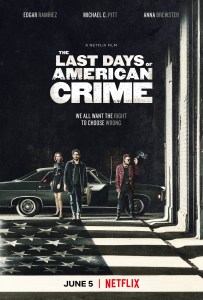 Even by relaxed standards which we judge widely-available Netflix movies during a time of quarantine, The Last Days of American Crime is a staggering waste of 150 minutes. It’s based on a 2009 graphic novel series and even by the sliding scale of shut-your-brain-off action movies, it’s numbing, dreadfully dull, incoherent, and stitched together with hoary genre clichés and little creative forethought. It’s rare that I come across a movie that seems so willfully ignorant to explore the implications of its own premise.
In the near future, the U.S. government is in the final stages of implementing the American Peace Initiative (API), a special radio signal that stops crime in its tracks. It acts as a brain blocker on anything illegal, stopping the user from being able to follow through. Graham Bricke (Edgar Ramirez) finds out the hard way when his bank robbery crew become some of the first test subjects. American citizens are desperate to flee to Canada before the API goes live. Bricke gets seduced by computer hacker Shelby Dupree (Anna Brewster) to pull off one big score. The government is readying to destroy a billion dollars in currency before going digital, and Shelby’s fiancé, Kevin Cash (Michael Pitt), has the connection to pull off the heist of the century.
 Firstly, there is not nearly enough material here to justify the gargantuan Avengers-esque running time. You could realistically slice down a whole hour and not impact its middling entertainment value or clarity. While I was watching it didn’t even feel like a movie, more like a series designed to be binge watched, where the plotting becomes much more slack because the filmmakers anticipate their show will be digested in quick succession and that they have earned patience. It irritates me in television and it certainly irritated me here as well. Don’t blithely assume that your audience has infinite patience when you haven’t given them a proper story to properly engage with. Just about every scene could be trimmed down and some of them go on punishingly long, especially scenes where people are getting shot. There’s one late scene that goes on for what feels like five minutes of just watching two characters get shot. It’s so gratuitous, like much else in the movie, that it borders into unintentional anti-comedy.
As for the action, director Oliver Megaton (Taken 2 and 3) delivers very little of note. There’s a car chase here, a shootout there, but no set piece that actually develops or proves that memorable. It’s all just disposable noise that amounts to little, not even fleeting, escapist entertainment. This is a heist movie where the actual heist planning is ignored. The most enjoyable part of a heist movie is the intricate planning and then execution of that plan, combating the unforeseen complications and overcoming for triumph. If your entire movie is centered on a big heist, don’t treat that like it’s another meaningless plot element. I cannot believe the filmmakers failed to realize that if the viewer doesn’t know what the dangers, problems, and scheme of the upcoming heist will be, then everything feels arbitrary and unsatisfying, and it does so here. The actual heist, pulled off around the 90-minute mark, is not worth the buildup and lack of accessibility. It’s just another haphazard action set piece, not the culmination of planning and an important payoff for carefully manufactured setups. If you’re tuning in for fun action, you’ll be sorely disappointed to find there’s more time spent torturing people onscreen than there is for sustained and exciting action.
The awful characters we’re left to spend 150 minutes with are hardly worth that investment. Everyone is kept strictly as stock archetypes, and even when the screenplay tries to develop them, it follows a strictly predictable path to minimal results. Oh, someone has a family member in custody and is being pressured to snitch? Oh, our silent-and-seemingly-conflicted protagonist wants to avenge his dead brother because he cares and stuff? Oh, our oddball criminal scion wants to make a big name for himself outside of his father’s shadow? The fact the movie spends so much time with these characters while giving them so little dimension, little personality, and little to do is another indictment on the bloated pacing. If we’re spending this much time with our criminal rogues, the least you can do is make them interesting and dramatic and colorful. The protagonist’s name is Graham Bricke, which sounds so boring that it must have been generated by an A.I. The femme fatale super hacker lady is really here just to look sad or sexy, here to deliver three uncomfortable sex scenes including a near rape as well. The other notable female roles in this movie include News Anchor, Lesbian 1 and Lesbian 2, Female Tweeker, and Female Cop. Hooray for depth.
 There are two characters that had a chance of being interesting but are so mishandled. The first is Kevin Cash, our wannabe gangster. Pitt (HBO’s Boardwalk Empire) brings a much-needed dose of energy and theatrics, like he’s trying everything in his power to desperately hold your flagging attention. Even his pathetic overcompensating nature is tiresome. A scene where he, his father, and his younger stepmother (another fine example of female character representation in the movie) shriek and bicker at one another is just embarrassing and misplaced comic relief. He’s boring. The only other potential was with Sharlto Copley (District 9) as a disgraced police officer. We spend plenty of time with him early in the movie, establishing his outsider status, perhaps some regret, and hoping that his position of authority will be better explored as he wrestles with whether the police force is worthy of its state-decreed exemptions to the API. Nope. He just becomes another dude in the final act that could have been replaced by anyone else. It would be like devoting so much time to Henchman #12 and his personal crisis of self in a Bond movie only to watch the lug unceremoniously die in a final action rush. Was that worth the time spent?
Its Purge-like premise sounds intriguing and worthy of exploration until, that is, you really think about how silly it all is. So a magic radio signal is going to inhibit your brain from committing known wrongs, but does that mean that the radio signal will have to blare constantly in order to have a lasting effect, otherwise its enforcement will be limited? What happens to sociopaths who don’t even register right from wrong? They will be able to move and act without abandon. Then there’s the day-to-day corruption, graft, greed from all pillars of society, politicians and Wall Street and officials that exploit their positions for illegal gains. Seriously, if this radio signal inhibits the fruition of illegal acts, would Wall Street just shut down? Would the factory owners who knowingly skirt worker safety for profits be able to operate? Would criminal defense attorneys be able to operate or would they use the ethical justification that everyone, no matter how heinous, deserves legal representation? If you think about a capitalist society, it’s built upon people behaving not so nicely, so would all facets of the economy grind to a screeching halt?
There is one aspect of this world building, even with what the meager story has established, that could be interesting to explore, and that’s the exceptions to this new order. Police officers are getting implants that make them immune to the effects of API, though in a world where a radio wave eliminates criminal acts, do you still need a police force to protect and serve? Regardless, this special class of exception is deserving of further exploration, a socially relevant angle to tap into the inherent advantages offered to the top one percent who don’t think the rules apply to them. In fact, if Last Days of American Crime was going to run with its silly premise as is, and during the pre-activation countdown timeline, they should have presented a story about those who are given the state-sanctioned privilege to act with impunity. Let’s watch the elite get their special exemption chips and plan for the New World where they maintain their vaunted privileges. It would at least make the movie socially relevant as well as a better development of its sci-fi premise.
 Watch, dear reader, as I present you two better scenarios with this silly premise. The first is the most obvious and that’s life AFTER the implication of the AFI, presenting life under a new fascist order and a group of revolutionaries trying to thwart the radio waves. Imagine a group not plotting to pull off a bank heist but ridding their community of the AFI and giving them autonomy over their minds and bodies again? There’s an ever-present hostility that forces the characters to keep their thoughts on safe topics, having to communicate with subterfuge to not set off their brain jailers. It would be like a dystopian version of that classic Twilight Zone episode where little Bill Mumy where everyone had to think “good thoughts” or else he would magically banish them to the cornfield. That’s interesting, that’s genuine conflict, that’s characters under great duress trying to escape a fascist nightmare without tipping off the invisible sensors in their own minds that could trigger. There’s a larger goal of freeing their fellow citizens from this tyranny as well. That’s already one hundred times better than simply trying to steal money before the clock strikes zero. If it was only ever going to be “one big last score” then why even bother with the mind-control antics? It could have been anything at all.
However, if you wanted something more low-key, you could take a different path with the idea of the bucket list before the API goes live. Think of two teenagers who don’t have the means to escape and feel like they haven’t fully lived and a whole lifetime of rebellion and adventures they had been dreaming towards will now be snuffed out. The screenplay already floats the idea of a criminal bucket list but why not run with that idea as the core of your movie? Two teenagers making the most of their time together over the course of one long crazy night of cutting loose, testing their boundaries, and acting out the best ways they know how, learning about each other and the depth of their friendship before their minds will not fully be their own. It takes the teenager coming-of-age model, feeling like a stranger in your own body, and gives it a PG-13-Purge twist, with the distant tragedy of the looming tyranny ahead to up the stakes. Even that development would be better than “one last score,” and these are just two ideas I’ve come up with while writing this film review. Think what could be accomplished if a professional screenwriter spent weeks fleshing out a better version.
Alas, the version of The Last Days of American Crime we do receive is powerfully plodding, incoherent, empty and arbitrary, and definitely not worth your precious 150 minutes. With the current state of the world where thousands of U.S. citizens are protesting in the streets over a militarized police state and wanton brutality, it makes Last Days look even more phony and ill-conceived as entertainment. It doesn’t examine the implications of its own fascist police state, it only uses it as a pointless backdrop for an arbitrarily plotted “last score” heist before it all just falls apart, spent of imagination and intent.
Nate’s Grade: D+
Share this:

The Girl on the Train (2016)
 Consider it Gone Girl lite. The adaptation of the mega best-selling thriller The Girl on the Train seems to be on a runaway collision course with irony-free, amped-up melodrama and sundry “adult” sensuality reminiscent of the 90s boon of erotic thrillers like Jade and Sliver. The book by Paula Hawkins had three strong female lead characters each telling their own miserable worldview of trying to live up to social standards of motherhood and marriage. The movie seems to have shorn most of the focus on character and included every twist and turn, no matter how absurd. Take for instance just how insular this world is: Rachel (Emily Blunt) is the ex-wife to Tom (Justin Theroux) who left her for Anna (Rebecca Ferguson) who has a nubile nanny Megan (Haley Bennett) who is unhappy with her controlling husband Scott (Luke Evans), who happens to be the couple that Rachel voyeuristically observes and fantasizes domestic bliss. Megan goes missing and Rachel cannot account for her whereabouts because she has become a blackout drunk to kill her self-loathing and sense of internalized failure. The whodunit aspects of this movie can come across as rather hokey and overblown, but lacking the nasty nuance and subversive gender politics of the far superior Gone Girl. Every single person in the film has to come across like a suspect (Megan’s husband, Megan’s therapist, some guy in the road?) and talks in a curiously oblique style. The attempts at sexy lack heat but more than that they lack conviction. Director Tate Taylor (The Help) seems to think he’s directing a Hitchcockian thriller one minute and a tawdry art film the next. The screenplay is also unhelpfully nonlinear, frivolously jumping around in time and point of view and muddling the overall timeline. Anna and Megan are drastically underwritten; Megan is a sex kitten with a dark secret that’s trying too hard to be provocative, and Anna is an even more thankless role as the stand-in for Rachel’s swirling antipathy. The concluding moment of girl power feels unearned, and the answers to the mysteries leave a lot more lingering questions about train platform-sized plot gaps. The best thing this Girl has going for it is Emily Blunt, who delivers a better performance than the film deserves. She’s unrestrained, red-eyed, sloshing, and disturbing as a drunk. She’s wounded and lashing out ferociously at the world, at her self, and it’s fascinating and heartrending to watch. I bet it would be even better to read.
Nate’s Grade: C+
Share this:

Wrath of the Titans (2012)
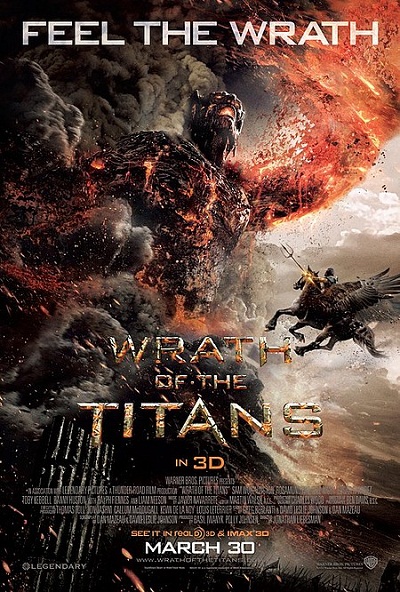 The 2010 Clash of the Titans made some sizable sums of money but it really became famous for one reason – the beginning of the 3D fleecing and the public’s souring on what was supposed to “save the movie going experience.” Clash was converted to 3D in post-production, and its lack of foresight and rushed conversion showed. After the high of Avatar, it only took approximately three months for the public to feel ripped off by 3D. Certain Hollywood bigwigs are concerned that bad 3D conversions will kill the golden goose, and it is having an effect. The percentage of movie audiences seeing big releases in 3D has slipped steadily from 2010. Whether it is the added cost or the underwhelming conversion, movie audiences are warier of the third dimension. And it was Clash of the Titans that destroyed a nation’s innocence. Two years later, the sequel is out and, surprise surprise, you also have the ability to see it in 3D. Either way, this movie will cause you a headache.
In the wake of Perseus successful slaying of the Kraken, he is now a widower with a young son, living their lives quietly, trying to avoid the daring heroics of his earlier life. Fat chance, kid. The gods are at war, particularly Hades (Ralph Fiennes) and Aries (Edgar Ramierez) versus Olympian head honcho Zeus (Liam Neeson), Perseus’ absentee father. The titan Kronos will be unleashed from his prison, Tartarus, and this powerful behemoth will lay waste to the armies of mankind. The gods have grown weak due to mankind’s dwindling faith, and as such they cannot conquer Kronos without the help of man. It’s up to Persues, Queen Andromeda (Rosamund Pike), and Poseidon’s demigod son a (Toby Kebbell) to track down the right magic artifacts to take down Kronos.
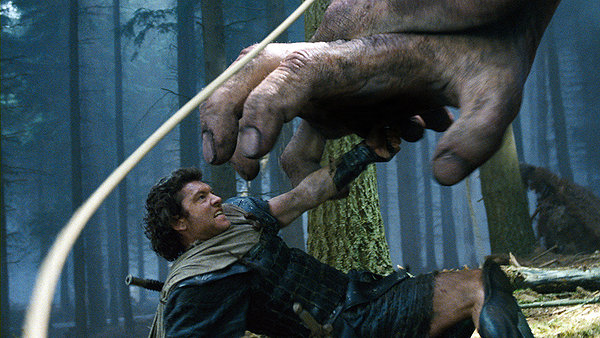 Once again we have a threadbare story that involves running from one location to another to find a clue that leads to the next location; the plot is just a series of magic-item gathering missions, much like a video game. Greek mythology made regular use of magic weapons to slay great monsters, but the myths at least gave their audience heroes worth fighting for. Worthington’s scowling rendition of Perseus is a bore, and giving him a son doesn’t help much. Just because the guy keeps insisting he has someone to protect doesn’t fill his void of characterization. He’s so free of charisma, so gruff and without any defining personality, that you wish he could find some magic shortcut to find his dumb magic items faster. The whole setup with our villain is also vague, beyond the very specialty of the god in question. And then there’s the whole concept of the gods dying, which was also featured in last fall’s glorious-to-look-at-but-empty-on-the-inside Immortals, another cinematic tussle with the titans. What’s the point of being a god anymore if the defining quality, immortality, can be ripped away? I suppose the screenwriters wanted to raise the stakes when Zeus and other gods enter the fray, dangling the threat that they too could perish. “We may not have weapons, but we’ll fight how long we can,” Zeus declares with modesty, and then he proceeds to zap enemies with lightning bolts. I don’t think a club is going to outrank a giant projectile of electricity. Realistically, I think the whole death-of-the-gods angle, which cold have brought some real somber and existential weight to the film, was just a setup to allow the producers to recast future sequels with less costly actors (goodbye, Neeson and Fiennes; they’ll be no more Kraken-releasing for either of you).
Director Jonathan Liebesman (Battle: Los Angeles) isn’t going to wow anybody with his addition to cinema, but he can put together a serviceable sequence of action. My favorite sequence in the entire film is when Perseus and crew enter the underground maze of Tartarus. The stone walls are constantly shifting around and the characters are zooming all around the room. It reminded me of the moving staircases in the Harry Potter world or think of it as the real prequel to Cube. And yet, even this nice sequence is limited because Liebesman and the screenwriters don’t take full advantage of their situation. We have a constantly shifting three-dimensional maze, and nobody gets lost at all? And the heroes, after discarding the map, easily find their way to the other side? What kind of design flaw is that? Liebesman prefers a lot of handheld camerawork and low angles, which can be jarring at times. Worse, the action favors a visceral chaos rather than steady development. There are plenty of people dying, columns exploding, fireballs tossing, but little of it adds up to much. It’s all disparate shots, like every character is in a separate movie. Such a shame because the special effects are rather good. If you’re going to spend this kind of money on a Greek mythology spectacle, at least make us care beyond a “fire pretty” level of tepid enjoyment.
The movie is in some breech of false advertisement since the title clearly states a plurality of titans, but by my modest account we only really have one titan to deal with, the giant lava beast Kronos (do the smaller creatures and Cyclops count as titans? I doubt this). Now we all love how fire looks, though some love it a bit too much. And lava itself has long been a childhood adversary. Who amongst us has never pretended the floor was once lava and but a handful of couch cushions were the only stepping-stones to safety? It’s hard to get an exact feel for how massive Kronos is considering he emerges from a mountaintop and seems to extend even higher into the sky. It’s intended to be a threatening and horrifying sight, but I kept thinking of a Marine ad from the 1990s where prospective recruits displayed their mettle by combating giant lava creatures (“Marines: Keeping the U.S. safe from lava men since 1916”). Instead of being awed by Kronos, I started picking apart the logistics of being a lava man. I suppose when you’re a god, or a titan for that matter, you don’t have to really eat or drink or do the things we mortals must for sustenance. But how does a lava creature work when part of his fiery M.O. is how drippy and malleable he can become? Perseus flies into the mouth of the lava beast but why does a beast, which needs no food or drinks, even needs a mouth? It’s not like this guy is speaking beyond a ground-shaking mumble. The entire face is almost superfluous. It’s not like a lava creature has eyes or a working circulatory system. Now I could apply these same annoying ticky-tack questions to any monster or mythological creature. The reason I did this is because the monster of monsters is no more intimidating, or satisfying, as the array of giant monsters that Godzilla would fight (or for you youngins – the Power Rangers). When your ultimate bad guy, and lone titan, can just as easily be blown up in the same manner as the Death Star, then we have a problem.
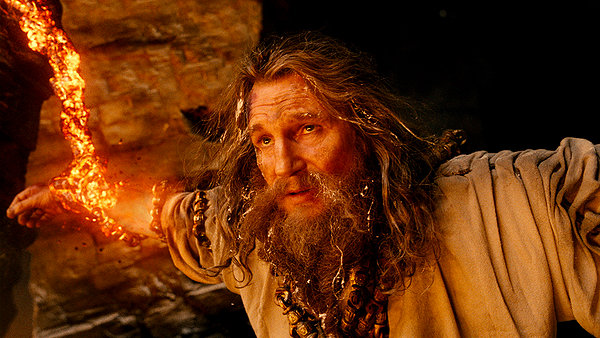 There’s a certain level of entertainment watching dignified actors in something so inherently campy. Neeson (The Grey) and Fiennes (Harry Potter and the Deathly Hallows: Part Two) are a long way from their Shindler’s List collaboration. The two men lend a level of gravitas to a movie that is leagues below their talents. Perseus proves to be such a dull demigod, that I wish the entire movie had followed the warring gods instead. That approach would have been much more interesting considering that they must confront mortality. Worthington (Avatar) still has a notable screen presence in the realm of action cinema, but his constant scowling is just getting tiresome. Hollywood, give this man something to do other than scowl and he may surprise you, like in The Debt. Pike (Doom) is unconvincing as a warrior princess, and her forced romance with Persues could not be more contrived (did somebody say, rebound?). The best actor in the movie is Bill Nighy (Underworld) who shows up as a daffy version of Hephaestus, the god of metallurgy and blacksmiths. Nighy understands how completely cheesy the whole getup really is and delivers a performance on the comic wavelength that the entire movie should have held.
While not nearly as humorless and joyless as the 2010 edition, Wrath is still a fairly block-headed romp through the noisiest parts of Greek mythology. After two movies with “titans” in the title, it’s somewhat remarkable that we only witness one single titan in the entire combined 245 minutes. It’s all CGI sound and fury with little cohesion to make anything feel important, despite huge mythological creatures demolishing cities. From an action standpoint, Wrath packs enough serviceable, escapist sights for the eyes to please diehards of Greek mythology and genre fans with low expectations. I wish there was a more compelling reason to run through all this stuff than big monsters needing to be killed; this hero’s quest needs more motivation or at least a grander sense of awe. The demise of the gods due to mankind’s mounting religious doubt seems like a juicy subject that could have opened these characters up. But then the theological discussions would get in the way of people hitting made-up CGI monsters. If you like your cheese feta, then Wrath of the Titans will provide enough wrath for your bucks, though found lacking in titans.
Nate’s Grade: C


 nathanzoebl
You must be logged in to post a comment.