Blog Archives
X-Men (2000) [Review Re-View]
 Released July 14, 2000:
Take a storied franchise that has long been the backbone of Marvel comics and develop it into a feature film where the last superhero movie was the purple-spandex-in-the-jungle The Phantom and you’re just asking for trouble. A nation of fans is breathing down the neck of the film crew nitpicking every fine detail. Studio execs want the film done as fast as possible and under budget regardless of the numbers of effects needed. Despite what would seem like a cataclysmic set-up, X-Men proves that Hollywood can occasionally take a comic book and get it right. For the most part.
X-Men is basically the pilot for a movie franchise. It sets up characters, conflicts, origins, but periodically forgets its audience. Numerous people are introduced and then given a grocery list sized amount of dialogue to read. Some even have atrocious John Watters-like wigs they are forced to wear. It’s a good thing then that the film centers mainly around Wolverine (Hugh Jackman), Rogue (Anna Paquin) and Magneto (Ian McKellen), the three most interesting characters.
 Often times the action in X-Men is surprisingly lackluster and contained. The battle royale finale atop the Statue of Liberty might induce more than a few eye rolls. I can’t help but hope that with all the groundwork laid out with this film that the eventual sequel will be more efficient with its action set pieces.
For the most part the dialogue in X-Men is passable and it even has a few rally snazzy sound bites. However, there is that ONE line delivered by Ms. Berry (“You know what happens when a toad gets struck by lightening? The same thing that happens to everything else.”) that is groan-worthy and destined to be notorious.
It may sound like I’m coming down hard on X-Men, but for a comic adaptation it got a whole hell lot more right than wrong. I want to congratulate director Bryan Singer (The Usual Suspects) for the amount of pressure he had looming over his head and what he pulled through with. X-Men is no campy nipple-plate festival but an attempt at possibly serious drama with tortured characters. The whole mutant/racism metaphor may be a little bludgeoned at times but for the most part is handled very well. The best aspect X-Men has is its patience. The film is in no rush and takes its time even if it is only like an hour and 40-some minutes. Still, it’s a welcome change in the summer action.
 Singer’s direction is smooth and well executed. The casting of the movie is near perfection with some minor exceptions. Stewart and McKellen were born to play their dueling think tank leaders. Jackman is an exciting breakout in a role that was supposed to be occupied by Dougray Scott (thank you MI:-2 delays). I look forward to more from this actor. And does anyone know when young Oscar recipient Anna Paquin became so attractive? Someone buy this casting director a fine steak dinner.
X-Men may have its flaws, one of which is an absolute mundane score, but the film is one of the better summer entries into the world of explosions and noise. I just hope the sequel(s) will be a tad better.
Nate’s Grade: B
——————————————————
WRITER REFLECTIONS 20 YEARS LATER

It’s hard not to understate just how eventful the first X-Men movie was back in 2000. Beforehand, the public’s conception of super heroes was that they were kids’ stuff, fed by recent duds like Batman and Robin and Steel. Then came X-Men and it changed everything. There wouldn’t be a Spider-Man without X-Men. There wouldn’t be a Marvel Cinematic Universe (MCU), arguably the defining cultural franchise of the twenty-first century, without X-Men. It was an immediate hit with audiences and would go onto spawn two sequels, four prequels, three direct spinoffs, and two indirect spinoffs (Deadpool) over the course of 19 years. It’s a franchise that has made over $6 billion dollars worldwide and will soon be intermingled into that MCU, re-imagined with new actors filling out the famous names for the first time in decades. I can recall the importance of the X-Men in my own maturation and love of comics. I grew up adoring the animated series in the early 90s, and this began my relationship with the Marvel universe. I have boxes filled with old comics and I even started one of my own in my junior high school years (it’s unfinished and about 160 pages). I fondly recall seeing X-Men opening weekend with my pal Kevin Lowe and both of us just being relieved. A big studio had done it justice. They got it right.
Twenty years later, one must remember how different X-Men was with the super hero landscape. The more grounded, more political, and more reverent take on splash pages and spandex was in direct contrast with the cheesier, dumber, and more slapstick-heavy comics movies. Sure, you’d have your occasional hit like Blade, but the vampire genre inoculated it from larger scrutiny as a “comic book venture.” Director Bryan Singer wanted to make a brooding, serious version of the X-Men, a fact bolstered by his opening a summer super hero blockbuster with a Holocaust flashback. The mutant metaphor inherent in the X-universe has always lent itself to broad social commentary, easy to apply to any disadvantaged and targeted group for simply being different. It had men and women, and aliens and robots and more, doing amazing feats of derring-do, but it also featured these same characters fighting for equality with a public that increasingly feared and despised them for their gifts. Singer recognized this greater political allegorical relevancy and wanted his foray into blockbusters to be more meaningful than another disposable punch-em-up to consume mass quantities of popcorn. The X-Men franchise might not have ever been as successful without Singer’s early vision, and of course, many years later upon its demise, the producers might wish differently given the director’s righteous career reckoning.
 But let’s talk about the movie first before we get into the controversy of the man in the director’s chair. I haven’t watched the original really since the superior X-2 came out in 2003, and I was amazed at how patient and assured the movie plays. For a super hero action movie, there really isn’t that much action until the final act. There are confrontations and what I would call “action beats” but nothing lasting longer than a minute in conflict. In its place is a patient movie that takes its time to establish its world, its ideological counterpoints, and its characters and their relationships. We have two entry point characters with Wolverine (High Jackman) and Rogue (Anna Paquin) being hunted and taken in by Charles Xavier (Patrick Stewart). Even though the final movie is barely longer than 100 minutes, it doesn’t feel rushed in its pacing. It has a lot to do in establishing a new world but by grounding it with a scared runaway and a lonely drifter followed by trouble, the movie taps into Western archetypes to act as a helpful surrogate guideline. Fortunately, screenwriter David Hayter (and un-credited writers Ed Solomon, John Logan, Christopher McQuarrie and a heavily rewritten Joss Whedon) anchors us with the most interesting characters who have the most to fear and rebel. Wolverine and Rogue are an excellent pair and Jackman and Paquin have a real nurturing onscreen connection that provides an emotional investment. By taking its time to set up characters and their internal conflicts, X-Men makes a wide audience care about what’s to come.
When it does transition to action, you can see the beginnings of something great tempered with the growing pains of staking out new territory. The special effects are still relatively good, especially Rogue’s life-draining powers on the human body. That’s another thing the screenplay does well is finding ways to demonstrate and then incorporate every mutant’s special ability. We learn about Wolverine’s metallic claws through him being antagonized, and his healing ability from going headfirst through a windshield after Rogue admonishes him about wearing his seat belt. Later Rogue uses her powers to tap in Wolverine’s healing ability to save herself, setting up the Act Three climax where she is the key to Magneto’s (Ian McKellen) evolutionary-charged scheme. One more note on that (I apologize for the deluge of digressions) because Magneto’s big evil scheme is really about empathy. He plots to turn the world’s leaders into fellow mutants so they can understand the plight of a subjugated minority class, and yes, sure, some of them will not survive the genetic re-calibration, like the prejudiced firebrand Senator Kelly (Bruce Davison), but it’s not like Magneto wants them all dead. He wants them to understand (at least until the next sequel where he welcomes an opportunity to kill all non-mutant humans). Thanks to Singer, the movie has plenty of dynamic visual compositions and a few wow-moments to pack a trailer. I was reminded what an excellent visual artist Singer can be as he stages his scenes. The placement of figures, the depth of focus, the fluidity of his camera movements. He was certainly one indie darling ready for a bigger stage, at least in an artistic sense and not necessarily a personal one.
 It’s impossible to think of any other actor than Jackman as Wolverine but it almost never happened. Dougray Scott was in place but because of Mission: Impossible 2 delays which themselves were previously affected by Eyes Wide Shut delays, the role had to be recast already weeks into filming. Jackman entered the picture per a suggestion from Russell Crowe, to our collective pop-culture elation. Jackman is rugged, rebellious, funny, gruff, secretly warm-hearted yet clearly still the enjoyable F-You anti-hero, and watching him inhabit what, in comics lore, was a short, stout, hairy Canadian grump is a reminder that you can still recognize star-making performances when you see them. He fully inhabits the character and brings him to startling life. Jackman would become indispensable to the X-Men franchise and earn three spinoff movies, culminating in 2017’s R-rated and Oscar-nominated neo-Western, Logan. It’s only a matter of time before the MCU reboots this character because he, like Batman, is simply too valuable an IP to keep on the sidelines. It feels like heresy to consider another actor in this role, much like it will if anyone other than Robert Downey Jr. steps into the role of Tony Stark/Iron Man. This is a role defined by its signature actor where possible early choices now seem offensively wrong (like Tom Selleck as Indiana Jones, or Christopher Walken as Harrison Ford, or John Travolta as Forrest Gump).
The ensemble was extremely well cast with Oscar-winners and nominees past (Paquin, McKellen) and future (Halle Berry, Jackman). Stewart (Star Trek: The Next Generation) was born to play Professor X, enough so that when he first viewed X-Men comics he said, “What am I doing on this cover?” McKellen brings a gravitas to his villainous role as well as a smirky flair that makes him hard to hate. He had his shooting schedule re-arranged to accommodate the Lord of the Rings shoot in early 2000. Most people can only hope for one generational, pop-culture defining role, and McKellen had two after the age of 60. Paquin was making her transition from child-actor to adult, which was further solidified with HBO’s bloody and steamy vampire series, True Blood. Marsden was filling out his fledgling leading man potential, though he’s always been more appealing to me as a charming comedic actor (27 Dresses, Enchanted). Supermodel Rebecca Romijn (Femme Fatale) made a favorable impression as the shape-shifting Mystique thanks to low expectations and a costume made of 100 scales covering her nearly nude body that took nine hours to apply. The only real miss for me was Berry (Monster’s Ball) because I always envisioned Angela Basset (Black Panther) as my Storm. This is also the only X-Men where Berry adopts her character’s Kenyan accent.
 Looking back over 19 years of movies, the wonky timelines of the X-Men world begin to break apart if given even cursory contemplation. Given what happens in the prequels set in the 1970s and 80s, including Apocalypse (Oscar Isaac) launching all of the world’s nuclear missiles, it certainly seems like the worldwide perception of mutants would be more pronounced. Then there’s characters being alive, like Mystique, when she dies in the 1990s in the last X-Men film, 2019’s Dark Phoenix. The back-story of Jean Grey (first Famke Janssen, later Sophie Turner) and her Phoenix powers got two big screen showcases that also happen to be two of the worst movies. The biggest issue was the prequels arbitrarily following a movie-a-decade model, hopping from the Cuban Missile Crisis in 2011’s X-Men: First Class to the 1990s three films later. That means that somehow within less than ten years that Michael Fassbender (12 Years a Slave) and James McAvoy (Split) were going to resemble old men McKellen and Stewart. Do they get exposed to radiation? The conclusion of X-Men: Days of Future Past was meant to rewrite the timeline miscues, erasing the bad X-Men movies at that point from existence (2006’s Last Stand and 2009’s first solo Wolverine). Instead, the producers then followed with two more of the worst films of the franchise. You tried.
And now it’s time we discuss the controversy that has followed Singer for decades from film set to film set. There have been uncomfortable rumors and allegations that have surfaced ever since 1998’s Apt Pupil when Singer filmed a high school shower scene and insisted two underage actors be physically naked during the onset filming. Seems pretty questionable, right? This was eventually settled out of court, as were other allegations of abuse. According to a revealing Hollywood Reporter article, the teen who played Pyro, Alex Burton, was personally flown from L.A. to the Toronto X-Men set. This is quite bizarre considering he doesn’t have any lines and the part is a glorified cameo. Burton said he was held hostage by Singer and his wealthy friends for months and was repeatedly raped. Singer has been out as a gay man in Hollywood early into his career, and he would host regular all-male parties that reportedly descended into lurid bacchanals. Ironically, his status as a prominent and out gay director in the industry might have afforded him an aura of perceived protection, the idea that any journalist snooping too closely would be accused of homophobia or a double standard. It wasn’t just Singer but also the company he kept. Several associates of Singer have been accused of sexual abuse and against underage men that have led to undisclosed settlements.
 These allegations of abuse continued when Singer rejoined the X-universe again in 2014’s Days of Future Past but he weathered it out, and then again during the filming of 2018’s Bohemian Rhapsody, and this time he wouldn’t be able to weather it out. He was fired with a month left to film and Dexter Fletcher (Rocketman) was brought onboard to finish directing the eventual Oscar-winning and shockingly successful Queen blockbuster (nobody seemed to cite Singer by name in their acceptance speeches). Singer also built a reputation of showing up to his sets extremely late, sometimes impaired, and for sudden and unknown disappearances. It’s amazing that with all of this chronic misbehavior he was still getting big studio offers, but the man kept producing hits, including the long-running TV show House, and so his shady behavior was overlooked until, finally, it wouldn’t be in a post-Me Too world. Even after he was attached for a Red Sonja remake for a time until another round of accusations made him too radioactive for the time being. I would not be surprised if in a few years some production company happily offers him another project. Singer seems like a new test subject as far as what can be forgiven for the hitmakers.
So, what do we as viewers do with this damning profile of Singer? It’s become a regular habit now of re-examining an artist’s legacy in light of new or old allegations of wrongdoing. I personally have no interest in ever listening to a Bill Cosby comedy album again or watching any of his many heralded TV shows. I feel different listening to Michael Jackson’s music now. I wince when I watch Kevin Spacey in performances now and try to only see the character instead (Spacey won his first Oscar for 1995’s Usual Suspects, directed by… Bryan Singer). Can you watch the early X-Men films, or the later sequels, and still enjoy them knowing that Singer has been repeatedly accused of sexual misconduct including against minors? I have no answer. This is a deeply personal call for every person. I have too much personal attachment to 1999’s American Beauty to cast it aside, and that’s a movie that prominently features Spacey lusting after an underage girl. I’ll never look at the film the same but I cannot discard the whole. X-Men might mean too much to too many to disregard as well.
Looking back on my original review in 2000, I’m genuinely a little stunned because it’s almost word-for-word my assessment upon re-watching in 2020. It does feel more like a pilot to a franchise, laying the groundwork for the world and character relationships. The action is surprisingly contained. The “toad struck by lightning” dialogue line did become notorious. The casting was marvelous. The score was weak, greatly improved by the addition of John Ottman as editor and composer in the sequel (that Nightcrawler assassination attempt scene is a matserclass of editing and shot design). I even note the patience. I even think my original grade is fair. The original X-Men is a perfectly good movie but it led the way for great movies to come.
Re-View Grade: B
Share this:

The Beach House (2020)/ Archive (2020)

Sometimes when watching a movie I will get disappointed because I sense a path not taken that should have been, an intriguing premise that hasn’t fully been developed, and I get sad that the movie I’m watching isn’t really the best version of its potential story. Call it the Black Mirror Syndrome (oh, hot take). I felt this same assessment while watching two small indie films recently released on demand, one horror and one science fiction. Each has its own artistic merits and each I felt wasn’t the best version of itself.
The Beach House follows a twenty-something couple on a beach side retreat. They have problems in their relationship, there’s an older couple who arrive at the same house, and after awhile the film essentially becomes The Color Out of Space, an atmospheric horror movie about humans dealing with a biological unknown. Something from the sea is coming out, via mist or jellyfish or… something, and it’s affecting human psychology and physiology. The Beach House is far too vague for its own good and takes far too long getting its story moving. I started falling asleep at several points, so my attention was not exactly rapt. It ends in an expected downbeat manner but without greater explanation or even theories about what is happening, and there’s just not enough story and drama present to fill that void. The characters come across a subdivision of beach homes mysteriously absent any neighbors. It reminded me of a Stephen King story beginning, an environment where something bad has transpired and the new characters have to figure it out. As far as creepy atmosphere goes, it’s fine, and there are moments of unnerving body horror, like a protracted sequence where our heroine fishes out a jellyfish tentacle inside her wounded foot. Still, the general obtuse nature of the entire enterprise, and the underdeveloped characters we’re stuck with, made this feel like a disappointment for all but the most desperate for atmospheric horror.
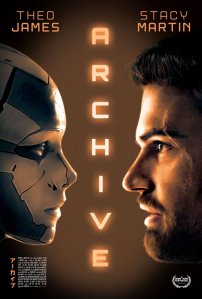
Archive follows one scientist (Theo James) trying to replicate his dead wife Jules (Stacy Martin) into a physical robotic form. She died in a car accident but he was able to save her consciousness onto a server available to consumers, but it will fray over time and only delays her inevitable passing, so he’s toiling away at a remote mountainous lab to create a new host to download her into. He’s gone through two different robots, each more complicated and more representational of Jules’ full brain; the first (J1) is like a box with legs and has the capacity of a child, the second robot (J2) is more like a teenager and reminiscent of the robot from I Am Mother, and the the third one (J3), under construction, looks the most human and will contain the full brain activity and hopefully the full Jules. Archive is fine and goes just about where you would expect, with exception to a last-minute twist that doesn’t make any sense. You can pick apart why it doesn’t work but I guess they wanted something shocking. The problem is that this movie needed to be told from a different lead perspective. Rather than being told from the scientist’s point of view as he doggedly tries to save the woman he loves, Archive should have been told from the second robot’s perspective. J2 looks at what her master is doing with the third, seeing the time and attention he’s putting into her, making her more feminine, and J2 feels pangs of jealousy and loneliness. She pleads for her master to make her better, asks why she isn’t good enough, and wants to be better while he essentially strips her for parts for her replacement. I felt so much for this second robot and her sad plight with a cold, selfish, oblivious creator. If Archive had been told from J2’s perspective, it could have been something special. She is going through a wealth of emotions, desiring to be all the things her creator projects onto his latest project, and she feels like she is failing him. When Archive focuses on its robots it’s at its best, and when it goes back to its human trying to avoid losing his wife one last time, it becomes too ordinary. It does have some commendable production values and special effects for a lower budget indie. I wish the movie could have been rewritten from the start and given us the superior dramatic perspective to serve as our guide.
Nate’s Grades:
The Beach House: C
Archive: C+
Share this:

Gladiator (2000) [Review Re-View]
 Originally released May 5, 2000:
Director Ridley Scott has given the world of cinema some of its most unforgettable visual experiences. But can Scott breath new life into a genre whose heyday was when a badly dubbed Steve Reeves oiled his chest and wrestled loincloth-clad extras in the 1950s?
The year is roughly 180 AD and Rome is just finishing up its long-standing assault on anything that moves in the European continent. General Maximus (Russell Crowe) merely wants to retire back to his loving family and get away from the doom and war that has plagued his life. This is made all the more difficult when the ailing Emperor bypasses his treacherous son Commodus (Joaquin Phoenix) and decides to crown Maximus as the Defender of Rome. Because of this Commodus rises to power through bloody circumstances and has Maximus assigned to execution and his family crucified. You’d think crucifixion would be so passé by now. Maximus escapes only to be sold into slavery and bought by a dirt-run gladiator training school. As he advances up the chain and learns the tricks of the primal sport he seeks but vengeance for his fallen family.
Gladiator is an absorbing and sweeping spectacle of carnage and first-rate entertainment. The action is swift and ruthlessly visceral. The first movie in a long time to literally have me poised on the edge of my seat. The blood spills in the gallons and life and limb go flying enough your theater owner may consider setting down a tarp.
 What Gladiator doesn’t sacrifice to the muscle of effects and action is storytelling. Are you listening George Lucas? Gladiator may unleash the beast when the rousing action is loose, but this is coupled with compelling drama and complex characters. Phoenix may at first seem like a snotty brat with an unhealthy eye for his sister (Connie Nielsen), but the further Gladiator continues the more you see in his eyes the troubled youth who just wants the love of his father that was never bestowed to him. Maximus is a devoted family man who regularly kisses clay statues of his family while away, and must ceremoniously dust himself with the earth before any battle.
The acting matches every sword blow and chariot race toe-for-toe. Russell Crowe marks a first-rate staple of heroism. Every calculating glare he exhibits shows the compassion and ferocity of this warrior. He becomes a rare breed – an action hero who can think and actually act. Oliver Reed, in what sadly was his last role, turns in a splendid and charismatic turn as the head of the gladiator school of Fine Arts and Carnage. Mysteriously everyone carries a British accent closer to them then a toga two sizes too small. Even Crowe who is nicknamed “The Spaniard” speaks like he walked out of Masterpiece Theater.
The effects and visuals are a sumptuous feast. The aerial shots of Rome and the Coliseum are simply breath taking. Gladiator rivals American Beauty for the most rose petals used in a movie, except in this one they don’t shoot out of Mena Suvari’s breasts.
Ridley Scott’s track record may be hit or miss but Gladiator is definitely one sorely not to be missed.
Nate’s Grade: A-
——————————————————
WRITER REFLECTIONS 20 YEARS LATER

As Russell Crowe famously barked, “Are you not entertained?’ It was hard to argue in 2000 and it still holds true to this day. Gladiator was a big-budget throwback to the swords-and-sandals epics of old Hollywood. It was a box-office hit, made Crowe a star, and won five Academy Awards including Best Picture. My own elderly grandmother loved it so much that she saw it three times in a theater that summer, which was practically unheard of in her later years (she also, inexplicably, loved the 1999 Mummy movie). It was a millennial DVD staple. I can recall everyone on my freshman dorm hall owning it and hearing it on regular rotation. As studio projects were getting bigger with more reliance on CGI, Gladiator felt like a refreshing reminder on how powerful old stories can be with some modern-day polish. Re-watching Gladiator twenty years later, it still resonates thanks to its tried-and-true formula of underdog vengeance.
We all love a good story where we follow a wronged party seek to right those wrongs, plus we all love a good underdog tale, and given the pomp and circumstance of the gladiatorial arena, it’s easy to see how this movie was engineered to be a success from the page. This isn’t a particularly new story. Stanley Kubrick’s Spartacus mined the same territory with an even bigger scope, both in politics and in war, and there have been many movies covering the same history around the rise of Commodus, like 1964’s The Fall of the Roman Empire and The Two Gladiators. We’ve seen this kind of story before even in this setting but that doesn’t matter. The familiarity with a story isn’t a hindrance if the filmmakers take their story seriously and make an audience care about its characters. It all comes down to execution. As long as the filmmakers don’t get complacent and take that formula familiarity for granted, old stories can have the same power they had for decades because, deep down, cooked in their structure, they just work.
 Gladiator gives us everything we need to know by the conclusion of its first act, introducing us to Maximus, showing his leadership and loyalty, giving us the strained father-son relationship with Marcus Aurelius and Commodus, the expectations of the son of his ascendancy, the regrets of the father and hope for a return to a Republic, the reluctance of Maximus to be more than a general of Rome, and finally after the murder of the old emperor, a decisive choice for Maximus that challenges his morals and responsibility. From there, screenwriters David Franzoni (Amistad), John Logan (The Aviator), and William Nicholson (Les Miserables) put our hero and villain on parallel tracks heading for a collision. Maximus rises through the ranks of gladiators and builds a name for himself, getting called to the major leagues of bloodsport, and Commodus schemes to have his old enemy killed with increasingly dangerous trials in the Coliseum. It’s a natural progression and escalation, which makes the storytelling satisfying as it carries on. Gladiator never had a finished script when they began filming, which has become more common with big budget tentpoles with daunting release dates and rarely does this work out well. However, this is the exception (the screenplay was even nominated for an Oscar). It should be stated that the events of Gladiator pay very little to the actual history but fidelity is not necessary to telling a compelling story (the real-life Commodus rose to power after dear old dad died from plague). Use what you need, I say.
Ridley Scott was on an artistic hot streak during the start of the twenty-first century, directing three movies within one and a half years of release and earning two Oscar nominations. He wanted to veer Gladiator away from anything too cheesy of older swords-and-sandals epics, as reported. This isn’t about homoerotic wrestling with men in unitards (in Jerry Seinfeld voice: not that there’s anything wrong with that) and instead about the grit and superficial glory of Rome. The opening battle in Germania is meant to show Maximus in action but it also shows just how overpowering the Roman Empire was during this time period. They just massacre the remaining German tribe, and there’s a reason we don’t focus on battle strategy and instead on the chaos. The conclusion of the battle is a shaky camera mess of bodies and flames and dark shapes. It’s a bloody mess and not something to be glorified. Maximus is tired. His men are tired. Even Marcus Aurelius is tired of his decade-long conquering of a map, adding little inches to an already gargantuan territory. When is it all enough? When is war a self-perpetuating quagmire?
 This same dismissive view over conquest and glory carries throughout. When Maximus becomes a slave, he must play the blood-thirsty appetites of the crowd to reach his goals. He disdains the theater of combat, the delaying of strikes simply to draw out the drama of two men fighting to the death. Later, these same venal interests of the mob form a protection for Maximus. He’s too popular to just be assassinated because the Roman people just love watching how he slays opponents. There’s an implicit condemnation of popular entertainment built around the suffering of others. Scott has a purpose for his depictions of violence, and you could even make the argument he is drawing parallels between the bloodthirsty crowds of the Coliseum and modern-day moviegoers screaming for violence. What are the human costs for this entertainment? It’s not explicitly stated, and some might even say this level of commentary for a movie awash in bloodshed makes any such condemnation hollow or hypocritical. Maybe. The violence feels like it has weight even when it can border on feeling like a video game stage with enemies to clear.
Crowe (The Nice Guys) was already making a name for himself as a rugged character actor in movies like L.A. Confidential and The Insider, but it was Gladiator that made him a Hollywood leading man, a title that he always seems to have felt uncomfortable with. Crowe wasn’t the first choice of Scott and the filmmakers (Mel Gibson turned Maximus down saying he was too old), but it’s hard to imagine another person in the role now. Crowe has a commanding presence in the film, an immediate magnetism, that you understand why men would follow him into hell. That flinty intensity plays into the action movie strengths, but there’s also a reflective side to the man, a sense of humor that can be surprising and rewarding. There’s more to Maximus than avenging his wife and child, and Crowe brings shades of complexity to an instantly iconic role. He finds the tired soul of Maximus when he could have simply been a kickass killing machine. Between Crowe’s three Best Actor nominations in a row from 1999-2001, I think he won for the wrong performance. It’s a shame Crowe hasn’t been nominated since, which seems downright absurd. People have forgotten what an amazing actor Crowe can be, singing voice notwithstanding (I need a sequel to Master and Commander please and thank you).
 This was also a breakout role for Joaquin Phoenix (Her), who has risen to become one of the most celebrated and chameleon-like actors of his generation. The character of Commodus is your classic example of an entitled child who doesn’t understand why people don’t like him. He’s a sniveling villain prone to temper tantrums (“I am vexed. I am very vexed”). Much like his co-star, Phoenix finds layers to the character rather than resting on a stock villain characterization. He’s really the jealous son who envies the preference and love given to Maximus, first from his father, then from his widowed sister (Connie Nielsen), and then from the Roman people. He whines that they love Maximus in a way he will never deserve. It’s hard not to even see a Trumpian psychology to Commodus, a man not equipped for the position of power he occupies who longs for adulation he hasn’t earned. You can hate the man, but you might also feel sorry for him despite yourself. When he wants to be pompous, he can be hilarious (I adored his quick reaction shots to the theatrical combat). When he wants to be creepy, he can be terrifying. You can even see some of the broken pieces here that Phoenix would masterfully use to compose his Oscar-winning Joker performance.
The supporting cast was gifted with great old actors getting one last victory lap. Richard Harris was so stately and grandfatherly that it got him the role of Dumbledore in the Harry Potter franchise. It also served as a great sendoff for Oliver Reed (Oliver!) as Proximo, the selfish, trash-talking former gladiator turned gladiator trainer. Reed died months into the production and before he had wrapped his part, requiring extensive reworking from the screenwriters (Logan was on set for much of the production to cater to the immediate day-to-day story needs). Scott used a body double and parlayed visual effects to recreate Reed’s face, much like what 1994’s The Crow was forced to do after the unfortunate death of its star, Brandon Lee. I kept looking for what moments would be Reed and what moments would be the CGI-enabled Reed double, and it was harder to determine than I thought, so nice job visual effects team. Reed had a reputation of being a carousing reprobate, so having a final performance that allowed him to tap into those old impulses plus the regrets of older age was a wonderful final match.
 The other big takeaway upon my twenty-year re-watch was how recognizable and stirring Hans Zimmer’s famous score was, which lost the Oscar that year to Crouching Tiger, Hidden Dragon, and that seems insane to me. Zimmer has been in a class all his own since the 90s with classic, instantly hum-able scores for True Romance, The Lion King, The Dark Knight, Inception, and The Pirates of the Caribbean, which borrows heavily from his theme for Gladiator. The score greatly adds to the excitement and majesty of the movie and can prove transporting by itself.
A truly bizarre post-script is the story of how the studio tried to develop a sequel. Gladiator was hugely successful but any sequel presented problems. Given the death of its star, following another character makes the most sense, and yet that’s not the direction the screenplay took. Eventually, the sequel to Gladiator was going to follow the ghost of Maximus as it travels through time including to modern-day. Just take a moment and dream of what could have been. Alas, we’ll likely never get time-traveling ghost Maximus now and we simply don’t deserve it as a society.
Reviewing my original film critique from 2000, I feel that my 18-year-old self was more entranced with making snappy, pithy blurbs than going into further detail on my analysis. My early reviews were far more declarative, saying something was good or bad and giving some detail but not dwelling on going deeper into the examination. This line, “The blood spills in the gallons and life and limb go flying enough your theater owner may consider setting down a tarp,” makes me cringe a little because it’s just trying too hard to be casually clever. I do enjoy the Mena Suvari rose petal joke. Still, I celebrated that a studio movie could emphasize its story first and foremost and my observations are still valid. I’m all but certain the only reason I knew who Steve Reeves was back then was because of his many appearances via Mystery Science Theater 3000 covering his cheesy swords-and-sandals films of old that Ridley Scott was so eager to avoid recreating (“Do you like films about gladiators?”)
Because the movie does so much so well, with some exceptional, it’s hard for me to rate Gladiator any lower than my initial grade of an A-, so that’s where I’m keeping it twenty years later. I think the national conversation has cooled on Gladiator, forgotten it because it wasn’t quite as audacious as other examples of early 2000s films, but it sets out to tell a familiar story on a big canvas and deserves its plaudits for somehow pulling it all off with style and gravity. It would be flippant to say Gladiator still slays the competition but it’s still mighty entertaining.
Re-View Grade: A-
Share this:

Disclosure (2020)
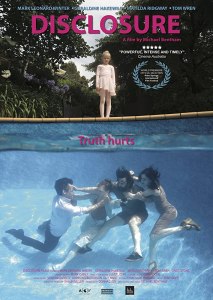 It starts with an accusation from a child during a playdate. Natasha, the four-year-old daughter of Emily (Matilda Ridgway) and Danny (Mark Leonard Winter), has a very serious accusation against the older nine-year-old son of Bek (Geraldine Hakewill) and Joel (Tom Wren). They’re neighbors, friends, and both sides are certain they can work things out like agreeable adults. Danny and Emily feel only right to be upfront about the accusation and ask to send the son to counseling. Joel and Bek are wary of this getting into the news (Joel is a local politician) and want the allegation withdrawn. Natasha says it happened. The boys say it did not. Over the course of one very long day, writer/director Michael Betham will push both couples to the brink.
Disclosure (not to be confused with another 2020 movie by the exact same name) plays out for 80 minutes like a play, locking us in one location with four characters growing increasingly hostile to one another. It’s an uncomfortable movie because it traps you in that squirming discomfort of hard conversations and high-pressure tactics to relent or capitulate on ethics. It’s important that we never really know the full truth of what actually happened between the children. We have what four-year-old Natasha has said happened, we have the denials from the older boys, who are older but still children themselves, and we have two sets of parents trying to make sense of some pretty startling behavior. Bek is convinced her own children could never commit something so heinous, and therefore Natasha must be confused or lying. She argues the children were too young to understand what her account alleges. Emily is convinced because of her daughter’s youth that she must be telling the truth, because why else would she concoct this harmful account? Each gets dug in from their perspective and only becomes more hardline. Bek reveals a startling secret of her own, being a victim of sexual grooming and manipulation in her youth, and this confounds Emily even more, asking why Bek doesn’t then believe the word of the victim here? These discussions begin in a civil manner that begins at surface-level neighborly pleasantries, but once the central conflict emerges and the opposing resolutions are debated, you start to wonder whether you are watching people at their extremes or whether you are watching the characters as they really are at heart.
 This is a patiently paced movie with every scene feeling like its own mini-movie or individual play, often a two-hander, and I was rapt with attention each time to see how the tension escalated. The couples think they can resolve matters, that they can convince the other side to the merits of their perspective and they can be persuaded to come over to their thinking. Naturally, this doesn’t happen. Given the seriousness of the alleged act, it brings out a ferocious defensive side, contemplating how far each member of each couple is willing to go to protect their children. It’s not like they get into a knife fight or anything that breaks the tonal reality of the scenario, but there is a clear moment where we have a divide between heroes and villains. That designation is a little flippant as nobody is portrayed in a strictly villainous manner; however, there are obvious moral missteps late in the movie that rely upon power plays and leverage. Bek and Joel have so much more immediate power between the couples and they’re not afraid to inflict it. They come over unannounced, catching Emily and Danny relaxing naked in their pool, vulnerable, embarrassed, and already discombobulated. Danny is eager to smooth things over and find a middle-ground because he loves his wife, and daughter naturally, but also because he doesn’t want to lose a prime career opportunity of working on a book with Joel. Eventually, the wealthier couple will use their wealth and influence to maximum pressure, even if they lament how much more they have to lose if the details of the allegation became public. For them, they have more at stake and Emily and Danny should be more reasonable and accommodating to their requests.
Eventually, there is a turning point where Disclosure goes from uncomfortably ambiguous to picking a side. A character clearly goes into the wrong, and at first you believe this transgression is to defend their child, but as it continues you begin to wonder whether or not it’s simply to “win” the argument and push aside a larger introspection over what this accusation personally means for this family. It made me loathe the character although it makes them more interesting and complicated. Ultimately, you will never know what happened with the children and the ending is somewhat unsatisfying because we end in a stalemate. I was genuinely hoping the movie would keep going for another 15-20 minutes to advance the plot and tensions further, but I understand the principle of Betham leaving on a point of disagreement and ruin and leaving the characters wanting. There are words and actions that will be highly unlikely to be taken back. They must deal with it all.
 Thankfully, the performances are universally strong to match the intensity of the story. It’s the women that make the biggest impact. Hakewill (The Pretend One) begins with the impression of Bek being an entitled rich wife who is used to getting what she wants, and over the course of those fractious 80 minutes, she proves how much this is merely an act. In fact, her own troubled marriage and past are in conflict with this veneer. Hakewill has several moments of barely-veiled rage that can be chilling but also heartbreaking. Ridgway (Book Week) is the face that many viewers will adopt as their own, meaning her perspective of treating her daughter’s accusation as credible and demanding response. She feels betrayed by her supposed friends, ambushed and wounded, and that she needs to remind her own husband to support their side of the argument. Ridgway is terrific as she tries to process her righteousness and disappointment over how everything spins out of control. The husbands are able in supporting positions, especially Wren (Winners & Losers) who uses a chummy sense of empathy as a shield he’ll drop at a moment’s notice. Winter (Escape from Pretoria) has the least to do simply of the players because his character attempts to be the most active peacemaker in the group.
Disclosure could have serviced as a stage play and the adaption wouldn’t have been too challenging but I’m glad Betham made this for the medium of film. I’m glad I got to see the subtle expressions of great actors trying to keep their cool, trying to stomach their resentment, and trying to force their opposition to retreat. It’s a pugilistic match where each side is convinced that they’re in the right or, in the wake of contrary evidence, that they have enough worth fighting for to be declared the winners. Characters keep saying they just want to think “about the children” and what’s best for them, but nobody seems to be on the same page about what that means. This isn’t an easy film to watch and given the thin line of sexual violence versus sexual exploration, as well as the question of how old a child can recognize their actions, it made me quite uncomfortable throughout, but I was always intrigued with where it would go next. Disclosure is a small Australian film that is available for streaming rentals and while it’s not going to be the most fun 80-some minutes of your day, it will definitely make you think.
Nate’s Grade: B+
Share this:

Hamilton (2020)

Multi-hyphenate sensation Lin-Manuel Miranda’s Hamilton sounds like a bizarre misfire, a hip-hop-infused musical about one of the lesser known Founding Fathers, and yet not only does it succeed so magnificently, so transcendentally, it’s one of those rare artistic pinnacles that lives up to its own momentous hype. This is one of the crowning artistic achievements of the twenty-first century. I’m exceedingly grateful for a filmed version of the vaulted stage experience, with the original cast, that allows me that front-row view my bank account never would afford. This is going to be a film review of what is, essentially, a live theatrical performance, but really this written review is going to be a celebration of Hamilton and what I consider to be so phenomenal.
In 1776, Alexander Hamilton (Miranda) is an immigrant looking to make his name in the American colonies and the looming war with Britain for independence from King George III (Jonathan Groff). He meets and befriends Aaron Burr (Leslie Odom Jr.), an ambitious upstart who seems fatefully linked with Hamilton through the decades. Hamilton falls in love and marries Eliza Schuyler (Phillipa Soo) but also has a close relationship with her older sister, Angelica (Renee Elise Goldsberry), who keeps her real feelings at bay to protect her sister. Eager to get into the action, Hamilton accepts a position as George Washington’s (Chris Jackson) right-hand man as the battle comes to New York and the colonists do the unthinkable and defeat England as we conclude the musical’s first act. “You’ll be back,” King George retorts.
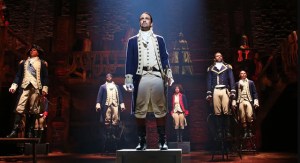
Next comes the tricky part of building a functioning country in the aftermath. Hamilton is appointed to be Secretary of the Treasury by newly elected President Washington, but his federalist principles are fought against by some pretty big names in the cabinet, like James Madison (Okieriete Onaodowan) and Secretary of State, Thomas Jefferson (Daveed Diggs). Both are wary of a centralized government and prefer more power to be held by the states. The Founding Fathers jostle for ideological supremacy and Hamilton gifts his opponents with the burgeoning nation’s first political sex scandal with Maria Reynolds (Jasmine Cephas Jones). Aaron Burr rises in local and national politics but sees Hamilton as a constant thorn in his side. With the presidential election so close in 1800, Hamilton’s endorsement of Jefferson over Burr is the final straw, and Burr demands satisfaction in a duel against Hamilton that will prove tragic.
For fans of musical theater, Hamilton is a two-hour-and-forty-minute joyously exuberant celebration of a bold artistic vision, the electricity of live theater, and broadening American history in a manner that makes it far more accessible, relevant, and humane for a modern audience. The very nature of having minority actors portraying the Founding Fathers and their famous wives is part of Miranda’s appeal that he wanted to tell the story of America with the America of today. Ordinarily, African-Americans would never get an opportunity to play Washington or Jefferson, or a Chinese-American woman playing the role of Eliza Hamilton, and there is definite power in representation, in seeing these different faces playing these historical figures. The deliberate color-blind casting makes America’s history feel more inclusive. It’s such a simple act, opening the ethnicity of historical roles, but it produces a beautiful result and provides even more cross-textual commentary, like slave-owning presidents played by black thespians.

Another miraculous effort by Miranda is his ability to generously humanize many of the characters, including the man who eventually murders Hamilton himself. Very often when we talk about the Founding Fathers and other Great Figures of History from oh so long ago, they take on a mythic quality and seem less human, less flawed, and less relatable. They seem practically superhuman, absent our doubts and desires. Miranda’s portrayal of the men and women of America’s founding does the opposite and makes these people feel relatable, flawed, and human yet again.
This includes Hamilton as well. He’s obsessed with his sense of legacy, has a pretty healthy ego that gets him into trouble, and might have been having an emotional affair with his sister-in-law, never mind an actual affair with Maria Reynolds. He’s so concerned about his “good name” and rumor of impropriety (he was accused of embezzling government money to pay for Ms. Reynolds’ husband’s extortion) that he literally confessed to his marital misdeeds and published it. Hamilton is consumed with writing his ideas (“Why do you write like you’re running out of time?”) and an impending early death, something he amazingly escaped during a hurricane in the Caribbean that destroyed his village as well as his mother’s fatal illness. He was so eager to get into the heat of war that Washington had to sit him down to persuade him that dying as a martyr isn’t as glamorous as living and seeing through your ideals. Hamilton’s death at the hands of Burr is likely the most widely known fact about both duelists, but the musical brings each to glorious and troubled life with unerring compassion without excusing their real failings.
Burr serves as the narrator of our near three hours, setting the stage for Hamilton’s story with his own regrets and jealousies framing his recounting. He’s a complex character worthy of his own biopic, an orphan who finished college in two years, had an affair with the wife or a British officer, lost her at sea, and championed retail politics centuries before it was the norm. His personal philosophy was one of caution, diametrically opposed to Hamilton jumping after whatever he wanted no matter the consequences. Burr longs for being near the real center of power, and his showstopping number “The Room Where It Happens” is an ode to his desire. He begins as a friend and ally of Hamilton, then political rival, and finally as a mortal enemy. He’s too calculated with his personal beliefs, never wanting to be too challenging and at risk, which is an embodiment of his social-climbing ambition as well as his callow decision-making. To Burr, avoiding risk and not accruing enemies is simply smart business. The musical does an excellent job of humanizing Burr (“Now I’m the villain in your history book”) and offering a perspective in opposition to Hamilton but not without its own measurable merits.
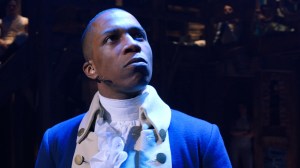
The domestic side of Hamilton could be its own movie to itself. The relationship between Alexander, Eliza, and Angelica is complicated to say the least. Angelica was the elder sister and in her stellar song “Satisfied” she details the social pressures of being in that position, being expected to marry into a desirable match that will see the family name and fortune to prosper. Feeling initially unsure about Hamilton’s intentions, she introduces him to her sister Eliza instead, and it’s a choice that she feels conflicted about ever since. Angelica dearly loves her sister (“I love my sister more than anything in this life/ I will choose her happiness over mine every time”) but cannot help but still feel a yearning for her brother-in-law. However, when the Reynolds scandal comes to light, she will defend her sister to her dying breath. That sisterly deference makes Angelica such a fascinating figure, and it certainly makes the Hamilton marriage more intriguing and roiling with pent-up desires. Eliza sings about removing herself from the narrative in “Burn” and how her husband has “forfeited the rights to my heart.” She’s been trying to impress upon her husband to be happy in the moment (“Look around, look around/ How lucky we are to be alive right now”) and enjoy his accomplishments rather than looking ahead. Her eventual forgiveness of Hamilton is one of the most emotional moments of the show that causes me to tear up. And she serves as a final testament to Hamilton’s legacy during the final number, after his death, and fills in the gaps of history by asserting her own agency back into the observed “narrative.”
I’ve gone over 1300 words, dear reader, and I haven’t even talked in depth about the music, so allow me to say that Hamilton as a musical is just about music perfection. Hip-hop is such a densely wordy platform that allows so much information to be imparted at lightning speed, which means that lyrically these songs are jam-packed with clever asides, allusions, and rhyming recitations of history. The songs are instantly quotable and filled with deep consideration from witticisms to also important dramatic themes and perspectives. I was amazed at Miranda’s composition skills in particular how he’s able to weave and build off character leitmotifs. It’s brilliant how something like Hamilton’s declarative early song “Not throwing away my shot” about his ambitions can come back during his duel with Burr where he raises his pistol in the air, away from Burr, and literally throws away his shot. Or how the beat of a song can imitate a failing heartbeat in a fractious moment of tragedy. Or how King George’s self-involved songs are fashioned to be like 1960s British invasion pop ditties. Or how cabinet arguments become riotous battle raps between Jefferson and Hamilton. Or how the same actors who played Hamilton’s wartime buddies in Act 1 are playing his political rivals in Act 2 (“Have you forgotten Lafayette?” he asks of Jefferson, the same man who portrayed Lafayette). There are layers and layers to the compositions here and the music is remarkably assured; almost every song is a certified earworm, and it’s an entirely sung musical. Every person will have their favorites, and for me they include “Satisfied,” “The Room Where It Happens,” “History Has Its Eyes on You,” “Dear Theodosia,” “One Last Time,” and the moving finisher, “Who Lives, Who Dies, Who Tells Your Story.” Even if you don’t like rap music, Miranda’s offerings are so catchy, so accomplished, and so bursting with excitement, that it’s near impossible to resist.

This movie was filmed in 2016 from the original Broadway cast, many of whom earned Tony awards for their sensational work (Diggs, Goldsberry, and Odom Jr.). Everyone is truly excellent but my favorite performer, by far, is Diggs (Blindspotting). He gets to spit lightning-fast rhymes in a French accent as Lafayette, and his portrayal of Jefferson as a dandy in the style of Andre 3000 from Outkast is enormously entertaining. His “What Did I Miss?” introductory number is a perfect impression for Jefferson’s arrival onto the stage. Diggs’ is so charming even when he’s being a scoundrel trying to plot the doom of Hamilton. His battle raps with Miranda are a highlight and Diggs also seems to get the most tricky lyrical arrangements because of his peerless skills at maintaining flow and diction (“I’m in the cabinet, I am complicit in/ Watching him grabbin’ at power and kiss it/ If Washington isn’t gon’ listen/ To disciplined dissidents, this is the difference./ This kid is out!”). There’s a reason Diggs has become the other breakout star of the show.
Soo (The Code) breaks my heart with her Act 2 solo numbers and then mends it back as she reasserts herself on “Who Live, Who Dies, Who Tells Your Story.” Goldsberry (Altered Carbon) has such a fire to her. Groff (Mindhunter) is hilarious as King George, though his singing involves a lot of literal spitting. Miranda (Mary Poppins Returns) is exceptional as the titular character who comes from nothing and through the power of his ideas creates America’s financial institutions that are still standing to this day. But it’s his personal relationships that better define him in the play. The fatherly relationship he has with Washington is affectionate (“One Last Time” has an extra poignancy knowing Washington died shortly after leaving office) and his hopes for his newborn son (“You’ll Blow Us All Away”) speak to a larger truth about parenting that also links up with the foundation of a nation in infancy. There’s also his complicated love divided between Eliza and her sister. Miranda has such a natural charm and swagger and earnestness that seeps into his performance and every performer.
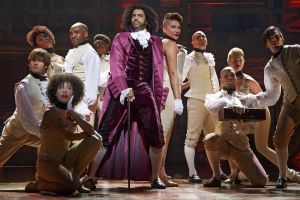
So is there anything about this movie-wise to separate it from a bootleg of the show? Director Thomas Kail (also the director of the musical) does make smart use of when to go tighter on his actors, to zero in on the emotions and expressiveness, and when to go wider for best impact. The stage is designed like a bullseye with a rotating circle, which can play up the dramatic confrontations between foes, especially the duels. I was impressed at points where the movement of the stage would be perfectly timed with camera focus and edits, allowing other characters to loom over the shoulder, or pop into focus, giving the production a greater sense of filmed visuals. However, this is really a filmed version of the stage show, so as a movie, it’s only going to do so much with those trappings. The unreality of theater has to be accepted but the movie version does a great job of maintaining the intimacy of the shared theatrical experience. It’s even nice to hear the applause after the musical numbers or some of the laugh lines hit home.
By this time, you’ve likely heard about the Broadway-smashing Hamilton success story of Miranda and his crew but do yourself a real favor and watch the movie with the OG cast. Yes, there are historical shortcuts taken for dramatic license and not everything you see on stage will be one hundred percent accurate with the long record of history, but it all clicks for the greater storytelling aims. Some might be uncomfortable with the re-visioning of the Founding Fathers, either by the open-ethnicity casting or glossing over their slave-owning faults, but Miranda’s larger goal of making history reflective of the people who currently live today is admirable. In short, unless you have the kind of money to blow on a front-row ticket, enjoy the Hamilton movie experience until Miranda eventually wrangles his artistic milestone into a more movie-movie version.
Movie Grade: A
Show Grade: A+
Share this:

365 Days (2020)

I never thought I would say these words but I am now reconsidering the artistic merits of the 50 Shades of Grey franchise, and that’s because 365 Days is an even more problematic and pathetic imitation of something that was already problematic and pathetic. The Netflix sensation is a Polish movie based on a trilogy of Polish books, and it’s been one of the most watched movies on the streaming service for months, all but guaranteeing that the remaining two novels by author Blanca Lipinski will find their way to the small screen in the near future. 365 Days is a gross distortion of romance and an uncomfortable watch for many reasons of taste and entertainment.
Massimo (Michele Morrone) is the son of a slain mafia boss. Laura (Anna Maria Sieklucka) is an ordinary woman in a bad relationship with a man who expresses little interest in her. One night, in Sicily, she’s kidnapped by Massimo and wakes up as a prisoner in his mansion. He’s been obsessed with her since he first saw her and is convinced that he can make Laura fall in love with him. He promises never to do anything against her will (as he literally gropes her that second) and that she will remain a captive for 365 days. If she doesn’t fall in love by then, he promises to let her go.

If you’re not troubled by that icky starting point for a modern romance, I worry about your concept of what consent means because this ain’t it. This is not the first story to use a brooding, dangerous, misunderstood man as its heartthrob, or a woman who despises a man before falling for him, nor is it even the first pseudo romance utilizing Stockholm syndrome. Laura even cites Beauty and the Beast by name. However, 365 Days seems inordinately confused about the simple concepts of consent and romance. Massimo is meant to seem gentlemanly when he says he’ll allow Laura to come to her own conclusions; he’s just so confidant in his charms. If that was simply the case, he wouldn’t need to kidnap and imprison her. He could try introducing himself and dating her. When her romantic desire is directly linked to her freedom, there is no real possibility for consent here. Laura attempts to run away at one point and inadvertently sees a mafia underling executed, which should motivate her more to flee or motivate Massimo even more to keep her locked up. It does neither. She never attempts escaping again even though she does leave the compound and runs into strangers. I suppose she accepts her captivity, though at one point she almost single-handedly instigates a war with a rival mafia family and that would have been an excellent act of rebellion. That would have been the more intriguing, feminist-friendly version. Instead we get the version where Laura bleaches her hair to appear more like Massimo’s blond ex-girlfriend. Commence heavy sighing.
Massimo isn’t some sad little puppy dog who needs love. He’s the head of a crime family, and the movie doesn’t present any potential softer side or moral code or vague introspection for the man. Sure, he kills a guy who was trafficking in children, but he seems to be nonchalant about trafficking adults. I was completely astonished that no redeeming qualities are ever presented for this dude (unless you count his bank account). He’s a creep. He’s awful. He’s got obvious anger and control issues. At one point, Laura starts wearing revealing lingerie and even stripping in front of him, all to tease him. It’s not so much an act of defiance and agency, and it only makes Massimo more agitated and aggressive. He grabs her forcefully and warns her not to “provoke me.” The implications are that he’s not responsible for his own actions because of her behavior. He tries to make Laura jealous but his actions are gross, like forcing her to watch another woman fellate him. He tries to charm her but his actions are gross, like his repeated use of the come-hither line, “Are you lost baby girl?” which is also the first thing he ever says to her face-to-face before kidnapping her. I shuddered every time he said it. The only selling points for this man are his physical looks (to me he looks like any disposable Euro trash villain in a Taken sequel) and his lavish lifestyle. The fantasy of living a life of privilege I suppose is enough for Laura, and fans of the movie and novels, to excuse the innumerable warning signs.

The bigger attention-grabber for this modestly budgeted foreign romance is the graphic sex. While not crossing over into un-simulated sex scenes, these uncomfortably long scenes cross more than a few lines. The first thing you’ll likely note is how aggressive Massimo comes across The very first sequence is inter-cut between Laura masturbating on her bed, to showcase her untapped passion from her bad boyfriend, and Massimo getting a blowjob from a stewardess who very much does not look to be enjoying herself. He is forcibly grabbing this poor woman’s head and repeatedly shoving it downward, enough to look to generate her tears. Again, I must stress, this is the first impression of sex we get from 365 Days. This behavior reappears when Massimo is trying to make Laura jealous through forced voyeurism. The sex scenes feel so drawn out that 365 Days does begin to feel like a high-gloss version of soft-core porn. The plotting is just as empty and careless as we fill time from one sexual act to another. Just because there’s a lot of thrusting and writhing bodies not make onscreen sex automatically erotic. You have to feel the heat, feel the passion of the characters being unleashed, but also have empathy for those coupling, and empathy is a hindrance for Massimo and Laura. This movie doesn’t even know how to do simple storytelling right. It should present some kink of Laura’s in Act 1, before she meets Massimo, to show she has a secret wild side, and then that’s the avenue that could have been accessed for her to peel away those inhibitions. Even that is sleazy but it’s better storytelling structure.
The ending of 365 Days also made me scream at the screen because of how disastrously incomplete it is. It’s not an ending but a cliffhanger and one that doesn’t even serve as a meaningful cliffhanger knowing there are two whole books left to adapt (366 Days?). I was baffled by the appeal of 365 Days, so I looked up the plot synopses of the other stories ahead and, dear reader, believe me when I say that it only gets worse and more outlandishly soap operish from here on out. We’re talking identical twin brothers, dead dogs shipped in the mail, and even more trashy love affairs.

365 Days is two hours of rearing back in your seat wincing and groaning. While the cinematography is lush and the locations in Italy are idyllic, there is nothing sexy about this movie whatsoever. That’s because it’s built on a reprehensibly flawed premise of romance that doesn’t remotely understand consent. At no point does Laura really have an actual choice here. She is a prisoner who falls in love (or so she says) with her abuser. The fundamental draw of an onscreen romance, the desire to see people together, is absent with this twisted power dynamic. I want to see Laura escape, not twirl around with a shopping bag and dressing up for her man. This should have been a completely foreign-language production because when the foreign actors speak in English, they already sound disjointed, affect-less, like they’re victims of a bad dub. When they speak in their natural languages, it’s remarkably night and day. This is bad. All the way bad. Please don’t even spend one solitary day of your life, even during a pandemic, on 365 Days.
Nate’s Grade: D
Share this:

Da 5 Bloods (2020)
 Given the current political climate, there might not be a better filmmaker to seize the moment than Spike Lee. The controversial director has been making controversial, thought-provoking, inflammatory movies for over 30 years, and after the Oscar-winning success of 2018’s excellent BlackkKlansman, he’s on an artistic resurgence not seen since the early 2000s (please watch 2000’s Bamboozled, an underrated media satire that’s only gotten more relevant). In comes Netflix and their deep pockets and wide creative latitude for filmmakers and the result is Da 5 Bloods, a stirring movie that seems like a modern Kelly’s Heroes but becomes so much more.
“Da 5 Bloods” is the nickname for a group of Vietnam War vets, all African-American. Paul (Delroy Lindo), Otis (Clarke Peters), Eddie (Norm Lewis), and Melvin (Isiah Whitlock Jr.) venture back to Vietnam to discover a cache of gold bars they had hidden in 1971 as G.I.s. They’re also going to bring back the remains of their fallen leader, Stormin’ Norman (Chadwick Boseman), who died after they struck literal gold. The land has changed in the ensuing decades, with American culture finding its complacent commercial footing (a dance hall has an “Apocalypse Now” party presented by Budweiser), but then the men have also changed. Paul has brought along his adult son, David (Jonathan Majors, The Last Black Man in San Francisco), in an attempt to better understand one another and bridge their divide. When the multi-generational Bloods go for their buried treasure, it becomes a question over how far they will all go to get out of Vietnam rich.
 Lee’s commentary on art, war, and the commoditization of history happens early and with great deliberation. The most notable choice is how the flashbacks back to the group’s Vietnam experiences are portrayed. The aspect ratio squeezes to 4:3, akin to news footage or home movies over these memories, but Lee’s stylistic vision goes further. You’ll notice very early into the flashbacks that they take on a sort of heightened quality, coming across more like a movie version of the Vietnam War than the real experiences. The guys complain about the Rambo movies and then these flashbacks feel like their own Rambo rendition. The editing is quick, the shots are tight, and the boys are bursting with bravado, none more so than Stormin’ Norman, their celebrated friend who they believed was the best of them, and he’s played by a big-time movie star and a real black superhero of popular culture. The flashbacks take on an unreliable quality, exaggerated and fed by the bombastic war depictions of popular culture. This is later proven correct with a late personal reveal. The sequences feel more like preferential memories, and this is exemplified by the choice to have all the older actors play themselves in the flashbacks. It takes a little mental adjustment but I enjoyed the choice. It added to that surreal quality that made the scenes more worthy of analytical unpacking. It also gave our established characters more to do as they are slipping into their literal flashbacks coming back to Vietnam. Gratefully, Lee has also forgone any de-aging CGI spackle over his actors’ faces. Consider this the anti-Irishman, and it didn’t take me out of the movie at any point. I appreciated the choices.
The movie is about war and its representations in movies, as evidenced from those flashbacks, and then Da 5 Bloods becomes its own war movie. When the violence happens for real, it’s played differently than how it appears through the gung-hp flashbacks. It’s grislier, uglier, and hits you in the stomach. It’s not the rah-rah moments to celebrate in jingoistic fashion. As the Bloods get closer to their gold, the movie transforms into its own hybrid of Treasure of the Sierra Madre and pushes the characters to reconcile how far they will go to keep their secret. This pushes some characters to challenge others on a shifting plane of morality, and you never really get a sense of what might just happen next. When a French woman was talking about visiting Vietnam with the purpose of finding and detonating leftover landmines from the war, I knew it was only a matter of time before this scenario resurfaced with a vengeance. When the Bloods are exploring a hillside with a metal detector, I kept wincing, waiting for an eventual click and an explosion. There is a taut rescue sequence that also taps into a relationship showcase for two characters. That’s the greatness of what Lee has done here, because on top of mixing genres and tones and political commentary, he also makes sure that the action, the real action, actually means something.
 The last act of the movie is a big standoff with genuine stakes, and while it serves as a fun example of our older underdogs more than holding their own, it gets into the major theme of legacy. What will be these men’s legacy? What will the legacy be for a son who has never felt close to his father? What about a daughter who never knew her father? What will last beyond these men? The legacy of Stormin’ Norman informs and haunts the other Bloods; Paul practically breaks into tears confessing that he sees Norman’s ghost on a near daily basis. They all feel guilt over being unable to save Norman but also being unable to bring his remains home until now. Going back is not just about financial windfalls, it’s also about making good on a delayed promise. Talking about what the men will do with their shares of the loot allows each to fantasize about a more perfect life ahead, while at the same time coming to terms with their life’s regrets. This is where Eddie gets his most potent opportunity to stand out. The character too often just feels present rather than integrated in the narrative, but here he opens up about how his life might not be as perfect as his friends tease him about. Inherent in this ongoing discussion is the notion of what does sacrifice mean and for whom. Lee repeatedly threads historical footnotes of African-Americans being shortchanged after serving their country in wartime. Even though only making up ten percent of the U.S. population during Vietnam, black soldiers made up over 30% of the grunts on the ground. Paul says, “We fought in an immoral war that wasn’t ours for rights we didn’t have.” The Bloods view this gold as their long overdue reparations for being black in a racist country. However, it’s Eddie who won’t allow the Bloods to merely deal in grievance. He cites Stormin’ Norman and how they can improve the lives of the next generation even at their own expense. Even as the gunfire picks up and we have a misplaced mustache-twirling villain (Jean Reno), Da 5 Bloods is an action flick that has much more on its mind, looking to the past, present, and a better future.
 This is a compelling ensemble tale but Da 5 Bloods is clearly Lindo’s movie. Lindo has been a hard-working actor for decades, with roles in Get Shorty, The Core, Gone in 60 Seconds, The Good Fight, and a bevy of Lee’s films (er, “joints”) like Crooklyn, Clockers, and Malcolm X. But it’s the role of Paul that will serve as the actor’s finest career performance. There is so much pain and anger coursing under the surface with this character. Paul wears a red MAGA hat in proud defiance and to the jeers of his pals. Paul is a Trump voter who wanted to shake up the system, the same system that had let him down for his life. He’s haunted by his past, and even decades later, he can admit returning to the jungles is still affecting him. The gold represents something elemental, mythical to him, a lifetime-defining event that he needs to accomplish. As this zeal overtakes him, Lindo unleashes spellbinding monologues looking directly into Lee’s camera as he marches along, narrating his stormy inner thoughts, and trying to assess the contradictions of his life. Lindo doesn’t just play Paul as a hardass grumpy old man. He’s still reeling, from service, from fatherhood, from the decades having vanished, and from the setbacks to retrieve the gold. Paul’s odyssey takes on a religious passion play that builds him into a symbol of America’s unmet promises and fallibility. Even in uncertain COVID-19 times, I’d be shocked if Lindo isn’t nominated for an Oscar.
Netflix’s Da 5 Bloods is a great movie and invigorating reaffirmation that when Spike Lee really gives a damn he is one of our most essential filmmakers, even after 30-plus years in the director’s chair. The movie is packed with rich detail and character moments, little things to keep you thinking, and a blending of tones and texts that invites further analytical examination. At its core, it’s a story of friendship and legacy, and the actors are a great pleasure to watch grouse and weep and laugh together. Even at a taxing 154 minutes, I was happy to spend the extra minutes with these men and better understand them and their pain and their relationships. Even though the movie delves in loss and grievance, I found it to be ultimately hopeful and galvanizing. Something as simple as a hand-written letter can turn out to be more restorative than millions in gold bars.
Nate’s Grade: A-
Share this:

The Right to Remain (2020)
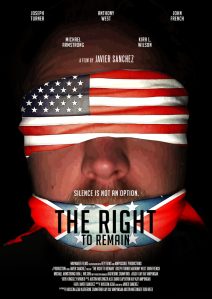 The Right to Remain is definitely a message movie with a very pertinent message for our trying times of racial injustice and civil unrest. This Ohio-made indie, filmed in my hometown of Columbus, was made before 2020 but its release seems even more timely with the outrage over police abuses dominating the news (it’s currently available for free on the film’s website as a five-part series). Even the title itself I find very fitting, taking its phrasing from the Miranda Rights that police officers are required to recite upon making an arrest and transforming it into a more exclamatory statement of defiance, one that could apply to the protests in the wake of George Floyd’s execution and the injustices roiling the country. The right to remain; the right to remain alive, the right to remain a citizen, the right to remain a human being deserving of equality. It’s all right there in the title as a starting point, so kudos to screenwriter/producer Javier Sanchez. The Right to Remain is a message movie that mostly succeeds on a patented formula even if it could have been a bit more ambitious or specific with its examination on race relations.
In 1987, Forsyth County Georgia is awash in racial acrimony. The overwhelming white citizens want to drive out black citizens from calling this county home. Master (Anthony West) is detained in the county jail after a botched bank robbery. The presiding officers harass, antagonize, and even torture Master during his extended lockup (where is the man’s lawyer?). Danny (Joe Turner) is an officer who doesn’t want to join in the harassment. He’s fighting against his own environmental upbringing, but he starts to see Master differently, even forming an unexpected friendship. Danny’s change of heart is tested when he learns that several townsfolk, aided by complicit officers, want to lynch Master to send a message.
Given the focus of the movie, it’s going to make liberal use of the N-word, which always carries a burden of justification for the storyteller. The movie is set in 1980s Georgia, and we’re following multiple racist characters, so it seems logical that when it comes to African-Americans, these people have one go-to word. It’s appropriate in that context but the filmmakers need to be careful about how often the word appears, not to dull its hateful power or, worse, to feel enabled by their setting to unleash the word without abandon. I feel like the filmmakers here have their hearts in the right place and trust them more with the N-word than Quentin Tarantino.

Behind-the-scenes picture from film website.
The message of this movie is pretty identifiable but still affecting. Watching two characters from different walks of life find common ground and build an uneasy friendship is a tried-and-true formula for mass appeal uplift. It recently even earned Oscar gold with 2018’s Best Picture-winner Green Book. The core of the movie is using a personal relationship and gradual reawakening from hate to discuss a larger issue, namely the mistreatment of black citizens and rampant police harassment. Through Master, the audience is able to personalize the experiences of a larger community. It’s all there and it still works from a general storytelling standard. However, do we need even more movies where black experiences are being told through the prism of a noble white person’s emerging epiphany? While he didn’t create this trope, I call this the Edward Zwick Model of nudging an audience with social commentary, like showing slavery and racism through a white P.O.V. (Glory), showing the Japanese modernization through a white P.O.V. (The Last Samurai), and showing the horrors of the diamond industry exploiting Africans through a white P.O.V. (Blood Diamond). Do we really need these gatekeepers to better tell the stories of minorities? I would say no, Hollywood execs would argue otherwise, but in 2020, I think using the suffering of a minority character to better educate a concerned white character is even more unnecessary. By no means am I condemning The Right to Remain and its filmmakers, good people with a story they wanted to tell and following a recognizable model to do so. I believe entirely in their good faith. Still, I kept debating whether this should be Danny’s story or Master’s.
Much of the movie is going to hinge on the writing and performances of the two men at the core of this relationship, so it’s a relief that this is where the movie shines. The two men begin to see past their prejudices, though, to be fair, this is far more pronounced with Danny realizing that his captive is not the animal his fellow officers decry. Master explains his reasoning for robbing the bank of the exact amount owed his family from Forsyth’s ancestors stealing his great-grandfather’s holdings in 1912. I enjoyed that he learns a sense of calm through his interactions with a kindly black pastor (Michael Armstrong), but it’s not a larger integration of spirituality, it’s actual pragmatic breathing exercises and meditation. Master even tries yoga. The larger emphasis is on Danny and his personal growth through his interactions with Master. It’s through small actions like a conversation, a shared game, a walk in the fresh air, but it feels earned and appropriately paced. By the end of the film, Danny is willing to put his life on the line to save Master and he has shaken free from the racist group-think that permeates the town. I like that even though the relationship between these two men improves, it’s not like everything can be readily resolved. You can tell Danny still has some lingering prejudices, and Master still has some doubts, but both men want to believe in the goodness of the other. I appreciated that degree of subtlety for a movie that doesn’t exactly trade in subtlety in service of its larger message. Not a complaint, mind you.
 Several supporting characters would probably have been better left out of the overall story. I don’t think we needed as many scenes with racists just glowering and being racist. As a movie, The Right to Remain runs around two hours total and could be trimmed down. As a series, if it were to remain so, I can understand the desire to refresh a viewer on the prejudices of the town and the stewing threat these bad men pose on the periphery of the story. The racist rogue’s gallery needed less check-ins. They bring in a white boy who was reportedly the victim of violence from a black man, and I thought we were going to get more examples of how racist brainwashing works through the role of this young boy with some very unfortunate burn make-up. Really, it looks like he has a pizza on his face minus the cheese. Except that’s not what happens, which seems peculiar that the good ole’ boys didn’t want to involve him in their fledgling murder message. Danny has a sickly pregnant wife (Vera Angelina Ignatov) whose narrative purpose seems to be to symbolize what he has lost in service of his job in a racist police force. That description makes it sound like she pushes him to take a stand against the pressures in his force but it’s really simpler than that. She’s the standard Wife to a Cop that reminds him he should be home more often. This also extends into the wife’s sister character (Kira L. Wilson) who also reminds Danny that he should be home more often. It’s redundant, and ending the film’s resolution with the wife’s sister’s personal recollection of when she knew racism was bad is strange.
The acting overall is both pleasant and earnest. West has a righteous defiance but also has a battle-weary resignation about his time as a black man in Georgia. He has an easy charisma that draws the viewer into his orbit. Seeing his responses to the tiny kindnesses offered is heartbreaking. Turner (Broken Mirror) begins as an uncomfortable but compliant officer and much of the movie rests upon his dawning realization of his own wrongs. Turner finds a well of decency to tap into with the character that makes him compelling even with the familiar formula. Turner and West have an amiable chemistry together and the best moments are their conversations. Another actor of note is John French (Confined) who plays what might be the most boisterously racist character I’ve seen in a movie since Alan Tudyk took my breath away in the Jackie Robinson biopic, 42. French is our primary villain and face of racism, and the actor seems to come alive with the pettiness and viciousness of his grotesque character. His chief seems to relish his position of authority and how we can abuse his powers. Also, given the Georgia setting, you’ll hear a range of Southern accents, some more understated and some more cartoonish.
I was slightly disappointed that the specific message of Forsyth County gets lost. The larger messages of racial tolerance swallow up the specifics of what happened in Forsyth, to the point that this story could have been told anywhere in the South. I was expecting the movie to come with facts and livid details about the history of Forsyth County and its bloody past of driving out all black residents in 1912 and how that legacy has shaped its descendants. There are brief news clips of Klansman and white supremacists rallying in 1987 to remind you of how prevalent this hateful organization still was in the community. There are even clips from Oprah Winfrey’s talk show, which worries me about copyright use and licensing for this production. The larger picture on racism still comes together with clarity, but I was hoping for something a little more specific about the county that inspired this movie. Imagine watching a movie about the Tulsa riots in 1921 and the decimation of Black Wall Street at the hands of envious white supremacists and that movie doesn’t go into specific details unique to its setting. It would be slightly disappointing because of the dramatic potential to a community opening up about its own past.

Behind-the-scenes picture from film website.
The Right to Remain is a low-budget indie ($10,000) so some technical issues and limitations are expected as long as they don’t fully rip the viewer out of the reality of the movie. The photography can be limited depending upon locations. Since much of the film is set in the whereabouts of Master’s jail cell, I was hoping for a larger variety of camera angles to spice up and differentiate the many sit-downs between bars. The sound design and recording, a notorious calamity of many an indie production, is also noticeably askew at points, with room tone levels clashing between shots. Other shots seem to use sound recorded from on-person mics where actors are rustling those microphones on their persons. An acoustic song seems to come in abruptly and leave just as abruptly, scoring moments awkwardly and then vanishing. It would be less bizarre if it didn’t show up repeatedly as if the sole musical selection for this universe. Any movie on a minuscule budget is going to have to cut some corners. Maybe the lighting isn’t dynamic here, maybe there isn’t as much coverage for certain scenes for the edit here, and maybe a location is lost and a more mundane setting is forced as a solution. There are numerous problems and solutions. I feel like director Hussein Azab (The Thin Blue Line) does a fine job of keeping things rolling without giving into artistic sacrifices. Sure, the sound could be improved, and maybe that pizza-face kid should just have been sidelined, but the big stuff is there on screen and it’s generally successful, which means the director had his priorities straight.
With message firmly pinned to its proverbial sleeve, The Right to Remain is a poignant drama that feels familiar and effective and well-acted and emotionally involving. It’s a low-budget success story of an Ohio indie who has found a timely relevance with its subject matter. Something tells me, sadly, that this movie will not stop being timely in the near future. The film is currently available for online streaming and even has a discussion guide with resources. It may be familiar, it could have been a little more polished, but the movie simply just works, and that’s a credit to the many cast and crew who had a worthy story to show the world.
Nate’s Grade: B-
Share this:

The King of Staten Island (2020)
 The King of Staten Island is a semi-autobiographical vehicle for its star and co-writer, Pete Davidson. He plays Scott, a shiftless young twenty-something bumming through life and trying to find his sense of self as a wannabe tattoo artist. His father was a fireman who died on 9/11 and his mother (Marissa Tomei) has just started dating a new man (Bill Burr), also a fireman, and that triggers Scott, who fights to sabotage his mother’s new relationship. I’ve never been impressed with Davidson from his fleeting appearances on Saturday Night Live, but I genuinely enjoyed him here and, yes, the character is a natural fit with his awkward, sarcastic, deadpan sensibilities. It’s another in director Judd Apatow’s style of loping big screen comedy, so we have many scenes of hanging out with friends and reprobates, with Scott trying different things to get a better concept of what he wants to do with his life. It’s a movie that coasts on the good feelings with the characters and their easy camaraderie. However, from a plotting standpoint, The King of Staten Island could have used more at the end and less in the middle. It’s only the last 40 minutes or so where Scott moves into the firehouse, which seemed like a more central focus from the advertising. The abrupt conclusion left me on a note of, “Oh? Okay.” The movie is already an unwieldy 137 minutes long, so there was plenty of hanging out moments that could have been trimmed to better position the actual personal triumphs and character resolutions. Some of the payoffs don’t exactly feel earned either. Scott’s wants to keep things casual with a woman he sleeps with (Bel Powley) and uses his mental illness as the excuse, and she says she deserves better, but then they just end up together and it doesn’t feel earned or like Scott has learned how to be a better boyfriend. It’s like Apatow is saying, “Oh, yeah, and he got the girl. The end?” I would put this on par with 2015’s Trainwreck, though that film has a more clearly defined character arc, but both serve as fitting vehicles that play to the strengths of their individual comedians. I enjoyed the overall mood, I laughed, I enjoyed the various vignettes of the fun supporting characters. I wish there was a bit more shaping with the plot and a more fitting conclusion, but The King of Staten Island allowed me to enjoy Davidson as a performer. That’s a triumph for a guy I didn’t care much for prior to this moment.
Nate’s Grade: B
Share this:

American Psycho (2000) [Review Re-View]
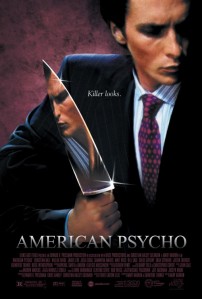 Originally released April 14, 2000:
American Psycho is based on the controversial 1991 best seller by Bret Easton Ellis though it got old fast. One can easily grasp how the lead connects with brand names on page one, but repeat it for 300 more and you’re tempted to add the book to your collection of firewood. Ellis’ novel was sadistically perverse, but director Mary Haron (I Shot Andy Warhol) has somehow managed to pull out an entertaining social satire from the pages of blood and name brands.
Christian Bale, mainly known as the boy-next-door in period piece films, plays Patrick Bateman with ferocious malevolence and vigorous life. Teen scream Leo was once considered for the part but after seeing Bale’s startling performance it should prove why he’s on screen and Leo’s swimming in The Beach. Bateman is an up-and-up Wall Street yuppie who glosses over appearance more than anything else. The only outlet it appears for our sinister shark from the soulless decade is by random acts of gruesome violence.
If Bateman blows off steam by blowing off companion’s heads than it only becomes more frustrating when no one believes his random confessions. Haron takes the grisly material of Ellis’ novel and mines it for pure 80s pulp. It only gets better the further it gets as you have so many points to discuss: Is Bateman acting out to prove his existence in a world that doesn’t humor him or others? Is he acting out deep-seeded rage from the actions of the decade on its people? Is he desensitized and so jaded that death does not even fracture him anymore? The questions are boundless.
The hit list of stars in Psycho includes Chloe Sevigny as a nailed home addition, Willem Dafoe as an investigative detective, Jared Leto as an axed co-worker, and sweet Reese Witherspoon as the apple of Bateman’s twisted eye. Everyone has fun in their tongue-in-cheek nostalgia romp through the absurd.
American Psychoshould not be confused with the successful teen sex farce American Pie. The only desserts in this film are just, and they’re usually left of the mayonnaise and behind the frozen head in the refrigerator. American Psycho is the thinking man’s slasher movie. A flick that slices, dices, and always entices. It only gets better after you’ve seen it. One of the best films of 2000 for now.
Nate’s Grade: A
——————————————————
WRITER REFLECTIONS 20 YEARS LATER

American Psycho was a literary sensation upon its initial publication in 1991 and was deemed shocking, grotesque, perverse, and all those splashy adjectives that made it guaranteed Hollywood would turn Bret Easton Ellis’ novel into a film. Every young actor in Hollywood in the 90s was rumored to play narcissistic serial killer Patrick Bateman. By the late 90s, director Mary Haron was attached with Christian Bale as the intended Bateman on the condition that other name actors could be brought on (Haron secured Willem Dafoe and Reese Witherspoon for supporting roles). The producers kept pushing for their number one target, Leonardo DiCaprio as Bateman, and Haron said she would walk if he was hired over Bale. The producers went ahead and DiCaprio was hired for several months, with the budget ballooning to over $40 million, half of which was slated just for DiCaprio’s payday. Months later, DiCaprio left to film Danny Boyle’s The Beach, and the producers went back to Haron and her top choice, Bale, who was so determined to play Bateman that he didn’t take any other acting gigs for nine months just in case (new total film budget: $7 million). Looking back again twenty years later, it’s difficult to imagine late 90s DiCaprio in the part that became the first of many star-making performances for Bale, one of the most chameleon-like actors of his generation. Haron’s tenacity and instincts proved correct and the film still stands tall as a dark comedy and a character study of a compulsive narcissist.
 The novel was set in the 1980s and intended to satirize the soulless suits of Regan’s America that made their ill-gotten gains on Wall Street, and the satire has only become more relevant after the 2008 financial meltdown and numerous white-collar scandals. The perception of Wall Street as predatory and vampiric and roiling with sociopathic greed has only become more pronounced, which makes the intended satirical targets even more worthy of their take-downs.
I initially wondered in my original review in 2000 whether, among other interpretations, Bateman was lashing out in a world that didn’t care about him in order to make himself feel heard, and that is exactly the opposite response. Bateman is acting out because he can and because he no longer cares about following rules. It may be a metaphorically simplistic application to make a Wall Street trader a serial killer but that doesn’t make it any less appropriate and resonating. The iconic business card scene still sends me howling, as Bateman and his colleagues (Justin Theroux, Josh Lucas, Matt Ross) compete for supremacy with who has the most accomplished little square of cardboard with their name on it. The hushed and awed voices, the detailed micro-analysis, the slow motion and beauty shots of the cards, it’s played to such wonderful heights of absurdity. When Bateman hires two call girls for a threesome, he spends more time flexing and admiring his own image in the mirror. He spends more time on his daily beauty care rituals than he does on introspection. For these hollow men, status and appearance is the only thing that matters in a world of imposters and transitory pleasures.
Bateman is meant to serve as a character study for a man who declares there isn’t anything there underneath him. It’s an expose of vanity in an era of venal excess and it’s also an indictment on privilege. As depicted on film, and later revealed why with an ambiguous conclusion, Bateman gets away with his wild and increasingly murderous antics because of his position. He’s a rich white Yuppie during 1980s New York City. He can get away with anything, which is why he can run around screaming, flailing a live chainsaw, wearing nothing but socks and blood, and nobody seems to be the wiser. It’s why he can go back to his own crime scenes to leave even more of his evidence, and DNA, around the premises. It’s why he can pose as Paul Allen (Jared Leto) even after he has hacked Allen into tiny little Yuppie pieces. It’s why he can hilariously wax on like a Rolling Stone essayist about musical artists like Phil Collins and Whitney Houston as he prepares to slice and dice his victims. As his actions become more and more blatant, the satire rises with Bateman to blanket his reckless impulses (these crooks can get away with anything, Haron seems to be whispering in your ear while elbowing you in the ribs). After two more decades of Wall Street scandal without consequence or credible jail time, as well as a president who is convinced rules do not apply to him, the satire has approached an even darker laugh-because-otherwise-you-might-cry territory than it was back in 2000 (“This confession has meant nothing.”).
 With no one able to tell him no, how far will Bateman go? Haron and her co-writer Guinevere Turner (who also appears in the film as Elizabeth, a drunk friend of Bateman’s who becomes another victim) smartly dialed into the themes they wanted to send up and dialed down the grisly gratuitous details. In the book, Bateman’s depravity is described in as much detail as he gives to his rampant consumerism. We don’t need pages upon pages of description to understand that Bateman is sick in the head, and we don’t need examples such as torturing a prostitute by trapping rats inside her vagina. The grisly overkill of the book is smartly pulled back to its essentials, and an oft-reviled work deemed misogynistic by many critics has been transformed from a deep dive into rape, dismemberment, and cruelty into a satire on the men who aspire to commit such awful acts. There’s a noticeable difference there that some will miss. One perspective focuses on the actions and the other focuses on the meaning. Bateman is a privileged, entitled, and alienated white man teeming with unprovoked rage, a figure we’ve seen more often in the news in the ensuing decades. The American Psycho movie takes aim at the fragile male egos of past and present. Haron would later go on to write and direct other indies (2006’s The Notorious Bettie Paige) but she never seemed to get that career boost after American Psycho. Ellis decried the movie adaptation and later said he felt female directors were unable to accurately translate the male gaze, which is dubious when the starting point for Hollywood filmmaking is preset at “male gaze.”
Bale is phenomenal in what proved to be his breakout role. It was only a few years later that he nabbed Batman for Christopher Nolan. According to interviews, Bale modeled his performance after what he saw during a Tom Cruise appearance on David Letterman’s talk show. Bale says he saw an “intense friendliness with nothing behind the eyes,” and he then knew how to play the part. It was also the beginning of Bale’s trademark method transformations, becoming the muscled figure of Bateman’s desire, the only thing that ever truly mattered to the man. Bale’s thinly veiled contempt for everyone and ironic detachment are constantly entertaining and provide great laughs (his go-to excuse for departing, “I have to return some video tapes,” made me laugh every time). There’s a late scene where Bateman calls his lawyer to confess to his litany of sins, feeling cornered, and it’s a spellbinding performance all in one take where he approaches mania as he finally unburdens himself (“Tonight I, uh, I just had to kill a LOT of people. And I’m not sure I’m gonna get away with it this time.”). It’s a tremendous moment in a tremendous performance. The movie is filled with familiar faces (Chloe Sevigny! Samantha Mathis! Reg E. Cathy!) that it becomes fun to realize just how many great actors and future stars contributed to the movie. For trivia buffs, it also features Batman (Bale) killing the Joker (Leto).
 My original review attempts many turns of phrase, like “blowing off steam by blowing off others’ heads,” but the core points are still viable: the satire improves from the book, Bale delivers an amazing performance, and there are many ways to interpret the film. The ending isn’t quite as ambiguous as perceived but it makes sense with the outlandish escalation of events, a point where even Bateman looks at his own power with befuddled curiosity. Back in 2000, I called American Psycho the “thinking man’s slasher movie” and I think that title still applies. It’s a vicious movie but the satire is just as vicious. Weirdly, there was a direct-to-DVD sequel that just went the “non-thinking man’s slasher” route by featuring Mila Kunis (Black Swan) as a criminal justice coed who embarks on her own bloodbath, including killing William Shatner as a professor. It’s like unintended satire on Hollywood itself; follow a cerebral and daring artistic work with run-of-the-mill slop under the same name, co-opting the appeal of a “brand” to make a buck. Much like Wall Street, Hollywood doesn’t know when to stop.
Re-View Grade: A


 nathanzoebl
You must be logged in to post a comment.