Blog Archives
Murderball (2005)
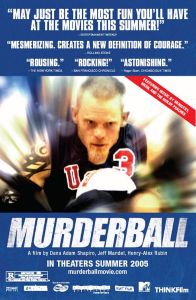 A fascinating look into the world of international wheelchair rugby, a high-octane game of bumper cars. This is a mere 80-minute movie and yet the wallop it packs can be felt long after. In such a short amount of time you get to understand the people, you really get involved in their drama and social situations, their competitive nature. Murderball explores so much of a little-seen world; I love the segment where they frankly talk about sex after their accidents. The help video that advises what sexual positions may be best for people in wheelchairs is hilarious. I never thought about it but there has to be quad groupies out there licking their lips. Mark Zupan comes across as nothing short of a superhero, and he’s just being himself. The film is surprisingly moving and poignant, with many uplifting scenes without ever getting sentimental. This movie earns every emotion. The people featured don’t want to get sentimental, they don?t want your pity; they just want to be treated the same how they were before their accidents. The wheelchair rugby bouts are exciting, with lots of interesting camerawork and useful animation. I loved immersing myself in this unusual sport, learning the point system depending upon the ability of movement with each person. This is an expertly crafted documentary with tight, rock-solid editing (it won an award for it at Sundance). You get this wealth of emotions and stories in at 80 minutes with enough time to close on an extended montage at the 2004 Paralympic games in Athens. It?s incredible seeing them turn their wheelchairs into these chariots of destruction. You get a great sense of the people and their world. This is the best documentary since the exceptional 2002 doc Spellbound, and Murderball is nothing short of the BEST film of 2005.
Nate’s Grade: A
Share this:

The Aristocrats (2005)
 A man walks into a talent agency. He tells the agent he’s got a family act the likes of which no one has ever seen before. The agent tells the man to continue. The man’s wife, children, and pet come into the room and proceed to do the most vile, puerile, horrendously vulgar acts to themselves and each other. The agent is shocked. After a long moment of silence, the agent says, “What do you call this act?” The man replies, “The Aristocrats!” Ba-dum-dum.
It’s really not a good joke, but what makes it special is that the middle is entirely open for the comic to say whatever they want. Comedians will build and build in their obscenity so that the weak punchline is practically an afterthought. It’s a joke that goes all the way back to the days of vaudeville. Comics tell it to each other after shows like a secret handshake. The Aristocrats, an unrated documentary, gathers 100 comedians and lets them put their own crass spin on a classic dirty joke.
 The movie boasts plenty of well-known names getting down and dirty, like Robin Williams, Chris Rock, Whoopi Goldberg, George Carlin, the South Park creators, Jason Alexander, Eric Idle, Richard Lewis, Andy Dick, Fred Willard, Howie Mandel, Eddie Izzard, and Drew Carey (he insists the punchline should be accompanied by finger-snaps). Few comedians give a full rendition of the joke but the clips are just as potent. Judy Gold involves her unborn baby in the act and Carrie Fisher says her mother likes to sing in a very different kind of shower, but the filthiest mind of all belongs to Bob Saget, who can’t make it through without breaking up and saying, “What am I doing?” The Aristocrats also includes comics from different eras, including Larry Storch, the Smothers Brothers (one of which has never heard the joke before), and even Phyllis Diller, who pretty much just cackles at others. Dana Gould manages to pull together a very funny clean rendition involving the Amish version of the joke. The film opens on Carlin, closes on Gilbert Gottfried, and oh what a journey the film takes.
The Aristocrats is very very funny but also a rather incisive look at the nature of comedy. In between dishing the dirt, various comedians rhapsodize about the mechanics of comedy, the freedom in conquering taboos, and the intricacies of delivery (Paul Reiser stresses that any poo-related parts should be saved for the big finish). Penn Jilette says, “It’s the singer, not the song.” The Aristocrats displays comedy like it was jazz, each individual playing the same note a different way.
Things get a tad repetitious after awhile and the vulgarity starts to lose its impact once you’ve listened to countless unspeakable acts, mostly involving family members, the animal kingdom, and the loosening of bowels. As an example, my friend from college, Jason Davis, attended Mardi Gras in New Orleans one year, and as any viewer of late night TV will attest, the girls have gone wild. The ladies, it seems, will freely show you their bosoms in exchange for cheap plastic beads, and some don’t even want anything in return. Jason said the experience was amazing, at first, but after hours of non-stop frontal nudity, it all got a little tiring after awhile. The rampant nudity lost its effect and Jason started paying more attention to the women who actually kept their clothes on. So too is it with The Aristocrats, in a manner of speaking.
 The film’s unabashed vulgarity will spur guffaws and titters, especially in an “Oh-my-God-did-he/she-just-say-that?” way. But after so many tellings, things that were funny because they were taboo don’t seem as funny in repetition. It’s at this point that an audience can really appreciate comics that take unconventional routes toward telling the joke. Eric Meade does a card trick, Kevin Pollack does the joke as Christopher Walken, Mario Cantone performs the joke as Liza Minnelli, Sarah Silverman actually puts herself in the joke’s family (for my money, she gives the best performance), Penn and Teller do a magic trick with a soda bottle, there are jugglers, a ventriloquist, and even a mime. The Aristocrats still has its straightforward dirty pleasures, but it’s much more satisfying when certain comics work outside the box.
It should be obvious at this point but The Aristocrats is not going to be a movie for most people. The incredibly course language and graphic accounts of lewd acts will not sit well with most of the American public. This is a movie strictly for people that have a strong stomach and like hearing a dirty joke. For that group, The Aristocrats will knock you silly with laughter. My three friends whom I saw the film with said they were in pain from laughing so hard. Perhaps that speaks volumes about the company I keep.
The Aristocrats is a bawdy, filthy, hilarious documentary that becomes more than a bunch of funnymen retelling a dirty joke. This is a film for a very select audience, to say the least, and it does lag at parts when the continual vulgarity loses its impact. The Aristocrats also seems to be erratically edited; scenes will rapidly jump from different angles for little reason. Every comedian has their own style and every audience member will find something different to strike their funny bone. At the very end, The Aristocrats invites viewers to submit their own form of the joke for the eventual DVD. I don’t know about you but I’ve already got a goldmine of ideas.
Nate’s Grade: B
Share this:

March of the Penguins (2005)
 In the vein of 2003’s Winged Migration, comes the newest nature documentary, March of the Penguins. A French film crew spent several months in the Antarctic and documented the mating habits of the adult Emperor penguin. Originally the film was told from a first-person point of view with the penguins narrating their lives. There was supposedly even a song by the baby penguins chirping for food. Eegads. Thankfully, the American distributor dropped this Milo and Otis approach, wrote some brand new third-person narration and tapped Morgan Freeman to voice it. Now that?s a step in the right direction. The results are a dazzling family-friendly documentary about birds that seem out of this world.
At a certain age, the adult Emperor penguins will leave their fishing grounds and begin their long march. No one knows how they know when and where to go, but scores and scores of penguins will travel hundreds of miles to a fertile breeding ground where the ice will be thick enough.
Once they’ve reached this spot the males must choose a female companion and then make with that hot penguin love. If the conception is successful the mamma penguins must now pass the egg off to the males. To do this both birds must keep their toes together the whole time. It doesn’t take much exposure to the harsh Antarctic elements to freeze the egg and null the penguin’s efforts. If this exchange is successful, the mamma penguins must now march 70 miles to fill their bellies with fish. They’ve given up fifty percent of their body weight birthing the egg and are literally starving to death. It’s now the daddy penguin’s responsibility to hatch the egg and guard it from the frigid temperatures until their mate returns. This perilous process will repeat until the baby is strong enough to be left on its own.
 Throughout the many months, we watch the penguins endure incredible hardships. They begin by walking (or by waddling) hundreds of miles and then bracing temperatures as bitter as 80 degrees below zero. While the males carry the egg, they will go as long as four months without eating. The community will huddle together for warmth against the elements, and they even cycle teams out so that every penguin gets a turn in the center. The daddy penguins can pick out the voice of their baby even though they haven’t heard their voice since birth. Penguins are freaking awesome.
It’s amazing how characteristically human the penguins can appear. It’s striking to see penguins show affection for each other, from rubbing their beaks to craning their heads and pushing their bodies together. In one remarkable scene, we see the fields of penguins after most of them have decided on a mate. As far as the eye can see there are penguins pressed together in twos declaring their monogamous affection.
But these flightless birds also display painful emotions. After one strong windstorm, a mother penguin searches for her baby and finds it sprawled against the ice and dead. She starts poking the body at first but then lets loose a wail of grief. It’s remarkable how much you can feel for grieving penguins. We’re also told that, though rare, some mama penguins that have lost their little one will try and steal a baby.
The biggest draw of March of the Penguins is the wonderful photography. Covering the majority of a year, we see the entire mating and birth cycle in surprisingly candid and beautifully realized detail. It’s easy to get lost staring at the gorgeous images, from the vast and desolate Antarctic landscapes, to the long lines of hundreds of marching adult penguins, to the irresistibly cute and fluffy baby penguins (they look like stuffed animals come to life). This is what separates March of the Penguins from every day, run-of-the-mill TV nature shows, though National Geographic did help produce. The high-quality cinematography, absorbing story, and sheer adorability of the penguins make this a movie that demands to be seen on the biggest screen possible.
 March of the Penguins is also a perfect film for families. The plight of the penguins will be enough to ensure younger kiddies keep watching. The images will dazzle people of all ages and make you feel all warm and fuzzy, like a baby penguin. There’s great humor in watching these birds but there?s also great wonder. You’ll be surprised how often you may discover yourself narrating along; my favorite comment apparently was “Damn, that’s a whole lotta penguins.” What’s even more mysterious is that I didn’t care at all overhearing other people doing the same thing. March of the Penguins is an experience that also easily lends itself to viewer involvement, which makes it perfect for kids. There are some scarier moments when predators hit the scene but nothing that should be too traumatic.
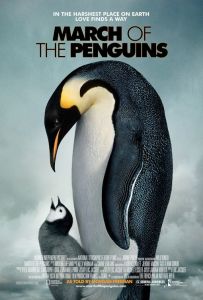
March of the Penguins is a wonderful, heart warming, dazzling documentary that should charm audiences of all ages. You’d have to have a heart of stone not to be amused, impressed, or delighted by the penguins and their fuzzy brood. The photography is amazing in its scope and detail, and you?ll want to take a baby penguin home with you (just look at that picture! Look at it!) This is a lovely and enchanting summer entry that should pick up steam as it picks up additional screens. Catch those penguins now before they march out of your town.
Nate’s Grade: B+
Share this:

Inside Deep Throat (2005)
 I find that there are generally two requirements that make a really great documentary: 1) have an interesting story, and 2) have an interesting way of telling it. I’ve seen documentaries on ripe topics squandered because of the dull and unimaginative ways they tell their tales. The skilled documentary team behind The Eyes of Tammy Faye and Party Monster has set their sights on a little smut film that changed the world in the early 1970s. Deep Throat was a “dirty movie” made for peanuts (25 grand) that ended up becoming the most profitable film of all time, eventually grossing more than $600 million. The story behind its meteoric rise, cultural acceptance, and damnation hits both requirements, thus making Inside Deep Throat a sensationally entertaining documentary.
It all started in 1971 when Gerard Damiano wanted to make an inexpensive pornographic film. Back in those days, many aspiring filmmakers actually got their start in porn (Wes Craven admits it). Damiano was in the planning process when he was visited by a man who wanted his girlfriend, Linda Lovelace, to appear in the eventual porno. He swore his girlfriend could do the most amazing trick. Lovelace demonstrated her trick, the full swallowing of an erect penis. Damiano was dumbstruck. He was determined not just to involve Lovelace but to base an entire film around her stunning ability. Deep Throat was written in three days, filmed in six days, but the furor it would bring would be irrevocably long lasting.
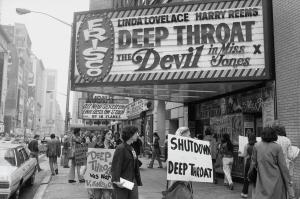 Deep Throat, as many of the crew will happily report, is not exactly a good movie. In fact, some call it the worst pornographic film of all time. Lovelace’s character found sex joyless, that is, until a doctor (Harry Reems) discovers that she has her clitoris all the way in the back of her throat. Thus to orgasm she has to swallow head-on (oh the double meaning). When the crew actually witnessed Lovelace’s cavernous abilities firsthand, they too were flabbergasted. But they wouldn’t be alone. Inside Deep Throat makes smart use of archival footage to prove how mainstream a small smut flick became. We see clips of Bob Hope and Johnny Carson cracking jokes about the film, and most amusingly of all are one or two interviews with little old ladies who “wanted to see a dirty picture.” Deep Throat crossed over and people went out in their Sunday finest to watch a hard-core porno.
Inside Deep Throat is rated NC-17 and with good reason. We do get to see Lovelace strut her stuff and the film almost playfully teases an audience with anticipation. We hear interviewees discuss their amazement; we see a close-up of Reems face as he gets pleasured. By the time the scene in question is shown uncut, we’re eager to witness this feat of fantastic fellatio ourselves. Let’s be honest, you can?’t have a documentary about Deep Throat‘s impact without showing the goods.
Filmmaking duo Fenton Bailey and Randy Barbato have a very visually satisfying way of telling their story. Images tear across the screen and animation pops, all set to what must amount to most of the soundtrack to Boogie Nights. The glossy visual flair reminds me of the swirling, near-pop-out book imagery of The Kid Stays in the Picture. The pacing of Inside Deep Throat is near break-neck, with the film clocking in at just over 90 minutes. I wish that the filmmakers had spent more time on their subject and gone more in depth into certain areas like Lovelace’s turnaround from girl next door goddess to anti-porn crusader back to fifty-something nude model (she was killed in a car accident in 2002).
 The cultural splash Deep Throat made is interesting enough, but the meat of the story is in the battles that would ensue. Damiano openly talks about how the mob controlled the early porn industry. He admits that he refused his share in the millions out of fear that he might have had his legs broken, or worse. There’s a long tangled web of mafia influence in the proliferation of Deep Throat. It was banned in over 30 states, but everywhere it went it became a hit. A Mafioso says that they were making so much money that they had to count it by the pound. Mob hits would materialize over the film’s profits and territory.
Even more fascinating, the U.S. government, to no one’s surprise, declared the film indecent. They couldn’t prosecute the director, or the distributors (unless they liked sleeping with the fishes), or anyone really making money off of the success of Deep Throat. So what’s a stubborn government to do? They prosecuted Reems for his involvement in a pornographic film. It was the first time an actor was ever prosecuted for his participation in art after the fact. Celebs like Warren Beatty and Jack Nicholson came to Reems’ aid, fearful of what might happen if a government could retroactively punish artists. Sadly, Reems was found guilty and sentenced to years in prison and was really never the same afterwards.
But instructional films on sexuality were still okay as far as government was concerned, and we see clips of them in all their medical film hilarity (apparently some positions are not meant for the obese we’re told). These were acceptable because they were meant to help and inform, whereas porn is meant to entertain.
The film’s interviews comprise some of its best and worst moments. Most of the Deep Throat crew is in their 60s or 70s now, and hearing them talk about porn and sexual acts does make you titter a bit. The crew provides funny anecdotes and some of the juiciest material. However, the film also curiously interviews people like Dick Cavett and Bill Maher. The expected talking heads are here like Dr. Ruth, Camille Paglia, John Waters, Hugh Hefner and Larry Flynt, but they regularly don’t have anything insightful to say.
 Inside Deep Throat goes back and forth with its objectivity. It’s obviously pro-freedom of speech and doesn’t mind ridiculing the government agents who tried taking Deep Throat down (oh the double meaning). Particularly telling is an FBI agent who wishes that terrorism could be tidied up so that he could finally get to the real importance, which is stopping people from seeing pornography. One of the main points of the prosecution of Deep Throat was that it “wrongly” purported the idea of a clitoral orgasm (I think many will find some error with this judgment). It’s easy in retrospect to chide government officials ruling on inaccurate information or just plain ignorance. It may be too easy for some viewers, but for me it’s fair game to lambaste any idiot trying to strip me of my Constitutional rights.
Inside Deep Throat is an engrossing if light-hearted look at a moment in time. Some of the seedier elements feel skipped over, but this is a documentary on a fascinating subject told with a pleasing visual style. Don’t be put off by the NC-17 rating or the subject matter. Inside Deep Throat is more than a behind-the-scenes featurette on a wildly successful porno. It’s a fast, funny, and greatly entertaining time capsule of an era where boundaries were still being pushed, both by artists and by censors. And in today’s FCC-fearing landscape, maybe not everything has changed since Deep Throat brought porn into the mainstream.
Nate’s Grade: B+
Share this:

Michael Moore Hates America (2004)
 Mike Wilson is an ordinary guy. He saw some of Michael Moore’s documentaries, listened to some of his interview bits, and didn’t appreciate what he saw and heard. But unlike the rest of us, Wilson grabbed a camera and did something. He spent the next couple years scouring the country trying to score an interview with Moore and reevaluate some of his assertions. Wilson’s final product is Michael Moore Hates America, a small but potent documentary that’s far sweeter than the title may have you believe.
With camera in hand, Wilson travels around the country to find out what ordinary Americans have to say about Moore’s viewpoints. He visits Flint Michigan, Moore’s self-proclaimed hometown (his real hometown is a middle class suburb) and finds success stories. Wilson interviews various figures from Moore’s films, like bank workers in the opening of Bowling for Columbine and an amputated soldier shown in Fahrenheit 9/11 without his knowledge. Wilson also speaks with some of Moore’s fans who chillingly declare not to care if Moore misleads or makes up facts, because to them the end justifies the means. All the while Wilson hunts for his interview with Moore but is rebuffed at every pass. Moore even goes on air saying Wilson and his movie do not exist at all.
Wilson weaves three subjects into his film: 1) an analysis of Moore’s filmmaking tactics and statements, 2) a look at what America means to people, and 3) Wilson?s own hunt for an interview with Moore. Wilson’s interview pursuit resembles Moore’s own dogged pursuit of an interview with General Motors CEO Roger Smith in 1989’s Roger and Me.
 Michael Moore Hates America is the best of the rebuttal films because Wilson smartly refrains from preaching. He doesn’t stick to party rhetoric or unleash baseless claims without supporting evidence. The name may seem mean spirited and spiteful, but Wilson’s film may be one of the most fairly balanced looks at politics and film in recent years. This is an attempt to understand why Moore does what he does, and if his actions are honest. Wilson is tackling more than Moore’s questionable tactics; he’s examining the nature of documentary film itself. Is it even possible to be objective when it comes to documentaries? Wilson interviews, among others, legendary filmmaker Albert Maysles (Gimme Shelter) and Penn Jilette (of Penn and Teller fame) and gets insights into the troubles of objective editing, context, and overriding agendas.
Michael Moore Hates America is pleasantly well made and articulated. This isn’t some ribald shout-fest. It isn’t some home movie made in someone’s basement either. Wilson’s pacing is tight and he knows when to use humor to assist his points. An animated game show called “Six Degrees of Conspiracy Theory” is a fun way to deflate Moore’s contention about why Disney dropped Fahrenheit 9/11. It’s a shame Wilson doesn’t go back to this segment again. There’s also a funny montage of Moore backing unsuccessful political candidates, topped off by him predicting George Bush senior would eat Bill Clinton alive. It’s a fun sequence but it also proves Wilson’s point that Moore isn’t necessarily mirroring the views of America despite his claims. There is an actual thematic reason for its inclusion in Wilson’s film.
The most frustrating thing about Moore, as Wilson’s film agrees, is the needless sleight-of-hand when it comes to the facts. It’s not too difficult to make President Bush look foolish; just give him enough rope to hang himself. Nor is it too difficult to make a convincing argument that the war in Iraq was misguided (All you’d have to do is quote the 9/11 Commission’s report). But Moore has the maddening habit of putting two images together, or separate pieces of information, and creating meaning when there was none before.
Take for instance Heston’s post-Columbine speech in Bowling for Columbine. In Moore’s film, we see harrowing security camera footage of the school massacre, and then Heston pops onscreen, rifle in non-cold, non-dead hand, proclaiming defiance. Moore narrates that Heston and the NRA came to Denver shortly after the tragedy as a shameless PR ploy. Not so fast. As Wilson’s film illustrates, Moore has cut and pasted different speeches into one false, defiant statement. The image of Heston clenching the rifle comes from a NRA gathering a whole year after Columbine. The NRA had a Denver gathering scheduled a week after Columbine and was legally obligated to hold the gathering because there wasn’t enough time to contact its millions of members and reschedule. Events in Bowling for Columbine seem a tad different when the harsh light of truth shines upon them. Wilson questions why Moore needs to fudge facts so egregiously to deliver his message.
 While watching Michael Moore Hates America, one gets the distinct impression that Moore cannot take criticism of any kind. One subject calls it Moore’s Achilles’ heel. Wilson attends a Moore speaking engagement at the University of Minnesota. He steps up to the mic, requests a brief interview, tells the name of his film, and Moore shouts him down, talks over him, and then cuts Wilson with 7,000 people cheering. Afterwards, some fans do come up to Wilson to comment on his courage or disapprove of how Moore refused to listen to differing points of view. Moore’s die-hard fans seem to refuse to entertain any notion that Moore’s films could be anything but gospel truth, and it’s a shame they’ll likely never view Michael Moore Hates America.
Wilson even finds himself in some sticky ethical situations. He gets an interview from the mayor of Moore’s hometown by disingenuously telling him that he?s making a film about the appeal of small town America. Wilson prods the mayor for any info on local celebrities. Later, Wilson feels so guilty about misinforming the mayor that he sends him an e-mail apologizing and being upfront about his true intentions. The scene is both surprising and slightly amazing to witness, because it speaks volumes to the brevity of Wilson’s ego. It’s quite something that Wilson actually went through with the apology, but it’s even more impressive that he put the whole incident in his own movie. You think Moore ever sent an e-mail to the people he’s misinformed in his films? I wouldn’t hold my breath.
Michael Moore Hates America does have some non-authoritative talking heads. Quotes about the violence in Canada and the resurgence of Flint are not necessarily all encompassing, but I think Wilson is just trying to show different sides of an argument and not the end of an argument.
Ultimately, Mike Wilson has created a good-natured rebuttal. Michael Moore Hates America may be a visceral title, but the movie is a balanced, intelligent, above average examination on Moore and the nature of the documentary film field. Wilson doesn’t rely on misinformation and emotional appeals; he’s looking at all the evidence and instructing us to judge for ourselves. Moore?s fans and enemies would be equally entertained to see what Wilson has captured on film.
Nate’s Grade: B-
Share this:

Super Size Me (2004)
 Morgan Spurlock was just sitting on the couch one Thanksgiving. He saw two overweight girls on TV who were suing McDonalds because they blamed the fast food giant for making them obese. Spurlock got off the couch and was inspired. He set off to see what would happen to a healthy adult body if he ate nothing but [i]McDonalds[/i] food for a 30 day period. The results are Spurlock’s award winning documentary, Super Size Me. Spurlock monitors his progress with a team of doctors. He follows certain guidelines as he begins his fast food binge: 1) He must order everything off the menu at least once; 2) He must eat McDonalds three times a day; 3) If someone asks him if he wishes to Super Size his order, he must comply.
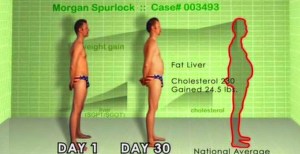
The results are staggering, if a tad expected. Spurlock gains 30 pounds, loses his sex drive, experiences what he fears are chest palpitations, and develops symptoms of depression when hes not stuffing his face with French fries and the like. Spurlock starts out wide-eyed and giddy at the prospect of living every kids dream at first he is awed by the food but by the halfway point hes noticing a discernible change for the worse. Hes starting to develop an actual dependency on his subject. Along the way Spurlock interviews an assortment of dieticians, a man who’s eaten 20,000 Big Macs, doctors, health trainers, lobbyists for food corporations, Jared from Subway, and tries ever so hard to garner an interview with a McDonalds spokesperson (he calls about 17 times). The result is a sprawling look at what makes our fat nation tick, and the weird, wonderful, and scary people within.
 Spurlock puts a lot of gut-churning effort into stating the obvious. You mean eating nothing but McDonalds is bad for you? Stop the presses! Perhaps for his follow-up, Spurlock will unleash a searing expose telling us not to look directly into the sun, stick our tongues to icy poles, or place our hands on a hot stove. The world waits. Even though Spurlock’s McDonalds diet gimmick grows somewhat boring (watching someone eat is about as exciting as watching someone brush their teeth), Super Size Me’s true strength lies in the tangents it takes on its otherwise high-fattening journey to artery corrosion.
Spurlock examines what it is in our culture that makes us more prone to obesity, and the results are equal parts startling and fascinating. The films best moments occur when Spurlock looks at the national school lunch programs and how kids are already being molded to live unhealthy lifestyles. At the same time in our nations history, food programs are getting less healthy (pizza, fries, soda) and mandatory gym programs are on a steep decline. The effects of this segment are far scarier than watching a grown man balloon in weight.
The film follows the Michael Moore (Fahrenheit 9/11) style of documentary, minus the distasteful half-truths. Spurlock knows that humor is the best way to get a point across, so with the use of clever animation he throws every statistic you can imagine out there, hoping that some will stick. Some are obvious, some are amusing, and some of the information is startling when visually represented, like the amounts of sugar and fat Spurlock consumed on his 30-day diet. Super Size Mes results retain Moores signature underdog-fighting-the-Big-Boys method that creates a rapport with the audience, but it also refrains from any sort of bullying. Spurlock doesn’t have the broad charm of a Moore, but hes likeable enough and keeps his information as the heart of his documentary and not the fairly silly gimmick.
 With this new genre of Gimmick Documentaries, there is a greater sense of voyeurism than in the genres usual outpourings. The central concept is watching a man essentially destroy himself, and there is a perverse pleasure in viewing medical changes that scare the crap out of Spurlock’s teams of dumbfounded doctors. So while Spurlock’s odyssey may not always be stupefying, it usually is genuinely entertaining in some form or another.
Spurlock’s excess is our revelry. Hes crafted an intelligent, entertaining, and sometimes grotesquely disturbing portrayal of our Fast Food Nation (I live in the sixth fattest U.S. city, Columbus Ohio, by the way). Fans of muckraking documentaries should be delighted, but Super Size Me has the appeal to reach out to a wider, more divergent audience. Spurlock’s film, despite some inherent flaws, is a strong wake-up call. Super Size Me is a lucid debate about personal responsibility, the boundaries of corporations, and the possible future health of the fattest nation on earth (eat your heart out Norway).
In the end though, it looks like Spurlock is having the last laugh. His film was a hit at the 2004 Sundance film festival, and shortly after McDonalds announced they were officially phasing out Super Size portions from their menu. They denied Spurlock’s film was the cause of their Super Size Slashing, but it doesnt take a genius to see through the corporate rhetoric.
I confess that Super Size Me really got to me and motivated me to live healthier. I was determined to exercise more regularly and eat less junk food. I was empowered. And then I saw a McDonalds on the way back from the theater and, well, the #1 plan, Exercise More Thoroughly, was scratched in favor of a #2 Value Meal (the double cheeseburger one). Carry on Spurlock; carry on my Fu Manchu-ed son. Your documentary is entertaining and, at points, fascinating, but I’ll get on that treadmill next week.
Nate’s Grade: B+
Share this:

Lost in La Mancha (2003)
Poor Terry Gilliam. One of the best visual directors today hardly ever gets a break. If there was justice in the world (a rhetorical question) Gilliam would be directing a Harry Potter movie. Just imagine t he greatness of something like that. But Gilliam is seen as an eccentric who doesnt keep good track of his budget, as evidenced by the inflating costs of his Baron Munchausen effort. As a result of making classy yet quirky pictures his way Gilliam has become a director that works on the fringe. His last effort was a delirious retelling of the Don Quixote tale. When it came time to film The Man Who Killed don Quixote it seems everyone, even God, was against Gilliam realizing his dream.
Lost in La Mancha is a fascinating and equally heart breaking documentary following the making of and, more so, the breaking of Gilliams movie. For starters the location for a pivotal scene in the desert is located near a Spanish air force base and fighter jets roar overhead. Then theres a flash food that destroys equipment and a set. Then theres the star of the picture that may or may not have cancer but sure cant ride a horse. Its enough to pull your hair out. Lost in La Mancha is like the cinematic version of the highly entertaining, and addictive, HBO series Project Greenlight: witness movie making first hand and witness one catastrophe after another! The two directors of Lost in La Mancha are the same people that created the nearly 90 minute documentary on the trials and tribulations of making 12 Monkeys (and this documentary is by far the best special feature on any DVD ever released). The two have a certain fondness for Gilliam but push the Gilliam-as-Quixote image way too much.
The really sad part about this documentary is that the glimpses it does show of the film (when it is working and not going into devastation) prove it could have been a wonderful and whimsical fantasy. Heck, he even got Johnny Depp to be in it! Gilliam will move on as will everyone else involved in this aborted film but there will now be a lasting mark. Whether it serves as an open sore or a Band-Aid is a different matter.
Nate’s Grade: B+
Share this:

Spellbound (2002)
 The field of super spellers heading to Washington D.C. is more varied than you could possibly imagine. What is truly amazing, and equally heart-rending, are the scenes showing working-class families encourage their children to excellence. Angelas parents fled Mexico to give a better life for their family in Texas. Her father has been a rancher for 30 years and does not speak a word of English. Its incredible to see the amount of pride her parents have when they see her compete. She says she’s doing it for them. Ashley lives in the projects outside of Washington D.C. She exudes confidence as she makes long treks from school to the cramp apartment her family lives in. Her mother had never expected her child, from her background, to compete for spelling contests but becomes her biggest and most vocal cheerleader.
Spellbound also shows the fanatical level of commitment some of these kids have. Neils father pushes his son to the extremes and the two go over 4,000-8,000 words a day. Neils parents even hire a spelling coach and he gets instruction from his schools foreign language teachers on the history and spelling of foreign words. The commitment most of these kids show is jaw-dropping and obsessive. Ted is the exact opposite. Hes so nonchalant about the spelling bees that it almost seems like hes battling complacency in his small town. His younger brother has the films best line: “It was so exciting. If I had blood pressure it would be through the roof!”
 My favorite speller is April. She and her parents live in a dying town. Her father worked in a asbestos factory until it was shut down. He now operates a tavern across from the decaying factory. The family struggles to get by but has so much visible love for their daughter, so much undying support for April. I saw April’s parents as the type you might be embarrassed to say something weird to your friends (“Mom, you are so out of it, geez.”) but the same type that you secretly thank everyday you have. April declares herself a pessimist and doubts the distance she’ll go in the national bee. This is the kind of instantly likeable and compelling character Hollywood has forgotten how to create.
With Spellbound we get to know our hopefuls so well that were saddened before the national bee even begin because, at best, only one of them will win. And, as corny as it sounds, they are all exemplary examples of winners.
Spellbound is the most thrilling movie I’ve seen in ages, totally walloping the heady pretensions of certain action movies. This film will make your palms sweat and then some. Your heart races wildly when it isn’t in your throat. Several films like The Sweet Hereafter or American History X have brought me to tears through their adept expressions of sadness; Spellbound may be the first film thats ever brought me to tears (about five times) just for pure vicarious happiness and joy. To see these kids achieve will, and I know this is so cheesy and blurb-y, but it will make your spirit soar and want to cheer. I’ve since watched the film several times on DVD, and I must report how surprised I am that I end up crying every time, though at different spots. This is a joyous movie, pure and simple.
Spellbound is an uplifting movie for everyone that is guaranteed to have some lasting, triumphant resonance. If you cant feel for these kids I suggest you check if your heart is defective. This is a great example of what film can do, what the American dream can mean for people, and the great diversity an academic competition can inspire. Spellbound is thrilling, heartwarming, and sunnily satisfying. You’ll fall in love with these kids and their hopes and dreams.
E-X-C-E-L-L-E-N-T. Excellent.
Nate’s Grade: A
Share this:

Bowling for Columbine (2002)
 Documentary filmmaker, political activist and corporate pot-stirrer Michael Moore prefaces his latest film Bowling for Columbine by admitting his lifetime membership in the National Rifle Association (NRA). He even received a marksmanship award as a teenager in his hometown of Flint, Michigan. Bowling for Columbine is Moore’s sprawling and hilarious search for answers among America’s zealous gun culture and alarmingly high number of homicides. It’s the tangents Moore just can’t help but take along the ride that add some of the more fun moments.
He opens a checking account at a Michigan bank that’s offering a gun for new customer accounts. Moore astutely asks an employee, “Do you think it’s a good idea handing out guns in a bank?” Moore travels to Canada to find out what reasons exist that make our cultures so different when it comes to crime. After hearing from citizens about how they don’t lock their doors, Moore decides to go door-to-door and see for himself. Sure enough, he walks into half-a-dozen homes.
Moore is better at pointing the finger than fathoming real answers. He touches media sensationalism, our nation’s bloody history, corporate greed, past military involvement, and an environment of fear being developed by those who profit from such actions. The sobering truth is that there are no easy answers to be debunked. The film’s climax involves an impromptu sit-down with NRA president Charlton Heston. Moore questions the sensitivity of the NRA after it held support rallies days after the school shootings in Littleton and Flint. Heston becomes weary and walks out of the interview after five minutes.
The film demands to be seen. It’s complex, challenging, and thought-provoking. Not only is Bowling for Columbine the most important film of 2002, it’s also one of the best.
Nate’s Grade: A
Share this:

Michael Jordan to the MAX (2000)
 IMAX’s next trip is an NBA’s dream of promotion but also an indication of what exactly they’re missing — that is a basketball God. Jordan to the MAX is basically a pat documentary featuring Jordan’s upbringing and his dreams. It’s all the typical uplifting never-stop-trying stuff that’s routinely handed out to the kids. What makes this documentary worthwhile though is the format it’s presented in. Seeing Jordan do his numerous acrobatics in slow-mo on IMAX’s 50-foot screen makes him seem even more immortal then he already is considered to be. You can see the grace and overwhelming talent he possesses in every flexing of muscle and bead of sweat. It’s quite impressive and worth the remaining dull moments.
Nate’s Grade: B-


 nathanzoebl
You must be logged in to post a comment.