Blog Archives
Melania (2026)

Let’s tackle the reality that reviewing a documentary like Melania is practically beyond the point. This movie wasn’t created by artists who felt they had a compelling and insightful story to tell, a revelatory depiction of the human condition that would cause us all to sit back and reflect on ourselves. No, this movie was created to appease and suck up to one important orange-hued ticket-buyer. Amazon bought the rights to the movie for a staggering $40 million dollars, pledged an additional $35 million in marketing, and put out all the stops to open the documentary on the residing First Lady in 1700 screens nationwide. For those not in the know, documentaries are not big moneymakers; the highest-grossing doc of 2025 was Becoming Led Zeppelin at $16 million. Only thirteen documentaries have ever grossed over $70 million worldwide and only 39 have grossed more than $30 million. It’s hard to fathom that Amazon imagined this would become a runaway hit. They’re not that deluded. Think less of Melania as a documentary and more as a transparent corporate bribe by Amazon and its CEO, Jeff Bezos, who sure would like favorable consideration from the current administration that interferes in every facet of media to better protect the ego of a soon-to-be octogenarian who needs everyone to constantly be showering him with effusive adoration (le sigh). Welcome to our new American ecosystem, where all corporations are expected to bend the knee in fealty so as to procure favorable dispensation from a mad king always in need.
What is even the point of reviewing something like this? It’s so obviously manufactured in bad faith. Well, dear reader, I guess it comes back to my own martyr complex: I suffer so that you may be spared the same fate. Unless you’re a diehard MAGA member, Melania will be a torturously facile example of unserious people elevating other unserious people for an audience of the unserious to be patronizingly pat on the head and told that, yes, theirs is the true voice of America’s solemn destiny.

The film follows the 20 days before the second inauguration of Donald Trump as the American president. For those of you, especially in endangered minority communities, wondering what Melania Trump was going through when it came to designing the drapes and White House color patterns, fear not! Most of the movie is listening to Melania’s strained narration while we watch handlers and assistants flit about and primp the soon-to-be First Lady while handing her samples. Never has insider access felt so tedious!
Did I mention that this movie is directed by none other than Brett Ratner, disgraced filmmaker who was jettisoned from Hollywood as a Me Too reckoning following decades of harassment? Ratner has never directed a documentary before and it shows. Opening the doc with the Scorsese-esque notes from the Rolling Stones’ “Gimme Shelter” feels like sacrilege. It’s even worse when played over the start of Melania strutting through her Mar-a-Lago mansion to a fleet of cars. It plays like self-parody but you know nobody has the awareness for that. Ratner asks her such incisive questions like, “What is your favorite recording artist?” like it’s a Tiger Beat interview. Late in the film, he’s heard on camera wishing the president “sweet dreams” in the most sycophantic voice. Really Ratner’s here like everyone else, seeing the craven opportunity to get into the good graces of the president. Ratner has been pushing to get Rush Hour 4 greenlit, a sequel that I don’t even think Chris Tucker (current age: 54) and Jackie Chan (current age: 72) are eager to launch. Not that it matters to Ratner, but it’s been almost TWENTY YEARS since 2007’s Rush Hour 3, which also featured a cameo by notorious sex pest Roman Polanski. Sure enough, in the wake of Melania’s release, Trump was pushing for a Rush Hour 4, as clearly the man whose brain is always stuck in the 1980s has his finger on the pulse of the cultural zeitgeist. All Ratner had to do was make a 100-minute fluff piece about the president’s third wife and, voila, one sexual predator in the highest office in the land can ensure that another sexual predator can get his dream project, which I repeat is depressingly Rush Hour 4, off the ground. Also recall that Ratner was literally seen canoodling on a couch with pal Jeffrey Epstein and a group of young women who were certainly there by choice. Ugh.
I actually think a figure like Melania could be an interesting subject for a hard-hitting documentary. The Slovenian model becomes the third wife to a notorious philanderer and crook, enough that he was famously having sex with adult film actress Stormy Daniels while Melania was recovering from the birth of their son. From the outside, this relationship appears entirely transactional, with Trump getting a new, younger, more desirable wife, though not desirable enough to stop having affairs with other women (note: this is a condemnation of Trump, not on any perceived shortcoming of Melania). For her, she gets the security of a man of riches and with that security is the tacit understanding that he can do whatever he wants and she will have to accept it. Getting an insider’s account of all the debauchery and debasement of being Trump’s current wife could be extremely insightful and would make Melania genuinely empathetic for one of the rare times in public life. Granted, she’s made her calculation and stood silent while her husband’s regime has terrorized millions at home and endangered the lives of millions abroad, so let’s cap that degree of empathy. Still, she has a perspective that could be very illuminating under the right circumstances. It’s just that we’ll never see that kind of perspective. It’s too off-brand. It goes against her agreement with the money-man. I don’t fault her for wanting to stay in her echelon of riches and comfort any more than I would, say, a duchess who prefers a pampered life to starving on the streets. I get it, but it doesn’t excuse the lasting damage of being the pursed-lip silent partner to a degenerate with total power. Imagine a documentary about Eva Braun but it’s all about her favorite throw pillows. Not exactly the most interesting angle to take for someone so close to such disruptive and systemic abuses of power.

I take particular umbrage with one angle the documentary takes, setting Melania up as a celebration of immigration, a reflection of the American Dream. It’s more than a little hypocritical for this movie to elevate the immigrant story of Melania while the administration of her husband is targeting anyone it deems insufficiently American, namely people of color regardless of their actual citizenship. When the government’s special masked police are rounding up indigenous people to deport to adhere to an unrealistic and damningly racist daily quota, you know they’re not targeting the “worst of the worst.” Are the “worst of the worse” the day care workers? The family-owned pizzeria? The spouses of American soldiers? Those seeking asylum from persecution and death from hostile governments? The immigrants who have navigated the byzantine system of immigration to become official citizens and who are abducted by ICE for appearing at their court appointments? To manufacture Melania as a symbol of the celebration of an immigrant’s journey is farcical when the Trump Administration is built upon the elimination of immigrants from every facet of society. It isn’t a coincidence that the administration has lowered immigration numbers to a paltry 7500 in 2025 and most of those are white South Africans. She’s quoted as saying, “No matter where we come from, we are bound by the same humanity.” Uh huh. Tell that to Stephen Miller and his dogged desire to Make America as Alabaster as Possible Again.
There’s just not enough material here to cover a feature film, which is why the shallow movie often feels like an overly padded infomercial propping up its star. There are long stretches where you’re just watching people walk or listen to performances. It’s filling time. The whole enterprise feels like you’re watching someone else’s lackadaisical wedding video. There are perhaps two or three memorable moments caught on camera. The first is Trump complaining that the college football championship game being held the same day as his presidential inauguration is a conspiracy against him. His reasoning is that they’ve had the inaugural date for “centuries.” The next is Melania turning the funeral of President Jimmy Carter into her own grief about losing her mother. Melania takes reverence walking through the halls of the Capitol, remarking about the military defending the rights of the Constitution, which is quite ironic considering Donald Trump fomented an insurrection that gleefully attacked police officers to try and overturn an election in defiance of the Constitution. There’s also the line from his inaugural speech that is particularly galling in 2026: “My proudest legacy will be that of a peace-maker and unifier.” Yes, surely history will remember Trump as an instrument of peace when he’s not bombing girls’ schools and pledging to annihilate civilizations as well as other blatant war crimes.
Rather than continue to tell you about the many creative and moral shortcomings of this enterprise, why not provide a sampling of some of the best critical hits on this movie? Here you go:
“I’m not even sure it qualifies as a documentary, exactly, so much as an elaborate piece of designer taxidermy, horribly overpriced and ice-cold to the touch and proffered like a medieval tribute to placate the greedy king on his throne.” – Xan Brooks, The Guardian
“To say that Melania is a hagiography would be an insult to hagiographies.” – Frank Scheck, The Hollywood Reporter
“Melania the movie isn’t a documentary; it’s a protection racket.” -Sophie Gilbert, The Atlantic
“A soothingly looped AI screensaver.” -Amy Noicholson, Los Angeles Times
“Call it a document, instead, of 20 days in the First Lady’s life circa January 2025, with all the weight and depth of a Post-it.” -Liz Shannon Miller, Consequence
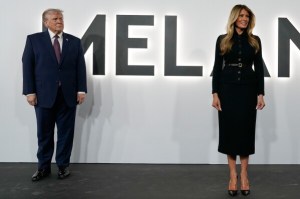
“Ratner’s film plays like a gilded trash remake of Jonathan Glazer’s The Zone of Interest in which a button-eyed Cinderella points at gold baubles and designer dresses, cunningly distracting us while her husband and his cronies prepare to dismantle the Constitution and asset-strip the federal government.” -Xan Brooks cooking again, The Guardian
Anyway, don’t watch Melania. I was never going to appreciate this movie. It was not made for me. It wasn’t made for you either. It wasn’t made for anyone but the First Lady, who had editorial control over the movie, so why would you expect anything other than a stage-managed image-consulted propaganda puff piece on her air of dignified grace and style? Hearing her somnambulant narration over her gilded life and the pageantry of a second inauguration of the most destructive president in American history, it’s enough to make you zone out. While wars are being waged, prices are soaring, neighbors are being rounded up into camps of concentration by masked goons, and corruption and graft reign supreme in a government run by the worst people imaginable, it’s hard not to find a soft-pedaled vanity project like Melania as an offense to the senses. If there are bigger wastes of time at the movies in 2026, it will be a truly hellacious year. This is not being best. This is not being best at all.
Nate’s Grade: F
Share this:

Bama Rush (2023)
 Rarely have I watched a feature-length documentary that felt so stretched out that it felt like the movie equivalent of messing around with the margins of an essay to try and maximize the shortage of viable content. Bama Rush is ostensibly about a group of young women competing to join various sororities at the University of Alabama, a school famous for its Greek life and the sordid and storied histories. You might reasonably think that the documentary formula would be to follow a small number of girls applying, likely four or five, and to use this as a jumping off point to explore the toxic history of Greek life, especially the racist and segregationist history for Southern institutions of higher learning. You would also likely assume that we would follow the highs and lows of these women and use them to examine modern-day sexism and the threat of sexual violence that many women endure on college campuses and beyond. You would assume, again naturally, that the filmmakers would have a genuine interest in investigating their topic and interrogating it and the people involved for better understanding and reflection. You would not expect the movie to abandon almost all of its many points of interest to then become about how one woman living with alopecia is the same as rushing for a sorority. Because why would you ever expect that from a film called Bama Rush?
 Whether it was the original design or by the inconvenient needs of filling a feature, director Rachel Fleit (Introducing, Selma Blair) inserts herself awkwardly into her story. She shares her history of living with alopecia and being the “bald girl” and having a secret to hide, how nervous she was to appear like all the other girls, and then she says, directly to the camera, “So… I feel like I rushed too.” No, no you didn’t. The barest connection that Fleit is using here is general insecurity about being accepted. That’s it. By that very generalized notion, you can connect anything to the topic of rushing a sorority. Hey, you ever feel like you had a bad hair day? You rushed too. Hey, you ever feel like your clothes were outdated? You rushed too. Hey, you ever worry you had too much hair on your toes? You rushed too. This is ridiculous. Fleit’s personal struggles with her condition could be worthy of a documentary all her own, using her personal connection to the topic to explore alopecia in general and the social pressures over women’s hair. There’s a deep dive there. You could pair it as a double-feature with Chris Rock’s Good Hair. However, making your sorority documentary about you and an unrelated topic just smacks of opportunism and narcissism. I’m not downplaying the pain this woman felt about being different and having a secret. It just doesn’t belong in this movie when it’s supposed to be about other people not named Rachel Fleit.
Ignoring the many tangents about Fleit and her personal ails, Bama Rush also fails at even exploring its actual intended topic. Southern sororities are a rich tapestry to explore America’s racist traditions and histories, especially at the University of Alabama, but this topic only gets the most cursory of mentions. The same with the topic of The Machine, a would-be conspiracy of rich and powerful people influencing campus decisions and seemingly a shadowy cabal behind everything and nothing. I’m not disputing that something like this may exist, although whether it’s so organized and codified I would question, but Fleit doesn’t do anything to explore this facet. Talking to subjects currently attending the university is a limited pool of experiences. It’s shocking that she doesn’t interview former members who could talk about their complacency and can detail what this order dictated with specific examples. It’s also shocking that Fleit is following a group of women and several of them end up drugged from a campus party and the movie shrugs this off in such horrifying ambivalence. The girl being interviewed even says this is the third time she’s been roofied. How does a filmmaker not devote more screen time to this than wigs?
For a movie that can explore the questions of race, class, privilege, tradition, and sexual identity, it instead is a poorly composed movie that neglects to scrutinize any topic for more than fleeting glances. There’s a reason that a solid tenth of this movie is simply made up of TikTok videos supplied by the Bama Rush hashtag. In fact, even that angle, examining the vicarious entertainment and investment of adult strangers over whether or not these women broadcasting their sorority applications could be a worthy topic to touch upon social media’s strengths and ills, a voyeuristic hunger for manufactured realities. Instead, Bama Rush gives you a little of everything and a lot of nothing beyond the director’s unrelated experiences.
Nate’s Grade: D+
Share this:

Still: A Michael J. Fox Movie (2023)
 Reminiscent of the Val Kilmer documentary from 2021, with archival footage taken from the star himself, Still is a documentary that opens up an actor’s biography but also makes you reconsider your own feelings as you process them in a diminished state. Fox was a natural actor, and his trajectory from Canadian student to international stardom was fast, but things took a dramatic turn when Fox first exhibited symptoms of Parkinson’s, a neurological disorder that causes involuntary movements. The present-day interviews with Fox are startlingly candid, showing the effect the disease has had on his body as well as his spirit, as he fights to get his quick wit out from a body that is betraying him. Fox himself doubts he’ll even make it to 80 under his current condition, which we see the rigors of his physical therapy as well as the challenges of everyday life. The Hollywood stardom tale is familiar but still intriguing with Fox’s insights and recollections, and director Davis Guggenheim (An Inconvenient Truth) makes clever use of the many clips from movies and TV to reflect the emotional state of Fox’s story as needed. It’s also interesting to learn about the tricks he would use to better hide his Parkinson’s symptoms in TV and film, as now we have a better understanding and can see the moments in a new light. You will likely feel different levels of sympathy as you reflect on what effect the disease has had on this spry, commanding performer, but Fox wouldn’t want your pity. Fox is irascible and self-deprecating but still so easily charming, and spending 90 minutes with him as he opens up his life, his family, and his physical and mental struggles feels like a rare and privileged peak into this man’s rich life before it’s gone.
Nate’s Grade: B
Share this:

Fire of Love (2022)
 Find someone who looks at you the way that Katia and Maurice Krafft look at volcanoes. The French husband-and-wife team were two of the world’s finest volcanologists and would leap into dangerous locales to better study and document erupting volcanoes. The documentary Fire of Love is built upon their extensive archive of stunning nature footage, often mesmerizing and then horrifying to realize how close Katia and particularly Mauriece appear to the explosive action. The movie is narrated by twee filmmaker Miranda July (Kajillionaire) and she sounds so somber that you’re waiting for the story’s inevitable ending, that the two of these passionate volcano nerds got too close to one of their subjects. Katia says, “I follow him, because if he’s going to die I’d rather be with him.” Until then, we explore their relationship as well as their scientific expertise in trying to better warn about erupting volcanoes to prevent future loss of life. It’s a noble effort, one that the Kraffts have to pay for with television specials and global appearances to better fund their research and air travel. I found Fire of Love to be a better nature documentary than an insightful examination of the relationship between these two scientists. The movie’s narration feels given to poetic pontifications that often sound reaching and a tad pretentious. It feels like the movie is a little too desperate to make larger conclusions. Some times, just having access to exclusive and awesome volcano footage can be enough for a 90-minute documentary.
Nate’s Grade: B
Share this:

Bowling for Columbine (2002) [Review Re-View]

Originally released October 11, 2002:
Documentary filmmaker, political activist and corporate pot-stirrer Michael Moore prefaces his latest film Bowling for Columbine by admitting his lifetime membership in the National Rifle Association (NRA). He even received a marksmanship award as a teenager in his hometown of Flint, Michigan. Bowling for Columbine is Moore’s sprawling and hilarious search for answers among America’s zealous gun culture and alarmingly high number of homicides. It’s the tangents Moore just can’t help but take along the ride that add some of the more fun moments.
He opens a checking account at a Michigan bank that’s offering a gun for new customer accounts. Moore astutely asks an employee, “Do you think it’s a good idea handing out guns in a bank?” Moore travels to Canada to find out what reasons exist that make our cultures so different when it comes to crime. After hearing from citizens about how they don’t lock their doors, Moore decides to go door-to-door and see for himself. Sure enough, he walks into half-a-dozen homes.
Moore is better at pointing the finger than fathoming real answers. He touches media sensationalism, our nation’s bloody history, corporate greed, past military involvement, and an environment of fear being developed by those who profit from such actions. The sobering truth is that there are no easy answers to be debunked. The film’s climax involves an impromptu sit-down with NRA president Charlton Heston. Moore questions the sensitivity of the NRA after it held support rallies days after the school shootings in Littleton and Flint. Heston becomes weary and walks out of the interview after five minutes.
The film demands to be seen. It’s complex, challenging, and thought-provoking. Not only is Bowling for Columbine the most important film of 2002, it’s also one of the best.
Nate’s Grade: A
——————————————————
WRITER REFLECTIONS 20 YEARS LATER
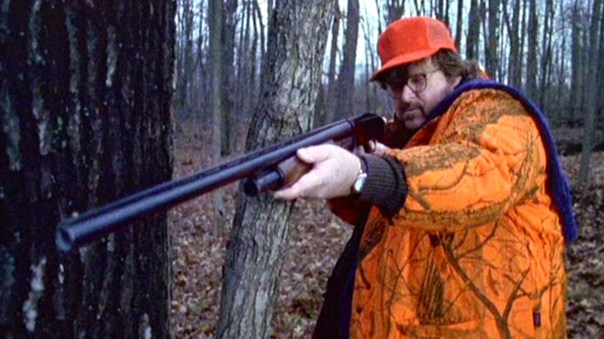
I was a junior in high school when the horrific massacre at Columbine happened in April of 1999. I remember the shock that washed over the country. I remember the daze and sorrow. I remember students not coming back to school for days, some because they feared that our Ohio school could be the next site of the next tragedy because of how upending the Columbine school shooting had been for the general sense of security. “How could this happen?’ we solemnly asked. I remember exasperated politicians wringing their hands, grasping for solutions and scapegoats alike, and I most remember just the overall gravity of the whole situation, the sense of loss, and the sense that this meant something significant. Flash forward twenty years, and the Columbine school shootings, which snuffed out 15 lives that fateful morning, is now ranked fifth on the list of deadliest school shootings in the United States, having been gut-wrenchingly eclipsed by the 18 at Parkland in 2018, the 22 in Uvalde in 2022, the 28 in Sandy Hook in 2012, and the 33 in Virginia Tech in 2007. Since then, mass shootings and spree killers have become so common that the satirical news website The Onion keeps recycling the same condemning headline with the latest mass shooting: “‘No Way To Prevent This,’ Says Only Nation Where This Regularly Happens” (this damning headline has been repeated 22 times in eight years time, and it’s only a matter of months at most before it gets repeated yet again if history is anything).
After each new tragedy, we’ve been inured to the reality of anything of merit being done in the way of reform; we move from “thoughts and prayers” to, “let’s not politicize this now,” to, “you’ll never solve every problem,” and then finally to a litany of social issues that conveniently are the real culprits, and never the guns mind you, of course. It’s easy to be cynical that, in our current day and age, no gun tragedy will ever move politicians to make real changes. After Sandy Hook, the most watered down of reforms, increasing background checks, was met with stonewalling from Republicans and those funded by the formidable National Rifle Association (NRA) lobby. After 60 people were slaughtered during a music festival in Las Vegas in 2017, the next hopeful reform was eliminating bump stocks. That didn’t happen. The patterns emerge and become their own tragic parody of performative action masquerading as meaningful action.

When people argue, “Well criminals will just ignore the new laws we pass anyway,” I’m dumbfounded by this logic, as if that is reason enough to cancel all attempts at law and governance. The oft-quoted axiom of a “good guy with a gun” being the only real solution to a “bad guy with a gun” is equally nonsensical to me. If that’s the case, then the rising presence of guns would better police these matters, mitigating their deadliness, and that is definitely not the case. The good guys with the guns aren’t working. The challenge is determining who is a good guy with a gun or a bad guy with a gun. This reflexive thinking never applies to other tragedies: “The only way to battle a bad drunk driver is with a good drunk driver.” It’s maddening for any citizen genuinely seeking common sense gun reform that’s supported by a far majority of voters.
America’s fixation with our gun culture was already a potent issue in 2002 when political muckraker Michael Moore elevated himself to new commercial and critical heights, and it’s only become even more essential to unpacking twenty years later. Moore had restyled documentary filmmaking with his searing and tragic-comic 1989 Roger and Me, his documentation of the fall of the American auto industry in his hometown of Flint, Michigan, where my mother grew up, and his search for answers with General Motors’ CEO, Roger B. Smith. Moore put himself front and center in his films, the schlubby everyman trying to hold truth to power, though he himself would have a slippery hold on it as well. Moore directed two more features in the 1990s, The Big One and Canadian Bacon, his only non-documentary film. But Moore catapulted into a new stratosphere of media attention and derision in the George W. Bush era, first with 2002’s Bowling for Columbine, which won him his first Oscar and set doc box-office records, and then in 2004 for Fahrenheit 9/11, which obliterated the box-office records Moore had just set and would have likely won him another Oscar but he refused to submit in Documentary and only wanted to submit for Best Picture (Born into Brothels won that year instead, so thanks I guess).
Bowling for Columbine is an aggravating movie by design and through Moore’s tactics. The issue of guns and violence in America has only become more central to American lives. Moore’s thesis is messy because it’s hard to find a single cause for the root of America’s gun violence, ignoring, of course, the sheer number of guns, though he even says Canada has a high guns-per-resident ratio from their culture of hunting but lacks our murder rate. The section on the media sensationalism driving gun sales is potent, as a nation constantly in fear will reach for protection that is abundant supply and access. As the murder rate has gone down over the 1990s and 2000s, the network news’ reporting over violent crime has increased, as well as gun ownership. It’s a brew of paranoia that benefits politicians, media, and especially gun manufacturers. Gun sales soared once Barack Obama swept into office, not because he said he would take people’s guns, but a section sure trumpeted those fears for monetary gain. The extended anecdote on the mother of the youngest school shooter, a six-year-old, is a powerful indictment on welfare-to-work and a system that forces people into unlivable choices. I wish Moore had touched more upon the mental health aspect of the gun violence equation, as the far majority of gun violence are suicides and not homicides. Many were quick to deduce that the Columbine killers, Eric Harris and Dylan Klebold, were victims of bullying, but millions are victims of bullying and do not shoot up their schools. In a 2017 TED Talk, Dylan Klebold’s mother, Sue, discussed her personal process of coming to terms with her son’s actions and realizing how essential his desire to die was to his infamous actions. When people make irrational, impassioned, split-second decisions, and guns are readily available, then bad things can be made even worse. Moore doesn’t explore this angle, unfortunately. Some of his larger connections can seem very reaching, like when he tries to say that kids knowing their parents work for Lockheed Martin, a military weapons manufacturer, would be less likely to value human life.

But it’s the needless sleight-of-hand tactics with the truth that confound me with Moore, and these inevitably blunt the power of his message and ability to convert thinkers. This habit infuriates and flabbergasts me. Moore has so many good points already at his disposal, so many meaningful data points and heart-tugging anecdotes that he doesn’t need to stretch the truth to convey his message. I’ve since used Bowling for Columbine as an example in teaching credibility gaps and the concept of ethos with public speaking. This is epitomized in the handling of NRA president Charlton Heston. Shortly after the events of Columbine are replayed for us, including frantic 911 calls and security camera footage, Moore cuts to Heston defiantly declaring, “With my cold dead hands,” and informs the viewer that within ten days that the NRA held their annual conference in Denver, despite pleas from local leaders for distance and sensitivity. “Don’t come here? We’re already here,” Heston replies to applause. The problem is that Moore has stitched together two separate Heston speeches to seem as one, including the “From my cold dead hands” intro, which was given an entire year after the Columbine shooting. He also excludes pertinent details like the fact that the meeting in Denver was scheduled a year in advance, the NRA was required by law to notify all four million of its members ten days before a location change, and all other NRA events were canceled except for the meeting required by corporate law. When you look at the parts of Heston’s speech Moore picked from, anyone could follow the same approach and edit the speech to say whatever message they desired. The climax of the movie is Moore sitting down with Heston, but when he peppers him with questions about his speech days after Columbine, and Heston has no idea what he’s talking about, it’s because Moore isn’t playing fair. Then also take into account the aged actor likely going through the Althzeimer’s that caused him to step down from acting and the NRA in 2002. Look, I’m no fan of the NRA, and I personally believe their self-serving actions perform a genuine harm to the country, but this is just self-righteously badgering an ailing old man.
Moore is not the only documentary filmmaker to make use of selective editing, anecdotal evidence extrapolated, and narrative cheats for manipulative emotional purposes, but when you’re being provocative, you’re going to get push back, and when you use deceitful storytelling methods with your facts, you are a disservice to your cause and your message. There’s so much on this topic that Moore can effectively criticize, like the handy media scapegoats, the failings of zero tolerance and school resource officers, the obvious hypocrisy of do-nothing elected officials, the fear-mongering news seeking out consistent sensationalism, a deference to the military industrial complex, and the fact that the rest of the world watches the same movies, listens to the same music, plays the same violent video games, and yet, to paraphrase The Onion, we’re the only country where this happens all the time. Sadly, no place is safe in the U.S. from a possible mass shooting, and yet a good portion of this country will shrug and say that’s just the price we have to pay for living our freedoms. There are so many fallible arguments to poke apart, and that’s why I’m so frustrated with Moore’s misuse of his platform, giving his opponents the ammunition to dismiss his points.

Moore’s career has fallen quite a bit from his meteoric height in 2002 and 2004, last releasing Fahrenheit 11/9 in 2018 to warn about the lasting dangers of an inactive voting public and Donald Trump as president (it grossed $6.3 million, approximately five percent of the gargantuan $119 million gross of Fahrenheit 9/11). It feels like Moore’s style, once so revolutionary, prankish, and urgent, has now become stale. As I wrote in 2018: “If our country ever needed Moore, it would be now, but his time might have already passed as an influencer. The last time Moore was breaking through into the cultural conversation was with Sicko in 2007, years before the formation of the ACA. Since then we’ve seen the rise of social media, YouTube, and the instant commentaries of media old and new, all trying to one-up one another in expediency and exclusivity. Is Moore just another member of the old guard he laments has become obsolete?” It’s not uncommon for a filmmaker to lose their edge or passion after 30 years. It’s also not uncommon for the envelope-pushers to become part of an establishment that a younger public starts tuning out for lack of relevance. I don’t know if Moore has a real audience any more.
Re-reading my old 2002 review, I’m sure glad I kept a paper copy of each of my published film reviews for my college newspaper because it was the only surviving copy I could find. I could not find my review for Bowling for Columbine on any of the websites and blogs I’ve used over the years, so in 2022, I literally sat with my twenty-year-old newspaper and retyped my relatively brief review from 2002. Thank you, me, for stubbornly holding onto these yellowing papers. I remember being more taken with the film in 2002, so much so that I would brush aside criticisms from my other friends who made valid points about Moore’s larger thesis (they just “didn’t get it,” I’m sure I incredulously scoffed). My apologies, my put-upon and sensible friends.
In the scheme of Moore’s catalog of films, I still think Roger and Me is his finest work and much of this is because it’s the most personal of his movies, chronicling the decline of his hometown with his special access. It’s the one that feels most essential for him to be the face of the movie. Bowling for Columbine is a messy movie but all Moore’s films are scattershot entertainments in retrospect, each deserving of reflection but also outside verification. As a result, the movies never become more than the sum of their parts and floating ideas and interviews and stunts and his loose thesis statements rarely coalesce into anything definitive, like an Alex Gibney documentary. Moore can be hectoring and disingenuous, especially during his interviews, and most of all aggravatingly short-sighted in his techniques, but he is a documentary industry unto himself and with good reason. Bowling for Columbine is the start of a conversation, with many asides both illuminating and diversionary, and it’s still worth watching twenty years later, as gun violence has only gotten worse. I think it’s likely Moore’s third best film, after 2007’s Sicko, but maybe I’ll change my mind in 2027. Until then, I’m lowering the film grade from an A to a B.
Re-Review Grade: B
Share this:

2000 Mules (2022)
 I swore I would be done with conservative filmmaker Dinesh D’Souza after 2020’s pseudo-documentary Trump Card, just as I also wrote that I was ready to be done with Donald Trump as president, and yet both have persisted and still pose a danger to the general public. Trump had been priming his voters to not trust any election outcome where he lost and now the Big Lie has become fundamental dogma for millions. 2000 Mules is intended to be D’Souza’s smoking gun, his proof that the election was stolen by nefarious Democrats and their cronies taking advantage of making absentee ballots easiest to access during a world-altering pandemic. D’Souza says he has amassed cellular data proving that ballots were stuffed into voting drop boxes, and these “mules” have been “trafficking” votes, and posits that 400,000 votes were invalid and tilted the presidency.
The entire rhetorical argument D’Souza and his co-conspirators have gathered amounts to a lot of, “Yeah, buddy, trust us on this,” when they’ve earned no such faith except for those who are already desperate for confirmation bias. D’Souza has built a lifetime of bad faith arguments, and anyone he brings on board to further his thesis statements is likewise to be dubiously trusted. True The Vote is listed as a “non-profit organization” about “voter integrity” when it’s really looking to restrict access to voting. They made the same baseless accusations after 2016’s election. The movie says we should trust this organization because they even helped solve a cold case murder by tracking cell phone data and contacting the Atlanta Bureau of Investigations. The problem with this noble claim is that True The Vote contacted Georgia officials two months AFTER they had already indicted two suspects for the 2021 murder of Secoriea Turner. You don’t get credit for solving a cold case that 1) wasn’t cold, and 2) where the police had already solved it. Should I get credit for reporting to the FBI that I know who’s responsible for Ted Bundy’s murders with my own evidence? True The Vote’s executive director, Catherine Engelbrecht, and board member, Gregg Phillips, are listed as executive producers, so I find it especially odd when, confronted by this discrepancy by NPR, Englerecht responded via email that her movie “did not have the benefit of full context.” Well, as an executive producer, and someone featured prominently on camera, would you not have the ability and say to provide that important context and clarity?
 D’Souza states, “Bold accusations require bold evidence,” although this has never stopped the man from making documentaries that make the most baseless of accusations and disingenuous conclusions, but 2000 Mules lacks the potency to support its claims. It doesn’t have security footage of people dumping tons of ballots, although D’Souza somehow says the data they do have is even better than video footage (“No no, this Tiger handheld game is way better than any Game Boy, grandson”). It doesn’t have any important testimony from people involved outside of True The Vote with the exception of one “whistleblower” who cannot go into accompanying details and speaks in racist generalities about Mexicans. Just because D’Souza and a few of his friends got together (Sebastian Gorka didn’t bring his Nazi medal) and talk about 400,000 false votes doesn’t make them magically appear from nothing. It’s always worth remembering that D’Souza was a convicted felon for campaign finance fraud before being pardoned by Trump after a movie courting his incalculable ego.
The only thing that D’Souza presents is assorted cellular data points that he wants to infer only nefarious conclusions. The technology for data pings is not that exact, according to several Associated Press reports, which means True The Vote cannot even be certain that these points of data are people dropping off ballots rather than simply standing ten to twenty feet away from the drop boxes. Nor can they tell if these data points aren’t cab drivers, election workers, or people that would frequent the area for work. Nor can they tell if these multiple data points aren’t merely people wearing multiple pieces of technology (phones, watch, tablet, laptops, etc.). The fact that the movie is purporting that it was busy around a space adjacent to a drop box is not exactly bold or revelatory when they were always intended to be placed in busy metro areas for better civic engagement. Never mind that ballot drop boxes have been utilized in Democrat and Republican-run states for decades and are tamper-proof. It’s the flimsiest of evidence blown to massive proportions that breaks down upon the most minimal dollop of intellectual scrutiny, but this is true of every dysfunctional D’Souza political polemic.
However, even if I was the most generous person in the world and took D’Souza’s assertions at face value, and again no human being should ever do this for their own mental and ethical well being, 2000 Mules falls apart because it’s not ever asserting that these ballots are phony. Even if someone was stuffing ballots, each one of these would be verified through a rigorous system of checks. Absentee ballots are tracked via signature and anyone can track their ballot online, which is what I did for my own 2020 absentee ballot. Casting extra ballots is really difficult when everything is finely tracked. One of the references True The Vote made to Georgia officials was investigated and found to be a man dropping off ballots for the rest of his family, completely legal under Georgia law. It is legal in 31 states for someone else to drop off your ballot for you even if they aren’t your family. All of this also assumes that anyone voting absentee would be voting for Biden over Trump, and while more Democratic voters did make use of the absentee process during a pandemic, to just assume absentee equals Democrat and thus equals untrustworthy is an escalating blend of bad faith.
 The votes have been counted, recounted, and in some states and counties recounted again and again, and yet Joe Biden still tops Donald Trump by seven million votes and still serves as president. Even if D’Souza’s incredulous account is true, and these people “trafficked ballots,” they would have been easily discovered and larger discrepancies would have been uncovered especially with so many partisans scouring for even the faintest hint of fraud. And yet, the scant cases of 2020 election fraud have been Republican voters trying to vote twice or vote for their relatives, living and dead (the call is coming from inside the house, True The Vote). According to the Associated Press, in the 2020 election there were fewer than 475 potential voter fraud cases in the six battleground states of Arizona, Georgia, Wisconsin, Pennsylvania, Nevada, and Michigan (out of a combined 25.5 million votes cast, being approximately .00002%). No matter how many times fraud is claimed, no matter how loud its champions get, it’s never verified in a statistically meaningful way. The Atlanta Journal-Constitution reported only finding four cases of dead people voting in Georgia, not the “thousands” that Donald Trump swore up and down had wrongly cost him the state. Trump’s own legal team had sixty chances in court to substantiate his claims of widespread voter fraud. It didn’t happen. True The Vote even told the Wisconsin legislature that they aren’t arguing the ballots were illegal, only that the process was somehow abused. So if the votes are legal then should not every legal vote be counted in free and fair elections? Where exactly is the controversy there? The controversy occurs when politicians, and bad actors, try to forge dubious claims about “protecting voting” by providing more obstacles between a voter and a ballot, less so protections after voting.
So in the end, what does D’Souza’s reportedly “explosive” “game-changing” “documentary” actually legitimately prove? It proves how easy misinformed organizations can buy consumer metadata. It proves that there were people around ballot drop boxes in cities. Or it proves that people exist in cities. It proves that D’Souza and his fellow bottom-scraping partisans will keep looking for any fig leaf, no matter how insignificant or made up, to still hold onto their quixotic claim that the 2020 election was stolen. It doesn’t matter that recounts have occurred and confirmed the totals, it doesn’t matter that these recount totals have been confirmed by Republican-led legislatures and committees, it’s become a defacto belief for over half of registered Republicans that the only way Donald Trump, an immensely unpopular president with a lifetime of self-serving bluster, could have lost the 2020 presidential election was because it must have been rigged. Somehow. This new Lost Cause is corrosive and becoming the purity test for Republicans seeking office. That’s why it’s important to rebut obvious falsehoods that undermine the integrity of our elections.
 2000 Mules has no real experts, no real smoking guns, no real legitimate evidence beyond purchased cell data it has extrapolated into grossly malicious conclusions. Even by D’Souza’s ridiculously low standards, there just isn’t any merit to his phony points. That’s because this man isn’t formulating a real-world argument. This is an alternate world argument for people living in bubbles of confirmation bias delusion. But that’s always been this man’s audience and he knows it. There’s no persuasive points here to convince anyone outside the circle of election deniers. D’Souza’s round table of pals, including Charlie Kirk and Dennis Prager, has Kirk saying, “Millions of Americans know something went wrong, and they have little pieces, and no one’s really put it together.” By the end of the movie, all of D’Souza’s friends have been amazingly convinced from his amazingly unconvincing evidence. Even Gorka says the 2020 election was the “perfect crime” because it “cannot be curated after it’s been committed.” So there you have it, folks. They don’t ever have to prove the fraud because it cannot be proven because it was so perfect, therefore there had to have been fraud all along. 2000 Mules is a deeply un-serious documentary about a serious subject for people willfully ignorant.
Nate’s Grade: F
[Update: Since the release of D’Souza’s movie, a Fulton County Superior Court judge ordered True the Vote to prove their evidence of voter fraud and to submit any witnesses or witness statements. They admitted they had no evidence. Funny how when it comes to court, and penalties of perjury and jail, all these “massive voter fraud” Kraken-conspiracy mongers eventually reveal they’re completely full of it. It’s all a money-making scam, folks. Wise up.]
Share this:

White Hot: The Rise & Fall of Ambercrombie & Fitch (2022)
 I don’t know if the superficial fashion company Ambercrombie & Fitch deserves a better expose but a superficial documentary now on Netflix feels like a nostalgia trip that trades in too many glancing, annoying generalities. White Hot: The Rise & Fall of Ambercrombie & Fitch feels like an extended segment from one of those old I Love the 90s specials that used to dominate VH1 where a group of talking heads chatted nostalgically about whatever pop culture bon mot of the past that deserved reverence or being forgotten. I think there could be a story here too. Ambercrombie’s success was built upon two men, both of them gay, creating a brand image basically around the kind of man they found most alluring and attractive: WASPy, muscular, young, and their idea of what it meant to be American (a.k.a. white frat boys). One of those men was closeted and mercurial, and the other was a prominent photographer who was also a predator, but both of these men were responsible for a largely heterosexual cultural landscape accepting their vision and wanting to match their personal preferences. There’s also a story about their wantonly discriminatory hiring practices, keeping minorities in the back or with overnight shifts, wanting to maintain their CEO’s image of people in stores, including hiring people based upon attraction (i.e. thin and white) and not even whether they could be a functional employee. However, director Alison Klayman, no stranger to documentaries that feel rushed and uninformative (Jagged, The Brink, Take Your Pills), would rather speed through an armada of interview talking heads for clipped sound bytes and vague explanations for what made Ambercrombie so popular and then stopped being so (“It was really cool… and then I guess it wasn’t”). The doc completely misses relevant subjects like the online shopping revolution, the decline of malls and mall culture, or anything of actual meaningful cultural contribution beyond the rise of social media. According to the movie, because of social media, more people have voices, I guess just forgetting there was an Internet beforehand. It is strange, by today’s standards, for a large fashion company to be willfully uninterested in its brand being more inclusive. By the end, the documentary even seems to sell a redemption story, so it doesn’t go far enough in its condemnation because that would get in the way of its nostalgia trip and would actually push the interview subjects to confront more of their own actions or inaction. Alas, White Hot is yesterday’s news without any lasting appeal or insight.
Nate’s Grade: C
Share this:

DeRosa: Life & Art in Transition (2021)
 Angelo Thomas is an impressive young filmmaker. At his college, the Columbus College of Art and Design in Ohio, the man was able to make a $50,000 feature film, 2020’s The Incredible Jake Parker, the first undergraduate film in over 30 years. Now he’s right back with another feature, the documentary project DeRosa: Life, Love & Art in Transition, illuminating the story of artist Felicia DeRosa, a CCAD grad and professor who lived most of her life as a man before accepting herself and coming out as trans at the age of 43. The 65-minute documentary is nicely polished and deeply empathetic and worth an hour of your time to learn more about DeRosa’s harrowing and inspirational life.
The biggest question any documentary must ask itself is whether there is a story here that can support a deeper dive. I suppose this same question should be given to fictional narratives, can it support a film, but documentaries are limited by the experiences of their subjects. Fortunately, with DeRosa, there is plenty to talk about and the hour running time feels more than enough time to sincerely cover one woman’s journey of self-discovery and an evolving love story where two people recognized they were better together no matter the changes. DeRosa is a natural gabber and quite capable of compellingly retelling her story with bittersweet personal insights and wisdom. She’s an easy person to sit in front of a camera and just say, “Go.” It also helps that the production has access to what must have been hours upon hours of DeRosa’s home recordings. She was prolific in documenting her feelings and anxieties at different points. It’s a wealth of resources for the documentary to be able to immediately supply DeRosa at different points of her life’s journey articulating her struggles and anxieties in the moment. It reminded me a bit of the documentary Val, extensively using Val Kilmer’s home movies enough so that it credited him with cinematography. DeRosa is all over the movie and to our benefit.
 As expected, much of the movie examines individual and societal views on gender identity, a subject that is simultaneously becoming more normalized and scandalized. As more and more trans people discuss their personal journeys of discovery and acceptance, our media and arts are helping to build compassion and understanding. At the same time, as gay rights have become more acceptable across the political spectrum, the new focal point for conservative hysteria and political opportunism has shifted to trans rights. No longer is the thought of two gay people getting married the boogeyman for fundamentalist outrage; now it’s the entire idea of trans people using restrooms and playing sports and more or less existing in a public manner. DeRosa’s own experiences may be similar to many who grow up closeted in households and have to pretend to be someone they are not. There is a social good to hearing more stories of those marginalized from our society and finding their strength and advocacy to inspire others to keep pushing forward.
I expected DeRosa’s mother to be disapproving. Upon discovering her young son playing dress up in feminine clothing, DeRosa’s mother went into a frenzy and kept beating her child. As tragic as this setback is, it’s not uncommon. However, DeRosa’s experiences with her mother become even more gut-wrenching when she reveals how, at the age of 13, her mother raped her while remarking how similar they looked like their father. I had to walk out of the room after this awful revelation and pause the movie. It’s heavy and head-spinning and would send anyone into a depressive spiral. I completely understand the reluctance to dig further without seeming to exploit DeRosa’s sexual trauma for inflated drama. That’s the challenge for any documentary filmmaker. How far do you push your subjects and when do you cross a moral line? DeRosa shares therapeutic letters she has written directed to her mother, and years later it’s still a tangle of complicated emotions to process. DeRosa’s mother is left behind as a topic, fittingly, as DeRosa ventures into independence. She gets news that her mother is on death’s door, and DeRosa is the one who must decide whether to pull the plug and end her mother’s life. That’s all kinds of messed up.
 Another aspect of the documentary that stands out is how much compassion and empathy it builds from the complicated relationship with DeRosa’s wife. Gwen comes from a conservative Christian upbringing and her early relationship with her husband is supportive; they’re clearly each other’s person as they’ve only been apart for twenty minutes in the past eighteen years. Hearing from Gwen’s side is more than simply checking in on how the dutiful wife is dealing with her husband’s identity. I recall 2015’s The Danish Girl that seemed to elevate the grieving perspective of the “poor yet supportive wife” over the turmoil of the one actually going through the gender reassignment surgery for the first time in modern history (and lead to Oscar victory for Alicia Vikander). It was intended to be a considerate and compassionate ploy, but the counterbalance also made it so this perspective was the dominant one, a cis gendered heterosexual spouse who couldn’t quite understand but stood by her man as he chose to outwardly transition to a woman. With this documentary, the inclusion of Gwen enlarges the story and she’s by far the best secondary voice to provide insight for DeRosa. She also knows her story is supplemental but also important. She’s supportive of her wife and acknowledges her own questions and processing, but through this journey it’s allowed her to personally reflect upon her own queer identity. Felicia and Gwen, while not filmed together in interviews, are eminently loving of one another, and to watch them speak about one another is a reflection of grace.
As far as documentaries go, this one is professionally packaged for only having a meager budget of $8,000. It’s sharply edited and with a multi-camera setup for its interviews that allows more dynamic visuals and coverage opportunities. The music is sparse but appropriate, and the editing is smooth as it incorporates personal photos and extensive home video recordings to better give voice to the idea or feeling in that moment. This is assembled like a professional documentary and the interview subjects, while only limited to two people, have plenty to say and are engagingly laid back. I wish the movie was a little longer, but as a documentary, an hour’s length of content seems more fitting in our age of endless streaming docus-series. I’m impressed with Thomas’ finesse at going from fictional narrative filmmaking to documentary filmmaking. He proves a natural for the material. DeRosa: Life, Love & Art in Transition is a confirmation that Thomas can adapt his talents to his subjects and aims with skill and compassion. DeRosa is an agreeable hour of your time and proves another sign than Thomas is artistically thriving.
Nate’s Grade: B
Share this:

Misha and the Wolves (2021)
 The Sundance documentary Misha and the Wolves, now available on Netflix streaming, is a movie about trauma, lies, and ultimately proves to be unfulfilling due to the circumstances of its own narrative limitations, both in subject and approach. It’s worth watching at only 90 interview-packed minutes, but it’s also a case of a movie that could have gone much deeper into a troubled subject that demanded more scrutiny and psychological examination than what the film has to offer.
Misha Defonseca was an elderly Belgian immigrant living in a small Pennsylvania town when she decided to share her personal story of survival one day at her community synagogue. When she was seven years old, her parents were taken by Nazis during the Holocaust. She was living with a Catholic family and hiding her real identity but she wanted to be with her parents, so she set out on foot across the country to find them, and in the process stumbled upon a pack of wolves who grew to accept her as one of their own. Misha’s story was immediately engaging, and a local publisher snapped up the rights to sell her story. Oprah’s talk show wanted to make Misha’s story their next book club selection. Disney wanted to buy the film rights. This story was going to be huge, but then Misha backed down from both media suitors. It picked up in Europe where Misha traveled and gave lectures on her spellbinding experience and they made it into a French movie in 2008. It is a truly remarkable story. The problem is that her unbelievable true story wasn’t actually true.
 It’s a story that even one interview subject admits sounded “too fantastic to be true,” and in hindsight it’s one of those stories that I’m sure many would feel foolish for believing – a little girl at the age of seven trekking hundreds of miles, on her own, through the war, in enemy territory, and then accepted by a friendly wolf pack. It definitely beggars belief but nobody wants to think skeptically of someone who claims to be a Holocaust survivor. I wouldn’t want to assume the worst of anyone’s personal experiences during such a hellish time. The primary interview subject is Misha’s first publisher she sued who is the one that first started investigating the voracity of this amazing tale. She relates how disgusted she felt doing what she did, suspecting the worst in someone who had experienced her own set of traumas. She says she felt like a villain in a story that she didn’t sign up for. Admittedly, she could have researched Misha’s claims early on to verify her account but chose not to because she was thinking of how much money she could make. However, there have been so many amazing tales of survival from the atrocities of the Holocaust so maybe Misha could have been accepted by a pack of wolves and offered protection. Maybe she did stab and kill a Nazi as a child like she said. Maybe. That need to believe survivors and the fear of calling out the storyteller for their accompanying proof is what Misha exploited to continue spinning her phony story. She exploited the good will of being a survivor and the communal sympathies of others. Why she did what she did is another matter that frustratingly goes unexplored.
There is one big narrative twist that I was predicting early on and that I think most viewers will be able to anticipate once they start asking their own questions, but for the sake of spoilers I’ll caution that this paragraph is going to talk about this gambit because I don’t know how to discuss the implications and how it dulls the movie without being specific. With that being said, early in the movie we have Misha being interviewed but there are limits to what she is responding to, limits that become more notable as her story continues at points that you’re positive a documentary filmmaker would want their subject’s direct personal input rather than having others speak for them. That’s when I began suspecting that the Misha on camera was going to be revealed to be an actor, and two-thirds of the way through the film that is exactly what happens. Our fake Misha pulls off a wig and peels off the elaborate makeup. Aha, a story about a phony Holocaust survivor has itself made use of fictitious representations. I can understand some viewers feeling hoodwinked and perhaps a little angry from this deception. I can also understand why the filmmakers elected to go this route thematically so that they could replicate the feel of what Misha’s friends and neighbors and supporters may have felt. There’s also the very pragmatic issue of not having access to the subject of your documentary. It’s a missing hole that seriously hobbles the impact and reach of the movie, and that’s where Misha and the Wolves starts to disappoint. It’s understandable to supply your own stand-in version of Misha to respond to the claims and accusations. It’s a necessary perspective. Once the jig is up, and you know for certain that Misha will not be available to explain anything, then you realize the movie is a whodunnit where it would have been far more engrossing as a whytheydunnit. There are questions we want answered for such a heinous fabrication, and I wish the film had been structured not in the details of uncovering Misha’s false identity but in trying to explain why someone would do such a thing. The movie is lacking psychological insight and without that it becomes any other well-made but disposable episode of ordinary true crime television.
 It begs the question that I wish the documentary would have gone much deeper into, namely why would anyone fashion a Holocaust story for themselves? Defonseca is far from the only person who fabricated a story about their Holocaust history. Rosemarie Kocz was an artist who said she escaped from two concentration camps and whose art hung in museums around the world including Yad Vashem in Israel. She was a fraud. Herman Rosenblat embellished his own Holocaust survival with a love story of reconnecting with the young girl who gave him apples in the camp and that was completely made up. Joseph Hirt said he met Dr. Mengele and then, upon confrontation, said he had lied to “keep the memories alive” about Holocaust history. That justification offends me and likely should offend you too, dear reader. The numerous dead do not need the stories of phony victims to keep their memories alive. When people greedily co-opt another human’s tragedy as their own, they are knowingly diminishing it by trying to transform this horror into something appealing about their own life story and experiences. If anything, these stories are making it more likely for pernicious Holocaust denial to spread, with deniers pointing to these phony personal accounts and saying, “See.” It dishonors the dead and their memory.
The story behind Misha and the Wolves is interesting and inflammatory but also very surface-level in substance ultimately, about uncovering the truth behind a liar’s lies. There is a certain level of interest in watching how the investigation picks up momentum and makes the necessary connections to finally reveal the disappointing truth, but then the movie doesn’t go a step further. It’s about how a liar’s story fell apart but there seems more potential with exploring why people falsify such stories of real-life trauma. For Misha, her own personal experiences involved tragedy at the hands of Nazis, so why was that not enough? Misha said that her story might not be reality but it is her reality. I don’t fully understand her position, but I will likely never understand why someone like Misha Defonseca does what they do. I suppose there’s an inherent attention-seeking intent. Maybe a projection of pretending to be someone else, a person who has survived amazing ordeals and come out the other side. One of the film’s subjects, Evelyn Haendel, a Holocaust survivor and investigator, declares Misha both a victim and a villain, but she dismisses the idea of these fabrications as acceptable outlets for troubled souls. In an era of increasing Holocaust denialism, these phony accounts are unfortunate fuel and are even more incendiary. Misha and the Wolves is an okay documentary on a topic that demands more attention.
Nate’s Grade: B-
Share this:

Val (2021)

Watching the documentary Val, comprised from thousands of hours of home videos shot by actor Val Kilmer over the course of 30 years, may make you realize just how little you know about the actor. His reputation is that he’s difficult to work with, conceited, and Method to the point of losing himself in roles and pushing his co-stars to the brink of sanity. Coming from his own words, narrated by his son Jack, naturally allows the most empathetic read of the man and his rationale for his personal and professional decisions. I never knew about his family life, losing his teenage brother who was an inspiration and early collaborator. I never knew Kilmer wrote his own plays, including a student production at Juliard that broke new ground. I never even knew he was an early adopter of technology and had a warehouse filled with his self-documentation and behind the scenes footage (Kilmer is even credited with the doc’s cinematography). You get the sense of a wounded and restless soul, a handsome movie star who so rarely found a film role that allowed him to feel like an artist in his element. Kilmer can be one of his generation’s greatest actors, as evidenced in classics like Heat and Tombstone and as Jim Morrison in The Doors, still one of the greatest acting performances I’ve ever watched. Kilmer languished through plenty of studio dreck as well. His time as Batman is marked by dejection and loneliness, stuck playing the straight man in a movie of oddballs and trapped in a suit of limited mobility and an inability to hear (actors and crew started avoiding him in the Bat suit because he couldn’t respond). Strewn throughout the movie is contemporary footage of Kilmer after beating throat cancer, though the subsequent surgeries have left his speech haggard. Listening to the labored and tortured sound of his voice is a direct jab to your sympathy. Given that this is produced by Kilmer from his own archives, and narrated by his son, the documentary isn’t as critical as it could have been. I wish the movie provided more self-analysis for Kilmer, especially on some of his rockier relationships and onset disruptions, like for the notorious Island of Doctor Moreau. I don’t think you can still fall back on his deceased brother for decades of his behavior. There’s a limit to the level of insight because it feels a bit like Kilmer managing his reputation and legacy within the industry. Still, for nearly two hours, Val can be a poignant and illuminating expose of an actor with a reputation for equal parts trouble and brilliance.
Nate’s Grade: B


 nathanzoebl
You must be logged in to post a comment.