Blog Archives
2012 (2009)
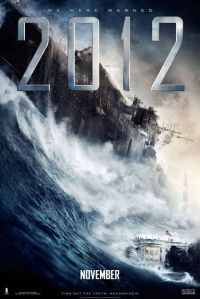 Let’s get this out of the way. The world isn’t going to end in 2012. Well, it might, but it won’t be because the Mayans said so. Because truth be told, the Mayans didn’t say anything about the world ending. The Mayan calendar exists in large circular amounts of time, and the largest period of time is called a bactun. An epoch, 13 bactun, will be coming to an end somewhere around December 21, 2012, but this in no way is a signal for the end of days. It just means that one cycle of time has come full circle and we begin anew. This is entirely a Western invention. If you learn nothing else from this review, know that the world will be fine come 2012. At least in this regard. Who knows about nuclear holocaust, biological warfare, religious fanatics bringing about the end of days, Sarah Palin running for president. The world could still end, but don’t blame the Mayans. They’re already dead anyway. They didn’t see that one coming, either.
2012 is the latest disaster movie from director Roland Emmerich, who fondly destroyed the world in Independence Day and The Day After Tomorrow. In news interviews, Emmerich has insisted that 2012 will be his last disaster movie (yeah right!), so he wanted to pull out all the stops. And he does. 2012 is like the disaster movie to end all disaster movies. It’s great escapist fun but it’s also silly and cheesy and hokey and all things a great memorable disaster movie should be. The movie packs so much that you may likely experience fatigue by the end.
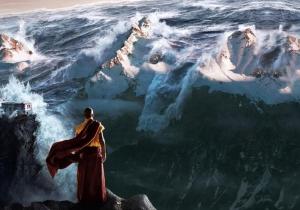 Like previous Emmerich movies, we follow a dispirit group of people from all walks of life who coincidentally come together. Jackson (John Cusack) and his wife Kate (Amanda Peet) are separating. Kate is currently seeing a new guy, Gordon (Thomas McCarthy, the writer/director of The Station Agent), and Jackson’s son thinks highly of new dad (maybe he saw the excellent Station Agent). Jackson is trying to become a better dad and take the kids camping to Yellowstone National Park. It’s there that he runs aground with government officials and a conspiracy radio host (Woody Harrelson) warning about impending doom. He puts enough pieces together to hatch a plan to save his family and escape. The government was alerted by a geologist (Chiwetel Ejiofor) in 2009 and has been preparing for massive seismic shifts. The president’s chief of staff (Oliver Platt) has been planning the “continuity of our species.” The elites have secured a place on massive arks built in the Himalayan mountain range. Jackson and his family must find a way to reach the arks in China for any hope of surviving the next chapter in human existence.
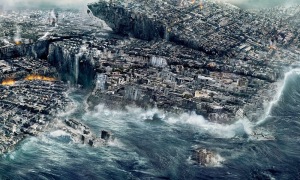
Emmerich packs so much earthly chaos into this movie that it can get flabbergasting. It’s not enough that California is upending by earthquakes and gaping chasms, it has to be thrown into the sea city block by city block. It’s not enough that Yellowstone National Park emits a thunderous volcanic discharge; it has to explode with the might of three mushroom clouds. It’s not enough that a 150-foot tidal wave strikes Washington D.C., it has to drag along a U.S. aircraft carrier that topples the memorable architectural sights of the city. It seems like Emmerich is trying to one-up everything that has come before in disaster cinema, but beyond the cheesy Irwin Allen movies of the 1970s, his only real competition is himself. No one wreaks havoc upon the world like Emmerich. He has the same destructive tastes of a mad scientist of Godzilla. He’s a big kid that likes to see things fall down and go boom. And in that regard, Emmerich has no equals. Not even Michael Bay, who certainly has panache to his record of ruination, can compete with this German master of disaster. No one can do enjoyable cheesy entertainment on such a mass scale like this man.
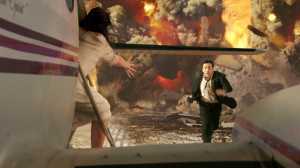 The special effects in 2012 are first-rate and the true draw to see this thing on the big screen. Large-scale global devastation has never looked so pretty. This is a full-blown summer movie in the midst of the fall prestige season. The destruction is often awe-inspiring thanks to Emmerich and his team of visual wizards, and the buildup of suspense can be palatable as well. The pacing is better than you would expect for a movie that runs over 150 minutes, but that didn’t stop the contingent of teenagers in my theater from standing up and leaving whenever there wasn’t violent death. At least Mother Nature wasn’t taking out specific monuments with pinpoint precision like She normally likes to do in these things. And just like in disaster movies, the “chosen few” are gifted with the amazing ability to outrun fireballs, earthquakes, falling debris, falling buildings, and just about everything falling at high velocity. Sure the immediate heat from an explosion at Yellowstone would instantly fry the characters, and sure an airplane can?t fly through a pyroclastic cloud, but it’s all part of the territory for the genre. If it was really true to life than we’d all be dead and the movie would be considerably shorter.
So what is the protocol for enjoying mass entertainment that coincides with massive death? Emmerich is usually very good about his disaster sequences to keep his focal point at long distance angles, both so that the audience can get a full vision of the mayhem and also to make sure that we cannot concentrate on the little people fruitlessly scurrying away for their lives. If you stop and think, practically every second of on screen destruction in 2012 involves thousands of nameless, faceless people dying horribly, and these are the big moments when the audience chows down on greasy fistfuls of popcorn. It reminded me somewhat when the news kept repeating the planes crashing into the World Trade Center towers as pieces for their 9/11 segments, and I’d stop and think, “You know, you just paused an image and in that image is the reality that hundreds of people are dying.” It’s a strange thing to contemplate, which is probably why Emmerich overloads your senses with (safe distance) disaster carnage. There is an image that does cross a line, where we witness office building workers tumbling out of the crumbling high rise. That’s one 9/11 image that’s just too distasteful even for a disaster flick.
 Naturally the reason to see these kinds of movies is the big bangs for your bucks, but what happens during the downtime? I was genuinely surprised how involved I became with the collection of characters. I’m not saying that this is deep, penetrating writing, but it’s easy to wring some pathos out of a story when you have one character after another delivering a teary “Goodbye, I always loved you” speech to their soon-to-be-dearly-departed relatives. I cared about these characters enough to wince when they began being picked off one-by-one when the script called for heroic sacrifice upon heroic sacrifice. Burrowed beneath the avalanche of special effects, like really really buried in there, is an interesting philosophical argument about how people would behave during the end of the world. Would they be selfless or selfish? Would they step on their neighbor’s neck for another minute of life or would people sacrifice? Personally, I’m a bit of a pessimist, but the debate is intriguing. I also thought that 2012 had a vital conversation about who exactly gets to survive. In the story, a seat on the super arks are a billions Euros, which gives the insanely rich a huge advantage, but it’s because of the insanely rich private sector that the world’s governments are able to build these massive arks and plan for a future. So there you have it: a future world with the likes of billionaires and politicians. Who will get them all coffee? Who will pick up their dry cleaning? Who will take their calls? Is this even a world worth living in?
2012 is dopey and self-serious and way too long but man is it entertaining. The fabulous special effects are the real star of the movie, though the assorted cast does well. 2012 is deemed Emmerich’s last disaster picture, and if that holds true then he’s making sure there isn’t anything left to destroy. This is disaster pornography on a scale rarely seen in the movies. It deserves to be seen on the big screen for maximum enjoyment of maximum destruction.
Nate’s Grade: B
Share this:

Knowing (2009)
 Knowing is a movie about the consequences of seeing the Eternal Plan. If you could know the exact day of your death, would you want to know? How would that impact your life? Would you feel motivated to live every other day to its fullest, or would it cast a pall over the rest of your time? One character in Knowing is told the day of her death and it destroys the rest of her life. I think this topic is interesting but perhaps I’m in the minority. Knowing has been savaged by film critics, and I can certainly see the validity of some of their complaints. It’s not a flawless movie by any means, but I found Knowing to be an effective and suspenseful B-movie.
In 1959, a Massachusetts school buried a time capsule with drawn predictions of what students though the world would be like in 2009 (lots of robots and rockets, how we’ve let them down). One girl, Lucinda Embry, wrote a series of numbers. Flash forward 50 years. MIT professor John Koestler (Nicolas Cage) is a widower raising his eight-year-old son, Caleb (Chandler Canterbury). When the school reopens the time capsule, the schoolteachers pass out the individual letters to students. Naturally Caleb is given the envelope with the number code. He brings it home to show his father, who becomes intrigued and looks for patterns. John reasons that the string of numbers is an eerie predictor for major disasters around the world. They predict the date, the number that die, and the location via longitude and latitude. All of the numbered disasters have already taken place (including the hotel fire that killed John’s wife), but there are three more numbered disasters that have yet to happen. It?s about this time that Caleb is visited by mysterious thin men in long black trench coats. John seeks out assistance from Lucinda’s daughter (Rose Byrne), whose daughter also hears the same voices that Caleb does about an impending doom.
 Count me genuinely surprised at how taut I found Knowing. This movie builds a good head of steam and I dreaded what was to follow (in the good sense). When John figures out the exact design of the numbers, pinpointing date and location of disasters, he feels compelled to try and prevent the loss of life. Would you do the same? I think if I had been given a secret celestial code that predicted cataclysmic disasters that I would make sure to steer clear from those locales, rather than running to them. Director Alex Proyas (Dark City, I, Robot) expertly stages the carnage, to the point that I was grimacing and wincing. The plane crash, all shown in one unending shot, is a realistic nightmare that gets more and more disturbing. John hops through the wreckage to attempt to save people and encounters one burning victims after another, all screaming in terror. There are subsequent explosions amongst the wreckage that engulf more people in flames. The scene is spellbinding and unflinchingly horrific. The same can be said about the second disaster sequence in New York City, indelicately evoking some 9/11 memories. After these sequences I was dreading every moment leading up to the next, yet I was also perversely interested to see what would happen next.
I?m glad that the screenwriters tackled the fallacy of numerology early. One of John’s MIT colleagues says that people see what they want to see in the numbers, and surprise then they find them. This was completely the case with the ridiculous 2007 thriller, The Number 23. Jim Carrey went crazy deducing everything to one number, but it was the human mind projecting what it desired to see. The same thing goes for psychics who express vague statements so that the poor saps paying can fill in the details and make it personally relevant (“I’m thinking of a grandfather who died… He was a man?”). I had less of a logic gap with the numbers in Knowing. Granted, I have no idea which set of numbers the code is going with. For example, it lists a set number of deaths for the 2004 tsunami that killed over 250,000 people. But with such a massive event, how do we calculate the dead? There could be loads of people missing and presumed killed by the tsunami. Do people that die as a result of injuries count as direct victims, or are they victims of infection? My point is either the number code is going by the reported estimate on the news or has the exact number, which would be different than what the estimate was in the press. Either way, it presents a mild discrepancy for John.
The movie paints itself into a corner and the astute viewer will realize that it?s only a matter of time before one of the two supernatural A-words gets dropped as the force behind the strange occurrences (or a hybrid of both options). While the movie gets somewhat silly toward the end with its apocalyptic resolution, Knowing refrains from getting stupid. Yes it’s weird that John somehow lives in a giant house decorated to look like some peeling haunted mansion. Yes it’s weird that some supernatural force could predict every man-made disaster yet decide not to intervene in the biggest one. Yes it’s weird when Cage screams, “We have to go where the numbers want us to go.” But here’s the thing, Knowing is packed with ideas, some of them derivative (the ending borrows liberally from Arthur C. Clarke’s novel, Childhood’s End), but there is an ongoing discussion over the nature of science, religion, destiny and free will, and this discussion does not pander. I would have expected a conventional movie to transform John back into a man of faith over the amazing course of events, but it never fully happens. The movie never deduces that religious faith is the right prescription for our ailing times, and it even questions the ideas of divine intervention, namely that we live in a universe of determination rather than randomness, though it won’t specify what that determination is. The movie adheres to its pessimistic viewpoint right down to the end, which result in some ballsy choices for a mainstream Hollywood thriller. The heavy-handed ending didn’t break the enjoyment of the movie for me, though I expect it will for many.
 Not that it was needed but Knowing offers some nice little moments of characterization. I really enjoyed John’s monologue about his wife’s passing. He laments what he was doing at the time of her death, mainly blowing leaves off the lawn. He thought you were supposed to know, to feel something when your loved ones are in peril. He was just tending to the leaves, unaware of his wife’s fiery death. I really appreciated this insight into John and also how realistic the scenario felt: the depressing realization that the universe let you down. This seems like a much more believable reason for John’s scientific atheism than anything Mel Gibson went through in Signs.
The acting is cranked up to an exaggerated level of screaming. Cage spends a good portion of the movie with his mouth agape. The rest of the time he’s frantically screaming, which could account for most of the acting. It alternates between catatonic and hysterical. Cage is rather decent as his life is consumed by mysteries. I must say though that the acting only made me raise my eyebrow a few times and never pulled me out of the movie. This is no Wicker Man embarrassment of monumental proportions.
[Knowing is a solid B-movie with some super special effects to go along with its haunting scenes of disaster. It?s a step above your average sci-fi flick thanks to a lack of pandering to easy answers. I’m somewhat amazed that a movie this fatalistic and bleak would be greenlighted and given the budget it has. Proyas make sure the movie doesn’t succumb to numerology hokum, though the movie does tilt a bit toward the silly by its conclusion. I went into Knowing knowing little beyond the fact that the movie was ripped apart by other critics. Perhaps my positive reaction is born completely out of low expectations, but I found Knowing to be a juicy bit of sci-fi escapism that diverted the time nicely
Nate’s Grade: B
Share this:

Poseidon (2006)
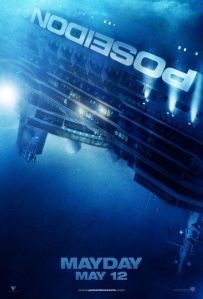 The Poseidon production design is rather fantastic and director Wolfgang Peterson (Troy) has a real handle on large-scale carnage, but Poseidon is a stripped down action flick that lacks the suspense and emotional involvement to bring strength to its attempts at harrowing survival. Some sequences, only some, are nail-biting, like a very claustrophobic escape through an air vent slowly filling with water. We’re presented a situation and then Peterson cranks up the tension and utilizes different characters working together. The sequence has the added benefit of utilizing the child to save them, unlike most films of this nature where irritating kids just become a liability to your own safety. The fact that this sequence, the film’s high point in my view, is also the least expensive of this $160 million dollar movie’s sequences is not lost on me. The film’s premise of working through the bowels of an underwater ship is filled with potential. The original Poseidon Adventure was cheesy, yes, but it was a lot of fun. This slick remake brings the action fairly early, having its “rouge wave” flip the ship at the 15-minute mark. Because of this decision the audience has no attachment to the film’s collection of characters, given fleeting seconds to establish some sense of personality. You really don’t care at all what happens to these people in the ensuing danger. The female characters add nothing to the story except to fall into the constant need of being rescued. Peterson paces his obstacles mercilessly right after the other, but he runs into the problem of killing off all his expendable (read: non-white) cast off too quickly. That lessens even the small amount of tension the film had going. Poseidon is way too big-budget and serious to go for camp. The special effects are above average and the pacing is swift. Frankly, you could do worse this summer for entertainment than spending 100 minutes watching this movie.
Nate’s Grade: C+
Share this:

War of the Worlds (2005)
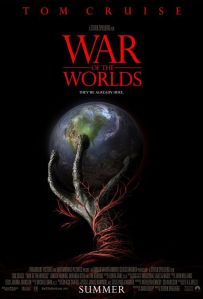 Steven Spielberg is America’s favorite director. He’s made films about alien encounters before (hell, it was most of the title of one movie), but Spielberg has never tackled evil aliens. Alien movies either involve cuddly little green men or the kind that want to destroy our planet. The latter is usually more interesting and finally Spielberg takes the trip with War of the Worlds.
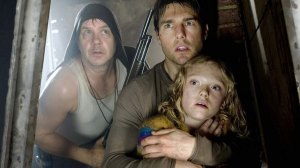
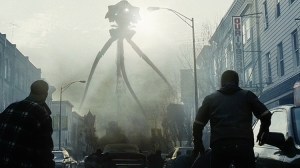
Instead of focusing on high-ranking government officials, War of the Worlds concentrates on an everyday man just trying to save his family. Ray (Tom Cruise) is a New Jersey dock worker and a divorced pop. His ex-wife (Miranda Otto) has dropped off the kids (Dakota Fanning, Justin Chatwin) for the weekend. Ray isn’t exactly father of the year and his sullen kids remind him of this fact. Meanwhile, there seems to be a series of lightning storms hitting the world that then leave an electronic magnetic field that eliminates all the electricity in the area. A storm hovers over New Jersey and lightning strikes not once but over twenty times in the same spot. Ray goes to investigate the site. The ground beneath trembles and caves in. A giant machine with three tentacle-like legs emerges from the earth and starts zapping any humans it can find. Ray escapes, packs up the kids in the only working car in town, and runs, runs, runs, all with the aliens just a step behind ready and waiting for a people zappin’.
 There are three things an audience will have to put behind them in order to enjoy what War of the Worlds has to offer.
1) The film has no plot. War of the Worlds spends the first 15 minutes setting up its handful of characters and their misery with each other. After that, it’s nothing but all-out alien attacks. That’s really it. Ray and the kids run to one place and think they’re safe. The aliens come and attack. Ray and the kids escape to a new place. The aliens come and attack. Lather, rinse, repeat. There is little more to War of the Worlds.
2) Spielberg has pretty much forgotten how to make good endings. I think A.I. was the nail in the coffin. Routinely Spielberg films seem to run out of gas or end rather anticlimactically, but A.I. really cemented the glaring fact that Spielberg cannot sit still with an unhappy ending. So, yes, War of the Worlds both ends anticlimactically and with an abrupt happy ending. Of course the H.G. Wells novel ends in the same fashion so there’s less to gripe about, until, that is, until you reach the implausible reunion. Spielberg can’t keep well enough alone and forces the story to be even happier at the cost of logic.
3) Ignore whatever feelings you hold about Tom Cruise. Off-screen, many feel that Cruise is becoming an obnoxious, pampered, self-involved, couch-jumping cretin. No matter what your feelings about Cruise and his self-taught knowledge about the history of psychiatry, that is not who is in War of the Worlds. He is playing a character. I never understood the argument that because you dislike an actor as a person it invalidates all their acting. I’ve read magazines that actually say people are staying away from Cinderella Man because people think Russell Crowe is a grump. In War of the Worlds, Cruise plays a deadbeat dad who finds his paternal instincts during the end of the world. The character isn’t deep and acts as a cipher for the audience to put themselves in the scary story. Plus it’s not like Cruise is a bad actor; he has been nominated for three Oscars.
 Since this is a large Hollywood horror film, the acting consists mainly or healthy lungs and frightful, big-eyed expressions. So it seems natural that little Dakota Fanning would play the role of Child in Danger. Cruise somehow finds some points in the story to exhibit good acting. There’s a moment right after Ray and his kids escape to their mother’s home. He tries making them food out of whatever they saved which amounts to little more than condiments and bread. His kids rebuff his offer and he throws the sandwiches against a window and repeats to himself to breathe. In lesser hands this moment would just be some light comedy, but Cruise turns it into an opportunity to see the character’s desperation. Tim Robbins shows up late playing a nutball going through some self-induced cabin fever.
War of the Worlds, at its core, is a post-9/11 horror film on a mass scale. Spielberg plays with our paranoia and anxiety and creates a movie that is fraught with tension and an overriding sense of inevitable annihilation. The aliens are so advanced and so powerful. The deck definitely seems to be stacked against Earth. I felt great amounts of dread throughout the film knowing that the aliens will find you, they will get you, and it’s only a matter of time. And that’s the recipe for a perfectly moody horror film. War of the Worlds is chilling in its depiction of worldly destruction, and yet it becomes even more terrifying by how realistic everything seems as the world falls apart when its under attack. The introduction of huge, human-zapping aliens is expected to be scary, but who knew human beings at their wit?s end could be just as scary? A crowd of people turns into a violent mob fighting for any last bit of space in Ray’s working car. A man sitting on top of the hood is actually ripping away chunks of windshield with his bare, bloody hands.
War of the Worlds really benefits from awesome special effects. As stated before, we live in a jaded age where most special effects have lost feeling special. Computer advancements have also created a more advanced audience able to point out the big screen fakery at a faster pace. If you don’t believe me, look back at some movies from 1995 or so and see if you’re still wowed. War of the Worlds marvelously displays destruction on such an incredible scale. City streets ripped apart, houses blown up, cars flipping through the air, ferries plunged into the water, and it all looks as real as can be. There are moments I know that have to be computer assisted, like seeing miles and miles of stranded vehicles and people on the side, but it looks like they filmed it for real. The only thing that seemed hokey was people being vaporized by alien ray guns and having their clothes remain. I don’t know if Spielberg was going for a veiled Schindler’s List reference or they thought anything more grim could rock their PG-13 rating.
 Due to all of this realism, War of the Worlds is not a film to take young children to see. The startling realism and suffocating sense of dread will keep kids up for weeks with nightmares, maybe some adults too. There’s more than a passing reference to 9/11, and that may be a wound too fresh for some. Thousands of people walk the streets as homeless refugees. There are large tack boards with hopeful missing fliers of relatives. One of the most horrifying images consists of a flowing river filled with floating corpses. There’s also a grand set built around the remains of a downed airplane. When Ray is trying to explain the situation at first, his son interjects, “Were they terrorists?” Spielberg calculatingly uses our memories of 9/11 to create a true-to-life horror story that doesn’t feel exploitative. “War” implies some kind of even ground. This is a massacre, and one parents should be wise not to bring youngsters to.
With War of the Worlds, Spielberg has crafted a chilling, realistic, post-9/11 horror movie. The action is big, the destruction is bigger, and the dread is at a near breaking point. Sure the movie is plotless and the ending is anticlimactic and forcibly happy, but War of the Worlds should appeal to those looking for the safe way to witness the end of the world. Spielberg invented the big summer movie and War of the Worlds is a taught return to form. It’s not much more than watching aliens destroy things but for many that will be plenty for a summer movie.
Nate’s Grade: B
Share this:

The Core (2003)
 I knew about 15 minutes in that The Core was not going to take its science too seriously. Aaron Eckhart, as a hunky science professor, is addressing military generals and essentially says, “We broke the Earth.” He tells them that because the Earth no longer spins (don’t think about it, you’ll only hurt yourself) the electromagnetic shield will dissipate and the sun will cook our planet. And just to make sure people understand the term “cook” he sets a peach on fire as an example. At this point I knew The Core was going to be a ridiculous disaster flick with its tongue firmly planted in its cheek.
Earth’s core has stopped spinning and horrific disasters are starting to be unleashed with anything from drunken bird attacks to lightening strikes in Rome. I always love how in disaster films Mother Nature always instinctively goes after the monuments, the landmarks, the things of cultural importance. The United States government hires a ragtag group of scientists and NASA pilots to journey to the center of the Earth and jump-start our planet. Of course everything that can go wrong on this fantastic journey will eventually go wrong.
The Core is so improbable, so silly, that it ends up being guilty fun. If you let go, ignore the incredible amounts of birth imagery (the sperm-like ship tunneling through to get to the egg-like core), then the very game cast will take you for a fun ride.
There’s a scene where the government approaches kooky scientist Delroy Lindo to build the super-ship that will take them to said core. When asked how much he thinks it’ll cost Lindo laughs and says, ”Try fifty billion dollars.” The government responds, ”Can you take a check?” I was pleasantly reminded of an episode of Futurama where the space-time continuum is disrupted and time keeps skipping forward. The old scientist and a Harlem Globetrotter (it was a very funny episode) theorize that to create a machine to stop this problem they would need all the money on the Earth. Flash immediately to the two of them being handed a check that says, “All the money of the Earth.” Richard Nixons head, in its glass jar, then says, “Get going, you know we cant spend All the Money on the Earth every day.”
 The assembled cast is quite nice. Hilary Swank assumes a leadership role quite nicely. Eckhart is suitably hunky and dashing. Stanley Tucci is very funny as an arrogant science snob. Tcheky Karyo (the poor mans Jean Reno) is … uh, French. I don’t think anyone would believe that these people were the best in their fields (only in movies are scientists not old white men but hunky and sexy fun-lovin folk).
Director Jon Amiel (Entrapment) seems to know the preposterous nature of his films proceedings and amps up the campy thrills. An impromptu landing of the space shuttle in an LA reservoir is a fantastic action set piece, yet is likely the reason the film was delayed after the Columbia crash. The cornball science and steady pacing make The Core an enjoyable, if goofy ride. The film does run out of steam and goes on for 20 minutes longer than it should.
The Core is pure escapist entertainment without a thought in its head. And in dire times of war and harsh realism blaring at us every evening, there’s nothing wrong with a little juicy escapist fair. Buy a big tub of popcorn and enjoy. Does anyone else wonder if we broke the Earth just after its 5 billion year warranty was up?
Nate’s Grade: C+


 nathanzoebl
You must be logged in to post a comment.