Blog Archives
Gigli (2003) [Review Re-View]
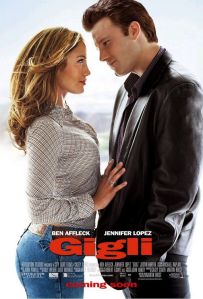 Originally released August 1, 2003:
It’s the feel-good movie of the year revolving around a lunkhead mobster (Ben Affleck) and his mentally challenged kipnapee and their attempts to covert a lesbian hitman (Jennifer Lopez) in between her yoga/horrific monologues concerning the superiority of female genitalia. Believe the hype people; Gigli is indeed as bad as they have told you. It’s not even entertainingly bad, like Bulletproof Monk, no folks; Gigli is just mundane and awful. During the entire two-hour stretch, which feels much much longer, I kept saying one thing aloud: “How could anyone making this think they were making a good movie?” Did they think audiences would find it funny that Affleck’s mother (the mother from My Big Fat Greek Wedding) shows us her big fat Greek behind? Did they really think that a mentally challenged kid (who has an affinity for gangster rap and wishes to travel to the mythical “Baywatch”) would come off as endearing? Well instead it comes across as insulting. And what else is insulting is the laugh-out-loud dialogue Lopez is forced to spit out concerning her attraction for women. I can’t think of any actress that could say the line, “I love my pussy” convincingly. And I’m sure a lot of actresses out there have true affection for it. The writing is just atrocious. And so much else fails as well. The score is a perplexing mix of upbeat jazz and inappropriate string orchestra. I don’t understand what emotions they were going for during scenes in Gigli but a full string orchestra playing music better suited for a real drama does not fit. Maybe it was for a tragedy. In that case, then it’s right on the money. You won’t see a more sloppily executed, horribly acted, painfully written, lazily directed, inept film this year. And what the hell did Christopher Walken walking in have anything to do with anything?
Nate’s Grade: F
——————————————————
WRITER REFLECTIONS 20 YEARS LATER

Gigli. It’s a word that instantly trigger shudders and shivers, a code name for fiasco, for career-destroying miscalculations. Writer/director Martin Brest was a Hollywood heavyweight with hit adult comedies like Going in Style, Beverly Hills Cop, Midnight Run, and Scent of a Woman, and since the cataclysmic disaster that was Gigli in 2003, this man hasn’t directed a single thing in these twenty years. The man is still reeling from the wafting stink from this very bad movie. I thought it might be worthwhile to revisit what I dubbed the worst film of 2003, though I was not the only critic to make this distinction, but now I’m questioning why I even bothered. It’s not like this movie was somehow going to get that much better with two decades of safe distance. The amazingly miscalculated artistic decisions will still be the same, still bad. I guess it must have been primarily my own morbid curiosity, much like revisiting 2001’s Freddy Got Figured, about whether this famous flop could still live up to its reputation. Well, dear reader, allow me to put any lingering doubts to rest you may have had about Gigli. It’s still very very very bad.
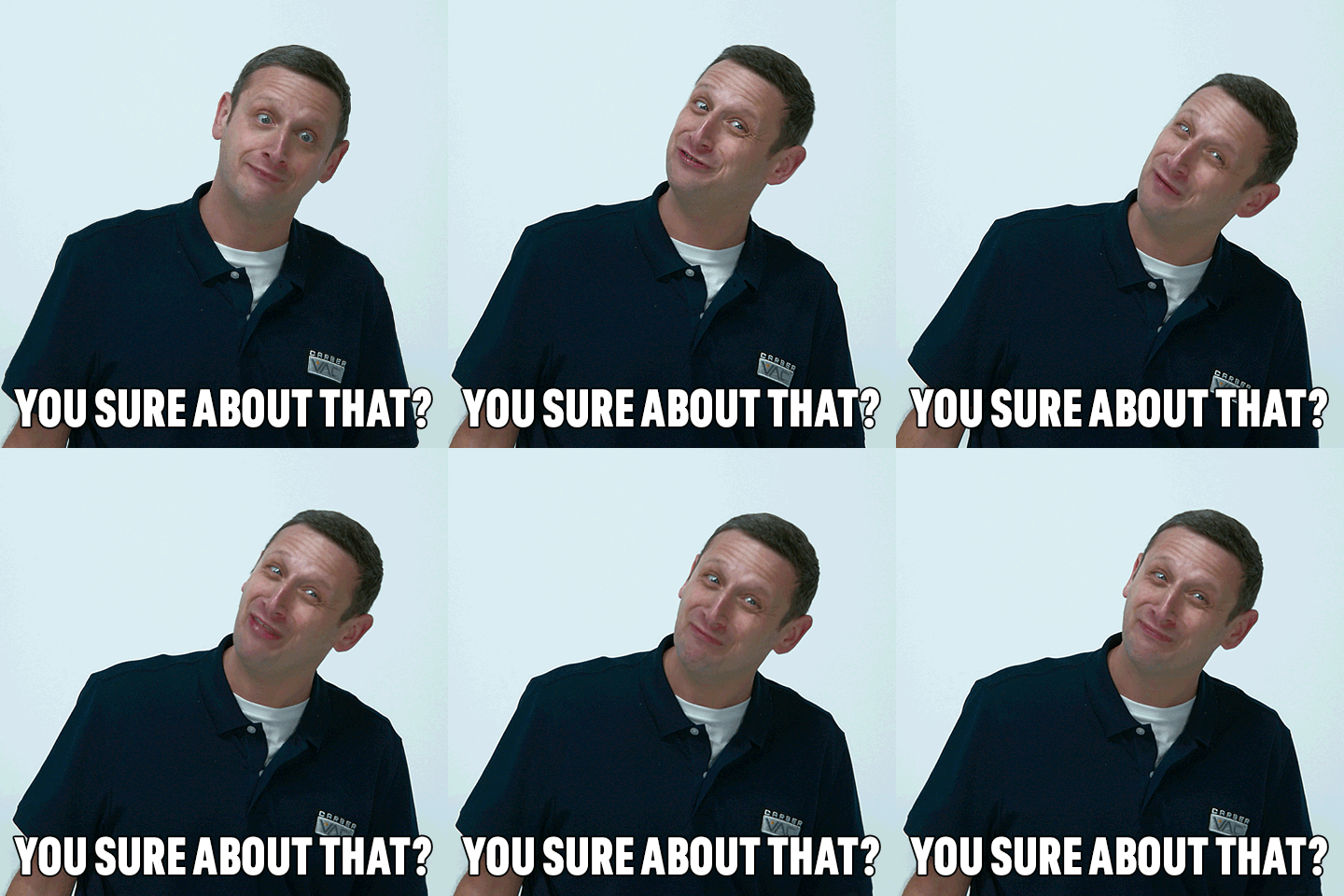
I might possibly recommend watching this once in your life (depending upon how many years you are lucky to earn) for the sheer fascination; Hollywood so easily makes mediocre and boring and familiar movies that feel like pale imitators of some prior hit, but Gigli is something different in the realm of studio stinkers, a project where just about every single creative decision warranted the incredulous Tim Robinson gif response: “You sure about that? You sure about that?” Gigli feels like two tonally dissonant movies in conflict at every moment. The plot elements feel lifted from some mid-to-late 90s indie crime comedy, the likes where they would just throw together a grab-bag of ironic provocative plot elements you wouldn’t expect together. “Mobster doofus kidnaps mentally challenged kid who is obsessed with gangster rap and wants to visit the ‘Baywatch’ which he thinks is real! Romance with a lesbian! Severed thumb ruses!” The collection of strange parts feels like it’s supposed to be a madcap, wacky comedy, and yet the tonal approach is complete treacle, with a shockingly syrupy score that rises and falls throughout, trying to convince you that what you’re watching is quixotically aiming for Oscars. It is astounding if you stop and pay attention to the film score at any moment, no matter how strange, as it attempts to provide jazzy saunter to “comedy” scenes, like an ex-girlfriend showing up into an unstable situation, and then it segues to Spielbergian emotional heft, like when that same ex-girlfriend attempts to take her own life to convince Jennifer Lopez to come back. There were so many moments where my only response possible was to avert my eyes, shake my head, and wonder whether anyone at any stage had any misgivings, tried to reach out to Brest, but then shrugged and dismissed their very legitimate worries as, “Well, he made Midnight Run after all. What do I know?” You know enough that these different tonal approaches will not work.
 Apparently, the movie was intended to be a straightforward mob comedy but the studio wanted the focus to shift toward a romance because of the actual romance between its stars, Lopez and Ben Affleck. Whenever actors begin a relationship after a movie or over the course of making one together, it provides another lens to review the movie, to gauge their chemistry and, if you’re so lucky and observant, able to “see” them falling in love with one another. That is nowhere to be found with Gigli. Maybe it was the shared experience of finding what they could to cling to while making this movie that nobody fully understood but committed to anyway (I guess love can be described the same way under some circumstances). Regardless, the romance between the two characters is, like all other plot elements, haphazard and spontaneous and foolhardy.
The characters are all awful and they never remotely come across like relatable or even remotely interesting people. Affleck’s Italian lunkhead Larry Gigli is just awash in early 2000s misogyny and bravado, dubbing himself the “sultan of slick, the rule of cool, the straight-first-foremost, pimp-mack, hustler, original gangster’s gangster.” Allow that macho boast to also exemplify another critical problem with the movie in that almost all the dialogue will make you cringe. There’s an entire monologue by Lopez, while she’s contorting her body in a plethora of lithe yoga positions, all about how superior the vagina is in appearance and function. What about when Lopez, as an indication that she wants to engage in heterosexual congress, utters the immortal phrase: “It’s turkey time. Gobble gobble.” Larry slams a kid’s computer on the ground and triumphantly says to suck an appendage of his, but then adds, “dot com” because the kid’s a nerd or something because he likes computers. Ho ho, the kidnapped young man insists that he be read to before going to bed, and what does Larry have at his disposal? Not books, oh no, so he’s forced to read him instructions on shampoo and toilet paper. Hilarious, right? What about when this same mentally challenged kid says, “When my penis sneezes, I say, ‘God bless you.’” The early 2000s weren’t an enlightened time with depiction of mental handicaps, and poor Justin Bartha (National Treasure, The Hangover) goes fully into the worst of these impulses, making the performance feel like a minstrel show for those with mental challenges. At least this aspect is not alone. Nothing ages well in this movie and its comedy only falls flatter and the drama is only more inexplicable twenty years later. It’s a special kind of bad so rarely achieved at this level of Hollywood.
Given that the majority of the movie consists of kidnapping a naïf, most of the movie is set in Gigli’s apartment keeping the man unseen and unheard from. This makes the movie feel for a long stretch like a glorified one-set play, with special appearances from traveling guest actors popping through for a brief moment in the spotlight. Here’s Christopher Walken dispensing with a monologue and then never being seen again. thanks for coming. Here’s Al Pacino, yelling so hard I’m surprised Lopez and Affleck didn’t need to wash the layers of spittle off. Here’s Lanie Kazan (My Big Fat Greek Wedding) who needs an insulin shot in her butt and let’s make sure we see her thong while we’re at it. These incursions of well-known actors re-explain the plot, not that it was hard to keep up with, and it all feels like stretching for time when the movie is already two hours long. The resolution, where our characters drive off into their sunny endings, lasts twenty minutes itself, which feels as long as the endings of 2003’s Return of the King. It’s a screenplay that feels like it’s holding itself on ice, content that the kooky characters butting heads and trading quips and monologues would be enough, and one that feels unsure of those same impulses, relying upon a revolving door of one-scene guests to remind us what we already know. It makes you feel simultaneously trapped with awful characters yet also in the hands of someone who doesn’t quite think you’re understanding the nuance and hilarity of the strained effort.
 I’m not an automatic Affleck hater. I enjoyed his rise from the films of Kevin Smith to Hollywood leading man. I can understand the draw of working with a filmmaker like Brest, and it’s probably that same appeal that lead him to also star in 2003’s Paycheck, directed by John Woo, who like Brest never worked in Hollywood again. This was the period where Affleck’s star was on the decline, and Bennifer was dominating tabloid space, and if it weren’t for the failures we might not have ever gotten Affleck as film director, so maybe we never would have gotten The Town or Argo or Gone Baby Gone had it not been for Gigli, so there’s a silver lining for you.
Look, you already know you shouldn’t even get near Gigli and with good cause. It’s a rarity to see something this colossally bad with this level of artistic freedom to be bad, not simply having too many cooks in the kitchen but having one very wayward chef nobody felt they could interfere with. This was a runaway chef, the kind of fiasco that only comes from unchecked artistic hubris. In that regard, there may be some rubbernecking appeal here for those who can endure bad characters, bad drama, bad comedy, bad acting, and horrible depictions of human beings who never at any point sound like human beings. It’s hard to watch and two hours of your precious time. 2003 began as a rough year for movies, sporting fascinating disasters like Bulletproof Monk and The League of Extraordinary Gentlemen. Watch those movies if you’re looking for a good-bad time. With Gigli, it’s only going to be a bad-bad time, whether it’s 2003, 2023, or any year until the sun explodes. Hey, if Ben Affleck and Jennifer Lopez could put this movie behind them and reunite, and even get officially married in 2022, then we can put it behind us as well.
Re-View Grade: F
Share this:

Still: A Michael J. Fox Movie (2023)
 Reminiscent of the Val Kilmer documentary from 2021, with archival footage taken from the star himself, Still is a documentary that opens up an actor’s biography but also makes you reconsider your own feelings as you process them in a diminished state. Fox was a natural actor, and his trajectory from Canadian student to international stardom was fast, but things took a dramatic turn when Fox first exhibited symptoms of Parkinson’s, a neurological disorder that causes involuntary movements. The present-day interviews with Fox are startlingly candid, showing the effect the disease has had on his body as well as his spirit, as he fights to get his quick wit out from a body that is betraying him. Fox himself doubts he’ll even make it to 80 under his current condition, which we see the rigors of his physical therapy as well as the challenges of everyday life. The Hollywood stardom tale is familiar but still intriguing with Fox’s insights and recollections, and director Davis Guggenheim (An Inconvenient Truth) makes clever use of the many clips from movies and TV to reflect the emotional state of Fox’s story as needed. It’s also interesting to learn about the tricks he would use to better hide his Parkinson’s symptoms in TV and film, as now we have a better understanding and can see the moments in a new light. You will likely feel different levels of sympathy as you reflect on what effect the disease has had on this spry, commanding performer, but Fox wouldn’t want your pity. Fox is irascible and self-deprecating but still so easily charming, and spending 90 minutes with him as he opens up his life, his family, and his physical and mental struggles feels like a rare and privileged peak into this man’s rich life before it’s gone.
Nate’s Grade: B
Share this:

The Whale (2022)
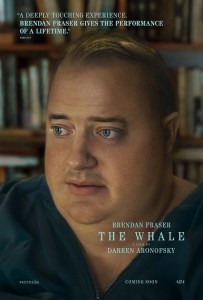 Much has been written about Brendan Fraser’s comeback role and the mountain of prosthetics he was buried under to portray a self-loathing 600-pound man in director Darren Aronofsky’s The Whale. The concern was that the movie would stigmatize overweight people as disgusting and treat fatness like a moral indictment, condemning their lifestyles as slovenly and doomed to misery. I watched the film ready to cringe at a moment’s notice with the hyped portrayal that earned such livid and divisive reactions. I found The Whale to be deeply empathetic but I’m uncertain about whether or not it was fully compassionate, and it’s that artistic distinction that I’m trying to square as I analyze Aronofsky’s melodramatic yet flawed character study.
Charlie (Fraser) is a morbidly obese English teacher who keeps his camera off during his online classes. The closest relationships he has is with his nurse, Liz (Hong Chau), who checks on him regularly with alarm and concern, as she’s also the sister of Charlie’s deceased partner. The movie chronicles one eventful week in Charlie’s life as he tries to make the most of his dwindling time and reconnect with his estranged teenage daughter, Ellie (Sadie Sink).
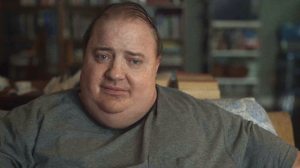 For me, Charlie is less a clinical case of what being morbidly obese can do to a person and he’s more a case study of self-destruction. In 1995’s Leaving Las Vegas, Nicholas Cage won an Oscar playing a man determined to drink himself to death over the course of one eventful weekend in Vegas, and I saw more parallels with his character and Charlie, a man who turned to eating as his source of grief that then became his vehicle for self-destruction. The movie is not casting judgment that all fat people, even those approaching the size of Charlie, are destined for eternal loneliness or crying out for help. However, this specific man is using his increasing weight as a form of suicide. This facet makes Charlie interesting but also increasingly confounding as well. He seems genuinely remorseful about the time he’s missed from his now-teen daughter’s life. He’s saved up his life’s money and plans to give it to her, but I kept wondering why, exactly, he had to die for this? He won’t take care of himself because any medical cost could take away from the handsome sum he plans to leave, in full, to Ellie. He apologizes for being absent but seems unable to see an alternative where he can be present. After so many years apart, maybe she would actually prefer having her dad back in her life? Charlie stubbornly holds to an all-or-nothing ideal, like some kind of fumbling romantic gesture, but he doesn’t have to die for his daughter to live her best life. She doesn’t even get a say. It’s his inability to see through this false choice he’s determined is the best outcome that makes the character frustrating. He only views his death, and I’m sure the insurance to go with it, as his biggest reward that he can offer his estranged daughter, and that makes it even more frustrating at the very end, where he’s trying to prove something to her but is also likely traumatizing her for life. That love he proclaims so readily for his daughter seems questionable when he prefers a misguidedly noble demise to getting to know her and allowing her to choose for herself. The character seems so frustratingly myopic about his own life and its value only being its end.
Complicating this matter is the reality that Ellie is, quite clearly, a horrible person. She’s angry at the world and trained her ire on her absentee father, who she believes left her and her mom to pursue an illicit affair with one of his male students (the reality is a bit more complicated). She is well and truly awful. Ellie insults her father repeatedly. She yells that she wants him to die and that she would be better off. She agrees to spend time with him for a hefty price. She even takes pictures of him and posts them online for social media derision. She’s detestable, and yet the screenplay by Samuel D. Hunter (Baskets), adapted from his play, wants me to yearn for a hopeful father/daughter reconciliation. There isn’t a hidden pool of depth with this character, a brilliance that we know just needs to be nurtured and that Ellie can tap back into. She’s just the unrepentant worst. I think The Whale errs by placing so much of its dramatic foundation on this pairing. It made me question why this man is literally killing himself for this bratty teen. The late reveal for Charlie’s essay that he often quotes like a religious mantra is obvious and still doesn’t open up Ellie as a character. There’s a brief tear-stricken moment at the end that I guess is meant to represent Ellie with her guard down, but I didn’t buy it, and I found her to be a thinly written archetype that is unwinnable. She’s more of a plot device to motivate a redemption arc. Maybe the point is she’s undeserving of her father’s graceful overtures but I guess that’s parenting, folks.
 Charlie says he’s always been a bigger guy but his weight got away from him after the loss of his partner, and it’s this unfathomable grief that caused Charlie to go on feeding binges. He sought comfort in the immediate appeal of food, and plenty of people can relate to stress eating or eating their feelings when times are turbulent. I don’t think the movie is setting Charlie up as a cautionary tale to avoid. Charlie’s grief is tied to religious intolerance and its own trauma. He opened himself to another person and then had his new sliver of happiness dashed away directly related to a religious intolerant mindset that his partner was unable to break free from. He’s a victim who saw no way out including a heavenly reward supposedly denied to him. It’s not this dead man’s fault that he was raised in a diseased environment that viewed his own identity as an illness, and it’s not worth blaming this man for being unable to break free from this mentality. It’s the intolerance that has contributed to Charlie’s weight gain and his fatalistic sense of self. Heartbroken, Charlie has retreated from the world, and it’s the guise of spiritual salvation that proves alluring to the determined young missionary, Thomas (Ty Simpkins, Jurassic World). He sees the flesh as the prison for the soul, and he tries to sell Charlie on a salvation that asserts itself as liberation from his body, which the young man views with horror. Charlie doesn’t want the spiritual guidance, especially from the same community that poisoned the mind of his late partner. Like the Ellie character, I don’t think we gain much with this storyline and the amount of time that the screenplay gives Thomas. I guess we’re meant to see him as another wayward soul trying to live authentically, but he’s another underwritten archetype given misplaced emphasis.
The best reason to sit through The Whale are the performances from Fraser and Chau. We’ve never seen Fraser in a movie quite like this, a man best known for broad slapstick comedies (George of the Jungle, Furry Vengeance) or dashing action-adventure movies (The Mummy films), and he’s great. His performance is less mannered than you would assume for an actor undergoing such a physical transformation. In fact, his vocal range makes Charlie often sound anesthetized, like he’s already given up moving out of a comfortable yet limited range of emotional output. It’s kind of heartbreaking but he’s also got a gentle heart that chooses to see the best in people, even when they might not be there. Fraser is compelling in every moment and disappears into the role of Charlie. His best scene partner is Chau (The Menu), and the movie is at its best when they’re sharing the screen. Liz is the closest friend Charlie has, and they have a shared special kind of pain relating to the loss of Liz’s brother. She’s also enabling his self-destructive impulses and is devastated that Charlie is accepting a doomed fate rather than letting her take him to a costly hospital. Chau is heartbreaking as you feel her fear and guilt, afraid of losing another person so dear to her but also severing another connection to her brother.
 The Whale is an experience that makes me wonder about its best artistic intentions. Even the title of the movie feels like a glancing blow; what other analogy are you supposed to make other than Charlie as our very own Moby Dick? The critical essay he keeps reciting takes a sympathetic view of the marine animal and posits the fruitless efforts of those who wish to cruelly hunt it down and how this will not provide personal fulfillment (it shouldn’t be too hard to figure out who represents who in this dramatic dynamic). It’s also the least distinguishable Aronofsky film of his provocative career, confined to a single location and devoid of the director’s usual vision and verve. It feels like a challenge in restraint for Aronofsky, almost like he’s approaching theater and just wanting to get transfixed by the dramatic surges of the actor’s interactions. I found the central character to be interesting but confounding, not that human beings are ever so clearly understandable in every facet of their being. I don’t think the supporting characters really added much, with the exception of Hong Chau, and I wish the daughter plot had been scrapped. But if you’re sitting down to watch The Whale, you’re doing so to experience Fraser’s career-best performance where he reveals layers to his acting that you never knew were possible. He can still lean into his innate generous spirit and charm to get you to root for Charlie to find some peace. For Fraser alone, The Whale is worth watching and might open some hearts.
Nate’s Grade: B-
Share this:

Causeway (2022)
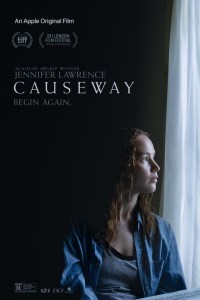 Jennifer Lawrence has been in four movies since 2017, so the once ubiquitous Oscar-nominated actress is getting more selective with her film roles, so now with each role the question becomes what made this project the one. Causeway is a fairly straightforward drama following Lynsey (Lawrence), a soldier who is recovering from her traumatic brain injury and ensuing memory loss. She’s stateside and living back in her hometown and trying to speed through physical therapy to re-enlist back to the life she knows but may not be equipped to handle. This is definitely a character piece but I don’t know if there’s enough interesting material here with these characters. Causeway is one of those indie dramas that lean into a lot of contemplative staring, which could be very meaningful if I felt like I had been given access to the characters internal dilemmas beyond a general assessment. Much of the movie follows Lynsey’s friendship with a local mechanic, James (Brian Tyree Henry), who has his own tragic past that he’s trying to come to terms with. The movie is at its best when they’re sharing time together and it begins to feel like an introspective hangout movie that will allow both of these people to let down their guards and develop. It moves in starts and stops but Causeway never feels like it gets anywhere fast or that transcendent. By the end, the journey doesn’t feel earned. Lawrence is good, though rather restrained, as the movie fills much of its time with her long pensive stares. There’s a movie here, for sure, but nobody feels in a hurry to uncover it. It’s a perfectly “nice movie” but one that underwhelms because it feels too afraid of pushing too hard or delving too far, for that would betray some artistic ode of “realism.” Causeway is a minimal, plaintive drama with much left unsaid, but what is said and honestly dealt with is compelling enough to make me wish I could trade in the many stares for more words spoken by these talented thespians.
Nate’s Grade: B-
Share this:

CODA (2021)
 Ruby Rossi (Emilia Jones) falls under the category of CODA, a Child Of a Deaf Adult. Her mother (Marlee Matlin) and father (Tony Kotsur) and her older brother (Daniel Durant) are all deaf, and she is the only member of her household with the ability to hear. She’s balancing working for her family on their fishing trawler, maintaining good grades in school, and possibly pursuing scholarships to enroll at a music and fine arts college for singing. Ruby’s music teacher agrees to train her because he believes in her potential, but Ruby has to worry that her dream is something that cannot be shared with the people she loves most, and how would they all get on without her?
The framework of CODA is familiar to anyone who has watched a coming-of-age story or family drama, but it’s the conviction and strength of character and sheer force of empathy that makes this movie a standout film for 2021. It’s based upon a 2014 French film, The Family Beller, and follows many of the same beats from other sentimental family dramas about sticking out in your family and society, chasing your dream, often in conflict with your family’s expectations, gaining that sense of inner strength and resolve, and mending differences in perspective with hard-fought and well-earned wisdom. It’s familiar, but that doesn’t mean under the right set of hands that it cannot still be resonant and emotionally gratifying. I do not hold the familiar formula against CODA, even as the family’s goal and her personal goal come into direct conflict in sometimes forced manners. That’s because the movie does an excellent job of establishing these people as characters, establishing the family dynamic as fraught but loving, and establishing a conflict that is direct and clear as far a major point of separation.
 Ruby isn’t just the only member of her family who can hear, she’s also their vital lifeline to the outside world. She’s looked upon as the family interpreter, a position they cannot afford to pay for someone else’s services so the duties and responsibilities fall upon her. That’s so much pressure to bear for one teenage girl, knowing that she’s the link between her family’s poverty-treading existence and possibly breaking free into a larger hearing community. She feels ostracized and awkward within her own family and outside of her own family. To the rest of the school, she’s that “deaf family girl,” and it’s remarked that when she began high school she had an accent reminiscent of what deaf people can sound like, a point that her peers cruelly imitate. She worries she will forever be defined by her family’s disability even if she doesn’t share it. However, within her family, she feels ostracized because she’s different. She wonders if her mother wishes that she too were deaf, and during a heartfelt late-night talk, mom actually admits that upon her daughter’s birth she did feel disappointment when Ruby had hearing. While she knows sign language and has grown up with these loving figures, she’ll still always be the one who’s different, the one who hears the insults her family cannot.
The film does a remarkable effort about contextualizing Ruby’s fears and frustrations of being held captive in two different worlds, neither feeling fully accepted or whole, and that’s why her embarking on a personal dream that her family can never fully appreciate feels so significant. Part of Ruby might feel that singing is selfish, especially if it means limiting her family’s upward mobility by eliminating their unpaid interpreter, but it’s the thing that makes her most happy, a special gift that her family will be excluded from. There’s a wonderful moment toward the end of the movie where Ruby’s father asks her to sing to him, and he puts his hands along her shoulders and neck to feel the vibrations, and his awed and tear-stricken face is so moving, as he so desperately wants to indulge too in the beauty of his daughter’s voice. While occasionally the film goes overboard pounding these two conflicting paths into forced collision (family vs. self), the movie is personal with its big problems and personal with its big triumphs, making it transcend the trappings of formula.
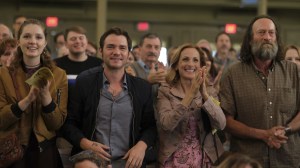 Writer/director Sian Heder got her start on Orange is the New Black, and that TV series’ hallmark has been its enormous sense of empathy for its diverse characters. This is evident in Heder’s screenplay and her observational, detail-rich simple storytelling that immerses you in this world, so even while you recognize more familiar made-for-TV plot turns, the genuine authenticity makes the movie feel like its own unique story. Heder’s direction is delicate and places the attention squarely on her performers. There is one stylistic move late in the film when Ruby’s family comes to her choir recital in support. They look around for cues when to applaud, and their minds wander as they sign about other menial topics like grocery lists, and you understand why once Heder drops you into their perspective. For a minute, the sound disappears, and you’re left studying facial expressions for cues like them. While we can imagine being deaf, it’s another matter to experience it and try and understand.
The acting is another laudable merit for CODA. I personally want three Oscar nominations for this clan, Jones (Locke & Key) for Best Actress, Matlin (Children of a Lesser God) for Best Supporting Actress, and Kotsur (Wild Prairie Rose) for Best Supporting Actor. Over the course of nine months, Jones learned American Sign Language and how to sing, which is surprising because I would have said she has a natural talent with singing. Her performance, as well as Matlin and Kotsur, feel so real, so nuanced, and so natural, like we’ve plucked these people from real life and given them this platform. It’s the best credit you can give an actor, when they seemingly disappear into the character, and the character feels like a fully breathing, flesh-and-blood person. Even the small supporting roles are well cast, well acted, and contribute to the overall authenticity of the movie. Unlike the 2014 French original movie, all of the deaf members of the family are portrayed by actual deaf actors as well.
CODA was a sensation at the 2021 Sundance Film Festival, with Apple Films buying the rights for $25 million dollars, and it’s easy to see why because it’s such a satisfying, enriching crowd-pleaser and legit tear-jerker. There were several points that had me tearing up, and then fully crying, because I was so emotionally engaged with the family, their struggles, and their triumphs and outpouring of love. You might be able to see where the movie is headed because its template is familiar and formulaic, but it’s the execution, the attention to detail, and the level of observational attention that elevates CODA and makes it so winning and so heartwarming.
Nate’s Grade: A
Share this:

Spiral (2021) / A Quiet Place Part II (2021)
 Chris Rock seems like an odd choice to spearhead a revival of the dormant Saw franchise, but the actor was a rabid fan of the grisly horror series and came to producers with an idea for a new Saw movie, and the results are Spiral: From the Book of Saw, like it’s a Biblical chapter. A Jigsaw copycat killer is targeting corrupt police officers and those who protected them, and Rock plays a detective who dared to turn in his partner after he murdered a crime scene witness. Rock’s character is seen as a traitor by his fellow brethren in blue, and as the Jigsaw copycat continues his or her bloody rampage, the history of police abuse and cover-ups comes to light. The problem with Spiral is that it feels like an entirely different independent script that somebody attached gory Saw set pieces and said, “Reboot.” The Saw set pieces get increasingly ludicrous and gross and the drama in between, where Rock tracks clues and barks at his peers, feels like boring connective tissue the movie can’t even bother to pretend is worth the effort. Both parts feel rote, the police conspiracy thriller and the gory death traps. The movie is also entirely predictable by the nature of the economy of characters. Within 15 minutes, I was able to predict the identity of the copycat killer as well as their connection and motive. This movie desperately needed more time with Rock and Samuel L. Jackson together. Another issue is that the movie ends abruptly and with a needed extra turn missing, perhaps where Rock agrees to work with the killer and justifies the executions as righteous reform. I wanted this new Saw to be more in keeping with Saw 6, the best sequel and most topical of the franchise where health care employees were put to fiendish ironic tests to punish them for denying medical coverage. It feels like targeting bad cops would produce more social commentary, but I guess that would get in the way of watching people try and sever their own spine on a single nail. Spiral doesn’t feel any more promising than the other attempted Jigsaw reboot in 2017 even with its topical elements. It might be cheap enough to earn a sequel, but it feels like a franchise eternally going in circles.
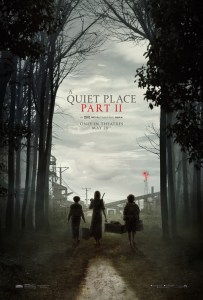 A Quiet Place Part II is the first movie I’ve seen physically in theaters since the middle of March 2020, and I genuinely missed the experience. It’s been the longest I’ve ever gone in my adult life without seeing movies in the theater, and this was one that felt like the presentation would be elevated by the big screen and superior sound system. Taking place nearly minutes after the conclusion of the 2018 hit, the surviving Abbott family ventures off their farm to find refuge and potentially find a way to protect themselves and neighboring communities from the killer monsters attracted to noise. The opening is the only flashback we get; everything else is forward-looking. I would have enjoyed getting more Day One experiences where the monsters first attacked, especially as we become open to new characters and their own harrowing journeys. The movie, written and directed by John Krasinski, isn’t quite as novel and brilliantly executed as its predecessor, but it’s still a strong sequel that gives you more while leaving you wanting more by the end. The majority of this lean 97 minutes is split between the family, one half staying put in a warehouse basement, and the other traveling out into the open to find a radio tower. The set pieces are still taut though rely more on jump scares this go-round, granted well executed jump scares that still got me to jolt in my seat and squeeze my girlfriend’s hand a little tighter. Cillian Murphy (Batman Begins) is the most significant addition as an Abbott family friend who has lost his whole family since that opening flashback. He’s a broken-down man, a parallel for Krasinski’s father figure from the first film, and at points it feels like he’s being set up to appear sinister, or at least hiding some dark secret that never really comes to fruition. The world building is expanded and introduces a very Walking Dead-familiar trope of desperate people being just as dangerous as deadly monsters, though in a world of hearing-enhanced creatures, I would think there’s more danger in larger numbers than security. The movie earns its triumphant ending even if the staging, and cross-cutting, is a little heavy-handed. A Quiet Place Part II is a successful sequel that understands the unique appeal of its franchise and how to keep an audience squirming while also remain emotionally involved and curious for more.
Nate’s Grades:
Spiral: C
A Quiet Place Part II: B+
Share this:

Sound of Metal (2020)
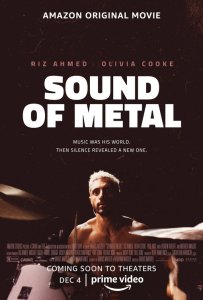
I don’t think I’ve better empathized with hearing loss and deafness than with Sound of Metal, a moving and observant drama about a heavy metal drummer quickly losing his sense of hearing. Riz Ahmed (Nightcrawler) plays Ruben, a former junkie who is four years sober and worried about losing his girlfriend/band mate (Olivia Cooke) with his recent diagnosis. He’s attending a treatment center meant to cater to a deaf community and transition others into this community. Ruben is defiant, depressed, angry, all the stages you can imagine with grief. The movie is at its best during its quiet and contemplative moments where we empathize with the terror and alienation of Ruben. When he first joins the center, we don’t get subtitles for the many signed conversations between members. It’s only after Ruben learns ASL, integrates into the community, and opens himself up to the program that we too get to be knowledgeable. The sound design is exceptionally utilized to illustrate Ruben’s changing perspective, and some later choices with it might make you long for the peacefulness of silence. The movie is exquisitely thoughtful and considerate while maintaining a subtle, character-driven approach that keeps things from wallowing in self-pity. For many of the deaf, hearing loss isn’t seen as a disability but a community with its own culture and quality of life. It’s understandable that Ruben is focused on loss but the movie doesn’t dwell in loss, more so transformation and acceptance. Ahmed is fabulous in the lead role which requires him to rely primarily upon non-verbal expression for extended periods. His eyes are his best vessel for communicating Ruben’s emotional state, and Ahmed is sensational. Paul Raci is also great as the leader of the treatment center and the responsibility and generosity he feels to those in his care. Sound of Metal is an immersive, sensitive, authentic and poignant drama with an Oscar-caliber lead performance and a depth of compassion for the many people of the deaf community.
Nate’s Grade: B+
Share this:

Run (2020)
 With Run, now available through Hulu thanks to COVID, we follow Chloe (newcomer Kiera Allen) as she yearns to leave home for college. She was born with multiple physical maladies and has been living at home in her wheelchair. Her mother, Diane (Sarah Paulson), tends to her needs but runs a tight ship, holding Chloe to a high academic standard. One day, while looking for college returns, Chloe finds a prescription for her mother that she denies is hers. This causes Chloe to investigate the myriad of medications she’s on and her mother’s cagey behavior. She comes to one conclusion: she is being held prisoner by her own mother.
I don’t consider it a spoiler to confirm that Run is exactly the movie it assures you from its start. Because the movie was so early and upfront about its distrust with the mother, part of me began to wonder, after watching so many Hollywood thrillers over the years, if I was being set up into false complacency. I began theorizing what a late twist could be, how we’re being lulled into one perspective so maybe the final twist would be that the big bad mom is actually the hero. This is not the case at all. There are later revelations that clarify just how disturbed and committed Diane is as a doting mother, but the core relationship dynamic is the same from the get-go. That means that Run might not have much going for it other than as an escape thriller. It’s not going to give you deeper insights into life with mental illness or physical disabilities, nor is it going to channel some relatable struggles with motherhood. It’s about a crazy woman holding a teenager captive and the great obstacles that teenager must overcome to reach freedom and safety. That’s all the movie has to offer but under the guidance of its filmmakers it does so with finesse.
 Let Run serve as a prime example of how you can take a simple story and create a lean, mean thriller that provides doses of satisfaction and triumph. The focus is so condensed that writer/director Aneesh Chaganty (Searching) can provide set piece after set piece to demonstrate his skills in suspense. The first act involves Chloe learning of her alarming state and getting confirmation that her medicine and ailments might not be true. From there, the next two acts are a series of planning escapes and escalating attempts at escape. There is a lovely sense of fulfillment in watching smart characters intelligently think their way through challenges. I recently re-watched 2015’s The Martian and was reminded how enjoyable it can be to just watch smart people smartly confront problems. Chloe is a formidable young woman with obvious vulnerabilities to overcome, but she has a sharp mind for science and can act like a plucky Zoomer MacGyver. It’s resolutely fun to watch her overcome her challenges. Each new set piece and setback presents a challenge and her thinking is logical and capable throughout. Even when the plot isn’t much more than a series of escape attempts, every time I wondered to myself how exactly Chloe was going to get through the next dilemma and admiring her as she persevered.
The photography, editing, and score work nicely in tandem to raise the level of suspense. The command that Chaganty has over all facets of filmmaking to serve a common purpose is impressive. It’s the same kind of assured vision he displayed with 2018’s Searching where the film screen was confined to the parameters of a computer monitor. As with that earlier inventive thriller, Chaganty has an innate understanding of how to make his moments matter, where every twist and turn has a connection to what came before it so it all feels of a whole. That is essential especially for a filmmaker working within a thriller genre. If you can tell even the simple stories well, where the pieces connect with perfect precision, and ratchet up tension efficiently no matter the scenario, then you’re already operating at an extremely high level. Given his first two entries, I would watch any movie, especially a thriller, that has Chaganty’s name attached.
 This is primarily a mother-daughter two-hander in terms of acting, though Paulson is off-screen for long portions. After several Ryan Murphy TV series, including Netflix’s Ratched, I’ve come to automatically assume I should be wary of whatever character Paulson is playing. This role is well within her unstable wheelhouse and she gets to better shine in her increased desperation in the second half when Diane no longer has to pretend to be sane. Her doting manipulation and intense mood changes can be quite creepy. The real star is Allen in a very physical performance. There is much the young actress has to communicate non-verbally, from her distress and paranoia to her doubts and fears and righteous anger. Plus all the crawling. She’s great, and I fully imagine this will be the start of Allen’s promising career as she finds even more high-profile roles to demonstrate her talent.
If you’re a fan of slick, intelligent, and sneaky fun thrillers, and why wouldn’t you, then seek out Run (not to be confused with the TV series of the same name on HBO in 2020). It’s well honed, well developed, and smartly constructed to deliver enjoyable thrills and payoffs for viewers. It might not have more on its mind than entertainment but that’s fine when the movie is this well done.
Nate’s Grade: B+
Share this:

Motherless Brooklyn (2019)
 I remember reading this novel back in college, so it’s been a long road for Jonathan Lethem’s crime story to find its way to the big screen. Motherless Brooklyn is a decade-plus passion project for star/adapter/director Edward Norton, and it’s easy to see why an actor would want to latch onto the lead role. Lionel Essrog (Norton) suffers from Tourette’s syndrome and is given to verbal and physical tics he needs to indulge or else his brain feels like it will explode. He’s our eyes and ears into a criminal world that views him as a freak. It’s an intriguing vulnerability given sympathy, forethought, and it’s an intriguing way to make something old new again through a disadvantaged lens. Norton is great in the lead and Lionel feels like a companion portrait to Joaquin Phoenix’s Joker, another struggling man given to unconformable physical outbursts that make him feel isolated from society. The book was fascinating from being inside this unique headspace and understanding how Lionel’s brain operated with obsessions and various pressure valves. The movie, which Norton rewrote completely and set in the 1950s, is an acceptable film noir, but without that specific perspective it would get lost. It’s handsomely made and has plenty of enjoyable actors in supporting roles. There’s an intelligence to the storytelling and power dynamics, but the movie is also a bit too smart for its own good, losing its way in a convoluted mystery where the pieces don’t so much add up as they’re just given to you after a long enough wait. And the wait is long. This is 144 minutes and takes its sweet time, applying more and more layers of intrigue and period settings like Norton is checking a list of Noir Elements to include in his first directing work in 19 years (Keeping the Faith, anyone?). The world itself is surface-level interesting but the main character is the real hook, so getting more of the world without going deeper on the character, or expressly placing him in different predicaments where he can utilize his unheralded abilities, feels like wheel spinning. Motherless Brooklyn is strictly for genre fans or those who don’t need much more from their movies than a high-concept quirk.
Nate’s Grade: B
Share this:

The Fanatic (2019)
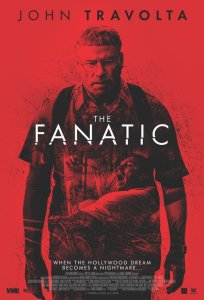 As a connoisseur of crappy cinema, I often seek out movies that I feel might hit that so-bad-it’s-good sweet spot. There are scads and scads of bad movies but few manage to land in the realm where their utter inanity and ineptitude provide genuine, baffled entertainment. The Internet would have you believe that the new movie The Fanatic fits that bill. On its face it seems like it might. It’s directed and co-written by Limp Bizkit front man Fred Durst, stars John Travolta, and is about a mentally challenged fan stalking and holding his idol hostage. That sounds like it has plenty of potential. The Fanatic is not a fun watch, especially by the last act, and I was mostly left scratching my head and wondering who in the world this movie was crafted for and why.
Moose (Travolta) is an obsessive fan. He also has a mental disability, which makes it hard for him to connect with other people. He’s obsessed with the actor Hunter Dunbar (Devon Sawa, fairly good here) and getting an autograph. After a misunderstanding, Moose is determined to track down his favorite actor and let him know why fans are important.
I have no idea who this movie was made for. I wasn’t so much laughing at it, though it did happen occasionally, as I was just staring slack-jawed and completely mystified. I didn’t really have fun watching something like this and I doubt most people would. It’s a bad movie but really it’s a gigantically miscalculated movie because what is the point and perspective presented? Are we meant to be weirded out by our mentally challenged protagonist, because that seems in bad taste? Are we meant to endorse his actions, because that seems in bad taste too considering how many transgressions he makes? Are we meant to feel that he is justified in his alienation or in how he responds to Hunter Dunbar, because that seems like enabling criminal behavior? Are we meant to feel for Hunter Dunbar when he gets the upper hand and tortures Moose in vengeance, because I can tell you listening to Travolta wail on the floor in pained cries is not exactly a hoot. Am I meant to have a squeamish sympathy for Moose that is then tested over time as he crosses more and more lines? That doesn’t really happen either. I don’t know what the movie wants me to think about Moose and Travolta’s committed yet stereotypical performance, which I think is why so many are holding this up as an example of something to ridicule because they don’t know what to make of it. It’s like the film just took a lot of bizarre and controversial plot elements, threw them together, and said, “You decide” when it comes to commentary.
 What is the message about fanaticism? It’s the title of the movie so I would assume it’s being presented at least as a subject worthy of discussion. Moose is a fanatic and his fandom drives his life. It’s all he can think about. It gives his life purpose. Yet the movie takes away any real negative interpretation by applying the mental disability to the character. He’s a fanatic but he can’t be all that bad because he’s mentally disabled and, maybe according to the movie, not fully in control or cognizant of his own actions. This is a cop-out on multiple fronts. The completely superfluous voice over narration from Leah (Ana Golja), a side character at best, is generally just describing what is literally happening as well as offering an occasional dismissive comment about the facile nature of reality in Hollywood. Hey, have you heard how the entertainment industry is shallow and surface-level and exploits dreams and dreamers for profit? This is new to me! The narration almost presents a weak justification for Moose, like he was entitled to strike back when he discovered that actors don’t like it when you track down their home addresses and harass them. “You’re nothing without your fans,” Moose screams at Hunter in anger, and in an ordinary movie I would consider this a sign that the movie is lambasting the self-aggrandized sense of entitlement from fans and how toxic this can be to the psyche. Except The Fanatic won’t do any of that. It won’t set up Moose as an example of toxic fandom, and his disability is proof enough why.
I did not enjoy this movie. For thirty minutes I’m watching Travolta go from scene to scene and try out every clichéd acting trope for playing somebody with mental retardation. I may have missed something, and I don’t have the interest to watch it again, but I was left wondering how in the world Moose even supports himself. He has friends across Hollywood plugged into different tourist ventures but we only ever see him dressing as a British policeman and running around the Boulevard trying to coax strangers into snapping pictures with him. He’s terrible and off-putting to the average person on the street, so he can’t be making money from this. It seems like the filmmakers are weeding out any and all things that could keep Moose away from this very select path of being an obsessive stalker. That’s all he does. He’s not focused on anything else other than finding this star and letting him know how much he loves his work. There’s so little to this character but because the film strips any other complications or attachments from his life, it feels downright manipulative to basically set him up for this collision course. I’m reminded of 2002’s One Hour Photo where Robin Williams played a disturbed man who formed an inappropriate attachment to a group of strangers and became more and more undone, finally stalking them, intervening with horrific results, and hinting at a deeper history of abuse. None of that is present with Moose and it makes the experience feel like it’s either pandering or dithering.
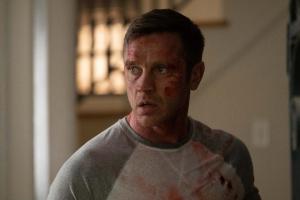 When Moose does kidnap Hunter in the last act it’s meant to evoke a Misery situation but it felt to me like a much sloppier version of 2006’s Hard Candy. In that film, it was a battle of wills between an angry young girl (Ellen Page) seeking righteous vengeance and a man swearing his innocence (Patrick Wilson), and your sympathies were meant to be tested and question who was correct and who was going too far. I think that’s what Durst and company were going for but oh do they miss the mark and then some. I didn’t feel like Hunter was getting comeuppance for his behavior because his responses to Moose seemed fairly reasonable. I didn’t feel like Moose had become the villain now because the movie was presenting him still as the same figure from the opening minutes; he hadn’t become more disturbed or aggressive even after doing some very bad, very criminal things. I didn’t feel like the film was setting up some form of tragedy where Moose and his ignorance of the severity of his actions would escalate beyond his control. Mostly I was just waiting for the movie to be over, again watching with the fascination of a rubbernecker. I didn’t feel tension during any moment of this movie and I didn’t really care what happened to anyone.
I don’t know what would exactly appeal to Travolta with this part, besides the actorly possibilities of playing someone with mental disabilities. God bless him, Travolta goes all-in on this part and is practically bouncing off the walls. He’s so unrestrained, so dug into the tics and mannerisms of his character, which feel more informed by the portrayals of other famous actors playing this kind of person than it does on anything else. It is a performance that makes you second guess many of the actor’s choices, including the … shaved mullet haircut, and there are certain line readings that are so awkward they will make you leave the room in embarrassment. Of note is one frantic threat about what Moose will do to a man in a way reminiscent of Freddy Kruger, and the level of detail said in such a serious, scream-heavy tone just adds more ammunition for its unintentional hilarity. The problem is that the movie certainly doesn’t see Moose as a tragic figure, until his brutal beating at the end, and it doesn’t see him as a comic figure, so he’s just kind of hanging around like an unwanted guest. Travolta’s wince-inducing go-for-broke, almost Nicolas Cage-ian performance (I’m making this a term) is the best reason to watch The Fanatic, and you should really not watch this movie at all.
Another reason the movie isn’t derisively enjoyable is because it’s fairly competent and actually a bit stylish in several areas. Durst will get a lot of mockery for his involvement but the man has always had an eye for visuals (he directed most of his band’s music videos). There are some pretty nicely composed shots with some moody lighting thanks to cinematographer Conrad W. Hall (Panic Room). The score is pretty good too, using a lot of Max Richter-esque strings for pointed punctuation of key moments of unease and dread. This isn’t a bad movie because of the technical merits or through Durst’s direction. Sure, you could argue he should have reined in Travolta’s eagerness, but when the movie seems made to indulge those impulses, I can’t fault him for basically just letting his lead actor throw subtlety out the window and dance on its grave and other mixed metaphors.
 It’s for these reasons that I found The Fanatic to just be a dispiriting movie, missing the electric charge of the truly and entertainingly bad movies like The Room or the oeuvre of Neil Breen. It’s just a bad movie by design, not on purpose. It’s hard to even find sincerity with it, an essential element of so-bad-it’s-good cinema, because I don’t really know what the movie finds sincere. It’s inconclusive what message I’m supposed to garner, what perspective is being delivered, and how I’m supposed to feel about any of this. It’s not executed in an intriguing ambiguity that pushes the audience to draw their own interpretations and conclusions. It feels more like the movie is simply incomplete, that it’s missing core elements to make it worth watching. Travolta unleashes a flurry of unrestrained acting tics and some may find it snicker-worthy, but Travolta hasn’t exactly been holding back as of late in his film choices. The Fanatic is really a dank genre thriller that doesn’t know what it wants to say and what it wants to do, and by slapping the mental disability factor into the mix, it definitely has no courage to pick a direction or statement. If you’re morbidly curious, you might find some degree of interest here but I wouldn’t advise it. The Fanatic is not the next best bad movie. It’s just a miscalculated effort and a sad one.
Nate’s Grade: C-


 nathanzoebl
You must be logged in to post a comment.