Blog Archives
Bernie (2012)
 The last person the residents of small town Carthage, Texas would expect to be tried with murder would be Bernie Tiede (Jack Black). He was an assistant funeral director, a “born natural” we’re told at comforting others, but he was really the everyman glue of the town. He lead the choir at church functions, loaned his time and money to those in need, directed the town’s fledgling drama productions, coached the Little League team, and went out of his way to spend time with the town’s lonely little old ladies. It was a shock then, in 1996, to find out that Bernie had shot one of those little old ladies, Marjorie (Shirley MacLaine), the meanest one of them all, and stuffed her body in a freezer and kept it all a secret for nine months. During that time, Bernie used Marjorie’s considerable fortunes to help every community project he could. Despite the macabre nature of the crime (she had to thaw out for two days before an autopsy could be performed), the residents of Carthage rallied around their boy, Bernie. District attorney Danny Buck (Matthew McConaughey) had to move the trial to a different venue, not because the accused couldn’t get a fair trial, but because everyone in town wanted Bernie free.
Bernie is Richard Linklater (School of Rock, Dazed and Confused) returning back to his local color roots. The man is excellent at taking the natural peculiarities of regionalism and credibly establishing a slightly skewed yet authentic portrayal of small town Middle America that feels like it was lifted straight from the pages of Mark Twain. Aiding Linklater is the fact that the movie is composed like a true crime special replete with on camera interviews from many of the real townsfolk of Carthage who knew the real Bernie and Marjorie (what a strange experience it must have been acting with the fictional counterparts). They are all amusing, unassuming characters in their own right, many natural scene-stealers, and they’re still fiercely protective of Bernie 15 years after the events of the movie. The town’s unswayable loyalty and adulation for Bernie pretty much becomes the film’s own point of view. Despite confessing to murder, we find ourselves liking the guy. It’s hard not to love the guy when we see him lift the spirits of the bereaved, volunteer around town, and bring so much pride and joy to the citizens of Carthage. When forces are circling around him, we want him to escape. We want him to keep the illusion of Marjorie being alive just a little bit longer, especially when, in death, she is helping so many more people. Even when we reconcile the facts our gut still wants him to get slapped on the wrist for what is, after all, a capital crime. It’s a fascinating emotional journey for the audience in that regard, to ignore the reality of the offense because of how genuinely nice Bernie is, except for that time he killed an old lady and stuffed her in the freezer.
 Black (Tropic Thunder) does something completely different from his usually manic routine. By God, the man inhabits this character. The part plays to his strengths as a performer, his energy and natural likeability, but allows him to mellow out and try a very different tact. For the first time in perhaps his acting career, he’s not playing some variation of Jack Black. He’s playing a real-life person, though that doesn’t necessarily mean the actor is indebted to completely mimicking the living inspiration. Told from the perspective of fawning townsfolk, and one completely mystified prosecutor, Bernie remains something of a mystery as a character. He’s deeply repressed, probably closeted as well, and it’s that distance that keeps us from better understanding him. For all intents and purposes, the people of Carthage loved Bernie, but did any of them really know him? He was a genial presence, charitable and kind, but could anyone really say they truly knew him? Who is the real Bernie, the guy who would break his back helping his neighbors out of the good of his heart, or the guy who shot a little old lady four times in the back? Black doesn’t overplay the fey mannerisms or go to camp levels; he hides behind his friendly veneer and hints at more at work. Bernie’s canny salesmanship with funerals, as well as his lavish spending when he got in control of Marjorie’s finances, give a glimpse at a darker side of Bernie. It’s subtle work for a role that tempts him to go larger. I have no reservations when I say that Black’s controlled yet charismatic performance is worthy of Oscar attention. He’s that good, folks.
Supporting Black are two other great performances from established stars. MacLaine (Valentine’s Day) hasn’t had a role this good since the underrated In Her Shoes. She has great fun as the old sourpuss in town, but she too shows us glimpses of the real Marjorie, the one behind the wall of negativity. There’s a scene where she’s watching Bernie’s musical practice and she can’t help herself but smile. The very act has to break through the scowl that she has so permanently etched into her face, but break through it does triumphantly. MacLaine could have easily been portrayed as a caricature of the grouchy rich old lady, but she’s better than that. You don’t exactly sympathize with her but you do feel Marjorie’s budding comfort, even if it’s slathered in her usual contempt, and you feel her desperation at clinging to the one person who has shown her any personal interest. Likewise, McConaughey (The Lincoln Lawyer) could have been the one-note daffy lawman, and he’s certainly presented as such early on with his attention-seeking theatrics. We don’t really like Danny Buck, but from an objective standpoint he is the voice of reason. He counters the easily forgiving townsfolk, “If he killed you and stuffed you in a freezer, would you not want him to go to jail?” We know he’s right. And yet, strangely, we don’t seem to mind that much. It’s nice to see McConaughey flourish in a role that shows you he can be a real fine actor instead of just a real fine shirtless torso.
 Linklater balances a lot of different tones here but manages to find a satisfying middle ground. Bernie is a chuckler, a movie that will continuously make you laugh but leave your sides safe from splitting. I chuckled and guffawed my way through from beginning to end with great amusement. The comedy is dark but not unrepentantly (hence the PG-13 rating) or mean-spirited. Linklater doesn’t make light that a real woman was murdered, but his film raises a cracked mirror at the absurdities of our culture and the power of charisma/celebrity. There’s a mordant amusement to the entire movie, and you know you shouldn’t be laughing but you cannot help the urge. The constant interviews with the actual Carthage townsfolk add a nice color commentary to the proceedings, filling in the edges of the blanks left over by the screenplay. Some may feel that the constant commentary undercuts the movie, interrupts its flow and turns the movie into one of those grisly TV true-crime specials gussied up for the big screen. The movie does follow a similar trajectory but Linklater balances the small-town satire, tragedy, courtroom drama, and general morbid curiosity into one persuasive, cohesive whole.
Bernie is one of those stories that are so bizarre that it could only come from real life. Buoyed by strong comedic performances, a mordantly compelling story, and some rich supporting turns from real-life witnesses, Bernie is an amusing breath of fresh air amidst the summer movie-going extravaganza. It’s gentler than I would have anticipated, and funnier, and Black’s wonderful performance is worthy of serious awards attention, though I know it will be long forgotten come the fall. I don’t think Linklater was trying to make some kind of larger statement about the powerful allure of charisma, or our malleable sense of what constitutes right and wrong, but Bernie the movie is all about the fronts people put out there and the human willingness to be deceived. Or it’s just a really fun, country-fried slice-of-life comedy. Why not both? Bernie is worth discovering.
Nate’s Grade: B+
Share this:

God Bless America (2012)
 Bobcat Goldthwait’s (World’s Greatest Dad) pitch-black social satire is something akin to Idiocracy meets Falling Down. Frank is a terminally-ill man (Joel Murray), fired from his job, and he’s had enough with the coarsening of American culture. He teams up with Roxy (Tara Lynne Barr), a precocious teenager, and embarks on a killing spree intended to take out the people responsible for making us so mean. Nothing is subtle about Goldthwait’s satire, and while the victims are easy targets (reality TV, media fear-mongering, hateful religious extremists), the results are wickedly funny and entertaining on a vicarious level. Murray is given a few standout speeches about the poisoning of intelligence, the celebration of self-absorption and ignorance, and while it may be preaching to the choir, God Bless America has enough moments that make you want to stand up and salute. There is a sequence in a movie theater where Frank and Roxy kill a group of noisy, inconsiderate teenagers, and I think this part should be shown before every movie, in every theater, for the rest of time.
What stops the film from being an irresponsible 90 minutes of pure cranky wish-fulfillment is that Goldthwait does not condone his killer’s point of view. The movie finds ways to undercut the glamorization of what they do, whether it’s robbing Frank of a movie-style “cool kill,” having Roxy list off every annoyance she think is worthy of being killed over (including people who misuse the word “literally” and Diablo Cody) and having Frank reign her in, or the fact that Frank admits to finding some common ground with a blowhard pundit’s political views. This is definitely a movie for a select audience, but for people with a perverse sense of humor and a sense of rising frustration and dread over the popular culture, God Bless America is the movie equivalent of a cultural enema. It’s the darkest movie about manners you’ll likely see in a lifetime.
Nate’s Grade: A-
Share this:

The Five-Year Engagement (2012)
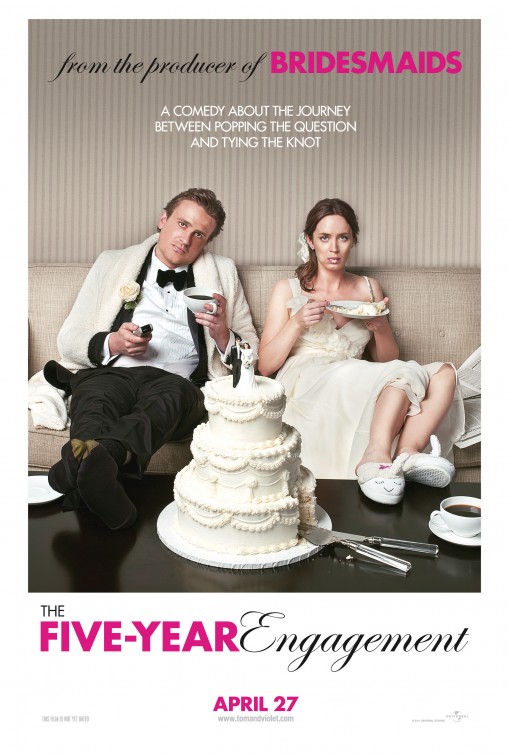 Relationships are serious business. In most Judd Apatow productions, they’re funny business. With The Five-Year Engagement, there’s romance to be found in surprising places, but the omnipresent feeling is one of dread. All those advertisements highlighting the comedy will start to melt away, and what you are left with is a funny, if bittersweet, anti-romantic comedy, more uncomfortable with hard-hitting truths than congenial laughs. My theater even had a few walkouts.
Tom (Jason Segel) and Violet (Emily Blunt) are happily in love. He’s a sous chef in a trendy San Francisco restaurant and she’s eager to gain a graduate fellowship at UC-Berkley in psychology. She doesn’t get accepted to Berkley, but the University of Michigan offers her a spot. Tom and Violet agree to put their wedding on hold and move to Michigan so that she can take advantage of an amazing opportunity. Michigan is not to Tom’s liking, especially since he can’t find a fulfilling job and settles with making sandwiches at a campus sub shop. It’s all just temporary, he keeps reminding himself. Then Violet’s two years gets extended, and Michigan isn’t just a temporary pit stop, it’s possibly home. Tom’s disappointment spirals, and he and Violet begin to drift apart, he resenting her for giving up his own dream to support hers. She begins getting emotionally attached to her Psychology professor, Dr. Childs (Rhys Ifans), in ways that straddle the mentor-student boundaries. Meanwhile, Violet’s sister, Suzie (Alison Brie), gets pregnant after a one-night stand with Alex (Chris Pratt), Tom’s best man and coworker, at the couple’s engagement party. They get married, have kids, and Tom and Violet are still stalling. This is the story of two people who deserve their happily ever after except life keeps putting obstacles in their path to the altar.
 You will be unprepared for how sobering The Five-Year Engagement can be. Some of these arguments between Tom and Violet cut right to the bone with an exacting level of painful authenticity. The level of uncomfortable intimacy can make the movie feel grueling. At the same time, I don’t want to give the impression that it’s some Apatow version of a John Cassavettes flick. There’s still plenty of comedy but the film is much more of a drama than any previous Apatow production. Part of the squirm factor comes in the very nature of the premise. The Five-Year Engagement picks up where most rom-coms end, with our happy couple together at last. We know these two are meant for one another; however, the majority of the screenplay involves watching two likeable, funny, loving people drift emotionally apart. Eventually they get back together in the end in a mad rush to staunch the gloom prevailing over the movie. It’s a hard act to watch people drift apart, losing the connections that once bound them together, and witnessing the glow of romance fade into complacency and resentment. Again, this is all handled in ways that find humor in uncomfortable places (like Tom, hopped up on painkillers, apologizing for smiling during sad news), but it can still be uncomfortable, and I don’t know if the ending, while happy, will justify the journey for many audience members.
I was shocked how much I found myself relating to the plight of the characters in The Five-Year Engagement, so much so that I simultaneously felt an extra level of engagement and discomfort. I will spare you the gory details, as I am a gentleman first and foremost, but relationships that just fizzle out rather than ending in some abrupt manner (infidelity, commitment issues, lack of availability, etc.) are not any more enviable. I related to the general sense of malaise that can plague a long-term relationship, the feeling of being forever a plus-one in your spouse’s circles, the resentment over the demands of a job or school, the small cracks that mask a lot of pain, the kind that is suffused with rationalization that to assert what you feel is to be selfish and inconsiderate, the loss of intimacy, physical and emotional, the guilt of being unhappy or making someone unhappy, and the sad realization that maybe love just wasn’t enough. What happens when nice people who are good for each other are just dealt rotten circumstances? Phew. I feel like I’m turning this into a therapy session. Let’s talk about something inappropriate in the next paragraph.
The biggest reason for sticking it out, both for Tom and Violet and the audience, is that Segel and Blunt have terrific chemistry together. Segel (Forgetting Sarah Marshall) is a big endearing lug of a man, and putting his career on hold to support his fiancé gives him an extra surplus of sympathy as we watch him spiral into despair and then resentment. He’s a funny, likeable guy, and we know he and Violet are meant for one another and we want them to get together, even as this looks less likely to come true after the circumstances that push them away. Granted, you must swallow the hard-to-believe reality that Tom couldn’t find a decent job in Ann Arbor, a college town that has to have some fine dining along the outskirts of town if not in the city. Blunt (The Adjustment Bureau) makes me fall in love with her yet again with a performance. Just like in 2011’s Bureau, she creates a charming, vibrant, luminescent portrayal of a person in love, so much so that I am envious of the man of her affections (her pantomime of “Circus Solei sex” made me feel all warm and fuzzy in multiple places). Violet has her own share of flaws but that just made her more relatable. I enjoy the way Segel, as a screenwriter (he co-wrote the movie with his regular collaborator, director Nicholas Stoller), is charitable with his characterization. He’s not afraid to make himself look mean and hurtful and wrong. He’s not afraid to make the girlfriends in his movies, even the ones who are about to dump him, justifiable in their decision-making. This is not a case of good guys and bad guys; it’s much more like life where everyone can draw good reasons, and the consequences just suck. Out of all of the Apatow films, Segel has done the best job of making his characters feel most like actual people than broad comedic types.
Luckily, the movie has its funny, peculiar little moments to make the drama bearable. I appreciate the little touches of comedy, which percolate through the heaviness. The wide supporting cast is peopled with the usual blend of oddballs and loudmouths. Pratt and Brie provide an ongoing foil as the couple who didn’t seem right for one another, made initial impulsive decisions, but have stuck it out and are happy; instead of waiting for the right time they embrace the mantra that there is no perfect time in life but the present. Pratt (TV’s Parks and Recreation) is great as a smart-aleck who grows into a responsible father. Brie adopts a British accent and becomes even more adorable, as all fans of Community would know. She’s quite funny as Violet’s sister and has a standout sequence where she and Violet have a very adult conversation in front of children so they disguise their voices as Cookie Monster and Elmo. The juxtaposition is a hoot and yet also a nice moment to add characterization. I also enjoyed seeing Chris Parnell (TV’s 30 Rock) as a sad sack faculty spouse stay-at-home father who clears his misery with kitting. There are some gory comedic set pieces around arrows being shot into legs and toes getting amputated, but the movie’s best comedy comes in the small moments, from Tom ‘s patchy “I’ve stopped caring” facial hair, to a self-described “pickle nerd” played by Brian Posehn, to the percentages of every undergrad named “Ashley” or “Zack,” to Tom’s hopelessly overmatched chase with Professor Childs, to a running gag about grandparents dying before Tom and Violet wed.
 I would like to take this time and observe that the University of Michigan, as well as its tenured professor, is responsible for the disruption of happiness between a young couple in love. How many other couples have you destroyed, U of M? When will your taste for suffering ever be quenched? And no, I’m not just saying this because I’m a diehard Ohio State Buckeyes fan, as well as a grad student. My point being: Michigan wants to kill Tom, Violet, and every person you hold dear (In short: Go Bucks).
You’d think with a title like The Five-Year Engagement they wouldn’t want to overstay their welcome, but like most Apatow productions, the film runs a bit on the long side. About 20 minutes into the movie, I felt the need to go to the bathroom. I rationalized staying put. Then about 90 minutes in, that urge became overwhelming but I reasoned the movie had to be over soon. And I kept telling myself that… for another 30 minutes. Then I just ran out and did my business, feeling the elation of relief. At over two hours, the movie feels excessive. Because of the drift away structure, the movie feels especially long in the second act, where we get hurtful scene after hurtful scene, and where Tom and Violet go their separate ways and start dating new people (the fact that Violet dates her smarmy professor feels realistic and yet also like a gut-punch to Tom). Some of the colorful characters that typical people Apatow productions feel more forced than usual, especially Violet’s collection of fellow psych grads played by the likes of Kevin Hart (Think Like a Man) and Mindy Kaling (TV’s The Office). They don’t seem well grafted to the story. The happy ending, while welcomed, also feels unlikely given the proceeding drama, and its brash adherence to rom-com conventions is a tad disappointing.
Watching the dissolution of a relationship is something of a hard sell to mainstream audiences, though Vince Vaughn was able to get audiences to see his anti-romantic comedy, 2006’s The Break-Up, which admittedly had bigger names and a lighter touch on the material. The Five-Year Engagement has its share of comedy but it’s pretty sublimated to the heavy drama of watching two people in love fall out of love and battle resentment, self-destruction, and apathy. Segel and Blunt are so good together we’re willing to give them a wider berth to stretch their wings, sow their oats, and eventually find one another again, falling back in love after a flurry of obstacles, realizing that finding and connecting with your right person is an ongoing process and not some prize to be awarded. I found myself connecting with the movie in several ways, so much so that it made me fee dour for the rest of the evening (you may feel differently). The movie gets so many subtle things right about how relationships can sour, and yet it still manages to overstay its welcome and fill its roly-poly narrative with annoying characters. At least the movie has helped me discover my perfect woman: Alison Brie with a British accent. However, Emily Blunt will also do in a pinch.
Nate’s Grade: B
Share this:

Miss Bala (2011)
 Miss Bala (Mexico’s foreign film entry for 2011) is an unwavering, startling, and deeply tense movie about one woman’s tragic and unwilling association with a powerful drug cartel. Laura (Stephanie Sigman) wants to be the next Miss Baja California, but she’s unwittingly pulled into a life of crime after she witnesses a gang hit. The cartel ensures that Laura wins the beauty pageant and becomes a courier for them. The movie takes a Lars von Trier approach to storytelling, putting its heroine through a torture chamber of anxiety and terror. This woman only wants to escape the hell she has accidentally found herself a part of, but every attempt to escape, be it going to the police or confessing assassination plots to the intended targets, gets her corralled back into the fray. For Laura, there is no escape. The movie packs a near-constant surge of paranoia, as we fear that at any time something awful will happen. In fact it’s usually only a matter of time. Laura is more a symbol of the collateral damage of Mexico’s billion-dollar drug war than a character, and she kind of becomes a numb zombie by the movie’s latter half, perhaps accepting her doomed fate. Director Gerado Naranjo favors long unwinding takes and handheld cameras, which add a gritty realism and sense of compounding dread to the picture. The movie has an unflinching level of realism to it that makes it all the more haunting, stripping the romanticism from a life of crime. Much like Italy’s heralded crime film Gomorrah, this bleak but impassioned movie shows the inescapable tentacles of organized crime and gives a face to innocents caught in the middle. Miss Bala is a testament to the hidden toll of a nation at war with itself.
Nate’s Grade: B+
Share this:

The Hunger Games (2012)
 Suzanne Collins’ smash novel The Hunger Games isn’t your normal young adult reading material. Dystopian future, corrupt government, oppressive forces, twisted media culture, and then there’s the whole inhumane concept of children murdering each other for sport. The book trilogy has been consumed by millions of readers, young and old, and inspired rabid devotion reminiscent of other successful publishing franchises like Twilight and Harry Potter. Yes, Battle Royale fans, the premise is not original, but Collins’ book could just as well cite inspiration from The Most Dangerous Game, Lord of the Flies, The Running Man, or even an Outer Limits episode known as “Fun and Games.” Producers are hoping those legions of fans will turn up in droves and start a new lucrative film franchise. Reliably squishy filmmaker Gary Ross (Seabiscuit) was tapped to shepherd the book to the big screen. The Hunger Games movie doesn’t commit any major blunders to screw up a good story, which is good enough for many.
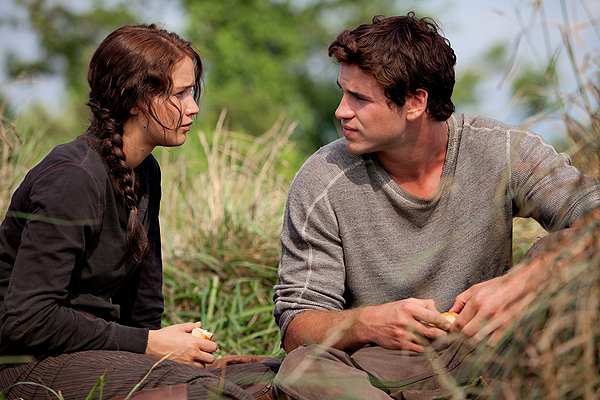
Set in a distant future, the ashes of North America have given way to the country of Panem. It is lead by a Capitol government and ringed by 12 mostly poor districts. Every year the Capitol commemorates the failed revolution of the districts by holding the nation’s favorite televised sport, the Hunger Games. Each district holds a reaping, which randomly draws one boy and one girl aged 12-18 years. These lucky chosen children, known as tributes, are then whisked to the Capitol where they will be placed into an arena and fight to the death. 24 tributes go in and there can be only one winner. In the outlying District 12, day-to-day life is a struggle, and Katniss Everdeen (Jennifer Lawrence) is burdened with providing for her family. She hunts illegally to provide food for her family and to trade for goods that they need. She’s excellent with a bow and arrow. Her hunting partner, Gale (Liam Hemsworth), suggests that they could run away. “We’d never make it more than five miles,” Katniss reasons. The two of them have too many responsibilities to ignore. Then Reaping Day comes, and Katniss’ 12-year-old younger sister Prim (Willow Shields) is chosen as the female tribute. Katniss volunteers to take her place, saving her sister, but throwing herself into a sport where the odds will not be in her favor. Joining Katniss as the male tribute is Peeta Melark (Josh Hutcherson), the baker’s son who has some history with Katniss.
 The tributes are paired with mentors, the oblivious Effie Trinket (Elizabeth Banks) and former District 12 Hunger Games winner Haymitch Abernathy (Woody Harrelson) whose helpfulness is tempered by the fact that he’s drunk often. He advises his newest tributes that they must make the audience like them to earn sponsors, people willing to pay big money to supply the tributes necessary supplies in the middle of the game. The Capitol is full of lush excess, the people donned in cartoonish and colorful garb. Katniss is dolled up and paraded around. She showcases her skills to the Game makers, who will give each tribute a rating that bettors will use. She’s interviewed by TV host Caesar Flickerman (Stanley Tucci) to make an impression. While with Caesar, Peeta reveals that there is a girl he’s had a crush on back home for the longest time – Katniss. The star-crossed lover angle hooks the audience and immediately transforms the dynamic of the games. Katniss is upset, but Haymitch rationalizes that Peeta’s confession has made them more marketable.
Then the dreaded day arrives and the 24 tributes are gathered up, injected with tracking devices, and launched into the outdoor arena to fight to the death. Katniss’ biggest threats will be the tributes from District 1, Glimmer (Leven Rambin) and Marvel (Jack Quaid), and District 2, Clove (Isabelle Fuhman) and Cato (Alexander Lutig). These tributes have trained their whole lives in the deadly arts so that they could volunteer to enter the games, hence why they are dubbed the Career tributes. And they usually win. Once the games begin, Katniss must survive the Careers, whatever surprises the Game makers have, the elements, and win over the affections of the TV audience. Let the games begin.
Firstly, fans can breathe a sigh of relief because The Hunger Games movie is a mostly successful venture brought to visual life. The legions of Collins’ fans celebrating the movie of their beloved book will mostly be satisfied. Collins’ story is still a good story no matter the medium. It establishes its alternative world and the stakes quickly and then it’s off to the killing fields. This is dark and disturbing stuff, far darker than even the darkest days of Harry Potter, and fans will be relived that the movie does not go soft. It’s not the exploitation-vehicle that Battle Royale was. This is trying to tell a story and not revel in the geysers of teenage bloodshed. This is a movie that satirizes reality TV and media culture as much class warfare. Katniss is primed and prepped to manufacture an impressionable image to TV audiences. It’s all about calculation, image control, and the manipulations of the media and audience to produce a star. Here’s a world where the 1% literally celebrate and toast the deaths of the 99%. Here’s a world that takes it cues from the Romans concerning spectator sports. I do wish the movie had channeled more of the book’s accusatory tone against the Capitol citizens, the silent majority complicit in villainy. And of course it was Collins’ point that we, too, the audience could be accountable in our own YA bloodlust.
 This is a story that grabs you and rarely lets go, centered on a heroine that is refreshingly a strong female role model for girls. Bella Swan has nothing on Katniss Everdeen. Here is a heroine that is proactive, resourceful, resolute, compassionate, and she doesn’t need a man to complete her. Sorry Ms. Swan, but Katniss has a lot more important things on her mind than getting a boyfriend. She’s got to provide for her impoverished family and shoulder plenty of responsibility, and that’s before she’s plucked into a death sport. In short, Bella Swan sucks. Katniss Everdeen rules 4-ever.
Since the book was written in first person, we were inside Katniss’ head the whole time. There are disadvantages of leaving that POV, namely that Katniss’ survival skills and cunning can be brushed over. She’s not just fighting the other tributes, she’s trying to think how best to play certain moments, how to appeal to the viewers at home. During the games, the movie jumps back and forth between the action and what I’d like to call Mission Control from Hell, the game makers HQ. This is a smart move that provides a greater antagonistic sense with the book’s unseen game makers. The exposition, mostly handled by Tucci as color commentary throughout the games, is presented in a way that doesn’t feel clunky. I also enjoyed the two sit-downs we get with President Snow (Donald Sutherland), the autocratic ruler of the Capitol, who sees early on the danger of Katniss. He explains that the games are meant to give hope to the poor citizens. “Hope is the only thing more powerful than fear. A little hope is good. A lot of hope is not,” he explains while pruning flowers. It’s nice to have a villain who understands the calculations needed for a proper oppression. It’s also nice to see Sutherland sink his teeth into a role that will only get more enjoyably evil as the films progress. I felt that the tracker jacker sequence, the interviews with Caesar, and the time in the caves were the best-adapted sequences.
Lawrence (X-Men: First Class) is a star, pure and simple. She was the perfect choice to play Katniss Everdeen. The Oscar-nominated young actress brings great steely determination and grit to the Girl on Fire. Katniss isn’t supposed to be a teenage warrior (that would be the Careers), even though she is thrust into that role. She doesn’t celebrate killing. This is not fun for her. Lawrence can play an array of emotions silently, deftly, like her hoarse, wild panic at Prim being chosen, her shell-shocked disorientation at going into the games, her quiet fury at her irresponsible mother and others like the game makers, her budding warmth for Peeta while he rubs a salve over her facial cut. Pages of description can be consolidated in just one pensive, conflicted expression on Lawrence’s lovely face. Lawrence is the heart of the movie and a tremendous presence to ground our sympathy and emotions.
Katniss is a dangerous competitor but she’s also vulnerable. She’s emotionally guarded and thrust into a situation where she has to “pretend” to be in love. Now the romance angle, and the self-awareness on Katniss’ part to give a good show, was a far bigger storyline in the book. In the book, she begins by playing a part and by the end doesn’t know if her feelings are false or genuine. It’s strange that in the movie their this-is-love kiss, meant to make the audience swoon on Katniss’ part, is followed up with nothing but hugs. Maybe the filmmakers thought a romantic angle was in poor taste given the kill-or-be-killed scenario, except that the romance angle is what keeps Katniss and Peeta alive. Want to know the best way to irk a Hunger Games fan? Start comparing the complicated romantic triangle of Peeta and Gale to dismissive terms like Team Jacob and Team Edward.
 The supporting cast performs ably, some better than others. Hutcherson (The Kids Are All Right) is given the most material to work with. He’s a nice kid, strong, but worried about his humanity, and the filmmakers never portray him as anything close to a badass or a helpless baby. Hutcherson shines in the moments where he comes clean with his emotions, like admitting that he has no chance of winning (his mom thinks so too). Peeta’s much easier at charm than bravado, and Hutcherson is a charming guy. I think Banks (Zack and Miri Make a Porno) actually gives the best performance, short of our lead heroine, as the maniacally bent Effie Trinket. Half the performance is the garish outfits, wigs, and makeup, but Banks nails the affluent insensitivity and ignorance of her character. Her forced enthusiasm is good for a few laughs. Harrelson (Zombieland) gives hints about the demons behind his character, a man who has to watch a pair of children under his tutelage die every year as his “prize” for winning. He’s a colorful character in a movie filled with colorful characters, but his sauced sarcasm can sting. Tucci (Easy A) hams it up with great pleasure as the smarmy, inauthentic, over-the-top TV host, Caesar Flickerman. They dolled up actor Toby Jones (Tinker, Tailor, Soldier, Spy) in a bouffant wig and sit him beside Caesar for commentary, but, and I literally counted, he has three lines where he speaks onscreen. Still, I love his oily voice as the games’ announcer.
The movie distills just about everything from the book, plot-wise, so the fans will be sure to see just about every plot event that they’ve developed a mental checklist for. However, this narrative approach, an attempt to satiate the fans that bristle when the movies of their favorite books deviate too much from the source material, blunts the impact of the material. I was astounded at how overwhelmingly rushed and hurried the movie is, spending little time on those variety of plot events, rarely allowing the movie enough room to breathe. With this brisk and brusque pacing, it stops the movie’s vitality. The context and history of important items and people feel clipped, becoming just set decoration. Ross has not done an adequate job of making his movie universe feel richly realized. The significance of the mockingjay, a symbol of perseverance under the oppression of the Capitol, is left unexplained. It just becomes a dinky pin that makes Katniss think about home. The ghoulish mutts have been turned into just a bunch of vicious dogs that eerily resemble the dog demons from Ghostbusters (actually, I’m relieved the mutts were toned down). The contrasts between the impoverished outer districts and the lavish Capitol denizens are nicely showcased thanks to luxurious and weird art direction and costume design; these people took fashion advice from Marie Antoinette and maybe their political outlooks as well (“Let them eat cake… or death”). There are also some passing moments of dark satire as far as the Capitol’s overall stance with the games, and their blasé attitude about the value of human life, though the movie could have and should have pushed harder with its class warfare.
The Hunger Games reminded me of the first two Harry Potter films where the producers crammed in all the plot points they felt fans wanted to see rather than just, you know, adapting it into a good movie. If they wanted to keep everything from the book, plot wise, then they should have followed their convictions and produced a three-hour movie. Imagine The Godfather being cut down to two hours and twenty minutes. Imagine rushing through all that drama. Now I’m not in any way comparing The Hunger Games to The Godfather in terms of quality, but movies need sufficient time to establish their worlds and develop characters. They need time to breathe. The fact that a 142-minute long movie doesn’t have time to breathe is plain inexcusable.
 The characterization, beyond Katniss and Peeta, is extremely limited, and so when he deaths do occur the impact is minimal; only one tribute’s death is given time for mourning, and even this character’s death is limited due to superficial characterization and about two minutes of screen time. I’m not saying that every one of these 24 tributes needs a detailed back-story, but they’ve got to have some personality to them and the movie has to devote some time to develop that; good writing can tell a lot with little. Otherwise they just become somewhat recognizable faces and not characters. Cinna (Lenny Kravitz), Katniss’ stylist for the pre-game publicity in the Capitol, is reduced to being a bland companion. Let me single out the villains, our group of Career tributes. The movies have a long tradition of villains who aren’t given much characterization but are given personality. I need my bad guys to be given an opportunity to make an impression, and no, weapon distinction is not enough. With The Hunger Games, the bad guys just become a series of sneering faces, and these kids (Ludig, Rambin, Quaid, Fuhman) have got some good sneer faces. True, the movie’s entire twisted premise lays enough overwrought tragedy to the entire setup, turning children into killers, and President Snow is the ultimate villain, but the movie should be agonizing, terrifying, devastating, upsetting, and not merely inferential and rushed. I want to feel the deaths. Instead, the movie can’t even be bothered to briefly show the faces of the dead kids during the game’s daily death montage. There are all sorts of kids who were hired to be tributes from districts and I question if they ever got a second onscreen.
I also feel that Ross is, at times, completely wrong for this material. The man behind Pleasantville and Seabiscuit is not the first name you’d think of to tackle a dystopian sci-fi survival thriller built upon the premise of dead children. I almost wish they had hired Paul Verhoeven (Robocop, Starship Troopers), an artist well versed in sci-fi spectacle and subversion. Ross’ misguided visual approach, borrowing a page from the Bourne franchise, can make it hard to enjoy the film. During the opening segment in District 12, as well as the games themselves, Ross will attempt to up the visceral ante with his bobbing handheld camera. Now I’m not one of the people who loudly decry the use of “shaky cam” during action sequences, but before the second minute was over, I turned to my friend and said, “I already hate the shaky cam.” There’s a difference between handheld camerawork, which has some jostle to it, and a deliberately inauthentic docu-drama approach that makes exaggerated and distracting camera bobbling. There are long segments of this movie that is nothing but shaky close-ups cut together. There’s a climactic battle atop a metal structure that is completely incomprehensible to follow. It’s all just a blur of flashes save for two wide shots to thankfully attempt to orient the viewer. When an audience can’t follow the action, it not only kills tension but it also kills investment. The docu-drama visual approach is completely wrong for this movie. When was the last time you saw a dystopian sci-fi movie that had a docu-drama aesthetic? Try never.
 Likewise, to achieve the all-important PG-13 rating, Ross sanitizes the blood sport, utilizing lots of implied violence. The jangly aesthetic works for the duration of the race to the Cornucopia to start the games, as tributes turn a fight over supplies into a bloodbath, communicating the chaotic frenzy. I’m not clamoring for explicit carnage to get its message across, but just seeing children as far-off lifeless heaps is a disservice to the power of the story. Also, I don’t feel like Ross properly takes full advantage of the visual medium. Instead of being told, twice, about mines that will explode if any tribute steps off their platform before the conclusion of the countdown, let’s see it. Since half of these kids are about to become faceless corpses anyway, why can’t one of them lose their balance, fall out of the ring, and blow up? And then we cut to a nearby tribute dusted with pieces of dirt and blood, trying to keep their cool and failing. It would have kicked up the tension and shown the immediate danger that awaits. I don’t want the one-minute countdown to cut around the globe, seeing the different districts watching TV. I want that entire minute spent in the arena, hearing every second counted down, seeing every face of the tributes sick with anxiety and unease, gritting themselves for combat. I want to feel the same sense of doom that they do, not cut around the globe and then have the audio drop out. That’s a sorry way to start the games, even with a PG-13 mandate.
There are heavy expectations for The Hunger Games on all fronts, from studio execs to the millions of eager fans. I consider myself one of their legion. I voraciously read through the trilogy, getting hooked early, and have even helped teach the book as part of an American Literature curriculum. It’s a thrill to watch reluctant readers get excited about the book. The Hunger Games succeeds mostly as the pilot to an exciting film franchise. But having seen the Hunger Games movie twice in 14 hours, and being a huge fan of the book, here are my chief criticisms: the movie is far too rushed, speeding over so many plot points and characters, never getting time to breathe; nascent characterization for supporting characters; the context of so many things is missing; shaky cam overuse to the point of incomprehensible action sequences; dodgy CGI; not taking full advantage of visual medium; intensity a bit muted; and finally, a forgettable score. But, hey, good movie. It just frustrates me because it could have been a great movie, a searing, powerful, provocative, thrilling movie. Good movie will be good enough, especially when it makes more money opening weekend than the citizens of District 12 will ever see in their lifetimes. When you got a fan base as large as this series, the odds will usually be in your favor.
Nate’s Grade: B
Share this:

Fright Night (2011)
 Horror is a genre that’s been notoriously cannibalistic, especially as of late. I don’t mean flesh-eating, I mean the glut of remakes that has polluted the horror market in recent years. After remakes of Halloween, A Nightmare on Elm Street, Friday the Thirteenth, The Hills Have Eyes, House of Wax, Prom Night, My Bloody Valentine, The Amityville Horror, The Fog, The Texas Chainsaw Massacre, Black Christmas, Sorority Row, Dawn of the Dead, The Crazies, Don’t Be Afraid of the Dark, I Spit on Your Grave, Last House on the Left, The Thing, and scads more, you’d be forgiven for believing that the remake of 1985’s Fright Night would be another soulless cash grab. It turns out that it’s way better than even the original and quite an entertaining movie that got lost in the shuffle.
In a quiet little suburb outside Las Vegas, students are going missing. Ed (Christopher Mintz-Plasse) suspects that there is a vampire in town. Ed’s former friend, Charley Brewster (Anton Yelchin), dismisses this idea, especially since the would-be vampire in question is his new neighbor, Jerry (Colin Farrell), a home construction worker who seems to work at night mostly. But lo and behold, after Ed goes missing, Charley concludes that his old friend was right all along. Jerry has his eyes set on Charley’s single realtor mom, Jane (Toni Colette), and maybe even Charlie’s sprightly girlfriend, Amy (Imogen Poots). The only ally Charley can muster is a drunken Vegas magician in the Criss Angel tradition. Peter Vincent (David Tennant) has been studying vampires for years due to his tragic personal connection to vampires, notably Jerry.
 Fright Night finds that horror sweet spot, equal parts scary and funny. Credit screenwriter Marti Noxon who cut her teeth on TV’s seminal show (yeah, I said it) Buffy the Vampire Slayer; there’s even a reference to a “Scooby gang” for we Buffy fans. Noxon does a terrific job of establishing a suspenseful situation and then developing it nicely, teasing it out. There’s a sequence where Charley is trying to rescue a neighbor lady that just involves a series of hiding places but uses a simple setup of ducking around corners so well. When our plucky protagonist checks in with Vincent for some assistance, we’re introduced to an array of exotic vampire-hunting weapons and artifacts that the Vegas magician has under glass. With a setup like that, you better believe we’re going to be using those weapons later, and how. The character development is richer than most teens-battle-monster genre films. The relationship between Charley and Ed, and the awkwardness and resentment of two friends growing apart, feels rather believable even dropped into the middle of a vampire adventure. The standard girlfriend role is given a bit more weight, as she’s the one who feels confidant and aggressive. She knows what she wants, and as played by the adorably named Imogen Poots (Solitary Man), you want to be what she wants. Seriously, this actress is striking in her Grecian features and I like a woman who knows how to handle a mace. There are also small touches that I really enjoyed that helped round out the movie. At one moment, a woman is being fed on by Jerry and she spots Charley hiding behind a door. Rather than cry out for help, she carefully draws a shaking finger to her mouth, wishing him to keep quiet and not to save her. The resolution of this rescue attempt is shocking in all the right ways. It’s a surprise that feels completely within reason, and organic twists and turns are always the most satisfying.
Noxon’s script continually surprises even when it starts to follow a by-the-numbers plot. Instead of an axe lopping off a vampire’s head, it just goes about halfway through thanks to the rigidity of bone. That’s a nice touch, but then when that same vampire tries to bite our hero and can’t move his fairly severed neck closer, then that’s when Noxon has capitalized on her cleverness. And she capitalizes often enough for Fright Night to be a real step above most vampire action flicks. Noxon also finds clever spins on vampire mythos; to get around the whole can’t-enter-without-an-invitation rule, Jerry just attempts to blow up the Brewster’s home to drive them out (“Don’t need an invitation if there’s no house”). There’s a particularly ingenious method to light a vampire on fire. And the entire character of Peter Vincent, played brilliantly by Dr. Who actor David Tennant, is a hoot and a great addition. He’s a riot as a cynical, profane, and selfish stage performer. His character is such an enjoyably comic foil, and Tennant plays him with aplomb, that you almost wish for a Peter Vincent spinoff movie.
Director Craig Gillespie shows that he is shocking adept when it comes to staging a horror film. I would not have expected this level of competency from the director of Lars and the Real Girl. It embraces its R-rating and the bloodshed is plentiful though the gore is restrained. Gillespie draws out scenes with judicious editing, letting the dread build steadily. The tension of something simple like Jerry standing in a doorway, waiting for any verbal slipup to come inside, can be terrific. Gillespie also has some nifty visual tricks up his sleeve to complement Noxon’s crafty screenplay. There’s one scene where Jerry walks into a hotel lobby and is confronted by a security guard. The camera pans over a series of security monitors that do not pick up Jerry. Then in the background we see Jerry hurl the guard to the ground to bite him and in the foreground we see the security footage minus Jerry. There’s an ongoing tracking shot inside a fleeing minivan that’s not exactly Children of Men but still a good way to feel the fever of panic. The final showdown between Charley and Vincent versus Jerry is suitably climactic and rewarding, nicely tying back elements that were introduced earlier and giving Poots an opportunity to vamp out, literally and figuratively.
 Farrell (Horrible Bosses) is a charming, sexy, alluring menace as Jerry, which is exactly what you’d want in a vampire (sorry Twilight fans). Vampires are supposed to be seductive; they’re inherently sexual, what with all that biting and sucking and sharing of body fluids. If Jerry is going to be dangerous, he also has to be seductive, and Farrell is exactly that. With his swaggering walk, with his pose-worthy stances, with his grins, he’s a great ambassador for vampire kind. But this guy does more than preen; he’s also a credible threat. He’s the bad boy that is actually quite bad. Farrell’s enjoyment of his villainous role is noticeable. Jerry taunts Vincent: “You have your mother’s eyes.” He shoots and misses the big bad vamp. “And your father’s aim,” he add, chillingly. Having a strong villain can do wonders for an action movie, and Jerry is a formidable foe played with great relish by Farrell.
Not everything goes off without a hitch. The special effects can be dodgy at times, especially when Jerry goes into full CGI vampire face. The vampires tend to look like shark people, with long exaggerated jaws and rows of gnarly teeth. It’s not a particularly good look. While Noxon’s script excels in most areas, there is still enough dangling plot threads. Charley’s mother is really never a figure of significance. Her potential romance of her neighbor/vampire is a storyline that is never capitalized upon, oddly enough. That seems like the kind of storyline you’d build a whole movie around. She’s written out of the movie in hasty fashion, immediately going from a sequence of driving to being unconscious in a hospital bed. How did that happen exactly? After the Brewster house explodes, nobody seems to make a big deal out of this, like it’s just some regular neighborhood occurrence. What kind of neighborhood watch is this?
Fright Night is just a fun night out at the movies. It’s got plenty of laughs thanks to Noxon’s clever script, plenty of scares thanks to Gillespie, and plenty of sex appeal oozing from Farrell (though “sex appeal” and “oozing” don’t sound like an advisable linguistic match). It’s not much more than a vampire action flick but it’s a really good vampire action flick, clearly a cut above the dreck that usually just relies on its audience’s understanding of genre convention to cover up for its shortcomings. There’s no reason you cannot be a good movie with this genre, and Fright Night is proof of that. Convincingly acted, cleverly staged, and surprisingly well-executed, this is one genre movie that hits the right vein.
Nate’s Grade: A-
Share this:

A Dangerous Method (2011)
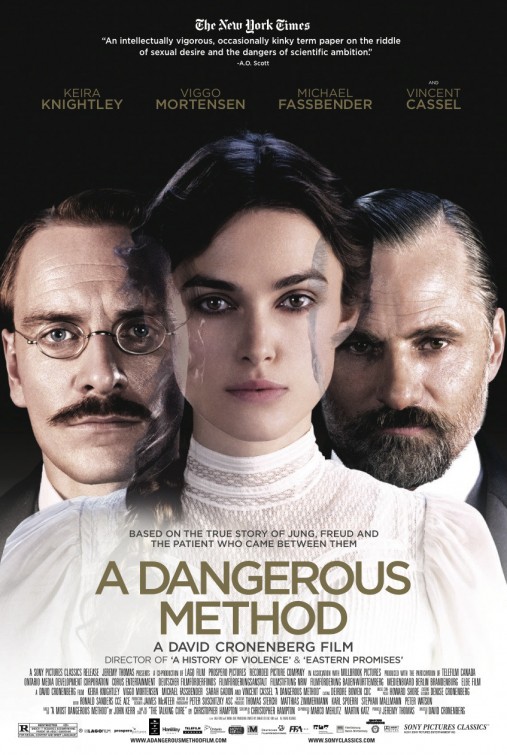 At first glance, the movie seems like an odd fit for director David Cronenberg, that is until you realize that, as Freud himself might approve, the entire movie is bubbling with sexual repression and kink. The movie showcases the friendship between the two titans of psychoanalysis, Sigmund Freud (Viggo Mortensen) and Carl Jung (Michael Fassbender), and the strange patient (Keira Knightley) who brought them together and tore them apart. This is a very intimate chamber drama, confined to lots of men in suits talking in great detail about psychology and philosophy and desire (there are three separate scenes of dream decoding and lots of letter correspondence voice over). Knightley is superb as a hysterical patient torn apart by her socially inappropriate desires. It may be a tic-heavy performance but my God can the woman act. She’s like a feral beast at points. The majority of the film follows Jung’s affair with Knightley and his friction with the single-minded Freud, who incidentally is never without a cigar clenched between his teeth. Jung wants to expand their field of study to include paranormal activities; Freud wanted to stay within the realms of science to give their movement credibility. Cronenberg’s period drama can be a bit too sedate at times given its aberrant sexuality. You don’t really empathize with either Freud or Jung, and thus the drama is a robust and intellectually stimulating exercise but only an exercise. For people who do not share an interest in psychoanalysis, they’re in for a long slog. A Dangerous Method is a rather short film, only 99 minutes, and would have benefited from being a bit more dangerous with its subdued subject matter.
Nate’s Grade: B+
Share this:

The Grey (2012)
 I’ve always been fascinated with survival thriller/horror, where we think step-by-step with the characters through an unlikely scenario. I greatly enjoyed Frozen, a horror movie about three teens stranded on a ski lift, and Buried was in my top ten list for 2010. I enjoy the thought exercise and find the scenarios easily empathetic as long as people don’t make boneheaded decisions. Director Joe Carnahan has been paying his bills as of late with stylized, overdone, and generally overblown action movies like Smokin’ Aces and The A-Team. I would not have expected Carnahan to deliver anything that could be described as nuanced or meditative, but lo and behold The Grey is a survival thriller that’s as thoughtful and emotional as it is viscerally exhilarating. The Grey is the first great movie of 2012 and I’m astounded that it was released in January, the dumping ground for cinematic dreck.
We follow a group of grunts working on an oil pipeline way out in the northern Alaskan territory. They’re heading south for some R&R when their plane crashes due to electrical issues. Ottway (Liam Neeson) and seven other men are the lone survivors. While checking for supplies, they discover a pack of wolves feasting on some of the choicer corpses. Ottway is a wolf expert, hired by the oil company to patrol the grounds and hunt antagonistic wolves. He explains that wolves have a hunting radius of 300 miles and a kill radius of 30 within the den. It is uncertain where these men find themselves, so they bundle up and head south, hoping to escape the predators, find food and water, and discover a way to help.
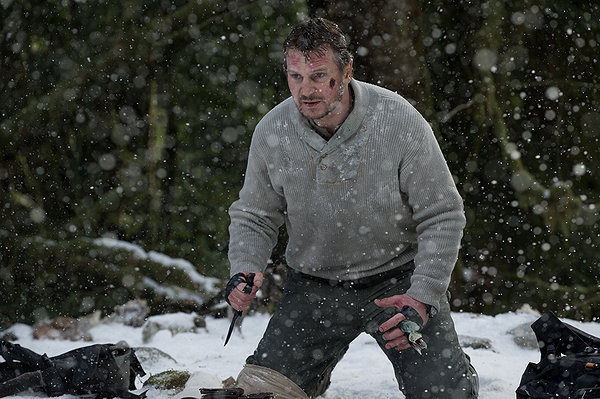 The Grey is a harrowing, haunting, and intense thriller, masterfully played by Carnahan. The threat is real and brutal, enough that it convinces the men to leave the safety of the plane wreckage to possibly escape the wolf kill radius. We’re told that wolves are the only animal that will kill out of vengeance (look out Sarah Palin). The attacks are vicious and the violence is bloody and occasionally shocking, though it never seems gratuitous. The special effects and canine animatronics are seamlessly integrated. The sound design for this movie is exceptional, probably the best use of sound to fashion anxiety since 2007’s No Country for Old Men or even Spielberg’s War of the Worlds. The sounds of the wolf pack echo around the theater, completely keeping you off guard, disorienting the audience. Carnahan creates such a vivid picture of dread that we’re convinced that the wolves could sic at any moment. And when they do the editing becomes chaotic, mimicking the ferocity of the animals and depicting the frenzied fear of the attacked.
I was a terrible bundle of nerves throughout most of this movie. The plane crash is an exemplary sequence of terror, capturing the terrifying moments from Ottway’s limited point of view. The rest of the movie doesn’t get any less tense just because they’re on stable footing. There’s one scene where the wolves attack a guy who has fallen back from the group. Carnahan brilliantly captures the helpless reality by showing the men trying to race back in knee-high snow. They can only stomp so far while the man is ripped apart in the background. The action sequences, though to be fair they’re really more suspense pieces, are the most nerve-wracking I’ve endured since the brilliant Best Picture winner, The Hurt Locker. Of course these being life and death stakes, there is plenty of death, as the men are generally picked off one by one, though not all by the pack of wolves. The frigid elements are just as dangerous as the killer wolves. The men could just as easily freeze to death. The need for shelter and food is dire (the men even joke about the famous cannibalism from Alive). One of them is suffering just from his brain being unable to acclimate to the elevated attitude. That’s almost enviable considering the doom that constantly hangs over the other survivors.
Naturally there’s some friction between the survivors as far as the best course of action. Ottway has assumed Alpha dog status thanks to his expertise on wolves and the Arctic climate, but that does not mean that the rest of the men follow lockstep. Give the alarming situation, it will be in these men’s best interest to work together for survival. Some of the men chafe at being what to do but the movie doesn’t drags out this conflict, thankfully, because jockeying for power positions seems like an absurd waste of time. There are heavier issues at play. The impact of the movie would be blunted if the characters came across as one-dimensional; then we wouldn’t care about their fate. Carnahan and co-writer Ian Mackenzie Jeffers, based on Jeffers’ short story “Ghost Walker,” find creative ways to enrich and reveal the character of these lone men. They feel believable and their reactions to the implausible dangers seem plausible, keeping us invested. Ottway keeps flashing back to an image of his wife (Anne Openshaw) for strength, this angelic brunette telling him not to worry. It’s what he has to hold onto, though when we learn more about the context of this image it becomes even more meaningful. One character has had enough struggling and has no will power to continue. He argues that whatever life he may return to is no reward.
 The thrills and scares are what are to be expected, but The Grey is also a much more thoughtful and intellectually stimulating picture than you may have hoped. Carnahan’s script covers a wide array of survival tactics without breaking from the reality of its premise. It’s just interesting to watch a group of men use their wits to make best use of their dwindling supplies and dire situation. It becomes a game that the audience plays, systematically judging every choice and assessing if we would follow suit. Beforehand, the men engage in a theological discussion regarding the existence of God, faith, the belief that there is a divine plan. The men are fighting for their survival but having an existential crisis all the same, trying to supply meaning to the horrific, find reasons to keep fighting. “We crashed going 400 miles per hour and we survived. That has to mean something,” one of them reasons. Or it all could just be very bad luck. Ottway at one point, an admitted non-believer in a higher power, bellows to the sky for something, anything. His desperation is effective and turns what could have been trite into a nice character moment. One of the men shares a memory of his daughter, who would wake him up by gently dangling her hair in his face. It’s a touching moment and when that same character meets an untimely end and is helped to the other side by a vision of that same daughter, it becomes profoundly moving (the quick snap to reality is a jarring point for grisly comparison). The Grey has plenty more on its mind than making an audience jump. It also wants to make the audience think and, in the end, feel genuine emotion.
The ending may rankle some who felt, especially with the advertising, that the film was going to be a two-hour Neeson ass-kicking vehicle, but for me it was fitting and the only way this story could have ended. Though let me advise all potential ticket-buyers to stay during the end credits for a small bit that offers a tad more resolution, though still leaves as much to be determined by the viewer. It’s not exactly ambiguous considering how things are left.
Neeson (Unknown, Clash of the Titans) has settled nicely into his newest incarnation as middle-aged ass-kicker, such an odd path for the man who famously portrayed Oskar Schindler. At some level, it’s below an actor of Neeson’s standards to be running through such genre frills, but it’s also a joy to see someone who can really, truly act give gravitas to his men of action. After he delivered his warning in Taken, I was completely on board and ready to watch this man bust some skulls. Beyond the physical challenges, the role really puts Neeson through an emotional wringer and the man gives a strong, stirring performance. You’d be glad to have this man in any predicament. The rest of the cast fill out their parts well, with Dermot Mulroney (The Family Stone) making the best use of his time onscreen to create a character.
The Grey is a startling movie; horrific, jolting, thrilling, moving, beautiful, philosophical, and extremely captivating. Carnahan has crafted an exciting movie that transcends genre. There were moments so tense that I was chewing on my knuckles. There were moments so intense I felt like I had to look away. And there were moments so poignant that tears welled up in my eyes. I look forward to watching this movie again and finding even more at work. No grey area here, this is one truly excellent movie.
Nate’s Grade: A
Share this:

Melancholia (2011)
 Melancholia opens with a bang. Literally. Lars von Trier, film’s most polarizing and famous sadist, begins his movie with the ultimate spoiler alert, destroying the entire planet. Lars von Trier’s grandiose exploration of annihilation, both personal and species-level, can be maddening in how tedious the whole affair can become for long stretches. What’s even more maddening is that the movie flirts with being magnificent for other, regrettably smaller, stretches.
We open with the wedding of Justine (Kirsten Dunst) and Michael (True Blood’s Alexander Skarsgard). Hours late, the couple arrives at their reception at the palatial estate that belongs to her sister, Claire (Charlotte Gainsbourg), and her husband, amateur astronomer John (Kiefer Sutherland). Over the course of one very late night, Justine will quit her job, sleep with a random wedding guest, alienate her family, and end her brief marriage, putting Kim Kardashian to shame. Several months later, Justine has been released from a hospital for clinical depression and is now living with Claire and John’s along with their young son, Leo. A tiny star in the sky has gotten larger over the ensuing months, and scientists have determined that this new planet is heading straight for Earth. Named Melancholia, this rogue space rock is predicted to pass by, but the calculations are getting closer and closer. Eventually, the truth is evident and Melancholia is on a cataclysmic collision course with Earth.
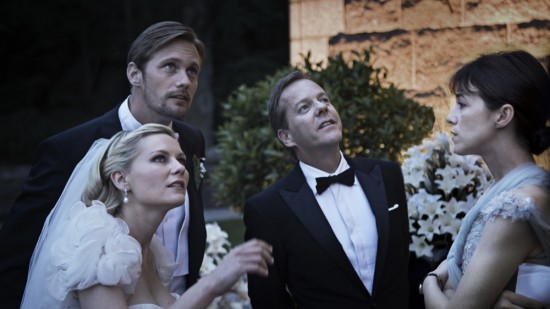 From a plot standpoint, the movie is completely lopsided. Melancholia opens with beautiful images that…. just…. keep…. going…. on…. and… on… set to thunderous Wagnerian overtures. It lets us know right away that von Trier is performing at an operatic level of melodrama. After this spoiler sequence, we jump back to the last months of Earth. The first hour of this movie is a boring wedding sequence that just seems to stretch for an eternity. You may wish that the rogue planet would show up and smash everyone to bits so we could get on with it. Justine and her groom are already several hours late because of the precarious route their limo had to take, so the fact that Justine takes frequent breaks and needs to be constantly retrieved can be draining. The hour of wedding blahs would be better time spent if I felt von Trier was laying the groundwork for characters. Little of the first hour seems to matter at all or has any lingering ramifications, which is bizarre considering the amount of personal nosedives Justine takes. It’s plain to see that Justine is unhappy and going through the motions, pretending to be happy for everyone’s benefit and maybe, just maybe, she can trick herself. What’s not plain to see is why we have to spend so much time on a room full of characters that will never be seen again. We learn so little about the characters, their relationships, and why any of this matters. The first half of this movie could have easily been condensed to 20 minutes. If the point was to test the audience’s patience, much like Justine does to her family, then bravo.
It’s that second hour where Melancholia flirts with the profound. The second half only concerns four principal characters. Unlike the first monotonous hour, there are events that actually matter and have substance to them, namely the encroaching obliteration of Earth. Having seen the pre-credit preview, we already know every life on the planet is doomed, but that doesn’t stop us from feeling the same pangs of anxiety as Claire discovers what we already know. Depression may be an elusive personal experience that not everybody can empathize with, especially when the depressed individual becomes overly taxing, but coming to terms with the end, not just your own, but of all of human history? That’s something every person can identify with. This confrontation of the inevitable can lead to some thoughtful soul-searching. This is an extinction event. There is no escape, unless you’re an astronaut (it’s now or never, lunar colonists).
Like most of us would be, Claire is terrified to die, to have all her loved ones die, but Justine is eerily placid. She feels that the Earth is evil and that “nobody will miss it.” To further drive von Trier’s bleak pessimism, Justine says there is no other life elsewhere in the universe. This is it, and it’ll all be over soon. “I just know,” she adds, unhelpfully. We watch Claire go through different stages of grief, fighting for some sense of closure, but von Trier will not allow any comforts. Gainsbourg was put through Trier’s typical emotional wringer in 2009’s unpleasant Antichrist, and here she’s really the entry point for the audience, and as such we sympathize the most with her since her reactions are so believable. It’s hard to feel like there’s any bond between these two sisters, which limits the impact of the end. Still, the end is fittingly devastating and makes me wish I had seen the beautiful destruction on the big screen, bathing in its apocalyptic splendor.
 The dread of that final hour is extremely palpable, with the presence of Melancholia in the sky played almost like an art-house existential horror movie. At first we’re told by John that the scientists predict it will fly-by at roughly 60,000 miles per hour, but slowly the realization becomes clear that Melancholia is coming back with a vengeance. There’s a terrific plot point where John introduces a way to judge the planet’s movement. A wire circle is held out at arm’s reach, designed to trace around the perimeter of Melancholia. Then five minutes later the wire ring goes back up and, voila, the rogue planet has shrunken in size or gained. It’s a smart device that helps establish the momentum of doom, and it’s practical enough for the characters to perform. As Melancholia comes closer to collision, it gives off an unnerving blue glow. I started joking with my friend Alan that the movie was going to descend into a slasher-style stalker movie, with Melancholia chasing to get you like a spurned and dangerous lover (“We’ve traced the phone call. The planet is calling from inside the house!”). These attempts at levity are inevitable when the subject matter is so depressing and the nature of von Trier’s film lends itself to operatic pomposity.
von Trier’s film is quite a departure from the most disaster cinema, but sometimes its Big Statements can seem inartful and obvious. The very idea that the planet of doom in this dance of death is called Melancholia… come on. Maybe this whole thing would have been avoided had those egghead astronomers had given this rogue planet a happier name (My suggestion: “Doug.”). The metaphorical connection to Justine’s own melancholy is just inane. The planet is but a tiny speck in the sky at her wedding, and Justine is desperately trying to hold it together, and then in the second half the planet is much bigger and, surprise, so is Justine’s melancholy.
I found it hard to care about Justine and her personal demons. Depression and mental illness can be exasperating conditions, but that doesn’t mean I sympathized with her any more than the other seven billion souls destined to be incinerated. Her rejection of niceties can seem cold when all her sister wants to do is find some level of reassurance before the end is near. Dunst (Marie Antoinette) won an acting award at the Cannes Film Festival for her performance, and it’s hard for me to see why. It’s a darker, somber, more serious role for the actress, but looking tired, sullen, and impassive doesn’t come across as a fully rendered performance, more of a bad mood swing. My feelings are likely tempered by the fact that I found her character to be unbearable and agonizingly opaque
Melancholia is half of a great movie, but only half. The movie can feel a little too isolated, a little too leisurely paced, a little too pretentious. The beginning wedding sequence is like a minor endurance test, but rewards await those who carry on to the bitter end. This uneven art-house disaster movie has stunning imagery, numbing dread, and an apocalyptic grandeur, the likes of which could only come from the perverse mind of Lars von Trier. It’s beautiful and lyrical in its best moments, a cold, surrealist nightmare. The boldness of von Trier’s vision is inescapable, but I only wished he had fashioned a better story and sharper characters for his experiment in nihilism. If we’re going to spend the last few hours on Earth, I’d rather it be with people I gave a damn about.
Nate’s Grade: B-
Share this:

The Girl with the Dragon Tattoo (2011)
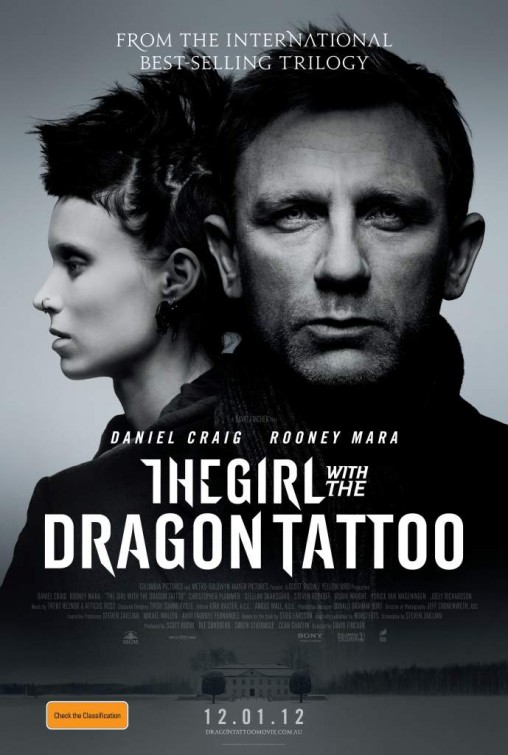 Nothing says holiday treat for the whole family like a nearly three-hour movie about rape. Late author Stieg Larsson’s best-selling trilogy made three very successful Swedish films, all released last year in indie theaters. It was only a matter of time before Hollywood optioned The Girl with the Dragon Tattoo, benefiting those averse to reading subtitles. At least they hired the right director in David Fincher, a man used to plumbing the depths of human depravity in films like Seven, Fight Club, and Zodiac. Fincher’s take is pretty dark and hardcore, but once you wash all that perfectionist grime off, I prefer the Swedish film in just about every way.
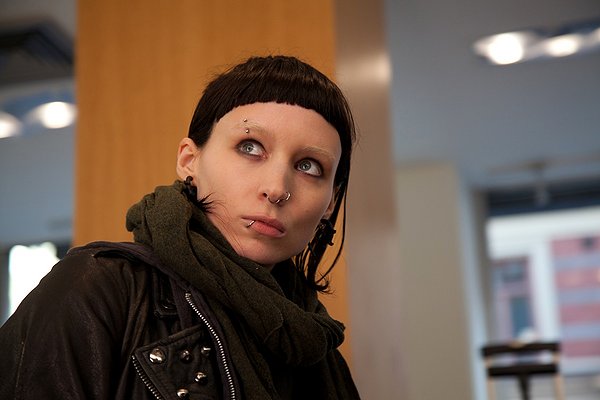
Crusading journalist Mikael Blomkvist (Daniel Craig) is smarting from a court case that found him guilty of libel. He’s commissioned by a wealthy businessman Henrik Vagner (Christopher Plummer) to investigate the 40-year-old disappearance of his granddaughter, Harriet. Henrik strongly believes she was murdered by one of the sinister members of his extended family, a group of shady characters with some allegiance to Nazism. Mikael is assisted by the unorthodox computer hacker Lisbeth Salander (Rooney Mara), a rail-thin Gothic gal clad in tattoos and piercings. Their partnership sometimes gets blurry as they grow closer over the course of the investigation. Together the pair investigates a series of grisly, ritualistic murders related to Harriet’s disappearance, and the closer they get to discover the truth the more dangerous things get.
 So the burning question: is Fincher’s take better than the original Swedish version? Well, in some areas yes but in many areas I’d have to say no, that I prefer the lower budget, no-name Swedish version. Obviously a director of Fincher’s caliber is going to significantly raise the quality of a production, and the technical merits of Fincher’s Dragon Tattoo are without question. This is a seedy, grimy, prurient, and very dark (in both lighting and thematic material) little movie. There’s always been an eerie beauty to Fincher’s cool aesthetics, and it’s on display here as well. Many of Fincher’s Social Network crew carried right over to Dragon Tattoo, so the editing is crisp, the cinematography sleek, and Trent Reznor and Atticus Ross’ score is a storm of ominous tones. Their plaintive score is actually a fairly unmemorable muddle, never approaching the energy, intricacy, or diversity of their Oscar-winning score for The Social Network. However, the extra polish and the glut of familiar actors takes away from the intrigue of the movie. When something meant to be gritty is too artistically stunning, it detracts from the thematic intent of the story. That sounds like a contrary way to insult Fincher for making his movie look too good, but perhaps that’s the best way of stating the point. Niels Arden Oplev is nowhere near the filmmaker that Fincher is, nor did he have the budget or creative freedom afforded Fincher, but perhaps someone of lesser talents was better suited to best tell this tale. By all means, the American Dragon Tattoo is a more visually alluring film, but Oplev’s film is more fully felt. I recently rewatched the Swedish version again for points of comparison and found myself much more involved in the characters, the story, and the actors, even though I had already seen the movie. Fincher’s version may be the better-looking movie, but surprisingly Oplev’s is just the better movie, period.
The adaptation by Steven Zallian (Schindler’s List) actually hews closer to Larsson’s book than the Swedish film, though Zallian redirects the film into a new ending. But the additions don’t seem to add anything of substance to the narrative (Blomkvist’s teenage daughter; dead cat), and the new ending feels more confused than helpful. Most of all, Zallian’s script devotes less time to the characters of Lisbeth and Blomkvist. I had a better understanding of these characters and their complicated, shifting relationship in the Swedish film. That narrative was much cleaner with helpful, clarifying procedural details and a dose of ambiguity. Simply put, the story just flowed better in the Swedish film. The personal connection Blomkvist had to Harriet (she was his babysitter long ago) has also been severed. Many of the story’s problems are still the same regardless of language or adapter. There is a clear disparity when it comes to audience interest in the two leads. What’s more interesting, a punky, bisexual, computer hacker or a disgraced, somewhat bland journalist? Exactly. Also, the story takes far too long to put our lead characters together, over an hour at that. The murder mystery is filled with murky plot points, pieces that seem like they might be integral but then turn out to be incidental. It takes a good while to process and familiarize oneself with the expository details of the case, but under Zallian’s draft, the mystery is given less room to breath. For a movie clocking in at 150 minutes, things feel untidy and rushed. The resolution feels drawn out to ungodly Lord of the Rings-lengths; I swear there must be a solid 20 minutes after the eventual serial killer is dealt with. It just feels like it goes on forever. Still, the characters are what ultimately makes Dragon Tattoo engaging, and Zallian’s efforts cannot dampen the captivating, curious nature of Lisbeth Salander.
Both Craig and Mara give fine performances but I prefer both Swedish actors to the A-listers. Craig is certainly a better actor than his Swedish counterpart, but the role is a middle-aged journalist and not James Bond, and thus a better fit for the unknown Swedish actor, Michael Nyqvist (Mission: impossible: Ghosts Protocol). Blomkvist isn’t supposed to be an ass-kicker. As a result, you don’t feel his terror as he gets in deeper and lands in serious physical jeopardy. Likewise, following in Noomi Rapace’s (Sherlock Holmes: A Game of Shadows) shoes was going to be a difficult feat for any actress, but Fincher got the girl he wanted, Mara, who tore down Mark Zuckerberg with precision in The Social Network. Mara commits herself completely to the role and undergoes a severe physical transformation (bleached eyebrows, wiry frame, nipple piercings), but she lacks the intensity of Rapace, the spiteful attitude, the recklessness and the resourcefulness. Rapace felt like a caged animal that could explode at any moment; Mara feels more like a lost puppy. I’m being intentionally cavalier with my word choice. Mara is quite good as Lisbeth; it’s just that Mara can’t quite measure up to the preceding tattooed girl. It feels like there’s a lot more going on with the Swedish Salander, whereas the American (still Swedish) Salander is waiting for her cue. It’s like Mara has dressed the part and waits for the character to just click over.
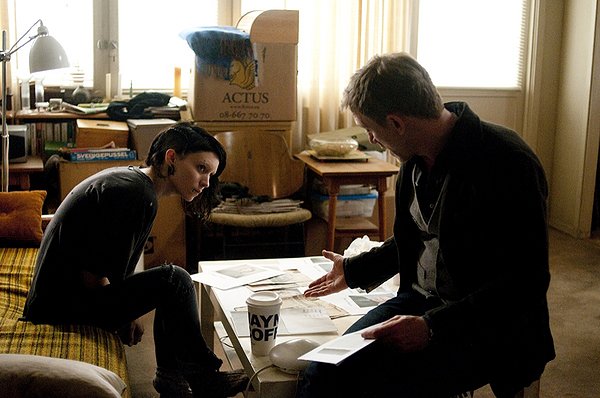 I’m not one for lazy analysis, but I feel like the uncomfortable issue of sexual violence/ voyeurism needs to be addressed, and I find that everything I wrote a year ago in my original Girl with the Dragon Tattoo review could readily apply to its Hollywood counterpart. So here goes: “The book’s original title was ‘Men Who Hate Women’ and that seems apt given what occurs on screen. Sure there’s a serial murderer on the loose but that’s par for the course. Even the grisly ritualistic killing stuff. But Lisbeth encounters a lot of malice and hostile male aggression, some of it very sickening. There’s a startlingly extended rape sequence, followed by some sadistic, if justifiable, revenge. It all contributes to an overall tone of queasy misogyny that seems to waver between intentional and unintentional. I’m not sure tone-wise whether the movie ever creeps into unsettling voyeurism at the behest of women in explicit sexual peril, but it certainly is a distraction. It can get pretty hard to watch at times in this disturbing thriller. I hope the eventual sequels don’t follow this same queasy, upsetting tone but I also worry that this may be unfortunately part of the books/movies’ appeal.”
For those new to Lisbeth and Larsson’s sordid saga, The Girl with the Dragon Tattoo will more than likely play well, a squalid thriller with the nicest coat of gloss you could ever hope for given the material. This is dark, rape-heavy stuff, and an odd adult drama to position as a Christmas release, but the collective appeal of the best-selling books should guarantee so many butts in the seats. It’s likely a safe bet that a high majority of those paying customers are unfamiliar with the Swedish version of the same story, which is a shame because, short of a few technical advances, I believe the Swedish film to be the superior movie. It had better acting, more appropriate casting, a rounder narrative that fleshed out the characters, their relationships, and their histories better, and a better score (sorry Trent, better luck next time). It’s still a movie that registers a “good” on most critical accounts, and Lisbeth Salander is still a fascinating person, a wounded warrior that catches the imagination. I’ll be curious to see if the subtitle-free Girl with the Dragon Tattoo does well enough at the box-office to warrant filming the next two decidedly lesser books. Whatever the case, there will always be the Swedish films and Ms. Rapace’s star-making performance.
Nate’s Grade: B


 nathanzoebl
You must be logged in to post a comment.