Blog Archives
Swiss Army Man (2016)
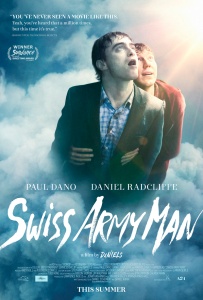 Swiss Army Man shouldn’t work as a movie, and in fact it will only work for a narrow swath of the world’s audience. There were plenty of walkouts during its Sundance premiere. The triumphant riding of a powerfully flatulent corpse in the film’s opening ten minutes should seal the movie’s fate. How does a movie survive such a juvenile, taste-obliterating moment, and one that is meant as an introduction to the film? Amazingly, stupendously, Swiss Army Man delicately walks that narrow tonal path and succeeds wildly, rapturously, and produces the rarest commodity in Hollywood, something daringly different and excitingly new. I fully anticipate that sizeable portions of readers are going to have an immediate and repellent response from just reading the plot synopsis, and I can’t blame them. I will do my best to try and explain why the movie worked so well even if I know this will be a fool’s errand for many, but if I can convince one more human soul to give Swiss Army Man a chance, then I’ve done the Lord’s work.
Hank (Paul Dano) is stranded on a desert island and about to hang himself when a dead body (Daniel Radcliffe) washes ashore. Unfazed, Hank is still determined to end his life, that is, until he can no longer ignore the farting of the body. That’s when he gets an idea and uses the power of the farting corpse to ride back to the mainland. Hank drags the corpse with him finding unique benefits, like his retention of drinkable rainwater. He’s still stranded and it’s at this point that Manny, the name he gives the corpse, begins speaking and inquiring about the world and what it means to be human.
 Swiss Army Man is a disarming buddy comedy that weirdly yet miraculously deepens as it goes, becoming a genuine relationship drama that touches on the profound and philosophical. For the first act, the movie is an unconventional survival drama with Hank finding peculiar yet helpful uses with his savior, the dead corpse. It’s a guy lugging around a dead body at the end of the day. I was wondering if this was really a story that was more suited as a short and didn’t have the substance to merit a feature-length runtime, and that’s when the magic realism steps up and when Manny comes into focus. This is easily one of the most oddball buddy comedies ever. Manny is an innocent, a proverbial babe in the woods, and doesn’t know much about himself and the world, and Hank becomes his teacher. Through this process he’s forced to examine his own life from an altogether different perspective and actually starts to vocalize and come to grips with his own life’s shortcomings, insecurities, and frustrations. It’s through Manny that Hank is able to open up and examine what it means to be human. Their interaction becomes a truly rewarding and emotionally honest buddy film where one of them just happens to be a talking corpse that farts a lot. Manny wants to learn about the world and to feel what it means to be alive, and it’s this new path that emerges that gives the film a new life.
You would expect something this strange to be drenched in irony or pushing the audience to laugh at the characters, but you would be completely wrong. Swiss Army Man is one of the most earnest movies you will ever see. It is completely genuine, heartfelt, sincere in every crazy detail, and it’s what gives the movie its emotional resonance. It treats the relationship between Hank and Manny with credibility. It’s a movie about celebrating and claiming ones weirdness, told from a movie that is proudly offbeat. Hank feels left out by normal social interactions. He’s the typically withdrawn and awkward Dano character we’ve come to expect from his catalogue of films; however, rarely has he seemed this artfully articulated. He’s a man who has some deep-seeded neuroses and fears, including farting aloud in public, and he’s using his ongoing experiences with Manny to exorcise some of these past failings, to become the determined, self-actualized man he wants to be. There’s a touching part where Hank talks about the poor relationship with his father; the two have signed up for one another to get birthday e-cards via email. That’s the extent of their connection at this point, and yet Hank remarks that even if he were to die his father would still get a birthday card from him in perpetuity. It’s a small little thing but it hits and makes one think about the impact and legacy we’ll have after we’re gone for good. Are we more than just an occasional birthday card? The fact that the movie utilizes a climax that incorporates farting in public as an emotional catharsis is amazing, but what’s even more amazing is that this moment is completely earned and gratifying.
Another aspect of Swiss Army Man that kept me specifically amused is the clever use of ambiguity. As the fantastical plays out with even-keeled realism, it’s easy and expected to believe that much of what we are witnessing is all in the mind of Hank. He’s projecting his needs and hopes onto this analogue for a friend that also represents himself. That’s why Hank uses Manny to relive personal experiences and to try and get them right. Then the third act comes along and causes you to question even more, putting the behavior of Hank into a muddier realm that makes you wonder if he’s this innocent wounded heart we had come to know previously. Then there’s Hank’s fixation over the pretty girl (Mary Elizabeth Winstead) he gravitated to on his bus rides. He looks to her as a goal, something he can return to once finally rescued and returned home. As he plays out his brief experiences with her, dressed as her, with Manny in the position of Hank, a faux courtship ensues. Hank, as her, and Manny, as stand-in for Hank, and it’s weird and wonderful and not afraid to accept the homoerotic qualities of its implications. This is a love story ultimately but a unique kind of love, and it’s up to the audience to determine what that means exactly. Is it romantic, bro-mantic, or simply a dude coming to terms with his own life in a very unusual therapeutic manner? The writer/directors The Daniels (Dan Kwan, Dan Scheinert) don’t outright tell you how to think or feel throughout any of this movie, which is a blessing. They present a complicated world with complicated and broken people doing their best to try and make their own sense, and they invite the audience along on this beguiling journey and just ask that they be patient and open-minded and then come to their own conclusions.
 The music is a wonderful element that is also another facet of the characters, layering in even more whimsy and character depth. The music is often accompanied by Radcliffe and Dano, their mutterings and ramblings becoming syncopated and layered into a soothing collage of sound. They’re providing their own soundtrack to the movie of their life. Early on Hank describes the music from Jurassic Park as the proper accompaniment for life’s big moments, with a little nestling of nostalgia as well. It’s especially enjoyable to listen to either of the guys break out into their rendition of the majestic Jurassic Park theme. It’s silly and sweet but it also gets at the psychological element of Hank being outside himself, seeing his life as a movie and he as its lead. He also hums what he remembers of “Cotton Eyed Joe,” which reappears throughout with comically incorrect and changing lyrics. The music is another reflection of the characters and it imbues the scenes with an extra sense of whimsy that helps to maintain its magic realism tone.
Radcliffe (Harry Potter and the… everything) and Dano (Love and Mercy) are terrific together and Radcliffe gives a tour de force physical performance. The way he’s able to contort his body, malign his posture, make use of stilted facial expressions is amazing. This goes leagues beyond the simple slapstick of Weekend at Bernie’s. The way he’s able to convey a character and a performance through this crazy decaying prism. Manny wants to help people, is eager to learn, and it makes his character so endearing, and then you remember he’s a corpse who might just be a figment of Hank’s diseased imagination. Radcliffe completely lets go of vanity and delivers one of the best performances of the year. Dano is in more familiar territory but shines again, serving as a dry comic foil for Radcliffe. The two of them form a highly entertaining and winning buddy team.
Swiss Army Man is a unique film experience and one that shouldn’t work. It’s filled with juvenile body humor. Its key supporting role is a dead body. It’s about a guy who may or may not be a stalker living in a fantasy world in his own head. This should not be, and yet like Manny himself, miraculously it has been birthed into existence and we are better for it. Every time it feels like the movie is heading for a more conventional direction that will weigh it down, be it a love triangle or some slapdash “he was dead the whole time” twist ending, it calmly steers away. This is a wonderfully humane, touching, earnest, and emotionally affecting movie, one that, yes, also involves farting. The body humor stuff is a reflection over confronting what we feel uncomfortable with and why that is, what social conventions tell us is in poor taste, tell us to box ourselves in and play by the rules. Here is a movie that gleefully plays by its own rules. It’s not going to be for everyone but if it’s for you, like me, there might not be much else that can rival its cinematic highs. Even if you think you will hate this movie, see it. See it just to have seen one of the strangest and most beguiling movies of the modern era. See it and judge for yourself. I’m still awed at how life affirming and profound a movie with a farting corpse can be. Swiss Army Man is a labor of love, an explosion of feeling, and a declaration to stay weird.
Nate’s Grade: A
Share this:

Deadpool (2016)
 Deadpool is easily the most fan service of comic characters, so it makes sense that his big screen spotlight is a movie that feels a fan service movie. The “merc with a mouth” is a character that doesn’t take himself seriously and neither does his big screen adventure, which is the biggest appeal of an otherwise standard super hero formula hiding under waves of winking irony, crass humor, and gleefully bloody violent mayhem. Ryan Reynolds plays Wade Wilson, a hired gun that undergoes a risky experimental treatment by a shady black ops organization to cure his terminal illness. It makes him generally indestructible with a rapid healing ability but his flesh is also horribly scarred and Wade is afraid his girlfriend Vanessa (Morena Baccarin), a hooker with a heart of gold, will reject him. Even in the opening credits, you know this isn’t going to be a typical super hero movie. The time is ripe for a film that knowingly ridicules the tropes of the super hero film industry, and Deadpool scores some big laughs when its making fun of itself and its super peers. The dark humor can often surprise with how go-for-broke it can get, like Wade and his Vanessa’s flirty one-upsmanship of hypothetical sexual trauma. There’s a clever montage of Wade and Vanessa’s romantic history told through sexually-specific holiday celebrations, and the inclusion of a couple of low-rent X-Men provides a comic foil for Deadpool to bounce off from. The action is fun and the movie is entertaining from its opening credits to the now-mandatory post-credits bonus. Reynolds is spiritually attuned with the irreverence of the anti-hero, finally plugging into a part that makes full use of his charm, motor mouth, and physicality. Deadpool’s runaway box-office success (grossing more than any X-Men film and on at least half the budget) will hopefully allow Hollywood to feel comfortable allowing their less than family-friendly comic titles to stay true to their intentions. Then again maybe they’ll just take all the wrong messages and think that audiences just want to hear more swearing from people in spandex. Deadpool is a super hero movie that prioritizes fun over everything else, and while it may not be for everyone, at least it’s trying to be for someone different.
Nate’s Grade: B
Share this:

The Big Short (2015)
 Adam McKay is not exactly the kind of name you associate with a prestige picture that’s building serious Oscar heat. McKay is best known as the director and co-writer of Will Ferrell’s best movies, from Anchorman and its sequel to Talladega Nights and the underrated 2010 buddy cop movie, The Other Guys. If you stuck through the closing credits for Guys, you were treated to an animated education lesson on the size of Wall Street’s greed and accountability in regards to the 2008 financial crisis. It was impassioned, angry, and an interesting note to end an otherwise goofy comedy. The Big Short is based upon Michael Lewis’ (Moneyball) best-selling book and it’s a disaster movie where the biggest disaster is the world economy. The movie McKay co-adapted and directed is bristling with intelligence, indignation, and a clear purpose. He wants to make you very angry, and by the end if you’re not, you haven’t been paying enough attention.
In the wake of the financial collapse in 2008, the fallout was so tremendous that many people felt nobody could have seen this coming. There were a few and they made out like bandits while trying to warn others about the impending doom. In the early 2000s, Michael Burry (Christian Bale) is a hedgefund manager who sees warning signs that the housing market is a bubble ready to burst. He sees the toxicity of the majority sub-prime mortgages wrapped together and sold as a seemingly safe security, a CDO (collateralized debt obligation). His bosses think he’s mad and they’re furious when they discover Burry has gone from bank to bank making big bets against the housing market. The banks are eager to take what they believe to be easy money from a sucker. How could the housing market burst? Other Wall Street investors take notice of Burry, notably Jared Vennett (Ryan Gosling) who pitches the plan to “short” the housing market. Nobody takes him seriously except Mark Baum (Steve Carell) and his small team who works for Goldman Sachs. Baum is curious how something so large could go unnoticed, so he and his team fly to Florida and Vegas to investigate the realities of the market and what they find does not match the rosy cheerleading from Wall Street. A pair of wannabe traders (Finn Witrock, John Magaro) stumbles across Burry’s analysis and try to make their own bets, except they need a bigger name to make the trades. They reach out to an ex-Wall Street trader (Brad Pitt) who agrees to shepherd them on this quixotic quest. Are these men righteous defenders of fraud or just people trying to get their own cut of the pie?
 The brilliance of The Big Short lies in its accessibility and the virulent passion that McKay has for the subject matter. The movie is structured like a heist and an underdog story, suckering in the audience to root for the upstarts trying to fleece the big banks and profit off their greed and stupidity. For the first 90 minutes or so, the film comes across like a caper and we follow our group of misfits as they fight against the conventional wisdom that the housing market could never topple. These guys see the signs and the risks that others could not or would not see, especially since the flow of money was rich and the good times could be shared, which lead to collusion from the very same agencies designed to regulate and enforce the financial laws. For those 90 minutes the movie flies by on its sense of whimsy and are-we-getting-away-with-this good fortune, putting our band of misfits in position to win big on the losses of the ignorant and fraudulent. And then, in one swift move, it all comes down and you’re reminded, rather indignantly by Pitt’s character, that what they are benefiting from is the meltdown of the U.S. housing market and by extension the American economy. What once felt like a celebratory caper now starts to feel queasy, and it’s in the last act that The Big Short reminds you just how awful the events of the 2008 financial crisis were and how these guys did nothing more than benefit from mass misery. These are not heroes, though Mark Baum is given plenty of moral grandstanding moments that present him as the closest thing we have in the picture. These were a bunch of guys who got rich betting on a lot of other people’s bad bets, bets that almost destroyed the world’s economic systems. The concluding half hour feels like a sudden stop after a sugar rush, where you’re left to question your decision-making but also come to terms with the reality of what seemed like a fun time. McKay lures his audience in with the guise of a heist/underdog story, appealing and accessible avenues of cinema, and then serves the cold hard medicine in the concluding moments.
McKay is admirably trying to educate and advocate while he entertains, but he truly wants the audience to understand why they should be sharpening their pitchforks. At several points, characters will break the fourth wall and talk directly into the camera, admitting that certain events didn’t happen exactly as we saw, or occasionally they’ll remind us that what we watched was exactly how it happened. It’s a measure that isn’t overplayed and helps juice the spirits of the movie, becoming something of a confidant in the schemes with the onscreen participants. When things gets a little hard to understand with the mountain of Wall Street lingo, McKay will cut to celebrity cameos to help explain the more arcane instruments of the financial system. Margot Robbie luxuriates in a bubble bath and explains sub-prime mortgages, Anthony Bourdain explains CDOs, and Selena Gomez, in a rather cogent analogy, explains synthetic CDOs as an endless chain of side bets being made off one hand of blackjack. The movie goes pretty fast and a viewer might experience information overload but McKay knows when to slow things down and provide a well-timed assist so that his learned audience will see the true extent of the corruption and greed rampant in how Wall Street handled its business.
 Of the three storylines, I found Mark Baum and his team easily the most interesting and I think McKay and co-screenwriter Charles Randolph (The Interpreter) agreed, which is why he’s the biggest part of the movie. Burry gets things started but he recedes into the background after the first act, and that’s where Baum and his financial team step into the spotlight to further explore how unstable the housing market just might be. I think this is Carell’s best dramatic performance to date (I wasn’t wowed by Foxcatcher). He’s playing perhaps one of the angriest people seen on screen but that’s because he has a moral center and the bad business practices, let alone the sociopathic greed of his “peers,” constantly enrage him. He’s something like a flabbergasted crusading journalist who keeps shaking his head in stupefying revulsion at just how deep this whole thing goes. Having Baum as our entry into the moral morass of Wall Street allows the audience to feel a sense of ethical superiority, and then like Pitt’s character, it can all go away with one perfectly articulated retort. There’s a moment where Baum is lambasting a mortgage ratings officer (Melissa Leo, her only scene too) after she admits that if they don’t rate bad mortgages as good, the banks will just go to their competitor, and then she accuses Baum of being a hypocrite. His reason for the office visit is not his outrage at the fraud but the fact that this fraud is holding up his winnings. He’s not the crusader he may wish to be. Bale (American Hustle) and Gosling (Only God Forgives) are perfectly cast and provide strong supporting work in small doses spread throughout. Pitt is in 12 Years a Slave producer mode where he knows he needs to appear in the movie to better sell it to audiences, and so he’s here and rather unremarkable. There is a bevy of familiar faces (Marisa Tomei, Rafe Spall, Max Greenfield, Karen Gillan) appearing in small moments as if everybody in Hollywood wanted to get in on McKay’s party.
There is one annoying misstep in the movie and it occurs about halfway and it’s made to stretch out the stakes in a haphazard manner. The Big Short is a disaster movie where the audience knows exactly when the disaster is coming, and yet there’s a section in the middle where the characters are all left in doubt whether their big bets will pay off because of the ratings fraud. Burry is threatened with losing his job. It’s silly because we know the economy is going to crash in 2008, but the movie throws out a weak obstacle that, hey, maybe it won’t crash. It reminds me of the Hinderberg movie from the 1970s. There were several moments where it looked like that zeppelin full of hydrogen was going to go up in flames… except students of history know that moment is fated in New Jersey, so all the close calls were foolish fake-outs for a major event that was well anticipated. We all know the economy is going down so there’s no need for the manufactured doubts.
McKay and company want to wake up a fairly apathetic general public about the crimes and negligence of the Wall Street robber barons that risked the world’s economy and then managed to skip out on the tab. The tones can juggle wildly, and I’d credit McKay’s background in comedy for his ability to maintain a reliable and firm comic footing for the film without losing the significance of his message. It’s hard to nail down a genre for the movie; it’s a dark comedy, a drama, a true crime picture, and a wake-up call. You have moments that feel like a heist flick and moments that feel like a sickening journalistic expose. It’s got highs, lows, laughs, groans, and plenty of human emotions, though the most prominent would be disgust and disbelief. The Big Short is advocacy populism as pop-entertainment, and it succeeds ably. It’s an economics lesson for the public. At the end of the movie, the closing text informs us about “bespoke tranches,” which are investment opportunities that banks are flocking to ($5 billion in 2013 to $20 billion in 2014). It’s just another name for CDOs. Unless an informed public demands action from the system, it seems that Wall Street is doomed to repeat its same high-risk mistakes and that same vulnerable public is doomed to clean up the mess.
Nate’s Grade: A-
Share this:

Dom Hemingway (2014)
 Undeservingly lost in the shuffle, Dom Hemingway is a brash and wildly entertaining dark crime comedy. Jude Law is a sheer force of nature as the title character, a charismatic and garrulous criminal with no shortness of ego or volume. He’s just getting out of a 12-year jail sentence and taking stock of his life. His wife is dead, his grown-up daughter (Game of Thrones’ Emilia Clarke) hates him for his absence, and his bosses are ready to reward him for his long silence. The only person who could screw things is up is Dom, and he does, as he’s prone to impulsive fits, shouting matches, and oversized bravado. This is really a series of comic vignettes and vulgar monologues, but the writing by Richard Shepard (The Matador) is slyly hilarious, leaving me in stitches throughout (“I am not burying your body today! I didn’t bring the right shoes for it.”). The comic voice here is assured and finely attuned to the broad wavelengths the characters. It’s not exactly he colorful, cartoon criminal universe of early Guy Ritchie films, but there’s a definitely heightened atmosphere here that blends well with the manic nature of Dom. Law is bouncing off the walls; you may have to wash the spittle off your TV. But he’s compelling from his first minute onscreen to his last. The third act squeezes in a degree of emotions though by then we’ve been enjoying the depravity too much to switch focus. I don’t think the work has been put in to make Dom a three-dimensional character, but that won’t stop Dom’s film from being a blast of entertainment with swagger to spare.
Nate’s Grade: A-
Share this:

Birdman or (The Unexpected Virtue of Ignorance) (2014)
 Expecting a comedy from Mexican director Alejandro Gonzalez Inarritu would have preposterous. The man was known for his cinema verite of suffering, notably Babel, 21 Grams, Biutiful, and his best film, Amores Perros, roughly translated to Love’s a Bitch. Perhaps there isn’t much of a shift going from tragedy to comedy. Inarritu’s newest film, Birdman or (The Unexpected Virtue of Ignorance), has been wowing critics and audiences alike, building deafening awards buzz for its cast, Iarritu, and the superb cinematography, but will it fly with mainstream audiences? This may be one of the weirdest Oscar front-runners in some time.
Riggan (Michael Keaton) is an actor best known for playing the superhero Birdman in the early 1990s and walking away from the franchise. He’s still haunted by that role (sometimes literally) and struggling to prove himself as an artist. He’s brokered all his money into directing, adapting, and starring in a theatrical version of Raymond Carver’s short story, “What We Talk About When We Talk About Love.” The show is in previews and about to open its run on Broadway but it’s already got a rash of problems. The leading man needs to be replaced immediately. The supposed savior is famous actor Mike (Edward Norton), an undeniably talented but temperamental actor who pushes buttons to find some fleeting semblance of “truth.” Mike’s girlfriend, Lesley (Naomi Watts), is growing tired of his antics and desperate for her own long-delayed big break. Laura (Andrea Riseborough) is Riggan’s “girlfriend” and co-star and may be pregnant. Sam (Emma Stone), Riggan’s personal assistant and also his detached daughter, is fresh from rehab, and spiteful against her neglectful dad. Toss in Riggan’s best friend/manager/play producer (Zach Galifianakis), Riggan’s ex-wife (Amy Ryan), and a feared theater critic (Lindsay Duncan) who is determined to kill Riggan’s show to send a message to the rest of Hollywood polluting the integrity of the theat-tah. Oh, and throughout all this, Riggan hears an ominous voice that alternating encourages him and humiliates him.
 It’s an industry satire, a bizarre comedy, a father/daughter drama, an examination on identity and the complicated pulls of affection and admiration, and a stunning virtuoso technical achievement. As a movie, Birdman is hard to pin down or categorize. It’s a movie that you definitely need to experience on your own rather than have described (don’t stop reading, come back…), and that is a reason enough to see the film, a rare aspect among modern movies. It’s an artistically offbeat movie and yet it ultimately is about one has been actor looking back on his career and coming to terms with his own impact with pop-culture, art, and his family. It’s about a man struggling to find his place in his own life, beset at all odds by doubters and traitors and obstructionists. The refreshing aspect about Riggan is that he’s a has-been but not a sad sack; he’s fighting from the beginning, sometimes pathetically and sometimes in vain, but the man is always fighting to regain his dignity, to reclaim his life’s narrative, and to fight for his legacy. Riggan, after all, set the stage for the modern superhero industry that currently dominates Hollywood bean counters. He was too just soon, and the parallels with Keaton (Batman) are superficially interesting but there’s more of an original character here than a reflection of the actor playing him. He’s neurotic, egotistical, hungry, and fighting for respect, like many actors, and the film flirts with the façades people inhabit. Many of the characters are emotionally needy, desperate for validation wherever they can find it.
Another strength of the film is that it finds a moment for each of its talented ensemble players to shine, chief among them Keaton. The actor hasn’t had a showcase like this in some time and he is a terrific guiding force to hold the entire story together. Whether it’s marching in his tighty whities or working through his complicated degrees of neuroses, Keaton is alive in a way that is electrifying. We see several highs and lows over the course of two hours, some moments making us cheer on Riggan and others making us wince, but he comes across more like a person than just the butt of a joke. It’s also just fun to watch him adopt different acting styles when he steps on stage, including one early on where he’s purposely too stilted. It’s so comforting to watch Norton (The Grand Budapest Hotel) get to be great again, not just good but great. Early on, you see the appeal of Mike, his allure, and Norton keeps pushing the audience, as well as the characters, back and forth with his wealth of talent. Stone (Amazing Spider-Man 2) spends most of the film as the sulky daughter but she gets to uncork one awesomely angry monologue against her loser dad. The thawing father/daughter relationship ends up supplying the film with its only degree of heart. Watts (The Impossible) is comically frazzled for the majority of her time but gets a memorable character beat where she breaks down in tears, realizing her dream of “making it” might never materialize. Riseborough (Oblivion) also has moments where he sadness and vulnerability cut deep. The supporting characters aren’t terribly deep but they all have a moment to standout.
It’s a decidedly offbeat film that dips into the surreal though never dives completely inside. The movie is rather ambiguous about whether or not the fantastical flourishes are a result of Riggan being mentally ill, or at the least overtaxed with stress. Is there really a Birdman or is it a voice in his head, a manifestation of his ego or a ghost to remind him of the past when he was a star? Does Riggan really have the powers he seems to believe he does, including the ability to make objects move with his mind? Innaritu playfully keeps the audience guessing, treating the bizarre in an offhand manner reminiscent of magic realism. The bizarre embellishments blend smoothly with the film’s darkly comic tone. It’s a funny movie but one that you laugh at between clenched teeth.
 Is it all the unblinking camerawork a gimmick? I don’t think so. While the story can engage with its weirdness and surreal unpredictability, the long tracking shots bring a heightened reality to the unreal, they bring a larger sense of awe to the proceedings, watching to see the magic trick pulled off to the end. If anything, it’s an extra thrill to the script and greatly compounds the artistic audaciousness of the film, but I think it also channels the live-wire energy of theater, of watching actors have to walk that tightrope of performance and blocking, weaving together to pull off the ensemble. It makes the film medium feel more like live theater. Thematically I think the style also connects to the anxious mentality of Riggan. In the end, I don’t truly care that much whether it’s a gimmick or not (though I vote it is not) because the camerawork is rapturous. Made to resemble an entire two-hour tracking shot, it is a joyous thrill to watch these technical wizards do their thing, to watch the best in the business perform a visual magic trick over the duration of two hours. Even if you don’t care for the overall movie you can at least be entertained by the imaginative and thoroughly accomplished cinematography by Emmanuel Lubezki, fresh from his Oscar for Gravity and who should be clearing shelf space for the next bushel of awards he’s destined to win with this film. It’s an intoxicating experience to behold, though the film is structured into 10-minute or so chunks for feasibility. If you want to watch a real cinematic magic trick, check out the film Russian Ark, which is an entire movie, performed in one uncut single tracking shot.
I’m still wrestling with the debate over whether Birdman is an artistically ambitious romp or a truly great movie. Much like the characters in the film, I’m wrestling with whether I have confused my admiration with adoration. It’s a movie that I feel compelled to see a second time, and maybe a third, just to get a handle on my overall thoughts and feelings. That may be a sign that Birdman is a film for the ages, or maybe it’s just a sign that it’s not as approachable and denied a higher level of greatness by its obtuseness. Inarritu’s surreal showbiz satire is plenty entertaining, darkly comic, and a technical marvel thanks to the brilliant camerawork. The percussion-heavy musical score is another clever choice, naturally adding more urgency and anxiety to the proceedings. Birdman is a strange and beguiling movie, one that deserves to be seen, needs to be experienced, and stays with you rolling around in your brain. That sounds like a winner to me.
Nate’s Grade: A
Share this:

The Wolf of Wall Street (2013)
 Martin Scorsese. The greatest living filmmaker on the planet. Enough said. When his latest, The Wolf of Wall Street, was pushed back due to an editing crunch, the rumor mill started as it normally does. Are there problems? Is it any good? Will it be forgotten this late into the awards season? While I can’t speak for the Academy, but for me The Wolf of Wall Street just about blows every competing movie out of the water this season. It’s brash, exhilarating, uproarious, mesmerizing, and just about every other adjective you can fetch from a dictionary. This is first-class filmmaking from a master, and consider Wolf of Wall Street the white-collar companion piece to Scorsese’s gangster masterpiece, Goodfellas. It’s that good, folks.
Based on his memoirs, Jordan Belfort (Leonardo DiCaprio) rises on Wall Street from a rookie stock trader to the king of his own empire. From the late 80s to the 90s, Jordan assembles a cutthroat team that knowingly sells lousy stocks to gullible investors and stuffing their pockets with hefty commissions. “Better there money was with me. I knew how to spend it better,” he admits. His closest friend and business partner, Donnie Azoff (Jonah Hill), literally quits his job to work for Jordan after spying one of his pay stubs. The guys start their own firm, specializing in high-pressure sales and on penny stock commissions. From there, they expand and expand until they’re making their own noise on Wall Street. The trading floor more closely resembles a frathouse party, complete with chimp, strippers, marching bands in their underwear, midget tossing, and other objectionable behavior. Jordan easily succumbs to the sex and drugs of the high-finance world of money, leaving his plain wife for Naomi (Margot Robbie), a gorgeous underwear model. He’s got a giant estate, a huge yacht, his own helicopter, and more money than he can spend. He’s also got the attention of the FBI and Agent Patrick Denham (Kyle Chandler). With the feds circling in, Jordan has to take extra steps to keep the good times rolling.
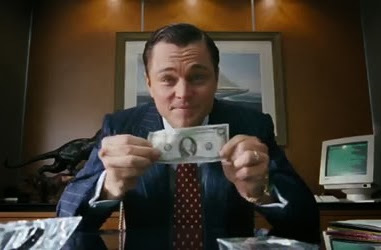 With a running time exactly one minute shy of three hours, it’s easy to call The Wolf of Wall Street self-indulgent and excessive, except that’s exactly the point. The movie is an orgy of unchecked male ego, a perverse bacchanal of Earthly pleasures that Caligula might blushingly admire. They are literally two orgies depicted in the movie and plenty of thrust-heavy sexual congress (I counted eight walkouts in my theater, most of them the little old lady variety). Here is a tilt-o-wheel of madness. These people were living like there was no tomorrow, had more money than they knew what to possibly do with, and would figuratively dance while Rome burns (in this instance, the stability of the U.S. economy). What’s important is to communicate that these individuals were having the time of their lives. It wasn’t just the hedonistic pleasures and the mountains of drugs; it was the power, the uninhibited embrace of a life available via poorly regulated capitalism. Many of those brokers in Jordan’s company were people from ordinary backgrounds. Their self-made success (that wasn’t so much earned as swindled) is a point of pride that fills them with purpose. They are seizing their full potential. There is no doubt in my mind that every broker in this movie would do it all again in a heartbeat. There is no remorse on display anywhere. The only remorse is having the ride unceremoniously end. “Was it obscene? Yeah it was obscene. In the normal world,” Jordan narrates. “And who wants to live there?”
I won’t say that there aren’t scenes and moments that could have been trimmed, but I was enjoying myself way too much to care about the bloat. This is the fastest three hours you’ll ever experience in your life. There’s some fat, yes, but man does this picture just move along like a freight train. The screenplay by Terence Winter (creator of HBO’s Boardwalk Empire) is impeccably drawn. The movie just courses with energy and watching it is often an exhilarating rush, communicating the highs the characters are undergoing. The supporting players are used to great effect to punctuate the comedy moment to moment. I loved Rob Reiner’s exasperated and profane performance as Jordan’s father. Naturally the bad behavior is entertaining in how absurd and over-the-top it can get, but one key sequence ranks up there with the finest sequences Scorsese has ever put to film. It’s the “Lemon” sequence, named after a legendarily potent batch of Quaaludes. It is a sequence of pure movie bliss, brilliantly edited and staged, as Jordan is placed in a precarious position when the drugs kick in, and his comic floundering is riotous. Winter and Scorsese have taken what, in other hands, could have been a modern American tragedy and decided to portray it as a darkly comic fantasia. I laughed long and hard throughout the movie. There are numerous scenes I can think back on and start laughing again. The ridiculous nature of moments, like discussing the logistics of tossing midgets at a dart board (“This is their gift”) is to be expected, but it’s the overall degenerate lifestyle these clowns chase after with impunity that kept me laughing.
I’ve read cantankerous critiques of the film, chastising Scorsese for celebrating the lavish lifestyle and excessive hedonism of his characters. I could not disagree with this appraisal more. The error is assuming that witnessing Jordan behaving badly is akin to celebrating it, as if adopting the perspective of our lead is the same as excusing his actions. Scorsese makes it clear early, and often, that Jordan Belfort is not a good person. Hopefully you don’t need him hitting his wife for this point to stick. This guy is fleecing people out of their life savings, living high off the fat of the land, and openly admitting to the camera how deeply illegal his activities are. But you’re under his spell, much like his brokers that worship him with unflinching zeal. Jordan, especially as portrayed by DiCaprio, is a volcano of energy and single-minded determination. He whips his troops up like a religious revival, manipulating you with every tactic in his employ. Early on, he’s defrauding ordinary middle-class and low-income clients, but because we’re all addicted to the adrenaline rush of the sale, of the con, we push this troubling reality from our minds. When he moves onto wealthier clients, we adopt a similar attitude of Teresa, Jordan’s first wife, mainly that these people can afford the losses and therefore get what they deserve from a silver-tongued shyster. It’s the audience that proves to have a selective memory because we’re drawn to Jordan’s charisma, expertise, and talent, so we ignore the pesky details of who gets stuck with the bill. Don’t pin that on Scorsese. He makes it abundantly clear that Jordan is a bad man, and the depths of his greed is but the tip of the iceberg when it comes to Wall Street. Jordan’s firm was a tiny player. Think of what horror stories Goldman Sachs or Lehman Brothers would offer if ever exposed.
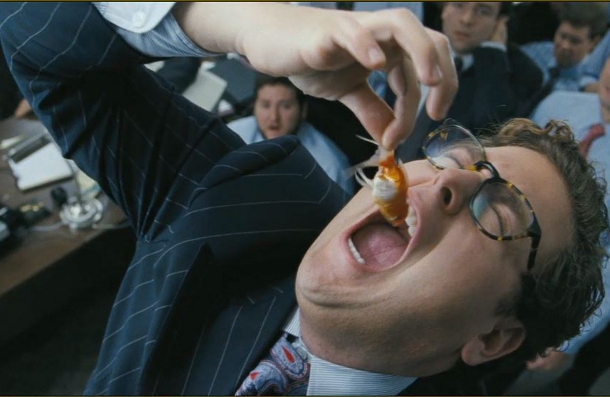 This is my favorite Scorsese film since Goodfellas, and they have plenty of similarities. It makes sense because these men of finance take their cues from movie gangsters, styling themselves as tough guys. At one point, brokers hold a guy over a building to intimidate him. There’s also certainly as much cocaine as there may have been in Scarface. But like that classic of the gangster cinema, Scorsese propels us into the hidden world of the financial institution run amok, allowing us a backstage pass to the people profiting from wrecking the economy. It’s a fascinating perspective that confirms some of our worst fears about stockbrokers. It’s a misogynistic boys club and the few women that do participate have to play by their hyper masculine, juvenile rules. These are people that find any number of ways to skirt the law, rip off their clients, and live in luxury until they can find another sucker. It’s a system built for the entertainment of the few on the backs of the many, and it’s just as relevant today as it was in the 90s. With Jordan’s inside knowledge, we’re educated on the many corrupt ways of Wall Street.
Marking the fifth collaboration with Scorsese, this may be the finest DiCaprio (The Great Gatsby) performance yet. The man sheds his vanity, easily fitting into the shark that is Jordan Belfort. He’s ruthless in one moment and completely inept in another, at the whim of his vices. DiCaprio taps into Jordan’s leadership qualities with the dynamite sales speeches, but he also shows what an insecure man he is at heart. He’s got a taste for the good life and is reinventing himself, including trading up in wives to attain that proverbial American Dream. He’s living empty pleasure to empty pleasure and he doesn’t care. DiCaprio acts as our ringmaster through his own circus, and you’ll be delighted and horrified by his actions (and also his peculiar, bird-like dance moves). There’s not a bad performance in the whole cast, and this is one huge cast. Hill (This is the End) is a becoming more and more credible as a dramatic actor, though he excels at the blustery outrageousness as Jordan’s number two. He’s a treat. Robbie (About Time) nails her New Yawk accent but more importantly nails the portrayal of a trophy wife who recognizes and eventually resents her lifestyle. And oh does she just exude sexual heat.
I want to focus on the very end of the film, so there will be some mild spoilers in this paragraph but nothing I feel that would ruin the viewing experience. You have been warned, spoiler phobes. As expected, Jordan eventually winds up in jail for his felonious misdeeds. Ordinarily this would be the end of our traditional law-and-order morality tales; the bad guys are locked away to pay for their crimes. Jordan tells us how nervous he was on his first day of prison, that is, until he remembered one very important fact: he’s rich. White-collar prison is not the same as other penitentiaries, and we see Jordan loftily playing tennis. His sentence is only three years as well, which seems like an insult given the thousands of lives he may have instrumentally ruined. But that’s the ultimate condemnation in the end: the system is rigged for people like Jordan, people with money. In the end, he wins. He goes to prison, his family life is torn asunder, and his personal relationships are strained, but the guy wins. He continues his speaking engagements motivating everyday saps how, with his cherished expertise, they too can rake in wealth. The final shot of the movie tells me everything I need to know. It’s a slight pan out to the crowd in attendance of Jordan’s speaking session. We see the collection of faces, each person hanging onto Jordan’s every word, each filled with idolatry. They want to be him. Despite everything, the bad behavior, the crimes, the waste, they all want to be him, and that’s why people like Jordan will always succeed, will always prevail, will always have the last laugh. There will always be a healthy supply of suckers that want to believe whatever nonsense he’s peddling. That’s the point. He won.
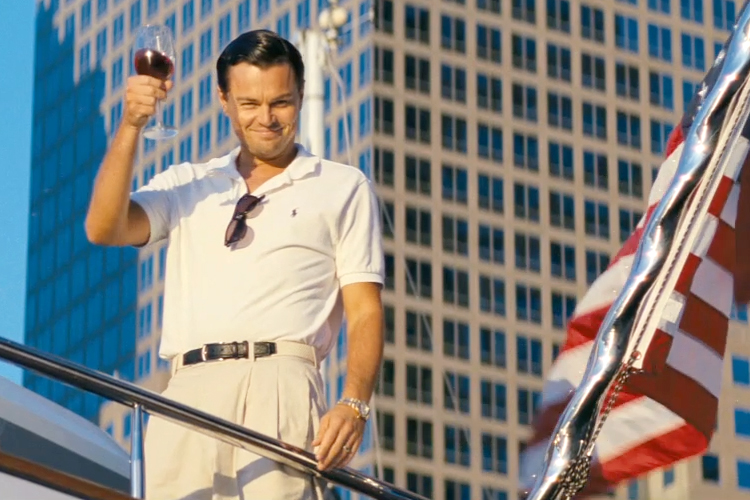 Recently I watched the very good crime caper American Hustle and noted that its director looked to be fashioning a loving Martin Scorsese homage. Well, after watching The Wolf of Wall Street twice (not back to back, mind you; I’m not nuts) I can say that there is no Scorsese like the source. This is vintage Scorsese. This is brilliant filmmaking, a bold movie that practically sings, it flies by with exhilarating force and acumen, daring you to keep watching. The fact that 71-year-old Scorsese could make a movie this highly energetic, this debased, this brash, this borderline indecent, and this awesomely entertaining is encouraging. It’s even more hilarious to me that older Academy members at a recent screening of the film accosted Scorsese, essentially being termed a “debauched scoundrel.” That’s got to count as some badge of honor. Yes, at three hours the movie can get long but it’s never dull or taxing. The propulsive narrative, the hilarious humor, the shrewd characterization, the wanton excess, the filmmaking bravado that hums, it all coalesces into a disturbing and disturbingly enjoyable condemnation of greed and our inherent celebration of this lifestyle. There is not one aspect of this movie that falls flat. The Wolf of Wall Street is an invigorating piece of cinema. The choice of music, the swinging cinematography, the wide ensemble of actors, the feverish editing, it all comes beautifully together to form a whole that surpasses everything else in cinema this year. Dig in.
Nate’s Grade: A
Share this:

August: Osage County (2013)
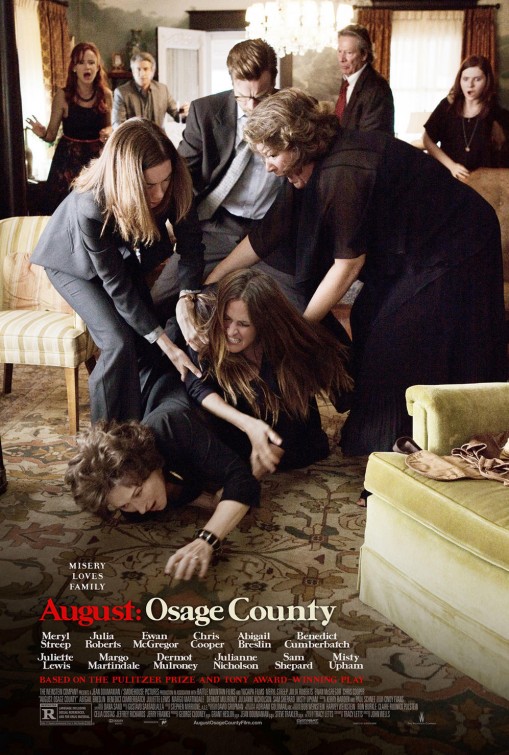 This holiday season, the movie with the most acting, by far, is likely to be August: Osage County, the adaptation of Tracy Letts’ Tony award-winning play. It’s a large dysfunctional family getting back together and opening old wounds, so, you know, the most relatable Christmas movie for some. It’s easy to see what attracted such A-list talent to this project because these characters are actor catnip; each is overflowing with drama, secrets, revelations, anger, and it’s all channeled through Letts’ barbed sense of humor and wickedly skillful dialogue. With Meryl Streep as the pill-popping matriarch, Julia Roberts as her resentful daughter, and a host of other inter-generational conflicts and secrets, you may feel exhausted by the end of its 130-minute running time (the stage play was 3.5 hours, respectively). The emotional confrontations feel like grueling pugilist matches, the melodrama kept at a fever pitch, but the film is never boring. Streep is her usual astonishing self and the deep ensemble gives each actor something to chew over. This is the best Roberts has been in years, and she’s not afraid to get nasty (“Eat your fish!”). Just when you think the story might soften, Letts unleashes another body blow, allowing no uncertainty that this is a family doomed. The story also provides insights into tracking the path of cruelty through the family tree, limb by limb. August: Osage County is stridently funny but also punishing in its no-holds-barred approach to family drama. If you’re looking for a movie that makes your family seem normal and even-tempered, this may be it.
Nate’s Grade: B
Share this:

Violet & Daisy (2013)
 It’s not often that I say this but… what the hell did I just watch? I know it’s a movie called Violet & Daisy, written and directed by Geoffrey Fletcher, the man who won a screenwriting Oscar for adapting Precious. But what is this? It is some meta commentary on film violence? A twisted fairy tale? A dark comedy? Whatever it is, I know for certain that it was not very good or entertaining.
Violet (Alexis Bledel) and Daisy (Saoirse Ronan) are teenagers who also work as hired assassins by their boss, Russ (Danny Trejo). Their next assignment has a personal angle: Michael (James Gandolfini) stole a large sum of money from Russ. The gals hide out in Michael’s apartment only to fall asleep. When they wake up, Michael is sitting there, accepting his fate, begging the girls to complete their job. He’s dying from terminal cancer, estranged from his daughter, and hoping to exit this world on his own terms. Over the course of one long afternoon, the gals run into rival gangs, a trained sniper, police, neighbors, and all sorts of other plot contrivances to delay the death of Michael.
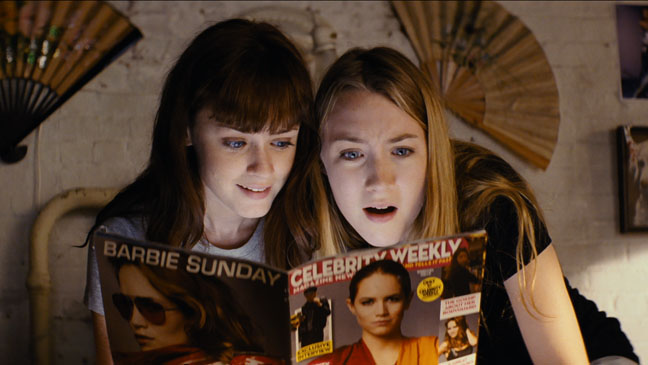 If you’re like me, with similar expectations when it comes to your moviegoing experiences, you’ll be left scratching your head and fumbling for some kind of rationale why people decided to make a film like Violet & Daisy. It feels instantly dated, relying upon the hook of young teen girls with big guns, you know, the same model that has translated to many a successful video game. More so than that, the aspiration, or at least direct inspiration, appears to be a Tarantino-knock-off. Not ripping off Tarantino, as many did in the mid-to-late 90s, but ripping off a poor Tarantino knock-off, like Two Days in the Valley or, the more adept comparison, The Big Hit. There is so much crap in this movie that exists merely because somebody thought it would look cool. Violet and Daisy open the movie dressed as pizza-delivering nuns (is this a fetish I am unaware of?) and open fire on a gang of criminals. But before their fateful gunfight, you better believe it, they have an innocuous conversation about something small, you know, like Jules and Vincent. Why are they dressed as nuns, let alone nuns delivering pizza? It doesn’t matter. This is a movie that doesn’t exist in a universe minutely close to our own. Everything about this film feels painfully and artificial. You know what previous job Violet and Daisy had? They worked at the “doll hospital,” a literal ward for dolls. The decisions of this movie are driven purely by a stylized self-indulgent whimsy. Once you realize this, and you will, the movie becomes even more of a chore to finish.
Then there’s the bizarre and sometimes uncomfortable infantilization of the female lead characters. These ladies do not act like adults; they don’t even act like teenagers. Even though they’re both over 18 years old, their behavior more closely resembles that of a flighty seven-year-old. Their speaking patterns are often in an annoying and partially creepy baby coo. They play paddy cake after successful hits. They ride tricycles. They chew bubblegum and blow bubbles during hits. They get excited about new Barbie Sunday dresses, and this is their real motivation for taking assassination jobs. Yes, to buy dresses. Then there’s their game, the Internal Bleeding Dance, where they hop up and down on the chests of their dying victims, blood spurting out of their mouths, the girls giggling, as if they were bouncing on a bed at a slumber party. These women aren’t remotely actual characters; they are masturbatory quirky hipster fodder, the ironically detached, sexy baby doll killer approximation. Except there is never any commentary at work. The depiction of Violet and Daisy as petite killers never approaches anything meaningful. They are killers because it’s cool. They talk like lobotomized film noir archetypes because it’s cool. This is quirk run amok, quirk with a gun and no purpose. I’m trying hard to ignore the obvious sexual kink undercurrents of the whole enterprise.
 Even with all these flaws, perhaps Violet & Daisy could have been morbidly interesting, except that the circuitous plot twiddles its thumbs, padding out a half-baked story. This is a movie that takes its time and seems to go nowhere. Once the girls meet Michael, the plot has to come up with numerously lame excuses to delay Michael’s execution. I kid you not, there are THREE instances where the girls run out of bullets and have to stop and walk back to the hardware store to go buy ammo. This happens. This is a thing that keeps the plot moving. It’s like as soon as the main characters get into a room together, Fletcher has to struggle to come up with reasons why his narrative should still exist. So we get a second group that Michael stole from because this guy has an even bigger death wish. This second group of spurned bad guys is on their way. If Fletcher was going this route, he might as well gone whole-hog imitating Smokin’ Aces and just had numerous crews all fighting over taking out this schlub first. It feels like Fletcher is making up the story as he goes, taking us on relatively pointless nonlinear interludes to pad the running time. The film, like Tarantino, breaks up the story into a series on onscreen chapters, though one of these only lasts like a minute. Then there’s a loopy dream sequence. The narrative is so stagnant that whatever interest you may have had will long be gone. By the time the movie actually does end, at about 80 minutes, it has long felt creatively exhausted, totally gassed. Fletcher throws out all the stops to get across that finish line.
Even though it was filmed way back in 2010, it’s hard to escape the morbid irony of Gandolfini (Enough Said) playing a character discussing his own inevitable death. He’s the best actor in the film, offering a paternal warmth that goes wasted amidst all the stylistic nonsense. Our other two featured players, Bledel (TV’s Gilmore Girls) and Ronan (The Host), have a sprightly chemistry together that works. I just wish all three actors had something to do rather than strike artificial poses and quip.
After enduring The Paperboy, and “enduring” is indeed the correct term, I was certain that the messy, tonally uneven, sometimes garish flights of fancy in Precious were due to director Lee Daniels. After enduring, and again “enduring” is the correct term, Violet & Daisy, I’m starting to think that Fletcher is deserves equal credit. Violet & Daisy is a curious exercise in twee indie hipness, suffused with quirk standing in place for characters, story, meaning, etc. It feels like the development stopped once the core concept of teen girl assassins was concocted. The off-putting childish nature of the adult girls, juxtaposed with the baby doll sexuality of the film, makes for an uncomfortable watch. To call the film bad taste is too easy. Whether this is a bizarre dark comedy, a whacko modern fairy tale, or whatever term you want to apply to justify the artificial excesses and emptiness, Violet & Daisy is a contrived mess that labors to fill out a basic feature running time, often doubling back and delaying. There isn’t a story here, more just an incongruent, irregular style. If you’re content with a knockoff of a Tarantino knockoff, with an extra dose of whimsy, then enjoy Violet & Daisy and you can dance your cares away atop bleeding bodies.
Nate’s Grade: D+
Share this:

The Family (2013)
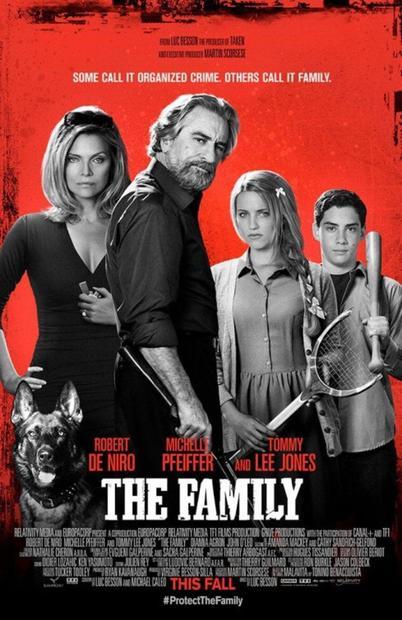 The most impressive thing I can credit The Family, an otherwise adequate action-comedy with identity issues, is that it makes each member of its titular family worth watching. Robert De Niro is the patriarch of a family on the run from the Mob, who used to serve as De Niro’s chief employer. They’re hiding in Normandy, France, and trying to blend in, with very mixed results. I was worried that everything was going to be too obvious, but the movie does a fine job of rounding out its cast, giving each family member a personality, flaws, and a reason you want to keep tabs with them. I enjoyed the son’s single-minded manipulation of his school, able to suss out everyone’s needs and how to turn alliances. De Niro starts writing his memoirs as a therapeutic exercise, but really nothing comes from this obvious plot catalyst. The nagging problem that dogs the movie is an inconsistent tone. The violence can be rather brutal and much of it is meant to be silly, but it doesn’t come across that way. In fact, most of the film’s laughs are tied up in over-the-top, and often, bloody violence. But the movie isn’t dark enough to work as a twisted comedy, holding back to become something of an uneven mob cartoon with plenty of hoary Italian stereotypes. As a result, when the third act is all bloody mayhem, it feels like The Family is three half-baked movies badly stitched together. I laughed enough and was passably entertained but The Family is too dark to work as a lark, too juvenile to be substantial, and too predictable by half.
Nate’s Grade: C+
Share this:

Kick-Ass 2 (2013)
 It’s hard for me to discuss Kick-Ass 2 without sounding like a hypocrite. I enjoyed the first film’s visceral thrills, style, and satire of superhero tropes. The sequel gives me more of the same except not nearly as well polished, and in typical sequel mentality, it goes bigger, expanding the world and the height of the sick puppy violence. Kick-Ass (Aaron Taylor-Johnson) and Hit Girl (Chloe Grace-Moritz) are trying to live ordinary lives but keep feeling the need to don their suits and fight crime. Kick-Ass joins a ragtag team of other costumed vigilantes to battle a super villain team, lead by the former Red Mist (Christopher Mintz-Plasse). For long stretches, the movie seems like an unwanted Heathers knockoff as Hit Girl attempts to fit in at high school. She has some particularly nasty vengeance against a popular bully, and if there is a line, it may have been crossed here. I don’t know what it says about me, but I guess I’m fine with a pint-sized kid slicing up bad guys and cursing like a sailor, but making a woman simultaneously vomit and defecate herself, watching both projectile streams spray out her ends, is too much for me. This is a darker, cruel, and mean-spirited feel with the material, and writer/director Jeff Wadlow fails to compensate for the lack of creativity this go-round (I miss you Matthew Vaughn). The humor is still lively, but the plot is predictable at every step, the characters behave in ways that don’t make sense, and the action sequences are poorly filmed, leading to an anticlimactic ending that simply peters out. Kick-Ass 2 won’t be knocking anyone out.
Nate’s Grade: C+


 nathanzoebl
You must be logged in to post a comment.