Blog Archives
The Flash (2023)/ Spider-Man: Across the Spider-Verse (2023)
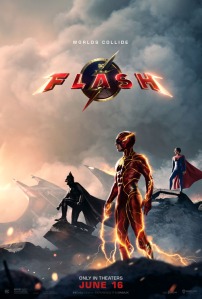
Released within two weeks of one another, two big summer movies take the concept of a multiverse, now becoming the norm in comic book cinema, and explore the imaginative possibilities and wish-fulfillment that it proposes, but only one of them does it well. Spider-Man: Across the Spider-Verse is the sequel to the Oscar-winning 2018 revolutionary animated film, and it’s a glorious and thrilling and visually sumptuous experience, whereas DC’s much-hyped and much-troubled movie The Flash feels like a deflated project running in place and coming apart. Let this be a lesson to any studio executive, that multiverses are harder than they look.
Barry Allen (Ezra Miller) has the ability to travel at fantastic speeds as his superhero alter ego, The Flash. He’s tired of being the Justice League’s errand boy and still fighting to prove his father is innocent of the crime of killing Barry’s mother. Then Barry discovers he can run fast enough to actually travel back in time, so he returns with the intention of trying to save his mother. Except now he’s an extra Flash and has to train his alternate self (also Miller) how to control his powers. In this different timeline, there is no Justice League to combat General Zod (Michael Shannon, so thoroughly bored) from destroying the planet for Kryptonians.
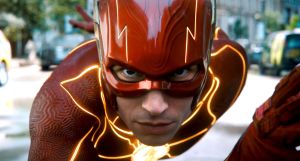
This is the first big screen solo outing for The Flash, and after none other than Tom Cruise, Stephen King, and James Gunn calling it one of the best superhero movies of all time, it’s hard to square how trifling and mediocre so much plays out as an example of a creative enterprise being pulled in too many directions. Miller was cast as the speedster almost ten years ago, and this tale has gone through so much tortured development, leaping through numerous filmmakers and writers, that its purpose has now gone from being a pillar of the expanding DC cinematic universe began with Zack Snyder’s Man of Steel in 2013 to becoming the Snyderverse’s death knell. The premise of traveling back in time is meant for Barry to learn important lessons about grief and responsibility and the limits of his powers, but it’s also intended as the reboot option for the future of these cross-connected comic franchises. It allows Gunn, now the co-head of the new way forward for DC movies and TV, to keep what they want (presumably Margot Robbie and Jason Momoa) and ditch the rest (Henry Cavill, Ben Affleck, Black Adam, Shazam, and Zack Snyder’s overall creative influence). So reviewing The Flash as only a movie is inadequate; it’s also a larger ploy by its corporate overlords to reset their comic book universe. In that regard, the quality level of the movie is secondary to its mission of wiping the creative slate clean.
Where the movie works best is with its personal stakes and the strange but appealing chemistry between the two Millers. It’s an easy starting point to understand why Barry does what he does, to save his mother. This provides a sturdy foundation to build a character arc, with Barry coming to terms with accepting his grief rather than trying to eradicate it. That stuff works, and the final talk he has to wrap up this storyline has an emotional pull that none of the other DCU movies have exhibited. Who wouldn’t want one last conversation with a departed loved one, one last opportunity to say how you feel or to even tell them goodbye? This search for closure is a relatable and an effective vehicle for Barry to learn, and it’s through his tutelage of the other Barry that he gets to see beyond himself. The movie is at its best not with all its assorted cameos and goofy action (more on both later) but when it’s a buddy comedy between the two Barrys. The older Barry becomes a mentor to himself and has to teach this inexperienced version how to hone and control his powers as well as their limits. It puts the hyper-charged character into a teaching position where he has to deal with a student just like him (or just him). It serves as a soft re-education for the audience alongside the other Barry without being a full origin story. The impetuous young Barry wanting to have everything, and the elation he feels about his powers, can be fun, but it’s even more fun with the older Barry having to corral his pupil. It also allows the character an interactive checkpoint for his own maturity and mental growth. Miller’s exuberant performances are quite entertaining and never fail to hit the comedy beats.
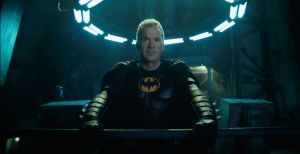
The problem is that the movie puts so much emphasis on too many things outside of its titular hero. Much was made of bringing back Keaton to reprise his Batman after 30 years. I just wish he came back for a better reason and had legitimate things to add. His role is that of the retired gunslinger being called back into action, and there’s an innate understanding with Barry wanting to go back in time and save his family, but too much of this character’s inclusion feels like a stab at stoking audience nostalgia (the callback lines all made me groan). I highly enjoyed Keaton as Batman and appreciated how weird he could make the billionaire-turned-vigilante, but he’s no more formed here than a hologram. The same thing happens with the inclusion of Super Girl a.k.a. Kara Zor-El (Sasha Callie). In this universe, there is no Superman, so she’s our requisite super-powered alien that Zod is hunting to complete his plans for terraforming Earth. She’s an intriguing character as a tortured refugee who has lingering doubts about whether humanity is worth the sacrifice, but much of her usage is meant only to make us think about Superman. She’s not given material to make her own impression, so she simply becomes the imitation of the familiar, the shadow to the archetype already being left behind. But these character additions aren’t even the worst of the nostalgia nods, as the final climactic sequence involves a collision of worlds that harkens to just about every iteration of the famous DC heroes, resurrecting several with dodgy CGI and uncomfortable implications (spoilers… the inclusion of George Reeves, when he felt so typecast as TV’s Superman that he supposedly killed himself because he thought his acting career was over, can be galling).
The action of The Flash is mostly fine but with one exceptional example that boggles my mind. In the opening sequence, no less, Barry is trying to help clean up a crumbling hospital when it collapses and literally sends a reign of babies falling through the air. I was beside myself when this happened, horrified and then stupefied that this absurd action sequence was actually happening. Barry goes into super speed to save the day, which more or less reverts the world into super slow-mo, though he needs to power up first, so we get a quick edit of him stuffing food into his face to load up on calories. We go from Barry breaking into a falling vending machine, stuffing himself in the face with snacks, getting the green light from his suit which I guess measures his caloric intake, and then grab a baby and literally put it in a microwave to shield it from danger. Just describing this event makes me feel insane. I figure the filmmakers were going for an over-the-top approach that also provides light-hearted goofiness to separate the movie from the oppressively dark grist of Snyder’s movies. However, this goes so far into the direction of absurdity that it destroys its credibility. It’s hard for me to fathom many watching this misguided and horrifying CGI baby-juggling sequence and say, “Yes, more please,” rather than scoff and shake their head. It’s not like the rest of the movie keeps to this tone either, which makes the sequence all the more baffling. There are Flash rules that are inconsistently applied to the action; Barry’s caloric intake is never a worry again, and the effects of moving a person during super speed don’t ever seem to be a problem except for one spewing gross-out gag.
While not being an unmitigated disaster, it’s hard for me to see the movie that got so many figures in the entertainment industry raving. The Flash has some notable emotional stakes, some amusing buddy comedy, and some goofy special effects sequences that run the gamut from amusing to confounding, but it’s also quite a mess of a movie, and too many of its nods to the fandom feel like empty gestures of nostalgia compensating for imagination. For all it gets right, or at least keeps interesting, it seems like another cog in a multi-billion-dollar machine, a stopping point also intended to be a reset and starting point. It feels like the character wasn’t trusted enough by the studio to lead his own solo movie even after years of buildup with Miller, nine seasons of the popular TV series, and 80-plus years of prominent placement in DC comics.
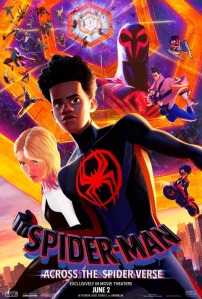
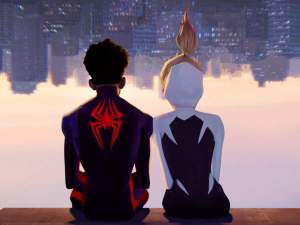
Conversely, Across the Spider-Verse is a sequel that expands an already stuffed story but knows what stories and themes to elevate so they don’t get lost amidst the fast-paced lunacy. Taking place a year later, Miles Morales (voiced by Shameik Moore) has grown into his role as the new Spider-Man for his world. He strains to meet the expectations of his parents, and keep up his grades, while fulfilling the duties of a superhero jumping into danger. When Gwen Stacey (voiced by Hailee Steinfeld) reappears to discuss joining the multiverse police, Miles jumps at the chance, having genuinely missed his other Spider friends, especially Gwen. There are countless Spider people in countless worlds, even including a Spider-T. Rex and a Spider-Car (Peter Parked Car, I believe the name was). Miguel O’Hara (voiced by Oscar Isaac) is the Spider-Man tasked with keeping order across the many interconnected multiverses, and he insists that sacrifice is essential to maintain balance, one that hits too close to home for Miles to abide.
The 2018 original is a hard act to follow, and while Across the Spider-Verse doesn’t quite overrule its predecessor it is a more than worthy sequel that has everything fans loved about the first trip. The visual inventiveness has been taken even higher, with the mixture of even more different animation and art styles. I loved seeing each Spider person and how they fit into their unique art style of their world, like the living water colors of Gwen’s world and the punky paper collage style of Spider-Punk (voiced by Daniel Kaluuya). There’s a villain that comes from a paper universe, so he resembles a three-dimensional paper construction with hand-scribbled notes appearing around him like Da Vinci’s commentary. There is something to dazzle your senses in every second of this movie. The visuals are colorful, creative, and groundbreaking with the level of detail and development. There’s probably even too much to fully take in with just one viewing. I want to see the movie again not just because it’s outstanding but so I can catch the split-second vernacular asterisk boxes that pop up throughout the movie. Going further into living comic book aesthetics, new characters will be introduced with boxes citing their comics issue reference point, and certain names and vocab will get their own citations as well. These are split-second additions, nothing meant to distract from the larger narrative. Simply put, this is one of the most gorgeous looking movies of all time, animated or live action. It’s bursting, thrumming, nearly vibrating with life and love stuffed into every nook and cranny, and it’s exhilarating to just experience a vivid, thriving world with animators operating at peak talent.
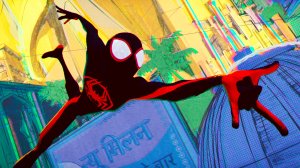
However, the movie has an engrossing story to better position all those eye-popping visuals. The worry with any modern multiverse story is that the unlimited possibilities of variations and opportunities for characters to do just about anything will overwhelm a narrative, or like The Flash, become a checklist of overburdened and empty fan service. The screenplay by Phil Lord, Christopher Miller, and Dave Callaham is all about relationships. If Miles’ relationship with his stern police lieutenant father (voiced by Brian Tyree Henry) wasn’t such an important focal point, then the emotional stakes of the movie would be meaningless. We see a relatable struggle from both sides, the parents trying to connect with their growing child and give him enough space to find himself, and the child who clearly loves his parents but doesn’t fully appreciate or understand their concerns. They worry about Miles leaving them and whether others will love and support him like his parents. Miles has to experience a wider world of possibility, but these experiences make him appreciate what he has at home, and what could be permanently lost. I don’t mind saying there were more than a few moments that caused me to tear up. I found Gwen’s storyline equally compelling, and her turmoil over keeping her secret identity and then coming out to her father was rather moving. The family bond resurfacing will get me every time, and the simple action of a hug can be as heartwarming and fulfilling as any romantic ode. Across the Spider-Verse makes sure we care about the characters and their personal journeys.
At a towering 140 minutes, this is the longest (American) animated movie ever, and it’s still only one half of a larger story. I knew ahead of time this was only the first part so as soon as we entered Act Three I kept gearing up for the cliffhanger ending. Every five or so minutes I thought, “Okay, this is going to be the end,” and then it kept going, and I was relieved. Not just because I got to spend more time in this unique universe but each new moment added even more to raise the stakes, twist the intrigue, and make me excited for what could happen next. I was shaking in my seat at different points, from the excitement of different sequences to the emotional catharsis of other moments. I cannot wait to experience this same feeling when the story picks back up reportedly in March 2024, though I fear it will get delayed to late 2024.
Even with the unlimited possibility of jokes and silly mayhem, the filmmakers keenly understand that it doesn’t matter unless we care about the characters and their fates. I am shocked that a goofy character I thought was going to be a one-scene joke, The Spot (voiced by Jason Schwartzman), could end up becoming the ultimate destroyer of worlds. I think this reflection nicely summarizes the impeccable artistry of Across the Spider-Verse, where even the moments or characters misjudged as fleeting or inconsequential can be of great power. It’s a movie that is full of surprises and thrills and laughs, all in equal measure, and a blessed experience for a movie fan. In the crush of comic book multiverse madness, Across the Spider-Verse is a refreshing and rejuvenating creative enterprise, one that builds off the formidable talent of its predecessor and carries it even further into artistic excellence that reminds us how transporting movies can be. If you see one superhero multiverse movie this summer, the choice should be as obvious as an inter-dimensional spider bite.
Nate’s Grades:
The Flash: C
Across the Spider-Verse: A
Share this:

Nope (2022)
 Within two movies, and most likely just with his first in 2017, Jordan Peele catapulted himself as a brand name in the world of horror. At this point, you’ll see a Peele horror movie sight unseen because you know what you’re getting is going to be a unique experience. There are plenty of modern horror directors that have built a rabid fandom, like Ari Aster or James Wan, but nobody seems to be given the same platform as Peele has earned at this juncture. The writer/director has become what M. Night Shyamalan used to exhibit, the director whose creative visions were each highly anticipated event movies. Nope is Peele’s first foray into science fiction territory and the results are messy, disturbing, and, at points, astounding.
The Haywood family ranch has been involved in the motion picture industry since its very beginning. One of the first film images, a black man astride a horse, was the great-great-great grandfather of Emerald (Keke Palmer) and Otis Jr. (Daniel Kaluuya). The brother and sister are trying to save the family ranch after the untimely and strange passing of their father (Keith David) who was felled by debris falling from the sky. Their neighbor, Ricky “Jupe” Park (Steven Yeun), is spinning his notoriety as a child actor into a Western theme park attraction. Ricky’s claim to fame was being one of two survivors of a 1990s sitcom where the trained chimpanzee, who in the context of the show was his adopted sibling, snapped and went on a killing spree. Emerald and Otis Jr. begin to suspect that there is a real unidentified flying object hanging over their land, so they set out to capture living proof and become rich and famous. The alien, hiding in an unmoving cloud over the course of six months, has other plans and intends to assert its claim on the Haywood territory.
 Peele is proving himself more and more as a major director of genre spectacle and vision. Each of his three directorial efforts will hit people differently; I think they’ve incrementally gotten a little sloppier in the writing department, but Peele is only growing stronger as a visual stylist and orchestrator of big screen spookery. There is a grandeur to the visual arrangements, owing as much to the expansive language of Westerns and the awe of early Steven Spielberg. I wish I had seen the movie in IMAX as Peele intended, since he went to all the trouble of planning specific sequences for the grand IMAX cameras. There are several moments that are jaw-dropping and stirring in horror and wonder. A literal rain of blood and viscera and expelled non-organic items is a striking image. Even the unnatural way that helpless people are thrown off the ground can be jolting and primal. There’s a claustrophobic interior sequence of desperate people that really conveys the terror of the doomed. A big addition to the eerie atmosphere is the brilliant sound design. The otherworldly-ness of the alien encounters is heightened by a really in-depth sound design that can make the hairs on the back of your neck stand at attention. Even the sound of rain, and its distance, can be an indicator of the proximity of danger. There are also the distant sounds of horrible screams circling through the clouds high above, and it’s a deeply unsettling design trick that works every time. Even when the movie wasn’t quite as engaging from a narrative or thematic standpoint, Nope is always engaging on a simple delivery system of spectacle. The way Peele distributes his visual clues and keys, sometimes literally, always provides something for an audience to anticipate.
I was also starting to grow impatient from Peele’s coy narrative games. The plot moves in frustrating starts and stops, teasing an intriguing development or proffering a question and then skipping backwards, denying the viewer a sense of gathering momentum. There’s a toying sense of teasing out how far he can go before an audience gets too impatient and quits. Much of the first half also takes place during night or sequences of sustained darkness, which can definitely play into the the fear of what could be in those shadows, but it makes for a fitfully frustrating experience when you’re trying to unravel a science fiction mystery. I kept wondering how all these pieces were going to come together, especially the ongoing subplot about this killer chimpanzee, but I had faith in Peele (mostly). That faith was rewarded but I’ll admit for the first hour I was wondering if Peele was too evasive for his own good.
 Nope begins as Close Encounters of the Third Kind and then transitions into Jaws and stays there, and it was during the second half that my interest magnified exponentially. It’s around the hour mark that the movie finally puts all its cards on the table and declares what it is and what the remaining movie is going to be about. All the stutter steps and vagaries are cast aside, and the movie finally shifts into its grand entertainment of a group of humans learning about an overwhelming and unusual threat and plotting their unorthodox plan of attack. I’ll still try and play around spoilers without getting too deep into specifics. It’s a great relief when Peele no longer has to tease his threads and mysteries and can at last be open and let the conflicting components come together. The annoyances I felt in the first half melted away, and I was satisfied as the movie picked up a genuine momentum and smartly tied in many prior plot elements for the bigger picture, like the inflatable tube men, old timey picture-taking souvenir machines, and even the very vague almost carwash-esque imagery from the opening credits. The second half of the movie is more fun because it’s a big hunt and it allows our characters to make use of what they have learned to form conclusions and strategic moves and adjustments. It’s characters making smart decisions. It’s a scenario that finally allows Peele to finally play with all the setups he’s spent an hour cheekily hiding around.
While the climax is great, and the movie gets consistently better, I don’t feel like all of its many thematic ties come together. Being a Jordan Peele horror movie, we’re now expecting there to be extra layers of social-political commentary and allegories. The back-story for Ricky as a child actor is given a lot of attention and screen time for a two-hour movie, and I don’t know if what it adds up to is equal to the time it was given. Thematically, you can make some speculative reaching about the exploitation of animals for spectacle, about underestimating and not respecting nature, and even setting up for later tragedy, but it all seems less meaningfully integrated than any other Peele movies’ elevated subplots. With the Ricky back-story, there is even a literal anticipation of a literal shoe to drop, which seems so obvious as a visual metaphor but I cannot link it directly with what follows. I can keep digging and find connections but it requires far more effort than Peele’s other works of horror. The family history of working for Hollywood as horse wranglers feels underdeveloped. There are also rules that it establishes that Peele isn’t fully consistent (just don’t look?) that left me questioning. I figured that colonialism would be an obvious parallel with invading aliens (H.G. Welles even made use of the analogy 120 years ago), but maybe that was too obvious territory for someone like Peele. My friend Ben had a crazy early theory that the aliens themselves would resemble horses and thus they were returning to free their equine brothers and sisters from human exploitation. I guess I’ll go ahead and spoil you, dear reader, that this does not happen in any shape with Nope.
 I’d rank Nope the third best Jordan Peele horror venture, and while it clearly makes use of science fiction concepts and its rich iconography, it’s still very firmly a movie rooted in horror, the horror of the unknown, the horror of being small and helpless, the horror of being left behind. Not all of Nope’s many ambitions quite land, and the themes feel a bit more jumbled or underdeveloped, but I want Jordan Peele to continue making the movies he wants on his terms. Not every one is going to hit exactly the same for me, or for any viewer, but we’re all better when unique artists like Peele are given the latitude and support to bring their personal visions to the big screen. As long as he’s still achieving a baseline of quality, something that befell the middle Shyamalan period, then I say swing away and let’s see where you’ll take us all next, Jordan Peele.
Nate’s Grade: B
Share this:

Judas and the Black Messiah (2021)

Fred Hampton was the deputy chairman of the Black Panthers in Chicago and was only 21 years old when he was murdered in 1969 by federal agents. Judas and the Black Messiah is about Hampton and his life in political activism cut short, but it’s also another tragedy, one far less known. Bill O’Neal was a federal informant who was manipulated into betraying Hampton to the FBI and ultimately setting up the man’s execution. Both men are given consideration and brought to life by great actors, Laketih Stanfield as O’Neal and Daniel Kaluuya as Hampton. O’Neal is tasked with getting into the trusted inner circle of Hampton and the Black Panthers without blowing his cover, or else he’ll be going to jail for years on potentially pending charges. The FBI agent in charge (Jesse Plemons) is under pressure by J. Edgar Hoover (Martin Sheen), and this all provides even more pressure onto O’Neal, who is a pawn of the higher-ups who only care about neutralizing the growing power of the Black Panthers. The film plays out similar to an undercover mob movie, like The Departed, and much of the drama follows whether O’Neal will get caught, how he will navigate the tenuous territory he is in, and the paranoia of being in danger at all times and from multiple sides if he succeeds or fails. I appreciated the attention given to O’Neal and the consideration that he too is another victim. He is eager to succeed and thinks he might use his service as an introduction into the Bureau for legit work, but he also very much wants to be accepted by the Panthers because he agrees with their philosophies and is looking for a community that welcomes him and provides a sense of direction. If I had a complaint, it is simply that we get a lot more Judas here than we do the Black Messiah. It feels like we’re getting a rather simplified summation of Hampton and scrubbing clean some of his personal leanings (having him identity as a socialist rather than a Marxist) that would make him more controversial. By all definitions, Hampton was executed by agents of the state to pacify institutionally racist fears about powerful and gun-owning black Americans, but putting so much emphasis of the story on the man who betrayed him creates an imbalance in presentation and risks mitigating the depth of Hampton. After Hampton returns from prison, the movement he’s been so heavily involved with seems to dissolve onscreen, focusing solely on setting up our deadly climax. He is seen as a martyr first and foremost. There are two extended shootouts in the second half that don’t feel at all in keeping with the first half of the movie. Kaluuya (Get Out) is electric in public and awkward and sweet in private with his beloved girlfriend. It hints at much more that could have been explored away from his fiery public persona. Stanfield (Knives Out) has the more multi-dimensional role and yet even given the grand Shakespearean tragic proportions of his position, I can’t help but feel like O’Neal feels a tad underdeveloped. There’s a subtle ambiguity that follows his character’s motivations but many of his moments revolve around whether he will be accepted, fool someone, or get caught. There are greater questions of whether the mask he wears is real. The characterization gets a little lost because of the nature of the subterfuge. This movie is over two hours but has the potential to be an epic tragedy and could have sustained a limited series of storytelling. As it is, it’s a tense and powerful movie with great acting and an ending that will rightfully outrage and disquiet. Judas and the Black Messiah is stirring but I feel like it had lost potential by transposing its story and conflicts into two hours and with two central underwritten figures of tragedy. It’s quite good but man this could have been amazing.
Nate’s Grade: B+
Share this:

Queen & Slim (2019)
 It’s been a couple weeks since I watched Queen & Slim and I can’t get it out of my mind. It’s billed as a modern-day Bonnie and Clyde, and while that description is technically apt, it’s more a frighteningly relevant thriller about police brutality, the skewed criminal justice system, and the hairpin-turning horror of daily life as a black person in America. A first date between Queen (Jodie Turner-Smith) and Slim (Daniel Kaluuya) goes awry when they’re pulled over by a racist trigger-happy cop and, in the ensuring struggle, Slim shoots and kills the officer in self-defense. They go on the run trying to escape one setup after another, all the while during this hellish ordeal the characters are growing closer out of reliance and a budding sense of romance. This is a powerfully intense movie with several supremely suspenseful sequences where I worried deeply whether or not the titular pair would be found out, could escape out of a jam, and all the while the authorities are getting closer and closer. They become folk heroes for a community familiar with the oppressive day-to-day of always being seen as a suspect, as “up to no good,” as presumed guilty and dangerous. There are a couple questionable moments later in the film involving the pair as inspiration where I wish the film had perhaps been a little less ambiguous over what I’m supposed to draw. The screenplay by Lena Waithe (The Chi, Boomerang) is cannily crafted with a strong sense of how to develop its premise, deepen it with larger themes, and throw organic obstacles at the characters. I was impressed with how quickly the movie would crank up the tension of a moment, but these thriller aspects never felt cheap or superfluous. The characters do not get lost to the overall plotting machinations and the performances from Turner-Smith and Kaluuya are terrific. Director Melina Matsoukas (Insecure, the soon-to-be release Y comic adaptation) has such an affecting manner with her camera and, in particular, the moody lighting that can express a range of feelings from anxiety or sensuality. The ending of this tale might be expected but that doesn’t take away any of its inordinate power, an ending that has stayed with me and shaken me for days. Queen & Slim is a character-driven chase film that manages to also touch upon powerful social themes, taking a mythic story and making it personal, relevant, and, in a new manner, timeless.
Nate’s Grade: A-
Share this:

Widows (2018)
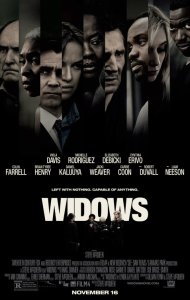 Widows has an all-star cast, an Oscar-nominated director, and a best-selling novelist-turned screenwriter, so my expectations might have been turned up a bit too high. It follows a team of titular widows (Viola Davis, Michelle Rodriguez, Elizabeth Dibecki) picking up the pieces in the wake of their husbands’ deaths. It seems their dearly departed spouses stole money from a local criminal who very much demands the sum returned. The women must enter into a criminal heist, using notes left behind by a dead hubby, to settle the debt and spare their lives. Widows is a higher caliber crime movie with notable texture given to a wide assortment of characters; even the villains are given small character touches to better flesh them out and feel more realized. There’s a concurrent election tying together different corrupt and criminal enterprises that widens the scope of the film into a grander scale. The characters and performances are the selling point of the movie and provide consistent entertainment. Davis (Fences) is the strong-willed linchpin of the group and I could watch her boss around people for hours. Dibecki (The Great Gatsby) has a nice turn as a trophy wife accustomed to being abused. The problem is that there might be too many characters. Rodriguez has far more significance in the first thirty minutes and then is put on ice. Likewise, Carrie Coon and Cynthia Erivo are hastily added when the plot requires something of them. That plot, adapted by Gillian Flynn (Gone Girl) and director Steve McQueen (12 Years a Slave), proves to be the film’s biggest hindrance by the end. The second half plot turns seem to come from a schlockier version of this story, not the classier version we had been treated to beforehand. There are character decisions that baffle credulity and personal safety. The quality of the characters deserved a movie that could refrain from the hacky genre twists. McQueen’s precise camerawork is still alive and well and highlights tension and also moments of social commentary, like when we watch a car travel mere blocks from a rundown inner city neighborhood to a fancy gated residence. There’s a lot to like with Widows, and plenty to get excited about, but I wanted to like even more.
Nate’s Grade: B
Share this:

Black Panther (2018)
 Black Panther is unlike any other Marvel Cinematic Universe (MCU) film prior. It’s unlike any other super hero film prior. Yes, there have been African-American leading men in comic-based movies, notably Wesley Snipes’ half-vampire-all-badass Blade. However, this is the first movie I can think of with this kind of budget, this kind of backing, and with this kind of ownership over its cultural heritage and the heavy burdens it carries.
We last saw T’Challa (Chadwick Boseman) in Captain America: Civil War mourning the loss of his father, the king of the African nation of Wakanda. The outside world does not know that Wakanda sits on a vast supply of virbanium, the strongest and more durable metal in the world and the key to Wakanda’s impressive technology. Under a holographic cover, Wakanda is a thriving metropolis with flying cars, skyscrapers, and next gen weapons. T’Challa goes home and must earn the right to the throne. However, Erik Killmonger (Michael B. Jordan), a former top-level black ops solider, is looking for his own path into Wakanda and onto the throne. Killmonger teams up with arms dealer, Ulysses Klaue (Andy Serkis), to force Wakanda to deal with being cut off from the world.
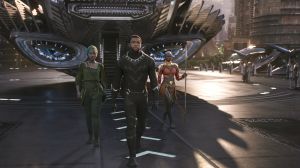 This is a movie populated almost entirely by black faces, notably black women (more on that later), and they are given a mainstream platform that celebrates its multitudinous African roots and traditions thanks to co-writer/director Ryan Coogler (Creed). This movie is proudly black, which will rankle some on the fringes of society, as if celebrating one’s own identity is somehow denigrating those who do not apply to that status. Black Panther is not an exclusionary movie because of its content and execution; this is a very accessible movie to a mass audience, even those who haven’t been paying attention to every nitty-gritty detail in the previous seventeen MCU entries. There are only two characters from other MCU films that appear, one as a post-credits cameo and the other an officious representative (Martin Freeman) of the outside’s clandestine organizations. This is a unique world isolated from the long shadow of colonialism. Wakanda has never known, to our knowledge, the depravity of the European and American slave trade. They have continued to develop uninterrupted by conquerors, slave traders, and the crippling aftereffects of racism. The Wakanda people could very easily be the conquerors themselves. They’re the most technologically advanced nation on the planet and hide as a “third-world nation,” utilizing the ignorance of the Western world to its security. The world of Wakanda is a fascinating, awe-inspiring, and defiantly independent nation.
The larger theme is over the responsibilities inherent to those with privilege. The nation of Wakanda is vastly successful by all conventional metrics. T’Challa must wrestle with whether to continue their exclusionary stance, ignore the plight of the larger world and say it’s none of their business or engage with the world, potentially putting his own kingdom’s peace and prosperity at risk. It’s a simple enough theme and yet it has tremendous weight to it especially when you account for those on the other end of the Wakanda borders. The character of Killmonger is a direct reflection of this. His experiences in Oakland are not the ideal pairing with the luxury of Wakanda. Killmonger sees Wakanda’s great influence as a way to protect beleaguered black citizens of the world and especially in the United States. It’s a way to prevent more senseless deaths from black citizens who were slain as a result of the fear of just being black (a powerful example was Coogler’s debut film, Fruitvale Station). It’s a pointed political statement that doesn’t get too heavy-handed (even though I would have preferred that). It questions the value of isolationism especially when suffering can be prevented. Killmonger works as a villain because you can understand his point of view. He goes beyond the need for vengeance. The wrongs he wants to right are larger and historical. Even Killmonger’s last line really attaches itself to this theme. T’Challa offers him a way out but with imprisonment. “No,” Killmonger declines, “My people were the ones who leaped over the sides of the slave ships. They knew death was better than bondage.” The emphasis is “his people,” not T’Challa’s, not Wakanda. His people were the ones who suffered from slavery. Could Wakanda have possibly prevented it?
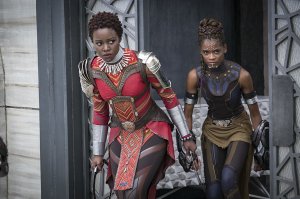 Another wonderful surprise of Black Panther is its incredible all-female ensemble that provides expert support to their king. T’Challa has the good fortune of four strong women, each of them having a different and vital relationship to him. The standout will be Danai Gurira (TV’s Walking Dead) as the fierce chief of security, Okoye. She has a swagger that vacillates between being intimidating and being brashly enjoyable. Okoye has many of the best lines and she throws herself into every fight. There’s also a sense of duty that transcends a single man that challenges her loyalty. Letitia Wright (TV’s Humans) plays Shuri, the Q of this world, the top scientist and creator of many a gadget. She’s T’Challa’s little sister and their interplay is very competitive and teasing. She’s looking to be more involved in the action and a highlight is when she teams up with her big bro. Lupita Nyong’o (The Jungle Book) is Nakia, a former flame of T’Challa’s who comes in and out of his life as an undercover spy. All three of these women have a powerful sense of agency and are integrated in important and essential ways. Even though Nakia may slide into that romantic interest role, she still has a vibrant life outside whatever feelings she may or may not have for the hero. Then there’s T’Challa’s mother, Ramonda (Angela Bassett), who radiates strength and fortitude. These women gave me some of the biggest moments of entertainment in the entire 135 minutes of movie.
Now some careful readers might note that I haven’t done much to emphasize the actual action of the super hero action movie, and that’s for a good reason. Black Panther stands stronger on theme and character than it does its actual action sequences. Coogler had a wonderful sense of scale and verisimilitude with 2015’s Creed, relying on long takes to put the audience in the heightened drama of the boxing ring. With Black Panther, the action sequences can lose a sense of immediacy. Many happen at night or are filmed and edited in ways that diminish some of their impact, like hand-to-hand combat in splashing water where the splashes obscure the activity. Other scenes felt like a video game CGI cut-scene. Speaking of video games, Black Panther’s suit has a crazy ability to absorb the kinetic energy of weapons, which means the stakes take a dip when our hero can merely just stand and allow himself to get shot repeatedly. The payoff for this absorption is a giant energy shockwave but it plays out like a fighting game’s special feature. It’s an aspect that’s not really utilized in a satisfying or unique way. The final showdown between Black Panther and Killmonger feels too weightless in execution. It’s meant to even the playing field by nullifying their extra abilities, but if they both have the same “Panther powers” isn’t the field already even? The third act, the usual punching bag for MCU critics, is the best part of the movie from an action standpoint. It utilizes the characters in significant ways and allows for organic complications while still maintaining its wider sense of spectacle. Plus it’s one of the few action sequences that allow all the pyrotechnics to be enjoyed during the visibility of day.

Boseman (Marshall) was an excellent choice for a stoic and too-cool-for-school character that can glide right on by. The ageless Boseman is at his best when he’s working off the other actors, especially his female posse. He has a couple of very effective emotional confrontations as he learns of his family’s secrets. As steady and soothing a presence as Boseman can be, this is Jordan’s movie. Michael B. Jordan (Creed) has been Coogler’s cinematic good luck charm and we’re still benefiting from that divine kinship. His character is at the heart of the central thematic question. While T’Challa is ultimately the one who has to decide, it is Killmonger who embodies that need for change and the desire to rectify the past. There’s a flashback with Jordan that got me to tear up, and this guy was the villain! It’s one of the film’s biggest mistakes sidelining Jordan for far too long. After his introduction, Killmonger is strangely absent for the next hour or so of the movie, ceding the spotlight to Serkis (War for the Planet of the Apes), a more antic and goofy scenery-chewing baddie who has a few regrettably “faux hip” lines of dialogue that land awkwardly. Serkis is having a blast but can feel like a holdover from a different film.
Much like last summer’s Wonder Woman, this is a movie that is going to mean a lot to a lot of people. It has a personal significance that I will not be able to fully tap into, no matter the expansive powers of empathy. Black Panther, as a long-awaited cultural moment, will have many ripples of inspiration. After my early screening, I sat back and watched an African-American boy, no older than seven or eight, walk out of the theater in a daze. His eyes were wide, his mouth agape, and he said in astonishment, “That was the best movie ever.” That kid has a hero he can call his own. That matters. Black Panther, as a work of art, is rich in topical themes and has a wide supporting net of exciting, robust, and capable women. I enjoyed how personal and relevant and political the movie could become, folding new and challenging ideas onto the MCU formula. Coogler is a marvelous director and storyteller showing rare acumen for being able to handle the rigors of a Hollywood blockbuster and deliver something hearty. The action has some issues and there are some structural hiccups that hold it from the MCU’s upper echelon (I enjoyed all of the 2017 MCU movies better). Black Panther is a winning movie when it features its sterling cast celebrating their virtues and solidarity and a still respectable enough action spectacle when called upon for big screen duty.
Nate’s Grade: B
Share this:

Get Out (2017)
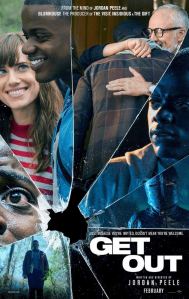 After years as a brilliant sketch comedian, Get Out is Jordan Peele’s first foray into horror, and if this gifted comic mind only wanted to make suspense thrillers from now on, that would be mighty fine. This is the first horror movie in years that left me buzzing, feeling charged and anxious, anxious to share with others so they too can feel the full effect of this live wire of a movie. It may be my favorite theatrical horror film since 2012’s The Cabin in the Woods, and what they both have in common is a knowing understanding of their genres and expectations, a delicately balanced sense of tone, and a funhouse of darkly clever surprises. This is a movie rich with commentary, suspense, payoffs, and it all begins by exploring the dread-filled everyday existence of African-American men in this country as a waking horror movie that cannot be escaped.
Before even going further, I advise most readers to go into Get Out with as little knowledge as possible, which I understand means delaying reading this review. I can accept the loss of eyeballs knowing that more people will go in with an even greater ability to be surprised (I’ll avoid significant spoilers below, so fear not, dear reader).
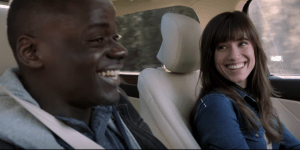
Chris (Daniel Kaluuya) is visiting the parents of his girlfriend for the first time. He’s worried that Rose Armitage (Allison Williams) hasn’t mentioned that he’s black. She assures him that her rich, wealthy, and liberal family won’t care in the slightest. Rose swears her parents are the least racist people she can think of. Dean (Bradley Whitford) is a retired brain surgeon, Missy (Catherine Keener) is a hypnotherapist who volunteers to help Chris stop smoking, and Rose’s younger brother, Jeremy (Caleb Landry Jones), is obsessed with martial arts and lacrosse. They also have black housekeepers, which Dean says he hates how it looks. It isn’t long before Chris’ sense of unease starts to make him rethink this weekend getaway and whether or not something sinister is under the surface.
 Early on, Peele tips his hand to the sharp social and genre criticism. In the opening scene we watch Andrew (Lakeith Stanfield), a young black man, walking around lost in a tony suburban neighborhood. He checks his phone for an address when a lone car drives past him, stops, and turns around, pulling up next to Andrew and idling, blasting the old song “Run Rabbit Run.” He takes one look at the situation and immediately turns around, heading in the opposite direction. “Not today,” he says to himself, clearly providing voice to the audience’s apprehension. And yet, he’s incapacitated, and abducted by masked assailants. Even self-awareness and avoidance will not be enough for this man to survive if captured within the crosshairs of modern White America. He becomes another horror victim just like we might see splashed across the news all too often.
Peele’s biting social commentary is ever-present but it never outpaces the genuine fun and entertainment from his genre storytelling. It’s a condemnation of the fallacy of a post-racial society and an exploration of the uncomfortable burdens African-Americans are disproportionately expected to bear in general. Rose’s family is all too happy to show off how seemingly inclusive they are. Rose’s father confesses, with no legitimate conversational prompting, that he would have voted for Obama a third time (trust me, there’s a lot of people in the camp, Dean). Yet he seems to enjoy awkwardly inserting recitations of “my man” while also trying to openly explain why he has eerily subservient black housekeepers. Rose’s antic brother seems to hungrily size Chris up as a physical challenge to battle, openly admiring his “genetic gifts.” Despite their self-styled liberalism and protests to the contrary that race doesn’t matter, the family can’t help but treat Chris like an other. Race “doesn’t matter” to people who have the position where it might not matter, the same going for those who elect to be “color blind.”
This stifling sense of condescension and pandering is best exemplified in a deeply awkward sequence where Chris is introduced at a party to the whole older majority-white neighborhood. One man informs him he likes Tiger Woods. Another says being black is hip. A woman squeezes his muscles in transparent lust. Another asks what the “African-American experience” is like and whether Chris feels being born black is an advantage. All through this meet-and-greet gauntlet, Chris is holding his carefully crafted smile, trying to shrug off the mounting discomfort, and being told not to make a big deal out of it. After all, these are well-educated liberals, the “good ones.” They can’t be racist too.
 Get Out is also an excellent example of a movie that straddles a precise tone to perfection. Peele has a carefully refined comedy sensibility, but I was genuinely awed in his ability to go from sardonically funny to creepy funny to just plain creepy. There’s an increasingly heightened sense of dread from the get-go. It’s like any other horror premise where our protagonist goes into the house they shouldn’t and combats a host of horrors be they supernatural or superhuman. In this case, the scary scenario is white people. There’s a general off feeling about the Armitage estate and this is best encapsulated with their hired help, Walter (Marcus Henderson) and Georgina (Betty Gabriel). They seem to be in a robotic daze, smiles plastered to their faces, their tone of voice disquietingly calm and meticulous. Even the antiquated and culturally incongruous vocabulary they employ contributes to their unsettling vibes. Something is wrong here. There is a remarkable scene where Chris speaks with Georgina, and she hovers closer to him to apologize. Peele keeps the camera locked on his actor’s faces in extreme close-ups and he has a damn good reason for it. Gabriel (The Purge: Election Year) tries to reassure him all is normal and in one mesmerizing moment the camera fixates on her as she repeats “no,” each time a different reflection, her eyes tearing up as she tries to fight back subverted emotions. It feels like you’re watching twenty emotions and impulses fighting for dominance behind an impassive mask of compliance. Peele magnificently finds ways to keep his elements intensely upsetting while still finding room to laugh and break tension and increase tension.
While more a suspense thriller than a traditional horror film, Peele proves himself shockingly adept at a genre that I would have assumed outside his comfort zone. The shot arrangements and the natural development of tension shows clear knowledge and affinity for the horror genre; Peele knows when to hold onto a moment for extra suspense, when to pull back, and especially when to litter the camera frame with something to draw the eye. Peele has a great eye for his troubling, surreal visuals. When Chris is hypnotized and instructed to “sink into the floor” it’s like he’s falling into an inky void while his consciousness plays out on a square, like his life is a movie only he can watch from a distance. You feel the helplessness but it’s also a beautiful and beautifully unnerving image. There are a few jump scares accompanied by loud musical stings but the far majority of the movie is the overwhelming discomfort and dread marvelously kept at a continual simmer. I was squirming in my seat for long stretches and started backpedaling in others, and I can’t remember another movie in years affecting me that well. It’s partly the terrific execution of his genre elements but also partly because I liked the protagonist and had no idea what would happen to him next, which is the foundation of all horror. The last act cranks up the genre elements but Peele has brilliantly structured his script, laying out all the pieces he’ll need that provide an array of payoffs when we’re breaking for the finish line. This is a movie that knows how to satisfy all audiences, rest assured.
The actors are pitch-perfect and Kaluuya (Sicario, Black Mirror) delivers a star-making performance. He has to wear his own mask to deal with the small and large iniquities of whether or not these people are sinister or whether they’re just oblivious cretins. Chris is a black man expected to mind his manners and to laugh away the casual ignorance afforded by the oblivious privilege of others. He can never be unaware as the lone black man in a sea of white faces. It’s a position I think many people in the audience will be able to relate to and hopefully others can empathize with. Kaluuya has some standout emotional sequences where he digs deep to show the real depth of a character others fetishize or dismiss. Kaluuya is also British and you’d never know it. The Armitage family clan are each their own slice of weird. Whitford (The Cabin in the Woods) is exploding with thinly veiled smarm and great comic awkwardness. Keener (Capote) is chilling in her icy WASP den mother role with her weapon of choice, and hypnotic aid, being a literal silver spoon. Williams is like her blithely privileged character stepped out of HBO’s Girls, and her flippant attitude to Chris’s perspective belies something familiar and darker. The other best actor in the movie is LilRel Howrey (The Carmichael Show) who play’s a friend to Chris that works for the TSA. He’s a reliable and reliable crude source of comic relief but he’s also our ally on the outside, and he behaves like an intelligent investigator trying to save him. I was actually applauding his sensible steps to see through the sinister conspiracy.
 It’s been hours since I saw Get Out and I’m still buzzing from the experience. I was unprepared for how genuinely unnerving and invigorating the movie was as a horror thriller, character piece, but also as a trenchant social satire on race. Jordan Peele has established himself as an immediate visionary in the world of horror, taking the black protagonist who might usually be the first to get killed in a Hollywood slasher flick and widening the boundaries of horror. The real-lie horror film is day-to-day existence in the United States as a person of color. Get Out was conceived in the Obama era but has even more renewed resonance under the beginnings of the Age of Trump. I remember people saying that America now existed in a post-racial world, but we live in the kind of world that takes a call for innocent black lives to stop being executed by police officers and transforms it into All Lives Matter. It’s a hazardous world and Peele has created a marvelous movie where the insidious, ever-present force that cannot be escaped is not a maniac with a chainsaw or some cranky ghost, it’s white society itself. As the news has indicated, from Trayvon Martin to Sandra Bland and numerous others, there isn’t exactly a safe territory to escape to. Danger and death can come at any moment as long as a larger society perceives black skin as a threat first and a person second. Get Out is a timely movie but also timeless, thanks to how brilliantly conceived, developed, and executed Peel’s movie performs. This will make my top ten list for the year. Simply put, stop whatever you’re doing and go out to go see Get Out as soon as possible.
Nate’s Grade: A
Share this:

Kick-Ass 2 (2013)
 It’s hard for me to discuss Kick-Ass 2 without sounding like a hypocrite. I enjoyed the first film’s visceral thrills, style, and satire of superhero tropes. The sequel gives me more of the same except not nearly as well polished, and in typical sequel mentality, it goes bigger, expanding the world and the height of the sick puppy violence. Kick-Ass (Aaron Taylor-Johnson) and Hit Girl (Chloe Grace-Moritz) are trying to live ordinary lives but keep feeling the need to don their suits and fight crime. Kick-Ass joins a ragtag team of other costumed vigilantes to battle a super villain team, lead by the former Red Mist (Christopher Mintz-Plasse). For long stretches, the movie seems like an unwanted Heathers knockoff as Hit Girl attempts to fit in at high school. She has some particularly nasty vengeance against a popular bully, and if there is a line, it may have been crossed here. I don’t know what it says about me, but I guess I’m fine with a pint-sized kid slicing up bad guys and cursing like a sailor, but making a woman simultaneously vomit and defecate herself, watching both projectile streams spray out her ends, is too much for me. This is a darker, cruel, and mean-spirited feel with the material, and writer/director Jeff Wadlow fails to compensate for the lack of creativity this go-round (I miss you Matthew Vaughn). The humor is still lively, but the plot is predictable at every step, the characters behave in ways that don’t make sense, and the action sequences are poorly filmed, leading to an anticlimactic ending that simply peters out. Kick-Ass 2 won’t be knocking anyone out.
Nate’s Grade: C+


 nathanzoebl
You must be logged in to post a comment.