Blog Archives
The Black Dahlia (2006)
 Hey, I got an idea. How about we make a Black Dahlia movie and hardly involve anything having to do with the notorious Black Dahlia murder? I’ve got an even better idea; let’s center the action around a love triangle involving cops who are, say it with me, too close to the case. And then we’ll have a wacked out rich family where the mother (Fiona Shaw, God bless her) gives a performance that isn’t three-sheets-to-the-wind drunk, she is staggering, cataclysmically, powerfully, off-the-wall drunk. Watching her sway and sneer and hiccup is like watching Daffy Duck in this Brian DePalma mess. The central actors feel too young for their parts (the best actor is Mia Kirshner, seen briefly in an audition reel as the soon to be eviscerated Elizabeth Short), and the ending is an insipid caper to an ongoing, unsolved murder mystery. The Black Dahlia is appallingly boring and yet also appallingly dimwitted, but it does occasionally look good thanks to the technical proficiency of its director. DePalma has had a very up and down career. Consider this one of his valleys.
Nate’s Grade: D
Share this:

Eastern Promises (2007)
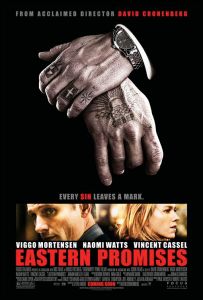 Director David Cronenberg is an idiosyncratic director who explores Big Ideas through the context of creepy horror movies where the body is violated. He’s covered everything from evil gnome-like children, ravenous monsters in Marilyn Chambers’ armpit, and Jeff Goldblum’s face unfortunately peeling away. But then Cronenberg struck it big with 2005’s A History of Violence, giving him the highest profile of his long Canadian career. The auteur of ick is now back in a similarly themed tale of the true impacts of bloodshed with Eastern Promises, a gripping and thoughtful work.
Anna (Naomi Watts) is a midwife working in London and come across a young Russian girl who dies in childbirth. She leaves behind a diary that Anna seeks to have translated so that she can find family members to contact about the newborn. This brings her unknowingly to the doorstep of Senyon (Armin Mueller-Stahl) who runs a restaurant in London’s Russian district. She inquires if Senyon or any of the employees knew the dead girl, and as soon as Senyon hears about the reality of a diary he becomes more concerned. And he should be since he is the head of one of London’s most notorious organized crime families. His loose canon of a son, Kirill (Vincent Cassel), has authorized a hit behind his father’s back and repercussions may soon be approaching. Nikolai (Viggo Mortensen) serves as the family’s chauffeur but takes an interest in Anna and is willing to assist her as she stumbles into impending danger the more she translates from the diary.
 Much like writer Steven Knight’s excellent previous film Dirty Pretty Things, this is a film that shines a light on the underbelly of London and focuses on the immigrant experience and how apt they are to be exploited. Eastern Promises is both a straightforward crime thriller with an intriguing, albeit simple central mystery, but then as it moves along it transforms into something far richer. Through the diary, we uncover the hidden inner workings of the Russian mafia, which is a truly global enterprise. Women are promised with great riches and freedoms in their Slavic homeland, and then once transported will spend the rest of their lives behind the bars of a whorehouse, kept dependent thanks to a drug habit forced upon them. We’re immersed in the culture of this crime family. Eastern Promises takes its noirsh sensibilities and then gives us the foreboding and enigmatic Nikolai, a mysterious figure that the audience, like Anna, is drawn to. He spent time in a Siberian prison and is covered in telling tattoos that serve as a resume for the mafia. Nikolai is such a dominating presence and proves to be more intriguing than the central diary mystery, and it’s here where the film performs a balancing act and transfers our attentions fully to this brooding brute.
Cronenberg subverts his usual irony and weirdness to stay true to his tale, and this may well be, even more so than A History of Violence, the most accessible Cronenberg movie yet. We’re a long way from flesh-eating-monster-in-Marilyn-Chambers’-armpit. He still works with such compact efficiency so that no scene feels wasted, and Eastern Promises is a brisk 1 hour 40 minutes. Where Eastern Promises really succeeds is by layering in strong characters within a relatively genre movie. People are not exactly who they seem and the actors do their best to give remarkable depth to their roles.
Cronenberg seems to have found an actor that shares his artistic sensibilities. Scorsese has Leonardo DiCaprio, Wes Anderson has Bill Murray, Kevin Smith has Ben Affleck, and now Cronenberg has Viggo Mortensen. I never thought much of Mortensen as an actor until Cronenberg unlocked something deep and mesmerizing in their first pairing. With Eastern Promises, Mortensen establishes himself as an extremely capable actor. Nikolai is a complex figure and he Mortensen displays a mastery of understatement; his stony silences and piercing stares speak volumes, but you can practically watch the decision-making of the character pass through the face of Mortensen. He skillfully displays the good inside a man bred for evil.
 Watts is an actress with few equals and she dazzles once more in a role that requires her to do a lot of legwork. And yet, there’s a sad, haunting quality to her thanks to the back-story where she lost a child due to miscarriage. Cassel is also impressive in a complicated role that requires a lot of internal languishing. He’s at one an impudent child willing to live high off the power of his family name, and at other times he comes across as a severely wounded man who cannot thrive in his hostile family (both little and big F) environment. There are interesting revelations that make Kirill a much more complex and captivating figure, and Cassel plays the many dimensions very well. Personally, I’m happy to see Armin Mueller-Stahl in another high profile movie. There was a time shortly after his 1996 Oscar nomination for Shine where if you needed an old guy for a movie, you got the Armin. Lately, it seems James Cromwell has taken his place as go-to old guy. In Eastern Promises, he has such a sly menace to him from the moment his ears prick up at the notion of a diary. He insists upon inserting himself into Anna’s life and casually makes remarks like, “You know where I work, now I know where you work,” with just the right amount of finesse to sound intimidating and yet potentially harmless.
One scene I will never forget is when Nikolai is ambushed in a bathhouse by two revenge-hungry thugs. He sits there naked and exposed and these two unhappy gentlemen descend upon him (fully clothed) with knives. Nikolai fights like a wounded animal and manages to successfully take down both men even though he is unarmed and un-clothed. Up to this point the character has been something of a gentle giant, knowing the vicious ways of the Russian mob but seemingly at distance from them for whatever ethical decision. But it’s at this moment that we bare witness, no pun intended, to the cagey survival instincts of a man who must live his life looking over his shoulder. It’s a bravura scene that is played out in agonizing detail. Nikolai is slashed and thrown against tiled walls (much penis-related mayhem is glimpsed), but he keeps coming back and knows precisely when to strike. It really is the actors doing all the hard knocks and brawling, which heightens the tension. Cronenberg stages the violence in his realistic drawn-out style, which horrifies an audience while simultaneously fascinating them. This is by far one of the most indelible film moments of the entire year.
 Eastern Promises is an engaging character-based thriller, and yet I wish it finished as strongly as it began. This is the kind of movie where much is implied or said in silence, which works great at respecting the intelligence of an audience as well as staying consistent with a believable reality where everyone in such dangerous positions is not explaining everything aloud. However, one of the drawbacks of a film where much is implied is that when it’s over you may wish that they implied less and showed more. The climax to Eastern Promises is a little weak, especially when it comes shortly after the incredible bathhouse attack. There’s a very hazy sense of a resolution. From an artistic standpoint, I suppose I can appreciate a thriller that doesn’t feel the need to end with a pile of dead bodies and much blood being spilt, but at the same time, from an audience point of view, I was really left wanting for more when the film finally comes to a halt.
Thanks to a smart, twisty script, Cronenberg’s sharp yet quirk-free direction, and some stirring performances, Eastern Promises is a first-rate thriller with the added benefit of strong characterization to add richer depth to this tale of mobsters, retribution, and sex slavery. Mortensen is the real deal when it comes to acting, folks. Cronenberg may have found a true match with Mortensen, and the added cache may give the director greater financial opportunities to tell more intriguing tales that may or may not feature ravenous armpits.
Nate’s Grade: B+
Share this:

Ocean’s 13 (2007)
 Much more like 11 than 12, this latest Ocean’s caper is just as preposterous as all the others but remembers that the audience needs to have fun too. Danny (George Clooney) and his baker’s dozen are plotting revenge on Willie Bank (Al Pacino, looking like a leather couch), a ruthless casino mogul who pushed old friend Rueben (Elliot Gould) out of a business agreement. The boys must outwit casino workers, modern technology, and a super computer able to detect pupil dilation in order to fleece Bank’s Vegas eyesore. Thankfully, all of the players are back and given tasks to do, and some of the means of their scheme are ingenious. How do you pass a lie detector tests? Place a tack in your shoe so that all your truthful answers match the intensity of your false ones. How do you get your hands on rigging dice? You send a couple guys to work in the Mexican factory and, why not, start a worker’s revolt. Ocean’s Thirteen glides along almost too smoothly, barely stopping to enjoy the crazy amount of absurd machinations before they fly by. The dialogue is packed with coded terms and the film doesn’t even stop to explain them. The movie works on the contact high of cool it luxuriates in, but unlike Ocean’s Twelve, this time the gang is given an objective, allows the audience in on their plot, and then we sit back and watch the execution. Steven Soderbergh and the gang have created a slick and amusing sequel. It lacks the freshness of the first go-round in 2001, but Ocean’s Thirteen is the most satisfying three-quel so far in a summer already weighed down by them.
Nate’s Grade: B
Share this:

Smokin’ Aces (2007)
 Writer/director Joe Carnahan (Narc) wants to impress an audience so bad with his muscular and macho gangster flick, but his Smokin’ Aces is vapid, nihilistic, and opines not to simply be a Tarantino rip-off, but a rip-off of a Tarantino rip-off. The premise seems ripe enough as we follow a rogue’s gallery of hitmen and killers trying to be the first to knock off a mob snitch/Vegas magician (Jeremy Piven) for a million dollar bounty. The colorful characters are introduced and some are quickly and unexpectedly taken out, but Carnahan never fully knows what to do with his bushel of baddies after he establishes their character quirks. The killers don’t really interact that much with one another and some of them hardly have any screen time at all; perhaps less would have been more in this jumbled stew. Carnahan throws out a few nifty visual tricks but it’s all superfluous and empty. Smokin’ Aces moves quickly, doesn’t make much sense in the beginning and end, and little to any of the characters have satisfying conclusions. So much of the writing feels like lame macho posturing without anything new or interesting to add to an overstuffed shoot-em-up. There are cops, robbers, plenty of gunfire, lesbians, and all sorts of convoluted twists, but it never holds together. Carnahan throws a lot of different elements together but they never extend beyond the elemental stage, so every storyline and character feels like an introduction that?s never capped off. The man has no idea what to do with what he’s started, and a karate kid on Ritalin is all the proof I need. Guy Ritchie did this territory far better service with the marvelously entertaining 2001 film Snatch. Rent that instead and save yourself the headache.
Nate’s Grade: D+
Share this:

Lucky Number Slevin (2006)
 Probably too clever by half, this Tarantino knockoff is gloriously twisty and far more twisted than you may have thought from the surface. It’s a puzzle piece that winds up being vastly entertaining. Josh Hartnett does the best work of his career in an effervescent comedic performance, playing Slevin, a nobody mistaken for a somebody who owes different mobsters large sums of money. There are a lot of balls to keep juggling, but Lucky Number Slevin finds a way to keep the headstrong momentum constantly going. The neo-noir art direction is fabulous and eye-catching. Things get really dark in the last act, perhaps too dark for some, but for me, this was a crime caper that left me captivated by clever storytelling and flashy camerawork. Definitely for fans of the noir genre and for those with hard stomachs for violence.
Nate’s Grade: B
Share this:

The Departed (2006)
 “I don’t want to be a product of my environment,” growls Frank Costello (Jack Nicholson) in the opening seconds of The Departed. “I want my environment to be a product of me.” Without question, the filmmaker that has shaped the environment of movies more than any other in the last 30 years is Martin Scorsese. No one does the cops-and-robbers territory better than Scorsese, and it’s great to have him back on familiar turf. It’s not that Gangs of New York and The Aviator were lacking in directorial skill, it’s just that they felt so labored and reeking of classy awards envy. With The Departed, it all feels so artistically effortless, like Scorsese settled in a zone of brilliant filmmaking. I just hope Marty bangs out more of these excellent gangster flicks before trying again to woo Oscar. In fact, his return to his violent stomping grounds might finally be his long-overdue ticket to the winner’s circle.
The premise is appealingly simple. The Boston State Police Department is desperate to nail local crime lord Costello. They pluck a young recruit, William Costigan (Leonardo DiCaprio), who has a shady family history of small-time crooks. He agrees to infiltrate Costello’s mob and report back to the Boston PD. To make is situation credible, Costigan is expelled from the force and sent to prison to earn a rep. Only two other people know Cosigan’s real identity, the police chief (Martin Sheen) and the head of undercover work (Mark Wahlberg). On the other side of the law, Costello has a mole all his own working inside the Boston State police force. Colin Sullivan (Matt Damon) has quickly risen through the ranks and has a prime position working with the state?s FBI crack force. He’s also an acolyte of Costello’s ever since he was a young Southie kid seeing the draw of power. Now full grown, Sullivan tips Costello and tries to redirect the ongoing investigation to bring the man to justice.
 The real sparks come when both moles try to discover the identity of the other, without compromising their own precarious identities.
The Departed is a bruising, bristling return to form for Martin Scorsese and his most entertaining film since his last Great Movie, 1990’s gangster-rific Goodfellas. This is a movie that crams multiple characters, storylines, and histories into one tight, focused setting, but then the flick glides smoothly on electric storytelling and intense performances. The movie’s twists and turns are, at times, of a knockout variety, and there’s a stretch of late surprises that each feels like a shot to the gut. I was possibly winded from gasping so hard. This is a film so fantastically alive with feeling and vigor that you cannot help but get ensnared. It sets up all the players and back-story before we even get the opening titles set to the blaring wails of the Dropkick Murphies. The thrills are real because we feel the danger, and the onslaught of brutal violence is another rhythmic piece in Scorsese’s masterful conduction. Adding to the feeling is the sure-handed, quick-fire editing of longtime Scorsese collaborator Thelma Schoonmaker and the ominous cinematography of Michael Ballhaus. Even though this film is based on a 2002 Hong Kong film, Scorsese has firmly made The Departed a movie all its own in spirit and personality. No one so easily brings us into the sordid lives of criminals better than this man, who, when in that creative zone of his, brings such palpable energy to his melding of image, song, and consequence, that the results are simply intoxicating. The Departed reminds you why Scorsese is still our greatest living director, no matter what Oscar thinks.
What elevates The Departed from the clutter of other macho men-with-guns crime capers is its studious attention to character. This is a film that works beyond a concept. The movie’s central moral theme is the price of identity. Frank opens the film asking what does it matter who’s holding the gun to your head, cop or crook. Costigan is tormented from wearing too many faces. He’s having trouble justifying his deeds and actions and is scared he may lose his own soul at the price of his lost identity. Sullivan, on the other hand, has gladly sold his own soul for a pittance. He’s a class conscience yuppie that craves power and will cut any throat if it gets him ahead. The movie steamrolls ahead with intrigue but it’s our connections to these characters that elevate the life-and-death stakes. You have a real emotional investment in this story, therefore when things get murky you really feel the danger. My heart was racing with excitement and dread. There may still be impressions from where I was squeezing the movie chair.
 Complimenting these complex characters are brilliant performances. DiCaprio may have been nominated for a Best Actor Oscar for his second Scorsese collaboration, The Aviator, but he turns in his strongest work here. DiCaprio expertly bares a gnawing moral conflict with equal parts desperation and the hunger to do good. He’s trying to finally do right and step out of his family’s criminal past, and DiCaprio brings sharp intensity to this plight. You really feel every stomach churn this guy goes through to do what he does and stay alive. I knocked the boy for being too boyish a gangster in Gangs of New York, and let me say I take back my words. On the flip side, Damon utilizes his angelic, choirboy good looks and masterfully downplays his character’s pragmatic villainy. The character has to hide so much from the outside world, be it the police, his true bosses, his girlfriend, and even himself. Damon goes about his deceitful business with slickly sick ease, tapping a killer’s instinct for self-preservation. You may shudder from how methodically cold and manipulative he comes across. He’s a mesmerizing rat bastard of a human being and yet Damon presents an almost seductive portrait of evil.
Nicholson is equally good though at times can be a distraction to the storytelling. There are a handful of moments where Nicholson seems to go too far off the page, indulging his crazier tendencies. Costello is supposed to be a scary, unpredictable, potentially unhinged man, and Scorsese has plenty of moments that bring home this point. It just feels inappropriate then for Nicholson to, in a few small moments, transform into a goofy cartoon. With that said, it’s great to see Nicholson cracking some heads for Scorsese. He has devilish fun and is insanely watchable while definitely going for broke. After some nice guy roles it’s nice to have back an unrestrained Nicholson to play the film’s abyss of evil.
 The collected supporting players all leave some mark. Baldwin and Wahlerg are perfectly profane hardass characters that you warm up to. Sheen, free from the Oval Office, displays nice touches of weariness and, in one moment, practically breaks my heart with his brave resignation. Breaking up this boy’s club is Vera Farmiga (Running Scared) as a somewhat contrived plot point to connect Costigan and Sullivan as the police shrink to one and the girlfriend to the other. There’s a perceived sadness to her willowy eyes and slender face that she plays to great effect. She?s a captivating new face and gives an extra ladling of emotion to the tale.
It’s been over a week since I’ve seen the movie and I still can’t get it out of my head. There are only a handful of flaws that separates The Departed from Scorsese’s rich pantheon of mythically Great Movies. This is a complex, gritty, amazing crime thriller stuffed to the gills with entertainment. Making the bloody body count resonate are the incredibly intense performances, particularly Damon and DiCaprio. This is a gripping gangster thriller pumping with the blood of a sterling character piece. The unexpected twists and turns will shake you, and the movie goes well beyond a snappy premise. The Departed is a moviegoing experience that will thrill you, stir you, sadden you, exhilarate you, and firmly plant itself in your memory banks. Welcome back Marty.
Nate’s Grade: A
Share this:

Brick (2006)
 I appreciate movies that try something different. That isn’t to say I love all movies that try, like Gus van Sant’s latest collection of watch-grass-grow cinema. More often than not I appreciate stabs at originality even if it results in colossal failure. That’s why I can never beat too much on M. Night Shyamalan. When Brick came out last spring it had my attention immediately. Writer/director Rian Johnson placed a hard-boiled detective story in the contemporary setting of a high school. And true to my promise on my podcasts, I bought it the day it came out on DVD. For fans of crime fiction and excitingly bold cinema, rent this movie.
Brendan (Joseph Gordon-Levitt) is a kid that knows the ins and outs of the high school scene. He’s currently looking into what happened to Emily (Emile de Ravin), his ex-girlfriend who was last seen trying to fit in with the popular types. She was in some form of danger and contacted Brendan for help. With the help of The Brain (Matt O’Leary), an old friend, Brendan must negotiate a web of unsavory characters, each with their own game. There’s Dode (Noah Fleiss), a burnout who was last seen crushing on Emily. There’s Laura (Nora Zehetner), a rich girl accustomed to hanging out with bad boys. It all leads to The Pin (Lukas Haas), the man controlling the area’s drug supply and who, we’re told, is “way old, like 26.” The Pin’s been volatile ever since a brick of heroin went missing. If Brendan’s head isn’t spinning piecing together all the clues, surely the audience’s will be.
 Brick is a film that refuses to simply be an afternoon afterthought. This is a movie that demands you sit on edge, poised to decode its complicated detective jargon and twisty storyline. It takes a while to first get into the movie because of its stylized dialogue and how straight everyone plays it. Johnson has recycled the same hard-boiled talk you’d expect coming from the mouths of Humphrey Bogart and Lauren Bacall. I heard that some theaters actually gave a glossary of terms and verbal exchanges for people who went to see Brick. Whether that’s true or not, your brain is working overtime to decipher what is being said, and I love that. I love that Brick doesn’t take time out to explain its terminology but expects you to keep up as best you can. I don?t want to scare readers off, because even if you don’t know any noir vernacular you’ll be able to know what’s going on, but it’s just cooler to be in on the fun. The snappy dialogue is only one part of Johnson’s extremely intelligent, very meaty script.
Brick relies on a gimmick, yes, but what an inventive and clever gimmick. There’s just an extra level of fun for film noir fans, spotting the same archetypes (mysterious damsel in over her head, femme fatales, goons, underworld boss) and locations (gin joints become house parties, detective offices become teen bedrooms). Brendan even gets chewed out by his superior who wants results… his assistant vice principal (Shaft‘s Richard Roundtree). There’s such a common language of film noir and its staples, and part of Brick‘s enjoyment is placing all of them. I’m fully aware that Brick will exist more as an artifact in a film class than as a film casual moviegoers will actively watch. The plot is blissfully twisty with many intriguing players, and once it’s all laid out it actually holds together. Brick is rewarding for those willing to stay attentive.
The movie succeeds because of how committed everyone is. The gimmick seems doomed to fail but the movie has creativity in spades. Of course it’s all highly unrealistic but it all works splendidly within the world it creates. Because the filmmakers play it all straight, you never look at the movie from an outside perspective. You’ll never laugh at it unless you’re giggling about how much fun it is. Unlike other recent brainteasers like Syriana, you do have an emotional connection to the movie and you do care about the characters and are interested to see where the story goes (and it’s not nearly as confounding as Syriana). I love that Brendan outsmarts everyone and sometimes he does it by taking a pounding. I love that he takes so many beatings that he actually gets sick from swallowing so much blood. It’s the attention to details like that where Brick shows its commitment to the world it has created. Brick is reveling instead of deconstructing the detective genre, like the audaciously cheeky Kiss Kiss Bang Bang.
 There are some humorous winks that remind you of Brick‘s gimmick, which is surprisingly easy to forget. The Pin’s mother serves juice to her son’s “friends;” The Pin walks along a beach discussing the details of his operations and then drops a peculiar non-sequitur, asking Brendan if he’s ever read J.R.R. Tolkien (“His descriptions of things is really good. He makes you want to be there.”) That moment has haunted me still months after I viewed Brick in a theater. The Pin is a scary bad guy but it’s that line that makes me go back and say, “Yeah, but they’re just kids.”
Johnson masterfully handles his actors. Gordon-Levitt is fast becoming one of the most versatile young actors. He’s the moral anchor of the movie and Levitt carries the film on his back. He’s great handling the dialogue but even better making Brendan seem human in a highly stylized tale. Zehetner leaves quite an impression as a smoky seductress who may be the biggest player in the film. Haas plays his villain role to eerie perfection.
Brick is an exciting, disarming, demanding, vibrantly different movie that is stone cold cool. This is not the easiest movie to get into, but once you open up to its freshly retro wavelength then Brick is one greatly rewarding movie. Johnson has built a movie around a gimmick but it all holds together so well thanks to his total commitment. The dialogue is heavy in noir slang and the story is crammed with twists and surprises. I loved this movie from the first frame to the last. Johnson has found a refreshingly original movie by going back in time. They don’t make ’em like this anymore.
Nate’s Grade: A
Share this:

Running Scared (2006)
 Running Scared is ridiculous, perverse, puerile, so over the top you forget where the top was, and yet it works within its own uncompromising universe. Writer/director Wayne Kramer (The Cooler) has a singular point of view so that while the out-there theatrics pile up, you feel like nothing is exactly out of bounds. The crux of the movie centers around a low-level mobster Joey (Paul Walker) trying to retrieve a gun that his kid neighbor stole and used. This gun was last used in a shootout involving dirty cops led by Chazz Palminteri. Joey needs to find it before the mob gets him, the dirty cops put the pieces together, and then Kramer even introduces more threats, like pimps, the Russian mafia, and in the movie?s most bizarre subplot, killer pederasts that look like normal people (one of the more disturbing elements is the fact they have star ratings on their home-made child porn).
The missing gun is really a McGuffin for a wild night with wild characters and extreme antics. Running Scared succeeds both as gaudy, trashy, dirty boy’s-night-out fun, as well as a wink-wink parody of the Tarantino-esque crime capers (stylized gun fights, pop culture soliloquies, quirky characters, anti-heroes, brutal violence, gratuitous nudity, weird coincidences, outlandish irony). You’ll know whether or not you’re along the film’s relentless, highly graphic wavelength early on. Running Scared opens with an incredibly bloody shootout and then quickly transitions into some surprisingly near graphic sex, as Joey wishes to service his wife (Vera Farmiga) right on top of their washer. Running Scared‘s unpredictability is its greatest asset, though a late character revelation meant to make an audience view Joey as a good guy seems forced and negates the chase for the stolen gun. I also swear … this had to be the most times I have ever heard the F-word in a film (current champ is Nil by Mouth at 470 at 3.9 a minute).
This is one movie that has to be seen to be believed. It’s so over-the-top in near everything it does, it’s nearly awe-inspiring. I knew I was in good hands when Kramer included the gratuitous sit down at a strip club … and had his strippers be bottomless as well. That’s someone who knows what movie they’re aiming for, and with Running Scared, it looks like Kramer is having his own fun playing with the bombast.
Nate’s Grade: B
Share this:

Millions (2005)
 This movie feels like someone is projecting straight from the bountiful imagination of a child. It’s wildly whimsical and fantastical; it’s a fantasy film and a family film that never falters into treacle. Director Danny Boyle (Trainspotting) of all people has crafted a masterful living fantasy with great emotional heft. I was left very teary by the end and have remained so with repeat viewings. Millions has great visuals, great acting, and is a great movie.
Nate’s Grade: A
Share this:

Lord of War (2005)
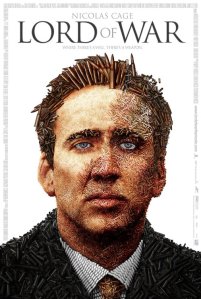 Andrew Niccol is back in my cadre of cool. He’s responsible for two awesome movies (Gattaca, The Truman Show) and one very lackluster Hollywood satire (Simone). But now the man is back and Lord of War is a startling look into the amoral world of international arms dealing. The film is enthralling as Uri (Nicolas Cage) narrates us about the ins-and-outs of his world a la Ray Liotta in Goodfellas. Not to be outdone by a juicy narrative by Niccol the writer, Niccol the director adds lots of stylish flash to his tale. The opening watches the manufacturing and journey of one bullet, it’s ending destination in the head of a little African boy caught in the crossfire. It’s jarring, it’s powerful, and it’s direct. That’s Lord of War in a nutshell.
Nate’s Grade: A-


 nathanzoebl
You must be logged in to post a comment.