Blog Archives
Zodiac (2007)
 Zodiac is something altogether different from a genre best known for cannibalism, skin suits, and express shipping of human heads. It has more in common with All the President’s Men than director David Fincher’s 1995 masterpiece, Seven. This is a serial killer thriller steeped in police procedural, closed door deliberations, and the slow drip of a decades long investigation into the Zodiac killings that terrorized California from the 1960s and 70s. Watching close to 3 hours of procedure with nary a car chase or a shoot-out may not sit right for fans of the genre, but I enjoyed the film for the same reasons people will decry it — the details. I loved how methodical this film is, how dogged and stubborn it is, and I found myself being enveloped into the minutia of the case.
It all began with a young couple looking for a bit of privacy in 1968. They park at a lover’s lane and nervously engage in a bit of the old “neckin.” A passing car interrupts them, and then that car returns with its headlights blasting into the couple’s faces. This man then takes out a gun and starts firing, killing the woman and badly injuring the young man. Robert Graysmith (Jake Gyllenhaal) is a political cartoonist for the San Francisco Chronicle when a curious letter has stirred up a lot of discussion. It’s a cryptic message with a puzzle attached made up of symbols and codes. The author demands his puzzle run in the newspaper, and if not, more will suffer at his hands. There are further attacks along the California coast and the mysterious figure finally gives himself a name at the end of one of his letters: Zodiac.
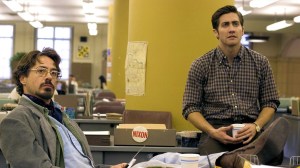 San Francisco detectives David Toschi (a great, raspy Mark Ruffalo) and William Armstrong (Anthony Edwards) are called in after Zodiac executes a cab driver in the city. The Chronicle‘s star crime reporter, Paul Avery (Robert Downey Jr.), pesters the police for details and eventually gets under Zodiac?s skin. Graysmith becomes obsessed with the case through a life-long love of puzzles and the case eventually consumes him, dooming his marriage to a pretty girl (Chloe Sevigny). Thanks to the tutelage of Avery, Graymsith becomes an amateur detective of his own, and his zeal to solve the case outlasts the actual police.
The Zodiac killer was really the first mass media serial killer. As the news of brutal attacks spreads, the media ate it all up and enlarged the figure of Zodiac to grand heights. And he was eager to help inflate his image, taking credit for crimes and slayings that were not his doing. The killer used the media age to terrorize the populace and increase his notoriety, similar tactics used by today’s stream of terrorists. The detectives didn’t just have to navigate all the shifting evidence but the formation of an urban legend.
This is before the day of DNA and super computers, so all progress comes from good old-fashioned police work. Long hours are spent pouring over mounting evidence while coordinating around bureaucracy; because Zodiac has struck in several different small communities it can take a saint’s patience to figure out the correct jurisdiction and compile the various parts in various offices. The film packs a lot in its running time introducing scores of information, suspects, witnesses, and varying theories, but the film cannot be faulted for pace; nearly every scene takes place weeks, months, even years after the last.
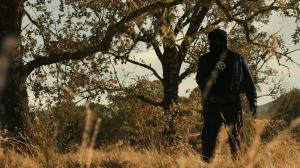 Zodiac is Fincher’s most restrained work even at a gargantuan running length. Fincher is a master tactician with slick visuals but has a penchant for getting too dazzled by needless visual flourishes (did the camera really need to zoom through the handle of a coffee pot in Panic Room?). He tones down the excess but still maintains a refined visual palate that makes the film feel fluid. The period detail is incredibly reconstructed, giving an authentic feel for a very serious story. But Fincher knows that with Zodiac the impetus lies with the story, and he devotes his considerable style to the service of the story. The mood balances nicely with intrigue, humor (after Zodiac singles out Avery fellow journalists start wearing “I’m Not Avery” buttons), and some truly terrifying moments involving the Zodiac attacks. The violence is sparse but when it does occur it is shocking, particularly watching a knife plunge repeatedly into the writhing body of a woman at a lake. One key element of sustaining such an ominous mood is fabulous song selection. Very often pop songs can be counter-productive to a movie, coming across as a lazy attempt to cobble together a soundtrack to shill. With Zodiac, “Hurdy Gurdy Man” becomes a powerfully haunting medley for the killer and the sonic linchpin for the film.
Fincher does an excellent job of transporting us back in time and recreating the sense of paranoia that grappled many. There is a great scene late in the film where Graysmith comes to the sudden realization that he may have walked right into the spider’s parlor. The scene plays out to an agonizingly uncomfortable length, and you too feel like running out the door as fast as your legs can take you. By not knowing definitively who the Zodiac may be, the film gets a boost of suspense from a multitude of creepy suspects. In an interesting decision, Fincher uses different actors of different shape during the Zodiac attacks, playing against the varying reports from witnesses and survivors.
There?s a sizeable danger trying to find a climax to a case that remains open to this day and where no one has been officially charged. Zodiac does as good a job as possible to present a fitting, mostly satisfying conclusion. The movie presents the best theory and points a convincing finger at who Zodiac perhaps really was.
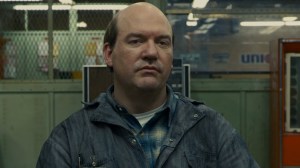 Zodiac is expertly crafted but has a handful of minor flaws that hold it back. The overall script is rather nimble with how it dishes new information to digest, however the intricacies can amass and become too great, and some scenes congest too much without needed forward momentum which causes the flow to get caught up in an expository pile-up. Still, the film is demanding but not overwhelming and not without reward. The film follows the ups and downs of the Zodiac investigation, and that means characterization runs short and simple. I fear the only false note amongst a vastly talented cast is Gyllenhaal, an actor I adore. He works fine in the portrayal of a young kid in the newsroom trying his hand at crime solving, but it’s the film’s second half where the actor falters. He fails to sell the obsession and desperation that dominates his life, instead looking wiped out but no worse for wear, like the temporary results of an all-nighter before a big test.
It was five years since Fincher’s last film, and he wasn’t sitting on his laurels when he crafted Zodiac, an exceptionally intelligent and demanding movie. Decades pass, suspects weave in and out, evidence and testimony contradict one another, it’s all a lot to keep track of but I found myself absorbed in the case just like Graysmith. This is a serial killer movie that could bring the smarts back and redefine the genre, that is, if fans are willing to sit through 3 hours of police work. If not, well they might get their kicks out of the more genre loyal The Zodiac, released in 2006. And that movie’s only 97 minutes long.
Nate’s Grade: A-
Share this:

Big Momma’s House 2 (2006)
 Men in drag is one of the truest tenets of comedy. Billy Wilder proved it, Dustin Hoffman proved it, even Robin Williams proved it. Eddie Murphy found career resurgence when he put on a fat suit for 1996’s The Nutty Professor. I think Martin Lawrence thought, why not combine them both? Thus was the unholy birth of 2000’s Big Momma’s House, where Lawrence goes undercover for the FBI as a morbidly obese older woman. If that doesn’t spell comedy then what will. Forgotten amidst the fat jokes and flatulence is the fact that Oscar-nominated Paul Giamatti was Lawrence’s beleaguered co-star.
Now, I myself had never seen the first trip to Big Momma’s House but in order to give a rounder opinion of the year 2006 in film, I felt it was my duty to see its sequel. For fun I felt a traditional review would do a disservice to the fine craftsmanship and invigorating cinema I was about to witness, so I decided to create a rundown of my viewing thoughts by the minute. Here, ladies and gents, is Big Momma’s House 2. Beware plot spoilers below.
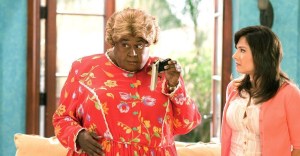 03: Martin Lawrence is dressed as an eagle and teaching kids about safety during a school assembly. Somehow his adolescent stepson is embarrassed by this.
04: Apparently Mrs. Big Momma (Gabriel Union) has a bun in the oven. Or an egg in the nest. She has the most unrealistic looking pregnancy ever. It’s almost like a cone.
10: Lawrence climbs back into the fat suit to go undercover as a nanny to stop computer hackers from dismantling the secrets of national security and selling them to terrorists. That’s right, it’s Big Momma vs. terrorism.
11: Also, apparently the rich do not do background checks on those in charge of watching their children. Has Dateline taught us nothing?
18: Here are the kids: dumb kid, cheerleader wannabe, and Hot Topic rocker chick (the daughter in 40 Year-Old Virgin that wanted to have sex).
22: Wife discovers Lawrence’s secret supply of XXXXXXXXL panties. Does she not know of Big Momma?
26: Nope. No she doesn’t, as she mentions her concern to a gal pal. “A woman this big wearing a thong? That can’t be comfortable.” Cue cut to Big Momma lamenting her thong. Why is Lawrence even wearing a thong? What are the benefits of dressing as a large woman and also wearing a thong?
32: Even the FBI, who put Big Momma into the field years ago, doesn’t even know Big Momma is not real. No wonder we have intelligence failures. Send Big Momma to fix Iraq. That’s a sequel I’d be interested in.
34: What school plays “Baby Got Back” for a gym dance class? Big Momma shows the uncoordinated cheerleader wannabe how to dance. The gym leaders ask for Big Momma to lead them to glory. Maybe he/she can also sink the winning last-second shot for the high school basketball championship too.
40: 19-year-old Chad is lurking in the bushes for the 15-year-old Hot Topic girl. Nothing spells romantic like “lurking” and “interested in dating a 15-year-old.” Again, did Dateline teach us nothing?
 45: Lawrence has to spy on the baddies and attempt to outrun his pregnant wife. Who do you think will win in a footrace?
46: The FBI finally realizes Big Momma is neither. The FBI earns a lollipop.
48: Lawrence decides to actually do housework for his nanny job but he decides to do it outside of his Big Momma costume, you know, in case the family walks in and wonders what a strange man is doing cleaning dishes and cooking dinner.
49: Big Momma pours the doggie a bowl full of tequila to lift its spirits. Dog depression is no laughing matter.
52: Big Momma teaches young girls how to dance like video stars.
56: Big Momma is at a spa with naked women and massages. Her advice to women for long-lasting marriage: put out often. That’s Big Momma for you, teaching our youth to dance salaciously, liquoring up animals, and turning back on the clock on feminism.
60: Big Momma runs on the beach in a 10 parody that no one seeing the movie will ever get. I guess it’s supposed to be funny because she’s fat? I think that’s the punchline for most of the movie.
63: Again, the limitations of an agent undercover in a fat suit (and thong) are revealed when Big Momma tries to chase down a suspect.
73: The dumb kid’s first words are, “Big Momma.” Then, “stakeout” and “investigate” and “hackneyed plot.” I made that last one up but it would have been something.
79: Big Momma enters a club to rescue Hot Topic girl at her plea. Oh, but Chad did not send a message it’s… THE BAD GUYS! And they’re taking her and Big Momma hostage.
80: My first laugh. Hot Topic girl and Big Momma tied in the back of a speeding van and rolling on top of each other with the sharp turns. Big Momma crushes the girl. Hot Topic Girl: “This is not how I imagined my death.” I’ll say.
83: Big Momma on a jet ski battles terrorists. Doesn’t being a large woman also make you a bigger target for bullets? Regardless, she kicks ass and we’re treated to a half-hearted payoff for thong wearing.
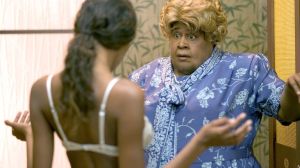 86: Big Momma gets shot just as the FBI arrives to shoot the bad guy. Excellent timing. Big Momma saves the day and is unmasked.
89: Have no fear, Big Momma stands in for the girls’ cheerleading dance. They apparently have a matching uniform in Big Momma size. There’s nothing Big Momma can’t do except star in a decent movie.
93: Lawrence brings home his new baby. He also threatens, in voice over, “You never know when Big Momma might be back.” Great, now I have to check under my bed every night.
I’m somewhat surprised that the movie isn’t as bad as I had feared. It’s mostly bland, with cookie-cutter characters, contrived situations, mishandled life lessons, and a dearth of comedy. Martin Lawrence must have been in bad shape to bring the fat suit out of the closet for one more go-round. The film is a dumb comedy that relies heavily on slapstick and Lawrence’s patter but neither ever feels inspired. This is a big bland mess, but it’s somewhat depressing in how cut-and-paste it all is and still designed to boost Lawrence’s career. If it wasn’t obvious before, it should be now — it’s time for Big Momma to pack her bags for good.
Nate?s Grade: D+
Share this:

The Departed (2006)
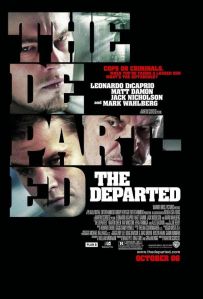 “I don’t want to be a product of my environment,” growls Frank Costello (Jack Nicholson) in the opening seconds of The Departed. “I want my environment to be a product of me.” Without question, the filmmaker that has shaped the environment of movies more than any other in the last 30 years is Martin Scorsese. No one does the cops-and-robbers territory better than Scorsese, and it’s great to have him back on familiar turf. It’s not that Gangs of New York and The Aviator were lacking in directorial skill, it’s just that they felt so labored and reeking of classy awards envy. With The Departed, it all feels so artistically effortless, like Scorsese settled in a zone of brilliant filmmaking. I just hope Marty bangs out more of these excellent gangster flicks before trying again to woo Oscar. In fact, his return to his violent stomping grounds might finally be his long-overdue ticket to the winner’s circle.
The premise is appealingly simple. The Boston State Police Department is desperate to nail local crime lord Costello. They pluck a young recruit, William Costigan (Leonardo DiCaprio), who has a shady family history of small-time crooks. He agrees to infiltrate Costello’s mob and report back to the Boston PD. To make is situation credible, Costigan is expelled from the force and sent to prison to earn a rep. Only two other people know Cosigan’s real identity, the police chief (Martin Sheen) and the head of undercover work (Mark Wahlberg). On the other side of the law, Costello has a mole all his own working inside the Boston State police force. Colin Sullivan (Matt Damon) has quickly risen through the ranks and has a prime position working with the state?s FBI crack force. He’s also an acolyte of Costello’s ever since he was a young Southie kid seeing the draw of power. Now full grown, Sullivan tips Costello and tries to redirect the ongoing investigation to bring the man to justice.
 The real sparks come when both moles try to discover the identity of the other, without compromising their own precarious identities.
The Departed is a bruising, bristling return to form for Martin Scorsese and his most entertaining film since his last Great Movie, 1990’s gangster-rific Goodfellas. This is a movie that crams multiple characters, storylines, and histories into one tight, focused setting, but then the flick glides smoothly on electric storytelling and intense performances. The movie’s twists and turns are, at times, of a knockout variety, and there’s a stretch of late surprises that each feels like a shot to the gut. I was possibly winded from gasping so hard. This is a film so fantastically alive with feeling and vigor that you cannot help but get ensnared. It sets up all the players and back-story before we even get the opening titles set to the blaring wails of the Dropkick Murphies. The thrills are real because we feel the danger, and the onslaught of brutal violence is another rhythmic piece in Scorsese’s masterful conduction. Adding to the feeling is the sure-handed, quick-fire editing of longtime Scorsese collaborator Thelma Schoonmaker and the ominous cinematography of Michael Ballhaus. Even though this film is based on a 2002 Hong Kong film, Scorsese has firmly made The Departed a movie all its own in spirit and personality. No one so easily brings us into the sordid lives of criminals better than this man, who, when in that creative zone of his, brings such palpable energy to his melding of image, song, and consequence, that the results are simply intoxicating. The Departed reminds you why Scorsese is still our greatest living director, no matter what Oscar thinks.
What elevates The Departed from the clutter of other macho men-with-guns crime capers is its studious attention to character. This is a film that works beyond a concept. The movie’s central moral theme is the price of identity. Frank opens the film asking what does it matter who’s holding the gun to your head, cop or crook. Costigan is tormented from wearing too many faces. He’s having trouble justifying his deeds and actions and is scared he may lose his own soul at the price of his lost identity. Sullivan, on the other hand, has gladly sold his own soul for a pittance. He’s a class conscience yuppie that craves power and will cut any throat if it gets him ahead. The movie steamrolls ahead with intrigue but it’s our connections to these characters that elevate the life-and-death stakes. You have a real emotional investment in this story, therefore when things get murky you really feel the danger. My heart was racing with excitement and dread. There may still be impressions from where I was squeezing the movie chair.
 Complimenting these complex characters are brilliant performances. DiCaprio may have been nominated for a Best Actor Oscar for his second Scorsese collaboration, The Aviator, but he turns in his strongest work here. DiCaprio expertly bares a gnawing moral conflict with equal parts desperation and the hunger to do good. He’s trying to finally do right and step out of his family’s criminal past, and DiCaprio brings sharp intensity to this plight. You really feel every stomach churn this guy goes through to do what he does and stay alive. I knocked the boy for being too boyish a gangster in Gangs of New York, and let me say I take back my words. On the flip side, Damon utilizes his angelic, choirboy good looks and masterfully downplays his character’s pragmatic villainy. The character has to hide so much from the outside world, be it the police, his true bosses, his girlfriend, and even himself. Damon goes about his deceitful business with slickly sick ease, tapping a killer’s instinct for self-preservation. You may shudder from how methodically cold and manipulative he comes across. He’s a mesmerizing rat bastard of a human being and yet Damon presents an almost seductive portrait of evil.
Nicholson is equally good though at times can be a distraction to the storytelling. There are a handful of moments where Nicholson seems to go too far off the page, indulging his crazier tendencies. Costello is supposed to be a scary, unpredictable, potentially unhinged man, and Scorsese has plenty of moments that bring home this point. It just feels inappropriate then for Nicholson to, in a few small moments, transform into a goofy cartoon. With that said, it’s great to see Nicholson cracking some heads for Scorsese. He has devilish fun and is insanely watchable while definitely going for broke. After some nice guy roles it’s nice to have back an unrestrained Nicholson to play the film’s abyss of evil.
 The collected supporting players all leave some mark. Baldwin and Wahlerg are perfectly profane hardass characters that you warm up to. Sheen, free from the Oval Office, displays nice touches of weariness and, in one moment, practically breaks my heart with his brave resignation. Breaking up this boy’s club is Vera Farmiga (Running Scared) as a somewhat contrived plot point to connect Costigan and Sullivan as the police shrink to one and the girlfriend to the other. There’s a perceived sadness to her willowy eyes and slender face that she plays to great effect. She?s a captivating new face and gives an extra ladling of emotion to the tale.
It’s been over a week since I’ve seen the movie and I still can’t get it out of my head. There are only a handful of flaws that separates The Departed from Scorsese’s rich pantheon of mythically Great Movies. This is a complex, gritty, amazing crime thriller stuffed to the gills with entertainment. Making the bloody body count resonate are the incredibly intense performances, particularly Damon and DiCaprio. This is a gripping gangster thriller pumping with the blood of a sterling character piece. The unexpected twists and turns will shake you, and the movie goes well beyond a snappy premise. The Departed is a moviegoing experience that will thrill you, stir you, sadden you, exhilarate you, and firmly plant itself in your memory banks. Welcome back Marty.
Nate’s Grade: A
Share this:

Inside Man (2006)
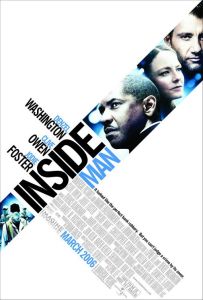 Spike Lee is one of the most recognizable names in film. Usually, the edgy, pointedly opinionated director sets his sights on racial strife, human relations, and satire. So what is Lee’s name doing attached to the Hollywood heist flick, Inside Man? For starters, it’s his most commercial film of his career, a sharp, engrossing thriller that doesn’t blunt his distinct voice.
Dalton Russell (Clive Owen) has set forth the perfect bank robbery. He and a handful of associates, dressed as painters with their faces obscured, have locked down a bank in downtown Manhattan. They’ve rounded up everyone inside, robbed them of their trusted cell phones, and ordered them to wear identical painter suits and masks. Detective Keith Frazier (Denzel Washington) is tasked with resolving this standoff, which the media is all too eager to cover in its escalation. What could the crooks be after? Well, bank owner Arthur Case (Christopher Plummer) is certainly nervous about a key document he has inside a safety deposit box, a document linking him to scratching the backs of Nazis. He pits Madeline White (Jodie Foster) to retrieve the document at any cost, and she has the tenacity to wedge herself between her political contacts and the police. All the characters keep their cards held close and try and outfox the other, while figuring out what exactly is going on inside that bank.
This movie is a born crowd pleaser. The heist and ensuing complications really grab an audience early on. There’s a certain thrill watching Dalton, so cool and clam, plot out his bank robbery like the script is still in hand. The crooks are always one step ahead of the police as well as the audience, and I mean that in the best terms. It’s great fun just wondering how Dalton’s team is going to get out of their many jams, and the results are rarely unsatisfying. Inside Man knows exactly when to tantalize with intrigue, inject humor (“Penalty of code 36DD?”), or tighten the tension. The filmmakers know exactly what button to press and at what time. For a two-hour plus film, Lee keeps the film at a swift pace and smoothly weaves his characters in and out. The draw of Inside Man is watching the tit-for-tat game between Frazier and Dalton, too stone-faced pros trying to outsmart each other. Lee smartly allows his characters and story to take center stage and refrains from goosing a strong genre flick with some annoying, superficial artistic artifice.
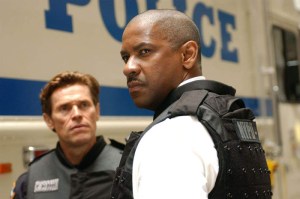 Inside Man is a heist that’s refreshingly grounded in reality. Nothing is altogether too out there or complicated to the point where you’d need a score sheet to follow along. Dalton is the movie’s star and Inside Man gives him the center stage to draw us in and keep us guessing. In fact, the flick is so grounded in the plausible that mainstream audiences might be put off by the fact that there isn’t any super twist saved for the end. I think the same audiences Inside Man is so fine-tuned to entertain will discover the lack of a last-second twist as underwhelming. I hope we’re not to the point, as an audience, where we’d rather have an illogical, forced twist ending than something that closes our story with satisfying maturity and finesse. The biggest plot hole you’ll have to swallow with Inside Man is that a businessman would keep a document that linked him to the Nazis. What’s that about? Sentimental value? I’m also still a bit hazy on the motivation of our crooks.
Even though this is a crowd-pleaser, the film is not without its missteps. Inside Man has one of the worst scores I have heard for a movie, ever. Allow me to explain why I feel so brutally, and I do. The score flashes inappropriate mood all throughout the film, robbing many sequences of drama and calling attention to itself. Take for instance a phone conversation between Frazier and Dalton; we cut back and forth between the two and each actor has a different music score. Frazier’s is a jaunty jazz riff, while Dalton’s is the more traditional brooding orchestral number. Because of the schizophrenic musical score this moment becomes funny. The best example of how this score is dreadful is during a scene late where SWAT storms inside the bank. The camera takes their point of view and creeps through the bank lobby, and then you hear a horn (trumpet?) reverberate. It gets louder and then quieter in beats, like a high school brass orchestra just whizzed by in a race car. Then it keeps going but in another direction. At first I was confused, and then I thought, “Did Dalton actually set up a horn section to distract the police?” No, it’s just the awful Inside Man score that totally takes you out of the movie. Scores should enhance the movie, not turn drama into comedy.
Lee also doesn’t help his story by including so many flash-forwards in time. They mostly rob Inside Man of key suspense points. Now we know the bank robbers get away, we know their identities are still unknown, and we know no one died. Luckily, the charisma of the leads and the clever storyline can survive Lee shooting the movie in the foot. The movie also has what feels like the longest denouement since 2003’s Return of the King 20-minute hug fest.
 The quality cast definitely gives Inside Man a boost. Washington is on autopilot but is still charming as ever while being intense and intuitive. Foster is like a female version of Mr. Wolf (Pulp Fiction) but full of steely determination. It says something when really talented actors like Willem Defoe and Chiwetel Ejiofor take tiny roles. As it should be, Owen is the standout. He’s so menacing and composed that you not only want Dalton to get away with the bank holdup, you want him to humiliate and embarrass his opponents even more. I?m convinced that in the world of film there’s no cooler actor than Clive Owen at this point. He adds a touch of badass to every role, with the notable exception of Derailed. At this point, I would pay to hear him recite the phone book and walk away going, “Wow, I didn’t know Aaron A. Anderson of 1200 West Avenue sounded so kickass!” Clive Owen is that cool.
Inside Man is a sharp, intelligent, mostly satisfying heist flick with a terrific ensemble. Lee’s most mainstream picture ever is a born crowd-pleaser, despite some missteps here and there (flash forwards, a poor score). The acting all around is top-notch, and the flick works as a tight and mature genre piece, simultaneously covering all its genre bases and playing up the smarts. I hope audiences appreciate the sense of believability with the film and don’t walk away irked that there is no super last-second twist. Inside Man isn’t anything groundbreaking but it knows how to tease an audience and tell a good guessing game of a tale.
Nate’s Grade: B
Share this:

16 Blocks (2006)
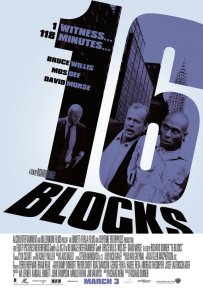 If you think you’ve heard of 16 Blocks before, you may just be correct. There was a 1977 Clint Eastwood movie called The Guantlet where he was transporting a prostitute/mob witness on a bus, and hordes of dirty cops and mob enforcers are trying to eliminate this witness. So the bus gets shot up beyond all imaginable repair and something of a standoff occurs. If you’d rather rent The Guantlet than pay full price for 16 Blocks I can understand that, but 16 Blocks is an adequately entertaining return to form for director Richard Donner (The Goonies, Lethal Weapon).
Officer Jack Mosley (Bruce Willis) is the kind of New York cop that, when stationed at a crime scene, raids a drug dealer?s cabinet and helps himself to some booze. Jack is like a walking zombie, trudging from assignment to assignment. He’s stuck with one more assignment, transporting Eddie (Mos Def), a key witness in a government trial just 16 blocks away. Everything seems so routine, but then Jack thwarts an attempt to murder Eddie. He reports the attack and takes a breather in a bar. Shortly after, he’s greeted by his old partner, Frank (David Morse), who is ominously familiarity with Eddie. Seems Eddie saw something he shouldn’t have, and now a whole slew of dirty cops are going to go down if he testifies. Frank would appreciate it if Jack stepped aside, gave up Eddie, and everything would be square again. All he has to do is make sure Eddie misses his testimony deadline in an hour, dead or alive. A sudden conscience gives Jack a new life, and he?s determined to escort Eddie to the courthouse, no matter the cost. Frank is willing to stop this, no matter the cost. Let the countdown begin.
 16 Blocks is a solid genre picture up until a bus standoff lets all the air out and kills the film’s jumpy momentum. Yes, it’s assembled out of worn clichés and plot elements from other flicks, but this cut-and-paste action flick is a cut above out of its determination. When 16 Blocks is cooking, and it does for stretches, the movie seems to be moving forward by sheer force of will. It’s somewhat admirable, and I’m convinced Donner is responsible for this as he settles into familiar territory. 16 Blocks successfully introduces obstacles and then lets our heroes find believable and entertaining ways to skirt past the danger and into the next obstacle. New York City really feels like its own integral character that’s central to the unfolding plot. 16 Blocks is nothing spectacular but it’s proficiently fun, that is, until that protracted bus standoff gums up the film’s flow. The contrivances become too glaring and 16 Blocks settles into an overly redemptive finish. 16 Blocks succeeds as long as it can, which is surprisingly longer than I would have estimated, but it eventually winds down with too much time left on the clock.
What the hell is up with Mos Def’s voice in this movie? I don’t know if he was trying to stretch his thespian wings, but going the entire film sounding like you’re a cartoon is not helpful (unless you’re Joey Lauren Adams). I seriously expected a tank of helium to be connected. It’s so mannered, so annoying, and so purposely “different” that you’re almost glad he may die in the film’s opening minutes. However, if this was Donner’s attempt to put the audience in Jack’s place, make us just as bedraggled and frustrated, then well done sire. It’s still not forgivable but at least I may understand.
Willis comes across perhaps a bit too realistic as a doughy, down-on-his-luck cop. It’s getting all too natural to see Willis wearing a badge, or at least holstering a weapon, so at least it’s nice to know he changes it up every once and a while. In 16 Blocks he’s overweight, over the hill, and even sports a limp; not exactly action star material unless you still consider your dad the Strongest Person in the World. It adds an interesting, gritty charm to the picture and Willis coasts on our goodwill. 16 Blocks tries to do too much with his character towards the end, encasing him in a crusade to better himself. There just isn’t that much substance there, folks.
I don’t understand why Jack or Eddie doesn’t phone the media as soon as they know the trigger-happy cops are gunning for them. Seriously, you’d think one call to the press and they’d be swarmed with TV cameras, and as a rule the more TV cameras pointed around you, the less likely someone is going to shoot you. This seems like a no brainier to me, as well as an opportunity to put the media in the cross hairs of danger; it’s win-win.
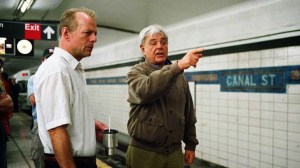 There are some moments in 16 Blocks that are perfect indicators about how familiar a movie like this has become. First, the “gotcha” edit. We see two sequences of action, Group A in a fixed location and Group B quickly descending toward that location when “voila” we’ve been had. The film reveals Group A has already left. I usually enjoy this bit of action sleight-of-hand, but when a movie has to pull the “gotcha” edit twice, then it’s a little like the boy who cried wolf. There’s also some stupid character slips meant to squeeze in tension. At the film’s sleepy climax, Jack is surrounded by men with their guns trained on him. He says he has a key piece of evidence is tucked away inside his coat pocket… and then he reaches in to grab it. Now wouldn’t an astute individual, let alone an experienced man of the law, just ask someone to grab it from him instead of reaching inside and giving people a reason to shoot? 16 Blocks has moments like these because the characters are all stock, so what does it matter if they alternate between brainy one second and bone-headed the next?
16 Blocks is an enjoyably retro genre flick, pasted together with stock characters, contrivances, and cliches, and yet the entire project nearly makes it to the finish line by sheer force of will. Despite the well-worn territory, Donner’s precision and some clever obstacle/resolution conflict keeps 16 Blocks passably entertaining. Willis and Def lack any real camaraderie, and you may want to strangle Def after listening to five seconds of his cartoonish voice, but it doesn’t matter because this film is about the journey, not the journeymen. 16 Blocks loses its way when it forgets this, spending the last act focusing on character dreams, morals, and redemption. 16 Blocks is a redemption of sorts for Donner; the man can still make nervy action sequences and keep an audience entertained, if even for only two acts. That’s worth a walk to the movie theater for most.
Nate’s Grade: C+
Share this:

Running Scared (2006)
 Running Scared is ridiculous, perverse, puerile, so over the top you forget where the top was, and yet it works within its own uncompromising universe. Writer/director Wayne Kramer (The Cooler) has a singular point of view so that while the out-there theatrics pile up, you feel like nothing is exactly out of bounds. The crux of the movie centers around a low-level mobster Joey (Paul Walker) trying to retrieve a gun that his kid neighbor stole and used. This gun was last used in a shootout involving dirty cops led by Chazz Palminteri. Joey needs to find it before the mob gets him, the dirty cops put the pieces together, and then Kramer even introduces more threats, like pimps, the Russian mafia, and in the movie?s most bizarre subplot, killer pederasts that look like normal people (one of the more disturbing elements is the fact they have star ratings on their home-made child porn).
The missing gun is really a McGuffin for a wild night with wild characters and extreme antics. Running Scared succeeds both as gaudy, trashy, dirty boy’s-night-out fun, as well as a wink-wink parody of the Tarantino-esque crime capers (stylized gun fights, pop culture soliloquies, quirky characters, anti-heroes, brutal violence, gratuitous nudity, weird coincidences, outlandish irony). You’ll know whether or not you’re along the film’s relentless, highly graphic wavelength early on. Running Scared opens with an incredibly bloody shootout and then quickly transitions into some surprisingly near graphic sex, as Joey wishes to service his wife (Vera Farmiga) right on top of their washer. Running Scared‘s unpredictability is its greatest asset, though a late character revelation meant to make an audience view Joey as a good guy seems forced and negates the chase for the stolen gun. I also swear … this had to be the most times I have ever heard the F-word in a film (current champ is Nil by Mouth at 470 at 3.9 a minute).
This is one movie that has to be seen to be believed. It’s so over-the-top in near everything it does, it’s nearly awe-inspiring. I knew I was in good hands when Kramer included the gratuitous sit down at a strip club … and had his strippers be bottomless as well. That’s someone who knows what movie they’re aiming for, and with Running Scared, it looks like Kramer is having his own fun playing with the bombast.
Nate’s Grade: B
Share this:

Freedomland (2006)
 There’s one thing I’m going to remember about Freedomland more than anything — seeing this movie cost me about $300. Allow me to explain. Upon returning home from seeing this terrible film, I received an e-mail from a friend alerting me that a secret code had been floating around the Internet. This code was to be used at Amazon.com, and when punched in at the check-out, your order would be free as long as it totaled over 80 dollars. Just as I was about to check out with over $300 of goods the window closed and the code was no longer working. If I had not seen Freedomland then I would have gotten this news earlier and would have been able to obtain my booty. Alas, I did see Freedomland, a drama that attempts to shed light on racial woes. Movie mogul Joe Roth, the head of Revolutions Studios, doesn’t direct movies fairly often and when he does they’re not great (America’s Sweethearts, Christmas with the Kranks). I knew exactly what I was getting into when I entered the theater; I just didn’t know it was going to cost me $300.
In 1999 New Jersey , Brenda (Julianne Moore) walked dazed and bloodies through an urban neighborhood to a hospital. She tells detective Lorenzo Council (Samuel L. Jackson) that she was the victim of a car jacking while she was traveling through an urban area. She says a black man threw her from her car and drove off. Brenda’s four-year-old son Cody is still in the car. This sets the neighboring communities abuzz. Brenda’s hot-headed cop brother (Ron Eldard) is ready to turn the black projects and high rises upside down, unafraid of whom he may harass. The black community is in an uproar over the treatment, succinctly pointing out that many black children go missing but the news vans and police cars only come out when the missing happens to be white (for further proof, look to the still ongoing coverage of Natalee Halloway). Karen (Edie Falco) runs a team of mothers who volunteer nationwide to help find missing children. Lorenzo has his own doubts about Brenda and the details of her story.
 Plain and simple, Freedomland just does not have enough story to justify its existence. It goes nowhere and practically drifts to its long-awaited conclusion. You’ll see the light at the end of the tunnel around the halfway mark, and then Freedomland limps to its foreseeable ending, devoid of any twists and turns that aren’t telegraphed a mile away. It got so pathetic that I was actually hoping, against all odds, there’d be some gonzo M. Night Shyamalan-esque twist at the very end to jar me out of my complacency. No such luck. The marketing folks of Freedomland seemed to advertise a twist ending, which is hard to believe since everything plays out exactly like you?d first suspect. Moore’s overacting hysteria makes the audience doubt her from the start; plus the fact that Brenda’s like, “Oh yeah, I almost forgot, my SON is in the hijacked car.”
This is a movie so mishandled by Roth that every moment feels false, and when it doesn’t feel false it feels trite and awkward. Take a moment when Lorenzo takes Brenda to an empty urban high-rise. He?s got her pinned in a corner, very literally, and is pressing to know if she killed her kid. The framing of the scene would almost suggest something quasi-romantic, with Lorenzo leaning very closely into Brenda and his arm against the wall beside her. At the very least, it?s really intrusive. And then at the end of Brenda’s “he was all I got” monologue the two actors seem to just stare at each other, like they’re mentally waiting to hear the word “Cut.” The weird framing and the editing make the scene feel amateurish.
But Roth doesn’t stop there. Freedomland itself is a gigantic mislead, and the old abandoned building has about five minutes of total screen time. It’s not enough to even qualify as a red herring, let alone justify it as a movie title. Apparently, this building has been rotting in the woods for decades, and yet Lorenzo lets a large volunteer search party just trounce around inside. I’m pretty sure any policeman worth their salt would need to get a team to make sure the building was structurally sound before letting civilians snoop around in a potential crime scene. That’s not enough stupidity. Later while the people are exploring the Freedomland building, Karen says the floorboards may give way at any moment, and then she leaves Brenda by herself with said unreliable floorboards. Do these people even understand what they’re doing?
Freedomland seems so message-hungry and preoccupied with making some Big Statement that it forgets to be entertaining. Roth is clueless how to juggle all his plot elements, letting the racial tensions turn both sides into offensive stereotypes. The white cops have short fuses and have no hesitation to assault innocent black people (they’d be suspended and then reviewed). The black community in Freedomland, while seeming to have nothing better to do than assemble and shout at the police, stir up their community ills whenever the plot deems it necessary. Some black people are seen setting the community’s own property on fire, swept up in the rising air of a riot. Rafik, a youth given a lot of foreshadowing, instigates the riot and an entire wall of angry black faces proceeds, never mind that this brash decision results in many innocent people being beaten. The movie seems to say that all blacks are victims or instigators. Freedomland is so earnest to be earnest that it misses the mark when it comes to all the details. How else to explain why the film is inexplicably set in 1999. Someone didn’t tell the film’s costume designer, because Rafik is wearing a “G-Unit” shirt, a rap group that didn’t come into light until after 50 Cent’s commercial rise in 2003.
 Perhaps the film’s ending is Roth?s biggest misfire. Lorenzo visits Cody?s shallow grave, now festooned with flowers and personal messages. He reads one that says, basically, “Cody’s death made us all look beyond our differences and realize what we have in common, the ability to feel sad.” What? Is Roth actually justifying the death of a child and subsequent racial fallout as being medicine for society’s ills? This seems ridiculous to me, especially after sitting through two hours of a movie where no one came together, unless you’re talking about the human connection of fist-to-face.
The acting in Freedomland is so unrestrained and shows another of Roth?s directorial weaknesses. Moore, always so reliable a performer, goes out of her mind and gives what should be the worst performance of her career. She’s so over the top, so Looney tunes, so wildly out of control with no bearing, she’s practically bouncing off the walls; it’s kind of embarrassing to watch. Her hysterical theatrics provide several moments of unintentional laughter, particularly a moment where Lorenzo is interrogating her and she just blurts out, “I love you.” Freedomland does her no service by handing her some dreadful dialogue and drawn out monologues. I think it may be time for Moore to star in something a little happier instead of more movies where she’s predominantly crying or grieving. And is it me, or does it seem like Moore has a habit of losing her kids in movies (maybe she should start tethering them to her waist)? Note to Julianne Moore: just because you get to cry and scream doesn’t mean you should take the role. Did you actually read the script to Freedomland?
Jackson, left directionless with an underdeveloped character, reverts to his standard operating procedure when it comes to authority figures … namely staring and yelling. Lorenzo has some character traits (asthma, a son in prison) that are either dropped or have no payoff or insight toward his character. He?s a cop in the middle of it all, and yet Freedomland feels like just having Jackson as an actor should cover the characterization part. At this point, Jackson can do these roles in his sleep.
Falco, far more subdued than everyone else in a very yell-heavy movie, leaves the biggest impression and gives the movie life when she’s onscreen. Falco’s character is what Freedomland should have been based around, not Moore’s shrieking loon of a mother. Falco has the film’s only great moment, effortlessly shifting a story about her own loss and need for closure back to Brenda. The patience and control Falco has in that scene only reminds me how much I need The Sopranos back on the air.
Freedomland is so starved to say something grandiose about racial tensions that it neglects being entertaining. When the movie is entertaining, it’s mainly because of the wild, embarrassing overacting and the nonsensical human behavior. At its worst, Freedomland is offensive to cops and blacks and moviegoers in general with working grey matter, at its best Freedomland is a muddled, incompetently directed movie that drifts unchallenged toward its expected and welcomed end. Roth should leave directing to people that have a better feel for taking control of actors, material, and editing. For those that said the racially-charged Crash lacked tact, I invite them to take a trip to Freedomland. It’s trite, it’s dull, it’s funny when it’s not meant to be, and it’s one of the worst films of 2006.
Nate’s Grade: D+
Share this:

Crash (2005)
 A searing look at race relations and a powerful human drama at that. This flick has some of the sharpest memories I’ve had from any movie all year, particularly the relationship between a Hispanic locksmith (Michael Pena) and his daughter and a special invisible cloak. Their first scene, where he talks her out of hiding under her bed, is one of the most beautifully written short scenes I have ever witnessed. A late scene involving the two of them knocked the wind out of me completely and is the most vivid moviegoing moment of all 2005 for me. Every character has at least one great moment, though time is not spaced equally amongst this large ensemble. Crash has the intriguing practice of introducing near every character spouting some kind of racist diatribe, and then the movie spend the rest of its running time opening you up to these characters and getting to like them. Writer/director Paul Haggis has such a natural ear for terse, realistic dialogue that can really define characters with such brevity. A fine movie, despite the overarching coincidences.
Nate’s Grade: B+
Share this:

Kiss Kiss, Bang Bang (2005)
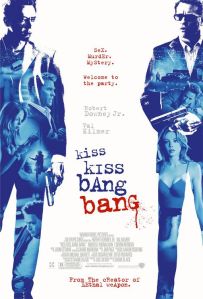 Shane Black was a Hollywood icon by the time he was in his early 20s. In 1987 he sold a script called Lethal Weapon to producer Joel Silver that put a jolt back into action flicks and gave the template for all buddy-cop comedies to come. He earned a then-record $1.7 million for his script, The Last Boy Scout, topped later by the $2 million paycheck he got for The Long Kiss Goodnight. It’s a shame both scripts were marginalized by their film directors. Black went underground for a long time, nursing his wounds over what had happened to his screenplays. Then in 2004, Black began his comeback vehicle, a modern day detective story that also lampooned Hollywood, and this time he’d direct his own material. The final product is called Kiss Kiss, Bang Bang, and Black’s comeback film is nothing short of a cinematic knockout and the most refreshingly entertaining movie of all 2005.
Harry Lockhart (Robert Downey Jr.) is a small-time crook on the run from the cops when he stumbles into an acting audition. They hand him a script, tell him his partner’s dead, and are so impressed with his “acting” that he’s immediately flown to Hollywood. Harry is teamed up with Gay Perry (Val Kilmer), a cop who does advisory work and just happens to be gay. During a house party, Harry reunites with a childhood friend, Harmony Faith Lane (Michelle Monaghan). They reminisce about their childhoods in Indiana and their fascination with the Johnny Gossamer detective novels, but she has much more on her mind: her sister’s gone missing and she needs Harry to find her. Trouble is Harry hasn’t told her he’s not a real detective. He’s gone from crook to pretend actor to pretend detective, and before Christmas is over he’ll be up to his neck in bodies, intrigue, double-crosses and all the stuff that would make for a rip-roaring Johnny Gossamer book.
 First and foremost, Kiss Kiss, Bang Bang is one deliriously fun party. The film moves at breakneck speed through its smart, cheeky gags. Black’s dialogue is hilarious and feels so effortlessly natural coming from Downey Jr. and Kilmer, like he’s got their speech patterns tattooed in his brain. In fact, the dialogue feels so robust and natural, never glib and self-conscious, that it almost comes across as feeling like a heavy improv session between two immensely talented actors. Kiss Kiss, Bang Bang, Black’s opus to the hard-boiled detective genre, has more twists and turns than a seizure patient doing the Hokey Pokey. You never know where this movie will head next or what joke will topple you over with unexpected laughter, and that’s what makes Kiss Kiss, Bang Bang so unabashedly thrilling to watch. Even when the movie does start to veer into more conventional material, Downey Jr. is there as our narrator to point out what we’re all thinking and to make fun of the expected. Kiss Kiss, Bang Bang can get jubilantly perverse at parts (a corpse getting a golden shower), but the macabre touches never deflect from the film’s boundless, inconsumable energy. Everyone is having the time of their lives in Black’s comic caper, and it shows.
Seriously, this movie is the definition of a laugh riot. It’s like a carnival ride through a gag factory (that sounds kind of spooky, actually), and Black has such an assured confidence to his writing, evidenced in his set-ups, reversals, and the insightful tweaking of Hollywood that could only come from one of its own (Harry laments that the nation turned over and shook and all the normal girls hung on while the crazies landed in L.A.). Here’s a conversation between Harmony and Harry about a promiscuous actress:
Harmony: Well, for starters, she’s been f***ed more times than she’s had a hot meal.
Harry: Yeah, I heard about that. It was neck-and-neck and then she skipped lunch.
Just re-reading it makes me laugh. How many comedies make you laugh just thinking about them in retrospect? Kiss Kiss, Bang Bang is one of those oh so rare delights. It even has a talking bear in it!
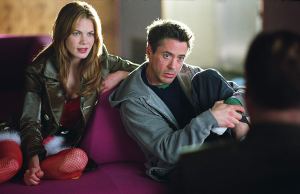 The lone detraction for Kiss Kiss, Bang Bang is the movie’s overall lack of substance. It doesn’t reach for anything more than bold entertainment, and to that end it succeeds in spades. Some may argue the movie is spinning so fast to try and distract you from its empty center, but I say enjoy the ride while it lasts. I only wish this movie was longer, like Lord of the Rings-long. I did not want to leave this world and these characters. My claw marks might still be visible on the armrests where they had to throw me out.
Black also proves to be a very slick director with a natural eye for camera placement. His photography is very pleasing, relying on different light placements to add surreal touches that accentuate the narrative. Black keeps his movie at a breathless pace and knows how to handle his actors. His narrative side-steps enliven the film and grab our attention, and Harry’s voice over is never overused to explain the minutia the script cannot. The only drawback for Black might be that his film could be too smart for its own good. I mean, most of the movie going public will be stooped by a joke about adverbs. Black has an obvious love for detective yarns and film noir, that’s evident with the film’s style and the fact that chapter titles are Raymond Chandler novels, but some familiarity with this world will sharpen your experience. Kiss Kiss, Bang Bang never panders to its audience, and that may hurt Black as far as making a movie that will reach out to Middle America (Perry apologizes to the Midwest for using the “f-bomb” as often as they do).
The chemistry between Downey Jr. and Kilmer is incredible, positioning them as one of the finest comic pairings in recent cinema history. Their indelible camaraderie is the true heart of Kiss Kiss, Bang Bang. They bat insults and injuries with comic aplomb. Both characters are unapologetic, Harry as a nattering criminal screw-up way in over his head, and Perry as gay man who’s fine with that and will rip your testicles off just the same if you cross him. He’s not stereotypical swishy or flamboyant, but he’s very enjoyably dry and sarcastic. Both actors have a history of being troublesome to work with, but Downey Jr. and Kilmer have been two of our most amazingly talented actors … when they want to be. Kilmer is the coolest customer in the film, being nonchalantly badass even when he’s about to blow his top (this is NOT a gay joke, by the way). Downey Jr. is his usual charming, amiable, fast-talking self, but even his tiniest details speak comedic volumes, like his reactions and general awkward physicality. I cannot imagine anyone else doing as excellent a job in these roles, especially Harrison Ford who was sought by producers for the Gay Perry part (feel free to shudder at what might have been Hollywood Homicide 2.
 Monaghan is a break-out actress that could have been even more break-out-er by this time. She’s mostly had small unmemorable roles in films like Unfaithful and The Bourne Supremacy, but 2005 was set to be her year. She had roles in Constantine, Mr. and Mrs. Smith, and Syriana. Unfortunately, her scenes were cut from Syriana and Constantine, and her role was drastically pared down in Mr. and Mrs. Smith. The only thing Monaghan has to show for 2005 is Kiss Kiss, Bang Bang, and that’s all she’ll need. She’s bright and pretty, but she also gives Harmony a great sense of being run down, another girl getting off the bus to Hollywood with stars in her eyes only to find out the harsh reality. Her combative relationship with Harry as they reconnect and try and wonder how they went astray is another film high point. She’s a comedic asset and should be on Hollywood’s speed dial if they need a charming, funny, capable actress.
Kiss Kiss, Bang Bang is a wicked good time. It’s complex, twisting, riveting, unique, hilarious, and just about every synonym you can think for the word “awesome.” Black’s comeback may be too smart for its own good, and having a general understanding of film noir will enhance your experience, but this is one comic caper that’s so much fun, so stylish, so damned entertaining, who cares if it lacks substance? Kiss Kiss, Bang Bang is a refreshing blast of fresh air and should please anyone looking for a smart Hollywood film mixed with doses of their familiar sex and violence. But that’s what makes Kiss Kiss, Bang Bang so exhilarating, nothing about it could be classified as familiar. Seeing this flick is like being invited to the party of the year. Just make sure to head to your theater before your invitation gets lost in the mail.
Nate’s Grade: A
Share this:

Sin City (2005)
 Like film noir on steroids. Director Robert Rodriguez has made the most faithful comics adaptation ever; giving life to Frank Miller’s striking black and white art. The visuals are sumptuous but the storytelling is just as involving, a perfect mix of noir/detective elements and subversive, highly memorable characters. Sin City may be the most violent studio film … ever, but the over-the-top tone keeps the proceedings from becoming too nauseating, even after limbs are lost, heads roll (and talk), and dogs pick away at living bodies. This is a very ball-unfriendly movie; lots of castrations. The blood even looks like fluorescent bird crap. The stories become somewhat repetitious (anti-hero saves distressed woman), but Miller and Rodriguez keep their tales tight, pulpy, comic, and unpredictable. My friend turned to me after it was done and said, “That was a great movie.” I could not argue.
Nate’s Grade: B+


 nathanzoebl
You must be logged in to post a comment.