Blog Archives
Mercy (2026)
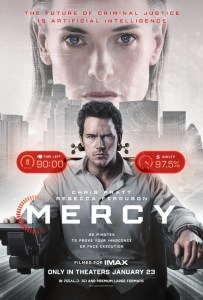 Detective Chris Raven (Chris Pratt) wakes up strapped to a chair. An A.I. judge (Rebecca Ferguson) informs him that he has been changed with the murder of his wife, and thanks to the new Mercy program instituted by the Los Angeles justice system, he will have 90 minutes to prove his innocence to a “reasonable doubt” level of 91% guilty (is that all a “reasonable doubt” is going for these days?). If he fails to convince the A.I. judge, then he will be terminated at the end of those 90 minutes. Start the clock.
Mercy is essentially a screen life movie with a high-concept twist, but at no time was I captivated with the mystery or intellectually satisfied by the application of its storytelling angle. We’ve seen similar movies recently, notably 2018’s Searching and far far less notably the 2025 War of the Worlds, where the movie screen is an extension of a computer screen that holds the borders and tools of our storytelling. In a way it reminds me of the found footage boom of the early 2010s, a hot gimmick that could get studio execs to say yes to projects that they would otherwise have passed on. However, there still needs to be careful ingenuity about how to incorporate these elements and, even more importantly, how to work within the limitations of your gimmick. With Mercy, our main character is basically trying to prove his innocence in real time with an A.I. judge who really functions more like an A.I. assistant, granting him access to people and databases even his police position would not have immediate access to. The recreation of the crime scene with the clues and evidence has a very Detroit Become Human feel (that’s a sci-fi video game that plays more like a movie). The A.I. judge is willing to help out this convicted man as long as he doesn’t admit guilt, because then it’s straight to execution time. For ninety minutes, Chris Raven has to crack his own murder case. The real-time element is meant to provide a sense of urgency, a literal ticking clock, but it’s also quite the misstep when your movie isn’t very good. This allows the audience to mentally count down how much time is left before your movie is finally over. The screen life aspects are pretty superficial and visually dull even if the graphics as being pulled around like interactive three-dimensional objects. The fact that this movie was shot for IMAX is astounding.
 The problem is that the plot is too predictable at every turn. We have a future criminal justice system made for automation and expediency, so it’s not going to be too much of a leap to suspect it might not be operating at the level of success its proponents profess. There’s a long history of stories presenting a new technological leap that is meant to be fool-proof that, shocker, is proven to be anything but. Right away, the audience is already going to be suspecting that the Mercy system is compromised or at least prone to errors like our present criminal justice system. We can safely assume that our protagonist is innocent, and if that’s the case then the implicit question is how many others who were tried and convicted were also ultimately innocent? Some might call it a death row metaphor but it’s literally the same thing just with a high-tech A.I. spin. The next question becomes is the potential error a sign of the limitations of assigning such power to seemingly infallible computers, or is it being deliberately compromised and manipulated? Are certain powers-that-be using this as an excuse to eliminate undesirable peoples and populations? The case of Chris Raven is meant to unveil a larger, systemic problem of justice not being served. And yet, the movie doesn’t exactly explore this obvious implication.
I’m going to dive into spoilers with this next paragraph because I think it’s worthwhile and also I don’t think you’re missing anything with Mercy. If you already assume that Chris is innocent or set up, there’s only so many other places you can go as a story. So with that warning addressed, the Mercy system is really easy to trick, as evidenced by our eventual culprit who has the know-how to digitally erase and alter security footage. Didn’t know this guy had those kinds of skills but, hey, people can surprise you or, more accurately, when the screenplay calls upon enough coincidences. However, there’s another layer of conspiracy afoot. This one guy is responsible for setting Chris Raven up because his own brother was accused and executed by Mercy even after he gave the police an alibi that was ignored. He wants vengeance for the injustice done to his family. This means there’s also the unraveling of who was responsible for this other guy’s wrongful arrest and execution, and wouldn’t you know it happens to be Chris Raven’s own partner, who needed the Mercy program to be seen as trustworthy. The movie never deals with the implications of this. It doesn’t really confront the moral turpitude of killing an innocent man, and it doesn’t think big picture to ask how many other innocent people have been sacrificed as cover. Amazingly, the last line of the movie involves Chris Raven saying, “Humans and A.I., we all make mistakes. And we learn.” What? Technology shouldn’t make mistakes. Alexander Pope didn’t say, “To err is human, and also these new contraptions. Have you seen these textile factories? Wild.” We don’t expect technology to fail us, especially if we are putting judgement over life and death as one of its tasks. This sounds like dubious excuse-making for a system literally killing innocents in the name of the law, and yet our hero treats the whole revelation like, “Well, you gotta break some eggs for an omelette.” It’s such a callous, incompetent response to an immediate problem that his own police force is exploiting. Yet the movie doesn’t blame the faulty A.I. system, which I repeat even some random guy was able to hack and manipulate, and instead looks at it as a tool, like when people try to separate guns from gun violence. However, in this case, the gun is making its own calculations on who deserves to die, and, again, being manipulated by randos. This gets a little more unseemly when you realize that the movie studio’s release is from Amazon, which would very much like you, dear citizen, to stop villainizing A.I. and accept its omnipresence in your new digital life.
 Mercifully, Mercy holds to its countdown, though there’s an extra period of “stoppage time” with an action sequence outside of the chair as climax. The mystery is dull, the plot is predictable (if you don’t suspect who the real killer is after 30 minutes, this might be your first movie, so I’ll tell you now – they get better), the world building is underwritten (who needs an exploration of the large-ranging moral implications of this system when we get police on drone cycles!), and the fun of its creative ingenuity is gasping. It’s forever going to be the Chris-Pratt-stuck-in-a-death-chair movie. This concept could have worked but there needed to be significant revisions, especially unpacking the larger implications for this new system of justice outsourcing justice to all-knowing machines. That’s not this movie. Mercy isn’t even overtly critical of artificial intelligence, instead excusing its faults as “user error” from bad actors. It’s a film too afraid to have any strong sentiments, which makes for a pretty lifeless time at the movies. The machines have won.
Nate’s Grade: D+
Share this:

The Rip (2026)
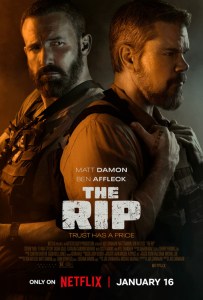
Director Joe Carnahan (The A-Team, Narc) excels at machismo, and I mean that not as a detriment. He makes muscular action-thrillers, often about corrupted men coming to terms with their ruination. 2012’s The Grey is still one of the best movies I’ve ever seen released in January. Well here comes The Rip, also released in January, starring Matt Damon and Ben Affleck as combustible Miami cops who follow a tip to a cartel stash house that holds a cache of twenty million dollars. The cops are supposed to follow protocol, call it into their superiors, but with that kind of money, much more than what the tip reported, it’s hard to resist the life-altering implications of indulging in that kind of haul. I thought The Rip, named after the seizure of contraband, was going to be a modern-day Treasure of the Sierra Madre, where the power of greed is irresistible and leads to betrayals and murder among our characters. It does that, with each questionable decision going against protocol making us question who might be most susceptible and who might be heading for a collision. The movie, co-written by Carnahan, is strictly genre boilerplate. The characters are never more than archetypes, the dialogue is aggressively expository often reminding us of all the conflicts and characters on the periphery that haven’t been brought back yet, and the majority of the film is a contained thriller awaiting trouble at the stash house. And yet I was entertained from start to finish thanks to the cast and a simmering tension that Carnahan unleashes between his paranoid characters. There are some late plot turns that I don’t know if they’re actually clever, convoluted, or both. It’s the kind of thing that’s meant to excuse bizarre behavior that we’d have no reason to assume differently, so it feels a little bit like being jerked around. However, The Rip is a fairly fun way to blow through two hours built upon movie stars unleashing their swagger.
Nate’s Grade: B-
Share this:

The Naked Gun (2025)
 Relaunching a seminal spoof series in today’s environment is going to be a risk. I’ve discussed how comedy seems to have been relegated to TV and streaming in a post-COVID theatrical era, but there is still an immense appeal of watching something funny with a jovial audience. The Naked Gun series was a spoof on police procedurals with the indefatigable Leslie Neeson as the dumbest straight man to the absurdity of the Zucker-Abrahams-Zucker boys. This time it’s Liam Neeson as the lead but he’s thankfully keeping to the same spirit, playing the entire movie straight rather than being in on the joke, and it makes his performance that much more seriously funny. A scene where he and Danny Huston unexpectedly declare their irony-free love of The Black Eyes Peas made me laugh hard because of the sheer conviction of their performances. The intrinsic nature of spoofs is that they are uneven. It’s hit-or-miss but because the pacing is multiple jokes every minute, if one of the gags doesn’t make you smile, you only have to wait a short while for the next. I’d say my laugh percentage was about 20-33% of the jokes, which I think is a pretty solid batting average for yuks. Naturally, your mileage will vary. Neeson is terrific and so is Pamela Anderson as his co-star. She has a delightful impromptu scatting performance that is silly beyond words, which is a good overall description of the movie. I wish there were more visual gags and running gags (I enjoyed how frequently people discarded coffee cups for more coffee cups) to compensate for the heavy verbal whimsy, double entendres, and slapstick. There are some deranged sequences that go in directions I could not predict, like a holiday montage that gets freaky for several reasons. I wish the movie had more sustained sequences like this but I’m grateful we got as many as we did. It’s also a little weird that the villain’s plan is exactly the same as 2015’s Kingsman but nobody mentions this. Regardless, the new Naked Gun is refreshingly stupid and a good silly time at the movies.
Nate’s Grade: B
Share this:

Havoc (2025)/ Novocaine (2025)

Action cinema has long been one of the most satisfying experiences for the always-insatiable moviegoer, being presented with the thrum of kinetic editing, expert choreography, and visceral photography to produce a sensory thrill. Watching a well-developed action sequence is akin to watching a stupendously choreographed dance, where the movement and struggle are part of the storytelling momentum. Two recent action movies show what can be achieved, one through intensity of the familiar and the other through elevating its concept. Both are fairly enjoyable escapes and reminders that, with the right hook or sense of passion, action cinema can be some of the most gleefully transporting sensory experiences.
One of the best genre filmmakers is Gareth Evans, a man who blew the industry away with his intense Indonesian martial arts epics, The Raid and its even better sequel. After watching those movies, and taking time to catch your breath, you have to wonder why Evans isn’t directing every Hollywood action movie, or at least been tapped to try his hand at juicing some studio franchise with his visionary feel for action. It’s still a mystery to me that Evans has only helmed two movies since 2014. Both of them happen to be from Netflix, and while I don’t pretend to understand the creative machinations behind this streaming giant, if I were them I would give Evans a $20-million budget every three years and tell him to do whatever he wants as long as it involves people getting hurt. At first glance, Havoc looks fairly conventional, a crime drama about corrupt cops and hoodlums fighting over who can get to a target first. You have to keep reminding yourself that Havoc is not The Raid and not aspiring to be, so the fact that it cannot rise to that extreme level of action excellence does not mean it is a failure. It’s not in that upper echelon of action cinema, like your John Wicks, but Havoc is most definitely a step above many of Netflix’s junky action-thrillers with A-listers that inevitably disappoint in their flailing execution.

Tom Hardy plays Walker, a veteran cop who works as an enforcer when the money’s right. He’s tired of being a tool to the rich and powerful and looking to get out and be a better family man. You know, the stuff of formulaic action boilerplate. He gets involved in a job gone wrong that leads to a gang war spreading and plenty of hired guns looking to find the son of the mayor (Forest Whitaker). That’s about it as far as the plot. It’s about different groups racing to get what they want first at whatever bloody cost.
Whereas The Raid was a martial arts action extravaganza with professionals at the top of their game getting the platform and material to showcase their amazing skills, Havoc is not that kind of movie; in fact there’s very few moments where the action consists of fisticuffs. This is an action movie built on car chases and mainly gunfights. It’s a cops and robbers kind of action movie, which puts less emphasis on hand-to-hand and more on room clearing. While the accumulated thrills might not be as gratifying as watching professional athletes launch exciting routines, there is still plenty to enjoy when watching finely developed gunfight sequences. The boring approach is simply to convey a shot-reverse shot dynamic: Character A fires a gun, then cuts to Character B being shot or dodging, repeat. Good directors will think about how to better stage a sequence so that each one has its own purpose, its own set of mini-goals, a set of organic complications that keep the conflict roiling, and ways to connect to character. Action sequences should not just be excuses to blow something up. With Havoc, it takes quite a bit to get going, but there are two standout action sequences that make it worthwhile and will satisfy most action aficionados.
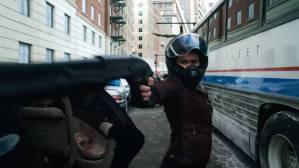
The first sequence is a fight in a club that kicks off the movie’s shift to constant scrambling action. It’s about 50 minutes into the movie and all the respective characters have been slotted into their conflicting positions. We know who the good guys are, the bad guys, the goals in opposition, and what the stakes are, and from there the movie just takes off in a sprint until its final blast. The club involves different levels and different factions fighting and mixing, providing a series of changing complications that makes the sequence feel more lively and engaging. There are several inventive moves to avoid gunfire or reach guns, and the cinematography keeps the action centered and easy to comprehend. The best action sequences are planned like moving puzzles, and the more work that is put into the preparation, the more enjoyable the action can become. This club shootout scene finds numerous ways to keep the stakes upended and to place the characters in new forms of danger they have to quickly adapt to survive.
The second sequence is a climactic confrontation at a cabin in the middle of a snowy forest. It’s a prolonged siege sequence where the bad guys are attempting to break through into this secure location and take out our heroes. From this claustrophobic setting, Evans presents the antagonistic intrusions as unrelenting and coming from all four walls and even below as well. The characters have to constantly be moving and reacting to an assembly of threats while their protective walls begin to literally crumble. It is a literal onslaught. I’m shocked the cabin is still standing by the end. It’s an immensely engaging sequence that communicates the frenzy and anxiety of being under constant attack. The gunplay can be brutal and there are satisfying kills and battles between side characters throughout this sequence to avoid the sequence from feeling too repetitive. It feels in many ways like the whole movie has been leading up to this sequence, not just in a traditional linear-plotting fashion but also the viewer has been waiting for the director to fully go off with a celebration of action mayhem. This is Evans unleashing his best, and he’s adapted his creativity to the setting and the action sub-genre, so there’s different moments meant to present immediate gunfire problems and fast-paced responses. In this world, people aren’t all gifted as expert fighters, and thus even our heroes can falter under the harried circumstances.
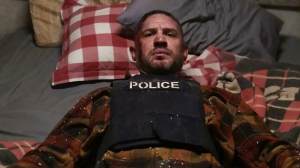
Short of these sequences, the rest of Havoc has difficulty breaking free from the gravitational pull of its own genre cliches. Evans wrote the screenplay by himself and I’m surprised how flimsy so much of the story and characters come across. With 2011’s Raid, there wasn’t much of a story once the action stopped, but with 2014’s Raid 2, Evans was able to compose an undercover cop story that was just as compelling even when people weren’t getting kicked in the face. He can write colorful side characters that feel like they stepped out of a Tarantino-favorite grindhouse movie. He can write tense sequences that don’t have to rely upon action. He can do so much more than what Havoc provides, so it’s hard not to feel like this wasn’t exactly a passion project. It feels more like a serviceable vehicle to achieve the kind of action that Evans was looking to achieve. Now, if you’ve underwritten a genre movie because your real interest is staging the action, then you would expect there to be more action, correct? Strangely, Evans spends most of those first fifty minutes setting up his story, the same story that is awash in genre stock roles and cliches without much intrigue beyond a one-sentence description. Simply put, if you’re going to stick us with underdeveloped characters, don’t keep us waiting for the action. There’s so many characters in this movie that I think Evans gets overwhelmed trying to set them all up and involve them in the larger story. If they’re only going to be stock roles, why do we need 30 when 10 can do? I think Evans keeps his cast so big so he can unceremoniously bump off so many of them, which can be surprising, but I would have preferred doing more with the space their absence might have provided the narrative. There’s also an odd stylistic choice where any exterior shots are much more stylized, looking more like video game cut-scenes or something out of the realm of Sin City. It’s at odds with the rest of the film’s stripped-down look.
Havoc is a gritty and bloody action movie that can overwhelm at moments and underwhelm at others. The genre grist is pretty familiar, from our troubled antihero lead trying to atone for his past sins, to the dumb kids in the middle of a gang war they don’t understand, to the good-natured partner who has to grow up, so to speak, by getting their hands dirty. You’ve seen variations of these stories before, but the real draw is once Evans works up enough space to really unleash his invigorating action best. It’s a movie I wish was better but it’s functional enough for Evans to do his extraordinary thing. I just want more of his specialty.
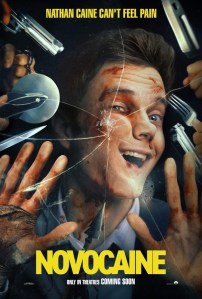
In comparison, Novocaine isn’t going to be defined by stylish choreography or exceptional style. It’s a high-concept action comedy driven by flipping the genre script. Instead of our hero inflicting great pain on his foes, this movie is about a hero enduring amazing amounts of pain. It’s an underdog story where a novice is thrust into an unfamiliar situation and has to utilize his unique disorder, a blessing and a curse, in order to rescue the girl and save the day. It’s a great premise that lends itself to plenty of fun scenarios to fully capitalize on its bizarre potential, and that’s where Novocaine hits a sweet spot of entertainment.
Nate (Jack Quaid) is a shy assistant manager at a small bank in San Diego. He suffers from a unique medical condition where he doesn’t feel the burdens of physical pain. You might think this a luxury but it’s actually a great worry for Nate. Without his body’s alarm system he can stumble into grave danger without even knowing it, so he’s been living an overly cautious life as a result. That all changes when he meets Sherry (Amber Midthunder), a new coworker who takes an interest in him. They go out on a date and really hit it off. Things are looking up for Nate until bank robbers storm his work, kill his boss, and take Sherry hostage. Nate hijacks a cop car and goes chasing after the bandits to rescue Sherry. He’ll undergo lots of trials of pain to win back the girl who makes him feel things.

How do you make a person invulnerable to pain an exciting character? It’s the lingering Superman question, except nobody is going to confuse the character of Nate with Krypton’s orphaned son; if a character cannot feel pain how can we worry over their well-being? Now there’s a reason writers have been able to tell Superman stories for decades, even if the movies often struggle with representing the figure, and that’s because it just forces you to have to think harder. It can be done. With Novocaine, Nate is a hapless naif thrown into an action movie and trying his best to fit in. He lacks physical prowess, weapons training, and tactical planning. However, the only thing he has going for him is his inability to feel physical pain, and the filmmakers routinely find funny and entertaining methods to test how far one could go with this pain threshold. While his body isn’t registering pain he is still taking all the punishment. Nate is nowhere near indestructible, and a running gag becomes how utterly mangled and deformed his hand becomes from event after event (I thought it was just going to be a stump by the end). He takes quite a beating but because of the whole “mind over matter” matter, he’s surprisingly able to persevere where others could not. This allows Nate to become an unexpected hero where the rest of us would pass out from shock. The appeal of the movie isn’t so much the action itself but the ongoing response to all of said action.
The set pieces are what makes this movie so much fun, pushing Naate into action hero mode when he’s clearly awkward and not ready for the promotion. I loved his dry responses to every new injury, from mild annoyance to feigned surprise. There’s a scene where one of the villains is torturing Nate and he has to go along with the charade in order to appease his tormentor and get valuable information out of him. It’s a reverse interrogation where the target is actually trying to manipulate the guy with the pliers. I loved how quickly he could bounce back from whatever trauma, from catching a knife blade first and quickly yanking it out of his hand, to casually writing an address on his hand with a tattoo gun. There is a crafty ingenuity to how the filmmakers can make the best use of this superpower. There are some impressive kills that also made me wince in response, like reaching for a gun at the bottom of a deep fryer, or literally stabbing a person in the face with an exposed arm bone. Novocaine has a delightfully demented sense of humor that keeps everything grounded with mordant laughs even when it’s dishing out the punishment.

Even more surprising, there’s a buoyant love story that genuinely feels sweet that could have benefited from a little more development and attention. Sherry is the one who activates our protagonist and pushes him outside of his comfort zone. He lacks confidence in himself and has been living an overly cautious existence from fear of not being able to respond to his body’s emergencies. The man has been eating his food as liquefied goop out of a fear of choking. She introduces him to the simple joys of eating one’s food before it’s been vigorously blended, like the wonders of pie. Their first date was genuinely charming and I liked the chemistry between both actors. Midthunder has been a favorite of mine since Prey and I want to see her in more varied roles. When the bank robbery commences, I actually had an emotional response to these two being in danger and watching the other being put in danger. Once she becomes a hostage, Sherry is placed as the damsel to be saved, which is disappointing because I liked her contributions to the story and especially what she brought out of Nate. There is a revelation with her later that reorients our understanding of her but I don’t think it was fully necessary. Their budding romance is quite enjoyable and so I wish the story could also continue to develop this connection over its wild series of mishaps.
Novocaine is a great example of a movie that maximizes its unique premise to stand out. It’s structured like a traditional action-thriller but it never takes itself seriously, pushing forward a stumbling protagonist whose real gift is that he’s the human equivalent of a punching bag. This dynamic is ingeniously developed and showcased, and just when I was worrying the premise might get old or become repetitive, the filmmakers find new ways to twist their story into even better twisted results. I wish the female supporting role was more tied into the action and fun, and the villains are a bland blend of overly confident paramilitary goons. Still, the fun comes from Quaid and his light-footed screwball performance anchoring the bloody hi-jinks and demented humor. Novocaine is a fresh reworking of action movie tropes with a twist that allows the audience to heartily laugh at our hero’s pain and pratfalls. It’s the kind of humor and energy that reminds me of the Crank filmmakers. If you’re looking for a winning dark comedy bouncing against the formulas of action movies of old, settle in for some Novocaine and enjoy the pain.
Nate’s Grades:
Havoc: B-
Novocaine: B+
Share this:

Rebel Ridge (2024)
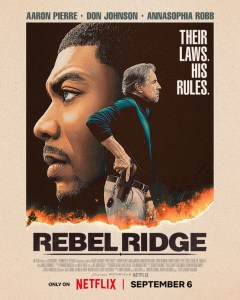 It only took minutes for me to be both engrossed and enraged by Rebel Ridge, the latest film from Jeremy Saulnier, a master of genre elevation. The scene begins with Terry Richmond (Aaron Pierce) riding his bike down a country road. A police cruiser appears behind him impatient to get around, and eventually the officer decides to use his vehicle to ram the bicyclist off the road. Afterwards, the officer tells Terry to stay on the ground and, upon a search of his belongings, discovers a stack of cash. Terry explains he cashed out his ownership in a restaurant and he’s on his way to do two things: buy a truck, and post bail for his cousin who was recently arrested for a minor drug possession. The police confiscate the money, accuse Terry of being involved with a drug conspiracy, and tell him that if he wants to fight for his money back, he’ll need to hire a lawyer and petition the court. Oh, and also the casual racism of the police officers is galling. With just his opening scene, Saulnier and his actors have made me feel vivid emotions and given me an underdog who I’m pulling for, a man who will come to serve as an honorable wrecking ball to this small-town police force who think they are above the law as it suits them. Saulnier’s movie tackles pertinent social topics with great care and detail, but it also delivers a masterful and satisfying action-thriller that knows how to entertain first and foremost rather than just incite.
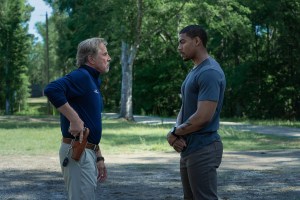 There are some serious criminal justice topics here dealt with unusually convincing clarity and accessibility, and that proves to be the ethos of Rebel Ridge, a message movie that knows it needs to be a movie first and a good one. Saulnier’s prior film work just oozes with dread and menace, though Blue Ruin and Green Room and even 2018’s Hold the Dark, by far the lesser work, dwell in bleak human outlooks. Very bad things will happen to people who stumbled into situations beyond their control, and usually by the end of the movie, there’s no recompense and we’re left to wonder about the empty cost of suffering. With Rebel Ridge, it feels like Saulnier has taken an assignment, like Netflix said to make one of your movies with your level of craft and thought, but also make it so the underdog is a badass and wins. I suppose one could argue that it’s turning a formula meant to defy convention back to convention, but by providing a crusader, we’re given a champion to root along that we can share confidence with. Terry isn’t invincible, some fearless behemoth who goes unopposed at every turn. He’s a formidable force but he’s also one man fighting against the forces of injustice and one black man fighting against racist white men in authority (superbly epitomized by Don Johnson’s good ole’ boy chief). Even with the power at his disposal, there are still limitations, which still makes the movie thrilling even if we ultimately suspect good might win out at the end. There’s nothing wrong with a triumphant ending as long as the work before establishes it as a fitting conclusion; tragedy and misery are not somehow more meaningful endings just because they are more serious or subversive. More people will learn valuable lessons about civil asset forfeiture and bail reform from this movie because it has a stirring and accessible story for a mass audience. The genuine thrills allow the messages to prosper.
And what thrills there are. There’s a staggeringly taut sequence where Terry is racing against time to get his cousin’s bail money deposited to prevent him from being transferred to prison. He’s checking the clock, looking down the small courthouse hallways, waiting for the officers he indisposed to come rushing back to arrest him. If only he can get this money deposited first. Saulnier does his own editing and creates a masterful sequence that left me nervously tapping my foot and awaiting the worst. The later confrontations with the police have a deeply satisfying turnabout, as these bullies come to realize far too late that they picked on the wrong man. Terry is an ex-Marine who taught martial arts and hand-to-hand combat to the Corps, but the most dangerous weapon he has is his mind. He’s constantly thinking about plans and implementation and adaptation. He’s intimidating already, but then when he starts to adapt, the sheer force of what this man is capable of makes him that much more incomparable. Even as a man on a mission, he’s still one black man fighting against a system of entrenched power that doesn’t like to bend when it comes to compromise or imposed oversight. He’s still got institutional power against him, and in one of Sauliner’s other movies, he probably would end with Terry winning a Pyrrhic victory but with the system ultimately standing, readjusting to maintain its dominance against further reforms. Here, that may still be true in a larger sense, but at least this one man can make a difference and bust a few racist bullies.
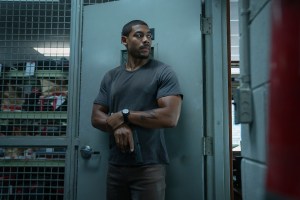 This experience wouldn’t be nearly as awesome without the commanding presence of its leading man. Pierce has had some noteworthy roles in Krypton and The Underground Railroad (he was also the amazingly named rapper “Mid-Sized Sedan” in M. Night Shyalaman’s Old). Originally, John Boyega (Star Wars: The Rise of Skywalker) was the lead role of Terry but Boyega bowed out weeks into filming in 2021 reportedly for “creative differences.” I cannot fathom any other actor in this role now that I have seen how thoroughly magnetic Pierce comes across. He’s a future star in the making and this should serve as a showcase for Hollywood. I like Boyega as an actor and have since 2011’s Attack the Block, but Pierce is a far more intimidating presence and likely candidate for action retribution. I cannot overstate how much better this movie is because it found the perfect leading man for its hero. Saulnier’s excellent command of the genre and tension is made even more compelling because of Pierce being our vehicle for comeuppance. His smooth intensity beautifully amplifies Saulnier’s percolating dialogue, finding the exact right tone and presence to make the challenges to power feel oh so combustible.
I wish the second half of Rebel Ridge was as perfectly structured and executed as that first scene. The second half gets a little lost in the details of its overarching small-town conspiracy. The momentum of the movie starts to slag a bit, and the clear connection of cause-effect plotting gets bogged down. There’s still important revelations and you get nice moments from the likes of James Cromwell as a judge and Steve Zissis as a courthouse clerk trying not to make waves within a system he acknowledges is unjust. The real significant supporting character is Summer (AnnaSophia Robb) as a lawyer with a past of drug addiction that she’s still trying to put behind her to earn back parental rights to her kids. She’s a good foil for our crusading hero, and her storyline also smartly allows for more social-political tangents to be hit about the difficulty of addicts and ex-cons to try and start over in the workforce. I wish she was more involved in the climax, as she’s relegated to being mostly a damsel needing to be saved after she proved so capable and cunning throughout the rest of the movie assisting Terry. The second half just isn’t as strong as the first half because the movie overextends with its conspiracy and history without the same tremendous clarity and urgency that drove the first hour of Rebel Ridge. The ultimate conclusion, while still satisfying, lacks the fireworks that we crave. It’s more a race against time and hoping that certain elements finally stand up against the corrupt police forces. It’s a solid ending, enough for a catharsis that Saulnier so rarely allows, but it’s not quite the release we might want, and maybe that’s the ultimate point.
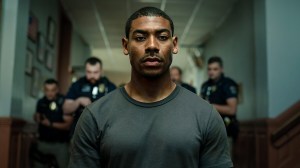 Rebel Ridge is a great genre movie that flirts with true excellence. It’s Jeremy Saulnier’s most accessible and crowd-pleasing movie, an action-thriller that executes its sequences of tension and retribution with as much care as it incorporates its Big Ideas for viewers to think over. Genre movies have long tackled relevant social and political topics, sometimes in ways that are far more meaningful and impactful than message movies that get bogged down in didactic dogma. But if you can link a relevant social issue to a story that grabs us and makes us want to inch closer to the screen, something that links a larger problem to a personal story, then you’ve found an accessible illustration that people will actually want to see. Rebel Ridge stands out among the Netflix house of action movies and proves that even a mainstream Saulnier can deliver the goods. Just because he’s working with a more conventional formula doesn’t mean that he hasn’t put thought and care into his characters and action. Rebel Ridge may leave you wanting a little more with its ending, but what it supplies is so engaging and entertaining that I’m happy to report Saulnier hasn’t lost his edge. Keep ‘em coming like this, Jeremy.
Nate’s Grade: B+
Share this:

Hit Man (2024)
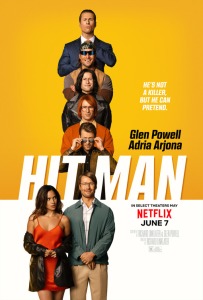
Hit Man is a movie that is wonderfully hard to describe. The premise has an easy-to-grasp hook that promises fun and hijinks, but where it goes from there takes on as many transformations as its protagonist, Gary Johnson (Glen Powell). It transforms from a fun game of undercover conning with wigs and silly accents into an unexpected rom-com hinging upon mistaken identity, maintaining assumed appearances, and secrets that then transforms into full film noir without losing its unique identity and the stakes of the character relationships. If you’d expect any filmmaker to pull off that trick, writer/director Richard Linklater has to be one of the best to keep things running smoothly, and that he does, as Hit Man is a crowd-pleasing comedy with some unexpected directions to keep everyone guessing until it lands on its own morally gray terms.
The movie is also, chiefly, a showcase of star and co-writer Powell, a handsome young actor hitting a new ascent of his career with last year’s Anyone But You and the upcoming Twisters. Powell is probably best known as the smirking guy you loved to hate in Top Gun: Maverick, but he’s also played memorable supporting roles in Scream Queens and three other Linklater film projects, notably 2016’s Everybody Wants Some!!, a pseudo-spiritual sequel to the seminal Dazed and Confused. This is Powell’s acting showcase and he’s utterly terrific. He has great infectious fun getting into the various hitman characters, which mostly exist in montages, and trying on different personas and voices. I cackled when he was doing his impression of Christian Bale’s Patrick Bateman, and I smiled throughout most of the other personas. It’s easy to see the network TV version of this premise, where every week Gary adopts a new persona and disguise to bust the next possible criminal from hiring a hitman, like an edgier Quantum Leap). The culprits are played like nitwits but then again the police are also played as nitwits (are there THIS many attempted hitman hirings in one city for the police to have a full-time unit?).

But before this acting experiment can get too broad or too redundant, Linklater and Powell switch things up. Around the Act One break is where Gary meets Madison (Adria Arjona), and that’s when everything changes for him and the audience. Now we have emotional stakes, because Gary intervenes to save Madison. While the circumstances of their first meeting involve her wanting to kill her husband and believing Gary as the professional to do such a job, the scene plays as a disarming first date you’d find in another charming romantic comedy, where it’s clear to anyone with a pulse that these two have something together. Instead of busting her for the solicitation, he pushes her to change her mind, take the money and leave her no-good husband rather than finding a questionable man to eliminate him. From there, they form a romantic relationship that fluctuates wildly. She thinks Gary is “Ron,” the suave and confidant persona Gary adopted for their sit-down. So the nerdy tech nerd who teaches philosophy must pretend to be the daring and dangerous man of mystery he wishes he could be. The script doesn’t get carried away with its farcical elements in play, juggling multiple identities for multiple specific audiences, but it asks the question, “Why can’t the milquetoast Gary simply be Ron? Is this an unexpected means of self-actualization for the nerd to win the girl?” Through this extreme exercise, Gary can mold himself into the man he would like to be. The rom-com is flirty, funny, and just as enjoyable as the earlier wacky comedy of being a versatile master of disguise.
It also really helps things when your two lead actors have such strong chemistry. Powell and Arjona (Father of the Bride, Andor) are smoldering together, like full on “get a room already” territory. This lends even more credence when Hit Man makes its next transformation into film noir thriller. I won’t divulge the specific plot elements but it all works with what Linklater has already established. There’s trouble for the both of them, and the question becomes how far is each participant willing to go to stay above the fray. The transition from silly costume comedy to sundry noir thriller is handled so naturally, as if the characters, already existing under such unique circumstances, found themselves in the elevated movie-movie version of their crazy relationship. Rather than feel contrived, Linklater and Powell have put in the work to make these twists and turns credible and exciting. The shifting nature of the movie is a wonderful reflection of its fake hitman hero. There’s a scene late in the film, where all of our principal players have come together, and you have characters saying one thing, intimating another, for different versions of different audiences, and it’s such a masterful tonal dance that feels satisfying as a climactic turning point as well as genuinely impressive for all the myriad subtext in play.

This is a clear-cut case of a movie being “inspired by” a true story rather than being “based on” a true story. Generally, we expect the “based on” stories to have some voracity to reality. We accept that there will be alterations for dramatic purposes, externalizing the internal, condensing timelines and characters into a more accessible structure, etc. If you go to a movie about Jackie Robinson, you don’t expect to see the famous baseball slugger fighting space monsters (“Racism was the real giant monster all along”). Hit Man is based upon a 2001 long-form news article by Texas Monthly journalist Skip Hollandsworth, the same author of the source material for Linklater’s fascinating true crime dark comedy gem, 2011’s Bernie, which I highly recommend (a career-best Jack Black). The real Gary Johnson really did pose as a fake hitman for the purposes of catching real criminals, but the rest of the movie exists in its own fictional universe of dramatic complications. Usually we want our film stories to have more fidelity with the truth and reality, but I’m glad Linklater and Powell recognized the sheer storytelling potential of this quirky premise. Sticking to the facts could have told an amusing story, but feeling confident to take bold leaps with well-worn genre motifs, when called for, is the right call for making the most of this tale.
The shame of Hit Man is how quickly it will likely be subsumed by Netflix’s suffocating tidal waves of content. Here is a fun, likable, and surprising indie comedy with definite mass appeal buoyed by great performances, clever writing, and a tonally shifting narrative to keep things fresh. Powell gets the breakout showcase he deserves and we get one of the most unexpected and amusing rom-coms of recent years. Hit Man is a movie that deserves to be seen, to be enjoyed with a crowd, but I worry it will get lost in the shuffle of streaming titles. I suppose this might just be the current reality for fans of mid-level adult dramas and comedies. At least they have a home on the streaming networks even if these movies would have been theatrical breakouts years ago. Regardless, Hit Man is a good time with good people pretending to be bad, or is it bad people pretending to be good, but whatever pretense, it’s a charming winner worth your two hours.
Nate’s Grade: B+
Share this:

Killers of the Flower Moon (2023)
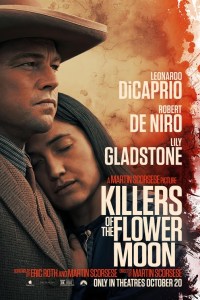
Killers of the Flower Moon has the banner of an Important Movie, telling a story many history books have overlooked for too long, an American tragedy built upon one of America’s original sins with the indigenous peoples, and tying a direct line to not only how we live now as well as how we choose to remember the past. The true story behind the murder of the Osage Nation natives in the 1920s is an urgent story that gets to the heart of greed and the human capacity for evil, and Martin Scorsese’s three-and-a-half-hour movie is somber and mournful and appropriately devastating. But I’m also wondering why I wasn’t as enchanted with it as a movie-going experience. Should I feel movie critic guilt for finding the movie merely good but not transcendentally great?

The whole of Killers of the Flower Moon is bleak, which is naturally much of the point. It’s difficult to retell the history of Native Americans in this country, or before there was a “this country,” without making use of lots of synonyms for the word “bleak.” The first hour presents the Native Americans as being legally incapable of greater agency; the murders are consistent, sloppy, and obvious, but the fact that no investigation was triggered for years in an acknowledgement that, simply put, the government just didn’t care about dead Indians. Oh, I hear you saying, but weren’t these Osage different? They had so much money from their oil rights that the local economy exploded with vultures offering common services for egregiously inflated prices to take advantage of people unaccustomed to having money and options. Even with a surge of riches, the Osage didn’t have an elevation in status. They were still looked upon as interlopers in the way of powerful white men getting that money, and there’s nothing these greedy people won’t do to get that money, especially with a system of justice of little accountability for dead minorities. One of the more galling scenes is when the town coroners are questioned over their unusual protocols, like chopping a corpse into tiny pieces so it could not be re-examined by other professionals. The whole town is in on this vile scheme, every doting neighbor can be guilty through complicity or complacency. Death after death, they all know what’s really going on; it’s plain as day, but nobody outside of the Osage feels the burning outrage, and that’s the point of the first half of the movie, to give the audience the same sense of anger and futility.
The majority of the lengthy movie follows our villains plotting their very obvious conspiracy, with Leonardo DiCaprio badly clenching his jaw in every scene as Ernest Burkhart, a WWI-veteran who comes home, becomes a cabbie, and marries Mollie (Lily Gladstone), one of the rich local Osage women. The question for the rest of the movie is whether or not his love for her is genuine or perhaps she is just a means to an end. He’s the lead of the movie and a total dope, a man who unironically proclaims repeatedly, “I love me some money!” Seems hard to read this guy, right? He’s an idiot, and again this might be the point, that this sort of small-thinking man could be the hinge on this entire conspiracy, which results in a lot of Mollie’s family members dying under increasingly mysterious circumstances to consolidate their inheritance. It’s a frustrating and spiritually exhausting experience to watch all these poor characters get murdered, again, so casually and transparently. One of them is staged as a would-be suicide except he’s shot through the back of the head and the gun wasn’t left at the scene. Eventually, the FBI does finally (finally!) arrive in town at the two-hour mark, but by then, I’ve been watching two hours of people dying without a legal stir.

This perspective is best embodied through Mollie, beautifully played by Gladstone (Certain Women, First Cow). When we first meet her, she’s a forward woman who can assert herself and what she wants. Then it all goes downhill after marrying Ernest. She loses damn near every family member she has and is forced to rely upon her husband for support, the same idiot bungling his way through arranging the deaths of her family members. She’s a personal stand-in for the Osage Nation as a whole, as we watch what they have whittled down and bled dry, watching the weight of all this suffering deteriorate their spirits and dignity. This is Mollie, our avatar for tragedy. She’s literally bedridden for a solid hour, and I dearly missed Gladstone’s presence. Since we’ve been aware of the bad deeds of the bad men from the start, much of Killers of the Flower Moon becomes a waiting game of when Mollie is hopefully going to wise up or at least suspect what is happening to her and her family. When will she see Ernest as a more nefarious force in her life, the kind of person you don’t want to solely trust with the responsibility of delivering your life-saving intravenous medicine. It adds to the overall frustrations of watching. Gladstone’s performance rises above whatever limitations her character is stricken with. First off, it’s a powerful performance of immense sorrow; having to watch her pained reaction to overhearing her sister’s skull sawed open for a disrespectful public autopsy is just sickening. The movie lives off this woman’s response to unfathomable trauma on repeat. When she is bedridden and lost in a medical fog, she still manages to communicate her wariness and suspicion through these extra layers of obfuscation.
Robert DeNiro, appearing in his eleventh Scorsese movie, is terrifying as a kindly cattle baron who fashions himself as the best friend of the Osage, preferring to refer to them by their indigenous names and warmly speaking their language. He’s also a monster, a stand-in for American big business and the blood-stained hands of capitalism without morals and oversight. The dramatic core of the movie, besides how far will this go before consequences will at long last germinate, is how can such self-styled men of God commit such heinous acts? How can people justify and equivocate over their own cruel crimes? This question is epitomized in Ernest and his direct connection to Mollie, but it’s also epitomized through DeNiro’s character, William Hale. We have two characters fulfilling the same thematic purpose, which might be the point, but it makes for a redundant narrative experience. DeNiro’s character is so much more interesting than Ernest too, with the full cognitive dissonance of being an avowed man of the people and true ally to the Osage while he’s plotting their demise. DeNiro holds to this homespun, Foghorn Leghorn accent throughout, and I can’t recall him ever raising his voice. It’s a performance where the lasting terror comes through its friendly disconnect. It’s a more impressive performance than watching DiCaprio grimace and mumble through three and a half hours.

Some chastise Killers of the Flower Moon for choosing to tell its story from the perspective of its white perpetrators. I understand from a narrative standpoint and an overall larger thematic point why this was done. Scorsese clearly thinks of his own limits of being the one to tell this story, appearing as a cameo in the coda to provide commentary on how the American morbid desire for true crime and historical atrocities will lead to yesterday’s outrages becoming today’s distilled and de-contextualized “content.” The problem is the movie already feels frustrating as is while we wait for there to finally be some accounting for the ongoing injustices, and centering the entire perspective on only the Osage would magnify this frustration with even less elucidation on the depths of what was happening. Scorsese strips away a lot of the stylistic flourishes and even the electric pacing and editing that we come to expect from his filmography. This is a slow, ponderous movie. It’s meant to provoke outrage. It’s also designed to frustrate, and I suppose I can admire that while also impatiently shifting in my seat and wondering how many of these 206 minutes could have been lost. I feel like a philistine for looking at a $200-million Scorsese movie, while this man is in the late stages of his career and clearly thinking of this reality, and asking, “Hey, can you give me maybe less movie?”
If you haven’t noticed, dear reader, I am a critic in conflict. Killers of the Flower Moon has fantastic production values, strong acting, and the importance of staging history as it was rather than how it may be remembered, especially over events long ignored by history. I even admire the choices that are deliberate that make the movie feel less like easily consumed entertainment. It’s a movie that I feel compelled to see a second time before I settle on my eventual rating (a seven-hour commitment). It’s a sad movie, a bleak movie, a challenging movie, a meaningful movie, and an Important Movie about Important Things. It’s also long, frustrating in structure and execution, and occasionally redundant with its characterization and plotting, giving the impression that things have been stretched beyond breaking. Again, maybe that’s the larger thematic point, but then again I might just be stuck in a rabbit hole of excuses to find some justification for my less-than-ecstatic reaction to Killers of the Flower Moon, a movie of strident artistic vision that can also feel like you’re eating your vegetables for three nonplussed hours.
Nate’s Grade: B
Share this:

Decision to Leave (2022)
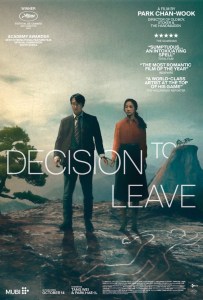 Imagine crossing a classic film noir detective story with some unrequited romance heavy with yearning, like In the Mood for Love, and that’s the combo you get with director Park Chan-wook’s newest, Decision to Leave. In Busan, a straight-laced detective (Park Hae-il, The Host) is investigating an older government official who fell to death from a mountain peak. He suspects that the man’s wife, Song Seo-rae (Tang Wei, Lust, Caution), a much younger Chinese immigrant, might have something to do with the death, and so the detective gets closer and closer to his suspect, blurring the lines of the investigation and his own personal desires. It sounds like familiar genre territory, and it can be, but director Park Chan-wook (The Handmaiden, Oldboy) is the X-factor, and quite simply, he shoots the hell out of this movie. There are some jaw-dropping shot selections and camera arrangements here to cherish. The movie is less interested in its sordid murder mystery details and more the possible relationship between its two magnetic poles, made even more complicated by the detective already being married, though only spending the weekends at home. There is a stormy swell of will-they-won’t-they sexual tension in constant churn, and it adds a dour sense of melancholy to the entire movie. There’s a time jump two-thirds of the way through the movie that is slightly aggravating, because it’s like starting over and repeating the mystery catch-up but with less time, making the details of this new case even less meaningful than earlier. Decision to Leave ends on a strong downbeat that feels appropriate given the mood of the preceding two-plus hours. I don’t think the characters are as textured as they could be, part of this is being jostled around by the non-linear storytelling and artistic tricks of Chan-wook. I think the movie generally favors mood and flirts with wanting to be seen a tragic romance worthy of Hitchcock, though I don’t think it fully gets there. So much of the movie is about probing whether or not the feelings are real between these two, whether she’s toying with him or he just wants to complete the unfinished assignment (the dynamic reminded me of Luther and Alice in the BBC series Luther). Decision to Leave feels like a solid film noir mystery, elevated by A-level directing talent, and then missing its ambitious grasp with its lilting love story that feels a little too subdued and understated to really smolder.
Nate’s Grade: B
Share this:

The Good Nurse (2022)
 I was recently having a conversation about how there seems to be fewer high-profile serial killers today, at least compared to the ignoble heyday of the 1970s-1990s, the kind of men, and yes, it’s almost always men, who fascinated millions and inspire countless books, movies, podcasts to detail the heinous details of their twisted and ritualistic crimes. I recall reading an article that proposed the rise of serial killers during that time period might have had something to do with the prevalence of lead paint and lead poisoning in homes before it was finally phased out in 1978. It seems like it would be harder to be a serial killer in the modern era, where almost every person has a device to call the police, or document your behavior, and submit it for the public record. Of course, we also have far more mass shootings and spree killers, so it’s not like things are perfect. I thought about this while watching The Good Nurse on Netflix, based on true events following a nurse in Pennsylvania who may have ultimately taken 400 lives before he was finally apprehended. How does a serial killer operate in the modern world? With help from lawyers.
Amy (Jessica Chastain) is a nurse working the night shift and trying to raise two young girls on her own. She suffers from a heart defect and keeps her ailment hidden for fear she will be fired before she crosses the period where she can earn health insurance from her job. She’s stretched thin, overworked, exhausted, and anxious, and that’s when Charlie Cullen (Eddie Redmayne) comes into her life. He’s a new nurse for their hospital, comes highly recommended, but then… patients start coding and dying and Amy can’t explain it. Somehow insulin is getting into their systems, and she begins to suspect Charlie is the culprit, and from there she works with law enforcement to investigate Charlie’s mysterious past work history and assemble a credible legal case of guilt.
 It’s obvious from the start Charlie is guilty, and thankfully the movie doesn’t drag this reveal out, even choosing in its long take opening to demonstrate one of his dispassionate murders. This is less a story about whether this person is in fact the actual killer and more a story about how to nab the killer, and the methodical, detail-oriented case work reminded me especially of 2015’s Best Picture-winner, Spotlight. Likewise, we already knew the Catholic Church was covering up sexual crimes from its priests, so it was more a story about the people responsible for bringing them to justice and how they worked their case. It’s a similar and similarly engrossing formula for The Good Nurse. Uncovering Charlie’s past, his way of avoiding crimes is eerily and infuriatingly reminiscent of the Catholic Church just reshuffling its dangerous priests from parish to parish. The prior hospitals that employed Charlie will not talk about him because to do so will open them up to legal liability, so instead they simply fired him for specious reasons and allowed him to gain employment at another hospital, repeating his deadly patterns. To get more involved, or to investigate further, would be financially deleterious to the hospitals, so they looked the other way. A post-script tells us that none of the hospitals that employed Charlie Cullen were ever criminally charged for their role in perpetuating the death this man left behind. The Good Nurse smartly understands that pinning down one villain is easy, but indicting the system is an even bigger story, and one that rightfully earns every ounce of viewer condemnation and outrage. The lawyers representing these hospitals are just as culpable for these preventable murders.
Much of the movie follows Amy’s personal investigation, dovetailing with two detectives (Nnamdi Aomugha, Noah Emmerich) trying to put together the meager crumbs that the hospital is offering after its own six-week-late internal review that necessitated contacting the police about the “irregularity” in a patient’s death. Each has key pieces, Amy with the inner workings of the hospital system and nursing expertise, and the detectives with the shady background report on Charlie, and it’s an exciting turning point when they join forces. From there, the movie reminded me of Netflix’s sadly cancelled series Mindhunter, where two FBI agents profiled America’s most notorious serial killers to learn insights about the patterns of pathology. It was also a series about talking, about trying to draw these dark men into confession, and the subtle manipulations necessary to get the key pieces of information desired. Amy brings hard evidence that her co-worker is stealing insulin but it’s not enough, and she questions how far to put herself in the middle of this investigation, especially since her daughters have grown close to Charlie.
 The direction by Danish filmmaker Tobias Lindholm (A Hijacking, A War) is very aligned with the fact-finding tone established the screenplay by Krysty Wilson-Cairns (1917, Last Night in Soho). The camera work is never flashy, preferring longer takes from unobtrusive angles, but without fully adopting the impatient edits docu-drama verisimilitude approach many directors would follow to better capture the reality. The directing is very methodical, cerebral, and restrained in the best way to enhance all of these elements from the story. It’s also not a surprise when you recall that Lindholm directed two episodes of Mindhunter’s first season. It’s the kind of assured direction that often gets ignored in award season but it’s the kind of direction this movie needed to better succeed in tandem with its slow-building, fact-finding mission. It’s not dispassionate, it’s deliberate.
Redmayne (Fantastic Beasts) is an actor I’ve been critical of with some mumbly, tic-heavy past performances, but he’s genuinely good and unnerving for how “normal” he comes across while holding back just enough in his eyes to make you want to take a cautious step back at various points. His role is the more internal one, and the character becomes an incomplete guessing game of how much of what you see is the real Charlie Cullen. Is the kind, compassionate Charlie who helps Amy’s daughter learn her lines for a school play, while encouraging her repeatedly, the real version of this man? Is the evasive man who bursts into sudden and shocking moments of emotional outburst the real version? Is it some semblance in between, and how does one square the difference? The movie’s focus isn’t on unpacking the psychology of this bad man (the title is not a reference to Charlie but of Amy) but on the hard-nosed efforts to finally bring him to justice. Because of this there aren’t as many showcase moments for Redmayne, but he genuinely made me jump during his bigger moments. His Midwestern accent also sounded a lot like (a non-Bostonian) Mark Ruffalo to my ears, further cementing the connections to Spotlight.
The real star of The Good Nurse is its story, given careful examination and worthy condemnation to the forces that allowed a mass murderer to continue his trade for years. When finally asked why, as if there can ever be a satisfying revelation for why bad people do bad things, Charlie can only shake his head and respond, “They didn’t stop me.” He kept killing because the hospital lawyers shuffled him around, protecting their own rather than innocent victims who place their faith in the hospitals and their staff to follow the Hippocratic oath and “do no harm.” The Good Nurse is an appealing movie for fans of true-crime and investigative procedurals. It stays focused on the human cost of those preying upon others, whether they be serial killers masking their misdeeds or corporate lawyers protecting profits and liability over human suffering. It’s a good movie and a good reminder that the over-worked, underpaid nurses are legit heroes.
Nate’s Grade: B+
Share this:

Spiral (2021) / A Quiet Place Part II (2021)
 Chris Rock seems like an odd choice to spearhead a revival of the dormant Saw franchise, but the actor was a rabid fan of the grisly horror series and came to producers with an idea for a new Saw movie, and the results are Spiral: From the Book of Saw, like it’s a Biblical chapter. A Jigsaw copycat killer is targeting corrupt police officers and those who protected them, and Rock plays a detective who dared to turn in his partner after he murdered a crime scene witness. Rock’s character is seen as a traitor by his fellow brethren in blue, and as the Jigsaw copycat continues his or her bloody rampage, the history of police abuse and cover-ups comes to light. The problem with Spiral is that it feels like an entirely different independent script that somebody attached gory Saw set pieces and said, “Reboot.” The Saw set pieces get increasingly ludicrous and gross and the drama in between, where Rock tracks clues and barks at his peers, feels like boring connective tissue the movie can’t even bother to pretend is worth the effort. Both parts feel rote, the police conspiracy thriller and the gory death traps. The movie is also entirely predictable by the nature of the economy of characters. Within 15 minutes, I was able to predict the identity of the copycat killer as well as their connection and motive. This movie desperately needed more time with Rock and Samuel L. Jackson together. Another issue is that the movie ends abruptly and with a needed extra turn missing, perhaps where Rock agrees to work with the killer and justifies the executions as righteous reform. I wanted this new Saw to be more in keeping with Saw 6, the best sequel and most topical of the franchise where health care employees were put to fiendish ironic tests to punish them for denying medical coverage. It feels like targeting bad cops would produce more social commentary, but I guess that would get in the way of watching people try and sever their own spine on a single nail. Spiral doesn’t feel any more promising than the other attempted Jigsaw reboot in 2017 even with its topical elements. It might be cheap enough to earn a sequel, but it feels like a franchise eternally going in circles.
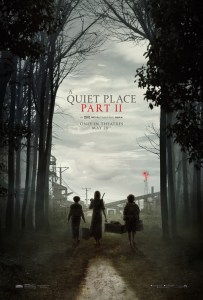 A Quiet Place Part II is the first movie I’ve seen physically in theaters since the middle of March 2020, and I genuinely missed the experience. It’s been the longest I’ve ever gone in my adult life without seeing movies in the theater, and this was one that felt like the presentation would be elevated by the big screen and superior sound system. Taking place nearly minutes after the conclusion of the 2018 hit, the surviving Abbott family ventures off their farm to find refuge and potentially find a way to protect themselves and neighboring communities from the killer monsters attracted to noise. The opening is the only flashback we get; everything else is forward-looking. I would have enjoyed getting more Day One experiences where the monsters first attacked, especially as we become open to new characters and their own harrowing journeys. The movie, written and directed by John Krasinski, isn’t quite as novel and brilliantly executed as its predecessor, but it’s still a strong sequel that gives you more while leaving you wanting more by the end. The majority of this lean 97 minutes is split between the family, one half staying put in a warehouse basement, and the other traveling out into the open to find a radio tower. The set pieces are still taut though rely more on jump scares this go-round, granted well executed jump scares that still got me to jolt in my seat and squeeze my girlfriend’s hand a little tighter. Cillian Murphy (Batman Begins) is the most significant addition as an Abbott family friend who has lost his whole family since that opening flashback. He’s a broken-down man, a parallel for Krasinski’s father figure from the first film, and at points it feels like he’s being set up to appear sinister, or at least hiding some dark secret that never really comes to fruition. The world building is expanded and introduces a very Walking Dead-familiar trope of desperate people being just as dangerous as deadly monsters, though in a world of hearing-enhanced creatures, I would think there’s more danger in larger numbers than security. The movie earns its triumphant ending even if the staging, and cross-cutting, is a little heavy-handed. A Quiet Place Part II is a successful sequel that understands the unique appeal of its franchise and how to keep an audience squirming while also remain emotionally involved and curious for more.
Nate’s Grades:
Spiral: C
A Quiet Place Part II: B+


 nathanzoebl
You must be logged in to post a comment.