Blog Archives
The Way, Way Back (2013)
 A throwback to the youthful summer movies of the 80s, The Way, Way Back is a delightful coming-of-age film that manages to excel at both comedy and drama. Oscar-winners Jim Rash and Nat Faxon (co-writers of 2011’s The Descendants) graduate to directors, guiding the famous cast with ease yet squeezing enough satisfying emotional truth into the formula of a screwy, Meatballs-style comedy. We follow 13-year-old Duncan (Liam James) as he spends the summer with his mother (Toni Collette) and her bully of a boyfriend (Steve Carell). My one gripe is that the film spends far more time than it needs to establish just how unequivocally awkward Duncan is. You will likely cringe. When Sam Rockwell enters the picture as a charming goofball water park employee who takes Duncan under his wing is when the movie ascends to a new level of comedy. The Way, Way Back hums along with its own sense of charm, presenting familiar characters/scenes but giving them added texture and relatability. You will be surprised at how much you feel for these characters, you may get a bit misty at points, especially when they behave like people and not zany cartoons. Carell as a bad guy is a real eye-opener; he’s a passive aggressive bully rarely seen in movies. James is an authentically awkward teen but you also buy every step of his journey. It’s just such a sweet, enjoyable, and cute movie, exuding charm and sincerity. Here is a movie that just makes you smile. You’ll leave The Way, Way Back feeling warm and fuzzy, and Rash and Faxon have another winner on their hands.
Nate’s Grade: B+
Share this:

The Kings of Summer (2013)
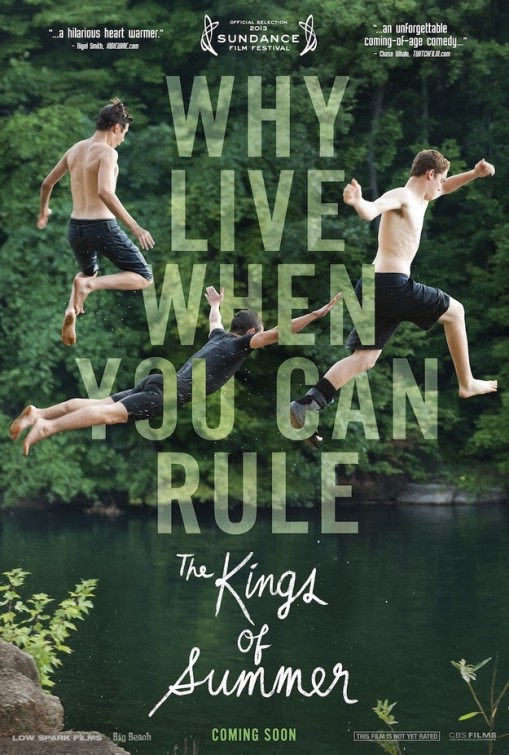 Working part-time at a movie theater in the summers, I come across, let’s say, an interesting selection of customers with… interesting opinions. One middle-aged woman openly opined, while looking at the poster for the coming-of-age comedy The Kings of Summer, that she’s had enough with movies told from a teenage male perspective. While this same woman had very specific and narrow demands for an acceptable movie, she got me thinking. Why do we get so many coming-of-age movies from a male perspective? Let’s forget the easy answer that Hollywood has a lot more male filmmakers than female. There’s always that sense of romance with coming-of-age films, a nostalgic look back at a supposedly simpler time that now seems better appreciated. Maybe men are just more prone to romanticizing the past while women look forward to the future. Or maybe there are really just more men calling the shots about films get made. Whatever the reason, the woman didn’t go see The Kings of Summer, and judging by her attitude, I don’t think she missed out.
 Joe (Nick Robinson) has just finished his freshman year in high school. He has a long summer ahead butting heads with his no-nonsense father (Nick Offerman). Then Joe gets the brilliant idea. He and his pal Patrick (Gabriel Basso), who is also sick of his annoying parents, will build their own home in the woods, a sanctuary where they can set the rules. Joe and Patrick pack up their belongings, find a quiet spot in the woods, and build that dream home. Biaggio (Moises Arias), a weird and gangly kid, takes an interest in the youthful declaration of independence and joins in. The guys invite girls over, explore the wilderness, grow patchy wisps of facial hair, and live out their fantasies of roughing it like real men. Of course it helps when a Boston Market is just down the road.
From start to finish, The Kings of Summer kept me laughing. I did not expect the comedy to be as consistent and thorough as it was, but writer Chris Galletta has a sure handed way of making the comedy derive from the situations and characters. Even with some outsized elements, notably Biaggio and the fact that the boys home-away-from-home is way too advanced for a kid who blundered through shop class, the humor never feels forced. That is an accomplishment, though the script also overly relies on Biaggio to say outlandish or weird lines. I especially enjoyed his one-scene pep talk with his father late in the movie. That confidant sense of humor goes a long way to relax an audience, allowing us to attune to the mellow waves of the film. It’s fun to watch the guys try to forage a life out in the woods, slowly learning how hard this whole survivalist lifestyle may actually be. The adults are viewed as blithe buffoons or hardasses, though they don’t come across as caricatures. Credit the attention paid to Offerman’s (TV’s Parks and Recreation) character as Joe’s father and credit Offerman’s uncanny ability to make gruff parenting endearing. This is an easy film to like, to go along with the flow, and to enjoy. It never really falters in entertainment and routinely has another joke at the ready to make you smile. It’s a sweet movie that does enough to keep you charmed.
While pleasant, I had to stop and reflect that there was absolutely very little to these characters. The boys all kind of blend together in their youthful romanticism of freedom and rebellion of lame parents, but you’d be hard-pressed to describe them beyond core physical descriptions. The moments that do supply character development are mostly broadly comedic or somewhat generic in their coming-of-age tropes, notably the broken heart administered by a guy’s crush. Example: Biaggio is essentially little more than a walking punchline machine. While quite funny and well acted, every line of his dialogue feels like a punchline. He comes from nowhere. At one point, Joe advises Biaggio that a girl may be interested in him, but Biaggio demurs and says that won’t work out. All right, here we go. Here’s where the movie sheds some light on him. Biaggio admits to being gay. The very next line involves him confusing gay with cystic fibrosis. It’s a funny joke but it turns a moment where a character was getting added dimension and just manufactures another punchline. Again, The Kings of Summer is a very pleasant film going experience, and one that made me laugh consistently, but objectively, the impact is too limited because of the lack of proper characterization.
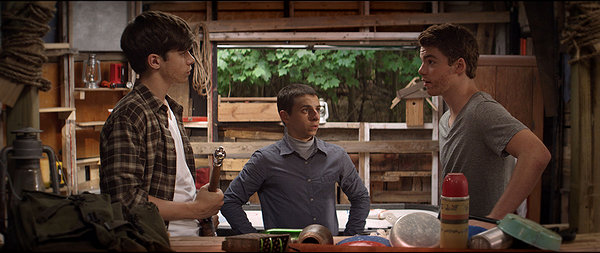 And I suppose this leads into a bigger question of whether this lack of substantial characterization even matters. Coming-of-age movies, like any subgenre in film, have their own expectations and conventions. We all have our different tolerance levels for narrative familiarity, and depending upon the genre, familiarity may be a necessity. Fans of coming-of-age films want to see those familiar elements. They want to see the bonds of friendship, the neglectful parents, the first crushes that lead to first heartaches. It’s just like fans of romantic comedies finding comfort in the two leads hating one another until, inevitably, they love each other, or the public sing-alongs. I think many coming-of-age films at some level tend to be somewhat broad or generic to make them more relatable. Perhaps I’m just being too generous to formulaic pictures. If you’re a fan of coming-of-age movies then you’ll probably be quite forgiving of the shortcomings in The Kings of Summer. Me, I prefer Jeff Nichols’ Mud and its more textured, empathetic look at adolescence in a working poor Missouri riverbed community.
Director Jordan Vogt-Roberts (TV’s Mash Up, Funny or Die Presents…) makes the film look beautiful. The romanticism of the youth running away to live in nature is improved with some spectacular looking natural settings and compositions. The film was primarily filmed in Cleveland and northern Ohio, and as a native Ohioan, I have to puff my chest. Vogt-Roberts is also skilled at handling his actors and balancing tone; while I criticize the over reliance on comedy at the expense of fleshing out characters, the tone is not divergent. It plays within the same cohesive wavelength throughout. If there is a breakout actor from this movie, it would have to be Arias (TV’s Hannah Montana, The Middle). The kid has a tremendous ability to tap into an oddball character, making him quirky rather than insufferable. He also has a unique look to him, and that’s got to be a plus for a working actor. Just ask Steve Buscemi.
Genial and undemanding, The Kings of Summer isn’t anything close to royalty in the coming-of-age genre but it’s consistently funny and enjoyable. The acting is good, the jokes work, and the movie’s out after 90 minutes. It’s a nice summer diversion but doesn’t contain the resonance to be considered more than that. The weak characterization and broad humor, while opening its wide appeal, also makes the film less substantial. It’s sweet and funny but little to distinguish it from other sweet and funny coming-of-age entries. If you’re a fan of the genre or looking for a mellow and pleasant evening at the movies, think of The Kings of Summer. Just don’t think it’s going to be anything more.
Nate’s Grade: B
Share this:

Frances Ha (2013)
 Noah Baumbach is a filmmaker I generally don’t care for. I quite enjoyed his first feature, the college comedy Kicking and Screaming, and his co-authorship of Wes Anderson’s Fantastic Mr. Fox was a worthy venture. But I normally associate such unrepentant misery with this guy’s movies, chiefly because they’re generally about miserable people being miserable (The Squid and the Whale, Margot at the Wedding, Greenberg). I was surprised then when his new movie Frances Ha got ringing endorsements from several of my trusted female friends, the kind who would not cotton to Baumbach’s usual pedigree of filmmaking. I took the plunge and was captivated by the shrewd, funny, and surprisingly affectionate portrayal of a twenty-something woman finding herself late (ish) in life.
Frances (Greta Gerwig) is an apprentice for a dance company in New York City waiting her turn at much in life. She’s waiting for her post-college life to fall into place; however, her world gets shaken up when her roommate and best friend since college, Sophie (Mickey Sumner), moves out. The distance grows beyond physical proximity and Frances feels like she’s drifting away from her closest friend. In the meantime, she sputters trying to become an adult herself, swapping roommates and living conditions, and getting into trouble with guys, money, and Sophie.
 While a bit freeform in its plot momentum, Frances Ha is a perceptive and ultimately poignant film exploring female friendship dynamics and the perils of growing up. Frances is something of an adorable mess but she’s been treading water for some time, bouncing around, but her window for avoiding the adult world is coming to a close and she knows it, which is why she feels the anxiety that she does. There’s something completely relatable about the anxiety of entering into the “adult world,” and yet it’s a transition we must all endure. Frances, now 27, has put it off as long as she could but even her “other half,” Sophie, is making the transition, and with it growing apart from her BFF. Frances may be living in New York City but she hasn’t had a charmed existence, the kind of hipster nouveau rich experience we see detailed in Lena Dunham’s Girls (a show I genuinely enjoy, though the second season was a bit iffy). When Frances is out on a date, an event she engineered because she just got her tax return, she discovers she has to pay in cash. She then runs several blocks looking for an ATM. When she finds one she stands in great deliberation at the screen. She’ll incur a $3 fee for withdrawing. When she returns, she apologizes to her date, saying, “I’m sorry. I’m not a real person yet.” Despite these economic bearings, she makes impulsive decisions but pays for them. A spontaneous weekend getaway to Paris, which she spends most of it sleeping or moping, results in Frances working back at her alma mater in a menial fashion.
There’s also Baumbach’s signature dark humor that follows Frances like a dark cloud, her life regularly a series of more downs than ups. However, Baumbach’s caustic sensibilities have been sanded down, perhaps thanks to co-writer/girlfriend Gerwig’s involvement, and the movie adopts a tone less scabrous and more knowing. It doesn’t position us to laugh at Frances as a self-involved moron who makes poor decisions; we’re laughing from the standpoint of perspective. I noticed little judgment (when she says “my friends make fun of me because I can’t explain where my bruises come from,” I thought of a few female friends in my life who could relate). Not much goes right for Frances through the duration of the movie, but by the end she appears to have come out the stronger. She’s got the beginnings of her entrance into the adult world and the movie leaves the impression that she’s going to be okay. I appreciated that she didn’t abandon her passion with dance as if becoming a grown-up meant stepping away from what you care about. That concluding uplift provides a reward for the audience and Frances after so many missteps and struggles. There’s a tenderness here that’s refreshing for Baumbach.
I also thought Frances Ha was a very insightful and interesting look at female dynamics, something that rarely gets such a thoughtful and high profile examination. Friendships, especially those between women, can function like romantic relationships when it comes to intimacy, minus the sex. Frances and Sophie comment that their relationship is like an old lesbian couple that has stopped having sex. They are each other’s other half, attuned perfectly to one another’s peculiar sensibilities. When Frances tries to recreate these sensibilities with another woman, she responds in annoyance. At the very beginning, Frances gets into a fight and breaks up with her boyfriend all because he wanted her to move in with him and thus away from Sophie. We feel her grief then when this important person, this long-standing friend that Frances has defined her own sense of identity with, is moving on and moving out. We’ve all had those people in our lives whose personal successes force us to reflect upon our own life trajectories, and we may grimace. It’s an unavoidable part of growing up but our relationships will alter and the people important in our lives will fluctuate, many times through no fault to either party. Frances and Sophie are at that crossroads as Sophie settles down with a career and an emerging and serious relationship, while Frances is sputtering and trying to hold onto the past. The end even borrows a literal nod from 2011 Bridesmaids, one of my favorite films of that year. Frances yearns for a love that is so powerful so transcendent, that all it needs is a look, a silent nod of communication that both parties share, invisible to all others. It doesn’t take a genius to infer that this look will be between Frances and Sophie by film’s end.
 Gerwig (Arthur, To Rome with Love) has been an up-and-coming It Girl for some time in Hollywood, rising in the ranks of mumblecore cinema and becoming a muse for Baumbach. Frances Ha is tailor-made to her amiable strengths; the woman is easy to fall in love with. Watch her skip and dance through the streets of New York, set to David Bowie’s “Modern Love,” and try not to smile. Gerwig has a natural, easy-going charisma and a screen presence that grabs you. Her cheerful, unmannered dorkiness grounds Frances’ vanity, making her far more relatable and worthy of our rooting. France sis no mere Manic Pixie Dream Girl sketch of a woman; here is a three-dimensional figure for the taking. Gerwig also has fantastic chemistry with Sumner (TV’s The Borgias), daughter of Sting. You instantly get a feel for the history these two have shared with their relaxed interactions. And speaking of HBO’s Girls, Adam Driver, a.k.a. Adam, has a substantial supporting role and another Frances Ha actor, Michael Zegen (TV’s Boardwalk Empire), will appear in season 3. Small world.
Frances Ha owes as much to the French New Wave as it does to the observational mumblecore movies of Gerwig’s early roots. Here is a film that’s perceptive, dryly funny, poignant, and relatively lovely in its quieter moments of everyday life and relationships, rich with feeling. It’s angst and ennui without overpowering self-absorption. Your ultimate judgment is going to rest on your opinion of Gerwig and the Frances character, but I found both to be charming and easy to relate with. We want this woman to land on her feet, find her place in the world so to speak, but the movie refrains from casting condescension. Frances isn’t stupid; she’s a bit naïve and a bit impulsive and oblivious, but this woman is also hopeful, passionate, persistent, and a good person at heart. Losing her closest female friend is akin to the worst breakup of her life. She’s sputtering to redefine herself, to find traction with the adult world she knows she cannot hold off any longer. In that sense, Frances Ha is also a winning look at late-bloomers. It’s Baumbach’s best film since Kicking and Screaming and one of the best films of 2013 thus far.
Nate’s Grade: A-
Share this:

Mud (2013)
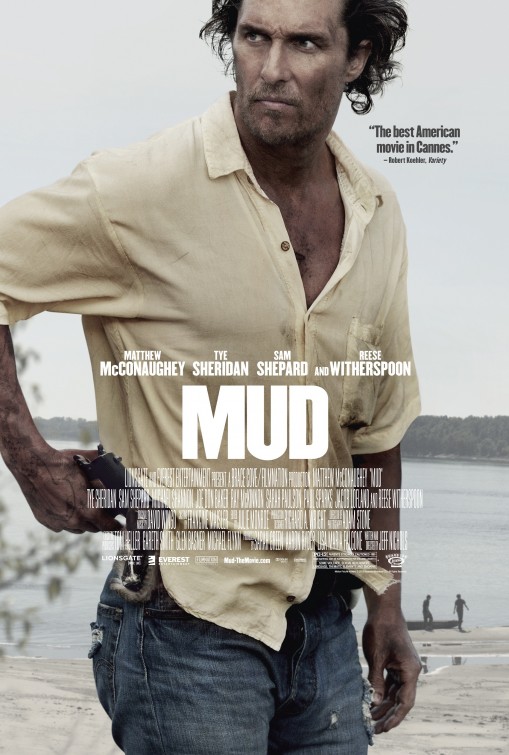 If you aren’t familiar with writer/director Jeff Nichols, do yourself a favor and get acquainted and fast because this guy is headed for indie stardom. Nichols’ last movie, the somber and unbearably tense thriller Take Shelter, was my top film of 2011. Mud, in contrast, is a harder sell, something akin to a modern-day Mark Twain fable about romantic outsiders, fugitives, friendship, and boys coming of age. Matthew McConaughey plays the titular character, a wanted man hiding out on a small island along the Mississippi River. He befriends two teens that help him rebuild a boat so that Mud can escape with his lady (Reese Witherspoon) and evade a team of dangerous bounty hunters seeking vengeance. Nichols is truly gifted at his ability to craft wholly believable characters regardless of circumstance. There is a great sense of setting here, without nary a judgment to the lower class moorings and difficulties, just as Nichols expertly showcased rural Midwestern life and day-to-day anxieties in Take Shelter. His new film is admittedly slow and takes a while to rev up, but the performances are just so good and richly delivered, from top to bottom, that you’re happy to go along with the somewhat loping ride. It’s such a pleasure to witness McConaughey fully engaged with a role, pushing him to utilize new and exciting acting muscles. Nichols also doesn’t soft-pedal the hardships of his characters. While it’s poignant and satisfying how the various plot threads come together for a thrilling conclusion, Mud also has the grace to leave several storylines absent tidy bows. There’s real heartbreak, real disappointment, and recognizable people of all walks trying to do good and find their place in this complicated world. If Mud is playing near you, it should shoot to the top of your must-see list.
Nate’s Grade: A-
Share this:

Beasts of the Southern Wild (2012)
 After months of rapturous praise from Sundance and Cannes, allow me to be the wet blanket of the critical community, because Beasts of the Southern Wild is one big helping of “meh.” I didn’t enjoy this movie at all and its mixture of strange fantasy elements and a hellish childhood reminded me of another misfire, 2009’s Where the Wild Things Are.
Six-year-old Hushpuppy (Quvenzhane Wallis) lives on a spit of land off New Orleans and below the levy. This tucked-away land is nicknamed by its colorful, besotted residents as the Bathtub. Hushpuppy lives with her father Wink (Dwight Henry) in large shacks elevated high off the ground. This comes in handy because after a disastrous flood, Hushpuppy and her father have to navigate the waters to find others and scramble for some return to their life and culture. The residents must also make sure to be cautious because the U.S. government, which is evacuating all flood-devastated areas, is looking for survivors to forcibly remove. Wink is sick and has to impart the ways of his family and culture to young Hushpuppy, who sees herself as one piece in a big puzzle.
 This movie is awash in all sorts of tones and storylines, failing to cohesively gel together or form some kind of meaningful message. I could have sworn that the fantasy elements, namely the giant thundering pack of large boars, were just going to be a visual metaphor for Hushpuppy’s journey. And then they actually show up and every person can see them. So, now what? The boars are one of many ideas that the movie just sort of toys around with before losing interest. This is not a film of magic realism. This is not a film about the escapes from a hard reality. In a way, this movie plays out like if Terrence Malick had made Gummo, and if you know me, you know I loathe both Gummo and Terrence Malick movies. Beasts constantly flirts with pseudo-intellectual pabulum, trying to reach something profound but instead settling for confounding. Hushpuppy’s curlicue unnatural narration talks about being a little piece in a big universe and the interconnectedness of all things, but by film’s end you get no dynamic sense of this. What I got was a little kid’s poor life getting worse, and that’s about it. If the film has anything larger to say about the world, Katrina, human connection, then I’m at a loss as to explain what that may be. Beasts offers half-formed ideas, strange, conflicting imagery, and characters that are rather thinly written and barely register. I never found Hushpuppy an engaging protagonist and felt like her very age and the heavy burdens she is forced to carry were manipulative substitutes for actual characterization. I cannot understand the love here.
The movie is something of a wild stew of Southern folklore and coming-of-age tropes and plenty of indie trappings, like weak political allegory, roaming handheld camerawork, and sacrificing story to the altar of realism. So much of this movie feels like it was made to give a sense of how an overlooked life in poverty is lived. From that standpoint the film does a commendable job of showing everyday life and the struggle to feed and survive. There’s a certain sense of ingenuity at work. But all of these setting details do not take the place of an involving story and characters we should care about. I felt sorry for the various residents of the Bathtub and their lot in life, but I never felt attached to any of them. That’s because, as mentioned before, they’re bland and simplistically drawn, but also because Beasts doesn’t bother to do anything else other than create its rich, tragic, harsh world. It’s authentic all right, but what does all that authenticity have to add to genuine character work? Artistic authenticity is not always synonymous with telling a good story. The Bathtub feels real, got it. So now what?
Hushpuppy lives in squalor and the movie has a disquieting romanticism of abject poverty. To the residents of the Bathtub, they are living in some forgotten paradise away from the concerns of the mainland. They refuse to leave their homes and their lives, even though there isn’t much of a home to call one’s own. We wade in this horrible existence and are meant to pretend like it’s an idyllic lifestyle, you know, with all the creature comforts of child abuse thrown in for extra measure. While Beasts looks entirely authentic with its impoverished, junkyard-esque production design, the overall mood and atmosphere hardly seems worth celebrating. Now, I’m not saying that characters can’t make the most of whatever life has given them and meet the implacable with fearless optimism. These characters would likely shun our pity; they reject any government assistance after the great flood and just want to sneak back to their simpler lives. This is not an enviable life, and the fact that the movie tries to romanticize it feels deeply irresponsible. At least with a film like Winter’s Bone, where you felt the crushing existence of systemic poverty, the filmmakers didn’t try and put a smile on all the drudgery. In that movie, you felt the trappings of poverty and how it can sink into your soul. On some level perseverance in the face of adversity is noble, but so would escaping poverty. Regardless, this is not worthy of romanticizing or fetishizing.
 Little Wallis is certainly getting her fair share of attention for anchoring the film. She’s six years old so it’s hard to assess her full acting potential, but the kid looks to have some fire in her. However, it is not a performance that leaves a lasting impression. I realized that much of her performance was long reaction shots and that ponderous voiceover narration. True, she does get some dramatic sequences and lets loose a few tears, but it feels like the movie didn’t want to push her too far and settled on a barrage of shots of Hushpuppy being stoic. I was more impressed with Henry, he too an acting novice making his debut. His character is more complex than an innocent naïf we have as our protagonist. He’s clearly dying and trying to quickly get his daughter prepared for a life of independence. He’s also quick to anger and you can feel the heavy weight of his life and his fledgling mission. In fact, I think Beasts would have been better if it had been told from the father’s perspective rather than our child trying to understand the great big scary world. There’s certainly a lot more drama and an easier route for sympathy, even if he could be accused of being cruel and neglectful.
I’ll admit that Beasts of the Southern Wild is different, daring, and fitfully imaginative, as well as benefiting from strong production design and special effects work. But “different” and “daring” doesn’t always mean good. I cannot in good faith say I enjoyed this movie, especially with its freeform plot, messages, tones, and occasional garish imagery. The plot seems desperate for some form of greater meaning, defaulting to ponderous poetry rather than supply a workable narrative and characters that are developed. Then there’s the whole romanticizing of systemic poverty that I find off-putting and wrongheaded. This is just a swampy mess of a movie, one that sinks under the weight of its own pretensions. It’s admirable from a technical standpoint but as a movie, Beasts of the Southern Wild is an exercise in eclectic navel-gazing.
Nate’s Grade: C+
Share this:

Moonrise Kingdom (2012)
 It feels good to be a Wes Anderson fan once again. The indie auteur has a very distinctive style that he seems to have little regard in altering. I’ve been critical of Anderson’s idiosyncratic style, comparing it to crafting wonderfully composed, intricate dollhouses minus compelling or relatable characters to inhabit these artfully constructed mini-worlds. Without that necessary element, it’s all just fancy window dressing. Finally, Anderson, with Moonrise Kingdom, has concocted another movie where the characters grab more of your attention than the backgrounds.
Set in 1965 on a small island just off the New England coast, the movie follows the adventures of Sam (Jared Gilman) and Suzy (Kara Hayward), both twelve years old. Sam has run away from his summer camp, the Khaki Scouts, led by Scout Master Ward (Ed Norton). Suzy has run away from her parents (Bill Murray, Frances McDormand). The small island’s one police officer, Captain Sharp (Bruce Willis), enlists the help of several Khaki Scouts he deputizes to find the missing duo. It’s revealed through a serried of letters, and flashbacks, that Sam and Suzy have been plotting their escape for over a year. They’re in love, and they’re going to make sure nobody interferes.
 What more relatable than young love? Sam and Suzy just want to be together and the rest of the adult world seems intent on keeping them apart. Right away you’re pulling for these kids, rooting for their triumph, and the movie does a fantastic job of replicating the innocence of young love without overly romanticizing a very nervous, awkward time in life. When Sam and Suzy practice kissing, for what is obviously the first time, I defy anyone sitting in the audience not to feel a recognizable pang of insecurity. The experimentation is a tad more realistic than you might expect with the PG-13 rating but still nothing to shatter the youthful innocence of the picture. There is not a tawdry moment in Moonrise Kingdom. It’s a time in life when the knowledge of sex existed without a keen understanding of sensuality, like in Miranda July’s Me, and You, and Everyone We Know. It’s more like fumbling around with what you think is appropriate activity. Still, the fact that the movie features twelve-year-olds in their underwear dancing and mildly experimenting means Moonrise Kingdom might draw a swath of ticket-buyers for the wrong reasons (beware the patron in a raincoat).
The scrupulous attention to detail is the same obsessive quality you come to expect from a Wes Anderson movie. He builds living worlds and his color schemes and shot arrangements add much texture to this idiosyncratic landscape. Unlike Life Aquatic and Darjeeling Limited, these artistic elements work in harmony rather than conflict; Anderson actually seems to care about the people here. Chances are if you’re not a Wes Anderson fan, Moonrise Kingdom will probably not be the movie to win you over. The whimsical, storybook nature of the film actually accentuates the broader themes; bright-eyed exploration, the magic of possibility with love, and an unyielding hope. The movie feels like one of Suzy’s storied adventures come to life but without compromising the relatable character conflicts. The movie does build a nice head of steam thanks to the pursuit of our runaway romantics. There’s also a palpable sense of danger lurking, as the kids risk life and limb and even experience death, albeit a dog (Suzy: “Was he a good dog?” Sam: “Who’s to say?”). It’s a poignant tale of childhood but it doesn’t feel childish, a family film meant for people probably too young for families.
Moonrise Kingdom walks a fine line between whimsical and overly precious. Less skilled filmmakers haven fallen suit to making insufferably twee film productions consumed by their own indulgent sense of preciousness. Moonrise Kingdom is full of the typical Anderson quirk but it doesn’t overpower the narrative or define the characters in such limited personal scopes. There’s plenty of laughs to be had with the film, most in the wry chuckle variety; I was laughing throughout, finding those staple peculiar touches to be the most amusing, from the Scout Master reading a magazine titled “Indian Corn,” to Bob Balaban’s questionably omniscient narrator, to some improvised natural earrings.
The movie is consistently funny but also far sweeter than I would have imagined given the detached, arch nature of Life Aquatic and The Darjeeling Limited. Again, the kids are precocious and the adults act more like children, but everyone is really hurting and lonely and looking for a means of coping or persevering, with the biggest source of pain being love; the longing, the ache, the uncertainty of when and if it will return. Usually Anderson’s films involve dysfunctional families mending some degree of their brokenness by film’s end and formulating a connection. With Moonrise Kingdom, the plot is on two kids falling in love and their will to endure. I appreciate that Anderson and co-writer Roman Coppola (Darjeeling Limited) do not trivialize or look down upon the relationship between Sam and Suzy (“Oh, it’s just puppy love you silly, naïve, waifs.”). To them it feels like everything. The tender approach to young love opens the film up to a broader audience without compromising the director’s unique vision. I’d hardly say the film approaches overt sentimentality. What’s there feels earned and more reserved than what we might expect from burgeoning romance. When the expressions of affection occur, they have greater weight and make a greater impact charming the audience.
 The first-time child actors do a credible job with carrying the film. Hayward and Gilman are charming and easy to like, though I wish Anderson had pushed his young actors a tad harder. They seem stiff at times and a little above-it-all in attitude. I applaud the kids for acting somewhat reserved rather than going crazy with their budding hormones. Both characters are also characterized as “emotionally disturbed,” though this seems like another of the film’s damning details about the out-of-touch adults dictating their lives. I just wished we sensed a greater degree of urgency from them about this whole adventure and the possibility of losing one another. They feel a tad blasé, all things considered.
The bigger celebrity names in the cast assume smaller roles, and many of the supporting characters are thinly sketched with personal conflicts mostly kept at a simmer. These are grownups that, at their heart, don’t know what to do with their feelings. Sam and Suzy feel liberated by their feelings. I found Murray’s blustery sense of anger amusing, and Willis does some subtle work to give you a sense how truly lonely his character is to the core, but it’s Jason Schwartzman (Scott Pilgrim vs. the World) who steals the show in my book as the fast-talking, mercurial, scheming Cousin Ben who seems to have whatever somebody needs. When he agrees to marry Sam and Suzy and acknowledges that their marriage will not be deemed official under any court whatsoever, you get a sense that Moonrise Kingdom has been missing a propulsive and delightful character like Cousin Ben. I wish he had been inserted earlier, but this is Sam and Suzy’s movie, after all.
It’s not on the same level as Rushmore of The Royal Tenenbaums (my favorite Anderson films), but it’s a film that feels a lot more alive and emotionally resonant. It feels like a return to form for Anderson, remembering that the characters and their drama need to be as engaging as the set design. The turbulent young love of Sam and Suzy is sweet and leads to some tender yet poignant moments that warm the heart without making you overdose on cheap sentiment. The idiosyncratic touches are all there, the ironic humor, and the stellar soundtrack selection (Benjamin Britten’s deconstructive orchestral marches stand out as a thematic core), everything you’d expect from a Wes Anderson movie, except this time you’ll find the characters recognizable, their struggle compelling, and the end rewarding. Moonrise Kingdom isn’t the most substantive film playing in theaters but damned if it isn’t the most alluring, amusing, and affectionate, yet all on its own terms. Who would have guessed that a pair of twelve-year-olds would help us show what real love is in 2012?
Nate’s Grade: A-
Share this:

Submarine (2011)
 Submarine is the latest coming-of-age story, this time set in 1980s Wales, and while not breaking any new ground, it manages to be witty, stylish, and a completely winning portrait of a unique kid and his unique view of the world.
Oliver Tate (Craig Roberts) is a 15-eyar-old kid with two life goals. He’s like to romance the rebellious loner Jordana (Yasmin Paige) and, if possible, lose his virginity in the process. Oliver is also on a mission to save his parent’ marriage. Jill Tate (Sally Hawkins) has been drifting from her husband, Lloyd (Noah Taylor), a marine biologist who has been in a depressive funk for years. Jill’s old boyfriend, Graham (Paddy Considine), has moved in next-door and begun to insert himself back in her life.
Submarine is going to be something of an acquired taste. It’s almost drowning in whimsy, following the numerous affectations of its main character. Fans will say that the movie borrows liberally from Wes Anderson’s 1998 film, Rushmore; non-fans will just say the movie cops to outright theft. Like Rushmore, this movie follows the coming-of-age trials and tribulations of an intelligent but lonely outcast, a wiseacre beyond his years. What sets this movie apart is that we taken on the point of view of Oliver. He often refers to his life as if it were a movie, noting dramatic moments that would be accompanied by dramatic music, and a solemn moment that would feature a crane shot rising above the ground but if the budget were low he’d settle for a slow zoom out (the actual movie chooses the slow zoom). “I have turned these moments into the Super-8 footage of memory,” he remarks. Oliver is a student of pop-culture, an early Rob Gordon (High Fidelity), and as such blurs the line between reality and the movies. He will routinely point out film tropes ad then indulge in them. We are each the stars of our own stories. In this manner, Submarine separates itself from the idiosyncratic, miniaturized-doll house world of Anderson’s films or the fanciful magic realism of Jean Piere Jeunet (Amelie). For me, the multitude of quirks were appealing instead of insufferable because we were inside the mind of Oliver, seeing his world through his unique worldview. This brings rationale for the whimsy.
 Oliver is both an unreliable narrator and a flawed protagonist, a fantastic development. So often coming-of-age tales are mainly autobiographical (this one is based off a book by Joe Dunthorne), and as such the authors usually portray themselves as individuals whose chief fault is that they are naïve. Some life experience will shatter their innocence, usually a girl, and thus they will grow and learn. With Submarine, Oliver gains our sympathy by being clever but then he tests it with the compromises he makes to fit in. He engages in some very mean bullying all to win over Jordana. He’s trying to seem so mature, using advanced vocabulary to provide the illusion of adulthood, but really Oliver can’t comprehend the subtleties of social cues. Just when Jordana appears to be opening up and looking to him for need, that’s when he botches it, acts kind of awful, and then justifies it in his head, like so many of us will do with our mistakes. Still, I never stopped rooting for this kid. I was rooting for him and Jordana to work out. So hard was I yearning for these two loner oddballs to have their happy ending, I think I pulled something (my dignity?). We can see Jordana through Oliver’s infatuated eyes, but then we can also see deeper, see the vulnerability that comes forward that Oliver might be blithe to. Paige (The Sarah Jane Adventures) is a true breakout star and it’s easy to see why Oliver is so infatuated with the charming lass. She’s bruised but approachable, risky but relatable. We can see the connection building between these two, and we want it to continue (maybe that’s my own high school experience speaking out). The youthful romance is sweet and unconventional without seeming like a coming-of-age folly, something that Oliver is supposed to learn some gallant life lesson.
The other plot development, the rocky relationship between Oliver’s parents, is less resonant but it does provide for some fine moments of humor. The new neighbor, Graham, who practices martial arts and believes himself to be a New Age mystic, healing people by sensing their aura colors, just feels like a leftover Napoleon Dynamite. It provides Considine (In America) a springboard to act goofy, which he’s quite good at. The goofiness of the character, however, cuts into the credibility of being a threat to steal away Jill. She may be caught up in this guy’s tiny bubble of fame, but there’s no way she would leave her husband for this doofus, even if her husband has been suffering from depression for years. Oliver’s attempts to reignite his parents’ marriage are plenty hilarious, but they’re also informed with a sweet, if misguided, earnestness. He loves his parents and wants them to stay together. He doesn’t want a ninja mystic for his new dad. Fortunately, Oliver’s attempts to sabotage Graham are kept to a minimum and restrained enough not to resort to cheap slapstick or gross-out humiliation. Maybe it’s the distinctive point of view steering the narrative, but the potential doom of the marriage never feels as portentous and heartbreaking as Oliver’s hope at wooing Jordana.
 Debut director Richard Ayoade, who also adapted the screenplay, utilizes every visual trick in the book to tell this story. If the main character weren’t so amusing, and his plight so interesting, all the visual artifice might be exhausting. Instead it keeps the movie lively, crafty, and constantly wonderful to observe. Ayoade’s also quite a talent when it comes to screenwriting. He smoothly captures the very mannered speaking style of Oliver. Then there are just lines that make you laugh out loud from the sheer absurdity of misplaced teenager awe: “He wasn’t even considered hard until the Watkin twins famously stabbed him in the back with compasses. He said nothing; showed no discomfort as his shirt blossomed with blood poppies. His stoicism reminded me of the brave men who died in the First World War.” Ayoade, best known for his starring role on The IT Crowd, will probably soon have a lot more offers to direct features once people get a gander at Submarine. The man’s a natural storyteller and will be snapped up by Hollywood in no time flat.
Finally, the movie’s lead actor needs to be good, better than good, if this movie is going to rise above the din of precocious, coming-of-age cinema. Roberts (Jane Eyre), hollow eyed and just a little “off” looking, handles the material with ease, never letting his performance transform into a series of tics strewn together. Oliver is straight-laced throughout, letting the peculiarities of his imagination and worldview seem ordinary. Roberts doesn’t get overwhelmed by the material and makes a strong impression as a more literate, less rebellious, more anxious, less despondent Welsh version of Holden Caulfield (okay, so maybe that allusion doesn’t hold).
Submarine is an unfailingly entertaining vehicle full of quirk and humor and surprising heart. Oliver’s relationship with Jordana is sweet and mildly touching. I was surprised at how emotionally invested I was in their romance. The movie is also refreshingly low in angst, resorting more to Oliver’s comic anxieties and insecurities. It certainly owes a debt to Anderson’s Rushmore, but Submarine is so good, so thrilling in its creative voice, that it can stand outside the mighty shadow of Anderson and his indomitable influence.
Nate’s Grade: A-
Share this:

The Myth of the American Sleepover (2011)
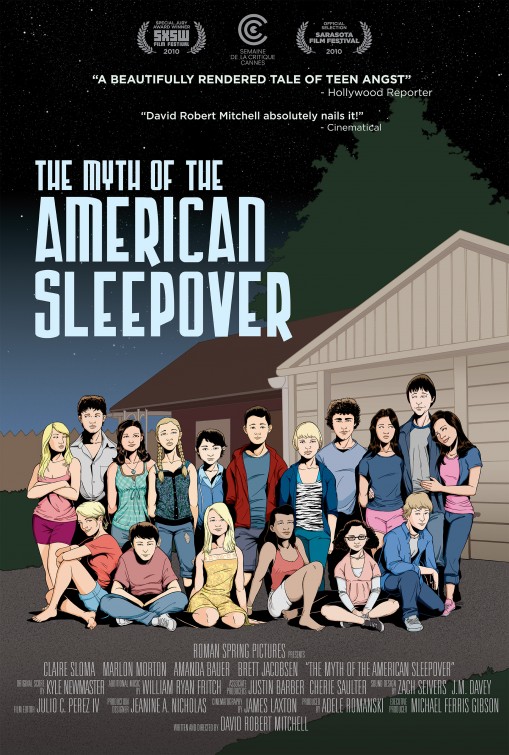 The curiously titled Myth of the American Sleepover owes as much to American Graffiti as it does to the works of John Hughes. This sprawling teenage opus by debut writer/director David Robert Mitchell resonates with all the beautiful aches and joys of adolescence, wonderfully understated but brilliantly realized. I fell in love with this movie.
Set over the course of one night in suburban Michigan, a slew of teenagers try and make the waning summer days worth remembering. Claudia (Amanda Bauer) is the new girl in school and invited to the cool gal’s (Shayla Curran) slumber party. She learns her boyfriend slept with the cool gal and plots a little boyfriend stealing of her own. Rob (Marlon Morton) is obsessed with a pretty blonde girl he once shared a look with in a supermarket. He is scouring the neighborhood, going from party to party, looking for her so he can reveal his true feelings. Scott (Brett Jacobson) is unsure of whether he wants to finish his final year of college, now the site of a painful breakup from his longtime girlfriend. One day while walking the halls of his former high school, he comes across a picture of him with twin sisters, Ady (Nikita Ramsey) and Anna Abbey (Jade Ramsey). He heads out to the University of Michigan, where the twins are enrolled, convinced he could win one, or both, of them over. Maggie (Claire Sloma) is navigating between the middle school sleepovers of her peers and the world of the cooler upperclassmen. She’s been nursing a crush on an older boy (Douglas Diedrich) who worked at the community pool all summer, and will find the courage to make a move.
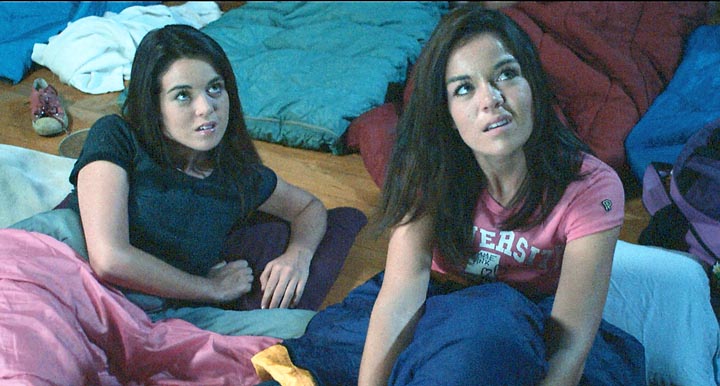 Unlike other coming-of-age entries, this is a movie that forgoes scatological comic setups and other Big Events meant to mark the passing into adulthood, like the loss of virginity, college admittance, or the prom; instead, Sleepover tackles a subject much more honestly and with tremendous naturalism. The level of detail is outstanding; set in what seems like the late 80s or early 90s, I was astounded at all the nostalgic artifacts of adolescence brought back to life. I kept going, “Oh yeah, I forgot about those,” or, “That’s totally something that me and my friends did.” I loved that the movie shows different social spheres and age ranges, so we go along with the late teen house party but we also get see a middle school/junior high sleepover that involves girls staying up late, talking about boys, and eating large bowls of chips. Obviously not everyone will have this reaction, but it just shows the commitment to recreating a very specific time, place, and sense of being. These feel entirely like real teenagers, and their troubles and desires are achingly articulated. You feel the powerful sense of yearning throughout, where the nudge of a knee, the closing distance between two hands that can cause your insides to fill up with a thousand butterflies. Sleepover is about teenagers grappling with emotional connection and personal identity, but it never drags out a soapbox or breaks from its verisimilitude. Every single character in this movie, even the ones meant to be seen in a questionable light, is deeply empathetic. Being an ensemble, you’ll gravitate to different characters and their pursuits, but the movie balances a nice mixture of storylines, cutting back and forth to build a graceful picture of the uncertainty of adolescence.
I found this movie to be so charming, so overwhelmingly affecting, and poignant without slipping into mock sentimentality, which would have been easy. It’s been a big year for nostalgia, but nostalgia is the “least authentic of all feelings,” according to Enrique de Heriz. It’s easy to sit back and say, “Oh I remember that too,” and feel the tingle of some wistful pull from the past, the yearning for a bygone time and place that has magically transformed in your mind into some idyllic spree. Does anyone remember those times, before there was an Internet, and cell phones, and social media, when you got together with your friends to witness the shared experience of a movie with female nudity (this might just be a guy thing), or when you didn’t know if you’d see your crush ever again? The Myth of the American Sleepover does, and so do I. In the words of Lou Reed: “I don’t like nostalgia unless it’s mine.”
 Indeed, it seems like the film exists in a bit of a cultural time warp, where sleepovers were the social apex and holding hands and making out were considered victories worth celebrating. There are no computers or cell phones, thank God. If you excuse the casual and extensive teenage drinking, Sleepover is a rather wholesome film. I was wary that some storyline might take an unexpected dark turn, especially with all the alcohol and hormones, but the movie maintains its sweet appeal without fail. While ostensibly existing in a late 80s/early 90s, I believe this movie is timeless and can be felt effortlessly by people of any age. The pains of adolescence and the anxiety of growing up, not to mention the peculiarities of the other sex, are universal. There is a superb scene where Rob and the girl who secretly likes him pass each other accompanied by friends. We get both sides of the story cut together; he tells his bud that one night he kissed her and then they made out. “It was a pretty good day,” he admits. She says she spent all night trying to get him to hold her hand and then just gave up. We instantly know that her side of this tale is far more accurate, but then this small exchange tells us even more about Rob, his fumbling attempt to be seen as cool with girls. Later, this same girl gives Rob a pep talk about unrequited crushes; she wonders if a person thinks hard enough about an individual, if they’ll know. Like most men, Rob misses her real meaning, but I’m happy to say that this story is tied up in such a sweet manner that I got choked up. The emotions of Sleepover are genuine and genuinely felt, no big overtures or outbursts, but the quiet moments of realizing who you are, who you like, and what you are and aren’t willing to compromise. It all feels utterly real and relatable.
The one storyline that seems to stand out amongst the rest of the panoply of sleepovers is that of Scott. He’s a college junior and at least three years outside the social realms of the majority of the other characters. You can’t help but feel at the start that he doesn’t belong and his presence, in a movie primarily about 14-15-year-olds, might feel a tad icky. Scott’s misguided attempt to get over his ex-girlfriend seems like some strange leftover plot from a sitcom. The fact that he’s trying to drown his sorrows in twin sisters almost seems skeevy. However, he comes clean early and opens up to reveal startling vulnerability, thanking the twins for a memory that would be incidental to them but has meant so much to him. It is this memory that gave him hope. The twins reveal that one of them had a huge crush on Scott back in high school, wishing he would one day reciprocate. But they won’t tell him who. He has to guess. The fact that this setup is actually a push toward personal growth and maturation is a great revelation and a relief.
 The cast of unknowns may be low when it comes to star-wattage but they lend the film another degree of authenticity. I wouldn’t say a single participant in this movie is a bad actor, though their characters are often understated, which under the wrong guidance can lead to blandness. None of these characters are exceptionally verbose or opinionated, which leaves the impression that they are thinly drawn. However, the characters coexist within the impressionistic nature of the film; it’s like a coming-of-age movie with the tone poem ambitions of Terrence Mallick. They are not as memorable or as sharp as the characters from Dazed and Confused and American Graffiti (Rob’s pursuit of his blonde dream girl, and his several near-misses, screams Graffiti homage), but the goal is a disarmingly sweet authenticity, allowing the viewer to discover relatable moments throughout the ensemble. I will say that Sloma imparts the biggest impression as the pieced, platinum pixie-gal feeling out the level of interest in her crush. I think we’ll be seeing more of Bauer and her cherubic, Scarlet Johansson-etched features as well.
The Myth of the American Sleepover is a sincere, observant, insightful, gentle, and overall wonderful little movie, brimming with life and the rocky experiences of growing up, but mostly it will make your heart sing. The details and small gestures feel completely believable; building an ode to youth that feels earnest without being sentimental and knowing without feeling like a know-it-all. There wasn’t a moment in this movie that didn’t leave me smiling, chuckling to myself, and feeling immersed in this innocent, heartfelt, exuberantly youthful world. The pleasures of Sleepover are small but numerous, and I don’t mind admitting to tearing up at several points, shaking in anticipation, and celebrating the personal triumphs of the cast of characters. The Myth of the American Sleepover made me feel like a teenager all over again, nervous, anxious, excited, and beguiled by the imprecise negotiations into adulthood. I’m sure some people will find this movie boring or too embryonic, a coming-of-age tale crystallized in dewy emo-earnestness. For me, I fell in love with this movie. It filled me with joy. I know it will do the same for others; Sleepover just needs a little tenderness and an open heart. The movie and its homespun magic will do the rest.
Nate’s Grade: A
Share this:

Circumstance (2011)
 Despite a slate of quality movies by homegrown filmmakers, Iran is not exactly the most film friendly country conceivable. Governed by a strict set of Islamic moral laws, filmmaking has often been conflated with Western cultural corruption. In 2010, Jafar Panahi, an internationally renowned Iranian filmmaker, was sentenced to six years in prison for nebulous charges of conspiring against ruling forces. He was also banned from making any movies, or even scriptwriting, for 20 years. Just imagine what the country’s moral authority would say about Circumstance, an independent drama about teen lesbians. The controversial movie was filmed in Lebanon and populated with Iranian-born actors living in North America. The movie is, no surprise, banned in Iran.
Atafeh (Nikohl Boosheri) and Shireen (Sarah Kazemy) are two teenage girls living in modern-day Tehran. They are both free-spirited and yearning for the freedoms not afforded under strict Islamic law. They sneak away from their families to go to parties where they drink, smoke, listen to forbidden music, and dance with boys. The two girls’ lives become even more complicated when they start having new feelings for one another. Shireen’s parents are dead and she lives with her traditional uncle, who is looking to marry the girl off. A suitable suitor is Mehran (Reza Sixo Safai), Atafeh’s older brother. Mehran is back after an, unsuccessful, stint in drug rehab and looks to stern religion to guide him. Shireen and Atafeh must keep their love a secret or risk losing everything they hold dear.

Circumstance seems, under the circumstances of geopolitical intolerance, to be casually tagged as “that Iranian lesbian movie,” much like Brokeback Mountain was initially dismissed as that “gay cowboy movie.” In a sense the movie doesn’t rise beyond the sum of its parts, but it does portray an intriguing slice of life hidden from mainstream society. You pretty much expect that things are not going to work out for these star-crossed Iranian girls, but that doesn’t stop you from hoping that they’ll beat the long impossible odds (the girls talk about running off to Dubai where “anything is possible”). The character work can be lacking, sadly. The girls will drift from scene to scene, perhaps metaphorically indicating the limited role of women in this strict environment. Then again it could just be a screenwriting deficiency. There’s enough interest in a secret lesbian romance behind the veil, but the story would have resonated greater had the characters been given greater attention. They seem real; there’s little in the film that seems inauthentic. The girls and their lives of limited options feels pressingly real, I just wanted to buy into their romance more. The friendship is there but the establishment of desire is taken for granted. A couple of sequences with roaming hands do not substitute for laying down character work. By the end of the movie, one of them blithely accepts her destiny as an unhappy subjugated bride, while the other escapes for a life abroad with possibility. The emotional impact of the ending is diminished. We feel sorry for them, but do we feel the ache of tragedy? I could not, and the unreasonably abrupt ending left zero in the way of resolution.
If you’re looking to quicken a few heartbeats, Circumstance should do the trick. Naturally a story about two young women falling for each other has a spark of eroticism. Writer/director Maryam Keshavarz offers a welcomed feminine perspective on budding sensuality. Her camera lingers on close-ups of hands, fingers dancing across goose bumped flesh. The film manages to be erotic without dipping into exploitation; there is only the briefest of partial nudity and the girl-on-girl activity is tastefully portrayed. Keshavarz could have pushed further so that the audience would feel the sense of longing that drives Shireen and Atafeh.
The unrequited lesbian romance is practically a genre unto itself in independent cinema. It’s a natural magnet for drama: suppressed feelings, oppressive regimes forbidding the forbidden love, and the spark of sensuality at the bloom of youth. I would argue that 1999’s Aimee and Jaguar is the best unrequited romance of modern cinema, gay or straight. Like Circumstance, that film dealt with a surprising lesbian romance during a time when homosexuals were persecuted (Germany in World War II). It seems given the terrain that you’d expect Circumstance to walk the line between unrequited lesbian romance and coming of age tale. While not as fully convincing about the sickness that first love can develop, like 2004’s teen lesbian romance My Summer of Love which gave the world Emily Blunt, Circumstance does present an interesting story due to the particular hostilities the girls must evade. Iran is a rather hostile place for women of all stripe, let alone ones with homosexual tendencies. This is, after all, the same country whose leader publically proclaimed that Iran did not have one gay citizen. The pressures to conform are omnipresent. Atafeh and Shireen are detained simply for going out late and wearing makeup in public. I wish the film had gone into greater specifics about the dangers the girls faced, rather then operate on the assumption that their actions would easily fall in the “no-no” category. I don’t consider myself a sadist, but more scenes like the police detention would dial up the peril as well as better articulate the impossibility of their romance.

While not living to its potential as an unrequited romance, Circumstance succeeds in other ways, namely as a showcase of the cultural struggles of modern-day Iran. We get an interesting glimpse into the underground youth culture, showcasing a world that fights for existence where young people will risk their lives for a taste of Western or modern culture. The particulars of this underground scene are not dealt with in any meaningful way; the characters just seem to duck into hidden parties and peel off their street clothes. One of the characters in the film states that everything is political, and just by showing the flourishing underground youth culture Keshavarz has made a political statement. I would have enjoyed more examination on this cultural schism. We see friends of Atafeh discussing the finer qualities of Milk in a hidden video store, discussing the relatability of the human rights message. They even plan on dubbing it over into Farsi and attaching it to a bootleg of the Sex and the City movie for maximum exposure. When this youthful rebellion gets uncovered late in the film, Iranian officials blame a widespread conspiracy involving Israel and the United States to weaken Iran. Circumstance oddly steers clear from showing many consequences of being caught. As a result, the hidden youth culture feels too protected from the country’s powerful Morality Police.
The Mehran character is the movie’s biggest stumbling block. He’s supposed to be an antagonist in some respects, though his long creepy lustful stares don’t seem to amount to much. His transition from failed musical student to religion convert is poorly handled. He’s seen smoking hardcore drugs but then it appears that Mehran is never tempted again with drugs. I assume that, as presented, Mehran has replaced drugs with religion (Karl Marx would nod to himself). The film’s conflict between modernism and theocratic rule is minimally addressed. The fact that the father, an affluent, college-educated middleclass secular man who was a rebel in his youth, is drawn back to religion by the film’s end is hard to swallow without more convincing evidence or commentary. The entire storyline where Mehran secretly spies on his family with hidden videos seems completely superfluous. It’s just another way to make the guy look creepy, which is just piling on. The hidden surveillance, the idea that women are always being scrutinized, could make for an interesting addition, but not as presented.
The two female leads, Boosheri and Kazemy, are both lovely ladies, giving tender, emotional, affecting performances. I just wish that Circumstance were less shallow when it came to its characters and specific plotlines. This unrequited romance is missing some necessary ingredients to work as a movie. The character work and plot can be frustratingly shallow at times, and the obvious peril of being young, female, and gay in Iran is too often left assumed. Circumstance is an interesting cultural document of Iran, but as the “Iranian lesbian movie” it fails to stretch beyond this simplistic branding.
Nate’s Grade: B-
Share this:

An Education (2009)
 In 1961 Britain, Jenny (Carey Mulligan) is a 16-year-old schoolgirl plowing away at her education. She?s on track to enroll at Oxford “reading English” and her parents (Alfred Molina, Cara Seymour) have overscheduled the girl with hobbies and clubs to help build her academic portfolio. Then one rainy night she meets David (Peter Sarsgaard), a thirty something man who offers to give her and her cello a ride. This enchanting man keeps coming back around to see Jenny, sweeping her off her feet. He invites her to go to concert recitals with his older friends Danny (Dominic Cooper) and Helen (Rosamund Pike), trips to the country, and even a fabulous getaway to Paris. “You have no idea how boring my life was before you,” she confesses to David. But David is coy about how he can pay for such extravagances. Jenny’s grades begin to suffer and it looks like she may miss out on being able to enroll at Oxford. She has to make a decision whether to continue seeing David or going back to her primary school education.
An Education is a handsomely recreated period drama that manages to be very funny, very engaging, and very well acted. It’s also rather insightful and does an exquisite job of conveying that strange wonderful heartsick of love, maybe better than any movie since My Summer of Love. You can practically just drink in all of Jenny’s excitement. Jenny isn’t a silly girl prone to naivety. She’s a smart and clever girl, and not just because other characters say so or we see her stellar test grades destined for prime placement on the fridge. You witness her intelligence in how she interacts through different social circles. Since the movie is entirely Jenny?s story, we need to be convinced that she’s smart in order to believe her willingness to be duped. She has reservations about David’s habits but doesn’t want to risk going back to a dull life of books and family dinners. She has to be a smart, vibrant girl anxious to keep a good thing going, willing to ignore certain warning signs that otherwise might cause her pause. Even Jenny’s parents get caught up in the seduction, swooning over David and his upper class connections and comforts.
 The teen-girl-with-older-male aspect might make us squirm, but in the realm of 1961 Britain, it’s acceptable. Jenny and David don?t need to hide their affair in dank hotel rooms and avoid any suspicious eyes. We don’t get any agonizing inner turmoil over dating a teenage girl, mostly because it’s from Jenny’s perspective and that everybody else seems okay with it all. This acceptance means that the drama for An Education can focus on something less seamy. That doesn’t mean that everybody approves. While Jenny’s friends think she hit the jackpot, and hang from her every word about her amazing sophisticated boyfriend, her literature teacher (Olivia Williams) sees through David?s whirlwind of charms. This isn’t the tale of some girl being drawn into the dark side, turning into an unsavory, rebellious teenager flouting the law and good manners. Jenny is not that kind of gal.
Mulligan is fantastic and delivers such a sumptuous performance that you feel like a human being is coming alive before your eyes. She lights up with the dawning realization that a charming and worldly man is courting her, and you feel every moments of her swirling delight and awe. Mulligan even goes so far as to get even the small details right, like the way Jenny opens her eyes to peak during a kiss to make sure it’s all not just some passing dream, or the way she has to look away at times and break eye-contact because she’s just so happy, with those twinkling eyes and a mouth curling like a cherry stem. She’s bashfully coquettish in her physical attraction to David, though in my praise it also sounds like I, too, have fallen for the girl. Much ink has been spilled declaring Mulligan as a rising Audrey Hepburn figure, mostly because she sports that famous short bob of a haircut that many girls had in 1961. To me, Mulligan gives a stronger impression as being the luminescent little sister to Emily Mortimer (Lovely & Amazing, Match Point). Mulligan is a fresh young actress that delivers a performance of stirring vulnerability. It’s a breakout performance that will likely mean that Hollywood will come calling when they need the worrisome girlfriend role for the next factory-produced mass-market entertainment (she’s finished filming the Wall Street sequel, so perhaps we’re already there).
 Adapted by Nick Hornby (About a Boy) from a memoir by Lynn Barber, An Education follows the coming-of-age track well with enough swipes at class-consciousness. But man, I was really surprised how funny this movie is. An Education is routinely crackling with a fine comic wit, and Jenny and her father have the best repartee. Molina is an unsung actor and he dutifully carries out the role of “uptight neurotic father” with more than a stiff upper lip; the man puts his all in the role. While he can come across as hysterical at times, Molina is paternal with a capital P. It’s refreshing just to listen to smart people banter at an intelligent level.
The movie’s theme ponders the significance of education. There’s the broader view of education, learning throughout one’s life from new and enriching experiences. She gets to learn a bit more of the way of the world, and Jenny feels that she can learn more and have fun with David than sitting through lectures and slogging through homework. She values what David has to teach her above what she can find in a textbook. Jenny’s father stresses the virtues of learning and thinking but once Jenny has a chance to marry an upper class, cultured male then education no longer matters. She is now set for life through David. All that learning to become a dutiful housewife in a lovely, gilded cage. Is that the real desired end to personal growth: to snag a husband? The school’s headmistress (Emma Thompson in practically a cameo) doesn’t serve as a great ambassador to higher learning: she stresses the lonely hardships, internal dedication, and she herself is openly anti-Semitic, proving that an intelligent mind is not the same as being open-minded. To her, Jenny is jeopardizing her lone chance at a respectable life.
 Jenny rejects the traditional route of education and chooses to pursue a life with David, that is, until the third act complications beckon. Jenny finds out about David’s secret rather too easily, I’m afraid (secret letters should never be hidden the glove compartment). While the end revelations are somewhat expected, what is unexpected is that every character pretty much escapes consequences by the end of the film. No one is really held accountable for his or her decisions. Pretty much everyone is exactly where he or she left off just with a tad more street smarts. It’s the equivalent of learning not to trust every person after getting ripped off.
Despite all the hesitation, and the age difference, An Education is an actual romantic movie. It’s a coming-of-age charmer with all the preen and gloss of an awards caliber film. You feel the delight in the sheer possibility of life for Jenny. The story unfolds at a deliberate pace and allows the audience to feel every point of anxiety and bubbling excitement for Jenny. Mulligan gives a star-making performance and practically glows with happiness during the movie’s key moments, making us love her even more. The plot may be conventional but the movie manages to be charming without much in the way of surprises. Still, An Education is a breezy, elegant, and clever movie that flies by, even if its biggest point of learning is that age-old chestnut that something too good to be true must be.
Nate’s Grade: A-


 nathanzoebl
You must be logged in to post a comment.